An Army Instructor Humiliated a 43-Year-Old Female Soldier, Calling Her “Dead Weight”—Then a Master Sergeant Recognized Her From Afghanistan 15 Years Ago. What He Did Next Silenced 30 Soldiers. 🇺🇸
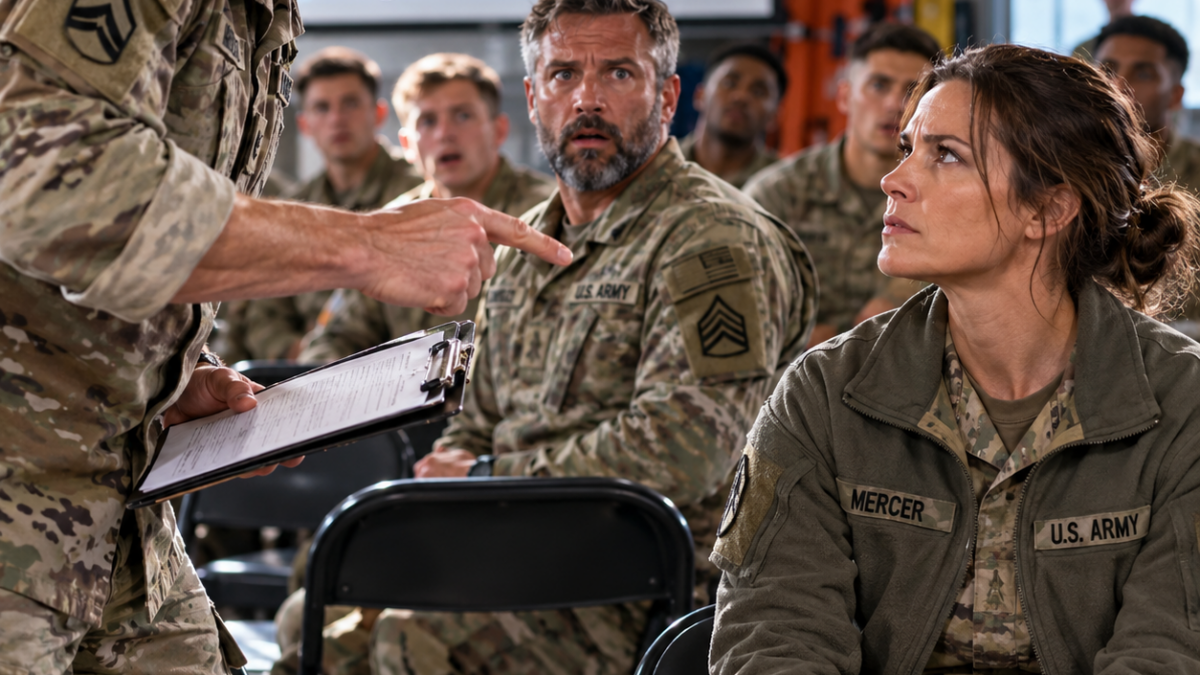
PART3:
Laughter usually does when the target refuses to feed it.
By the time the projector came on, I could almost convince myself the whole thing had meant nothing.
Almost.
The problem was Danner was good.
A bad instructor would have been easier to dismiss.
He knew the combat lifesaver material.
His demonstrations were sharp.
His explanations were clear.
He understood hemorrhage control, airway positioning, chest trauma, casualty movement, hypothermia prevention, and evacuation priorities well enough to teach them without staring at notes.
Competence made his mistake worse.
He had become good enough at one kind of rapid judgment that he believed the instinct applied everywhere.
“Out there,” Danner told us, advancing to the first slide, “you don’t get biographies.”
The screen read:
MARCH ALGORITHM.
“You don’t get fifteen minutes to understand somebody.”
He looked over the classroom.
“You see what’s in front of you.”
“Who can move?”
“Who needs help?”
“Who is becoming a liability?”
“Who can still work?”
He tapped the remote against his palm.
“You decide.”
That was when the master sergeant in the front row turned around.
I had not paid much attention to him before.
Broad shoulders.
Engineer patch.
Late thirties.
Maybe forty.
Gray beginning at both temples.
Notebook open on one knee.
Pen frozen halfway across the page.
He stared directly at me.
Not at the back row.
At me.
His face changed.
I knew that expression.
I had seen it in hospitals.
Aircraft.
Aid stations.
Family waiting rooms.
First, the muscles stopped moving.
Then the color seemed to drain from beneath the skin.
He turned farther until his entire body faced me.
Danner snapped his fingers.
“Master Sergeant.”
No response.
“Eyes front.”
The man kept staring.
“Master Sergeant Holloway?”
That name meant nothing for one second.
Then something inside me shifted.
Holloway.
The face was older.
Heavier.
Harder.
But memory does strange things with people you once studied from eight inches away while trying to keep them alive.
Age falls away.
Years collapse.
The old face rises through the new one.
I saw sunburn.
Dust.
Blood.
A young engineer lying beside a mud wall.
Danner gave a short laugh.
“You with us?”
Holloway finally turned.
Then he said:
“Sergeant, you should check her file.”
Danner looked toward me.
“I did.”
He tapped the roster.
“She drives trucks.”
A few people laughed again.
Less confidently.
Holloway did not.
He placed his pen beside the notebook with such care that it looked as though the pen might detonate if he dropped it.
My hands started trembling.
I pressed them harder into my knees.
Danner advanced the slide.
MASSIVE HEMORRHAGE.
For everyone else, the class continued.
For me, Fort Bliss disappeared.
Only for half a second.
Long enough.
Heat.
Vineyards.
Rotor wash.
Arghandab.
August.
At 0820, Tran carried his chair to the back after asking Danner whether he could sit beside his platoon sergeant.
“That was messed up,” he whispered.
“Take notes.”
“He doesn’t know anything about you.”
“Exactly.”
Tran frowned.
“You want me to say something?”
“No.”
He opened his notebook.
His handwriting looked like a heart monitor during ventricular fibrillation.
He wrote:
MASSIVE HEMORRHAGE.
Underlined it twice.
At 0840, Danner showed a photograph of a helicopter hovering above rough terrain.
“Hoist casualty packaging.”
I looked down at the concrete floor.
One long oil stain curved past my boot.
It looked like a river.
My mind supplied the wrong one.
Danner continued.
“Most of you will never do this yourselves.”
Click.
A litter appeared on the screen.
“But somebody may have to prepare a casualty for aircraft extraction.”
Click.
Straps.
Harness.
Tagline.
“Do it wrong and you make the flight crew’s job worse.”
Across the room, Holloway had stopped writing.
Every few minutes his head shifted slightly.
Checking whether I was still there.
Danner noticed.
“Master Sergeant Holloway.”
“I’m listening.”
“Good.”
Danner showed the strap sequence.
He got one detail wrong.
Not catastrophically.
Not something that would matter on a clean training floor.
It would make the package slower.
Maybe ten seconds.
Eleven.
I knew because I had once counted all of them.
Dust in my teeth.
Rounds striking a wall.
Aircraft burning fuel above me.
A casualty losing blood beneath my hands.
Eleven seconds can become a very long time.
I said nothing.
That silence bothered me later.
At 1000, Danner called break.
Chairs scraped.
Coffee poured.
People stretched.
The maintenance bay filled with overlapping voices.
Tran stepped outside to call home.
Brooks started toward me.
Saw my face.
Changed direction.
I stayed seated.
Holloway stood from the front row.
Ignored the coffee.
Walked down the side wall.
Stopped beside me.
For several seconds, neither of us spoke.
Then he said:
“Arghandab.”
My throat closed.
“August eighteenth.”
“I know.”
His hand wrapped around the back of the chair in front of me.
“I looked for you.”
Fifteen years disappeared.
August 18, 2011.
Kandahar Province.
I was twenty-eight.
Staff sergeant.
Flight medic.
DUSTOFF.
By breakfast, the heat was already pressing against everything.
By 1400, my uniform felt permanently attached to my body.
We were sitting near the aircraft when the call came.
Urgent surgical casualty.
Engineer unit.
Blast injury.
Arghandab River Valley.
From the air, the valley always looked wrong.
Green vineyards.
Brown mountains.
Mud walls.
Irrigation lines.
A maze built in a country where every field could become a firing position.
Our pilot, Chief Warrant Officer Evan Rourke, brought us toward the pickup point.
Rounds cracked somewhere west of the valley.
The landing zone was too tight.
Walls.
Vines.
Uneven ground.
Hover extraction.
Rourke’s voice came through my headset.
“You’ll get thirty seconds on the ground.”
I checked my harness.
“Thirty?”
“Then I’m bringing you up with him or without him.”
“With him.”
The crew chief clipped me into the hoist cable.
Tapped my shoulder.
I moved to the open door.
People who have never stood beneath a military helicopter describe rotor wash as wind.
It is not wind.
It is pressure.
Dust.
Noise.
Force.
It enters your sleeves.
Your collar.
Your nose.
Your teeth.
The aircraft becomes so loud your bones hear more than your ears.
I swung my boots out.
Then dropped.
The ground rushed up.
I landed hard between vineyard rows.
Four engineers surrounded one casualty.
Young.
Conscious.
Terrified.
Tourniquet high on the thigh.
Blood still escaping from an injury above the device.
Name tape:
HOLLOWAY.
He looked straight at me.
“Am I dying?”
Not hello.
Not what happened.
Just the question everyone thinks they will never ask.
I dropped beside him.
“Not today.”
I hated myself later for saying it.
Medics are trained not to promise outcomes.
But sometimes another human being looks at you with that much fear and training loses one round.
I assessed.
High proximal wound.
Tourniquet insufficient.
Packed the injury.
Pressed.
Hard.
There is no elegant way to describe wound packing.
No television version.
You put material where blood is coming from.
You push until the body gives you resistance.
Then you keep pressure.
My forearm started burning.
Someone asked:
“What can I do?”
“Litter.”
They moved.
Holloway’s breathing quickened.
“Stay with me.”
“I’m trying.”
“You’re doing good.”
“I don’t feel good.”
“That’s because your standards are unreasonable.”
He laughed.
Or coughed.
We got him onto the litter.
Cable lowered.
I connected both of us.
Positioned myself over the wound so pressure stayed constant.
Then we lifted.
The vineyard dropped beneath us.
We rotated slowly under the aircraft.
One engineer below raised a hand.
Then disappeared in dust.
Inside, I kept pressure.
The flight to Kandahar took nineteen minutes.
Holloway talked for most of them.
Talking was good.
Talking meant brain perfusion.
It also meant I could watch mental status without asking stupid orientation questions every thirty seconds.
“Tell me something,” he yelled.
“What?”
“Anything.”
“What do you want?”
“Where are you from?”
“Midland.”
“Texas?”
“Unfortunately.”
He smiled.
“What’s in Midland?”
“Oil.”
I leaned harder into the wound as the aircraft banked.
“Dust.”
“What else?”
“People pretending Odessa is worse.”
“That’s it?”
“Pretty much.”
“Sounds terrible.”
“You haven’t seen sunset.”
“Good?”
“Ugly.”
“That’s a terrible sales pitch.”
I looked at him.
“You can decide for yourself.”
He held my eyes.
“I’m going to?”
I could not promise.
So I said:
“You’re going to have to check.”
At Kandahar, the surgical team ran toward the aircraft.
A nurse reached me.
“I have pressure.”
I did not move.
She put both hands where mine were.
“I have him.”
Still nothing.
“Sergeant.”
She looked into my face.
“I’ve got him.”
My fingers released on the third command.
Holloway disappeared.
I stayed near the aircraft.
Blood drying on my hands.
Rourke walked around the nose carrying water.
Handed me the bottle.
We stood in rotor wash while I poured it over my arms.
The water turned pink.
Then clear.
Holloway lived.
I learned that two days later.
I did not visit.
I told myself I was busy.
That was true.
We flew four more urgent missions that week.
But the real reason was that I had stopped learning too much about survivors.
Because learning about survivors made the dead heavier.
Two months later, a letter arrived.
The envelope read:
TO THE FEMALE FLIGHT MEDIC
DUSTOFF
ARGHANDAB
AUGUST 18.
A clerk had attached a sticky note.
THIS YOU?
I recognized the handwriting.
Large.
Slanted.
I did not open it.
At the time, the choice felt logical.
Holloway could write because things went right.
Other families never wrote because things had gone wrong.
Some casualties died in our aircraft.
Some died after handoff.
Some never reached us.
Accepting gratitude from one survivor felt like stealing from all the dead.
So I put the envelope in a boot box.
Spare socks.
Photographs.
Old multitool.
The box followed me from Afghanistan.
To Georgia.
To Texas.
To four different homes.
The letter stayed sealed.
Back at Fort Bliss, Marcus Holloway stood beside my chair.
“I wrote for months.”
His voice was quiet.
“Nobody would give me your name.”
“I asked them not to.”
“I figured that out eventually.”
He smiled faintly.
“I called medevac associations.”
“Training commands.”
“People at Rucker.”
“I described you.”
I looked down.
“Brown hair.”
“Texas accent.”
“Woman.”
“You said Texas sunsets were ugly.”
That almost made me smile.
“I tell my soldiers about you.”
My head came up.
“What?”
“Every class.”
“Every bad ruck.”
“Every time some kid says fear means he doesn’t belong.”
I shook my head.
“Marcus.”
“I tell them about the medic who kept pressure on my wound for nineteen minutes.”
He paused.
“And who looked exactly as scared as I felt.”
“I wasn’t scared.”
“Yes.”
I stared at him.
He shrugged.
“I was bleeding.”
“I still had eyes.”
That shut me up.
He looked toward the front.
“Why are you back here?”
I should have given the easy answer.
Instructor assigned seating.
Instead:
“It’s where I was put.”
Something changed in Holloway’s face.
He straightened.
Then walked away.
I thought the conversation was over.
I was relieved.
Then he reached the front row.
Folded his chair.
The metal legs snapped together.
Loud.
Half the class looked over.
Holloway lifted it.
Carried it down the center aisle.
Stopped beside me.
Unfolded the chair.
Sat.
Danner looked up from his laptop.
“Master Sergeant.”
Holloway opened his notebook.
“Sergeant?”
“Your seat is front.”
“I’m good.”
“That’s the back row.”
“I’m aware.”
Danner gave a confused laugh.
“You need legroom.”
“My legs are fine.”
I leaned toward Holloway.
“Don’t.”
He kept his eyes down.
“Don’t what?”
“Do this for me.”
“I’m not.”
“Then what are you doing?”
He turned one page.
“Correcting where I decided to sit.”
That sentence went through me.
Because suddenly I knew he was right.
Danner had insulted me.
Danner had judged me.
Danner had pointed at the chair.
But he had not truly put me in the back.
Not the first time.
That happened years earlier.
Six months after Holloway.
Night mission.
Zabul Province.
Another casualty.
Another hoist.
Bad terrain.
Fine dust.
The kind that turns rotor wash into a wall.
Crew chief Lena Ortiz clipped me to the cable.
Chief Warrant Officer Silas Kerr held the aircraft over the ridge.
I reached the casualty.
Packaged him.
We started back up.
Halfway to the cabin, everything turned brown.
No horizon.
No ground.
No reference.
The aircraft drifted.
A skid hit rock.
Then:
Metal.
Impact.
Ortiz screaming.
My body thrown sideways.
Something hit my back hard enough to erase sound.
When motion stopped, the helicopter lay on its side.
Stars visible through what had become the upper doorway.
The patient was still attached to me.
My right wrist pointed wrong.
Ortiz crawled toward us.
“Natalie.”
“Get his feet.”
“Your arm.”
“Lena.”
“Your wrist is broken.”
“Get his feet.”
We moved the casualty.
Everyone survived.
Patient.
Pilots.
Ortiz.
Me.
That became the sentence.
Everyone lived.
True.
But incomplete.
My wrist needed surgery.
Two fractures.
Plates.
My lower spine had a vertebral fracture.
Rehabilitation began.
Six months grounded.
Then nine.
Then twelve.
The flight surgeon finally sat across from me.
“You can stay in uniform.”
I nodded.
“You can run within profile limits.”
“Yes.”
“You can lift.”
“Yes.”
“But I can’t certify you for flight duty.”
Silence.
“We can’t guarantee your spine tolerates another hard landing.”
I understood.
“If you fail on mission, you become a second casualty.”
“I understand.”
And I did.
The medical decision was fair.
What happened next was more complicated.
Major Peter Halbrook called me into his office.
My profile lay on his desk.
He was not cruel.
That matters.
He was organized.
Ambitious.
Good at logistics.
Not malicious.
He read the summary.
Then said:
“I can’t put a liability on an aircraft.”
Liability.
One word.
“I understand, sir.”
“We’ll move you to medical supply.”
“Yes, sir.”
“You’re still contributing.”
“Yes, sir.”
The supply cage stood in the back of the hangar.
Chain-link walls.
Shelves.
Boxes.
From my desk I could watch crews run to aircraft when the alert sounded.
Then return.
Dust.
Sweat.
Blood.
New flight medics passed every day.
No one said:
Ask Mercer.
She has more than two hundred hoists.
Ask her about brownout.
Ask her about difficult extractions.
Ask her what happens when the checklist stops matching the terrain.
They came for batteries.
Chest seals.
Gauze.
Tourniquets.
Aid bags.
I became the person who made them sign forms.
Then one afternoon I was counting training tourniquets.
Picked one up.
Wrapped it around my own arm.
Automatic motion.
My right hand began to tremble.
Not much.
Enough.
I stopped.
Looked at it.
Heard the word.
Liability.
I put the tourniquet down.
And never practiced again.
No commander ordered that.
No doctor.
No regulation.
Me.
When I eventually left active duty and joined the Guard, I chose transportation.
Trucks were easier.
Machines are honest.
Engines tell you when they are broken.
Tires lose pressure.
Fuel has weight.
Convoys have distance.
No one asks a truck who you used to be.
I became good at it.
Excellent, eventually.
Routes.
Maintenance.
Fuel loads.
Convoy discipline.
My soldiers.
I told almost nobody about flight medicine.
If someone got hurt during training, I called the medic.
Held the flashlight.
Moved aside.
Nobody kept me in the back of the hangar.
I simply stayed there.
Back at Fort Bliss, Holloway sat beside me.
Then Staff Sergeant Lonnie Price, one of his engineers, looked over.
He had heard the story for years.
He folded his chair.
Clap.
Carried it back.
Danner kept teaching.
Another engineer moved.
Then another.
Within ten minutes, all of Holloway’s soldiers were behind us.
The back row ran out of space.
Private Ramirez started another row.
At 1022, Brooks stood.
“Kesha.”
She ignored me.
Folded her chair.
Moved.
Tran followed.
Then the rest of my platoon.
Eleven soldiers.
Nobody ordered them.
They chose.
Two signal specialists looked at each other.
Shrugged.
Moved.
By eleven o’clock, the front half of the room was nearly empty.
Danner finally lowered the remote.
“What exactly is happening?”
No answer.
The projector fan hummed.
Outside, a truck shifted gears.
Three clean rows of empty chairs separated Danner from everyone else.
He looked at Holloway.
Nothing.
Brooks.
Nothing.
Then me.
I looked down.
Brooks finally said:
“Check her file.”
Danner’s jaw tightened.
“I did.”
“All of it.”
“Kesha.”
She looked at me.
“You can yell later.”
Danner checked his watch.
“Lunch.”
He pointed toward the door.
“Back thirteen hundred.”
People stood slowly.
Whispers began before they reached the hallway.
I remained seated.
Same habit.
Wait until rooms empty.
Avoid questions.
Avoid sympathy.
Danner went to the instructor computer.
I watched him type my name.
I should have left.
Didn’t.
Record loaded.
Primary MOS:
88M.
Prior:
68W.
Additional qualification:
Flight medic.
Danner leaned closer.
Assignments.
Medevac company.
Combat deployment.
Then awards.
Distinguished Flying Cross.
Air Medal with Valor.
Combat Medical Badge.
An old evaluation comment appeared:
211 operational hoists.
Danner stopped.
Scrolled.
Read again.
Then sat back.
Both hands flat on the table.
For one second, he looked exactly like I had that morning.
Quiet.
Careful.
Trying not to reveal what his body was doing.
I walked out.
By lunch, the story was already wrong.
“Did you hear she was special operations?”
No.
“She saved Holloway by herself.”
Definitely no.
“She had two hundred rescues.”
Hoists.
Not all rescues.
Stories get cleaner as they travel.
Cleaner usually means less true.
Holloway survived because engineers placed a tourniquet.
Because Rourke held the aircraft steady.
Because the crew ran the hoist.
Because surgeons repaired what I could only temporarily control.
I had one part.
Important.
Not whole.
At 1258 we assembled behind the maintenance bay.
Outdoor casualty movement lane.
Texas sun.
Gravel radiating heat through our boots.
The mannequin lay beside an orange litter.
Danner arrived.
Clipboard.
No jokes.
No age comments.
Command Sergeant Major Denise Carver stood near the building.
Arms crossed.
Watching.
Someone had called her.
Danner picked up the litter.
Walked toward me.
“Sergeant Mercer.”
“Sergeant.”
He held it out.
“I teach hoist packaging from a slide.”
I waited.
“I’ve done it with mannequins.”
“Yes.”
“Never a real casualty.”
No response.
“Will you teach this block?”
Every face turned.
The old part of me recoiled.
Attention.
Expectation.
Danger.
I could have embarrassed him.
Part of me wanted to.
He had embarrassed me.
Would have been neat.
Symmetrical.
But revenge and repair are different things.
“No.”
Some soldiers shifted.
Danner lowered the litter slightly.
“I’m not a flight medic anymore.”
He nodded.
“I drive trucks.”
“Yes.”
“You were right about that.”
He did not defend himself.
Turned.
Started back toward the group.
Then Tran spoke.
“Sergeant Mercer.”
I looked at him.
“Please.”
“Daniel.”
He pointed toward the litter.
“If something happens on a convoy, Danner won’t be there.”
Danner looked at him.
Tran swallowed.
“You will.”
“You.”
He gestured toward the rest of us.
“All of us.”
“I don’t want the slide.”
My right hand started trembling.
Tiny.
Familiar.
Condemning.
For twelve years, I had treated that tremor as evidence.
Exhibit A.
Liability.
Passenger.
Then, for the first time, another thought arrived.
Not bravery.
Irritation.
So what?
My hand shook.
So what?
I held it out.
“Give me the litter.”
Danner turned.
Walked back.
Placed it in my hands.
The gravel burned my knees when I knelt beside the mannequin.
My right hand shook until I snapped the litter open.
Then memory took over.
“Tran, head.”
He moved.
“Brooks, hips.”
She knelt.
“Price, legs.”
Holloway’s staff sergeant joined.
I looked at all three.
“Nobody moves until the person controlling the head calls movement.”
“Ready?”
Tran said:
“Ready.”
“On three.”
We rolled.
I positioned the litter.
Straps.
Chest.
Pelvis.
Legs.
Harness.
Tagline.
Danner watched.
“Chest first?”
“Yes.”
“Slide says feet.”
“Slide isn’t dangerous.”
I tightened a buckle.
“It’s slower.”
“How much?”
“Depends.”
I paused.
“Worst day?”
“Eleven seconds.”
Nobody moved.
I continued.
“Eleven seconds means nothing here.”
“No rounds.”
“No fuel problem.”
“No casualty losing blood.”
“This mannequin gives unlimited resets.”
I clipped the harness.
“Real people don’t.”
I attached the tagline.
Danner asked:
“Why that side?”
“To control rotation.”
I demonstrated.
“You put it opposite, you spend the ascent fighting the geometry.”
He took out his pen.
Wrote.
That mattered.
“Time.”
Danner checked.
“Three forty-two.”
I stood.
My hand started shaking again.
This time I did not hide it.
Carver’s eyes moved to the tremor.
Then Danner.
Then she walked away.
Danner looked nervous.
More nervous than if she had yelled.
“Again.”
I thought he meant me.
He pointed to the soldiers.
“Pair up.”
“Do it Mercer’s way.”
We trained for three hours.
Ramirez kept tangling straps.
He became angry.
I stopped him.
“Slow.”
“Sergeant, I’m behind everyone.”
“I don’t care.”
“I do.”
“That’s the problem.”
He stared.
“Do it right slowly.”
He did.
Again.
Again.
By the sixth repetition, his hands no longer searched.
Then we added speed.
Private Angela Rios understood the harness immediately.
Tran asked questions constantly.
“What if casualty is unconscious?”
“What if the ground isn’t level?”
“What if litter won’t fit?”
“What if you have two?”
“What if aircraft can’t hold hover?”
I answered.
Danner contributed.
Once he corrected me.
A regulation had changed.
I was wrong.
“Good catch.”
Several soldiers looked surprised.
I wasn’t.
Knowledge is not ownership.
The moment the afternoon became a ceremony about my hidden greatness, it would become useless.
The useful thing was watching two experienced people stop protecting ego long enough to teach.
At 1630, equipment came in.
Danner signed cards.
Mine reached him.
He signed.
Paused.
“I’ll see you tomorrow.”
“Yes.”
No apology.
I was glad.
I did not want him performing remorse because his command sergeant major was nearby.
If he learned something, tomorrow would show it.
CSM Carver intercepted me outside.
“Sergeant Mercer.”
“Command Sergeant Major.”
“How long flight medic?”
“Seven years.”
“How long transportation?”
“Ten.”
“Why did my instructor know none of that?”
“He didn’t need to.”
One eyebrow rose.
“For certification.”
I clarified.
“He needed to teach current skills.”
“Biography shouldn’t determine competency.”
She looked back toward the classroom.
“And his seating?”
“Wrong.”
“Why?”
I thought.
Then:
“Triage tells you what somebody needs now.”
She waited.
“It doesn’t tell you what they’re worth.”
Carver nodded.
“That may show up in a briefing.”
“Please leave my name out.”
“I can do that.”
She started walking.
Stopped.
“This isn’t only about Danner.”
I listened.
“We have instructors using humiliation like a teaching tool.”
“Front rows for high scorers.”
“Nicknames.”
“Public ranking.”
“Pushups tied to test failures.”
“Most mean well.”
I said:
“That doesn’t make it harmless.”
“No.”
She walked away.
That evening, I sat on my bunk.
Phone in my hand.
Contact:
Evelyn Park.
My seventy-six-year-old neighbor in Midland.
I called.
“Natalie?”
“Hi.”
“Are you overseas?”
“Not yet.”
“You sound strange.”
“I need a favor.”
She found the hall closet.
Top shelf.
Brown boot box.
KANDAHAR written on masking tape.
“I have it.”
“There’s an envelope.”
Paper rustled.
“Yes.”
“Photograph the front.”
Image arrived.
TO THE FEMALE FLIGHT MEDIC.
My hand shook.
“Evelyn?”
“Yes?”
“Open it.”
Mrs. Park opened Marcus Holloway’s letter fifteen years after he sent it.
Three pages.
Pictures from her kitchen counter.
Her thumb appeared in every frame.
I zoomed.
To the flight medic,
I still don’t know your name.
I know you’re from Texas and you said Midland sunsets are ugly.
I saw a sunset from my hospital window in Germany three days after they flew me out.
Gray and orange.
Honestly pretty bad.
I thought about you the whole time.
I stopped.
Screen dimmed.
Turned it back on.
He wrote about calling his mother.
His younger brother pretending not to cry.
Surgeons.
Rehab.
Then:
Someone told me the medic was a woman.
This is funny because half my platoon spent the deployment saying women could not handle real Army work.
Near the end:
I’m going to be a sergeant someday.
If I get soldiers, I’m going to tell them about you.
They don’t need your name.
I just need you to know somebody will remember.
I sat there.
Fifteen years.
I had called leaving that envelope sealed humility.
It wasn’t.
Punishment.
I had decided gratitude belonged to the woman before the crash.
The woman who could fly.
The woman whose hands did not shake.
Because she was gone, I denied both of us the letter.
At 2140, I bought two vending-machine coffees.
They tasted like hot cardboard.
Brooks knew Holloway’s barracks room.
Of course she did.
She knew everything.
He met me outside.
I handed him coffee.
“I read it.”
He stared.
“When?”
“Forty minutes ago.”
He laughed.
Sudden.
Loud.
Then stopped and wiped his eyes.
“I’m sorry.”
“For what?”
“Not answering.”
“You were busy.”
“No.”
I looked toward rows of military vehicles under yellow lamps.
“I didn’t think I deserved it.”
Holloway frowned.
“I did my job.”
“Sometimes people lived.”
“Sometimes they didn’t.”
“The dead didn’t send letters.”
He looked at me like I had said something absurd.
“That’s the dumbest thing I’ve heard this week.”
“Danner called me dead weight.”
“Still dumber.”
I laughed.
Barely.
Then told him about the crash.
The wrist.
Spine.
Grounding.
Halbrook.
Liability.
Supply cage.
Tremor.
Everything.
When I finished, Holloway sat quietly.
Then:
“You know what I actually tell soldiers about you?”
“You told me.”
“No.”
“That was the short version.”
I looked at him.
“I tell them you were afraid.”
I stiffened.
He laughed.
“There.”
“That face.”
“I was working.”
“You were terrified.”
“You were bleeding.”
“I could still see.”
Holloway leaned forward.
“Your face was scared.”
“Your hands weren’t.”
I looked at my right hand.
Trembling around the paper cup.
“I’ve been sitting in that row for years.”
“Yes.”
“Danner didn’t put me there.”
“No.”
“He just pointed at the chair.”
“Pretty much.”
I took a drink.
Terrible coffee.
He said:
“You’ve been very committed to being dead weight.”
The laugh came out of somewhere buried.
We talked until almost 2300.
After the important things were done, we argued about Texas sunsets.
That helped.
Important conversations need ordinary places to land.
The next morning, Danner had changed the room.
No rows.
Thirty chairs in an uneven circle.
Mannequin in the middle.
Danner stood beside the projector.
“Sit wherever.”
Nobody moved initially.
Then Holloway sat.
Everyone followed.
No ages.
No job jokes.
No “young legs.”
No dead weight.
At one point, a nineteen-year-old private answered incorrectly.
Danner inhaled.
I saw the old joke form.
Then he stopped.
“Walk me through how you got there.”
The private explained.
Danner found the misunderstanding.
Corrected it.
No humiliation.
That afternoon, Carver’s office issued temporary guidance suspending subjective seating systems pending review.
Danner’s embarrassment became paperwork.
The paperwork became policy.
On day ten, Danner found me in the dining facility.
“Can I sit?”
“Sure.”
We ate for a while.
Then he said:
“Triage has been my life.”
I waited.
“You look at people fast.”
“Who moves?”
“Who doesn’t?”
“Who needs resources?”
“Who probably won’t make it?”
“That’s the job.”
“I started thinking I was good at reading people.”
He pushed rice around.
“Triage works on injuries.”
I looked at him.
“Not identities.”
He smiled without humor.
“Took me seventeen years.”
“No.”
He looked up.
“One bad morning.”
That was enough.
We left Fort Bliss before sunrise on day eleven.
Floodlights.
Jet fuel.
Diesel.
Soldiers sitting on rucksacks.
Danner found me at 0405.
He handed me folded notebook paper.
“Read it later.”
We shook hands.
No speech.
On the aircraft, I opened it.
Sergeant Mercer,
I seated thirty soldiers based on what I thought I understood in thirty seconds.
I called that assessment.
It wasn’t.
I changed the class.
No assigned seats.
No age jokes.
No dead weight.
I fixed the hoist slide too.
At the bottom I wrote that the sequence came from an experienced flight medic who reminded me classrooms are not battlefields.
Your name is not there.
You do not have to write back.
—Danner
I folded it.
Read it again.
We reached Kuwait near the end of October.
My platoon’s world became trucks.
Diesel.
Gravel.
Convoy briefs.
Maintenance forms.
Tire pressure.
Fuel.
Routes.
I liked it.
During the first week, I met our company commander.
Captain Emily Shaw.
“I want to recertify as combat lifesaver instructor.”
She looked up.
“You were flight medicine.”
“I was.”
“I know.”
Of course she did.
She had read my file.
“What do you need?”
“Training tourniquets.”
“Medical supplies.”
“Mannequin if possible.”
“Time.”
“How much?”
“One hour twice a week.”
She wrote.
“We probably can’t get mannequin.”
“We’ll use Tran.”
Tran objected loudly.
His objections failed.
Our first class happened on the tailgate of Truck Eleven.
Left rear tire leaked two pounds every three days no matter how many requests I submitted.
Soldiers sat on gravel.
I held a training tourniquet.
Wrapped it around my arm.
My hand shook.
Everyone saw.
Nobody cared.
That was shocking.
Brooks interrupted constantly.
“Are we graded?”
“Yes.”
“Prize money?”
“No.”
“Then I reject legitimacy.”
“Ten pushups.”
“Abuse of authority.”
“Fifteen.”
She smiled.
Rios became fastest.
Fourteen seconds.
Clean placement.
When she did it, she jumped up and screamed.
“My mother will never believe this!”
“Do not tell your mother you’re excited about tourniquets.”
She called that night.
Told her mother.
Her mother told church.
By December, it was routine.
Then a truck from another company rolled on a curve outside camp.
Not catastrophic.
Broken window.
Driver’s forearm opened badly.
Our convoy arrived first.
Tran moved before I did.
He climbed into the wreck.
Tourniquet high.
Windlass.
Clip.
Bleeding stopped.
He looked up.
“Time it.”
I checked.
“1406.”
He marked it.
“Call nine-line.”
He grabbed radio.
I stood nearby.
For years after my crash, I had called the medic.
Then stepped away.
This time, I stayed.
Did not take over.
Did not need to.
That was the point.
Knowledge had moved.
Another soldier’s hands were ready.
That evening I walked toward the berm.
Sun dropping through dust.
Gray.
Orange.
Flat.
Ugly.
I took a photograph.
Sent it to Holloway.
No caption.
He replied:
Ugly.
Then:
Beautiful.
I laughed.
Two weeks later, I wrote Danner.
Sat outside a maintenance tent.
Sand moving over paper.
Headlamp.
I wrote:
The old strap sequence probably would never kill anyone.
But classrooms lie if we let them.
Everything is clean there.
Nobody shoots.
Nobody screams.
You can start over.
Real life doesn’t reset.
That is why humility matters more than looking certain.
Then I added:
You didn’t put me in the back row.
You only found me sitting there.
That doesn’t excuse what you did.
It means not all of that weight belongs to you.
I signed.
At the bottom:
Passenger.
Then mailed it.
Danner answered in January.
Three words.
Circle still there.
I taped it inside my convoy notebook.
By then, Carver’s curriculum review had become permanent guidance.
Competition allowed.
Timed drills allowed.
Pressure scenarios.
No ranking by age.
Body type.
MOS.
Assumed usefulness.
Danner remained an instructor.
I was glad.
A cleaner story would have ended with punishment.
Instructor humiliates veteran.
Veteran secretly decorated.
Command finds out.
Instructor removed.
Justice.
Except life is rarely improved by throwing away everyone who learns.
Danner had been careless with authority.
That mattered.
His mistake embarrassed him.
Then changed him.
Enough.
My hand kept shaking.
Still does.
Cold worsens it.
So does exhaustion.
For years I treated the tremor like confession.
Now it is simply movement.
The hand also works.
Near the end of deployment, Captain Shaw asked me to run a full company refresher.
Nearly eighty soldiers.
I stood in front holding a tourniquet.
Hand shaking.
No hiding.
I demonstrated.
Then passed it to the nearest private.
“Your turn.”
That mattered more than me doing it perfectly.
Knowledge held too tightly becomes another kind of hiding.
Holloway and I stayed in contact after deployment.
Not every day.
We did not become movie-best-friends.
Sometimes months passed.
Then I would receive a terrible sunset photograph.
He would write:
Texas still losing.
I sent worse ones.
Mrs. Park returned the original letter.
I framed it.
Not medals.
Not photographs.
The letter.
TO THE FLIGHT MEDIC.
I hung it in the hallway.
Every morning, kitchen meant walking past it.
For fifteen years I thought those words belonged to a dead version of myself.
Before crash.
Before tremor.
Before trucks.
Useful.
Medic.
Front row.
The categories had become mine.
A year after Fort Bliss, I attended a training conference in Texas.
Danner was teaching casualty movement.
I stood outside his classroom.
Thirty chairs.
Circle.
No front.
No back.
Mannequin in center.
Danner saw me.
Did not announce me.
Did not tell anyone my awards.
Did not make me inspirational material.
He pointed at one empty chair.
“Room if you want.”
I sat.
Halfway through, a soldier asked about hoist packaging.
Danner answered.
Then looked at me.
“Sergeant Mercer.”
“Anything you’d add?”
Old me would have said no.
Hidden behind humility.
I leaned forward.
“One thing.”
Thirty faces.
Hand shaking on my knee.
I left it there.
“When you learn casualty care, people give you sequences.”
“Checklists.”
“Numbers.”
“Rules.”
“Learn them.”
“Practice until your hands know them when your brain is scared.”
Silence.
“But don’t confuse being scared with being incapable.”
Danner looked down.
“And don’t make that mistake about whoever is beside you either.”
After class, we carried equipment.
Danner had the mannequin.
I carried a litter.
He said:
“You know, that first morning I genuinely thought I was motivating people.”
“I know.”
“That makes it worse.”
“It makes it common.”
He laughed quietly.
Then asked:
“Ever forgive the officer who called you liability?”
Major Halbrook.
I had not spoken to him in years.
For a long time, I blamed him.
Then blamed myself.
Eventually both versions seemed too simple.
“He chose a bad word.”
I said.
“I built a house inside it.”
Danner nodded.
“That’s not forgiveness.”
“No.”
We reached the storage cage.
I put the litter down.
“It’s better.”
“How?”
“I don’t need anything from him.”
No apology.
No explanation.
No late acknowledgment that returns twelve years.
He lived his life.
I lived mine.
That became enough.
Before leaving Fort Bliss, I returned to the old maintenance bay.
Renovated.
New lights.
Fresh paint.
Most oil stains gone.
I found the wall where the back row used to be.
Nothing special.
Concrete.
For years I had imagined distances as enormous.
Aircraft to supply cage.
Medic to truck driver.
Useful to liability.
Front row to back.
The room showed me something embarrassing.
It was only a few dozen feet.
The real distance had been inside me.
One folding chair sat near the wall.
I pulled it away.
Metal legs scraped across concrete.
Same sound as that morning.
I carried it toward the center.
My right hand shook around the top rail.
I did not switch hands.
Did not hide it.
Carried the chair anyway.
That is what I wish someone had told me at twenty-nine.
Someone may decide you are finished.
Commander.
Boss.
Parent.
Spouse.
Doctor.
Instructor holding a clipboard.
They may look at your age.
Job.
Injury.
Mistake.
Silence.
Body.
And believe they understand the whole person.
What they say can hurt.
Sometimes badly.
Sometimes for years.
Authority gives ordinary opinions unusual weight.
But eventually another danger appears.
You may start doing their work for them.
You may sit in the back before anybody asks.
Stop raising your hand.
Refuse letters.
Avoid rooms.
Hide the hand because it shakes.
Call retreat discipline because discipline sounds honorable.
That is what I did.
Marcus Holloway carried one chair across a room.
His soldiers moved.
Mine moved.
People who did not know me moved because people they trusted had moved.
By lunch, the front rows were empty.
I remember that image.
Always will.
But Marcus’s chair was not the most important one.
Neither was Brooks’s.
Tran’s.
Danner’s.
The important chair was the one I finally learned to carry for myself.
Years later, when new soldiers ask why my right hand shakes, I tell them.
“Old injury.”
Most say:
“Oh.”
That is it.
No legend.
No secret.
No shame.
Sometimes they notice the framed letter in my hallway.
“Who wrote that?”
“A soldier.”
“What happened?”
“I helped him once.”
That is enough too.
I no longer need the story to prove anything.
The proof is simpler.
My hand shakes.
It works.
I drive trucks.
I know medicine.
I am forty-three.
Then forty-four.
Then older.
I have been useful in more than one way.
So has everyone else.
That is what Danner missed when he read the roster.
And what I had missed for longer.
A job is information.
Age is information.
An injury is information.
A profile is information.
None of them is a verdict.
The last photograph Holloway sent me before his retirement showed a Texas sunset outside El Paso.
Orange.
Purple.
Ridiculously beautiful.
His text read:
Admit it.
I stared at it for almost a minute.
Then typed:
Still ugly.
He replied:
Liar.
Maybe.
Some lies are lighter than others.
The heavy ones are the ones we tell ourselves for years.
I am finished.
I am a liability.
I am dead weight.
I belong in the back.
Those are dangerous because eventually they start sounding like facts.
They aren’t.
They are only chairs.
And chairs can move.
My hands still shake.
I carry mine anyway.








