An 88-Year-Old Woman Lay Helpless on Her Hardwood Floor for Two Days While the Street Stayed Quiet—Then Her Cat Began Slamming Against the Front Window When the Garbage Truck Arrived.
PART3:
It was the middle of August.
The kind of morning where the air already felt wet and heavy before sunrise.
Sycamore Terrace looked like it always did from the outside.
Neat hedges.
Big maple trees.
Sprinklers ticking across lawns.
Driveways swept clean.
Porches with seasonal wreaths.
Houses close enough to share shadows while the lives inside stayed sealed up.
I turned onto the street at 6:28.
The truck groaned under me.
The route was already behind because Henderson Lane had three overfilled carts and one guy who somehow thought a broken patio umbrella belonged in recycling.
I was irritated.
Hot.
Thinking about coffee.
Thinking about the rest of the day.
Then I saw Mary’s house.
Her porch light was still on.
That was the first thing.
A small yellow glow above the front door in full morning.
Not impossible.
People forget porch lights all the time.
But Mary did not.
Then I saw the cart.
Blue.
At the curb.
Lid closed.
But wrong.
It sat too close to the driveway.
Not three feet from the curb like always.
And when I pulled alongside it, I could tell from the angle and weight that it was empty.
Mary never put out an empty cart.
If she had nothing to recycle, she kept it beside the house.
Routine was not a habit for her.
It was a promise.
I gave my two quick honks.
Waited.
No Lollie in the window.
No curtain movement.
No old tabby eyes judging me.
No frozen water bottle on the cart.
No Mary.
The back of my neck tightened.
People think instinct is dramatic.
It is not.
Sometimes it is just the body noticing a pattern before the mind finishes the sentence.
I hit the brakes so hard the air brakes shrieked.
The truck lurched.
A stack of bins behind me rattled in the cab.
I threw it into park and left the diesel idling.
My schedule vanished.
So did the heat.
So did every excuse.
I climbed down, boots hitting pavement, and jogged up Mary’s cracked driveway.
The porch boards creaked under me.
The swing moved slightly in the humid air.
I knocked.
Hard.
“Mary?”
Nothing.
I knocked again.
“Mary, it’s Marcus. Recycling route.”
Silence.
The kind that presses back.
Then I heard it.
Thin.
Sharp.
Desperate.
A cat yowl.
Not hungry.
Not annoyed.
Not the offended complaint of an animal whose breakfast is late.
This was panic.
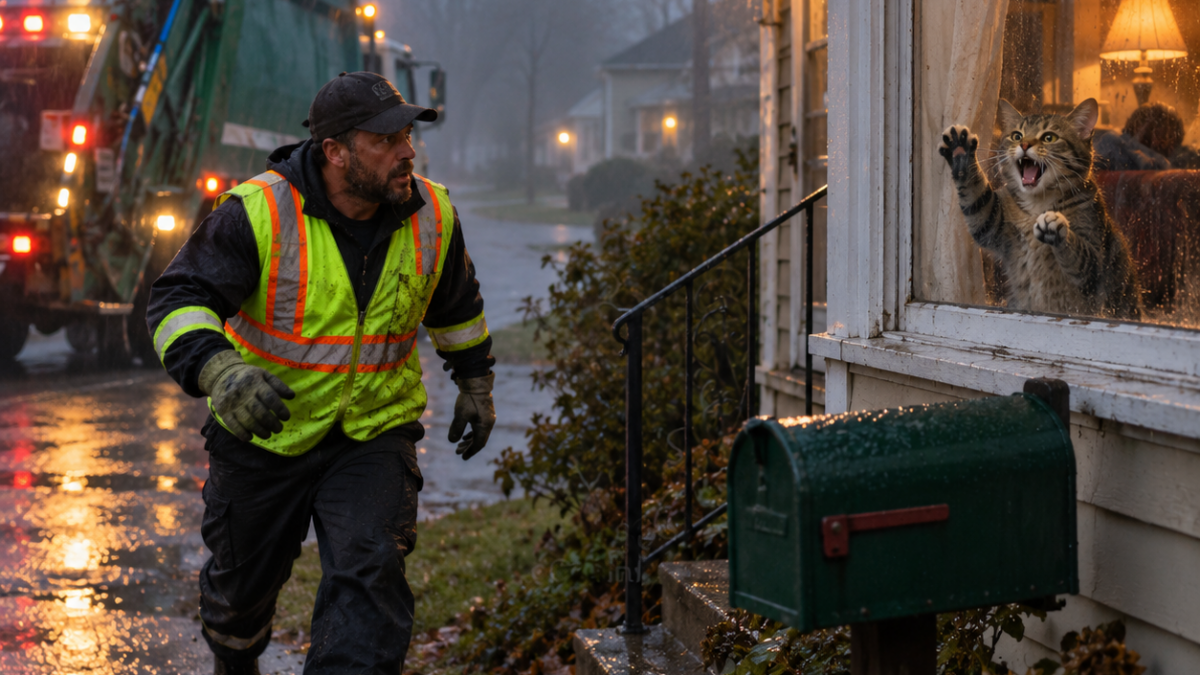
I moved to the front window and cupped my hands against the glare.
At first, all I saw was the sheer curtain.
White.
Still.
Then it jerked.
As if something had grabbed it from inside.
A second later, Lollie exploded into view.
Paws on the glass.
Eyes wide.
Mouth open.
She screamed again, then hooked both paws into the curtain and pulled.
The fabric slid sideways just enough for me to see into the living room.
A reading lamp tipped over.
A throw rug bunched up like a trap.
A glass coffee table.
Mary’s smartphone sitting on it.
And behind the floral sofa, partly hidden by the shadow—
An arm.
A pale hand reaching weakly from the hardwood floor.
My throat closed.
Training is a strange thing.
I am not a paramedic.
I am not a firefighter.
But every city driver gets basic emergency protocol.
Do not break in unless immediate danger requires it.
Call dispatch.
Report clearly.
Find access.
Stay calm.
Calm is not a feeling.
It is a task.
I grabbed my radio.
“Dispatch, this is Unit 14. I need EMS to 418 Sycamore Terrace. Elderly female down inside residence. Possible fall. She appears conscious but barely responsive. I have visual through front window. Send police for entry if needed.”
The dispatcher’s voice sharpened.
“Copy, Unit 14. EMS en route. Are you able to access?”
“Front door locked. Checking for neighbor key.”
Lollie kept throwing herself at the window.
Paws.
Glass.
Curtain.
Yowl.
Again and again.
Like she was trying to break reality open.
I tried the doorknob.
Locked.
I did not waste time playing hero.
I sprinted next door and pounded on the neighbor’s door hard enough to wake the dead.
A man in a robe cracked it open, irritated before he even saw me properly.
“Do you have a key to Mary’s house?” I asked.
He blinked.
“What?”
“Mary’s down. I can see her through the window. Do you have a key? A lockbox code? Anything?”
His face dropped.
“Oh my God.”
A woman appeared behind him, phone already in hand.
“Lockbox,” she said. “Emergency only. She told us years ago.”
We ran back together.
The woman’s name was Sherry.
The man was Doug.
The lockbox was tucked near the porch rail, half hidden behind the old swing.
Sherry’s hands shook so badly she missed the code twice.
“Breathe,” I said.
She nodded, swallowed, punched it in again.
The little metal door popped open.
Key.
I grabbed it, jammed it into the lock, and pushed inside.
The house smelled like old wood, lemon cleaner, and something stale underneath.
Lollie shot past my boots, stopped halfway down the hall, looked back at me like she was checking that I was following, then bolted into the living room and cried again.
Pointing me with sound.
I dropped behind the sofa.
Mary lay flat on the hardwood.
Her skin was pale.
Her breathing was shallow and ragged, every inhale fighting its way in.
Her lips were dry and tinged blue.
The throw rug was twisted under one hip.
One slipper had come off.
Her right arm was stretched toward the coffee table.
Toward the phone.
Three feet away.
Three feet might as well have been a mile.
“Mary,” I said, lowering myself beside her. “It’s Marcus. I’m here. Help’s coming.”
Her eyelids fluttered.
For one terrible second, I thought she was gone.
Then her eyes opened.
Cloudy.
Scared.
Aware.
They found mine and locked on.
“I’m here,” I said. “You’re not alone.”
Lollie climbed onto the sofa cushion above her and pressed her forehead to Mary’s hair.
She purred hard.
Frantic.
Then nudged Mary’s temple like she had been doing it for hours.
Maybe she had.
Maybe for two days, that cat had been pushing, crying, pacing, trying to make the world notice that something was wrong behind those quiet windows.
I pulled off my high-vis jacket and draped it over Mary’s shoulders.
I did not move her.
I took her hand in my gloved one.
Her fingers curled around mine with surprising strength.
A tear slipped down the side of her face into her white hair.
“My daughter,” she rasped.
“California?” I asked.
She nodded faintly.
“She hasn’t called since Easter.”
It was August.
I swallowed the first thing that rose in my throat.
This was not the time for anger.
Mary’s gaze drifted toward the window.
“I watched the sun go down,” she whispered.
Her voice was barely air.
“Then it came up.”
She shut her eyes, opened them again.
“Then it went down again.”
Behind me, Sherry made a small broken sound.
Doug stood in the doorway with his phone pressed to his ear, face gray.
Mary squeezed my hand.
“I prayed,” she breathed. “I just wanted someone to notice.”
I looked up at Lollie.
The cat’s eyes were still huge, her body pressed against Mary like a guard.
“She noticed,” I said. “And she made sure I did too.”
Mary’s mouth trembled.
“And you looked,” she whispered. “You always do.”
The sirens arrived minutes later.
Paramedics moved fast and gentle.
They asked questions.
How long down?
Unknown.
Breathing?
Shallow.
Responsive?
Barely.
Medication list?
On the fridge, Sherry said.
Emergency contact?
Daughter in California.
They stabilized Mary, checked her vitals, started fluids, lifted her carefully onto the stretcher.
Lollie tried to follow.
One of the paramedics nearly tripped over her.
“Is there someone who can take the cat?” he asked.
That question landed in the living room like a weight.
Silence.
Doug looked at the floor.
Sherry pressed her lips together.
“I’m allergic,” she whispered. “Bad.”
A few neighbors had drifted onto the porch by then, drawn by sirens the way people are always drawn by proof that something happened after it is too late to prevent it.
They held coffee mugs.
Wore slippers.
Stood with faces caught between concern and curiosity.
Nobody stepped forward.
Not because they were evil.
That would be easier.
They were used to not stepping forward.
That was worse.
“I’ll figure it out,” I said.
The paramedic nodded.
Mary’s eyes moved to mine as they wheeled her out.
“Lollie,” she whispered.
“I’ve got her.”
It was a promise I had no plan for.
But some promises have to come before the plan.
The ambulance doors shut.
The sirens pulled away.
And Sycamore Terrace did what it always did.
It went back to looking fine.
Porch lights clicked off.
Garage doors opened.
A sprinkler restarted.
The same curtains that had been sealed all morning suddenly became very interested.
I stood on Mary’s porch longer than I should have.
My truck idled at the curb, heavy and impatient, already making me late for the rest of the route.
But my boots felt nailed down.
Not because I was scared.
Because I was angry.
Not loud angry.
Not fist-through-wall angry.
The colder kind.
The kind that comes when you realize the crisis had been sitting in plain sight, and everybody had mistaken stillness for peace.
Lollie sat in the hallway just inside the door.
Tail tucked.
Eyes fixed on the empty space where Mary had been.
She did not run.
Did not hiss.
Did not cry now.
She stared at me like she was waiting for the world to keep its promise.
So I did what people always say they will do someday.
I took out my phone and started calling around.
Not the shiny rescues with polished websites and voice menus that looped forever.
Local numbers.
Local people.
The kind that still answered with a human hello.
After three calls, I got a woman who sounded tired but kind.
“Bring her in,” she said. “We’ll keep her safe. No judgment.”
Doug found an old carrier in his garage.
It was dusty, but usable.
I set it near the hallway.
“Come on, route inspector,” I said softly.
Lollie looked at it.
Then at me.
Then, with a dignity that nearly undid me, she walked inside.
No fight.
No panic.
Like she had already used every bit of emergency she had and was saving the rest for later.
When I carried her out, she did not cry.
She looked at the neighbors.
One by one.
Slow blink.
Slow blink.
Slow blink.
Like she was taking attendance.
Like she was remembering who had noticed and who had not.
Then she turned her face into my jacket and gave one small broken meow.
Not a yowl this time.
A question.
“I know,” I whispered. “I know.”
Then I did the thing that made the rest of my day fall apart.
I put Lollie safely in the cab of my truck.
And I drove away.
I tried to finish my route like normal.
Tried to pretend my hands were not shaking on the wheel.
Tried to treat the next blue cart like it meant the same thing it had meant yesterday.
But the whole city looked different now.
Every cart felt like a heartbeat.
Every porch felt like a closed mouth.
Every drawn curtain felt like it might be hiding something.
At the next stop, a man waved from his driveway and shouted, “Morning!”
My mind did something cruel.
It wondered what his last morning would look like if he fell in his kitchen.
If anyone would notice.
If his dog would bark.
If his porch light would burn until it felt like a confession.
I hated that thought.
But I could not unthink it.
Because once you have seen quiet up close, you stop trusting it.
By noon, the story had already started traveling.
Not the truth.
A version.
Doug’s nephew had apparently filmed the ambulance from across the street.
He filmed me standing on the porch.
Filmed Mary being wheeled out, her face turned toward the sky like she was trying to remember what air felt like.
Then he posted it.
No names at first.
Just a caption.
Recycling guy saves elderly woman after her cat alerts him.
That was all it took.
By my lunch break, I had three missed calls from an unknown number.
Two from a hospital line.
One text from Sherry.
This is blowing up. People are asking questions. Please call me.
I sat in my cab with my sandwich untouched.
Lollie was already safe at the rescue by then.
I had driven her there between route sections, signed temporary paperwork, and watched the volunteer place her in a quiet room with water, food, and a soft bed she refused to use because she preferred glaring from the carrier.
“She’s had a morning,” the woman said.
“She’s had two days,” I answered.
Now my phone kept buzzing.
I knew the questions before I read them.
People never ask the hardest thing first.
They circle it.
Where was her family?
Why didn’t the neighbors know?
Why was she alone?
Why didn’t anyone call?
Why do we live like this?
And underneath all of it, the question nobody wants to say out loud:
Could that be me?
I went to the hospital after my shift.
Still in work boots.
Still smelling like diesel, sweat, and hot plastic.
I did not bring flowers.
Did not bring balloons.
I brought myself because I did not know what else to bring a woman who had spent two nights on the floor praying somebody would notice.
At the front desk, they asked who I was.
I hesitated.
Because I did not know.
Friend?
Stranger?
Witness?
“The driver from her route,” I said finally. “Marcus.”
The woman behind the desk softened.
“Oh,” she said. “You’re him.”
That hit me wrong.
I was not him.
Not a headline.
Not a hero.
Just the guy who honked twice on Wednesdays.
Mary’s room door was open.
She lay propped up in bed, thin and small under white blankets.
Her skin looked less blue.
Her lips were still dry, but not dangerous.
An IV line ran into her arm.
When she saw me, her eyes filled immediately.
“Marcus,” she whispered.
Her voice sounded like paper.
But she was here.
I walked in slowly.
She reached out her hand.
I took it.
Her grip was weak now.
Weaker than when she had held on behind the sofa.
But it was still Mary.
Still stubborn.
Still here.
“You came,” she said.
“Yeah,” I answered. “I did.”
She swallowed.
“I didn’t want to be dramatic.”
That word made my throat burn.
Dramatic.
Only lonely people apologize for almost dying.
Only lonely people feel guilty for needing help.
“You weren’t dramatic,” I said. “You were human.”
Her eyes drifted toward the door.
“They called her.”
“Your daughter?”
Mary nodded once.
A tiny, tired nod.
“She didn’t answer at first. They left a message.”
She stared at the blank television mounted to the wall.
“She texted the hospital.”
Not me.
She did not say those last two words.
She did not have to.
Then, as if defending someone on trial, Mary added quickly, “She’s busy. She has her life.”
I had heard that tone before.
From people on porches.
In driveways.
From older men and women making excuses for adult children whose lives had become too full to hold a five-minute call.
I did not say what I wanted to say.
A call is not a mortgage.
Five minutes does not ruin a life.
Busy is not the same as gone.
Instead, I squeezed her hand.
“How are you feeling?”
Mary gave a tiny laugh with no humor in it.
“I feel old.”
Then quieter.
“I feel embarrassed.”
“Don’t.”
Her eyes sharpened.
“I laid there and listened.”
“For what?”
“My refrigerator,” she said. “It hummed. Then it stopped.”
A chill moved through me.
“My clock. Ticking. Like it didn’t care.”
She looked at me, eyes wet.
“And I listened for your truck. Because your truck means morning.”
My chest tightened.
“You’re not allowed to disappear on my route,” I said.
It was supposed to be a joke.
Mary smiled just a little.
Then she asked, “Where is Lollie?”
“Safe,” I said. “At a local rescue. I’ll bring her back as soon as you’re home or wherever you want her.”
Mary closed her eyes.
A tear slipped out.
“She saved me.”
“Yes,” I said. “She did.”
That night, sitting in my truck in the hospital parking lot, I read the comments.
I should not have.
Curiosity is a sickness.
Anger is gasoline.
Some people were kind.
God bless that driver.
Cats are angels.
This is why community matters.
But then came the other kind.
The ones that sound reasonable until you taste the poison.
Not the neighbors’ responsibility.
People fall all the time.
If she can’t live alone, she shouldn’t.
Why didn’t her family handle it?
Where are her kids?
That last one appeared again and again.
Where are her kids?
It sounds innocent.
It is not always innocent.
Sometimes it is a way of pushing responsibility away.
A way of saying, If you do not have family, you do not have a safety net.
A way of punishing someone for being alone.
As if loneliness is a personal failure.
As if aging is bad planning.
As if needing help means you should have arranged your life more conveniently for everyone else.
My phone buzzed.
Unknown number.
I answered.
“Is this Marcus?”
A woman’s voice.
Sharp.
Controlled.
“Yes.”
“This is Claire.”
Mary’s daughter.
She did not say hello.
Did not ask how her mother was.
She went straight to the part that mattered to her.
“Why is my mother’s situation online?”
I closed my eyes.
“I didn’t post anything.”
“I don’t care who posted it. It’s humiliating. It’s invasive.”
There it was.
Not concern first.
Image.
Control.
Embarrassment.
I kept my voice calm.
“Ma’am, your mother was on the floor for two days.”
Silence.
Then colder.
“That’s not what they told me.”
“That’s what she told me.”
Another pause.
“My mother exaggerates,” Claire said. “She’s always—”
I cut in before I could stop myself.
“Always what?”
She inhaled sharply.
For a second, neither of us spoke.
Then she said, “I’m flying in. I’ll handle it.”
I wanted to say, You already didn’t.
I wanted to say, Handling it would have been answering before the cat had to scream.
But Mary was alive, and fragile hope is not something you throw matches near.
So I said, “Okay.”
Then Claire said, “Don’t go back to the hospital.”
I blinked.
“Excuse me?”
“This is family,” she said. “You’re the driver.”
The driver.
I gripped the phone.
In that moment, I understood something that has stayed with me.
Some people would rather their loved one almost die in private than be saved in public.
Some people love the idea of family more than they love the work of showing up.
“I’m not trying to replace anyone,” I said. “I just showed up.”
For half a second, her voice softened.
Then she hardened again.
“Just don’t make this a thing.”
She hung up.
Two days later, Claire arrived.
I know because Sherry texted me like she was reporting national news.
She’s here. Tall. Expensive suitcase. Looks angry.
I stared at that text longer than I should have.
Then I did what Claire told me not to do.
I went to the hospital.
Not to start drama.
Not to play hero.
Because Mary had asked me, in that small paper voice, “Will you come back?”
And I could not shake the way she said it.
Like she did not believe she deserved a yes.
When I walked into Mary’s room, Claire was already there.
Perfect hair.
Sharp blazer.
A face built for boardrooms and boundaries.
She looked up and her eyes narrowed like I was a stain.
Mary looked between us like a child caught in the middle.
“Marcus,” Mary said softly.
Relief slipped through her exhaustion.
Claire stood.
“You came.”
Flat.
Mary’s fingers tightened on the blanket.
Claire turned back to her mother.
“Mom,” she said, voice overly calm, “why didn’t you press your emergency button?”
Mary’s cheeks flushed.
“I—”
“And why didn’t you call me?”
Mary blinked slowly.
“I did,” she whispered. “I left messages.”
Claire exhaled.
“My voicemail was full.”
Full.
Not I’m sorry.
Not I missed them.
Full.
Mary looked down at her hands.
“I didn’t want to bother you.”
Claire’s eyes flashed.
“Bother me? You were on the floor.”
“Yes,” Mary said quietly. “And I still didn’t want to bother you.”
That line cracked the room open.
Because this was no longer about a fall.
It was about the kind of loneliness where a person does not even feel entitled to their own emergency.
Claire looked at me as if I had taught Mary the sentence.
Then she said, “This is exactly why you can’t live alone.”
Mary’s spine straightened.
“I have lived alone for years.”
“And you almost died.”
Mary’s eyes filled, but she did not look away.
“I almost died quietly,” she said. “That is the part you should be afraid of.”
Claire’s mouth tightened.
She turned to me.
“And you have no idea what you’re stepping into.”
“I’m not stepping into anything,” I said. “I stopped because something was wrong.”
Claire laughed once, without humor.
“People like you always think you’re helping.”
Mary flinched.
That was when I saw it.
Not just anger.
Fear.
Claire was not only mad that her mother was vulnerable.
She was mad that the vulnerability had become visible.
Visible vulnerability forces a question.
Where were you?
And no one likes answering that when the answer hurts.
I should have left.
I knew that.
But Mary looked at me with pleading eyes.
Not save me.
Just please do not leave me alone in this room with my own daughter.
So I stayed quiet.
Claire paced once, then stopped at the foot of the bed.
“I’m arranging a facility,” she said. “Short-term rehab. Then we’ll see.”
Mary’s face tightened.
“A facility.”
“It’s safer.”
Mary shook her head slowly.
“I don’t want to die in a place where nobody knows my Wednesday.”
Claire blinked.
“What?”
“My Wednesday,” Mary repeated. “My routine. My porch light. My cat in the window.”
“That’s not a reason.”
Mary’s eyes flashed.
“It is the only reason. Routine is how you know someone is still here.”
Claire stared at her like she did not recognize her.
Then Mary said the sentence that made my throat sting.
“You used to call every Sunday.”
Claire’s face tightened.
“I was in college. Things change.”
Mary nodded.
“Yes. They do.”
Her voice dropped.
“And then you stopped.”
The silence that followed was not empty.
It was full of every call that did not happen.
Every excuse.
Every holiday shortened.
Every voicemail left unheard.
Every lonely afternoon dressed up as independence.
Claire looked away.
For the first time, she looked young.
Not in a flattering way.
In a scared way.
“Mom,” she said softly, “you don’t know what my life is.”
Mary nodded.
“You’re right. Because you never tell me. And you never ask about mine.”
Claire opened her mouth.
Closed it.
Then something in her face broke.
“I couldn’t,” she whispered.
Mary frowned.
“Couldn’t what?”
“Keep doing it.”
“Doing what?”
“Feeling guilty,” Claire said. “Every time you sounded lonely. Every time you made a joke about dying. Every time you asked when I was visiting and I didn’t have an answer.”
Mary stared.
Claire wiped at her eyes angrily, as if tears offended her.
“I live three time zones away. My job eats me alive. My marriage has been a mess for two years. I’m tired all the time. And every time I called, I felt like I was failing you anyway.”
Mary’s face softened and hardened at once.
“So you stopped.”
Claire nodded.
“Because it was easier than listening to myself feel like a bad daughter.”
There it was.
Not a villain’s speech.
A confession.
Still painful.
Still selfish.
Still real.
Mary’s lips trembled.
“I didn’t want you to feel guilty,” she whispered. “I wanted you to feel connected.”
Claire sat down.
For the first time since I had entered, no one seemed to know what role to play.
Daughter.
Mother.
Stranger.
Driver.
Witness.
Mary reached out one thin hand.
After a long second, Claire took it.
“I’m here now,” Claire said.
Mary held her gaze.
“I’m glad. But you’re here because strangers saw me first.”
Claire looked down.
The silence between them was not hate.
It was grief.
For years that could have been different.
For calls that might have softened the distance before it hardened.
For a relationship that had become a gap so wide a cat had to scream to bridge it.
After that, Sycamore Terrace changed.
Not all at once.
Not magically.
But enough to make people uncomfortable.
And sometimes discomfort is the first honest step toward decency.
The next Wednesday, Doug knocked on my truck window and handed me a piece of paper.
“Sherry made a list,” he said.
I looked at it.
Names.
Addresses.
Phone numbers.
Emergency contacts.
Everyone on the street who lived alone.
Everyone with routines.
Everyone who could disappear quietly if no one looked.
At the top, Sherry had written:
PORCH LIGHT CHECK.
I raised an eyebrow.
Doug shrugged.
“People were arguing online,” he said. “Privacy. Responsibility. Mind your business. All of it.”
He exhaled.
“Then Sherry said, fine, let’s make it everybody’s business voluntarily.”
So they did.
Nothing official.
Nothing fancy.
Just human.
If an older neighbor’s porch light stayed on past morning, someone knocked.
If the newspaper stacked up, someone checked.
If the blue cart did not show up on pickup day, somebody asked why.
If nobody answered, they did not break down doors or play hero.
They called for help.
They used the lockbox if there was one.
They stopped pretending silence meant fine.
Not everyone loved it.
One man on the corner snapped, “I don’t want people watching my house.”
A woman across the street said, “This feels invasive.”
Doug answered, blunt as a hammer.
“Then opt out. But don’t call it invasive when it saves someone’s life.”
That started a whole new argument.
Maybe it should have.
Because the truth is, nobody wants to be judged.
And nobody wants to be forgotten.
The line between privacy and abandonment is not always clean.
But Mary lying behind that sofa for two sunsets had made one thing impossible to deny.
A street full of closed doors is not the same as a community.
Lollie came home a week later.
Mary was still in rehab, rebuilding strength one slow step at a time.
Claire met me at the house.
She looked different.
Not softer exactly.
Less polished.
Like she had not slept enough to keep the mask straight.
“Thank you,” she said quietly, taking the carrier handle.
I nodded.
Lollie stared at Claire through the plastic door like she was evaluating a disappointing employee.
Claire gave a small laugh.
“I know,” she murmured. “I know. I’m late.”
She looked at me, then at the cottage.
“I saw the comments.”
“Yeah.”
“Some people called me a monster.”
I did not answer.
Sometimes the internet is cruel.
Sometimes it is accurate.
Sometimes it is both and still not useful.
Claire exhaled.
“I’m not a monster,” she said, almost like she needed to convince herself. “I’m just tired.”
“Tired doesn’t turn off love,” I said. “It just makes it harder to show.”
She swallowed.
Then she surprised me.
“I didn’t know she left you water.”
I blinked.
“She never told me,” Claire whispered. “About you. About the honks. About Lollie in the window.”
She stared at the little house like it had become a stranger.
“I didn’t know she had a whole life that didn’t include me.”
That line stayed with me.
Because that is what happens.
People keep living.
Even when someone stops showing up.
Mary had built small connections like bricks.
A frozen bottle of water.
Two honks.
A cat in a window.
A wave to a garbage truck.
Tiny proof that she existed.
Claire had missed those things.
Not because she did not love her mother.
Because love without presence eventually becomes a story you tell yourself.
And stories do not answer porch lights.
The day Mary came home, Sycamore Terrace lined the curb like it was a parade.
No balloons.
No signs.
Just ordinary people in ordinary clothes with awkward faces, holding casseroles, flowers, envelopes, and the uncomfortable knowledge that they should have knocked sooner.
Mary stepped out of Claire’s rental car slowly, leaning on a cane.
Her hair was brushed.
Her face was still thin.
But her eyes had that stubborn spark.
Lollie walked out of the house like she owned the deed.
She trotted straight to the front window.
Jumped up.
Sat.
Returned to her post.
Mary saw her and laughed.
A real laugh.
“I told you,” she said to Claire, loud enough for the street to hear. “She runs this place.”
Claire smiled.
Small.
Crooked.
Then Mary looked around at the neighbors.
Doug cleared his throat.
“We made you a schedule,” he said.
Mary blinked.
“A schedule?”
Sherry stepped forward with a paper.
“Check-ins,” she said. “Just hellos. Not hovering. Not invading. Just noticing.”
Mary stared at it.
Then her eyes filled.
“Oh,” she whispered.
She pressed one hand to her chest.
“You mean you’re going to look?”
Sherry nodded.
Mary swallowed.
Then she said the thing that made the whole street go still.
“I prayed for that,” she said simply. “On the floor.”
Nobody answered.
There was no good answer.
Later, when the crowd thinned and the porch light clicked on for evening—on purpose this time, not forgotten—Mary handed me a small envelope.
“For you,” she said.
I opened it in my truck after I finished the block.
Inside was a note in shaky handwriting.
Marcus,
You honk like the world still has rules.
Thank you for being the kind of person who notices when a rule breaks.
And tell Lollie she is grounded for scaring everyone.
—Mary
I laughed.
Then I wiped my face with my sleeve and pretended it was sweat.
It was not.
Mary did not move into a facility permanently.
She did go to rehab for a few weeks.
She hated it.
Complained about the food.
Corrected the nurses when they called Lollie “your kitty” instead of “my cat.”
Made friends with a man named Harold who cheated at cards badly enough that Mary said it was an insult to lying.
Claire stayed for ten days.
Then fourteen.
Then worked remotely from Mary’s dining room for another month.
They did not fix everything.
Real life rarely allows such neat repairs.
But they talked.
Not perfectly.
Not without sharp edges.
But honestly.
Claire learned the lockbox code.
She set up a medical alert system Mary actually agreed to wear after Lollie knocked the pendant off the table twice, which Mary took as divine instruction.
Claire cleared her voicemail.
She called every Sunday.
At first, the calls sounded formal.
Then less so.
Sometimes Mary complained afterward that Claire talked too much about work.
But she complained while smiling.
That counts.
Sycamore Terrace kept the porch light check.
Doug printed little cards.
Sherry organized emergency contacts.
The man who said it was invasive opted out, then quietly opted back in after slipping on his driveway in October.
Nobody teased him.
That mattered too.
A community cannot become real if people are punished for changing their minds.
As for Lollie, she became a legend.
The local rescue posted about her.
The newspaper ran a small story.
Someone called her “the window alarm cat.”
Mary hated that.
“She has a name,” she told anyone who used it.
But she also bought Lollie a new bed shaped like a strawberry, which Lollie ignored for three weeks before deciding it had always belonged to her.
Every Wednesday, I still turned onto Sycamore Terrace at 6:30.
I still gave two quick honks.
Mary’s blue cart still sat three feet from the curb.
Sometimes Claire was there.
Sometimes Sherry waved from next door.
Sometimes Doug lifted his coffee mug.
And always, right after the honks, Lollie appeared in the window.
Slow blink.
Tail flick.
Supervisor on duty.
The first Wednesday after Mary came home, there was a frozen bottle of water on the cart.
I picked it up and looked toward the porch.
Mary stood there with her cane.
She lifted one hand.
I lifted the bottle.
Then I noticed a sticky note on it.
In Mary’s handwriting:
Do not argue. Hydrate.
I did not argue.
Here is what I still think about.
A whole street did not notice.
A grown daughter did not call.
But a cat did.
A cat turned a window into a siren.
A recycling truck became the first response.
That is not a cute story.
It is a warning.
Because this is happening everywhere.
Older people living alone in quiet houses.
Adult children drowning in busy lives and distance and guilt.
Neighbors living ten feet apart like strangers.
Workers passing the same homes every week and knowing the patterns better than anyone realizes.
We have built a culture where minding your own business is treated like a virtue.
Sometimes it is.
Privacy matters.
Dignity matters.
Independence matters.
But there is a point where minding your own business becomes a prettier name for neglect.
There is a point where “I didn’t want to bother anyone” becomes dangerous.
There is a point where a porch light left on past morning is not just a porch light.
A missed cart is not just a missed cart.
A cat in a window is not just a cat.
I am still just the driver.
I still empty blue carts.
Still run behind schedule.
Still deal with people putting garden hoses in recycling bins no matter how many notices the city sends out.
But I look harder now.
At porch lights.
At curtains.
At routines.
At absence.
Because Mary was right.
Routine is how you know someone is still here.
And because Lollie, a stubborn old tabby with no words, understood something the rest of us had nearly forgotten.
Sometimes love is not a grand rescue.
Sometimes it is paying attention long enough to know when something small is wrong.
A closed lid.
An empty cart.
A porch light burning after sunrise.
A cat screaming at glass because the person she loves cannot reach the phone.
Mary spent two nights on the hardwood praying someone would notice.
On the third morning, someone finally did.
But the first one to sound the alarm was Lollie.
And every Wednesday now, when that old cat appears in the window after my two honks, I give her a nod before I touch the cart.
Not because she is cute.
Not because the story went viral.
Because she did what a whole street failed to do.
She refused to let Mary disappear quietly.








