**An 87-Year-Old Widow Let a Soaked Stray Dog Inside During a Thunderstorm—Then It Walked Straight to the Bed Her Dead German Shepherd Hadn’t Used Since 2018.**
An 87-Year-Old Widow Let a Soaked Stray Dog Inside During a Thunderstorm—Then It Walked Straight to the Bed Her Dead German Shepherd Hadn’t Used Since 2018.
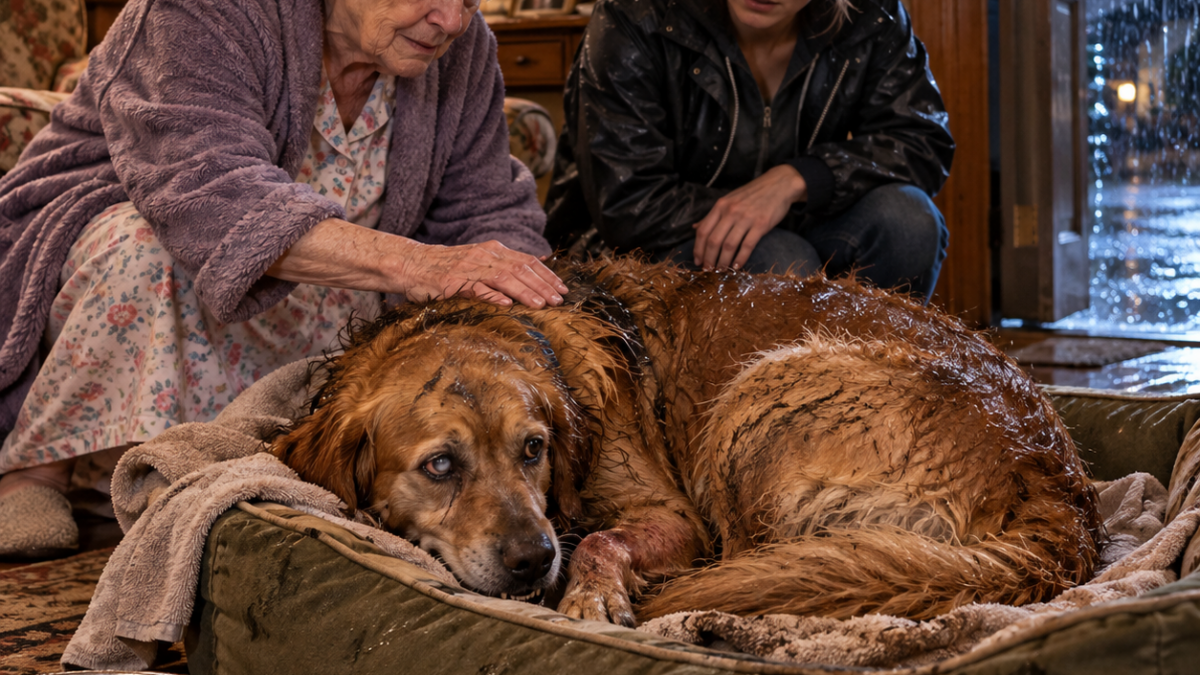
Every house on Lorraine Deitz’s block stayed shut against the worst thunderstorm of April, but the eighty-seven-year-old widow opened her door to a starving dog—and watched the animal ignore every warm blanket in the house except the faded green bed no one had touched since Roscoe died.
For thirty days, Lorraine searched for the stranger’s owner even as the wounded dog quietly rebuilt routines grief had erased, and every new phone call carried the possibility that someone might arrive and take away the first living thing my grandmother had allowed into Roscoe’s place in six years.
But when the final search ended and Lorraine was asked what she wanted to name the dog curled inside that old bed, she finally admitted the truth none of us had understood: she had never kept that empty corner because she could not move on—she had kept it because some part of her still believed love might need the room again.
I was asleep four miles away when my grandmother called.
She did not say hello.
“There’s a dog lying where Roscoe used to sleep.”
The clock beside my bed read 12:06 a.m.
Wind rattled the bedroom vent.
Rain hammered the roof hard enough that for a second I thought I had misunderstood her.
“What?”
“A dog.”
“Grandma, are you okay?”
“I’m fine.”
“Did you fall?”
“No.”
“Did a window break?”
“No.”
“Is the dog outside?”
“No.”
“On the porch?”
“No, Megan.”
Her voice sharpened with the particular offense only Lorraine Deitz could produce at eighty-seven years old.
“I know where my living room is.”
That sounded like her.
It also did not explain why there was apparently a dog inside it.
I threw back the blankets.
“Did you bring it in?”
“I opened the door.”
“Why?”
There was a pause.
“Because she was wet.”
As though that explained everything.
Maybe to Lorraine it did.
“Is she aggressive?”
“No.”
“Did you touch her?”
“A little.”
“Grandma.”
“Don’t use that voice.”
“What voice?”
“The one your mother uses when she thinks I’ve become incompetent.”
“I don’t think you’re incompetent.”
“You’re putting on pants while talking to me.”
I stopped.
“How do you know?”
PART2:
“You always breathe heavier when you put on pants.”
Even in the middle of an emergency, Lorraine could make me feel twelve.
“I’m coming over.”
“I didn’t ask you to.”
“I know.”
“Roads are bad.”
“I know.”
“Underpass might be flooded.”
“I’ll take Ridge Road.”
Silence.
Then:
“Bring one of those leash things.”
“A slip lead?”
“If that’s what they’re called.”
I worked part-time with a rescue group then.
PART3:
Not enough to call myself experienced, but enough that my car usually contained things normal people did not keep in their trunks.
Slip leads.
Old towels.
Collapsible bowls.
Disposable gloves.
A crate tie-down.
A bag of stale training treats I kept meaning to replace.
“I’ll be there.”
“Don’t hurry.”
“I’m going to hurry.”
“No.”
“Grandma.”
“Megan.”
I closed my eyes.
“Fine.”
“Good.”
“Lock the door.”
“She’s already inside.”
“The back door.”
“Oh.”
She hung up.
Seventeen minutes later, I pulled into Lorraine’s driveway.
Her brick house looked exactly as it had my entire childhood.
White shutters.
Two porch lights.
A metal goose near the flower bed wearing a yellow raincoat my mother hated.
The storm had turned the lawn into a dark, shining sheet.
Lorraine’s living-room lamp glowed behind curtains.
Her back door was unlocked.
Of course.
“Grandma?”
“In here.”
Muddy pawprints crossed the kitchen floor.
Large.
Uneven.
The right front print was lighter than the left, as though the dog did not want to put full weight on it.
I followed them.
They passed a stainless bowl filled with water.
An opened can of chicken.
A new gray fleece blanket laid beside the radiator.
None of it had been touched.
The prints continued into the living room.
Then ended.
The dog lay inside Roscoe’s bed.
I stopped.
There are moments when two unrelated pieces of your life touch, and your brain needs an extra second to accept that both things are happening in the same room.
The dog was a large female retriever mix.
Golden, maybe.
Reddish coat.
Darkened almost brown from rain.
Burrs tangled behind both ears.
Loose blue collar.
No visible tag.
She had curled as tightly as her size allowed inside a bed that had always been too small even for Roscoe.
Her ribs showed when she breathed.
The left eye had a pale cloudy cast.
The right front paw disappeared beneath her chest.
Lorraine sat three feet away.
Flowered nightgown.
Blue robe.
House slippers.
Two towels draped over the dog.
She held another towel in her lap.
“She walked straight there.”
I looked at her.
“Did she?”
“Passed everything.”
Lorraine pointed toward the kitchen.
“I put food down.”
“You gave her canned chicken?”
“It was low sodium.”
“Of course it was.”
“She didn’t eat.”
“She may be too scared.”
“She drank from my hand.”
That caught me.
“You put your hand near her mouth?”
Lorraine frowned.
“She was thirsty.”
“Grandma.”
“She did not bite me.”
“That doesn’t mean she couldn’t.”
Lorraine glanced toward the dog.
“She could.”
Then:
“She didn’t.”
I approached sideways.
Slow.
The dog lifted her head.
No growl.
No lip curl.
Just stillness.
A dog who has stopped running can become so motionless it looks like obedience.
It is not.
It is calculation.
If I move, what happens?
If I fight, what happens?
If I stay, maybe nothing happens.
I crouched.
“Hey, girl.”
Her eyes followed my hands.
I placed the slip lead beside me instead of lifting it.
Lorraine said:
“Don’t take her anywhere tonight.”
“I’m not.”
“You brought a leash.”
“In case we need one.”
“No one is putting her back into that rain.”
“I know.”
The dog’s right ear moved toward Lorraine.
Not mine.
Hers.
I noticed.
“Has she been like this the whole time?”
“Mostly.”
“How did she get inside?”
Lorraine pointed toward back porch.
“I heard scratching.”
“You opened the door?”
“I looked first.”
“Through the window?”
“Obviously.”
“What if it had been a bear?”
Lorraine stared.
“We live in Altoona, not Yellowstone.”
“That isn’t—”
“She looked cold.”
The dog’s head slowly lowered.
Right ear still angled toward Lorraine.
I sat on floor.
The green bed looked smaller than I remembered.
Faded olive fabric.
Brown canvas patch near one corner.
Dark blue repair seam on the side.
The wooden platform underneath had been built by my grandfather Frank eighteen years earlier.
Roscoe had been too big for the bed from the day Lorraine bought it.
That had somehow become part of its charm.
He would circle once.
Sometimes twice.
Fold his body into the center.
Leave two hind legs hanging over the edge.
Then rest his head against the raised side as if the manufacturer had simply misunderstood how dogs were shaped.
For six years, the bed had been empty.
Nobody used it.
Nobody sat in it.
My daughter Ellie had once tried when she was three.
Lorraine lifted her out so quickly the Thanksgiving table fell silent.
“Sorry, sweetheart.”
Lorraine had said afterward.
Then bought Ellie a stuffed German shepherd for Christmas.
No one mentioned the incident again.
That was how grief worked in Lorraine’s house.
Not dramatic.
Not loud.
It created rules no one officially announced.
Do not move Frank’s reading chair without asking.
Do not throw away the chipped green mug.
Do not ask why Roscoe’s leash remains folded in the second kitchen drawer.
And absolutely do not touch the bed beneath the living-room window.
My mother, Susan, called it unhealthy.
I once called it unfinished grief.
Lorraine called it furniture.
That was the only explanation she ever gave.
Now a strange wet dog had entered the house and broken the oldest rule without permission.
And Lorraine was sitting beside her.
Not angry.
Not even unsettled.
Watching.
I took out my phone.
Called county non-emergency dispatch.
Reported found dog.
Then after-hours veterinary clinic.
The woman asked questions.
Breathing?
Normal.
Gums?
I had not checked.
She told me not to force contact if the dog was frightened.
Any active bleeding?
No.
Can she bear weight?
Unknown.
Vomiting?
No.
Alert?
Yes.
Because several low roads were flooding, the clinic advised us to keep her contained until morning if she remained stable.
Offer water.
Small food.
No human pain medication.
Call again for pale gums, labored breathing, collapse, severe distress.
Lorraine listened carefully.
She repeated every instruction.
Then said:
“Megan.”
“Yes?”
“Basement.”
“What?”
“Roscoe’s baby gate.”
I stared.
“That thing is still down there?”
“Of course.”
“Why?”
“Because it’s a perfectly good gate.”
It had not been used in nearly a decade.
I went downstairs.
Found it behind the furnace.
Wooden pressure gate with teeth marks in one corner from puppy Roscoe.
I carried it up.
We blocked the living room from the hallway so the dog had a contained space without feeling trapped in a crate.
Around 1:18 a.m., she drank.
Lorraine poured water into her palm.
I wanted to stop her.
Didn’t.
The dog extended her neck.
One lick.
Then another.
Six in total.
Lorraine smiled.
Not broadly.
Just a tiny movement at one corner of her mouth.
At 1:31, she accepted chicken.
One small piece.
Then nothing.
At 2:04, she let Lorraine touch her neck.
I checked clock because I had fallen into rescue mode.
Times.
Changes.
Symptoms.
Observations.
Maybe that gave me control.
Around three, the rain softened.
Wind remained.
I stretched out on Lorraine’s couch.
She refused the spare bedroom.
Stayed in recliner.
“You need sleep.”
“So do you.”
“I’m sixty years younger.”
“Not quite.”
“I’m fifty-eight years younger.”
“Your math is improving.”
The dog slept.
Mostly.
Each time Lorraine’s eyes closed, the dog lifted her head.
Checked.
Then lowered it.
I noticed the third time.
By the sixth, I stopped believing coincidence.
Near dawn, Lorraine whispered:
“I don’t know your name.”
The dog’s tail tapped once against the bed.
Lorraine leaned forward.
“We’ll find your people.”
Tap.
“They’ll be worried.”
She meant it.
That matters.
Because people later told the story like Grace had been destined to belong to Lorraine.
I understand why.
It sounds better.
Lonely widow.
Storm.
Lost dog.
Dead dog’s bed.
Second chance.
But Lorraine did not think:
Mine.
She thought:
Someone is looking for you.
That distinction was the beginning of everything.
At 6:41, I made coffee.
At 6:52, Lorraine opened the second kitchen drawer.
She removed Roscoe’s leash.
Brown leather.
Soft with age.
Brass clip dulled.
Folded exactly the way it had been since 2018.
She stood there holding it.
I did not say anything.
That was the first thing of Roscoe’s she had taken from that drawer in six years.
She carried the leash into living room.
Placed it beside the bed.
Then sat down.
To understand what that meant, you need to understand Roscoe.
He came into Lorraine’s life in 2006.
Grandpa Frank was seventy-four.
Already slowing after bypass surgery.
He had worked forty-three years as a mechanic.
Even retired, he smelled faintly of machine oil no matter how many showers he took.
One afternoon, a younger mechanic from his old shop found a German shepherd wandering behind a loading dock.
Underweight.
Long legs.
Suspicious.
No collar.
Frank saw one photograph.
That was supposedly all.
According to Lorraine, he drove twenty miles in sleet before discussing anything with her.
He returned carrying dog food.
The dog was in the back seat.
Frank walked into kitchen.
“Before you say no—”
Lorraine said:
“No.”
Frank nodded.
“Right.”
Then the shepherd followed him through the door.
He saw Lorraine.
Stopped.
Frank said:
“He won’t bother you.”
The dog walked straight to Lorraine.
She had buttered toast in hand.
She tore off a corner.
Offered it.
The dog took it with extraordinary gentleness.
Lorraine looked at Frank.
Frank looked at ceiling.
“He needs a place for maybe two nights.”
Roscoe stayed twelve years.
Frank claimed dog was for protection.
Lorraine told everyone truth.
Frank had fallen in love before bringing him home.
Their marriage worked like that.
Frank made impulsive decisions.
Called them practical.
Lorraine complained.
Then rearranged the house to make them permanent.
Roscoe grew from awkward adolescent into ninety-pound shepherd.
Black saddle.
Tan legs.
Upright ears.
He checked every room before settling.
If Frank went outside, Roscoe watched Lorraine.
If Lorraine went upstairs, Roscoe checked door.
When both were home, he slept beneath living-room window where he could see front entrance and Lorraine’s green recliner.
The bed came from a discount store.
Twenty dollars.
Too small.
Frank built a low wood platform to keep it off cold floor.
On underside, where nobody saw, he wrote:
October 14, 2006.
Lorraine found it years later.
Frank died first.
January 2012.
Stroke in kitchen.
Reaching for coffee.
Roscoe barked.
Not normal bark.
Continuous.
Lorraine heard from laundry room.
Found Frank on floor.
Roscoe stood between him and doorway.
Would not move for paramedics until Lorraine took his collar.
Frank lived nine days.
Then died.
After funeral, everyone came.
Casseroles.
Paper plates.
Flowers.
Cards.
People sat.
Held Lorraine’s hands.
Said call anytime.
Then evening came.
Everyone returned home.
Roscoe stayed.
For first month, he stopped sleeping in green bed.
Slept at foot of Lorraine’s bed instead.
Never climbed up.
Just close enough that at two in morning, Lorraine could drop one hand and touch fur.
By spring, she returned to recliner.
Roscoe returned to bed.
They built schedule.
Seven breakfast.
Ten mailbox.
Noon soup.
Six local news.
Eight-thirty final bathroom.
Then Roscoe circled green bed.
One turn.
Sometimes two.
Head in same corner.
Watched Lorraine until lamp went off.
That routine became architecture of widowhood.
I visited twice a week.
Roscoe heard my car before Lorraine.
Paws on window ledge.
Breath fogging glass.
Lorraine scolded:
“You’re smearing my window.”
Then waited until I left to clean it.
He aged.
Gray around muzzle.
Hip stiffness.
Lorraine put nonslip runners through kitchen.
Three water bowls.
Warm towel from radiator on cold mornings.
By 2018, rear legs failed sometimes.
Lorraine was eighty-one.
Could not lift him.
She learned to use a bath towel beneath abdomen as sling.
Roscoe hated it.
Accepted for her.
Final morning, he refused food.
Drank water from Lorraine’s cupped palm.
Vet came house.
Roscoe lay in green bed.
I sat one side.
Lorraine the other.
Her hand behind his ear.
He looked at her until breathing stopped.
Lorraine made no sound.
Vet wrapped him in Frank’s old blue truck blanket.
Took body.
Lorraine stayed on floor.
Her palm rested inside hollow where Roscoe’s chest had been.
I asked:
“Do you want me to take bed?”
“No.”
“Not today?”
“No.”
Next week I asked.
Mom asked.
Neighbor June asked.
No.
Bed stayed.
At first collar lay inside.
After three months, Lorraine placed collar in drawer.
One year later, washed cover.
Stitched split seam with dark blue thread because that was color available.
Bed returned.
Same exact spot.
Under window.
People assumed Lorraine could not let go.
Maybe partly.
But grief is rarely one thing.
Lorraine remained functional.
Bills.
Church.
Birthday cards.
Porch sweeping.
Doctors.
From sidewalk, nothing looked broken.
Inside, measurements changed.
She stopped cooking meals requiring more than one pan.
Stopped listening to kitchen radio after batteries died.
Left church before coffee because people asked if she planned to “get another dog.”
She hated phrase.
Another dog.
As though Roscoe had been a lamp.
As though replacement was the same category as companionship.
Mom worried about falls.
I worried about loneliness.
Lorraine said:
“I have a telephone.”
Mom:
“You don’t call.”
Lorraine:
“I answer.”
“That isn’t same.”
“Close enough.”
Every Saturday she vacuumed bed.
Twice a year washed cover.
Dried on porch.
Repaired three times.
Dark blue seam.
Brown canvas patch where Roscoe’s elbow had rubbed.
New zipper sewn by June when Lorraine’s fingers became too stiff.
June once said:
“We can buy a new cushion.”
Lorraine answered:
“It isn’t for me.”
“Then who?”
“No one.”
No One became family shorthand.
Extra chair could not go there because No One’s bed.
Toddler could not sit because No One.
Heating technician moved it?
Put No One back.
In 2020, I delivered groceries to porch.
One afternoon saw white towel in bed.
“Why?”
“Washed cover.”
“He’s been gone two years.”
“I am aware.”
“I don’t want you waiting.”
“I’m not waiting.”
“Then what are you doing?”
Lorraine’s face flattened.
“Keeping my house the way I can live in it.”
I stopped asking.
That sentence embarrassed me later.
Because I had mistaken intervention for love.
Thought healing had one visible shape.
Throw things away.
Rearrange furniture.
Open windows.
Donate clothes.
Get another dog.
Move forward.
People love phrase move forward because it sounds directional.
Grief is not directional.
Sometimes it is circular.
Sometimes stationary.
Sometimes you wash dead dog’s bed twice a year and still live entire life around it.
That February, heating pipe leaked beneath living-room window.
Repair crew needed move bed.
Lorraine called me before plumber.
“They’ll throw it away.”
“They won’t.”
“People throw things away when old.”
“I’ll come.”
The technician lifted platform.
Pencil writing underneath.
October 14, 2006.
Frank’s handwriting.
Lorraine touched numbers.
Long tail on seven.
“I never knew.”
Technician reinforced two screws.
Sanded rough corner.
Asked where to return.
“Exactly there.”
That evening, Lorraine sat beside bed longer than usual.
She later told me she thought of Frank arriving with Roscoe.
Dog food first.
Question second.
And she wondered, for first time, whether keeping bed had become something other than refusing loss.
Maybe.
Just maybe.
It was refusing to declare that nothing living would ever need that corner again.
She told nobody.
Seven weeks later, storm came.
At 7:42 that first morning, animal control arrived.
Officer named Carla Mendez.
Mid-forties.
Practical.
Kind without baby talk.
She brought scanner.
Slip lead.
Towels.
Large crate in vehicle.
The dog watched.
Carla approached sideways.
Scanned.
Beep.
“Chip.”
Lorraine exhaled.
Relief and disappointment together.
I heard both.
“A chip is good.”
I said.
Lorraine nodded.
“Of course.”
Carla read number.
Called database.
Registered.
Older record.
Disconnected landline.
Address eleven miles away.
Name:
Margaret Ellis.
Common.
Email on file.
No immediate answer.
“This may take time.”
Carla said.
“Can she stay here?”
Lorraine asked.
“For now we need vet.”
“I’m going.”
I said.
Lorraine stood.
“So am I.”
“Grandma.”
“She drank from my hand.”
That was apparently legal standing in Lorraine’s mind.
We went.
Dog refused crate.
Not violently.
Planted.
Shook.
Carla said:
“We don’t force unless necessary.”
Lorraine stood near.
“I’m here.”
Dog looked.
Then stepped.
One paw.
Then another.
Clinic weighed her.
Fifty-eight pounds.
Low.
Not collapse-level.
Reduced hindquarter muscle.
Paw pads irritated.
Right front wrist swollen.
X-rays.
No fracture.
Likely strain.
Cloudy left lens consistent older change.
Bloodwork acceptable.
Burr removal.
Mud cleaning.
The dog tolerated everything.
Until tech tried leading toward kennel.
She froze.
Pulled backward.
Eyes found Lorraine.
Lorraine stood.
“I’m here.”
The dog stopped pulling.
Tech looked at me.
Then Lorraine.
“What do we call her?”
Lorraine said:
“We don’t.”
Tech smiled.
“I need something on chart.”
“Found Dog?”
“System requires name.”
Lorraine looked at reddish coat.
“Goldie.”
Temporary.
That afternoon we brought Goldie back.
I bought new orthopedic bed.
Gray.
Lower sides.
Cleaner.
Warmer near radiator.
Set it up.
Goldie entered.
Sniffed once.
Then crossed room.
Stepped into Roscoe’s bed.
Turned.
Lay with head in old hollow.
Lorraine watched.
“She chose.”
I wanted to say:
Because it smells familiar.
Because curved sides.
Because location quiet.
Because dogs select beds for reasons unrelated to fate.
Instead:
“Yes.”
We began search.
Photos.
But withheld details.
Pale patch beneath chin.
Tiny notch right ear.
Cloudy left eye partly visible but not emphasized.
Loose blue collar.
Microchip company emailed.
Called.
Nothing.
I drove old address day three.
Young couple.
Baby on father’s shoulder.
Never seen dog.
Landlord said previous tenant moved years earlier after elderly relative sick.
No number.
We contacted clinics.
Shelters.
Rescues.
Municipal offices.
Mail carriers.
Delivery drivers.
Lost pet groups.
Three claimants.
First:
“She’s Sunny.”
Sunny male.
Already found.
Second could not describe collar.
Said eyes both clear.
Third sent photos younger dog.
No ear notch.
No match.
Each call affected Lorraine.
First days she answered:
“I hope this is them.”
By day ten:
“We’ll see.”
By day eighteen, she stopped answering unknown numbers immediately.
Would let ring twice.
Collect herself.
Then pick up.
That frightened me.
Not because she wanted to keep Goldie.
Because she did.
And still knew wanting did not create ownership.
Goldie learned house.
Did not enter kitchen during food prep unless invited.
Waited threshold.
Flattened at raised voices.
When broom handle fell against wall, she hit floor.
Refused basement.
During thunder, returned green bed.
Muzzle into edge.
Lorraine never dragged her out.
Sat nearby.
Read newspaper aloud.
Weather page.
Obituaries.
Local council.
Goldie did not care.
Maybe voice mattered.
At first, Goldie ate only if Lorraine looked away.
So Lorraine set bowl beside bed and pretended weather was fascinating.
Day four:
ate while watched.
Day seven:
carried one kibble piece to recliner.
Dropped near Lorraine’s slipper.
Returned.
As though offering rent.
Lorraine laughed softly.
Paw improved.
Medication.
Rest.
Short walks.
We told Lorraine no walking alone until we knew leash behavior.
She agreed.
That should have warned me.
On day nine, I arrived 8:10.
Found them halfway driveway.
Lorraine cane one hand.
Roscoe’s leather leash other.
Goldie beside.
Not pulling.
Not lagging.
Matching eighty-seven-year-old pace.
I hurried.
“You promised.”
“I waited.”
“Until when?”
“Eight.”
“I said 8:15.”
Lorraine checked watch.
“Improve punctuality.”
“Grandma.”
Goldie sat when Lorraine stopped.
Shoulder touching knee.
I looked at them.
No argument survived.
That walk changed Lorraine.
Before it, “owner” came easily.
“We’ll find her owner.”
“They must be worried.”
After:
“If her family calls…”
“If someone proves…”
“Whoever had her…”
Small shifts.
She still searched.
Still honest.
But she began placing objects.
Second water bowl near bedroom.
Nonslip runner hall.
Treat jar by phone.
Things that only made sense if Goldie stayed.
On day twelve, chip company found alternate contact.
Woman named Denise who had once known registered owner.
She remembered older woman with reddish Golden mix.
Could not confirm current location.
Owner maybe moved after husband died.
Maybe to assisted living.
Maybe dog passed to nephew.
Lead.
Too weak.
Lorraine listened.
“What does that mean?”
I explained.
“We keep searching.”
She nodded.
Then looked at Goldie.
“She had someone.”
“Probably.”
“That’s good.”
Maybe.
Goldie’s reactions suggested home experience.
Doors.
Food manners.
Leash lowering.
But could not tell whether loved.
Lost.
Neglected.
Passed around.
Lorraine refused invent tragedy.
People online did.
Comments:
Probably dumped.
Look how skinny.
Owner didn’t deserve.
She ran from abuse.
Lorraine hated it.
“We don’t know.”
She said.
“Why do people need previous life to be ugly?”
I had no answer.
“Maybe somebody loved her.”
“Yes.”
“Maybe they died.”
“Maybe.”
“Maybe she got lost.”
“Yes.”
Lorraine looked at Goldie.
“She doesn’t need a villain to deserve help.”
That line stayed.
Day eighteen:
“What if someone comes day twenty-nine?”
Lorraine asked.
“If proof?”
“Yes.”
“We listen.”
“And if they left her outside?”
“Animal control decides.”
“What if she ran from someone kind?”
“We give her back.”
Lorraine’s thumb rubbed cane.
“I know.”
That night she slept in recliner.
Goldie left green bed.
Lay beneath dangling fingers.
Day twenty-four:
storm.
I called.
“How is she?”
“In bed.”
“Shaking?”
“A little.”
“And you?”
Long pause.
“A little.”
By then, storms meant two things.
Goldie afraid.
Lorraine remembering first night and possibility that dog’s stay was temporary.
I drove over.
No emergency.
Just company.
We sat.
Thunder.
Goldie in bed.
Lorraine beside.
At one point Lorraine said:
“If they come, I’ll give her.”
“I know.”
“I’ll hate them.”
“Grandma.”
“Not if they’re good.”
She corrected.
“I’ll hate circumstance.”
Fair.
Then:
“I survived Roscoe.”
Not question.
“Yes.”
“I can survive her leaving.”
I wanted to say:
You shouldn’t have to.
Instead:
“Yes.”
Because dignity sometimes means not promising impossible.
Day thirty.
Carla returned.
Folder.
Records.
Attempts.
Notices.
No verified claimant.
Local process completed.
Legal transfer possible.
Carla explained carefully.
Lorraine listened.
Signed.
Hand shaking.
Not emotion entirely.
Arthritis.
Still.
Then Carla asked:
“Permanent name?”
Lorraine looked across living room.
Goldie in green bed.
Chin on dark blue seam Lorraine had sewn.
For thirty days we had called her Goldie because we did not know.
Lorraine said:
“Yes.”
Carla smiled.
“What is it?”
Lorraine answered:
“Grace.”
I looked at her.
“Why Grace?”
Lorraine considered.
“Because I didn’t earn her.”
Carla’s eyes softened.
Lorraine looked embarrassed.
“That’s too sentimental.”
“No.”
I said.
“It’s right.”
Grace.
Dog’s ear moved.
No dramatic recognition.
No instant tail.
She remained where she was.
That made it better.
A name does not become real in one cinematic moment.
It becomes real through repetition.
Grace.
Breakfast.
Grace.
Outside.
Grace.
Wait.
Grace.
Good girl.
Grace.
Home.
By summer, she knew.
Adoption did not transform Lorraine overnight.
That would have been easier to tell.
Real change arrived in boring places.
At 6:52 every morning, Grace stood beside Lorraine’s bed breathing softly until she woke.
Not barking.
Just presence.
Lorraine’s alarm was set 7:00.
She complained:
“That dog is eight minutes fast.”
Still rose.
Treats appeared in robe pocket.
Kitchen radio got batteries.
Curtains opened.
Dog food bag beside refrigerator.
Muddy pawprints across floor no longer wiped immediately.
House changed from preserved to occupied.
That distinction is enormous.
Preserved homes feel respectful.
Occupied homes feel alive.
Grace barked at vacuum.
Stole toast.
Met Hendersons’ terrier and behaved “better than Hendersons’ terrier,” according Lorraine.
My mother called one afternoon.
“Your grandmother just talked sixteen minutes about dog poop.”
“Good?”
“I think so.”
We laughed.
Susan had been most critical of bed.
She changed slowly too.
At first she worried:
“Grace could knock her down.”
True.
“We need backup.”
True.
“Who pays vet?”
Important.
“Dog is responsibility.”
Yes.
Lorraine hated tone.
“I’m not senile.”
“No one said.”
“You mean.”
“No.”
They fought.
I mediated badly.
Eventually we built practical plan.
I handled vet transport if needed.
June backup key.
Dog walker for icy days.
Emergency card on refrigerator.
Food delivery subscription.
Grace’s needs mattered too.
Love is not enough if logistics fail.
Lorraine accepted.
Reluctantly.
Then August.
Phone rang at work.
June.
“Your grandma fell.”
My body went cold.
“Ambulance?”
“They’re here.”
“Is she conscious?”
“Yes.”
“Where?”
“Bathroom.”
I drove.
Lorraine had bruising.
No fracture.
Leg trapped awkwardly.
Emergency pendant twisted behind shoulder.
Couldn’t reach.
Grace had not barked wildly.
Instead walked hallway.
Back to Lorraine.
Then front window.
Nosed blinds.
Thump.
Thump.
Thump.
June watering flowers heard.
Looked.
Saw dog.
Used spare key.
Found Lorraine.
Paramedics.
When quiet, Grace remained near recliner.
Lorraine looked down.
“You weren’t sent to replace anyone.”
Grace raised head.
“You came because you were needed.”
Muzzle on knee.
Mom stood doorway crying.
Later she said:
“I was wrong about bed.”
“So was I.”
Lorraine heard.
“No.”
We looked.
“You were worried.”
“That doesn’t mean right.”
Lorraine looked toward green bed.
“You thought empty thing was useless.”
She said.
“That’s an easy mistake.”
Grace turned once.
Lay down.
Same hollow.
I thought about that for weeks.
Empty thing is useless.
Beds.
Rooms.
Lives.
People.
Lorraine had been treated like aging house sometimes.
Family asking what to remove.
Downsize.
Simplify.
Sell.
Move.
Assisted living brochures appeared after fall.
Susan brought.
Practical.
Reasonable.
Lorraine refused.
“Not yet.”
Grace complicated argument.
Was dog reason to stay or evidence she could not?
We had painful family meeting.
Mom:
“You fell.”
Lorraine:
“I have fallen before.”
“You couldn’t reach pendant.”
“Then fix pendant.”
“You’re eighty-seven.”
“I was eighty-seven before dog.”
“Exactly.”
I said:
“Can we discuss supports instead of moving?”
Mom looked at me.
“You’re enabling.”
Lorraine said:
“She’s respecting.”
Mom cried.
That changed room.
“I don’t want to lose you because everyone is afraid to offend you.”
Lorraine softened.
Rare.
“Susan.”
“You think because Dad died and Roscoe died and you survived everything, you’re indestructible.”
“No.”
“I know exactly how destructible I am.”
“Then why fight us?”
Lorraine looked around.
“This house is where my life happened.”
Mom:
“That isn’t enough.”
Lorraine:
“It’s enough for now.”
We compromised.
Grab bars.
Pendant worn visibly and wrist backup.
Bathroom modifications.
Morning check-ins.
June key.
Me two scheduled visits plus spontaneous.
Dog walker winter.
No basement alone.
Lorraine hated last.
Agreed.
Grace stayed.
Safety improved.
The following spring, Lorraine turned eighty-eight.
Small lunch.
Soup.
June’s apple cake.
My mother.
Me.
My daughter Ellie and her daughter Sophie.
Sophie was old enough to remember being lifted from Roscoe bed years before.
She knelt beside Grace.
Did not enter.
“Is this her bed?”
Lorraine considered.
“It was Roscoe’s first.”
“Does Grace know?”
“No.”
Then smile.
“But she knows it’s hers now.”
After lunch, I found Lorraine near window.
Fingers on brown canvas patch.
Grace leaned against her leg.
“Everyone told me to throw this away.”
She said.
“We thought it hurt.”
“It did.”
“Then why?”
Lorraine sat.
Grace entered.
Turned.
Chin on faded edge.
Lorraine watched.
“I kept that bed six years.”
“Yes.”
“You all thought I couldn’t let go.”
I said nothing.
“Maybe I couldn’t.”
She surprised me.
“Some days.”
Then:
“But that wasn’t all.”
“What else?”
Her hand lowered.
Grace lifted head into fingers.
“I couldn’t make myself declare that spot finished.”
I felt throat tighten.
Lorraine smiled.
“Turns out I was keeping a place for next one.”
There it was.
Not destiny.
Not prophecy.
A place.
After that, April 11 became ritual.
Not memorial exactly.
Lorraine washed green cover.
Dried porch railing.
I lifted platform.
We checked Frank’s pencil date.
October 14, 2006.
Lorraine traced.
Then returned.
Grace waited.
Stepped in.
Lay down.
Two histories.
Not mixed.
Roscoe did not become Grace.
Grace did not erase Roscoe.
Dark blue seam belonged grief.
Mud stain in corner belonged first night.
Brown canvas patch belonged old age.
Frank’s date underneath belonged beginning.
The bed held all without argument.
That taught me something about memory.
We often act like new love must replace old.
Or old loyalty prevents new.
As if heart is parking lot with fixed spaces.
Lorraine knew better before I did.
Grace grew healthier.
Fifty-eight pounds became sixty-seven.
Hindquarters stronger.
Paw improved.
Cloudy eye remained.
Thunder still frightened.
Broom handles still caused flinch for more than year.
We never learned why.
Did not need.
Lorraine did not invent trauma.
“She had a life before me.”
She said.
“I don’t need to make it ugly to make this one matter.”
Grace’s microchip mystery eventually gave one more fragment.
Almost two years after adoption, a woman from Ohio called.
Her name Caroline Ellis.
Niece of Margaret Ellis.
She had seen an old email forwarded by dormant account.
Margaret had owned a dog.
Ruby.
Golden retriever mix.
Caroline sent photographs.
There she was.
Younger.
Same pale chin patch.
Same ear notch.
Same cloudy eye beginning.
Ruby.
Grace.
Lorraine sat when she saw.
“That’s her.”
We called animal control.
Ownership trail complicated.
Margaret died in 2021.
Dog went to son, Peter.
Peter moved.
Caroline said family lost contact.
Eventually learned Peter died unexpectedly 2023.
What happened after uncertain.
Neighbor reportedly took dog temporarily.
Then moved.
No one knew.
Caroline cried.
“She was Aunt Margaret’s whole world.”
Lorraine held phone.
“She’s safe.”
“Can I see?”
We arranged video.
Grace looked at screen.
No obvious reaction.
Caroline laughed through tears.
“She never liked phones.”
She told stories.
Ruby loved scrambled eggs.
Slept under table during storms.
Hated vacuum.
Waited at kitchen threshold.
Lorraine listened.
Each familiar behavior became evidence of previous love.
Not previous harm.
After call, I asked:
“Does it bother you?”
“What?”
“Knowing she had another name.”
Lorraine looked at Grace.
“No.”
“She was Ruby to Margaret.”
“She’s Grace to me.”
“Which is real?”
“Both.”
Of course.
Grace had already taught us.
Two histories can occupy same bed.
Caroline visited in person months later.
Brought Margaret’s photograph.
Elderly woman in garden.
Ruby beside.
Grace sniffed Caroline’s coat for a long time.
Then leaned against her.
Caroline cried.
Lorraine did not look jealous.
Instead:
“Tell me everything.”
They sat three hours.
Lorraine learned Grace once slept on blue rug.
Loved snow as young dog, contrary to current hatred frost—age changes preferences.
Had a stuffed duck destroyed repeatedly.
Margaret called her “Roo.”
When Caroline left, she said:
“Thank you for taking care of her.”
Lorraine answered:
“Thank your aunt for doing it first.”
That grace—actual grace—was more powerful than any ownership language.
We could have turned it into competition.
Who loved more.
Who mattered.
Who “deserved” dog.
Lorraine refused.
Love is not invalidated by sequence.
Grace had belonged.
Then lost.
Then belonged again.
So had Lorraine.
To Frank.
To Roscoe.
To family.
To herself.
The years continued.
Grace aged faster than any of us wanted.
By ten or eleven—estimate—cloudy eye worsened.
Hearing softened.
Stairs harder.
Lorraine was ninety.
Yes.
She made ninety.
Doctors surprised no one more than Lorraine.
She said:
“I have appointments.”
As though death respected calendar.
Grace moved slowly beside her.
Two elderly bodies pacing house.
I worried constantly.
They adapted.
Nonslip runners.
Raised food bowl.
Ramp at back step.
Dog walker.
June moved to assisted living eventually.
That hurt Lorraine.
Another shrinking circle.
But she called.
Visited.
Grace went sometimes.
Residents loved her.
At ninety-one, Lorraine had minor stroke.
Two nights hospital.
Grace stayed with me.
Refused green bed I brought.
Paced.
Ate little.
When Lorraine returned, Grace moved faster than I thought possible.
Pressed body into her knees.
Lorraine laughed.
“Don’t knock me over after all this.”
Grace stood there.
Head beneath hand.
That night both slept living room.
Lorraine recliner.
Grace green bed.
I sat couch.
Old scene repeated from storm.
Except no fear.
Just age.
Near dawn, Lorraine woke.
“Still here?”
“Yes.”
“You hover.”
“Yes.”
“Your mother taught you.”
“Probably.”
Grace raised head.
Checked Lorraine.
Lowered.
Same as first night.
I thought:
They have been checking on each other for years.
Eventually the ending came.
Grace first.
It happened gently enough.
Cancer.
Splenic.
Same terrible kind many older retrievers get.
Vet explained.
Surgery possible but risk high.
Age.
Lorraine listened.
Asked questions.
No denial.
“How much time?”
“Hard to know.”
“Pain?”
“Manageable now.”
“What would you do if she were yours?”
Vet paused.
Lorraine said:
“I’m asking because I want answer, not comfort.”
Vet recommended comfort-focused care unless sudden emergency.
Lorraine nodded.
We had six weeks.
Good weeks mostly.
Grace ate chicken.
Walked driveway.
Slept.
Storm came once.
She barely heard thunder.
Lorraine sat beside anyway.
On final morning, Grace refused breakfast.
Drank from Lorraine’s palm.
The parallel hit me so hard I left room briefly.
Roscoe.
Same.
Vet came house.
Grace lay in green bed.
Of course.
Lorraine sat beside.
One hand behind ear.
I sat other side.
Exactly like Roscoe.
History did not repeat because destiny.
Because people create rituals.
Because home teaches bodies where to go when tired.
Grace looked at Lorraine.
Breathing slowed.
Stopped.
Lorraine cried this time.
Not silently.
She bent over dog.
Sobbed.
“I wasn’t ready.”
I held her.
“No.”
“I thought because I did it before…”
“No.”
“You don’t get better at this?”
“No.”
Thank God no.
If grief became easy, love would seem cheap.
After vet took Grace, wrapped in purple blanket—Lily’s old one, not Frank’s—Lorraine sat on floor beside green bed.
Her hand rested inside hollow again.
I did not ask if she wanted me to remove it.
I had finally learned.
Three days later, Lorraine called.
“Megan.”
“Yes.”
“I need you to come.”
Panic.
“What happened?”
“Nothing.”
“You sound—”
“Bring screwdriver.”
I arrived.
She stood beside green bed.
“Lift it.”
We turned platform.
October 14, 2006.
Frank.
She traced.
Then handed me pencil.
“What?”
“Write another date.”
I understood.
April 11, 2024.
Grace’s first night.
My hand shook.
“Under Frank’s?”
“Yes.”
I wrote.
Lorraine watched.
Then:
“Put bed back.”
I hesitated.
“Are you sure?”
She looked at me.
“There’s no dog.”
“I know.”
“Then why?”
Lorraine smiled sadly.
“You still haven’t learned?”
I laughed through tears.
“Apparently not.”
We returned it beneath window.
Empty.
Again.
Mom came later.
Saw.
Said nothing.
That was growth.
Lorraine lived another two years.
At ninety-three, she moved willingly to smaller apartment near my house after a second fall made stairs impossible.
The green bed went with her.
Yes.
I asked:
“Where do you want it?”
She pointed near window.
“Exactly there.”
No dog came.
Not during those two years.
And that was okay.
The bed did not require fulfillment to justify existence.
Sometimes hope remains hope.
Sometimes space stays empty.
Lorraine died in sleep.
Morning.
No drama.
Her emergency pendant untouched.
A cup rinsed beside sink.
Book face-down on table.
Green bed beneath window.
Her last week, she had said:
“When I’m gone, don’t keep everything.”
That startled me.
“You telling me to throw things away?”
“I’m telling you house isn’t museum.”
“What about bed?”
She looked.
“That’s yours to decide.”
Cruel woman.
She knew.
After funeral, family sorted.
Clothes donated.
Kitchenware.
Furniture.
Frank’s mug went to Mom.
Roscoe’s old collar to me.
Grace’s collar too.
The bed?
I stared.
For hours, maybe emotionally.
Ellie came.
My daughter grown now.
She remembered being lifted from it.
“Mom.”
“What?”
“Keep it.”
“Why?”
She shrugged.
“Seems like somebody always needs it eventually.”
We brought it to my house.
I did not have dog.
Not then.
Placed bed in garage.
Six months later rescue called.
Older shepherd mix.
Owner died.
No placement.
Needed foster.
My instinct:
No.
Too much work.
Grief.
Responsibility.
Then I looked at green bed.
Faded.
Patched.
Two dates beneath platform.
I said:
“Temporary.”
My grandmother would have laughed.
The dog’s name was Benji.
He sniffed new orthopedic bed I bought.
Of course I bought one.
Then wandered garage.
Found green.
Turned.
Lay down.
I laughed so hard I cried.
“Fine.”
I said.
“You people have a system.”
Benji stayed.
Not because fate.
Because I chose.
But maybe Lorraine’s lesson made choosing possible.
I eventually added no new date.
Not because he mattered less.
Because I understood date wasn’t requirement.
The bed had become more than memorial.
It was permission.
Permission for something living to use what grief had preserved.
People sometimes ask why Lorraine kept it six years.
If you want psychology:
continuing bonds.
Meaning-making.
Attachment.
Ritual.
Environmental stability after bereavement.
All true.
But Lorraine would hate that language.
She would say:
“It was furniture.”
Then, if she trusted you:
“I wasn’t finished needing the place.”
Maybe that is better.
Some things are not kept because we are refusing to move forward.
Some things remain because forward movement does not require erasure.
Frank wrote date.
Roscoe slept.
Roscoe died.
Bed stayed.
Grace arrived.
Grace slept.
Grace died.
Bed stayed.
Lorraine moved.
Bed moved.
Lorraine died.
Bed stayed.
Benji sleeps in it now.
Dark blue seam repaired by Lorraine.
Brown canvas patch.
Mud stain from Grace.
Tiny snag from Benji.
Underneath:
October 14, 2006.
April 11, 2024.
Two beginnings.
Not endings.
Whenever I wash cover, I dry it over porch railing.
Exactly like Lorraine.
Then I put it back.
Benji waits impatiently.
The first time I did it, he followed me room to room.
When bed returned, he stepped in before I finished smoothing cover.
I heard Lorraine’s voice in my head.
“She chose.”
I sat beside.
There are stories people tell about animals being sent by dead loved ones.
Maybe.
I do not know.
I have become less interested in proving mysteries.
Grace found the bed because it was soft.
Raised.
Quiet.
Curved.
Maybe residual scents.
Maybe nothing mystical.
None of those explanations reduce meaning.
Science can explain why rainbows happen.
Doesn’t make them ugly.
A frightened dog chose a safe place.
An old woman allowed her.
That is enough miracle.
Because the harder miracle was human.
Lorraine let something new touch what grief had made sacred.
That took courage.
Not because Grace replaced Roscoe.
She did not.
If she had, story would be sadder.
Replacement treats love as interchangeable.
What happened was expansion.
Roscoe’s bed became Grace’s without becoming less Roscoe’s.
Lorraine loved again without loving Frank or Roscoe less.
She opened curtains.
Bought food.
Walked driveway.
Talked on phone.
Laughed at pills hidden in cheese.
Grace gave structure.
Lorraine gave safety.
Neither rescued other completely.
They simply made next years more alive.
That is enough.
My favorite memory is not storm.
Not first night.
Not adoption.
It happened one autumn afternoon two years after Grace arrived.
I came through kitchen.
Lorraine asleep in recliner.
Book on lap.
Grace in green bed.
Sun across floor.
For years, after Roscoe died, that room had felt arranged around absence.
Every object seemed placed to avoid disturbing memory.
That afternoon it felt ordinary.
Dust in sunlight.
Dog snoring.
Clock ticking.
Half-empty mug.
Lorraine’s slipper crooked.
Nothing sacred.
Everything sacred.
I stood doorway.
Grace opened one eye.
Checked me.
Then Lorraine.
Went back to sleep.
That was it.
Life occupied room again.
Not loudly.
Not triumphantly.
It simply returned.
Maybe that is what healing often looks like.
Not moving on.
Not closure.
Not replacing.
Occupation.
The dead leave spaces.
We decide whether those spaces become shrines, wounds, storage, or places where life can eventually sit down.
Lorraine chose slowly.
Six years slowly.
Nobody had right to hurry her.
We tried.
We thought concern gave us authority.
It didn’t.
She knew what she could bear.
When Grace arrived, Lorraine did something none of us managed.
She recognized the moment before understanding it.
A wet animal at door.
No grand theory.
No symbolism.
She just opened.
That action contained everything.
Frank had once opened a door for Roscoe.
Roscoe helped Lorraine survive Frank.
Lorraine kept Roscoe’s bed.
Grace found it.
Grace later helped Lorraine after fall.
Love moved through practical things.
Toast.
Water.
Leashes.
Beds.
Open doors.
No speeches required.
On Lorraine’s final birthday, ninety-three, I asked:
“Do you regret keeping it?”
She knew what I meant.
“The bed?”
“Yes.”
“No.”
“Even all those years empty?”
She looked at me.
“Megan.”
“What?”
“Empty isn’t same as useless.”
There it was again.
“Do you regret not getting another dog sooner?”
She considered.
“No.”
“Why?”
“I wasn’t ready.”
“And when were you?”
“When she scratched.”
Simple.
Not before.
Not after.
When life knocked.
Maybe that is why story stayed with me.
We spend so much time trying to schedule recovery.
Six months.
One year.
Time to move furniture.
Time to date again.
Time to donate clothes.
Time to get another dog.
As though grief is a project with milestones.
Lorraine refused.
Annoyingly.
Wisely.
She did not know Grace was coming.
She just refused to make room impossible.
There is difference.
Sometimes hope is active.
Plans.
Goals.
Applications.
Calls.
Sometimes hope is passive architecture.
A bed beneath a window.
Kept clean.
Patched.
Waiting for no one.
Until someone arrives.
During worst thunderstorm of April, every house on Lorraine’s block stayed closed.
That is not accusation.
It was midnight.
Rain.
Wind.
People asleep.
No one knew dog existed.
Lorraine heard scratch because she was awake.
Older people sleep lightly.
She could have ignored.
Could have assumed branch.
Could have looked through curtain and called animal control.
Could have said:
Not my problem.
Instead she opened storm door.
The dog hesitated.
Thunder cracked.
Then stepped inside.
Past water.
Past chicken.
Past Lorraine.
Across dining room.
To green bed.
And for the first time in six years, that bed held breathing.
I think Lorraine understood something immediately that took rest of us years.
The bed was never empty because Roscoe was gone.
It was empty because nothing else had needed it yet.
Grace did.
So Lorraine let her have it.
That is why, when everyone told Lorraine for six years to throw the bed away, she refused.
Not because she believed Roscoe would come back.
She knew death.
She had held Frank’s hand.
Held Roscoe’s head.
She was not confused.
She simply would not let absence make every future decision.
She kept one small corner available.
And eventually, soaked, limping, frightened, wearing a loose blue collar and carrying a history none of us fully knew, the next one found it.
Lorraine named her Grace because she believed some gifts arrive without being earned.
But if you ask me now, I think Grace went both directions.
A lost dog found a bed.
An old woman found a reason to turn the kitchen radio back on.
And an entire family learned that holding onto something is not always the opposite of moving forward.
Sometimes it is how we leave the door open.








