An 85-Year-Old Man’s Cat Escaped During My Pizza Delivery—Then He Begged, “She’s All I Have Left.” After 45 Minutes Searching in the Dark, His Heartbreaking Words Left Me in Tears.
PART3:
Cold but not freezing.
The sort of fall evening when darkness arrives before you feel psychologically prepared for it.
We were slammed.
At 8:23 p.m., Darren handed me three deliveries.
The first two were close together.
The third was farther west, almost at the edge of our delivery radius.
“Don’t screw around out there,” Darren said.
“I was planning to start a second family.”
He stared at me.
Darren did not appreciate me.
“Forty-five minutes,” he said. “You should be back.”
The third receipt was stapled to a medium pizza box.
Mushrooms.
Sausage.
Light cheese.
Cash order.
$19.47.
The address was 418 Willow Street.
I didn’t recognize it.
“Old neighborhood?” I asked.
Darren didn’t look up.
“Yeah.”
I loaded the insulated bags into my Corolla and left.
The first delivery took maybe four minutes.
The second took six because somebody’s German shepherd got excited and forced the customer to conduct the transaction through a three-inch opening while yelling, “BACK UP, BRUCE.”
Then I drove toward Willow Street.
The neighborhood changed gradually.
Newer subdivisions gave way to houses built in the 1950s and ’60s.
Smaller lots.
Mature trees.
Cracked sidewalks.
Big porches.
Cars parked along the curb.
It was peaceful.
Almost too peaceful for a Friday night.
I found number 418 at 8:34.
Small white ranch house.
Green shutters.
A wheelchair ramp had been added beside the front steps, though it looked old.
One porch light glowed above the door.
Wind chimes moved quietly under the eaves.
I grabbed the pizza, checked the receipt, and walked up.
I knocked.
Nothing.
Waited.
Then heard movement.
Slow movement.
Something bumped inside.
A lock turned.
The front door opened.
The man standing behind it looked older than I had expected.
Mid-eighties, maybe.
Thin.
Gray hair combed carefully to one side.
Plaid shirt buttoned all the way to the collar.
Brown cardigan.
Dark pants.
He held a wooden cane in his left hand.
His right hand rested against the doorframe.
“Bellini’s?” he asked.
“Yes, sir.”
His face brightened slightly.
“Good. I was beginning to think I gave the wrong address.”
“Nope. You’re exactly where you’re supposed to be.”
I held the box toward him.
He started reaching into his back pocket.
That’s when everything happened.
There was a blur near his ankles.
Orange.
Small.
Fast.
The screen door had been propped open against my hip while the old man searched for his wallet.
The cat slipped between his legs.
Shot across the porch.
Down the steps.
Gone.
For half a second, neither of us understood what had happened.
Then the old man turned.
“Penny?”
The cat ran beneath a hydrangea bush.
The old man’s wallet fell.
I caught the pizza before it followed.
“Penny!”
He tried stepping forward too quickly.
His cane skidded on the porch.
I grabbed his elbow.
“Whoa. Easy.”
His hand clamped around my forearm.
Not strong.
But desperate.
His entire face had changed.
I had seen people panic before.
I’d seen customers realize they’d locked themselves out.
I’d seen a mother discover her toddler had wandered into a parking lot.
This looked different.
His eyes went wide.
His mouth started trembling.
“Please.”
“It’s okay. She’s right there.”
“No, no, she runs.”
“We’ll get her.”
“Please.”
He tightened his fingers around my sleeve.
“Please, son.”
I looked at him.
His eyes were already wet.
“She’s all I have left.”
That sentence made the whole world smaller.
The pizza.
The delivery timer.
Darren.
The next address waiting on my phone.
All of it disappeared.
I set the pizza on a porch chair.
“Stay here.”
The old man looked toward the yard.
“Her name is Penny.”
“I got it.”
“She frightens easy.”
“Okay.”
“Don’t chase too hard.”
“Okay.”
“She likes tuna.”
“Do you have tuna?”
He looked embarrassed.
“I don’t know.”
That almost made me laugh.
Instead I ran down the steps.
“Penny.”
The orange head vanished deeper beneath the bush.
This cat was maybe nine pounds.
Orange tabby.
White chest.
White paws.
Green eyes.
Cute.
Also apparently trained by the CIA.
I crouched.
“Come here, Penny.”
She stared.
I held out my hand.
“Look. I’m a nice guy.”
She did not believe me.
“Your dad’s having a nervous breakdown.”
Nothing.
“He bought you sausage pizza.”
Technically false.
Still nothing.
I moved closer.
Penny exploded out the other side of the bush.
“Okay!”
She ran behind the house.
I followed.
I remember hearing the old man call from the porch.
“Don’t let her get near the street!”
“Trying!”
That was the beginning.
I genuinely thought it would take five minutes.
Maybe ten.
Forty-five minutes later, I would be lying flat on cold pavement beneath a Ford F-150 while a cat hissed at me from behind a tire.
But I didn’t know that yet.
Behind the house was a narrow backyard enclosed on two sides by chain-link fencing.
The third side opened toward a neighbor’s driveway.
Penny ran under the porch.
I got down on my knees.
My Bellini’s polo immediately collected dirt.
“Penny.”
Two green eyes stared back from darkness.
I turned on my phone flashlight.
Bad decision.
Penny hissed.
“Okay. Sorry.”
I turned it off.
My phone buzzed.
Delivery app.
ORDER 214 IS RUNNING LATE.
No kidding.
I ignored it.
I reached under the porch.
Penny retreated.
Another foot.
Retreated.
I flattened myself onto my stomach.
There is no dignified way to crawl beneath an eighty-year-old porch in khaki pants.
Spiderweb went into my hair.
My shoulder hit a pipe.
Something I desperately hoped was a leaf touched my neck.
Penny waited until I was almost close enough to grab her.
Then she bolted.
Straight past my face.
I yelled something not suitable for customer service.
She ran across the yard.
Through the neighbor’s open gate.
I crawled backward, scrambled up, and followed.
“She’s moving toward Mrs. Talbot’s!” the old man called.
Apparently he knew the neighborhood better than Penny knew mercy.
I ran through the gate.
Mrs. Talbot turned out to be a woman in her sixties standing at her kitchen window.
She opened the back door.
“You looking for Walter’s cat?”
“Yes!”
“She went behind the shed.”
“Thank you!”
“You want treats?”
“Yes!”
Mrs. Talbot disappeared.
Penny emerged.
Saw me.
Changed direction.
“Penny, please!”
She ran past a birdbath.
Over a flower bed.
Under a wooden fence.
I climbed the fence.
My phone rang.
Darren.
I looked at it while balancing with one leg over the fence.
DECLINE.
I landed in somebody else’s yard.
A porch light came on.
A man opened his back door.
“Can I help you?”
I realized how I looked.
Strange young man.
Dirty restaurant shirt.
Climbing into his backyard at night.
“Pizza emergency.”
He stared.
“Cat emergency. Sorry. Orange cat?”
He pointed toward the side gate.
“Went that way.”
“Thank you.”
“Is that Walter’s?”
“Yes.”
His expression changed immediately.
“Get her.”
That stayed with me too.
“Get her.”
Like everybody knew.
Everybody except me.
Penny crossed the sidewalk.
My stomach dropped.
A car was approaching.
“Penny!”
The headlights came closer.
She froze.
I ran.
The driver braked.
Penny darted underneath a parked pickup truck.
I stood in the road breathing hard while the driver rolled down his window.
“You okay?”
“Cat.”
He looked toward the truck.
“Ah.”
“Sorry.”
He drove on.
I looked underneath the pickup.
Two green eyes.
There you are.
My phone rang again.
Darren.
I answered.
“What?”
“Where are you?”
“Willow Street.”
“You’ve been at Willow Street for thirty-five minutes.”
“Cat got out.”
Silence.
“What?”
“Customer’s cat escaped.”
“And?”
I stared at the phone.
“And I’m helping him catch it.”
Darren gave one short laugh.
Not amused.
“You’re kidding.”
“No.”
“You have another delivery.”
“I know.”
“It was promised twenty minutes ago.”
“I know.”
“Then leave.”
I looked back toward Walter’s porch.
He was still standing there.
Both hands resting on top of his cane.
Too far away for me to see his face clearly.
But he hadn’t gone inside.
He was waiting.
“I can’t.”
Darren’s voice lowered.
“What do you mean, you can’t?”
“The guy’s eighty-something. He can barely walk. The cat’s under a truck.”
“That isn’t our problem.”
I looked underneath the pickup again.
Penny had moved behind the rear wheel.
“It’s his problem.”
“Eli.”
“I’ll be back.”
“If that order gets refunded, you’re paying for it.”
“Fine.”
“And deliver the other pizza.”
“I can’t leave.”
“Then you’re choosing this.”
“I guess I am.”
He hung up.
My heart was pounding harder from that conversation than from running.
I put the phone in my pocket.
Then lay down in the street.
Face first.
Work uniform and all.
The pavement was freezing.
My shirt rode up.
My belt buckle dug into my stomach.
Penny hissed.
“I know.”
I slid my arm underneath.
She backed up.
“I’m also having a difficult evening.”
Hiss.
“I had plans.”
Hiss.
“Not good plans, but still.”
I stretched farther.
My fingers touched fur.
Penny twisted.
A claw opened my forearm.
“Ah!”
I jerked back.
Blood appeared in two thin lines.
Penny stayed underneath.
I rested my forehead against the pavement.
For maybe three seconds I considered giving up.
Not because of Darren.
Because the cat clearly hated me.
Then I heard Walter.
Farther away now.
He had managed to reach the edge of the porch.
“Please be careful with her!”
I raised my head.
He was gripping the rail.
“Stay there!”
“I am!”
“Don’t come down!”
“I won’t!”
His voice was thin.
“She gets scared.”
“So do I!”
That actually made him laugh.
Just once.
Then he called, “Her name’s Penny.”
“I KNOW!”
Mrs. Talbot appeared across the yard holding a bowl.
“I found tuna!”
That was the moment our rescue operation became organized.
A woman named Kayla from across the street came outside in pajamas after seeing us from her window.
The man whose fence I’d climbed appeared with a flashlight.
Somebody brought cat treats.
We formed a ridiculous semicircle around the pickup.
I placed the tuna just beyond the tire.
Penny sniffed.
No movement.
I waited.
One minute.
Two.
My phone buzzed constantly.
I ignored it.
Finally Penny crept forward.
One paw.
Then another.
I stayed completely still.
“Tuna,” I whispered.
She sniffed.
Closer.
Closer.
Then somebody’s dog barked from half a block away.
Penny shot backward.
Everyone groaned.
“It’s okay,” Kayla whispered.
“We’re getting her.”
I looked toward Walter.
He still stood on the porch.
That old man had not moved inside despite the cold.
I couldn’t let him stand there all night.
So I tried again.
This time I took the bowl.
Slid it farther under.
Penny edged toward me.
I didn’t reach.
She started eating.
One bite.
Another.
I moved my left hand slowly behind her.
Penny froze.
I froze.
She resumed eating.
I moved another inch.
Then another.
My fingers closed gently behind her front legs.
Penny erupted.
Teeth.
Claws.
Orange chaos.
I managed to pull her toward me.
She twisted and caught my other wrist.
I held on.
“Got her!”
The people around the truck cheered like we’d just won a playoff game.
I slid backward.
Penny kicked once.
Twice.
Then I got her against my chest.
Her heart was hammering.
So was mine.
“I know.”
She hissed near my chin.
“I don’t blame you.”
I stood carefully.
My pants were filthy.
My shirt had a tear near the shoulder.
Blood ran down my forearm.
My phone said 9:17.
Forty-three minutes.
Almost exactly.
Walter was waiting at the porch.
As soon as he saw Penny in my arms, something happened to his face.
Relief has a physical shape.
I know that now.
His knees seemed to weaken.
He put one hand against the doorframe.
“Oh, thank God.”
I carried Penny up the walkway.
“Keep the door shut this time.”
He nodded quickly.
“Yes. Yes.”
I climbed the steps.
Penny heard his voice.
Her body changed immediately.
She stopped fighting.
Just stopped.
The tense muscles beneath my arms softened.
Her ears came forward.
Walter opened his arms.
I handed her over.
Penny pressed against his chest.
He held her with both hands.
Not like somebody holding a pet.
Like somebody holding the last piece of something that had almost vanished forever.
He buried his face against her head.
“Oh, Penny.”
She started purring.
Loudly.
I could hear it from where I stood.
Walter closed his eyes.
His shoulders shook once.
Then twice.
I thought he might be crying.
I looked away to give him privacy.
When I looked back, he was staring at me.
“Thank you, son.”
“No problem.”
“No.”
He shook his head.
“You don’t understand.”
I smiled awkwardly.
“I think I do.”
He looked down at Penny.
His thumb moved slowly across her back.
Then he said the sentence that followed me home.
“She’s the only one who talks to me anymore.”
I didn’t know what to say.
There are moments when every standard phrase sounds insulting.
I’m sorry.
That’s terrible.
It’ll be okay.
None of those belonged there.
So I just stood beside a cold pizza in a dirty uniform with four fresh cat scratches on my arms while an eighty-five-year-old stranger held an orange tabby against his chest.
Finally I said, “She’s got a lot to say.”
Walter laughed.
A small laugh.
But real.
“She does.”
Penny looked at me.
I swear she looked pleased with herself.
Walter suddenly remembered the pizza.
“Oh, Lord.”
He looked toward the chair.
“You’ve been here all this time.”
“Yeah.”
“Your food.”
“My food?”
“Your other deliveries.”
I didn’t answer.
His face fell.
“I’m sorry.”
“Don’t be.”
He reached into his pocket.
Pulled out his wallet.
His hands were still shaking.
“How much?”
I looked at the box.
Cold.
Nearly forty-five minutes outside.
Mushrooms probably congealed into little rubber discs.
“Nothing.”
He frowned.
“What?”
“Pizza’s cold.”
“You brought it.”
“I’m not charging you for a cold pizza.”
“But it isn’t your fault.”
“It’s definitely your cat’s fault.”
He looked at Penny.
Penny purred.
Walter smiled.
Then tried handing me twenty dollars.
“No, sir.”
“Take it.”
“No.”
“You spent almost an hour—”
“Buy Penny something.”
“Son.”
“Seriously.”
I pushed his hand gently back.
“Get her tuna.”
His eyes filled again.
I pretended not to notice.
Before I left, something made me ask, “Can I get a picture?”
He looked confused.
“Of me?”
“You and Penny.”
“Why?”
I wasn’t sure.
Maybe because the moment felt important.
Maybe because I knew I would want proof later that it had happened.
“Just because.”
He looked down at his cardigan.
“I look awful.”
“You should see me.”
That got another laugh.
He nodded.
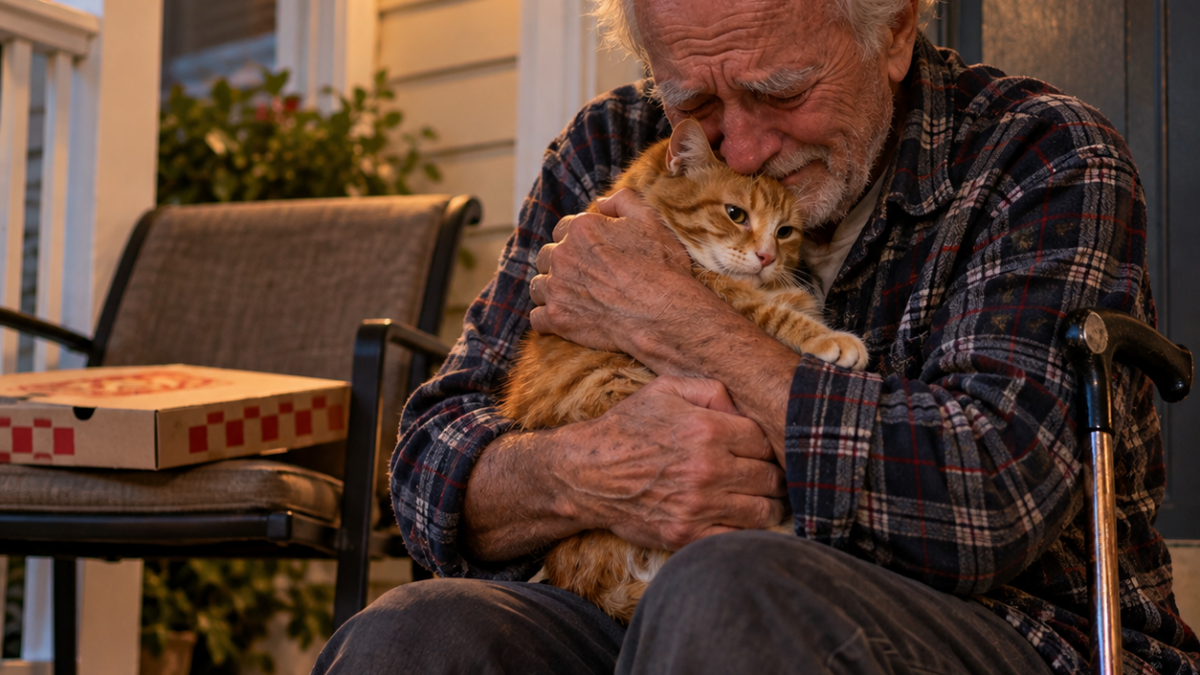
I took one picture.
Walter on the porch.
Penny against his chest.
His hand curved protectively over her back.
The yellow porch light behind him.
The closed pizza box visible on the chair.
Nothing staged.
Nothing beautiful in the conventional sense.
Just true.
“Thank you,” I said.
“No,” Walter replied.
“Thank you.”
I didn’t know his last name yet.
I didn’t know anything about his life.
I didn’t know why nobody spoke to him anymore.
I certainly didn’t know that photograph would eventually be seen by thousands of people.
I just got back into my Corolla.
My next delivery was forty-one minutes late.
A woman named Mrs. Chen opened the door before I could knock.
“I am so sorry,” I began.
She looked at my clothes.
Then my scratched arms.
“What happened to you?”
“Cat.”
She stared.
“Cat?”
“Long story.”
She took the pizza.
“Is the cat okay?”
“Yeah.”
“Then we’re good.”
She tipped me eight dollars.
I almost cried.
When I pulled away from her house, I had eleven missed notifications.
Four from Darren.
Two from the restaurant.
Several delivery app warnings.
One message.
CALL ME NOW.
I didn’t.
I drove back.
The Friday-night rush had slowed by the time I entered Bellini’s.
There were still customers waiting near the register.
Marisol was folding boxes.
Our cook, Andre, was cleaning the cutting table.
Darren stood behind the counter.
He saw me.
His expression changed.
“Office.”
I glanced at Marisol.
She gave me a look that said: What did you do?
I walked toward the back.
Darren followed.
Then apparently decided private humiliation wasn’t sufficient.
“Actually, no.”
He stopped beside the register.
“We’ll do this here.”
I turned.
“Do what?”
“Where’s the money for 214?”
“Didn’t charge him.”
Darren stared.
“You what?”
“The pizza was cold.”
“Because you chose to spend forty-five minutes playing animal control.”
“He’s eighty-five.”
“I don’t care if he’s a hundred and five.”
A customer near the soda cooler glanced over.
I lowered my voice.
“Can we talk in the office?”
“No. You clearly need this explained.”
My face warmed.
Marisol stopped folding boxes.
Darren pointed toward me.
“You don’t own the food.”
“I know.”
“So you don’t decide it’s free.”
“I’ll pay for it.”
“That isn’t the point.”
“What is the point?”
“The point is that you abandoned a delivery route.”
“I helped a customer.”
“You chased a cat.”
“He couldn’t.”
“And that is not your job.”
Something in me hardened.
I looked at Darren.
“No.”
He waited.
I continued.
“It wasn’t my job.”
For a moment, neither of us spoke.
Then he held out his hand.
“Bag.”
“What?”
“Delivery bag.”
I stared.
“You’re sending me home?”
“I’m suspending you.”
“For helping him?”
“For insubordination.”
I laughed because I genuinely thought he couldn’t be serious.
Wrong move.
Darren’s face went red.
“You think this is funny?”
“No.”
“You ignored my calls.”
“I was under a truck.”
“You deliberately ignored instructions.”
“Because his cat was under the truck.”
“This is a business.”
There it was.
Not a charity.
He didn’t even need to finish.
I untied my delivery bag from my belt.
Put it on the counter.
“How long?”
“Until Rosa decides.”
“Fine.”
“And you’re covering the nineteen forty-seven.”
“Fine.”
Darren shook his head.
“No.”
“What?”
“You don’t get to act like some hero here.”
Nobody had called me a hero.
I certainly hadn’t.
“I never said I was.”
“You created refunds. You made another customer wait. You cost this store money because you wanted to feel good about yourself.”
That hurt more than I expected.
Because for one second I wondered if he was right.
Was it selfish?
Had I decided my judgment mattered more than everybody else’s?
Then I pictured Walter gripping his cane.
She’s all I have left.
No.
I knew exactly what I would choose again.
“I’d do it again.”
Darren stared at me.
Then he smiled without warmth.
“That’s why you’re not driving tomorrow.”
I turned to leave.
“Eli.”
I stopped.
“If Rosa asks, I’m documenting this as route abandonment and unauthorized product loss.”
I looked back.
“Document whatever you want.”
Marisol’s eyes widened.
I walked out.
I didn’t feel brave.
I felt sick.
I needed that job.
Tuition was due in three weeks.
My checking account had $412.
My mother was already helping with my car insurance when she couldn’t really afford it.
On the drive home, I replayed every sentence.
Maybe I should have left the cat.
That thought lasted two seconds.
Then I saw Walter’s face again.
No.
I parked outside my apartment at 10:34 p.m.
And stayed in the car.
I didn’t turn off the engine.
I just sat there.
The photograph was still on my phone.
Walter and Penny.
Porch light.
Pizza box.
I zoomed in.
His hand looked fragile against the cat’s orange fur.
There was something about that hand.
The way his fingers curved around her.
Protective.
Afraid.
Like he still wasn’t completely convinced she couldn’t disappear again.
I thought about twenty doors I had knocked on that week.
A birthday party.
A couple arguing.
Some guy in a bathrobe.
Two teenage girls who tipped me entirely in quarters.
People reduced to addresses and receipts.
I had never considered what remained after the door closed.
Who ate alone.
Who didn’t.
Who had somebody to talk to.
Who waited all week for another human being to ring the bell.
At 11:02, Marisol texted.
DID YOU REALLY CRAWL UNDER A TRUCK FOR AN OLD MAN’S CAT?
I replied:
Unfortunately yes.
She answered:
Legend.
Then:
Darren is telling everyone you “stole a pizza.”
That sentence changed the temperature inside my car.
Stole?
I called her.
“What do you mean stole?”
“He says you gave away company property.”
“I said I’d pay.”
“I know.”
“Did he charge it to me?”
“I don’t know.”
“Rosa’s back Monday, right?”
“Supposedly.”
I rubbed my face.
“Whatever.”
“You okay?”
“Yeah.”
“You sound not okay.”
“I need the job.”
Marisol was quiet.
Then she said, “You did the right thing.”
I stared through the windshield.
“How do you know?”
“Because there’s no universe where the correct answer is leaving some eighty-year-old dude crying on his porch because your mozzarella sticks are getting cold.”
I laughed.
“Pizza.”
“Whatever.”
After we hung up, I went inside.
I cleaned the scratches.
Took a shower.
My phone buzzed near midnight.
Facebook notification.
I almost ignored it.
Then I saw my name.
A woman named Kayla Monroe had tagged Bellini’s Pizza in a post in our neighborhood community group.
I recognized her.
Pajama woman from the cat rescue.
The post showed a grainy picture taken from across the street.
Me lying under the pickup truck.
Only my legs and Bellini’s uniform were visible.
The caption said:
“Does anyone know this Bellini’s driver? Walter Hale’s cat Penny got loose during a delivery tonight. This kid spent almost an hour crawling under porches and cars trying to catch her while Walter, who can barely walk, waited on his front steps. He finally got Penny out from under my neighbor’s truck. That’s the kind of thing people should know about.”
I stared.
There were thirty-two comments.
Then thirty-five.
Then forty.
Mrs. Talbot had commented.
“His name is Eli. I saw the whole thing. He was wonderful with Walter.”
Another neighbor:
“Walter adores that cat. Glad she’s safe.”
Another:
“I’ve known Walter for 20 years. Penny means everything to him.”
Someone asked whether Bellini’s knew.
Kayla replied:
“I hope they do now.”
My stomach dropped.
Oh, great.
Darren was going to love this.
I considered messaging Kayla.
Taking it down.
Then another comment appeared.
“That’s my dad.”
The name was Claire Hale.
I clicked the profile before I could stop myself.
Woman in her late fifties.
Brown hair.
Family photos.
Lives in Pittsburgh.
The comment continued.
“I had no idea this happened tonight. Thank you to whoever helped him.”
Something about it felt strange.
That’s my dad.
I had assumed Walter had nobody.
Maybe Penny was the only one who spoke to him because nobody else existed.
Apparently somebody did.
I put the phone down.
The next morning at 8:14, Darren texted.
DO NOT COME IN TONIGHT.
At 8:19:
WE NEED TO MEET MONDAY WITH ROSA.
At 8:30:
AND TAKE DOWN ANY SOCIAL MEDIA POSTS ABOUT THE STORE.
I replied:
I didn’t post anything.
No response.
By noon, Kayla’s post had been shared eighty-seven times.
The comments had become a conversation about Walter.
People remembered his wife.
A woman named Margaret.
Someone said Walter and Margaret had lived on Willow Street for fifty-three years.
Someone else said Margaret had died two years earlier.
A former mail carrier wrote that Walter used to shovel three elderly neighbors’ sidewalks before doing his own.
Another person said he’d repaired kids’ bikes for free in his garage when their parents couldn’t afford a shop.
And then, slowly, a different theme emerged.
“Does anyone check on him?”
“I thought his daughter lived nearby.”
“No, she moved years ago.”
“Does Meals on Wheels go there?”
“I see him at the pharmacy sometimes.”
“He shouldn’t be alone.”
I kept thinking about that sentence.
She’s the only one who talks to me anymore.
At three that afternoon, I drove back to Willow Street.
I told myself I was checking on Penny.
That was partly true.
Mostly I wanted to know whether Walter had eaten the pizza.
I stopped at a pet store first.
Bought two cans of tuna-flavored cat food.
Then felt stupid.
Penny probably had food.
But I brought them anyway.
Walter answered after the third knock.
Penny was behind him.
Inside.
Safely.
He looked surprised.
“You came back.”
“Just checking whether this criminal made another escape attempt.”
Penny looked offended.
Walter smiled.
“No.”
I held up the cans.
“Peace offering.”
“For her?”
“Definitely not for you.”
He laughed and opened the door wider.
“Come in.”
I hesitated.
Then stepped inside.
The house was clean.
Very clean.
But it had the stillness of a place occupied by one person for a long time.
Old family pictures covered the walls.
A wooden clock ticked loudly in the living room.
There was a crocheted blanket folded across the couch.
Two recliners faced a television.
One looked used.
The other didn’t.
That empty chair told me almost everything before Walter did.
Penny walked beside him as he moved slowly toward the kitchen.
“Coffee?”
“I’m good.”
“I make terrible coffee.”
“Then I’m definitely good.”
Walter smiled again.
He moved carefully.
The cane was not optional.
I noticed pill bottles lined beside the toaster.
I also saw the pizza box from the night before.
Open.
One slice gone.
“You ate it.”
Walter glanced over.
“Of course.”
“It was cold.”
“I’ve eaten army food.”
“That bad?”
“Worse.”
He sat.
Penny jumped onto the chair beside him.
I sat across from them.
For a moment, it felt awkward.
We were strangers.
And yet the night before had skipped several stages strangers normally go through.
“You said something yesterday,” I began.
Walter looked at me.
I immediately regretted it.
“Never mind.”
“No.”
He seemed to know.
“About Penny.”
“Yeah.”
His eyes moved to the cat.
“Sounded dramatic, didn’t it?”
“I wasn’t going to say that.”
“You were thinking it.”
“I was thinking maybe I misunderstood.”
Walter stroked Penny’s head.
“My wife died twenty-seven months ago.”
“I’m sorry.”
“Margaret.”
He pointed toward a framed photograph on the wall.
Same porch.
Years earlier.
Walter looked stronger.
Beside him stood a small woman with silver hair and a bright red sweater.
Margaret.
Penny was in her arms.
“She found this fool behind a grocery store.”
He rubbed Penny’s ear.
“Skinny little thing. Ear infection. Fleas. Margaret spent eight hundred dollars saving a cat we didn’t need.”
“Sounds familiar.”
Walter smiled.
“She loved everything that needed saving.”
His smile faded.
“Then cancer got her.”
I said nothing.
“Forty-nine years married.”
He looked toward the unused recliner.
“People tell you grief gets easier.”
“Does it?”
“No.”
The answer came instantly.
“It gets familiar.”
That stayed with me.
He continued.
“You learn where it sits.”
His finger tapped his chest.
“You learn which grocery aisle makes it worse. Which song to turn off. Which side of the bed not to look at.”
Penny jumped onto his lap.
Walter’s hand immediately settled on her.
“Penny looked for Margaret for six months.”
My throat tightened.
“Every night around seven, Margaret sat in that chair.”
He nodded toward the empty recliner.
“Penny still goes there sometimes.”
“What about your family?”
I regretted asking as soon as I did.
Walter became still.
“There it is.”
“What?”
“The question.”
“Sorry.”
“No. Fair.”
He leaned back.
“I have a daughter.”
“Claire?”
His eyes snapped toward me.
“How do you know Claire?”
“Neighborhood post. She commented.”
Walter’s face hardened.
“What post?”
Uh-oh.
I showed him.
He read slowly.
His expression shifted from confusion to embarrassment.
“Good Lord.”
“You’re famous.”
“I don’t want to be famous.”
“You’re not. Penny is.”
That softened him.
He scrolled.
When he saw Claire’s comment, his thumb stopped.
That’s my dad.
Walter stared at those words.
For a long time.
Then handed back the phone.
“She hasn’t been here in fourteen months.”
“Why?”
He looked at me.
“I was an ass.”
That wasn’t the answer I’d expected.
He continued.
“After Margaret died, Claire wanted me to move near her.”
“Pittsburgh?”
“Outside Pittsburgh.”
“You didn’t want to.”
“I told her this is my house.”
“Reasonable.”
“I also told her she was trying to get rid of me.”
Less reasonable.
Walter stared at the table.
“She was worried because I fell in the bathroom.”
“Did you?”
“Yes.”
“You tell her?”
“Hospital did.”
He rubbed his jaw.
“She started talking about assisted living. Selling this place. Power of attorney.”
His voice tightened.
“I heard one thing.”
“What?”
“That she was waiting for me to die.”
He looked ashamed.
“I told her exactly that.”
I said nothing.
“She cried.”
Walter swallowed.
“I hadn’t seen Claire cry since her mother got sick.”
He turned Penny’s collar between his fingers.
“She said, ‘Dad, I’m trying to keep you alive.’”
“What happened?”
“I told her to leave.”
“And she did?”
“No.”
Walter laughed bitterly.
“That would’ve been easier.”
“She stayed another hour. Made food. Filled my pill box. Called my doctor.”
His eyes lowered.
“Then I told her she was just like her mother.”
I waited.
“Meaning?”
“Controlling.”
He winced.
“Margaret hated when I called her that.”
“Why’d you say it?”
“Because I wanted Claire to hurt.”
The honesty of that shocked me.
Walter looked straight at me.
“You’re young, so maybe nobody’s told you this yet.”
“What?”
“Old people can be cruel too.”
I didn’t know what to say.
“Pain doesn’t make you wise automatically.”
He scratched Penny beneath the chin.
“Sometimes it just makes you mean.”
After Claire left, they spoke twice by phone.
Both calls turned into arguments.
Then silence.
“I kept waiting for her to call.”
Walter said.
“She kept waiting for me.”
“Why don’t you call?”
“Because fourteen months becomes a wall.”
“No, it becomes fourteen months.”
He gave me a tired smile.
“Easy for you.”
“Probably.”
I stood.
“You have her number?”
He looked suspicious.
“Yes.”
“Then your phone works.”
“Yes.”
“Excellent.”
“Don’t start.”
“I won’t.”
I walked toward the door.
Walter followed slowly.
“Eli.”
I turned.
“Thank you.”
“For the tuna?”
“For coming back.”
I looked at him.
“You should call her.”
His jaw tightened.
“I knew there was a catch.”
Outside, I sat in my car.
A message waited from Marisol.
YOU NEED TO SEE THIS.
Screenshot.
Bellini’s employee group chat.
Darren had written:
“Reminder to all drivers: you are employees, not social workers or animal rescue volunteers. Unauthorized delays, giveaways, or route abandonment will result in termination.”
Below that:
“Food theft is theft even when you think you’re being generous.”
Food theft.
Again.
This time, anger replaced embarrassment.
I hadn’t stolen anything.
I’d offered to pay.
Darren knew that.
Why was he insisting on that word?
I called Marisol.
“He really hates you,” she said.
“I noticed.”
“You know what’s weird?”
“What?”
“Last month he accused Devon of missing cash too.”
Devon had been another driver.
He’d quit abruptly.
“What happened?”
“Darren said his settlement was short sixty bucks.”
“Was it?”
“Devon swore it wasn’t.”
I remembered.
At the time I’d assumed Devon screwed up.
Cash drivers settled receipts at the end of each shift.
Simple enough.
But Darren handled most of those settlements personally.
Marisol lowered her voice.
“And Jess got written up in August.”
“For cash?”
“Thirty-eight dollars.”
Something turned in my stomach.
“Why are you telling me this?”
“Because Andre says the register has been short a lot since Rosa started going to Cleveland.”
That didn’t prove anything.
But I thought about Darren’s urgency.
Stole.
The word he kept using.
Maybe he wasn’t just angry.
Maybe he needed a story.
Monday arrived.
I wore a button-down shirt to the meeting.
I don’t know why.
Probably because getting fired feels better in sleeves with buttons.
Rosa Bellini sat in the back office when I arrived at ten.
I’d always liked Rosa.
She was five-foot-nothing, wore reading glasses around her neck, and possessed enough energy to make people half her age feel lazy.
That morning she looked exhausted.
Darren stood beside the filing cabinet.
A paper lay on the desk.
Rosa pointed toward the chair.
“Sit.”
I did.
She studied my scratched arm.
“I saw the picture.”
Darren sighed.
“Rosa—”
She raised one hand.
He stopped.
Rosa looked at me.
“Tell me what happened.”
So I did.
Everything.
Delivery.
Penny escaping.
Walter panicking.
The chase.
Darren calling.
The cold pizza.
My offer to pay.
Darren’s expression remained flat.
When I finished, Rosa asked, “Did you give permission for the Facebook post?”
“No.”
“Did you contact media?”
“No.”
Darren scoffed.
“Media.”
Rosa ignored him.
She looked at Darren.
“Your report says Eli refused direct instruction, abandoned two active deliveries, failed to collect payment, ignored repeated calls, and misappropriated company product.”
“Yes.”
“Misappropriated?”
“He gave it away.”
“I offered to pay.”
Darren looked at me.
“That doesn’t make you the owner.”
Rosa removed her glasses.
“How much?”
“$19.47.”
She stared at Darren.
“You wrote four paragraphs over nineteen dollars?”
“It is the principle.”
Rosa leaned back.
“And you recommended termination.”
“He openly told me he’d do it again.”
Rosa looked at me.
“Would you?”
“Yes.”
Darren made a small noise of triumph.
I continued.
“If the same thing happened exactly the same way, yes.”
Rosa rubbed her forehead.
“Eli.”
“I know how it sounds.”
“No.”
She glanced toward my arm.
“I know exactly how it sounds.”
For a second, I thought I was safe.
Then Darren slid the paper forward.
“There’s more.”
He pointed.
“Saturday’s settlement review shows Eli’s Friday cash bag was short $67.47.”
My head lifted.
“What?”
“There was another fifty-dollar discrepancy.”
“No.”
Darren’s face remained calm.
“You signed the preliminary sheet.”
“I signed my mileage sheet.”
“You signed settlement.”
“No, I didn’t.”
Rosa looked between us.
“Eli?”
“I never settled Friday.”
That was true.
I’d been suspended before closing out.
Darren had taken my delivery bag.
My cash was still inside.
“I gave him my bag.”
Rosa turned toward Darren.
“You settled it?”
“Yes.”
“And it was short?”
“Yes.”
I felt cold.
“That is a lie.”
Darren shrugged.
“There it is.”
“Where’s the sheet?”
He produced it.
My name.
Orders listed.
Cash received.
A line near the bottom marked DRIVER SHORTAGE: $67.47.
Then a signature.
It looked vaguely like mine.
But it wasn’t.
I stared.
“I didn’t sign that.”
Darren laughed softly.
“Seriously?”
“I didn’t.”
Rosa took the page.
She knew my signature from payroll paperwork.
I could see uncertainty enter her face.
“Darren, when was this signed?”
“Before he left.”
“No.”
I stood.
“I never saw that.”
Darren’s voice sharpened.
“Sit down.”
I looked at him.
“Don’t talk to me like that.”
“Eli.”
Rosa’s tone stopped both of us.
I sat.
She studied the paper again.
“Do we have camera footage?”
Darren answered too quickly.
“Back office camera’s been unreliable.”
Rosa looked at him.
“Unreliable how?”
“Cuts out.”
“For how long?”
“I don’t know.”
Something had changed.
The meeting was no longer about me.
Not entirely.
Rosa folded her hands.
“Nobody is firing anybody this morning.”
Darren turned.
“Rosa—”
“I said nobody.”
She looked at me.
“You remain off schedule until I review this.”
My stomach fell.
“How long?”
“Give me until Wednesday.”
I couldn’t argue.
I stood.
Darren wouldn’t look at me.
As I reached the door, Rosa said, “Eli.”
I turned.
“For what it’s worth, I’m glad you caught the cat.”
Darren’s jaw moved.
I nodded.
“Me too.”
That afternoon, the local story got bigger.
Not because of me.
Because Claire Hale commented again.
She wrote that she’d spoken to her father for the first time in over a year.
I read that sentence three times.
Then another comment appeared beneath it.
Walter had apparently created Facebook years earlier and forgotten how it worked, because his profile picture showed him and Margaret at a county fair in 2016.
His comment was only seven words.
“Claire called. I was the stubborn one.”
The replies flooded in.
But I didn’t care about those.
Claire called.
I was the stubborn one.
I smiled alone in my apartment.
Then my phone rang.
Walter.
“Did you call her or did she call you?”
“She called me.”
“Coward.”
“Watch yourself.”
I laughed.
“How’d it go?”
There was a long silence.
Then Walter said, “I apologized.”
“How terrible was it?”
“Worst five minutes of my life.”
“Did you survive?”
“Unfortunately.”
“And?”
“She cried.”
His voice cracked.
“So did I.”
I didn’t joke after that.
Walter breathed slowly.
“She said she’s coming Saturday.”
“That’s good.”
“I’m scared.”
“Of your daughter?”
“No.”
He paused.
“Of finding out how much I missed.”
Saturday afternoon, Claire arrived on Willow Street.
I wasn’t there.
I didn’t need to be.
Walter told me later that Penny recognized her before he did.
Claire had barely reached the porch when Penny began meowing through the window.
Walter opened the door.
Father and daughter stood facing each other for several seconds.
Claire finally said, “You look awful.”
Walter replied, “You look expensive.”
Then both of them started crying.
She stayed eight hours.
Made him dinner.
Checked his medications.
Did not mention assisted living once.
Before leaving, she put three dates in his calendar for future visits.
Walter complained.
Claire ignored him.
Normal family behavior had returned before forgiveness was complete.
That seemed right.
My own situation got worse before it got better.
On Tuesday, Darren called me.
Not Rosa.
Darren.
“You need to come get your final check.”
My stomach dropped.
“Rosa fired me?”
“Position’s been terminated.”
“Rosa told me Wednesday.”
“Well, she reviewed things early.”
Something felt wrong.
“Put her on.”
“She’s unavailable.”
“Then I’ll call her.”
“Don’t.”
That one word told me everything.
I hung up.
Called Bellini’s main number.
Andre answered.
“Hey.”
“Rosa there?”
A pause.
Then quieter:
“Yeah.”
“Put her on.”
Another pause.
“Uh… Darren told us you quit.”
I closed my eyes.
“What?”
“He said you admitted taking cash and quit.”
My heart started hammering.
“Get Rosa.”
Thirty seconds later:
“Eli?”
“Did I get fired?”
Silence.
“No.”
“Darren just told me to pick up my final check.”
Another silence.
Longer.
“Did he?”
Her voice had changed.
“Yeah.”
“Do not come to the store.”
“Why?”
“Because I’m asking you not to.”
“What is happening?”
“I’ll call you.”
She hung up.
I sat on my couch staring at the wall.
Ten minutes passed.
Twenty.
At forty minutes, Marisol texted.
OH MY GOD.
Then:
ROSA JUST LOCKED DARREN OUT OF THE OFFICE.
I called.
She whispered when she answered.
“Something is happening.”
“What?”
“Accountant’s here.”
“Why?”
“Remember Devon?”
“Yes.”
“Rosa called him.”
My stomach tightened.
“And Jess.”
Another message came while we were talking.
From an unknown number.
This is Devon. Marisol gave me your number. Did Darren claim your cash settlement was short?
I replied:
Yes. $67.47. I didn’t sign it.
Typing bubbles.
Then:
Mine was $63.
Another message.
I never signed mine either.
There it was.
Not proof.
But enough to make my hands shake.
By Tuesday evening, Rosa knew more.
For months, cash discrepancies had been blamed on drivers.
Small amounts.
Thirty dollars.
Sixty.
Eighty.
Never large enough to trigger panic.
Drivers either repaid them, accepted write-ups, or quit.
Darren controlled the reconciliation sheets.
He also handled voided orders.
And on nights when drivers were “short,” corresponding cash adjustments appeared in the system.
Rosa’s accountant had assumed the restaurant was dealing with sloppy employees.
Then my sheet surfaced.
A sheet carrying a signature I said wasn’t mine.
Rosa stopped assuming.
The back-office camera wasn’t broken either.
Darren had unplugged it.
But the main kitchen camera captured part of the doorway.
And Friday night’s footage showed me walking out after Darren took my delivery bag.
It also showed something else.
Darren carrying that bag into the office nineteen minutes later.
Alone.
Rosa pulled bank deposit records.
Register logs.
Voids.
Driver settlements.
What began as a cold pizza turned into an audit.
By Wednesday morning, Darren had been suspended.
By Thursday, Rosa had found more than $7,000 in unexplained cash adjustments over eight months.
She called police.
I learned all of this slowly.
Rosa did not post details online.
Neither did I.
It became a legal matter.
What mattered to me was simpler.
My $67.47 shortage disappeared.
So did Devon’s.
So did Jess’s.
Drivers who had repaid money after false shortages received checks.
And Darren never managed another shift at Bellini’s.
The irony wasn’t lost on anyone.
He had called me a thief in front of customers over a nineteen-dollar pizza.
His own insistence on documenting my supposed theft created the paper trail that exposed him.
Rosa asked me to meet her Thursday morning.
This time the office door was open.
No Darren.
Just Rosa.
She placed an envelope on the desk.
Inside was payment for my suspended shifts.
I looked at her.
“You don’t have to do that.”
“Yes, I do.”
“I didn’t work.”
“You were removed from the schedule because I failed to understand what was happening in my store.”
“That’s not your fault.”
She stared at me.
“Don’t get generous with other people’s accountability.”
I smiled despite myself.
That sounded like Rosa.
She took a breath.
“I owe you an apology.”
“You didn’t accuse me.”
“I allowed somebody else to.”
She looked toward the kitchen.
“My father started this place because he liked feeding people.”
I waited.
“When I was seventeen, a man came in with three kids and ordered one small cheese pizza.”
She smiled faintly.
“He counted coins on the counter.”
“My father made a large.”
“Charged him for the small.”
“Then added breadsticks.”
She shook her head.
“I told Dad he was terrible at business.”
“What’d he say?”
“He said, ‘Rosa, if nineteen dollars decides whether this place survives, we deserve to close.’”
I laughed.
She didn’t.
“Darren forgot what kind of restaurant this is.”
Then she looked at me.
“I almost did too.”
She pushed another paper across the desk.
“Your schedule.”
I looked at it.
“You’re giving me my job back?”
“If you still want it.”
I didn’t answer immediately.
Part of me wanted to say no.
Pride.
Anger.
Fear.
But the truth was that I needed the job.
And Bellini’s had never really been the problem.
Darren was.
“I want one thing.”
Rosa raised an eyebrow.
“No more calling cash shortages theft until somebody actually knows what happened.”
“Done.”
“And Marisol gets first pick on Saturday routes for two weeks.”
“Why?”
“She covered mine.”
Rosa smiled.
“Done.”
“And Walter Hale gets a hot pizza.”
She leaned back.
“Now you’re negotiating recklessly.”
“Medium mushroom and sausage.”
“Light cheese?”
I looked at her.
“You remember?”
“I’ve been doing this thirty years.”
Friday night, exactly one week after Penny escaped, I drove back to 418 Willow Street.
This time the pizza was hot.
Rosa had written PAID across the receipt.
Underneath:
“House account.”
Walter opened the door.
Penny was nowhere near his feet.
Because Claire had installed a tall baby gate behind the screen door.
I pointed.
“Smart.”
Walter scowled.
“My daughter.”
“Definitely smart.”
“Don’t encourage her.”
Claire appeared from the kitchen.
“You must be Eli.”
I had never met her.
She looked like Walter around the eyes.
Same stubbornness.
Different generation.
She hugged me before I could react.
“Thank you.”
“Apparently everybody thanks me for being attacked by your cat.”
“Penny isn’t my cat.”
Penny appeared behind the gate.
I pointed.
“Enemy.”
Claire laughed.
Walter took the pizza.
“How much?”
“Paid.”
“By who?”
“Restaurant.”
“I don’t accept charity.”
“It’s not charity.”
“What is it?”
I thought.
“Delayed customer service.”
He grumbled but let me inside.
For the next hour, I ate pizza with an eighty-five-year-old man, his daughter, and the cat who had accidentally blown up my job.
Claire had driven from Pennsylvania again.
She and Walter were still figuring things out.
I could tell.
She corrected how he took his medication.
He got irritated.
He complained that she moved things.
She accused him of surviving entirely on canned soup.
He told her canned soup was civilization’s greatest achievement.
At one point, Claire said, “You need a shower bar installed.”
Walter said, “I need you to stop installing me.”
She stared at him.
Then both started laughing.
That was their reconciliation.
Not some cinematic speech.
Not instant healing.
Argument.
Pizza.
Familiar irritation.
Love trying to remember its old shape.
After Claire left the room, Walter leaned toward me.
“She wants me to wear one of those emergency buttons.”
“You should.”
“You’re on her side.”
“Absolutely.”
“Traitor.”
Penny climbed into his lap.
Walter scratched her ears.
“You know, Margaret would’ve liked you.”
That caught me off guard.
“Why?”
“Because you’re nosy.”
I laughed.
“She was nosy?”
“Terribly.”
He grew quiet.
“She would have chased Penny too.”
“Your wife could crawl under a pickup?”
“At eighty-two?”
He considered it.
“She would’ve tried.”
I looked at the empty recliner.
It didn’t look quite as empty anymore.
Maybe because Claire’s coat was draped across it.
Over the next several months, Walter became one of my regular customers.
Though “customer” stopped being accurate.
He ordered every Friday.
Medium pizza.
Usually sausage and mushroom.
Sometimes pepperoni.
Every single time, Penny was secured before the door opened.
Very secured.
Claire bought a second gate.
Walter accused her of turning his home into a federal prison.
She told him to stop being dramatic.
I usually spent ten or fifteen minutes inside after delivering.
Technically against policy.
Rosa knew.
She never mentioned it.
Walter showed me old photographs.
He had been a mechanic for the city transit department for thirty-eight years.
He and Margaret married when he was twenty-five.
They lost a son at birth before Claire.
Walter told me that once and never mentioned it again.
Some grief remained private even after sixty years.
He told me about Claire learning to ride a bicycle.
About Margaret getting drunk at their thirtieth anniversary party and trying to dance on a folding chair.
About the time Penny destroyed a Christmas tree.
He also told me things he wasn’t proud of.
How he had worked too much when Claire was young.
How Margaret begged him to retire two years before he finally did.
How, after her death, he stopped answering people’s calls because pity made him angry.
How friends eventually stopped making them.
“That’s the part nobody tells you,” Walter said one Friday.
“What?”
“Loneliness can become something you help build.”
I looked at him.
He continued.
“At first you’re alone because something happens.”
His hand rested on Penny.
“Then somebody calls and you don’t answer.”
“Somebody invites you somewhere and you say no.”
“You tell yourself they don’t understand.”
“Eventually they stop asking.”
He stared toward the window.
“Then you get to complain that nobody comes around.”
There was no self-pity in his voice.
Just recognition.
Claire started visiting every other weekend.
Then weekly when her work schedule allowed.
She installed grab bars.
Organized groceries.
Found a physical therapist.
Walter complained about all of it.
He also started shaving before she arrived.
I noticed.
So did Penny.
One night in January, I delivered during heavy snow.
Claire’s SUV was in the driveway.
Two little kids were building a terrible snowman in the front yard.
“Who are they?”
“My grandchildren,” Walter said.
I stopped.
“You have grandchildren?”
“Apparently.”
A girl around nine ran past us.
“Grandpa, Ben threw snow at me!”
Walter yelled back, “Throw some back!”
Claire appeared.
“Dad!”
“What?”
“Do not encourage warfare.”
The boy threw another snowball.
Walter laughed harder than I’d ever heard him laugh.
Penny watched from the window.
The house no longer seemed still.
That affected me more than I expected.
Because something else had been happening during those months.
Walter wasn’t the only person learning things about loneliness.
My father left when I was thirteen.
Not vanished.
Not dead.
Just left.
Moved to Texas with a woman he’d met through work.
Called regularly at first.
Then monthly.
Then birthdays.
Then sometimes not birthdays.
By twenty-two, I had convinced myself I didn’t care.
My mother raised me.
She was enough.
My father had made his choice.
Simple.
Except people aren’t simple when you’re alone in your car after midnight thinking about an old man who hadn’t spoken to his daughter for fourteen months because neither person wanted to be the first to admit they were hurt.
One night, Walter asked about my family.
I told him.
Not everything.
Enough.
He listened.
Then said, “Call your father.”
I almost laughed.
“No.”
“Why?”
“Because you’re projecting.”
“Probably.”
“He left us.”
Walter nodded.
“Then tell him.”
“He knows.”
“You’d be amazed what people can avoid knowing.”
“I don’t need him.”
“That wasn’t what I asked.”
I looked at Walter.
“I helped you get your daughter back and now you’re weaponizing wisdom?”
“Yes.”
“That seems unfair.”
“Life.”
I did not call my father that night.
Or the next week.
I waited nineteen days.
Then at 11:40 on a Wednesday evening, I found his number.
Stared at it.
Nearly deleted it.
Instead I texted:
You awake?
He called less than thirty seconds later.
“Eli?”
His voice sounded older.
I hated how immediately familiar it was.
“Yeah.”
“Everything okay?”
I almost said yes.
Then remembered Walter.
“No.”
We talked for an hour and seventeen minutes.
I didn’t forgive him.
That matters.
He apologized.
That also matters.
He admitted things I had spent years needing him to admit.
That leaving had been selfish.
That he had mistaken financial support for fatherhood.
That calling less often became easier than hearing how angry I sounded.
That shame turned into avoidance.
That avoidance became years.
I told him my high school graduation had one empty seat.
He cried.
I didn’t.
At least not until after the call.
Healing, I learned, is not the same thing as pretending something didn’t happen.
Sometimes healing is finally naming exactly what did.
By spring, Bellini’s felt different.
Rosa promoted Marisol to evening supervisor.
Marisol immediately made a sign for the employee board.
“THIS IS A BUSINESS, BUT WE ARE ALSO HUMAN BEINGS.”
Rosa pretended to hate it.
It stayed.
The police investigation involving Darren moved slowly.
I was interviewed once.
Then again.
Eventually he was charged with theft and falsifying business records.
I don’t know every legal detail.
I didn’t follow every court date.
I heard he took a plea agreement and was ordered to repay money.
Some people wanted me to feel triumphant.
I didn’t.
Mostly I felt tired.
Darren had spent months making younger employees doubt themselves while quietly taking advantage of a system he controlled.
That bothered me more than the money.
Devon had quit because he’d believed maybe he’d made a mistake.
Jess had paid back cash she didn’t owe.
I had nearly been fired as a thief.
Darren’s biggest weapon had not been authority.
It had been certainty.
He said things confidently enough that people assumed they must be true.
The last time I saw him was outside municipal court.
I had been asked to attend a hearing.
He stood near the entrance.
No Bellini’s shirt.
No manager’s keys.
Just a man in a gray coat.
For a second, we looked at each other.
I expected anger.
Maybe an apology.
He gave neither.
He looked away.
I realized then that justice isn’t always dramatic.
Sometimes nobody gives the perfect speech.
Sometimes the person who humiliated you simply loses the power they misused.
Sometimes you walk past them.
That is enough.
Summer came.
I graduated.
Associate degree.
Nothing fancy.
But mine.
My mother screamed when my name was called.
Marisol came.
Rosa came.
I did not expect Walter.
At eighty-six by then, walking long distances had become difficult.
But halfway through the ceremony, I spotted Claire pushing a wheelchair through the accessible entrance.
Walter sat in it looking deeply offended.
Penny was not there.
Apparently the college had standards.
Afterward, Walter handed me an envelope.
“What’s this?”
“Open it.”
Inside was a graduation card.
Twenty dollars.
I looked at him.
“You are unbelievable.”
“You refused my tip.”
“That was almost a year ago.”
“I hold grudges.”
I tried giving it back.
He closed my fingers around the bill.
“Buy yourself something good.”
I laughed.
“You remembered.”
“I’m old, not dead.”
Then he hugged me.
Walter wasn’t a hugger.
That made it worse.
His voice was quiet beside my ear.
“Margaret would be proud of you.”
I had to turn away afterward.
A month later, I was accepted into a bachelor’s program at Ohio State.
I couldn’t afford to stop working.
So I kept delivering pizzas.
People assumed I’d hate that.
I didn’t.
The job had become different.
Or I had.
Doors weren’t just doors anymore.
A man named Mr. Alvarez ordered every Sunday because his wife worked nights and pizza was the one dinner his autistic son reliably ate.
Mrs. Chen always tipped eight dollars because she had once waited tables through nursing school and remembered what four dollars meant when you’re broke.
A widower on Madison Avenue ordered two pizzas every Friday even though he lived alone because three neighborhood kids came over to play chess.
A woman named Tanya ordered garlic bread whenever her husband traveled because he hated garlic and she loved it.
Lives.
Behind every door.
Ordinary.
Complicated.
Invisible until someone stands still long enough to notice.
Almost exactly one year after Penny escaped, I received another order for 418 Willow Street.
I smiled when the ticket printed.
Medium sausage and mushroom.
Light cheese.
Then I noticed something.
Two large pizzas.
Breadsticks.
Salad.
Chocolate cake.
“This isn’t Walter’s normal order,” I told Marisol.
She looked at the screen.
“Maybe Penny’s hungry.”
When I arrived, cars filled the street.
For one terrible moment, I thought something had happened.
Then I saw balloons.
A banner hung across the porch.
HAPPY 87TH, WALTER.
Claire opened the door.
“Pizza!”
Behind her, the house was full.
Neighbors.
Family.
Two grandchildren.
Mrs. Talbot.
Kayla.
People I recognized from that night.
Walter sat in his recliner wearing a paper birthday hat and pretending to hate every second.
Penny slept in his lap.
I carried the pizzas inside.
Walter saw me.
“There he is.”
Everybody turned.
I suddenly wanted to disappear.
Claire grinned.
“Dad tells the cat story to literally everyone.”
“I’ve heard it three times,” her son-in-law said.
“Four,” Walter corrected.
Someone laughed.
Walter pointed toward me.
“That boy saved Penny.”
I set down the pizza.
“I caught Penny.”
“Same thing.”
“No.”
He looked at me.
I understood why the distinction mattered.
Saving sounded too big.
Too heroic.
I had simply stayed.
Maybe staying was sometimes enough.
After food was served, Claire brought out a photo album.
One picture stopped me.
It was the photograph from that first night.
Walter on the porch.
Penny against his chest.
Pizza box on the chair.
Claire had printed it.
Underneath she’d written the date.
October 17.
“Dad keeps this by his bed,” she said.
Walter glared.
“You don’t need to announce everything.”
Claire ignored him.
Then she turned the page.
Another photograph.
Walter and Claire.
The first Saturday after their phone call.
Another.
Walter with his grandchildren.
Another.
Christmas.
Another.
Easter.
Another.
Penny wearing a ridiculous red bow.
I understood suddenly that the photograph I had taken wasn’t an ending.
It was the last picture before things started changing.
Walter must have seen something on my face.
“You all right?”
“Yeah.”
I sat beside him.
“Just thinking.”
“Dangerous.”
“I know.”
The party continued.
Children yelling.
Adults arguing over cake.
Someone turned on music.
Walter complained it was too loud.
Nobody listened.
Penny eventually escaped his lap.
Not outside.
She simply moved to the windowsill.
She sat there watching everybody.
At one point, Walter leaned toward me.
“Remember what I told you that night?”
I knew exactly what he meant.
She’s the only one who talks to me anymore.
“Yeah.”
He looked around the room.
Claire was cutting cake.
His granddaughter argued with her brother.
Mrs. Talbot was showing Kayla something on her phone.
Penny’s tail moved lazily against the glass.
Walter smiled.
“Not true anymore.”
That was all.
Not true anymore.
I swallowed.
“Good.”
He nodded.
Then, because he was Walter, he ruined the moment.
“Pizza’s getting cold.”
“You are impossible.”
“So I’ve been told.”
When my shift ended that night, I sat in my car outside Bellini’s.
Same as I had a year earlier.
But everything felt different.
The first time, I’d sat there wondering whether I had ruined my job over a cat.
I’d been scared.
Angry.
Broke.
Unsure.
Now I knew something I hadn’t known then.
The pizza never mattered.
Not really.
Darren thought the story was about a $19.47 product leaving the store without payment.
I thought, for a while, the story was about whether helping Walter had been worth getting punished.
The neighborhood thought it was about a pizza driver doing something nice.
Walter thought it was about Penny.
Claire might say it was about a phone call that should have happened fourteen months earlier.
Rosa probably thought it was about recognizing what kind of business she wanted her family’s restaurant to be.
Devon and Jess would probably say it was about discovering they had never been thieves.
My father might say it was about one unexpected text from a son he’d failed.
All of those things were true.
But none were complete.
I think the story was about doors.
I know that sounds strange.
But hear me out.
I spent a year knocking on doors.
You see almost nothing.
A hand reaches out.
A face appears.
Money changes hands.
You leave.
We assume the few seconds we witness tell us something about the person inside.
Old.
Rich.
Poor.
Rude.
Lonely.
Happy.
Busy.
Cheap.
Generous.
We reduce people because it’s efficient.
Then the door closes.
But lives continue behind it.
Walter’s door looked ordinary.
Small white house.
One porch light.
Old man.
One pizza.
I had no idea grief lived inside.
No idea Margaret’s empty chair was in the living room.
No idea Claire’s photographs were still on the wall.
No idea pride had turned into loneliness.
No idea a cat named Penny had become one man’s final daily conversation.
If Penny hadn’t slipped through that door, I would have handed Walter his pizza.
He would have handed me twenty-five dollars.
I would have given him change.
Maybe he would have tipped three dollars.
I would have said, “Have a good night.”
He would have said, “You too.”
Door closed.
Gone.
That’s how close we come to people’s lives without ever entering them.
Six inches.
Two seconds.
One orange cat.
That was the difference.
People still occasionally mention the story.
Someone will recognize me at Bellini’s.
“You’re the cat guy.”
Wonderful legacy.
Marisol once had a T-shirt printed for me.
PENNY’S PERSONAL SECURITY.
I refused to wear it.
Then secretly kept it.
Penny herself never became friendlier toward me.
This is important.
After everything I did, that cat still treats me like someone who owes her money.
I visit Walter, and Penny watches me suspiciously.
Sometimes she’ll allow me to scratch her head.
Then she’ll remember her reputation and walk away.
Walter thinks this is hilarious.
“She hasn’t forgotten the truck.”
“Neither has my spine.”
“You scared her.”
“She shredded me.”
“She was afraid.”
“So was I.”
“She weighs nine pounds.”
“Of concentrated violence.”
Walter laughs every time.
He’s slowing down now.
We all see it.
His walking is worse.
Claire convinced him to stop driving.
That argument lasted three weeks.
He finally handed her the keys after backing into his own mailbox.
He claims the mailbox moved.
Nobody believes him.
Claire and her husband are looking into renovating a downstairs room in their home so Walter can eventually move closer.
The first time she mentioned it, I waited for the explosion.
Walter sighed.
Then asked one question.
“Penny comes?”
Claire said, “Obviously.”
“Then maybe.”
Maybe.
For Walter, that’s basically a signed contract.
A few weeks ago, I delivered his Friday pizza again.
Rain hammered the street.
Cold rain.
The kind that makes getting out of the car feel personal.
I ran to the porch.
Walter opened the door.
Penny sat safely behind the gate.
“Terrible night,” he said.
“You ordered pizza.”
“That’s why God invented delivery drivers.”
“I don’t think that’s the theology.”
“Get inside.”
I stepped in.
Claire had gone back to Pennsylvania that morning.
The house was quiet.
But not lonely.
There is a difference.
Photographs of the grandchildren now covered the refrigerator.
A calendar listed Claire’s next visit.
A neighbor had dropped off soup.
Walter’s physical therapist was coming Tuesday.
Penny had three different beds, none of which she used.
Walter paid for the pizza.
Then handed me five dollars.
I accepted it.
We had finally reached a compromise.
No twenty-dollar guilt tips.
Regular customer rules.
As I turned to leave, Walter said, “Eli.”
I looked back.
Penny had jumped onto his lap.
“What?”
“You ever wonder what would’ve happened if you’d left that night?”
I thought about it.
“Sometimes.”
“I do.”
His hand moved across Penny’s back.
“She might’ve come home.”
“Probably.”
“She might not.”
I didn’t answer.
Walter looked toward the dark window.
“I couldn’t have gone after her.”
“I know.”
“I think that’s what scared me.”
His voice grew quiet.
“Not losing a cat.”
“Being too old to save something I loved.”
That sentence hit harder than the original one.
I sat back down.
Walter looked embarrassed.
“Getting sentimental.”
“You’re eighty-seven. You’re allowed.”
“Says who?”
“I just decided.”
He nodded.
“Fair.”
Penny purred.
Walter looked at her.
“You know what Margaret used to say?”
“What?”
“That people think love is a feeling.”
“She said it was mostly chores.”
I laughed.
“Very romantic.”
“She was right.”
He counted lightly on his fingers.
“Driving somebody to the doctor.”
“Getting groceries.”
“Changing litter.”
“Calling even when you’re mad.”
“Chasing a fool cat in the dark.”
He looked at me.
“Staying.”
There it was again.
Staying.
Maybe that’s the thing I learned.
We tell ourselves kindness has to be dramatic to matter.
It doesn’t.
Most kindness is inconvenient.
That’s why it counts.
It happens when you’re late.
When you’re tired.
When your manager is calling.
When the pizza is getting cold.
When the person in front of you cannot do anything useful for you in return.
Kindness costs something.
Usually not everything.
But something.
Time.
Money.
Pride.
Comfort.
Forty-five minutes lying on cold asphalt.
A conversation you don’t want to have.
An apology fourteen months overdue.
A phone call to a father you’ve spent years pretending you don’t miss.
We don’t become good people by having good intentions while nothing is required of us.
The decision only becomes real when there is a reason not to make it.
I had plenty of reasons to leave Penny that night.
My next customer was waiting.
Darren was angry.
I needed my job.
I was in uniform.
It was dark.
The cat wasn’t mine.
Walter wasn’t my grandfather.
Technically, none of it was my problem.
That’s the phrase people use.
Not my problem.
And they’re often right.
We cannot fix every stranger.
We cannot stop for every crisis.
We cannot carry everyone’s loneliness.
But sometimes life puts one frightened person directly in front of you.
One moment.
One decision.
One thing you actually can do.
Then maybe the question isn’t whether it’s your problem.
Maybe the question is who you want to be while it is happening.
I got lucky.
My decision had a happy ending.
Penny came home.
I got my job back.
Darren’s lies were uncovered.
Walter called Claire.
Claire came home.
My father and I started talking again.
Not every act of kindness receives that kind of reward.
Most don’t.
You help somebody and never know what happens afterward.
You hold an elevator.
Jump a battery.
Pay for a meal.
Sit beside somebody in a hospital.
Listen five minutes longer than you planned.
Then everybody returns to their own lives.
No viral post.
No justice.
No perfect ending.
It still matters.
A few days after Walter asked what would’ve happened if I’d left, Rosa called me into the kitchen.
“Your boy ordered again.”
“Walter?”
“Who else?”
She handed me the receipt.
I checked the bottom.
There was a note in the special instructions.
PLEASE MAKE DRIVER ELI. PENNY LIKES HIM.
I stared.
“That’s a lie.”
Rosa laughed.
“Customer’s always right.”
“Penny hates me.”
“Then go defend yourself.”
I drove to Willow Street.
Evening sun.
Warm air.
No rain.
No crisis.
Walter’s porch light wasn’t needed yet.
I carried the pizza up.
Before I reached the door, it opened.
Not Walter.
Claire.
“Hey.”
“Hey.”
Then I heard a familiar voice.
“Who is it?”
“Your pizza boyfriend!”
Walter shouted, “He’s too young!”
I shook my head.
“I regret saving that cat.”
Claire laughed.
Behind the gate, Penny appeared.
She meowed.
Walter entered slowly from the living room.
He looked older than he had one year before.
Smaller.
But he was smiling.
“There he is.”
“Got your pizza.”
“How cold is it?”
I stared.
Walter grinned.
I handed it over.
“Get inside.”
“I have deliveries.”
“One slice.”
“Walter.”
“You’re getting skinny.”
“I am absolutely not.”
“One slice.”
So I stayed.
Ten minutes became thirty.
Claire told me they had officially decided Walter would move to Pennsylvania after Christmas.
Walter complained that everybody was kidnapping him.
“You agreed,” Claire said.
“I agreed under emotional pressure.”
“You demanded a sunroom for Penny.”
“Necessary.”
“And your recliner.”
“Medical equipment.”
“And the garage cabinet full of forty-year-old screws.”
“Historical archive.”
Claire looked at me.
“You see what I’m dealing with?”
“I refuse involvement.”
Penny jumped onto the table.
Three people yelled, “No.”
She jumped down.
Walter pointed.
“See? She listens to me.”
“She listened to all of us.”
“Mostly me.”
I watched them.
Father.
Daughter.
Cat.
Pizza.
Nothing extraordinary.
That’s what made it extraordinary.
When I eventually stood to go, Walter walked me to the door.
Claire stayed in the kitchen.
He lowered his voice.
“You know, this might be one of your last deliveries here.”
I looked around.
The old house.
Margaret’s photographs.
The empty recliner that wasn’t quite empty anymore.
“Yeah.”
“Fifty-five years.”
“You gonna miss it?”
“Every day.”
“Still moving?”
He looked toward Claire.
“Yes.”
No hesitation.
That mattered.
“Sometimes staying isn’t the brave thing,” he said.
I smiled.
“You’ve been saving that line?”
“Maybe.”
“Pretty good.”
“I know.”
Penny rubbed against his ankle.
Walter looked down.
“Besides.”
He smiled.
“I’m taking what matters.”
I stepped onto the porch.
Walter remained in the doorway.
Penny safely behind his legs.
For a second, I saw him exactly as he had been that first night.
Plaid shirt.
Cane.
Porch light.
Old man in a quiet house.
Except now I knew what was behind the door.
A wife who had been loved for forty-nine years.
A daughter who had been hurt.
A father too proud to apologize until loneliness became unbearable.
A cat who held what was left together long enough for humans to catch up.
And an ordinary life that had almost remained invisible to me forever.
“Drive safe,” Walter said.
“You too.”
He raised his eyebrows.
“Very funny.”
I walked toward my car.
Then he called my name.
I turned.
Walter stood there holding Penny.
Not because she was trying to escape.
Just because he wanted to hold her.
“Eli.”
“Yeah?”
“Thank you for not leaving.”
For a moment, I thought he meant that first night.
Maybe he did.
But I think he meant more.
I nodded.
“Anytime.”
Then the door closed.
I got into my car.
Another pizza waited in the insulated bag.
Another address.
Another stranger.
Another door.
I started the engine.
And before pulling away, I looked once more at Walter’s house.
Through the front window I could see movement.
Claire crossed the living room.
Walter followed slowly.
Penny jumped onto the back of the couch.
Three shapes beneath one warm light.
A year earlier, Walter had held that cat against his chest and told me she was the only one who talked to him anymore.
Now I couldn’t imagine that house quiet.
Maybe that is what I actually delivered that night.
Not a pizza.
Certainly not on time.
Maybe I delivered forty-five minutes.
Forty-five inconvenient minutes in which an old man’s fear became somebody else’s concern.
Forty-five minutes that made a neighbor take a picture.
A picture that made a daughter call.
A call that opened a door pride had kept closed.
A missing nineteen-dollar payment that exposed thousands of dollars in lies.
A story that eventually made a twenty-two-year-old kid look at his own father’s phone number differently.
None of that was planned.
That’s another thing life doesn’t tell you.
The moment that changes everything rarely looks important while you’re standing inside it.
It looks like a delay.
An inconvenience.
A mistake.
A cat under a truck.
A cold pizza.
A manager yelling.
You only see the shape later.
If Penny hadn’t escaped, I would have been gone in ninety seconds.
Walter would have eaten dinner alone.
Claire might have waited another month.
Or another year.
Maybe Darren’s theft would have continued longer.
Maybe I would still think some doors contained nothing but customers.
Maybe Walter and I would never have become friends.
Maybe my father and I would still communicate through birthday texts.
Instead, one stubborn orange cat ran into the dark.
And a lot of people followed.
These days, whenever a delivery takes me past Willow Street, I glance toward number 418.
Soon another family will probably live there.
The porch will change.
Somebody might remove the old green shutters.
The hydrangeas may get cut down.
New cars will sit in the driveway.
Nobody passing the house will know that an eighty-five-year-old man once stood beneath that porch light gripping a cane while a pizza driver crawled under a truck for the only creature he thought he had left.
Nobody will know how afraid he was.
Nobody will know how much changed afterward.
That’s okay.
Most important places look ordinary after the important moment ends.
I still have the picture.
Walter holding Penny.
His hand against her back.
Pizza box beside him.
Porch light behind them.
When I first took it, I thought I was photographing a man who had almost lost his cat.
Now I know better.
I was photographing a man about three days before he got his daughter back.
A few months before his grandchildren filled his yard with snowballs.
A year before his eighty-seventh birthday party filled the house with people.
I was photographing a lonely man at the exact moment loneliness began losing its grip on him.
And maybe that is why the photograph still gets me.
Because Walter was wrong that night.
Penny wasn’t all he had left.
She was simply the one who stayed close enough to remind him there were still others worth reaching for.
And Penny?
Penny has never apologized for any of it.
Not the escape.
Not the scratches.
Not nearly getting me fired.
Nothing.
Honestly, I respect that.
She lives like she knows exactly what she did.
Maybe she does.
Maybe somewhere in that tiny orange head, she decided an old man had been alone long enough.
So she ran.
And the rest of us finally caught up.








