An 8-Year-Old Girl Who Hadn’t Spoken in 3 Years Walked Straight Toward a 15-Pound Stray That Had Already Bitten Two Rescuers—Then the Cat Smelled Her Father’s Jacket and Suddenly Stopped Hissing.
PART3:
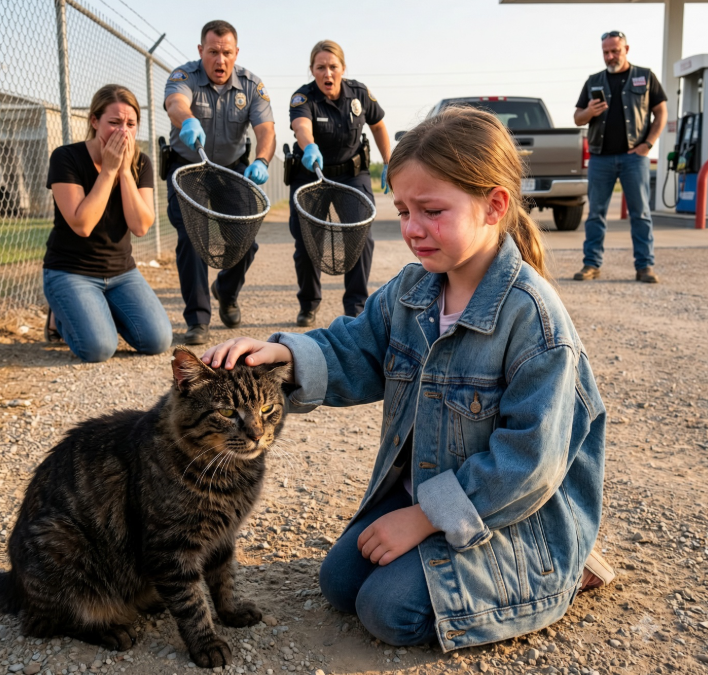
She was wearing Jake’s oversized denim jacket, sleeves rolled up half a dozen times, tiny sneakers crunching softly on the gravel. Her hair was tied in two uneven braids because I had never been as good at braids as Jake. The jacket hung around her like armor.
One worker lunged toward her.
“Get her back!”
I dropped my purse and moved, but I was too far.
The cat’s hissing rose.
His back arched.
The net lifted.
Everything happened too fast and too slowly at the same time.
Then Lily stepped within three feet of the fence.
The hissing stopped.
Abruptly.
Completely.
The massive cat froze.
His torn ears twitched.
His nose lifted.
He leaned his battered head forward, breathing hard, sniffing the air around my daughter.
No.
Not my daughter.
The jacket.
Jake’s jacket.
That old denim still carried something I could not smell anymore.
Motor oil.
Worn leather.
Maybe the ghost of my husband’s hands.
The cat took one step forward.
The workers stopped moving.
I stopped breathing.
The cat made a sound.
Not a hiss.
Not a growl.
A broken little meow that sounded like a question asked after years of searching.
Lily knelt in the dirt.
Without fear, without hesitation, she reached out her tiny trembling hand and placed it gently on the cat’s scarred head.
The cat leaned into her palm so hard he nearly knocked himself over.
Then he began to purr.
Deep.
Rough.
Thunderous.
The sound vibrated through the hot afternoon air like a tiny engine coming back to life.
Tears spilled over Lily’s eyelashes, cutting clean tracks through the dust on her cheeks.
She opened her mouth.
A mouth that had not formed a word in three years.
And whispered, “Diesel.”
My knees buckled.
The rescue workers stared.
The man with the bandaged hand lowered the towel from his fingers.
Lily stroked the cat’s head.
Her voice was scratchy and small, but it was there.
“You found me.”
I collapsed to my knees in the gravel.
My daughter was speaking.
She was talking to a feral stray cat with one torn ear and blood in his fur.
“I missed you,” Lily whispered.
Then she wrapped both arms around that massive animal and buried her face in his matted coat.
The cat did not bite.
Did not flinch.
Did not run.
He pressed himself against her as if he had finally found the one person he had crossed every hard road to reach.
A few yards away, near the gas station, a man dropped a fuel nozzle onto the concrete.
I turned my head.
He was large, heavy-booted, with a black leather biker vest covered in patches. His face had gone pale beneath his beard.
He was staring at Lily.
No.
At the cat.
When Lily said “Diesel” again, the man pulled out his phone with shaking hands.
“Bear,” he said into it, voice breaking. “I’m at the county animal rescue. I found him.”
He listened.
“Yeah. Diesel.”
Another pause.
Then the man looked at Lily, at the jacket, at me crying in the dirt.
“And Bear,” he choked out, “you’re not gonna believe who he found.”
Ten minutes later, the ground began to vibrate.
At first it was just a low sound from the highway.
Then it grew.
A rumble.
A roar.
A storm with engines.
Forty motorcycles turned off the main road and rolled into the shelter parking lot in perfect formation.
Heavy cruisers.
Black leather.
Chrome flashing in the sunlight.
Men with tattoos, beards, scars, bandanas, boots, and faces that would make most people step backward without meaning to.
But when they parked and killed their engines in unison, I saw several of them wipe their eyes.
A giant of a man stepped off the lead bike.
He had to be six-foot-five. Thick beard. Broad shoulders. An eyepatch over one eye. His leather vest looked worn, not decorative, the patches softened by years of sun and rain.
He walked straight toward Lily.
Diesel lifted his head.
The big man stopped.
For one breath, neither moved.
Then Diesel gave a rough purr.
The giant dropped to one knee in the gravel.
“Hello, little bird,” he said.
His deep voice trembled.
Lily looked directly at him.
“You’re Bear,” she said clearly. “Daddy said you give the best hugs.”
The giant man made a sound like a laugh breaking in half.
He looked at me.
I was still on the ground, shaking, terrified, confused, and afraid that if I blinked, Lily’s voice would disappear again.
“Ma’am,” Bear said gently, “your husband Jake rode with us.”
“I know,” I whispered.
“But he did a lot more than ride.”
The bikers gathered slowly, giving Lily and Diesel space. The rescue workers stood frozen, capture nets hanging uselessly in their hands.
Bear scratched Diesel beneath the chin.
The cat closed his eyes.
“Jake started something at our clubhouse,” Bear said. “After some of us came home from overseas, we weren’t doing too good. Not the kind of bad people understand. We looked alive. We weren’t always living.”
His voice roughened.
“Jake started bringing in cats.”
I blinked.
“Cats?”
“Strays. The worst ones. The ones shelters couldn’t place. Alley cats. Biters. Scratchers. Scarred-up old toms no sane person wanted to put hands on.”
He looked down at Diesel.
“He said angry cats and angry soldiers understood each other.”
One of the bikers behind him gave a wet laugh.
Bear continued.
“He’d pair the toughest cats with the toughest men. Not to tame them. To teach us. You can’t yell a scared cat into trusting you. You can’t grab it. Can’t force it. Can’t make it heal on your schedule. You sit still. You speak soft. You let it come when it’s ready.”
He wiped his face with the back of his leather glove.
“Turns out, some of us needed the same thing.”
Diesel rubbed his head against Lily’s sleeve.
“Diesel was Jake’s boy,” Bear said. “Meanest stray we’d ever seen. Bit me twice. Bit Preacher three times. Slept in Jake’s toolbox for a month before he let anybody touch him.”
A thin older rider near the back lifted one hand.
“I still got the scars.”
Bear ignored him.
“When Jake died, Diesel broke out of the clubhouse. We searched for months. Posters. Alleys. Shelters. Railroad tracks. Everywhere. We thought he was gone.”
Bear looked at Lily.
“He wasn’t lost. He was looking for Jake’s family.”
Then he reached toward Diesel’s frayed collar.
The cat allowed it.
Bear unclipped a small waterproof aluminum cylinder from the collar and placed it in my hand.
“I never got close enough to check if he still had this,” he said.
My fingers shook as I opened it.
Inside was a tightly rolled piece of paper.
Jake’s handwriting.
My husband’s handwriting.
I unfolded it and nearly stopped breathing.
Strays and soldiers are exactly alike. We don’t trust easy. But once we find our people, we love them for life.
My vision blurred.
The note continued.
If anyone finds this, it means Diesel went wandering. Bring him back to my little girl. Tell her that as long as he’s purring, Daddy is right there listening.
I pressed the paper to my chest and broke.
For three years, I had believed Jake left us with only grief, a folded flag, a closet full of clothes, and a little girl locked behind silence.
But he had left something else.
A piece of his healing.
A battered, scarred, impossible cat who had carried love like a message in a bottle until he found the child it belonged to.
Bear stood, turned to his club, and cleared his throat.
“It seems we have a lot of empty laps at the clubhouse,” he said, voice booming. “And this shelter has a lot of cats that need a good home.”
The men straightened.
Bear nodded toward the shelter doors.
“Let’s clear the place out.”
The shelter workers stared as dozens of intimidating, tattooed bikers lined up at the front desk and pulled out wallets.
Adoption fees.
Supplies.
Medical donations.
Every single animal in the building was spoken for that afternoon.
Big men in leather walked out carrying cardboard pet carriers like treasure boxes.
One had a kitten asleep inside his vest.
Another kept telling a one-eyed gray cat, “You’re not the boss of me,” while the cat looked like it had already taken his house.
Bear turned back to Lily.
“Want a ride home, little bird? My bike is louder than your mom’s car.”
For the first time in three years, my daughter smiled with her whole face.
“Can Diesel come?”
Bear smiled.
“Diesel always rides up front.”
Minutes later, the convoy rolled out.
Lily sat safely in front of Bear, tucked inside Jake’s oversized denim jacket. Diesel poked his scarred head out through the collar and purred against the wind.
Behind them, forty motorcycles followed in formation, many with pet carriers strapped carefully to the passenger seats.
And for the first time since Jake’s death, I followed behind with tears on my face that were not only grief.
By the time we reached our little blue house at the end of Maple Cut Road, half the neighborhood stood on their porches.
Nobody spoke.
They watched forty bikers roll in slow and careful, engines low, dust floating behind them.
Lily sat in front of Bear like she had always belonged there.
Diesel’s yellow eyes were half-closed, his purr somehow louder than the machines.
When Bear parked, he did not move right away.
He waited until I walked over.
Then he looked down at Lily and said, “Little bird, we’re home.”
Lily turned toward the house.
Her gaze landed on the porch.
The white railing was chipped. The welcome mat had faded almost gray. Jake’s old work boots still sat beside the door because I had never been able to move them.
For a moment, Lily’s mouth trembled.
Then she whispered, “Daddy’s boots.”
I covered my mouth.
The bikers went silent.
Even Diesel stopped purring for one breath.
Then he jumped down from the bike, limped straight up the porch steps, and rubbed his battered face against Jake’s old boots.
Like he remembered.
Like he had carried the scent all the way home.
I sat on the bottom step and fell apart.
Lily walked to me, Diesel pressed against her leg.
She touched my shoulder with one small hand.
“Don’t cry, Mommy,” she whispered.
That was the second sentence.
I grabbed her and held her so tightly she squeaked.
The bikers looked away because some moments are too private even when forty grown men are crying in the street.
Bear cleared his throat.
“We’ll get out of your way, ma’am.”
I looked up at him, still shaking.
“No,” I said. “Please don’t.”
He blinked.
I wiped my face with both hands.
“I don’t know what happens next. I don’t know if she’ll keep talking. I don’t know how to take care of him. I don’t even know what to feed a cat that looks like he fought a lawn mower and won.”
A few bikers laughed softly.
Bear smiled.
“That’s easy. He eats like a retired king and acts like a criminal.”
Diesel blinked at him slowly, as if offended.
Lily giggled.
Tiny.
Barely a sound.
But it hit me harder than any scream could have.
My little girl had laughed.
The same child who had spent three birthdays staring silently at candles while I made wishes for both of us.
The same child who sat through school meetings with her hands folded in her lap, answering adults with pencil marks and blank paper.
The same child who had not said “Mommy” since the morning Jake’s flag was folded.
Now she stood on the porch laughing at a cat with half an ear.
That should have been the end.
A miracle wrapped in leather jackets, old grief, and one ugly tomcat.
But miracles do not always make people comfortable.
By sunset, someone had posted a video.
A neighbor had filmed the convoy arriving.
The clip showed Lily riding in front of Bear.
Diesel sticking his scarred head from Jake’s jacket.
Bikers unloading pet carriers, hugging shelter workers, laughing through tears.
The video spread through town before I finished making dinner.
By morning, it had gone far beyond town.
Some people called it beautiful.
Some said it gave them hope.
Some wrote that broken children and broken animals understand each other in ways adults never can.
But not everyone saw a miracle.
Some saw a dangerous cat.
Some saw bikers who looked frightening.
Some saw a little girl on a motorcycle and decided they knew the whole story from twenty seconds of shaky video.
The next day, my phone would not stop buzzing.
I ignored most of it.
I was too busy watching Lily sit cross-legged on the kitchen floor, feeding Diesel pieces of plain cooked chicken from her fingers.
“Slow,” Lily told him softly.
Diesel, who had reportedly bitten two grown men the day before, took every bite like he was holding glass in his teeth.
I leaned against the counter, afraid to breathe too loudly.
Lily looked up.
“He was hungry,” she said.
Tears filled my eyes.
“I know, baby.”
She looked back at Diesel.
“Not mean,” she whispered. “Just scared.”
Those words settled inside my chest.
Not mean.
Just scared.
How many times had people looked at Lily and thought she was being stubborn?
How many times had adults said, “She’ll talk when she wants to,” like grief was a faucet?
How many times had I smiled politely while strangers gave advice that felt like little cuts?
Maybe Diesel was not the only one people had misunderstood.
That afternoon, Bear came back with two members of the club.
One was the man from the gas station, whose road name was Moose.
The other was a thin older rider named Preacher, though I later learned he had never preached anything except patience, coffee, and keeping promises.
They brought food, a large litter box, flea treatment, soft blankets, and a carrier big enough for a small raccoon.
Diesel hissed at the carrier.
Bear pointed at him.
“Don’t start. You lived in a clubhouse closet for two years and slept in a boot box.”
Diesel hissed again.
Lily looked at Bear.
“He doesn’t like cages.”
Bear’s face softened.
“No, he doesn’t.”
Lily looked down at Diesel.
“Me neither,” she whispered.
Nobody laughed.
Bear knelt slowly.
“Little bird,” he said, “your daddy used to say the cage isn’t always made of metal.”
Lily touched the frayed edge of Jake’s jacket.
“Sometimes it’s inside,” she said.
I turned toward the sink and pretended to rinse a cup.
I did not want her to see me crying every time she spoke.
But how could I not?
For three years, I had begged the sky for one word.
Now every word felt like a small door opening.
That night, I tucked Lily into bed with Diesel curled at her feet.
He barely fit.
He was massive, scarred, ugly in the most beautiful way, and when Lily reached for him in her sleep, he pressed his face into her palm.
I stood in the doorway for a long time.
Then whispered, “Thank you, Jake.”
Diesel opened one yellow eye.
And for one strange second, I felt like the house had answered.
The next morning was Monday.
I had already decided Lily could stay home from school.
After everything that happened, a mother has the right to keep her child close.
But Lily came downstairs wearing Jake’s jacket and carrying her backpack.
Diesel followed like a shadow.
I set down my coffee.
“Baby, you don’t have to go today.”
Lily looked at the floor.
Then at Diesel.
“I want to show Mrs. Keller,” she said.
I nearly dropped the mug.
Mrs. Keller was Lily’s speech support teacher.
For three years, that woman had sat beside Lily with flash cards, picture boards, soft patience, and no pressure.
She never once told me to make Lily talk.
She never once treated my daughter like she was difficult.
She only said, “We’ll wait as long as she needs.”
“You want to go to school?” I asked.
Lily nodded.
“With Diesel.”
That was where my heart sank.
The school had rules.
I understood rules.
Rules kept children safe. Rules helped teachers manage allergies, noise, fear, chaos, and a building full of moving bodies.
But I also understood the look in Lily’s eyes.
It was the look of a child standing at the edge of a bridge she had finally decided to cross.
I crouched in front of her.
“Sweetheart, I don’t know if they’ll let Diesel inside.”
The light dimmed in her face.
“He found my words,” she said.
“I know.”
She hugged Diesel around his thick neck.
“If he stays home, they go away.”
I had no answer.
Some truths are too heavy when they come from an eight-year-old mouth.
I called the school.
Principal Hanley sounded kind but careful.
He had already seen the video.
Of course he had.
“I’m happy for Lily,” he said. “Truly. But we cannot just bring an animal into the building, especially one with a recent bite history.”
“He was cornered,” I said. “He was terrified.”
“I understand. But I have to think about every child in that school.”
I hated him a little for being reasonable.
That was the worst part.
He was not cruel.
He was not heartless.
He was doing what principals do.
But my daughter stood in the kitchen hearing only one thing.
No.
When I hung up, Lily already knew.
Her chin lowered.
Diesel leaned against her knees.
I sat on the floor in my work clothes and pulled her close.
“I’m sorry.”
She said nothing.
The words were gone again.
Not all of them.
But enough.
Panic rose inside me.
No.
Not again.
Not after yesterday.
I called Bear.
He answered on the first ring.
“Everything all right?”
I tried to speak calmly.
The tears came first.
By three o’clock that afternoon, the Iron Oaks clubhouse was full.
Not loud full.
Soft full.
The kind of full where men who looked like they could break doors with one hand sat in folding chairs holding cats like newborn babies.
One orange kitten slept inside Moose’s vest.
A gray cat with one eye sat on Preacher’s shoulder like a judgmental parrot.
The clubhouse was not what I expected.
I had imagined beer signs, smoke, noise, and rough laughter.
Instead, I saw shelves of donated pet food, old couches, framed photos of men in uniform, and a big wooden sign above the fireplace.
SIT STILL. SPEAK SOFT. LET THEM COME TO YOU.
I stared at it.
Bear noticed.
“Your husband painted that.”
I turned.
“What?”
He nodded.
“After the first cat came in. Mean little thing. Bit through Jake’s glove and peed in his helmet.”
Despite myself, I smiled.
Bear smiled too.
“Jake said the cat wasn’t the problem. He said we were too loud.”
I looked at Lily.
She was running two fingers over Diesel’s scarred back.
Bear sat beside me, careful to leave space.
“You called about school.”
I nodded.
“They won’t let him in.”
Bear nodded slowly.
“They’re scared.”
“Everyone is scared.”
He looked around the room.
“Most bad decisions start there.”
I sighed.
“I can’t blame them. A parent hears scarred stray cat and bit two men, and they don’t see what we see.”
“No,” Bear said. “They see teeth.”
“And what do we see?”
Bear looked at Diesel.
Then Lily.
“We see what happened before the teeth.”
That sentence stayed with me.
What happened before the teeth.
Before the bite.
Before the silence.
Before the anger.
Before the child stopped speaking.
Before the animal stopped trusting.
People love judging the final reaction.
They rarely ask what came before it.
Two nights later, we held a community meeting in the school cafeteria.
Bear invited me, Mr. Hanley, Mrs. Keller, the shelter director, the two bitten rescue workers, and any parent who wanted to speak.
I almost said no.
I did not want Lily turned into a debate.
I did not want strangers arguing over my daughter’s pain.
But then Mrs. Keller called.
“I’ll come,” she said. “And I’ll speak for Lily if she wants me to.”
I looked across the room.
Lily lay on her stomach drawing Diesel with crayons.
For the first time in three years, she had drawn a mouth on herself.
A small one.
But it was there.
So I agreed.
The cafeteria was packed.
Parents sat with folded arms.
Teachers stood near the back.
The shelter workers came with bandages still on their hands.
The bikers arrived last.
They came quietly.
No roaring engines.
No swagger.
No hard looks.
Bear removed his leather vest before entering.
So did the others.
They hung them over their arms like church coats.
I understood why.
They did not want the room to feel surrounded.
They wanted people to listen.
Diesel was not inside.
He stayed in my car with Moose sitting beside him, windows cracked, bowl of water on the floorboard.
Lily sat beside me wearing Jake’s jacket, her hands tucked into the sleeves.
She had not spoken all day.
Mr. Hanley opened the meeting.
He thanked everyone for coming.
He said the school loved Lily.
He said everyone was happy she had spoken.
Then he said the sentence that made half the room nod.
“But we cannot make decisions based only on emotion.”
A woman in the third row clapped once.
“My son is allergic,” she said.
Another parent raised a hand.
“My daughter is afraid of cats.”
Another leaned forward.
“That animal attacked shelter workers.”
One man near the side said, “And why are we acting like a biker club should decide what happens at a school?”
The room stirred.
Bear did not move.
I felt heat crawl up my neck.
I wanted to defend them.
To say these men had emptied the shelter, paid adoption fees, brought food, and sat up all night with animals nobody wanted.
But I stayed quiet.
Because part of me understood the question.
Looks can scare people.
Leather can scare people.
Scars can scare people.
Silence can scare people.
That was the whole problem.
Paula, the shelter director, stood with a folder in her hands.
“Diesel was not easy to handle,” she said. “That is true.”
The room quieted.
“He bit two of my workers when they attempted to capture him. He was cornered. He had no escape route. He was injured, hungry, and overstimulated.”
One of the workers stood.
His hand was wrapped in white gauze.
“I was one of them,” he said.
Everyone turned.
He looked embarrassed.
“I came at him too fast. I was scared. He was scared. I don’t blame the cat.”
The room shifted.
Not enough to change.
Enough to listen.
Then Mrs. Keller stood.
She did not carry a folder.
Only one piece of paper.
“For three years,” she said, “I have worked with Lily.”
Lily’s hand slid into mine.
“In that time, I have never heard her speak. Not once. She communicates. She understands everything. She is bright, kind, and observant. But grief locked her voice away.”
A few parents looked down.
“On Sunday, she spoke to Diesel. On Monday morning, she told her mother she wanted to come to school. That matters.”
A parent raised her hand.
“But are we supposed to risk other kids for one child?”
The cafeteria went still.
There it was.
The question everyone wanted to ask.
The question that could split the room.
I felt like I had been slapped, even though the woman’s voice was not cruel.
Mrs. Keller nodded slowly.
“That is a fair question.”
The woman looked surprised.
Mrs. Keller looked around the cafeteria.
“We should not risk children. We should also not abandon a child because her healing looks unusual. Our job is to find a careful way, not an easy no.”
A careful way, not an easy no.
That sentence changed the air.
Then Bear stood.
He was so tall the cafeteria seemed to shrink.
Some parents stiffened.
Bear noticed and held both hands open.
“I’m not here to scare anybody,” he said. “I’ve spent enough years being judged by how I look. I don’t need to add to it tonight.”
A quiet laugh moved through the back row.
Bear glanced at Lily.
“Jake was my brother,” he said. “Not by blood. By choice.”
His voice cracked on Jake’s name.
“A lot of us came home from places we don’t talk about much. We looked fine to people who wanted us fine. But inside, some of us were not fine.”
Nobody moved.
“Jake figured out something strange. Men like us would not sit in a circle and talk about fear. But we would sit still for a half-starved alley cat.”
A few bikers smiled.
“The cats didn’t care how tough we looked. They didn’t care about our patches, our beards, our bad knees, or our nightmares. They only cared if we were safe.”
He looked toward the front row.
“We learned to become safe.”
Then Preacher stood too.
He was thin, gray-haired, and had calico cat hair stuck to his black shirt.
“I was angry for twenty years,” he said.
The room turned.
“I scared my wife. I scared my son. I scared myself. Never hit them. Never wanted to. But anger lived in every room before I walked into it.”
He swallowed.
“Then Jake gave me a cat named Pancake who hated everybody.”
A few people laughed.
“Pancake sat under a cabinet for six weeks. If I got loud, he disappeared. If I moved fast, he scratched. So I learned to sit. I learned to wait. I learned to be gentle even when I wanted to slam a door.”
His eyes filled.
“My son talks to me now.”
The cafeteria was silent.
Even the parents who came ready to argue were listening.
Then the shelter worker with the bandaged hand spoke again.
“I don’t think Diesel should roam a school hallway,” he said. “That’s not safe.”
Several parents nodded.
He held up his good hand.
“But maybe there’s a middle ground. A quiet room. Controlled visits. No crowding. No kids touching him unless approved. Maybe he doesn’t need to belong to the school. Maybe he just needs to help Lily enter it.”
People could argue against a wild cat in a classroom.
It was harder to argue against a careful plan.
Then Mr. Hanley looked at me.
“Would Lily like to say anything?”
My stomach dropped.
Lily froze.
Mrs. Keller stepped forward.
“She doesn’t have to.”
Bear nodded.
“No one pushes little bird.”
But Lily lifted her head.
Her face was pale.
Her hands shook inside Jake’s sleeves.
I whispered, “You don’t have to, baby.”
Lily looked at the room full of adults.
Then at the cafeteria doors, as if she could feel Diesel outside.
She took one breath.
Then another.
When she spoke, her voice was so small the whole room leaned toward it.
“He didn’t bite me.”
No one breathed.
Lily stared at the table.
“He was scared. I was scared too.”
My fist pressed against my mouth.
Her voice trembled.
“When Daddy didn’t come home, everybody talked loud. Doctors. Teachers. Family. Everybody said words over me.”
Her eyes filled.
“Diesel didn’t.”
A few parents wiped their faces.
Lily looked up.
“He just waited.”
That was all.
Five short sentences.
Then she curled into my side and disappeared inside Jake’s jacket.
But the damage was done.
Not bad damage.
Holy damage.
The kind that cracks a room open.
No vote happened that night.
Mr. Hanley said they would review options.
Parents still had concerns.
Allergies mattered.
Fear mattered.
Bite history mattered.
Safety mattered.
But for the first time, Lily mattered too.
Not as a headline.
Not as a viral video.
As a child sitting right there in a cafeteria, asking adults not to turn her miracle into a fight.
Two days later, Mrs. Keller called.
“Mr. Hanley approved a trial.”
I sat down.
“What kind of trial?”
“Outside only at first. Before school. Ten minutes. Diesel stays secured in a harness. You stay present. Lily enters afterward with me. No other students near him.”
I closed my eyes.
It was not perfect.
It was not everything.
But it was a door.
And doors mattered.
The first trial happened Friday morning.
I barely slept the night before.
Diesel hated the harness.
He rolled dramatically across the living room like he had been betrayed by everyone he loved.
Lily watched him and whispered, “Drama king.”
I laughed so hard I had to sit down.
Diesel glared at both of us.
At seven-thirty, we stood outside the school.
The air was cool.
Parents slowed their cars.
Some stared.
Some smiled.
Some shook their heads.
Diesel sat beneath the oak tree near the front walkway, harness clipped, leash in both my hands.
Bear stood twenty feet away with coffee, pretending he was not guarding us.
Mrs. Keller came outside.
She crouched near Lily.
“Good morning.”
Lily leaned into Diesel.
“Morning,” she whispered.
Mrs. Keller’s face broke into the softest smile.
Not too big.
Not too much.
She knew better than to make Lily feel watched.
“Ready?”
Lily nodded.
Then the school bell rang.
Kids poured from cars.
Voices filled the sidewalk.
Backpacks bounced.
A bus hissed at the curb.
Lily’s breathing changed.
I saw it happen.
The retreat.
The closing door.
Diesel saw it too.
He stood and pressed his huge head into Lily’s stomach.
Not jumping.
Not pulling.
Just steady pressure.
Warm.
Solid.
Lily grabbed his fur.
Her eyes squeezed shut.
I knelt.
“You can come home,” I whispered.
Lily shook her head.
Diesel purred.
That engine sound again.
Deep.
Battered.
Alive.
Lily opened her eyes.
She looked at Mrs. Keller.
“Walk with me.”
Mrs. Keller nodded.
“Always.”
Lily took one step.
Then another.
At the doorway, she turned back.
Diesel sat under the oak tree, tail wrapped around his paws, watching her like a soldier at his post.
Lily lifted one hand.
Diesel blinked slowly.
Then Lily walked inside.
I sobbed into Bear’s leather vest.
Bear patted my back awkwardly, like a man trying to comfort a bomb.
“She went in,” I cried.
“I saw.”
“She spoke.”
“I know.”
“She went in without him.”
Bear looked at the school doors.
“No,” he said softly. “She went in because of him.”
For two weeks, that became the routine.
Diesel waited under the oak tree every morning.
Lily spoke a little more each day.
Not to everyone.
Not all the time.
Not like nothing had happened.
Trauma does not vanish because a cat comes home.
Grief does not disappear because strangers clap.
But Lily began answering Mrs. Keller in whispers.
She asked for a red crayon.
She said thank you to the cafeteria worker.
She told a classmate, “Please don’t touch my jacket.”
That sentence alone made me cry in the grocery aisle later.
For three years, Lily had endured unwanted hugs, unwanted questions, unwanted pity.
Now she had found the strength to set one small boundary.
Some adults could learn from that.
Then came the morning everything changed again.
A boy named Evan walked past the oak tree with his mother.
He was in Lily’s grade.
Small, pale, always wearing long sleeves even when it was warm.
His mother kept one hand on his shoulder like she feared he might float away.
Evan stopped when he saw Diesel.
Diesel looked at him.
The boy did not reach.
Did not smile.
He just stared.
Then he whispered, “He looks how I feel.”
I heard it.
So did Lily.
Evan’s mother stiffened.
“Come on,” she said quickly.
But Evan did not move.
Diesel lowered himself to the ground.
Not afraid.
Not aggressive.
Just smaller.
Lily stepped closer.
“He won’t come to you,” she said softly. “You can just stand.”
Evan looked at her, startled.
“You talk?”
Lily looked embarrassed.
“Sometimes.”
Evan nodded like that made perfect sense.
“I don’t sleep,” he said.
His mother’s face flushed.
“Evan.”
The boy looked down.
“Sorry.”
But Lily shook her head.
“Diesel didn’t either. At first.”
Evan’s mother’s eyes filled.
That morning, Mrs. Keller let Lily and Evan walk into school together.
No one made a speech.
No one filmed it.
No one posted it.
Just two children crossing a sidewalk while a scarred cat watched from under a tree.
Sometimes the most important moments are the ones the internet never gets to touch.
But someone did see.
By afternoon, the school office had twelve messages.
Some supportive.
Some furious.
One said, “Now other kids are being pulled into this.”
Another said, “This is turning into therapy with a stray animal on school property.”
Another said, “My child deserves the same attention.”
That last one made me pause.
Because beneath the anger, there was real ache.
Other children were hurting too.
Other families were tired too.
Other parents were watching Lily receive care and wondering why their own children had to fall apart quietly.
That evening, I sat at the Iron Oaks clubhouse with Bear, Mrs. Keller, Paula from the shelter, Mr. Hanley, Evan, and Evan’s mother Rachel.
Diesel slept half on Lily’s lap, though most of him hung off.
Rachel kept apologizing.
“I didn’t mean to cause problems.”
I reached across the table.
“You didn’t.”
She shook her head.
“Evan hasn’t said that much to another child all year.”
Mr. Hanley rubbed his forehead.
“I’m going to be honest,” he said. “This is bigger than Diesel now.”
Bear grunted.
“Usually is.”
Mr. Hanley looked around the room.
“We have children struggling. Families struggling. Teachers stretched thin. A shelter full of animals most people overlook. And a community that clearly wants to fight about it.”
Paula smiled tiredly.
“That sounds about right.”
“We cannot bring cats into classrooms,” Mr. Hanley said. “We cannot turn the school into an animal rescue. But maybe we can create something after school. Off campus. Optional. Parent approved. Run by volunteers and professionals. Quiet reading. Calm presence. No forcing children. No forcing animals.”
Mrs. Keller’s eyes brightened.
“A quiet room.”
Bear looked at the wooden sign above the fireplace.
“Jake’s room,” he said.
My breath caught.
Bear looked at me quickly.
“Only if that’s okay.”
I stared at Lily.
She was asleep against Diesel, one hand buried in his fur.
Jake had saved men with cats.
Diesel had saved Lily with silence.
Maybe the story was not supposed to end at our front porch.
I nodded.
“Jake would like that.”
Three weeks later, Jake’s Quiet Room opened in the back half of the Iron Oaks clubhouse.
No company sponsored it.
No big sign went up.
No one sold shirts.
Bear refused every offer to turn it into a spectacle.
“This is not a circus,” he said. “It’s a room.”
They cleaned out the storage area.
Painted the walls soft cream.
Added old rugs, donated chairs, small lamps, bookshelves, and cat trees built by bikers who argued for two hours about carpet color.
They made simple rules.
No chasing.
No grabbing.
No loud voices.
No surprise touching.
A child could read to a cat.
A child could sit near a cat.
A child could say nothing at all.
Every animal was assessed.
Every visit supervised.
Every parent signed in.
Every child could leave whenever they wanted.
The first day, six children came.
Lily.
Evan.
A teenage girl who had lost her brother and refused to talk about him.
A boy who got angry so fast his teachers looked exhausted by October.
A little girl whose parents had recently separated.
And a quiet fourth grader who came because he said cats were better than people.
No one argued with that.
Diesel entered last.
He walked like an old king with a criminal record.
The children stared.
He ignored all of them and went straight to Lily.
Then, as if remembering he had a job, he turned and sat in the middle of the rug.
Evan slowly sat three feet away.
The angry boy sat near the door with his arms crossed.
The teenage girl pretended she did not care.
The fourth grader opened a book upside down.
Bear stood near the wall, arms folded, looking terrifying.
Mrs. Keller elbowed him.
“You look like a prison guard.”
Bear adjusted his expression.
“Better?”
“Now you look like a sad prison guard.”
He sighed and sat in a chair too small for him.
Lily picked up a book.
Her hands shook.
Everyone knew she was going to read.
No one said it.
That was part of the room.
No pressure.
She opened to the first page.
Looked at Diesel.
Diesel looked back.
Then Lily read one sentence.
Quiet.
Rough.
Not perfect.
But a sentence.
The teenage girl wiped her face and pretended it was allergies.
Evan scooted one inch closer to Diesel.
The angry boy looked at the floor.
Bear stared at the ceiling like it owed him money.
I stood in the hallway with one hand pressed over my heart.
One sentence became two.
Two became a paragraph.
Lily stopped after half a page, exhausted.
Nobody clapped.
That was another rule.
No clapping unless the child wanted it.
Instead, Diesel stood, walked to Lily, and pressed his scarred forehead into her knee.
Lily smiled.
“I know,” she whispered. “I did good.”
That clip never went online.
I made sure of it.
Some miracles deserve privacy.
Still, word spread.
Not through videos.
Through mothers in parking lots.
Teachers in break rooms.
Shelter volunteers.
Bikers who suddenly became experts in litter boxes and children’s books.
Within a month, Jake’s Quiet Room had a waiting list.
That created a new argument.
Of course it did.
Some people said it was beautiful.
Some said it was unfair.
Some said animals did not belong in healing spaces for children.
Some said children needed more spaces that did not feel like clinics.
Some said bikers should not run anything for kids.
Some said those bikers were the first adults their child had trusted in years.
At a town meeting, a man stood and said, “We’re teaching children to trust dangerous things.”
I stood before Bear could.
My hands shook.
But I stood.
“No,” I said.
The room turned.
I had avoided public speaking my whole life.
My voice trembled, but it did not break.
“We’re teaching children the difference between dangerous and wounded.”
The man frowned.
“That sounds nice, but it isn’t reality.”
“You’re right,” I said. “Reality is safety plans. Supervision. Boundaries. Training. Saying no when needed. We do all of that.”
Then I looked across the room.
“But reality is also this. My daughter spent three years trapped inside herself. A cat everybody gave up on helped her find the door.”
No one interrupted.
“Not every wounded thing can be brought close. Not every animal is safe. Not every person is safe. But if our only answer to fear is to throw everything broken away, then we should be honest about what kind of community we’re building.”
The room went quiet.
Even Bear looked stunned.
I took a breath.
“My husband believed love did not mean being careless. It meant being patient enough to be careful.”
That line traveled farther than the first video ever did.
Someone wrote it down.
Someone shared it.
Someone printed it on a shelter flyer.
I hated the attention.
But I loved the message.
Love did not mean being careless.
It meant being patient enough to be careful.
Then winter came.
The first hard frost silvered the grass around the school oak tree.
Diesel moved slower.
His limp got worse.
The veterinarian said old injuries were catching up with him.
Lily heard that and went silent for nearly two days.
I found her under the kitchen table with Diesel, both wrapped in Jake’s jacket.
“I can’t lose him too,” she whispered.
I crawled under the table beside her.
I was too tired to pretend life was fair.
So I told the truth.
“I know.”
Lily pressed her face into Diesel’s fur.
“Everybody leaves.”
My heart cracked.
I wanted to say no.
I wanted to promise Diesel would live forever.
I wanted to promise no one else would ever knock on our door with bad news.
But lies are not comfort.
They are fear wearing perfume.
So I touched Jake’s jacket and said, “Some people leave because they have to. But love doesn’t leave the same way.”
Lily looked at me.
“Your daddy is gone,” I said. “But his love found its way back in a cat with one good ear and terrible manners.”
Diesel flicked his tail.
I smiled through tears.
“When Diesel is gone someday, what he gave you will stay. Your voice is yours, baby. He helped you find it, but he doesn’t own it.”
Lily listened.
Then she whispered, “I’m scared.”
I nodded.
“Me too.”
Diesel lifted his head and sneezed directly into my sleeve.
Lily laughed.
Grief loosened.
Not gone.
Just loosened.
By Christmas, Jake’s Quiet Room had helped twenty-three children and found homes for seventeen shelter cats.
Not every story was dramatic.
One boy learned to sit still for ten minutes.
One girl read a whole page without apologizing.
One teenager cried for the first time since her brother’s funeral.
One father came to pick up his son and left with a three-legged tabby who hated everyone except him.
The Iron Oaks changed too.
Men who once spent evenings pretending they were fine now argued over cat nutrition.
Moose built a ramp for an elderly cat named Miss Biscuit.
Preacher started a weekly reading hour and cried every time a child finished a book.
Bear became Diesel’s second-favorite person, which wounded him deeply.
“Second?” he said one night.
Lily nodded.
“Mommy is third.”
I gasped.
“Excuse me?”
Lily pointed at Diesel.
“He likes your laundry basket, not you.”
Bear laughed so hard he scared three kittens.
Life did not become easy.
That would be a lie.
There were still bad days.
Lily still lost her words sometimes.
I still woke at two in the morning reaching for a husband who was not there.
Diesel still hissed at the vacuum, the mail slot, and one specific lamp for reasons no one understood.
People still argued online.
Some never changed their minds.
But our house was no longer silent.
That mattered.
On the one-year anniversary of Jake’s death, the Iron Oaks rode to the cemetery.
Not forty this time.
Sixty-three.
Some had cats at home now.
Some had children in Jake’s Quiet Room.
Some just wanted to honor a man who had left behind more healing than he ever knew.
I brought Lily and Diesel in the car because the old cat’s joints were too stiff for a ride.
At the grave, Lily stood in Jake’s jacket.
It finally fit her a little better.
That broke my heart in a new way.
Diesel sat beside the headstone, leaning against it like an old friend.
Bear placed Jake’s club vest patch at the base.
Moose placed a small toy mouse.
Preacher placed a children’s book.
I placed the aluminum cylinder from Diesel’s collar.
Lily placed one folded piece of paper.
Bear looked at her.
“What’s that, little bird?”
Lily swallowed.
“A note.”
I touched her shoulder.
“Do you want to read it?”
She looked at the circle of bikers.
At me.
At Diesel.
At the grave.
Then she nodded.
Her voice shook, but it carried.
“Dear Daddy,” she read. “Diesel found me like you said.”
Bear covered his eye with one hand.
Lily kept reading.
“I was mad at you for leaving. I still am sometimes. Mommy says that is okay.”
I wept silently.
“I didn’t talk because if I talked, then people would know I was still here. And I didn’t want to be here without you.”
No one moved.
“But Diesel was still here too. He looked ugly and angry, and everybody thought he was bad. But he was just waiting for someone who smelled like home.”
Diesel leaned into her leg.
“So I think maybe I was waiting too.”
Lily’s voice grew stronger.
“Now I talk sometimes. Not all the time. But more. I read to kids. Diesel helps. Bear gives okay hugs. Not better than yours, but okay.”
A broken laugh moved through the riders.
Bear cried openly.
Lily smiled through tears.
“Mommy smiles more now. The house sounds different. I still miss you every day. But I don’t think missing you has to be the only thing I do.”
I pressed a hand to my mouth.
Lily looked at the headstone.
“Diesel purrs like you’re listening. So I’m going to keep talking.”
She folded the paper.
Then whispered, “I love you, Daddy.”
For a long time, nobody spoke.
Then Diesel, old and scarred and impossible, climbed onto the flat base of Jake’s headstone and began to purr.
Deep.
Rough.
Steady.
Like a tiny engine refusing to quit.
Bear took off his glove and wiped his face.
“Well,” he said, voice broken. “Guess he heard her.”
That spring, the school planted an oak tree behind the building.
Not for Diesel.
Not exactly.
The plaque was simple.
For every child, person, and creature who needs a quiet place to begin again.
Parents came.
Teachers came.
Bikers came.
Shelter workers came.
Children from Jake’s Quiet Room came with books under their arms.
Even some people who had argued against the program came.
One mother approached me quietly.
She was the same woman who had asked if one child was worth the risk.
I recognized her immediately.
She looked nervous.
“I owe you an apology,” she said.
I did not answer right away.
She swallowed.
“My son is allergic. I was scared. And I still think safety matters.”
“It does,” I said.
She nodded.
“But I said it like your daughter mattered less. I’m sorry.”
Something inside me softened.
Not because apology erased the hurt.
But because it opened a window.
“Thank you,” I said.
The woman looked over at Lily, who was showing Evan how to hold a book low enough for a kitten to see the pictures.
“She looks happy,” the woman said.
I smiled.
“She’s getting there.”
The woman wiped one eye.
“Aren’t we all?”
That was the line I remembered.
Maybe that was the whole story.
Not that one cat saved one girl.
Not that bikers became heroes.
Not that a town learned its lesson in one clean, pretty ending.
Real life is messier.
People worry.
People judge.
People speak before they understand.
People get scared and call it common sense.
People get hurt and call it anger.
People build cages around pain and forget where they put the key.
But sometimes, if the world gets quiet enough, something wounded walks toward something wounded.
A child.
A stray.
A veteran.
A mother.
A teacher.
A whole town pretending it is not broken.
And for one small moment, nobody fixes anybody.
Nobody lectures.
Nobody grabs.
Nobody shouts.
They sit still.
They speak soft.
They let love come close at its own pace.
That afternoon, Lily stood under the new oak tree with Diesel in her arms.
He was too heavy for her now, but she refused to admit it.
Bear stood beside her, ready to catch the cat if necessary.
A reporter from a small local paper asked Lily what she wanted people to know.
I almost stepped in.
I still hated strangers asking my daughter for words.
But Lily looked at Diesel.
Then at Bear.
Then at me.
Finally, she looked at the reporter.
“Don’t call something mean just because it’s scared,” she said.
The reporter lowered her notebook.
Bear turned away fast.
I cried without hiding it.
Diesel yawned, unimpressed with his own fame.
That night, I found Lily asleep on the couch.
Jake’s jacket covered her like a blanket.
Diesel slept on top of it, one scarred paw resting over her hand.
The house hummed softly.
The refrigerator.
The old pipes.
The cat’s purr.
I sat in the chair across from them and listened.
For three years, silence had been the loudest thing in our home.
Now the quiet felt different.
Not empty.
Peaceful.
On the coffee table sat Jake’s note, unfolded beneath the lamp.
I had read it so many times the creases were wearing thin.
Strays and soldiers are exactly alike. We don’t trust easy. But once we find our people, we love them for life.
I finally understood the part Jake had not written.
Sometimes children are like that too.
Sometimes mothers.
Sometimes whole communities.
We do not trust easy after grief.
We hiss.
We hide.
We bite when cornered.
We mistake fear for truth.
But once we find a safe place, once someone waits long enough without demanding we become easy to love, something inside us begins to purr again.
I reached over and turned off the lamp.
In the darkness, Lily stirred.
“Mommy?”
I froze.
“Yes, baby?”
Her voice was sleepy and small.
“Tomorrow, can we go read to the new cats?”
I smiled in the dark.
“Of course.”
Lily tucked her face into Diesel’s fur.
“Good,” she whispered. “They might be waiting for their people.”
I sat there until the room went still again.
Outside, the world was still loud.
People would still argue.
Fear would still dress itself up as certainty.
Broken things would still be misunderstood.
But inside that little blue house, an eight-year-old girl slept with her father’s jacket, a scarred old cat, and a voice that had finally come home.
And this time, the silence did not win.








