An 8-Year-Old Boy Saw an 11-Year-Old Retired Police K9 Everyone Thought Was Unwanted—Then Realized He Was Still Waiting for One Final Command
PART3:
Water had come through part of the eastern roof.
Food boxes had to be moved.
Fence panels needed securing before another storm arrived.
I started carrying dog-food bags.
Noah handled towels and lighter supplies.
After about thirty minutes, I noticed him staring through a doorway toward the kennels.
“You want to see them?”
He nodded.
Grace pointed down the hallway.
“Main aisle only. Stay outside gates. No fingers through bars. Don’t open anything.”
“I won’t.”
“He’s good with rules,” I told her.
Grace said, “He’s probably better with animals.”
Noah called back without turning.
“I heard that too.”
The kennel corridor was warmer than the lobby.
Louder too.
A young hound launched himself toward the gate the moment Noah appeared.
A brown mixed breed barked and shoved his nose between the bars.
Another dog spun in an excited circle.
Noah moved slowly.
Read each card.
Whispered hello.
Then he reached the last kennel.
Later he told me he almost thought it was empty.
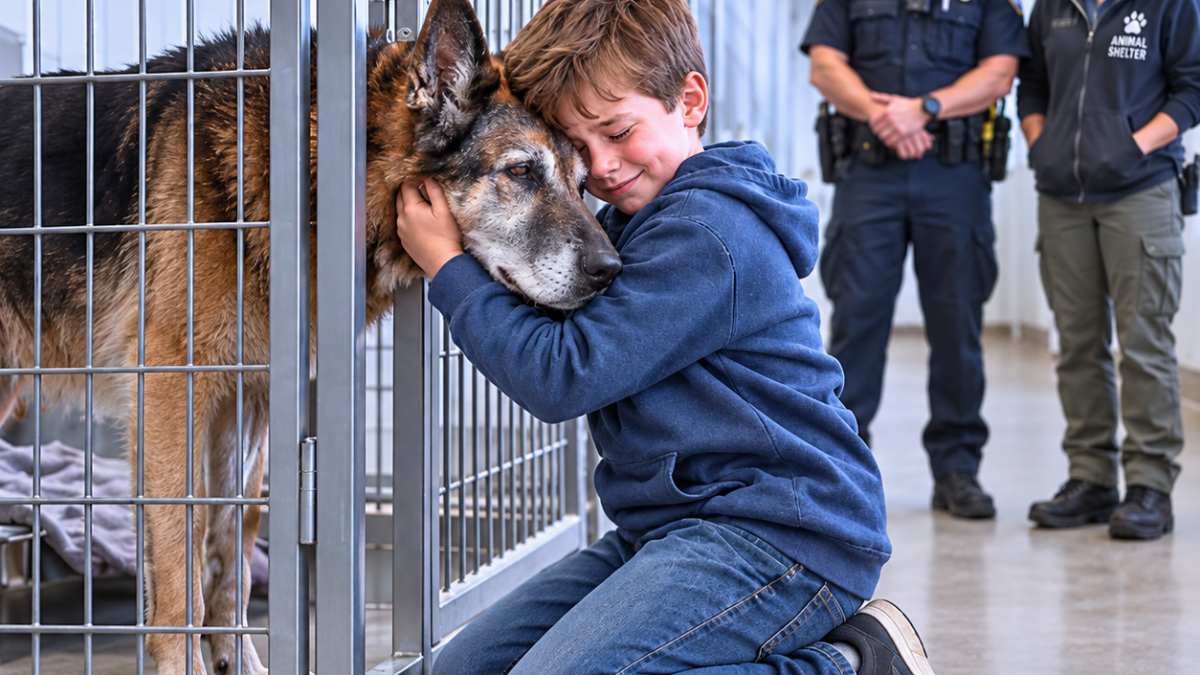
The German Shepherd sat near the back.
Eleven years old.
Black and tan coat.
Silver muzzle.
Gray beneath the eyes.
Broad chest still carrying traces of the powerful animal he had once been.
His rear legs sat carefully beneath him.
Not weakness exactly.
Age.
The deliberate movements of an animal who now considered standing before doing it.
But his eyes were clear.
Dark brown.
Alert.
He looked at Noah.
Then past him.
Toward the hallway entrance.
Noah looked behind himself.
Nothing.
Back at the dog.
Still watching the door.
The laminated card read:
SARGE
GERMAN SHEPHERD
11 YEARS OLD
RETIRED POLICE K9
AT RESCUE: 6 MONTHS
Noah read the last line twice.
Six months is different when you are eight.
To an adult, six months passes too fast.
Bills.
Work.
Appointments.
Suddenly another season is gone.
To a child, six months is almost a lifetime.
Grace found him there.
“He was a police dog?”
“Yes.”
“Why is he here?”
Her expression changed.
“That’s a longer story.”
“No one wanted him?”
“A few people tried.”
“What happened?”
Grace looked at Sarge.
“He isn’t what most people expect.”
“How?”
“He doesn’t run to people.”
Sarge continued watching the hallway.
“He doesn’t wag much. Doesn’t push into the gate for petting.”
“Does he not like people?”
Grace paused.
“I’m not sure.”
Noah liked that answer.
He always trusted uncertainty more than adults pretending they knew everything.
Grace continued.
“He lets us care for him. He walks well. Never gives us trouble. But he always feels…”
She searched for the word.
“Somewhere else.”
Noah followed Sarge’s eyes toward the door.
“He keeps looking out there.”
“Yes.”
“For somebody?”
“Maybe.”
That was when I entered.
“There you are.”
Noah did not turn.
I followed his gaze.
Saw the dog.
Then the card.
Retired police canine.
Something about that phrase changes how officers look at a dog.
Not because working K9s are more valuable than other animals.
Because you know what the words imply.
Hours in cruisers.
Training.
Trust.
Risk.
A life structured around partnership.
“How long?”
“Six months,” Grace said.
I frowned.
“Really?”
“Senior dogs are hard. Senior working dogs can be harder.”
I approached the kennel.
Sarge did nothing.
I crouched slightly.
“Hey, old man.”
His eyes moved toward my face.
Then down.
My uniform.
His ears moved first.
Forward.
Noah whispered:
“Dad.”
I raised one hand.
Wait.
Sarge leaned toward us.
Then stood.
Slowly.
Rear legs stiff.
But the moment he was upright, age seemed to disappear from everything except his muzzle.
Two measured steps.
Gate.
Stop.
Head high.
Shoulders squared.
Eyes fixed on me.
I knew that posture.
Every police officer who had spent enough time around K9 teams knew it.
Ready.
Waiting.
Not asking for affection.
Awaiting instruction.
I looked down at my uniform.
Then back.
Sarge did not blink.
Noah stepped closer to me.
“He isn’t scared.”
“No.”
“He’s waiting.”
Grace folded her arms.
“For what?”
Noah stared through the gate.
He took a long time before answering.
“For someone to tell him what to do next.”
Sarge remained motionless.
Then Noah reached for my sleeve.
“Dad?”
“Yeah?”
“Please don’t let him keep waiting.”
I looked down.
“What do you mean?”
“What if the person who’s supposed to give him the last command never comes?”
Children occasionally say things that go straight through every protective layer an adult has built.
That was one.
We moved into Grace’s office.
Barely large enough for a desk.
Filing cabinet.
Two mismatched chairs.
Portable heater.
Stacks of paper held together by optimism.
“You don’t have digital records?” I asked.
Grace gave me a look.
“Our computer remembers dial-up internet.”
Fair.
She pulled Sarge’s file.
Vaccinations.
Arthritis.
Intake paperwork.
Old copied law-enforcement records.
Nearly eight years of service.
Search support.
Evidence location.
Patrol assignments.
Community demonstrations.
No aggression history.
No behavioral retirement.
Age.
Stiff hips.
Retired before deterioration became unfair.
Then I found the handler.
Keith Torres.
Retired K9 officer.
Phone number disconnected.
Second number reassigned.
Old address.
Updated address.
Letters returned.
Another never answered.
“How did Sarge get here?”
Grace sighed.
“Temporary boarding.”
“From Keith?”
“Indirectly.”
Transfer.
Another organization.
Housing change.
Paperwork.
By the time Sarge arrived, everyone believed permanent placement had been authorized.
“Nobody talked to Keith?”
“No.”
There was no villain.
That bothered me.
Police work teaches you to like villains.
Villains make stories clean.
Someone caused the problem.
Find them.
Stop them.
Solve it.
Bureaucracy produces different tragedies.
Everybody does something reasonable.
Forms move.
Phone numbers change.
Assumptions harden into facts.
And sometimes an old dog waits six months because nobody realizes the story has gone wrong.
Noah asked:
“Does Sarge know he needs a new family?”
Grace looked at me.
Then him.
“That is a very good question.”
We went back.
I wanted to test something.
“Sarge.”
His eyes snapped onto me.
“Down.”
He lowered himself carefully.
“Sit.”
Up.
Another command.
Immediate.
Precise.
Then waiting again.
I tried the obvious releases.
“Free.”
Nothing.
“All done.”
Nothing.
“Okay.”
Nothing.
Sarge watched.
No praise-seeking.
No wandering.
No release.
Noah said:
“He thinks you aren’t finished.”
I looked at him.
“What makes you think that?”
“He keeps asking with his face.”
Hard to argue with that.
Later Grace told us about seven o’clock.
Every evening.
Almost exact.
Sarge left his bed.
Walked to the gate.
Sat facing the hallway.
Fifteen or twenty minutes.
Then lay down again.
Every day.
For six months.
Noah immediately said:
“He’s waiting for someone to pick him up after work.”
Sentimental.
I wanted to dismiss it.
But police dogs live by patterns.
Shift routines.
Equipment routines.
Vehicle routines.
Handler routines.
Seven might mean something.
That afternoon Noah asked:
“Can we take him home?”
“No.”
His face fell.
But I explained.
Eleven years old.
Arthritis.
Unknown medical needs.
Retired working habits.
Potential stress.
“You don’t adopt a dog because you feel sorry for him.”
“I don’t.”
I looked at him.
“I think everyone keeps deciding what he feels without asking why he does things.”
That landed.
Grace suddenly became extremely interested in a bucket of hardware.
“Noah—”
“Then don’t adopt him.”
I waited.
“Just find out what he’s waiting for.”
That was reasonable.
So I agreed.
We find out.
No promises.
The storm damage gave us a reason to keep returning.
I called officers.
Hardware-store owner.
Contractor.
Retired cop named Gerald James.
Soon pickup trucks filled the lot.
Lumber.
Tools.
Coffee.
Roof patching.
Fence repair.
The shelter slowly became ready for winter.
Noah developed a routine too.
He brought a book.
Sat several feet from Sarge’s kennel.
Read.
No treats.
No calling.
No trying to touch him.
Day one, Sarge stayed in back.
Day two, halfway forward.
Day three, blanket near the gate.
Grace said:
“He’s getting closer.”
Noah turned a page.
“Maybe.”
“You don’t sound excited.”
“If I act excited, he’ll think I want something.”
Grace stared.
Then told me later she suspected my son might be better with animals than both of us.
I began digging through old records.
One damaged departmental handling sheet changed everything.
Faded.
Folded.
Barely readable.
Then one line:
HANDLER RELEASE REQUIRED AT END OF SHIFT.
Below:
RELEASE COMMAND:
Unreadable.
I stared.
Handler release required.
Noah had been right.
Sarge had been trained not simply to work.
He had been trained to remain working until specifically released.
Seven o’clock.
Gate.
Waiting.
Whatever words meant “you’re done” had vanished somewhere between departments, rescues, handlers, transfers, and photocopies.
We needed Keith.
Finding him took days.
Archive searches.
Department newsletters.
Community photographs.
Old correspondence.
Then Grace found a recent profile.
Keith Torres.
Sixty-seven.
Living at a support and rehabilitation center for retired law-enforcement officers in Billings.
Alive.
I called.
Privacy rules prevented staff from putting me through immediately.
I left a message.
Then waited.
Two hours.
Phone rang.
“Officer Sanders.”
“This is Austin.”
Silence.
“You left a message about Sarge.”
Everything in my office disappeared.
“Are you Keith Torres?”
“I am.”
I had prepared an explanation.
Instead I said:
“Sarge is alive.”
Nothing.
Then:
“I heard you.”
His voice had changed.
“Where?”
“Thompson Falls Animal Rescue.”
“How long?”
“Six months.”
Silence.
“A shelter?”
“Rescue facility. He’s safe.”
“That isn’t what I asked.”
I understood.
“Yes. He’s been living in a kennel.”
A long breath.
“I thought he had a home.”
The story came apart slowly.
Spinal surgery.
Keith had deteriorated after years of injuries.
Temporary boarding.
Complications.
Housing changes.
The organization restructured.
Sarge transferred.
Then transferred again.
Keith signed permission allowing placement if he could not resume care.
Placement.
Not abandonment.
But by Thompson Falls, the paperwork looked permanent.
Keith thought Sarge was already with an experienced household.
Grace thought Keith had voluntarily disappeared.
No one had abandoned anybody.
They had lost each other inside a series of reasonable assumptions.
Then I told Keith about seven.
He interrupted.
“Seven?”
“Yes.”
“Every night?”
“Yes.”
His breathing changed.
“End of shift.”
I gripped the phone.
“What happened then?”
“We came back.”
His voice softened.
“Working lead off. Paws checked. Vest. Water.”
“And?”
“I put my hand on his shoulder.”
Pause.
“Released him.”
I told him about the faded command field.
He said:
“I know the words.”
“Tell me.”
“No.”
Immediate.
“Mr. Torres—”
“You don’t say it without me.”
I almost argued.
Then heard his voice.
Not secrecy.
Grief.
“That phrase ended our day for years,” he said. “It meant there was nothing else he needed to watch. Nothing else to hold. Nothing else I was asking of him.”
Silence.
“If he’s been waiting six months, I’m not letting a stranger say it through a kennel gate.”
I could not argue with that.
“When can you come?”
“I’ll find a way.”
Then came the harder truth.
His supported apartment did not allow large dogs.
He could see Sarge.
He could release him.
He could not take him back.
When I told Noah, his initial excitement disappeared.
“So Sarge finds him…”
“Yes.”
“And then Keith leaves?”
“Yes.”
Noah looked through the gate.
“What if finding him hurts more than waiting?”
I had no answer.
Keith arrived Saturday.
Cold.
Clear.
A transport vehicle stopped in the lot.
Keith stepped out with a wooden cane.
Broad shoulders gone thinner.
Silver hair.
Dark coat.
A man still carrying the shape of an officer even after the uniform was gone.
Inside, before he reached the kennel corridor, we heard claws scrape concrete.
Keith froze.
“What was that?”
Grace opened the door.
Dogs barked.
Sarge did not.
He stood at the last kennel.
Forty feet away.
Keith’s cane tapped tile.
Sarge moved forward.
Slow.
Certain.
Keith whispered:
“Sarge.”
The dog sat.
Straight.
Chest lifted.
Eyes fixed.
No whining.
No jumping.
No frantic tail.
Just attention.
Keith walked toward him.
Six months compressed into less than three feet.
“Hey, partner.”
Grace opened the gate.
Sarge came out.
Sat directly in front of Keith.
Keith’s cane fell.
He lowered himself.
Both hands around that silver muzzle.
“I’m sorry.”
His voice broke.
Sarge blinked.
Keith pressed his forehead to the dog’s.
“I didn’t leave you.”
Nobody moved.
“I didn’t know where you were.”
Noah looked at the floor.
I looked somewhere else too.
Some grief deserves privacy even when everyone is standing nearby.
For several minutes Keith simply held him.
Eventually Sarge leaned into his hand.
Softened around the eyes.
But his body stayed ready.
Keith noticed.
“You stubborn old fool.”
Noah asked:
“Why is he still sitting like that?”
Keith kept one hand on the dog.
“Waiting for me to finish.”
We spent the next hour and a half letting them have something ordinary.
A walk.
Keith with cane.
Sarge adjusting automatically to his pace.
Stop when Keith stopped.
Turn when he turned.
No pulling.
No command needed.
They remembered each other in movement.
Later, Keith told Noah stories.
Not police stories.
Real partner stories.
Paperwork naps.
Puddle avoidance.
Stolen turkey sandwich.
Unauthorized inspection, Keith called it.
Noah insisted it was theft.
Then the clock neared seven.
At 6:55, Sarge stood.
Every smile disappeared.
He walked to the doorway.
Sat.
Faced Keith.
Seven o’clock.
Six months of waiting arrived in one room.
Grace brought out an old storage box.
Inside:
Sarge’s working collar.
Leather.
Department tag.
Keith picked it up.
His hands shook.
He removed the rescue collar.
Put the old one on.
Click.
Sarge sharpened instantly.
Keith put one hand on his shoulder.
Exactly as he had described.
Then nothing.
Keith tried to speak.
Couldn’t.
“I can’t.”
I sat across from him.
He stared at Sarge.
“When I retired, I lost the job.”
His hand tightened in the coat.
“Then my back went.”
He looked at the cane.
“Then my house.”
He had moved because stairs became impossible.
“Everything kept becoming something I used to do.”
He swallowed.
“If I say it…”
His voice dropped.
“Then this ends too.”
Noah stepped forward.
“Mr. Torres?”
Keith looked at him.
“Maybe letting him stop is the last job you have to do for him.”
Keith closed his eyes.
Sarge did something then.
He broke eye contact.
Turned.
Looked at Noah.
Not casually.
Fully.
For months Sarge had looked at uniforms.
Doors.
Hallways.
Now he looked at the boy who had sat quietly reading beside his kennel without asking for anything.
Keith saw it too.
“He isn’t just waiting for the release.”
I understood.
“He wants to know what happens afterward.”
Keith nodded.
“We tell ourselves retirement is paperwork.”
He looked at Sarge.
“Dogs don’t.”
Work had rules.
Stay assigned.
Stay with handler.
Hold until release.
But nobody had explained the next part.
Everyone offered Sarge a new home while his old duty was still active inside him.
Keith reached for the leash.
Then held it toward me.
I did not take it immediately.
“You sure?”
“No.”
Honest.
“But knowing isn’t the same as being sure.”
I accepted it.
Sarge watched the transfer.
Keith lowered himself to one knee.
Pain crossed his face.
Hand on Sarge’s shoulder.
“Sarge.”
The old dog locked onto him.
Keith drew a breath.
“End of watch.”
Nothing.
Then:
“Go home.”
Sarge stayed perfectly still.
One heartbeat.
Two.
Then his shoulders changed.
The rigid line softened.
Front paws shifted.
Ears eased.
A long breath escaped him.
Almost a sigh.
Keith closed his eyes.
Sarge took two slow steps away.
Then turned toward Noah.
Walked across the room.
Lowered himself carefully.
Placed his silver muzzle across the toe of Noah’s winter boot.
Grace turned toward the window.
I looked down at the leash.
For the first time since I met him, Sarge was not looking at a door.
Noah lowered his hand.
Stopped before touching.
“Can I?”
Keith opened his eyes.
“I think he already answered.”
Noah rested his hand against Sarge’s neck.
Keith sat back.
Exhausted.
“I thought saying it would feel like losing him.”
“Does it?”
He watched Sarge.
“No.”
Pause.
“Feels like I finally stopped making him carry something that belonged to me.”
That night we did not adopt Sarge.
Not yet.
Emotion is a terrible substitute for planning.
Grace arranged foster-to-adopt.
Senior veterinary evaluation first.
Arthritis.
Medication.
Stairs.
Stress.
Working routines.
We would watch.
Adjust.
Not pretend.
Keith gave Noah an old K9 unit badge from his locker.
Scratched leather backing.
Worn edges.
“People think police work is mostly acting fast.”
Noah listened.
“Sometimes.”
Keith touched the badge.
“But the better you get, the more you learn to notice before deciding what something means.”
He looked toward Sarge.
“Everyone thought he didn’t want anybody.”
Then Noah.
“You didn’t decide that.”
Noah shrugged.
“I just watched him.”
Keith smiled.
“Observation before judgment.”
Then more seriously:
“Don’t lose that when you get older.”
That sentence stayed with me too.
Because I realized I sometimes treated Noah’s quietness as a problem to solve.
Maybe it was simply how he listened.
By 8:30, paperwork signed.
Medication packed.
Food.
Blanket.
Ordinary shelter collar.
Keith removed the working collar.
This time Sarge did not stiffen.
“That stays with me,” Keith said.
I understood.
At the entrance, Keith stopped.
Sarge stopped.
One second.
Would he turn back?
Keith looked at him.
“You heard me, partner.”
Sarge watched.
“Go home.”
Sarge turned toward Noah.
That was goodbye.
Quiet enough most people would have missed it.
The drive home took fifteen minutes.
Noah sat in back beside him.
Our house was single story.
Only two shallow steps.
Good for hips.
Sarge entered cautiously.
Smelled rug.
Couch.
Noah’s backpack.
Kitchen.
Mapped the house like an old professional.
Then chose a place beside the couch.
Noah sat on the floor with his book.
Ten minutes later, Sarge closed his eyes.
The next evening, the clock reached seven.
Chime.
Sarge’s eyes opened.
Second chime.
Head up.
Seven.
He stood.
Walked to the front door.
Waited.
Noah looked at me.
“You’re off duty,” I told him.
Nothing.
“Go home,” Noah said softly.
Sarge looked at him.
Still waited.
Noah whispered:
“Maybe he knows work is done, but doesn’t know what he’s supposed to do instead.”
Again.
Eight years old.
Right.
Ending a routine does not create a new life automatically.
So we began giving Sarge retirement.
Not replacement work.
Retirement.
Morning walk.
Same time.
Short enough for his hips.
Food after.
Afternoon rest.
No commands unless necessary.
No testing him.
No making him demonstrate old skills for visitors.
No asking him to be impressive.
Noah became especially serious about that.
A neighbor once said:
“Can he still find drugs?”
Noah answered:
“He doesn’t work for you.”
I had to turn away to hide a smile.
Dr. Katherine Roberts examined Sarge.
Moderate arthritis.
Hips and lower spine.
Heart good.
Weight acceptable.
Blood work surprisingly strong.
“He’s old,” she said. “Not done.”
That distinction mattered.
We changed medication.
Added joint supplements.
Put non-slip runners on hardwood floors.
Bought an orthopedic bed.
Sarge refused to use it for four days.
Then Noah lay on it.
Sarge came over.
Pushed him off with his shoulder.
Claimed it.
Noah considered that victory.
Seven o’clock remained difficult.
Every evening Sarge went to the door.
Sometimes ten minutes.
Sometimes fifteen.
Then Noah suggested something simple.
Walk.
Not duty.
Just walk.
At 6:55 we put on his ordinary collar.
At seven, instead of waiting for work to end, we went outside.
No patrol vehicle.
No vest.
No command.
No route with purpose.
Just snow.
Mailbox.
Pine trees.
Sometimes half a block.
Sometimes farther.
Sarge sniffed.
That was new.
Working dogs often move differently when working.
Focused.
Purposeful.
Sniffing for pleasure seemed almost decadent.
The first time Sarge spent nearly thirty seconds examining one shrub, Noah waited patiently.
“What is he doing?” I asked.
“Retirement.”
I laughed.
Slowly, seven changed.
From end of shift.
To family walk.
Then some evenings the weather was bad and Sarge stayed on the porch.
Examined snow.
Turned around.
Came inside.
Apparently retirement included personal discretion.
Something else changed.
Sarge started touching Noah.
At first accidentally.
A shoulder brushing his knee.
Then choosing the rug near him.
Then resting his muzzle against Noah’s foot.
One Saturday I found them both asleep on the floor.
Noah’s hand across the old dog’s neck.
Book open on his chest.
Sarge snoring.
I stood in the doorway for several minutes.
Rachel would have loved him.
That thought arrived unexpectedly.
Not Sarge.
Well, yes.
But Noah in that moment.
The quiet boy who had seen something adults missed.
I wished she could have watched him.
Grief changes over time.
At first it is a siren.
Eventually it becomes weather.
Still present.
Sometimes mild.
Sometimes suddenly violent.
But woven into the landscape.
I wondered if that was true for Sarge too.
Keith began calling.
At first for updates.
Then just conversation.
“How are his hips?”
“Better.”
“Eating?”
“Like evidence may disappear if he doesn’t secure it.”
“Still hates puddles?”
“We have not formally tested.”
Then Noah took the phone.
“He stole my toast.”
Keith laughed.
“Good.”
“Why good?”
“Means he likes you.”
“That seems like bad training.”
“Retirement.”
Keith and Noah got along disturbingly well.
Eventually we drove Sarge to Billings.
Several hours.
Support center.
Keith waiting outside with his cane.
Sarge recognized him immediately.
Stood.
But did not snap to attention.
Tail moved.
He stepped forward.
Keith placed a hand on his neck.
“Well.”
He smiled.
“You finally learned how to greet a man without filing a report.”
Inside, the support center surprised me.
Warm common room.
Fireplace.
Books.
Retired law enforcement officers scattered around.
The first man to notice Sarge was Harold Ward.
Seventy-two.
Former highway patrol.
He looked at Sarge and said:
“That dog worked.”
“You can tell?”
“Working dogs check rooms differently.”
Harold had once had a Shepherd named Bruno.
Thirty-four years earlier.
Patrol dog.
After retirement, Bruno stole socks.
Sarge eventually approached.
Harold put his hand beneath that gray muzzle.
Stopped talking.
No one hurried him.
Another resident, Patricia Harlon, former sheriff’s deputy, declared Sarge was judging everybody.
Keith said:
“He’s retired.”
She said:
“Retirement doesn’t eliminate standards.”
Sarge walked over.
Placed his head on her knee.
She smiled.
“Apparently I passed.”
Soon older officers approached one by one.
Not crowding.
Some had worked K9.
Others had not.
Most understood what it meant to leave a profession built around usefulness.
No one asked Sarge to perform.
No commands.
No demonstrations.
No searching.
Nothing.
For the first time in his police-related life, he entered a room full of officers and had absolutely no job.
He wandered.
Accepted scratches.
Slept beneath Harold’s chair.
A spoon fell.
He lifted his head.
Then went back to sleep.
Keith watched him.
I stood beside Keith.
“You okay?”
“Yes.”
He took time.
“I spent years believing his best quality was purpose.”
I looked at Sarge.
“And?”
“I was wrong.”
“How?”
Keith smiled.
“He doesn’t have to do anything to matter.”
That sentence stayed with me.
Because maybe Sarge’s story was not really about an old dog waiting for a command.
Maybe it was about what happens when usefulness becomes identity.
Police officers know that danger.
Military people too.
Nurses.
Firefighters.
Parents.
Anyone whose life becomes measured by what they provide.
Then one day:
Retirement.
Injury.
Children grow up.
Body slows.
Job ends.
And suddenly the question becomes:
If I am no longer useful in the way I was, what am I?
Sarge had no words for that question.
But he had been living it for six months.
The answer was not another mission.
It was belonging.
When we left Billings, Harold asked:
“Will he come back?”
Keith looked at me.
“Not my decision anymore.”
No pain in it now.
I nodded.
“We’ll bring him.”
The following Monday, Noah, Sarge, and I returned to Thompson Falls Animal Rescue.
Grace had the adoption folder.
I read every page.
Then signed.
No applause.
No ceremony.
Ink.
Grace stamped the file.
“Well, old man.”
She looked at Sarge.
“You’re officially unemployed.”
Noah frowned.
“He has a job.”
I raised an eyebrow.
“What job?”
He put one hand on Sarge’s neck.
“Being ours.”
Grace looked away.
So did I.
Officially, Sarge became a Sanders.
Life afterward was wonderfully unimportant.
That may be my favorite part.
No heroic rescue.
No crime solved.
No dramatic K9 comeback.
Breakfast.
Medication.
Slow walks.
Noah reading.
Sarge snoring.
Visits to Keith.
Occasional community events at the rescue.
Sarge became part of Grace’s “second chances” board.
Not because he was a police dog.
Because his story changed how people looked at older animals.
An elderly beagle found a retired teacher.
A three-legged hound went home with a couple outside town.
Two bonded senior dogs who had been overlooked for months were adopted together.
People started asking different questions.
Not:
“Why isn’t this dog excited to meet me?”
But:
“What does this dog need before he can feel safe?”
Not:
“Why is he so quiet?”
But:
“What might his quiet mean?”
That mattered.
One snowy evening months later, I stood in the kitchen holding coffee.
Noah sat on the floor.
Book across his knees.
Sarge lay beside him.
Silver muzzle over Noah’s foot.
The clock approached seven.
I noticed.
Noah noticed.
Neither of us said anything.
First chime.
Sarge opened his eyes.
Second.
Ears moved.
Seven.
Months earlier, that time pulled him upright more reliably than any alarm.
End of shift.
Wait.
Handler release.
Next assignment.
Sarge lifted his head.
For one second, I saw the old routine return.
His eyes went toward the door.
Then toward Noah.
Noah did not move.
Sarge looked back at the door.
And stayed down.
A long breath left him.
He lowered his muzzle onto Noah’s boot.
Closed his eyes.
Noah smiled.
My throat tightened.
No command.
No “end of watch.”
No “go home.”
No one needed to release him.
He already knew.
After eight years of service.
Six months behind a kennel gate.
Weeks learning that evenings could mean walks instead of waiting.
Sarge finally understood what Keith had been trying to give him.
His watch was over.
His worth was not.
He no longer needed a uniform in the room.
Did not need a handler.
A mission.
A gate.
A working collar.
He had nothing left to prove.
The only things expected of him now were things no department had ever trained him to do.
Sleep beside the fire.
Walk slowly through fresh snow.
Steal Noah’s toast when opportunity presented itself.
Visit an old partner.
Sniff one shrub for thirty seconds because nobody cared how long it took.
Rest his head on a child’s foot.
Trust that when he opened his eyes, the same people would still be there.
I turned off the kitchen light.
Outside, snow covered Thompson Falls.
Inside, Sarge slept through seven o’clock.
At last, he was home.
He lived with us for three more years.
Good years.
Not perfect.
Arthritis worsened.
Eventually the walks shortened.
The porch became enough on cold nights.
Then even the porch steps needed a ramp.
Noah helped me build it.
Mostly by holding tools and criticizing my measurements.
Keith visited when he could.
His health improved enough that travel became easier.
One summer afternoon, he sat on our porch with Sarge between us.
Noah had gone inside for lemonade.
Keith scratched beneath the old dog’s ear.
“You know what I was afraid of?”
I looked over.
“That he’d forget you?”
“No.”
He smiled sadly.
“That I’d forget who I was without him.”
That made sense.
“For eight years everybody knew me as Torres and Sarge.”
His hand remained on the dog.
“One unit.”
Sarge slept.
“Then retirement came.”
Keith looked toward the yard.
“And I thought letting go of his working life meant admitting mine was gone too.”
“What changed?”
He looked at Sarge.
“This.”
The dog opened one eye.
“That fool doesn’t care if I’m Officer Torres.”
Pause.
“He cares if I brought biscuits.”
We laughed.
Keith became part of our family in an odd way.
Not father.
Not grandfather.
Something unnamed.
Someone connected by an old dog.
Noah continued changing.
Or maybe I simply got better at seeing him.
He remained quiet.
I stopped pushing him to be less so.
Teachers said he participated when something mattered.
That sounded fine to me.
When he was ten, a new student joined his class.
Boy named Eli.
Stuttered badly.
Other children sometimes finished his sentences.
Noah did not.
One afternoon the teacher told me:
“Your son waits.”
I knew exactly what she meant.
Observation before judgment.
Keith’s phrase had traveled.
Sarge aged.
Gray spread from muzzle to face.
His hearing weakened.
Sight clouded slightly.
Yet he always knew when Noah came home.
School bus stopped.
Sarge lifted his head.
By middle school, Noah could not fit beside him on the floor the way he once had.
He tried anyway.
Then came the winter morning I knew.
If you have loved an old dog, sometimes you know before a veterinarian confirms it.
Sarge did not eat.
Could not stand without help.
His breathing had changed.
Dr. Roberts came to our house.
No clinic.
No stainless table.
Sarge lay on his blanket near the fireplace.
Keith came from Billings.
Grace came too.
Noah was eleven.
Old enough to understand.
Young enough that I wanted to protect him from understanding.
He sat beside Sarge.
One hand on his neck.
Dr. Roberts explained quietly.
His body was tired.
Pain control no longer enough.
Nothing dramatic.
Just age finally asking for what service, medicine, and love had delayed.
I asked Noah if he wanted to leave.
He looked offended.
“No.”
Keith sat on the other side.
His hand rested on Sarge’s shoulder.
Same place.
I saw it.
He saw me see it.
For a moment, none of us spoke.
Then Keith whispered:
“Partner.”
Sarge’s eyes shifted.
Barely.
Toward his old handler.
Keith’s voice cracked.
“End of watch.”
Noah started crying.
Keith swallowed.
“Go home.”
This time there was no shift in posture.
No dog crossing a room.
No new family waiting.
Only a long, quiet breath.
Noah bent over him.
Sarge died surrounded by the people who had finally learned not to ask him for anything.
For several minutes, nobody moved.
Then Noah whispered:
“Do you think he knew?”
“Knew what?”
“That he didn’t have to wait anymore.”
I looked at Sarge.
At the boy who had seen the truth first when every adult around him had mistaken waiting for emptiness.
“Yes.”
I put my hand on Noah’s shoulder.
“I think you taught him.”
We buried Sarge beneath a cottonwood behind the house.
Keith gave Noah the old unit badge permanently.
The working collar stayed with Keith until he died years later.
Then it came to Noah.
Today both sit in a small wooden case in my house.
Not a shrine.
Just memory.
Sarge’s photograph is on the rescue’s second-chance wall.
Silver muzzle.
Noah beside him.
No police vest.
No working collar.
Just an old dog leaning slightly against a boy.
Underneath, Grace added one sentence.
HE DIDN’T NEED ANOTHER MISSION. HE NEEDED SOMEONE TO NOTICE HE WAS STILL WAITING.
Noah is older now.
Much older than eight.
Still quiet.
Still watches first.
I stopped worrying about that a long time ago.
Sometimes people ask what I learned from Sarge.
They expect me to say retired K9s need patience.
True.
Or senior dogs deserve homes.
Also true.
But that old German Shepherd taught me something larger.
We are quick to value living things for what they can do.
Find people.
Protect officers.
Raise children.
Earn money.
Fix problems.
Carry weight.
Stay strong.
Then age comes.
Or injury.
Or retirement.
Or loss.
And suddenly the skills that once defined us are gone.
That can feel like disappearance.
Sarge spent eight years being rewarded for never abandoning a position until released.
Then six months being passed over because that same discipline made people think he was distant.
Nothing about him had become defective.
The world around him had changed while his understanding had not.
Noah saw that before I did.
Before Grace.
Before adopters.
Before anyone.
He did not see an unwanted old dog.
He saw somebody still doing the last job he had been given.
Waiting.
And perhaps that is why the moment I remember most is not Keith’s reunion.
Not the adoption papers.
Not even the day we said goodbye.
It is an ordinary winter evening months after Sarge came home.
Seven o’clock.
Clock chiming.
Snow against the windows.
A boy reading.
An old dog opening his eyes.
For one second, Sarge remembered duty.
Then he looked at Noah.
Lowered his head.
Went back to sleep.
No command.
No release.
No mission.
He finally understood.
He did not have to earn his place anymore.
He already belonged.








