An 8-Year-Old Boy Asked a Table of Bikers to Fill the Empty Chairs at His Daddy’s Funeral—Then He Told Them Why He Needed So Many “Scary Men.
An 8-Year-Old Boy Asked a Table of Bikers to Fill the Empty Chairs at His Daddy’s Funeral—Then He Told Them Why He Needed So Many “Scary Men.
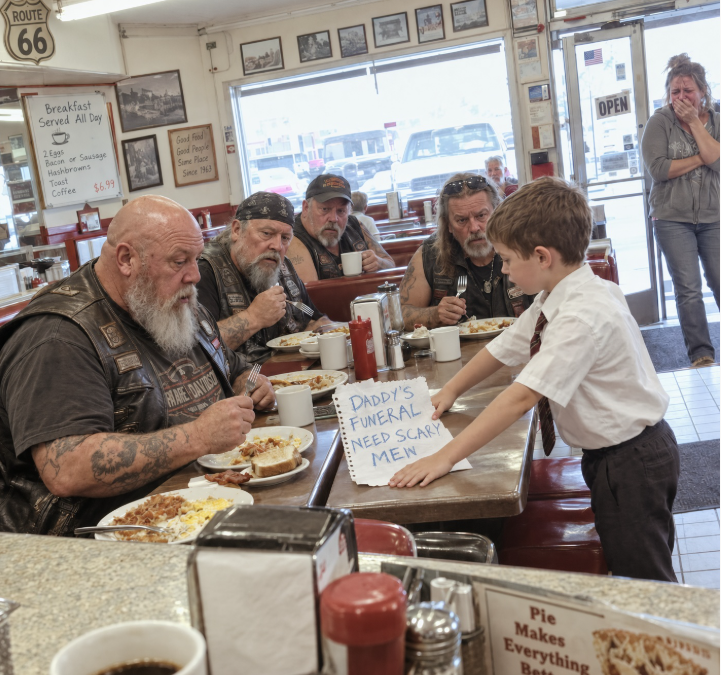
An eight-year-old boy walked into a diner, slammed a blue-crayon note onto our table, and asked seven men in black leather to attend his father’s funeral because he had already counted every chair in the church and knew exactly how empty it was going to look.
When he told us his father’s name, half the diner stopped moving, because Danny Mercer was the high-school custodian our town had quietly condemned after $14,000 disappeared—even though the charges against him had been dropped eleven weeks later.
We thought all we had to do was fill sixty-three chairs, but by the time four hundred bikers surrounded that little church, an old man stood beside Danny’s casket and confessed the truth that an entire town had been too cowardly to face while Danny was still alive.
My name is Raymond Decker.
Everybody calls me Dutch.
I’m fifty-nine years old, spent six years in the Army, and have spent most of the thirty-one years since then underneath cars.
I own a transmission shop two blocks off Route 9.
Nothing fancy.
Three lifts.
Four bays.
A Coke machine that has been stealing people’s money since the Clinton administration.
One office with a window air conditioner that works only if you kick the left side.
I ride an old Heritage Softail that leaks just enough oil to remind me where I parked.
I am not a hero.
Neither were the men sitting with me that Tuesday morning.
There were seven of us in the back booth at Millie’s Diner.
Me.
Big Mike.
Tiny.
Chuck.
Rooster.
Lenny.
And Bear.
We rode together most Saturdays.
Raised money when somebody’s kid got sick.
Escorted veterans’ funerals when families asked.
Helped stranded riders.
Argued over tires.
Lied about our cholesterol numbers.
The usual.
Big Mike is six foot four and maybe two hundred seventy pounds before breakfast.
Beard almost to his chest.
Scar through his left eyebrow from a bar fight he insists he won even though I personally watched him spend the next day eating soup through a straw.
Tiny is five foot six.
That’s how biker nicknames work.
He once threatened a man twice his size with a tire iron because the man kicked a stray dog.
Bear teaches high-school history.
Rooster sells insurance.
Lenny installs flooring.
Chuck owns a plumbing company.
None of us were dangerous unless you counted high blood pressure.
We had just finished a Saturday charity run for a firefighter’s family, and Tuesday breakfast was basically our excuse to complain about how sore we still were.
Mike was halfway through eggs and hash browns when the boy appeared.
I did not see him come through the door.
I just heard the paper hit the table.
Slap.
Hard enough to make Mike’s fork jump.
We all looked down.
Notebook paper.
Torn crooked from a spiral pad.
Blue crayon.
Letters written so hard the crayon had gone through the page in two places.
DADDY’S FUNERAL.
NEED SCARY MEN.
Nobody laughed.
Not even Rooster, who laughs at everything.
I looked up.
The kid couldn’t have been more than eight.
Skinny arms.
Brown hair combed too flat on one side.
White button-down shirt too large for him.
Clip-on tie crooked almost sideways.
Black pants that bunched around his sneakers.
He stood with both fists at his sides.
Trying very hard to look older than eight.
Big Mike lowered his fork.
Tiny whispered:
“What the hell?”
I kicked him under the table.
The boy stared at us.
Not scared.
Focused.
I leaned forward.
“Hey, bud.”
He swallowed.
“My daddy died Tuesday.”
Every sound at our table disappeared.
He continued.
“The funeral is Saturday.”
His voice was steady.
Too steady.
Children who have cried enough sometimes sound like adults because their bodies simply run out of places to shake.
“What’s your name?” I asked.
He ignored the question.
“Eleven o’clock.”
Mike pushed his plate away.
“All right.”
I pointed at the note.
“Why do you need scary men?”
That was when the boy’s confidence cracked.
Just a little.
He looked down.
Picked at the edge of the paper with his thumbnail.
One strip began tearing loose.
“Because nobody’s gonna come.”
Tiny leaned forward.
“Why wouldn’t they come?”
The boy shrugged.
“Mama says it’s okay.”
Pause.
“But it’s not okay.”
I looked toward the front door.
A woman stood just inside.
Thirty-something.
Thin.
Dark dress beneath a cheap cardigan.
Her hand covered her mouth.
She was crying so hard her shoulders shook.
She did not come get him.
That mattered.
She could have rushed forward.
Apologized.
Pulled the kid away from the scary strangers.
Instead she stayed by the door.
Maybe because she had already tried telling him everything would be fine.
Maybe because she no longer believed herself.
Mike slid out of the booth.
Got onto one knee.
That put his face level with the boy’s.
Mike has terrified grown men by simply standing too close.
The kid did not blink.
“Son.”
Mike’s voice softened.
“Does your daddy have friends?”
The boy nodded.
“A lot.”
“Family?”
“Some.”
“Work friends?”
Another nod.
“Why aren’t they coming?”
The child’s mouth tightened.
“They stopped being his friends when he got sick.”
Something about that answer felt incomplete.
I didn’t push.
Mike pointed gently at the note.
“How many chairs you need filled?”
The boy looked him directly in the eyes.
“Sixty-three.”
Tiny’s head came up.
Mike’s hands froze on his knees.
“Sixty-three?”
“There are sixty-three chairs in the church.”
“How do you know?”
“I counted.”
He said it like that should have been obvious.
“Once Sunday.”
Then:
“And yesterday.”
Mike stared.
“Why twice?”
“To make sure.”
That sentence did it.
Not Daddy’s funeral.
Not scary men.
Sixty-three.
An eight-year-old had gone into an empty church and counted every chair.
Then returned and counted again.
Because this child had reached the conclusion that grief was arithmetic.
Sixty-three chairs.
Three family members.
Maybe a pastor.
Too many empties.
Find people.
Any people.
Scary people were still people.
And apparently we looked like the kind most likely to say yes.
“What’s your name?” I asked again.
This time he answered.
“Caleb.”
“Caleb what?”
He hesitated.
First real fear I saw.
Not fear of us.
Fear of the name.
“Mercer.”
The diner changed.
The waitress stopped wiping the counter.
A man two booths over lowered his newspaper.
The cook leaned through the kitchen pass.
Then disappeared.
Bear slowly put down his coffee.
“Mercer?”
The boy nodded.
“Danny Mercer?”
“That’s my daddy.”
I knew the name.
Everybody in Warren County knew it.
Danny Mercer had worked as custodian at Jefferson High School for nineteen years.
Not principal.
Not coach.
Not teacher.
Custodian.
The man who arrived before sunrise.
Unlocked doors.
Salted icy sidewalks.
Cleaned vomit after basketball games.
Fixed loose toilet seats.
Set up folding chairs for graduation.
Stayed after dances.
Changed light bulbs thirty feet above the gym floor.
The kind of man hundreds of people recognize without knowing.
Two years earlier, fourteen thousand dollars disappeared from the athletic booster club.
Cash.
Fundraising money.
Concessions.
Uniform fund.
Whatever.
It had been locked in a metal cash box inside the athletic office.
Danny had master keys.
That fact became the entire town’s investigation by lunchtime.
The newspaper headline did not say:
QUESTIONS SURROUND MISSING BOOSTER MONEY.
It said:
SCHOOL CUSTODIAN QUESTIONED IN $14,000 THEFT.
Danny’s photograph appeared under it.
The school website photo.
No smile.
Bad fluorescent lighting.
He looked guilty because that’s what a still photograph does when a headline tells you what expression to see.
I remembered reading it.
I remember thinking:
Figures.
One word.
Figures.
Then I turned the page.
Eleven weeks later, charges were dropped.
Actually, according to the follow-up, prosecutors declined to pursue the case after investigators found insufficient evidence tying Danny to the missing funds.
That story appeared on page seven.
Four paragraphs.
No photograph.
No apology.
I remember seeing that too.
Barely.
By then my brain had already filed Danny Mercer under:
Janitor who stole money.
That is how reputation works.
Accusation is wet concrete.
Correction is somebody trying to scratch initials out after it dries.
Big Mike looked toward the woman at the door.
She finally approached.
“Caleb.”
The boy stiffened.
“I told you to wait in the car.”
“No.”
“Baby.”
“There are sixty-three chairs.”
She closed her eyes.
I stood.
“Ma’am.”
She wiped her cheeks.
“I’m sorry.”
“No need.”
“He saw your motorcycles.”
“I figured.”
“He said bikers go to funerals.”
Mike said:
“We do.”
She laughed once.
Broken.
“That’s what my husband told him.”
Danny Mercer.
Her husband.
Not just a name anymore.
Not just newspaper ink.
A woman’s husband.
A boy’s father.
We made space in the booth.
Her name was Dana.
Thirty-six years old.
She looked fifty.
Not because of age.
Because grief is heavy and apparently she had been carrying hers mostly alone.
Caleb slid in beside her.
Someone brought him hot chocolate.
He didn’t drink it.
Mike asked:
“What happened to Danny?”
Dana’s hands wrapped around a coffee cup.
“Pancreatic cancer.”
Nobody spoke.
“Fourteen months.”
Tiny whispered:
“Jesus.”
“He worked the first nine.”
“At the school?”
Dana nodded.
“Needed insurance.”
Bear frowned.
“They let him keep working after the investigation?”
“The charges were gone.”
“People weren’t.”
That line stayed with me.
People weren’t.
Dana told us the story in fragments.
After the missing-money accusation, Danny’s social world narrowed.
First people stopped inviting him places.
Then they stopped calling.
The Thursday bowling league he had attended for ten years suddenly stopped having room.
One guy texted:
Thinking of you.
Once.
A neighbor who used to borrow Danny’s snowblower began using a shovel rather than knock on their garage.
Christmas cards went from forty-something to seven.
His own brother in Ohio told him:
“Maybe give things time.”
They barely spoke after.
The school never fired Danny.
Technically, he was cleared.
But teachers who used to leave coffee for him stopped coming into rooms he was cleaning.
Coaches began locking office doors when he was nearby.
Parents whispered.
Students heard parents whisper.
Then students whispered too.
Dana said:
“One day he came home and asked me whether I thought he should stop wearing his school jacket to the grocery store.”
Nobody at our table moved.
“Did he?”
“Yes.”
Then cancer.
At first, people rallied.
That’s what people do when illness is new enough to be interesting.
Two casseroles.
Three cards.
One church meal train.
Then chemo dragged on.
Danny lost weight.
Hair.
Strength.
The story stopped being new.
People returned to their lives.
Danny spent his last five months in a rented hospital bed in the front room.
Facing the driveway.
“He never complained about nobody coming.”
Dana stared into her coffee.
“Not once.”
“But anytime a car slowed down…”
She demonstrated with her head.
A tiny lift.
Hope.
“Every time.”
Caleb stopped coloring the paper placemat someone had given him.
“The bowling men didn’t come.”
Dana touched his shoulder.
“Sweetheart.”
“I looked.”
That sentence hurt more than anything she had said.
I looked.
Children keep records adults pretend not to notice.
Big Mike put one huge hand flat on the table.
Very gently.
“How many are definitely coming Saturday?”
Dana’s eyes dropped.
“My mother.”
“My sister.”
“Her husband.”
“The hospice nurse said she’d try.”
“Pastor.”
She gave a helpless little shrug.
“That’s about it.”
Sixty-three chairs.
Maybe five people.
Eight-year-old mathematician.
I said:
“We’ll be there.”
Dana immediately shook her head.
“You don’t need to—”
Tiny:
“We’ll be there.”
Bear nodded.
“Absolutely.”
Mike looked at Caleb.
“Sixty-three, right?”
Caleb nodded.
Mike stood.
“All right.”
“Sixty-three.”
Caleb looked suspicious.
“All of them?”
Mike held out his hand.
“All of them.”
The boy shook it.
That should have been the end of it.
Seven bikers promise to fill some seats.
Nice story.
Except Big Mike cannot do anything at normal scale.
By the time we reached the parking lot, his phone was out.
First call:
Iron Shepherds chapter in Benton.
Second:
Veterans Riders Post 88.
Third:
Grace Riders Christian Motorcycle Ministry.
Then:
Women of Chrome.
Then:
A Gold Wing group Mike normally mocked for carrying enough luggage to invade Canada.
His message was twenty-two words:
Man died Tuesday. Town turned on him over a lie. Eight-year-old boy needs chairs filled. Saturday 11am. Grace Chapel.
No photo.
No fundraiser.
No hashtags.
By noon, four clubs had it.
By five Thursday evening, riders three counties away knew Caleb’s name.
By Friday morning, people I had never met were calling my transmission shop.
“How many bikes?”
“No idea.”
“Parking?”
“Church lot.”
“Overflow?”
“Probably Route 9 shoulder.”
“Family okay with colors?”
“What?”
“Patches.”
“I think so.”
“Police?”
“Why?”
“Traffic.”
That was when I realized this thing had escaped us.
I called Grace Chapel.
Pastor Samuel Reed answered.
“Pastor, this is Ray Decker.”
“Dutch?”
He knew me.
Small town.
“Yeah.”
“This about Danny?”
“His boy invited some riders.”
Pause.
“How many?”
“I don’t know.”
“How many should I prepare for?”
“More than sixty-three.”
Silence.
Then:
“How much more?”
“I genuinely have no idea.”
Another silence.
“I’ll call the funeral home.”
That Friday afternoon, I did something I had no authority to do.
I went to see Walter Furman.
Walt Furman had been booster-club treasurer when the money disappeared.
Sixty-eight.
Retired bank manager.
Big brick house out on Pine Ridge.
Perfect lawn.
Grandkids’ pictures in every room.
I knew him because I had rebuilt transmissions in two of his trucks.
Always paid cash.
Always tipped.
I did not have evidence.
I did not accuse him.
But something about Dana’s story kept bothering me.
Fourteen thousand dollars.
Cash box.
Danny had keys.
Case dies quietly.
Town never asks again.
I wanted to look at somebody from the booster club and say Danny’s name out loud.
Walt opened his front door.
“Dutch.”
“Walt.”
“What brings you out here?”
“Danny Mercer died Tuesday.”
His face changed.
Just enough.
“I didn’t know.”
“Cancer.”
“How long?”
“Fourteen months.”
Walt stared.
“Nobody told me.”
I said:
“Nobody tells anybody anything.”
Then:
“That seems to be the whole damn problem.”
His eyes dropped.
I continued.
“Funeral Saturday.”
“His eight-year-old walked into Millie’s yesterday asking bikers to fill chairs.”
Walt looked up sharply.
“What?”
“Sixty-three chairs.”
I watched him.
Something moved across his face.
Fear?
Guilt?
Regret?
Hard to say.
“You should come.”
Walt did not answer.
I turned toward my motorcycle.
Made it halfway down the walk.
“Dutch.”
I stopped.
He stood in the porch light.
“Does the boy know?”
I looked back.
“Know what?”
Walt’s mouth opened.
Nothing.
He looked toward the road.
Then:
“Never mind.”
“What does he need to know?”
Walt shook his head.
“I’ll be there.”
Friday night I barely slept.
Not because of the funeral.
Because of that sentence.
Does the boy know?
Know what?
Saturday morning I reached Grace Chapel at 9:45.
Eleven motorcycles already in the parking lot.
At 10:00:
Thirty.
10:15:
Sixty.
At 10:30, I stopped counting.
Bikes came down Route 9 in waves.
Harleys.
Indians.
Gold Wings.
Sportsters.
Trikes.
One old BMW that looked older than me.
Veterans patches.
Christian riders.
Independent riders.
Women’s clubs.
A man with one leg rolled up on a custom trike with a wheelchair rack.
A seventy-four-year-old woman named Evelyn came on a black Road King.
Strapped behind her passenger seat was a little metal urn.
Her husband.
She rode with him everywhere.
Deputy Reyes arrived in a cruiser.
Then another deputy.
Not because anybody feared trouble.
Reyes rode with a club in the next county.
He volunteered for traffic.
At 10:50, the funeral-home sedan pulled in.
Dana stepped out.
Black dress.
Caleb beside her.
Too-big suit jacket.
Same crooked clip-on tie.
He held her hand.
Then saw the motorcycles.
Both stopped.
I will never forget Dana’s sound.
Not a scream.
Not a sob.
Something lower.
Something coming from a place underneath language.
Her knees buckled.
Big Mike caught her.
Caleb let go.
Walked forward.
Dozens of bikers became hundreds in his eyes.
He turned in a slow circle.
Mouth open.
Leather everywhere.
Helmets.
Flags.
Boots.
Chrome.
He ran back.
Grabbed his mother’s sleeve.
“Mama.”
She looked down.
“Mama.”
His voice rose.
“There’s too many.”
Dana blinked.
“What?”
“There’s not enough chairs.”
No.
There were not.
Grace Chapel held sixty-three people.
Four hundred and eighteen showed up.
That was the funeral-home count.
Some stood three deep along the walls.
Others filled the vestibule.
More stood outside in the cold.
Open doors.
Speaker cable run to the church steps.
Riders lined the grass.
Shoulder of Route 9 packed a quarter mile each direction.
Nobody revved engines.
Nobody made noise.
Nobody turned the day into a motorcycle show.
Hats off.
Heads down.
Caleb sat front row with Dana.
He turned around every thirty seconds.
Checking.
Still there.
Still full.
I sat second row between Mike and Tiny.
The casket was simple.
Dark wood.
A photograph of Danny on an easel.
Not the newspaper photo.
This Danny was smiling.
Work shirt.
Baseball cap.
One arm around Caleb.
I stared at it.
This man had lived less than five miles from me.
I had read one headline about him.
Decided who he was.
Then returned to my breakfast.
Pastor Reed began.
Prayer.
Psalm.
A few words about grief.
Then he stopped.
Set down his notes.
Looked across the room.
“I need to say something.”
His voice changed.
“Something I should have said two years ago.”
No one moved.
“This community heard that Danny Mercer had been accused of taking money from Jefferson High School.”
Dana lowered her head.
“We heard accusation.”
“We treated it as verdict.”
Pastor Reed swallowed.
“The charges were later dropped.”
He looked toward Caleb.
“The investigation found no evidence proving Danny took a dollar.”
Someone in the back sniffed.
Pastor continued.
“The correction appeared.”
“But most of us had already decided.”
He looked down.
“I had decided too.”
That mattered.
Not:
You.
We.
“I saw Danny in the grocery store after the charges were dropped.”
“I could have crossed the aisle.”
“I did not.”
Dana began crying silently.
The pastor said:
“A man ate our decision every day for two years.”
“Then he got cancer.”
“And we told ourselves the isolation and the illness were separate stories.”
He shook his head.
“Maybe medically they were.”
“Morally, I’m not sure.”
The whole church was silent enough to hear a vehicle pass outside.
Then he said:
“If anyone wishes to speak, the family has asked that you may.”
Six seconds.
Maybe seven.
Then a chair scraped.
Back left.
Walter Furman stood.
My stomach tightened.
He wore a gray suit hanging loose around his shoulders.
No tie.
He looked older than he had the night before.
Much older.
He began walking down the aisle.
One hand on pew backs.
Like ice beneath his feet.
When he reached the front, he did not take the pulpit.
He went to Danny’s casket.
Placed one hand flat on the wood.
Then turned.
“My name is Walter Furman.”
Everybody knew.
“I was treasurer of the Jefferson Athletic Booster Club.”
The room changed.
Dana’s sister grabbed her hand.
Walt looked toward the casket.
“I need to tell you what I didn’t tell anybody.”
My pulse hammered.
He breathed.
“I’m not going to stand here and tell you I stole that fourteen thousand dollars.”
A murmur.
He raised one hand.
“I didn’t.”
Then:
“But I knew things.”
Silence again.
“I knew the lock on that cash box had been broken since March.”
Pastor Reed looked up.
“I knew Coach Hendricks had access.”
“I knew Marlene Cobb had access.”
“I knew I had access.”
“And I knew Danny wasn’t the only person who could get into that office after hours.”
Dana stared.
Walt’s voice began breaking.
“When the money came up short, somebody said, ‘The janitor’s got keys to everything.’”
He stopped.
Closed his eyes.
“I said nothing.”
Nobody moved.
“Why?”
He looked at us.
“Because if everyone was looking at Danny, they weren’t looking at me.”
There it was.
Not theft.
Cowardice.
He continued.
“I had been sloppy.”
“I was treasurer.”
“I didn’t count the way I was supposed to.”
“Deposits sat too long.”
“Cash records were a mess.”
“I knew if the spotlight moved around that room, people were going to ask what I had failed to do.”
“So when they pointed at Danny…”
His voice disappeared.
He tried again.
“I let them.”
Dana was shaking now.
Walt looked directly at her.
“I let them say your husband’s name because it protected mine.”
Caleb leaned toward his mother.
“Is he the bad man?”
Dana whispered:
“Listen.”
Walt returned his hand to the casket.
“I went to Danny’s house twice last year.”
My skin went cold.
“First time, I got to the mailbox.”
“Sat in my truck.”
“Couldn’t go farther.”
“Second time, same thing.”
“I saw the hospital bed through the front window.”
Dana covered her mouth.
“I turned around again.”
Walt began crying.
Not polite tears.
His whole face collapsed.
“I thought I had more time.”
Every person in that church understood what that sentence meant.
He bent over the casket.
“Danny.”
His voice carried through the microphone near the pulpit, out the church doors, into the parking lot.
“I am sorry.”
“I was a coward.”
“You paid for it.”
“And I can’t give it back.”
Nobody clapped.
Thank God.
No inspirational applause.
No cheering for confession.
Four hundred people sat quietly and let an old man feel exactly what he had earned.
When Walt finally straightened, he seemed unsure where to go.
Big Mike stood.
Walked to him.
Put one hand under his elbow.
Brought him into our row.
That surprised a few people.
Maybe they expected the scary bikers to throw him out.
We had not come to punish anyone.
We had come to fill chairs.
Danny Mercer was buried at 1:15 beneath a sky the color of old steel.
The motorcycle procession took eleven minutes to pass a single point.
People came out of stores.
A cashier from Dollar General stood by the road with her hand over her heart.
A man at the Fourth Street light shut off his pickup, stepped out, and removed his hat.
At the cemetery, riders formed two long lines.
Caleb stood beside his mother.
When the service ended, the bikers came past one at a time.
Every rider stopped.
Shook Caleb’s hand.
Some said:
“Your dad mattered.”
Some:
“Sorry, little man.”
Others simply nodded.
Four hundred people.
Fifty minutes.
That eight-year-old shook every hand.
Never sat down.
The last rider was Evelyn.
Seventy-four.
Black Road King.
Husband’s ashes strapped behind her.
She crouched in front of Caleb with difficulty.
“You know what you did?”
Caleb looked at her.
“No.”
“You asked.”
He frowned.
Evelyn smiled.
“Most grown people never learn that.”
Caleb considered this.
Then said:
“I didn’t know who else to ask.”
I turned away.
Because sometimes the simplest sentence is the one that catches you unprepared.
Afterward, Dana found me beside my bike.
“Dutch.”
“Yes?”
“I don’t know how to thank you.”
“Don’t.”
“I mean it.”
“So do I.”
She looked at the parking lot.
Helmets.
Leather.
Engines starting.
“Danny would’ve loved this.”
I nodded.
Then she said:
“He would’ve hated why.”
That stayed with me.
We showed up magnificently for a funeral.
Where had we been during the fourteen months of cancer?
Where had the town been during the two years of whispers?
Where had I been?
At my shop.
Eating breakfast.
Reading newspapers.
Living my life.
The funeral was not the end.
It became the beginning of a different kind of reckoning.
Walt Furman resigned from the booster club the following Monday.
Then school foundation.
Then Chamber of Commerce.
People thought he was running.
Maybe he was.
He sold the Pine Ridge house within six months and moved into a small place near the river.
The missing fourteen thousand was never recovered.
Investigators reopened nothing.
No new evidence.
No dramatic arrest.
Real life does not always produce a culprit because an audience wants one.
What became clear was simpler and uglier.
Records were terrible.
Controls nonexistent.
Cash passed through too many hands.
The certainty with which Danny had been accused had never matched the evidence.
Walt did something else.
Quietly.
He created a scholarship at Jefferson High School.
Five thousand dollars each spring.
Custodial staff’s children or students entering trades.
Name:
Daniel Mercer Memorial Scholarship.
We only learned because Bear taught at Jefferson.
He called me.
“You know Furman did this?”
“No.”
“He didn’t put his own name anywhere.”
“Good.”
Dana eventually learned too.
Her response surprised me.
“I don’t want it.”
“It’s not yours.”
“I know.”
She rubbed her forehead.
“I don’t know how I’m supposed to feel.”
I said:
“You don’t have to feel the way anybody expects.”
That answer came from Mike.
Not me.
I had learned it.
Dana got a job at the hospital in billing.
Steady hours.
Insurance.
Better pay than the office job she had lost while caring for Danny.
Caleb started coming to Saturday breakfast.
About once a month.
Always same order.
Pancakes.
Chocolate milk.
Big Mike bought him a small black denim vest.
No club colors.
Just one patch.
HONORARY.
Dana rolled her eyes when she saw it.
“You people are impossible.”
Mike said:
“He needs road credibility.”
“He’s nine.”
“Exactly.”
Caleb sat beside Mike every visit.
Asked endless questions.
Motorcycles.
Army.
Tools.
Why Tiny was named Tiny.
Why Mike was not called Tiny.
Why Bear did not look like a bear.
Children are ruthless.
One morning a new rider named Jason joined breakfast.
He did not know the story.
Caleb was ten then.
Jason looked at him.
“How’d you end up hanging around these old criminals?”
Caleb answered through a mouthful of pancake.
“They were the only ones who came.”
Seven men stopped eating.
Big Mike got up.
Walked outside.
Nobody followed.
Nobody joked.
He returned five minutes later.
Red-eyed.
Sat.
Continued breakfast.
Some truths do not become easier just because you have heard them before.
I began thinking about Danny more than made sense for a man I had never known.
I went through old newspapers.
Found every article.
First one:
big headline.
Danny’s photograph.
Detailed accusation.
Words like suspected.
Access.
Missing funds.
Investigation.
Second story:
page seven.
Charges dropped.
No evidence.
Tiny.
I clipped both.
Put them side by side in my shop office.
Customers asked why.
I told them.
Some remembered.
One man said:
“Wasn’t he the guy who stole booster money?”
I pointed at page seven.
“No.”
The man read.
Then:
“Huh.”
Huh.
Two years of a man’s life.
One syllable.
Huh.
That’s when Bear and I began pushing the school board.
Not for a statue.
Danny would have hated that.
For a public correction.
The board initially resisted.
“Legal concerns.”
“Historical matter.”
“Charges were already publicly dropped.”
Bear stood at the microphone during a meeting.
“Then why does every person in town still think he stole it?”
No answer.
Three months later, Jefferson High published a formal statement in the district newsletter and website.
Not apology enough.
But something.
DANIEL MERCER WAS NEVER FOUND RESPONSIBLE FOR MISSING BOOSTER FUNDS.
INVESTIGATION DID NOT ESTABLISH EVIDENCE OF THEFT BY MR. MERCER.
The superintendent called Dana beforehand.
She said:
“Good.”
That was all.
When I asked how she felt:
“Tired.”
Fair.
The strangest development came almost a year after the funeral.
Walt Furman showed up at Millie’s.
Saturday.
Our booth.
Caleb there.
The entire diner noticed.
Walt stood near the door like a man who had accidentally walked into the wrong church.
Mike saw him.
His jaw tightened.
Caleb looked over.
“Who’s that?”
Nobody answered fast enough.
Walt approached.
“Morning.”
Silence.
I finally said:
“Morning.”
He looked at Caleb.
“You probably don’t remember me.”
Caleb did.
“You talked at Daddy’s funeral.”
Walt swallowed.
“Yes.”
“You were scared.”
That surprised him.
“What?”
“You looked scared.”
Children notice truth in posture.
Walt nodded.
“I was.”
Caleb continued eating.
Walt stood there.
Then asked:
“Can I sit?”
Mike looked at me.
I looked at Caleb.
Caleb shrugged.
Walt sat at the end.
Nobody knew what to say.
The waitress brought coffee without asking.
Finally Walt said:
“I knew your dad.”
Caleb looked up.
“Were you his friend?”
There are questions adults survive by lying around.
Walt did not.
“No.”
“Why?”
“I should’ve been kinder.”
Caleb accepted that answer far easier than the rest of us.
“Okay.”
Then:
“Did he like pancakes?”
Walt stared.
“I don’t know.”
Caleb frowned.
“Then you didn’t know him very good.”
No cruelty.
Just fact.
Walt’s eyes filled.
“No.”
“I didn’t.”
That breakfast became the first of many.
Not every Saturday.
Maybe once every two months.
Walt never inserted himself.
Never tried buying Caleb gifts.
Never asked Dana for forgiveness.
Sometimes he paid for breakfast.
Sometimes Mike beat him to it.
One morning Caleb asked:
“Why did everybody think Dad stole money?”
Walt looked at me.
I did not rescue him.
His answer.
“Because we were lazy.”
Caleb frowned.
“Lazy?”
“Yes.”
“Thinking takes work.”
“We didn’t want to do the work.”
“So you picked Dad?”
Walt nodded.
“Yes.”
“Because he had keys?”
“Yes.”
Caleb considered.
“That’s dumb.”
“Yes.”
“Really dumb.”
“Yes.”
Then he returned to pancakes.
Walt went outside afterward and cried.
Again.
But he came back.
That mattered.
At eleven, Caleb entered middle school.
Kids know stories.
Someone eventually told him:
Your dad was a thief.
Caleb punched him.
First fight.
Dana called me.
Not Mike.
Me.
“Can you come?”
I arrived at their apartment.
Caleb sat on the couch.
Swollen knuckles.
Dana furious.
“Tell him.”
“Tell him what?”
“That punching is wrong.”
I sat.
“Punching is wrong.”
Caleb stared at me.
“He said Dad stole.”
“Still wrong.”
“He laughed.”
“Still.”
“What was I supposed to do?”
I thought about all the men I had hit for less.
Hypocrisy is uncomfortable.
“You tell him the truth.”
“He didn’t care.”
“Then you walk away.”
“That’s cowardly.”
“No.”
I leaned forward.
“Sometimes leaving is harder than swinging.”
He hated that.
Good.
Dana asked:
“Why did you come when my dad died?”
I blinked.
“What?”
“Why did you care?”
I told him the truth.
“At first?”
“Because you asked.”
“And after?”
“Because I realized your dad got treated unfairly.”
“Did you know him?”
“No.”
“Then why didn’t you come when he was sick?”
There it was.
The question I had been asking myself for years.
“I didn’t know.”
“You knew about the money.”
“Yes.”
“You thought he stole it.”
“Yes.”
Caleb’s face changed.
“You too?”
“Yes.”
His disappointment hurt.
Good.
“What made you think that?”
“Newspaper.”
“That’s it?”
“That’s it.”
“That’s stupid.”
“Yes.”
He looked away.
For several minutes.
Then:
“So everybody believed something without knowing.”
“Pretty much.”
“And then nobody came.”
“Pretty much.”
He looked at his swollen hand.
“Okay.”
I never asked what okay meant.
At twelve, Caleb began volunteering with us on charity rides.
Not riding.
Registration table.
Water.
Raffle.
He loved counting money.
That made Dana uncomfortable at first.
Then she laughed.
“Probably good somebody in this family learns bookkeeping.”
Dark humor.
Danny would probably have approved.
At thirteen, Caleb asked to see the old newspaper articles.
I brought the clippings.
He read the accusation first.
His jaw tightened.
Then the correction.
Four paragraphs.
“That’s it?”
“Yes.”
“Why is this one little?”
“Because being wrong isn’t as interesting.”
He read it again.
Then said:
“Can I keep them?”
I hesitated.
“They’re yours if your mom says.”
Dana agreed.
Caleb framed both.
Side by side.
Years later, he told me why.
“I wanted to remember what happens when only one story gets the big frame.”
That kid.
At fourteen, he began talking about his father differently.
Not:
Daddy.
Danny.
He wanted adult stories.
Who was he?
Did he swear?
Did he drink?
Did he get angry?
Did he ever mess up?
Problem:
We did not know.
That realization embarrassed us.
Four hundred bikers had attended Danny’s funeral.
Almost none knew him.
So we started finding people who did.
Not the men who disappeared.
At first Dana hated the idea.
Then she agreed on one condition.
“No pretending.”
We found a retired teacher named Mrs. Alvarez.
Danny used to sneak her classroom heater back on after administrators shut it off.
We found Coach Benton.
He admitted Danny once threatened to throw all the football equipment into the parking lot if players kept leaving muddy cleats in the hallway.
We found a special-needs aide who said Danny knew every student’s birthday.
A former student remembered being caught crying after school because his parents were divorcing.
Danny sat on a mop bucket for forty minutes and never asked why.
A cafeteria worker told us he stole fries.
Dana laughed.
“He did.”
Caleb wrote everything down.
Good.
Bad.
Ordinary.
His father slowly became human rather than victim.
That mattered.
Nobody should be reduced to the worst thing done to them.
Not even by people trying to honor them.
At fifteen, Caleb visited Walt Furman’s house by the river.
Alone.
Dana knew.
He sat on Walt’s porch.
Asked:
“Do you know who took the money?”
Walt said:
“No.”
“Do you think it was you?”
“No.”
“Are you sure?”
Walt took his time.
“I’m sure I never intentionally took it.”
“That’s not what I asked.”
Caleb had learned precision.
Walt looked toward the river.
“Our records were so bad that I can’t swear some cash didn’t get lost through mistakes I made.”
Caleb nodded.
“So maybe nobody stole fourteen thousand?”
“Maybe.”
“Maybe people counted wrong?”
“Some of it.”
“Maybe deposits were messed up?”
“Yes.”
“Maybe somebody stole some?”
“Possible.”
“But nobody knew.”
“No.”
“And they blamed Dad anyway.”
“Yes.”
Caleb stared.
Then said:
“That’s worse.”
Walt looked at him.
“Worse than somebody stealing?”
“Yeah.”
“Why?”
“Because if somebody stole it, there’s one bad guy.”
“If nobody even knew and everybody just picked Dad…”
He shook his head.
“That means everybody did it.”
Walt cried after Caleb left.
He told me later.
But that was the day he increased the scholarship.
At sixteen, Caleb started dating a girl named Mia.
Big Mike interrogated her boyfriend-style even though Caleb was the boyfriend.
Dana threatened to ban Mike from the house.
Caleb bought a cheap pickup.
Transmission slipped.
He brought it to my shop.
I made him work beside me.
“I’m paying you.”
“No.”
“Why?”
“Because you should know why transmissions cost so damn much.”
He laughed.
For three weekends, we rebuilt that transmission.
He learned quickly.
Hands like his father, according to Dana.
Careful.
Patient.
At one point, he found the old newspaper clippings hanging in my office.
Still there.
“Why do you keep these?”
“To remind me.”
“Of Dad?”
“Of me.”
He looked at me.
“I don’t understand.”
“I read the first article.”
“Thought he stole.”
“Didn’t care enough to read closely after.”
“I keep them so I remember how cheap judgment is when you’re not the one paying for it.”
Caleb nodded.
Then pointed at the Coke machine.
“Does this thing actually work?”
“No.”
“Why don’t you replace it?”
“Sentimental value.”
“It stole three dollars from me.”
“Builds character.”
At seventeen, Caleb spoke at the school where Danny worked.
The scholarship ceremony.
Walt sat in the back.
Dana front row.
Bear beside her.
Caleb walked to the podium.
No biker vest.
No dramatic outfit.
Jeans.
Button-down shirt.
He said:
“My father cleaned this building for nineteen years.”
“He was accused of stealing money.”
“Many of you know that part.”
Pause.
“The charges were dropped.”
“Fewer people know that.”
Then:
“I used to think what happened to my dad was one big injustice.”
“I don’t anymore.”
The room listened.
“I think it was a thousand small ones.”
“One person didn’t call.”
“One person didn’t ask.”
“One person looked away in the grocery store.”
“One person repeated something they hadn’t checked.”
“One person decided somebody else would visit.”
“One person thought the correction wasn’t important enough to share.”
“None of those things looked big alone.”
He looked toward Dana.
“Together they became my father’s last two years.”
Walt covered his face.
Caleb continued.
“So this scholarship isn’t about proving my dad was perfect.”
“He wasn’t.”
“I barely remember enough to know.”
“It’s about what we owe people before the funeral.”
There it was.
Before the funeral.
That line spread around town.
Not online viral.
Better.
Locally.
Teachers quoted it.
Pastor Reed used it in a sermon.
The newspaper printed it.
Front page this time.
I bought twelve copies.
At eighteen, Caleb graduated.
The church held a small reception.
Sixty-three folding chairs.
Exactly.
Mike noticed first.
“Did you plan this?”
Pastor Reed smiled.
“Maybe.”
All sixty-three were full.
Caleb walked in.
Saw them.
Stopped.
Dana grabbed his arm.
For one second, he became eight again.
Then he laughed.
“No scary men sign?”
Mike pointed.
“We’re already here.”
Caleb hugged him.
Big Mike cried.
By then, we had stopped pretending he didn’t.
Walt attended.
Sat near the back.
Afterward he approached Dana.
They had spoken only a handful of times.
“Your boy’s something.”
Dana smiled.
“He is.”
Walt swallowed.
“Danny would’ve been proud.”
Dana looked at him.
Then said:
“Yes.”
Not cruel.
Not warm.
Just yes.
Walt nodded and left.
That was enough.
Caleb went to community college.
Studied social work.
Surprised us.
We thought mechanic.
Police.
Military.
Something predictable.
He said:
“I want to work with families who disappear from people’s lives because everything gets complicated.”
Made sense.
During college, he interned with hospice.
The first day nearly broke Dana.
“Why hospice?”
Caleb answered:
“Because somebody showed up for Dad at the end.”
“The nurse.”
“Yeah.”
“I want to be that person earlier.”
Later he became a hospital social worker.
That fits him.
He walks into rooms where families are overwhelmed.
Asks what they need.
Not what they should have needed.
That distinction matters.
Walt Furman died when Caleb was twenty-four.
Heart attack.
Quiet.
The scholarship continued through his estate.
Caleb attended the funeral.
Dana did not.
Neither choice was wrong.
There were maybe forty people in the church.
I found Caleb standing outside beforehand.
“You okay?”
“Yeah.”
“You sure?”
“No.”
Fair.
“You loved him?”
“No.”
Then:
“I knew him.”
Different.
At the service, the pastor invited remarks.
Caleb did not stand.
After burial, he walked alone to Walt’s grave.
Stayed maybe ten minutes.
When he returned, I asked nothing.
Months later he told me:
“I said I forgave him.”
I looked at him.
“Did you?”
“I don’t know.”
“Then why say it?”
“He was dead.”
“So?”
Caleb shrugged.
“I realized forgiveness wasn’t something I could give him anymore.”
“It was something I had to decide whether I wanted to keep carrying.”
“What did you decide?”
He smiled sadly.
“Still deciding.”
Good answer.
There are too many stories where forgiveness arrives like a switch.
Real forgiveness behaves more like weather.
Some days clear.
Some not.
Big Mike made it to seventy.
Still six four.
Less muscle.
Same beard, now completely white.
Caleb kept attending breakfast.
Not every month.
Life happened.
Job.
Marriage.
A daughter named Dana.
Yes.
His mother cried for three days over that.
One Saturday, Caleb brought his daughter.
She was seven.
Almost the age he had been.
She wore pink boots.
Mike gave her pancakes.
She looked around at us.
“Why does Daddy know so many motorcycle people?”
Silence.
Caleb looked at me.
“Dutch?”
Absolutely not.
“You started this.”
He laughed.
Then told her.
Simplified.
“Grandpa Danny died when I was little.”
“I was scared nobody would come to his funeral.”
“So I asked these guys.”
She looked at Mike.
“You were scary?”
Mike sat straighter.
“Very.”
She studied him.
“No.”
We nearly died laughing.
Then she asked:
“How many came?”
Caleb said:
“A lot.”
“How many?”
“Over four hundred.”
Her eyes widened.
“Why?”
Caleb looked around the table.
“Because sometimes people show up when you ask.”
I wanted to correct him.
Because that wasn’t the whole lesson.
Yes.
People showed up.
Beautifully.
But we had failed to show up before being asked.
That’s the part I cannot release.
The funeral was magnificent.
Four hundred people.
Leather.
Motorcycles.
Traffic stopped.
Sixty-three chairs filled many times over.
A boy who feared empty seats instead saw strangers standing in the cold.
We did something good.
Absolutely.
But whenever people tell this story, that is the part they like.
The bikers.
The convoy.
The surprise.
Big scary men with soft hearts.
Fine.
Nice.
But it is not the part that changed me.
The part that changed me happened months before Caleb walked into Millie’s.
Danny Mercer lying in a hospital bed by the front window.
A car slows.
His head lifts.
Nobody turns in.
Again.
Again.
Again.
Fourteen months.
We showed up magnificent at the end.
We were nowhere in the middle.
Years later, my wife got sick.
Breast cancer.
Caught early.
Good prognosis.
Still terrifying.
First month:
Calls.
Food.
Flowers.
Cards.
Three months later:
Quiet.
Not malicious.
Life.
People assume someone else is still checking.
I remembered Danny.
So I made a rule.
Whenever somebody’s name crossed my mind with the thought:
I should call them sometime.
I called.
Not always.
I’m still human.
But more.
A club member stopped attending rides after his wife died.
Old me would have said:
Give him space.
Instead I rode to his house.
Knocked.
He opened the door.
Said:
“I don’t want company.”
I said:
“Okay.”
Sat on his porch anyway.
Ten minutes later he brought coffee.
Another rider got sober.
First year, everyone congratulated him.
Second year, nobody thought about it.
I called.
A woman who worked at my shop lost her mother.
Two months after the funeral, I asked:
“How are you really?”
She cried for twenty minutes.
People need us after the casseroles stop.
That is what Danny taught me without ever meeting me.
Pastor Reed eventually put a sentence above the exit doors at Grace Chapel.
Not scripture.
Dana approved.
IF YOU THINK OF SOMEBODY, GO TO THE DOOR.
Simple.
Visitors ask what it means.
People tell the story.
Not just funeral.
Whole story.
Including our absence.
Caleb insisted on that.
“Don’t make the bikers heroes.”
He said.
“We did something good.”
“But tell why we had to.”
So we do.
Danny Mercer was never proven a thief.
A town treated him like one anyway.
Then he got cancer.
People vanished.
His son counted sixty-three chairs.
An eight-year-old decided scary strangers were safer than empty seats.
Four hundred riders came.
An old treasurer confessed his cowardice.
A community learned too late that correction after death is cheaper than courage during life.
Dana never remarried.
Not because Danny was her only possible love.
She dated twice.
Nothing fit.
Eventually she said:
“I like my house quiet now.”
I asked if that made her sad.
She said:
“No.”
“Quiet isn’t the same as lonely.”
She had earned the distinction.
She kept Danny’s work jacket.
The one he stopped wearing to the grocery store.
Years after his death, she gave it to Caleb.
He wore it once.
Scholarship ceremony.
Name patch:
DANNY.
Custodial Services.
People cried.
Of course.
But Caleb said something afterward that I liked better.
“I don’t want Dad remembered only because people were mean to him.”
So we stopped telling only the tragedy.
We told that Danny sang badly while waxing floors.
That he put googly eyes on the principal’s stapler.
That he kept dog treats in his truck.
That he hated mayonnaise.
That he once spent an entire snow day building a ramp so a student using a wheelchair could reach the sledding hill behind school.
That he had a temper about tools.
That he left socks beside the couch.
Dana insisted on that one.
“Tell the truth.”
She said.
“He was not a martyr in his own living room.”
Good.
Saints are hard to love.
People are easier.
I am seventy-two now.
Still own the transmission shop, technically.
My son runs most of it.
I show up.
Get in the way.
Drink coffee.
Give advice nobody requested.
Ride shorter distances.
My knees finally won.
Big Mike is seventy-five.
Tiny is seventy-one.
His nickname remains stupid.
Caleb is thirty-one.
Social worker.
Husband.
Father.
Still comes to breakfast when he can.
Same booth.
Millie’s remodeled, but we bullied the owner into keeping it.
The original blue-crayon note hangs behind the counter.
Dana gave permission.
DADDY’S FUNERAL — NEED SCARY MEN.
Below it is a small plaque.
Not about bikers.
Not about numbers.
Just:
GO TO THE DOOR.
Last month, I watched a young couple notice it.
The man asked the waitress:
“What’s that?”
She pointed toward me.
“Ask Dutch.”
I pretended not to hear.
He walked over.
So I told him.
The whole thing.
At the end, he said:
“That’s incredible.”
“What part?”
“All those bikers coming.”
I nodded.
“Yeah.”
Then:
“But that’s not the important part.”
He looked confused.
I pointed at the note.
“The important part is an eight-year-old had to ask strangers because the people who already knew his father had stopped coming.”
The young man looked back at the paper.
“Oh.”
Exactly.
Oh.
That is the part.
Caleb’s note solved the funeral.
It could not solve the months before it.
No convoy can drive backward.
No filled chair can sit beside a dying man six months earlier.
No confession at a casket can knock on the front door of the living.
Walt knew that.
I know that.
Dana knows that better than anyone.
The scholarship helps.
The memorial helps.
The story helps.
But none of it reaches Danny Mercer lying in that hospital bed, lifting his head because a car slowed outside.
That moment is gone.
That is why I tell people:
Do not wait for funerals to become brave.
Do not become generous only after someone can no longer receive it.
Do not confuse giving space with disappearing.
If your friend gets sick, call after everyone else stops.
If somebody is accused of something, wait for facts before you help destroy their name.
If a correction comes, repeat it as loudly as you repeated the accusation.
If somebody goes quiet, don’t assume they want to be forgotten.
Go to the door.
Knock.
If they tell you to leave, fine.
Leave.
But let them make that choice.
Do not make it for them because showing up feels uncomfortable.
I have buried a lot of people.
Brothers.
Parents.
Friends.
Men younger than me.
Men older.
I have stood at gravesides in rain.
Snow.
Heat.
I used to think funerals revealed how loved somebody was.
I don’t anymore.
Funerals reveal who is willing to come after the story is finished.
Life reveals who came while there was still time to answer the door.
Caleb taught me that.
Eight years old.
Skinny arms.
Crooked tie.
Blue crayon.
Sixty-three chairs.
He walked into a diner because he thought his father deserved better than empty seats.
He was right.
But Danny Mercer had deserved better long before Saturday at eleven.
We could not give him that.
So the best we can do now is give it to somebody else.
Today.
Before the church.
Before the casket.
Before some child has to start counting chairs.








