An 11-Year-Old Retired K9 Nearly Died Protecting a Sleeping Baby—But What He Did After Coming Home Made Millions Understand Why He Never Ran
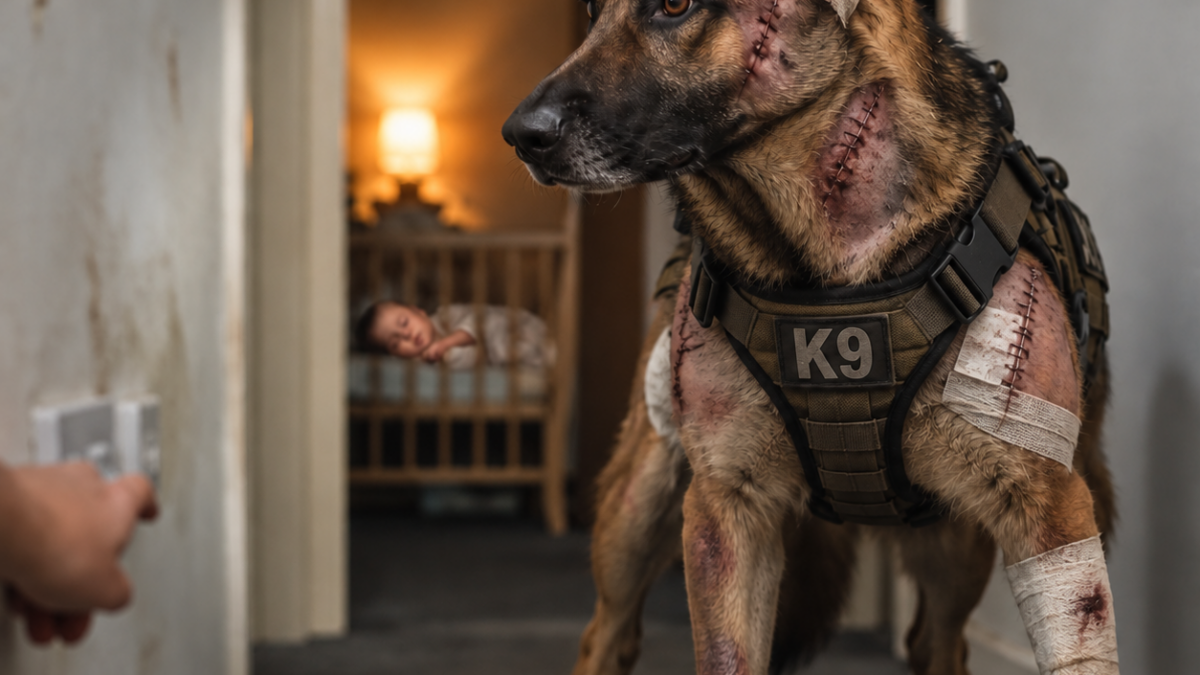
PART3:
“He was Aaron’s partner.”
Tyler rubbed both hands over his face.
“We’re trying to have a baby.”
“And?”
“And you want an eighty-pound attack dog living in the house?”
“He’s not an attack dog.”
“Mara.”
“He’s family.”
Tyler stared at me for a long moment.
I stared back.
Ghost came home that night.
For the first month, he slept beside our front door.
Not in the expensive orthopedic bed the sheriff’s department sent with him.
Not beside the couch.
Not in our bedroom.
At the door.
Waiting.
Every time headlights swept across the living room window, his head lifted.
Every time boots struck the sidewalk outside, he stood.
Every time a car door slammed, he looked toward the entrance.
Aaron never came through it.
Eventually Ghost stopped waiting for my brother.
But he never stopped guarding the door.
Five years later, when my daughter Lily was born, I understood that Ghost had simply transferred the promise.
By then, my marriage was failing.
Not loudly.
That might have been easier.
There was no dramatic affair discovered in a hotel room, no screaming match that ended with plates shattered against walls.
Tyler just became less present by degrees.
He stayed late at work.
He began sleeping on the couch.
He stopped touching my stomach during the last two months of pregnancy.
When Lily was born, he held her like someone had handed him an object made of glass he had never asked to carry.
Ghost reacted differently.
The first time I brought Lily home from the hospital, he stood six feet away from the car seat and watched.
His body was still then.
His nose worked constantly.
I lowered the carrier onto the living room floor.
“Easy,” I told him.
Tyler hovered behind me.
“This is exactly what I was worried about.”
Ghost approached.
One step.
Then another.
His hips were already stiff from arthritis, and gray had begun spreading around his muzzle.
He stopped beside the carrier.
Lily made a tiny squeaking sound in her sleep.
Ghost’s ears moved forward.
Tyler stiffened.
I placed a hand on Ghost’s shoulder.
“It’s okay.”
He sniffed Lily’s blanket.
Then her foot.
Then he looked at me.
Something in his expression changed.
I cannot prove that.
People like facts when animals are involved.
They want instincts.
Training.
Behavioral conditioning.
Scent recognition.
Pack bonding.
Maybe that was all it was.
But Ghost looked at me, then looked down at Lily, and lowered himself beside her carrier.
He stayed there for forty-three minutes.
I know because I took a photograph.
That photograph lived on my phone long before the other one made him famous.
Ghost beside a newborn baby.
Two old paws crossed in front of him.
Aaron’s faded sheriff’s K9 collar still hanging around his neck.
His ears standing tall.
His eyes watching the room.
Tyler looked at the photograph and said, “He looks like security.”
I smiled.
“He is.”
Tyler left when Lily was three months old.
He packed a navy duffel bag while I held our daughter against my chest.
“I can’t do this,” he said.
“Do what?”
“All of it.”
I stared at him.
“You mean be a father?”
“Don’t make it sound like that.”
“What should I make it sound like?”
“I’m drowning here, Mara.”
I laughed once.
It came out ugly.
“You’re drowning?”
“You’re better at this than me.”
That sentence has stayed with me longer than the apology that came months later.
You’re better at this than me.
As if competence was permission to abandon someone.
As if because I could survive carrying everything, he was allowed to hand me more.
He moved two counties away.
A month later, I learned the female coworker he had insisted was “just a friend” had also moved two counties away.
Different apartment.
Same town.
Tyler called Lily “the baby.”
Not Lily.
The baby.
As if avoiding her name made leaving easier.
Ghost never left.
He was there when Lily had colic.
He was there when I cried quietly in the kitchen after seeing our bank balance.
He was there when I sold my wedding ring because the pediatrician wanted an additional test my insurance would not fully cover.
He was there at two in the morning when Lily finally slept and I sat on the floor eating peanut butter from a jar because I was too tired to cook.
Ghost would lower his old body beside me.
Sometimes I talked to him.
“I bet Aaron would tell me I married an idiot.”
Ghost would sigh.
“I know. You tried to warn me.”
Another sigh.
“Little late now.”
He would rest his muzzle against my knee.
That was our life.
Messy.
Small.
Ours.
In September of 2023, Lily was seven months old.
Ghost was eleven.
We lived in a ground-floor apartment at Maple Court, a six-unit brick building that had one dying maple tree and absolutely nothing that could reasonably be called a court.
The apartment was cheap.
That was its best quality.
The air conditioner worked when it felt like it.
The cabinet under the sink smelled like mildew.
The bathroom fan sounded like a helicopter preparing to crash.
And the living room window did not lock properly.
I reported that window three times.
June 14.
July 3.
August 22.
The property manager, Vernon Calloway, treated every maintenance request like a personal insult.
He was a thick-necked man in his late fifties who wore golf shirts tucked too tightly into khaki pants and spoke to tenants as though allowing them to pay rent was an act of generosity.
The third time I complained, he came to the apartment.
Ghost was lying beside Lily’s play mat.
Calloway stopped in the doorway.
“That the police dog?”
“He’s retired.”
“Still got teeth?”
I looked at him.
“Yes, Vernon. Retirement did not make his teeth fall out.”
He did not appreciate the joke.
Ghost lifted his head.
Calloway pointed at him.
“That dog ever bites somebody here, insurance is going to have a field day.”
“He hasn’t bitten anybody outside police work in his life.”
“Police dog’s still a police dog.”
“He’s eleven.”
Calloway walked to the window and rattled the latch.
“It catches.”
“It slips if you push the frame.”
“Then don’t push the frame.”
“That isn’t a repair.”
He shrugged.
“This isn’t a luxury building.”
“I’m not asking for marble floors. I’m asking for the window to lock.”
He looked at Lily sitting on the carpet.
Then at me.
“You single mothers worry about everything.”
The sentence froze something inside me.
“What did you say?”
He smiled.
“You’ve got a big dog. Nobody’s climbing through your window.”
Ghost stared at him.
Calloway laughed.
“See? Best alarm system in the building.”
Then he left.
I should have called the housing department that day.
I know that.
I have replayed it enough times.
But life does not happen with the clarity people apply afterward.
At the time, Lily had a pediatric appointment.
I was two days late on the electric bill.
Ghost needed arthritis medication.
My work supervisor had warned me my call times were slipping because I kept muting customers to soothe a crying baby.
The latch became one more problem in a life already made of them.
On September 2, the temperature stayed above eighty degrees well after sunset.
The air conditioner quit around nine.
I opened the living room window three inches.
I checked the screen.
It looked secure.
Ghost was asleep in the hallway.
Lily was asleep in her crib.
At 11:40, I checked the latch again.
It held.
I locked the front door.
I kissed Ghost between the ears.
“Night, old man.”
His tail thumped once.
I went to bed.
Single mothers do not sleep the way other people sleep.
We listen.
Even unconscious, some part of us remains standing in a dark hallway.
I heard Lily shift around one.
I heard pipes knock in the wall.
I heard a car roll slowly through the parking lot.
I heard Ghost move once.
I did not hear the fox enter.
Animal control later reconstructed what probably happened.
The dumpsters behind Maple Court had overflowed for weeks.
Trash bags had been left outside the enclosure.
Residents had reported foxes near the drainage ditch.
One tenant had photographed a large red fox beside the dumpster in August.
Calloway had responded in the building group chat with a laughing emoji.
KEEP YOUR PETS INSIDE.
Nobody told me that until afterward.
Sometime after two in the morning, a hungry adult fox approached my living room window.
Maybe it smelled food.
Maybe mice.
Maybe trash.
Maybe nothing we will ever understand.
The screen was already weak at one corner.
The latch was loose.
The fox pushed.
The frame moved.
The latch slipped.
The screen tore.
And the animal entered my home.
Ghost must have smelled it instantly.
He had spent eight years being taught that unfamiliar scent in a protected space mattered.
Eleven years old.
Arthritic hips.
Partial hearing loss in his left ear.
Two cracked canine teeth from police work.
A shoulder that bothered him whenever rain was coming.
Retired.
Finished.
Safe.
He got up anyway.
At 3:20 a.m., I heard him bark.
One bark.
Deep enough to shake the wall.
I opened my eyes.
Then came a sound I had never heard from Ghost before.
A scream.
People think dogs only yelp when frightened or hurt.
This was neither.
It was rage sharpened by pain.
I came out of bed so fast my feet tangled in the blanket.
Lily cried.
I ran into the hallway.
The moon-shaped night-light in her room cast a pale blue glow across the floor.
Ghost stood in the doorway.
His old body looked enormous.
His hackles were raised from shoulders to tail.
His head was low.
His teeth were exposed.
And three feet in front of him stood a fox.
For one absurd second, my brain refused to understand the image.
Wild animal.
Inside.
Baby behind dog.
Blood already on Ghost’s muzzle.
The fox must have attacked before I arrived.
One side of Ghost’s face was wet.
His right ear hung lower than the left.
But he had not moved.
Lily was behind him in her crib.
The fox shifted its weight.
Ghost shifted too.
Blocking.
Always blocking.
“Ghost.”
His ear twitched.
The fox looked at me.
Its coat appeared almost black in the darkness except for a strip of red along its spine.
Its mouth opened.
Teeth.
Saliva.
Wild eyes.
Lily screamed.
The fox turned toward the sound.
Ghost attacked.
There was no warning.
No hesitation.
No old age.
He crossed the distance like the police dog he had once been.
His shoulder hit the fox hard enough to throw both animals into the wall.
A framed photograph of Aaron fell from the hallway table and shattered.
The fox screamed.
Ghost clamped his jaws around its shoulder.
“Ghost!”
I grabbed the first thing I could reach.
A wooden laundry basket.
The fox twisted.
Its claws ripped across Ghost’s face.
He released for half a second.
Then lunged again.
The fox bit his ear.
Ghost jerked backward.
I saw tissue tear.
I heard it.
That sound lived inside me afterward.
A wet tearing sound.
Ghost screamed.
But he did not retreat.
“GET OUT!”
I swung the basket.
It struck the wall.
The fox spun.
Ghost went after it.
They crashed into the shoe cabinet.
Wood split.
Shoes scattered across the floor.
Lily screamed so loudly she began choking between breaths.
I tried to move toward her.
Ghost’s body blocked the doorway.
Not from me.
From the fox.
Even in the fight, even confused and bleeding, he kept himself between that animal and the crib.
The fox slashed again.
Ghost’s left ear tore nearly to the base.
Blood sprayed the wall.
“No!”
I swung the basket and hit the fox across the hindquarters.
It snapped at me.
Ghost hit it before it could reach my leg.
His front paws slid in blood.
His bad shoulder buckled.
He went down.
The fox lunged.
Ghost rolled.
The animal’s teeth caught his chest.
He howled.
And then something happened I would replay for years.
Ghost had an opening.
The fox turned toward the living room.
Ghost could have stayed down.
He could have crawled away.
He could have let the animal run.
Instead he got up.
His legs shook.
Blood covered his face.
Both ears were torn.
And he followed.
Not because he wanted to kill it.
Because the fox was still inside the house.
Inside Lily’s house.
He drove it backward through the living room.
The fox scrambled over the overturned chair.
Ghost lunged.
The animal reached the window.
For one second it slipped, claws scratching the sill.
Ghost was almost on it.
Then the fox forced itself through the torn screen.
Gone.
Silence crashed into the apartment.
Ghost stood beneath the window.
His legs trembled.
“Ghost?”
He turned.
He looked past me.
Toward Lily.
Then he started walking.
One step.
Two.
Blood dotted the floor behind him.
His right front leg dragged.
“Ghost, stop.”
He kept going.
“Baby, stop.”
He reached Lily’s doorway.
The same doorway.
He turned so his body faced the hallway.
Then he sat.
Exactly where he had been before the fight.
His chest rose once.
Twice.
His legs folded.
He collapsed.
I dropped beside him.
“No. No, no, no.”
Blood had soaked the fur around his neck.
His right ear was almost detached.
His left was split open.
Deep claw marks crossed his face from forehead to jaw.
Puncture wounds showed through the fur near his ribs.
One eye was already swelling.
“Ghost.”
His eyes found me.
“Stay with me.”
Lily was crying behind us.
My baby.
My dog.
Blood.
Broken glass.
Open window.
For several seconds I could not move.
I hate admitting that.
People like courage to look instant.
Sometimes terror wins first.
I froze.
Ghost moved before I did.
His paw scraped the floor.
Toward Lily’s room.
Once.
Weakly.
Maybe it meant nothing.
Maybe a muscle spasmed.
Maybe I created meaning because I needed it.
But I heard Aaron in my head.
Check the child first.
I crawled over Ghost.
Lily stood inside the crib gripping the rail.
I picked her up.
Her body shook against mine.
I checked her face.
Hands.
Arms.
Neck.
No blood.
No scratches.
Nothing.
Ghost had stopped it.
“You’re okay.”
She screamed into my shoulder.
“You’re okay.”
I carried her into the living room, strapped her into her infant car seat, shoved the coffee table against the window and called 911.
Then I returned to Ghost.
He had not moved.
I wrapped the thickest towel I owned around his body.
He cried when I lifted him.
One sound.
Low.
Almost embarrassed.
“I know. I know. I’m sorry.”
He weighed eighty pounds, but adrenaline made weight meaningless.
I carried him to the car.
The emergency veterinary hospital was twenty-five minutes away.
I arrived in sixteen.
I remember every red light.
Every turn.
Every time I looked at the passenger seat and thought he had stopped breathing.
“Stay with me.”
His eyes remained half-open.
“Ghost, stay.”
Lily cried behind me.
“Please.”
At the hospital, I pulled across two parking spaces and ran inside.
Ghost was in my arms.
Blood covered my shirt.
The receptionist stood.
“Oh my God.”
“I need help.”
Two technicians ran through the doors.
One took Ghost.
“What happened?”
“Fox.”
“What?”
“A fox got inside. He fought it. My baby was behind him. Please save him.”
They rushed him away.
I stood empty-handed.
Then remembered Lily was still in the car.
I ran back.
By the time I carried her into the waiting room, my knees were shaking so hard I could barely stand.
We sat beneath fluorescent lights.
A vending machine hummed.
A television played weather forecasts with the sound muted.
Another woman held a small dog wrapped in a blanket.
She stared at the blood on me.
I did not care.
Twenty minutes passed.
Then thirty.
Then forty-three.
A veterinarian named Dr. Hannah Mercer walked into the waiting room.
Blue scrubs.
Hair pulled back.
Blood on one sleeve.
“Ghost’s owner?”
I stood.
“Is he alive?”
“He’s alive.”
My knees weakened.
“But he is critically injured.”
She brought me into a consultation room.
Lily had cried herself to sleep against my chest.
Dr. Mercer sat across from me.
“I’m going to explain everything clearly.”
I nodded.
“His right external ear is nearly completely avulsed.”
I stared at her.
“Torn away.”
“Yes.”
“Can you fix it?”
Her face answered before she spoke.
“No.”
My throat tightened.
“The blood supply has been destroyed.”
I looked down at Lily.
“And his left ear has extensive tearing from the base through the cartilage. We could attempt reconstruction, but given the contamination from a wild animal bite and the damage to the vessels, the risk of tissue death and infection is very high.”
“What are you saying?”
“We believe the safest option is removal of both external ears.”
Both.
Ghost’s ears.
The ones Aaron used to scratch.
The ones that stood straight when Lily cried.
The ones I had kissed three hours earlier.
“Both?”
“I’m sorry.”
I put my hand over my mouth.
Dr. Mercer continued gently.
“He has four significant lacerations across the right side of his face. One is very close to the eye.”
“How close?”
“A few millimeters.”
I stopped breathing.
“The eye appears intact.”
“Okay.”
“He has a deep bite wound to the left front leg with muscle damage. There are punctures along his chest. One comes dangerously close to the thoracic cavity.”
“What does that mean?”
“If it had penetrated slightly deeper, it could have collapsed his lung.”
“How slightly?”
She hesitated.
“Two millimeters. Perhaps less.”
I stared at her.
She continued.
“He has lost a lot of blood. His temperature is low. His blood pressure is unstable. He’s in shock.”
“Can you save him?”
“We are trying.”
“Can you?”
Dr. Mercer looked directly at me.
“I don’t know.”
Those three words broke something.
I started crying.
Quietly at first.
Then harder.
Lily stirred.
I held her closer.
“He stood in front of her.”
Dr. Mercer waited.
“He knew where she was.”
“I believe you.”
“He could have run.”
“Yes.”
“He didn’t.”
Dr. Mercer leaned forward.
“We need to operate now.”
“Do it.”
“There’s another issue.”
I knew before she said it.
Money.
The estimate was more than two months of rent.
More than my savings.
More than my available credit.
I stared at the paper.
The numbers blurred.
“I don’t have that.”
“We have an emergency assistance fund.”
“I’ll pay.”
“Mara—”
“I’ll sell my car.”
“You need a car for your daughter.”
“I’ll figure it out.”
“We can apply part of the assistance fund. We can arrange payments for the remainder.”
I wiped my face.
“Do whatever you have to do.”
“All right.”
“Do not stop because of money.”
“We won’t.”
“I mean it.”
“I understand.”
I looked at Lily.
Then at Dr. Mercer.
“He served eight years.”
She paused.
“Police?”
“My brother’s K9.”
Her expression changed.
“My brother died five years ago.”
“Oh.”
“Ghost lost him. Then Tyler left. He’s the only one who stayed.”
The words sounded pathetic once spoken.
But Dr. Mercer did not look at me with pity.
She stood.
“We’re going to fight for him.”
They took Ghost into surgery at 4:41 a.m.
Mrs. Alvarez arrived shortly after five.
She lived above me in Unit 2A.
Sixty-three years old.
Four grown children.
Seven grandchildren.
A woman who could make arroz con pollo, scold a landlord and calm a screaming baby without changing expression.
She entered the waiting room wearing slippers beneath a winter coat.
“Mara.”
I stood.
She saw the blood.
Her hand covered her mouth.
“Is Lily hurt?”
“No.”
“Ghost?”
“Surgery.”
She took Lily from me.
“Go wash.”
“I can’t.”
“Bathroom.”
“Mrs. Alvarez—”
“Now.”
I obeyed.
Inside the bathroom, I finally saw myself.
Blood on my shirt.
Blood across my neck.
Blood in my hair.
Blood beneath my fingernails.
Some belonged to Ghost.
Some possibly to the fox.
I turned on the faucet.
Pink water ran into the sink.
I started shaking.
I remembered Aaron.
The last time I had washed blood from my hands had been nothing like this.
At the hospital after his crash, there had been no blood on me.
That had almost made it worse.
He had looked clean beneath the sheet.
Like death could happen politely.
Ghost’s blood was not polite.
It was everywhere.
Proof of what he had paid.
I sat on the bathroom floor.
“I’m sorry.”
Nobody heard.
“I’m so sorry.”
When I returned, Mrs. Alvarez handed me coffee.
“I left that window open.”
She stared at me.
“The latch was broken.”
“I knew it was broken.”
“You reported it.”
“I should have—”
“Stop.”
“If I had shut it—”
“Mara.”
“Ghost is losing both ears because I wanted air in the apartment.”
Mrs. Alvarez leaned toward me.
“You did not put a fox in your house.”
I looked away.
“He might die.”
She squeezed my hand.
“Then we stay until we know.”
Ghost remained in surgery for two hours and twenty-three minutes.
They removed both external ears.
Cleaned the bite wounds.
Closed the facial lacerations.
Placed drains.
Flushed his chest wounds.
Debrided damaged tissue.
Stabilized the leg.
Started transfusion support.
At 7:04, Dr. Mercer returned.
“He made it through.”
I collapsed into the chair.
Not fainting.
Just losing the strength to remain upright.
“He’s alive?”
“Yes.”
“Thank God.”
“He’s not out of danger.”
I nodded.
“Infection is our biggest concern. Shock is another. The next forty-eight hours are critical.”
“Can I see him?”
“For a minute.”
Ghost lay inside a heated recovery kennel.
I almost did not recognize him.
Bandages wrapped his head.
Both ears were gone.
His face was swollen.
Dark stitches crossed the right side of his muzzle.
One eye barely opened.
His chest had been shaved.
Tubes ran beneath blankets.
The mighty police dog who had once chased armed men through abandoned buildings looked small.
Old.
Breakable.
I placed my fingers against the kennel door.
“Oh, Ghost.”
His eye moved.
He saw me.
His paw shifted.
That was all.
I started crying.
“You did enough.”
A vet tech looked away.
“You hear me?”
Of course he probably did not.
His hearing had already been declining.
Now, without his external ears and with additional trauma, Dr. Mercer warned me it might be dramatically worse.
“You don’t have to guard anything.”
His eye closed.
“Just stay.”
I went home without him.
The apartment looked like a crime scene.
Animal control arrived shortly after eight.
So did Officer Grant from the local police department.
Mrs. Alvarez kept Lily upstairs.
Vernon Calloway arrived at 8:40 wearing a baseball cap and annoyance.
Animal Control Officer Bethany Price crouched near the window.
The torn screen bowed inward.
The latch hung sideways.
One screw was missing.
The wood around the hardware showed old wear.
“This latch was compromised before entry,” Bethany said.
Calloway crossed his arms.
“She left the window open.”
“Three inches.”
“Open is open.”
I stared at him.
“My dog nearly died.”
He shrugged slightly.
“I’m sorry about your animal.”
My animal.
Ghost had served his county longer than Calloway had managed that building.
Bethany stood.
“Did she report the latch?”
Calloway looked at me.
“Tenants report a lot of things.”
“I reported it three times.”
“That doesn’t mean it was unsafe.”
Officer Grant looked up from his notebook.
“A wild animal entered through it.”
Calloway’s face tightened.
“She chose to keep the window open at night.”
“Because the air conditioner doesn’t work,” I said.
“It works.”
“It was eighty-four degrees in my living room.”
“Personal responsibility matters too, Miss Ellis.”
Personal responsibility.
The phrase landed harder than it should have.
I walked to the kitchen.
Opened my phone.
Pulled up the maintenance portal.
June 14.
Living room window latch loose. Window will not reliably lock.
July 3.
Second request. Still not repaired.
August 22.
Third request. Infant in home. Concerned about security.
I held the phone toward him.
Calloway’s face changed.
Bethany took photographs of the screen.
“Preserve those.”
“I will.”
Calloway cleared his throat.
“That system doesn’t necessarily reflect completed work.”
“Then show us the completed repair,” Officer Grant said.
Silence.
Calloway looked at the broken hallway furniture.
“This damage is extensive.”
“A fox did it.”
“Your dog participated.”
I stared at him.
“My dog stopped a wild animal from reaching my seven-month-old daughter.”
“I’m talking about liability.”
“No. You’re talking about money.”
His eyes narrowed.
“You need to watch your tone.”
Officer Grant looked between us.
“Mr. Calloway, I think she’s had enough this morning.”
Calloway left.
By noon there was a notice taped to my door.
INSPECTION REQUIRED DUE TO PET-RELATED PROPERTY DAMAGE.
Pet-related.
Not wildlife intrusion.
Not failed window hardware.
Pet-related.
That was when I began to understand what he was doing.
He was building another version of the night.
One where Ghost caused the damage.
One where I was irresponsible.
One where Maple Court had nothing to answer for.
Ghost spent seven days in intensive care.
I visited every morning.
Every evening.
On day two he lifted his head.
On day three he ate from Dr. Mercer’s hand.
On day four he growled weakly when a young Labrador tried to sniff through the kennel bars.
The technicians celebrated.
“Good,” one said. “Be grumpy.”
On day five his fever dropped.
On day six the drains came out.
On day seven, Dr. Mercer walked me into an exam room.
“He’s stubborn.”
I laughed through tears.
“That sounds right.”
“He wants out.”
“When can he come home?”
“Not yet.”
My face fell.
“His wounds need more time.”
Another three days.
Then two.
On the twelfth day after the attack, I brought Lily to the clinic.
Dr. Mercer reviewed Ghost’s medication schedule twice.
“His hearing is much worse.”
“How much?”
“We won’t know precisely until swelling decreases.”
“Could he be completely deaf?”
“Yes.”
I closed my eyes.
“There’s more.”
I looked at her.
“The front leg.”
“Permanent?”
“Possibly. The bite damaged muscle and there may be nerve involvement. He may always limp.”
I nodded.
“He may also have balance issues for a while.”
“Because of his ears?”
“Partly.”
Dr. Mercer placed a hand lightly on my arm.
“He’s still Ghost.”
“I know.”
“He may look different.”
“I know.”
“Sometimes owners have a stronger reaction than they expect.”
I swallowed.
“He lost his ears saving my daughter.”
“I know.”
“There is nothing he could look like that would make me love him less.”
Dr. Mercer smiled.
“That’s what I hoped you’d say.”
They brought Ghost out.
Lily stopped moving.
He looked smaller without his ears.
Not physically.
Emotionally.
His head seemed rounder.
His scars made one side of his face pull slightly.
His right foreleg was bandaged.
Gray fur around his muzzle had been shaved away.
Lily stared.
I worried she might cry.
Instead she leaned forward in her stroller.
“Go.”
It was the closest she had ever come to saying his name.
Ghost turned.
His eyes found her.
Lily reached out.
“Go.”
Ghost stepped toward her.
One slow step.
Then another.
He pressed his nose against her hand.
I cried.
The receptionist cried.
Dr. Mercer cried.
Nobody pretended otherwise.
When we reached the apartment, I expected Ghost to hesitate.
That hallway still smelled different even after cleaning.
Dogs remember through scent what humans try to erase with bleach.
He stepped from the car.
Limped inside.
Looked around.
Then walked straight toward Lily’s bedroom.
“Ghost.”
He continued.
“You don’t have to.”
He reached the doorway.
The same doorway where he had nearly died.
He sniffed the floor.
Then lowered himself down.
Facing the hallway.
Back toward Lily.
Guarding her again.
I stood ten feet away and covered my mouth.
Lily gripped the crib rail.
“Go.”
He did not hear her.
But he looked back.
Maybe he saw movement.
Maybe he felt vibration.
Maybe love does not always need sound.
I took one photograph.
Not staged.
Not planned.
Ghost lying scarred and earless at Lily’s doorway.
Lily standing behind him in her crib.
I posted it that evening in a local pet group because people from the clinic had been asking if he survived.
The caption was one sentence.
He came home today and went straight back to her door.
The next morning, the photograph had been shared eight thousand times.
By evening, eighty thousand.
Two days later, more than a million people had seen it.
Then two million.
Then four.
The same phrase kept appearing.
He went back.
Others wrote:
He still thinks he’s on duty.
That baby is his last assignment.
Somebody tell him he can rest.
And again and again:
He didn’t run.
People sent stories.
A retired Marine sent a picture of his old military working dog sleeping beside his grandson.
A police officer from Arizona wrote that his K9 partner had died three years earlier and he still reached toward the back seat sometimes.
A mother whose child had survived a house fire told me her Labrador had barked until firefighters arrived.
Veterans wrote about dogs who had brought them back from places no one else could reach.
Parents wrote about grief.
Abandonment.
Protection.
Children sent drawings of Ghost wearing a cape.
One drawing showed him with enormous superhero ears.
That one destroyed me.
A second-grade teacher mailed a packet of letters.
DEAR GHOST, YOU ARE BRAVE EVEN WITHOUT YOUR EARS.
DEAR GHOST, I THINK YOUR BABY LOVES YOU.
DEAR GHOST, MY DOG IS OLD TOO AND I TELL HIM YOU SAID OLD DOGS CAN STILL BE HEROES.
Then donations began arriving at the veterinary clinic.
Dr. Mercer called.
“Mara.”
“What happened?”
“Nothing bad.”
“You sound strange.”
“Someone paid your remaining balance.”
I sat down.
“What?”
“All of it.”
“No.”
“Yes.”
“Who?”
“Anonymous.”
I started crying.
“And there’s more.”
“What do you mean?”
“Other people have called asking to donate.”
“To me?”
“To emergency cases.”
I looked toward the hallway.
Ghost was asleep outside Lily’s room.
Dr. Mercer continued.
“The clinic owner wants to establish an emergency fund in Ghost’s name.”
I laughed through tears.
“He would hate that.”
“Probably.”
“What would it do?”
“Help families who can’t afford deposits for emergency treatment.”
The shame from that first night returned.
I remembered sitting beneath fluorescent lights while someone explained the price of keeping Ghost alive.
“Do it.”
“We need your permission to use his name and image.”
“Use everything.”
The Ghost Fund was created two weeks later.
But viral stories never remain kind.
By the fifth day, strangers began asking different questions.
WHY WAS A WINDOW OPEN?
WHERE WAS THE MOTHER?
WHY DID SHE HAVE A FORMER POLICE DOG AROUND A BABY?
THAT DOG SHOULD HAVE BEEN RETIRED SOMEWHERE SAFE.
SOUNDS STAGED.
THE DOG LOOKS ABUSED.
TAKE THE CHILD AWAY.
I told myself not to read the comments.
I read them anyway.
Then a local online news blog published an article.
RETIRED K9 SAVES INFANT AFTER MOTHER LEAVES WINDOW OPEN OVERNIGHT.
That headline spread faster than the correction ever would.
The article quoted anonymous residents.
“Overwhelmed single mother.”
“Chaotic apartment.”
“Dangerous retired police dog.”
One neighbor claimed Ghost was aggressive because he barked when delivery drivers approached.
Another claimed animal control had visited before.
False.
The article asked whether public sympathy had “obscured questions about parental responsibility.”
Tyler called that evening.
“What the hell happened?”
That was his greeting.
Not:
Is Lily okay?
Not:
Are you okay?
Not:
Is Ghost alive?
“What do you think happened?”
“My mom sent me the article.”
“Of course she did.”
“You left a window open?”
“The latch was broken.”
“You knew that?”
“I reported it three times.”
“So you knew.”
I went still.
“Be very careful where you’re going with this.”
“Mara, our daughter could have been killed.”
“Our daughter?”
“Yes, our daughter.”
“Interesting.”
“Don’t do that.”
“Do what?”
“Turn this into another argument about me leaving.”
“You called because you’re worried how an internet article makes you look.”
“That’s not fair.”
“No?”
“No.”
Ghost shifted near Lily’s doorway.
Tyler continued.
“My mom thinks Lily should stay with me for a while.”
My body turned cold.
“What?”
“Until things settle down.”
“You haven’t kept her overnight once.”
“I’m still her father.”
“You have missed six scheduled visits.”
“I work.”
“So do I.”
“She almost got attacked by a fox.”
“And the retired K9 you wanted me to get rid of stopped it.”
“A dog shouldn’t be your safety plan.”
“No.”
I lowered my voice.
“A father should have been part of it.”
Silence.
Then:
“You’re not taking this seriously.”
Something changed in me.
For months, I had tried to make co-parenting easy for Tyler.
I reminded him of visits.
Sent photographs.
Avoided mentioning money unless absolutely necessary.
Protected his image for a daughter too young to know there was an image to protect.
That night, I stopped.
“You want Lily?”
“That isn’t what I said.”
“You want custody?”
“My mom thinks—”
“I’m asking you.”
A pause.
“Maybe temporary custody.”
“All right.”
His voice changed.
“What?”
“File.”
“Mara.”
“File for custody.”
“You’re being emotional.”
“No. For the first time since you left, I’m not.”
“Mara—”
“I have every message.”
“What messages?”
“The ones where you said diapers were my responsibility because you were ‘getting back on your feet.’ The ones where you canceled visits because your girlfriend wanted to go to a concert. The ones where you called Lily ‘the baby.’ The bank statements. The missed payments. The screenshots.”
“You’ve been saving that?”
“I’ve been surviving you.”
Silence.
“You want to tell a judge I’m unfit because a wild animal entered through a window management ignored for three months? Go ahead.”
“Mara.”
“And Tyler?”
“What?”
“Her name is Lily.”
I hung up.
Then I shook for ten minutes.
The next morning, I called legal aid.
Priya Shah became my attorney.
She was thirty-four, spoke quickly, listened carefully and had the kind of calm that made other people nervous.
I told her everything.
The window.
Calloway.
The fox.
Ghost.
The online article.
Tyler.
The notices.
She asked one question after another.
“When was the first maintenance request?”
“June fourteenth.”
“Do you have proof?”
“Yes.”
“The second?”
“July third.”
“Third?”
“August twenty-second.”
“Any wildlife complaints?”
“I didn’t know until afterward.”
“Find out.”
“Okay.”
“Any written communication from management after the incident?”
“Two notices.”
“Send them.”
“What should I do if Calloway comes back?”
“Do not have an undocumented conversation with him.”
That afternoon, Calloway knocked.
Lily was on my hip.
Ghost was behind me.
The moment I opened the door, Ghost stood.
Slowly.
Painfully.
Calloway looked at him and recoiled.
“Jesus.”
I felt my jaw tighten.
“What?”
“His ears.”
“Yes.”
“That’s rough.”
“What do you need?”
He smiled.
“You’ve been making quite a fuss.”
“I hired an attorney.”
The smile disappeared.
“Over a window?”
“Over retaliation after a documented safety failure.”
His eyes narrowed.
“Big words.”
“Not mine.”
He glanced at Ghost.
“That dog should maybe stay somewhere else while this gets sorted out.”
“No.”
“He caused significant damage.”
“A fox caused significant damage.”
“That dog tore up the hallway.”
“That dog saved my daughter.”
“He’s a liability.”
I stared at him.
“No.”
“He’s a retired bite-trained K9 living around an infant.”
“Leave.”
“Mara—”
“My attorney told me not to speak to you.”
“I’m trying to help.”
“No, you’re trying to scare me.”
He leaned slightly closer.
“Housing can become difficult when landlords hear a tenant is litigious.”
There it was.
The threat.
Soft enough to deny.
Clear enough to understand.
I felt fear rise into my throat.
Then Ghost stepped forward.
Not lunging.
Not growling.
Just standing beside me.
Scarred.
Earless.
Limping.
Calloway stepped back.
I almost smiled.
“You should leave.”
He did.
My hands shook after I closed the door.
Ghost pressed his body against my leg.
“You still working?”
His tail moved.
The investigation began quietly.
Bethany Price returned to Maple Court.
She photographed overflowing dumpsters.
Broken enclosure gates.
Animal tracks near the drainage ditch.
A tenant named Mr. Ingram admitted he had reported fox sightings twice.
“He told Calloway?”
“Yes.”
“What did Calloway say?”
Mr. Ingram looked embarrassed.
“He said unless the fox was paying rent, it wasn’t his problem.”
Mrs. Alvarez found the building group chat.
August 11.
A blurry photograph of a fox near the dumpster.
Someone wrote:
THIRD TIME THIS WEEK.
Calloway replied:
KEEP YOUR PETS INSIDE AND STOP FEEDING STRAYS.
He knew.
Priya sent Maple Court Properties a preservation notice.
Maintenance logs.
Resident complaints.
Wildlife reports.
Internal emails.
Communications about me.
Communications about Ghost.
Security footage.
Inspection records.
Then she filed a complaint with the city housing department.
Maple Court changed its tone immediately.
The woman from the leasing office called.
I let voicemail answer.
“Ms. Ellis, we would like to resolve this matter amicably.”
Amicably.
The word people discover after intimidation fails.
The city inspector arrived the following Monday.
A silver-haired woman named Jacqueline Reeves.
Calloway wore a clean polo shirt.
“We take tenant safety very seriously.”
Jacqueline looked at him.
“When was this window repaired?”
“Immediately following the incident.”
“Ten days later,” I said.
Calloway looked at me.
“There were scheduling complications.”
I handed Jacqueline my records.
She read the June request.
Then July.
Then August.
She walked to the window.
Pressed the new latch.
Looked at Calloway.
“Why was this not repaired after the June complaint?”
“I can’t speak to individual scheduling decisions.”
“You are the property manager.”
Silence.
She inspected every ground-floor unit.
Three windows had weak locks.
Two screens were torn.
A rear security light had been dead for months.
Brush near the building exceeded local code requirements.
The dumpster enclosure failed to close.
Maple Court received multiple citations.
Calloway stopped smiling.
The local blog published a correction after Priya contacted them.
NEW DOCUMENTS SHOW REPEATED WINDOW REPAIR REQUESTS BEFORE RETIRED K9 SAVED INFANT.
I stared at that headline for five minutes.
Not because I enjoyed seeing Calloway exposed.
Because the truth existed somewhere outside my own mouth.
That mattered.
Then Tyler filed for temporary custody.
The petition arrived in October.
It described “unsafe residential circumstances.”
It referenced “the presence of a bite-trained police animal.”
It claimed my “viral attention” had created instability.
I read it once.
Then vomited into the kitchen sink.
Ghost stood behind me.
Lily cried because my vomiting frightened her.
I rinsed my mouth.
Called Priya.
Then opened the folder I had created.
I became a woman made of evidence.
Maintenance requests.
Veterinary reports.
Animal control documents.
Police report.
Photographs.
Calloway’s notices.
Building chat screenshots.
Wildlife complaints.
Bank statements.
Tyler’s messages.
Missed visitation records.
Work records.
Pediatric appointments.
Receipts.
Dates.
Facts.
The night before court, I sat on the couch surrounded by paper.
Ghost approached.
His limp worsened when he was tired.
Getting onto the couch had become difficult.
I lifted him.
He settled against my thigh.
Before the attack, Ghost rarely cuddled.
Police dogs are often affectionate, but Ghost had always carried himself with professional dignity.
He loved you.
He just did not see a reason to climb onto you about it.
That night, he pressed his scarred head against my leg.
“I’m scared.”
He closed his eyes.
“I know you can’t hear me.”
His remaining hearing was almost gone.
“I think everyone’s going to decide I’m not enough.”
His breathing remained slow.
“Tyler.”
Nothing.
“His mother.”
Nothing.
“Calloway.”
Nothing.
“The judge.”
I touched the scar where his right ear had been.
“People online.”
Ghost opened one eye.
“You lost both ears because I opened a window.”
His head lifted.
“I know everyone says it wasn’t my fault.”
My voice cracked.
“But you paid for it.”
Ghost pushed his forehead against my hand.
I started crying.
“You stood there.”
He stayed.
“You didn’t wonder whether you were enough.”
He breathed.
“You just stood there.”
Court was the next morning.
Tyler wore a suit I had purchased for him two years earlier.
His mother sat behind him.
Pearls.
Perfect hair.
Disapproval.
He looked surprised when he saw Priya.
The hearing was not cinematic.
Real justice rarely is.
No one shouted.
No surprise witnesses burst through doors.
There was beige carpet.
Fluorescent lighting.
A judge who looked tired.
Documents.
Questions.
Tyler’s attorney began with the fox attack.
Priya presented the maintenance history.
The animal control report.
The city citations.
The wildlife complaints.
The repaired window.
Then Tyler’s attorney raised Ghost.
“A former police K9 trained in apprehension lives in the home?”
“Yes.”
“Has he been trained to bite?”
“Of course.”
“Is he around the child?”
“Yes.”
“Do you consider that safe?”
I looked at the judge.
“Yes.”
Tyler’s attorney glanced at Ghost’s veterinary report.
“This same animal recently engaged in a violent fight inside the residence.”
Priya stood.
“With a fox that entered the residence and approached the child’s room.”
The judge looked at Tyler’s attorney.
“Counsel?”
He sat down.
Priya submitted a letter from Ghost’s former K9 trainer.
It described his temperament.
His retirement evaluation.
His bite release reliability.
His five years without a civilian aggression incident.
Then Tyler testified.
His attorney described him as a concerned father seeking greater involvement.
The judge asked him a simple question.
“How many overnight visits have you had with Lily?”
Tyler shifted.
“None yet.”
“When was your last full-day visit?”
He looked at his attorney.
“I’m not sure of the date.”
“Who is Lily’s pediatrician?”
“I don’t have the name with me.”
“What medications is the child currently taking?”
“I don’t believe she takes any.”
She had been on antibiotics for an ear infection the previous week.
I looked down.
The judge continued.
“What size diaper does Lily wear?”
Tyler swallowed.
“Three?”
Four.
His mother shifted behind him.
I did not feel satisfaction.
That surprised me.
I felt grief.
Because once, I had wanted this man to know everything.
I had wanted him beside me when Lily took her first steps.
I had wanted to wake him at two in the morning when she had a fever.
I had wanted someone who knew diaper sizes because he had changed hundreds.
Watching him fail was not victory.
It was evidence of a life we had not built.
The judge denied temporary custody.
She ordered structured visitation.
Parenting classes before overnight visits.
Formal child support.
Then she looked at me.
“Ms. Ellis.”
“Yes, Your Honor.”
“The court does not find evidence that the wildlife incident resulted from parental neglect.”
I stopped breathing.
“The documentation shows repeated attempts by you to have a defective window repaired.”
My eyes filled.
“You responded appropriately during and after the emergency.”
I nodded.
“Thank you.”
It was not comfort.
It was better.
It was a record.
The shame did not belong entirely to me.
Outside court, Tyler followed me to the elevator.
“Mara.”
I stopped.
“I didn’t know about the maintenance requests.”
“You never asked.”
“My mom showed me the article.”
“You believed an article before calling the mother of your child.”
He looked down.
“I panicked.”
“So did I.”
“I want to see Lily.”
“Then show up.”
“I will.”
I studied him.
“Don’t promise me.”
He looked up.
“Promise her by being there.”
The elevator opened.
I stepped inside.
That evening, Mrs. Alvarez was feeding Lily applesauce.
Ghost sat outside the bedroom.
“How did court go?”
I set my bag down.
“We’re okay.”
Mrs. Alvarez hugged me.
For the first time in months, I believed it.
Winter arrived.
Ghost healed badly.
That sounds harsh.
But healing is often ugly.
His ears did not return.
His limp did not disappear.
The scars remained.
His balance improved slowly.
Sometimes he woke startled and snapped his head toward sounds he could no longer hear.
We learned new ways to communicate.
I stomped gently before approaching him from behind.
Flicked lights.
Used hand signals he remembered from police work.
Open palm for stay.
Two fingers toward me for come.
Pointing downward for down.
Lily learned too.
Before she touched Ghost, she began patting the floor.
Three small pats.
Ghost would look.
Then she would approach.
The first time she did it without my help, I cried in the kitchen.
At nine o’clock every night, Ghost went to her doorway.
Bath.
Pajamas.
Bottle.
Story.
Lights dimmed.
Then Ghost rose.
Some nights his leg hurt.
Some nights getting up took ten seconds.
Sometimes I tried to stop him.
“Stay.”
He ignored me.
“Ghost, bed.”
Ignored.
“Old man, you are retired.”
He walked down the hallway.
Sat outside Lily’s room.
Faced outward.
Always outward.
Toward whatever might come.
The windows were locked.
I checked them twice.
Then three times.
Fear had changed me.
I pushed every latch before bed.
Checked the door.
Checked the kitchen.
Looked behind curtains.
Sometimes I woke at two and checked again.
Trauma teaches you that safety is temporary.
Ghost seemed to believe something different.
Safety was a job.
Maple Court offered a settlement in December.
No admission of wrongdoing.
Of course.
But the lease violations disappeared.
Property damage was reimbursed.
They covered medical expenses not already paid by donations.
I redirected that money to the Ghost Fund.
They offered to release me from the lease without penalty.
I accepted.
Mrs. Alvarez helped me find a small duplex ten minutes away.
The owner was a retired principal named Margaret Donnelly.
At the first viewing, she noticed the back door lock sticking.
“I’ll replace that before you move in.”
I stared at her.
“You don’t have to ask twice for a lock,” she said.
I almost cried in front of a stranger.
The duplex had yellow kitchen curtains.
A little fenced yard.
Two bedrooms.
Working heat.
Every window locked.
Moving day was cold.
Ghost hated everything about it.
The boxes.
The car.
The new smells.
The disruption.
He stood in the empty living room refusing to look at me.
“I know,” I said. “Terrible management.”
Lily toddled across the floor.
Dropped her stuffed rabbit beside him.
Ghost sniffed it.
Then looked down the new hallway.
I stopped breathing.
Lily’s room was at the end.
White door.
Brass knob.
Sunlight on the floor.
Ghost walked.
Limp.
Step.
Limp.
Step.
He reached the doorway.
Went inside.
Checked beneath the crib.
Sniffed the corners.
Came back out.
Sat facing the hallway.
I sat on a moving box.
My brother’s old dog.
My daughter’s guardian.
Same post.
New house.
I cried until my younger cousin Jason asked if something was wrong.
I pointed.
He looked at Ghost.
Then at me.
“He’s still doing it?”
“Yes.”
Jason shook his head.
“That dog has issues.”
I laughed.
“So do we.”
By spring, Lily could walk.
She moved like a tiny drunk politician giving speeches nobody understood.
Ghost tolerated her.
She brought him blocks.
Stuffed animals.
Plastic spoons.
Cheerios.
One afternoon she attempted to put a pink sun hat on his head.
He looked at me with such betrayal that I laughed for several minutes.
Her first clear word after Mama was not Dada.
It was Go.
She pointed at Ghost.
“Go.”
His eyes opened.
“Go!”
His tail moved.
Tyler heard it during a supervised visit.
By then, he had completed his parenting class.
He had started showing up.
Not perfectly.
But regularly.
“She calls him Go?”
“Yes.”
He smiled.
“That’s cute.”
We watched Lily stack blocks.
After several minutes, Tyler spoke.
“I’m sorry.”
I looked at him.
“For what?”
He swallowed.
“Everything.”
“That’s broad.”
“For leaving.”
I waited.
“For making you carry everything.”
I said nothing.
“For the custody petition.”
Still nothing.
“For believing my mom before asking you.”
His voice lowered.
“For being ashamed that I couldn’t handle becoming a father and turning that shame into anger at you.”
That one reached me.
I looked at him.
He looked older.
Not physically.
Consequences age people differently.
“I kept telling myself you were better at it.”
“I remember.”
“And that made leaving feel less terrible.”
“For you.”
“Yes.”
I nodded.
“Thank you for saying it.”
He waited.
“It doesn’t erase anything.”
“I know.”
“We are not getting back together.”
“I know.”
“You need to become Lily’s father because she deserves one. Not because you want me back.”
“I understand.”
For once, I believed he might.
We never reconciled.
That became one of the healthiest endings in my life.
Tyler slowly became a better father.
He learned Lily’s doctor’s name.
Her diaper size.
Her favorite cup.
Which stuffed animal had to be in bed.
That bananas must be cut lengthwise or she would declare them “broken.”
He learned to approach Ghost from the front.
He learned the hand signal for stay.
One afternoon, Tyler stood in my kitchen watching Ghost sleep.
“I was wrong about him.”
I glanced over.
“Yes.”
He almost smiled.
“You could let me feel slightly less terrible.”
“No.”
“Fair.”
His mother took longer.
The first time she saw Ghost after the attack, she recoiled.
It lasted less than a second.
But Lily saw it.
Children notice more than adults understand.
Lily was eighteen months old.
Her hand rested on Ghost’s back.
She looked at her grandmother.
Then Ghost.
Then frowned.
“Nice.”
Tyler’s mother blinked.
“What?”
“Nice.”
She patted Ghost.
Be nice.
I turned away before I laughed.
Tyler coughed.
His mother looked humiliated.
Then, to her credit, she knelt.
“Hello, Ghost.”
Ghost looked away.
Perfect.
The Ghost Fund grew.
The first animal it helped was a tabby cat that swallowed sewing thread.
The second was a beagle hit by a car.
The third was an old pit bull whose owner lived on Social Security and arrived carrying forty-three dollars in cash because that was all he had.
Dr. Mercer called after that case.
“He cried when we told him.”
I sat on the kitchen floor.
“Is the dog okay?”
“Surgery went well.”
“What’s his name?”
“Charlie.”
I looked toward the hallway.
Ghost was sleeping.
“Tell Charlie Ghost says he owes him nothing.”
Dr. Mercer laughed.
“I’ll translate.”
A national K9 organization shared Ghost’s story.
Then a police association.
Then a veterans group.
Letters arrived from retired handlers.
One from Texas read:
My partner Ranger died six years ago. Your Ghost reminded me that dogs don’t understand retirement the way we do. They understand their people.
Another:
I served in Afghanistan with a working dog named Duke. When I came home, Duke did not. I hope Ghost knows there are men who would stand for him the way he stood for that baby.
I kept them all.
Dr. Mercer eventually asked me to speak at a Ghost Fund fundraiser.
“No.”
“Mara.”
“Absolutely not.”
“You survived court.”
“I had Priya.”
“You survived a fox.”
“Ghost handled most of that.”
“Mara.”
“No public speaking.”
Then she mailed me a letter.
Handwritten.
From the elderly man whose dog Charlie had been saved.
I already said goodbye before the veterinarian returned because I knew I could not afford what they were going to ask. Then they told me about Ghost. I got six more months with Charlie before cancer took him. Six months of breakfast. Six months of walks. Six months of sleeping beside my bed. Please tell whoever owns that old police dog that his courage bought me time.
I called Dr. Mercer.
“What time is the fundraiser?”
It was held in May.
Folding tables.
Cupcakes.
Police cars.
Dog demonstrations.
Children coloring.
A huge photograph of Ghost beneath a banner.
THE GHOST FUND.
He attended for twenty minutes.
Dr. Mercer insisted.
“No more.”
Ghost wore a blue harness.
No police markings.
No dramatic vest.
Just Ghost.
People approached slowly.
Some saluted jokingly.
Some cried.
A retired officer knelt in front of him.
“Good boy.”
Ghost ignored him.
The officer laughed through tears.
“Yeah. Mine ignored compliments too.”
A little boy approached carrying a drawing.
White paper.
Crayons.
A black-and-tan dog without ears standing before a crib.
Above it:
BRAVE GOST.
I crouched.
“You made this?”
He nodded.
“Ghost lost his ears?”
“Yes.”
“Did the fox eat them?”
His mother looked horrified.
“It’s okay.”
I smiled.
“No. But they were hurt so badly the doctors had to remove them.”
The boy considered this.
“Can he hear?”
“Not much.”
“Does he know the baby isn’t his puppy?”
The question caught me off guard.
I looked at Ghost.
Then at Lily.
She was sitting on Tyler’s shoulders near the back of the crowd.
“I don’t think he cares.”
“Why?”
“Because she was small.”
The boy waited.
“And she was ours.”
That answer satisfied him.
When I stood in front of the microphone, my hands shook.
I looked across the crowd.
Dr. Mercer.
Mrs. Alvarez.
Bethany Price.
Officer Grant.
Priya.
Tyler.
Lily.
Retired police officers.
Families whose pets had been helped.
Ghost sat beside my chair.
Scarred.
Earless.
Unimpressed.
“Ghost was not supposed to work anymore,” I began.
The crowd quieted.
“He was eleven years old when the fox entered our apartment.”
I looked down at him.
“He had arthritis. Hearing loss. Old injuries. He had already spent eight years serving as a police K9 beside my brother Aaron.”
My throat tightened.
“Aaron died five years before Lily was born.”
People shifted.
“After Aaron died, Ghost waited for him. Every door. Every car. Every set of footsteps.”
I paused.
“And eventually, he stopped waiting.”
Ghost lowered himself.
“But I don’t think he ever stopped believing someone needed to be protected.”
The crowd remained silent.
“When Lily came home from the hospital, Ghost chose her.”
Tyler looked down.
“When her father left, Ghost stayed.”
Tyler closed his eyes briefly.
“And when danger entered our house, Ghost did not know anyone would call him brave.”
My voice began shaking.
“He did not know there would be photographs.”
I looked toward Dr. Mercer.
“He did not know strangers would pay his medical bills.”
I looked at the families near the Ghost Fund table.
“He did not know other animals would live because of him.”
I swallowed.
“He knew one thing.”
The microphone trembled in my hand.
“My baby was behind him.”
Silence.
“And something dangerous was in front of him.”
A woman wiped her eyes.
“That was enough.”
I looked at Ghost.
“He lost both ears.”
My voice broke.
“Part of the muscle in his leg.”
Pause.
“Most of his hearing.”
Pause.
“And almost his life.”
I breathed.
“But the fox never crossed that doorway.”
People began clapping.
I held up my hand.
“Please.”
They quieted.
“I used to think courage belonged to young things.”
I looked down.
“Strong things.”
Ghost’s eyes were half-closed.
“Things that had not already been hurt.”
I shook my head.
“Ghost taught me I was wrong.”
My eyes filled.
“Sometimes the bravest thing in the room is old.”
A few people cried openly.
“Sometimes it limps.”
Dr. Mercer lowered her head.
“Sometimes it has already lost someone.”
I thought of Aaron.
“And sometimes it is terrified.”
I touched Ghost’s shoulder.
“But it stays anyway.”
The crowd stood.
Ghost fell asleep before they finished applauding.
That was exactly like him.
One year after the attack, I woke before dawn.
September second.
My body remembered before my mind did.
3:17.
I stared at the clock.
At 3:20, I sat up.
Nothing happened.
No scream.
No crashing.
No glass.
Only quiet.
I walked to Lily’s room.
She was asleep.
Two years old.
Hair everywhere.
One foot outside the blanket.
Ghost was not at the doorway.
Panic shot through me.
“Ghost?”
Then I saw him.
Living room.
Front window.
Sitting in the early darkness.
The window was locked.
Outside, rain touched the glass.
I sat beside him.
His head turned.
“I remember.”
He could not hear me.
“I know you do too.”
Maybe he did not.
Maybe that anniversary belonged only to humans.
But Ghost remained beside me.
At seven, Lily woke.
“Mama!”
I stood.
Then:
“Go!”
Ghost rose.
Slowly.
He limped down the hallway.
“Ghost.”
He continued.
“You’re off duty.”
He reached her door.
Sat.
Lily smiled.
“Go!”
His tail moved.
One year became two.
Ghost grew older.
Twelve.
Then thirteen.
His muzzle turned almost entirely gray.
His hips weakened.
Cold mornings were difficult.
Dr. Mercer started him on additional arthritis medication.
His bloodwork needed monitoring.
He slept more.
But every evening at nine, he got up.
Lily’s routine changed.
No bottle.
Then no crib.
Toddler bed.
More books.
Longer bedtime negotiations.
Requests for water.
Requests for another hug.
Requests to locate a stuffed rabbit already beneath her arm.
Ghost adapted.
He waited.
At nine, doorway.
Always.
One night Lily was two and a half.
I was pulling her blanket over her when she touched her own ear.
“Mama?”
“Yes?”
“Ghost ears?”
I froze.
Ghost sat outside the door.
“What about Ghost’s ears?”
“Where?”
I sat beside her.
I had known this question would come.
How do you explain sacrifice to a toddler without giving her nightmares?
“Ghost got hurt before.”
“Ouchie?”
“Yes.”
“Big ouchie?”
My throat tightened.
“Very big.”
She looked at him.
“Why?”
“He was protecting you.”
Lily frowned.
“Me?”
“Yes.”
“I baby?”
“You were a little baby.”
She looked down at herself.
Then toward Ghost.
“Bad dog?”
“No.”
“Bad fox?”
I hesitated.
“A scared wild fox came inside.”
“Ghost fight?”
“Yes.”
“Ghost hurt?”
“Yes.”
“Me hurt?”
“No.”
“Why?”
The question destroyed me.
Because he did not let it happen.
I took her hand.
“Because Ghost stood in front of you.”
She stared toward the doorway.
Then climbed out of bed.
“Lily.”
She ignored me.
Tiny feet crossed the carpet.
Ghost looked up when the floor vibrated.
Lily stopped in front of him.
She remembered the rule.
Pat the floor.
One.
Two.
Three.
Ghost looked.
Lily placed both hands gently around his neck.
“Thank you, Go.”
I covered my mouth.
Ghost did something he had never done before.
He leaned forward.
Pressed his scarred head against Lily’s chest.
She hugged him.
Carefully.
No ears to pull.
No fear.
Just a child embracing an old dog whose body carried a story she was finally beginning to understand.
I cried silently behind them.
That photograph never went online.
Some things belong to the world.
Some things should remain yours.
Years will pass.
Lily will understand more.
Someday she will learn what a collapsed lung is.
What blood loss means.
Why twenty-five minutes became sixteen.
Why her father was not living with us.
Why a landlord’s negligence mattered.
Why strangers argued about her mother.
Why her uncle Aaron’s old K9 was sleeping outside her bedroom before she could even say his name.
Someday she will know Ghost was once a police dog.
She will see photographs of him standing beside Aaron.
Ears tall.
Chest wide.
Sheriff’s patch on his harness.
She will see the dog before the scars.
And maybe she will cry.
I hope she also understands something else.
The scars were not the end of him.
That is what people misunderstand about injury.
About betrayal.
About grief.
They think healing means becoming what you were before.
It does not.
Ghost never became what he was before.
Neither did I.
His ears never grew back.
His leg never stopped limping.
His hearing never returned.
I never became the woman who trusted Tyler without fear.
Aaron never came home.
The hallway never became just another hallway.
But damage did not get the final word.
Ghost’s missing ears became the first thing children noticed.
Then they noticed his eyes.
His calm.
His patience.
His tail moving when Lily entered.
The leg he nearly lost carried him to her doorway thousands more times.
The veterinary bill I thought would destroy me became a fund that saved other animals.
The viral photograph that brought cruelty also brought people who understood.
Tyler’s custody threat forced him into a courtroom where he finally had to confront what leaving had cost.
Calloway’s retaliation exposed records that proved management had ignored the danger.
The apartment I was afraid to leave pushed me toward a safer home.
And the retired police dog everyone thought had finished his service found one final assignment no department ever gave him.
Lily.
Ghost is fourteen now.
Getting up takes longer.
He needs help into the car.
He sleeps on an orthopedic mattress near the hallway because I finally convinced him the doorway floor is too hard.
Mostly.
At 8:55 each evening, his eyes open.
At 9:00, he stands.
Some nights I support his hips.
“You’re ridiculous.”
Step.
“You know that?”
Step.
“She’s safe.”
Step.
“We have locks.”
Step.
“An alarm system.”
Step.
“Motion lights.”
Step.
“You are fourteen years old.”
Ghost continues.
Lily is six now.
She no longer calls him Go.
“Ghost!”
He cannot hear her.
So she runs into the hallway.
Stomps twice.
Ghost turns.
She gives him the hand signal she invented.
Two fingers touching her heart.
Then pointing toward him.
It means:
I love you.
Ghost does not know what the gesture means.
Or maybe he does.
He moves his tail.
Lily knows the story now.
Not every detail.
But enough.
She knows Uncle Aaron was Ghost’s first partner.
She knows Ghost worked with police.
She knows a fox came inside when she was a baby.
She knows Ghost stopped it.
She knows he lost his ears.
Last year, her first-grade teacher asked the children to draw a hero.
Some children drew firefighters.
Superman.
Mothers.
Fathers.
A doctor.
Lily drew a German shepherd without ears sitting in a doorway.
Her teacher asked what happened to him.
Lily said:
“He protected me when I couldn’t protect myself.”
The teacher sent me a photograph.
I cried in the grocery store parking lot.
A few months later, Ghost’s health declined.
Nothing dramatic at first.
Less appetite.
Longer sleep.
More difficulty rising.
Dr. Mercer examined him.
She had more gray hair now.
So did I.
“His heart sounds good.”
“Okay.”
“Kidneys are showing his age.”
I looked at Ghost.
“How much time?”
Dr. Mercer hated that question.
All veterinarians do.
“Mara.”
“Tell me.”
“I can’t.”
“Months?”
“Maybe.”
“A year?”
“Maybe.”
“What do I do?”
“Watch his quality of life.”
I laughed bitterly.
“He has spent fourteen years watching ours.”
Dr. Mercer’s eyes filled.
“I know.”
The drive home was quiet.
Lily sat beside Ghost in the back seat.
She kept one hand on his shoulder.
He slept.
That night, he tried to walk to her doorway.
His hind legs failed.
He fell.
“Ghost!”
I reached him.
Lily ran from her room.
“Is he okay?”
“He’s okay.”
Ghost tried to rise.
“No.”
He tried again.
“Ghost.”
Lily knelt.
“Mom.”
“He needs rest.”
Ghost pushed with his front legs.
His back legs trembled.
He looked toward Lily’s room.
I began crying.
“God, you stubborn old man.”
Lily touched my shoulder.
Then she looked at Ghost.
“Wait.”
She disappeared into her room.
Returned carrying her pillow and blanket.
“What are you doing?”
“If he can’t come to my door, I’ll come here.”
She placed the pillow beside Ghost.
Lay down on the hallway floor.
Pulled the blanket over herself.
“Lily.”
“I’m sleeping here.”
“No, baby.”
“Why?”
“Because you have a bed.”
“Ghost can’t walk.”
My throat closed.
“He always came to me.”
I had no answer.
She put one hand on his paw.
“So now I come to him.”
I sat against the wall.
And cried.
Ghost rested his head beside her.
Within fifteen minutes, Lily fell asleep.
Ghost stayed awake.
Facing the front door.
Still.
Always.
Facing whatever might come.
I took no photograph.
I posted nothing.
I simply sat there.
At midnight, I carried Lily back to bed.
Then I returned.
Ghost was awake.
I lowered myself beside him.
“You know what?”
His eyes moved.
“You won.”
His chest rose.
“The baby grew up.”
I touched the smooth place where his ear had once been.
“She’s safe.”
His eyes closed.
“You did it.”
For fourteen years, Ghost had belonged to someone’s mission.
Find him.
Track that scent.
Search that building.
Stay.
Down.
Watch.
Protect.
After Aaron died, nobody gave Ghost commands for a while.
Maybe that was why he invented his own.
Protect the house.
Protect Mara.
Protect Lily.
Protect the doorway.
That night, I gave him one more.
“Rest.”
His breathing slowed.
“You’re allowed.”
I slept beside him on the hallway floor.
At six in the morning, I woke to Lily sitting beside us.
She had brought Ghost’s water bowl.
“He thirsty?”
“Maybe.”
She held it beneath his muzzle.
He drank a little.
Lily smiled.
“Good boy.”
Ghost’s tail moved once.
The same single movement he had given me years earlier.
At the emergency hospital.
At Lily’s crib.
At every moment words were unnecessary.
Good boy.
People say those words casually.
To dogs who sit.
Dogs who fetch.
Dogs who wait before eating.
But when I say them to Ghost, I mean something larger.
Good boy for waiting after Aaron died.
Good boy for choosing life after grief.
Good boy for accepting a baby who pulled your fur.
Good boy for staying when her father left.
Good boy for waking at 3:20.
Good boy for standing in that doorway.
Good boy for attacking something younger and faster.
Good boy for getting up after it tore your ears apart.
Good boy for driving it from the house.
Good boy for crawling back to Lily.
Good boy for surviving surgery.
Good boy for coming home.
Good boy for returning to the doorway.
Good boy for every animal whose family received help because strangers learned your name.
Good boy for every night afterward.
Good boy for growing old.
Good boy for finally becoming tired.
Some people still message me about Ghost.
The photograph resurfaces every few months.
New accounts repost it.
Sometimes the details change.
People exaggerate.
They call the fox a wolf.
They claim Ghost killed it.
He did not.
They say I was unconscious during the entire fight.
I was not.
They say Ghost had been shot in police service.
He had not.
The truth never needed exaggeration.
An eleven-year-old retired K9 with arthritis and hearing loss saw a wild animal between himself and a sleeping baby.
He could have run.
He did not.
He lost both ears.
He nearly lost his life.
He came home twelve days later.
And before he ate, before he slept, before he explored the apartment, he walked to the same doorway where he had fallen and sat down facing the hall.
That is enough.
Sometimes strangers ask me why.
Why would an old dog do that?
Was it training?
Instinct?
Loyalty?
Did he think Lily was part of his pack?
Did Aaron’s police training make him incapable of retreating?
I do not know.
Anyone who claims certainty is pretending.
But I know this.
Ghost had already lost one person he loved.
He knew waiting for someone who never came home.
He knew what an empty doorway meant.
Maybe that is why when danger came toward Lily’s doorway, something in him decided this time the person behind it would not disappear.
Maybe I am giving a dog human thoughts.
Maybe.
But love has always made humans arrogant enough to believe only we understand it.
I have seen horses stand over injured riders.
Dogs lie beside coffins.
Cats refuse to leave hospital beds.
Elephants touch the bones of dead family members.
We give ourselves too much credit for grief.
Too much credit for loyalty.
Too much credit for courage.
Ghost never gave a speech.
Never understood headlines.
Never saw the millions of shares.
Never knew a judge mentioned the fox incident in court.
Never knew his face hung on a banner.
Never understood why strangers cried when they met him.
He knew Lily.
He knew home.
He knew danger.
He knew where to stand.
Maybe that is all courage has ever required.
Knowing where to stand.
Ghost turned fifteen in February.
We celebrated quietly.
Lily made him a card.
She drew him with enormous ears.
I laughed when I saw it.
“Why did you give him ears?”
She looked confused.
“Because Uncle Aaron remembers him with ears.”
I stopped smiling.
She pointed at the drawing.
“This is Ghost when Uncle Aaron had him.”
Next to the dog, she had drawn a stick figure wearing a sheriff’s uniform.
Above them:
PARTNERS.
Then another drawing.
Ghost without ears.
A tiny crib.
A woman.
Above it:
FAMILY.
I sat at the kitchen table crying over construction paper.
Lily hugged me.
“Mom?”
“I’m okay.”
“Are you sad?”
“Yes.”
“Why?”
“Because sometimes sad and happy live in the same place.”
She considered that.
“Like Ghost?”
I looked at her.
“What do you mean?”
“He got hurt but I didn’t.”
Six years old.
She understood.
“Yes.”
“Sad and happy.”
“Yes, baby.”
She pointed to the first drawing.
“Uncle Aaron died.”
“Yes.”
“Then Ghost came to you.”
“Yes.”
She pointed to the second.
“Dad left.”
I swallowed.
“Yes.”
“Ghost stayed.”
“Yes.”
She nodded.
“Sad and happy.”
I pulled her into my arms.
“That’s exactly right.”
Ghost died three months later.
Peacefully.
At home.
There was no emergency.
No blood.
No screaming.
No race through red lights.
His body simply became too tired to carry the old promise.
Dr. Mercer came to the house.
By then Ghost could barely stand.
Lily knew what was happening.
We did not lie to her.
She lay beside him on the living room rug.
Ghost’s head rested in her lap.
Tyler came.
Mrs. Alvarez came.
Priya sent flowers.
Several retired K9 officers waited outside because I had asked for quiet.
Dr. Mercer knelt.
“Are you ready?”
No.
I said yes.
Lily kissed the top of Ghost’s head.
The place where an ear had once stood.
“Thank you.”
Ghost’s eyes moved toward her.
She made their hand signal.
Two fingers to her heart.
Then toward him.
I love you.
His tail moved.
Once.
The medication entered the catheter.
I held his paw.
Lily held his head.
And for the first time in eleven years, Ghost did not have to stand between anyone and anything.
His breathing slowed.
Then stopped.
I pressed my forehead against his.
“You can go.”
The words almost killed me.
“You can go find Aaron.”
Lily sobbed.
Tyler turned away.
Dr. Mercer cried openly.
Ghost died at 9:07 in the evening.
Exactly seven minutes after the time he had spent years going to Lily’s doorway.
For weeks afterward, I woke at nine expecting movement.
Nails on the floor.
A slow body rising.
Limp.
Step.
Limp.
Step.
Nothing.
Lily slept with his old K9 tag beneath her lamp.
The sheriff’s department held a small memorial.
Not because Ghost had become famous.
Because he had served.
Eight years officially.
Then seven more unofficially.
Aaron’s former captain spoke.
“Some K9s retire from service.”
He looked toward Lily.
“Some just change who they serve.”
Ghost’s ashes came home in a wooden box.
I placed Aaron’s old photograph beside them.
K9 Ghost.
Ears up.
Young.
Strong.
Beside Deputy Aaron Ellis.
Then I placed the photograph from the day Ghost came home after surgery.
No ears.
Scarred.
Old.
At Lily’s doorway.
Two lives.
Same dog.
The Ghost Fund still exists.
It has helped hundreds of animals.
Every year on September second, the clinic posts his photograph.
The caption never changes.
HE WENT BACK TO HER DOOR.
People still comment.
Some know the story.
Some discover it for the first time.
Lily is older now.
She remembers Ghost.
Not the fox.
Not the night.
But him.
The way his fur felt.
The scar beside his eye.
The floor patting.
The hand signal.
The doorway.
Sometimes she asks whether I think Ghost found Aaron.
I tell her I do not know what happens after death.
Then she says:
“I think he did.”
“Why?”
“Because Uncle Aaron was probably waiting at a door.”
That image stays with me.
Aaron.
Young again.
Standing somewhere I cannot see.
A doorway opening.
Ghost on the other side.
Ears restored.
Leg strong.
Hearing perfect.
My brother kneeling.
Ghost running.
No limp.
No scars.
No pain.
Maybe.
I hope so.
But I also know that if there is a heaven and Ghost found Aaron, sooner or later he probably looked back.
Because that was who he became.
A dog who looked back.
At Lily.
At me.
At whatever he believed still needed protecting.
For years, people called Ghost a hero because of one terrible night.
I understand why.
But that is not why I remember him as one.
The fight lasted less than a minute.
Heroism was what came afterward.
Twelve days fighting to survive.
Thousands of nights returning to the doorway.
Growing old without bitterness.
Loving after loss.
Staying after abandonment.
Accepting pain without becoming cruel.
Teaching a little girl that scars do not make something ugly.
Teaching her mother that being left does not make you unworthy of loyalty.
Teaching strangers that courage does not always arrive young, strong and untouched.
Sometimes courage is eleven years old.
Sometimes its joints hurt.
Sometimes it already buried the person it loved first.
Sometimes it has nothing left to prove.
And still, when something dangerous enters the dark and a sleeping child is behind it, courage gets up.
Ghost lost both ears that night.
He lost blood.
Hearing.
Muscle.
Years of comfort he might otherwise have had.
But the fox did not reach Lily.
That single fact became the dividing line in my life.
Before Ghost stood in the doorway.
After Ghost stood in the doorway.
Before, I thought strength meant carrying everything alone.
After, I understood strength also meant allowing people to help.
Before, I thought being abandoned meant I had somehow failed.
After, I watched an animal who had already been abandoned by death choose love again.
Before, I thought safety came from locks.
After, I understood locks matter, laws matter, accountability matters—but sometimes, in the terrible seconds before help arrives, safety is simply whoever decides to stand between you and what is coming.
Ghost did that for Lily.
Then, without meaning to, he did something similar for me.
He stood between me and shame.
Between me and the belief that everyone eventually leaves.
Between my daughter and a childhood defined by the father who walked away.
Because whenever I began thinking our family was incomplete, I remembered that hallway.
Me.
Lily.
Ghost.
Blood on the floor.
One old K9 refusing to move.
We were not incomplete.
We were wounded.
There is a difference.
Lily understands that now.
On the wall outside her bedroom hangs one photograph.
Not the viral one.
Not Ghost after surgery.
Not Aaron in uniform.
The first photograph.
The day Lily came home from the hospital.
Newborn inside her carrier.
Ghost beside her.
Ears tall.
Gray beginning around his muzzle.
Watching the room.
Beneath it is a small brass plate the sheriff’s department gave Lily after Ghost died.
K9 GHOST
END OF WATCH
LOVED BEYOND DUTY
But Lily added something.
She wrote it on a piece of paper in purple marker and taped it beneath the plaque.
HE NEVER LEFT HIS POST.
I almost removed it because the tape looked messy.
I left it.
Because she was right.
Ghost’s post was never really a hallway.
It was us.
And he stayed there until his body could stay no longer.
So when people ask what made an eleven-year-old retired K9 fight an animal that could have killed him, I no longer try to explain training.
I do not talk about police commands.
Breed instincts.
Territorial behavior.
Protective drives.
Those things probably mattered.
But they are not the answer I carry.
My answer is simpler.
Ghost had already learned the worst thing a loyal creature can learn.
Sometimes the person you love does not come home.
He learned it when Aaron died.
He learned it when he waited by a kennel gate.
He learned it every time a car stopped and my brother was not inside.
Maybe that is why, years later, when danger walked toward my daughter’s room, Ghost refused to let another doorway become a place where someone he loved disappeared.
He stood there.
Old.
Half deaf.
Arthritic.
Outmatched.
And he made one decision.
Not this child.
Not this doorway.
Not tonight.
That decision cost him both ears.
It nearly cost him his life.
And when he finally came home, stitched together and limping, with every reasonable excuse in the world to hide from the place where he had almost died, Ghost walked back down that hallway.
He stopped at Lily’s room.
He lowered his scarred body.
He faced outward.
And he went back on duty.
That was the photograph millions saw.
But the photograph could never show the whole truth.
It could not show Aaron.
It could not show the kennel.
It could not show Tyler’s duffel bag.
It could not show unpaid bills.
It could not show Calloway’s threats.
It could not show the courtroom.
It could not show Lily learning to pat the floor before touching a deaf dog.
It could not show Ghost trying to stand when his legs finally began failing.
It could not show a six-year-old girl sleeping beside him because he could no longer walk to her doorway.
It could not show his tail moving once when she told him she loved him.
A photograph freezes one moment.
Love is everything that happens before and after.
And Ghost’s love lasted long after the blood dried.
Long after the stitches came out.
Long after strangers stopped sharing the story.
Long after justice was settled.
Long after the fox became only a shadow in my memory.
That is why I no longer say Ghost lost his ears saving Lily.
The sentence is true.
But incomplete.
Ghost gave pieces of himself so Lily could keep all of hers.
Her first steps.
Her first words.
Her first day of school.
Her drawings.
Her terrible jokes.
Her habit of singing while brushing her teeth.
Her future.
And perhaps the most beautiful thing is that Ghost never knew any of those things were coming.
He did not know the baby behind him would someday become the child holding his head while he died.
He did not know she would draw him as her hero.
He did not know she would tell classmates about him.
He did not know his name would save animals he never met.
He did not know his story would reach people who had been abandoned, injured, frightened or told they were too old to matter.
He knew only that she was behind him.
And danger was in front.
For Ghost, that was enough.
Sometimes, when the house is quiet, I still wake around 3:20.
Trauma keeps strange appointments.
I walk into the hallway.
Lily’s door is closed now.
She is old enough to want privacy.
There is no dog outside it.
For a second, the emptiness hurts.
Then I look at the photograph.
I remember.
The doorway was never empty.
It was protected so completely that the child behind it got to grow old enough to close it herself.
That is Ghost’s ending.
Not the blood.
Not the scars.
Not even the death.
A little girl sleeping safely behind a door.
A mother who finally learned she was stronger than the people who tried to shame her.
A father who eventually learned that showing up mattered more than apologies.
A landlord forced to answer for negligence.
Hundreds of animals given another chance through a fund named after an old K9.
And somewhere inside all of it, the memory of a dog who had already served one lifetime and somehow found enough courage for one more watch.
Ghost did not run.
Not because he was never afraid.
Not because police training turned him into a machine.
Not because he could not feel pain.
Ghost did not run because, in the moment that mattered, he decided there was something behind him worth more than the body he stood in.
That is the kind of courage people spend whole lives trying to understand.
Ghost understood it in a hallway at 3:20 in the morning.
And then he spent the rest of his life returning to the same place, proving that the bravest thing he ever did was not fighting the fox.
It was coming home wounded—
and choosing to guard love again.








