An 11-Year-Old Boy and His 5-Year-Old Sister Had Been Homeless for 11 Days—Then a Giant Biker Offered Them Food, and the Whole Town Accused Him of Kidnapping.
PART3:
Mostly.
They slept on flattened cardboard.
Hazel asked when Mom was coming back.
“Soon.”
Gavin lied.
He became good at that too.
Every morning he checked the street before leaving.
They used the public restroom near the river when it opened.
He washed Hazel’s face.
Comb through her hair with his fingers.
Buttoned her cardigan.
The cardigan became important because Hazel was five and five-year-olds could look normal if their faces were clean and their clothes were buttoned.
The problem was Gavin never buttoned it correctly.
One hole off.
Every time.
He knew.
He just could not make his fingers care enough.
Hazel’s shoes were worse.
They had been handed down from a neighbor’s daughter.
Two sizes too large.
Gavin stuffed paper towels into the toes.
That worked.
Mostly.
Food was harder.
Mrs. Haskell owned the bakery across from the old plaza near the Tom Sawyer and Huck Finn statue.
Every Friday she put day-old bread and rolls beside the dumpster.
Not in the dumpster.
Beside it.
Gavin had noticed months earlier.
He did not know whether that made taking them stealing.
He decided it didn’t.
On Friday afternoon, eleven days after their mother disappeared, he brought Hazel into the alley behind the bakery.
“Wait.”
Hazel stood with one fist wrapped around his sleeve.
“You wait here.”
“No.”
“I’m going twenty feet.”
“No.”
“Hazel.”
Her fingers tightened.
She had barely spoken since Wednesday.
Gavin sighed.
“Fine.”
They walked together.
He had taken two steps toward the rolls when the bricks beneath his ruined sneakers started vibrating.
At first he thought truck.
Then came the sound.
Low.
Heavy.
Growing.
Motorcycles.
Hazel lifted her head.
The engines came around the corner in a double column.
Forty motorcycles.
Chrome throwing sunlight.
Exhaust rolling through the narrow street.
Leather.
Beards.
Tattooed arms.
Gavin’s stomach turned to ice.
When he was eight, one of his mother’s boyfriends rode a motorcycle.
Not part of a club.
Just a motorcycle.
He wore a black leather vest anyway.
He stayed with them four months.
The bathroom door still carried the hole where his fist went through it.
Gavin remembered the vest better than the face.
That memory was enough.
“Come on.”
He grabbed Hazel.
They should have gone back to the warehouse.
Instead Hazel stopped.
“Shiny.”
Gavin froze.
It was the first full word she had said in nearly two days.
A deep red motorcycle parked nearest the statue.
Tank polished like glass.
Hazel slipped free.
“Hazel!”
She walked toward it.
Gavin ran.
Not fast enough.
A man was already moving.
The biggest one.
Sixty-eight.
Broad enough to block sunlight.
Gray hair tied low.
White beard to his chest.
Forearms covered in faded tattoos.
A patch over his heart read:
CLIFF.
Another:
PRESIDENT.
He saw Hazel approaching the motorcycle.
Then Gavin behind her.
And did something Gavin did not expect.
He backed away.
Ten feet.
Then lowered himself onto one knee.
Hands resting flat on his thigh.
Visible.
“That’s a lot of chrome.”
Hazel stopped.
Nodded.
The man smiled slightly.
“I won’t touch you.”
Gavin reached her.
Pulled her behind him.
The biker’s eyes did not move past Gavin’s chest.
That was strange.
Adults always looked over children.
Around them.
Down at them.
This man did not.
He spoke to Gavin.
“I’ve got two ham sandwiches.”
Gavin said nothing.
“They’re in that canvas bag.”
Nothing.
“I’m not hungry anymore.”
Gavin looked at the bag.
Cliff continued.
“I’ll put them on the bench.”
“Then I’m going to walk to the other side of the plaza.”
Gavin finally spoke.
“What do you want?”
“Nothing.”
“That’s a lie.”
Cliff nodded once.
“Reasonable assumption.”
Gavin hated the answer.
The biker stood slowly.
“No questions.”
He said.
“No names.”
“No trade.”
“I leave the food.”
“You decide.”
Before Gavin could respond, Mrs. Haskell’s voice sliced across the street.
“You get away from those children!”
Hazel jumped.
Cliff stepped backward immediately.
Mrs. Haskell marched over wearing her blue flowered dress and gray cardigan.
Seventy-four years old.
Five feet three.
Absolutely unafraid of a man twice her width.
“I saw you.”
Cliff said:
“Yes, ma’am.”
“Down on your knees in front of that little girl.”
“Yes.”
“I’m calling the police.”
Cliff looked at Gavin.
Not at Hazel.
Then stepped farther away.
“Okay.”
That answer disturbed Gavin more than arguing would have.
No threat.
No outrage.
Okay.
Police.
Gavin grabbed Hazel.
Ran.
Into the alley.
Through the bent fence.
Up the freight ladder.
Hazel climbed after him.
He pulled the loose plywood panel back into place.
They hid.
Ten minutes later, a police cruiser entered the plaza.
No siren.
No flashing lights.
Somehow that was worse.
Gavin watched through a gap.
Sergeant Glenn Tuttle stepped out.
Fifty-two.
Thick through the middle.
Mirrored sunglasses.
Hand near his belt.
He spoke to Mrs. Haskell.
Then Cliff.
Gavin could not hear everything.
Only pieces.
Approached children.
Food.
Alone.
Shoes stuffed.
Name on backpack.
Gavin looked down.
Black marker on one strap.
G. LEDFORD.
Idiot.
Cliff had noticed.
Of course.
Sergeant Tuttle said something sharper.
Cliff opened his hands.
Then pointed at the bench.
Eventually the officer left.
The motorcycles left too.
Before Cliff rode away, he placed the two sandwiches on the bench.
He took a pen from his vest.
Wrote something on a napkin.
Slid it beneath the plastic wrap.
Then crossed to the opposite side of the plaza.
Turned his back.
Waited ten minutes.
Never looked at the alley.
Not once.
That bothered Gavin.
Every grown man looked.
Curiosity.
Suspicion.
Control.
Adults always wanted to know where children were hiding.
Cliff deliberately did not.
After dark, Gavin climbed down.
Waited.
Listened.
Nothing.
He approached the bench.
Took the sandwiches.
Ran back.
Inside the warehouse, Hazel ate slowly.
Tiny bites.
Gavin ate his entire half in three.
His stomach cramped from speed.
He unfolded the napkin.
Four lines.
You are not in trouble.
I will not lie to you.
I’ll be here at 5 every day.
Take all the time you need.
Below:
CLIFF.
Gavin read it again.
Then a third time.
Adults did not write things like that unless they wanted something.
He folded the napkin.
Put it inside his math notebook.
Saturday at five, Cliff returned.
Alone.
Canvas bag.
He sat on the bench.
Opened a paperback.
Read.
For ninety minutes.
Never looked toward the alley.
At 6:30, he stood.
Left the bag.
Walked away.
Gavin waited until dark.
Inside:
Four sandwiches.
Two apples.
Water.
A wool blanket.
Flashlight.
Coloring book.
Crayons.
Napkin.
The blue one is probably the best one.
Hazel found the blue crayon.
Held it for the rest of the night.
Sunday morning, Gavin opened the back of his math notebook.
Made two columns.
THINGS HE DID.
THINGS HE DIDN’T.
Under DID:
Brought food.
Sat down.
Left.
Under DIDN’T:
Look at alley.
Ask where Mom is.
Tell police.
Say come here.
Touch Hazel.
Touch me.
Lie.
Gavin stared at the last word.
Too early.
He crossed it out.
Sunday evening Cliff came again.
Same time.
Same bench.
No motorcycle club.
No police.
Food.
Water.
Bandages.
Nothing else.
Monday:
Apples from his own tree.
Tuesday:
More food.
Dry socks.
Another blanket.
Hazel used the blue crayon to draw.
Red motorcycle.
Huge stick man.
White beard represented by twelve furious scribbles.
Small pink girl.
She made Gavin hide the picture.
He did.
Then before sunrise Tuesday, he slipped from the warehouse.
Crossed the empty plaza.
Tucked the picture beneath a bench slat.
At five, Cliff arrived.
Sat.
Found it.
For nearly a minute he studied the drawing.
Then he looked straight ahead.
Not toward the warehouse.
Spoke quietly.
“That’s the best motorcycle I’ve seen all year.”
Pause.
“Thank you.”
Gavin watched from above.
Something rose behind his ribs.
He hated it.
Hope felt dangerous.
By Wednesday, police had the names.
School reported Gavin absent.
Children’s Division pulled the old case.
Flyers appeared.
GAVIN LEDFORD, 11.
HAZEL LEDFORD, 5.
MISSING.
Last seen near members of a motorcycle club.
The photograph used showed Cliff kneeling in front of Hazel.
Taken through the insurance-office window.
Bad angle.
Perfect accusation.
Gavin stared at one taped to a lamppost.
They blamed Cliff.
His stomach twisted.
He counted fifty posters before stopping.
By afternoon, the neighborhood page had hundreds of shares.
Comments:
Check the biker clubhouse.
Those gangs traffic kids.
Why was that man approaching a five-year-old?
Police need to arrest him.
Gavin returned to the loft sick with guilt.
At five, Cliff sat at the bench anyway.
Across the plaza stood Dwight Pomeroy.
City councilman.
Insurance-office owner.
Man who had posted the photograph.
Phone held up.
Recording.
Pomeroy announced loudly:
“Every night he sits beside a statue of two children waiting for missing kids.”
Cliff turned one page.
No response.
“You want to explain that?”
Nothing.
“You know where they are?”
Cliff kept reading.
Gavin understood.
Cliff could end everything.
One sentence.
They’re in the warehouse.
Police would clear him.
Town would apologize.
Charity ride would survive.
He said nothing.
Because saying it would expose Gavin and Hazel.
The ledger stopped mattering.
No trick lasted this long.
Thursday night, City Hall filled beyond capacity.
Pomeroy wanted the club’s Saturday Lunchline Ride permit revoked.
That annual ride paid delinquent school meal accounts.
Cliff stood at the back.
Leather vest.
No attempt to look safer.
Pomeroy held 212 signatures.
“This event creates a risk.”
Murmurs.
“A child disappearance investigation now involves members of this motorcycle organization.”
Cliff waited.
Finally the chair recognized him.
Cliff walked forward.
Every eye followed.
“I’m the man who reported those children.”
Pomeroy laughed.
“How convenient.”
Mrs. Haskell stood.
“I saw him with the little girl.”
The room shifted.
Cliff looked at her.
Did not attack.
“You did.”
Mrs. Haskell frowned.
“I know what I saw.”
“I believe you.”
That stole some momentum.
Cliff faced everyone.
“I knelt ten feet away.”
“I offered food.”
“I called Sergeant Tuttle because their shoes were stuffed with paper and the boy stood between me and his sister like he expected somebody to take her.”
Silence.
“I have not followed them.”
“Have not searched for them.”
“Have not told my club to search.”
Pomeroy said:
“Why?”
Cliff looked at him.
“Because scared children hear good intentions as footsteps.”
The room became quieter.
Pomeroy raised the flyer.
“You expect us to trust a motorcycle gang?”
“No.”
Cliff answered.
“I expect you to look for two children.”
The permit survived.
Four votes to three.
But two dealerships withdrew six thousand dollars in sponsorship.
Insurance threatened review.
Some riders wanted to cancel.
At the Bluff Hawks clubhouse Friday night, younger member Trent Gaskins slammed a county map onto the workbench.
“Eighty bikes.”
“Six hours.”
“We search everything.”
Cliff shook his head.
“Absolutely not.”
“We can find them.”
“You can scare them.”
“You think they’re watching you?”
“Yes.”
“How do you know?”
“I don’t.”
“Then what are we doing?”
Cliff looked around the room.
“Waiting.”
Floyd Maddox, road captain, studied him.
“Why do you know this?”
Cliff did not answer immediately.
Thirty-two years in the same club.
They knew he had military service.
Knew his wife Joanne had died twenty-two months earlier.
Knew he lived alone on a farmhouse off Route 79.
Almost nobody knew his previous work.
Finally:
“I worked with children.”
“How?”
Cliff looked at the floor.
“Across the river.”
Floyd waited.
Cliff sighed.
“Forensic interviewing.”
The room stilled.
Trent frowned.
“What’s that?”
“Kids who saw things.”
“Kids things happened to.”
“I interviewed them.”
“How long?”
“Twenty-four years.”
Nobody spoke.
Floyd asked:
“How many?”
“About nineteen hundred.”
Trent stared.
“You never told us?”
“No.”
“Why?”
“Didn’t come up.”
Floyd laughed once.
“Twenty-four years didn’t come up?”
Cliff picked up his keys.
“Somebody needs to be on that bench at five.”
Friday night a storm hit.
Rain hammered the warehouse roof.
Water came through rusted seams.
Gavin dragged Hazel into the driest corner.
By midnight she was coughing.
By one, her forehead was hot.
By two, hotter.
Gavin panicked.
Hospitals meant questions.
Questions meant separation.
He searched the canvas bag Cliff left Thursday.
At the bottom:
Children’s fever reducer.
Still sealed.
Beside it a printed dosing chart.
Gavin read Hazel’s age.
Read again.
Measured exactly.
Held the cup to her lips.
“Drink.”
“No.”
“Hazel.”
“No.”
“Please.”
She drank.
Gavin sat awake.
Palm on her forehead.
Counting breaths.
Around four, the fever started dropping.
He cried silently from relief.
Then realized something.
He had trusted Cliff with the most important thing in his life.
Not personally.
A chart.
Medicine.
But still.
He had followed instructions written by a stranger.
And the stranger had been right.
Saturday morning, Gavin made his decision.
The Lunchline Ride would happen at noon.
The entire town would be there.
So would police.
So would Pomeroy.
Gavin would break his only rule.
He would come out.
Not because he trusted the system.
Not yet.
Because somebody was being punished for protecting him.
At 12:47, North Main Street held nearly three hundred people.
Two hundred twelve motorcycles registered.
Five clubs.
Three states.
Riders lined the brick plaza.
Across from them:
Pomeroy supporters.
Shopkeepers.
Church members.
Curious residents.
Missing-child flyers.
Sergeant Tuttle stood beside his cruiser.
He had spent six days watching Cliff.
Waiting for the mistake.
The mistake never came.
No alcohol at the event.
No threats.
No fights.
Riders picked up garbage.
Helped children cross around bikes.
One returned a toddler’s lost sandal to a mother holding a baby.
Donation buckets filled despite lost sponsors.
Tuttle’s certainty had begun to rot from the inside.
Then movement came from the alley.
A boy stepped out.
Gray sweatshirt.
Dirt.
Torn knee.
A little girl behind him.
Pink cardigan buttoned wrong.
Hands wrapped around his sleeve.
Silence moved outward.
Pomeroy recognized them first.
“That’s them!”
Gavin flinched.
Hazel hid.
The bikers nearest them stepped backward.
Nobody instructed it.
A lane opened.
Gavin looked down it.
At the far end stood Cliff.
Beside the bench.
Hands open.
Gavin walked.
Thirty feet.
Fifty.
The crowd silent.
Hazel shuffled behind.
When they reached Cliff, Gavin stopped.
For a moment no voice came.
Then:
“He didn’t take us.”
Too quiet.
Pomeroy shouted:
“What?”
Gavin turned.
“Nobody took us!”
His voice cracked.
“I ran away.”
Murmurs.
“My mom left.”
“Power got shut off.”
“I didn’t call anybody.”
He pointed toward Cliff.
“He never chased us.”
“He left food.”
“Water.”
“Blankets.”
“Medicine.”
“He never looked at where we were.”
“He never told me anything that wasn’t true.”
Cliff’s face changed.
Not triumph.
Pain.
Gavin continued.
“You put our pictures on poles.”
“People said he took us.”
“He could’ve told.”
“He didn’t.”
The old biker struggled to speak.
Finally:
“Gavin.”
The boy froze at hearing his name.
Cliff asked:
“May I put my hands on your shoulders?”
Every adult in the plaza noticed the question.
Gavin nodded.
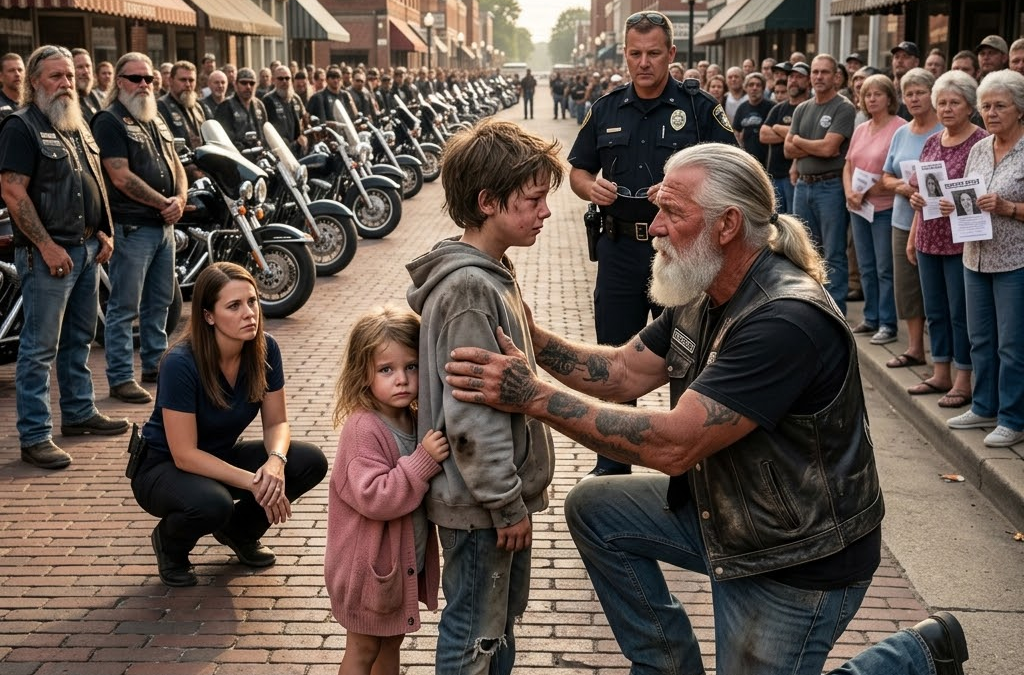
Cliff lowered himself.
One knee on the hot brick.
Hands gently on Gavin’s shoulders.
For the first time in eleven days, no adult stood over him.
“You didn’t have to do that.”
Gavin whispered.
“They were blaming you.”
“I know.”
“Why didn’t you tell?”
“You weren’t ready.”
Pomeroy crossed the bricks.
“Get your hands off that child.”
Trent took one step.
Cliff did not turn.
“Trent.”
The young biker stopped.
“Hands down.”
Eighty riders remained motionless.
Tuttle removed his sunglasses.
Walked between Pomeroy and Cliff.
“Dwight.”
“That’s enough.”
Pomeroy stared.
“Glenn.”
“That man is in a motorcycle gang.”
“I know.”
“You’ve been investigating him.”
“I’ve been waiting six days for Clifford Rayburn to give me one reason.”
Tuttle’s voice roughened.
“He hasn’t.”
“He sat on a public bench.”
“Brought food.”
“Called us himself.”
“Never approached the alley.”
“Back up.”
Pomeroy’s mouth opened.
Tuttle held up one hand.
“Give these kids room.”
The crowd moved back.
Then Wendy Brandt arrived.
Children’s Division investigator.
No clipboard visible.
No uniform.
Just flat shoes.
She approached.
Stopped fifteen feet away.
Kneeled.
“Gavin?”
His body stiffened.
“I’m Wendy.”
“I know.”
That surprised her.
“You know me?”
“I saw you talking to him.”
He looked at Cliff.
Wendy nodded.
“Nobody here is in trouble.”
Gavin’s jaw tightened.
“They always say that.”
Wendy absorbed the hit.
“Fair.”
He blinked.
No defense.
Interesting.
She continued:
“I need to know what you want right now.”
“You’ll split us.”
His voice cracked.
Hazel tightened her grip.
Wendy said:
“Not today.”
“You did before.”
“I know.”
“Seven months.”
“I read the file.”
“You put her in another car.”
“I wasn’t the worker then.”
“Doesn’t matter.”
Wendy nodded.
“Probably doesn’t to you.”
Gavin looked at Cliff.
“With him.”
Pomeroy stared.
“He’s a stranger.”
Wendy stood.
Turned toward the crowd.
“Mr. Rayburn has held an active foster-care license through the Missouri Children’s Division for twenty-two months.”
The plaza changed.
Whispers.
Cliff closed his eyes briefly.
Floyd stared at him.
“Twenty-two months?”
Cliff ignored him.
Pomeroy recovered.
“That boy has a mother.”
Cliff finally stood.
“You’re right.”
His voice low.
“She is his mother.”
“Nobody here takes that away.”
He looked around.
“But she isn’t here.”
“Right now, I am.”
Gavin stared.
Cliff continued.
“I told this boy I would not lie.”
“So I’m saying this where every person can hear me.”
Then his voice carried across the whole street.
“That’s my son now.”
Silence.
“And that’s my girl.”
Hazel looked up.
Cliff pointed toward Wendy.
“Court can argue details Monday.”
“Agency can inspect my house again.”
“Judge can tell me what I’m allowed to call myself.”
“But tonight nobody splits them.”
He looked toward Pomeroy.
“Anybody with an argument can take it to a courtroom like grown men.”
Gavin’s face crumpled.
“Do you mean it?”
Cliff turned back.
The boy whispered:
“Or are you just saying it for them?”
Cliff’s eyes filled.
“I have never said something I didn’t mean in front of a child.”
That broke Gavin.
Eleven days.
Hunger.
Cardboard.
Fear.
Watching doors.
Counting crackers.
Taking his sister to public bathrooms.
Measuring medicine under a flashlight.
All of it came out.
He folded forward.
Cliff caught him.
Not pulling.
Just holding.
Gavin buried his face against the leather vest he had been terrified of one week earlier.
Hazel wrapped herself around both of them.
Nobody on the street spoke.
Then Mrs. Haskell crossed.
Blue dress.
Gray cardigan.
Paper bakery bag.
Damp towel.
She lowered herself onto both knees in front of Hazel.
At seventy-four, that was commitment.
She opened the towel.
“May I?”
Hazel looked at Gavin.
He nodded.
Mrs. Haskell wiped dirt from Hazel’s cheek.
Then the other.
Opened the bag.
Two cinnamon rolls.
Still warm.
Hazel whispered:
“Mine?”
“All yours.”
She looked toward Cliff.
“I called the police on you.”
Cliff said:
“I remember.”
“I saw you kneeling in front of her.”
“Yes.”
“I decided what it meant before I reached the curb.”
Cliff shook his head gently.
“You saw a child alone with a strange man.”
“You called.”
“That part was right.”
Mrs. Haskell blinked.
“What?”
“I want people calling when they see children in trouble.”
“Every time.”
“You were right to call.”
He paused.
“You were wrong about me.”
“That’s different.”
Mrs. Haskell’s chin trembled.
“I’ve worked that bakery fifty-one years.”
“Thought I could read people.”
Cliff smiled.
“Bread maybe.”
“People are harder.”
She laughed through tears.
Wendy stepped aside.
Made a call.
Eleven minutes.
Returned.
“My supervisor authorized emergency placement.”
Gavin froze.
Wendy raised a hand.
“Listen to the whole sentence.”
“Hannibal Regional first.”
“Both of you together.”
“After that, Mr. Rayburn’s home tonight pending Monday hearing.”
Gavin looked at Hazel.
“Together?”
“Together.”
“Same car?”
“Yes.”
“Same room?”
“If Mr. Rayburn has one.”
Every biker looked at Cliff.
Cliff swallowed.
“I have one.”
Nobody knew what that meant yet.
At the hospital, a young doctor examined them.
Underweight.
Mild dehydration.
Scraped knee.
Hazel’s ear infection improving.
“Who gave the fever medicine?”
Gavin raised one hand.
“I did.”
“What dose?”
He recited it.
Doctor checked.
“Exactly right.”
Gavin looked down.
Cliff saw his eyes fill.
Sergeant Tuttle arrived at seven.
Carrying a cardboard box.
He placed it on a chair.
Booster seat.
Still wrapped.
“Missouri law.”
He muttered toward the wall.
“She needs one.”
Cliff nodded.
“Thank you.”
Tuttle remained standing.
Then turned.
Looked directly at Cliff.
“I made up my mind about you before I got out of the cruiser.”
Cliff said nothing.
“I spent six days wanting to be right.”
Pause.
“I wasn’t.”
The sergeant held out his hand.
“I owe you an apology.”
Cliff took it.
“Accepted.”
Tuttle looked surprised.
“That easy?”
“No.”
Cliff said.
“But standing here pretending you didn’t say it would be harder.”
Tuttle almost smiled.
“Sit down, Glenn.”
“You look tired.”
An hour later, Floyd appeared.
Phone in hand.
“Ride total.”
Cliff looked up.
“How bad?”
“Fourteen thousand two hundred ten.”
Cliff frowned.
“We lost six thousand in sponsorship.”
“Yes.”
“So how—”
“Buckets.”
Floyd smiled.
“Filled.”
“Someone dropped five hundred.”
“No note.”
“Signed check.”
“Dwight Pomeroy.”
Cliff went quiet.
Floyd leaned against the wall.
“Twenty-two months.”
“What?”
“Foster license.”
Cliff stared at the linoleum.
“You never said.”
“No.”
“Why?”
Cliff’s shoulders dropped.
“Joanne and I started the paperwork.”
That changed Floyd.
Cliff’s wife.
Gone twenty-two months.
Cancer.
“She died before the home study.”
Floyd whispered.
“I finished alone.”
“Why keep it secret?”
Cliff’s eyes remained on the floor.
“Didn’t want a room full of men hoping for something that might never happen.”
Floyd cleared his throat.
“It happened.”
That night, they drove to Cliff’s farmhouse.
Route 79.
Old white house.
Wide porch.
Barn.
Apple trees.
Joanne’s old sewing room upstairs.
Made bed.
Quilt.
Dust-free.
Waiting.
Cliff had cleaned it every Sunday for twenty-two months.
One bed.
By the time they arrived, club members had somehow solved that.
Second twin bed carried upstairs.
Sheets.
Night-light.
Small stuffed dog.
Hazel walked in.
Saw the two beds.
“Both?”
Cliff nodded.
“One for you.”
“One for Gavin.”
She touched the quilt.
“Forever?”
Cliff stopped.
That word.
Dangerous.
He knelt.
“No.”
Hazel’s face fell.
Gavin stiffened.
Cliff continued.
“I can’t promise forever.”
“Judge decides things.”
“Your mom decides some things.”
“Agency decides some things.”
He looked at both.
“I promise tonight.”
“And tomorrow.”
“And if tomorrow changes, I tell you before it changes.”
Gavin stared.
“You really don’t lie.”
“I try hard not to.”
Hazel chose the bed nearest the window.
Fell asleep holding the blue crayon.
Gavin did not sleep.
Not immediately.
He lay on top of the blankets fully dressed.
Shoes on.
Cliff noticed from the doorway.
Did not comment.
He simply left the hallway light on.
At 2:13 a.m., Gavin woke.
Panic.
Wrong ceiling.
Soft mattress.
He sat.
Hazel.
Other bed.
Breathing.
Okay.
He walked downstairs.
Cliff sat at kitchen table.
Coffee.
Not surprised.
“You don’t sleep?”
Cliff asked.
“Do you?”
“Not much.”
Gavin stood.
“Why did you have the room?”
Cliff knew the question beneath it.
He answered the real one.
“My wife wanted kids.”
“You didn’t have any?”
“No.”
“Why?”
“Life.”
“That’s not an answer.”
Cliff smiled sadly.
“No.”
“Just sometimes the only one.”
He pointed toward a chair.
Gavin sat.
“Joanne and I fostered unofficially.”
“Kids from the club.”
“Nieces.”
“Grandkids.”
“People who needed somewhere.”
“Then we decided to get licensed.”
“She got sick.”
“How?”
“Cancer.”
Gavin looked away.
“She died.”
“Yes.”
“Then why finish?”
Cliff stared at his coffee.
“Because she asked me to.”
Gavin understood promises.
“How long ago?”
“Twenty-two months.”
“The same as the license?”
“Close.”
“You’ve been waiting?”
“Yes.”
“For us?”
“No.”
That answer mattered.
Cliff continued.
“I didn’t know you existed.”
“Then why?”
“Because maybe somebody would need a room.”
Gavin stared toward the staircase.
“Hazel likes it.”
“I noticed.”
“She hasn’t slept in her own bed since…”
He stopped.
Cliff did not finish.
“Can I ask you something?”
Gavin nodded.
“Why didn’t you call after your mom left?”
Silence.
Cliff waited.
Finally:
“They separated us.”
“I know.”
“She cried every Sunday.”
“I know.”
“I told them she couldn’t sleep without me.”
Gavin’s voice hardened.
“They said foster homes weren’t available together.”
“Maybe true.”
“Doesn’t matter.”
Cliff nodded.
“No.”
“It doesn’t.”
Gavin’s eyes burned.
“I’m not letting them do it again.”
Cliff leaned forward.
“You kept her alive eleven days.”
Gavin stiffened.
“You found shelter.”
“Food.”
“Medicine.”
“You did more than an eleven-year-old should ever have to do.”
Gavin swallowed.
Cliff continued.
“But protecting Hazel does not mean you have to become her father.”
“I’m her brother.”
“I know.”
“She needs me.”
“Yes.”
Cliff’s voice softened.
“And you need someone too.”
Gavin shook his head immediately.
“No.”
“Okay.”
The answer surprised him.
Cliff did not argue.
Just:
“Okay.”
Sunday afternoon, Gavin found Cliff on the porch.
He sat beside him.
“What does the ride money pay for?”
“School lunch accounts.”
Gavin stared.
“How?”
“Kids owe cafeteria money.”
“Club sends district a check.”
“Every year?”
“For years.”
Gavin picked at a loose thread.
“I owe sixty-three dollars and forty cents.”
Fast.
Like confession.
Cliff looked at him.
“That’s specific.”
“The lunch lady said it.”
“How?”
Gavin imitated her.
“Gavin Ledford, you’re at sixty-three forty.”
Cliff’s jaw tightened.
“Everybody heard.”
“What did you do?”
“Stopped eating lunch.”
Cliff looked away toward the pasture.
“How many accounts this year?”
Gavin asked.
“Two hundred sixty-one.”
“So…”
“Yes.”
“Yours is probably one.”
Gavin turned his face away.
Tears.
He wiped them angrily.
The men he had feared had been paying debts for children whose names they did not know.
Cliff said nothing.
Sunday evening, Wendy called.
They had found Melissa.
Not missing.
Not dead.
Not abandoned by choice exactly.
She had been arrested August twenty-ninth in Springfield on an old warrant.
Gave officers a disconnected phone number.
No one asked whether children were home.
The system had simply swallowed an adult and forgotten to count two kids.
Wendy arranged a phone call.
Melissa’s voice came through speaker.
“Gavin?”
His shoulders folded.
“Mom.”
“Oh God.”
She cried.
“I’m sorry.”
“Hazel’s okay.”
“Baby…”
“She got sick.”
“What?”
“I gave medicine.”
“I followed the chart.”
“Gavin.”
“I did it right.”
Cliff closed his eyes.
That was what the boy needed his mother to know.
Not that he had been scared.
That he had succeeded.
Melissa sobbed.
“I’m sorry.”
Gavin said nothing.
Eventually the call ended.
He sat on the porch step.
Cliff joined him.
Not too close.
“What I said on Main Street.”
Gavin looked.
“About being my son?”
“Yes.”
Cliff paused.
“I meant who would stand beside you.”
“Your mother is still your mother.”
“Judge decides what comes next.”
“I cannot promise the ending.”
Gavin stared at the gravel.
“What can you promise?”
“Tomorrow.”
“And the day after?”
“If I have it to give.”
Gavin nodded.
“That’s enough.”
Monday brought court.
Temporary placement continued.
Melissa remained incarcerated pending resolution.
Caseworkers interviewed Gavin.
Then Hazel.
Separately but within sight.
No forced separation.
Wendy kept the promise.
Tuesday morning, school.
That was the part Gavin dreaded more than court.
Yellow bus arrived at 7:05.
Cliff walked them down the gravel drive.
Leather vest.
Hazel’s hand in one of his.
Her lunchbox in the other.
Gavin beside them tying one shoelace while walking.
Bus driver Pearl Tibbitz watched.
She had driven the route nineteen years.
She recognized Cliff.
Recognized the missing children.
Did not ask.
Opened the door.
Hazel stopped.
Looked at Gavin.
He nodded.
She climbed.
Gavin followed.
Before the door closed, he looked back.
Cliff stood in the road shoulder.
Gavin raised one hand.
Cliff raised his.
The bus pulled away.
At Hannibal Middle, Gavin walked toward the cafeteria.
Stopped.
Lunch lady looked up.
Recognition.
Gavin’s stomach tightened.
Then she said:
“Morning, Gavin.”
Normal.
He stood there.
She looked confused.
“What?”
“My account.”
Her expression softened.
“Zero.”
“What?”
“Paid.”
“By who?”
She smiled.
“A whole lot of noisy men.”
Gavin laughed unexpectedly.
Then cried.
He hated crying in school.
But for once he let it happen.
Weeks passed.
Melissa’s case became complicated.
Old warrant.
Substance issues.
Housing instability.
She entered treatment after release.
The court did not terminate anything quickly.
Real life does not wrap itself in one hearing.
Gavin and Hazel remained with Cliff.
Temporary became extended.
Extended became foster placement.
Cliff never called himself Dad.
Not first.
He let Gavin decide language.
Mr. Rayburn lasted six days.
Then Cliff.
Hazel called him “Big Cliff.”
Everyone did after that.
The farmhouse changed.
Two toothbrushes.
School papers on the refrigerator.
Cereal Cliff hated.
Shoes abandoned near doors.
Hazel’s drawings taped everywhere.
Gavin’s math notebook on the kitchen table.
The ledger remained hidden inside it.
One day Cliff found it accidentally.
Gavin froze.
Cliff opened to the columns.
Things he did.
Things he didn’t.
Cliff read.
Didn’t chase.
Didn’t ask.
Didn’t lie.
Didn’t tell.
He closed it.
Put it back.
Said nothing.
That night, Gavin added one more entry.
Didn’t read what wasn’t his.
Except Cliff had.
Gavin knew.
Somehow that made the line more important.
The town changed slower.
Some apologized.
Mrs. Haskell first.
Sergeant Tuttle publicly.
Pomeroy last.
For weeks he avoided Cliff.
Then one afternoon entered the clubhouse during a Lunchline committee meeting.
Carried an envelope.
“Insurance renewal donation.”
Floyd frowned.
“You sell insurance.”
“I’m aware.”
“How much?”
“Enough.”
Cliff watched.
Pomeroy swallowed.
“I was wrong.”
“About what?”
The councilman winced.
“Don’t make me list it.”
“List one.”
Pomeroy looked at him.
“I saw a vest before I saw a man.”
Cliff nodded.
“That’s one.”
Pomeroy almost smiled.
“Still irritating.”
“Frequently.”
The Lunchline Ride grew.
The following year:
Four hundred riders.
More money.
No sponsors withdrew.
Mrs. Haskell donated cinnamon rolls.
Sergeant Tuttle directed traffic.
Wendy staffed an information table for foster families.
Not recruitment through guilt.
Information.
Cliff insisted.
Gavin helped count donations.
At twelve.
Then thirteen.
Then fourteen.
Melissa improved.
Then relapsed.
Then improved again.
Visits happened.
Sometimes missed.
Cliff never insulted her.
Gavin noticed.
Once, after she failed to appear for a scheduled Saturday visit, Gavin slammed the truck door.
“She doesn’t care.”
Cliff said:
“You’re angry.”
“She doesn’t.”
“I heard you.”
“Say I’m right.”
“No.”
“Why?”
“Because I don’t know.”
“You always defend her.”
“No.”
Cliff faced him.
“I defend your right to know she is your mother without me trying to make myself bigger by making her smaller.”
Gavin stared.
“That’s not the same as saying what she does is okay.”
“No.”
“It isn’t.”
Gavin looked away.
“I hate her.”
“You can.”
“Do you?”
“No.”
“Why?”
“Not my job.”
Cliff said.
“My job is you.”
That sentence stayed.
At fifteen, Gavin got into a fight.
Not biker fight.
School.
A boy joked:
“Your fake dad’s in a gang.”
Gavin broke the boy’s nose.
Cliff picked him up from the principal’s office.
Silence in the truck.
Finally:
“You win?”
Gavin looked shocked.
“What?”
“Fight.”
“I guess.”
“Good.”
Gavin stared.
Then Cliff added:
“Now tell me why you were stupid enough to have it.”
Gavin sighed.
“He said you’re my fake dad.”
Cliff drove.
“What’s funny?”
“I’m not laughing.”
“You’re smiling.”
“A little.”
“Why?”
“Because at least you hit him over something sentimental.”
Gavin tried not to laugh.
Failed.
Then Cliff became serious.
“You can’t fight every person who misunderstands your family.”
“Why not?”
“You’ll never have time for anything else.”
At sixteen, Gavin stopped using Ledford on some informal school assignments.
Wrote:
Gavin Ledford-Rayburn.
Not legal.
Just trying it.
Cliff saw the paper.
Said nothing.
Gavin waited.
Nothing.
Finally:
“You’re supposed to notice.”
“I noticed.”
“And?”
Cliff continued washing dishes.
“It’s your name.”
“You don’t care?”
Cliff turned.
“I care so much I’m trying not to make my feelings your problem.”
Gavin stared.
“That is extremely annoying.”
“Yes.”
At seventeen, Melissa completed nearly two years sober.
Housing.
Job.
Court modified visitation.
Then came the question everyone feared.
Would Gavin and Hazel return?
Hazel was eleven.
She loved her mother.
Loved Cliff.
Children can do both.
Adults are the ones who demand loyalty become exclusive.
Gavin was nearly eighteen.
He had choices.
Melissa sat at Cliff’s kitchen table.
First time in the farmhouse.
She looked around.
Hazel’s drawings.
Gavin’s trophies.
Joanne’s photograph.
Club patches.
Melissa cried.
“You did all this.”
Cliff shook his head.
“They did.”
Gavin sat rigid.
Melissa looked at him.
“I want you home.”
His jaw tightened.
Hazel started crying.
Cliff said:
“Stop.”
Everyone looked.
“Not stop crying.”
He pointed gently.
“Stop talking about home like there’s only one.”
Silence.
Melissa wiped her face.
Cliff continued.
“You’re their mother.”
“No argument.”
“This house is also home.”
“Your apartment can become home too.”
“These kids do not owe either of us a courtroom victory.”
Melissa looked at him for a long time.
Then whispered:
“You really are what he said.”
“What?”
“My son.”
Cliff’s eyes shifted to Gavin.
Melissa smiled through tears.
“He said you don’t lie.”
Cliff looked down.
“I try.”
Gavin chose to stay through high school.
Hazel split time gradually.
No dramatic removal.
No winner.
A family became something messier and healthier than the town would have understood from a headline.
At graduation, Gavin had four people in the front row.
Melissa.
Hazel.
Cliff.
Wendy.
Behind them:
Half the Bluff Hawks.
The principal threatened to remove anyone revving engines.
Nobody did.
Mostly.
When Gavin’s name was called:
“Gavin Michael Ledford.”
He crossed the stage.
Then stopped near the microphone.
The principal stared.
Gavin leaned in.
“Can I say something?”
“That depends.”
“Five words.”
The principal sighed.
“Fine.”
Gavin looked toward Cliff.
The old biker had aged.
White beard thinner.
Shoulders still broad.
Gavin smiled.
“That’s my dad now.”
The gym exploded.
Cliff covered his face.
Floyd slapped his back.
Hazel screamed.
Melissa stood first.
That mattered.
She applauded harder than anyone.
Afterward, Cliff found Gavin.
“You said six words.”
“What?”
“That’s my dad now.”
“Five.”
“That’s one.”
“My two.”
“Dad three.”
“Now four.”
Gavin laughed.
“You’re old.”
“Still can count.”
Years later, Gavin would become a social worker.
Nobody predicted that at eleven.
Least of all Gavin.
He studied psychology first.
Then child welfare.
Not because he thought the system was evil.
That would have been easier.
He entered because he learned something harder.
Systems are made of people.
Some rush.
Some listen.
Some separate because policy leaves no option.
Some find better options.
Some children run because the last adult with a clipboard made a promise that did not survive the parking lot.
On Gavin’s first day working with a runaway fourteen-year-old, police wanted to search an abandoned mill.
Gavin said:
“Don’t.”
The officer frowned.
“Why?”
“Leave food.”
“You serious?”
“Yes.”
“You learned that in school?”
“No.”
“Where?”
Gavin smiled.
“Park bench.”
He carried Cliff’s rule forward.
Do not chase fear and call it rescue.
Hazel became a nurse.
Pediatrics.
She kept the blue crayon.
The original one.
Worn almost flat.
Framed beside her nursing license.
Under it:
TAKE ALL THE TIME YOU NEED.
Cliff never legally adopted Gavin before eighteen.
Timing.
Courts.
Parental rights.
Life.
It bothered outsiders more than Gavin.
At twenty-three, Gavin changed his name legally.
Gavin Ledford Rayburn.
He kept Ledford.
Cliff approved.
“Why?”
Gavin asked.
“Because you came from somewhere before me.”
“You aren’t replacing it.”
Cliff said.
“Neither am I.”
When Gavin married, Cliff stood beside Melissa in the front row.
When Hazel married, Cliff walked halfway down the aisle with her.
Then stopped.
Melissa joined.
They walked the rest together.
People cried.
Cliff complained weddings were manipulative.
At seventy-nine, Cliff finally sold the red motorcycle.
Gavin was offended.
“You can still ride.”
“I can also fall.”
“You taught me motorcycles are freedom.”
“I was younger and stupider.”
“You were sixty-eight.”
“Exactly.”
The buyer was Trent.
Still in the club.
Less hotheaded.
Three kids.
He promised never to repaint the tank.
Cliff said:
“I don’t care.”
Everyone knew he cared.
The old farmhouse remained.
Joanne’s sewing room eventually became Hazel’s children’s room when they visited.
Two twin beds still there.
Cliff refused to replace them.
“Those beds work.”
Gavin once asked:
“You really dusted this room every Sunday before we came?”
Cliff looked embarrassed.
“Maybe.”
“For twenty-two months?”
“Your mother Joanne was bossy.”
Gavin smiled.
“You were waiting.”
Cliff looked around.
“I was trying to stay ready.”
At eighty-four, Cliff’s health failed.
Heart.
Then lungs.
Nothing dramatic.
Age collecting debts.
Gavin sat beside him in the hospital.
Hazel on the other side.
Melissa came too.
Still sober.
Older.
Gentler.
Cliff’s club vest hung over the chair.
Gavin touched the PRESIDENT patch.
“Whole town used to think this thing meant you were dangerous.”
Cliff breathed through oxygen.
“Whole town?”
“Most.”
“You too.”
Gavin smiled.
“Especially me.”
“Smart boy.”
“You were terrifying.”
“Still am.”
“You’re eighty-four and wearing hospital socks.”
“Deadly socks.”
Hazel laughed through tears.
Then silence.
Gavin asked:
“Do you remember what you said?”
“Lots of nonsense.”
“Main Street.”
Cliff looked toward him.
Understanding.
“That’s my son now.”
Cliff closed his eyes.
“Yeah.”
“You meant it?”
One eye opened.
“At eighty-four, you’re still asking?”
Gavin laughed.
“I just…”
His voice broke.
“I never asked why you said it in front of everybody.”
Cliff stared at the ceiling.
“Because everybody had been talking about you like you were evidence.”
“Missing child.”
“Runaway.”
“Case.”
“Headline.”
He turned his head.
“I wanted them to hear somebody claim responsibility instead of ownership.”
Gavin swallowed.
“Responsibility?”
“Yeah.”
Cliff’s voice weakened.
“Saying you were my son wasn’t about saying you belonged to me.”
“It meant…”
He breathed.
“I belonged next to you.”
Gavin covered his mouth.
Hazel cried openly.
Cliff smiled.
“Difference matters.”
Gavin took his hand.
“I know.”
Cliff died two days later.
The funeral procession stretched from the farmhouse to town.
Hundreds of motorcycles.
School cafeteria workers.
Police.
Children’s Division employees.
Families.
Mrs. Haskell was gone by then, but her granddaughter sent cinnamon rolls.
Sergeant Tuttle, retired, attended wearing a suit.
Pomeroy came too.
Older.
Quiet.
At the service, Gavin stood beside Cliff’s vest.
He did not begin with the motorcycles.
Or the club.
Or foster license.
He began:
“When I was eleven, I thought every adult wanted something.”
He looked over the crowd.
“I had evidence.”
A few people smiled sadly.
“Some wanted answers.”
“Some wanted obedience.”
“Some wanted to separate my sister and me because they thought that was safer.”
“Some wanted gratitude.”
“Some wanted a headline.”
“Then I met a man who wanted me to eat a sandwich.”
Soft laughter.
“He sat on a bench for eight days.”
“He did not chase me.”
“He did not expose me.”
“He did not make me trust him.”
“He gave me enough time to notice that he kept showing up.”
Gavin paused.
“That was the first thing he taught me.”
“Trust is not something adults should demand from children.”
“It is something adults build where children can watch.”
Hazel wiped her face.
Gavin continued.
“Then, when half the town thought he had taken us, he could have protected himself by telling police exactly where we were.”
“He didn’t.”
“He protected two scared kids who had not yet decided whether the world was safe.”
“That almost cost him everything.”
“The club’s charity.”
“His reputation.”
“His friends’ businesses.”
“He did it anyway.”
Gavin looked at Cliff’s photograph.
“Then I walked out.”
“I told the truth.”
“And somebody said I belonged to nobody except my mother.”
Gavin breathed.
“Cliff agreed.”
“That part matters.”
“He never tried to erase my mother.”
“He never needed her to be worse so he could look better.”
“He just looked at an empty place beside two children and stepped into it.”
Then Gavin smiled.
“And he said…”
His voice failed once.
He tried again.
“‘That’s my son now.’”
The bikers lowered their heads.
Gavin touched the vest.
“I spent years thinking he claimed me that day.”
He shook his head.
“I understand now.”
“He volunteered.”
Silence.
“He volunteered to stay.”
After the funeral, Tuttle approached.
Old now.
No sunglasses.
Never wore mirrored ones after 2023.
“I still remember that day.”
“So do I.”
“I wanted Cliff guilty.”
Gavin nodded.
Tuttle swallowed.
“Badly.”
“Why?”
The retired sergeant looked toward the motorcycles.
“Because then everything made sense.”
“Missing kids.”
“Scary biker.”
“Picture.”
“Done.”
He sighed.
“Your dad taught me easy stories are usually where you stop asking questions too soon.”
Gavin smiled.
“Yeah.”
“He did that.”
The Lunchline Ride continued.
Cliff’s photograph eventually hung inside the Bluff Hawks clubhouse.
Not above the bar.
He would have hated that.
Beside a framed napkin.
The original.
Gavin had kept it all those years.
You are not in trouble.
I will not lie to you.
I’ll be here at 5 every day.
Take all the time you need.
CLIFF.
Below it was a plaque.
No title.
No rank.
Just:
HE STAYED ON THE BENCH.
New club members asked what it meant.
Old riders told them.
Every year, before the Lunchline Ride, the club placed one canvas bag on the bench beside the Tom Sawyer statue.
Two sandwiches.
Two apples.
Water.
Crayons.
A blue one on top.
No ceremony.
Most people walking past never understood.
That was fine.
Some acts become stronger when they do not need an audience.
Gavin eventually took his own foster-care classes.
His wife, Emily, joined him.
The first child placed with them was thirteen.
Boy.
Would not unpack.
Slept fully dressed.
Kept shoes on.
Checked windows.
Gavin knew better than to say:
You’re safe here.
Safety does not become true because an adult says it.
Instead he showed the boy the bedroom.
Put food in the kitchen.
Explained doors were never locked from outside.
Then left.
At midnight, Gavin found him sitting near the back porch.
Gavin sat thirty feet away.
Not beside him.
The boy asked:
“You going to ask why I’m out here?”
“No.”
“Why not?”
“You’ll tell me if you want.”
The boy looked suspicious.
“You always like this?”
Gavin smiled.
“No.”
“I learned it.”
“From who?”
Gavin looked toward a photograph inside the house.
Huge man.
White beard.
Leather vest.
“My dad.”
Years later, Gavin realized he had started speaking about Cliff that way automatically.
Not foster father.
Not club president.
Dad.
No qualification.
No explanation.
People rarely asked.
Hazel had children of her own.
She brought them to the old plaza.
One afternoon her six-year-old daughter climbed onto the bench.
“Why is this important?”
Hazel sat beside her.
“Because somebody waited here.”
“For what?”
“For Uncle Gavin and me.”
The girl frowned.
“Why didn’t he just go get you?”
Hazel smiled.
“Because sometimes going toward somebody scares them farther away.”
The child thought.
“That’s weird.”
“People are weird.”
“Was Grandpa Cliff weird?”
“Extremely.”
The girl laughed.
Hazel looked down at the bricks.
She remembered paper towels inside oversized shoes.
Cinnamon roll.
Blue crayon.
Gavin’s sleeve in her fist.
A giant stranger kneeling.
What remained strongest was not fear.
It was the distance Cliff kept.
Ten feet.
That had been the first gift.
Not the sandwiches.
Space.
Years passed.
North Main Street changed.
Bakery became a café.
Insurance office became an accounting firm.
The warehouse was demolished.
Luxury apartments eventually rose where Gavin and Hazel had slept on cardboard.
The new building advertised:
RIVERFRONT LOFT LIVING.
Gavin stood across the street the first time he saw the sign.
Laughed.
Then unexpectedly cried.
He walked to the bench.
Sat.
Cliff was gone.
But Gavin could still see him.
Paperback.
Canvas bag.
Eyes forward.
No questions.
Gavin stayed until five.
Habit.
At exactly five, a motorcycle passed.
Not the red one.
Still enough.
A boy around fourteen sat at the far end of the plaza eating alone.
Gavin almost approached.
Then stopped.
Cliff’s lesson.
Look first.
Do not turn every memory into permission.
The boy seemed fine.
So Gavin let him be.
That mattered too.
Not every child needed rescue.
Sometimes the hardest discipline was refusing to make yourself necessary.
Cliff had taught that.
Near the end of his career, Gavin trained new child-welfare workers.
He used no dramatic slides.
No biker photographs.
He began by asking:
“What does a scared child owe you?”
Someone usually answered:
“The truth.”
Gavin shook his head.
“Nothing.”
Room quiet.
“You are the adult.”
“You have authority.”
“Transportation.”
“Food.”
“A bed.”
“A badge sometimes.”
“A court order sometimes.”
“The child does not owe you trust because your intentions are good.”
He walked slowly.
“You earn enough trust to make the next safe decision.”
“That’s all.”
Then he told them about eleven days.
The warehouse.
Hazel.
The sandwich.
The bench.
He never romanticized what happened.
Two children surviving alone was not brave in the inspirational sense.
It was dangerous.
They could have died.
Hazel almost became seriously ill.
Gavin made mistakes.
Cliff knew that.
The story’s lesson was not:
Children can survive if they are strong enough.
The lesson was:
A child who has been failed may fear rescue as much as danger.
Adults need to understand the difference.
One trainee asked:
“What made you finally come out?”
Gavin smiled.
“They blamed him.”
“Guilt?”
“Partly.”
“What else?”
“He never missed a day.”
That was the answer.
Not the food.
Not the medicine.
Not the foster license.
Consistency.
Five o’clock.
Saturday.
Sunday.
Monday.
Rain coming.
Town accusing.
Sponsors leaving.
Five o’clock.
Gavin’s ledger had turned Cliff into numbers.
Did.
Didn’t.
Eventually the columns told a story his fear could not dismiss.
The man stayed.
When Gavin retired, Hazel gave him a framed page.
His old math notebook.
She had found it in a box after Cliff’s death.
The ledger.
Things he did.
Things he didn’t.
At the bottom, Hazel had added in blue ink:
HE STAYED.
Gavin hung it beside Cliff’s napkin.
Two documents.
One written by a frightened boy trying to decide whether an adult could be trusted.
One written by the adult refusing to demand an answer.
That was their whole relationship before it had a name.
When Gavin was sixty-eight—the same age Cliff had been when they met—he returned to the Lunchline Ride as grand marshal.
He hated the title.
The club insisted.
Hundreds of motorcycles.
Town festival.
Families everywhere.
No fear behind storefront windows anymore.
Mostly.
Prejudice never completely dies.
It just learns new clothes.
Gavin stood near the statue.
A young reporter approached.
“I’m doing a feature about the famous quote.”
Gavin sighed.
“What quote?”
“You know.”
He did.
“‘That’s my son now.’”
“Yes.”
“People say that was the moment everything changed.”
Gavin looked toward the bench.
“No.”
The reporter blinked.
“No?”
“That was the moment everybody noticed.”
“What actually changed things?”
Gavin pointed.
“That.”
“The bench?”
“Yes.”
“Why?”
“Because he sat there when no one was watching.”
The reporter looked disappointed.
Not dramatic enough.
Gavin smiled.
“That’s usually how character works.”
She asked:
“Did Cliff save you?”
Gavin considered.
“No.”
Another disappointing answer.
“He helped.”
“Who saved you?”
Gavin looked toward Hazel, now sixty-two, laughing with grandchildren near the motorcycles.
“We saved each other.”
“Hazel and me.”
“Cliff gave us somewhere safe to stop doing it alone.”
The reporter finally lowered her notebook.
“That’s better.”
“For your article?”
“No.”
She smiled.
“For me.”
At five o’clock, club tradition began.
One bag placed on the bench.
Gavin walked over.
Inside:
Two sandwiches.
Two apples.
Water.
Blanket.
Flashlight.
Coloring book.
Crayons.
Blue on top.
He sat.
For a moment, the street disappeared.
He was eleven again.
Dirty sweatshirt.
Hungry.
Suspicious.
Watching through boards.
He could almost hear Cliff:
Take all the time you need.
Gavin had spent half his life understanding how radical those words were.
Adults rush children constantly.
Answer me.
Trust me.
Come here.
Tell me.
Be ready.
Forgive.
Adjust.
Move on.
Cliff had offered time.
No deadline.
No demand.
That was why Gavin eventually moved toward him.
Not because fear vanished.
Because the man did not punish fear for existing.
Hazel sat beside her brother.
“You crying?”
“No.”
“Allergies?”
“Shut up.”
She laughed.
“Cliff used that one.”
“He was wiser.”
“Older.”
“Same thing.”
They sat together.
The motorcycles around them gleamed.
Children ran between adults.
Cinnamon rolls sold at the old bakery.
Donation buckets filled.
School-meal debt would be erased again Monday.
Gavin looked toward the alley where they had emerged decades earlier.
“You remember walking out?”
Hazel thought.
“Pieces.”
“What?”
“Your sweatshirt.”
“His beard.”
“The bricks were hot.”
“Cinnamon rolls.”
“You remember what he said?”
“Which part?”
“That’s my girl.”
Hazel smiled.
“Yeah.”
Gavin looked down.
“He said son first.”
“You jealous after fifty years?”
“No.”
“Yes.”
They laughed.
Then Hazel’s expression softened.
“You know what I remember most?”
“What?”
“He asked before touching you.”
Gavin looked at her.
“Yeah.”
“Nobody else did.”
She stared toward the bench.
“Everybody thinks the big moment was when he called us his kids.”
“It wasn’t for me.”
“What was?”
“Ten feet.”
Gavin understood.
The first afternoon.
Huge biker.
Terrified five-year-old.
Cliff backing away.
Ten feet.
“I won’t touch you.”
For Hazel, that had been the beginning.
For Gavin:
The bench.
Different doors into the same trust.
He took her hand.
Old now.
Not eleven and five.
Still brother and sister.
Still together.
The promise had changed over the years.
Never again had once meant:
I will protect you from every adult.
Later it became:
I will stay connected no matter what adults decide.
Eventually:
We will allow good people to help us.
That was the promise Cliff taught him to rewrite.
A child’s survival rule had become an adult’s understanding.
You cannot build a life entirely around preventing the worst thing from happening again.
Eventually you need room for something good to happen.
Cliff had been that room.
Joanne’s sewing room.
Two twin beds.
Porch.
Breakfast.
School bus.
Court dates.
Missed visits.
Graduations.
Weddings.
Hospital rooms.
Ordinary Tuesdays.
That was family.
Not the dramatic declaration on Main Street.
Everything after it.
Because saying:
“That’s my son now”
took five seconds.
Being his father took the rest of Cliff’s life.
And that was why Gavin never forgot the distinction.
Anyone could say something powerful in front of a crowd.
Cliff proved it when nobody was there.
Five o’clock.
One bench.
A bag of sandwiches.
Eyes turned away from the alley.
Every day.
Until a frightened eleven-year-old finally decided the man was telling the truth.
Decades later, Gavin would still correct people when they told the story wrong.
They would say:
“That biker claimed you in front of the whole town.”
Gavin would shake his head.
“No.”
“He didn’t claim me.”
“He stood beside me.”
They would ask:
“What’s the difference?”
And Gavin would always think of the first night in the farmhouse.
Two beds.
A blue crayon.
A hallway light left on.
Cliff saying he could promise tonight but not forever.
Then the thousands of ordinary days that followed.
“The difference,” Gavin would say, “is that ownership asks who a child belongs to.”
He would pause.
“Love asks who is willing to stay.”
And on that hot September afternoon, in front of three hundred people who had already decided what a man in cracked black leather must be, Cliff Rayburn answered that question before anyone else understood it.
He lowered himself onto one knee.
Put his hands on the shoulders of a boy who had been standing between his little sister and the world for eleven days.
Then he looked at the entire town and said:
“That’s my son now.”
Not because Gavin suddenly belonged to him.
Because, from that moment forward, Cliff had decided exactly where he belonged.
Beside the boy.








