A Wyoming Rancher Asked for a “Plain, Practical” Mail-Order Bride—Then Clara Stepped Off the Train, Married Him That Same Day, and Proved She Was Anything but Simple
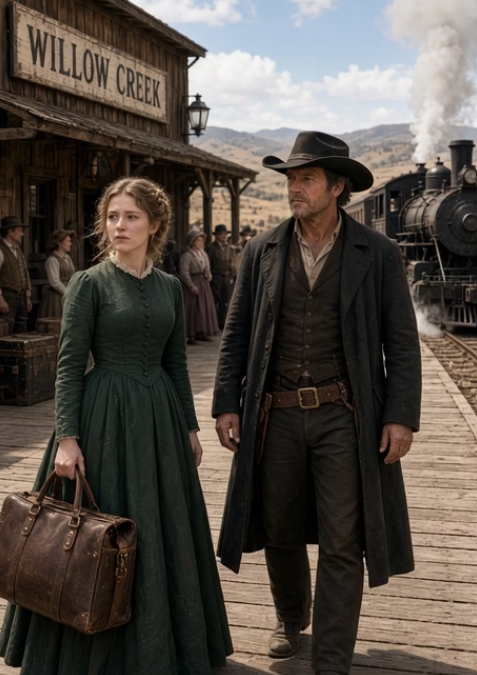
PART2:
But when we stood in the storeroom between sacks of flour, crates of nails, and a wall calendar advertising tobacco, practicality began to look a lot like madness.
Two strangers.
A few letters.
A ring in my pocket.
A decision large enough to ruin two lives if we were careless.
Judge Whitaker cleared his throat and opened his book. He had performed three mail-order marriages that year and looked at us with the resigned patience of a man who had learned that loneliness could make even sensible people gamble.
“State your names.”
“Elías Morgan.”
“Clara Bennett.”
The judge looked up.
“Soon to be Morgan, assuming neither of you runs before I finish speaking.”
Clara glanced at me.
I nearly smiled.
Nearly.
The questions were simple.
Did I take her?
I said yes.
Did she take me?
She said yes.
Her voice did not tremble.
But when I took her hand to slide the ring onto her finger, her fingers shook once.
Only once.
Then she held still.
It struck me then that courage did not always look like certainty.
Sometimes it looked like a woman standing in the back of a general store, marrying a man she had met ten minutes earlier because every other door in her life had been locked by someone else.
I placed the ring on her hand.
Plain silver.
No stone.
No fancy engraving.
It had been my mother’s wedding band.
I had not told Clara that.
Not then.
Judge Whitaker pronounced us husband and wife in less time than it took a man to saddle a horse.
Clara Bennett became Clara Morgan.
My wife.
And I still did not understand who she was.
We left Willow Creek before sundown.
The wagon trail ran through dry grass, low rises, and open land that stretched so wide some people mistook it for emptiness. Clara sat beside me in silence at first. I thought maybe she regretted what she had done. Maybe she was holding herself together until we reached the ranch. Maybe city women were proud until the last witness disappeared.
Then I realized she was studying everything.
The fences.
The cattle in the distance.
The horses grazing near a wash.
The color of the hills.
The way the land rolled and hardened and opened under a sky so large it made most people feel small.
There was no fear in her eyes.
There was curiosity.
“It’s beautiful,” she said.
I looked at her.
“That’s not usually the first word people use.”
“What do they use?”
“Empty. Hard. Lonely.”
Clara watched the land.
“That’s because a lot of people think beauty has to be soft.”
She nodded toward the hills.
“This isn’t soft.”
I waited.
“It’s honest.”
The word stayed with me.
Honest.
I had never thought of my land that way.
To me, the ranch meant work.
Endurance.
Discipline.
You survived or you did not.
I knew every fence line and water trough, every weak patch of soil, every place snow drifted too high and every draw where cattle might vanish in a storm. I knew the land’s demands. I knew its punishments. I knew what it took and what it gave only after taking first.
But honest?
That was not how I had been taught to see it.
“In winter,” I said, “you might change your mind.”
“Maybe.”
“The snow can close the road for days.”
“I did not come looking for comfort.”
I turned toward her.
“Then why did you come?”
Clara remained quiet long enough that the horses’ harness leather creaked between us.
She did not look like a woman hiding a lie.
She looked like a woman deciding how much truth to give a man who had been her husband less than an hour.
“My father decided my life for thirty years,” she said at last.
My grip tightened on the reins.
“How?”
“Where I lived. What I learned. Which people were suitable. Which opinions were unladylike. Which talents were useful only if they made him look wise.”
She kept her voice calm.
Too calm.
“He even decided whom I should marry.”
I looked at her.
“You were engaged?”
“He wanted me to be.”
“To whom?”
“A merchant in our city. Charles Harwood.”
She gave a small laugh without amusement.
“My father called him reasonable. Safe. A man with good prospects.”
“And you refused him?”
“Yes.”
“What happened?”
She looked at me.
“I chose this.”
“Marrying a stranger in Wyoming?”
“Choosing my own life.”
That silenced me.
Clara turned back to the horizon.
“This may prove to be a terrible mistake, Mr. Morgan.”
“It’s Elías now.”
Her mouth curved.
“Then this may prove to be a terrible mistake, Elías.”
“That is comforting.”
“But it will be my mistake.”
For reasons I did not yet understand, that answer moved something in me that had been asleep for years.
I had asked for a simple wife because I believed a simple life could protect a man from surprises.
My mother had died when I was thirteen, leaving behind a silence my father filled with work.
My father had turned the ranch into a religion and raised me to worship survival.
Expect little.
Need less.
Never build a life around anything that can vanish.
By thirty-six, I had become good at that.
Too good.
Then Clara Bennett sat beside me in a wagon, wearing my mother’s ring, telling me she had chosen me not because I was known but because the choice was hers.
When the ranch came into view, Clara leaned forward.
It was not impressive.
A wood house with a sloped porch.
A small barn.
Two corrals.
A stable that needed new shingles.
A vegetable patch nearly lost to weeds.
No grand gate.
No hired men riding out to greet us.
Nothing polished.
Nothing easy.
Everything built to last because the alternative out here was ruin.
“Is that yours?” she asked.
“That is my home.”
She corrected me with a faint smile.
“Our home.”
I turned toward her.
“Our?”
She lifted the hand wearing the ring.
“Unless I misunderstood what happened in the general store.”
I nearly smiled.
“I suppose you didn’t.”
“Then it is ours now.”
She looked at the ranch as if she were already imagining who she might become there.
Not as a visitor.
Not as decoration.
As someone arriving.
And while the wagon rolled toward the house, I understood my first mistake.
I had not brought home something simple.
I had brought home a storm.
Clara’s first question after stepping into the yard was not where she could wash or lie down.
It was, “What is my work?”
I looked at her.
“Your work?”
“I did not cross half the country to sit by a window.”
“I thought you might want to rest.”
“I do. After that, I want to understand how this place runs.”
I showed her the house, the stable, the corrals, the well, the small kitchen garden, the smokehouse, the pantry, and the back room I had not cleaned properly because I had convinced myself a practical woman would not mind dust.
Clara minded.
She said nothing at first.
That was worse.
When she opened the pantry, she found flour for a few weeks, two sacks of beans, some salt pork, dried apples, and barely enough coffee.
“Do you always buy this little?” she asked.
“I buy what’s needed.”
“That explains why your house feels prepared to survive, not to live.”
I stiffened.
“You already plan to change it?”
“Not without asking.”
Then she looked at me directly.
“But I do not intend to ask permission to breathe.”
I did smile then.
Could not help it.
That night we ate across from each other like two strangers who had made a decision too large to discuss directly. I served beans, bread, and the last of the beef stew from the iron pot. Clara ate without complaint. She thanked me for the meal, then asked where I kept household accounts.
I told her in my head.
She stared.
“In your head.”
“It has worked so far.”
“Those are famous last words spoken by men shortly before discovering they have been robbed for years.”
I almost laughed.
Then a rider arrived from Willow Creek with a letter.
Clara recognized the handwriting before she opened it.
I saw it in her face.
Her father.
She unfolded the paper slowly.
Her expression changed as she read.
Not shock.
Not fear exactly.
Something more painful because it had been expected.
She handed the letter to me without a word.
It contained four lines.
You can still correct this disgrace. Return before the whole town learns what you have done. Mr. Harwood remains willing to forgive you. If you stay there, do not call yourself my daughter again.
I read it twice.
Not because it was hard to understand.
Because I wanted the words to improve.
They did not.
“Who is Harwood?” I asked.
“The man my father chose.”
“And forgive you for what?”
“For leaving before he could own what my father had already promised.”
She took the letter back and folded it neatly.
For the first time since stepping off the train, Clara Bennett Morgan looked as though the cost of choosing herself had arrived in full.
I did not know what to say.
I knew cattle.
Fences.
Debt.
Weather.
The sound of a horse going lame before most men noticed.
I did not know what to do with a woman whose father could wound her from hundreds of miles away using only four lines of ink.
So I said the only honest thing I could.
“Do you want to go back?”
Clara looked up.
“No.”
“Then there’s nothing to correct.”
She stared at me.
For a moment I thought I had offended her.
Then the smallest laugh escaped her.
“My father does not see it that way.”
“Your father isn’t married to me.”
Her brow lifted.
“That sounded dangerously possessive.”
I froze.
“I did not mean it that way.”
She studied me.
“I know.”
That small correction mattered more than I could explain.
The next morning, Clara woke before sunrise.
I found her in the stable wearing the same travel dress, sleeves pinned up, trying to feed a mare who did not like strangers.
“You should be sleeping,” I said.
“You should have better coffee.”
“That coffee kept me alive through two winters.”
“It tastes like it resents you.”
The mare snorted.
Clara stroked her neck.
“What’s her name?”
“Daisy.”
Clara glanced at me.
“She does not look like a Daisy.”
“My mother named her.”
“Then Daisy is perfect.”
That was the first time she mentioned my mother indirectly, and the gentleness of it caught me unprepared.
“I’m checking the west fence,” I said.
“I’m coming.”
“No.”
She looked at me.
“No?”
“It’s a long ride.”
“I have ridden long rides.”
“The terrain is rough.”
“I did not expect your fences to be indoors.”
“Clara.”
“Elías.”
We stared each other down.
Finally I pointed toward a chestnut mare in the second stall.
“She’s steady.”
“There you go again with steady and simple.”
“This time I’m talking about the horse.”
“I should hope so.”
She rode well.
Too well for someone I had imagined growing up between city parlors and supervised walks.
She noticed my surprise.
“My father could decide whom I was supposed to marry. He never managed to stop me from learning to ride.”
“Who taught you?”
“A worker in one of his warehouses. He was dismissed when my father found out.”
“For teaching you?”
“For obeying me before him.”
That explained many things.
Clara did not reject orders because she was difficult.
She had spent her life learning that every small choice might be taken if she did not defend it.
Over the next two weeks, she learned the ranch the way a thirsty person learns water.
She did not try to govern it.
That was what surprised me most.
She asked.
Watched.
Remembered.
Then offered opinions with a confidence that made ignoring her impossible.
She discovered one corral gate did not latch properly unless lifted first.
She noticed the kitchen garden had been planted in poor rows for irrigation.
She asked why the smokehouse had no second shelf when there was room enough for one.
She found that I bought flour from Harlan Briggs at the general store even though the miller near South Creek sold better flour for less.
“You go to Willow Creek every week anyway,” she said. “Why pay more?”
“Harlan extends credit.”
“And charges for the privilege, I assume.”
“He’s fair.”
“Men who say ‘trust me’ too quickly often aren’t.”
“Harlan never cheated me.”
“That you know of.”
It irritated me.
Then it troubled me.
Then she asked for my account book.
“I don’t keep one.”
She closed her eyes.
Not dramatically.
Like a woman praying for patience and finding the supply low.
“How do you know what you owe?”
“I know.”
“How do you know what others owe you?”
“They pay.”
“And if they don’t?”
“I remember.”
Clara leaned back in her chair.
“Elías, memory is not a ledger. It is a place where pride hides mistakes.”
I should have argued.
Instead, perhaps because the house already felt different with her in it, I opened an old desk drawer and pulled out the closest thing I had to records. Receipts. Notes. Bills. Loan papers folded so many times they had become soft at the edges.
Clara said nothing.
That was how I knew it was bad.
She sat at the kitchen table for three evenings, sorting my life into piles.
Paid.
Unpaid.
Questionable.
Unknown.
I disliked unknown most.
By the fourth evening, she tapped one receipt with her finger.
“Harlan charged you transport fees on salt for four months.”
“So?”
“You picked up the salt yourself.”
I stared.
She waited.
“It was supplier increase,” I said.
“That is what he wrote. But the amount matches transport, not supplier cost.”
“Harlan told me—”
“Harlan lied or cannot add.”
We went to town the next day.
I did not want to.
Clara said that was likely why I needed to.
Harlan Briggs was a wide man with a yellow mustache, small eyes, and a habit of laughing before anything was funny. His general store sat at the center of Willow Creek, which meant he knew everyone’s needs and most of their weaknesses. That combination gives a man power if he lacks conscience.
He smiled when we entered.
“Morning, Elías. Mrs. Morgan.”
He looked Clara over as if assessing whether she had been worth the shipping.
I disliked him more than usual.
Clara placed the receipts on the counter.
“I believe you owe my husband twelve dollars.”
Harlan blinked.
“Pardon?”
“These charges were applied for transport services not rendered.”
He laughed.
“There must be some confusion.”
“Yes,” Clara said. “I believe you confused him for a man without a wife who reads.”
A man near the flour sacks coughed into his hand.
Harlan’s smile tightened.
“Elías never had trouble with my accounts before.”
“Elías never brought them to me before.”
I felt every eye in that store turn toward me, waiting to see if I would be insulted by my wife speaking where a man was expected to stand.
I looked at Harlan.
“Pay her.”
Clara did not look at me.
But something in her shoulders changed.
Harlan paid.
From that day on, I stopped saying my accounts.
I started saying the accounts.
Clara noticed.
She did not comment.
But in the evenings, when we sat on the porch and watched the sky bruise purple over the west field, the space between our chairs grew smaller.
One afternoon while repairing fence, I asked about Harwood.
I had not planned to.
His name had become a stone in my boot.
“Was he rich?”
Clara hammered a staple into place.
“His family owns three warehouses, two freight contracts, and a wagon company.”
“Important to your father?”
“Almost the only thing important to him.”
“And to you?”
She set the hammer down.
“Charles Harwood spoke of me the way men speak of property they are negotiating to acquire.”
I said nothing.
“He told me that after we married, I would not ride alone. He said I would no longer need to keep books because a wife should not put herself in a position to argue with employees. He told me my father had indulged my habits too long.”
Her mouth curved without humor.
“My father called him a man who knew how to lead a household.”
I rested both hands on the fence rail.
“Did he mistreat you?”
She looked away.
“He never struck me.”
“That isn’t what I asked.”
Her eyes returned to mine.
I held her gaze.
“Did he mistreat you?”
Clara’s face changed.
Not much.
Just enough to tell me that no man had asked her that question in a way that allowed more than one answer.
“He made me feel,” she said slowly, “as if I should be grateful he was willing to marry me.”
Something hot and quiet moved through my chest.
“Do not ever thank a man for tolerating you.”
Her eyes sharpened.
“Including you?”
“Especially me.”
That night, we laughed for the first time without effort.
It was over something foolish. Daisy had stolen a biscuit from Clara’s apron pocket, and Clara accused me of raising immoral livestock. I told her Daisy had belonged to my mother and therefore possessed ancestral rights. Clara said theft did not become heritage just because a man spoke solemnly.
I laughed until my ribs hurt.
Then stopped because the sound felt unfamiliar in the house.
Clara noticed.
She did not ask.
Instead, she cut another biscuit and set it on my plate.
Three days later, a telegram arrived.
Clara read it twice.
“My father is coming to Willow Creek on Friday.”
My stomach tightened.
“With Harwood?”
“Yes.”
“You do not have to see them.”
“Yes,” she said. “I do.”
“Why?”
“Because running from them would let them believe I still live by their permission.”
“I’ll go with you.”
“No.”
“Clara.”
“Elías.”
The old challenge returned, but there was sadness in it now.
“I need to do this myself.”
“He is your father.”
“Exactly.”
I understood then.
Everything in me wanted to stand between her and whatever hurt might come.
But Clara had not crossed half the country to exchange one man’s control for another man’s protection.
So I nodded.
“I’ll wait outside the hotel.”
“That,” she said, “I can accept.”
On Friday, Willow Creek seemed too small to contain the tension.
Her father, Horace Bennett, waited in the hotel dining room.
I saw him through the window before Clara went inside.
He was sixty or near it, dressed like a banker even after days of travel, gray beard trimmed close, posture straight, eyes cold with the certainty of a man who had never been contradicted without punishing someone for it.
Charles Harwood sat beside him.
Thirty-five.
Elegant.
Polished.
Pale gloves.
A silver watch chain.
He looked like a man drawn in fine lines, every part arranged to suggest breeding and restraint.
I disliked him before he opened his mouth.
Clara entered alone.
I waited by the wagon with my hat low and my hands doing nothing useful.
That was one of the hardest things I have ever done.
Later, Clara told me what happened.
Horace did not rise when she approached.
“Finally,” he said.
“Hello, Father.”
His eyes went to her ring.
“So it is true.”
“Yes.”
Harwood leaned forward with the soft concern of a man performing reason.
“Clara, we all understand you were distressed.”
“I was not distressed.”
“Marrying a stranger in Wyoming is not a rational decision.”
“It was rational enough for me.”
Horace tapped the table once.
“I did not raise a daughter for thirty years to watch her become the wife of a nameless rancher.”
Clara felt the old wound open.
Not because she agreed.
Because he knew exactly where to cut.
“Elías has a name.”
“You know what I mean.”
“Yes,” she said. “I always do.”
Harwood tried again.
“Your father wants to protect you.”
“From what?”
“A hard life.”
“And you intended to save me from that?”
“I could have given you a comfortable home.”
“At the price of obedience.”
“At the price of respect.”
Clara smiled faintly.
“Men often call it respect when they expect obedience from a woman.”
Horace leaned forward.
“Enough.”
For a moment, that one word did what it had done since childhood.
It made her body remember.
Then she looked down at my mother’s ring on her hand.
“No.”
Horace blinked.
Clara continued.
“Not enough because you say it is.”
Her father stared as if she had spoken another language.
“You will return with me.”
“No.”
“Then you lose all claim to my property.”
It struck her.
Not because of the money.
Because of how easily he turned love into a transaction.
“Is that a threat?”
“A consequence.”
“No,” she said. “It is what you have always done.”
Horace rose.
“I gave you education, shelter, security—”
“And every gift came tied to a rope.”
Harwood’s patience snapped first.
“Think before destroying your future over a man you barely know.”
Clara stood.
“I have thought.”
“You chose him?”
“I did not choose Elías because I knew him well.”
Both men watched her.
“I chose him because for the first time the choice was mine.”
Then she walked out.
I was by the wagon when she came through the hotel doors.
I did not ask what happened.
I only looked at her face.
“Do you want to go home?”
She nodded.
On the road back, she said little.
Halfway to the ranch, I asked, “Did he disinherit you?”
A dry laugh escaped her.
“It seems so.”
“Does that matter?”
She stared ahead for a long moment.
“It matters how easy it was for him.”
I did not know what to say.
“No need to repair it,” she said quietly.
“I know.”
She turned toward me, surprised.
“I’m learning,” I said, “that helping you does not mean deciding for you.”
Something softened in her face.
When we reached the ranch, we found one of the corrals open.
Three cows had escaped.
Clara jumped down from the wagon before I could stop her.
“I’ll check the creek.”
“I’ll ride north.”
We worked until sunset, found the animals, brought them back, and repaired the latch by lantern light. Clara’s dress was muddy. My shoulder ached. Supper was burned on one side and cold on the other.
For the first time since her father arrived, Clara stopped looking like a woman counting what she had lost.
The next morning, I brought the account papers to the table.
All of them.
Not just what she had seen.
Not just what made me look careless.
Everything.
She looked from the papers to me.
“What is this?”
“What I should have told you before we married.”
She sat slowly.
There were debts.
More than she expected.
A loan against the next cattle sale.
Two late payments for tools.
Credit at the feed store.
A note held by the bank in Cheyenne.
The last number made her face go still.
“Elías.”
“I know.”
“Why didn’t you tell me before we married?”
I could have blamed weather.
Bad winters.
The herd fever last year.
Harlan’s overcharges.
My father’s final illness before he died.
All were true.
None answered her question.
“I should have.”
“When were you going to?”
“Before winter.”
“That isn’t an answer.”
I looked down.
“I didn’t know how.”
“You could begin with, ‘Clara, I have debts.’”
Her voice was hard enough to make me lift my eyes.
She deserved that.
“How much exactly?” she asked.
I told her.
It was not impossible.
That was the mercy.
But a bad season could cost me half the herd.
Two bad seasons could cost the ranch.
Clara closed the book.
“Why did you send for a wife if you could barely hold this place?”
There it was.
The shame under all my practical words.
“Because I thought an empty house was making me a worse man.”
That made her pause.
I continued before cowardice stopped me.
“And because I thought if I found a simple woman—someone who did not require much—”
The sentence died.
Clara understood anyway.
“That is what simple meant.”
“No.”
“Elías.”
“I did not want a cheap servant.”
“But you wanted a woman who would not add to your troubles.”
I could not deny it.
Humiliation moved across her face.
Not the same as what her father had done.
But close enough to hurt.
“You did not want a partner.”
“Yes.”
“You wanted safety.”
“At first,” I said quietly. “Maybe.”
She stood.
“Where are you going?”
“To think.”
“Clara—”
She turned at the door.
“My father designed my entire life around what made him comfortable.”
I went still.
“I will not begin another life doing the same for you.”
She left.
I spent the next hours in the stable because animals demand action and action is easier than remorse.
I saddled and unsaddled the same horse twice.
I cleaned stalls that were already clean.
I repaired a bridle that did not need repair.
By dusk, Clara returned from the creek with her hem wet and her expression unreadable.
I did not meet her with promises.
I did not hide the papers.
That was all I could offer.
She stood in the stable doorway.
“I want to see every debt.”
I looked up.
“All of them?”
“Every one.”
“Are you staying?”
“I didn’t say that.”
I nodded.
Then showed her everything.
For two days, Clara worked through my accounts.
I brought her coffee that she declared only slightly less hostile than before.
She made columns.
Asked questions.
Corrected figures.
Found waste.
Found poor habits.
Found pride disguised as tradition.
A small hay field that produced too little but cost too much labor.
A supplier I used because my father had used him.
Credit extended to a neighbor who never paid on time because I disliked confrontation when the man came with his hat in his hands.
The ranch, she told me on the third evening, was not doomed.
It was badly managed.
That struck harder than doomed.
Doom lets a man feel tragic.
Bad management makes him responsible.
“You can survive this,” she said.
“How?”
She turned the ledger toward me.
“Sell twenty head before winter. Use it to clear the tool debt and reduce the Cheyenne note. Renegotiate feed. Stop buying from Harlan. Keep written accounts. No exceptions.”
“That reduces the herd.”
“Yes.”
“I worked ten years to build it.”
“And pride may lose it all in one.”
I said nothing.
She softened her voice.
“I am not ordering you.”
“I know.”
“I am telling you what I would do if half of this were also my responsibility.”
I looked at the ledger.
Then at her.
“It is.”
The words weighed more than any romantic declaration I might have made.
Clara’s eyes changed.
“Then listen to me.”
I did.
We sold cattle.
It hurt.
I will not pretend otherwise.
Every animal loaded felt like failure on four legs.
But we cleared one debt and cut another nearly in half.
Clara negotiated with a miller near South Creek and got better flour for less money.
I began keeping receipts.
All of them.
She checked.
All of them.
Something grew between us in those weeks.
Not passion at first.
Trust.
It is less dramatic.
It is also harder to fake.
Then came the day Horace Bennett arrived at our ranch alone.
I saw the carriage first.
Too fine for our road.
Clara was hanging laundry behind the house. She wiped her hands on her apron and came to stand on the porch.
Her father stepped down, looked at the ranch as if it were an unfortunate smell, and said, “I came to take you home.”
Clara folded her arms.
“I am home.”
His face tightened.
“Harwood has withdrawn his offer.”
“What a tragedy.”
“You don’t understand.”
“I think I do.”
“The business is in trouble.”
That surprised her.
“Which business?”
“Mine.”
She said nothing.
“I need you to return.”
“For what?”
His jaw moved.
“You kept the accounts better than anyone.”
I stood behind Clara in the doorway, but I did not speak.
Horace saw me.
“This is family business.”
Clara answered before I could.
“My husband is my family.”
Horace went pale.
She continued.
“But the decision is mine.”
He looked back at her.
“If you return, I will restore your place.”
“My place?”
“Your inheritance. Your name. Everything.”
Clara stared at him.
For years, he had treated her skill as an indulgence.
Now he needed it.
“Are you asking for my help,” she said, “or buying my obedience again?”
Horace’s nostrils flared.
“I am trying to save what belongs to this family.”
“Then answer.”
The silence stretched.
Finally he said, “I need your help.”
It cost him.
I could see that.
Clara could too.
Guilt moved across her face, but this time she recognized the old rope before it tightened around her throat.
“I will help for one month.”
Horace exhaled.
“But I will not return to live there.”
His face hardened.
“That does not serve.”
“Then you do not need my help.”
The wind moved across the yard.
At last Horace said, “One month.”
Clara nodded.
After he left, I waited until the carriage vanished beyond the rise.
“Are you sure?”
She looked at the ranch.
The house.
The laundry.
The corrals.
Me.
“No.”
I almost smiled.
“Does that mean I should stop you?”
“It means I am learning that choosing includes the freedom to be wrong.”
I took her hand.
“Then come back.”
She looked up.
“Is that an order?”
“A request.”
She squeezed my fingers.
“Much better.”
For the next month, Clara rode between our ranch, Willow Creek, and the city where her father kept his warehouses. I hated every mile she traveled away, and I hated more that I could not resent her for going.
She had not returned as an obedient daughter.
She returned as a woman who knew her worth.
That difference showed the first day.
Horace placed the business ledgers before her and said, “Fix this.”
Clara reviewed the books for an hour.
Then closed them.
“You have extended credit to customers who cannot pay.”
“I know that.”
“Harwood has been purchasing goods in your company’s name at prices you never approved.”
Horace frowned.
“Charles would not do that.”
“Do you want me to keep your accounts or tell you what comforts you?”
He went quiet.
That was new, she told me later.
Her father, silent because of something she said.
For three weeks, Clara worked.
She discovered there was no mysterious curse on Horace Bennett’s business.
No bad luck.
No unavoidable collapse.
Only pride, carelessness, and Charles Harwood.
Harwood had used informal authority granted by Horace to divert freight, inflate transport invoices, purchase goods through Bennett accounts, and sell them through a side arrangement with Harlan Briggs in Willow Creek. The amounts were hidden beneath routine credit entries and shipping delays. Not enough at first to draw attention. Enough over time to weaken the business and make Horace desperate.
Harwood had planned to marry Clara for two reasons.
Her father’s assets.
And her silence.
Because he knew Clara was the only person likely to find what he had done.
The proof came from a receipt Clara found folded inside an old shipping register.
Harlan Briggs’s mark.
Charles Harwood’s signature.
A freight charge routed through Bennett accounts for salt delivered to Willow Creek.
The same salt Harlan had overcharged me for.
When Clara rode home that night, her face was pale with fury.
I met her in the yard.
“What happened?”
She handed me the papers.
“Harwood and Harlan have been stealing from my father.”
I read through the documents slowly.
Numbers were Clara’s language, not mine, but even I could see the pattern once she showed me.
“This is enough?”
“To begin.”
“For what?”
Her eyes lifted.
“Public ruin.”
The town meeting took place two days later in Willow Creek.
It began as a creditors’ discussion in the hotel dining room and became the most satisfying humiliation I have ever witnessed.
Horace Bennett stood at one end of the room, proud even in crisis.
Charles Harwood stood near him, confident as ever, wearing a gray suit and an expression of practiced concern. Harlan Briggs lingered by the door, sweating through his collar.
Clara entered with a ledger under one arm.
I walked beside her.
Horace glanced at me but said nothing.
That was progress.
Harwood smiled.
“Clara. I heard you had been involving yourself in matters beyond domestic concern.”
She set the ledger on the table.
“And I heard you had been involving yourself in theft.”
The room went silent.
Harwood laughed lightly.
“You should be careful.”
“No,” Clara said. “You should have been.”
She opened the ledger.
At first he dismissed her.
Then she read the first entry.
Then the second.
Then produced the duplicate invoice.
Then the freight bill.
Then the signed note from Harlan.
With each paper, Harwood’s expression lost another layer of polish.
Harlan tried to leave.
I moved in front of the door.
Not dramatically.
Just enough.
Clara never raised her voice.
That made it worse for Harwood.
A shouting woman could be dismissed as hysterical.
A calm woman with documents frightened men who had built their lives on being believed without proof.
Horace’s face changed slowly.
Disbelief.
Embarrassment.
Anger.
Then something deeper.
Recognition.
Not only that he had been cheated.
That Clara had seen what he refused to.
Harwood turned on her at last.
“You vindictive little fool. You think this makes you powerful?”
“No,” Clara said. “It makes you caught.”
“You ruined yourself for a rancher who cannot keep his own accounts.”
I took one step forward.
Clara lifted a hand.
I stopped.
She did not look at me.
“I chose a rancher who learned,” she said. “You never did.”
Harwood’s face twisted.
“Your father should have locked you in your room until you remembered your place.”
Horace spoke then.
“Enough.”
One word.
The same word that had once silenced Clara.
This time, he used it on someone else.
Harwood turned.
Horace’s voice was cold.
“You will return every dollar.”
Harwood scoffed.
“You can’t prove—”
Clara placed one final paper on the table.
“I can.”
It was a letter from Harwood to Harlan, arranging shipment through Bennett accounts and splitting the difference after resale.
Harlan sank into a chair.
Harwood lunged for the paper.
I caught his wrist.
He looked at me with hatred.
I leaned close.
“You should have stayed reasonable.”
By sunset, Harwood had been detained by the sheriff pending formal charges of fraud and theft. Harlan agreed to testify in exchange for leniency, though no one believed leniency would save his reputation. The town that had whispered about Clara’s disgrace now whispered about her brilliance.
People love scandal.
They love justice more when it arrives carrying paperwork.
Outside the hotel, Horace approached Clara.
He looked older than he had that morning.
“You saved my business.”
“Yes.”
He flinched at the plainness of it.
“I misjudged Charles.”
“Yes.”
Another flinch.
“And you,” he said.
Clara held still.
Horace struggled with the words like a man trying to lift something too heavy for hands unused to humility.
“I was unjust to you.”
Clara did not answer.
Not because she was cruel.
Because apologies are not coins that purchase immediate relief.
Horace looked at me.
Then back at her.
“I thought protecting you meant choosing for you.”
“No,” Clara said.
“I know that now.”
“You know it today.”
He absorbed the distinction.
“I cannot promise I will understand all your decisions.”
“I do not need you to understand them.”
He nodded slowly.
“Only respect them.”
“That would be a start.”
No embrace followed.
No weeping reconciliation.
But when Clara turned to leave with me, Horace did not stop her.
For now, that was enough.
We rode home beneath a sky streaked gold and violet.
Clara was quiet.
So was I.
Halfway home, I said, “You could have stayed.”
She looked at me.
“With my father?”
“With the business. He needs you.”
“Yes.”
“He would pay you.”
“Now.”
I smiled.
She did too, but only faintly.
“He may write,” she said.
“He should.”
“He may not know how.”
“Few men do.”
She looked amused.
“You speak as if you are not one.”
“I am trying to rise above my kind.”
“That will be difficult.”
“I have you to correct me.”
“I did not agree to a lifetime of correction.”
“You married me. It was implied.”
She laughed then, real and tired and beautiful.
When we reached the ranch, the house was dark except for the lamp I had left burning in the window.
Clara saw it.
“You left a light.”
“Yes.”
“Why?”
“So you could find your way home.”
She looked at me for a long time.
Then said, “I knew the way.”
“I know.”
Her expression softened.
“But I’m glad it was there.”
Winter came hard that year.
Snow closed the road for six days in January.
One storm damaged part of the barn roof.
Two calves died.
Clara fell ill for a week and discovered that accepting care irritated her almost as much as being ordered about. She tried to get out of bed three times in one morning.
I threatened to tie her to it.
She said if I tried, I would be widowed by supper.
I believed her.
We learned each other through weather.
That is the truest way a ranch teaches marriage.
Not through romance by lamplight, though there was some of that too.
Through accounts balanced at midnight.
Through frozen hands.
Through arguments over whether selling five more cows was caution or fear.
Through quiet apologies.
Through burnt biscuits.
Through the first time Clara leaned against me on the porch without seeming to realize she had done it.
Through the first time I said our herd and meant it.
I learned to ask before deciding for both of us.
Not always.
But more often.
Clara learned that sharing a life did not mean surrendering authority over her own.
Not all at once.
But enough.
In spring, we reduced the biggest loan by half.
A year later, it was gone.
The ranch grew slowly.
Not because of hidden gold, a sudden inheritance, or some easy miracle.
Because Clara kept the books like a general planning war.
Because I swallowed pride often enough not to choke on it.
Because we made hard decisions early instead of desperate ones too late.
Because trust, once earned, became stronger than fear.
Horace wrote occasionally.
His letters were never sentimental.
He did not become a warm man.
Life is not that tidy.
But he stopped mentioning Harwood.
He began sending business updates as if Clara were a consultant he respected and not a daughter he had once tried to command.
One letter ended with a sentence Clara read twice.
The west warehouse remains open. Your advice was correct.
She handed it to me.
“Is that an apology?” I asked.
“For my father? Nearly a declaration of love.”
We both laughed.
Two years after Clara stepped off the train, we returned to Willow Creek station to receive a shipment of new equipment. The platform looked smaller than I remembered. Or maybe I had become less afraid of what had arrived there.
Clara stood beside me in a blue dress she had made herself, one hand resting on the rail, the other holding a folded list of supplies.
Her hair was pinned neatly, though one strand had escaped at her cheek.
Some things, praise God, do not change.
“Do you remember the first thing I said to you?” I asked.
“That you expected a simpler bride.”
I winced.
“A stupid thing to say.”
“It was honest.”
“That does not improve it.”
“No,” she said. “But it gave me fair warning.”
The train whistle sounded in the distance.
I looked down the tracks.
“I believed a simple wife meant a life without trouble.”
“And then you got me.”
“Yes.”
“A tragedy.”
I took her hand.
“I got a woman who taught me peace is not the absence of being challenged.”
She glanced at me.
“That was surprisingly intelligent.”
“Living with you improves a man through exhaustion.”
She bumped my shoulder with hers.
I laughed.
The train appeared, smoke rising over the plain.
Clara watched it approach with an expression I could not quite name.
She had arrived at that same place seeking a life where she could decide who she was.
I think, back then, she believed freedom meant owing nothing to anyone.
She knew better now.
So did I.
Freedom was not loneliness.
It was not defiance for its own sake.
It was not never needing, never loving, never bending.
Freedom was choosing.
Choosing work.
Choosing love.
Choosing to stay.
Choosing to leave when staying cost too much.
Choosing to admit wrong.
Choosing to change.
Choosing another person not because they held the door shut behind you, but because they stood beside it and trusted you to walk through or remain.
I looked at her.
“What are you thinking?”
Clara lifted her chin exactly as she had the day she stepped off the train.
“That you asked for a simple woman.”
“Please stop reminding me.”
“And instead you got me.”
I smiled.
“Yes.”
I drew her closer.
“And that was the best thing that train could have brought me.”
Years later, men would ask me whether mail-order marriages were wise.
I never knew how to answer.
Wise?
Probably not.
Loneliness rarely makes wise men.
Need makes gamblers of us all.
But I know this.
I wrote to Saint Louis asking for a woman who would not change my life too much.
Instead, I got Clara.
She brought dust on her dress, fire in her spine, ledgers under her arm, and a refusal to be owned by any man’s fear.
She uncovered my debts.
Exposed a thief.
Humbled her father.
Saved my ranch.
And then did the hardest thing of all.
She stayed.
Not because she had nowhere else to go.
Not because I rescued her.
Not because a ring in a general store made her mine.
She stayed because every morning she chose the life we were building, and every morning I tried to become the kind of man worthy of being chosen again.
So if you ask whether I got the simple wife I requested, the answer is no.
Thank God.
I got a woman complicated enough to make a home.
Strong enough to tell the truth.
Stubborn enough to save what pride would have ruined.
And free enough that when she put her hand in mine, I knew it was not obedience.
It was love.








