A Wheelchair Boy Asked 14 Bikers for $20 at a Gas Station—Then He Touched One Man’s Motorcycle and Said, “That Was My Daddy’s Bike
Forty-three years married to a woman patient enough to deserve a highway named after her.
By the time we pulled into the gas station, we were tired.
Not movie-biker tired.
No dramatic bloodshot eyes or whiskey bottles.
Just old.
Hot.
Emotionally wrung out from spending six hours telling stories about a dead friend.
I remember thinking I wanted air conditioning.
My wife, Joan.
A shower.
My recliner.
Nothing complicated.
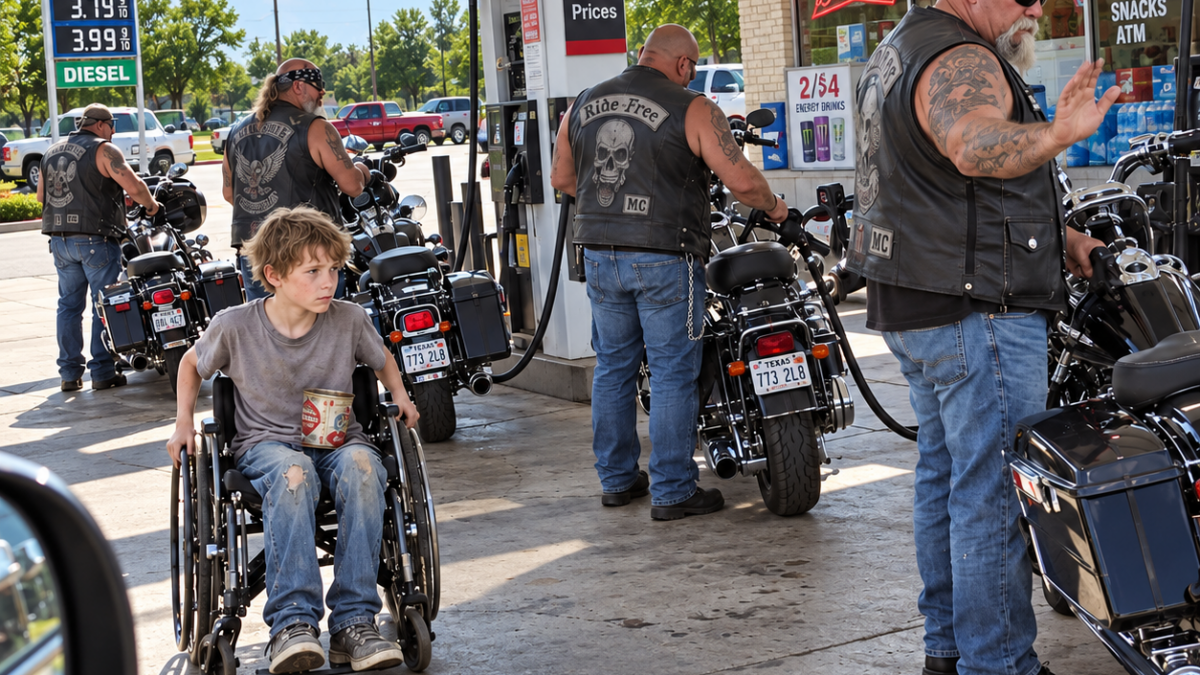
Then Caleb rolled toward us.
His wheelchair made a faint clicking sound every revolution.
Click.
Click.
Click.
The right front caster was slightly crooked.
One armrest had black electrical tape wrapped around it.
The blue vinyl seat had a tear near the corner.
Caleb himself was skinny enough that his elbows looked too large.
Dark brown hair.
Sunburn across his nose.
Gray T-shirt with a faded Oklahoma Sooners logo.
Metal braces ran beneath his jeans from knees to shoes.
On his lap sat an old coffee can.
Red.
Dented.
A strip of masking tape across the front.
Someone had written in black marker:
BIKE FUND.
I noticed that later.
At the time, I barely noticed him at all.
He approached Rooster first.
Rooster was fueling his Heritage Classic.
“Sir?”
Rooster turned.
Caleb held the coffee can with both hands.
“Could you spare twenty dollars?”
Rooster’s eyebrows rose.
Not one dollar.
Not spare change.
Twenty.
Exact.
Rooster shook his head.
“Sorry, kid.”
Caleb nodded.
“Okay.”
Then Big Mike.
Same question.
“Could you spare twenty dollars?”
Mike looked at the can.
Then at the diner across the road.
“Where are your folks?”
“My mama’s working.”
“Then you ought to stay with her.”
Caleb’s fingers tightened slightly around the can.
“Yes, sir.”
Mike said no.
Dale went next.
Dale had spent thirty-one years as a correctional officer.
Good man.
Loyal man.
But working inside a prison had put armor around parts of him he did not know how to take off.
Caleb asked.
Dale sighed.
“Twenty dollars?”
“Yes, sir.”
“For what?”
Caleb glanced toward the motorcycles.
“I’m saving.”
Dale snorted.
“Everybody’s saving.”
Then he muttered, not quite quietly enough:
“Parents ought to be ashamed, sending a crippled kid around begging.”
Everything in me now wishes I had stopped him.
I didn’t.
Caleb heard.
His face changed.
Only slightly.
His mouth flattened.
Eyes dropped.
No tears.
No anger.
He moved on.
Click.
Click.
Click.
One man after another.
No.
No.
Sorry.
Not today.
Ask somebody else.
I’ve only got cards.
Can’t help you.
By the time he reached me, thirteen men had rejected him.
I was tightening my fuel cap.
He stopped beside the dark blue Road King.
“Sir?”
I knew the question before he asked.
“Could you spare twenty dollars?”
I kept looking at the tank.
“Not today, pal.”
I expected the chair to click away.
It didn’t.
I slid my gloves into my saddlebag.
Closed it.
Still no click.
I finally looked over.
Caleb was not looking at me.
He was staring at the Road King.
Not like children usually stare at motorcycles.
I know that look.
Kids see chrome and noise.
They see danger they are not allowed to touch.
They look at motorcycles the same way they look at fire trucks.
Caleb looked like somebody had opened a grave.
My bike was a 2008 dark blue Road King Classic.
Deep cobalt under sunlight.
Lots of miles but beautifully maintained.
Chrome engine guards.
Black leather touring seat.
Aftermarket pipes.
And down the left side of the fuel tank was a scratch.
Long.
Ugly.
Maybe fourteen inches.
Thin at the front.
Wider toward the seat.
I had almost repaired it twice.
Never did.
Caleb rolled closer.
His breathing changed.
I straightened.
“Careful, son.”
He stopped.
“Can I touch it?”
I almost asked:
Touch what?
Then he pointed.
The scratch.
“Sure.”
He moved closer.
Reached out.
Two fingers.
Barely touched the damaged paint.
Then traced the mark from front to back.
Slowly.
His lower lip started trembling.
“I’ve been saving since summer.”
I looked at him.
“For what?”
His fingers stayed on the scratch.
“Mama says it costs too much.”
“What does?”
“The bike.”
Something cold moved beneath my ribs.
I said:
“What bike?”
He looked at me then.
This kid who had just been refused twenty dollars fourteen times.
Eyes glossy now.
“This one.”
The gas station noise seemed to disappear.
Pumps clicking.
Cars.
Traffic.
All of it moved somewhere far away.
“What do you mean?”
“I thought if enough people gave me twenty, maybe I could buy it back.”
My mouth went dry.
“Buy it back?”
He nodded.
“This was my daddy’s motorcycle.”
Behind me, somebody stopped moving.
I heard a helmet hit a seat.
I crouched.
My knees cracked loudly.
Caleb almost smiled.
It vanished quickly.
“How do you know?”
“The scratch.”
He touched it again.
“This happened because of me.”
I stared.
Caleb looked down at his legs.
“My braces.”
Then he told me.
He had been seven.
His father’s name was Daniel Pruitt.
Everybody called him Danny.
Danny was a power lineman.
Broad-shouldered.
Beard.
Loved motorcycles.
Loved terrible country music.
Could repair almost anything except a washing machine, according to Caleb.
Caleb had been born with spina bifida.
Multiple surgeries.
Braces.
Wheelchair.
Danny’s wife, Renee, worried constantly about injuries.
Especially motorcycles.
Danny apparently understood that.
Mostly.
One summer night, when Caleb was seven, Danny waited until Renee went to bed.
Then carried his son into the garage.
Caleb told the story with the solemn seriousness children use when describing the best crime they ever committed with a parent.
“Daddy said we weren’t really riding.”
“What were you doing?”
“Testing.”
“Testing what?”
He shrugged.
“Something.”
That sounded like a father.
Danny placed Caleb on the front portion of the seat.
Not for highway riding.
Not even a real road.
Just the empty parking lot behind Grace Fellowship Church three blocks from their house.
Danny sat behind him.
One arm around Caleb.
One hand controlling the bike.
First gear.
Barely above idle.
Slow circles.
Maybe twelve miles per hour.
But to a seven-year-old child whose legs had never carried him across a playground, twelve miles per hour might as well have been flight.
Caleb smiled while telling me.
A completely different boy.
“I could feel the wind.”
He closed his eyes.
“Daddy kept asking if I was scared.”
“What’d you say?”
“I lied.”
“What was the lie?”
“I said no.”
I laughed softly.
“So you were scared?”
“A little.”
“How scared?”
He held his thumb and finger one inch apart.
“This much.”
Then smiled.
“But I wanted to go faster.”
Of course.
When Danny stopped, he carried Caleb down.
One steel leg brace caught the fuel tank.
Scraped paint.
Long line.
Caleb said he immediately started crying.
Not because he was hurt.
Because he thought his father would be angry.
Danny stared at the scratch.
Rubbed his thumb along it.
Then laughed.
“Leave it.”
Caleb remembered every word.
“That one’s yours now.”
Danny never repaired it.
Not once.
The scratch became Caleb’s mark.
When Danny washed the motorcycle, he cleaned around it.
When friends teased him, he said:
“That’s custom work.”
When Caleb apologized again months later, Danny told him:
“If I ever fix that scratch, you better check if I’ve been replaced by an alien.”
Caleb laughed telling me that.
Then the laughter faded.
I knew what was coming.
I asked anyway.
“Where’s your dad now?”
He looked down.
“Dead.”
One word.
Children can make the largest things sound small because they have no other way to carry them.
“How?”
“Ice storm.”
I heard Big Mike whisper:
“Jesus.”
Caleb continued.
Christmas Eve.
Two winters earlier.
A severe ice storm had taken out power across multiple counties.
Lines down.
Trees snapping.
Tens of thousands of homes without electricity.
Danny got called in around four in the afternoon.
Renee begged him to wait until morning.
He told her families had children.
Elderly people.
Medical equipment.
Christmas dinner.
No heat.
He kissed her.
Kissed Caleb.
Promised he would be home before midnight.
He was working near a rural intersection when a damaged pole shifted during repair.
The investigation later called it a structural failure under ice load.
Whatever phrase the report used, the result was the same.
Danny did not come home.
Caleb said:
“He got people’s lights on first.”
I swallowed.
“He did?”
“Yeah.”
Then, proudly:
“Three streets.”
I looked at my Road King.
Danny’s Road King.
Caleb’s scratch.
Suddenly every mile I had put on that motorcycle felt like I had unknowingly been riding through somebody else’s family album.
Caleb continued.
After the funeral, Renee could not stand the motorcycle.
It sat in the garage under a cover.
She would hear metal cooling at night.
Or imagine the garage door opening.
Once she came downstairs at three in the morning because she was certain the engine was running.
It wasn’t.
Money was tight too.
Danny had insurance.
But disability equipment is expensive.
Wheelchairs.
Appointments.
House modifications.
And Caleb needed a van with a ramp.
Renee sold the bike.
I remembered buying it.
God help me, I remembered everything.
Estate sale was not quite the right phrase.
There were household items.
Tools.
Some furniture.
Danny’s riding gear.
The motorcycle.
Renee stood on the porch in a gray cardigan with her arms crossed tight.
I inspected the Road King like a man looking for a bargain.
Tires.
Fork seals.
Oil leaks.
Service records.
The asking price was six thousand.
I offered fifty-eight hundred.
She accepted immediately.
I remember being proud of that two hundred dollars.
Proud.
The bike was worth more than ten thousand in its condition.
I rode home feeling lucky.
Renee never looked at the bike as I left.
I had thought:
She’s ready to move on.
What an idiot I had been.
There at the gas station, Caleb said:
“Mama isn’t mad at the motorcycle.”
“No?”
“She says she hates what it sounds like.”
I understood.
Then I asked the question none of us could stop wondering.
“Why twenty dollars?”
Caleb looked confused.
“Because that’s what bikers have.”
Rooster stepped closer.
“What do you mean?”
Caleb looked around at all fourteen of us.
“Daddy said real bikers always keep twenty dollars folded behind their license.”
Nobody moved.
Caleb continued.
“For gas.”
He lifted one shoulder.
“Or somebody who needs it worse.”
My heart stopped.
“He told me if I ever got stuck somewhere and he wasn’t there, find a biker.”
Caleb tapped the coffee can.
“He said they’d have twenty.”
The silence that followed was unlike anything I had ever heard.
I have stood at gravesides with bikers.
Hospital rooms.
Accident scenes.
Courtrooms.
Funerals for men who thought nothing could kill them until something did.
But fourteen old men standing silent around an eleven-year-old child can make a gas station feel like church.
I knew exactly what was behind my driver’s license.
A twenty.
Folded twice.
Been carrying one there since 1976.
My father gave me the habit.
First motorcycle.
1973 Honda CB750.
I was seventeen.
Dad slipped twenty dollars into my wallet.
“For gas?”
I asked.
“For trouble.”
“What kind?”
“Yours or somebody else’s.”
He told me:
“Never ride past a stranded bike.”
I had replaced that twenty dozens of times.
Used it for gas.
Tow fees.
A young couple whose car overheated outside Wichita.
A Marine who lost his wallet.
A woman with two kids at a motel vending machine during a snowstorm.
Every time:
Spend it.
Replace it.
Behind the license.
I looked around.
Rooster.
Mike.
Dale.
All of them.
I would have bet every motorcycle at that station each man carried one too.
Caleb’s father had taught him something true.
And fourteen men had just made it a lie.
Dale moved first.
The same Dale who had said the ugly thing.
He walked toward Caleb.
Stopped.
Then lowered himself onto both knees on hot concrete.
Dale had an artificial left knee.
He hated kneeling.
Did it anyway.
Took out his wallet.
His hands shook.
He pulled his driver’s license.
Behind it:
twenty dollars.
Folded twice.
He looked at Caleb.
“Son.”
His voice broke.
He tried again.
“I said something about your parents.”
Caleb looked at him.
“I heard.”
Dale closed his eyes briefly.
“Yeah.”
He nodded.
“You did.”
Then:
“It was ugly.”
Caleb said nothing.
“I spent a lot of years listening to people lie to me.”
Dale swallowed.
“Started making me think everybody was lying before they even opened their mouth.”
He held out the twenty.
“That’s my problem.”
“Not yours.”
Caleb looked at the bill.
Dale continued.
“Your daddy was right.”
He smiled painfully.
“I had it the whole time.”
Caleb accepted it.
Unfolded it.
Smoothed the crease.
Placed it in the coffee can.
Rooster came next.
No speech.
Twenty.
Big Mike.
Twenty.
Preacher.
Twenty.
Mack.
Tommy.
Shovel.
Birdman.
Lester.
Ray.
Boone.
Cal.
Little John.
One at a time.
Some apologized.
Some couldn’t.
Big Mike put his twenty in, walked to his motorcycle, and stood facing away.
Mike was six foot five.
Two hundred eighty pounds.
Vietnam-era Marine.
He had held Hollis’s widow while she cried that morning.
Now his shoulders shook.
I went last.
Again.
I pulled my license out.
Twenty behind it.
Exactly where Caleb said it would be.
I held it for a second.
Then crouched.
“Caleb.”
“Yes, sir?”
“I lied to you.”
He frowned.
“When?”
“When I said not today.”
I showed him the bill.
“I had it.”
His face did not accuse me.
That almost hurt worse.
I put it in the can.
Fourteen twenties.
Two hundred eighty dollars.
Added to whatever he had already saved.
Then somebody screamed:
“CALEB!”
We all turned.
A woman was running across the parking lot from a diner on the other side.
White server apron.
Dark jeans.
Gray T-shirt underneath.
Hair coming loose from a ponytail.
A dish towel in one hand.
Terrified.
“CALEB!”
From her angle she must have seen:
Her disabled son.
Fourteen bikers.
Motorcycles surrounding him.
Probably not the scene any mother wants to discover.
She ran straight toward us.
“Caleb Michael Pruitt, you get away from—”
Then stopped.
Mid-step.
The dish towel fell.
Her eyes had found the Road King.
Not me.
Not Caleb.
The bike.
Her entire body went still.
Caleb smiled.
“Mama.”
She whispered:
“No.”
“Mama, I found it.”
Renee stared at the tank.
The scratch.
Then at me.
Recognition.
Slow.
Painful.
“You.”
I stood.
“My name’s Walt Baker.”
“I remember.”
Her voice barely worked.
She did.
The man on the porch.
The bargain hunter.
The stranger who drove away on her dead husband’s motorcycle.
Caleb reached into the coffee can.
“Mama, look.”
Renee finally noticed the money.
Her face flushed.
“What did you do?”
“I found bikers.”
“Caleb.”
“They had twenties.”
“Caleb.”
“They—”
“Give it back.”
He stopped.
“What?”
“Every dollar.”
She looked at us.
“I’m sorry.”
Her voice shook.
“I am so sorry.”
“He’s been doing this all summer.”
Caleb hugged the can.
“No.”
Renee crouched.
“You promised me.”
“I promised I wouldn’t go far.”
“You promised you’d stop asking strangers for money.”
“Bikers aren’t strangers.”
Every man around us flinched.
Renee looked toward Dale.
Then Big Mike.
Then me.
“Of course they’re strangers.”
Caleb shook his head.
“Daddy said—”
“I know what Daddy said.”
Her voice cracked.
She put one hand over her mouth.
For a few seconds, she could not speak.
Then quieter:
“I know.”
She looked at us.
“I work doubles here.”
She pointed toward the diner.
“He is supposed to stay in the corner booth.”
Caleb muttered:
“You can see me from the window.”
“That does not make this okay.”
“I only asked bikers.”
“That makes it worse.”
Rooster murmured:
“Depends on the biker.”
Renee almost laughed.
Almost.
Then her eyes returned to the Road King.
All humor left.
I said:
“Renee.”
She looked at me.
“I’d like to give the bike back.”
Fourteen bikers apparently all stopped breathing together.
Caleb’s head snapped toward me.
Renee shook hers immediately.
“No.”
“I’m serious.”
“No.”
“Title’s clean.”
“I said no.”
“You don’t owe me anything.”
“Mr. Baker.”
“Walt.”
“Mr. Baker.”
Fair.
“I cannot have that motorcycle at my house.”
Caleb looked at her.
“Mama.”
“No.”
I stepped closer.
“You sold it because you needed the van.”
“I sold it because I needed it gone.”
That silenced me.
She pointed at the Road King.
“You hear an engine.”
She pressed one hand against her chest.
“I hear Christmas Eve.”
Nobody moved.
“I hear him leaving.”
Her breath trembled.
“I hear myself telling him not to go.”
She looked toward Caleb.
“I hear the garage door closing.”
Then back to me.
“For months after Danny died, I woke up hearing that motorcycle.”
Caleb whispered:
“Mama.”
“I know you love it.”
She crouched beside him.
“I know.”
“But I couldn’t breathe with it in the garage.”
Tears ran down her face.
“I would walk past it and think he was going to come inside.”
She laughed once.
Broken.
“Like if I didn’t sell it, maybe he wasn’t completely gone.”
Caleb looked at the tank.
Renee continued:
“And we needed the van.”
“I know.”
“No, sweetheart.”
She took his hand.
“You were nine.”
“You didn’t know the bills.”
“Ramp conversion.”
“Chair.”
“Therapy.”
“Insurance fighting every little thing.”
“I was drowning.”
Caleb’s eyes lowered.
“I’m not mad.”
Renee cried harder.
“That makes it worse.”
He reached up.
Touched her cheek.
“I know why you sold it.”
Renee kissed his hand.
Then she looked at me.
“But I cannot take it back.”
I understood.
At least I thought I did.
Then she whispered something that cut deeper.
“And he can’t ride it.”
Caleb heard.
His fingers froze.
Renee realized.
Closed her eyes.
“I’m sorry.”
Caleb looked down at his braces.
No one knew what to say.
We were old men.
We had opinions about everything.
Engines.
Politics.
Weather.
Roads.
Coffee.
But there are sentences nobody can wrench apart and repair.
He cannot ride it.
Rooster spoke.
“He can.”
Renee looked up.
“What?”
Rooster pointed at Caleb.
“He can ride.”
She stared.
Rooster shrugged.
“Sidecar.”
Silence.
Then:
“I built one for an amputee in Okmulgee.”
Rooster was a welder.
Not hobby welder.
Forty-four years fabricating structural steel.
Custom motorcycle work on weekends.
He stepped toward the bike.
“Mounting frame can take it.”
He pointed.
“Road King’s heavy enough.”
Renee stared at him like he had started speaking another language.
Rooster continued.
“Build a proper seat.”
“Five-point harness.”
“Side protection.”
“Transfer height matched to his chair.”
“Handhold.”
“Foot support.”
“Maybe removable canopy if sun is an issue.”
Caleb’s face was changing.
Hope is frightening to watch when somebody has been protecting themselves from it.
“Mister.”
Rooster looked down.
“Yeah?”
“Could it be blue?”
Rooster snorted.
“Son, if I build it ugly, they take my welding card.”
A laugh moved through us.
Even Renee.
Tiny.
But real.
I looked at Caleb.
Then the Road King.
Something clicked.
Not mechanically.
Morally.
“Here’s what I want to do.”
Renee’s expression became cautious.
“No.”
“You haven’t heard it.”
“If it involves giving us an eleven-thousand-dollar motorcycle—”
“It stays with me.”
She stopped.
“What?”
“The bike.”
I pointed toward it.
“Lives at my place.”
“You never have to hear it in your garage.”
“I keep insurance.”
“Maintenance.”
“Registration until paperwork is sorted.”
“But ownership…”
I looked at Caleb.
“Goes to him.”
Renee stared.
“No.”
“Yes.”
“He’s eleven.”
“Then trust arrangement until he’s old enough.”
“We’ll have a lawyer make it clean.”
“The bike becomes Caleb’s.”
I continued before fear could catch me.
“Rooster builds the sidecar.”
“We set it up safely.”
“And on Sundays, if you allow it…”
I looked at Caleb.
“I take him riding.”
Renee stared at me.
“Why?”
Fair question.
“You met him ten minutes ago.”
I looked at the scratch.
“No.”
I shook my head.
“I think I met him two years ago.”
“What?”
“When I bought the bike.”
I told her.
The two times I nearly repaired the scratch.
First winter.
Buffer on workbench.
Paint matched.
I got interrupted by a phone call.
Second time.
Tape around the damage.
Buffer in my hand.
I stood there.
Could not touch it.
No reason.
I left it.
Renee started crying again.
I said:
“I don’t believe ghosts stop you from buffing paint.”
A few men smiled.
“But I have ridden eleven thousand miles looking at your son’s scratch.”
I touched the tank.
“Maybe I’ve been carrying something that never belonged to me.”
Caleb whispered:
“Daddy said it belonged to me.”
I looked at him.
“Yeah.”
“He did.”
Renee stepped away.
Walked ten feet.
Turned toward the highway.
We waited.
No pressure.
No speeches.
Eventually she asked:
“What if he gets hurt?”
Rooster answered before I could.
“He can get hurt transferring into a van.”
Renee turned sharply.
Rooster lifted both hands.
“Not saying motorcycles are safe.”
“They’re not.”
“We build it right.”
“Protective gear.”
“Helmet.”
“Harness.”
“Slow roads first.”
“Daylight.”
“You follow.”
“Your rules.”
Renee looked at Caleb.
He had stopped breathing normally.
Waiting.
“Mama?”
She closed her eyes.
Then pointed at me.
“Daylight.”
“Yes, ma’am.”
“Good weather.”
“Yes.”
“No interstate until I say.”
“Absolutely.”
“I follow in the van.”
“Fine.”
“If I say stop—”
“We stop.”
“If he is tired—”
“We stop.”
“If anything feels wrong—”
“We stop.”
Rooster raised a finger.
“And I inspect the rig every month.”
Renee looked at him.
“You’re all insane.”
Big Mike finally turned around.
“Ma’am.”
She looked.
Mike wiped his face.
“Absolutely.”
That broke something.
Renee laughed.
Then cried.
Then laughed while crying.
Caleb looked into the coffee can.
I asked:
“How much did you have before today?”
“Three hundred twelve dollars.”
“You saved all that?”
He nodded.
“How?”
“Birthday.”
“Sold games.”
“Helped Mrs. Avery with her dog.”
“She gives me five dollars.”
“Lemonade stand.”
He hesitated.
“I sold Daddy’s fishing rods.”
Renee turned.
“You what?”
Caleb shrank.
“The small ones.”
“Caleb.”
“I kept his favorite.”
Renee covered her face.
I said:
“Keep the money.”
Caleb looked at me.
“All of it.”
“For what?”
I pointed at his braces.
“Seven years from now, you’re gonna start wanting more than a sidecar.”
His eyes widened.
“They make trikes.”
Rooster nodded.
“Hand controls too.”
Caleb stared at us.
“Could I…”
He hesitated.
“Could I drive one?”
Rooster said:
“Kid, people missing both legs drive motorcycles.”
Caleb sat straighter.
“We’ve got seven years to figure out what stupid thing you want to ride.”
Renee said:
“Excuse me?”
Rooster smiled.
“Safe stupid.”
“That isn’t better.”
But Caleb was smiling.
Not the little smile from remembering the church parking lot.
A future smile.
That is different.
Renee tried returning the twenty-dollar bills.
She carried the coffee can to Dale first.
“Please.”
Dale put his hands behind his back.
“No, ma’am.”
“It’s your money.”
“Not anymore.”
“Mr.—”
“Dale.”
“Dale.”
She sighed.
“My son should not be begging.”
Dale nodded.
“You’re right.”
Caleb looked hurt.
Then Dale continued.
“But he wasn’t asking for food.”
“He was trying to buy back his father’s motorcycle.”
“That doesn’t make asking strangers smart.”
Renee looked at him.
“See?”
Dale nodded.
“But I was still wrong.”
He looked at Caleb.
“I judged your mama without knowing one damn thing.”
Renee’s expression softened.
Dale said:
“That twenty isn’t payment for begging.”
“It’s tuition.”
“For me.”
“What did you learn?”
Renee asked.
Dale gave a sad smile.
“Shut up until you know something.”
Big Mike muttered:
“Expensive lesson.”
Dale looked over.
“You paid too.”
That got another laugh.
Caleb said:
“Mama.”
Renee looked down.
“It’s Daddy’s rule.”
“What is?”
“The twenty.”
“He said it’s for somebody who needs it more.”
Renee stared at her son.
Then the fourteen men.
Then the money.
Slowly, she put the coffee can back in Caleb’s lap.
“Sundays.”
She said it to me.
“Daylight.”
“I remember.”
“And I follow.”
“Yes.”
Then:
“And if you’re coming to my house every Sunday, stop calling me ma’am.”
She held out her hand.
“Renee.”
I shook it.
“Walt.”
Caleb looked between us.
“So I get the bike?”
Renee pointed.
“You get nothing until lawyers and insurance and every adult with more sense than these men says it is legal.”
Caleb looked at me.
“That’s a yes.”
I whispered:
“Sounds like one.”
Renee heard.
“I can still change my mind.”
“Yes, ma’am.”
“Walt.”
“Sorry.”
That should have been enough.
It wasn’t.
Because once fourteen bikers realize they have failed a kid, fourteen bikers can become unbearable.
We left the gas station two hours later.
Not because anything mechanical was wrong.
Because nobody wanted to leave.
Renee’s manager let her finish her shift early.
We sat in the diner.
All sixteen of us.
Fourteen bikers.
One mother.
One wheelchair kid.
The waitress pushed three tables together.
Caleb ordered pancakes despite it being nearly four in the afternoon.
Big Mike paid before anyone could argue.
Renee told us about Danny.
The real Danny.
Not dead-hero Danny.
Human Danny.
Forgot anniversaries.
Burned toast.
Owned seventeen identical black T-shirts.
Sang loudly and badly.
Could climb a utility pole in sleet but could not assemble IKEA furniture without swearing.
Once bought Caleb a drum set without asking Renee.
“That was almost the thing that killed him.”
She said.
Caleb laughed so hard milk came out his nose.
She told us Danny hated mayonnaise.
Loved cinnamon rolls.
Stopped for stranded motorists.
Carried jumper cables everywhere.
And yes—
twenty dollars behind his license.
Danny learned it from an older biker named Curtis years earlier.
Curtis found him out of gas on a county road at nineteen.
Gave him fuel.
Would not accept repayment.
Instead told him:
“Carry a twenty.”
“Someday somebody else will be you.”
Danny did.
For twenty-seven years.
I looked around the table.
That tradition had moved through men none of us knew.
Curtis.
Danny.
My father.
Maybe dozens of others.
Different origins.
Same principle.
Help before you interrogate somebody’s worthiness to need help.
Not blindly.
Not stupidly.
But do not let suspicion become an excuse for indifference.
Dale barely spoke.
Before leaving, he asked Renee privately if he could apologize again.
She said:
“You already did.”
“I need to do it right.”
He looked at Caleb.
Then her.
“I said lazy parents.”
Renee’s face hardened slightly.
Dale continued.
“My wife and I raised three boys.”
“We had two incomes.”
“Healthy kids.”
“Parents nearby.”
“Never once had to convert a van.”
He swallowed.
“I spoke like I knew your life.”
Renee stared.
Then:
“You hurt him.”
“I know.”
“He worships bikers because of Danny.”
Dale nodded.
“That makes it worse.”
“Yes.”
Dale accepted it.
No defense.
No:
I was tired.
No:
I didn’t mean it.
Just:
“I’m sorry.”
Renee eventually said:
“Thank you.”
Outside, Dale stood beside his bike.
I said:
“You okay?”
“No.”
“Good.”
He looked at me.
“Good?”
“Means you’re not who you were two hours ago.”
He considered.
Then nodded.
We rode home.
I expected to feel relieved.
Instead guilt came harder.
Every mile, I looked down at the scratch.
Joan was waiting when I arrived.
She came into the garage.
“Memorial okay?”
“Yeah.”
Then saw my face.
“What happened?”
I told her.
All of it.
When I finished, she sat on the workbench.
“Let me understand.”
“Okay.”
“You own a motorcycle that belonged to a dead lineman.”
“Yes.”
“His wheelchair-using son found you at a gas station.”
“Yes.”
“Asked fourteen bikers for twenties because his father told him bikers carry emergency twenties.”
“Yes.”
“You all said no.”
I closed my eyes.
“Yes.”
Joan stared for a long time.
Then:
“You’re an idiot.”
“I know.”
“Fourteen idiots.”
“Correct.”
“And now you’re giving him the motorcycle.”
“Yes.”
“And building a sidecar.”
“Rooster.”
“Of course Rooster.”
She stood.
Walked to the bike.
Ran a finger near the scratch.
“I told you not to fix this.”
I looked up.
“What?”
“You remember two winters ago?”
I did not.
“You had tape around it.”
“You came inside for coffee.”
“I went out to put laundry in the freezer.”
I stared.
“Garage freezer.”
“Right.”
She rolled her eyes.
“I saw the scratch.”
“Told you it gave the bike character.”
“You said it bothered you.”
“I said leave it.”
I had forgotten.
Joan looked at the tank.
“Maybe Danny had help.”
I almost laughed.
She kissed my cheek.
“Call the lawyer tomorrow.”
We did.
Ownership transfer became more complicated than a parking-lot promise.
Caleb was a minor.
Renee worried about liability.
I wanted the bike protected if anything happened to me.
We created a trust arrangement with Renee controlling use until Caleb turned eighteen.
I remained responsible for insurance and maintenance while the motorcycle stayed with me.
When Caleb turned eighteen, title ownership could fully transfer according to the agreement.
Unless Renee and Caleb decided differently.
We did it correctly.
No handshake mythology.
Paper.
Signatures.
Insurance approval.
Rooster began the sidecar.
That man turned into a lunatic.
He measured Caleb.
Chair height.
Hip width.
Torso length.
Harness angle.
Reach.
Transfer method.
Renee watched like an FAA inspector.
“Why is that bracket there?”
“Structural support.”
“Could he hit his elbow?”
“Padding.”
“Can it tip?”
“Anything can tip.”
Wrong answer.
Rooster learned.
“Designed to resist.”
Better.
He built the frame twice.
Scrapped the first because he disliked two welds.
Big Mike donated marine-grade upholstery.
Mack found a five-point harness supplier.
Preacher knew a physical therapist who specialized in adaptive sports.
She reviewed the seating angle.
Caleb became project supervisor.
Mostly he asked:
“Can it go faster?”
Renee answered:
“No.”
Rooster answered:
“Maybe.”
Renee glared.
Rooster corrected:
“No.”
We painted the sidecar to match the Road King.
Dark blue.
Silver pinstripe.
On the side, Caleb wanted his father’s name.
Renee hesitated.
Then approved something smaller.
A simple line beneath the seat:
D.P. — KEEP THE TWENTY.
Caleb cried when he saw it.
So did half the shop.
We built a transfer board.
Removable.
So Renee or I could move Caleb safely from wheelchair to sidecar.
The chair folded and secured to a rear carrier if needed.
Helmet fitted.
Gloves.
Armored jacket.
No black leather vest.
Not yet.
He asked.
Renee said eighteen.
Big Mike said thirteen.
Renee stared at him.
Big Mike disappeared into another room.
Five weeks.
That was all Rooster needed.
The first test happened in an empty community-college parking lot.
Exactly the kind of place Danny had used.
Renee stood holding her keys.
Terrified.
Caleb was vibrating with excitement.
I sat on the Road King.
Engine off.
Rooster checked everything.
Harness.
Latch.
Frame.
Tire pressure.
Steering damper.
Suspension.
Again.
Then one more time.
Renee crouched beside Caleb.
“You tell Walt if anything hurts.”
“I know.”
“If you feel dizzy—”
“I know.”
“If the harness—”
“Mama.”
She stopped.
Caleb reached for her.
She leaned in.
He hugged her.
“I’m okay.”
Renee closed her eyes.
“No.”
She whispered.
“You’re happy.”
Caleb smiled.
“Yeah.”
“That isn’t the same thing.”
It was one of the most honest things I ever heard.
Renee stood.
I started the engine.
She flinched.
Tiny.
But I saw.
For her, that sound still belonged to the worst night of her life.
Caleb heard something else.
His father.
That is the cruelty of grief.
The same sound can be home to one person and a wound to another.
I let the bike idle.
Renee stayed.
Did not leave.
We rolled forward.
Five miles per hour.
Then ten.
Wide circle.
Caleb started laughing.
Not polite.
Not nervous.
Belly laugh.
At fifteen miles per hour he yelled:
“FASTER!”
I shouted back:
“YOUR MOTHER IS WATCHING!”
He yelled:
“SHE CAN’T CATCH US!”
Behind us, a minivan horn blasted.
Renee.
We stayed at fifteen.
First real ride was planned for the following Sunday.
I told nobody except Joan and Renee.
At eight in the morning, I turned onto Renee’s street.
Thirteen motorcycles were waiting.
All of them.
Rooster.
Big Mike.
Dale.
Everybody from the gas station.
I stopped beside them.
“How?”
Rooster shrugged.
“People talk.”
“You people are ridiculous.”
Big Mike said:
“Correct.”
Renee stepped onto her porch.
Same gray sweater.
I recognized it from the estate sale.
That nearly broke me.
Caleb came down the ramp in his chair.
Helmet already on.
Grinning.
We transferred him.
Harnessed.
Checked.
Renee walked toward the motorcycle.
Then stopped beside the tank.
She stared at the scratch.
Nobody spoke.
She reached out.
Touched it.
Same way Caleb had.
Two fingers.
Slow.
“Hey, Danny.”
Barely audible.
Caleb heard.
His smile disappeared into something softer.
Renee rested her palm against the tank.
“I’m trying.”
She whispered.
That sentence belonged to her dead husband.
None of us pretended otherwise.
Then she stepped back.
“Bring him home.”
“Yes.”
“Walt.”
“Yes?”
“He likes to pretend he’s tougher than he is.”
Caleb protested:
“Mama.”
She continued:
“If he gets quiet, stop.”
I nodded.
“Promise.”
We rode first to Grace Fellowship.
Danny’s church.
Parking lot.
Same place he had taken Caleb years before.
Renee followed with hazards flashing.
We entered.
One slow lap.
Caleb did not laugh.
Not yet.
He looked around.
“Over there.”
He pointed.
“Daddy parked there.”
We stopped.
“Want a minute?”
He nodded.
Renee parked the van.
Walked over.
Caleb looked at his mother.
“I remember his arm.”
“What?”
“Here.”
He touched his chest.
“He held me.”
Renee nodded.
“I know.”
“I could smell his jacket.”
Silence.
Then:
“Was he scared?”
Renee thought.
“Your dad?”
“Taking me.”
She smiled.
“Of me finding out?”
Caleb nodded.
“Terrified.”
He laughed.
Then she did.
We made another lap.
This time, faster.
Twelve miles per hour.
Exactly what Caleb remembered.
He closed his eyes for three seconds.
Opened them.
“Daddy would go faster.”
I looked at Renee.
She sighed.
“Twenty.”
We went twenty.
Caleb laughed.
Thirteen motorcycles followed.
Around a church parking lot.
Slow.
Ridiculous.
Beautiful.
After that:
county road.
No interstate.
Renee behind.
At the first traffic light, Caleb leaned out slightly.
“Walt!”
“What?”
“Daddy would’ve gone faster!”
Every biker heard him.
Big Mike lowered his visor.
Again.
We stopped for breakfast at the same diner where Renee worked.
Her manager had saved a table.
Other customers stared at the sidecar.
Caleb loved explaining it.
“My daddy owned this bike.”
“Then Walt bought it.”
“Then I bought it back.”
Renee corrected:
“You did not buy anything.”
Caleb pointed at the coffee can, now kept at home.
“Technically I contributed.”
Rooster nearly spit coffee.
We made Sunday rides a routine.
Not every week.
Weather.
Health.
School.
Life.
But often.
Sometimes just twenty minutes.
Sometimes two hours.
Caleb learned maps.
Road signs.
Motorcycle mechanics.
At first he could not reach most things easily from the sidecar, so Rooster created a detachable tool tray.
I taught him oil checks.
Tire pressure.
Battery tender.
Danny’s service notebook was still inside a saddlebag when I bought the bike.
I had kept it.
Never really read the personal notes.
Now we did.
Danny wrote mileage.
Repairs.
Parts.
But also strange little comments.
6/14 — Caleb’s birthday next week. Wants astronaut stuff.
8/03 — Renee says pipes too loud. Renee correct.
11/22 — Need new rear tire before spring.
One page:
7/19 — Took C. around church lot. Scratched tank. Best damage ever.
Caleb stared at that line for nearly five minutes.
Then asked:
“Can I have this?”
I handed him the notebook.
“It’s yours.”
He pressed it against his chest.
Renee later told me he slept with it beneath his pillow.
Dale changed most.
Maybe guilt does that when a person allows it.
He started visiting Caleb separately.
Not charity.
He taught him leather stamping.
Made him a small wallet.
Behind the license-shaped plastic card inside, Dale put a folded twenty.
Caleb laughed.
“You know I don’t drive.”
“Preparation.”
“For what?”
“Trouble.”
Dale became close with Renee too.
Not romantically.
Just respectful.
One afternoon, I heard him tell her:
“My daughter stopped speaking to me for two years.”
Renee asked why.
“I judged her husband before I knew him.”
“Pattern?”
Dale nodded.
“Apparently.”
She laughed.
He said:
“I’m working on shutting up.”
“Slow progress.”
“Extremely.”
The fourteen of us began showing up for Caleb in ways nobody announced.
Mike repaired the wheelchair caster.
Mack found a better cushion.
Preacher’s wife helped Renee navigate an insurance appeal.
Little John knew someone selling an accessible shower bench and delivered it free.
Joan started sending meals whenever Renee worked doubles.
I worried once that we were overwhelming them.
I asked Renee.
She said:
“Yes.”
My stomach dropped.
Then she smiled.
“But not badly.”
She became serious.
“After Danny died, everybody helped for two months.”
“Food.”
“Cards.”
“Money.”
“People checked in.”
“Then life moved.”
I understood.
“Mine didn’t.”
She looked toward Caleb.
“Everybody went back to normal.”
“We didn’t have normal anymore.”
Then:
“You men don’t know how to leave.”
I smiled.
“Bikers.”
“I’m beginning to understand.”
Winter came.
No riding for stretches.
Caleb hated it.
We worked in my garage instead.
He learned socket sizes.
How to use a torque wrench.
Difference between something tight and something correctly torqued.
He hated cleaning chrome.
Good.
Shows intelligence.
One night he asked:
“Did you know my daddy?”
“Not really.”
“But you said you kind of did.”
I stopped working.
“Through the bike.”
He nodded.
“Tell me.”
So I did.
A machine keeps fingerprints in strange ways.
Not literal.
Choices.
Danny preferred one brand of spark plug.
Used blue thread locker too often.
Adjusted the clutch tighter than I liked.
Installed highway pegs himself.
Left one bolt slightly scarred from using the wrong wrench.
I told Caleb:
“You can tell when somebody works on their own bike.”
“How?”
“Little things.”
“Good?”
“Some.”
“Bad?”
“Some.”
He smiled.
“Daddy swore a lot in the garage.”
“That improves mechanical performance.”
Joan yelled from the kitchen:
“DO NOT TEACH HIM THAT.”
Caleb laughed.
Then he asked:
“Do you think Daddy knows I found it?”
There are questions where confidence is dishonest.
I said:
“I don’t know.”
He nodded.
I continued:
“But I know if there’s any way he could know…”
Caleb looked at me.
“He’d be proud you remembered.”
Caleb looked down.
“I forget his voice sometimes.”
That hurt.
“I can remember stuff he said.”
“But not how he sounded.”
I had no fix.
So I said:
“That happens.”
“Does it mean I’m forgetting him?”
“No.”
“How do you know?”
“Because you’re sitting in my garage learning how he ruined a clutch adjustment.”
Caleb smiled.
Memory does not survive equally.
Some details fade.
Others harden.
Scratch on a tank.
A rule about twenty dollars.
The smell of a jacket.
A slow circle in a church lot.
Enough can remain.
Spring brought another problem.
Caleb got sick.
Not catastrophic.
But serious enough.
A pressure sore near his hip became infected.
Hospitalized four days.
No sidecar.
No riding.
Renee was exhausted.
I visited.
Caleb hated being in the hospital.
He turned quiet.
Too quiet.
Renee remembered her own warning.
If he gets quiet, stop.
So we stopped pretending he was fine.
One evening, I sat beside his bed.
He said:
“Maybe Mama was right.”
“About?”
“I can’t ride.”
I looked at him.
“You have ridden.”
“Not by myself.”
“Yet.”
“What if I never can?”
I thought about giving him encouragement.
You can do anything.
I hate that phrase.
Everybody cannot do everything.
Disability does not disappear because an adult gives an inspiring speech.
I said:
“Then we figure out what you can do.”
He looked angry.
“That’s not the same.”
“No.”
I nodded.
“It isn’t.”
That surprised him.
“You’re supposed to say I can.”
“I’m supposed to tell you the truth.”
He looked toward the window.
I continued.
“Maybe at eighteen you ride a hand-control trike.”
“Maybe technology changes.”
“Maybe you decide motorcycles are stupid and buy a sports car.”
He looked horrified.
“Never.”
“Good.”
“Testing you.”
He smiled.
Then I said:
“The point isn’t proving your legs don’t matter.”
“They do.”
“The point is they don’t get to decide everything.”
He became quiet.
But not shut-down quiet.
Thinking quiet.
Three weeks later:
back in the sidecar.
Renee cried where nobody could see.
I saw anyway.
A year passed.
Caleb turned twelve.
Then thirteen.
We gave him a leather vest.
Renee approved reluctantly.
No full club patch.
That had meaning.
Instead, back panel said:
KEEP THE TWENTY.
Underneath:
TULSA, OKLAHOMA.
Caleb wore it everywhere for two weeks.
School finally told him to stop wearing it in class.
He claimed discrimination.
Renee claimed he was dramatic.
At fourteen, Caleb gave his first twenty away.
We were at a convenience store.
A young man stood beside an old Honda motorcycle.
Tank off.
Phone dead.
Out of gas.
Caleb saw him before we did.
He rolled toward him.
Took out his wallet.
Pulled a folded twenty.
“Here.”
The man stared.
“What?”
“For gas.”
“I can’t take that.”
Caleb said:
“Yeah, you can.”
The man looked at me.
I shrugged.
“Rule.”
He accepted.
Asked for Caleb’s address so he could repay.
Caleb shook his head.
“Put another twenty behind your license.”
The man laughed.
“Seriously?”
Caleb nodded.
“Someday somebody else will be you.”
I had to walk away.
Could not let him see my face.
The rule had moved again.
Danny to Caleb.
Caleb to stranger.
Maybe that was immortality.
Not heaven.
Not ghosts.
A useful thing you taught somebody that keeps traveling after your name stops being spoken.
At sixteen, Caleb became obsessed with riding independently.
Technology had improved.
We researched trikes.
Adaptive controls.
Shifter systems.
Electronic clutch options.
Renee had saved.
Caleb had saved too.
His original $312 remained in a bank account.
The fourteen twenties too.
He refused to spend those.
“Why?”
I asked.
“They’re the first ones.”
“So?”
“They’re not money.”
Fair.
He worked part-time doing computer repair.
Saved.
A nonprofit adaptive-riding program helped.
Rooster—older now, hands stiffer—came to every consultation.
At seventeen and nine months, Caleb took an adaptive motorcycle safety course on a training trike with hand controls.
I watched from behind a fence.
Renee beside me.
She held my arm so hard my hand went numb.
“He’s going too fast.”
“He’s doing twelve.”
“Too fast.”
“Danny did twelve.”
Wrong thing to say.
She looked at me.
Then smiled despite herself.
“Shut up, Walt.”
“Yes, ma’am.”
She still hated when I called her that.
Caleb passed.
At eighteen, the Road King legally became his.
We had planned the transfer for years.
Paperwork already structured.
Still, we went to the tag office.
Official.
Renee.
Caleb.
Me.
Rooster.
Dale.
Big Mike in a wheelchair of his own after a stroke.
Life had changed all of us.
When the clerk slid the title forward, Caleb signed.
His hands trembled.
Owner:
Caleb Michael Pruitt.
He stared.
Then handed the title to Renee.
She touched Danny’s old name in the prior ownership history.
Then mine.
Then Caleb’s.
Three men tied together by one motorcycle.
She cried quietly.
“I thought selling it meant I was losing him.”
Caleb said:
“You weren’t.”
She looked at her son.
“No.”
“I was just surviving.”
That mattered.
For years, part of Renee had carried shame about selling Danny’s bike.
Caleb had never blamed her.
I never blamed her.
Still, grief invents guilt when facts are insufficient.
She needed to say it.
She had not betrayed Danny.
She bought her son mobility.
The motorcycle had paid for part of the van that carried Caleb through childhood.
Then somehow came back.
Not magic.
Circumstance.
An estate sale.
A stubborn scratch.
A kid with a coffee can.
Fourteen foolish men at a gas station.
Caleb’s first solo ride on his own adaptive trike happened two months later.
Not the Road King.
We decided Danny’s bike would remain sidecar-equipped for a while.
Too much history.
Too much sentimental resistance to modifying it further.
Caleb bought a used three-wheeler.
Hand controls.
Deep black.
Rooster insulted the welds.
Then approved them.
We met at the church parking lot.
Of course.
Caleb transferred into the rider position.
Renee checked everything fourteen times.
He started the engine.
Looked at me.
“Walt.”
“Yeah?”
“You scared?”
“Yes.”
He grinned.
“Good.”
Little bastard.
He rode one slow lap.
Then another.
Then left the parking lot with me beside him.
Renee followed.
Same van.
Older.
More miles.
Same mother.
At a red light, Caleb looked over.
“Daddy would’ve gone faster.”
I laughed.
“You’ve been using that line for seven years.”
“Still true.”
Behind us, Renee leaned on the horn.
We behaved.
Mostly.
I am seventy-four now.
Road King sits in Caleb’s garage.
Not mine.
He bought a small house ten minutes from Renee.
Built a proper workspace.
Wide doors.
Low benches.
Concrete floor.
The scratch remains.
Still.
He will never repair it.
Neither will anyone else while he is alive.
Rooster died last winter.
Cancer.
Seventy-nine.
At his funeral, Caleb arrived in the sidecar rig.
He asked me to drive Danny’s Road King.
First time I had ridden it in almost three years.
We parked near Rooster’s casket.
On the memorial table:
Photographs.
Welding hood.
Gloves.
A small metal plaque.
Caleb had fabricated it himself.
KEEP THE TWENTY.
We placed one folded twenty beneath it.
Dale cried.
Dale cries easier now.
Age sandblasts pride.
After the funeral, we stopped at a gas station.
Not the same one.
Close.
A woman stood beside an old sedan.
Two kids.
Flat tire.
Phone in hand.
Upset.
Before I could dismount, Caleb rolled his trike beside her.
“You okay?”
“Flat.”
“Spare?”
“I think.”
He looked at me.
I looked at Dale.
Dale looked at Big Mike’s son, who rides with us now.
Nobody needed to say anything.
We fixed the tire.
The woman tried giving us money.
Caleb refused.
Her little boy stared at his wheelchair transfer equipment.
Then at the trike.
“You can ride that?”
Caleb smiled.
“Yeah.”
“Fast?”
I shouted:
“NO.”
Caleb shouted:
“YES.”
Some things never change.
Before leaving, the woman asked:
“What can I do?”
Caleb told her:
“Keep twenty dollars somewhere.”
She laughed.
He didn’t.
“For somebody who needs it worse.”
She looked at him differently then.
“Okay.”
That was all.
Maybe she did.
Maybe she didn’t.
Traditions survive by invitation, not enforcement.
I told you at the beginning that I was one of fourteen bikers who told an eleven-year-old wheelchair boy no.
That is true.
I also told you I did not sleep well afterward.
For a long time, guilt was part of that.
Because there is no editing what we did.
We judged him.
All fourteen.
We saw a child asking for twenty dollars and constructed a story that made saying no comfortable.
Scam.
Bad parents.
Begging.
Hustle.
We had evidence for none of it.
We were tired.
Suspicious.
Experienced enough to believe experience made us wise.
Sometimes experience only gives prejudice better vocabulary.
Caleb did not teach me to give everybody money.
That would be a stupid lesson.
There are scams.
There are dangerous situations.
Boundaries matter.
Judgment matters.
But Caleb taught me something harder.
Pause before you decide you already understand the person standing in front of you.
Ask one more question.
Look.
Actually look.
If I had looked at Caleb when he first reached me, maybe I would have noticed the way he stared at that bike.
If Rooster had asked why twenty before refusing, maybe the entire moment would have changed.
If Dale had waited five seconds before insulting Renee, he would have saved himself years of shame.
We cannot know every story.
But we can stop pretending we do.
Danny’s rule was never really about twenty dollars.
I understand that now.
The twenty was only a reminder.
Keep enough kindness in reserve that you can act before convenience talks you out of it.
Behind my driver’s license today is a folded twenty.
Same place.
New bill.
I still replace it whenever I use it.
But now I carry something else.
A photograph.
Small.
Laminate peeling at the corners.
Caleb at eleven.
Wheelchair beside Danny’s Road King.
Rooster’s blue sidecar.
Renee standing behind him.
Fourteen bikers spread across the church parking lot.
On the back, Caleb wrote years later:
WALT —
DAD WAS RIGHT.
I FOUND BIKERS.
— CALEB
That line destroyed me the first time I read it.
Because Danny had been right.
Eventually.
But not because we were naturally better men.
We failed first.
That matters.
People prefer stories where heroes know what to do immediately.
Real life is full of decent people who get the first choice wrong.
The question becomes what happens after truth arrives.
Do you defend yourself?
Explain?
Blame?
Say you were tired?
Say anybody would have thought the same?
Or do you kneel on hot concrete, pull the twenty out from behind your license, and admit:
I had it the whole time.
That was us.
Fourteen men.
Caleb gave us a chance to become better than the men who first said no.
Not because he preached.
Because he touched a scratch.
Told us where it came from.
And trusted his father’s rule even after we had nearly proved his father wrong.
Last Sunday, I rode with Caleb.
I do not ride long distances anymore.
Knees.
Balance.
Joan’s persuasive arguments regarding mortality.
But Sunday morning was clear.
Seventy degrees.
Light wind.
Caleb came to my house on his trike.
He no longer needs me to come get him.
That is still strange.
He rolled into my driveway.
Killed the engine.
“Old man.”
“You’re getting disrespectful.”
“You’ve been old since I met you.”
“I was sixty-seven.”
“Exactly.”
Joan came outside.
Handed us coffee.
“Where are you going?”
Caleb answered:
“Church lot.”
She looked at me.
“Why?”
I knew.
Anniversary.
Eleven years since the gas station.
We rode to Grace Fellowship.
The lot was empty.
Parked near the far edge.
Caleb transferred into his chair.
Rolled toward the spot where Danny once lifted him onto the Road King.
There is no marker.
No plaque.
No reason anybody else would know.
He stopped.
I stood beside him.
After a while, Caleb said:
“I barely remember the first ride now.”
I looked at him.
“I remember remembering it.”
He tapped his temple.
“But I don’t know which parts are real memories and which parts came from telling the story.”
“That happens.”
“I remember the scratch.”
“Yeah.”
“I remember Daddy laughing.”
“That’s enough.”
He looked toward me.
“Is it?”
I thought about Danny.
A man I never met alive.
Yet I know his maintenance habits.
His terrible music taste.
His work.
His twenty-dollar rule.
His son.
His wife.
His bike.
I said:
“More than enough.”
Caleb smiled.
Then pulled out his wallet.
Behind his license was a twenty.
Folded twice.
He held it up.
“I still carry it.”
“So do I.”
“Dale carries fifty now.”
“Dale overcompensates.”
Caleb laughed.
Then became quiet.
“Walt.”
“Yeah?”
“Thank you for saying yes.”
I looked at him.
I knew what he meant.
Not first.
Later.
I shook my head.
“You’ve got the story wrong.”
“How?”
“I said no.”
He smiled.
“Yeah.”
“Then you changed your answer.”
That hit me harder than I expected.
Maybe that is what grace is.
Not pretending the no never happened.
Allowing a person to give a different answer when they finally understand the question.
We stayed another few minutes.
Then rode.
No convoy.
No sidecar.
No mother following with hazards.
Just Caleb and me.
At the first red light he looked over.
Same grin.
Older face.
Beard now.
“Daddy would’ve gone faster.”
I laughed.
“Your daddy got me in enough trouble without ever meeting me.”
Light turned green.
Caleb accelerated.
Not recklessly.
But faster than me.
I let him.
The Road King with Danny’s scratch was waiting safely in his garage.
The sidecar Rooster built was still attached.
On special Sundays Caleb takes kids from the adaptive recreation program for slow rides in parking lots.
Parents sign forms.
Helmets.
Safety checks.
All very responsible.
Renee still follows sometimes.
Not because she needs to.
Because mothers apparently never retire from following.
And when a kid climbs into that sidecar scared and comes back laughing, Caleb always runs two fingers along the scratch before shutting down the bike.
I asked him once why.
He said:
“Checking in.”
“With who?”
He shrugged.
“Everybody.”
Danny.
Rooster.
Maybe the seven-year-old version of himself.
Maybe us.
The fourteen men who almost missed him.
That scratch is ugly.
Deep.
Ruins the paint.
Any competent body shop could erase it in an afternoon.
It has probably reduced the motorcycle’s resale value.
Nobody cares.
Some damage becomes evidence of love.
Not because damage is good.
Because of what people attach to it afterward.
A steel brace slipped.
Paint opened.
A father laughed instead of getting angry.
A son remembered.
A widow survived.
A stranger bought a motorcycle.
A scratch remained untouched for reasons he did not understand.
An eleven-year-old boy found it again.
Fourteen folded twenties hit the bottom of a coffee can.
A welder built a sidecar.
A mother found courage to hear an engine again.
A boy who once thought riding was something his body had taken away grew into a man who rides wherever he wants.
And fourteen bikers learned that you can carry twenty dollars for fifty years and still forget what it is for.
I haven’t forgotten since.
Every Saturday night, I still sleep badly sometimes.
But no longer because I am ashamed of the gas station.
Mostly because Caleb calls too early on Sundays.
He says old men need less sleep.
I tell him to go to hell.
He laughs.
Then asks:
“You got your twenty?”
Always.
Always now.
Because Danny Pruitt taught his son that if he ever found himself in trouble after his father was gone, he should find a biker.
Danny believed somebody would stop.
Somebody would help.
Somebody would have that folded twenty.
The first fourteen bikers Caleb found failed him.
Every one of us.
But he stayed long enough to touch one scratch.
And because he did, fourteen tired old men got a second chance to become the kind of men his father had promised him we were.
I thank God he gave us that chance.
Because the boy thought he was begging us for enough money to buy back his father’s motorcycle.
He wasn’t.
He was handing fourteen men back something we had lost somewhere along the road.
And the price was twenty dollars each.








