A U.S. Marine Stopped for a 5-Month-Old German Shepherd Beside an $8 Sign—Then Discovered the 79-Year-Old Widow Had Quietly Rescued Dogs and Changed Lives for Decades
PART3:
There are moments in a man’s life when he should make the intelligent decision.
I have never been particularly reliable during those moments.
I pulled over.
Put on my gloves.
Got out.
“All right.”
The puppy turned toward the square.
“You lead. If this is some elaborate robbery, I’m going to be embarrassed.”
He trotted ahead.
Whitefish looked almost abandoned under the snow.
Christmas lights hung from black iron streetlamps.
Stores were closing early.
The bakery had already switched off half its lights.
Fresh snow softened the sidewalks and swallowed sound until the entire town felt muffled.
The puppy led me toward a leafless maple tree in the center of the square.
Then I saw her.
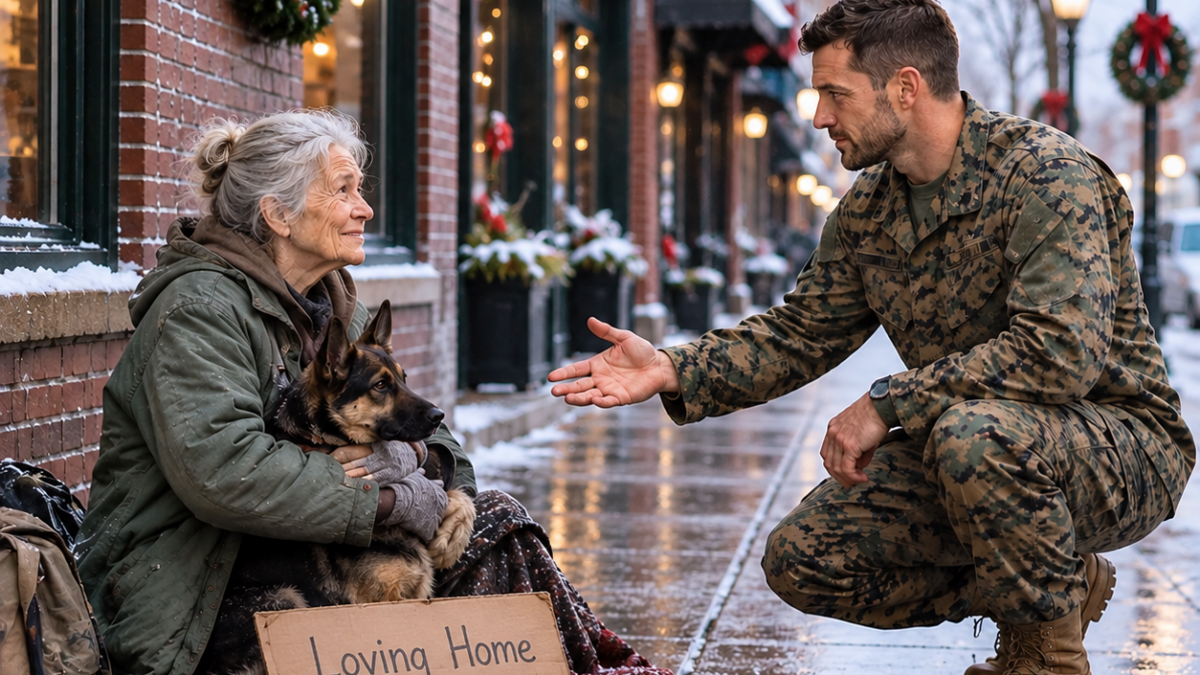
An elderly woman sat in a folding chair beneath the tree.
Small.
Thin.
Silver hair escaping beneath a knitted hat.
Faded green winter coat patched at one elbow.
Her hands were wrapped around a leash.
The other end belonged to the puppy.
At her feet sat a cardboard sign.
Handwritten.
LOVING HOME NEEDED
$8
I read it twice.
Eight dollars.
For a German Shepherd puppy.
Even mixed-breed puppies went for more than that around town.
A purebred-looking Shepherd could cost hundreds.
Maybe more.
Before I could ask anything, laughter came from behind me.
Two young men stood near the coffee shop.
Early twenties.
Nice coats.
Expensive boots.
Paper cups in their hands.
One waved a five-dollar bill.
“I’ll give you five.”
His friend laughed.
“He’s not worth eight.”
The old woman said nothing.
The puppy moved immediately.
He stepped between her chair and the men.
Tiny body.
Still shaking from cold.
But shoulders squared.
The taller young man smirked.
“Look at him.”
I stepped between them.
“That’s enough.”
They turned.
One looked at the name tape on my field jacket.
COLE.
Then the Marine insignia.
His expression changed.
“We’re joking.”
“Then find a better audience.”
The second one muttered something under his breath.
I took one step toward them.
Not aggressive.
Did not need to be.
They left.
The woman looked up at me.
“Thank you.”
“You shouldn’t be sitting out here.”
Her smile surprised me.
Gentle.
Not embarrassed.
“I’ve been told.”
The puppy came back to her.
She placed one hand on his back.
“Ember.”
That was his name.
I crouched several feet away.
“Can I ask you something?”
“You already are.”
That made me smile.
I pointed at the sign.
“Why eight dollars?”
“Because free is easy.”
I waited.
She looked down at Ember.
“When people receive something for nothing, sometimes they forget what it cost someone else.”
Snow gathered along the edge of the cardboard.
“Eight dollars won’t change my life.”
She rubbed Ember behind the ear.
“But if someone is unwilling to give up eight dollars…”
Her pale blue eyes lifted toward mine.
“How will they give him ten years of patience?”
I did not have an answer.
She looked almost amused by that.
The puppy walked toward me.
Slowly.
Sniffed my glove.
Then sat directly beside my boot.
The woman’s smile deepened.
“Interesting.”
“What?”
“He doesn’t do that.”
“Do what?”
“Decide quickly.”
I looked down.
Ember leaned against my shin.
“Maybe he’s cold.”
“Maybe.”
She did not sound convinced.
I looked at her.
“What’s your name?”
“Dorothy Harper.”
“Nathan Cole.”
“I know.”
That caught me.
“You do?”
“I’ve seen your truck.”
“That’s concerning.”
She smiled.
“You fixed Mrs. Lawson’s furnace last February.”
I nodded.
“You cleared the Wilson driveway before sunrise during the March storm.”
“Yes.”
“And you repaired the church generator today.”
I glanced toward St. Matthew’s steeple.
“You keeping a file?”
“I notice kindness.”
The joke left me.
Dorothy folded her hands together for warmth.
“I wasn’t waiting for someone to buy Ember.”
I looked at the sign.
“Then what are you doing?”
She watched the puppy against my boot.
“Waiting to see who he chose.”
Wind moved fresh snow across the square.
I did not like the way Dorothy’s shoulders trembled.
“The storm’s getting worse.”
“I noticed.”
“Where do you live?”
“Whitefish Lake.”
“That’s not close.”
“No.”
“Car?”
“No.”
“Who brought you?”
“A neighbor this morning.”
“Coming back?”
Dorothy looked toward the darkening sky.
“He said he would.”
That meant no.
I stood.
“I’ll take you home.”
“You don’t need to.”
“I know.”
She studied me.
Then folded the cardboard sign and placed it inside a worn canvas bag.
“Very well.”
Ember jumped through the snow like the decision had already been made.
Halfway to the truck, Dorothy said, “It wasn’t me who invited you today, Gunnery Sergeant.”
I looked at her.
“What?”
She nodded toward Ember.
“He did.”
The drive to her cabin took almost half an hour.
Whitefish Lake disappeared beneath gray sky and falling snow.
Dorothy sat in the passenger seat.
Ember insisted on placing his front paws between us from the floorboard.
Every few minutes, he looked at me.
Then Dorothy.
Then forward.
Like he was checking inventory.
The road narrowed.
We turned onto an unplowed lane.
At the end stood a cedar cabin beneath tall pines.
Old.
Weathered.
One corner of the porch sagged.
The moment I stepped inside, I knew something was wrong.
Cold.
Not chilly.
Cold enough that I could see my breath.
A cast-iron stove sat in one corner.
Almost dead.
The furnace was silent.
Frost traced the inside edges of two windows.
Dorothy removed her gloves.
“It’s usually warmer.”
“When did the furnace stop?”
“About three weeks ago.”
I turned.
“Three weeks?”
“Yes.”
“Why didn’t you call someone?”
She started filling a kettle.
“I managed.”
“That was not my question.”
Dorothy opened a cupboard.
Two prescription bottles.
One nearly empty bag of dog food.
She touched the medicine bottles.
“I could afford one thing.”
I looked at the dog food.
Then the prescriptions.
“And you chose medication.”
“I enjoy remaining alive.”
Dry humor.
Good.
I walked toward the furnace.
“And Ember?”
“I ate smaller meals.”
I stopped.
She pretended to be interested in the kettle.
Something tightened in my chest.
“Tea?” she asked.
“I’ll fix the heat.”
“You don’t have to.”
“I’m aware.”
The furnace was old but salvageable.
Cracked igniter.
Worn belt.
Loose electrical connection.
Dust everywhere.
“This thing wants to work.”
Dorothy sat at the kitchen table.
“So do I.”
I looked over my shoulder.
She smiled.
I laughed.
Actually laughed.
Ember became my assistant.
A terrible one.
I asked for nothing.
He brought a screwdriver.
Then another.
Then one of my gloves.
Then a spoon.
Then he proudly carried a wrench twice the length of his head.
“You’re not certified.”
His tail wagged.
“You’re also violating every safety standard I know.”
He brought me the spoon again.
An hour later, the furnace coughed.
Rumbled.
Then warm air started moving through the vents.
Dorothy closed her eyes.
I watched her stand in front of the vent.
Heat touched her face.
For a long moment, she did not move.
“I almost forgot what that feels like.”
I wiped grease from my hands.
“You won’t now.”
She looked at me.
“You repaired more than a furnace today.”
I did not like where that sentence might go.
“Where’s your firewood?”
She laughed softly.
The next morning, I came back before sunrise.
Truck bed full of split logs.
Dorothy had not asked.
She was still asleep when I cleared the steps.
Ember heard me.
The front door opened.
He came running out carrying one of my gloves.
I had apparently left it.
He dropped it at my feet.
Then grabbed a piece of kindling from the pile.
Nearly fell over trying to drag it.
I took it from him.
“Overachiever.”
He barked.
That became the beginning.
At first, I told myself I stopped by because Dorothy needed help.
That was true.
Just not complete.
I checked the furnace.
Fixed porch boards.
Repaired a leak above the kitchen.
Sealed window drafts.
Straightened the fence.
Reinforced the woodshed.
Dorothy objected every time.
“You have work.”
“I’m on leave Saturday.”
“You should rest.”
“This is rest.”
“Your definition is troubling.”
Every morning Ember waited by the gate.
If my truck was two minutes late, he paced.
By the third week, I had started carrying treats.
Dorothy caught me.
“You’re bribing him.”
“Operational incentives.”
“You’ve become soft.”
“Classified.”
One afternoon, I climbed into the attic to inspect roof supports.
I expected insulation.
Dust.
Broken furniture.
Instead, I found boxes.
Dozens.
Wooden.
Carefully stacked.
Each tied with faded blue ribbon.
Labels.
CHRISTMAS.
SCHOOL.
CHURCH.
FAMILIES.
I should have left them.
I know that.
Instead, curiosity won.
I opened one.
Christmas cards.
Hundreds.
Another.
Photographs.
Children beside Christmas trees.
Graduations.
Weddings.
Families.
Another contained letters.
I read the first.
Mrs. Harper, thank you for making sure I never went hungry after Dad died.
Next.
You were the first person who told me I could become a nurse.
Another.
I still remember the winter coat you left outside our door so my mother wouldn’t know who bought it.
Another.
You paid my exam fee when I was going to quit school.
I stopped.
There were decades of these.
People Dorothy helped.
Quietly.
I carried one box downstairs.
She looked at it.
No anger.
Just recognition.
“I wondered when you’d find those.”
“You helped all these people?”
“I made soup.”
“That’s not what these letters say.”
“Letters exaggerate.”
“No.”
She poured coffee.
“I only did what someone once did for me.”
“What?”
Dorothy looked toward the lake.
“When Harold and I were young, we lost almost everything.”
Her husband.
I had seen the photograph near her bed.
“Someone helped?”
“A woman from church.”
“Who?”
“I never learned.”
I frowned.
“She brought groceries for three months. Left money in hymn books. Found Harold work.”
“And you never knew?”
Dorothy smiled.
“That was the point.”
I looked at the boxes.
“So you spent forty years doing the same thing.”
“Maybe.”
“You remember everyone?”
“No.”
“Looks like they remembered you.”
Her expression changed slightly.
I reached for the next bundle.
Then saw the envelope.
Cream-colored.
Alone beneath the letters.
Different.
Unopened.
On the front:
FOR DOROTHY.
I carried it down.
The moment she saw it, all warmth left her face.
“You found that.”
“You never opened it.”
“No.”
“Why?”
She looked toward the window.
Snow tapped against the glass.
For nearly a minute, she said nothing.
Then:
“Some memories survive because we never ask them another question.”
I sat.
“What does that mean?”
She wrapped both hands around her cup.
“I’m afraid that if I open it, I’ll discover someone I loved forgot me long ago.”
“Who sent it?”
“I don’t know.”
“How can you—”
“I recognize the handwriting.”
She stopped.
Ember came over.
Rested his head against her knee.
Dorothy stroked him.
“I’m not ready.”
I pushed the envelope toward her.
“Then don’t.”
She looked relieved.
I returned it to the box.
But the attic changed something in me.
Dorothy Harper had spent decades giving parts of herself away.
Food.
Time.
Money.
Encouragement.
Heat.
School supplies.
Small things.
Everything.
And somehow she reached seventy-nine sitting in the snow trying to find a home for a puppy while her own furnace had been broken three weeks.
That made me angry.
Not at Whitefish.
Not yet.
At the strange arithmetic of kindness.
Some people give so quietly that everyone assumes someone else is taking care of them.
The next Sunday, I started with the names in the attic.
I did not tell Dorothy.
First was Daniel Brooks.
Whitefish Fire Department.
Fifty-two.
Burn scar down his forearm.
He looked at the old photograph I brought.
Then sat down.
“Mrs. Harper.”
“You know her.”
He laughed softly.
“Know her?”
His eyes filled.
“My father died when I was seventeen.”
He looked at the photograph again.
“I worked mornings at the diner before school. Every Monday, breakfast was paid.”
“Dorothy?”
“Took me three years to figure it out.”
“Did you thank her?”
Daniel looked ashamed.
“I meant to.”
I said the only useful thing.
“You still can.”
Next was Emily Carter.
Elementary teacher.
Thirty-four.
When I showed Dorothy’s picture, Emily opened a classroom cabinet.
Inside was a blue wool scarf.
Old.
Repaired.
“She made this.”
“For you?”
“My mother died while I was in college.”
Emily held the scarf against her palms.
“I came home and fell apart.”
“What did Dorothy do?”
“Sat with me.”
“That’s all?”
Emily smiled sadly.
“For hours.”
“She talk?”
“Almost not at all.”
She looked at the scarf.
“Some things aren’t supposed to be replaced.”
Then Samuel Rhodes.
Rancher.
Fifty-nine.
When I said Dorothy’s name, he removed his hat.
“She brought soup.”
I waited.
“Twenty years ago. Blizzard.”
Samuel looked toward the barn.
“My wife was sick. Roads closed. Nobody could get through.”
“Dorothy did.”
“She always did.”
By the time I returned to the cabin, it was dark.
Dorothy had coffee waiting.
“You were gone.”
“So were they.”
I told her.
Daniel.
Emily.
Samuel.
She listened.
No pride.
No satisfaction.
Her first questions were:
“Is Daniel healthy?”
“Does Emily have children?”
“Did Samuel ever repair that south barn?”
I laughed.
“You’re impossible.”
The next Saturday, Daniel knocked.
Two armloads of firewood.
“Woodshed looked light.”
Then Emily.
Bread.
Mittens her students had knitted.
Then Samuel.
Vegetables.
Flour.
Preserves.
The cabin filled.
Dorothy tried to stand.
“I should make supper.”
I pointed at her chair.
“You’re supervising.”
“I don’t supervise.”
“You absolutely do.”
Daniel chopped vegetables.
Emily rolled dough.
Samuel repaired a cabinet hinge because apparently ranchers cannot sit still.
Ember carried objects from one person to another.
Useful or not.
Spatula.
Glove.
Dish towel.
One potato.
Dorothy laughed so hard she had to wipe tears from her eyes.
I stood in the doorway and realized the cabin did not sound empty anymore.
Then came another knock.
The two young men from the square.
I recognized them immediately.
They stood beneath the porch light.
One holding a snow shovel.
The other rock salt.
The taller one looked at Dorothy.
“We came to apologize.”
She waited.
“We were stupid.”
His friend nodded.
“We didn’t know.”
Dorothy said quietly:
“You didn’t need to know my story to be kind.”
Both looked ashamed.
Good.
Then she opened the door wider.
They spent an hour clearing the driveway.
No speech.
No excuses.
That mattered.
Word spread.
Whitefish is small.
Stories travel faster than plows.
People began asking about the sign.
Why eight dollars?
I repeated Dorothy’s answer.
Eight dollars was not a price.
It was proof of willingness.
The grocery store put a wooden box beside the register.
THE $8 PROMISE.
People left eight dollars.
Exactly eight.
The church youth group collected dog food, blankets, firewood, coats.
No donors’ names.
Dorothy hated being credited.
That made people love the idea more.
One evening after everyone left, I found her beside the window.
Snow falling over the lake.
“They remembered.”
She smiled.
“I never wanted to be remembered.”
“What did you want?”
She reached down.
Ember rested against her leg.
“I hoped kindness would keep traveling after I couldn’t.”
I should have heard the goodbye hidden inside that sentence.
I did not want to.
A year passed.
Dorothy turned eighty.
Her cabin became one of the warmest places in Whitefish.
Not temperature.
People.
Coffee.
Children.
Firefighters.
Teachers.
Neighbors.
Ember grew into a strong young German Shepherd.
Amber-black coat.
Intelligent eyes.
Still one of the most observant dogs I had ever known.
He watched Dorothy constantly.
Before I noticed her breathing change, he did.
Before she stood, he rose.
If she forgot her medication basket, he nudged it.
When she slept in the chair, he lay where she could touch him without reaching.
I still stopped by before duty.
Groceries.
Wood.
Furnace checks.
She said I was overprotective.
She was correct.
Dr. Benjamin Cross started visiting.
Cardiologist.
Forty-two.
Quiet.
Thin rectangular glasses.
The kind of doctor who actually sat down.
One evening, he walked me outside.
Snow had started again.
“How bad?”
Benjamin looked toward the cabin.
“The medication is helping.”
“But.”
“It won’t stop progression.”
I knew.
“How long?”
“I don’t know.”
“Estimate.”
He hated the question.
“Months. Maybe longer.”
I looked toward the window.
Dorothy and Ember were visible beside the fire.
Benjamin said softly:
“Every winter day matters now.”
Three weeks later, I arrived before sunrise.
No chimney smoke.
Porch light off.
That was wrong.
Ember did not meet me.
Worse.
I unlocked the door with the spare key Dorothy had forced me to take.
Cold tea on the table.
Coat missing.
“Dorothy?”
Nothing.
Then barking behind the cabin.
Ember burst through snow.
Ran toward me.
Turned.
Ran uphill.
Stopped.
Looked back.
The same thing he had done the day I met him.
“Show me.”
He led me toward the cemetery.
I found Dorothy sitting on a bench beside Harold Harper’s grave.
Snow covered her shoulders.
One hand rested on the stone.
My anger disappeared the moment she smiled.
“I knew Ember would find you.”
“You should not be here alone.”
“I wanted one last conversation.”
“Do not say last.”
She brushed snow from the name.
“Harold hated goodbyes.”
I sat.
“He said if people truly loved each other, they never left without promising they’d meet again.”
I looked at her.
“I’m not afraid anymore.”
“You still have time.”
“I know.”
She watched the frozen lake below us.
“I just don’t want my goodbye to surprise me.”
Getting her home was difficult.
She stopped every few steps.
Leaning heavily on me.
Ember paced beside us.
Benjamin admitted her to the hospital that afternoon.
The room overlooked the lake.
Machines tracked the heart of a woman who had spent eighty years using it more generously than most people ever would.
Late that evening, Dorothy looked at me.
“There’s something in the attic.”
I knew.
“The letter.”
She nodded.
“I think it’s ready.”
I drove back.
Found the cream envelope.
When I returned, Benjamin was in the room.
Dorothy looked at both of us.
“Read.”
I opened it.
Yellowed paper.
Blue ink.
The first sentence stopped me.
Dear Mrs. Harper, if you’re reading this, it means I finally became the doctor you always believed I could be.
Benjamin went completely still.
I looked at him.
He removed his glasses.
“No.”
Dorothy smiled.
I kept reading.
When my mother and I were living in our car, I thought school no longer mattered.
Benjamin turned away.
I continued.
Every morning you found a way to make breakfast appear without making me feel ashamed.
His shoulders began shaking.
You never called it charity.
You called it tomorrow.
The room blurred.
I kept going.
You told me that someone would someday need my hands more than I needed my fear.
I carried those words through every exam, every failure, every victory.
If our paths ever cross again, I hope I can finally thank you.
Silence.
Benjamin whispered:
“I wrote that.”
Dorothy reached one thin hand toward him.
“I know.”
He stared.
“You knew?”
“I recognized the handwriting.”
“How?”
“You used to make your B backward.”
He laughed and cried at the same time.
“I wrote that my last year of medical school.”
“You became a cardiologist.”
“Yes.”
“You always did like difficult things.”
Benjamin sat beside her.
“Why didn’t you open it?”
Dorothy looked at him.
“Because I was afraid.”
“Of me?”
“Of finding out the boy I remembered was gone.”
Benjamin took her hand.
“He wasn’t.”
After that, he stopped being only her doctor.
He visited after hours.
Reviewed every test.
Sat with her.
Talked about his mother.
Medical school.
The first patient he lost.
The first one he saved.
Dorothy listened.
Just as she always had.
Several weeks later, she improved enough to leave the hospital.
Before I helped her into my truck, she gave me a cream envelope.
Inside were eight one-dollar bills.
I looked at her.
“What’s this?”
“If one day Ember has only you…”
My stomach tightened.
“Dorothy.”
“Listen.”
I did.
“Don’t give him away for free.”
“I’m not giving him away.”
“Good.”
She smiled.
“But if you ever must…”
She touched the envelope.
“Give these eight dollars to the first person willing to keep a promise instead of make a purchase.”
“I don’t understand.”
“You will.”
I kept the envelope.
Dorothy lived almost another year.
That year became something none of us wanted to call farewell.
Daniel brought wood.
Emily brought students.
Samuel brought food.
Benjamin brought medicine.
The two young men from the square kept shoveling whenever storms came.
Others joined.
Caleb Mason.
Families Dorothy had once helped.
People she barely remembered.
Children.
The cabin became loud.
Christmas was the loudest.
Handmade ornaments.
A crooked tree.
Stew.
Students singing.
Daniel burned biscuits.
Benjamin laughed at him for ten straight minutes.
Dorothy sat wrapped in a blue blanket.
Ember’s head in her lap.
She looked at the room.
Then at me.
“I thought love left when people did.”
I could not speak.
She continued.
“It only changes hands.”
Dorothy died near the end of winter.
Before dawn.
Fire low.
Snow tapping the windows.
Ember beside the bed.
His head beneath her hand.
When I arrived, Benjamin stood in the doorway.
Eyes red.
The cabin was still warm.
But empty in the way places become empty when the person who defined them is gone.
Dorothy looked peaceful.
Not poetic peaceful.
Real peaceful.
Tired work finished.
The funeral filled the cemetery.
Firefighters.
Teachers.
Ranchers.
Children.
Shopkeepers.
Old people.
Young families.
Everyone carried some piece of her story.
Afterward, people left slowly.
Ember did not.
He lay in front of the grave.
Paws in snow.
Staring at the stone.
Waiting.
I stood holding his leash.
Then I unclipped it.
Sat beside him.
Snow gathered on my shoulders.
“She kept her promise.”
Ember looked at me.
“Now I keep mine.”
He came home with me.
I never tried to replace Dorothy.
Or turn Ember into something he had not chosen.
Training started with trust.
Scent games.
Gloves hidden in snow.
Recall.
Search.
Noise.
Obstacles.
He was extraordinary.
Not because he was fast.
Because he would not quit.
Once Ember had a scent, he stayed with it.
Once he understood someone was missing, he searched with a focus that bordered on stubbornness.
Master Sergeant Daniel Brooks watched him during a regional working-dog evaluation.
Different Daniel than the firefighter.
Marine.
Forty-eight.
Hard man.
Fair.
Ember tracked a hidden subject through falling snow, ignored two false trails, circled a collapsed training structure, and located the person beneath broken boards faster than any dog on the field.
Daniel knelt.
Looked at Ember.
Then me.
“That dog wasn’t only trained.”
“No.”
“He was raised with purpose.”
Ember entered the Marine working-dog evaluation program.
Obedience.
Detection.
Search.
Stress work.
Obstacles.
He passed.
Years later, people inside the unit knew his name.
He detected an explosive before a convoy entered a mountain road.
Found two children after a blizzard buried a rural cabin.
Located injured survivors after a mudslide when aircraft could not fly.
People called him heroic.
Maybe.
I knew where it started.
A freezing cabin.
An old woman.
A puppy sleeping beside her chair.
Love meant staying.
That was the first lesson.
The final piece of Dorothy’s story came when Benjamin and I cleaned her woodshed.
Behind old boards were rows of collars.
Hundreds.
Leather.
Nylon.
Rope.
Tiny puppy collars.
Large working-dog collars.
Each with a paper tag.
Name.
Date.
Two words.
FOUND HOME.
I stood there unable to speak.
Benjamin wiped his eyes.
“You didn’t know?”
“No.”
He found an old ledger.
Dorothy had been rescuing dogs for decades.
Abandoned.
Injured.
Unwanted.
She fed them.
Paid vet bills when she could.
Found families.
Never called herself a rescuer.
Never asked donations.
Ember had been the last.
The $8 sign suddenly meant something even larger.
It was not an idea she invented for him.
It was the final version of a promise she had spent a lifetime keeping.
I did not sell the cabin.
Everyone assumed I would.
Instead, Benjamin and I formed a small nonprofit with help from the town.
Dorothy’s cabin became a support house.
Part animal rescue.
Part assistance program for struggling families who loved their pets but could not afford temporary food, medicine, or emergency boarding.
We did not want people surrendering animals only because one terrible month made them poor.
Above the living-room doorway, I framed the original sign.
LOVING HOME NEEDED
$8
Visitors always asked.
“Why eight?”
I gave Dorothy’s answer.
“Eight dollars was never the cost of a dog.”
Then I would look toward the wall of collars.
“It was the price of keeping a promise.”
The grocery-store box remained.
So did the $8 Promise.
Years passed.
Children who once donated coins grew older.
Some volunteered.
Daniel retired from the fire department.
Emily became a principal.
Samuel complained about his knees but still brought vegetables.
Benjamin kept visiting even after there was no medical reason.
Ember aged.
Gray around his muzzle.
Still brilliant.
Still stubborn.
I kept Dorothy’s eight dollars inside my desk.
Never spent.
People asked why.
Because it was not money anymore.
It was instruction.
When Ember finally retired from military service, he came home to Whitefish.
No ceremony mattered as much as the moment he walked into Dorothy’s old cabin and stopped beneath the framed sign.
He looked around.
Then lay beside the fireplace.
Same place he had slept as a puppy.
I sat on the floor next to him.
“You remember?”
His tail moved.
Maybe he did.
Maybe dogs remember places as smell, warmth, and safety.
That is enough.
Ember died years later with his head in my lap.
Old.
Tired.
Loved.
I kept one hand between his ears.
The same amber fur Dorothy used to stroke.
His breathing slowed.
Then stopped.
I cried harder than I expected.
Marines are not especially impressive against grief.
Afterward, I buried him near Dorothy and Harold.
Not military cemetery.
Not a monument.
Whitefish.
Home.
I placed his old collar beneath the stone.
Then took Dorothy’s envelope from my pocket.
Eight dollars.
Still there.
I almost buried them with him.
Then remembered.
Give these eight dollars to the first person willing to keep a promise instead of making a purchase.
I finally understood.
The money was never supposed to end with Ember.
A month later, a young woman came to Dorothy’s cabin.
Twenty-six.
Two children.
Old Labrador.
She had lost her job.
Her rent was late.
Dog needed medication.
She stood at the doorway crying.
“I don’t want to surrender him.”
“You don’t have to.”
“I can’t pay.”
I opened the drawer.
Took out the envelope.
Eight one-dollar bills.
I placed them in her hand.
She stared.
“What is this?”
“A promise.”
She looked confused.
“Keep your dog.”
“I can’t take your money.”
“It isn’t mine.”
“Whose?”
I looked at Dorothy’s photograph.
Then Ember’s collar.
“A widow who believed free was easy.”
The woman cried.
We paid the veterinary bill from the fund.
Found her temporary work through one of our volunteers.
Her dog stayed home.
Months later, she returned.
She put eight dollars into the wooden donation box.
Exactly.
Then another eight.
“This is for someone else.”
That was the moment I understood Dorothy’s hidden legacy completely.
It was not the letters.
Not the collars.
Not the people she helped.
Not even Ember.
Her legacy was motion.
Kindness kept moving.
One person to another.
No ownership.
No recognition required.
She never wanted to be remembered.
She wanted the help to continue.
And it did.
Sometimes people ask whether the story of the $8 puppy is true in the way stories are supposed to be true.
They want one moment.
One twist.
One ending.
Life rarely gives you that.
The ending was not when I found the attic.
Not when Benjamin heard his old letter.
Not when Dorothy died.
Not when Ember became a working dog.
Not when we discovered hundreds of collars.
Those were only links.
The real ending is still happening.
Every time somebody puts eight dollars into the box.
Every time a struggling family keeps a dog they love.
Every time a volunteer brings firewood without being asked.
Every time a child learns that something can be inexpensive without being worthless.
Every time someone stops.
That is Dorothy.
I thought I stopped my truck because a puppy ran into the road.
I was wrong.
Ember stopped me.
Then led me toward a woman sitting in the snow with a cardboard sign.
She looked poor.
Alone.
Forgettable.
I thought she needed help.
That was also only partly true.
Dorothy Harper had spent forty years helping a town become better without the town realizing where the goodness came from.
By the time we noticed her, she had almost run out of heat.
But not love.
Never that.
And the strangest part?
Eight dollars really did change everything.
Not because of what it could buy.
Because of what it asked.
Are you willing to give something up?
Are you willing to stay when care becomes inconvenient?
Are you willing to keep a promise after the easy part is over?
Dorothy asked those questions with a cardboard sign.
Ember answered them with his whole life.
I am still trying.
Every winter, when snow begins covering Whitefish Lake, smoke rises from Dorothy’s chimney again.
The cabin is no longer silent.
There are dogs inside.
Children.
Volunteers.
Coffee.
Boots by the door.
Sometimes laughter.
Sometimes tears.
Above it all hangs the old sign.
LOVING HOME NEEDED
$8
People still pause when they see it.
Some smile.
Some ask what it means.
And I always tell them the same thing.
“Eight dollars was never the price of the puppy.”
Then I open the door.
“It was the cost of proving you meant to stay.”








