A U.S. Marine Shared His Breakfast With a Grieving 76-Year-Old Woman—Days Later, Her Late Son’s Journal Revealed the Truth Behind the Scandal That Had Cost Him His Career
PART3:
Cole chose a booth near the fireplace.
Shadow followed.
Then stopped.
Cole took two more steps before noticing.
He looked back.
Shadow’s ears were raised.
Not toward the kitchen.
Across the dining room.
Near the windows sat an elderly woman alone at a four-person table.
Cole guessed mid-seventies.
Maybe older.
Silver hair framed a face that still carried a quiet elegance.
Her gray wool coat looked expensive.
Not flashy.
Well made.
The kind bought years earlier and cared for properly.
A menu rested open in front of her.
Untouched.
No coffee.
No food.
Her hands lay around a pair of gloves.
They were trembling.
A young employee approached.
He could not have been more than twenty-five.
Cole could not hear the first sentence.
Then the employee leaned closer.
“I’m sorry, ma’am. We’re getting busy. If you’re not ordering, we need the table.”
The woman looked around.
Several booths were filling.
There were still empty seats elsewhere.
But she did not argue.
“I understand.”
Her voice carried no anger.
Only embarrassment.
She gathered the gloves.
Shadow moved.
Cole said quietly:
“Shadow.”
The dog ignored him.
That almost never happened.
Shadow crossed the dining room.
People noticed.
A German Shepherd that size attracted attention.
The elderly woman noticed last.
She looked down as Shadow reached her.
He stopped beside the chair.
Studied her.
Then gently placed his head on her knee.
The woman froze.
Her fingers hovered above the dog’s fur.
For several seconds she seemed afraid to touch him.
Then her hand lowered.
Slowly.
She stroked between his ears.
Something in her face broke.
Not dramatically.
Her eyes simply closed.
Cole knew that look.
He had seen it in hospitals.
Funerals.
Barracks.
Airport terminals.
The instant someone who had been holding themselves together discovered they no longer had to.
Cole stood.
The employee looked nervous.
“I’m sorry, sir. Is that your dog?”
“Yeah.”
“I didn’t mean—”
“You’re fine.”
Cole walked over.
He stopped a respectful distance away.
“My partner doesn’t usually introduce himself first.”
The woman opened her eyes.
Cole nodded toward Shadow.
“I figured I should follow his example.”
The smallest smile appeared.
“He has better manners than most people.”
“Definitely better than me.”
She laughed once.
Very softly.
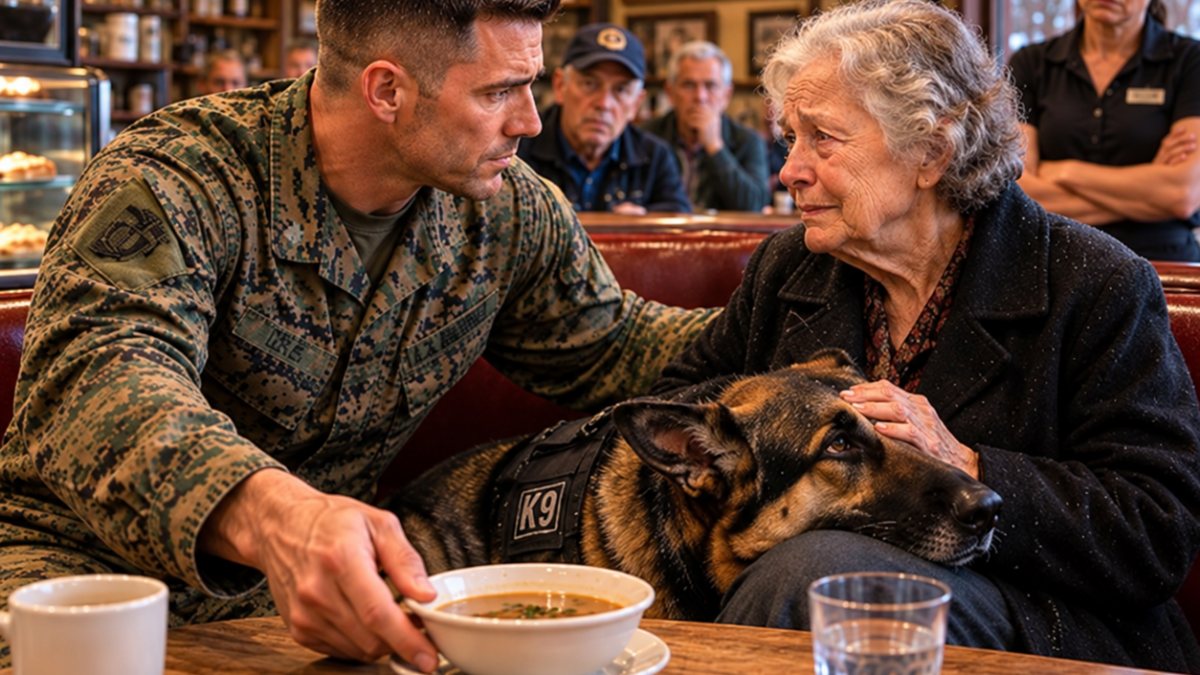
Cole pulled out the empty chair.
“If you’d like, you can join us.”
Her expression changed.
“You don’t know me.”
“No.”
She waited.
Cole added:
“But breakfast is easier with company.”
The woman looked toward the employee.
The young man seemed mortified now.
She looked at Cole again.
“I don’t want to impose.”
“You’d be helping me.”
“How?”
“Shadow judges me when I eat alone.”
That earned another small laugh.
The employee stepped forward.
“You can stay, ma’am. I’m sorry. I didn’t mean to rush you.”
The woman nodded.
“I know.”
No cruelty.
No scene.
That told Cole almost as much about her as her trembling hands did.
She moved to his booth.
“My name is Margaret.”
“Cole.”
He pointed beneath the table.
“You already met the important one.”
“Shadow?”
“Yes.”
The waitress returned carrying Cole’s breakfast.
Eggs.
Potatoes.
Toast.
Two strips of bacon.
Cole looked at the plate.
Then at Margaret.
“Could I get an extra plate?”
Margaret immediately shook her head.
“No.”
Cole ignored her.
The waitress brought one.
He divided everything evenly.
Margaret watched.
“You should keep more.”
“Why?”
“You ordered it.”
Cole pushed half the toast toward her.
“I’ve worked on old furnaces for years.”
She looked confused.
“What does that have to do with breakfast?”
“They run better when they’re warm.”
Margaret stared at him.
Then she understood.
He was giving her food without saying she needed food.
He was sharing instead of offering charity.
Her dignity remained intact.
That mattered.
They ate quietly.
Shadow lay between them.
Margaret gave him half a piece of bacon when she thought Cole was not looking.
“I saw that.”
She looked innocent.
“I don’t know what you mean.”
Shadow immediately moved closer to her.
“Traitor.”
Margaret smiled.
For the first time, it lasted.
Eventually she said:
“My son loved places like this.”
Cole looked up.
She stared into her coffee.
“Whenever we traveled, he refused to stop at expensive restaurants.”
“Smart man.”
“He said expensive food makes people behave.”
Cole smiled.
“What did diners do?”
“Let people tell the truth.”
Cole liked that.
Margaret’s fingers tightened around the cup.
“He died four months ago.”
Cole lowered his fork.
“I’m sorry.”
She nodded.
People often rushed to fill grief.
Cole had learned not to.
After his wife Catherine died of cancer seven years earlier, strangers offered him phrases as if language could repair absence.
She’s in a better place.
Everything happens for a reason.
Time heals.
Cole had hated all of them.
So he said nothing more.
Margaret looked at him.
“You didn’t tell me he’s at peace.”
“No.”
“Or that everything happens for a reason.”
“No.”
“Why?”
Cole looked toward the falling snow.
“Because I don’t know that.”
Margaret studied him.
“My wife died seven years ago.”
Her expression softened.
“Were you married long?”
“Eleven years.”
“I’m sorry.”
“Thank you.”
He took a sip of coffee.
“People kept trying to tell me what grief was supposed to become.”
Margaret nodded.
“It doesn’t become anything.”
Cole looked at her.
She continued.
“It just learns the shape of your life.”
For a long moment neither spoke.
Then Margaret said:
“I’ve been driving.”
“Where?”
“Anywhere.”
She looked embarrassed.
“I leave my house in the morning and drive until I get tired.”
“Why?”
She stared through the window.
“Every room knows he’s gone.”
Cole understood.
Silence could become a person.
A coat still hanging.
A chair no one used.
A coffee mug no one moved because moving it felt like agreeing the owner was not coming back.
Margaret rubbed Shadow’s ear.
“I haven’t smiled much since Andrew died.”
Shadow placed one paw against her boot.
Margaret stared at it.
A tear appeared.
She wiped it away.
“I think he knows.”
Cole looked at Shadow.
“He usually does.”
Neither of them noticed the framed photograph hanging near the fireplace.
It had been taken almost three years earlier at a local business luncheon.
Seven men stood together.
Near the center was Andrew Ellison.
Beside him stood Cole Donovan.
Three people away stood Richard Hail.
If Cole had looked at that photograph, the morning might have changed immediately.
He did not.
And maybe that was fortunate.
Because Margaret got to know him before she knew his name mattered.
They finished breakfast.
Margaret stood.
Too quickly.
The room shifted beneath her.
She reached toward the table.
Missed.
Cole caught her elbow.
Shadow moved against her legs.
“I’m fine.”
Cole almost smiled.
“I believe you want to be.”
Margaret looked annoyed.
That was encouraging.
Ten minutes later, Cole drove her to a community clinic less than a mile away.
Dr. Emily Harper examined her.
Dehydration.
Low blood pressure.
Not enough food.
Not enough sleep.
No stroke.
No immediate cardiac issue.
Margaret looked ashamed.
“I’ve been forgetting meals.”
Dr. Harper asked:
“For how long?”
Margaret looked away.
“Long enough.”
Nobody pushed.
Cole waited.
Shadow stretched across the exam room doorway.
When Margaret was discharged, she put on her coat.
Cole called:
“Shadow.”
The dog did not move.
“Partner.”
One ear twitched.
Nothing else.
Margaret looked down.
Then slowly reached toward him.
Her hand rested against his neck.
Shadow closed his eyes.
Margaret’s lips trembled.
“I think he knows I don’t want to go home.”
Cole felt the words in his chest.
He did not ask why.
He knew.
Instead he said:
“You don’t have to stay there all day.”
Margaret looked at him.
“What?”
“Home.”
“You can go somewhere.”
“Where?”
Cole shrugged.
“Coffee shop.”
“Library.”
“Drive.”
She gave him a look.
“I’ve been doing that.”
“Right.”
He thought.
“Then go somewhere that still feels like yours.”
Margaret became quiet.
Cole did not know what he had just unlocked.
Three days later, his phone rang.
He was kneeling beside an old furnace at a ranch near Alberton.
Unknown number.
Then he saw the caller ID.
Margaret Ellison.
She had given him her full name at the clinic paperwork desk.
Cole had not recognized it.
“Hello?”
“Cole?”
“Yes.”
“This is Margaret.”
“I know.”
“Oh.”
A pause.
“You saved my number?”
“I told you to call if you needed something.”
Another pause.
“There is a place.”
Cole stopped working.
“What place?”
“A farm outside Missoula.”
She corrected herself.
“It isn’t really a farm anymore.”
“What’s wrong with it?”
“Probably everything.”
Cole smiled.
“You’re selling this well.”
Margaret laughed.
Then became quiet.
“My husband built it.”
Cole waited.
“His name was Thomas.”
“He died four years ago.”
“I’m sorry.”
“My son handled the property after that.”
Cole’s hand stopped.
Her son.
Andrew.
He still did not make the connection.
“After Andrew died…”
Margaret struggled.
“I haven’t been able to go inside.”
Cole leaned back against the furnace.
“What do you want me to do?”
“I don’t know.”
That answer mattered.
She was not calling for a contractor.
She was calling because she did not want to walk into the house alone.
Cole looked at Shadow sleeping beside the tool bag.
“What time?”
Cedar Hill sat beyond a narrow county road west of Missoula.
The property had been beautiful once.
It still was if you knew how to look beneath neglect.
Cedar-log farmhouse.
Wide porch.
Barn.
Apple trees.
Windmill.
Pastures.
Sections of fence had fallen.
Snow weighted the roof.
Margaret stood beside her sedan staring at the house.
“My husband built that porch.”
Cole said nothing.
“Andrew learned to ride a bicycle there.”
Still nothing.
“He broke his arm falling off it when he was eight.”
Cole smiled.
“Did that stop him?”
“For three days.”
Shadow walked toward the porch.
Sat at the door.
Waited.
Margaret looked at him.
“I’m beginning to think he’s controlling this relationship.”
“He usually does.”
Margaret climbed the steps.
Her hand shook around the key.
The door opened.
Cold air drifted out.
Dust.
Cedar.
Old furniture beneath white sheets.
A fireplace.
Family photographs.
The house did not feel abandoned.
It felt paused.
Margaret stood just inside.
Cole remained behind her.
“Take your time.”
She nodded.
Shadow moved carefully from room to room.
Cole checked the furnace.
Dirty.
Old.
Repairable.
The pump needed work.
Some pipes required attention.
Roof leak.
Porch rot.
None of it impossible.
That became the next several weeks.
Cole came when his schedule allowed.
Fixed the furnace.
Replaced pipe.
Reinforced fencing.
Patched roof sections.
Repaired the pump.
Margaret began coming every day.
At first she sat while Cole worked.
Then she cleaned one drawer.
One cabinet.
One shelf.
Grief left rooms slowly.
Shadow chased birds.
Then returned to Margaret.
On the fifth evening, Cole entered the kitchen.
Soup simmered.
Bread warmed in the oven.
Margaret wore an old blue apron.
Three places were set.
Cole looked at the table.
“One too many.”
Margaret looked down.
Shadow was already seated beside the third chair.
“No.”
She smiled.
“I think it’s correct.”
That night a light burned in Cedar Hill’s kitchen for the first time in years.
Days later Shadow became obsessed with the barn.
He scratched at the door.
Cole opened it.
Dust.
Tools.
Tack.
Crates.
Old family things.
Margaret entered slowly.
“My husband used to say barns remember people.”
Shadow wandered toward a cedar chest hidden under canvas.
He stopped.
Sat.
Margaret frowned.
“I remember that.”
Cole pulled away the cloth.
Margaret knelt.
“Andrew packed it after Thomas died.”
The chest contained photographs.
Christmas ornaments.
School drawings.
A baseball glove.
And leather journals tied with a faded blue ribbon.
Margaret touched them.
“Andrews.”
They carried the journals inside.
Rain began before evening.
Margaret sat near the fireplace.
Cole repaired an old lantern at the table.
She read.
Ordinary entries.
Employee birthdays.
Warehouse problems.
Weather.
Business meetings.
Notes about people.
Andrew had apparently noticed everything.
Margaret smiled.
Cried.
Laughed once.
Then stopped.
Completely.
Cole looked up.
“What?”
She read the same page again.
Then closed her eyes.
“What is it?”
Margaret held out the journal.
Cole wiped his hands.
Took it.
The entry was dated three years earlier.
Cole read.
The meeting ended badly today. Everyone was angry except Cole Donovan. He refused to approve the North Valley refrigeration system because final testing had not been completed. People called him stubborn after he walked out. I watched him leave through the conference-room glass. Strange thing—the only man being blamed may be the only man who can sleep tonight.
Cole stared.
Margaret watched him.
He read it again.
“You knew my son.”
Cole’s jaw tightened.
“Yes.”
“You never said.”
“I didn’t know Andrew Ellison was your son.”
Her face changed.
“Ellison.”
“You knew my last name.”
“I…”
Margaret looked down.
“I don’t know why I didn’t make the connection.”
“Neither did I.”
Cole closed the journal.
The rain tapped against the windows.
Margaret studied him.
“What happened?”
Cole did not answer immediately.
He carried the journal onto the porch.
Margaret followed.
They sat.
Shadow between them.
Cole looked across wet pasture.
“When I left the Marines, I went back to school.”
Margaret nodded.
“Industrial HVAC engineering.”
“Yes.”
“Andrew hired me.”
A small smile appeared.
“He liked veterans.”
“He liked people who answered questions directly.”
“That too.”
Cole rested his forearms on his knees.
“I worked for Ellison Technical Systems for almost six years.”
“You were good?”
Cole looked at her.
“I was careful.”
Margaret smiled faintly.
“That means yes.”
Cole continued.
“The North Valley project was a medical distribution center.”
Margaret listened.
“Temperature-sensitive medication.”
“Vaccines.”
“Biological materials.”
“We designed redundant refrigeration and backup control systems.”
“I was lead commissioning engineer for final testing.”
Margaret’s face tightened.
“Three days before opening, I discovered several specified components had been substituted.”
“With cheaper ones?”
“Yes.”
“Unsafe?”
“I didn’t know.”
Margaret frowned.
“That was the problem.”
Cole nodded.
“They might have worked perfectly.”
“But they had not passed the required test cycle under load.”
“How long did you need?”
“Seventy-two hours.”
Margaret stared.
“Three days.”
“Three days.”
“And they refused?”
“The opening ceremony was scheduled.”
“Contracts were tied to the date.”
“Investors were coming.”
“Media.”
“Deliveries.”
Cole’s voice remained calm.
“The project manager wanted my signature.”
“Richard.”
Cole looked at her.
“Richard Hail.”
Margaret leaned back.
She knew the name.
Richard had worked with Andrew for nearly twenty-five years.
Trusted employee.
Senior project manager.
Almost family.
“What did you tell him?”
“That I couldn’t sign.”
“What did he say?”
“That I was overreacting.”
Cole looked toward the mountains.
“He said the substitutes were equivalent.”
“Were they?”
“Probably.”
Margaret frowned.
“Probably isn’t the same as proven.”
“No.”
Cole looked at her.
“That’s exactly what I said.”
“What happened?”
“They opened anyway.”
“You refused to sign?”
“Yes.”
“Did the system fail?”
“No.”
Margaret seemed confused.
“Then why did you lose your career?”
Cole’s mouth tightened.
“Because when nothing failed, I looked like the problem.”
The answer hung there.
“The facility performed.”
“The substitute components passed later testing.”
“Everyone celebrated.”
“The project manager documented that I had created unnecessary delays, refused reasonable direction, and damaged client relationships.”
“You were fired?”
“I was encouraged to resign.”
“That sounds like fired.”
“It was.”
Margaret looked down at Andrew’s handwriting.
“But my son…”
“He was already sick.”
“What?”
“Andrew had stepped away from daily operations for treatment.”
Margaret stared.
“He never told me he had stepped away that early.”
“He didn’t want people worrying.”
“That sounds like him.”
Cole rubbed his hands together against the cold.
“He returned briefly afterward.”
“He called me once.”
Margaret looked up quickly.
“What did he say?”
“He asked if I would come back.”
Her eyes widened.
“You refused?”
Cole nodded.
“Why?”
“I didn’t trust the company anymore.”
“But Andrew believed you.”
“I knew.”
“Then why?”
Cole looked at her.
“Because by then the story was already everywhere.”
“What story?”
“That I panicked.”
“That I could not adjust to civilian leadership.”
“That Marine habits made me inflexible.”
Margaret’s expression changed.
Cole continued.
“People stopped returning calls.”
“Two companies withdrew offers after references.”
“One interviewer told me privately that Ellison Systems had marked me as a liability.”
Margaret’s face went pale.
“They damaged your reputation.”
Cole shrugged.
“I found other work.”
“That isn’t what I asked.”
“No.”
“You served twelve years.”
“Yes.”
“Went back to school.”
“Yes.”
“Worked six years for Andrew.”
“Yes.”
“And because you refused one signature…”
“I became difficult.”
Margaret looked furious.
Cole noticed.
“Don’t.”
“Don’t what?”
“Turn anger into something Andrew would have hated.”
“You’re defending them?”
“No.”
“Then what?”
Cole looked at the journal.
“I survived.”
Margaret almost laughed in disbelief.
“That is a low standard.”
“Sometimes.”
“But I sleep.”
That stopped her.
Cole continued.
“I install furnaces now.”
“Repair boilers.”
“Help ranchers whose heat dies at two in the morning.”
“I go home.”
“Shadow gets half my dinner.”
“Life is smaller.”
He looked toward the valley.
“But it’s mine.”
Margaret watched him for a long time.
Then looked at Andrew’s journal.
“My son knew.”
“Yes.”
“And said nothing publicly.”
Cole did not answer.
Margaret closed the book.
That hurt more than anger would have.
Three nights later, Margaret had read every journal.
Andrew had written about Cole repeatedly.
Not obsessively.
Respectfully.
A Christmas Eve when Cole worked all night so warehouse crews could finish early.
An apprentice he protected from being fired after a mistake.
A widow whose furnace Cole repaired personally without billing the company.
The North Valley meeting.
Andrew had written:
If integrity is only rewarded when it is convenient, it is not integrity. Cole may lose more than he knows for refusing this signature. I need to fix this when I’m strong enough.
Margaret cried when she read that.
Andrew never became strong enough.
Cancer accelerated.
Meetings disappeared.
Treatment consumed him.
The promise remained in a journal.
And Cole carried the consequences.
Margaret made a decision.
Not revenge.
Not lawsuit first.
Not humiliation.
Truth.
She wrote invitations.
By hand.
Former employees.
Engineers.
Maintenance workers.
Warehouse supervisors.
Receptionists.
Drivers.
People Andrew respected.
Then one name.
Richard Hail.
Her pen stopped above the envelope.
She stared.
Then wrote the address.
The gathering happened on a Sunday.
No reporters.
No lawyers.
No corporate banners.
Just food beneath the maple tree at Cedar Hill.
Cole almost refused to attend.
Margaret called him.
“Come as my friend.”
“I don’t want this to become a trial.”
“It won’t.”
“Margaret.”
“Cole.”
He sighed.
“Fine.”
He came.
Shadow too.
At first only six people arrived.
Then twelve.
Then twenty.
Stories emerged.
Harold Jenkins, retired maintenance supervisor, pointed at Cole.
“You remember Christmas Eve in Billings?”
Cole shook his head.
“I remember too many Christmas Eves.”
Harold laughed.
“Warehouse refrigeration went down.”
“Company said close.”
“You stayed.”
Cole shrugged.
“Equipment needed fixing.”
“No.”
Harold leaned forward.
“You said half the crew had children waiting.”
“You fixed it by sunrise.”
Another man nodded.
“I was there.”
A former clerk spoke.
“When my husband lost his job, groceries appeared on our porch.”
She looked at Cole.
“Andrew told me years later it was you.”
Cole frowned.
“He wasn’t supposed to.”
Margaret smiled.
An electrician laughed.
“You remember Kyle Morrison?”
Cole covered his face.
“Oh no.”
“Apprentice flooded the mechanical room.”
“He opened the wrong drain.”
“Management wanted him gone.”
The electrician looked around.
“Cole stayed four hours cleaning it with him.”
“He told the kid, ‘Mistakes should become teachers, not permanent labels.’”
People nodded.
Memory after memory.
Not achievements.
Character.
Margaret sat quietly.
Cole became increasingly uncomfortable.
He eventually escaped by repairing a loose chair.
Then a pickup approached.
Silver.
Old.
The conversation stopped.
Richard Hail stepped out.
Sixty-eight now.
Gray hair.
Weathered face.
Shoulders smaller than Cole remembered.
He carried a cardboard box.
Shadow stood.
Richard froze.
The dog approached.
Sniffed his hand.
Then leaned against his leg once before walking away.
Richard exhaled.
“I suppose that’s more grace than I deserve.”
Margaret walked toward him.
“Thank you for coming.”
“I almost didn’t.”
“I know.”
Richard placed the box on the table.
“I found this cleaning my garage.”
Inside:
Field notes.
Inspection photographs.
Project notebooks.
Original copies of Cole’s commissioning records.
And one sealed envelope addressed to Andrew.
Margaret looked at him.
“What is this?”
Richard stared at Cole.
“I kept your notes.”
Cole’s expression did not change.
“I wondered.”
“I should have returned them.”
“Yes.”
Richard swallowed.
The entire yard became quiet.
“I asked you to sign because I was afraid.”
Cole said nothing.
“The investors were furious.”
“The client was threatening penalties.”
“Andrew was sick.”
“I thought if we delayed, everything would collapse.”
Richard’s voice weakened.
“I convinced myself the components would pass.”
“They did.”
“Yes.”
Richard looked ashamed.
“And that made it easier to pretend you were wrong.”
Cole’s jaw tightened.
Richard continued.
“You weren’t wrong.”
Nobody moved.
“The equipment passing later tests did not make your refusal wrong.”
He looked toward Margaret.
“Cole followed the written commissioning procedure.”
“He requested seventy-two additional hours.”
“I denied it.”
“He refused to certify the system.”
“And when the facility operated successfully…”
Richard’s eyes lowered.
“…I let everyone believe he had overreacted.”
Cole stared at him.
“Why?”
Richard laughed bitterly.
“Because admitting you were right meant admitting I had opened a medical facility without completed commissioning.”
“And your career?”
“Thirty-five years.”
Richard looked older suddenly.
“I chose the career.”
The silence was brutal.
Cole asked:
“Did Andrew know?”
Richard nodded.
“Later.”
“How much later?”
“After the opening.”
“Why didn’t he correct it?”
“He tried.”
Cole frowned.
Richard pointed toward the envelope.
“He became too sick.”
Margaret picked it up.
“Is this yours?”
Richard nodded.
“I wrote him after he entered treatment.”
“What does it say?”
“Everything I should have said then.”
“Why didn’t you send it?”
Richard looked down.
“Cowardice.”
No excuse.
Just the word.
Margaret stared at him.
Cole surprised everyone.
He extended his hand.
Richard looked at it.
“What are you doing?”
Cole answered:
“Ending the part we can end.”
Richard’s eyes filled.
“I cost you your career.”
“You did.”
“I damaged your name.”
“Yes.”
“I don’t deserve forgiveness.”
Cole’s hand remained extended.
“I didn’t say forgiveness erases consequences.”
Richard stared.
“Then what is this?”
Cole thought.
“A choice.”
“About what?”
“What I carry tomorrow.”
Richard slowly took his hand.
The handshake lasted seconds.
Margaret watched.
That evening Shadow discovered the sealed envelope after it slipped beneath the old rocking chair.
Margaret read it the next morning.
Richard’s letter contained no secret legal bombshell.
No hidden plot.
Just confession.
He admitted he had pressured Cole.
Admitted the required testing was incomplete.
Admitted Cole’s refusal had been technically correct.
Admitted internal documentation later framed Cole as insubordinate because Richard feared professional consequences.
And one sentence mattered most:
If Cole Donovan’s reputation suffers because of my decision, then I have allowed a man’s integrity to pay for my fear.
Margaret sat on the porch for an hour.
Then she called an attorney.
Not to destroy Richard.
To correct the record.
Ellison Technical Systems still existed.
Andrew’s shares had passed into a family trust Margaret controlled.
The board had changed.
But corporate records remained.
The attorney reviewed everything.
Cole’s original inspection notes.
Richard’s statement.
Andrew’s journals.
Emails.
Project procedures.
The evidence was straightforward.
Cole had not violated protocol.
He had followed it.
Three weeks later, the company issued a formal correction.
Not a quiet memo.
Margaret refused that.
She requested a written professional statement acknowledging that Staff Sergeant Cole Donovan’s refusal to certify the North Valley system before final testing was consistent with approved commissioning requirements and safety procedures.
The company withdrew the adverse internal findings.
Corrected his employment record.
Sent revised references to the firms that had previously received negative information.
Then the board asked Cole to attend a meeting.
He refused.
Margaret drove to his workshop.
“You’re going.”
“No.”
“Cole.”
“No.”
“Why?”
“Because I don’t need a ceremony.”
“It isn’t for you.”
He frowned.
“Then who?”
“Everyone who watched a man get punished for doing the right thing.”
Cole looked irritated.
“That sounds dramatic.”
“Good.”
She picked up Shadow’s leash.
“We’re leaving.”
Shadow immediately went with her.
Cole stared.
“You’re stealing my dog?”
“Apparently.”
Cole had no choice.
The meeting took place in the same conference room where the North Valley argument began.
Cole stopped outside the door.
Memory came back instantly.
Richard standing at the far end.
Investors.
Plans.
Arguments.
Pressure.
Sign.
Just sign.
Cole almost turned around.
Shadow pressed against his leg.
Margaret touched his arm.
“Ready?”
“No.”
She smiled.
“Good.”
Inside sat current board members.
Former staff.
Harold.
Several engineers.
Richard.
A representative from the client facility.
No media.
Margaret had honored that request.
The board chair stood.
“Mr. Donovan.”
Cole corrected automatically.
“Cole.”
The man nodded.
“Cole.”
He opened a folder.
“Three years ago, this company documented your conduct during the North Valley project as obstructive and unprofessional.”
Cole remained still.
“After reviewing the full record, including original inspection documents that were not retained in the final project file…”
Richard lowered his eyes.
“…we have determined that characterization was incorrect.”
Silence.
“You acted within the responsibilities of your position.”
“You requested testing required under the approved commissioning plan.”
“You refused certification because those requirements had not yet been satisfied.”
The chairman looked directly at him.
“Whatever later results showed, your decision at that moment was professionally justified.”
Cole said nothing.
The man continued.
“The company formally withdraws all adverse findings.”
“We have corrected your personnel record.”
“And on behalf of Ellison Technical Systems…”
He paused.
“…we apologize.”
Cole had imagined this moment before.
Years ago.
Angrily.
He had imagined satisfaction.
Victory.
People embarrassed.
He felt none of that.
Only a strange lightness.
Margaret watched him.
Richard stood.
“I would like to add something.”
Cole looked at him.
Richard faced the room.
“Cole didn’t lose his career because he lacked judgment.”
His voice shook.
“He lost it because I lacked courage.”
Nobody moved.
“I believed the project would succeed.”
“It did.”
“But success afterward does not justify a dishonest decision beforehand.”
Richard looked at Cole.
“I knew what the procedure required.”
“I asked him to ignore it.”
“He refused.”
“And I protected myself by making his integrity look like insubordination.”
Cole’s jaw tightened.
Richard continued.
“I cannot give him back three years.”
“I cannot undo the interviews he lost.”
“The relationships.”
“The work.”
“But I can say publicly what I refused to say then.”
He swallowed.
“Cole Donovan was right to refuse.”
The room remained silent.
Then Harold began clapping.
Cole looked at him with irritation.
Harold kept going.
Another person joined.
Then another.
Cole shook his head.
Margaret smiled.
Shadow leaned against his leg.
Cole looked down.
“Don’t encourage them.”
Shadow did not care.
Afterward the company offered Cole a senior engineering position.
He declined.
The chairman looked surprised.
“May I ask why?”
Cole looked through the conference-room window.
Snow falling beyond the parking lot.
“I like fixing furnaces.”
The man laughed.
“I’m serious.”
“So am I.”
Margaret waited until they were outside.
“You could have gone back.”
“I know.”
“You loved engineering.”
“I still do.”
“Then why say no?”
Cole opened the truck door for Shadow.
“Because restoration isn’t the same as reversal.”
Margaret considered that.
Cole continued.
“I wanted my name back.”
“I got it.”
“I don’t want my old life back.”
She smiled.
“What do you want?”
Cole looked toward the mountains.
“Something useful.”
Cedar Hill became the answer.
Margaret had spent months restoring the farmhouse.
Former Ellison employees volunteered.
Neighbors repaired fencing.
Craftsmen rebuilt the old workshop.
Margaret decided the property would no longer sit empty preserving memories.
It would serve people.
Veterans transitioning into civilian life.
Older neighbors living alone.
Families in temporary crisis.
No charity language.
No humiliation.
People would contribute what they could.
Cooking.
Repairs.
Gardening.
Mentoring.
Presence.
Margaret named it the Andrew Ellison Community House.
Cole resisted becoming involved officially.
That lasted two days.
He became maintenance director.
Then instructor.
Then the person young veterans requested most.
Among the first was Ethan Brooks.
Twenty-seven.
Marine veteran.
Quiet.
Smart.
Lost after leaving service.
Cole taught him furnace diagnostics.
Electrical systems.
Refrigeration.
The practical work mattered.
The conversations mattered more.
One afternoon Ethan stared at a control board.
“I used to be good at things.”
Cole handed him a meter.
“You still are.”
“Doesn’t feel like it.”
“Feelings are unreliable technicians.”
Ethan laughed.
Cole pointed.
“Test voltage.”
Shadow became Cedar Hill’s unofficial greeter.
Children loved him.
Elderly guests talked to him.
Veterans who refused therapy sometimes sat beside him for hours.
Margaret watched the dog one spring morning.
“He found me before you did.”
Cole smiled.
“He’s better at people.”
“I agree.”
“Everyone does.”
On opening day, long tables filled with bread, soup, pies, vegetables, coffee.
No reserved seating.
Margaret stood beneath the maple tree holding Andrew’s journal.
“My son believed kindness should never make another person feel smaller.”
Cole listened.
Margaret continued.
“He believed integrity mattered most when keeping it cost something.”
Her eyes found Cole.
“And he believed people deserved the chance to begin again.”
She handed him the journal.
Cole hesitated.
“This belongs to you.”
Margaret shook her head.
“It belonged to Andrew.”
“Now it belongs where his values are still alive.”
Cole accepted it.
“I’ll take care of it.”
“I know.”
Later Shadow wandered toward the gate.
An elderly man stood there.
Thin.
Field jacket.
Campaign cap.
Uncertain.
Shadow approached.
Touched his nose to the man’s hand.
Then turned back toward the house.
The man smiled.
“I suppose that’s an invitation.”
Cole saw him.
Pulled out an empty chair.
“Looks like there’s room.”
The man hesitated.
“I don’t know anybody.”
Cole glanced at Margaret.
Then smiled.
“Neither did she.”
Margaret laughed.
“Sit.”
The man sat.
Someone handed him coffee.
Another person passed bread.
No questions.
No explanation required.
Margaret watched.
Months earlier she had been the person sitting alone, believing she had become an inconvenience.
Now she watched a stranger discover the same thing Cole had given her at Blue Cedar.
A place at the table without having to earn it first.
That evening, after everyone left, Margaret and Cole sat on the porch.
Shadow slept between them.
Apple blossoms moved in the breeze.
Margaret said:
“You restored this place.”
Cole shook his head.
“You did.”
“You restored me.”
“No.”
She smiled.
“You’re terrible at accepting gratitude.”
“I’ve been told.”
Margaret looked toward the barn.
“You know what Andrew would say?”
Cole glanced at her.
“What?”
“That you’re still stubborn.”
Cole laughed.
“Probably.”
“He admired you.”
Cole became quiet.
“I wish I’d known.”
Margaret’s expression softened.
“So do I.”
He looked toward the fields.
“For a long time, I thought losing that job meant they took something from me.”
“Didn’t they?”
“Some things.”
He rubbed Shadow’s ear.
“But not what mattered.”
Margaret waited.
Cole continued.
“They could write whatever they wanted in a personnel file.”
“They could make people stop calling.”
“They could make me doubt whether the civilian world had any use for what I believed.”
“But they couldn’t make me sign.”
Margaret’s eyes filled.
Cole smiled faintly.
“That’s what I should’ve understood earlier.”
“What?”
“They never had my honor.”
“They only had my reputation.”
The difference settled between them.
Margaret reached over.
Placed her hand on his.
“And now you have both.”
Cole looked uncomfortable.
“Careful.”
“With what?”
“You’re getting sentimental.”
“I’m seventy-six.”
“I’m allowed.”
Shadow opened one eye.
Margaret smiled.
“Even he agrees.”
Cole looked at the dog.
“Traitor.”
Years later, people who came through Cedar Hill often heard the story.
Not the dramatic version.
Cole refused that.
He never let anyone say Margaret “saved” him.
Margaret refused to let anyone say Cole “saved” her.
They both believed those words made life too simple.
What happened had been smaller and therefore more important.
A woman sat alone in a travel plaza.
A dog noticed.
A Marine shared his breakfast.
A widow made a phone call three days later.
A locked house opened.
A forgotten barn opened.
A journal opened.
Then finally, the truth did too.
On the fifth anniversary of Cedar Hill, Margaret stood again beneath the maple tree.
She was eighty-one.
Cole was forty-seven.
Shadow’s muzzle had turned gray.
He moved more slowly.
But he still inspected every new arrival.
Margaret looked across tables filled with veterans, widows, families, mechanics, nurses, ranchers, children.
Ethan Brooks now owned a small HVAC company.
He employed three veterans.
Walter Briggs, the elderly Marine Shadow had once escorted through the gate, came every Wednesday for coffee.
Richard Hail occasionally volunteered repairing furniture.
The first time he asked if that was appropriate, Cole answered:
“If you’re here to work, work.”
So Richard did.
Margaret opened Andrew’s old journal.
Its leather was softer now.
Pages worn.
She read one line.
Not the North Valley entry.
Another.
Something Andrew had written years earlier:
A person’s character is easiest to see when doing the right thing costs more than doing the easy thing.
Margaret closed the book.
She looked toward Cole.
He immediately shook his head.
“No speech.”
Everyone laughed.
Margaret ignored him.
“My son wrote that.”
She continued.
“For years I thought his greatest legacy was the company he built.”
“I was wrong.”
“Buildings are sold.”
“Companies change.”
“Money disappears.”
“But character travels.”
She looked around Cedar Hill.
“It moves from one person to another.”
“Sometimes through a decision.”
“Sometimes through a meal.”
“Sometimes through a dog who refuses to walk past somebody who is hurting.”
People laughed softly.
Shadow’s ears lifted.
Margaret smiled at him.
Then looked back at Cole.
“Years ago, a Marine lost a career because he refused to put his name on something before he believed it deserved his name.”
Cole looked down.
Margaret’s voice softened.
“He thought his honor had been taken.”
“It had not.”
“The truth was simply late.”
Silence.
“And sometimes truth arrives late.”
“But late is not the same as never.”
Cole looked at her.
His eyes were wet.
Margaret closed the journal.
Lunch began.
Bread moved around the table.
Coffee poured.
Conversation filled the rooms.
Shadow wandered slowly between chairs.
Then stopped beside a woman sitting alone.
New guest.
Maybe sixty.
Nervous.
Hands folded.
Nobody knew her yet.
Shadow placed his head on her knee.
The woman looked down.
Cole saw it from across the room.
He smiled.
He picked up his plate.
Walked over.
“Careful.”
The woman looked confused.
“What?”
He nodded toward Shadow.
“My partner usually introduces himself first.”
She laughed uncertainly.
Cole pulled out the empty chair beside her.
“Mind if I sit?”
She looked at him.
“You don’t know me.”
Cole smiled.
“No.”
He set his plate between them.
“But nobody should have to eat feeling like they’re in somebody’s way.”
Shadow settled beneath the table.
Outside, afternoon sunlight moved across the Bitterroot Valley.
Inside Cedar Hill, another stranger found a place to sit.
And Cole finally understood that honor had never been the certificate on the company letterhead.
It was not applause.
It was not an apology.
It was not being proven right.
Honor had been there all along.
In the moment he refused to sign.
In the meal he divided.
In the chair he pulled out.
In the fact that when life gave him every excuse to become bitter, he still knew how to make room for someone else.
Margaret had restored his reputation.
Andrew had restored the truth.
But Cole Donovan’s honor?
That had never left him.








