A U.S. Marine and His Retired K9 Found a 75-Year-Old Widow Searching a Restaurant Dumpster in the Rain—Then One Paycheck Revealed Why She Had Nothing Left to Eat.
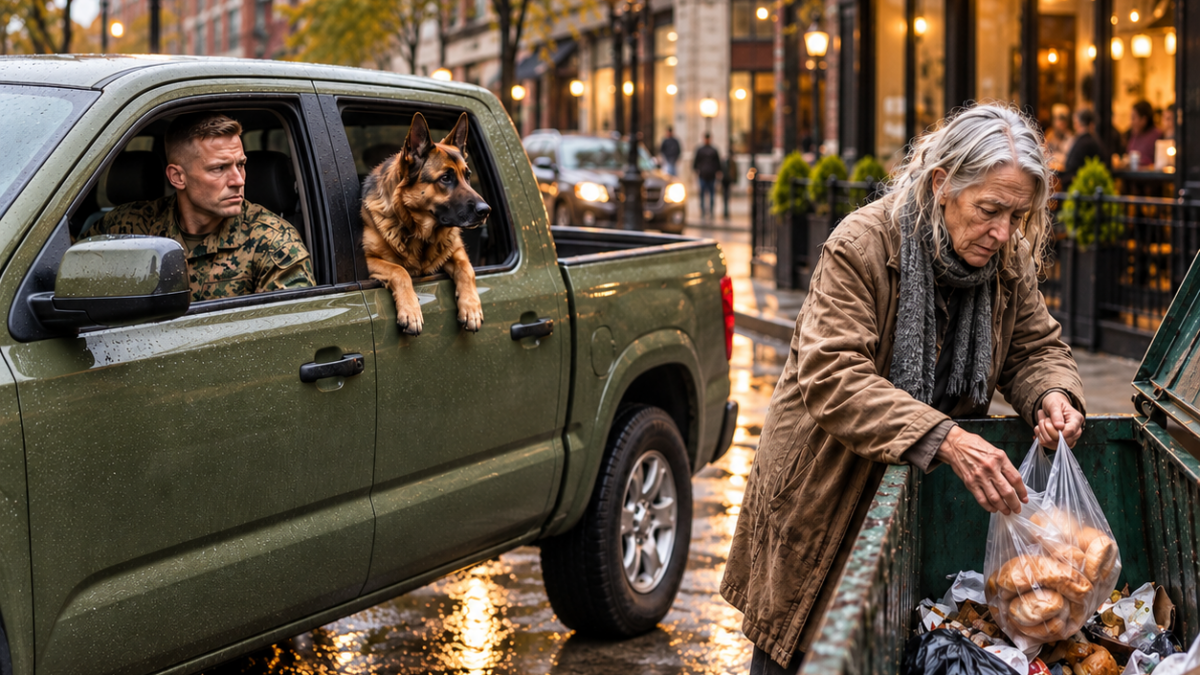
A U.S. Marine and His Retired K9 Found a 75-Year-Old Widow Searching a Restaurant Dumpster in the Rain—Then One Paycheck Revealed Why She Had Nothing Left to Eat.
I saw the old woman behind the restaurant, carefully brushing dirt from a piece of bread like hunger had not yet stolen her dignity.
My retired K9, Valor, froze in the backseat before I even touched the brakes.
By the time I learned why she was searching through garbage in the rain, one wealthy business owner, a warehouse full of underpaid workers, and an entire city would be forced to answer the question I whispered that night: “Who let her get this hungry?”
Cold rain moved across downtown Spokane in thin, silver lines the evening I first saw Margaret Holloway.
The sky had turned the color of worn steel, and traffic crawled beneath the glow of wet streetlights. I was driving the dark green SUV from the Rocky Mountain Veterans Resource Center after another long day delivering food, blankets, medical supplies, and winter coats to veterans and struggling families across Eastern Washington.
My name is Daniel Cross.
Master Sergeant Daniel Cross, United States Marine Corps, retired.
Forty-one years old.
More scars than I cared to count.
More memories than I knew what to do with.
For twenty years, I had been trained to move toward danger, assess quickly, act decisively, and never let emotion get ahead of the mission. That discipline had saved my life more than once.
But nothing in Afghanistan, Iraq, or any cold training field had prepared me for the sight of a seventy-five-year-old widow searching for dinner in a dumpster behind one of the most expensive restaurants in Spokane.
The traffic light turned red.
I slowed to a stop outside a restaurant where warm yellow light spilled through polished windows. Inside, people sat beneath chandeliers, laughing over plates that probably cost more than some families had for groceries that week. Waiters moved through the dining room with white towels over their arms. Wine glasses caught the light. Couples leaned close over candlelit tables.
It was a world that looked untouched by hardship.
Then my eyes drifted toward the narrow service alley beside the building.
Under a flickering security light, an elderly woman stood beside a large dumpster.
She was painfully thin. Her faded brown coat hung loose from her shoulders. A gray scarf clung damply around her silver hair. Rain ran down the deep lines of her face, but she did not wipe it away.
She was not digging wildly.
That was the first thing I noticed.
She opened each discarded container carefully. She inspected the food. She set spoiled things aside. She closed lids neatly. When she found half a piece of bread still wrapped in paper, she brushed dirt from it with the sleeve of her coat and placed it gently into a worn plastic bag.
My chest tightened.
Behind me, Valor lifted his head.
Valor was my retired German Shepherd K9. Six years old. Black-and-amber coat. Eyes too intelligent for comfort. He had served through deployment, noise, chaos, fear, and command. Retirement had softened none of his instincts.
But Valor had one gift I still could not explain.
He could recognize loneliness before people admitted they were lonely.
Children. Elderly veterans. Widows sitting too still in waiting rooms. Men who smiled with their mouths while their hands shook.
Valor always knew.
That evening, he stared through the rain-speckled window and let out one low, mournful whine.
I looked at the woman again.
Neither of us moved.
The light changed green.
A horn sounded behind me.
I drove forward slowly, turned the next corner, and pulled to the curb near the alley entrance.
The engine hummed.
Rain tapped against the windshield.
The woman continued searching, unaware anyone had seen her.
I did not jump out immediately.
Twenty years in the Marines had taught me that rushing toward suffering can sometimes become another kind of force. People in pain do not always need rescue performed at them. Sometimes they need to be approached as though their dignity is still intact.
Because it is.
PART2:
I opened the rear door.
Valor jumped down without a sound.
Together, we walked toward the alley.
“Ma’am?” I called gently.
The woman gasped.
She clutched the plastic bag against her chest and stumbled two steps back. Her pale blue eyes widened with fear so sharp it made me stop where I stood.
“I’m sorry,” she whispered quickly. “I wasn’t stealing. Everything had already been thrown away.”
That sentence hit harder than I expected.
She was standing in the rain with trash in her hands and still trying to prove she had not done wrong.
“I know,” I said softly. “You don’t have to explain yourself.”
For a moment, neither of us spoke.
Valor sat beside me, relaxed and still. He lowered his head slightly and wagged his tail once.
The woman looked at him first.
Then at me.
“He’s beautiful,” she said, almost to herself.
“His name is Valor.”
A faint warmth moved through her tired expression.
“I’m Margaret,” she said. “Margaret Holloway.”
She was seventy-five, though hardship had carved deeper years into her face. Her hands were roughened, her frame thin, her eyes exhausted. Yet even there, beside the dumpster, she stood with a kind of dignity no hunger had managed to destroy.
“Mrs. Holloway,” I said, careful to put no pity in my voice. “Would you let me buy you a warm dinner?”
She lowered her eyes.
“I don’t want charity.”
“Neither would I.”
That made her look up.
PART3:
I reached into my jacket, took out a business card, and wrote two names on the back.
Daniel Cross.
Helen Brooks.
Rocky Mountain Veterans Resource Center.
I handed it to her.
“If you ever decide you need help, come see me. No pressure. No lecture. Just a door that’s open.”
Margaret looked at the card like it weighed more than paper.
Rain gathered on the brim of her scarf.
“I don’t know if I can.”
“You don’t have to decide tonight.”
She held the card carefully, as if afraid it might disappear.
Valor leaned forward, just enough for his nose to touch her sleeve.
Margaret looked down at him.
For the first time that night, her mouth trembled toward something close to a smile.
The next morning, Margaret Holloway barely slept.
I learned that later.
She sat in a small apartment with peeling wallpaper, an old radiator that rattled more than it heated, and a kitchen clean enough to break your heart. Poverty had entered her home, but disorder had not. Every dish was washed. Every towel folded. Every surface wiped.
Margaret believed hardship was no excuse for surrendering dignity.
On her kitchen table sat my business card beside a bottle of heart medication with only three pills left.
In the next room slept her grandson.
Ethan Holloway was ten years old.
Too thin.
Too quiet for a child.
Too skilled at making adults think he was fine.
He had lost both parents in a highway accident four years earlier, and since then he and Margaret had become each other’s whole world. By ten, Ethan already knew how to count groceries without looking like he was counting. He knew how to smile so his grandmother worried less. He knew how to pretend hunger was preference.
That morning, Margaret placed two pieces of toast on a plate.
One had a thin spread of peanut butter.
One was plain.
When she turned away to pour hot water into two mugs, Ethan switched them.
She saw him.
“You switched them again.”
“I like the plain one better.”
“You’ve said that every morning this week.”
He shrugged.
“It’s still true.”
Margaret knew he was lying.
He had been lying out of love for nearly a year.
She broke the peanut butter toast in half and handed part back to him.
“We’re sharing.”
Neither of them argued.
After Ethan left for school with a backpack whose zipper had been repaired twice with fishing line, Margaret stood in the kitchen for a long time with my card in her coat pocket.
Pride had carried her for decades.
But pride could not fill an empty cupboard forever.
An hour later, I was inside the loading dock of the Rocky Mountain Veterans Resource Center, directing volunteers while a semi-truck backed toward the warehouse.
The center occupied an old brick distribution building near the Spokane River. We served veterans, families, seniors, workers whose paychecks did not stretch, and anyone else who walked in hungry enough to set pride down for a moment.
Forklifts moved across the concrete floor.
Volunteers stacked canned goods.
Boxes of blankets lined one wall.
Medical supplies were being sorted near the back office.
Valor was walking beside me when he suddenly stopped.
His ears lifted.
His eyes fixed on the front entrance.
I followed his gaze.
Margaret stood just inside the door, holding my worn business card with both hands.
Rain glistened on her brown coat.
She looked like she was preparing to apologize for existing in the wrong place.
I walked toward her slowly.
“I’m glad you came, Mrs. Holloway.”
Her eyes lowered.
“I almost didn’t.”
“You made it. That counts.”
She glanced around the warehouse.
“I don’t know if I belong in a place like this.”
“You don’t have to belong before you walk through the door,” I said. “Sometimes you belong because you walked through it.”
Before she could answer, a sharp voice came from across the loading dock.
“Daniel, if that truck sits there another five minutes, we’ll be sorting frozen vegetables instead of canned soup.”
That was Helen Brooks.
Warehouse manager.
Fifty-eight years old.
Short silver-blonde hair.
Sharp blue eyes.
Heavy boots.
Work gloves.
A woman who could spot a misplaced box from fifty feet and a dishonest excuse from twice that distance.
Helen had lost her husband, a firefighter, years earlier during a warehouse rescue. Grief had hardened her standards, but not her heart. She believed kindness without discipline turned into chaos, and discipline without kindness became cruelty.
Everyone respected her.
Most people feared her a little.
Both reactions were appropriate.
“Helen,” I said, “this is Margaret Holloway.”
Helen gave Margaret a long, even look.
“If you’re here looking for pity,” she said, “this warehouse doesn’t stock it.”
Margaret straightened.
“I wasn’t.”
Helen studied her another second.
“Good.”
Then she turned back toward the pallets.
“Grab gloves if you want to help. Sit if you need to eat first.”
Margaret hesitated.
Then removed her old coat, rolled up her sleeves, and stepped beside the loading pallets.
She did not wait for special instruction.
She checked expiration dates before stacking cans.
She put heavier boxes on the bottom and lighter ones on top.
She grouped similar products together.
She rotated older inventory forward without being asked.
Every motion was efficient.
Careful.
Practiced.
Helen noticed immediately.
She said nothing for nearly two hours.
But I watched Helen watching Margaret.
That was when I knew something had shifted.
Late that morning, a school bus stopped across the street.
The warehouse doors opened, and a boy hurried inside with a worn backpack over one shoulder.
“Grandma!”
Margaret’s face changed completely.
Ethan ran to her.
Valor trotted toward him with a happy wag of his tail and gently nudged the boy’s hand. Ethan laughed and scratched behind his ears like they had known each other for years.
During lunch, every volunteer received a sandwich.
Helen handed one to Ethan too.
“Growing boys eat more than old warehouse managers,” she said.
Ethan thanked her politely and sat near the break table.
A few minutes later, I saw him glance toward Margaret, who was still organizing shelves instead of eating.
Thinking no one noticed, Ethan wrapped half his sandwich in a napkin and slipped it into his backpack.
Valor saw it.
So did I.
The dog remained seated beside me, eyes fixed on the small movement.
In that silent moment, I understood something painful.
Hunger had not only reached Margaret Holloway.
It had taught a ten-year-old boy to pretend he was already full.
A week later, Margaret stood outside Helen’s office with both hands folded in front of her.
In seven days, she had not arrived late once.
She had not complained about her back.
She had not asked for special treatment.
She worked quietly, carefully, and so well that even Helen had stopped pretending not to be impressed.
Helen stepped out holding a plain white envelope.
“Margaret.”
Margaret accepted it carefully.
“My paycheck?”
“You earned it.”
Margaret opened the envelope with trembling fingers.
Her eyes stayed on the amount for several seconds.
“Is this really all mine?”
“Every penny.”
“On the day you promised?”
A faint smile crossed Helen’s face.
“That’s how payday is supposed to work.”
Margaret pressed the envelope against her chest.
Sometimes dignity does not return through generosity.
Sometimes it returns through honest wages paid on time.
That afternoon, Margaret took a bus across Spokane to Cascade Textile Services.
She had worked there nearly three years.
The facility supplied linens to hotels, hospitals, retirement homes, and restaurants. It was the kind of business nobody thinks about until clean sheets appear exactly when they are needed.
For years, Margaret had believed patience and loyalty would be rewarded.
She had taken extra shifts.
Covered missing workers.
Stayed late.
Arrived early.
Lifted more than she should have at her age.
Inside the office, Anthony Grayson sat behind a polished desk.
Anthony was fifty-two, sharply dressed, clean-shaven except for a trimmed beard, with carefully styled dark hair and gray eyes that had learned to look calm while doing cruel arithmetic.
He slid a check across the desk without asking Margaret to sit.
“There you are.”
Margaret thanked him.
Then looked down.
Her smile faded.
The amount was nearly half of what she expected.
Below the total were unfamiliar deductions.
Uniform damage.
Procedure violation.
Schedule adjustment.
Equipment recovery.
She looked up.
“Mr. Grayson, there must be a mistake.”
“There isn’t.”
“My overtime isn’t here.”
“We adjusted payroll.”
“I was never told I violated procedures.”
“Company policy.”
“I worked every shift you asked me to.”
Anthony leaned back.
“Mrs. Holloway, everyone has been waiting.”
That was the kind of sentence men like Anthony use when they want theft to sound like patience.
Margaret folded the check carefully.
She thanked him anyway.
Then she left with far less than she had earned.
She returned to the Veterans Resource Center just before sunset.
Valor stood before I saw her.
His tail moved once, then he walked straight to her and rested his head against her hand.
“I’m sorry to interrupt,” she said.
“You never interrupt,” I answered. “Come in.”
She handed me the check.
I unfolded it and read every line.
At first, I thought it might be a payroll error.
Then I read the deductions again.
No dates.
No reports.
No signatures.
No explanation.
“Mrs. Holloway,” I said, keeping my voice even, “did anyone ever explain these deductions to you?”
She shook her head.
“No.”
“Did anyone else have problems getting paid?”
Margaret hesitated.
“Maria Jenkins said she never received all her overtime. Robert Mills stopped asking because he said nobody listened. Tanya Cooper cried in the locker room once. She said some of her hours disappeared, but she was afraid to complain.”
I placed the check on my desk.
“This doesn’t sound like one mistake.”
Helen entered carrying delivery forms and stopped when she saw my face.
“What happened?”
I handed her the check.
She read it.
Her eyes hardened.
“I’ve seen this before.”
“When?”
“Years ago. A warehouse contractor hid unpaid wages under fake deductions until somebody finally compared multiple paychecks.”
The office went quiet.
I picked up the phone.
“If this is a pattern, we need someone who understands labor law.”
The next morning, Rebecca Lawson arrived with a worn leather briefcase.
Forty-six years old.
Auburn hair.
Thin silver glasses.
Green eyes that missed very little.
Rebecca had spent years defending workers because, early in her career, she lost a wage theft case when frightened employees were too afraid to testify. She never forgave herself for not finding another way to protect them.
She reviewed Margaret’s paycheck carefully.
Then looked at me.
“One paycheck proves very little.”
“I expected that.”
“But several matching paychecks can prove a pattern.”
Margaret sat very still.
Rebecca turned to her.
“Do you think the others would talk?”
Margaret looked down at her hands.
“They’re scared.”
“Scared people can still tell the truth,” Rebecca said gently. “But they need to know they won’t be standing alone.”
Across town, someone else had reached the same conclusion.
Linda Perez, chief accountant at Cascade Textile Services, sat alone in her office after everyone had gone home.
Linda was fifty-five, small in stature, dark hair streaked with silver, kind brown eyes tired from too many years watching numbers get twisted into lies.
For more than twenty years, she believed numbers should tell the truth.
Anthony Grayson had spent the last several months ordering her to rename deductions, delay wage payments, alter payroll records, and bury overtime under vague adjustment codes.
That evening, she watched an elderly employee leave because he could not afford medication.
Something inside Linda finally broke in the right direction.
She closed her office door.
Turned on her computer.
Inserted a small flash drive.
Then began copying payroll records, internal emails, bank transfers, deduction logs, and the original files before Anthony’s changes.
For the first time in years, someone inside Cascade Textile decided to stop protecting the company and start protecting the truth.
Three weeks later, bitter winter wind swept across downtown Spokane as we arrived at the Spokane Civic Center before sunrise.
Margaret stepped out of my SUV holding a small notebook in both hands.
Valor climbed down behind her.
Service animals were not allowed inside the hearing room, but Valor stayed close until I rested one hand on his shoulder.
He watched Margaret walk toward the glass doors like he wanted to go with her.
She turned once.
“Will he be all right?”
I looked down at Valor.
“He’s worried about you.”
Margaret swallowed.
“Tell him I’ll try to be brave.”
“He already knows.”
Inside, the hearing room looked ordinary.
Folding chairs.
Fluorescent lights.
Long tables.
A three-member labor review panel.
Nothing dramatic.
But I had learned long ago that lives often change in rooms that look plain.
Rebecca stood near the front arranging folders into careful stacks.
Payroll records.
Attendance sheets.
Bank transfers.
Witness statements.
Emails.
Every page organized with precision.
Across the room, Anthony Grayson entered with his attorney.
Navy suit.
Polished shoes.
Confident smile.
He shook hands like a man attending a routine business matter.
At exactly nine, the chairwoman called the hearing to order.
Denise Harper was sixty, with neatly styled silver hair, thoughtful eyes, and a calm voice strengthened by decades of public service. Before joining the labor commission, she had spent nearly thirty years mediating employment disputes.
She knew truth rarely arrived loudly.
More often, it came through patient questions and consistent evidence.
Rebecca stood first.
She did not begin with outrage.
She began with records.
“These documents show Cascade Textile Services received full payment from multiple hospitals, hotels, and retirement communities before employees experienced repeated payroll delays.”
She projected payroll summaries onto a screen.
Then attendance records.
Then altered pay statements.
“This record belongs to Margaret Holloway. This pay statement shows overtime removed without supporting documentation.”
Anthony’s attorney rose.
“Payroll adjustments happen in every company.”
Rebecca nodded.
“They do.”
She placed another folder on the table.
“So do explanations. We are still waiting to see one.”
A murmur moved through the room.
Anthony’s smile faded slightly.
Rebecca continued.
“One record may suggest error. Two may suggest carelessness. Repeated records across multiple employees, using identical unexplained deduction categories, suggest a system.”
Then she called witnesses.
Maria Jenkins went first.
Thirty-nine years old.
Two daughters.
Widowed five years earlier.
A woman who worked double shifts because rent did not care that grief made mornings harder.
Her hands trembled when she adjusted the microphone.
Rebecca’s voice softened.
“Mrs. Jenkins, why are you here today?”
Maria took a slow breath.
“My overtime disappeared.”
She held up several pay stubs.
“I worked the hours. My time cards showed the hours. But the money was never there.”
Robert Mills followed.
Fifty-eight.
Broad-shouldered.
Rough hands.
A former construction foreman whose back injury forced him into lighter work.
“When I kept asking about my pay,” Robert said, “my hours started disappearing from the schedule.”
Then Tanya Cooper.
Twenty-seven.
Single mother.
Curly black hair.
Warm brown skin.
Eyes full of fear she refused to let stop her.
Her voice shook as she described being warned to stop asking questions if she wanted steady work.
More than once, she paused to wipe tears away.
But her story never changed.
Anthony sat stiffly.
His attorney took notes faster.
Then Rebecca turned toward the audience.
“The final witness is Mrs. Linda Perez.”
The room changed.
Linda walked forward carrying a cardboard file box against her chest.
Her face was pale.
Her steps did not falter.
“I was the chief accountant,” she began.
She opened the box.
“These are the original payroll files before deductions were changed.”
She placed a folder on the table.
“These bank records confirm Cascade received payment from hospitals and hotels on time.”
Another folder.
“These emails instructed me to delay payroll, rename deductions, and hide the real accounting entries.”
Anthony’s attorney stood abruptly.
“Objection.”
Denise Harper looked up.
“On what grounds?”
“Those documents require verification.”
Rebecca nodded.
“And they will receive it. Today’s question is whether sufficient evidence exists to justify a full state audit.”
No one spoke.
Finally, Denise Harper looked toward Margaret.
“Mrs. Holloway, would you like to make a statement?”
Margaret rose slowly.
Three weeks earlier, she had stood in an alley with rain running down her face, apologizing for food that had already been thrown away.
Now she walked to the microphone.
Her hands rested lightly on the podium.
Her voice was quiet.
“I worked every shift they asked me to work.”
She paused.
“When my pay didn’t come, I thought it was a mistake.”
Another pause.
“I kept waiting.”
The room stayed completely still.
“I ran out of food before I ran out of hope.”
My throat tightened.
Margaret swallowed.
“So one night, I searched behind a restaurant for something my grandson and I could eat.”
Anthony’s attorney stood.
“Madam Chair, we would like to introduce video.”
A screen lit up behind the panel.
Grainy restaurant security footage appeared.
Margaret beside the dumpster.
Rain falling.
Her thin hands brushing dirt from a piece of bread.
Whispers moved through the room.
The clip ended.
Anthony’s attorney folded his hands.
“No further questions.”
He thought shame would do what evidence could not.
Rebecca looked at Margaret.
“You may respond.”
Margaret turned toward the frozen image of herself on the screen.
Then back to the panel.
“That video shows I was hungry,” she said.
Her voice never rose.
“It does not show why I was hungry.”
Silence.
Then Anthony stood.
“This is ridiculous,” he snapped. “I run a business, not a charity. If employees can’t manage their money, that isn’t my responsibility.”
Several workers lowered their heads.
Others stared at him in disbelief.
Denise Harper struck her gavel once.
“Mr. Grayson, sit down.”
But the damage had already been done.
For the first time that morning, Anthony stopped hiding behind deductions and revealed what he believed.
Workers were costs.
Hunger was their problem.
Dignity was not his concern.
Several weeks later, early autumn came softly to Spokane.
Golden leaves moved across the parking lot outside the Veterans Resource Center. Delivery trucks arrived one after another with supplies for families still struggling after months of delayed wages.
The state audit had expanded.
Payroll records, bank transfers, overtime reports, and internal emails confirmed what Margaret and the others had suspected for years.
Anthony Grayson had deliberately withheld wages, reduced overtime, and approved unlawful deductions affecting dozens of workers.
Labor officials suspended him from managing Cascade Textile while legal proceedings moved forward. Hospitals, hotels, and retirement homes began canceling contracts. No one wanted their clean linens delivered by a company that dirtied its hands stealing from workers.
I read the latest update on my phone, then put it away.
Justice mattered.
But watching Anthony fall brought less satisfaction than people might think.
In the Marines, I learned that rebuilding lives matters more than watching someone else’s collapse.
Across the warehouse, Margaret worked beside long-time volunteers with calm confidence.
Her silver hair was still tucked beneath the familiar gray scarf.
But the sadness behind her pale blue eyes had changed.
Not disappeared completely.
Life does not work that cleanly.
But it no longer owned the room.
She checked expiration dates, rotated cans, stacked heavy boxes on lower shelves, and helped new volunteers understand the system better than some people who had been there for years.
Helen walked over holding a sealed envelope.
“I think you’ve earned this.”
Margaret accepted it carefully.
Inside was an employment letter.
Her temporary role had become permanent.
For several seconds, she stared at the page.
“I never imagined I’d receive another job offer at my age.”
Helen smiled faintly.
“I wasn’t looking at your age.”
She nodded toward the organized shelves.
“I was looking at your character.”
Emotion filled Margaret’s eyes.
“Thank you.”
“You already thanked us,” Helen said. “Every morning you show up.”
Nearby, Ethan Holloway sat beside Valor after school, finishing homework at the break room table.
Weeks earlier, he had hidden half a sandwich because he believed there might not be enough food at home.
That afternoon, he finished every bite without hesitation.
Then laughed when Valor rested his head across the boy’s knee.
Some victories never appear in court records.
Sometimes they look like a child eating without fear.
The center soon launched a new program.
No Worker Should Go Hungry.
Emergency food boxes.
Bus passes.
Legal guidance.
Job placement assistance.
Help for workers whose wages had been delayed, withheld, or stolen behind fake deductions.
I insisted on one rule from the beginning.
No one should have to prove they are worthy of a meal.
That sentence became the heart of the program.
Margaret became one of its most trusted volunteers.
When frightened workers came in carrying overdue bills, empty refrigerators, and more embarrassment than hope, she did not begin with forms.
She asked one question.
“Have you eaten today?”
People often relaxed before answering.
Margaret understood fear before it spoke because she had lived inside it.
Her kindness never sounded like pity.
It sounded like recognition.
Ethan changed too.
He stopped hiding food in his backpack.
He laughed more.
He raced into the center after school looking for Valor, and somehow Valor always heard his footsteps first. The old German Shepherd would trot toward the lobby before the boy even opened the door, tail wagging like he had been waiting all day.
Their friendship became part of the center’s rhythm.
A reminder that healing often arrives in ordinary moments.
Several months later, I drove the green SUV through downtown Spokane after another supply delivery.
As I approached the same intersection where everything began, the traffic light turned red.
Without warning, Valor stood in the backseat.
He looked toward the narrow alley.
I turned instinctively.
The dumpster was gone.
In its place stood folding tables beneath white volunteer tents. Steam rose from insulated food containers. Volunteers handed warm meals to homeless neighbors, elderly residents, and workers facing temporary hardship.
Standing near the serving table was Margaret.
She wore a volunteer apron over her brown coat and greeted people by name. Beside her, Ethan handed out bottled water and fresh bread with the confidence of a boy who no longer feared tomorrow.
Margaret looked across the street and recognized my SUV.
She smiled.
Then gave me a small nod.
Valor wagged his tail against the window.
I smiled back but stayed behind the wheel.
The light turned green.
I drove forward slowly, looking once in the rearview mirror.
That was when I understood the most important thing I had offered Margaret that rainy night was not dinner.
It was not a job.
It was not even legal help.
It was a door.
She had chosen to walk through it.
Now every meal she served, every frightened worker she welcomed, and every act of quiet compassion she offered opened another door for someone else.
Some missions do not end when the work is finished.
They live on in the people who carry hope forward.
I still think about that first night sometimes.
The restaurant lights.
The rain.
The old woman brushing dirt from bread.
Valor’s mournful whine.
The question I whispered before I even knew her name.
Who let her get this hungry?
The answer was not one person.
It was a boss who stole wages and called it policy.
A system that made workers too afraid to speak.
A city that walked past alleys because the dining rooms were warmer.
A world that taught people like Margaret to apologize for surviving.
But the answer became something else too.
Who helped her stand again?
A dog who noticed loneliness.
A warehouse manager who paid honest wages.
A lawyer who followed paper until lies collapsed.
A bookkeeper who chose truth.
Workers who found courage together.
A grandmother who walked through one open door and then held it open for others.
That is how dignity returns.
Not always with speeches.
Not always with headlines.
Sometimes it returns through a paycheck paid on time.
A sandwich a boy no longer hides.
A job offer accepted with trembling hands.
A warm meal served where a dumpster used to stand.
And a German Shepherd named Valor, watching from the backseat, knowing before the rest of us that someone forgotten was still worth finding.








