A Trucker Rescued an Abandoned Kitten From a Taped-Up Box—Then They Spent 14 Years and 2.3 Million Miles Together. On His Final Day Before Retirement, the Old Cat Placed One Paw on the Steering Wheel… and What Happened Next Brought Everyone to Tears.
PART2:
He finished fueling, replaced the nozzle, and started walking toward the store when he heard the scratching again.
Three soft scrapes.
Then silence.
He stopped.
Looked around.
Nothing.
The sound came from somewhere behind the trash enclosure near the edge of the lot.
Ray glanced toward the store.
Cold air waited inside.
So did coffee.
He took another step.
Scratch.
Scratch.
Then something weaker.
Ray sighed.
“Of course.”
He walked around the dumpster.
There was a cardboard box on the ground.
Medium-sized.
Cheap brown corrugated cardboard.
PART3:
The top had been folded shut and wrapped with gray duct tape.
At first, Ray assumed someone had dumped garbage.
Then the box moved.
Not much.
Just enough.
He crouched.
“Hey.”
Another faint scratch came from inside.
Ray’s expression changed.
He touched the cardboard.
It was hot.
Not warm.
Hot.
The box had been sitting in direct sunlight on black pavement in ninety-three-degree weather.
Ray pulled a pocketknife from his belt.
He cut the tape.
As soon as he peeled back one flap, two orange ears appeared.
Then a tiny face.
The kitten inside blinked at him.
Ray froze.
There was no food.
No water.
No towel.
No note.
Nothing.
Just a kitten.
Orange tabby.
Maybe six weeks old.
His fur was damp around the neck.
His mouth hung slightly open.
His body trembled even though the air inside the box must have been unbearable.
“Son of a bitch.”
The kitten tried to stand.
His back legs folded.
Ray reached in.
He had never been particularly comfortable handling fragile things.
The kitten seemed to weigh nothing.
Less than a pound.
Maybe a pound if Ray was being generous.
He fit almost completely inside Ray’s left hand.
“Who did this to you?”
The kitten gave a hoarse little sound that barely qualified as a meow.
Ray looked around the lot.
People moved between pumps.
Drivers carried drinks.
Travelers went in and out of the store.
Someone had placed the box there.
Someone had taped it shut.
Someone had walked away.
Ray felt anger arrive faster than sympathy.
He preferred anger.
Anger was easier.
He picked up the box and looked for writing.
Nothing.
He checked behind the dumpster.
Nothing.
He walked toward the store carrying the kitten against his shirt.
Inside, cold air hit them.
The kitten shivered violently.
A cashier looked up.
“Oh my God.”
“You know who left this?”
“What?”
Ray held the kitten higher.
“Found him in a taped box out back.”
The young woman behind the register stared.
“No.”
“You got cameras?”
She called the manager.
Ten minutes later Ray was in a cramped office watching grainy security footage.
The camera covered the fuel lanes but not the rear dumpster area.
A silver minivan had stopped near the side of the building around noon.
No plate visible.
A person got out.
Hard to tell gender.
Carried something behind the building.
Came back without it.
That was all.
The manager offered to call animal control.
Ray looked at the kitten.
He was tucked beneath Ray’s open work shirt now, pressed against his undershirt.
Despite the heat outside, he still trembled.
“How long till they get here?”
The manager shrugged.
“Could be a couple hours.”
Ray looked at his watch.
He had a delivery window.
“Where’s the nearest vet?”
The cashier found one fourteen miles away.
Ray left the truck stop with a paper cup of water, a handful of napkins, and a kitten he absolutely did not intend to keep.
At the veterinary clinic, a woman named Dr. Laura Benson told him the kitten was dehydrated, overheated, underweight, and probably no more than six or seven weeks old.
“But he’ll make it?” Ray asked.
“I think so.”
She gave the kitten fluids beneath the skin and examined him.
No fractures.
No visible disease.
Fleas.
Ear mites.
Hungry enough to attack canned food as though it had personally insulted him.
Ray stood with his arms folded while the kitten ate.
“He needs a home,” Dr. Benson said.
“I’m aware.”
“You have one?”
“A home?”
“Yes.”
“Technically.”
She smiled.
“That sounded convincing.”
“I drive.”
“So?”
“So I’m gone three hundred days a year.”
“Some truckers travel with animals.”
“I don’t.”
The veterinarian looked at the orange kitten.
The kitten had food on his nose.
“He doesn’t know that.”
Ray glanced at the clock.
“I can take him to a shelter.”
“There is one west of here.”
“How far?”
“About three hundred forty miles along your route.”
Ray nodded.
“Good.”
Dr. Benson put together a small bag.
Kitten food.
A shallow bowl.
Disposable litter tray.
Medication for fleas.
A towel.
“Don’t overfeed him.”
“I won’t.”
“Keep the cab cool.”
“Obviously.”
“And don’t let him crawl under your brake pedal.”
Ray stared at her.
She smiled again.
“You’d be surprised.”
Ray paid the bill.
One hundred eighty-six dollars.
For a cat that wasn’t his.
He told himself that several times while walking back to the truck.
Not mine.
Not keeping him.
Just transportation.
He set the kitten on the passenger seat.
The kitten immediately climbed down.
“Hey.”
Ray grabbed him.
Put him back.
The kitten climbed down again.
Ray looked at him.
“No.”
The kitten looked up.
“No.”
The kitten took three steps toward the center console.
Ray picked him up.
“You are not free-range cargo.”
He placed him inside his jacket.
The kitten settled.
Ray started the truck.
The diesel engine came alive beneath them.
The kitten stiffened.
Ray put one hand over the tiny body.
“It’s noise. That’s all.”
The kitten’s heart hammered beneath his palm.
Ray pulled onto the interstate.
For the first twenty miles, the kitten stayed inside his jacket.
At mile thirty-three, a head appeared near Ray’s collar.
At mile forty-one, the kitten crawled out.
At mile forty-six, he explored the center console.
At mile fifty-two, he attacked the end of Ray’s CB microphone cord.
At mile sixty-three, he climbed onto the dashboard.
“Absolutely not.”
Ray moved him.
The kitten returned.
Ray moved him again.
The third time, the kitten found a warm patch of sunlight near the base of the windshield, turned twice, and collapsed asleep.
Ray stared at him.
Tiny orange body.
One paw tucked beneath his chin.
Traffic rolled west beneath an enormous blue sky.
Ray muttered, “Fine.”
Eighty miles after the truck stop, the kitten was sleeping against the windshield as if he had been riding there forever.
At the next fuel stop, Ray bought a proper water dish.
And a small bag of better food.
He also bought a rubber-backed bath mat because he was worried the kitten would slide on the dashboard.
None of these purchases meant anything.
The shelter was still ahead.
At two hundred miles, the kitten woke.
Ray had the radio on low.
Willie Nelson.
The kitten sat on the passenger seat.
Watched the road.
Not Ray.
The road.
Cars approached.
Passed.
Vanished.
The kitten’s head moved slightly each time.
Ray glanced over.
“First time?”
The kitten blinked.
“Yeah. Me too, once.”
Ray stopped talking.
Twenty minutes later he started again.
“Wyoming’s better.”
The kitten watched the windshield.
“Not much there, but what is there knows how to keep its mouth shut.”
At three hundred miles, the kitten climbed into Ray’s lap.
Ray tried to stop him.
Failed.
The cat curled between Ray’s stomach and the steering wheel.
“This is temporary.”
Purr.
Ray looked down.
“You don’t even know me.”
Purr.
“I could be terrible.”
The kitten fell asleep.
Ray drove thirty more miles.
Then forty.
The shelter exit sign appeared.
NEXT RIGHT.
Ray saw it.
His hands tightened around the wheel.
He moved toward the exit lane.
The kitten shifted in his lap.
Ray looked down.
One tiny orange paw rested against his belt buckle.
The exit came closer.
Ray imagined parking.
Handing him over.
Signing a form.
Getting back into the truck alone.
He imagined the passenger seat empty.
The dashboard empty.
The strange little breathing sound gone.
The exit passed.
Ray did not turn.
He stared straight ahead.
Five miles later he said, “Well.”
The kitten opened one eye.
“You better not make me regret this.”
The kitten went back to sleep.
Ray needed a name.
For two days, he rejected everything.
Pumpkin was stupid.
Tiger was worse.
Rusty sounded like a guy who stole catalytic converters.
Red was lazy.
At a truck stop outside Cheyenne, another driver leaned into Ray’s cab, saw the kitten, and laughed.
“What the hell is that?”
“Temporary problem.”
The driver sniffed.
“Smells like diesel in here.”
Ray looked at the kitten.
The kitten sat beside the gearshift.
“Diesel.”
The other driver laughed.
“That’s his name?”
Ray considered it.
“Now it is.”
Diesel sneezed.
And that was that.
The first month nearly broke every rule Ray had built his life around.
Diesel had no respect for order.
He slept on Ray’s paperwork.
He climbed the sleeper curtains.
He once stepped on the CB microphone button and broadcast twenty-seven seconds of chaotic meowing across channel nineteen while Ray was fueling.
The response from nearby truckers was immediate.
“Somebody hauling livestock?”
“Sounds like your alternator’s dying.”
“Ray, you finally got yourself a dispatcher?”
Ray returned to the cab, found Diesel sitting on the microphone, and said, “You’re embarrassing me professionally.”
Diesel purred.
The cat learned fast.
Faster than Ray expected.
He learned that the truck stopped at regular intervals.
He learned not to approach the pedals.
He learned the vibration of the engine.
He learned which compartment held treats.
He learned that the passenger seat belonged to him.
Ray fixed a folded wool blanket there.
Diesel slept on it with his face toward the windshield.
Always the windshield.
Other cats, Ray later learned, loved windows because of birds.
Diesel loved highways.
He watched lane markers.
Overpasses.
Headlights.
Mountain grades.
Rain.
Snow.
Cities at night.
Open plains.
He seemed fascinated by the movement itself.
Ray joked that Diesel thought the world was a movie made specifically for him.
By the end of the first year, everyone on Ray’s regular routes knew the cat.
Dispatch knew.
Fuel clerks knew.
Mechanics knew.
Waitresses knew.
Truckers he had never formally met knew.
“You the guy with the orange cat?”
Ray would sigh.
“Apparently.”
Diesel became larger.
Then longer.
Then heavier.
His kitten body turned into a solid twelve-pound tomcat with bright amber eyes and a habit of sitting upright in the passenger seat like he was inspecting commercial traffic.
Ray bought him a harness.
Diesel hated it.
Ray bought another.
Diesel hated that one too.
Eventually they reached a compromise in which Diesel tolerated the harness outside the truck but walked as though each paw had been personally betrayed.
Ray laughed more that year than he had in the previous three.
He noticed that.
He did not talk about it.
Ray’s parents had died within eighteen months of each other.
His father first.
Heart attack at sixty-seven.
His mother after a stroke.
Ray had driven home for both funerals.
After his mother’s burial, he returned to the truck early.
His brother, Michael, noticed.
“You don’t have to leave tonight.”
“I’ve got a load.”
“You always have a load.”
Ray had been thirty-eight.
Michael stood in their mother’s kitchen with two plates still wrapped in foil from the church reception.
“You know, you can stay somewhere longer than a day without the building collapsing.”
Ray put on his coat.
“Some of us work.”
Michael flinched.
Ray regretted the words immediately.
He didn’t apologize.
Michael didn’t either.
That was the problem with brothers.
Both knew where to hurt each other.
Neither knew how to stop once they had started.
Afterward, Ray spent nearly a year not speaking to Michael except on birthdays and Christmas.
Even those calls lasted under five minutes.
By the time he found Diesel, silence had become the default structure of his life.
Diesel changed it accidentally.
Ray talked to him.
At first as a joke.
“Don’t look at me like that.”
“You saw what that idiot did.”
“No, we are not stopping. You ate forty minutes ago.”
“That’s not a parking spot.”
“Utah’s pretty, but don’t trust anyone who says this grade is easy.”
Then the conversations deepened.
Not because Ray decided to confess anything.
Because there was no reason not to.
Diesel never interrupted.
Never advised.
Never weaponized old sentences.
One night in Montana, parked under sodium lights while wind shook the trailer, Ray told Diesel about his mother.
“She called every Sunday.”
Diesel sat near his boots.
“Every Sunday. Didn’t matter where I was.”
The cat blinked.
“I used to let it go to voicemail if I was tired.”
Ray rubbed his hands.
“Sometimes two weeks.”
Diesel jumped onto the bunk.
Ray looked at him.
“She’d leave messages anyway.”
The cat climbed beside him.
“Hey, Raymond. Just your mother. You don’t have to call back tonight. I just wanted to hear your voice.”
Ray smiled painfully.
“She always said that. ‘You don’t have to call back.’”
Diesel curled against his thigh.
“I’d give just about anything for one of those voicemails now.”
The truck rocked in the wind.
Ray scratched Diesel’s head.
“Don’t repeat that.”
Purr.
“Good.”
The long-haul community began treating Diesel like a minor celebrity.
At a diner in Iowa, a waitress named Carol kept a small saucer behind the counter.
Ray stopped there every six or seven weeks.
The first time Diesel came inside, Carol said, “Absolutely not.”
The second time, she gave him scrambled eggs.
By the fifth visit, she had purchased a ceramic dish with a painted paw print.
“You’re encouraging him,” Ray said.
Carol placed eggs in front of Diesel.
“He has better manners than most of your friends.”
A driver named Stump, who weighed nearly three hundred pounds and had ketchup on his shirt, looked offended.
“I have excellent manners.”
Carol stared.
Stump chewed.
Then wiped his mouth.
Diesel ate delicately from his saucer.
Carol pointed.
“See?”
Ray laughed.
For years, the joke continued.
The cat with better table manners than truckers.
But underneath the jokes, Diesel became part of a network Ray had never realized he possessed.
Drivers watched for them.
If Ray was delayed by snow, people asked where Diesel was.
If his truck went into the shop, mechanics made sure the cat could stay inside the office.
A dispatcher once rescheduled a load because the veterinary appointment for Diesel’s annual shots conflicted with pickup.
Ray discovered that loneliness was not always the absence of people.
Sometimes it was the absence of permission to need them.
Diesel gave Ray that permission without saying anything.
They crossed America again and again.
Texas heat shimmered outside the windows.
Maine fog swallowed two-lane roads.
Wyoming wind pushed trailers sideways.
Arkansas thunderstorms turned noon into night.
They spent a Christmas morning parked outside Flagstaff because an interstate closure trapped hundreds of trucks in snow.
Ray heated canned chili in the sleeper.
Diesel watched snow pile against the windshield.
“Merry Christmas,” Ray said.
Diesel touched the glass with one paw.
Ray called Michael.
His brother sounded surprised.
“Ray?”
“Merry Christmas.”
A pause.
“Merry Christmas.”
They talked seventeen minutes.
Longest conversation in years.
Michael asked about the cat.
Ray pretended to be annoyed.
“He’s expensive.”
“You love him.”
“I feed him.”
“Same thing for you.”
Ray smiled.
“Shut up.”
That phone call became another.
Then another.
A bridge slowly rebuilt from ordinary words.
Weather.
Work.
Michael’s daughter Emily.
Diesel.
Especially Diesel.
“Send me another picture,” Michael would say.
“I sent one yesterday.”
“He looked blurry.”
“He’s a cat.”
“Take a better one.”
Ray did.
The first real crisis came in 2012.
They were three years into the partnership.
Ray was hauling machine parts through Colorado in February.
Snow had been falling since afternoon.
By midnight, conditions deteriorated.
Chains required.
Visibility poor.
Ray considered shutting down but the next safe parking area was twenty-six miles ahead.
He had driven worse.
That sentence had killed plenty of drivers.
Ray knew it.
He kept going anyway.
At 1:13 a.m., a pickup truck two vehicles ahead lost traction on a curve.
Its rear end swung.
A car braked.
A tractor-trailer jackknifed.
Ray saw brake lights.
Too close.
He reacted.
Steering.
Braking.
Trailer weight shifting behind him.
Diesel flew from the passenger seat despite the restraint system Ray had rigged.
The truck slid toward the median.
Ray corrected.
Too much.
Then back.
The trailer kissed the guardrail.
Metal screamed.
Ray heard himself yelling.
Then they stopped.
Silence.
Snow moved through the headlights.
Ray’s hands remained locked on the wheel.
His heart hammered.
“Diesel?”
Nothing.
Ray turned.
“Diesel?”
The cat was on the floor behind the passenger seat.
Ray unbuckled.
Dropped down.
Diesel crouched beneath the edge of the bunk.
Eyes enormous.
“Come here.”
The cat would not move.
Ray reached.
Diesel crawled into his arms.
Ray sat on the floor of the cab holding him.
The truck was angled awkwardly but upright.
Outside, horns sounded.
Drivers called over the CB.
Ray ignored them for ten seconds.
“Okay.”
Diesel’s claws sank into his jacket.
“We’re okay.”
Ray closed his eyes.
“We’re okay.”
He realized he was shaking harder than the cat.
The trailer had damage.
The truck had scratches.
Nobody in the chain collision died.
Two people were injured.
Ray spent the night parked at a repair facility.
At dawn, he looked at Diesel sleeping against his ribs and considered quitting.
Seriously.
First time.
He could work local.
Warehouse.
Dispatch.
Anything.
He imagined never again asking a living thing that trusted him to ride through freezing mountain passes at one in the morning.
Diesel woke.
Stretched.
Walked to the passenger seat.
Sat.
Looked forward.
Ray stared at him.
“You’re insane.”
Diesel’s tail flicked.
“We almost died.”
The cat looked at the windshield.
Ray laughed.
“All right.”
He became more careful after that.
Not fearful.
Careful.
There was a difference.
He stopped earlier in bad weather.
Ignored dispatch pressure when roads looked wrong.
Added better restraints for Diesel.
If anyone complained, Ray said, “Freight doesn’t care if I make it home.”
That became one of his rules.
It was not the only thing Diesel changed.
In 2014, Ray’s brother suffered a stroke.
Mild by medical standards.
Terrifying by every other standard.
Ray was in Arizona when Emily called.
“Uncle Ray, Dad’s in the hospital.”
Ray turned the truck around as soon as dispatch found another driver for the load.
He drove fifteen hours with only necessary stops.
Diesel sat quietly.
At the hospital, Ray discovered something embarrassing.
He did not know what to say to Michael.
His brother was fifty.
Speech slightly slurred.
Right hand weak.
Scared.
Ray stood beside the bed.
Michael looked at him.
“You came.”
“Of course I came.”
Michael smiled.
“Thought the cat might outrank me.”
Ray snorted.
“Close.”
They both laughed.
Then Michael cried.
Ray had not seen him cry since they were children.
Ray sat down.
“I should’ve called more.”
Michael shook his head.
“Not doing this.”
“Doing what?”
“Funeral conversation while I’m alive.”
Ray looked at him.
Michael continued.
“If you want to call more, call more.”
Simple.
Ray understood.
Years of distance had made everything feel complicated.
It wasn’t.
Call.
Show up.
Stay.
That night, Ray slept in the truck outside the hospital.
Diesel lay on his chest.
Ray whispered, “You’re turning me into a person.”
Diesel kneaded his shirt.
“I don’t appreciate it.”
By 2016, Diesel had traveled more miles than most human beings would in several lifetimes.
Ray logged routes obsessively.
Mileage.
Fuel.
Maintenance.
Stops.
He had kept detailed records since his first professional run at twenty-nine.
There was satisfaction in numbers.
Numbers did not exaggerate.
They did not forget.
They did not leave.
Ray eventually added a second notation to the logbook.
A small orange D.
He marked every trip Diesel accompanied him on.
Which was every trip.
When another driver noticed, he laughed.
“You logging cat miles?”
Ray closed the book.
“Mind your business.”
But he did.
He counted.
Half a million.
Seven hundred thousand.
One million.
When Diesel passed his millionth mile, Ray bought him a steak.
Carol at the Iowa diner cooked a small piece without seasoning.
She stuck one candle into it.
Ray stared.
“Absolutely not.”
Carol lit the candle.
“Million-mile cat.”
“This is humiliating.”
Half the diner sang anyway.
Diesel ate the steak.
Someone took pictures.
For the next year, drivers called him Million-Mile Diesel.
Ray pretended to hate it.
He secretly saved the photograph.
There were hard years too.
In 2017, Ray began seeing a woman.
Her name was Denise.
She taught middle school English in Kansas.
They met because her car battery died at a gas station and Ray happened to have jumper cables.
Ray liked her immediately.
That terrified him.
Denise had curly brown hair, quick humor, and the alarming ability to ask direct questions.
“How long are you usually gone?”
“Two weeks.”
“And home?”
“Two days.”
She stared.
“That sounds awful.”
“You get used to it.”
“That isn’t what I said.”
Ray smiled.
They dated for almost eleven months.
For the first time in years, Ray imagined reducing his routes.
Maybe a local job.
Maybe an actual home.
Denise liked Diesel.
Diesel adored Denise.
That almost made things worse.
She would sit in Ray’s truck while he packed.
Diesel would move between them.
“You know he judges us,” she once said.
“He judges everyone.”
“No. He likes me.”
“He tolerates you.”
Diesel climbed into her lap.
Denise looked at Ray.
“Devastating.”
Ray laughed.
But love asked questions the road did not.
Where is this going?
What do you want?
How much are you willing to change?
Ray could drive through black ice.
He could back a fifty-three-foot trailer between two trucks with inches to spare.
He could diagnose engine trouble from a sound.
But those questions defeated him.
Denise finally said, “I can’t build a life with someone who’s always leaving.”
Ray heard accusation where there was mostly sadness.
“This is my job.”
“I know.”
“You knew that.”
“I did.”
“Then what are we talking about?”
Denise looked at him for a long time.
“We’re talking about whether you want a job or whether you want a reason not to stay anywhere.”
Ray’s face hardened.
“That what you think?”
“I think you’re lonely and you’ve gotten very good at protecting it.”
“That doesn’t make sense.”
“It does to me.”
Ray stood.
Diesel watched from the couch.
Denise’s eyes filled.
“I love you.”
Ray said nothing.
That silence ended them.
He regretted it before he reached his truck.
But pride was old muscle.
It moved easily.
He drove away.
For three hours, Diesel sat on the passenger seat.
Ray said nothing.
Finally, somewhere outside Salina, he muttered, “Don’t.”
Diesel looked at him.
“Not one word.”
The cat blinked.
“She wanted me to stop being who I am.”
Diesel stared.
Ray gripped the wheel.
“That’s what she wanted.”
Silence.
“Stop looking at me.”
Diesel turned toward the windshield.
Ray lasted thirty seconds.
“Fine.”
He pulled into a rest area.
Stopped.
Put both hands over his face.
“I loved her.”
Diesel climbed onto his lap.
Ray cried for the first time since his mother died.
There were no dramatic reconciliations.
No last-minute airport scene.
Denise moved on.
Ray learned through mutual friends that she later married.
He sent a card.
Did not sign anything beyond his name.
For months afterward, he blamed the road.
Then himself.
Then no one.
Some relationships ended because two people were wrong for each other.
Others ended because love arrived before courage.
Ray never decided which theirs had been.
Diesel remained.
That was the thing.
No matter what else changed, Diesel remained.
When Ray was angry, Diesel was there.
When he embarrassed himself, Diesel was there.
When he drove four hundred miles in silence because he hated his own thoughts, Diesel sat beside him and never tried to make the silence prettier than it was.
In 2019, Diesel developed urinary crystals.
Ray noticed because the cat kept entering the litter box without producing much.
Within two hours, Ray had abandoned his delivery schedule and was inside an emergency veterinary clinic in Oklahoma City.
The veterinarian explained the risk of blockage.
Ray listened with a face so severe the young vet finally asked, “Are you okay?”
“No.”
“We caught it early.”
“Can he die from this?”
“Not if we manage it.”
Ray sat beside Diesel’s carrier.
The cat complained loudly.
“I’m sorry,” Ray whispered.
The veterinarian smiled.
“He’s got a good owner.”
Ray looked up.
“I almost left him at a shelter.”
“But you didn’t.”
Ray thought about that often afterward.
Life could turn on such stupidly small things.
An exit.
A missed turn.
A phone call answered.
A box opened.
A decision delayed ten seconds.
If he had taken the shelter exit in 2009, someone else might have adopted Diesel.
Maybe a family.
Maybe a child.
Maybe Diesel would have lived a beautiful life.
Ray would never know.
What he knew was that his own life would have been smaller.
He had trouble admitting that.
Diesel had not saved him in the dramatic way people used the word saved.
Ray had not been suicidal.
He had not been dying.
He had been functioning.
Working.
Eating.
Sleeping.
Paying bills.
That was the danger.
A person could be lonely and fully operational.
No emergency alarm sounded.
No one came running.
You simply moved through the world with fewer and fewer people who knew what your voice sounded like when you were scared.
Diesel had changed that.
The cat heard everything.
Ray’s jokes.
Cursing.
Grief.
Regret.
Phone calls.
Nightmares.
Silence.
In 2020, the road changed.
Truck stops became stranger.
Restaurants closed dining rooms.
Drivers spent more time isolated.
People called them essential.
Some treated them like contamination.
Ray hauled medical supplies.
Food.
Paper products.
He drove through cities that felt abandoned.
Diesel sat in the passenger seat.
Same as always.
One April night, Ray parked behind a distribution center in Illinois.
The world felt wrong.
No traffic.
No diner lights.
No other voices on the pavement.
Ray ate crackers in the sleeper.
Diesel sat beside him.
Ray said, “You know what I figured out?”
Diesel washed one paw.
“Everybody’s finding out what we already knew.”
The cat continued.
“Being alone sounds peaceful until you have no choice.”
Diesel looked up.
Ray smiled.
“But you and me?”
He scratched beneath the cat’s chin.
“We’re professionals.”
Diesel purred.
Later that year, Michael called.
“Emily’s getting married.”
“Good.”
“She wants you there.”
“When?”
Michael told him.
Ray checked his schedule.
“I’ll make it.”
“You said that at her graduation.”
Ray’s jaw tightened.
“I had a breakdown in Nevada.”
“I know.”
“Then why say it like that?”
“Because you missed Thanksgiving too.”
“I was working.”
Michael sighed.
“Ray.”
“What?”
There was a pause.
Then Michael said, “You’re fifty-two.”
Ray said nothing.
“You always talk like there’s another year waiting.”
“What’s that supposed to mean?”
“It means someday the road ends whether you schedule it or not.”
Ray almost snapped back.
Instead he looked at Diesel.
The cat was eleven.
Gray hairs had begun appearing around his muzzle.
Not many.
Enough.
Ray felt something uncomfortable.
Time.
He had measured his life in miles because miles were visible.
Years were quieter.
They accumulated without signs.
He attended Emily’s wedding.
He wore a suit that felt too tight across the shoulders.
Michael hugged him.
No jokes.
No sarcasm.
Just held him.
Emily cried when she saw him.
“You came.”
Ray remembered saying those same words beside Michael’s hospital bed.
He smiled.
“Of course.”
Diesel stayed at the hotel with a pet sitter Ray had interviewed so aggressively the woman probably thought she was applying for federal security clearance.
At the reception, Emily danced with her father.
Ray sat alone at a table.
For one moment he thought about Denise.
Then about his mother.
Then about fourteen years of choices not yet fourteen years old.
He left before midnight.
Back at the hotel, Diesel was waiting behind the door.
Ray sat on the floor in his suit.
The cat climbed into his lap.
“People are exhausting.”
Purr.
“You would’ve hated the music.”
Purr.
“You would’ve liked the salmon.”
Diesel looked interested.
Ray laughed.
In 2021, Ray’s knees started hurting seriously.
Not stiffness.
Pain.
Sharp when he climbed down from the cab.
Deep ache at night.
He ignored it.
Drivers became experts at ignoring body parts.
Back.
Shoulders.
Wrists.
Knees.
Hips.
The truck hurt you slowly enough that you could pretend aging was the only culprit.
A doctor finally showed Ray the X-rays.
“Your knees look older than you are.”
“That’s rude.”
The doctor smiled.
“I’m serious.”
“So am I.”
“Arthritis. Degeneration. You need to reduce strain.”
Ray stared.
“I drive.”
“I know.”
“My job is sitting.”
“Your job is sitting while your entire body vibrates ten hours a day, then climbing in and out of a cab, handling equipment, securing loads, walking uneven yards, and sleeping irregular hours.”
“When you say it like that, it sounds unhealthy.”
“It is.”
Ray left with medication.
He told nobody.
Except Diesel.
“Doctor thinks we’re old.”
Diesel, now twelve, stretched carefully.
His own movements had slowed.
Ray noticed.
He did not like the symmetry.
At Diesel’s annual exam, the veterinarian manipulated the cat’s hips.
Diesel growled.
“Arthritis,” she said.
Ray frowned.
“At twelve?”
“Not unusual.”
“From the truck?”
“Hard to prove. Years of vibration may contribute to joint wear, but age, genetics, body condition—all of it matters.”
Ray looked at Diesel.
The cat glared at the veterinarian.
“You hear that? You’re fat.”
The vet laughed.
“He is not fat.”
Diesel looked vindicated.
Ray bought a ramp.
At first Diesel refused to use it.
Ray spent forty dollars on a second ramp.
Diesel refused that one too.
Finally, Ray covered the first ramp with a piece of the old passenger-seat blanket.
Diesel used it immediately.
Ray stared.
“You are manipulative.”
Diesel climbed aboard.
By 2022, retirement became a word people used around Ray more often.
Dispatch.
Michael.
Doctors.
Drivers his age.
“I’m not retiring.”
“Why?”
“What would I do?”
That was the question.
Ray rented a small house in a quiet town in Kansas.
Had for years.
Two bedrooms.
Small yard.
One-car garage.
He spent maybe forty nights a year there.
Sometimes fewer.
It contained furniture chosen for usefulness, not comfort.
A couch.
Bed.
Kitchen table.
Television.
Few pictures.
No real signs of a life except unopened mail and cat toys Diesel ignored because he preferred truck-stop receipt paper.
What would Ray do there?
Wake up.
Sit.
Watch television.
Go to the grocery store.
Wait for tomorrow.
The idea frightened him more than winter mountain roads.
He admitted that to no one.
Then one night in October, Diesel fell.
The truck was parked.
Nothing dramatic.
Diesel tried to jump from the dashboard to the passenger seat.
A jump he had made ten thousand times.
His hind legs missed.
He landed awkwardly.
Cried out.
Ray moved faster than his knees allowed.
“Diesel.”
The cat tried to stand.
One back leg buckled.
Ray’s heart dropped.
Within twenty minutes they were driving toward an emergency clinic.
Not the truck.
Ray called a taxi because he could not legally bobtail from the secured facility where his trailer sat.
He rode in the back holding Diesel’s carrier.
“Stay with me.”
The taxi driver glanced in the mirror.
“He’ll be okay.”
Ray didn’t answer.
At the clinic, X-rays showed no fracture.
Severe arthritis.
Soft-tissue strain.
Medication.
Rest.
The veterinarian said, “He should not be jumping from elevated surfaces anymore.”
Ray stared at Diesel.
The cat stared back.
Something changed in Ray.
Not immediately.
No dramatic decision.
But the road suddenly looked different.
For years, Diesel had adapted to Ray’s life.
Every schedule.
Every route.
Every night.
Every season.
Ray had always thought, He likes it.
And Diesel did.
But liking a life did not mean the life had to continue until it broke you.
Ray sat in the hotel room that night because Diesel needed rest away from the truck.
The cat slept on a pillow.
Ray watched him breathe.
Gray muzzle.
Slightly cloudy eyes.
One ear twitching in sleep.
“Fourteen years.”
Diesel did not move.
Ray whispered, “You gave me fourteen years.”
He thought about the passenger seat.
About the box.
About one tiny orange kitten in his jacket.
He thought about how many times Diesel had waited while Ray fueled.
How many nights he had slept through vibration.
How many storms.
How many loading docks.
How many parking lots at two in the morning.
How many times Ray had chosen another route because moving felt easier than stopping.
A strange thought came to him.
Maybe retirement was not the end of the road.
Maybe it was finally choosing where to stay.
In December, Ray called his fleet manager, Tom Willis.
“You sitting down?”
Tom laughed.
“Why?”
“I’m retiring in March.”
Silence.
Then, “What?”
“You heard me.”
“Bull.”
“March thirty-first.”
“Ray.”
“I’m serious.”
“You’ve threatened retirement every winter since 2015.”
“I never threatened anything.”
“You say, ‘I’m getting too old for this crap’ every time Wyoming exists.”
“This is different.”
Tom became quiet.
“Diesel?”
Ray looked at the cat sleeping in the passenger seat.
“Partly.”
“You okay?”
“Yeah.”
“Knees?”
“Yeah.”
“You sure?”
“No.”
Tom laughed softly.
“That’s probably how you know.”
The company offered Ray a dispatch position.
Office.
Steady salary.
Benefits.
No road.
He declined.
Tom tried again.
“You’d be good.”
“I’d be terrible.”
“You know routes.”
“I hate phones.”
“You talk on the CB all day.”
“That’s different.”
“How?”
“I can hang up.”
Tom sighed.
“What are you going to do?”
Ray looked through the windshield.
“Go home.”
He heard the words as he said them.
Home.
Not house.
Home.
It felt unfamiliar.
Ray told Michael next.
His brother was quiet for so long Ray checked the phone.
“You there?”
“Yeah.”
“What?”
“Nothing.”
“You’re crying?”
“Shut up.”
Ray laughed.
Michael said, “I’m happy for you.”
“Don’t get dramatic.”
“Too late.”
Emily sent him a message with six exclamation marks.
Carol at the diner hugged him.
Stump claimed Ray would last nine days before stealing a truck.
Other drivers placed bets.
Diesel seemed unimpressed.
The final months became a countdown Ray pretended not to notice.
Last January run through Montana.
Last overnight in Oregon.
Last delivery in New Jersey.
Last border crossing into Canada.
Last sunrise in Arizona.
Ray began taking photographs again.
He had stopped years earlier because sunrises became routine.
Now they were endings.
Diesel still watched every one.
That fascinated Ray.
The cat had seen thousands.
Still looked.
Same attention.
Same stillness.
As if repetition did not reduce beauty.
Ray envied that.
Humans were experts at letting familiarity turn miracles into wallpaper.
Diesel never seemed to.
On March 27, 2023, Ray began his final long-haul assignment.
Georgia to Kansas.
Industrial equipment.
Nearly a thousand miles after the final customer, then home after returning company paperwork and cleaning out the truck.
Ray packed differently.
Usually he loaded enough clothes and supplies for weeks.
This time every object he placed inside reminded him it would have to come out again.
Coffee mug.
Jackets.
Tool bag.
Diesel’s food.
Blankets.
Logbooks.
The tiny ceramic dish Carol had given Diesel years earlier.
Ray held that one for a while.
Diesel watched from the passenger seat.
“Don’t start.”
The cat blinked.
“I’m fine.”
Diesel blinked again.
“You don’t know anything.”
The cat yawned.
The final trip was uneventful.
Ray had expected meaning everywhere.
Instead, traffic was traffic.
Fuel was fuel.
Loads were loads.
A warehouse employee complained about paperwork.
A driver cut Ray off near Nashville.
It rained outside St. Louis.
Real life refused to arrange itself into symbolism just because someone was leaving.
Ray appreciated that.
Then came the final 200 miles.
He turned off the radio.
Not intentionally at first.
A song ended.
He reached toward the knob.
Stopped.
Left it silent.
Diesel sat on the passenger seat.
The truck hummed.
Tires sang against pavement.
Ray drove.
For fourteen years, he had filled silence with conversation.
That day he couldn’t.
Every sentence seemed too small.
What do you say to a cat who has shared 2.3 million miles?
Thank you?
For what exactly?
For sitting there?
Yes.
That was exactly it.
For sitting there.
Ray had spent decades believing companionship required solving loneliness.
Diesel had taught him something else.
The cat had never solved anything.
He did not replace parents.
A partner.
Children.
Family.
He did not make truck stops less ugly or night highways less dark.
He simply occupied the emptiness with Ray.
That turned out to be enough.
At mile 150, Ray reached over and touched Diesel’s head.
The cat leaned into his hand.
At mile 117, Ray said, “You remember Nebraska?”
Diesel looked forward.
“Course you don’t.”
Ray smiled.
“At least pretend.”
At mile 83, they passed a rest area.
Ray glanced at the sign.
For one second he saw the cardboard box.
Not literally.
Memory.
Heat.
Tape.
Two orange ears.
He swallowed.
“You were supposed to go to a shelter.”
Diesel’s tail moved.
“That’s the truth.”
Ray’s voice cracked.
“I wasn’t supposed to keep you.”
The cat turned.
Ray shook his head.
“Best wrong turn I ever made.”
At mile 41, the sunset turned the windshield gold.
Diesel moved onto the dashboard.
Ray allowed it.
No correction.
No “get down.”
Not today.
At mile 20, Ray’s hands began to shake.
He blamed his knees.
At mile 10, he nearly turned the radio back on.
Did not.
At mile 3, Diesel stood.
He watched the company yard approaching.
Ray slowed.
Security gate.
Rows of trailers.
Fuel island.
Maintenance building.
Everything ordinary.
Everything enormous.
He entered for the last time.
A few drivers were outside.
Tom stood near the office.
Someone had apparently told people when Ray was arriving because more trucks were parked near the yard than usual.
Ray muttered, “Traitors.”
He parked in his assigned space.
Set the brakes.
Turned off the engine.
Silence.
That was the moment.
For twenty-three years, the end of a run always contained another beginning.
Unload.
Rest.
Paperwork.
Next dispatch.
Another destination waiting.
This time there was nothing.
Ray did not move.
Diesel sat on the dashboard.
Twenty minutes passed.
People outside waited.
Nobody knocked.
Tom understood enough not to.
Ray looked around the cab.
The scratches near the console where Diesel had been a kitten.
A faded patch on the passenger seat.
CB microphone.
The bunk.
The cabinets.
Millions of miles compressed into objects.
Ray said, “Well, buddy.”
His voice failed.
He cleared his throat.
Diesel turned.
“We’re done.”
The cat stood.
Walked across the dashboard.
Ray watched.
Diesel moved slowly because of his hips.
One careful paw.
Then another.
He reached the steering wheel.
Ray thought he would continue toward him.
Instead, Diesel stopped.
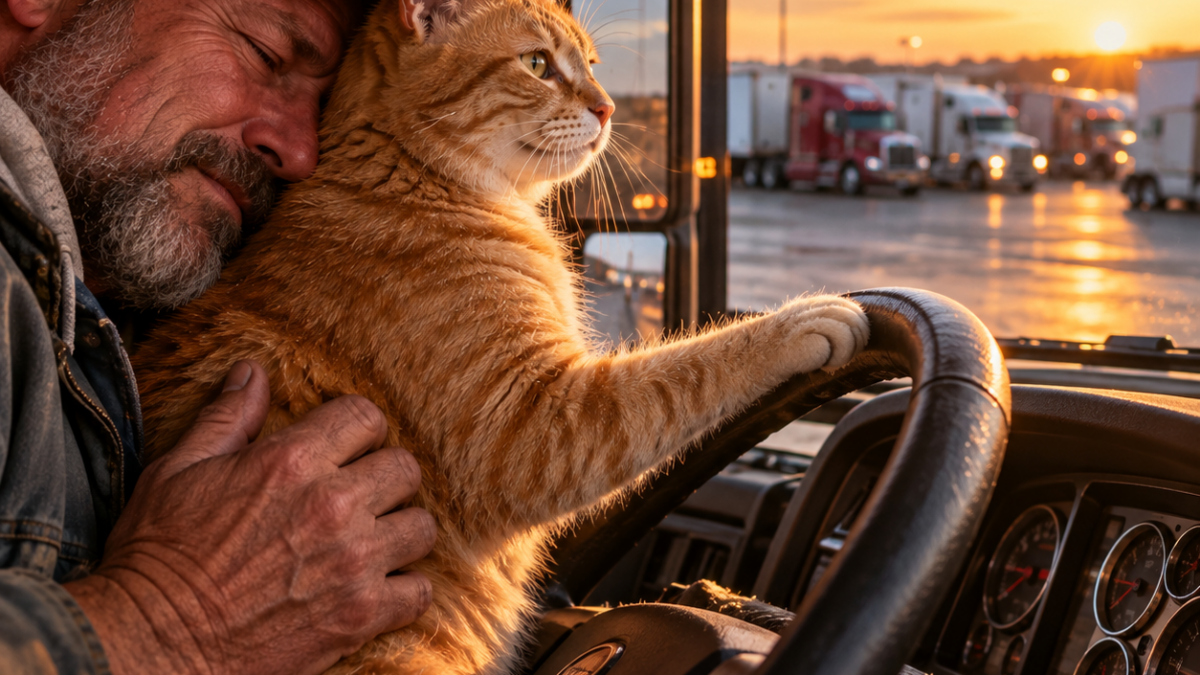
Placed one front paw on top of the wheel.
And looked through the windshield.
Ray froze.
Outside, driver Luis Ramirez saw it.
Luis had known Ray twelve years.
He had heard the stories.
Shared snow delays.
Birthday meals.
Breakdowns.
Luis was standing beside his own truck when he saw the orange cat silhouetted in the cab.
He took out his phone.
Not because he expected anything.
Because the scene looked like Ray.
Man.
Cat.
Truck.
Then Diesel put his paw on the wheel.
Luis took one photograph.
Inside, Ray stared at that paw.
Orange fur.
Gray at the toes.
Resting on worn black leather where Ray’s own hands had sat for decades.
“Yeah,” Ray whispered.
Diesel remained there several seconds.
Then turned.
Stepped down.
Moved across the dash.
Ray opened his arms.
Diesel climbed into them.
Slowly.
Carefully.
He pressed his face against Ray’s neck.
Ray shut his eyes.
He did not care who saw.
“I know.”
His voice broke completely.
“I know.”
Diesel purred against him.
Ray held him.
Not tight.
Just enough.
“We’re going home.”
Outside the windshield, Tom looked away.
Luis lowered his phone.
Nobody cheered.
That mattered.
It would have ruined it.
They simply waited.
When Ray finally climbed down from the truck, he carried Diesel against his chest.
His knees hurt.
His back hurt.
He had a duffel over one shoulder.
Tom approached.
“That’s it?”
Ray looked back at the truck.
“That’s it.”
Tom held out his hand.
Ray looked at it.
Then pulled him into a hug.
Tom laughed.
“Who are you?”
“Don’t get used to it.”
Other drivers came over.
Hands.
Hugs.
Insults disguised as affection.
One man handed Ray a retirement card stuffed with gas-station gift cards despite the fact that Ray no longer needed diesel.
Stump said, “For road trips.”
Ray replied, “I’m never driving again.”
Everyone laughed because nobody believed him.
Diesel stayed in Ray’s arms.
When they reached home that evening, the house felt strange.
Too still.
Ray carried Diesel inside.
Set him down.
The cat walked slowly through the living room.
Sniffed.
Kitchen.
Hallway.
Bedroom.
Then returned to the front window.
He jumped onto the sill.
Missed slightly.
Ray caught him.
“Easy.”
The next morning Ray bought a recliner.
Not because he needed one.
Because the seat height lined up with the front window.
Diesel could sit on the armrest without jumping.
Ray placed it beside the glass.
At sunset, he sat down.
Diesel climbed onto the arm.
Traffic moved along the road outside.
Pickup.
SUV.
Delivery van.
Then a tractor-trailer in the distance.
Diesel’s head turned.
He followed it until it disappeared.
Ray watched him.
“You miss it?”
Diesel remained focused on the road.
Ray felt something ache.
“Me too.”
Retirement was harder than Ray admitted.
The first week felt like vacation.
The second felt wrong.
By the third, he was waking at 3:45 a.m. without an alarm.
He would make coffee.
Stand in the kitchen.
Listen.
No reefer units.
No air brakes.
No truck engines.
Silence in a stationary house had a different weight than silence in a cab.
On the road, stillness was temporary.
At home, stillness stayed.
Ray reorganized the garage.
Twice.
Changed the furnace filter.
Fixed a loose cabinet hinge.
Cleaned the gutters.
Bought groceries he did not know how to cook.
He irritated Michael with unnecessary phone calls.
“You busy?”
“Ray, I have a job.”
“So?”
“So retired people don’t get to harass workers.”
Ray smiled.
“Call me after.”
“I will.”
One afternoon Ray drove to the hardware store.
At the stoplight, a semi passed.
His hands tightened around his pickup steering wheel.
The instinct to follow was ridiculous.
Powerful.
He returned home in a bad mood.
Diesel was asleep at the window.
Ray sat beside him.
“I don’t know how to do this.”
The cat opened one eye.
“I know how to go.”
Ray looked at the quiet room.
“I don’t know how to stay.”
Diesel climbed slowly onto his lap.
Ray stroked his back.
“Guess we’ll figure it out.”
Three months after retirement, Luis posted the photograph.
He had asked Ray first.
“No.”
Luis waited a week.
Asked again.
“No.”
Another month.
“No.”
Then one afternoon, Ray said, “Do whatever.”
Luis posted it to a trucking group.
The caption was simple.
A man and his cat just finished 2.3 million miles together. This is how they said goodbye to the truck.
The picture spread.
Forty-three thousand shares in four days.
Then more.
People sent messages.
Truckers.
Veterans.
Widowers.
Night-shift workers.
People who understood what it meant to have one living thing beside you when the rest of the world felt far away.
Ray hated the attention.
At first.
A local reporter called.
He declined.
Then another.
Declined.
A morning television show emailed.
Absolutely not.
Michael called laughing.
“You’re famous.”
“I’m changing my number.”
“You’re the cat’s driver.”
“That seems accurate.”
But Ray read the comments.
Not all.
Enough.
A nurse working night shifts wrote that she understood the line about someone sitting in loneliness with you.
A widower said his beagle had done the same after his wife died.
A former soldier wrote that his dog had heard things he never told another person.
A trucker’s daughter said the photograph helped her understand why her father talked about his road dog like family.
Ray sat at his kitchen table reading.
Diesel slept nearby.
He realized the photograph was not really about mileage.
Or trucks.
Or even cats.
It was about presence.
The quiet kind.
The kind nobody photographs most days.
The kind that saves nothing and somehow changes everything.
Diesel turned fifteen.
His arthritis worsened.
The veterinarian added medication.
A heated bed appeared near the window.
Then a ramp to the couch.
Then another beside Ray’s bed.
Diesel’s hearing faded.
Ray began touching the floor gently before approaching from behind so he would not startle him.
The orange around Diesel’s muzzle became cream.
Then nearly white.
But every morning, he went to the front window.
Every morning.
Sometimes slowly.
Sometimes Ray carried him.
Diesel still watched the road.
Long-haul trucks drew the strongest reaction.
His ears moved.
His eyes followed.
Ray began recognizing regular drivers on the county road.
At first he simply waved.
Then one driver started tapping his horn lightly when he passed Ray’s house.
Diesel would lift his head.
Ray laughed.
Soon several drivers did it.
Not loud air-horn blasts.
Just short greetings.
Beep.
Diesel looked up.
Ray raised his coffee.
The world, once measured in interstate exits, had narrowed to one window.
Ray expected that to feel sad.
Often it did not.
In the evenings, sunlight crossed the living room.
Ray sat in the recliner.
Diesel on the armrest.
Sometimes Michael called.
Sometimes Emily visited with her little boy, Samuel.
The first time Samuel met Diesel, he whispered, “Is that the truck cat?”
Ray looked offended.
“He has a name.”
“Diesel.”
“Correct.”
Samuel touched the cat gently.
“Did he really go everywhere?”
“Pretty much.”
“Did he drive?”
“No.”
Samuel looked disappointed.
Ray glanced at the famous photograph framed on the wall.
“Well.”
He reconsidered.
“Maybe once.”
Samuel’s eyes widened.
Diesel slept through the lie.
Ray began attending breakfast every Wednesday with several retired drivers.
He had mocked retirement groups for years.
Now he showed up early.
They complained about knees.
Fuel prices.
Young drivers.
Electronic logs.
Everything.
Ray discovered that companionship did not have to be dramatic.
Coffee.
Eggs.
Same table.
Same time.
Someone noticing if you didn’t come.
He wished he had learned that earlier.
One evening, Michael visited.
They sat on the porch.
Diesel slept inside near the screen door.
Michael looked at him.
“You know what Mom would’ve said?”
Ray smiled.
“About what?”
“The cat.”
“That I’m wasting money.”
“No.”
“She hated pet hair.”
“She would’ve bought him Christmas presents.”
Ray laughed.
“Probably.”
Michael looked toward the sunset.
“You were gone a lot.”
Ray nodded.
“I know.”
“I used to be mad.”
“I know.”
“I thought you didn’t care.”
Ray looked at his hands.
“I cared.”
“I know that now.”
Ray swallowed.
“I didn’t know how to be around all of it.”
“All of what?”
“Dad dying. Mom. The house.”
Michael waited.
Ray continued.
“Every room had something in it.”
“A memory?”
“Yeah.”
“And the road didn’t?”
“The road only had whatever was in front of me.”
Michael nodded.
“So you kept moving.”
“Yeah.”
They were quiet.
Then Michael said, “And then you found a cat.”
Ray smiled.
“He found me.”
“That sounds like a bumper sticker.”
“Don’t ruin it.”
Michael laughed.
Inside, Diesel woke.
He walked stiffly toward the door.
Ray opened it.
The cat stepped onto the porch.
Moved directly to Ray.
Sat beside his boot.
Michael looked down.
“Still shadowing you.”
“Fourteen years.”
“Think he’ll ever stop?”
Ray scratched Diesel’s head.
“No.”
He was right.
At sixteen, Diesel’s kidneys began failing.
Not suddenly.
A slow shift.
More water.
Less appetite.
Weight loss.
The veterinarian showed Ray the lab values.
Early chronic kidney disease.
Manageable.
For now.
Ray nodded.
He had heard those words before.
Manageable.
For now.
Time had a way of hiding inside medical language.
Ray gave fluids when needed.
Changed food.
Monitored weight.
Diesel tolerated everything except one particular medication, which he spit dramatically across the kitchen every morning.
Ray once found a pill behind the refrigerator and realized Diesel had been pretending to swallow for at least three days.
“You’re a criminal.”
Diesel stared.
“Fifteen years and now you turn to fraud.”
But Ray worried.
Every slow step.
Every unfinished meal.
Every longer nap.
He watched.
Too much.
One night, Diesel struggled to climb onto the recliner arm.
Ray lifted him.
The cat settled.
A semi passed outside.
Diesel watched.
Ray said, “I know what you’re thinking.”
The cat’s eyes followed the truck lights.
“No.”
Ray stroked the thin fur between his shoulders.
“We’re not going anywhere.”
Diesel looked at him.
Ray smiled sadly.
“Not because I don’t want to.”
He leaned back.
“Because we already did.”
Diesel rested his head against Ray’s arm.
They watched headlights move through darkness.
Months later, Luis visited.
He stood in the living room staring at the framed photograph he’d taken.
“Still hate that picture?”
Ray considered.
“No.”
“Finally.”
“Don’t get excited.”
Luis crouched near Diesel.
“Hey, old man.”
Diesel sniffed his hand.
Luis looked at Ray.
“Remember that last day?”
“Every minute.”
“You sat there forever.”
“Twenty minutes.”
“Felt like an hour.”
Ray looked at the photograph.
“I didn’t know how to get out.”
“Out of the truck?”
“Out of that life.”
Luis sat opposite him.
Ray continued.
“Everybody thinks retirement happens when you turn off the engine.”
Luis nodded.
“It doesn’t.”
“No?”
“It happens later. Maybe a hundred times.”
Ray gestured toward the window.
“First time you wake up and don’t have somewhere to be.”
“The first snowstorm you don’t drive through.”
“First Christmas home.”
“The first time you hear trucks on the highway at night.”
Luis nodded slowly.
Ray touched Diesel’s back.
“And every time you realize that’s not you anymore.”
“You regret it?”
Ray looked down.
Diesel was asleep.
“No.”
Not even once?
Ray thought about it.
“I miss it.”
“That isn’t the same.”
“No.”
Ray smiled.
“I used to think missing something meant you made the wrong choice leaving it.”
Luis leaned back.
“And now?”
“Now I think it just means it mattered.”
Diesel reached seventeen.
No one expected that.
Dr. Benson, the veterinarian who had treated him as a kitten, had long since retired herself.
Ray tracked her down through the clinic.
Sent the famous photograph.
Beneath it he wrote:
You told me some truckers travel with cats. You neglected to mention the cat might steal fourteen years of my life.
Dr. Benson replied:
Looks like he gave them back with interest.
Ray printed that email.
Kept it.
Diesel’s final year was quiet.
He could no longer jump.
His hearing was mostly gone.
His vision remained good enough for the road.
Always the road.
Ray’s world had become a rhythm.
Morning medication.
Breakfast.
Window.
Nap.
Lunch.
Short walk through the yard in a harness Diesel still hated after nearly two decades.
Evening chair.
Traffic.
Bed.
Some people might have called it small.
Ray did not.
He had spent half his life crossing a continent.
Small no longer sounded like failure.
Small could mean close enough to touch.
One October afternoon, rain fell steadily.
Diesel was on the recliner arm.
Ray sat beside him.
A truck passed.
Diesel did not lift his head.
Ray noticed.
He waited.
Another truck.
Nothing.
Ray touched him.
Diesel opened his eyes.
Looked toward the road.
Then back at Ray.
Something inside Ray understood before his mind accepted it.
That night Diesel did not finish dinner.
The next morning, he did not go to the window.
Ray carried him there.
Set him carefully on the cushion.
Diesel watched for ten minutes.
Then turned away.
Ray called the veterinarian.
Bloodwork was worse.
Much worse.
Kidneys failing.
Dehydration.
Anemia.
Weight loss.
The vet was kind.
Too kind.
Ray hated kindness when bad news was coming.
“What do we do?”
“We can hospitalize him.”
“For how long?”
“Two or three days.”
“And then?”
“We see how he responds.”
“Will it fix him?”
The vet paused.
“No.”
Ray looked at Diesel.
The cat was curled inside his carrier.
“Will it give him good time?”
“Possibly.”
“Good?”
“I can’t promise that.”
Ray nodded.
He knew.
He had known before asking.
“What would you do?”
Veterinarians hated that question.
Ray asked anyway.
She looked at Diesel.
Then at Ray.
“I would take him home today.”
Ray’s eyes filled.
“And?”
“Give him whatever he wants.”
Ray swallowed.
“And when he stops enjoying the things that make him Diesel…”
She paused.
“…don’t make him stay for you.”
Ray stared at the floor.
That sentence followed him home.
Don’t make him stay for you.
How many times had Diesel stayed?
Every mile.
Every night.
Every parking lot.
Every storm.
Every bad decision.
Every silence.
Ray wanted more.
Of course he did.
One more sunrise.
One more winter.
One more ridiculous fight over medication.
One more truck passing the window.
Love was greedy that way.
But Diesel had never asked Ray to prove love by suffering.
Ray would not ask it of him.
For three days, Diesel seemed to improve.
He ate chicken.
Slept in the sun.
Watched traffic.
Ray allowed hope to enter.
Then on the fourth morning, Diesel tried to stand and could not.
Ray lifted him.
The cat’s body felt frighteningly light.
“Okay.”
Diesel’s eyes found him.
“Okay, buddy.”
Ray held him against his chest.
The same place he had held a six-week-old kitten beneath his work shirt in 2009.
“You don’t have to.”
Ray cried before he finished.
“You don’t have to do another mile.”
Diesel rested his head beneath Ray’s chin.
Ray called the clinic.
Michael came.
Emily came.
Luis drove two hours.
Carol sent a photograph of the ceramic egg dish because she could not travel.
Stump called and pretended not to cry.
Diesel spent the afternoon near the front window.
People came quietly.
No crowd.
No spectacle.
Just people whose lives had crossed theirs somewhere along 2.3 million miles.
Michael sat beside Ray.
“You okay?”
“No.”
“Good.”
Ray laughed weakly.
“What?”
“You’re allowed not to be.”
Diesel opened his eyes when a truck passed.
His ears moved.
Barely.
Ray smiled.
“There he is.”
At sunset, Ray took him to the clinic.
He carried Diesel inside wrapped in the old passenger-seat blanket.
Faded.
Frayed.
Still smelling faintly, impossibly, like truck fabric and years.
The veterinarian placed a blanket on the table.
Ray shook his head.
“My lap.”
“Of course.”
He sat.
Diesel rested against him.
The veterinarian inserted the catheter.
Ray looked through the window.
The clinic sat near a highway.
Headlights moved in the distance.
Ray repositioned Diesel slightly.
“So you can see.”
The cat’s eyes followed the road.
Ray pressed his face against Diesel’s head.
“You know something?”
Purr.
Very faint.
“You were never supposed to stay.”
Ray laughed through tears.
“That was the plan.”
Diesel breathed slowly.
“I was going to drop you at a shelter.”
Ray stroked the white fur around his muzzle.
“Then you climbed onto the dashboard.”
Another breath.
“And that was pretty much the end of me.”
The veterinarian waited.
Ray continued.
“You heard everything.”
His voice shook.
“More than anybody.”
Diesel’s paw rested against Ray’s wrist.
“The stupid stuff.”
“The bad stuff.”
“The things I should’ve told people.”
Ray closed his eyes.
“You were there.”
The veterinarian asked softly, “Are you ready?”
Ray looked at Diesel.
No.
Every part of him said no.
Then he remembered the box.
A tiny life abandoned because someone had chosen convenience over compassion.
Ray had spent seventeen years doing the opposite.
Love now required one final inconvenience.
Letting go.
He nodded.
“Yeah.”
The first injection made Diesel sleepy.
His body relaxed.
Ray whispered, “We’re parked.”
Diesel’s breathing softened.
“No more mountains.”
Ray kissed his head.
“No more scales.”
A tiny smile.
“No dispatch.”
Michael covered his mouth.
“No bad coffee.”
Ray cried openly.
“And no more damn harness.”
The veterinarian laughed through tears.
Diesel’s eyes almost closed.
Ray looked toward the highway lights.
“You did good.”
He placed one hand under Diesel’s paw.
“2.3 million miles.”
Then, softer:
“And somehow none of them were the important part.”
Diesel breathed.
Ray whispered, “You were.”
The final medication entered.
Diesel’s breathing slowed.
Then stopped.
Ray remained in the chair.
Nobody moved.
Outside, a tractor-trailer passed.
Its lights swept across the clinic wall.
Ray looked down at the orange cat in his arms.
Seventeen years earlier, he had opened a taped cardboard box beside a dumpster because he heard something scratching.
That tiny decision had split his life into before and after.
Before Diesel.
After Diesel.
Nine lonely years on the road before him.
Fourteen extraordinary years beside him.
And several quieter years afterward in a house by a window, learning that staying could be its own kind of journey.
Ray had Diesel cremated.
The ashes went into a small wooden box.
No elaborate inscription.
Just:
DIESEL
MY PASSENGER
2009–2026
Beneath it:
EVERY MILE.
Ray placed the box beside the famous photograph.
For weeks, he could not sit in the recliner.
The empty armrest hurt too much.
He used the couch instead.
He stopped opening the front blinds.
Then one morning, a truck tapped its horn outside.
Beep.
Ray looked up.
Another driver who had been greeting Diesel for years.
Ray stood.
Walked to the window.
Opened the blinds.
The road was there.
Same as always.
Cars.
Pickups.
Trucks.
People leaving.
People returning.
People heading somewhere he would never know.
Ray stood for a long time.
Then he moved to the recliner.
Sat.
The armrest was empty.
He placed one hand there.
“Morning, buddy.”
The silence hurt.
But it did not feel empty.
Not exactly.
Ray finally understood something he had tried to explain years earlier.
Diesel had never made loneliness disappear.
That was not what companionship did.
Companionship said:
I see the empty space too.
I’ll sit here with you.
Ray had said those words in different forms to Diesel for seventeen years.
Diesel had said them without words for even longer.
Months passed.
Ray began volunteering with a trucker support group.
Nothing official at first.
Coffee with younger drivers.
Phone calls.
Advice.
Then talks at training centers about fatigue, mental health, and isolation.
Ray hated the phrase mental health.
Sounded too clinical.
So he talked about what he knew.
The two a.m. parking lot.
The silence after turning off the engine.
The feeling of carrying things nobody asked about.
The danger of believing endurance and strength were the same.
At one event, a twenty-four-year-old driver asked, “What kept you going?”
Ray looked at the photograph on his phone.
“Orange cat.”
Everyone laughed.
Ray smiled.
“I’m serious.”
Then he told them.
Not the viral version.
The real version.
The taped box.
The shelter exit.
The passenger seat.
The fights with his brother.
Denise.
The crash.
The lonely nights.
The final run.
The wheel.
When he finished, the room was quiet.
Ray said, “Everybody thinks you need somebody who knows what to say.”
He shook his head.
“Sometimes you need somebody who doesn’t leave while you’re trying to figure out what to say yourself.”
Years later, people still shared Luis’s photograph.
Most did not know Diesel was gone.
They saw an old orange cat with one paw on a steering wheel.
A weathered hand nearby.
Sunlight through glass.
They wrote captions about loyalty.
Adventure.
Friendship.
Ray rarely corrected details.
Stories belonged partly to whoever needed them.
But if somebody asked him directly what the photograph meant, Ray gave the same answer.
“It wasn’t goodbye to the truck.”
They would look confused.
Ray would explain.
“That picture is about realizing we had finally reached the place where we didn’t need the truck anymore.”
Because the truck had never been home.
The road had never been home.
Home was not the rented house either.
Home had been the repeated presence of another living thing.
A folded blanket on a passenger seat.
A warm body against his arm at two in the morning.
A cat watching sunrise number one thousand as if it were the first.
Fourteen years of a quiet promise neither of them had known they were making.
I’m here.
Still here.
Still here.
Still here.
Ray sometimes wondered what Diesel had thought during those final 200 silent miles.
Of course, he knew the cat probably had not understood retirement.
Mileage.
Careers.
Endings.
Perhaps Diesel had simply noticed that Ray was quiet.
Maybe he smelled something different in him.
Maybe the paw on the steering wheel meant nothing more than an old cat choosing a comfortable place to stand.
Ray was fine with that possibility.
Love did not require magic.
It did not need fate.
A random act could still become a meaningful life.
A kitten could be abandoned without reason.
A trucker could open a box without knowing why that moment would matter.
A shelter exit could pass.
A million miles could accumulate.
Two lives could simply remain beside each other long enough to become inseparable.
That was miraculous enough.
Ray never found out who abandoned Diesel.
For a while, he wanted to.
In the early years, whenever he passed that Nebraska truck stop, he felt anger.
He would look toward the dumpster.
Imagine the box.
Imagine the person walking away.
He wanted to know how anyone could tape a kitten inside cardboard under summer heat.
Eventually the anger changed.
Not forgiveness.
Ray did not pretend cruelty deserved that.
But he stopped allowing the unknown person to occupy the center of Diesel’s story.
That person had possessed Diesel for maybe six weeks.
Ray had known him seventeen years.
The abandonment was an opening scene.
Not the ending.
Not even the important part.
The important part came afterward.
The passenger seat.
The sunrises.
The diner eggs.
The million-mile steak.
The snowstorm Christmas.
The mountain crash.
The hospital parking lot.
The bad breakup.
The kidney scare.
The wedding.
The retirement yard.
The wheel.
The window.
The quiet evenings.
The final drive.
The final highway lights.
That was the life.
One summer evening, almost a year after Diesel died, Ray sat beside the front window.
A storm had passed.
The road was wet.
Sunlight broke through clouds and turned the pavement gold.
A tractor-trailer moved toward town.
For a second, Ray automatically glanced toward the armrest.
Empty.
He smiled.
The truck passed.
Ray followed it with his eyes until it disappeared.
He finally understood why Diesel had never stopped watching the road.
It was not because the road was always changing.
It was because every passing thing deserved attention while it was still there.
Ray sat until dark.
He thought about the first nine years of his trucking life.
Then the fourteen years after.
He had once told Luis:
“People think trucking is lonely. It is.”
That remained true.
He had driven twenty-three years.
The first nine were the loneliest years of his life.
The next fourteen were not.
Not because loneliness disappeared.
Not because a cat could replace people.
Not because Ray suddenly became whole.
But because Diesel sat inside the loneliness with him.
Every mile.
Every overnight lot.
Every freezing morning.
Every desert afternoon.
Every cheap meal.
Every argument over the phone.
Every stretch of interstate where there was nothing outside but black sky and headlights.
Diesel was there.
A six-week-old kitten someone had once decided was disposable.
A kitten left sealed inside cardboard beside garbage.
He became the witness to almost half a man’s adult life.
The keeper of stories Ray could not tell.
The reason strangers at truck stops smiled.
The bridge that helped two brothers speak again.
The passenger beside whom millions of miles somehow became bearable.
Ray drove 2.3 million miles with Diesel.
But distance, in the end, was not the remarkable thing.
The remarkable thing was that of all the places they crossed, all the interstates, state lines, mountains, plains, cities, exits, rest areas, diners, loading docks, and empty nighttime highways, the most important journey was only a few feet long.
From a taped cardboard box beside a dumpster…
to the passenger seat of a truck.
From the passenger seat…
to Ray’s lap.
From the truck…
to the front window of a quiet little house.
And finally, from being something someone had thrown away…
to becoming something one man could not imagine having lived without.
The road kept moving after Diesel was gone.
It always would.
But whenever a semi rolled past Ray’s window in the evening and sunlight flashed across the glass, Ray sometimes rested his hand on the empty armrest beside him.
Not because he believed Diesel was still sitting there.
Because once, for millions of miles, he had been.
And sometimes the deepest love a life gives us is not the kind that rescues us from loneliness.
Sometimes it simply climbs into the passenger seat…
looks through the windshield…
and stays.








