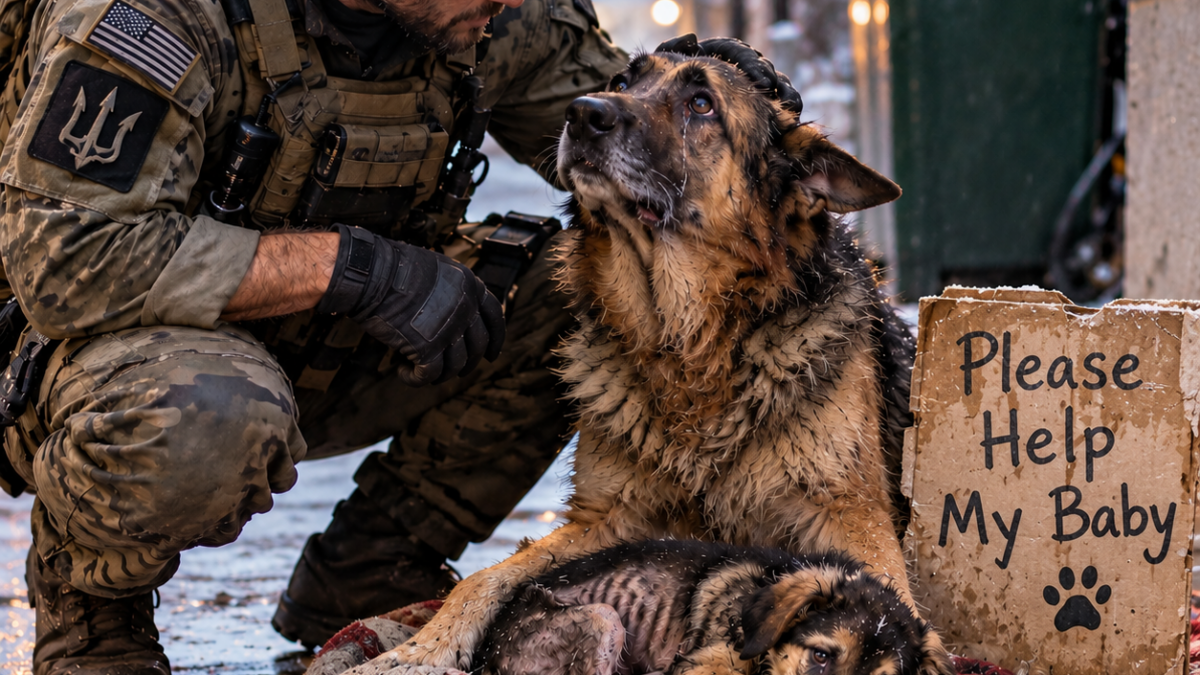
A Starving Mother German Shepherd Sat on a Wet Sidewalk With Her Paws Pressed Together Beside Her Dying Puppy—Then a Navy SEAL Stopped and Read the Four Words on the Cardboard Sign.
PART3:
But the most disturbing part was not their condition.
It was the way the mother kept glancing down at the puppy between every person who passed.
Her body was begging for herself.
Her eyes were begging for him.
A man in a long black coat crouched near the bowl, holding a coin between two fingers like bait.
“Come on,” he said. “Do the prayer thing again.”
Garrett’s jaw tightened.
The dog’s paws wobbled.
The man chuckled.
“Smart girl. Somebody trained you good.”
Garrett stepped forward.
“Is she yours?”
The man looked up, annoyed at the interruption.
“No.”
“Do you know whose dog she is?”
The man shrugged. “Been here since I got coffee. Maybe some homeless guy’s. Maybe a scam. Who knows?”
Garrett looked at the puppy.
“He yours?”
“What part of no didn’t you understand?”
The man tossed the coin into the bowl. It clinked against the metal.
The mother dog flinched at the sound but did not run.
She lowered her paws and leaned over the puppy, nudging his face with her nose.
The puppy did not lift his head.
Garrett crouched slowly.
Not directly in front of her.
To the side.
Every movement controlled.
Every instinct in him understood what she was: frightened, protective, starving, and still willing to stand between danger and her baby.
“Hey, mama,” he said softly.
The dog’s ears twitched.
One ear stood weakly.
The other drooped.
Her gaze snapped to his face.
He held out one hand, palm down, not touching.
She sniffed the air.
Then her eyes moved to his hand.
Then his face.
Then back to the puppy.
Garrett took in the details.
Raw skin around her neck where something had rubbed too long.
Old scars along her muzzle.
A swollen front paw.
Mud dried into her chest fur.
The puppy’s gums, visible when his lip moved slightly, were pale.
Too pale.
His breathing was shallow and uneven.
Not sleeping.
Declining.
Garrett pulled out his phone.
The mother dog stiffened.
“I’m calling help,” he said, not because she understood the words, but because tone mattered.
He searched for the nearest emergency veterinary clinic.
Twelve minutes by car.
That was too long if he waited for someone else.
He dialed anyway.
“San Diego Emergency Animal Hospital,” a woman answered.
“I’m on Fifth near Broadway,” Garrett said. “I’ve got a severely malnourished German Shepherd mother and a critical puppy. Puppy is barely responsive. I’m bringing them in now.”
“Sir, are they safe to handle?”
Garrett looked at the mother.
She looked back.
“I’ll make them safe.”
He ended the call.
The man in the black coat stood.
“Careful, dude. You can’t just take street dogs. Someone might own them.”
Garrett turned his head slowly.
The look he gave the man came from places far darker than a downtown sidewalk.
“If someone owns them,” Garrett said, “they should pray I don’t find them first.”
The man backed away.
Garrett removed his jacket and spread it over the blanket.
The mother dog watched, tense.
“I’m going to pick him up,” he said softly. “I know. I know you don’t know me. But I’m going to help him.”
He slid his hands beneath the puppy.
The little dog weighed almost nothing.
That was wrong.
A puppy should feel solid with new life, all belly and paws and heartbeat.
This one felt like heat, bone, and exhaustion.
The puppy made a tiny sound.
The mother lurched forward, panic flashing through her entire body.
Garrett froze.
“I’m not taking him from you,” he said. “You’re coming too.”
The mother’s eyes stayed on his.
Her body shook.
Maybe it was his voice.
Maybe it was her exhaustion.
Maybe, after everything she had survived, she still had enough faith left to recognize a person who meant what he said.
She did not bite.
She followed.
Not easily.
Not steadily.
She stumbled when she stood. Her back legs nearly folded. Her front paw slipped on the wet concrete.
A woman near the storefront gasped.
“Oh my God,” she said. “That poor thing.”
Garrett wanted to ask why she had only seen it now.
Instead, he focused on the dogs.
His truck was parked half a block away.
A black Ford F-250 with dried mud on the tires and a folded American flag sticker on the back window.
He carried the puppy against his chest.
The mother limped after him, head low, eyes locked on her baby.
The city continued around them.
A bus hissed to a stop.
A cyclist rang a bell.
Someone behind Garrett said, “Is anyone recording this?”
That was the world now.
Suffering had to become content before it became urgent.
Garrett opened the back door of his truck and placed the puppy on his jacket across the seat.
The mother tried to climb in.
Failed.
Tried again.
Her paws scraped against the running board.
Garrett bent down.
“I’ve got you too, mama.”
She stiffened when he lifted her.
She was shockingly light.
A grown German Shepherd should never feel like a bundle of wet laundry.
Garrett placed her beside the puppy.
She immediately curled around him, pressing her chest to his back, licking his face with slow, tired strokes.
Garrett shut the door gently.
Then he drove.
Fast, but controlled.
He had driven under fire.
Driven with one tire blown.
Driven with men bleeding in the back of armored vehicles.
But that morning, every red light felt cruel.
Every pedestrian crossing too slowly made his hands tighten on the wheel.
He kept looking in the rearview mirror.
The mother dog’s head rested over the puppy’s neck.
Her eyes never closed.
At the emergency clinic, Garrett carried the puppy inside.
The mother tried to follow and collapsed just past the entrance.
Two technicians rushed forward.
“What happened?” one asked.
“Found them downtown,” Garrett said. “Mother is malnourished and injured. Puppy is critical. He’s barely responding.”
The word critical changed the room.
A veterinary technician scooped the puppy from Garrett’s arms.
The mother tried to rise.
Her legs failed.
Garrett knelt beside her.
“You did your part,” he told her. “Let them do theirs.”
A technician brought a stretcher.
Another brought warm blankets.
The mother dog let out a sound when they carried the puppy through the double doors.
It was not a bark.
Not a howl.
A thin, broken cry.
The kind of sound a creature makes when the only thing keeping her alive is taken out of sight.
Garrett moved with her as they placed her on a padded mat.
“I’m staying,” he said.
No one argued.
The veterinarian came out twenty minutes later.
Dr. Natalie Brooks.
Early forties.
Dark hair pulled back.
Green scrubs.
Eyes tired in the way emergency veterinarians’ eyes are tired: from seeing suffering and still choosing tenderness.
“The puppy is alive,” she said first.
Garrett exhaled through his nose.
“But he is extremely weak. Severe dehydration, malnutrition, low blood sugar, and likely infection. We are warming him slowly and starting fluids.”
“And the mother?”
Dr. Brooks glanced through the glass toward the treatment room.
“She is also in serious condition. Severe malnutrition, dehydration, old wounds, a neck abrasion that suggests prolonged restraint. Her front paw is infected. She has bruising along her ribs.”
Garrett’s jaw moved once.
“And?”
Dr. Brooks understood the question beneath the question.
“And she has been nursing him while starving herself,” she said softly. “Her body has been breaking down its own fat and muscle to keep milk production going. If they had stayed out there much longer…”
She did not finish.
She did not need to.
Garrett looked through the window.
The mother dog lay on her side now, IV line taped to one leg. Even sedated by exhaustion, her head was angled toward the incubator where the puppy was being treated.
“She was begging for him,” Garrett said.
Dr. Brooks nodded.
“Yes. I believe she was.”
Garrett pulled out his wallet.
“Do whatever it takes.”
“Mr.—?”
“Hayes. Garrett Hayes.”
“Mr. Hayes, this could be expensive.”
He handed her a credit card.
“Do whatever it takes.”
Dr. Brooks took the card.
There was something in her face now.
Not pity.
Respect.
“I’ll do everything I can.”
Hours passed.
Garrett stayed.
He sat in the waiting room in wet clothes, elbows on knees, hands clasped, eyes fixed on the swinging doors.
The clinic moved around him.
A bulldog with breathing trouble.
A cat with a blocked bladder.
A terrier who had eaten something it should not have eaten.
Ordinary emergencies.
Garrett barely noticed.
His mind kept returning to the sidewalk.
The mother’s paws pressed together.
The cardboard sign.
The bowl with coins.
Please Help My Baby.
Who had written it?
Where had that person gone?
Had someone left them there to collect sympathy money?
Had someone found them, written the sign, and walked away because they did not know what else to do?
Had the mother dog learned that posture from hunger, from watching humans respond to anything that looked like prayer?
No answer made it better.
At dawn, Dr. Brooks returned.
Garrett stood instantly.
“The puppy is responding,” she said. “His glucose is up. He’s still fragile, but he’s stronger than when he came in.”
Garrett closed his eyes for one brief second.
“And the mother?”
“Stable. Weak, but stable.”
“For now?”
Dr. Brooks did not soften the truth.
“The next forty-eight hours matter.”
“Can I see them?”
She studied him.
Then nodded.
Garrett followed her into the treatment area.
The puppy lay in a warming enclosure, wrapped in soft towels, a tiny catheter in one leg. His eyes were closed now. His breathing looked easier.
The mother lay beside the enclosure on a heated pad.
Not inside.
Not touching.
But close enough to see him.
The moment Garrett entered, she lifted her head a few inches.
Her eyes searched his hands.
Looking for the puppy.
“He’s there,” Garrett said.
He pointed gently toward the enclosure.
“He’s safe.”
The mother looked.
The puppy’s paw twitched.
She lowered her head and released the smallest sigh.
Garrett felt it in his own chest.
“What are their names?” Dr. Brooks asked.
Garrett blinked.
“They’re not mine.”
Dr. Brooks said nothing.
She only looked at the mother dog.
Then at the puppy.
Then back at Garrett.
He followed her gaze and saw the cardboard sign sitting sealed in a plastic bag on the counter. Someone from the clinic had saved it.
Please Help My Baby.
Garrett stared at the words.
“Hope,” he said finally.
“The mother?”
He nodded.
“She had nothing left and still begged for him. That’s hope.”
“And the puppy?”
Garrett watched the little body breathing under the towel.
“Bravo.”
Dr. Brooks smiled slightly.
“Military alphabet?”
“Yeah.”
“Why Bravo?”
Garrett’s voice softened.
“Because he made it through his first fight.”
Hope and Bravo stayed in the clinic for nine days.
Garrett came every day.
The first day, Hope did not let him touch her unless Dr. Brooks was beside him.
The second day, she sniffed his hand.
The third day, she allowed one slow stroke between the ears.
Her body trembled the entire time.
But she did not pull away.
Bravo improved by tiny increments.
A stronger breath.
A lifted head.
A little whimper that sounded offended rather than dying.
On the fourth day, he opened both eyes fully and stared at Garrett through the glass of the warming enclosure as if trying to decide whether this large human was now part of his world.
On the fifth day, his tail moved.
Just once.
A tiny sweep beneath the blanket.
Garrett turned away quickly.
Dr. Brooks pretended not to notice.
By the sixth day, Bravo was strong enough to be placed beside Hope for a short supervised visit.
The moment the puppy touched her side, Hope’s entire body changed.
Until then, she had been resting.
Surviving.
Enduring care.
But when Bravo pressed his nose into her fur, she became alive in a way that made every technician in the room go quiet.
She lowered her head over him and began grooming his face with small careful licks.
Bravo made a squeaky sound and pushed closer.
Hope closed her eyes.
Not from exhaustion this time.
From relief.
Garrett stood behind the glass, hands in his pockets, unable to look away.
Dr. Brooks came to stand beside him.
“She trusts you,” she said.
“No, she doesn’t.”
“She’s starting to.”
Garrett shook his head.
“She trusts that I brought him back.”
“That’s a beginning.”
He said nothing.
Dr. Brooks studied him for a moment.
“Do you have dogs?”
“Not anymore.”
“Before?”
Garrett swallowed.
“We had military working dogs attached to units sometimes.”
“That’s not what I meant.”
He looked at her.
She had a way of asking questions without making them feel like traps.
“My best friend had one,” Garrett said finally. “Liam. His dog was named Valkyrie. German Shepherd. Smartest animal I ever knew.”
“What happened?”
Garrett’s face changed.
Only slightly.
But Dr. Brooks saw it.
“Liam didn’t come home,” he said.
“And Valkyrie?”
“She did. Last I heard, she was retired to his parents’ ranch.”
He looked at Hope.
“Dogs like this… they don’t just work with you. They learn the shape of you. They know when you’re scared before you do.”
Dr. Brooks was quiet.
Garrett continued, almost to himself.
“Liam used to say Valkyrie could smell bad decisions.”
“That sounds useful.”
“It was.”
Hope lifted her head behind the glass.
Her eyes found Garrett.
For a moment, he had the unsettling feeling that she knew he was talking about another dog.
Another war.
Another grief.
On the seventh day, Garrett asked the question everyone had been waiting for.
“What happens to them after they leave here?”
Dr. Brooks folded her arms.
“We contact animal control, document the case, and work with a rescue if no owner comes forward.”
“No owner is getting them back.”
“That will be investigated.”
Garrett’s voice went flat.
“Good.”
Dr. Brooks held his gaze.
“Are you asking because you want to foster them?”
Garrett did not answer quickly.
He had spent the last three weeks telling himself he was not ready to be responsible for anything living.
Some mornings, he barely felt responsible for himself.
His cabin was quiet because he had chosen quiet.
His phone stayed on silent because he hated sudden rings.
His refrigerator contained eggs, coffee, and meals that came in cardboard trays.
He woke from nightmares more nights than not.
He had no business taking in a traumatized dog and a medically fragile puppy.
That was the practical answer.
Then Hope shifted behind the glass, placing one paw across Bravo’s back.
Garrett said, “Yes.”
Dr. Brooks did not smile yet.
“Both?”
“Yes.”
“Hope may have long-term medical issues.”
“I understand.”
“She may have trauma responses. Fear, guarding, anxiety, difficulty trusting men, difficulty with sudden movement.”
“I understand.”
“Bravo will need training, vaccines, careful nutrition, socialization. He may have developmental concerns from early malnutrition.”
“I understand.”
“Do you?”
Garrett looked at her.
Dr. Brooks did not look away.
This was not judgment.
It was responsibility.
She was not going to hand living beings over to a man simply because he had a credit card and a heroic story.
Good.
That made Garrett respect her more.
“I know what trauma looks like when it doesn’t have words,” he said quietly. “I know progress can be slow. I know some nights are bad for no clear reason. I know trust isn’t owed because you did one decent thing.”
Dr. Brooks’s expression softened.
“I also know,” Garrett continued, “that I have space. Time. A secure home. Money for follow-up care. And I know what it means when something broken still chooses to come closer instead of running.”
Hope’s eyes were on him.
Bravo was asleep under her chin.
“I want them,” Garrett said. “Not because I think I saved them. Because I think maybe we’re supposed to save each other.”
Dr. Brooks looked through the glass.
Then back at him.
“That,” she said, “is the first answer today I actually like.”
Bringing them home was not cinematic.
Garrett imagined some great emotional moment, like Hope stepping into the cabin and immediately understanding she was safe.
That did not happen.
Hope froze at the doorway.
Bravo wriggled in Garrett’s arms, curious and nervous, while Hope stared into the cabin like it might swallow her.
Garrett had prepared everything.
A large orthopedic dog bed near the fireplace.
A smaller bed beside it for Bravo.
Food and water bowls.
Medication.
A baby gate to block the stairs.
Soft rugs over the slick hardwood.
A crate with the door removed because he did not want Hope to feel trapped.
Toys arranged in a basket because the pet store clerk had told him puppies needed stimulation and Garrett had overcorrected by buying half an aisle.
Hope did not care about any of it.
She stood in the entryway shaking.
Garrett set Bravo down gently on the rug.
The puppy sniffed twice, stumbled forward, and peed immediately.
Garrett looked at him.
Bravo looked back.
“Fair,” Garrett said.
Hope took one step inside only after Bravo moved.
Then another.
She inspected the walls.
The corners.
The windows.
The back door.
The bed.
The food.
The fireplace.
Garrett did not touch her.
Did not coax.
Did not crowd.
He simply stood aside and let her map the room.
At last, she went to the far corner near the fireplace and lay down with her back to the wall.
Bravo followed, collapsed against her belly, and fell asleep almost instantly.
Garrett sat on the floor ten feet away.
For an hour, no one moved.
That became the beginning of their life.
Not trust.
Not yet.
Just no one hurting anyone.
Sometimes that is the first miracle.
The first week was hard.
Hope ate only when Garrett sat across the room and looked away.
Bravo needed feeding on a strict schedule.
Hope panicked if he cried too loudly.
Garrett slept badly because he listened for every movement.
Hope slept badly because she listened too, though not for the same things.
If Garrett dropped a pan, Hope flinched so hard she hit the wall.
If a truck backfired on the road, Bravo yelped and Hope stood over him shaking, ready to defend him from a sound already gone.
If Garrett reached for a belt, even to move it from a chair, Hope froze.
The first time that happened, Garrett put the belt in a drawer and sat on the floor until she could breathe normally again.
“I’m sorry,” he said.
She watched him.
He meant more than the belt.
He meant every human who had taught her to fear hands.
Every passerby who had walked around her on the sidewalk.
Every person who had seen the sign and decided a coin was enough.
Garrett knew apology did not fix history.
But he gave it anyway.
On the tenth night, Garrett woke from a nightmare.
He was not in his cabin.
Not at first.
He was back in dust and heat and screaming radio traffic. Liam was calling his name. Valkyrie was barking somewhere he could not see. The sky was full of smoke.
Garrett came awake sitting upright, one hand reaching for a weapon that was not there.
His heart hammered.
The cabin was dark.
The fire had burned low.
Bravo was asleep in the crate beside Hope’s bed, twitching in puppy dreams.
Hope stood beside Garrett’s couch.
Silent.
Watching him.
Her eyes were not afraid.
Not exactly.
Alert.
Concerned.
He lowered his hand slowly.
“Bad dream,” he whispered.
Hope took one cautious step forward.
Then another.
Garrett held still.
She reached the edge of the couch and pressed her forehead against his knee.
He closed his eyes.
For the first time since coming home, he cried where someone could see.
Not loudly.
Not dramatically.
Just a few silent tears he did not bother wiping away.
Hope did not move.
She had begged him to save Bravo.
Now, somehow, she was saving him back.
The investigation into Hope and Bravo’s abandonment moved slowly.
Too slowly for Garrett’s liking.
Animal control collected the cardboard sign, witness statements, clinic records, photos of the dogs’ condition, and security footage from nearby businesses.
The footage told part of the story.
At 4:12 that morning, a rusted van had pulled near the curb.
A man in a hooded sweatshirt had unloaded the blanket, the bowl, the cardboard sign, the puppy, and Hope.
The man had tried to tie Hope to a parking meter.
She fought him.
Even starving, she fought.
He shoved her hard enough that Garrett had to pause the video and look away.
Then the man left.
Hope spent the next several hours on that sidewalk.
At first, she had paced around Bravo.
Then she had tried to follow the van but returned when Bravo cried.
Then people began passing.
At some point, Hope raised her paws.
No one knew why.
Maybe someone gave money when she did it.
Maybe someone had trained her cruelly before.
Maybe she discovered by accident that humans reacted to prayer more than pain.
Whatever the reason, she kept doing it.
Again and again.
For her baby.
A license plate reader eventually caught the van. The man was identified as Bradley Dawson, a low-level criminal with prior animal cruelty complaints that had never gone far enough.
Garrett wanted to be there when they arrested him.
He was not allowed.
That was probably good.
The detectives learned that Dawson had been running dogs through illegal backyard breeding networks. Females kept until their bodies gave out. Puppies sold if healthy. Dumped if not.
Hope had been one of those females.
Bravo was likely the last puppy she had left.
The others were gone.
Garrett did not ask for details.
Some knowledge does not help healing.
But when the detective told him Dawson was being charged, Garrett stood very still for a long time.
Then he said, “Good.”
That night, Hope refused dinner.
Garrett sat beside her bowl.
Not too close.
Just close enough.
“I know,” he said.
Hope stared at the food.
Bravo, who had no emotional conflict about food whatsoever, tried to toddle over and eat it.
Hope placed one paw gently in front of him.
Not aggressive.
Just mother.
Garrett smiled despite himself.
“You’re right,” he told her. “He has his own.”
Bravo sneezed.
Weeks became months.
Hope gained weight.
Slowly.
Her coat grew cleaner, thicker, more golden around the edges.
The scars did not vanish, but they stopped being the first thing people saw.
Bravo became chaos.
He discovered shoes.
Then socks.
Then toilet paper.
Then the magical thrill of barking at his own reflection in the oven door.
He tripped over his paws daily and reacted each time as if betrayed by the floor.
Hope watched him with tired devotion and occasional disbelief.
Garrett had never known a puppy could produce so much noise, motion, and laundry.
He loved him helplessly.
The first time Bravo chased a tennis ball across the yard, Hope stood on the porch.
Her body was tense.
Garrett held the ball.
“You ready?” he asked.
Bravo barked, spun in a circle, and nearly fell over.
Garrett tossed it gently.
Bravo launched himself after it with heroic incompetence.
He caught up to the ball, stepped on it, rolled forward, and landed in the grass.
Garrett laughed.
A real laugh.
Hope’s ears perked.
Bravo came back carrying the ball by one edge, head held high like he had conquered a nation.
He dropped it at Hope’s feet.
Hope looked at the ball.
Then at Bravo.
Then, to Garrett’s amazement, she lowered her head, picked it up, and placed it back in front of her son.
Bravo barked with joy.
Hope’s tail thumped once.
It was the first time Garrett saw her play.
Not fully.
Not freely.
But enough.
Spring came soft over the cabin.
Wildflowers appeared near the fence.
Sun warmed the porch steps.
Garrett began leaving the front door open with the screen latched so Hope and Bravo could smell the world without fearing it.
One afternoon, Dr. Brooks came for a home visit.
Officially, it was to check Hope’s weight and Bravo’s development.
Unofficially, Garrett suspected she wanted to see whether the tired SEAL and the sidewalk dogs were actually becoming a family.
Hope met her at the door.
Cautious, but not hiding.
Bravo barreled into Dr. Brooks’s legs, tail wagging so hard his whole back end moved.
“Well,” Dr. Brooks said, laughing as she crouched. “Someone feels better.”
Bravo licked her chin.
Hope sniffed her sleeve.
Then allowed Dr. Brooks to touch her shoulder.
Only once.
But willingly.
Dr. Brooks looked at Garrett.
“She looks wonderful.”
“She did the work.”
“You helped.”
Garrett shrugged.
Hope walked to the porch and lay in a patch of sun.
Bravo grabbed a tennis ball and immediately forgot what he planned to do with it.
Inside the cabin, Dr. Brooks noticed the framed cardboard sign on the wall.
Please Help My Baby.
She stood in front of it quietly.
“You kept it.”
“I couldn’t throw it away.”
“I’m glad.”
Garrett looked at the sign.
“I hate it.”
“I know.”
“But I need it.”
Dr. Brooks turned toward him.
“Why?”
He took a while to answer.
“Because it reminds me that I almost kept walking.”
She did not interrupt.
“I saw them,” Garrett said. “And for half a second, I thought what everyone thinks. Someone else will handle it. There are numbers for this. There are agencies. There are people whose job this is.”
He looked through the window at Hope and Bravo.
“Then she looked at me.”
Dr. Brooks followed his gaze.
“Most people don’t think they’re bad when they look away,” he said. “They think they’re busy. They think they’re protecting themselves. They think one person can’t fix every sad thing.”
“That’s true,” Dr. Brooks said softly.
“I know.”
He swallowed.
“But one person can stop for one sad thing.”
Outside, Bravo pounced on the ball and missed.
Hope rested her head on her paws.
The sun outlined the scars beneath her fur.
Dr. Brooks said, “That’s why you kept the sign.”
Garrett nodded.
“So I don’t forget.”
Summer arrived.
Bravo grew.
His paws remained too big for him, but the rest of his body started catching up. His coat became glossy black and tan. His ears stood up unevenly for a while, one always slightly confused.
Hope became stronger too.
She still limped after long walks.
Still startled at sudden shouts.
Still positioned herself between Bravo and strangers.
But she began choosing softness.
She slept on the dog bed instead of the floor.
She accepted treats from Garrett’s hand.
She came when called.
Not always quickly.
But willingly.
One night, during a thunderstorm, she did not hide.
She stood from her bed, looked toward the windows, then walked to Garrett and pressed against his leg.
Bravo followed, concerned mainly because everyone else seemed concerned.
Garrett sat on the floor between them while thunder rolled over the hills.
No one panicked.
That was progress.
Not dramatic.
Not cinematic.
But real.
The news story came later.
A local reporter found out through court records after Bradley Dawson pleaded guilty to animal cruelty and illegal breeding charges.
The headline read:
Navy SEAL Rescues Mother Dog Begging for Her Puppy on Downtown Sidewalk.
Garrett hated it.
“They make it sound like I did something heroic,” he told Dr. Brooks.
She was examining Bravo’s ears at the time.
“You did.”
“I picked up two dogs.”
“You stopped.”
He said nothing.
“That’s the heroic part,” she added.
He looked away.
The story spread.
People wanted interviews.
Garrett refused most.
Then Dr. Brooks called and said the clinic had received dozens of messages asking how to help neglected animals, how to report abuse, how to foster.
That changed his answer.
He agreed to one interview.
Only one.
He sat on his porch with Hope lying beside him and Bravo chewing a rope toy near his boots.
The reporter asked about his military service.
Garrett redirected to the dogs.
The reporter asked whether he believed fate brought him to that sidewalk.
Garrett looked at Hope.
“No,” he said. “I believe she asked for help, and I happened to be the one who finally listened.”
The reporter asked what he wanted people to learn.
Garrett thought for a long moment.
Then he said, “Don’t make suffering perform before you care.”
The reporter lowered her pen.
He continued.
“That dog had to sit like she was praying before people stopped. She had to have a cardboard sign before people understood she was desperate. We should not need suffering to become dramatic before we respond to it.”
The story ran that weekend.
This time, donations went to the rescue organizations that helped shut down Dawson’s network.
Several neglected dogs were pulled from related properties.
Some survived.
Some did not.
Garrett learned that rescue work carried grief even when it succeeded.
Hope seemed to understand when new dogs came briefly through the cabin as emergency fosters.
She did not love every dog.
She was not a saint.
But she tolerated scared mothers best.
Once, Dr. Brooks brought over a young shepherd mix with three puppies who needed overnight placement.
Hope watched them from across the room.
Then stood, walked to the nervous mother, and lay down a respectful distance away.
Not invading.
Not claiming.
Just present.
The young mother stopped shaking after a while.
Garrett saw that and had to step outside.
Some circles are too painful and beautiful when they close.
A year after the morning on the sidewalk, Garrett took Hope and Bravo downtown.
Not to the same exact spot at first.
He was not sure Hope could handle it.
Or maybe he was not sure he could.
They walked slowly.
Bravo was full-grown now, strong and bright, wearing a blue collar with a small tag that read BRAVO HAYES.
Hope wore a red collar with her name engraved on brass.
She moved with dignity.
A slight limp.
A watchful gaze.
Scars hidden mostly by healthy fur.
People noticed them.
Of course they did.
Two German Shepherds with a tall, quiet man always drew glances.
Garrett stopped across the street from the storefront where he had found them.
The shop had changed.
The sidewalk had been cleaned.
No blanket.
No bowl.
No cardboard sign.
Just people walking past, carrying coffee, shopping bags, phones, their own urgent lives.
Hope stood still.
Bravo sniffed a lamppost with deep professional interest.
Garrett looked down.
“You okay, mama?”
Hope’s ears shifted.
She looked across the street.
For a long moment, she did not move.
Then she leaned against Garrett’s leg.
Not trembling.
Not collapsing.
Just leaning.
He placed one hand on her head.
“I know.”
A woman passing by recognized them.
“Is that the dog?” she asked.
Garrett nodded once.
Her eyes filled.
“She looks so good.”
Hope looked at the woman, then back at Garrett.
The woman crouched slightly but did not reach.
“Hi, Hope,” she said.
Hope gave one slow blink.
That was all.
It was enough.
Back at the cabin that evening, the sun poured gold across the porch.
Bravo sprawled upside down in the grass, legs in the air, completely shameless.
Hope lay beside Garrett on the steps.
He held an old green tennis ball in one hand.
For a while, he did not throw it.
He simply watched the yard.
The trees.
The safe fence.
The two bowls inside by the kitchen.
The framed sign visible through the front window.
Please Help My Baby.
A year ago, those words had been a plea.
Now they were history.
Not forgotten.
But answered.
Garrett tossed the ball.
Bravo sprang after it, fast and clumsy and full of joy.
Hope watched him run.
Her tail thumped once against the wood.
A mother’s quiet pride.
When Bravo returned, he did not drop the ball at Garrett’s feet.
He dropped it in front of Hope.
Hope picked it up gently, held it for a moment, then released it back to him.
Bravo barked.
Garrett smiled.
The world had taken things from all three of them.
From Garrett, it had taken sleep, certainty, friends whose voices still visited him in dreams.
From Hope, it had taken safety, strength, trust, and almost her baby.
From Bravo, it had almost taken the chance to grow up at all.
But the world had also left a sidewalk.
A morning.
A moment.
A mother dog brave enough to beg.
A man tired enough to nearly walk past, but not quite.
Sometimes people ask Garrett whether Hope saved Bravo.
He always says yes.
Sometimes they ask whether Garrett saved them both.
He says no.
Not exactly.
Hope saved Bravo first.
Bravo saved Hope by giving her a reason to keep breathing.
And together, they saved Garrett from returning to a life where he moved through the world without belonging to it.
That is what people miss about rescue.
It does not move in one direction.
You reach down for something broken, and sometimes it reaches back.
That night, long after Bravo had worn himself out and Hope had settled near the fireplace, Garrett stood in front of the framed cardboard sign.
The marker had faded slightly.
The cardboard edges had softened.
But the words still held.
Please Help My Baby.
Garrett touched the bottom of the frame once.
Then turned off the light.
In the dark, Hope lifted her head.
Bravo snored softly.
The cabin was quiet.
Not empty.
Quiet.
There is a difference.
Garrett walked to the living room and sat on the floor between them.
Hope rested her chin on his knee.
Bravo rolled over in his sleep and pressed one paw against Garrett’s boot.
Outside, wind moved through the trees.
Inside, no one was begging anymore.
No one was performing pain for strangers.
No one was being ignored.
Hope closed her eyes first.
Then Bravo.
Garrett stayed awake a little longer, listening to their breathing.
Steady.
Safe.
Home.
And for the first time in a long time, he did not feel like a man waiting for the next mission to give his life meaning.
He felt like a man who had already found it.
Because one cold morning, on a wet city sidewalk, a starving mother dog had pressed her paws together and asked the world for mercy.
Most people gave coins.
Garrett gave her a chance.
And that made all the difference.








