A Starving Mother Cat Kept Four Newborn Kittens Alive for 12 Days Inside a Condemned Warehouse—Then a Demolition Worker Heard Faint Cries Behind a Jammed Basement Door.
PART3:
Then started again.
Tiny cries.
More than one.
I reached a small utility room at the very back of the basement.
The door was swollen from damp.
The bottom edge scraped against the concrete.
It had been shut so long that the handle barely turned.
I put my shoulder into it.
Nothing.
I tried again.
The door groaned.
Something inside shifted.
The cries stopped.
“Easy,” I said, though I did not know who I was talking to yet.
I pushed harder.
The door finally gave with a sharp crack and swung inward three inches.
The smell hit me first.
Not the heavy stink of death, thank God.
But fear.
Waste.
Stale air.
Animal.
I wedged my boot against the door and forced it open enough for my flashlight to enter.
Then I froze.
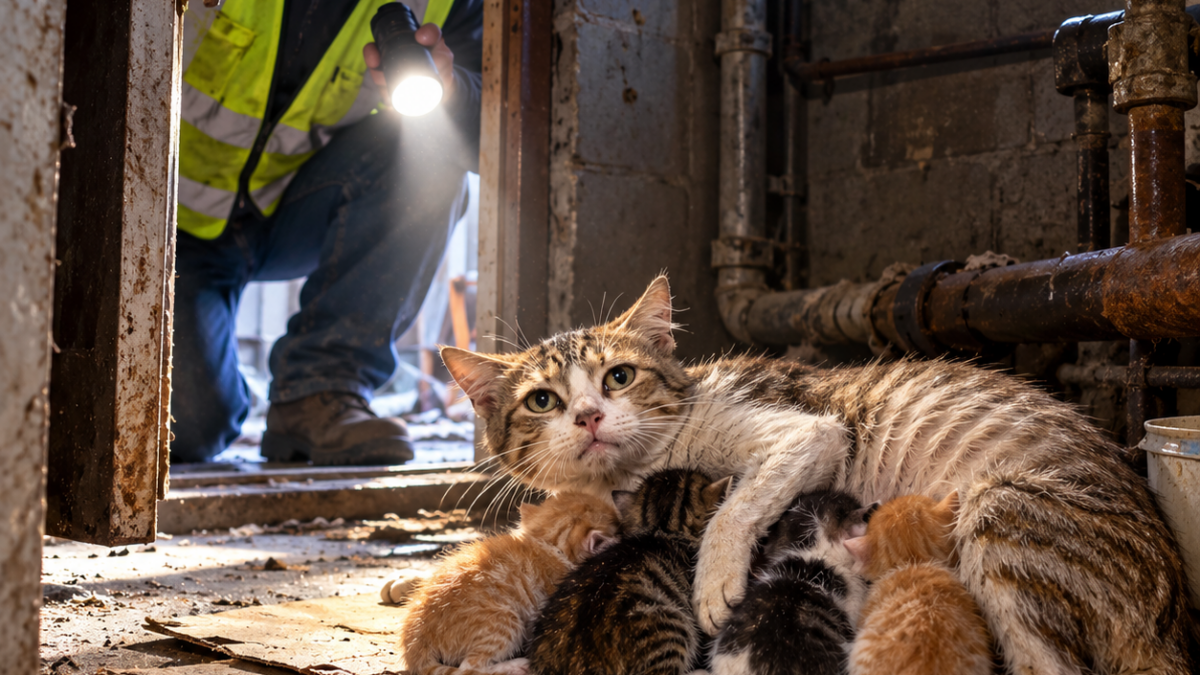
A young mother cat lay on a piece of flattened cardboard on the cold concrete floor.
She was curled so tightly around four tiny kittens that, for a moment, I could not tell where her body ended and theirs began.
They were pressed into her belly, nursing.
Little heads.
Tiny ears still folded soft.
Bodies no bigger than my palm.
They could not have been more than a couple of weeks old.
The mother looked up at me.
Her eyes were huge.
Yellow-green.
Terrified.
Exhausted.
But she did not run.
She did not hiss.
She did not leave them.
Instead, she pulled her body tighter around the kittens and shifted just enough to place herself between them and me.
That was the part that got me.
She was skin and bones.
So thin I could see every ridge along her spine.
Her fur was dirty and dull.
Her sides moved shallowly with each breath.
She looked like she barely had the strength to lift her head.
But she still tried to protect them from me.
I had seen plenty of rough things on job sites.
Injured raccoons.
Birds trapped in vents.
Stray dogs sleeping under broken porches.
But this was different.
This was a mother who had nothing left and was still offering her body as a wall.
I backed away slowly.
“It’s okay,” I whispered. “I’m not going to hurt you.”
She watched every movement.
The kittens kept nursing, unaware that the building above them had been scheduled to come down that morning.
I stepped into the hallway and called up to my supervisor.
“Mike!”
My voice echoed.
A second later, he answered from somewhere above.
“What?”
“We’ve got cats down here.”
“How many?”
I looked back through the doorway.
The mother’s eyes were still on me.
“Five,” I said. “One mama. Four babies. And she’s in bad shape.”
Everything stopped after that.
No machinery started.
No one signed the clearance sheet.
No one said we were behind schedule.
Mike came down with another flashlight.
He was a big man, usually impatient, the kind of foreman who measured his day by how much concrete got moved.
But when he looked into that utility room, he took off his hard hat and held it against his chest.
“Damn,” he said softly.
The mother cat lifted her head again.
One of the kittens made a tiny squeaking sound.
Mike pulled out his phone.
“I’ll call animal rescue.”
We waited in that basement for twenty-four minutes.
I know because I kept looking at my watch.
The crew gathered upstairs, talking quietly.
Nobody complained.
One guy, Brandon, came down with a clean towel from his truck and a bottle of water. We did not try to touch the cat or move the kittens ourselves. We knew enough to wait.
But I did set the bottle on the floor outside the utility room and poured a little water into a shallow plastic lid I found near the hallway.
The mother cat watched me.
Her nose twitched.
For nearly a full minute, she did nothing.
Then, very slowly, she stretched her neck forward.
Not away from the kittens.
Never away.
Just far enough to reach the water.
She drank.
Not much.
Her tongue moved weakly.
She paused twice as if the effort itself was too much.
Then she pulled back and curled around her babies again.
That was when I realized she had probably been waiting for water longer than I could imagine.
The rescue team arrived in a white van with faded blue lettering on the side.
Two women came down first.
One was named Karen, though everyone called her Kaye.
The other was a younger woman named Lila.
They carried carriers, towels, gloves, and a small medical kit.
The moment Kaye saw the mother cat, her face changed the way Dr. Porter’s face changed later.
Professionals have expressions for bad situations.
They try to keep calm, but their eyes tell the truth.
“How long has the building been sealed?” she asked.
Mike looked at me.
I looked at the boarded window above the utility room.
“City secured it a few weeks ago,” Mike said. “At least that’s what the work order says.”
Kaye crouched at the doorway.
The mother cat watched her.
No growl.
No energy for growling.
Only fear.
“Hi, sweetheart,” Kaye said. “You did good. We’re here now.”
The cat blinked slowly.
Then lowered her head over the kittens.
Kaye did not reach in immediately.
She took her time.
She spoke softly.
She let the cat hear her voice.
Then she slid a folded towel near the mother’s side.
The cat flinched, but did not move away.
“She’s weak,” Lila whispered.
“Very,” Kaye said.
They worked with the kind of patience I had never seen on a demolition site.
Every movement gentle.
Every sound controlled.
The four kittens were lifted first, one at a time, while the mother watched with panic rising in her eyes.
The moment the first kitten left her belly, she tried to stand.
Her legs failed.
She collapsed back onto the cardboard and let out a sound I will never forget.
Not a hiss.
Not a cry exactly.
A broken plea.
Kaye immediately placed the kitten into a warm carrier right beside her, close enough for the mother to see.
“Still here,” she said softly. “Baby’s still here.”
The mother’s head followed every movement.
Second kitten.
Third.
Fourth.
All alive.
All cold, but moving.
All making tiny, angry sounds at being disturbed.
When Kaye finally lifted the mother, the cat weighed almost nothing.
I had picked up heavier tool bags.
Her body hung limp for half a second before she struggled weakly to twist toward the carrier.
“Okay,” Kaye said. “Okay, mama. We’re keeping you together.”
They placed her with the kittens.
The second she touched the towel inside, she dragged herself around them again.
Curled tight.
Body shaking.
Eyes still fixed on us.
Lila closed the carrier door gently.
“What’s her name?” Brandon asked.
Kaye looked at the mother cat.
“She doesn’t have one yet.”
Then she looked at the cardboard nest, the basement, the boarded window, the empty room where she had somehow kept four babies alive.
“She should.”
No one spoke.
Finally Mike said, “Mabel.”
We all looked at him.
He shrugged, embarrassed.
“My grandma was named Mabel. Toughest woman I ever knew.”
Kaye smiled.
“Mabel it is.”
That was how she got her name.
Mabel left that condemned building in a carrier lined with towels, her four kittens pressed against her belly.
The demolition did not start that day.
It did not start the next day either.
Mike called the city and told them the basement needed a second inspection for animals before work resumed.
Nobody argued.
Not after seeing her.
Later, we learned more about what had happened.
The rescue team found no food anywhere in the utility room.
No bowl.
No water source.
No obvious way in or out.
High above the basement was a broken window, but it had been boarded from the outside weeks earlier. The theory was that Mabel had entered the warehouse while pregnant, searching for shelter. Maybe she slipped in through that broken window before the boards went up. Maybe she had the kittens shortly after.
Then she became trapped.
No one knew she was inside.
No one heard her.
No one came.
For twelve days, she had been sealed into that building with four newborns who depended entirely on her body to live.
She may have survived by licking moisture that collected around old pipes.
Maybe rainwater had run down somewhere after a storm.
Maybe condensation formed in small amounts.
No one knew.
There was no food.
Maybe she caught insects.
Maybe she found something left behind in the basement.
Maybe she ate nothing.
What mattered was this:
She kept producing milk.
Her body was breaking itself down to keep those kittens alive.
At the veterinary clinic, the examination left everyone quiet.
Mabel was dangerously thin.
Severely dehydrated.
Her gums were almost white.
Every rib could be felt beneath her skin.
Her hips jutted out sharply under dull fur.
Her muscles had wasted.
Her body temperature was low.
She was barely conscious by the time they began treatment.
And yet, when they tried to examine the kittens, she lifted her head.
She did not have strength to stand.
But she lifted her head.
That was all she had left.
Her attention.
Her warning.
Her motherhood.
The veterinarian, Dr. Elaine Foster, later told us Mabel had likely been only days away from becoming too weak to nurse.
“And once the milk stopped,” she said, “the kittens would have declined very quickly.”
She did not finish the sentence.
She did not need to.
Pip.
Teddy.
Olive.
Sam.
Those were the names shelter staff gave the kittens.
Pip was the smallest, a little gray tabby with a white chin and a voice that sounded offended by everything.
Teddy was rounder, darker, and always searching blindly for warmth.
Olive had one orange patch over her head, like someone had spilled sunrise on her.
Sam was black and white and somehow always managed to wedge himself underneath his siblings.
They were hungry.
Cold.
But alive.
All four.
That was the miracle.
Not a loud miracle.
Not the kind that arrives with trumpets.
Just four tiny bodies breathing because one starving mother refused to stop giving what she did not have.
Mabel stayed at the clinic for the first forty-eight hours.
They gave her fluids.
Small meals.
Nutritional support.
Medication.
Warmth.
They monitored the kittens’ weight.
Every few hours, someone checked that each kitten was nursing.
Supplemental feeding was prepared just in case, but Mabel would not fully allow it at first.
Even exhausted, she watched every hand.
If someone lifted one kitten for weighing, her eyes followed.
If the kitten cried, her head rose.
If staff took too long, she tried to move.
Her body was weak.
Her fear was not.
On the third day, Mabel and the kittens were moved to the shelter’s quiet recovery room.
I visited after work.
I told myself I was just checking on them because I had found her.
That was not entirely true.
Something about Mabel had followed me out of that basement.
I kept seeing her eyes in the flashlight beam.
I kept seeing how she had curled tighter around the babies instead of running.
I had two children of my own.
Both grown by then.
I remembered nights when they were sick, when their small bodies burned with fever and all I could do was sit beside them feeling useless.
I remembered how fear changes you when someone tiny depends on you.
Mabel had lived inside that fear for twelve days.
At the shelter, she was lying in a soft enclosure lined with blankets.
A full bowl of food sat near her.
Clean water.
Fresh litter.
Heat.
Safety.
But she still looked ready for the world to take it away.
When I stepped into the room, she lifted her head.
Her eyes recognized something.
My boots maybe.
My voice.
Or maybe I imagined that because I wanted to matter to the story after the rescue part was over.
“Hey, Mabel,” I said.
She watched me.
The kittens nursed, making tiny kneading motions against her belly.
“You did good,” I whispered.
She did not relax.
Not then.
For the first week, Mabel hardly moved away from them.
Food and clean water were always available, but she ate quickly, nervously, never turning her body fully away from the kittens.
If a staff member approached, she shifted between the person and the babies.
Not aggressive.
Not mean.
Just certain that protection was still her job.
Kaye told me, “She doesn’t understand yet.”
“What?”
“That she can rest.”
That sentence stayed with me.
She does not understand she can rest.
There are animals like that.
People too.
Creatures who have lived so long in survival that safety feels suspicious.
The body does not believe a full bowl the first time it sees one.
It waits for hunger to return.
It waits for the hand to take back what it gave.
It waits for the door to close again.
Mabel waited.
The first sign of change came on day nine.
Lila entered the enclosure to weigh the kittens.
Normally, Mabel would tense the moment the door opened.
This time, she watched, but she did not lift her whole body.
Lila picked up Pip.
Pip squealed dramatically, though nothing bad had happened to him in his entire short life except being weighed.
Mabel’s ears flicked.
She raised her head.
Then, slowly, she lowered it again.
Lila whispered, “Good girl.”
Mabel blinked.
That was all.
But at the shelter, it was news.
Day nine: Mabel allowed Pip to be weighed without trying to intervene.
By the end of the second week, she was eating better.
Her milk supply stabilized.
The kittens gained weight.
Their bellies became round.
Their coats began to shine.
They no longer looked like fragile scraps of life.
They looked like kittens.
Tiny.
Wiggly.
Demanding.
Offended by delays in service.
Pip learned to crawl first.
Olive opened her eyes first.
Teddy slept through everything.
Sam somehow rolled onto his back during nursing and needed to be nudged upright more than once.
Mabel watched them with the weary pride of every mother who has ever thought, I nearly died for this chaos.
I kept visiting.
Once a week at first.
Then twice.
Sometimes I brought my wife, Elena.
She knew what was happening before I admitted it.
“You are attached,” she said after the third visit.
“I found them.”
“That is not what I said.”
“I just want to make sure they’re okay.”
She smiled.
“You call the shelter on days you do not visit.”
“That is called follow-up.”
“That is called attachment.”
She was right.
I had seen rescued animals before.
But Mabel was different.
Maybe because she had been found in the dark minutes before a building came down.
Maybe because if I had ignored that faint sound, the demolition might have started.
Maybe because I had almost walked away.
That part haunted me.
I had almost decided the sound was nothing.
A pipe.
A bird outside.
A trick of the building.
Almost.
Life is sometimes separated from death by someone stopping for one more second to listen.
At the three-week mark, Mabel changed.
Not all at once.
There was no dramatic transformation.
No sudden trust.
But one afternoon, Kaye entered the enclosure with food, and Mabel did not move between her and the kittens.
She lifted her head, watched, then stayed where she was.
Kaye froze.
Then slowly set down the food.
“Mabel,” she whispered, “there you go.”
Later that same day, Mabel left the kittens sleeping and walked to the water bowl on the other side of the enclosure.
It was the first time she had moved more than a few feet away from them voluntarily.
She drank.
Slowly.
Then looked back.
The kittens were still there.
No one had taken them.
No danger had entered.
Food remained.
Water remained.
Blankets remained.
For the first time in almost a month, Mabel seemed to consider the possibility that safety might not be temporary.
By week four, she allowed staff to handle the kittens for short periods.
By week five, the kittens were tumbling over one another, chewing blankets, attacking invisible enemies, and making the shelter staff laugh loud enough to be heard down the hall.
Mabel gained weight.
Her fur improved.
Her eyes softened.
She still watched every door.
But she began sleeping more deeply.
Sometimes, when the kittens were piled beside her, she rolled onto her side and stretched her front legs out completely.
Kaye told me that was a good sign.
“Vulnerable position,” she said. “She wouldn’t do that if she didn’t feel safer.”
One day, I came in and found Mabel asleep while Olive climbed directly over her face.
Mabel opened one eye, sighed, and let it happen.
That was when I knew she was going to be okay.
The shelter posted their story online.
Not a dramatic headline.
Just a photo and a short caption.
Young mother cat found in condemned building with four newborn kittens. All safe. Recovering well.
The photo showed Mabel curled around the kittens inside a soft enclosure.
A full plate of food sat beside her.
A bowl of clean water too.
Her ribs were still visible.
Her hips still sharp.
But the kittens were nursing peacefully, pressed against her warmth.
Mabel was looking directly at the camera.
That look was what people noticed.
Cautious.
Exhausted.
Disbelieving.
As if she still expected someone to say there had been a mistake and she did not get to keep the blanket, the food, the water, or the babies.
One shelter worker said later that Mabel’s eyes seemed to ask:
Are you really going to let us stay?
The answer was yes.
For once, the answer was yes.
Applications came in quickly.
Everybody wanted the kittens.
That always happens.
Kittens are easy to love.
Small things bring out tenderness in people, especially when they are fluffy and playful and do not yet carry the visible cost of surviving.
But Mabel?
People asked about her too, but differently.
Some asked if she was friendly.
If she was fully healthy.
If she had trauma.
If she would hide.
If she would get along with other animals.
If she would be affectionate.
Kaye was careful.
“She is sweet,” she would say. “But she has been through a lot. She will need patience.”
Patience is where many people discover they only wanted the idea of rescue, not the work of it.
Then the Henderson family came.
Laura and Ben Henderson had two children, ages nine and eleven, both quiet in the respectful way children can be when adults have taught them that animals are not toys.
They had recently lost an older cat named Juniper.
They were not looking for a kitten at first.
They came to donate leftover food and blankets.
Then they saw Mabel.
She was sitting near the back of the enclosure while the kittens wrestled in a pile.
Laura crouched down.
Mabel looked at her.
Not with fear exactly.
With caution.
Laura did not reach through the bars.
She did not make kissing noises.
She did not call her pretty in that high voice some people use with animals.
She simply sat on the floor.
“Hi, Mabel,” she said softly.
Mabel blinked.
The Hendersons stayed for nearly forty minutes.
Ben asked about Mabel’s medical needs.
The children asked how to help a cat feel safe.
Not how to pick up kittens.
Not whether they could rename them.
How to help them feel safe.
Kaye noticed.
So did I.
The family came back twice.
On the third visit, Mabel walked to the front of the enclosure and sniffed Laura’s fingers.
Laura cried.
Just a little.
She tried to hide it.
Mabel pretended not to notice.
When the kittens were old enough, the adoption plan was made.
Mabel would go home with the Hendersons.
So would Olive.
The other three kittens—Pip, Teddy, and Sam—would go together to another family who had fallen in love with the idea of keeping the brothers as a wild little trio.
It was not easy for shelter staff.
They had all become protective.
Everyone wanted the ending to be perfect.
Perfect endings are rare.
But this one came close.
The day Mabel left the shelter, I was there.
I had asked if I could come.
Kaye said, “You found her. Of course you can.”
Mabel was stronger by then.
Still lean.
Still watchful.
But no longer hollow.
Olive bounced around the carrier like she had been born for adventure and had not once considered the emotional weight of leaving.
Mabel stepped inside more slowly.
She turned once.
Looked at the room.
The blankets.
The bowls.
The people who had saved her after she saved her babies.
Then she sat down beside Olive.
Laura Henderson carried the carrier like something sacred.
At the door, she turned to me.
“You were the worker who heard them?”
I nodded.
“I almost didn’t.”
Her face softened.
“But you did.”
That answer was kind.
Too kind maybe.
But I took it.
Sometimes people need permission to accept that one good choice mattered.
Mabel’s new home had sunlight.
That was the first thing Kaye told me after the follow-up visit.
Sunlight on the living room floor.
A quiet corner with a bed.
Food in a raised bowl.
A water fountain because Mabel liked moving water.
Soft rugs so she could rest wherever she wanted.
Olive claimed the windowsill within six hours.
Mabel hid behind the couch at first.
Then under the bed.
Then in the hallway.
Then, after three days, she came out at night to eat.
After a week, she sat in the same room as the family.
After two weeks, she allowed Laura to touch the top of her head.
After a month, she slept on the end of the youngest child’s bed.
That was the photo that made Kaye cry.
Mabel, the cat who once curled around her babies on cold concrete, asleep on a pink blanket at the feet of a child who loved her enough not to crowd her.
Olive sprawled beside her, belly up, paws in the air, completely untroubled by the world.
That is what Mabel had fought for.
Not fame.
Not admiration.
Not a story.
That.
A warm room.
A full bowl.
A sleeping kitten.
A door that stayed open.
The other three kittens thrived too.
Pip became bold.
Teddy became enormous.
Sam became trouble.
Their adoptive family sent pictures of them sleeping in a pile, climbing curtains, sitting in a laundry basket like they had conquered it.
They grew up together.
Safe.
Fed.
Loved.
Completely unaware of how close they had come to never seeing another day.
Maybe that is mercy.
The rescued do not always need to remember the rescue.
Sometimes it is enough that the rescuers do.
The warehouse came down two weeks after Mabel was found.
Before demolition began, we swept it twice.
Then a third time.
No more animals.
No people.
No cries.
When the excavator finally bit into the wall, I stood farther back than usual.
The building groaned.
Brick crumbled.
Dust lifted.
The utility room disappeared beneath falling concrete and twisted metal.
I thought about that cardboard nest.
About Mabel’s body curved around the kittens.
About how close we had come.
Brandon stood beside me.
“You okay?” he asked.
“Yeah.”
He watched the building come down.
“Crazy, huh?”
“What?”
He nodded toward the rubble.
“All that building. All that concrete. And the most important thing inside was five pounds of cat.”
I looked at him.
Five pounds.
Maybe less when we found her.
“Yes,” I said. “It was.”
Months later, the shelter held a small fundraising event.
They invited the demolition crew.
Most of us went.
We were not animal rescue people by profession.
We were hard hats, steel-toe boots, busted knuckles, bad backs, and lunch coolers.
But that night, we stood awkwardly in a shelter lobby eating cookies shaped like paw prints while volunteers thanked us for not starting demolition too soon.
There was a wall of rescue photos.
Mabel’s was in the center.
The photo from shortly after the rescue.
Her thin body curled around all four kittens.
Food and water within reach.
Eyes fixed on the camera.
Underneath, someone had written:
MABEL
Found on the twelfth day.
She kept all four alive.
I stood in front of that picture a long time.
Kaye came up beside me.
“She looks different now,” she said.
“I saw the updates.”
“Healthy.”
“Good.”
“Still watchful.”
“I figured.”
“But happy, I think.”
I nodded.
Then Kaye said, “You know, people keep asking how she did it.”
“What do you tell them?”
“The truth.”
“What’s that?”
She looked at the photo.
“I don’t know.”
That was honest.
Science could explain parts of it.
Metabolism.
Maternal instinct.
Stored fat.
Moisture.
Milk production.
Stress response.
But none of those words fully explained a starving cat curled around four babies in a dark room, giving her body away day after day.
Some things can be described without being reduced.
Mabel survived because bodies are remarkable.
Because mothers are fierce.
Because chance allowed a little moisture to collect somewhere.
Because the kittens cried.
Because I stopped walking.
Because rescue came.
Because the world, for once, was just barely kind enough in time.
A year after the rescue, I received a card at work.
No return address I recognized.
Inside was a photo.
Mabel sat in a sunbeam on a wooden floor.
She was fuller now.
Her fur glossy.
Her eyes clear.
Olive, nearly grown, was stretched beside her with one paw draped across Mabel’s tail.
On the back, Laura Henderson had written:
She still sleeps lightly, but she sleeps.
Thank you for hearing them.
I kept that photo in my locker for a long time.
Then I brought it home.
My wife put it on the refrigerator.
Sometimes, when friends came over, they asked about it.
I told them the short version.
Condemned building.
Tiny cries.
Mother cat.
Four kittens.
Twelve days.
Most people reacted the same way.
Hand over mouth.
Eyes soft.
“Oh my God.”
Then, usually:
“How could she survive?”
I always said, “She had a reason.”
That was the simplest answer.
Mabel had four reasons.
Pip.
Teddy.
Olive.
Sam.
Four tiny lives pressed against her body in the dark.
Four mouths searching for milk.
Four heartbeats depending on hers.
Love did not make food appear.
It did not open the door.
It did not fix the boarded window.
But love made her spend every remaining bit of herself trying until help arrived.
That should humble anyone.
It humbled me.
I listen differently now on job sites.
Not dramatically.
I still have work to do.
Buildings still come down.
Schedules still matter.
But before we clear a room, I stop.
Really stop.
I listen past the obvious sounds.
Past traffic.
Past pipes.
Past wind.
Because sometimes life is quiet when it asks to be found.
Sometimes it is only a faint cry behind a swollen door.
Sometimes it is easy to miss.
And sometimes missing it would change everything.
Mabel taught me that.
A cat I almost did not hear.
A starving mother in the back room of a condemned warehouse.
A creature with no language I understood, who still managed to say the only thing that mattered.
My babies are here.
Please.
Someone.
Hear us.
We did.
Late.
But not too late.
For twelve days, Mabel held on.
For twelve days, she gave them milk when her own body had almost nothing left.
For twelve days, she curled around them on cold concrete in a building the world had already marked for destruction.
Then, on the morning the machines arrived to tear it all down, one worker stopped in the basement because he thought he heard something.
A tiny cry.
Weak.
Frightened.
Desperate.
He almost ignored it.
He did not.
And because he listened, Pip, Teddy, Olive, and Sam grew up in homes with full bowls, soft beds, and people who wanted them.
Because he listened, Mabel learned that food could come tomorrow.
And the day after.
And the day after that.
Because he listened, a mother who had given everything finally got to rest.
That is the part I remember most.
Not the rescue van.
Not the clinic.
Not even the kittens.
I remember the first photo Laura sent of Mabel asleep in the sun.
Not watching the door.
Not curled tightly around danger.
Not bracing for loss.
Just sleeping.
Safe at last.
And maybe that is the real miracle.
Not only that she survived.
But that after everything, she finally believed she was allowed to.








