A Shelter Cat Was Marked “Dangerous” After Attacking Her Owner—Then a Vet Lifted One Ear and Found What Had Been Hurting Her All Along.
PART3:
And animals, unlike people, do not sit you down and say, “My left ear has felt like it is on fire for three weeks, and every time your husband scratches me there, I think I am going to explode.”
They hiss.
They swat.
They bite.
They hide.
Then someone fills out a form.
That was how Junie came to us.
Her paperwork arrived before she did.
A folded packet clipped to a yellow intake sheet, carried in by one of our front-desk staff with the expression people wear when they already know the room is about to get harder.
“Owner surrender,” Maya said.
Maya was twenty-three, still new enough that she believed there was a correct way to feel about every case.
She would learn.
Most of us learn that feelings at shelters do not come in neat categories.
Sometimes you feel compassion and anger at the same time.
Sometimes relief looks like guilt.
Sometimes you are grateful someone surrendered an animal instead of abandoning it, and furious that they waited until the animal was nearly broken.
I took the papers.
The first page was stiff from being handled too many times.
The handwriting was not.
It was angry.
Heavy black ink pressed so hard into the page that the words left dents you could feel with your thumb.
Reason for surrender:
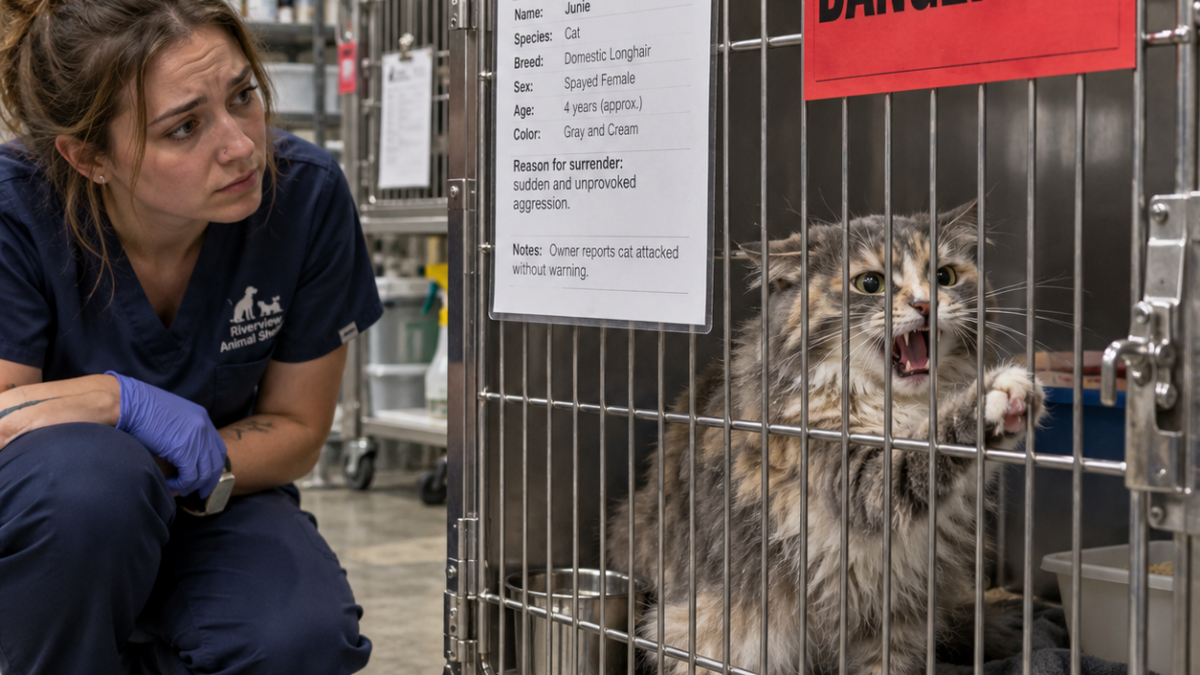
Sudden and unprovoked aggression. Attacked my husband. Dangerous. Do not approach.
I read it once.
Then again.
“Unprovoked,” I said quietly.
Maya glanced at me.
“You don’t like that word.”
“No.”
“Why?”
“Because people use it when they didn’t notice the provocation.”
That was not always fair.
Sometimes attacks really do seem to come from nowhere.
Sometimes the warning signs are subtle.
Sometimes people do not know what to watch for.
Sometimes they are frightened, and frightened people simplify.
Still, the word bothered me.
Unprovoked.
Dangerous.
Do not approach.
The cat’s name was Junie.
Four years old.
Female spayed.
Gray-and-cream domestic medium hair.
No known medical conditions.
Indoor only.
Had lived with the same family since kittenhood.
No previous bite history listed.
That last part lit up in my mind.
No previous bite history.
Four-year-old indoor cat.
Sudden aggression.
Attacked husband.
Dangerous.
Do not approach.
Those facts did not line up cleanly.
They rarely do.
“Where is she now?” I asked.
“Intake three.”
“Carrier or kennel?”
“Carrier still. Owner wouldn’t transfer her.”
“Wouldn’t?”
Maya looked uncomfortable.
“Said we could do it. Said she wasn’t getting near that thing again.”
That thing.
Another phrase I have learned to hear.
The change from name to object often happens before surrender.
The animal becomes “it.”
The dog becomes “that dog.”
The cat becomes “that thing.”
Distance helps people do hard things.
Sometimes it helps them do cruel ones.
I took the paperwork and walked down the hall.
Intake three was one of our smaller rooms, used for cats who needed quiet or animals whose behavior was unknown. It had a stainless-steel exam table, two transfer kennels, a sink, a cabinet of basic supplies, and walls painted a shade of beige chosen by someone who had clearly never spent a difficult afternoon in a shelter.
The carrier sat on the floor.
Hard plastic.
Tan top.
Dark blue bottom.
Door wired shut with a twist tie someone had added in a hurry.
Inside was a cat who looked like a storm packed into twelve pounds of fur.
Junie.
At first glance, she should have looked sweet.
Round face.
Cream muzzle.
Gray patches over both eyes like soft shadows.
A fluffy tail curled tight against her belly.
Small white paws.
A cat made for sunny windows, couch cushions, and photographs captioned with things like “my princess.”
But in that carrier, she looked like a warning.
Her pupils were enormous.
Her ears were flattened so tightly to her skull they nearly disappeared.
Her mouth was open.
Not panting.
Threatening.
A low, guttural growl came from her chest, rising and falling like a motor that had been built from fear.
I stopped three feet away.
Junie exploded.
She slammed the carrier door so hard the plastic jumped.
One front paw shot through the metal grid, claws extended.
She hissed, and the sound hit the small room like steam escaping under pressure.
Maya, who had followed me, stepped back.
“That’s… that’s a lot.”
“It is.”
Junie struck the door again.
Bang.
Bang.
Bang.
The twist tie held.
For now.
Her whole body was braced forward, but the motion was wrong.
That is what I noticed first.
Not just aggressive.
Defensive.
She was not trying to come at us.
She was trying to keep us away.
That difference matters.
An offensive animal advances with purpose.
A terrified animal expands itself because it believes shrinking has already failed.
Junie’s weight was low.
Tail wrapped tight.
Back rigid.
Whiskers forward, then pinned, then forward again.
Breathing fast.
Her eyes were huge, glassy, and unfocused in that way you see right before panic outruns the body’s ability to organize it.
“Has she had any handling?” I asked.
“Owner said no vet visit recently. Last rabies was two years ago.”
“No, I mean here.”
Maya shook her head.
“Director said wait for you.”
Good.
That probably saved us a bite.
Maybe saved Junie more than that.
I crouched sideways instead of facing the carrier head-on.
A direct stare can feel like a threat.
I lowered my voice.
“Hey, Junie.”
She spat.
“Fair,” I said.
Maya looked at me.
“You always say fair to the angry ones.”
“They usually have reasons.”
Junie struck the carrier door again.
This time I watched her body carefully.
Right paw first.
Head angled.
Neck stiff.
Then she twisted slightly, making sure her left side stayed away from us.
Small.
Almost invisible.
But there.
I shifted one inch to the left.
Junie immediately rotated to block me.
Not random.
Not generalized aggression.
Avoidance.
She would not let me view her left side.
My attention sharpened.
“Did the owner mention where the bite was?” I asked.
Maya flipped through the intake sheet.
“Husband’s hand. Two punctures. Said he was petting her on the couch and she attacked.”
“Petting where?”
“Doesn’t say.”
I could guess.
Not prove.
Guess.
I stood slowly.
Junie followed every movement.
“Maya, find the director for me.”
“Now?”
“Yes.”
She left and returned two minutes later with Aaron Pike, our shelter director.
Aaron was a good man with the permanent expression of someone trying to solve twelve problems while listening to a thirteenth. He had been director for five years and had aged ten. County shelters do that to people.
He looked at Junie.
Junie looked back and told him exactly what she thought of his leadership.
He sighed.
“Intake notes?”
I handed him the form.
He read the words.
Sudden and unprovoked aggression.
Attacked my husband.
Dangerous.
Do not approach.
His jaw tightened.
“Lena.”
“I know.”
“She’s rescue only at minimum.”
“I know.”
“And if she can’t be safely handled—”
“I know.”
The words hung between us.
We do not like saying euthanasia in front of new staff.
Not because we hide reality.
Because reality does not need help becoming heavier.
Junie slammed the carrier again.
Maya flinched.
Aaron rubbed the back of his neck.
“We’re at capacity. Cat room is full. Isolation is full. Foster list is dry. We’ve got the hoarding case coming in tomorrow if the warrant clears.”
“I know.”
“You always say that when you’re about to make my day harder.”
“Give me twenty minutes before any final decision.”
He looked at Junie.
She hissed so hard spittle hit the inside of the carrier door.
“Twenty minutes to do what?”
“Find out if she’s dangerous or in pain.”
His expression changed slightly.
“You think medical?”
“I think sudden aggression in a four-year-old indoor cat with no previous bite history deserves a medical exam before we let one word on a form decide her future.”
Phones rang beyond the door.
A dog barked in the hall.
Someone called for more paper towels.
A volunteer knocked and then immediately apologized when everyone looked at her.
The day was already collapsing.
Aaron closed his eyes for half a second.
Then nodded.
“Twenty.”
“Thank you.”
“Don’t get bit.”
“That’s the plan.”
He pointed at me.
“I mean it.”
“So do I.”
When he left, Maya stayed in the doorway.
“What do you need?”
“Quiet. Towel. Bite gloves ready but not on unless we need them. Gabapentin won’t help fast enough. We’ll use an injectable sedative through the carrier.”
“You’re sedating before exam?”
“I’m not reaching into that carrier while she thinks the world is trying to kill her.”
Maya nodded quickly.
Some people think a good animal handler can touch any terrified animal through some magical energy.
That is nonsense.
Confidence is not immunity.
Kindness is not a bite shield.
Respect means knowing when not to force contact.
The internet loves videos where someone reaches toward a snarling dog or a hissing cat and wins them over in ninety seconds with patience and music.
Real life is less cinematic.
Real fear can put you in urgent care.
Real panic can cost an animal its last chance if it escalates enough to confirm the label already written on its paperwork.
So I did not try to be a hero.
I prepared a mild, fast-acting sedative.
Calculated the dose twice.
Checked Junie’s weight estimate.
Chose the route least likely to increase her panic.
Spoke softly.
Moved slowly.
No sudden lunges.
No crowding.
No “just grab her.”
I administered the medication through the carrier with a careful hand and a long needle.
Junie fought the air itself.
Twisting.
Spitting.
Striking.
Furious that the world had found another way to touch her.
Then we waited.
The medication took hold gradually.
Her growl shortened.
Her eyelids drooped.
The muscles along her back softened one by one.
She tried to stay upright longer than most cats would have.
Stubborn little thing.
Finally, her chin lowered to the towel.
Her eyes half closed.
Her body, which had looked ready to shatter from tension, let go.
The room changed.
Shelters are never truly quiet, but the sharp edge left the air.
Maya exhaled.
“I didn’t realize I was holding my breath.”
“You and Junie both.”
I waited another minute to make sure sedation was deep enough, then cut the twist tie and opened the carrier door.
No strike.
No hiss.
Just a drugged, exhausted cat.
I slid a towel beneath her and carefully eased her out.
Up close, Junie looked smaller.
Not physically.
Emotionally.
The rage that had filled the carrier had made her seem enormous. Without it, she was just a frightened gray-and-cream cat with dull fur and a body that had probably not slept properly in days.
Her whiskers were bent.
Her coat along her shoulders looked unkempt.
Not neglected in the long-term sense.
More like grooming had become too difficult recently.
A cat in pain will often stop caring about fur.
Humans do the same thing.
Depression, fever, pain, grief—eventually even washing a dish becomes too much.
I placed Junie on the exam table, keeping her wrapped loosely in the towel.
Maya stood across from me with a notebook.
“Ready?”
“Start time 10:42. Sedated exam. Owner-reported sudden aggression, bite incident, high kennel reactivity.”
Maya wrote.
I began where I always begin.
Paws first.
No broken nails except one slightly worn claw.
Pads intact.
No swelling between toes.
Leg joints next.
Range of motion normal.
No obvious fracture.
Mild muscle tension but sedation made assessment limited.
Abdomen soft.
No mass.
No obvious pain response.
Hydration slightly reduced.
Gums pink.
Teeth with mild tartar but no obvious abscess, no fractured canine, no mouth ulcer screaming dental pain.
Heart normal rate for sedated status.
Breathing slow and even.
Temperature a little elevated but stress could explain it.
Nothing.
Nothing obvious.
Maya watched.
“So maybe behavior?”
“Maybe.”
But my mind stayed on the left side.
The way she blocked it.
The way she rotated.
The bite while being petted.
The suddenness.
The one-sided avoidance.
I ran my hand gently along the right side of her head.
No reaction.
Right cheek.
Right ear.
Nothing.
Then I touched the base of the left ear.
Even sedated, Junie’s shoulder twitched.
There.
Not dramatic.
Not enough for someone rushed to notice.
But there.
I leaned closer.
The smell reached me before I lifted the ear.
Sharp.
Sour.
Rotten in the way infection smells when it has been sealed inside warmth.
Maya’s nose wrinkled.
“Oh.”
“Yeah.”
I gently lifted the left ear flap.
The outer ear was dirty but not terrible.
A little wax.
Some redness.
Then I adjusted the otoscope, angled the cone carefully, and looked down into the canal.
The tissue was swollen.
Angry-red.
Inflamed.
Moist.
Narrowed from irritation.
At first, all I could see was debris and discharge.
Then the light hit something pale and rigid.
A point.
Barbed.
Buried deep.
My stomach dropped.
“Foxtail,” I said.
Maya leaned closer, then stopped herself.
“In the ear?”
“Deep in the canal.”
“How long would that have been there?”
“Long enough to make her world hell.”
Foxtails are evil little things.
They look harmless in a field—dry grass seed heads, sharp and barbed, designed by nature to travel forward and never back out easily. They catch in fur, skin, paws, noses, ears. Once they start working their way into tissue, they can migrate deeper with movement.
They do not soften.
They do not dissolve.
They dig.
A foxtail in an ear canal is not discomfort.
It is torment.
Every head shake drives it.
Every touch shifts it.
Every attempt by an owner to pet near the ear can turn into a stab.
Junie had probably tried to warn them.
Maybe she shook her head.
Maybe she avoided touch.
Maybe she flattened her ears.
Maybe she swatted once lightly before the bite.
Maybe she left the room.
Maybe no one noticed.
Or maybe they noticed and called it attitude.
By the time she bit, she may have been living with days or weeks of pain.
And when someone reached for the sore place again, her body answered before anyone’s feelings could get involved.
That was not unprovoked.
The provocation was buried in her ear.
I felt my throat tighten.
It happens sometimes when pain finally has a name.
Not because the case is solved.
Because you suddenly understand how long the animal has been trying to explain something nobody translated.
Maya looked at the surrender form lying on the counter.
Dangerous.
Do not approach.
“She was hurting,” Maya said.
“Yes.”
“And they didn’t know.”
“Maybe.”
“You think they should have?”
I looked at Junie’s sedated face.
Her mouth was relaxed now.
Her body quiet.
“I think someone should have asked why.”
That was the fairest answer I could give.
Anger is easy in shelter work.
Too easy.
If you let it run unchecked, it will eat every soft part of you and call itself justice.
I have learned to be careful with it.
Owners fail animals for many reasons.
Some cruel.
Some ignorant.
Some overwhelmed.
Some poor.
Some afraid.
Some unwilling.
Some trying their best with the wrong information until the damage is done.
I did not know which kind Junie’s people were.
But I knew Junie had paid the price.
I prepared forceps, flush, medication, swabs, and gauze.
The extraction had to be careful.
The canal was swollen, visibility limited, and the foxtail positioned deep enough that careless force could damage tissue further.
I asked Maya to adjust the light.
Then I worked.
Slow.
Steady.
No rushing.
The forceps closed around the visible end.
The first pull met resistance.
Of course it did.
Foxtails are built like cruelty with engineering.
I changed angle slightly.
Pulled again.
The barbed seed head came free in one long, ugly piece slick with discharge and blood.
Maya made a small sound behind her mask.
I placed it on gauze.
It looked too small to have nearly killed a cat.
That is how suffering often looks once removed.
Tiny.
Absurd.
Unworthy of the damage it caused.
But inside the ear, it had been everything.
I flushed the canal gently.
Dark debris and infected fluid washed out.
The smell sharpened, then eased.
I cleaned until the fluid ran clearer.
Applied medication.
Checked for deeper damage.
Inflammation significant.
Secondary infection.
Pain almost certainly severe.
But treatable.
Treatable.
That word felt like a door opening.
“Document foreign body removed from left ear canal,” I said.
Maya wrote quickly.
“Severe otitis and tissue inflammation. Started topical therapy. Pain management. Antibiotic pending vet approval.”
I looked at Junie.
Her breathing remained steady.
“Add note: behavior likely pain-related. Reassess after treatment before final behavioral determination.”
Maya paused.
Then wrote it down with care.
Words matter.
The first form had nearly ended Junie.
This one might save her.
After the procedure, I moved Junie onto a padded blanket in a quiet recovery kennel in the treatment room.
Not the cat room.
Not yet.
Too loud.
Too many eyes.
Too many smells.
She needed to wake somewhere that did not ask anything from her.
I placed her on her right side so the treated ear was up, then adjusted the blanket around her.
She looked impossibly vulnerable.
A cat who had seemed ready to tear through steel an hour earlier now lay small and limp beneath a fleece printed with cartoon bones we usually used for puppies.
Maya stood beside me.
“What happens now?”
“We wait.”
“For how long?”
“As long as it takes to see who she is without that thing in her ear.”
Maya looked at the gauze where the foxtail lay.
“I keep thinking about someone petting her.”
“So do I.”
“She must have thought people were hurting her on purpose.”
I nodded.
That is one of the cruelest things about untreated pain.
It can turn affection into threat.
The same hand that once meant comfort becomes the hand that makes fire shoot through your skull.
After enough times, the body stops waiting to see which kind of touch is coming.
It defends.
Then humans call the defense a personality.
Junie slept for almost an hour.
During that time, the shelter kept moving around us.
A woman surrendered two guinea pigs in a laundry basket because her child developed allergies.
Animal control brought in a stray shepherd mix with burrs matted behind both ears.
A man yelled at the front desk because we would not take his neighbor’s cats without proof of ownership.
The dryer broke again.
Someone spilled diluted disinfectant in the hall.
A volunteer cried because a bonded pair of senior dogs had been separated by adoption.
Shelters do not pause for revelation.
One animal’s world may crack open while someone else is asking where we keep trash bags.
I checked Junie every few minutes.
Heart rate.
Breathing.
Gum color.
Temperature.
Pain signs.
At first, she slept heavily.
Then her ears twitched.
Then her paws flexed.
Then her eyes opened.
Slowly.
Cloudy from sedation.
She lifted her head an inch and dropped it again.
I sat on the floor outside the open recovery kennel.
Not reaching in.
Not looming.
Just there.
Maya hovered behind me until I gently waved her back.
Too many people can turn safety into pressure.
Junie blinked.
Her pupils were still wide.
For a moment, her body tensed.
I saw the old pattern try to return.
Shoulders rising.
Paws drawing inward.
Breath catching.
Fear has muscle memory.
Pain may be gone, but the body does not know that immediately.
It remembers what touch did yesterday.
It prepares for yesterday to happen again.
I kept my voice low.
“Hi, Junie.”
She stared.
I expected the hiss.
It did not come.
She turned her head slightly.
Then paused.
That movement must have felt different.
No jab.
No internal needle.
No lightning inside her ear.
She tried again, a small turn toward the left.
Her eyes shifted as if she did not understand the absence.
Pain leaves a shape behind.
When it disappears, animals sometimes seem confused by the empty space.
Junie pushed herself upright.
Unsteady.
Her legs wobbled.
Her head hung low.
She looked at me.
Really looked.
Not through panic.
At me.
I held still.
She took one step.
Stopped.
Another.
Her body swayed.
Then, slowly, she crawled forward until her nose reached my scrub pants.
She sniffed.
One second.
Two.
Then she pressed her face against my knee.
I did not move.
Her shoulders loosened.
A long, shaky exhale left her body.
The sound was almost human.
Then she climbed awkwardly into my lap, sedation making her clumsy, and pushed her face into my chest.
Not a head-butt.
Not a demand.
A surrender.
Her body began to purr.
Low.
Rattling.
Uneven.
Like an engine turning over after being flooded.
Her front paws pressed into my scrub top and kneaded weakly.
I put one hand near her side but did not close it around her.
She leaned into it.
Only then did I touch her.
Softly.
Not near the left ear.
Never near the left ear yet.
Just one hand along her back.
Her fur felt dull beneath my palm.
Her spine rose and fell with each breath.
Maya stood in the doorway, eyes wet.
“Is she…?”
“She’s purring.”
Maya covered her mouth.
I did not cry then.
Not yet.
In shelter work, you learn to delay crying because there is always another task waiting, another syringe to fill, another kennel to clean, another animal watching your face for clues about whether the world is ending.
But I sat there with Junie’s weight against me and felt the familiar ache of anger and relief twisting together.
How close had we come?
If Aaron had not given me twenty minutes.
If Maya had been alone.
If intake had happened at the end of a worse day.
If Junie had bitten one more person.
If the carrier door had failed.
If we had accepted the label without examining the body beneath it.
Twenty minutes.
Sometimes a life is balanced on less.
Aaron came in quietly ten minutes later.
He stopped when he saw Junie in my lap.
“Well,” he said.
Junie opened one eye.
No hiss.
No strike.
Just a tired look that suggested shelter directors were not impressive.
“She had a foxtail buried deep in her left ear,” I said. “Severe infection. Significant pain.”
Aaron’s face changed.
“Damn.”
“Yes.”
He looked at the clipboard.
“Behavior note?”
“Pain-related until proven otherwise.”
He nodded.
“I’ll remove the immediate euthanasia risk pending reassessment.”
Relief moved through my body so fast I felt dizzy.
“Thank you.”
“Don’t thank me. You were right.”
“I like hearing that. Could you repeat it with Maya recording?”
Maya laughed softly.
Aaron almost smiled.
“Don’t push your luck.”
He crouched near Junie, keeping distance.
“Sorry, girl,” he said.
Junie blinked.
That was all.
But from her, that was generosity.
The next few days became Junie’s second intake.
Not the intake written by angry ink.
The real one.
Who are you when pain is not speaking for you?
Day one, she ate half a can of wet food and slept twelve hours.
Day two, she allowed me to change her bedding without hiding, though she watched my hands carefully.
Day three, she hissed once when a metal bowl clanged in the hall, then seemed embarrassed by her own reaction and retreated into her box.
Day four, she accepted a chin scratch from Maya.
Maya cried afterward in the laundry room.
“I didn’t cry,” she said when I found her.
“Of course not.”
“My eyes were disinfecting themselves.”
“Common condition.”
Day five, Junie rolled onto one hip and exposed half her belly before remembering she did not know us that well and sitting up quickly.
Day six, she played with a feather wand for twelve seconds, then pretended she had not.
Day seven, she purred when I entered the room.
Not when I touched her.
When I entered.
That was when I cried.
Not in front of her.
In the medication closet, like a professional.
The vet, Dr. Samir Patel, examined her twice during that first week.
He confirmed the ear canal was healing.
Inflammation decreasing.
Infection responding to treatment.
No evidence of deeper structural damage.
Pain improved.
Prognosis good.
“Behavior?” he asked.
“Transforming.”
“Medical cases often do.”
“She was nearly listed for euthanasia.”
He sighed.
“I know.”
We both looked at her through the kennel door.
Junie sat on her blanket, paws tucked neatly beneath her chest, watching a fly with more focus than some surgeons bring to the operating room.
“She’s lucky,” he said.
I shook my head.
“She’s not lucky. She was in pain for weeks, surrendered by her family, labeled dangerous, almost written off, and ended up in a county shelter at capacity.”
Samir accepted the correction.
“Fair. She got one lucky break.”
“Yes.”
“You.”
“No. Twenty minutes.”
He looked at me.
“That too.”
I wish I could say Junie immediately became easy.
She did not.
Pain had explained her behavior.
It had not erased what happened to her.
Trust is not a switch flipped by antibiotics.
She had learned that hands could hurt.
She had learned that warning signs might be ignored.
She had learned that being scared could make people louder.
She had learned that defending herself made humans call her dangerous.
Those lessons do not disappear because a foxtail comes out.
For the first two weeks, Junie hated fast movement.
If someone reached over her head, she ducked.
If anyone approached from the left, she stiffened.
If a hand moved toward her ear too quickly, she swatted.
Not hard.
Not claws-out most of the time.
But enough to say:
No.
This time, we listened.
“No overhead petting,” I told every staff member and volunteer cleared to enter her room. “No left-ear touch. Let her approach. Offer hand low. Stop when she shifts away. If she says no, the answer is no.”
One volunteer frowned.
“She’s going to need to get used to being handled.”
“She will.”
“How, if we don’t push?”
“By learning we won’t.”
That is hard for people.
We like to believe trust is built by proving our intentions.
Animals do not care about intentions as much as patterns.
One respectful stop teaches more than ten forced touches followed by apologies.
Junie began to learn the new pattern.
Hand offered.
She sniffed.
If she leaned, touch came.
If she turned away, touch stopped.
No one chased.
No one said, “Oh, come on.”
No one grabbed her because “she needs to know we’re safe.”
Safety cannot be declared.
It has to be demonstrated.
Over and over.
With boring consistency.
By the end of the second week, Junie had changed enough that visitors would not have recognized the cat from intake.
Her coat improved first.
She began grooming again.
The dullness lifted.
Cream patches brightened.
Gray fur smoothed.
Her round face regained softness.
She developed a fondness for sitting with both front paws crossed like a retired judge.
She liked fleece blankets but only the green ones.
She hated salmon.
Loved chicken.
Ignored turkey unless someone else wanted it.
She had a tiny chirping sound she made when birds passed the treatment-room window.
She enjoyed being brushed along the cheeks.
She drooled slightly when purring.
She did not like being picked up yet.
That was okay.
Junie’s adoption profile took me longer to write than most.
Words had already failed her once.
I refused to let them do it again.
Name: Junie.
Age: 4 years.
Personality: Sensitive, affectionate, slow-to-trust, deeply rewarding.
Medical: Treated for painful foxtail foreign body and infection in left ear. Healing well. May remain sensitive to touch around left ear during recovery.
Behavior: Junie was previously labeled aggressive due to pain-related defensive behavior. Since treatment, she has shown steady trust-building, purring, gentle affection, and increasing confidence. She needs a calm adopter who respects boundaries and understands that trust takes time.
Best home: Quiet adult home or calm household. No forced handling. Patient adopter willing to let Junie choose the pace.
Aaron read it.
“That’s honest.”
“It has to be.”
“Too honest?”
“Do you want her returned?”
“No.”
“Then it is exactly honest enough.”
He nodded.
We posted her as special placement.
Not rescue only anymore.
Not general adoption floor either.
Junie needed the right person.
That phrase gets overused, but with her it was true.
The wrong adopter would take her progress personally.
The wrong adopter would push.
The wrong adopter would want gratitude.
The wrong adopter would call in three days saying she was hiding and maybe this was a mistake.
Junie did not need someone who wanted an easy cat.
She needed someone who understood that being chosen slowly is still being chosen.
For nine days, no one asked about her.
Not seriously.
People saw her picture.
Round face.
Soft colors.
Pretty eyes.
Then read the description and drifted toward kittens.
That is another thing about shelters.
People say they want to rescue until rescue looks like patience instead of a photo.
Then Renee came in.
She arrived on a rainy Thursday afternoon wearing jeans, a navy sweater, and the kind of shoes people wear when they have no intention of rushing anywhere.
Mid-sixties, maybe.
Silver hair cut short.
No perfume, which I appreciated immediately.
Strong scents can overwhelm cats.
She walked up to the front desk and said, “I’m here to meet the difficult cat.”
Maya looked confused.
“We have several.”
Renee smiled.
“Junie.”
Maya came to get me.
“There’s a woman asking for the difficult cat.”
“Exact words?”
“Exact words.”
I stepped into the lobby.
Renee stood near the bulletin board reading the adoption notices. She did not tap the counter. Did not sigh. Did not look impatient.
Good sign.
“I’m Lena,” I said.
“Renee Whitaker.”
We shook hands.
Her grip was warm and steady.
“You’re interested in Junie?”
“I am.”
“Can I ask what drew you to her?”
Renee glanced toward the cat rooms.
“Your profile said she needs someone who won’t take it personally.”
That was not the answer I expected.
She continued.
“I’m a retired hospice nurse. I’ve spent most of my adult life with people who were scared, hurting, angry, grieving, or all of the above. I learned a long time ago that behavior is often information wearing an ugly coat.”
I liked her immediately.
Still, liking someone is not enough.
Junie deserved caution.
“She has made wonderful progress,” I said, “but I need to be very clear. She was surrendered after a bite incident. We found a painful foreign body in her ear, and her behavior changed dramatically after treatment. But she is still sensitive. She may hide. She may swat if touched too fast. She needs someone who will go slowly.”
Renee nodded.
“Good.”
“Good?”
“If she had no needs, someone else would already have taken her.”
That sentence landed in me.
Not dramatically.
Quietly.
Some people understand before you explain.
I brought Renee to the small visitation room instead of Junie’s recovery space. Neutral territory, but quiet. I placed a green blanket on the floor because Junie liked green. Set out a low hiding box. Brought treats. Opened the carrier and let Junie decide.
She did not come out right away.
Renee sat on the floor with her back partly turned, hands resting loosely in her lap.
She did not stare at the carrier.
Did not click her tongue.
Did not say, “Come here, baby,” in that coaxing voice that makes cats suspicious.
She simply existed.
Five minutes passed.
Junie’s nose appeared first.
Then one paw.
Then her round face.
She looked at me.
Looked at Renee.
Looked at the door.
Calculated all exits.
Good girl.
A cat who checks exits is a cat thinking instead of panicking.
Junie stepped fully out of the carrier.
Tail low but not tucked.
She moved along the wall.
Sniffed the chair leg.
Ignored the treats.
Approached Renee from the right side.
Renee did not move.
Junie sniffed her shoe.
Then the cuff of her jeans.
Then her fingers.
Renee kept her hand still.
Junie paused.
One second.
Two.
Then she leaned her head into Renee’s palm.
Renee’s eyes filled immediately.
But she did not grab.
Did not stroke right away.
She waited until Junie pressed again.
Then she moved one finger gently along Junie’s cheek.
Not near the ear.
Perfect.
“Hi, baby,” Renee whispered.
Her voice held something I cannot quite name.
An apology, maybe.
Not for what she had done.
For what had been done before she arrived.
Junie closed her eyes.
The purr started.
Soft at first.
Then steady.
I stood by the door and looked at the floor because sometimes happiness is too intimate to stare at directly.
Renee visited three times before adoption.
Her choice.
Not ours.
“I want her to know I come back,” she said.
The second visit, Junie climbed halfway into her lap.
The third, fully.
Renee brought a blanket from home, washed in unscented detergent, so Junie could begin learning the smell.
She asked smart questions.
Where does Junie dislike touch?
What signs mean stop?
What does she eat?
How should medication be finished?
When is her recheck?
How should introductions to the home be handled?
What should she do if Junie hides?
“What if she hisses at me?” Renee asked.
“Pause. Assess. Give space.”
“Not scold.”
“Never scold fear.”
She nodded like that confirmed something she already believed.
Adoption day came two weeks and three days after intake.
Junie’s ear looked dramatically better.
Still healing.
Still tender.
But no odor.
No discharge.
No buried weapon.
Her chart had changed from Rescue Only / Euthanasia Risk to Adoption Pending.
I printed the paperwork myself.
Not because no one else could.
Because I needed to see it.
Renee signed slowly, reading every page.
Medication instructions.
Medical disclosure.
Behavior notes.
Return policy.
Emergency contact.
When she finished, I handed her Junie’s original surrender form.
Not to keep.
To see.
Renee read the words.
Dangerous.
Do not approach.
Her face tightened.
“She never got a chance, did she?”
“She got twenty minutes.”
Renee looked up.
“Sometimes that is a chance.”
“Yes.”
Junie rode home in a carrier lined with the green blanket and Renee’s scent blanket beneath it.
Before they left, Renee opened the carrier door one last time in the visitation room.
Junie stepped out, walked to me, and pressed her cheek against my shoe.
It was not dramatic.
No movie music.
No final embrace.
Just a small mark of recognition.
Then she returned to Renee, who lifted the carrier gently.
“I’ll send updates,” Renee said.
“Please.”
She hesitated.
“Do you want me to keep the name Junie?”
I looked at the cat.
Junie looked back.
“Yes,” I said. “She’s earned the right to keep something that was hers before all this.”
Renee smiled.
“Junie it is.”
After they left, I went back to intake three.
The room had already been cleaned.
Another carrier sat where Junie’s had been.
A new cat inside.
A new file.
A new story arriving after something had already gone wrong.
Shelter work does not let you linger long.
But I picked up Junie’s original surrender form from the counter before filing it.
I stared at the word dangerous until it blurred.
Heavy black ink.
Pressed hard.
Certain.
Wrong.
Not entirely wrong, maybe.
That is the uncomfortable truth.
Junie had been dangerous in the way any creature in enough pain can become dangerous.
Pain can make weapons of teeth.
Fear can make weapons of hands.
Desperation can make weapons of words.
But dangerous was not who she was.
It was what happened when nobody looked closely enough at what hurt.
Two months later, Renee sent a photo.
Junie lay on a windowsill in a patch of sunlight, body stretched long, green blanket beneath her, one paw draped over the edge like royalty.
The message said:
She still doesn’t like quick hands. She loves morning sun. She sleeps beside me now, but only after pretending she has not decided to. Her ear is fully healed. She chirps at cardinals. She bit one houseplant and showed no remorse.
A second message followed.
Thank you for not believing the form.
I sat on the treatment-room stool for a long time holding my phone.
Maya walked in carrying clean syringes.
“Good update?”
I turned the screen toward her.
She smiled.
“Oh, Junie.”
Then she looked at me.
“You okay?”
“Yes.”
That was mostly true.
Then I said, “Print it for the board?”
She knew which board.
We had a staff board in the break room where we posted adoption updates, thank-you cards, and photos we needed on the worst days. The board was not decorative. It was structural support.
Maya printed Junie’s photo and pinned it near the center.
Under it, she wrote:
TWENTY MINUTES MATTER.
The phrase stuck.
At first, it was just Junie’s phrase.
Then it became something we said when a case felt too easy to judge.
A growling dog with a thorn embedded between his toes.
Twenty minutes matter.
A rabbit labeled mean who had a bladder stone.
Twenty minutes matter.
A senior cat who screamed when lifted because her hips were arthritic.
Twenty minutes matter.
A dog returned for “sudden aggression” who had an ear infection so severe he could barely hear.
Twenty minutes matter.
It did not mean every animal could be saved.
That would be a lie.
Some animals are truly unsafe.
Some pain cannot be healed enough.
Some behavior is too deeply ingrained for the resources available.
Some days still end in grief.
But Junie changed the way our staff paused before accepting a label as the full truth.
That matters.
In shelters, small changes matter because the system is made of pressure.
Pressure to move fast.
Pressure to make space.
Pressure to protect staff.
Pressure to satisfy policy.
Pressure to document liability.
Pressure to make heartbreaking decisions with incomplete information.
Pressure turns living beings into categories because categories are faster than stories.
Bite case.
Dangerous.
Feral.
Unadoptable.
Aggressive.
Difficult.
Behavioral.
Medical.
Rescue only.
Euthanasia risk.
Sometimes those labels are necessary.
But they are never enough.
An animal is not a form.
A form is just where the story stopped being told by someone who knew them.
Our job is to ask whether there is more.
Years in shelter medicine have taught me that pain is often misread as character.
Not just in animals.
In people too.
A dog who lunges at the kennel door may be terrified.
A cat who swats may be protecting a wound.
A person who snaps at the front desk may have just lost housing, marriage, money, and the last creature who still loved them.
That does not excuse harm.
It explains where to look.
Understanding is not the same as permission.
Compassion is not the same as recklessness.
We still use bite gloves.
We still document.
We still protect staff.
We still say no when no is necessary.
But Junie reminded me that caution and curiosity can stand in the same room.
You can respect risk and still ask why.
You can protect your hands and still refuse to reduce a terrified body to one angry word.
A year after Junie’s adoption, Renee brought her back for a shelter fundraiser.
Not into the main building.
Too stressful.
We set up a quiet room in the education center where alumni animals could visit staff in controlled conditions.
I was nervous.
Not because I thought Junie would hurt anyone.
Because some part of me feared she would not remember.
That is selfish, but true.
Animals move forward.
They do not owe us recognition just because we played a role in one chapter.
Renee arrived with Junie in a soft-sided carrier.
“She may stay inside,” she warned.
“That’s fine.”
Renee set the carrier on the floor and opened it.
Junie remained inside for almost five minutes.
Then her nose appeared.
Same gray-and-cream face.
Softer now.
Fuller.
Eyes clear.
Coat glossy.
No smell of infection.
No panic.
She stepped out.
Sniffed the air.
Looked at Renee.
Looked at me.
For one second, I saw the intake room again.
The carrier.
The form.
The hissing.
The foxtail on gauze.
Then Junie walked to me and pressed her face against my leg.
Not because she owed me.
Not because this was a movie.
Because some part of her remembered enough.
I crouched slowly.
“Hi, Junie.”
She leaned into my hand.
I touched her cheek.
Right side first.
Then, with her permission, the top of her head.
Not the left ear.
I still did not go there without asking.
She purred.
Renee smiled.
“She lets me touch the ear now sometimes.”
“Sometimes?”
“When she feels like I deserve it.”
“That sounds like Junie.”
“She sleeps on my chest when it storms.”
The sentence entered me quietly.
Storms.
Pain.
Fear.
A cat once called dangerous now choosing to comfort someone else through bad weather.
That is the part labels never predict.
They tell you what happened.
They do not tell you what healing may make possible.
Before Renee left, she handed me a small envelope.
Inside was a photo of Junie asleep beside an open book, one paw resting on the page.
On the back Renee had written:
For Lena, who looked closer.
I keep that photo in my locker.
Not because I need credit.
Because I need reminding.
I need it on days when the work feels too big.
When kennels are full.
When people are careless.
When the phone will not stop.
When forms arrive with words that feel like verdicts.
When I am tired enough to become efficient in ways that frighten me.
I look at Junie.
I remember the foxtail.
I remember that suffering can hide in narrow places.
I remember that a creature can be telling the truth badly because pain has stolen every better language.
And I remember that twenty minutes is not much to give.
Sometimes it is everything.
If you had met Junie on intake day, you might have believed the form.
I almost would not blame you.
She looked dangerous.
She sounded dangerous.
She struck the carrier with enough force to make trained staff step back.
But beneath all that was a cat who had loved people once.
A cat who had probably slept on a couch, chased dust in sunlight, accepted kisses on her head, maybe pressed her cheek into the very hand she later bit.
Then pain entered.
Quietly.
Small as a seed head.
Sharp as a needle.
Buried where nobody thought to look.
Day by day, it rewrote her world.
Touch became threat.
Hands became pain.
Her own body became unsafe.
So she armored herself in hissing, claws, and teeth.
Humans saw the armor and named it personality.
That is the mistake.
We do it constantly.
With animals.
With each other.
We meet the defense and think we have met the self.
We see someone’s sharpness and never ask what kept cutting them first.
We see withdrawal and call it coldness.
We see panic and call it drama.
We see anger and call it character.
Sometimes we are right to protect ourselves.
Sometimes distance is necessary.
But when we have the responsibility and the ability to look closer, we should.
Not forever.
Not foolishly.
But long enough to ask:
Where is the pain?
What changed?
What is this behavior protecting?
What story did the form leave out?
Junie’s surrender form said dangerous.
But her body said help.
For twenty minutes, we listened to the body instead of the label.
That was the difference between an ending and a window.
So now, whenever I train new staff, I tell them about her.
I show them the photo first.
Junie on Renee’s windowsill.
Sunlit.
Soft.
One paw dangling.
The kind of cat anyone would call sweet.
Then I show them the surrender form.
Dangerous.
Do not approach.
Then I tell them both were part of the same story.
The hissing mattered.
The bite mattered.
The fear mattered.
The pain mattered.
The foxtail mattered.
The healing mattered.
No single page held all of her.
No single moment should have been allowed to decide her life.
That is the lesson.
Not that every aggressive animal is secretly gentle.
Not that risk should be ignored.
Not that love fixes all behavior.
Those are comforting lies, and shelters cannot afford them.
The lesson is harder and more useful.
Do not confuse a label with a diagnosis.
Do not confuse fear with malice.
Do not confuse pain with identity.
And when the world hands you an angry form written in heavy black ink, remember Junie.
A gray-and-cream cat in a plastic carrier.
A shelter at capacity.
A staff stretched thin.
A director who gave us twenty minutes.
A hidden foxtail.
A purr that started only after pain finally had a name.
Sometimes aggression is pain wearing armor.
Sometimes dangerous means desperate.
Sometimes the most human thing we can do for an animal—or for anyone—is stop before the verdict, look where nobody looked, and give the truth a little time to come out.
Junie got that time.
And because she did, somewhere across town there is a cat asleep in a patch of morning sun, alive in the quiet life she almost lost.
Her surrender form said dangerous.
Her adoption photo says home.
Both papers are in her file.
Only one tells the truth about who she became.








