A Shelter Begged Someone to Adopt Their “Absolutely Unbearable” 19-Pound Orange Cat—After 14 Months Without a Single Adoption Request, One Brutally Honest Post Brought 2,000 Applications in Just 48 Hours.
PART3:
One man had once surrendered a cat because the animal “looked judgmental.”
Maria thought she had become immune to absurdity.
Then she met Diesel.
The carrier door opened.
Diesel came out like he had been fired from a cannon.
He jumped onto the exam table.
Knocked over a jar of cotton swabs.
Stepped directly into the technician’s paperwork.
Bit the corner off a cardboard vaccine box.
Then walked into Maria’s arms and head-butted her chin so hard her teeth clicked.
She laughed.
“Oh, you’re trouble.”
Diesel purred.
That was day one.
On day two, he learned how to open the latch on his enclosure.
The staff changed the latch.
Day three, he opened the new one.
They added a clip.
He worked at it for nearly forty minutes.
Then escaped.
They added a second clip.
He stopped trying.
Everyone celebrated.
The next morning he was asleep on the receptionist’s keyboard.
Nobody ever determined how he got out.
By the end of his first month, Diesel had escaped seven times.
By month three, eleven.
After escape number eleven, Shelter Director Joanne Mercer stood in the hallway staring at Diesel while he sat on top of the industrial dryer in the laundry room.
“How?”
Maria looked up at him.
Diesel looked down at both women.
“Do you really want the answer?”
“Yes.”
“I think he watches us.”
Joanne folded her arms.
“He is a cat.”
Maria pointed upward.
“He’s an organized crime figure.”
Diesel yawned.
They switched him into a reinforced dog kennel temporarily.
He escaped that too.
Eventually the shelter accepted that Diesel would always require what the staff called “creative containment.”
He became part animal.
Part coworker.
Part recurring workplace safety incident.
He knocked coffee over constantly.
Not accidentally.
Maria became convinced of this.
Diesel showed no interest in empty mugs.
Only full ones.
Black coffee.
Lattes.
Iced coffee.
Once, during a staff meeting, Joanne placed a fresh cappuccino beside her laptop.
Diesel sat on the filing cabinet.
Watched.
Waited.
Joanne stood to grab a folder.
Diesel crossed the desk.
Looked directly at Maria.
Then pushed the mug with one paw.
Slowly.
Deliberately.
It tipped.
Coffee spread across three intake forms and Joanne’s keyboard.
Maria covered her mouth.
Joanne turned.
“Diesel.”
Diesel jumped down and left.
Maria lost control.
She laughed so hard she had to sit on the floor.
Joanne stared at the ruined laptop.
“I’m putting him on Craigslist.”
“You can’t.”
“I know.”
“I’d take him.”
“No, you wouldn’t.”
Maria stopped laughing.
Joanne raised one eyebrow.
“You have three cats.”
“Exactly.”
“Diesel hates cats.”
“He doesn’t hate cats.”
“He steals their food.”
“That’s different.”
“He body-checks Pumpkin away from water bowls.”
“He has leadership qualities.”
“He screamed at a foster kitten until it peed.”
Maria winced.
“That one was bad.”
Joanne pointed toward the hallway.
“You do not want this cat.”
Maria looked where Diesel had disappeared.
“No.”
She sighed.
“But somebody does.”
That had been the problem.
Nobody seemed to.
Month after month passed.
They photographed him.
The first adoption photo showed Diesel sitting beside a blue blanket.
Maria had placed a little bow tie around his neck.
Diesel looked like a mob boss attending a wedding.
The caption read:
MEET DIESEL!
This handsome gentleman is looking for a quiet home where he can relax and enjoy his golden years.
Zero applications.
They tried again.
A volunteer photographed him in a sunny window.
Diesel had just seen a pigeon and looked intensely focused.
The caption said:
Diesel may take a little time to warm up, but once he trusts you, he is incredibly affectionate.
One inquiry.
The woman wanted a declawed cat.
Diesel was not declawed.
She never visited.
Another bio:
A diamond in the rough.
Nothing.
Another:
Big personality, bigger heart.
Nothing.
Another:
Independent but loving.
Nothing.
Maria began hating the phrase independent but loving.
It meant nothing.
Every adoption bio sounded the same.
Sweet.
Gentle.
Affectionate.
Patient home.
Loving family.
Wonderful companion.
Even the difficult cats were described as misunderstood little angels.
A cat who attacked ankles became “playful.”
A cat who hated children became “best suited to a calm adult environment.”
A cat who urinated in laundry baskets was “still perfecting litter-box manners.”
Maria understood why.
Shelters wanted animals adopted.
You emphasized positives.
Softened negatives.
Made people imagine a future.
But Diesel had become impossible to soften without erasing him.
He was affectionate.
That was true.
He was also a menace.
He once climbed into an open bag of donated cat food and had to be physically removed while growling through a mouthful of kibble.
He stole sandwiches.
Opened cabinet doors.
Shredded toilet paper.
Slept on paperwork.
Hated closed doors.
Loved people selectively.
Despised being ignored universally.
And his scream—
God.
The scream.
The first time Maria heard it, she thought someone had brought in an injured animal overnight.
She ran down the hallway at 4:03 a.m. during an emergency intake shift.
“Where is it?”
A technician named Bryce pointed toward Diesel.
Diesel stood in enclosure seventeen.
Perfectly healthy.
Perfectly furious.
“MRAAAAAAOOOOOOOW!”
Maria stopped.
“What is wrong with him?”
Bryce looked exhausted.
“Breakfast is at six.”
“MRAAAAAAOOOOOOOW!”
Maria stared.
“He knows.”
“Knows what?”
“That breakfast exists.”
“It’s four in the morning.”
Diesel screamed again.
Bryce said, “Explain time zones to him.”
For weeks, the staff tried ignoring him.
Diesel increased volume.
They tried timed feeders.
Diesel figured out how to turn one over.
They tried covering his kennel.
He shredded the cover through the bars.
Eventually morning staff simply accepted that between 3:57 and 4:12 every morning, Diesel would announce that society had failed him.
Then came the mayor.
Brookside’s mayor, Charles Whitaker, loved public charity events.
He loved ribbon cuttings.
He loved cameras.
And, according to Maria, he loved animals primarily when someone else was holding them for a photograph.
The shelter’s spring fundraiser was held in the municipal park.
Volunteers brought several adoptable animals.
Diesel had not originally been invited.
Maria insisted.
“He needs exposure.”
Joanne stared at her.
“He needs an exorcism.”
“He does great with adults.”
“He bit the UPS driver.”
“The driver touched his stomach.”
“That doesn’t make biting constitutional.”
Maria won.
Diesel came.
For the first hour, he behaved perfectly.
He sat inside a large mesh pen.
Accepted treats.
Rubbed against visitors.
Allowed three children to pet his head.
Maria became suspicious.
“You’re planning something.”
Diesel purred.
Then Mayor Whitaker arrived.
Cameras followed him.
He shook hands.
Praised the shelter.
Announced that Brookside was “a community that cares.”
Then someone suggested a photograph with an adoptable animal.
Maria should have intervened.
Later, she blamed herself.
But Diesel had been so good.
The mayor crouched beside the pen.
“Oh, what a big fellow.”
Diesel looked at him.
“He’s friendly?” the mayor asked.
Maria hesitated one second too long.
“Usually.”
That should have ended the conversation.
Instead the mayor laughed.
“Animals love me.”
He reached toward Diesel.
Diesel sniffed his fingers.
No problem.
The photographer raised the camera.
The mayor lifted Diesel.
Mistake number one.
He held him under the front legs like a toddler.
Mistake number two.
Then he said:
“Whoa, somebody needs a diet.”
Mistake number three.
Diesel turned his head.
Bit the mayor’s thumb.
Hard.
Charles Whitaker yelled.
The photographer captured the exact moment.
The picture showed the mayor grimacing.
Diesel attached to his hand.
Maria reaching forward in horror.
It appeared online within twenty minutes.
Joanne called Maria.
“You let Diesel bite the mayor.”
“I did not let him.”
“He bit the mayor.”
“The mayor criticized his weight.”
“That is not a legal defense.”
“Can we use the photo in his adoption profile?”
“No!”
Maria thought about it anyway.
Still, nothing changed.
Diesel returned to the shelter.
Month eight.
Nine.
Ten.
People came.
Other cats left.
Diesel stayed.
He watched kittens grow old enough to move from nursery to adoption floor.
Then watched them leave before him.
He watched senior cats arrive and get adopted.
Tripod cats.
Blind cats.
Cats requiring medication.
All found somebody.
Diesel remained in enclosure seventeen.
Maria started noticing things the public never saw.
Whenever Joanne stayed late after a difficult euthanasia case, Diesel somehow appeared in her office and slept beside her keyboard.
When Bryce’s mother died, Diesel spent three consecutive lunch breaks sitting silently against his leg.
One volunteer, a college student named Tasha, suffered a panic attack in the storage room.
Diesel scratched at the door until someone opened it.
Then climbed into her lap and stayed until her breathing slowed.
He was not gentle generally.
He was gentle specifically.
That was different.
Diesel did not love everyone.
He loved hard when he decided to.
Harold Pierce’s daughter had warned them.
“He chooses people.”
At the time Maria thought it was sentimental owner language.
After a year, she understood.
Diesel had liked Harold.
Loved him, probably.
Everyone after Harold seemed temporary.
Diesel could charm.
Play.
Demand food.
But attachment?
That seemed locked behind something.
Maria once visited Harold at the assisted-living facility.
She brought photographs because the shelter could not bring Diesel into the building due to another resident’s severe allergy.
Harold was weaker.
Speech impaired from the stroke.
But when Maria placed Diesel’s photo on the table, his face changed.
“Dies.”
Maria smiled.
“Yeah.”
Harold touched the picture.
“He bad?”
Maria laughed.
“Very.”
Harold smiled.
“Good.”
She told him about the escapes.
The coffee.
The mayor.
Harold laughed until he coughed.
Then his expression softened.
“He sleep here.”
He touched his chest.
“Every night?”
Harold nodded.
Maria swallowed.
“He hasn’t really done that with anybody.”
Harold looked at her.
“Will.”
“What?”
“He will.”
Maria sat quietly.
“When?”
Harold struggled with the words.
“His person.”
Maria thought about that conversation often.
At month fourteen, Diesel’s behavior got worse.
Not dangerous.
Restless.
He had been institutionalized too long.
Animals changed in shelters.
Even good ones.
Noise.
Smells.
Constant turnover.
No true territory.
No routine they controlled.
Diesel began overgrooming one flank.
He slept more during visiting hours.
Then screamed after closing.
He escaped twice in one week.
Joanne found him sitting in the front lobby at midnight staring at the exit doors.
That bothered her.
“He wants out.”
Maria stood beside her.
“They all want out.”
“No.”
Joanne watched Diesel.
“He’s done.”
Maria understood.
Not dying.
Done with waiting.
The next afternoon, a family visited.
Parents.
Teenage daughter.
They paused at Diesel.
The girl liked him.
“He’s huge.”
Maria smiled.
“He contains multitudes.”
The father read the bio.
“Gentle boy?”
Maria looked through the glass.
Diesel was currently attempting to pull the laminated information card into his kennel.
“Relatively.”
The mother asked, “Is he calm?”
Maria opened her mouth.
Diesel yanked the card through the bars.
Chewed the corner.
Maria closed her mouth.
The family adopted a gray kitten.
After they left, Maria stared at Diesel’s adoption bio.
Gentle boy looking for a loving home.
She ripped it down.
Joanne saw.
“What are you doing?”
“I’m rewriting this.”
“We’ve rewritten it six times.”
“No.”
Maria crumpled the paper.
“We’ve been writing about a cat who doesn’t exist.”
Joanne folded her arms.
“And what are you proposing?”
“The truth.”
“That sounds ominous.”
Maria walked toward the office.
“Nothing else works.”
Joanne followed.
“You cannot write that he bit the mayor.”
“Why not?”
“Because we would like someone to adopt him.”
“That’s exactly why.”
“No.”
“Joanne.”
“No.”
“Fourteen months.”
Joanne stopped.
Maria turned.
“Fourteen months.”
The director looked toward enclosure seventeen.
Diesel was licking his paw.
“People keep meeting him expecting some generic cuddly senior cat.”
Maria continued.
“He isn’t one.”
“No.”
“He is loud.”
“Yes.”
“He’s destructive.”
“Yes.”
“He’s manipulative.”
“Arguably.”
“He’s fat.”
“Veterinary term is overweight.”
“He’s twenty pounds of criminal intent.”
Joanne rubbed her forehead.
“What exactly do you want to write?”
Maria smiled.
Joanne pointed.
“That expression is why I’m concerned.”
That evening, after closing, Maria sat at the front desk.
Diesel was loose because nobody had the energy to return him to his enclosure.
He occupied Joanne’s chair.
Maria opened the shelter’s social media account.
Then began typing.
DIESEL.
7 years old.
18.9 pounds of audacity.
He is absolutely unbearable and we are begging somebody to come get him.
Joanne leaned over Maria’s shoulder.
“Oh no.”
Maria kept typing.
He has knocked a full cup of coffee off nearly every desk in this building.
He has escaped his kennel eleven times.
ELEVEN.
We stopped counting after he learned how to open the latch.
Joanne whispered, “This is career-ending.”
Maria continued.
He bit the mayor during a shelter fundraiser.
THE MAYOR.
Joanne grabbed her shoulder.
“Maria.”
“It’s public record.”
“He steals food from other cats and displays no remorse whatsoever.”
“That part is accurate.”
“He destroyed two adoption banners by sleeping on them.”
“One banner.”
“The blue one ripped too.”
“That was Bryce.”
“We’re blaming Diesel.”
Joanne laughed despite herself.
Maria continued.
He screams—not meows, SCREAMS—at approximately 4:00 a.m. every single morning because apparently dawn itself requires his personal supervision.
Joanne sat beside her.
“You’re really posting this.”
“Yes.”
“He weighs 18.9 pounds and uses every ounce of that weight against us daily.”
Maria paused.
The jokes were easy.
The next part mattered.
She looked toward Diesel.
He was watching her.
Always watching.
She typed more slowly.
He is also one of the most loyal, devoted, deeply attached cats we have ever known.
Once Diesel decides you are his person, personal space stops existing.
He will follow you to the bathroom.
He will supervise your cooking.
He will sleep against you.
He will complain when you leave.
He will probably attempt to eat part of your dinner.
He has an enormous personality, inconvenient opinions, and absolutely no interest in becoming the easy cat you imagined adopting.
The problem is that he still hasn’t chosen anybody here.
Maybe he’s waiting for the right person to annoy for the rest of his life.
If that person is you—and honestly, at this point our standards are becoming dangerously flexible—please come take this cat.
We love him.
We are tired.
He is tired.
Somebody please get him out of here before he learns how to drive.
Joanne was crying from laughter.
“You cannot post the driving line.”
“Why?”
“Because now somebody will bring him car keys.”
“Fair.”
Maria deleted it.
Then she needed a photograph.
The adoption folder contained dozens.
Pretty Diesel.
Sunlight Diesel.
Bow-tie Diesel.
Sleeping Diesel.
She rejected every one.
Joanne said, “Use the window photo.”
“No.”
“Why?”
“It’s dishonest.”
“He looks good.”
“That’s the problem.”
Maria scrolled farther back.
Then stopped.
Joanne looked.
“No.”
“Yes.”
“Absolutely not.”
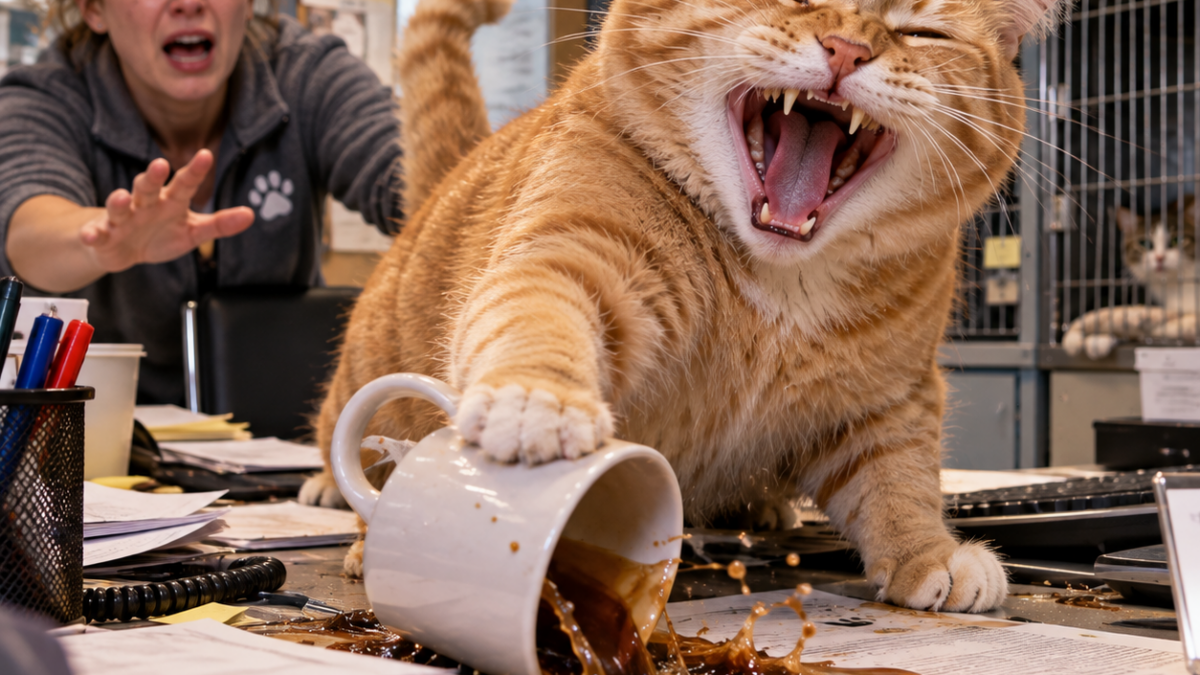
The photo had been taken three months earlier.
Diesel sat on Joanne’s desk.
A coffee mug lay overturned behind him.
Brown liquid spread across paperwork.
Diesel was caught mid-yawn.
His mouth gaped open.
Every tooth visible.
Eyes squeezed nearly shut.
He looked less like a housecat than a demon being expelled from somebody.
Maria smiled.
“Perfect.”
“He looks rabid.”
“He looks authentic.”
“He looks like he’s threatening the photographer.”
“He probably was.”
Joanne stared at the post.
Then looked at Diesel.
“What’s the worst that happens?”
“Still zero applications.”
“Fine.”
Maria pressed POST.
Thursday.
7:42 p.m.
By 8:05, there were twenty comments.
By 8:20, eighty.
At 9:00, the post had been shared more than a thousand times.
Maria texted Joanne.
You awake?
Joanne replied:
I am now.
Screenshot.
The comments came faster than they could read.
I HAVE NEVER WANTED A CAT MORE.
This is my soulmate.
My husband says no but he is weaker than I am.
I can fix him.
No you cannot. Adopt him anyway.
Tell Diesel I have coffee and no fear.
Does the mayor have to approve the adoption?
I live six states away. This is not a joke. Who do I call?
At 10:16, the first completed adoption application arrived.
Then another.
Then six.
Then twenty-three.
Maria stared at the screen.
“What is happening?”
Joanne called.
“Take it down.”
“What?”
“We cannot process this many.”
“You’re kidding.”
“I’m serious.”
“No!”
“Maria, we have thirty applications.”
“That’s good.”
“It’s been two hours.”
“Exactly!”
“Take it—”
The shelter phone rang.
Joanne answered.
A woman from Oregon had seen the post.
She wanted to fly in.
Joanne hung up.
The phone rang again.
A man in Tennessee offered to drive nine hours.
Another person asked whether Diesel could live on a sailboat.
Maria rejected that one on principle.
By midnight, there were more than two hundred applications.
At 1:30 a.m., Maria finally went home.
At 4:03, her phone buzzed.
A message from Bryce, who had overnight duty.
Photo attached.
Diesel was standing in his kennel screaming.
Caption:
Fame has changed nothing.
By Friday morning, local television had called.
Then regional radio.
Then a national pet website.
Maria arrived at the shelter and found Joanne staring at the computer.
“How many?”
Joanne looked up.
“Six hundred and twelve.”
Maria laughed.
Joanne did not.
“Our email server is struggling.”
“That’s great.”
“No, it isn’t.”
The phone rang.
Joanne ignored it.
“We have seven other animals who need placement.”
“Then use the traffic.”
Joanne stopped.
Maria opened the shelter page.
Comments were full of people saying:
I can’t adopt Diesel but what other cats do you have?
Maria pointed.
“This isn’t just him.”
That changed everything.
They pinned links to every long-term resident.
A bonded pair nobody had asked about in six months received twelve inquiries.
A shy black cat named Pepper got nine.
A ten-year-old cat with diabetes received three serious applications.
Diesel, apparently, had become marketing.
By Saturday morning, forty-eight hours after Maria hit Post, the shelter had received just over two thousand completed or partially completed applications, inquiries, messages, and formal adoption requests related to him.
Their email stopped working.
The voicemail filled.
People began arriving at the shelter before opening.
Joanne locked the front door and turned off the lobby lights.
Maria said, “This feels illegal.”
“This feels like a riot.”
Diesel slept through it.
He was stretched across a blanket in enclosure seventeen.
“Look at him,” Joanne said.
“He has no idea.”
Maria smiled.
“Classic celebrity.”
They spent Saturday narrowing applications.
Many were jokes.
Many were emotionally enthusiastic but logistically impossible.
Apartments prohibiting pets.
Families with six cats.
People wanting Diesel as a “funny internet cat.”
Maria hated those.
Diesel was not a meme.
He was a living animal who had already lost one home.
They needed someone who understood what the joke covered.
No other pets.
Preferably adult household.
Financially stable.
Prepared for weight management.
Prepared for early-morning screaming.
Prepared for destructive curiosity.
Prepared for attachment.
Then Maria found one application.
Applicant names:
Eric and Jason Miller.
Same city.
Married eleven years.
No children.
No pets.
Homeowners.
Previous cat experience.
Their last cat had died from kidney disease two years earlier at age eighteen.
Under:
WHY ARE YOU INTERESTED IN DIESEL?
They had written:
Large tolerance for chaos.
Maria laughed.
Joanne leaned over.
“That’s it?”
“There’s more.”
We miss having an animal in the house, but we have avoided adopting because after eighteen years with our last cat we learned we don’t want “easy.” We want a personality.
We both work partly from home.
We do not care about furniture.
Jason wakes at 4:30 for work anyway.
Eric drinks coffee from travel mugs with locking lids.
We consider the mayor incident context-dependent and are willing to hear both sides.
Joanne laughed.
“Call them.”
They arrived Sunday afternoon.
Eric was forty-two.
Tall.
Soft-spoken.
Glasses.
Jason was thirty-nine and worked as an emergency-room nurse.
They entered the meet-and-greet room carrying an enormous cat carrier.
Maria stared.
“That’s ambitious.”
Jason shrugged.
“He’s eighteen pounds.”
“You did research.”
“We’ve watched the video.”
“What video?”
Eric looked guilty.
“The mayor.”
Maria closed her eyes.
“Of course.”
Joanne brought Diesel.
Maria prepared her speech.
“Okay. He may ignore you. He may become overstimulated. Don’t touch his stomach. Let him approach.”
Diesel entered.
Looked at Jason.
Looked at Eric.
Walked across the room.
Maria stopped talking.
Diesel approached Eric first.
Sniffed his shoe.
Then stood on his hind legs and placed both front paws against Eric’s knee.
Eric looked at Maria.
“Can I—”
Diesel jumped.
All eighteen-point-nine pounds landed across Eric’s lap.
Eric made a noise.
“Wow.”
Diesel turned twice.
Then curled.
Jason laughed.
Maria stared.
Diesel closed his eyes.
Within two minutes he was asleep.
Nobody spoke for several seconds.
Eric finally looked up.
“I thought you said he was unbearable.”
Maria folded her arms.
“Wait twenty-four hours.”
The adoption was approved.
Joanne cried.
Maria did not expect that.
She thought she would celebrate.
Instead, when she carried Diesel’s blanket toward the carrier, something tightened in her chest.
Fourteen months.
The longest stay of any healthy cat in the building that year.
Diesel had become embedded in the shelter.
His scream.
His theft.
His escapes.
His presence beside whoever was having the worst day.
Maria knelt.
“Okay, criminal.”
Diesel rubbed against her hand.
“You’re leaving.”
He purred.
“You understand?”
Probably not.
She touched his forehead.
“You do not come back.”
Diesel blinked.
“I mean it.”
Her eyes filled.
“This is one escape you need to make permanent.”
Jason crouched beside her.
“We’ll take care of him.”
Maria nodded.
“I know.”
Eric opened the huge carrier.
Diesel entered voluntarily.
Maria stared.
“That alone proves he likes you.”
“What does he normally do?”
“Become liquid and develop twelve additional legs.”
The carrier door closed.
Diesel looked through it.
Maria touched one finger to the mesh.
“Go home.”
They left.
The adoption wing felt wrong.
Too quiet.
At 4:03 the next morning, Bryce texted:
I hate this.
Maria replied:
What?
No screaming.
Maria stared at the message.
Then cried.
Diesel’s first night in his new home began well.
He exited the carrier.
Inspected every room.
Walked into both bathrooms.
Opened one cabinet.
Sat inside the bathtub.
Discovered the guest bed.
Rejected it.
Jumped onto the kitchen counter.
Was removed.
Jumped back.
Was removed.
Repeated until Eric said:
“I think we’re negotiating.”
Jason replied:
“We’re losing.”
At 11:47 p.m., Diesel knocked a potted pothos plant from the counter.
Soil covered the floor.
Eric stood in the doorway.
Diesel sat in the dirt.
“Seriously?”
Diesel blinked.
Jason appeared behind him.
“How bad?”
Eric pointed.
Jason stared.
“Day one.”
“Maria warned us.”
“You said plants were safe.”
“I was wrong.”
They swept.
Moved every plant into a closed room.
At 3:58 a.m., Diesel climbed onto the bed.
Eric woke.
“What?”
Diesel inhaled.
“MRAAAAAAOOOOOOOW.”
Eric sat bolt upright.
Jason opened one eye.
“Oh.”
Diesel screamed again.
Jason checked the clock.
“Right on schedule.”
Eric stared.
“He really does this every day?”
“MRAAAAAAOOOOOOOW.”
Jason covered his head with a pillow.
“The ad was legally binding.”
Diesel walked across Eric’s chest.
Eric groaned.
“You weigh as much as furniture.”
Breakfast happened at 4:09.
At 6:45, Eric cooked eggs and chicken.
He sat at the kitchen table.
Diesel watched from the floor.
“No.”
Diesel jumped onto the chair beside him.
“No.”
One paw reached toward the plate.
“Diesel.”
Faster than Eric expected, Diesel hooked a piece of chicken.
Eric grabbed the plate.
Diesel grabbed the chicken.
Victory.
Jason entered.
“What happened?”
“Robbery.”
Diesel ate beneath the table.
Jason nodded.
“Ad said no remorse.”
“Accurate.”
By the third day, Diesel had discovered that Eric worked from a home office.
This became unacceptable because Eric sometimes closed the door.
The first closed-door incident lasted thirty-seven seconds.
Scratch.
Scratch.
Scratch.
“Diesel.”
Silence.
Eric resumed typing.
“MRAAAAAAOOOOOOOW.”
Eric closed his eyes.
“Please.”
Scratch.
Then a thump.
Another.
Eric opened the door.
Diesel sat outside.
Calm.
“Why?”
Diesel walked inside.
Jumped onto the desk.
Lay across the keyboard.
Eric messaged Jason:
We need a bigger office.
Jason replied:
We need a smaller cat.
By day five, Diesel slept every night against Eric’s ribs.
Not near him.
Against.
If Eric rolled, Diesel rolled too.
If Eric got up to use the bathroom, Diesel followed.
If Eric showered, Diesel sat outside.
If Eric cooked, Diesel supervised.
If Jason came home after a difficult ER shift, Diesel met him at the door.
That happened Friday night.
Jason arrived after thirteen hours.
A patient had died.
Young.
Too young.
He entered quietly.
Eric was upstairs.
Jason sat on the floor near the couch without turning on the lights.
Diesel appeared from the hallway.
Normally arrival meant screaming.
Food demand.
Attention.
That night, nothing.
Diesel walked to Jason.
Sniffed his face.
Then climbed into his lap.
Jason put both arms around him.
“Not tonight, buddy.”
Diesel stayed.
Jason cried into orange fur.
Diesel did not move for forty minutes.
Later Jason told Eric:
“He knew.”
Eric smiled.
“That’s what Maria said.”
“What?”
“He chooses.”
One week after adoption, Eric took a photograph.
He was asleep on the couch.
Diesel stretched across his chest.
Both looked completely unconscious.
Television on.
One of Diesel’s paws rested under Eric’s chin.
On the coffee table beside them, a water glass lay on its side.
Water pooled across two magazines.
Jason took the photo.
Eric sent it to Maria with one message:
He is terrible.
He is perfect.
Do not contact us.
We are keeping him.
Maria laughed so loudly Joanne came into the room.
“What?”
Maria showed her.
Joanne smiled.
“Post it.”
“You sure?”
“Absolutely.”
They posted the photo with permission.
The response was bigger than the original.
People wanted updates.
A local news station ran the story.
Then another.
Headlines appeared:
“UNADOPTABLE CAT FINDS HOME AFTER BRUTALLY HONEST BIO.”
“CAT WHO BIT MAYOR BECOMES LOCAL CELEBRITY.”
“2,000 PEOPLE APPLY FOR ‘UNBEARABLE’ SHELTER CAT.”
Mayor Whitaker even played along.
He posted:
I forgive Diesel but remain available for testimony if his new family needs character evidence.
Maria printed that one.
She taped it above her desk.
But the strangest thing happened afterward.
People began asking about the other difficult cats.
Not easy cats.
Difficult ones.
The ones who had been invisible behind soft language.
Maria rewrote Pepper’s profile.
Pepper had spent eight months in the shelter because she hid from everyone.
The old bio said:
Shy girl looking for patient home.
Maria replaced it.
PEPPER.
She will probably hide under your bed for the first two weeks and make you question every life choice that led you to adoption.
You will spend money on beautiful cat furniture.
She will live behind your washing machine.
Then, on a random Tuesday when you have finally accepted she hates you, you will wake up with her sleeping against your ankle.
From that day forward you will belong to her.
Pepper received forty-three applications.
Adopted in four days.
Then Bruno.
A black cat with one eye and a habit of slapping people who stopped petting too soon.
Old bio:
Affectionate boy.
Maria wrote:
Bruno has one eye, which is unfortunate because he uses the remaining one exclusively to monitor whether you are disappointing him.
Adopted in three days.
Then Eleanor.
Thirteen.
Arthritis.
Kidney medication.
Hated children.
Loved heating pads.
Maria wrote:
Eleanor is not interested in your grandchildren.
She is not interested in your neighbors.
She does not want adventure.
She wants prescription food, silence, one heated blanket and an adult human who respects the fact that she has survived thirteen years without anybody’s nonsense.
A seventy-one-year-old widow adopted her.
Then Pickles.
Young.
Hyperactive.
Climbed curtains.
Maria did not say “energetic.”
She wrote:
Pickles believes gravity is a suggestion.
Adopted.
By the end of September, Brookside’s cat adoption rate had nearly tripled.
A local reporter interviewed Joanne.
“What changed?”
Joanne looked toward Maria.
Maria tried to disappear behind a kennel.
Joanne smiled.
“Ask her.”
The reporter approached.
“What changed?”
Maria considered the polite answer.
Better marketing.
Social-media engagement.
Authentic storytelling.
Instead she said:
“We stopped lying.”
The reporter laughed.
Maria did not.
“I’m serious.”
She pointed toward the adoption wing.
“For years, shelters have been told to sell animals the way companies sell products.”
“Highlight advantages.”
“Minimize problems.”
“But people aren’t adopting furniture.”
She looked through the glass.
“They’re choosing a relationship.”
“Relationships come with problems.”
The reporter asked:
“So honesty sells?”
Maria shook her head.
“That’s not exactly it.”
“What is it?”
“Honesty lets the right person recognize themselves.”
The reporter waited.
Maria continued.
“Diesel didn’t need two thousand people.”
“He needed one household that read ‘screams at four in the morning’ and thought, Fine, I’m already awake.”
“He needed someone who didn’t care about plants.”
“Someone who understood he had opinions.”
“Someone who wanted that exact cat instead of the polite imaginary one we kept advertising.”
She smiled.
“Turns out there are more people like that than we thought.”
Diesel became healthier after adoption.
Not thinner immediately.
His weight had been part genetics, part previous feeding habits, part inactivity from fourteen months in shelter housing.
Jason and Eric worked with their veterinarian.
Measured meals.
Puzzle feeders.
Play sessions.
Diesel objected to all nutritional reforms.
The first evening his dinner portion decreased, he stared into the bowl.
Then at Eric.
Then at the bowl.
Then screamed.
Eric said, “Your doctor says you’re overweight.”
Diesel screamed again.
Jason whispered:
“Careful. He has political connections.”
They bought automatic feeders.
Diesel dismantled the first one.
Not destroyed.
Dismantled.
Eric woke to find the lid removed and Diesel asleep beside the empty food tray.
“How?”
Jason stared.
“I don’t want to know.”
The second feeder had a locking mechanism.
Diesel learned that if he threw his full body weight against it repeatedly, kibble sometimes fell through.
Eric found him doing this at 2:30 a.m.
Thump.
Thump.
Thump.
“Diesel!”
The cat froze.
Eric turned on the light.
Diesel walked away casually.
“You criminal.”
Six months later, Diesel had lost almost two pounds.
He remained enormous.
Just less enormous.
The mayor incident followed him everywhere.
At his annual veterinary appointment, the receptionist recognized him.
“Oh!”
Jason sighed.
“Yes.”
“Is that Diesel?”
“Yes.”
“The mayor cat?”
Diesel screamed from the carrier.
The receptionist laughed.
“I love him.”
Jason looked down.
“Everybody does from a safe distance.”
One year after adoption, Brookside invited Eric and Jason to a fundraiser.
They brought Diesel in a secure carrier.
Maria had not seen him in months.
When the carrier opened, Diesel stepped out.
Larger emotionally than physically.
Maria crouched.
“Hey, monster.”
Diesel stared.
She held out her hand.
For half a second Maria feared he had forgotten her.
Then Diesel walked forward.
Head-butted her hand.
Hard.
Maria’s eyes filled.
“You remember.”
Diesel rubbed against her arm.
Then attempted to steal a sandwich from the table.
Maria laughed.
“There he is.”
Joanne approached.
“You look good, Diesel.”
Diesel ignored her.
“You ruined two laptops.”
No response.
“You cost us hundreds of dollars.”
Diesel turned away.
“I still have coffee anxiety because of you.”
Eric smiled.
“He’s improved.”
At that exact moment, Diesel jumped onto a chair.
Then the table.
Walked directly toward Joanne’s coffee.
She grabbed it.
“No.”
Diesel sat.
Maria laughed so hard she almost dropped a donation jar.
“Improved.”
The mayor appeared later.
Charles Whitaker had learned to enjoy the joke because voters enjoyed the joke.
He kept a respectful distance.
“How’s my attacker?”
Eric lifted Diesel.
Maria warned:
“Do not recreate history.”
The mayor raised both hands.
“No touching.”
Someone took a photograph.
Mayor on one side.
Diesel in Eric’s arms.
Diesel looked furious.
The photo later appeared in the city newsletter with the caption:
DIPLOMATIC RELATIONS RESTORED.
Diesel lived the life Maria had hoped for.
Not a perfect one.
A real one.
He developed arthritis at ten.
Needed medication.
Hated pills.
Jason, an experienced nurse, discovered that professional medical competence meant nothing when trying to medicate a seventeen-pound orange cat.
“Hold him.”
“I am holding him!”
“No, you’re loosely negotiating with him.”
Diesel spat the tablet across the kitchen.
Eric stared.
Jason sighed.
“I give medication to combative adults every week.”
Eric pointed.
“Apparently none of them have claws.”
They eventually hid pills in chicken.
Diesel pretended not to notice.
At eleven, he stopped screaming every morning at four.
Not entirely.
Just less.
The first morning he slept until 5:12, Eric woke on his own.
He looked at the clock.
Then sat up.
“Jason.”
Nothing.
“Jason.”
“What?”
“Diesel didn’t scream.”
Jason opened one eye.
“Enjoy it.”
“What if something’s wrong?”
“You’ve complained about this cat waking us for four years.”
“I know.”
“And now he doesn’t and you’re upset?”
Eric was already downstairs.
Diesel slept on the couch.
Fine.
Eric stood over him.
Diesel opened one eye.
“You scared me.”
Diesel closed it.
That was when Eric realized the chaos had become routine.
Not chaos anymore.
Home.
Years earlier, Maria had written that once Diesel chose someone he never left.
She had been right.
He followed Eric and Jason everywhere.
Through job changes.
A kitchen renovation.
The death of Eric’s father.
Jason’s night shifts.
A terrible year when Jason developed depression after the hospital lost several patients during a respiratory outbreak.
Diesel became especially attached then.
He slept beside Jason every afternoon.
If Jason remained in bed too long, Diesel screamed.
Not for breakfast.
At him.
Jason joked that Diesel was an abusive therapist.
“Get up or be yelled at.”
But some days, that ridiculous orange face helped.
During the worst month, Jason told Maria later:
“I didn’t always want to talk.”
“Diesel didn’t care.”
“He’d just lie there.”
“Twenty pounds of heat.”
“He didn’t ask me to feel better.”
Maria understood.
That was Diesel.
Demanding about food.
Non-negotiable about doors.
But strangely respectful of grief.
At thirteen, kidney disease appeared.
The diagnosis frightened Eric and Jason because their previous cat had died from it.
They knew the progression.
The fluids.
Diet.
Blood work.
Good months.
Bad numbers.
Hope.
Adjustment.
Eventually goodbye.
Diesel, however, remained Diesel.
He attacked the fluid line.
Stole prescription food from his own bowl before they had officially served it.
Screamed at a heating pad when it automatically turned off.
His body became older.
His personality refused.
Maria visited him once during that period.
Diesel lay on the couch.
Thinner.
Orange fur slightly dull.
She sat beside him.
“Hey.”
He lifted his head.
Maria scratched beneath his chin.
“Remember enclosure seventeen?”
Diesel purred.
“I do.”
She looked around the house.
Photographs everywhere.
Diesel on Christmas morning.
Diesel beside a pumpkin.
Diesel asleep on Eric.
Diesel sitting on Jason’s paperwork.
One framed copy of the original shelter ad hung in the hallway.
Maria laughed.
“You kept it?”
Eric smiled.
“Of course.”
Jason pointed toward one line.
“‘We love him. But we can’t take it anymore.’”
Maria winced.
“I was tired.”
“I’m glad.”
“You are?”
Jason nodded.
“If you had written ‘sweet senior boy seeks loving home,’ I probably would’ve scrolled past.”
Eric added:
“The honesty made him specific.”
Maria stared at the framed post.
Specific.
Maybe that was the word she had been looking for all those years.
Not difficult.
Not perfect.
Specific.
Diesel was not for everybody.
Nobody was.
The shelter’s mistake had been trying to make every animal sound suitable for anyone.
That erased the exact qualities somebody might love.
At fourteen, Diesel slowed significantly.
His kidneys worsened.
Arthritis made jumping difficult.
Eric built steps to the bed.
The first night, Diesel ignored them and attempted the jump anyway.
Missed.
Eric caught him.
“You have stairs.”
Diesel screamed.
“Use them.”
Another scream.
Jason watched.
“He believes accessibility is insulting.”
Eventually he used the stairs when nobody watched.
At fifteen, he slept more.
Still screamed.
Just with less volume.
The sound became raspy.
One morning Maria received a message.
Can you come over?
She knew.
She drove to Eric and Jason’s house after her shelter shift.
Diesel lay on the couch.
Same couch from the famous photograph.
Eric sat beside him.
Jason on the floor.
Their veterinarian had visited that morning.
Kidney failure.
Severe.
Diesel had stopped eating.
Even chicken.
Maria knew what that meant.
She sat.
“Hey, terrible cat.”
Diesel’s eyes opened.
He lifted his head slightly.
Maria put one hand beside him.
Diesel pushed his forehead into it.
Still.
After all those years.
Still head-butting.
Her throat closed.
“You actually got old.”
Eric wiped his eyes.
“He’s been false advertising his immortality.”
Maria laughed through tears.
Diesel purred faintly.
They talked.
Not about death at first.
About everything else.
The mayor.
The coffee.
The first night.
The feeder demolition.
The 4:00 a.m. screaming.
Eric told Maria something she had never known.
“The first week after we adopted him, I thought maybe we had made a mistake.”
Maria looked up.
“Seriously?”
“Absolutely.”
Jason laughed.
“He knocked over three plants.”
“Two.”
“Three.”
“One was already unstable.”
“He screamed every morning.”
Eric smiled.
“He stole food from my plate while making eye contact.”
Maria looked at Diesel.
“Sounds right.”
“But then one night I woke up.”
Eric’s voice softened.
“He was asleep right here.”
He touched his chest.
“Exactly where our old cat used to sleep.”
He swallowed.
“And I realized how empty the house had felt before him.”
Jason added:
“He filled every room.”
That was also Diesel.
He had never simply occupied space.
He took possession of it.
At 4:02 the next morning, Diesel screamed.
One last time.
Weak.
Raspy.
Eric woke.
Looked at the clock.
Then laughed and cried simultaneously.
“You still know.”
Diesel lay between them.
Jason stroked his side.
Breakfast was offered.
He refused.
But he drank water.
Then returned to bed.
The veterinarian arrived at eleven.
Maria came too because Eric and Jason asked.
Diesel lay on Eric’s chest.
Exactly as he had in that photograph years earlier.
Jason sat beside them.
Maria sat near Diesel’s head.
There was no coffee nearby.
They joked about that.
“Finally learned,” Maria said.
Eric smiled.
“Only took fourteen years.”
The sedative went in.
Diesel relaxed.
His paw stretched against Eric’s shoulder.
Maria touched the notch in his ear.
“You did it.”
She did not know exactly what she meant.
Maybe:
You got out.
Maybe:
You found them.
Maybe:
You proved us wrong.
Maybe all of it.
Diesel’s breathing slowed.
Eric whispered:
“You’re terrible.”
Jason laughed softly through tears.
“The worst.”
Eric kissed Diesel’s head.
“Perfect.”
A few minutes later, the house became unbearably quiet.
Maria returned to the shelter that afternoon.
She did not have to.
Joanne told her to go home.
Maria could not.
At 4:00 the following morning, she was awake.
She sat in her kitchen.
Waiting.
No scream came.
Of course not.
But her body expected it anyway.
She smiled.
Then cried.
Brookside posted Diesel’s memorial that day.
They did not write a polished tribute.
Maria refused.
She used the same photograph from the original adoption post.
Diesel mid-yawn.
Mouth open.
Coffee spilled behind him.
And wrote:
Diesel died yesterday at approximately fifteen years old.
He spent fourteen months at Brookside because nobody wanted him.
Then we finally told everybody exactly how awful he was.
Two thousand people volunteered.
He chose Eric and Jason.
Over the years, Diesel continued to scream, steal food, knock things over, interfere with work, occupy furniture, terrorize automatic feeders and generally remain committed to the personality that made his original adoption profile necessary.
He also slept on their chests.
Sat beside them when they were grieving.
Followed them through every room.
Waited at doors.
Stayed through depression, illness, loss and ordinary Tuesday nights.
He was never easier.
He was simply loved accurately.
We once wrote that Diesel was waiting for the right person to annoy for the rest of his life.
We were wrong.
He found two.
The post spread again.
Not as widely as the first.
But enough.
Comments came from people who had followed him for years.
Some had adopted pets because of Diesel.
Several shared photos of “difficult” animals Brookside had placed using Maria’s honest profiles.
Pepper under a blanket.
Bruno glaring with one eye.
Eleanor on her heating pad.
Pickles upside down on a curtain rod.
The mayor commented too.
Rest easy, old enemy.
Maria printed that.
Years later, when new volunteers arrived, they often heard the Diesel story.
Some knew it already.
Internet history had preserved fragments.
The unbearable cat.
Two thousand applications.
Mayor bite.
What they usually did not understand was why the story mattered.
It was not because outrageous posts worked better on social media.
That was the shallow lesson.
Maria eventually became Brookside’s adoption coordinator.
On her first day, she took down a laminated sign from the staff room.
It said:
Every animal deserves a loving home.
She replaced it with:
Every animal deserves the right home.
The distinction mattered.
A loud cat did not need someone who tolerated noise because they felt sorry for him.
He needed someone who found the noise funny.
A shy cat did not need to become social enough for a busy family.
She needed a quiet person who understood that trust might take months.
An elderly animal did not need to masquerade as youthful.
An energetic dog did not need to be described as “enthusiastic” to a family that wanted calm.
You did not love an animal by pretending away the difficult parts.
Sometimes love began by seeing those parts clearly and choosing anyway.
One afternoon, years after Diesel died, Maria trained a new volunteer named Sophie.
They stopped beside a kennel containing a large black-and-white cat called Louie.
Louie had been returned twice.
He hated being picked up.
Destroyed blinds.
Needed prescription food.
He adored one particular chair in the staff office and attacked anyone who tried to move him from it.
Sophie held the draft adoption bio.
“Sweet boy looking for his forever family.”
Maria stared at it.
Then smiled.
“No.”
“What?”
“Start over.”
Sophie looked confused.
“What should I say?”
Maria pointed toward Louie.
“What is he actually like?”
Sophie hesitated.
“He’s kind of a jerk.”
Louie slapped the kennel door.
Maria laughed.
“Good.”
“I can’t write that.”
“Why not?”
“Because nobody will adopt him.”
Maria looked down the row of kennels.
She remembered an orange cat in enclosure seventeen.
Fourteen months.
Zero applications.
Then one paragraph of truth.
“Maybe.”
She smiled.
“But the person who laughs when they read it might be exactly who he’s waiting for.”
Sophie rewrote the bio.
Louie was adopted five days later.
That became Maria’s favorite part.
Not the viral numbers.
Not interviews.
Not adoption statistics.
The ripple.
Diesel had changed how an entire shelter spoke about animals.
Not because he was easy to sell.
Because he was impossible to fake convincingly.
Years after his death, his original post still hung above Maria’s desk.
The paper had faded.
The photograph remained ridiculous.
Open mouth.
Visible teeth.
Eyes squeezed shut.
Coffee spilled behind him.
Sometimes visitors asked:
“Is that the famous cat?”
Maria would look up.
“Unfortunately.”
They laughed.
“Was he really that bad?”
Maria would consider the question.
Then answer:
“Worse.”
People always laughed again.
Then she would add:
“And better.”
That was the truth.
Diesel had never been a diamond in the rough.
Maria hated that phrase most of all in retrospect.
A diamond in the rough implied the rough parts were accidental.
Something to polish away before the true valuable thing appeared.
Diesel’s rough edges were part of the valuable thing.
The screaming.
The stubbornness.
The enormous body thrown against closed doors.
The food theft.
The selective loyalty.
The territorial devotion.
The way he attached himself completely once he decided someone belonged to him.
You could not polish those away without removing Diesel.
He did not need improvement before love.
He needed compatibility.
That became Maria’s answer whenever anyone asked why the brutally honest post succeeded after fourteen months of failure.
Because people had not been rejecting Diesel.
They had been failing to see him.
Every polite adoption description blurred him into a thousand other cats.
Gentle boy.
Loving home.
Affectionate once comfortable.
Those phrases protected him from judgment.
They also erased him.
Then Maria wrote:
He bit the mayor.
And suddenly everybody could see him.
Not literally.
They could imagine him.
They could hear the 4:00 a.m. scream.
Picture the coffee falling.
Imagine the eighteen-pound body occupying a keyboard.
Imagine laughing instead of becoming angry.
Some people saw chaos and thought absolutely not.
Good.
Those were not Diesel’s people.
Others read the exact same words and thought:
Oh no.
That sounds like my cat.
Or:
That sounds like me.
Or simply:
I want him.
That was the miracle, if Maria believed in that word.
Truth did not reduce his chances.
Truth filtered them.
Two thousand applicants were funny.
But Diesel had never needed two thousand.
He needed Eric.
He needed Jason.
A quiet house.
No other animals.
A man already awake at four.
Locking coffee mugs.
Furniture nobody worshipped.
Two people who missed the kind of love that inconvenienced them.
And they needed him too.
They did not know that when they filled out the form.
They only knew the advertisement made them laugh.
Years later, Eric told Maria that the phrase he remembered most was not the mayor.
Not the screaming.
Not the escapes.
It was:
Once he chooses you, he never leaves.
“That was the line,” Eric said.
Maria smiled.
“Why?”
Eric looked toward the little wooden box containing Diesel’s ashes.
“Because after our first cat died, I think that was what we were afraid of.”
“What?”
“Loving something that leaves.”
Maria said nothing.
Eric smiled sadly.
“Which is stupid.”
“No.”
“Everything leaves eventually.”
“Yes.”
“But Diesel…”
He laughed softly.
“That cat took your line literally.”
Maria smiled.
“Bathroom?”
“Every time.”
“Kitchen?”
“Always.”
“Work calls?”
“Sat on the keyboard.”
“Bed?”
“Chest.”
Eric nodded.
“Right until the last day.”
Maria looked at the box.
“Then the ad was accurate.”
Eric smiled.
“The only accurate advertisement I’ve ever responded to.”
Maria thought about that later.
The shelter had spent fourteen months trying to make Diesel adoptable by making him sound less like himself.
The thing that finally sent him home was the exact opposite.
They stopped asking:
How do we make people want this cat?
And asked:
Who would want this cat?
That question changed everything.
Maybe it applied outside shelters too.
Maria saw people do the same thing to themselves constantly.
Smooth the difficult edges.
Hide the loud parts.
Pretend to like what everybody else liked.
Try to become universally acceptable.
Diesel had never had that instinct.
He was catastrophically himself.
That was inconvenient.
It was also why, once the right people found him, the match held for the rest of his life.
A few months after his death, Maria received a handwritten card from Jason.
Inside was a photograph she had never seen.
Diesel was sitting in the kitchen at 4:06 a.m.
Eric stood behind him holding a coffee mug.
Jason had apparently taken the picture.
Diesel’s mouth was open mid-scream.
Eric looked exhausted.
On the back, Jason had written:
You said wait a day.
We waited years.
He never got better.
Thank God.
Maria placed the photograph beneath the original adoption post.
That became the full story.
The first photo:
Diesel at the shelter.
Mouth open.
Coffee spilled.
Nobody wanted him.
The second:
Diesel at home.
Mouth open.
Coffee safely protected in a locking mug.
Completely loved.
Same cat.
Different context.
And maybe that was what people had misunderstood from the beginning.
Diesel did not need to become better.
He needed to get somewhere his worst qualities could be understood beside his best ones.
Somewhere screaming at four in the morning became a family joke.
Somewhere stealing chicken became a story told for years.
Somewhere knocking things over made people groan and then laugh.
Somewhere loyalty mattered more than obedience.
Somewhere “difficult” did not mean disposable.
Maria sometimes thought about Harold Pierce too.
The first person Diesel chose.
The old man who could no longer care for him.
The shelter eventually informed Harold when Diesel was adopted.
Maria brought him a photograph.
Diesel asleep on Eric’s chest.
Harold’s hands shook when he held it.
“Home?”
“Yes.”
Harold touched the photograph.
“His?”
Maria nodded.
“His.”
The old man smiled.
“Told you.”
Maria had forgotten his promise.
His person.
Diesel would choose.
He had.
Maybe two.
Harold died the following winter.
Maria later told Eric and Jason.
They placed Harold’s photograph near Diesel’s bed for a while.
Not because they believed Diesel understood.
Because people need continuity.
Need to know love existed before them and would remain after them.
Diesel had been loved by Harold.
Lost him.
Waited fourteen months.
Then loved again.
Not smoothly.
Not conveniently.
But completely.
That was why Maria never again allowed anyone at Brookside to use “nobody wants him” casually.
Sometimes nobody had wanted an animal yet.
Different sentence.
Different future.
A cat could sit fourteen months behind glass.
Be passed hundreds of times.
Ignored.
Misdescribed.
Misunderstood.
Then one honest paragraph could reach the exact household that had been waiting without knowing it.
Diesel’s case became shelter folklore.
New staff exaggerated it.
“He bit three politicians.”
“One.”
“He escaped twenty times.”
“Eleven confirmed.”
“He weighed twenty-five pounds.”
“Absolutely not.”
“He destroyed a computer.”
“That part is basically true.”
Maria corrected them.
The facts were already good enough.
That was another lesson Diesel had given her.
Reality did not always need improvement.
Sometimes the strongest story was simply the one you stopped sanitizing.
The final line of his first viral post remained her favorite.
We love him.
But we can’t take it anymore.
People assumed it was a joke.
It was.
Mostly.
But inside it was something shelters rarely admitted publicly.
Love and exhaustion could coexist.
An animal could be cherished and difficult.
A good home could include frustration.
A successful adoption did not mean nobody ever regretted having a cat at four in the morning.
It meant the regret passed.
The commitment stayed.
Eric and Jason had complained about Diesel constantly.
Then built their lives around him.
That was real love.
Not endless delight.
Endurance with affection.
Humor with responsibility.
Choosing again after the plant falls.
After the scream.
After the stolen chicken.
After the vet bill.
After the medication gets spat onto the floor.
After the cat grows old and the chaos fades and suddenly you miss the version of him that drove you crazy.
Years later, Maria still arrived early at Brookside.
Sometimes at four.
The adoption wing would be dark.
Quiet.
Dozens of animals sleeping.
Every so often, one cat would wake and cry.
Maria always turned automatically toward enclosure seventeen.
It had housed dozens of cats since Diesel.
Nobody special permanently.
Every animal special temporarily.
She would remember the scream.
The orange face.
The coffee.
Then smile.
Fourteen months of polite lies had accomplished nothing.
One night of frustration finally told the truth.
The truth made two thousand people laugh.
It made dozens apply seriously.
It sent one ridiculous orange cat home.
And for the rest of Diesel’s life, nobody who loved him ever had to pretend he was easy.
He was loud.
Destructive.
Greedy.
Manipulative.
Heavy.
Possessive.
Impossible.
He was loyal.
Funny.
Attentive.
Devoted.
Comforting.
Brave in strange little ways.
And once he chose you, he stayed.
All of those things were true at the same time.
That was the point.
Maria had once believed adoption work meant convincing people an animal was worth loving despite its flaws.
Diesel taught her something better.
Sometimes the flaws were not obstacles around the personality.
They were the personality.
The right home would not merely tolerate them.
It would learn their rhythm.
At 4:00 a.m.
With a locking coffee mug.
A plate guarded carefully from orange paws.
A large space left open on somebody’s chest.
And maybe that was why, after fourteen months of nobody wanting him, two thousand people suddenly did.
Not because Diesel changed.
Because for the first time, nobody asked him to.








