A Scared Foster Cat Put One Paw on My Wrist When I Tried to Move Her Only Kitten—Then I Realized She Thought I Was Taking Away the Last Thing She Had Left.
PART3:
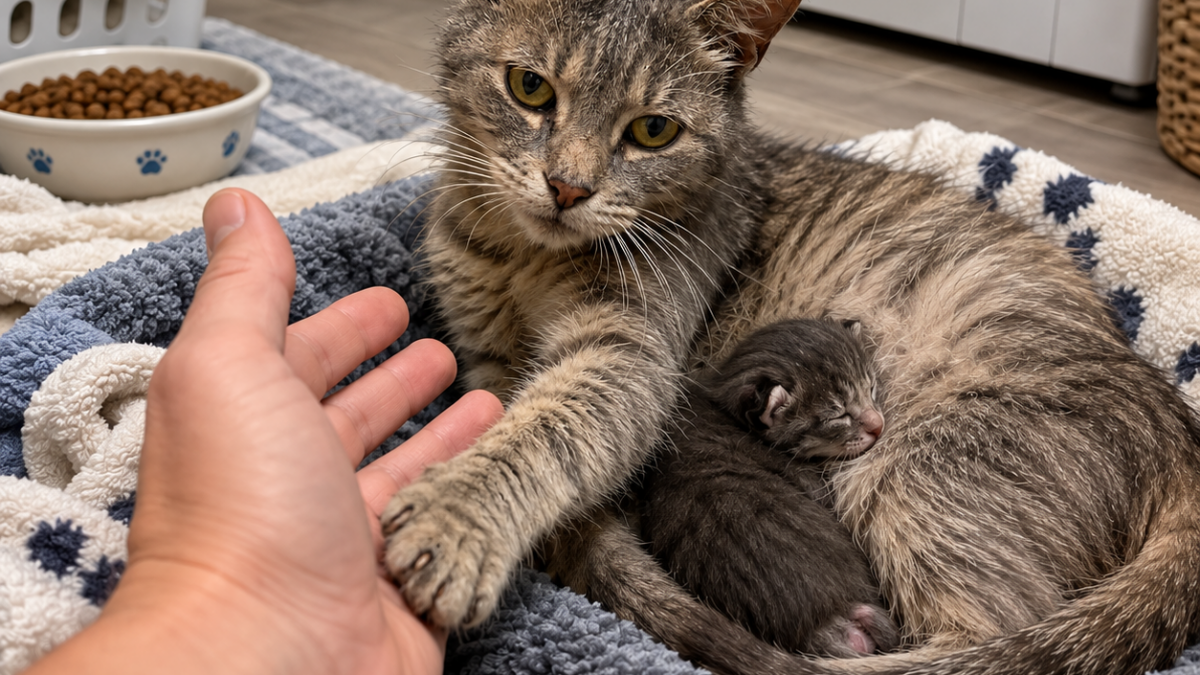
Her paw pressed lightly against my wrist.
Not pushing.
Holding.
Please.
I knew what she was saying as clearly as if she had spoken.
Don’t take him.
Bean squeaked beneath her.
Bea’s head snapped down immediately.
She licked the top of his head once.
Twice.
Three times.
Then looked back at me.
Her paw stayed where it was.
I whispered:
“Oh, Bea.”
She blinked.
My throat tightened.
“I’m not taking him.”
No response.
“I promise.”
She had no reason to understand promises.
Probably no reason to trust one.
I lowered my hand.
Set the scale beside the blanket instead.
Then sat back.
“I’m trying to help him stay.”
That was the moment everything changed.
Not suddenly.
Not magically.
Bea did not crawl into my lap.
She did not purr.
She did not remove her paw and hand me Bean as if we had signed a custody agreement.
She watched me.
For a long time.
Then she moved her paw perhaps half an inch.
Enough for one finger.
I reached slowly.
Touched Bean’s back.
Bea tensed.
But she let me.
One finger.
That was the first piece of trust she gave me.
To explain why it mattered so much, I have to go back three weeks.
Bea came from behind a vacant storefront at the edge of town.
There had once been a small florist there.
Then a tax office.
Then nothing.
By the time the rescue volunteer called me, the windows were covered in brown paper and weeds had grown through cracks in the parking lot.
A woman who worked at the pharmacy next door had been putting food behind the building for several stray cats.
That was how she noticed the gray one.
Pregnant.
Very pregnant.
Thin everywhere except the belly.
She appeared at sunset.
Ate fast.
Left.
Came back the next evening.
Then one morning she struggled to stand after eating.
That was when the pharmacy employee called Maple County Cat Rescue.
And Maple County called me.
My name is Claire Bennett.
I had been fostering cats for six years.
Not professionally.
There is no professional level at which your furniture looks better after six years of fostering.
I had a spare laundry room.
A tolerant husband named Paul.
Two resident cats who believed every foster was a temporary insult.
And enough experience to know a heavily pregnant stray needed somewhere quiet before she decided the underside of a dumpster was good enough.
June, the rescue coordinator, called me at 5:32 p.m.
“Please don’t say no.”
“That is a terrible opening.”
“Pregnant female.”
“How pregnant?”
“Extremely.”
“That is not medical.”
“She looks like she swallowed volleyball.”
I sighed.
“Friendly?”
June paused.
“Define friendly.”
“No.”
“Not exactly.”
“June.”
“She hasn’t bitten anyone.”
“Because?”
“No one has touched her.”
I closed my eyes.
Paul was sitting across the kitchen eating pasta.
He saw my face.
“No.”
He said.
I covered phone.
“You don’t know what she asked.”
“Yes, I do.”
“No, you don’t.”
“Pregnant cat.”
I stared.
“How?”
“Your rescue voice.”
I went back to phone.
“One night.”
Paul laughed.
June said:
“Absolutely.”
Nobody believed one night.
They brought Bea just after seven.
She arrived in a large carrier covered with a towel.
When June set it down in laundry room, I could hear breathing from inside.
Fast.
Shallow.
Not labor.
Fear.
We closed door.
Dimmed lights.
Put food and water several feet from carrier.
A litter box in opposite corner.
Clean blankets inside a low-sided nesting box.
Then June lifted towel.
Two yellow eyes stared through carrier door.
Bea was small.
Smaller than I expected.
Maybe seven pounds under pregnancy weight.
Gray short-haired coat.
Dirty around paws.
One patch on shoulder where fur had thinned.
Her belly hung low and wide.
Her nipples were prominent.
She looked exhausted.
Not wild in the true feral sense.
There was too much watching.
Too much familiarity with rooms.
She knew humans.
That almost made me sadder.
Cats completely unfamiliar with people react differently.
Bea knew doors.
Bowls.
Voices.
Hands.
She just did not trust any of them.
“Do we know if she belonged to somebody?”
I asked.
“No chip.”
June said.
“No collar.”
“Pharmacy lady says she’s been around maybe two months.”
“What happened before?”
“No idea.”
That is the hardest part about rescue animals.
You get the middle.
Sometimes the end.
Almost never the beginning.
People invent stories to fill blanks.
She was dumped.
She escaped.
Owner died.
She was born outside.
Someone abused her.
Maybe.
Maybe not.
We knew only what stood in front of us.
Thin pregnant cat.
Dirty fur.
Afraid.
June left.
Paul stood in doorway.
“This is one night?”
“Yes.”
Bea stared at him.
He whispered:
“She looks like she wants to kill me.”
“No.”
“She looks like she wants you to disappear.”
“Same result.”
We left her alone.
An hour later food was gone.
By midnight she had moved out of carrier and behind dryer.
The next morning she was in nesting box.
That was progress.
I sat on floor six feet away and read email on my phone without looking at her.
Bea watched me for twenty minutes.
Then ate.
Three days later, she went into labor.
It started around eleven at night.
Restlessness.
Turning.
Digging at blankets.
Licking.
Panting.
I called June.
Then the emergency vet just to confirm what I already knew.
Monitor.
Give space.
Call if prolonged straining without kitten or signs of distress.
Paul slept upstairs because one of us needed functioning brain next day.
I stayed.
Bea wanted me there and did not want me there at the same time.
If I left laundry room, she cried.
If I sat too close, she stared.
So I found a spot against wall.
Four feet away.
At 1:36 a.m., Bean was born.
Tiny.
Wet.
Gray.
Alive.
Bea immediately turned.
Opened sac.
Cleaned his face.
Licked with frantic intensity.
He squeaked.
That sound nearly made me cry.
“There you go.”
I whispered.
Bea ignored me.
She nudged Bean toward belly.
He found milk.
For the next hour, I waited for second kitten.
So did Bea.
That was what stayed with me.
She would clean Bean, settle him, then lift her head.
Listen.
Turn toward her flank.
Shift position.
Wait.
Twenty minutes.
Forty.
An hour.
I watched abdomen.
Called vet again.
No active straining.
No distress.
Singleton litters happen.
Maybe imaging had missed? We had not had x-ray because she came so late and vet initially thought labor imminent; ultrasound had suggested perhaps one or two but not definitive.
At 3:00, no second kitten.
At 4:00, none.
Bea kept looking.
As if she believed there should be another cry.
Maybe that is me humanizing.
I know.
But I watched.
Every time Bean squeaked, she responded.
Then she looked toward empty corner.
Again.
Again.
By daylight it was clear.
Only Bean.
One tiny kitten.
One mother.
Something in Bea changed.
Before labor she had been a frightened stray.
After Bean arrived she became organized.
Focused.
She had a purpose.
Nothing entered that nest without her tracking it.
She ate only when Bean was asleep.
Used litter box quickly.
Returned immediately.
If he crawled more than a few inches, one gray paw hooked gently around him and dragged him back.
She washed his face after every feeding.
His paws.
His belly.
His bottom.
Everything.
She curled so tightly around him sometimes all I could see was one white chin spot.
When I came into room, Bea placed herself between us.
Never attacked.
Never threatened.
Just blocked.
I learned to announce.
“Hey, Bea.”
Open door.
Pause.
Sit.
Move slowly.
She began accepting my presence.
Not me.
My presence.
Different.
By day five, she ate while I sat six feet away.
Day eight, four feet.
Day ten, she allowed me to replace a dirty blanket if Bean stayed against her.
Day twelve, I weighed him without drama.
Day fourteen, she watched closely but did not move.
I thought we were making progress.
Then Bean’s weight gain slowed.
I told myself not to panic.
Some variation.
Maybe scale.
Maybe he had recently urinated.
Maybe timing.
But neonatal foster people become accountants.
Numbers are reassurance.
Numbers are warning.
I charted.
Called June.
She told me:
“If flat tomorrow, vet.”
The next morning was flat.
4:17 a.m.
Scale.
Coffee.
Bea’s paw.
Everything I told you.
After she allowed me to touch Bean, I weighed him beside her.
No lifting away.
I slid a folded washcloth onto scale.
Tared it.
Moved scale directly against nest.
Then gently rolled Bean onto it while Bea’s nose stayed inches away.
She kept one paw on my wrist.
The number appeared.
Same as day before.
My stomach dropped.
I called emergency line because waiting until office opened felt wrong.
The technician asked questions.
Is he warm?
Yes.
Nursing?
Yes, but maybe less vigorously.
Responsive?
Yes.
Gums?
Pink.
Breathing?
Normal.
Any diarrhea?
No.
Mom producing milk?
I thought so.
They told me bring him in when clinic opened unless he declined sooner.
The problem was Bea.
Could I take Bean without her?
Technically yes.
Emotionally, no.
And medically, he still needed her.
So at 7:30 I called June.
“We’re taking both.”
“Bea too?”
“Yes.”
“She’ll lose her mind.”
“Then she loses it beside him.”
There was silence.
June said:
“That sounds right.”
Getting Bea into carrier took forty minutes.
Not because she fought.
Because I refused to separate them.
I put Bean inside small fleece-lined basket within larger carrier.
Bea watched.
Paced.
I backed away.
She eventually stepped in after him.
Door closed.
She stared at me through bars with expression of betrayal so complete I nearly opened it again.
“I know.”
I whispered.
“I know.”
At clinic, Dr. Lena Morris examined Bean first while Bea remained close.
She had worked with rescue cats for years.
No unnecessary restraint.
No taking kitten into back room unless needed.
She weighed.
Listened.
Checked hydration.
Mouth.
Temperature.
Then watched him nurse.
“He’s weak.”
She said.
“But I don’t see obvious emergency yet.”
“What does yet mean?”
“It means he has very little margin.”
I hated that answer because it was honest.
“Could Bea not have enough milk?”
“Possible.”
“Could be infection?”
“Possible.”
“Congenital issue?”
“Possible.”
Every answer possible.
We discussed supplemental feeding.
Not replacing nursing.
Supporting.
Frequent small feeds.
Monitoring aspiration.
Daily weights.
Possible labs if no improvement.
Dr. Morris looked at Bea.
Mother cat was pressed against carrier back wall, eyes huge.
“She’s protective.”
“Very.”
“That’s good.”
“Unless she stops me.”
“Then we work with her.”
Not against.
I liked Dr. Morris immediately.
At home, the real work began.
Every few hours:
Warm formula.
Measure.
Offer supplemental feeding according to vet guidance.
Watch Bean nurse Bea.
Track urine and stool.
Weigh.
Write.
Bea hated bottle at first.
Not because bottle itself.
Because it required me to touch Bean longer.
The first feeding she climbed halfway onto my lap—not affectionately, more like a security officer entering restricted area.
Her paw rested on my forearm.
Nose against Bean.
She watched.
I fed slowly.
Bean swallowed.
Bea licked his face between drops.
It became a strange partnership.
Me holding.
Bea supervising.
Bean eating.
At 2 a.m., all three exhausted.
Paul would appear in doorway.
“You okay?”
“No.”
“Need anything?”
“Coffee.”
“You should sleep.”
“Coffee.”
He learned.
By third supplemental feed, Bea let me position Bean without putting paw on me.
By fifth, she rested chin on my knee.
I did not move.
Not even to breathe properly.
Paul walked in.
Saw.
Backed out.
Smart man.
The next morning Bean gained two grams.
Two.
I wrote it in notebook like stock market recovery.
+2
Then the next:
+4
Then:
+5
Not huge.
But direction right.
Bea seemed to notice change before I trusted it.
Bean became louder.
A stronger squeak.
Then a tiny demanding yell that sounded absurd coming from a body smaller than my hand.
His belly rounded.
He crawled with more purpose.
One afternoon he pushed himself halfway across blanket and fell sideways.
Bea stared.
Then looked at me as if this nonsense was my fault.
“You made him stronger.”
I told her.
She licked him aggressively.
By day twenty-three, Bean’s weight gain was consistent.
Dr. Morris smiled at recheck.
“That’s what we want.”
I almost hugged her.
Bea almost would have killed me for sudden movement.
So I didn’t.
Something else changed.
Bea began leaving Bean.
Not far.
Two feet.
At first to eat.
Previously she dragged bowl close or waited until I placed it beside nest.
Now she walked to bowl.
Ate.
Looked back every two bites.
Returned.
The first time I saw it, I cried.
Ridiculous.
Cat walked two feet.
But trust is measured differently depending on starting point.
A mother who believed the world might take her only kitten had allowed distance.
Then one night she slept.
Really slept.
I came in at 1:30 for check.
Bean was curled beneath her chin.
Bea lay on side.
Eyes fully closed.
No ears twitching.
No head lifting when hallway floor creaked.
I sat quietly.
She did not wake.
That was the first time.
For weeks, Bea had slept the way people sleep in hospital rooms.
One part always listening.
Now her body had finally decided someone else was on watch.
Me.
I stayed on floor twenty minutes so she could have it.
That became one of the quietest privileges of my life.
Bean grew.
Slowly at first.
Then like someone flipped switch.
At four weeks he discovered legs.
At five he discovered speed.
At six he discovered his mother’s tail.
Bea regretted motherhood visibly.
He would launch himself at her.
She would stare into distance with exhausted expression recognized by parents across species.
He climbed her.
Bit her ears.
Attacked her back feet.
Pounced on her face while she slept.
Bea tolerated almost all of it.
When he crossed line, one paw pinned him gently to blanket.
He froze.
Lesson.
Then resumed crime two minutes later.
Singleton kittens can miss some social learning littermates provide.
So Bea had extra work.
She taught bite inhibition.
Boundaries.
Grooming.
How hard was too hard.
When Bean became obnoxious, I occasionally brought in a similarly aged foster kitten from June for supervised play after health clearance.
Bea inspected newcomer like customs agent.
Bean lost his mind with joy.
Another kitten!
He wrestled.
Learned.
Then returned to Bea and collapsed against her.
Every time.
No matter how independent he became, sleep belonged to mom.
Bea’s relationship with me evolved more quietly.
One morning she ate from bowl while my hand rested nearby.
Then rubbed cheek against my knuckle.
Once.
I froze.
She froze too.
As if we both realized she had violated contract.
She stepped away.
I pretended nothing happened.
Next day she did it again.
Two weeks later, she allowed one scratch under chin.
Only while Bean was nursing.
Then five seconds.
Then ten.
Never top of head at first.
Hands coming down frightened her.
So I offered from side.
She chose.
That was our rule.
She chooses.
One afternoon Paul walked in and saw Bea purring under my hand.
He whispered:
“You finally domesticated her.”
I shook head.
“No.”
“She finally decided I’m not dangerous.”
Important difference.
At eight weeks, Bean was officially adoptable soon.
That fact had been true from beginning.
I knew.
Fostering means temporary.
You take an animal in knowing successful ending often means goodbye.
I had done it dozens of times.
Kittens.
Adults.
Mothers.
Seniors.
Medical fosters.
I cried sometimes.
Then sent them.
That is work.
But Bean and Bea complicated things.
The rescue’s standard plan was kittens adopted when old enough and healthy.
Mothers spayed and placed separately if necessary.
Many moms are ready to be done with kittens.
Some actively avoid them.
Bea was not.
Bean still slept against her.
She still called if he left room.
He still ran to her when startled.
June came over.
Watched them.
“This is going to be hard.”
“Yes.”
“Applications already on Bean.”
“Of course.”
“Gray kitten with white chin.”
“Yes.”
“Bea has none.”
That made me angry though not surprised.
Adult gray cat.
Skittish.
No cute kitten photos.
No one lining up.
“What if we list bonded?”
June hesitated.
“Are they?”
I looked through doorway.
Bean was attacking Bea’s tail.
Bea grabbed his face and washed it while he protested.
“Yes.”
“Maybe.”
“June.”
“Claire, bonded pairs are harder.”
“So?”
“So if insisting together keeps Bea in foster another six months—”
“Then six months.”
She looked.
“Paul know you said that?”
From kitchen:
“I heard.”
Traitor.
June smiled.
“We can try.”
We did.
Ad:
BEA & BEAN — MOTHER AND SON
Bean: curious, playful, ridiculous.
Bea: gentle, cautious, learning humans can be safe.
Preference for home together.
Applications came.
Most wanted Bean only.
One person said:
“We already have adult cat so don’t need mom.”
As if Bea were accessory.
Another:
“Would Bea be okay as barn cat?”
No.
Then a family visited.
Two children.
Too loud.
Bea disappeared behind dryer.
Bean enjoyed kids.
They loved him.
Wanted him.
Not Bea.
I said no.
June supported.
Weeks passed.
Bean turned twelve weeks.
Then fourteen.
Bea spayed.
Recovery required separation for a few hours.
Bean screamed from adjoining enclosure.
Bea scratched door.
I sat between them wondering if perhaps we were all unhealthy.
Dr. Morris laughed when I described.
“Some bonds are close.”
“Too close?”
“Are they functioning?”
“Yes.”
“Eating independently?”
“Yes.”
“Playing independently?”
“Yes.”
“Mom can leave him?”
“Yes.”
“Then closeness isn’t pathology.”
Good.
I needed someone to say.
At sixteen weeks, application came from a woman named Ruth Ellison.
Sixty-two.
Retired elementary school teacher.
Recently lost seventeen-year-old cat.
No other pets.
Quiet house.
Screened porch.
She wrote:
I was initially looking for an adult cat because kittens exhaust me. Then I saw Bean sleeping across Bea’s neck and thought perhaps Bea and I have same problem: we both accidentally come with a kitten.
I laughed out loud.
We scheduled visit.
Ruth arrived carrying nothing.
No toy.
No treats.
That impressed me oddly.
People often try bribing shy cats.
She sat laundry-room floor.
Sideways.
Did not stare.
Bean climbed her pant leg within five minutes.
Of course.
Traitor.
Bea stayed three feet away.
Ruth ignored.
For forty-five minutes.
Then Bea approached.
Sniffed shoe.
Ruth did not move.
Sniffed hand.
No move.
Then Bea sat beside her.
Not touching.
Ruth looked at me.
I saw tears.
“I think she’s enough.”
She whispered.
Bean attacked her shoelace.
“And apparently I get bonus.”
I almost cried.
We did home check.
Perfect.
Adoption scheduled.
I dreaded it for a week.
The morning they left, Bean ran around as though moving day were carnival.
Bea saw carrier and hid.
My chest cracked.
Here we go again.
I sat.
Put carrier open.
Blanket from nest inside.
Bean walked in because no survival instincts.
Bea watched.
Then followed him.
Just like first vet trip.
I closed door.
Her eyes met mine.
Not betrayal this time.
Question.
I put fingers through bars.
Bea leaned nose forward.
Touched one fingertip.
That was goodbye.
Ruth loaded them.
I stood driveway.
Cried.
Paul put arm around me.
“You did job.”
“I hate job.”
“I know.”
The house felt enormous without them.
Laundry room smelled faintly of kitten formula and cedar litter.
I washed blankets.
Put scale away.
Then found notebook.
BEAN — DAILY WEIGHT
Pages of numbers.
At 4:17 morning entry:
NO GAIN.
Underneath, later I had written:
Bea let me touch him.
I sat floor and cried harder.
Three hours after adoption, Ruth texted photo.
Bean sprawled on couch.
Bea under coffee table.
Caption:
Everyone alive. Bean has attacked three curtains. Bea thinks I am suspicious but tolerable.
That night:
Bea ate.
Next morning:
Bea slept on rug beside bed.
Day three:
Bean discovered screened porch.
Bea sat with him.
Day five:
Photo.
Ruth in chair.
Bea beside her.
Bean on Bea.
Then two weeks later:
Bea climbed onto couch voluntarily.
A month:
Bea slept against Ruth’s leg.
Three months:
Bean enormous.
Well, not enormous.
But no longer sock-sized.
Healthy.
Bright.
Still white chin.
Still slept with his mother.
At six months Ruth sent video.
Bean running through hallway.
Bea chasing.
They flew past camera.
Ruth laughing.
I replayed five times.
One year later, Ruth invited us.
I worried Bea would not remember.
Cats remember differently.
Scent.
Pattern.
Association.
I walked into living room.
Bean approached first.
Of course.
Adult now.
Long-bodied.
Confident.
He sniffed my shoes.
Then flopped.
Bea appeared doorway.
She stopped.
Yellow eyes.
For a long moment nothing.
I sat floor.
Same way.
Sideways.
Hand resting on knee.
No reach.
Bea walked toward me.
Slow.
Sniffed fingers.
Then placed one paw on my wrist.
My breath stopped.
The exact gesture.
Same gray paw.
Same yellow eyes.
But this time there was no kitten beside her.
No fear.
Her claws remained sheathed.
She pressed once.
Then stepped onto my lap.
I cried so suddenly Ruth thought something wrong.
“I’m okay.”
I whispered.
Bea circled.
Settled.
Bean jumped up too and crushed us both.
Ruth laughed.
“There’s your bonus.”
I stroked Bea’s back.
She purred.
Loud.
The same cat who once believed my hand meant loss now slept beneath it.
That should have been enough ending.
But Bea taught me something I did not understand until much later.
Protection and trust are not opposites.
At first, I thought her paw meant:
No.
Then I thought later it meant:
Please.
Eventually I realized it meant both.
A boundary can be fear and love at same time.
Bea did not need to stop protecting Bean to trust me.
She needed to learn I could help her protect him.
That is different.
Humans often demand trust as surrender.
If you trust me, let go.
If you trust me, stop worrying.
If you trust me, give me access.
Bea never did that.
She kept watch.
She kept her paw there.
She watched my hands.
And slowly she let me join the work.
Trust was not removing boundary.
It was moving it one inch.
One finger.
One weigh-in.
One feeding.
One night of sleep.
People say animals live only in present.
Maybe.
But their bodies remember.
Bea’s did.
A hand coming from above.
A door closing.
A carrier.
Being separated.
Whatever had happened before the empty storefront lived in her muscles even if I never knew story.
Bean gave those instincts somewhere to focus.
One little life.
Her entire world under her chin.
That is why she seemed to love him desperately.
Maybe all mothers do.
Maybe scarcity sharpened it.
No littermates.
No second baby.
No other cry.
Just Bean.
If she lost him, there was nothing else in nest.
I once asked Dr. Morris:
“Do you think Bea knew he was only one?”
She smiled.
“Bea knows what’s in front of her.”
“That’s not answer.”
“It’s best one.”
Fair.
We humans like meaning.
Animals may simply act.
Yet actions can still teach.
Bea stayed.
Through hunger.
Birth.
Fear.
Sleepless nights.
Bean’s stalled weight.
Vet trips.
Bottle feedings.
Recovery.
She stayed.
Love did not look like speeches.
It looked like cleaning milk from Bean’s face.
Pulling him back under her belly.
Skipping food until he slept.
Leaving bowl early when he squeaked.
Putting paw on my wrist.
Then later, walking two feet away because she finally believed someone else would watch.
That two feet may have been greatest distance she ever traveled.
People love rescue transformations.
Before and after photos.
Dirty to clean.
Thin to healthy.
Scared to cuddly.
But the real changes are often invisible.
The first time animal sleeps deeply.
The first time they eat with back turned.
The first time they play.
The first time they choose a doorway instead of corner.
The first time they hear footsteps and do not hide.
Bea’s transformation was not becoming friendly.
It was becoming less afraid that good things would vanish if she closed her eyes.
That takes time.
Bean’s stalled weight taught me something too.
Love alone is not enough.
Bea loved him perfectly.
He still needed supplementation.
Veterinary care.
A scale.
Sometimes humans romanticize maternal love as if devotion can solve biology.
It cannot.
Bea would have licked Bean forever.
If he needed more calories, licking could not provide them.
Helping did not diminish her motherhood.
It supported it.
That matters outside cats too.
Asking for help does not mean love failed.
Accepting help does not mean you were not enough.
Bea did not become less of mother because I fed bottle.
She became mother who let another set of hands keep her baby alive.
There was dignity in that.
I think about 4:17 often.
Cold coffee.
Old robe.
Scale.
Her paw.
If I had pushed through?
I could have.
I was bigger.
Human.
I could have lifted kitten.
She probably would not have stopped me physically.
But something might have changed.
Maybe trust would have broken.
Maybe she would have moved Bean behind dryer.
Maybe every weigh-in became battle.
Instead, we paused.
I adjusted.
Brought care to nest instead of taking Bean from it.
That was such small accommodation.
It changed everything.
Whenever new foster volunteers ask me:
“How do I make a scared cat trust me?”
I say:
“You don’t.”
They hate that answer.
“What do you mean?”
“You behave predictably and let cat decide what evidence means.”
Food.
Distance.
Routine.
Slow hands.
Choice.
You cannot demand trust any more than you can demand sleep.
You create conditions.
Then wait.
Bea taught me that.
Ruth sends photos every birthday now.
Bean turned five last spring.
He is large.
Too large, according to Ruth.
“Built like upholstered footstool.”
She says.
Bea is older.
Maybe nine.
Maybe ten.
Nobody knows.
Gray fur lighter around face.
She has arthritis beginning.
Ruth bought little stairs to couch.
Bean ignores stairs and launches.
Bea uses them carefully.
Still sleeps beside him.
Not wrapped around him anymore.
He would suffocate her.
But close.
Often one paw touching his back.
Every photo has that.
Paw.
Contact.
Proof.
One day Ruth sent image that made me sit down.
Bean was asleep on windowsill.
Bea was asleep in armchair several feet away.
No touching.
No watching.
Eyes closed.
Sunlight across face.
I stared.
The fearful mother who once could not eat two feet from baby now slept across room.
That was not distance.
That was security.
She knew Bean could exist beyond her body and remain.
She knew home remained.
Food remained.
Ruth remained.
Maybe love had finally become less frightened.
That is what I want for all of us.
Not to love less.
To fear loss less while we have what we have.
Hard.
Maybe impossible completely.
But perhaps one paw at a time.
People sometimes ask why I foster.
There are easier ways to spend weekends.
Easier ways to ruin rugs too.
I do it because rescue is full of tiny moments nobody sees.
A cat eating after refusing for two days.
A kitten gaining four grams.
An animal learning blanket is soft.
A mother sleeping.
A paw on wrist.
Those moments are not dramatic enough for television.
They are everything.
Bea and Bean did not need me to save them in some grand sense.
A pharmacy worker noticed Bea.
June trapped her.
Paul gave up laundry room.
Dr. Morris treated Bean.
Rescue paid bills.
Ruth gave them home.
I was one person in chain.
That is how most rescue actually works.
Many ordinary people each doing one piece.
Bea did largest piece.
She brought Bean into world.
Kept him warm.
Fed him.
Cleaned him.
Guarded him.
Then did something even harder.
She let help in.
I think that is why her paw hurt me so much.
Because it was not rejection.
It was negotiation.
She was saying:
This is mine to protect.
Show me you understand.
So I did.
Or tried.
Years later, when she placed that same paw on my wrist and then climbed into my lap, I realized the gesture had changed meaning without changing shape.
At 4:17:
Don’t take him.
At Ruth’s house:
I remember you.
Same paw.
Same cat.
Different world.
Bean never knew any of this.
That is perhaps best part.
He grew up thinking warm laundry rooms, full bowls, careful hands, his mother, and humans who show up were normal.
He never knew he almost stopped gaining.
Never knew notebook.
Never knew emergency calls.
Never knew Bea’s panic.
Never knew there had been a version of his life where he might not make it.
He only knew he was hungry, then fed.
Cold, then warm.
Alone for three seconds, then mother arrived.
That is what successful care looks like sometimes.
The one being protected never has to understand how close things were.
Bea knew.
I knew.
That was enough.
I still have the notebook.
I almost threw it away after adoption.
Could not.
It sits in desk drawer.
Pages:
Day 1.
Day 2.
Day 3.
Numbers.
Then day seventeen.
Flat.
Under it:
4:17 a.m. Bea put paw on wrist. Wouldn’t let me lift him. Moved scale. She allowed one-finger exam.
Then next night:
GAIN.
I had underlined three times.
Ridiculous.
Not really.
There are moments when fraction of ounce feels like universe moving.
Bean gained.
Then gained again.
Bea slept.
Then ate away from nest.
Then trusted.
Small increments.
Healing loves small increments.
We notice huge changes because easier.
But life often comes back by grams.
One more bite.
One more hour of sleep.
One more step away.
One more hand allowed closer.
That is Bea’s story to me.
Not “stray cat becomes loving mom.”
She was already loving.
Not “scared cat learns humans good.”
Some humans probably were not.
Not “kitten miracle.”
Veterinary support and consistent care mattered.
It is story of a mother who had almost nothing and guarded what remained until someone convinced her help did not always mean taking.
And a tiny kitten who grew because two species stopped fighting over who loved him more and worked together instead.
At 4:17 that morning, Bea’s whole world fit beneath her chin.
Seventeen-day-old Bean.
Gray.
White spot.
Soft squeak.
Her paw rested on my wrist because she thought I might remove him.
I told her:
“I’m not taking him from you.”
I meant it.
But I did not yet understand second sentence.
“I’m trying to help him stay.”
That became our agreement.
Not written.
Not spoken twice.
Just lived.
I would help.
She would decide how close I could come.
Bean would keep gaining.
And one day, if we were lucky, Bea would learn that loving something did not always mean holding it so tightly she could never sleep.
We were lucky.
Bean stayed.
And eventually, so did she.








