A Retired Navy SEAL’s K9 Walked Past 61 ER Patients and Refused to Leave a Pregnant Nurse’s Side—Then the Blood Pressure Cuff Revealed What Everyone Else Had Missed.
PART3:
“I’m not asking to judge you. I’m asking because it affects how we treat you.”
I slid the clipboard across the counter.
“Blood type, if you know it.”
“O positive.”
I noted it.
My handwriting stayed steady.
My lower back did not.
While Marcus filled out the form, I glanced over the waiting room the way I had done thousands of times.
A toddler with croup crying in cycles against his father’s chest.
An elderly woman sitting too still, likely hip fracture.
Two dockworkers from the same fight pretending not to know each other.
A young man in his twenties who had checked in with chest pain and then started texting like the answer to his symptoms might appear on his phone.
And in the far corner, near the vending machines, a man sat alone with a large gray-muzzled dog at his feet.
The man was tall, broad-shouldered, probably early forties, with close-cropped dark hair and a posture that did not fully relax even in a plastic ER chair.
His left wrist was held at an angle that told me it hurt more than he wanted anyone to know.
Possible fracture.
Maybe concussion too, if the tightness around his eyes meant what I thought it meant.
His intake form said Nolan Vess.
The dog beside him was old, but not weak.
He had a black-and-tan coat gone gray around the muzzle, amber eyes, and the kind of stillness that made people leave space around him without understanding why.
Not threatening.
Significant.
Some animals enter a room and become part of its structure.
This dog did that.
I processed Marcus’s paperwork, flagged him for the laceration team, handed him a proper bandage to replace the bloody paper towel, and turned to update the board.
That was when the dog stood up.
I did not notice him first.
I noticed the waiting room noticing him.
The murmur changed.
Sixty-one miserable people adjusted around one moving animal the way birds shift direction before the human eye catches the pattern.
I turned.
The dog was walking toward me.
Not toward the exit.
Not toward his handler.
Toward me.
“Holt,” Nolan Vess said.
His voice was quiet and precise.
A command voice.
The kind that expected response because it had earned response.
“Holt, halt.”
The dog did not halt.
He kept walking.
Steady.
Deliberate.
Head low.
No aggression.
No hesitation.
Only commitment.
People moved their feet out of his path.
The toddler with croup stopped crying long enough to stare.
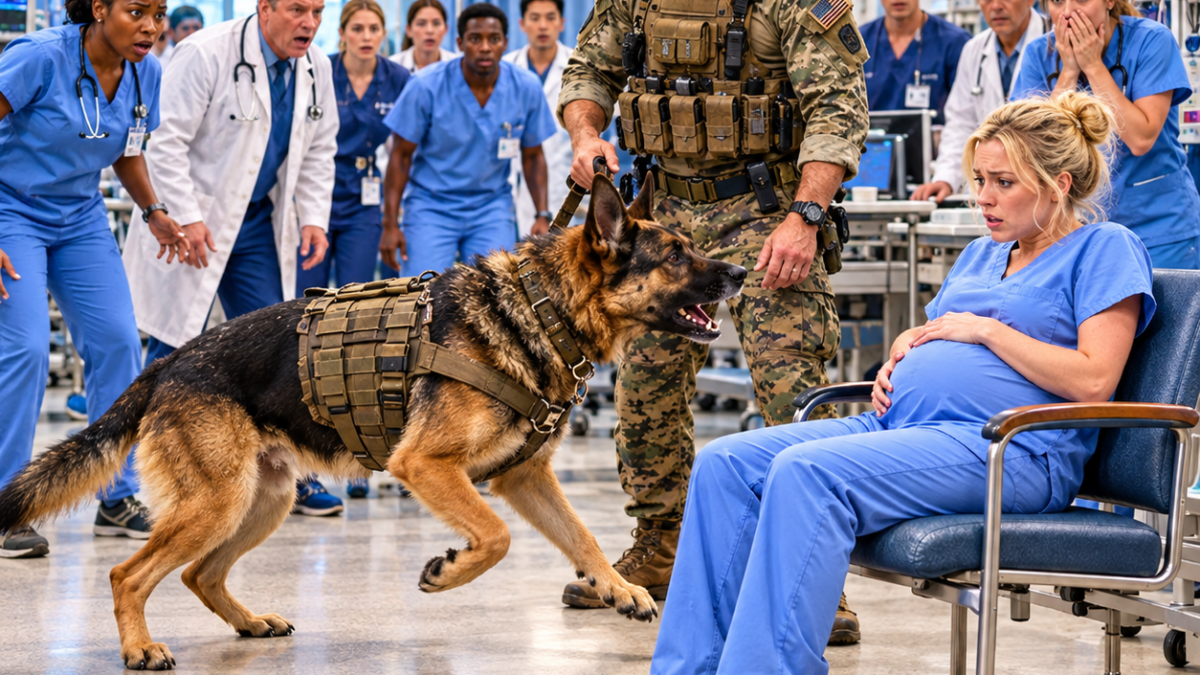
The dog reached the intake desk, came around the side before anyone could block him, and sat down at my feet.
Then he looked up at me and did not look away.
The cold that moved through my chest had nothing to do with the hospital HVAC.
Nolan crossed the waiting room with the leash in his right hand, embarrassment and concern tightening his face.
“I’m sorry,” he said. “He doesn’t do this. He’s trained.”
I looked down at Holt.
His amber eyes were fixed on my midsection.
His nostrils flared slowly, deliberately.
Not sniffing like a curious pet.
Working odor.
I knew that movement.
I had seen it before in a different life, on different dogs, under different lights.
“What’s his name?” I asked.
“Holt.”
“Military?”
Nolan’s eyes shifted.
A tiny recalibration.
The way a person looks when a stranger asks a question that implies they know more than they should.
“Retired military working dog,” he said. “Navy. Special operations.”
“You?”
“Same.”
“How long?”
“Fourteen years.”
I nodded once.
“Holt,” I said softly.
Not as a command.
Just as a name.
His tail moved once, slow as a flag in low wind.
Behind me, Dr. Renata Foresight appeared from the hallway carrying a chart and the expression she wore when something had interrupted the flow of a shift already held together by tape and force of will.
“Weston, can we get the board updated? We’ve got two admissions pending.”
“One minute.”
“We don’t have one minute.”
Then she saw Holt.
Saw Nolan.
Her mouth tightened.
“Is that animal supposed to be in the patient area?”
“He’s a service animal,” Nolan said.
It was not exactly a lie.
It was not exactly the whole truth either.
“He needs to be with his handler,” Foresight said, “not at the intake desk.”
Nolan reached for the leash and gave a careful pull.
Holt’s paws dragged a fraction of an inch across the floor before he stood.
He moved, but slowly, with the clear reluctance of an animal that strongly disagreed with what was happening.
I watched him return to Nolan’s corner.
Then I told myself the cold feeling in my chest was nothing.
That was how the night continued.
A woman with a broken toe.
A cardiac patient waiting too long for telemetry.
A child needing breathing treatment.
A family member from the third floor who came down because she could not sit in the upstairs waiting room anymore and needed somewhere to exist with her fear.
I listened to her for four minutes I did not have, found her a quieter chair, and asked a volunteer to check on her later.
That was what I did.
I took care of people.
I pressed my palm against my lower back and kept moving.
At 11:14 p.m., the trauma bay received a motorcycle accident.
Twenty-two-year-old male.
Road rash.
Possible splenic injury.
The department shifted into the higher gear trauma always demanded.
I pulled supplies, checked suction, coordinated with imaging, restocked airway equipment, handed Foresight what she needed before she asked twice.
I was good in trauma.
I had always been good in trauma.
My hands stayed steady when rooms got loud.
That was probably why nobody noticed the way my jaw clenched.
Nobody noticed the way I blinked twice at a monitor I had read a thousand times.
Nobody noticed me.
Across the department, Holt did.
Nolan told me later he had been watching his dog for twenty minutes.
Holt had worked medical alert after Nolan’s own discharge. Before that, the dog had served with him in environments where one missed scent could mean the difference between getting home and not getting home at all.
Holt had flagged four serious medical events in two years of post-service life.
He had never done it casually.
Never for attention.
Never wrong in a way Nolan could dismiss.
That night, Holt stood rigid in the waiting area, oriented toward the trauma bay with his head low and his body still.
Not barking.
Not whining.
Waiting for Nolan to understand.
Nolan stood despite his wrist screaming.
He walked to the secondary nurse’s station, where Brock, one of our younger nurses, was trying to do three things at once and succeeding at one and a half.
“Excuse me,” Nolan said.
“One moment.”
“The charge nurse. Weston. Has anyone checked her vitals tonight?”
Brock looked up.
“I’m sorry?”
“Her blood pressure. Has anyone checked it?”
“Sir, she’s staff. She’s not a patient.”
“I understand that.”
Nolan kept his voice level.
“I’m asking if anyone has physically checked her blood pressure tonight.”
Brock stared at him, unsure if this was a complaint, concern, or the beginning of a problem security would need to handle.
“Is there something I can help you with?”
“Yes. You can get someone to check that nurse’s blood pressure soon.”
Then Nolan walked back to his chair.
Brock looked toward me.
I was pulling a chart.
Standing upright.
Working.
Showing no visible emergency.
So he made a mental note to mention it when things slowed down.
Things did not slow down.
At 11:47 p.m., I was restocking the supply cart near exam room three when I set down a box of gloves and stopped.
The hallway was not spinning.
I remember being very clear about that.
The walls stayed where they belonged.
The floor stayed steady.
But there was something wrong with the pressure inside my skull.
Not pain exactly.
More like I had been sealed inside a room where someone had turned up the air pressure and forgotten to tell me.
My ears felt full.
The shimmer at the left edge of my vision returned.
It was not the lights.
I knew that.
I pressed both hands flat on the cart and breathed.
“Weston?”
Dr. Foresight stepped out of exam room two, gloves off, chart in hand.
“You okay?”
“Fine.”
The word came out perfectly.
Right speed.
Right inflection.
I had practiced fine for years.
Foresight looked at me for one second longer than usual.
Long enough for some better part of her to notice.
Then the monitor in room two alarmed, and she turned away.
I straightened.
The shimmer came back.
I thought about my daughter.
She had not moved in three hours.
That thought arrived so clearly it cut through everything else.
Then I turned and saw Nolan Vess standing at the end of the hallway.
He was not supposed to be there.
Patients and visitors were not permitted past the double doors.
He had a fractured wrist, a controlled expression, and an air of someone who had spent a lifetime following only the instructions that made sense.
Holt stood beside him.
The dog looked at me and made a sound.
Not a bark.
Not a whine.
Something quieter.
Certainty, if certainty had a voice.
“Mr. Vess,” I said. “You can’t be back here.”
“I know.”
He did not move.
“When did your headache start?”
Everything in me went still.
“I need you to go back to the waiting room.”
“When did it start?”
I looked at him.
Not aggressive.
Not dramatic.
Fixed.
The dog was fixed too.
Both of them had committed to a truth and were waiting for the world to catch up.
“Early afternoon,” I said. “Around two.”
“How’s your vision?”
I did not answer.
Because the shimmer was happening right then.
“There’s a blood pressure cuff twelve feet to your left,” he said. “I’d like you to use it.”
“I’m fine.”
The answer rose automatically.
I am fine.
I am working.
I am the one who takes care of things here.
I am not the one who receives care.
That belief sat in my chest like a fist.
For five years, I had built a life where I was functional, necessary, contained, and never a burden.
Asking for a blood pressure check at 11:50 p.m. on a Tuesday felt like cracking something I had carefully sealed.
Then Holt made that quiet sound again.
And my daughter did not move.
I walked to the cuff.
Nolan did not follow.
He stayed at the end of the hallway.
Holt sat beside him, alert and still.
I wrapped the cuff around my left arm and pressed the button.
The machine cycled.
The numbers appeared.
I stared for four full seconds.
168 over 112.
There are readings that move you out of clinical neutrality.
A blood pressure of 168 over 112 at thirty-seven weeks pregnant is one of them.
I pressed the button again.
The cuff tightened.
The machine beeped.
168 over 114.
The word entered my mind before I wanted it there.
Preeclampsia.
Severe features likely.
Headache.
Vision change.
Swelling.
Reduced fetal movement.
I had seen through hundreds of patients who minimized symptoms.
I had been doing it to myself for more than a week.
I reached for the call button just as Foresight came around the corner.
She saw the monitor.
Then me.
Then my face.
The expression that crossed hers was not medical.
It was human.
The look of someone realizing a mistake had been building for a long time, and now the bill had arrived.
“Darra.”
Her voice was different.
The shift pressure had gone out of it.
“I know,” I said. “I need you to page OB now.”
I pulled off my lanyard with one hand and set it on the counter.
A small professional ritual.
Nurse to patient.
The crossing felt stranger than almost anything I had experienced in years.
Behind me, Foresight’s voice rose down the hallway.
The department rearranged itself around me, the way departments do when something real happens and everyone finally understands what they are looking at.
I turned once.
Nolan still stood at the end of the hall.
He gave me a single nod.
Not triumphant.
Not dramatic.
I see you.
Holt’s tail moved once.
Then two nurses were at my elbows, and a wheelchair appeared, and the next twenty minutes became the controlled urgency I had spent my career standing outside of.
Now I was at the center of it.
And being cared for felt terrifying.
By the time we reached the OB floor, my pressure was 171 over 116.
Dr. Marissa Pel, the on-call OB, reviewed my numbers with the focused expression of someone calculating how much time a situation has left before it becomes something worse.
“How long have you had the headache?”
“Since about two.”
“Vision changes?”
“Yes. Left peripheral.”
“You’ve been on shift since seven this morning?”
There was a pause.
She did not say what she was thinking.
She did not have to.
Seventeen hours.
Nobody noticed.
I did not say anything.
Here we are.
“We’re going to run labs,” Pel said. “Then we’ll make a decision about delivery.”
“If my platelets are dropping and liver enzymes are elevated, I know what that means.”
Pel looked at me.
“I know you do.”
A brief human pause.
“We’re going to take care of you. Both of you.”
I nodded.
I was calm.
Too calm.
I had spent so long being calm in rooms like that I did not know how to stop.
But when the fetal monitor found my daughter’s heartbeat, fast and present and real, something shifted under my ribs that had nothing to do with clinical training.
I put my hand on my stomach and held it there.
Downstairs, Nolan sat back in a plastic chair.
Holt placed his gray head on Nolan’s knee and closed his eyes.
From the break room at the far end of the ER corridor, a man watched the OB floor notification board through a half-open door.
His badge read:
Dr. Sterling Price
Administrative Director
He saw my name enter the system under emergency OB intake.
Weston, Darra.
He did not look concerned.
He did not look surprised.
He looked like a man watching risk change shape.
Price had been administrative director at Coastal Ridge for eleven years.
He was not a physician.
He had an MBA, a master’s in healthcare administration, and a gift for reading institutional risk the way fishermen read weather.
Not what was happening right now.
What would be asked later.
What would need explaining.
What would need framing.
At 11:58 p.m., a charge nurse who had worked a seventeen-hour shift had been admitted with severe pregnancy-related hypertension.
That was a problem.
Not because Price felt responsible.
He had approved staffing models.
He had signed off on shift coverage.
He had allowed the emergency department to run at the margins because, in his language, those margins were “acceptable within the framework of current operational needs.”
If the framework had gaps, those gaps were industry standard.
That was the kind of sentence men like Price kept ready.
He set his coffee down and opened the staffing file.
Then he began to edit.
My labs came back at 12:22 a.m.
Platelets low.
Not critical, but trending.
Liver enzymes elevated.
Significant protein in my urine.
Preeclampsia with severe features.
Dr. Pel recommended delivery that night.
She offered options because good doctors do not confuse urgency with ownership.
Induction was possible but might not work fast enough.
Cesarean was the safer call.
“What are the options?” I asked, because I was still trying to speak like a nurse for a patient who was not me.
Pel explained.
I listened.
Then I said, “Do it.”
“You’re sure?”
“I trust your judgment. Schedule it.”
The night nurse, Gabrielle, asked if there was someone they should call.
I thought about that longer than I should have.
My parents were gone.
My husband had been gone for five years.
The friends I trusted were asleep, and the person I would have called first existed only in memory.
“No,” I said. “There isn’t.”
At 1:17 a.m., my daughter was born.
She came into the world in OR two, small and furious, with a cry so sharp and immediate that two nurses made involuntary sounds of relief.
The neonatologist called her a good size for gestational age.
Five pounds, fourteen ounces.
Lungs working.
Color improving.
All the right reflexes.
I heard her cry behind the drape and closed my eyes.
Until that moment, I had managed myself by treating my own body as a medical event I was attending.
That strategy worked until the cry.
The cry undid me.
Not dramatically.
I did not sob.
I turned my head to the side, pressed my lips together, and let two tears slide into my hair.
When Gabrielle brought her to me, wrapped and blinking and impossibly real, I looked at my daughter’s face and felt awe, exhaustion, and a private grief so specific it had no public form.
“Hey,” I whispered.
Her mouth moved.
“I know,” I said. “Me too.”
By 2:00 a.m., the story had begun moving through the hospital.
Not by announcement.
Hospitals rarely need announcements.
Stories travel through break rooms, medication rooms, elevator rides, hallway fragments, and the strange connective tissue of people who work twelve-hour shifts close enough to know each other’s shoes, snacks, marriages, bad habits, and tells.
The ER knew because Louise had been there.
OB knew because they were there.
Surgery knew.
Security knew because one of them buzzed the OB team through and told the next person he saw.
By morning, nurses were asking themselves questions.
Did I miss it?
Was she showing signs last week?
Did I not look?
Some felt genuine concern.
Some felt the defensive discomfort of people realizing something that seemed fine had not been fine at all.
None of them knew the full picture.
Sterling Price understood more of it than anyone else, and he wanted the picture to remain partial.
Between midnight and 6:00 a.m., he reviewed staffing records with the focus of a man who believed documentation was not simply a record of truth, but a tool for controlling which truth survived.
He did not fabricate.
He was careful about that.
He edited for clarity.
For emphasis.
For framing.
That was what he would call it later.
He reviewed the scheduling overrides that had allowed me to continue working past my intended leave date.
He found three sign-offs and made sure his name was not adjacent to them.
Then he opened my employee file.
He looked at my military service disclosure.
Four years active duty, honorable discharge, combat medical specialist.
He looked at the dates.
Then at the small administrative note attached by an HR director eighteen months earlier.
Candidate background: advise verification. Classified service record components. See attached clearance form.
Nobody had followed up on the clearance form.
Price stared at it a long time.
Then he began drafting a memo.
At 6:52 a.m., eight minutes before day shift began, he sent it to Dr. Evelyn Craft, chief of medicine, copying legal and HR.
The memo did not say, “This is Darra Weston’s fault.”
Price was more sophisticated than that.
It raised “concerns.”
It referenced “discrepancies” in my military service documentation.
It questioned whether I had “appropriately disclosed” all components of my prior service during hiring.
It suggested my failure to self-report worsening symptoms during an active shift raised questions about clinical judgment and patient care liability.
In other words, it built a frame.
It positioned my medical crisis not as evidence of an institution running on unsafe staffing margins, but as a complexity surrounding one employee.
A quiet nurse.
A pregnant woman who should have spoken up.
A former military medic with a file Price could not fully read, which meant he thought he could make that file look suspicious.
Sterling Price had written memos like that before.
They usually worked.
This one did not.
Because three hours earlier, something had happened that he did not know about.
At 2:38 a.m., the volunteer coordinator who had taken Nolan Vess’s information passed it to Dolores, the night nursing supervisor.
Dolores had worked at Coastal Ridge for nineteen years.
She knew the difference between a man waiting around for attention and a man waiting because leaving felt wrong.
She looked up Nolan Vess.
Not in hospital records.
In the way nurses look things up when they know something is not ordinary.
His intake form listed prior employer as the United States Navy.
Special operations.
Retired.
She had a nephew in the SEAL teams and recognized certain details when she saw them.
What she found made her write one name on a piece of paper and leave it on the day supervisor’s desk with three words beneath it.
You should know.
At 9:15 a.m., I was lying in a hospital bed with my daughter asleep on my chest when the door opened and a physician I did not recognize stepped inside.
He was in his sixties, civilian clothes, carrying himself with the organized stillness of a military physician.
“My name is Dr. Leonard Quail,” he said. “I’m with the Naval Health Research Coordination Office.”
I looked at him over my daughter’s head.
“This is not the right morning for a conversation,” he said.
“Then why are you here?”
“Because your name came up this morning in a context that concerned us. There is a memo circulating inside this hospital’s administrative structure that contains several claims about your service record. Claims that are factually incorrect in ways I suspect are not accidental.”
Everything in me went still.
My daughter shifted, made a small sleep sound, and settled again.
“How did you get here this fast?”
“We have a regional office in Marlo Bay. When certain names appear in certain documents, we are notified quickly.”
He paused.
“Your record is not incomplete, Ms. Weston. It is classified. There is a significant difference. Someone in this building has either deliberately confused the two or been extremely careless about the implications.”
“What does the memo say?”
He told me.
By the time he finished, I felt very calm.
Not the old calm.
A different kind.
The kind that arrives when patience reaches its end.
“Who signed it?”
“Sterling Price. Administrative director.”
I looked down at my daughter.
She was less than eight hours old.
“What exactly does he claim?”
Quail unfolded a handwritten summary.
Not the memo itself, which told me he was being careful about document control.
“He states that your military service record contains discrepancies not disclosed during hiring. He implies that classified components suggest incomplete or falsified documentation. He also raises questions about clinical judgment related to your failure to self-report your medical condition during your shift.”
“He’s using the classification as a weapon,” I said.
“Yes.”
“If he can’t read it, he calls it suspicious.”
“Yes.”
“And the clinical judgment piece is his liability shield. If he can establish that I made a bad decision, the institution’s exposure for staffing conditions is reduced.”
Quail studied me.
“You understand administrative law.”
“I understand how institutions protect themselves.”
I paused.
“I watched one do it before to someone I loved. I know the playbook.”
Quail did not ask for more.
That was a kindness.
“What can you do?” I asked.
“We can verify the classified components through appropriate channels without disclosing operational content. Normally, two to four weeks.”
“He sent the memo this morning.”
“Yes.”
“So in two to four weeks, it has already done its damage.”
“That is why I am here at nine in the morning instead of filing a form.”
My blood pressure monitor beeped softly beside me.
My daughter’s weight on my chest was the most grounding thing I had felt in five years.
Every cell in my body wanted to stay there.
To hold her.
To let the world outside that room handle itself for once.
But it had never worked that way.
“Tell me what you need from me,” I said.
By 10:00 a.m., Price’s memo reached Dr. Evelyn Craft.
Craft had been chief of medicine for seven years. She had survived long enough in institutional medicine to distinguish actual problems from performances of problems.
She read Price’s memo twice.
Then called her assistant.
“Get Sterling Price.”
“He’s in a meeting with—”
“Get him out of it.”
Price arrived eleven minutes later, composed in the way of someone who had expected the call and prepared for it.
Craft did not waste time.
“The Weston situation. Walk me through your reasoning.”
“I felt the hospital needed a clear picture of liability exposure.”
“The woman delivered a baby in our OR five hours ago.”
“Which makes timing sensitive. I understand that. But the underlying questions about her record—”
“Sterling.”
Craft’s voice did not rise.
That made it worse.
“What is the actual problem you are trying to solve?”
“Patient safety,” he said. “And institutional exposure.”
“I’ve read staffing schedules from the past three weeks. She was scheduled for thirty-two hours. She worked sixty-one. Overtime requests are in the system. Approved.”
A pause.
“Who approved them?”
“Scheduling decisions go through multiple sign-offs.”
“Your office approved the October coverage overrides.”
Price’s expression did not visibly change.
Craft looked directly at him.
“So what I am reading in this memo is a document that raises questions about an employee while the person who signed it carries significant responsibility for the conditions that created her crisis.”
She let that land.
“I want you to understand how that looks.”
“I understand how it looks. But the record discrepancy is legitimate—”
“I have already spoken with someone from the Naval Health Research Coordination Office. Her record is classified. That is not the same as discrepant. A formal verification summary will be filed with HR by end of business.”
Something moved behind Price’s eyes.
Fast.
Subtle.
Recalculation.
“That’s good,” he said carefully. “That’s the appropriate process.”
“Yes,” Craft said. “It is.”
She picked up the memo.
“I’m asking legal to review this before it goes any further. Be available for that conversation.”
It was phrased as a request.
It was not a request.
Price left her office and walked back to his own with the measured pace of a man thinking very quickly and refusing to let his body reveal it.
He had files.
He always had files.
Documentation was how Sterling Price protected himself.
Emails.
Approvals.
Meeting notes.
The paper architecture of a career spent building walls before he needed them.
What he did not know was that, three floors above him, Dr. Quail was already on the phone with someone Price had not considered.
Dr. Petra Vasik.
Eighteen months earlier, Vasik had been chief of emergency medicine at Coastal Ridge.
Officially, she resigned after a mutual decision related to departmental restructuring.
Unofficially, everyone who had been paying attention knew something else.
Vasik had raised concerns about emergency department understaffing.
First verbally.
Then internally.
Then formally.
Then in writing.
She identified a pattern: staffing overrides were no longer emergency measures. They had become routine operations. On paper, each override could be justified. Together, they showed a department structurally understaffed and held together by exhausted clinicians.
She submitted three reports.
She identified three adverse patient outcomes where staffing conditions may have contributed.
The reviews came back clean.
“Within expected variance.”
That phrase made institutions feel better because it turned pain into a statistical category.
Vasik resigned six weeks later.
When Quail called her, she had been waiting eighteen months for someone to ask the right questions.
“Yes,” she said when he asked for a formal statement. “I’ve been willing for eighteen months. Nobody asked.”
At 11:30 a.m., Nolan received a call from Dolores.
He had gone home at 4:00, slept badly for three hours, and sat at his kitchen table with Holt watching him like the dog knew the story had not finished.
Dolores told him I was alive.
That the baby was alive.
Then she told him about Price’s memo.
“There are people in this building,” she said, “who would like the story of what happened to Darra Weston to stay small. A personal medical crisis. Nothing else.”
Nolan said nothing.
“I don’t think it should stay small,” Dolores continued. “And what your dog did last night is part of it. People need to know she was found in time because everyone here missed it and an outside party with a trained animal had to intervene.”
“I’m not trying to make anyone look bad,” Nolan said.
“I know. But the truth sometimes does that on its own.”
Nolan looked at Holt.
Holt looked back.
“Tell me about the memo,” Nolan said.
By 3:00 p.m., Nolan was back at Coastal Ridge with Holt beside him.
He met with Quail, a state health facilities investigator named Brin Solano, and a hospital liaison from risk management.
Holt settled beneath the conference table.
Nolan gave his account the way trained operators give accounts.
Sequence.
Observation.
Action.
Result.
He did not call anyone negligent.
He did not dramatize.
He described what he saw.
Holt’s first passive alert within twenty minutes.
The active response within forty.
My appearance.
My movements.
The way Nolan asked for my vitals to be checked and was told someone would mention it when things slowed down.
“Things did not slow down,” Nolan said.
Solano took notes.
Nolan added one more thing.
“By my observation, the department was severely understaffed for the volume it was managing. That is not a clinical judgment. It is a capacity observation. I have worked in environments where you make decisions constantly about what you can address and what you cannot. That is what I saw last night.”
The room went quiet.
“Thank you,” Quail said. “That helps.”
At 4:30 p.m., the audit expanded.
It began with eighteen months of emergency department staffing override approvals.
Then Solano expanded it to include every adverse patient event reviewed by risk management during that same period where the conclusion had blamed individual clinical judgment rather than systemic factors.
Dr. Vasik’s three cases.
Her original reports.
Her ignored warnings.
Her resignation.
The staffing files Price had modified between midnight and 6:00 a.m. were flagged almost immediately.
He had not known Coastal Ridge’s document management system had been upgraded fourteen months earlier with forensic versioning.
Every edit logged.
Every timestamp preserved.
Every credential recorded.
Price believed he had revised for clarity.
The system recorded interference.
At 5:30 p.m., Price walked into Craft’s office and found her standing by the window.
“Close the door,” she said.
He closed it.
“The audit has been expanded,” she said. “IT pulled version histories on several administrative files modified after midnight last night. The timestamps are under your credentials between 12:43 a.m. and 6:07 a.m.”
Price stood very still.
“Evelyn, I need you not to say anything right now that you have not discussed with your attorney.”
Her voice was flat.
Not angry.
More final than anger.
“Effective immediately, I am asking you to step back from your duties pending the outcome of the audit. This is not termination. It is procedural. But I need your badge and system credentials before you leave this office.”
Price reached into his jacket and placed his badge on her desk.
The door opened behind him.
A security officer stood there.
Beside him was Investigator Brin Solano.
Behind them, in a wheelchair, wearing a hospital gown, cardigan, and IV port, sat me.
I had given birth twelve hours earlier.
Gabrielle had objected to me leaving the OB floor.
I did it anyway.
Solano said, “Ms. Weston, you did not have to come down here.”
“I know,” I said.
I looked at Price.
“I wanted to.”
Price looked at the wheelchair.
The IV port.
My face.
I watched him assemble the expression his attorney would have wanted.
Controlled.
Neutral.
Professional.
It did not hold well under the way I was looking at him.
He expected anger.
He had prepared for anger.
I was not angry.
I was clear.
“I am not here to make a scene,” I said. “I wanted you to see me before whatever happens next happens.”
Price said nothing.
“You wrote a memo this morning about my record and my judgment. You sent it before my daughter was four hours old.”
“Ms. Weston, I understand you’re—”
“I’m not finished.”
Not loud.
Precise.
“You’ve worked in this building for eleven years. I’ve worked here for six. You’ve seen me in that department. You approved schedules I worked, overtime I took, coverage gaps I filled. Not once did you ask whether any of it was sustainable.”
He stayed silent.
“When my body failed after seventeen hours on a shift I should never have been cleared to work, your first move was to make it about something I did wrong.”
I breathed once.
Deliberately.
“I know why. I have known men like you since I was twenty-two years old, working in conditions that make this hallway look like a vacation. You do not do it because you are cruel. You do it because protecting the institution is the only thing you know how to do. And when the institution is the problem, the only tool you have left is finding someone else to be the problem instead.”
I looked at him a moment longer.
“I hope the audit is thorough.”
Then I turned the wheelchair myself and rolled back toward the elevator.
Gabrielle was waiting around the corner, furious and worried and entirely right to be both.
Nolan was in the fourth-floor corridor when the elevator opened.
He had been heading out with Holt after giving his statement.
For half a second, we both went still.
He looked tired.
His wrist was in a temporary splint.
Holt stood at his knee.
The dog’s tail moved once when he saw me.
“You’re still here,” I said.
“I had a meeting. I was leaving.”
I looked down at Holt.
“Is he allowed to do that again? What he did last night?”
“He’s not really going to ask me.”
For the first time in more than twenty-four hours, something near a smile moved through my face.
“No. I suppose he isn’t.”
Gabrielle caught up behind me.
“Ms. Weston, I really need you to—”
“I know. Give me one minute.”
She gave me the minute very visibly and not happily.
I looked back at Nolan.
“I was told you stayed until four in the morning.”
“Holt wouldn’t leave.”
“Right.”
I understood that kind of loyalty.
It did not need explaining.
“The meeting you had today,” I asked, “was that about last night or something bigger?”
“Both, probably.”
He paused.
There are people who offer comfort because they do not know what else to give.
Nolan offered information.
That was better.
“There is a state licensing investigator here,” he said. “The audit is going wider than you probably know. Eighteen months of staffing data. Three prior patient cases closed in review. Former emergency chief filed a statement.”
“Vasik,” I said.
He looked surprised.
“You know her?”
“She resigned the month after I came back from medical leave two years ago. I thought it was coincidence. I think I was wrong.”
“She tried to tell someone,” Nolan said.
“She did tell someone,” I replied. “They just didn’t do anything with it.”
“Until now.”
“Until now.”
For a moment, the corridor hummed around us.
Carts moved.
Voices carried from rooms.
A PA announcement blurred into unintelligible sound.
“Thank you,” I said.
“For last night. For staying.”
“Holt found you,” Nolan said. “I just followed him.”
“That’s not quite true.”
“No,” he admitted. “But it’s the part that mattered.”
I reached down and touched Holt’s head once.
The dog held very still beneath my hand, accepting and dignified.
Then Gabrielle took control of the wheelchair with the air of a woman who was absolutely done with my nonsense, and I let her.
The audit moved slowly.
Institutional truth rarely arrives all at once.
It gathers.
A log entry.
A timestamp.
An old report.
An ignored email.
A nurse finally asked the right question.
A physician willing to give a formal statement.
A dog that refused to be redirected.
Solano’s team spent two days at Coastal Ridge pulling staffing records, risk management files, scheduling approvals, version history logs, and Vasik’s original reports.
They interviewed fourteen staff members.
Louise gave a two-hour interview and mentioned my name seven times, not dramatically, just accurately, as a recurring example of someone the system had been relying on beyond reasonable limits.
When asked why she had not raised concerns officially, she looked at the investigator and said, “I did. Twice.”
Both responses had come from Price’s office.
The record got longer.
On the third day, I went home.
My blood pressure was stable enough for discharge.
Dr. Pel made me promise twice-weekly follow-ups the first week, a visiting nurse for four days, and no hospital shifts for at least six weeks.
She said it in the tone doctors use when they know the patient is exactly the kind of fool who needs to be told directly.
I said I understood.
I meant it.
Mostly.
My friend Tomasa picked me up, drove me home, filled my refrigerator, cleaned my bathroom, and set up the bassinet.
She had raised three children and knew the first week home did not require motivational speeches.
It required soup, clean towels, working batteries in the smoke detector, and somebody who would sit on the couch quietly while the new mother slept.
Marin slept.
I slept.
In the hours between, when the apartment took on that 3:00 a.m. quality where the world becomes only feeding, breathing, burping, changing, rocking, watching, I thought about the file Price had tried to use against me.
He had taken a closed chapter and called it suspicious.
He had taken privacy and framed it as deception.
He had taken the fact that some parts of my life were not available for public inspection and tried to turn that into doubt.
It had taken Quail, Solano, Nolan, Holt, Dolores, Craft, Louise, and Vasik to dismantle the frame.
That embarrassed me at first.
Then it humbled me.
There is a difference.
On the fifth day, Dr. Petra Vasik drove up from Portland with a covered dish and an expression of someone who had waited eighteen months for a conversation.
I knew who she was before I opened the door.
I had looked her up.
“You filed three reports,” I said.
No preamble.
I did not have energy for preamble.
“I did,” she said.
“One of them cited staffing conditions as a contributing factor in a patient outcome.”
“Yes.”
“I didn’t know.”
“You weren’t supposed to. The case was anonymized. But I knew your name. I knew the shift. I knew what the department was running on that night.”
“Why did you leave?”
Vasik was quiet.
“Because I thought if I stayed and kept pushing, they would find a way to make it about me. My judgment. My management style. My inability to understand operational realities.”
She paused.
“I was probably right. But leaving did not fix it. It removed the person asking questions.”
“Until now.”
“Until now.”
The preliminary audit findings were released internally on the fourteenth day.
The language was careful.
Regulatory documents always are.
But careful did not mean weak.
The report found a pattern of systematic underreporting.
Not falsification of every individual record, but chronic framing that presented structural understaffing as isolated incidents.
The three adverse patient cases had been reviewed through a process with significant procedural irregularities.
Price’s office had coordinated reviews in which it had a conflict of interest.
The overnight editing of staffing files was described as interference with institutional record integrity.
The finding was referred to the state attorney general’s office.
Sterling Price submitted his resignation on the sixteenth day through his attorney.
Effective immediately.
No statement.
Nothing useful remained for him to say.
His system access had already been revoked.
His office was cleared over a weekend by facilities staff, an impersonal little brutality nobody planned and nobody stopped.
That was not justice in the full sense.
Justice is rarely neat.
But it was consequence.
The three closed patient cases were reopened.
Two would eventually receive revised determinations.
Families would be notified.
Late.
Imperfectly.
But honestly.
Vasik’s reports were formally acknowledged.
Louise became interim department coordinator and, for the first time in years, received authority matching work she had already been doing.
The ER staffing model was sent to a clinical operations committee with a ninety-day mandate.
Whether that would become real change or better paperwork remained to be proven.
Time is the only test that matters.
I returned to Coastal Ridge seven weeks after the night Holt walked across the waiting room.
Not six.
Dr. Pel asked for one more week, and I considered arguing before remembering the look on her face and deciding not to be ridiculous.
The emergency department looked the same.
Fluorescent lights.
Crowded board.
Chairs full of people waiting to be helped.
A child asleep across two seats with his head in his father’s lap.
An old man holding his arm in a makeshift sling.
The machine was the same machine.
But also not.
The new scheduling grid hung on the wall with redundancy built into coverage.
Overtime overrides now required clinical oversight, not just administrative approval.
Louise sat at the coordinator’s desk and gave me a nod that carried six months of subtext.
I returned it with equal economy.
We both had work to do.
At the supply cart near exam room three—the same cart, the same hallway where I had stood with pressure in my skull and told myself it was the lights—Dr. Foresight appeared at the end of the corridor.
We had not spoken in person since the night of my delivery.
She had texted once.
I answered briefly.
Now we stood in the awkwardness of two clinicians who had been next to something significant and had not yet found language for it.
“Good to have you back,” she said.
She meant it imperfectly, the way people mean things when they are also managing their own complicated feelings.
“Good to be back,” I said.
I meant it the same way.
She looked like she wanted to say more.
Then decided not to.
Probably wise.
“I have chest pain in three. I’d like your second opinion.”
“I’ll be there in two minutes.”
We went to work.
Nolan came to the coffee shop on Tanner Street on a cold Saturday morning in December, forty-two days after I had suggested coffee in a hospital corridor.
Holt walked beside him off leash because the coffee shop patio allowed well-behaved dogs and Holt qualified by any reasonable standard.
I was already there with Marin in a carrier against my chest, her small face visible above the padded edge, eyes open in the unfocused wide way of an eight-week-old experiencing the world and apparently finding it acceptable.
Holt came straight to us.
Calm.
Unhurried.
He sat beside my chair and looked at Marin with the focused amber attention he directed at things that mattered.
“She likes him,” Nolan said.
“She likes warm things.”
“He’s warm.”
Nolan got coffee and sat.
For a while, we calibrated the ordinary register.
Not hospital.
Not crisis.
Not investigation.
Just two people with cold coffee, a baby, and an old dog who had done more in one night than half the hospital.
“How’s the wrist?” I asked.
“Eighty percent.”
“Following the PT protocol?”
“Mostly.”
“That means no.”
He did not deny it.
I looked out at the gray street.
“That wasn’t the only thing going on, was it?”
He was quiet.
“No,” he said. “It wasn’t.”
I did not push.
I had asked.
He had answered.
The edges were his.
“I’m asking because I recognize the strategy,” I said. “Carry something privately and lead with the functional injury. The wrist. The obvious thing. I am fairly expert at that particular strategy.”
He looked at me.
“I am also aware,” I continued, “that it does not actually work.”
Something shifted in his face.
Not discomfort.
Acknowledgment.
“Yeah,” he said. “I know.”
“There’s a Veterans Health Clinic two blocks from the waterfront. Director’s name is Hara. She’s good. Useful information.”
He said nothing.
But he filed it.
Some people do that with information that matters.
Sterling Price entered a guilty plea in February.
One count of institutional record falsification.
One count of obstruction.
Other charges were reduced as part of the plea agreement, which was not satisfying in the clean emotional sense, but ordinary in the legal sense.
Two years probation.
A substantial fine.
Permanent bar from healthcare administrative roles in the state.
That last part mattered most.
He would not do this again in that industry, in that state.
Vasik attended the sentencing.
She sat in the public gallery and watched the record close correctly.
She said nothing afterward.
That night, she texted me.
It’s done.
I was feeding Marin when I read it.
I thought about all it took to reach those two words.
The reports ignored.
The resignation that should not have been necessary.
The eighteen months of silence.
The dog in a waiting room.
The man who trusted him.
I texted back:
Thank you for not giving up on it.
Vasik replied:
Neither did you.
I put the phone down and looked at my daughter.
Marin stared back at me with the full-intensity focus of an infant who had not yet learned to ration attention.
She simply looked at the most important thing in her field of vision completely.
I thought about what five years of quiet had cost me.
Not the grief.
The grief had been real.
Necessary.
I do not regret protecting it.
But the other silence.
The professional silence.
The choosing of background because the foreground felt too exposed.
The years of “I’m fine.”
The years of palm to lower back.
The years of being needed because being needed felt safer than being seen.
That silence had almost cost me everything.
And what broke it was not a speech.
Not a confrontation.
Not courage in the cinematic sense.
It was a dog sitting down at my feet and refusing to move.
That still moves me.
While I had been managing myself into invisibility, something noticed anyway.
Something walked across a room toward the truth with certainty I had not been able to extend to myself.
In March, I joined the clinical staffing oversight committee.
Twelve people at the table.
Vasik.
A state regulatory representative.
Three clinical directors from regional hospitals.
Me.
I was not the loudest person in the room.
I was not trying to be.
But I was present in a way I had not allowed myself to be for years.
Fully.
Specifically.
With my actual knowledge.
My actual questions.
My actual concerns.
I pushed back when language softened into something technically accurate and practically useless.
After the third session, Vasik said, “You’re good at this.”
“I’m good at knowing what the actual problem is.”
“In this context,” she said, “that is the same skill.”
I thought about that.
“Then I’m getting better at meetings.”
By April, Marin was four months old and had strong opinions about everything.
Which direction she faced in the stroller.
Which hold was acceptable when tired.
Which hold was acceptable when pretending not to be tired.
And Holt.
Her opinion of Holt was uniformly positive.
Nolan had started going to the veterans clinic.
He did not tell me at first.
I noticed anyway.
Small changes.
Incremental.
The way a person looks when he has stopped carrying one thing entirely alone.
I did not mention it.
Some things are better acknowledged sideways.
One Saturday afternoon, we walked the waterfront path.
Marin faced forward in the stroller, taking in the harbor with her serious little gaze.
Holt walked beside the stroller with the serenity of an animal who had done significant things and found the quieter phase of life acceptable.
His muzzle was grayer than it had been in October.
He moved at our pace.
No hurry.
No urgency.
No alarm.
Nolan looked at Marin, then Holt.
“She’s going to want a dog.”
“She can’t have one.”
“She’s going to want one anyway.”
“Yes. She is going to want a lot of things she cannot have immediately. That is the job.”
I paused.
“The dog thing I will reconsider when she can pronounce responsibility.”
Holt ignored us both and continued walking beside the stroller like he had always belonged there.
I thought about what one dog’s decision had opened.
An audit.
Charges.
A committee.
Vasik returned to the work.
Louise with real authority.
Three families receiving corrected truth about people they loved.
A department not repaired, but being repaired with more honest hands than before.
Marin alive.
Here.
Currently attempting to communicate something important to a seagull on a piling.
None of it was finished.
The committee work would take years.
The department would have setbacks.
Nolan’s recovery was not a straight line.
Mine was not either.
I was still learning how to be seen.
Still catching myself in the reflex of the background.
The shrink.
The “I’m fine.”
Then remembering I had decided to stop.
Remembering was the work.
It is ongoing.
But that day, I was there on a harbor path in April.
My daughter was pointing at a seagull.
Holt was walking beside us.
Nolan was there.
The city was going about its ordinary Saturday life around us.
And I was not invisible.
I had never been invisible.
I had only spent too long waiting for someone else to confirm what I already knew.
I was done waiting for that.
The seagull lifted from the piling and flew out over the gray water.
Marin watched it go with the expression of someone who had not yet learned that not everything comes when you reach for it.
For now, she was simply herself.
Present.
Certain.
Reaching anyway.
I watched my daughter watch the bird.
This is what it looks like, I thought, when you stop disappearing.
Not a ceremony.
Not an award.
Not a speech where everyone finally admits they should have seen you sooner.
It looks like a Saturday in April.
A child pointing at things.
An old dog walking beside a stroller.
A man healing quietly next to you.
A harbor wide enough to hold the morning.
I had spent five years learning to be small enough that loss could not find me again.
What I had not understood was that smallness does not protect you.
It only makes you easier to overlook.
And the people who overlook you are not always your enemies.
Sometimes they are simply people who need to be required to see.
Sometimes it takes a dog crossing a crowded emergency room and sitting at your feet before anyone understands you were worth seeing the whole time.
Holt saw me.
Nolan followed him.
And because one retired K9 refused to move, my daughter lived, the truth surfaced, a corrupt director lost the career he had built on burying problems, and I finally stopped pressing my palm to my lower back and telling myself I was fine.
I was better than fine.
I was exactly where I was supposed to be.








