A Retired Navy SEAL Met a Freezing German Shepherd Who Refused to Leave Her Puppies—Then He Saw the Medical Bracelet Tangled Beneath Their Blanket.
PART3:
Then toward the woods again.
I understood before I wanted to.
“Where is he?”
Her ears lifted.
She stood.
Barely.
One back leg nearly folded beneath her, but she caught herself and took three steps into the trees.
Then she stopped and looked back.
I stared at the puppies.
Then at her.
“You want me to follow you?”
She took another step.
That was answer enough.
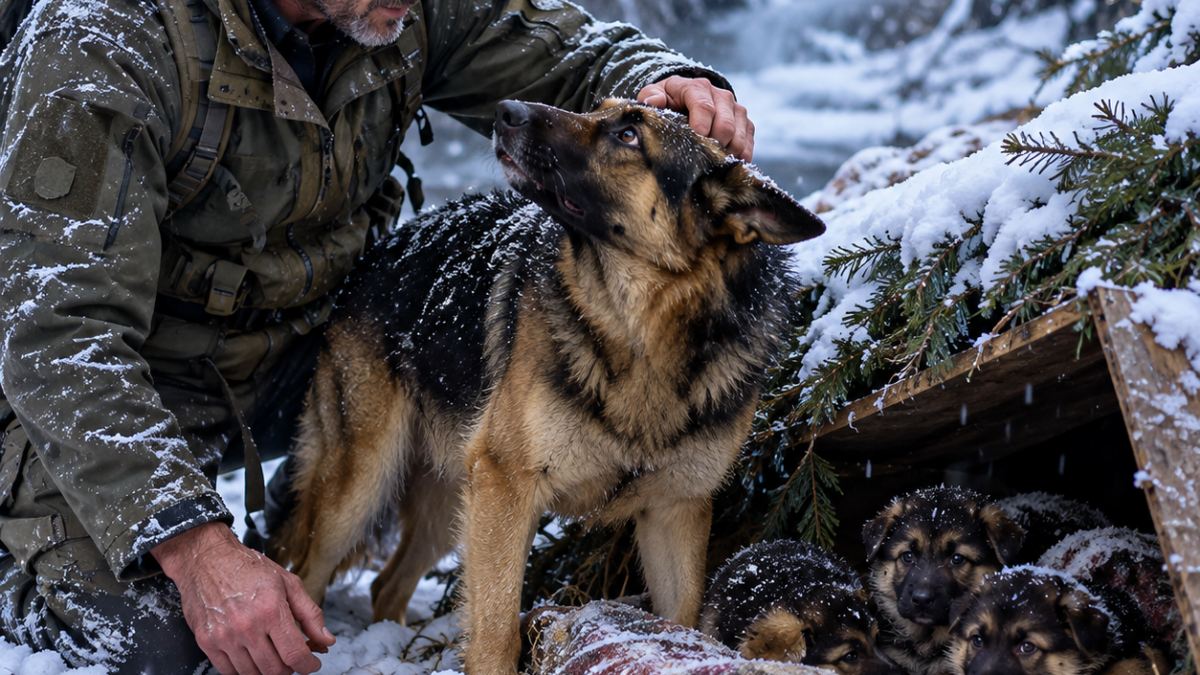
I pulled an emergency blanket from my pack and secured it across the exposed side of the shelter. I tucked my spare fleece around the puppies, left pieces of jerky near the mother, and watched her eat two without ever taking her eyes off me.
Then she turned and walked into the trees.
I followed.
The snow was getting worse.
Heavy flakes came sideways, erasing tracks almost as quickly as we made them. The shepherd moved like an animal running on pure obligation. Every thirty or forty yards, she stopped and waited for me.
We reached a narrow ravine.
That was where I found the first sign that scared me.
A walking cane.
Broken cleanly in two.
Twenty yards beyond it, a green wool scarf hung on a strand of barbed wire.
Then I saw one boot print pressed deep into the snow at the edge of a steep slope.
Below it, the ground dropped hard toward a creek bed tangled with fallen timber.
I stopped.
The dog did not.
She tried to descend.
Her back legs collapsed.
She hit the snow hard.
“No.”
I rushed forward.
She struggled to stand.
“No, girl. You’re done.”
She whined.
Not from pain.
From panic.
I had heard men make that sound without making any sound at all.
Men behind enemy lines.
Men listening to radios go silent.
Men who believed somebody they loved was still out there.
I crouched beside her.
“I’ll go.”
She stared at me.
“I’ll find him.”
Whether she understood the words or only the tone, I do not know.
But she stopped fighting.
I carried her beneath a rock shelf that blocked the worst of the wind, wrapped her in my spare thermal layer, and let her smell the puppies’ scent on my gloves before I left her.
Then I went down the ravine alone.
The slope was worse than it looked.
I descended sideways, catching trunks and exposed roots whenever my boots slipped.
Fifty yards.
Seventy.
A hundred.
Nothing.
I shouted.
“AMOS!”
The wind swallowed it.
I shouted again.
“AMOS WHITMORE!”
Nothing.
I almost climbed back up.
Then I heard it.
Three notes.
Weak.
A whistle.
I turned.
The sound came from behind a fallen spruce twenty yards downhill.
I slid the last few feet and found a man wedged between the trunk and the frozen bank.
White beard.
Gray hair.
Canvas work jacket.
One leg trapped beneath a branch thick enough to break my thigh.
Amos Whitmore looked up at me.
His face was almost colorless.
His lips were blue.
But his eyes were open.
“You Holloway?” he whispered.
“That’s me.”
He blinked slowly.
“Thought so.”
I dropped beside him and checked his pulse.
Fast.
Too fast.
“Where’s Hazel?”
So that was her name.
“She’s alive.”
His eyes closed.
“The puppies?”
“Alive.”
His face collapsed with relief.
Not pain.
Relief.
“I made her leave me,” he whispered.
I stared at him.
“She wouldn’t go,” he said. “I screamed at her until she did.”
His eyes opened again, and I saw something I did not expect.
Guilt.
“I thought she’d go home.”
“She went to the puppies.”
“That’s what I needed her to do.”
Snow shook loose from the branches above us.
I reached for my radio.
Amos grabbed my wrist.
His hand was frighteningly cold.
“Reid.”
“Yeah?”
“If I don’t make it—”
“Don’t.”
“Listen.”
“You’re making it.”
“The dogs.”
“You’re making it.”
He tightened his grip. For a seventy-six-year-old freezing in a ravine, he still had a hell of a hold.
“Don’t let them split Hazel from those pups tonight.”
Maybe it was because of Caroline.
Maybe it was because six years earlier I had promised a woman in a hospital room that she was not going anywhere, right before the world proved promises were not orders.
Whatever the reason, Amos’s words hit somewhere deep.
I keyed the radio.
“San Juan County Rescue, this is Reid Holloway. I have one elderly male down in Miller Creek Ravine. Severe cold exposure, possible leg trauma. Conscious, but we need extraction now.”
Static answered first.
Then a voice.
“Reid, repeat your coordinates.”
I gave them.
Amos released my wrist.
I covered him with my emergency shell.
From high above us came a bark.
Hazel.
Amos heard it.
His eyes filled.
“That damn dog,” he whispered.
Hazel barked again.
And that was when Amos said the sentence that made me understand this was about much more than one lost old man and four dogs.
“She’s the reason I was out here in the first place.”
Rescue reached us twenty-eight minutes later.
In winter, twenty-eight minutes can feel like a lifetime.
I kept Amos talking.
He complained about snowmobiles.
Then modern kitchen cabinets.
Then people who used particleboard and called it furniture.
The more irritated he became, the better I felt.
When rescue coordinator Ben Avery appeared over the ridge wearing an orange jacket, Amos looked up and muttered, “They sent the loud one.”
Ben heard him.
“Good,” he said. “You’re conscious enough to insult me.”
Two volunteers followed with ropes, a rescue sled, medical equipment, and a portable hydraulic spreader.
They stabilized Amos before moving the limb. The branch had pinned his lower leg but had not crushed it. His ankle looked badly twisted, and his blood sugar was dropping, but there was still circulation in his foot.
The bigger problem was cold.
“Hospital,” Ben said.
Amos shook his head.
“Hazel first.”
“Amos—”
“Dog.”
Ben looked at me.
I knew that look.
It meant: You deal with him.
“I’ll bring Hazel and the puppies,” I said.
Amos stared at me.
“All of them?”
“All of them.”
Only then did he agree to be moved.
Hazel was still beneath the rock shelf when I climbed back up. She tried to stand when she saw the rescue team, but her legs gave out.
I carried her.
She weighed less than she should have.
At the roadside shelter, the puppies were alive beneath the layers I had left them in. I loaded all three into my pack’s insulated compartment and carried Hazel in my arms toward the waiting truck.
She never stopped looking toward Amos.
Even when they loaded him into the heated rescue vehicle.
Even when the doors closed.
She watched.
At Mercy Regional Medical Center in Durango, doctors confirmed Amos had a severe ankle sprain, mild hypothermia, dehydration, and unstable blood glucose—but no fracture and no major internal injury.
The storm closed two roads before midnight.
That created another problem.
Amos’s power was out.
A tree had torn down the line behind his house.
The small kennel he had built beside his workshop had partially collapsed under the snow.
Hazel and the puppies needed somewhere warm.
The veterinary clinic could keep them overnight.
Amos said no.
The nurse suggested an emergency boarding facility.
Amos said no again.
Ben looked at me.
I already knew where this was going.
“Don’t,” I warned.
Ben raised both hands.
“I didn’t say anything.”
“You were going to.”
“You have a heated mudroom.”
“No.”
“And a fireplace.”
“No.”
“And no other living creature within approximately five miles.”
“Ben.”
Two hours later, Amos Whitmore was on my sofa.
Hazel lay on the rug beneath him.
Three puppies occupied a plastic storage tub lined with towels beside my fireplace.
I stood in the middle of my living room wondering exactly when I had lost control of my life.
Amos pointed toward the fire.
“Too hot for the pups.”
I moved the container back.
“Anything else?”
“Water bowl’s too far from Hazel.”
I moved it closer.
“Anything else?”
“You always this cheerful?”
“Only with houseguests.”
The smallest puppy climbed out.
I watched him stumble across the rug.
Mostly black.
Tan eyebrows.
Enormous paws.
“Put him back,” I said.
Amos looked at me.
“I’m injured.”
“You can still speak.”
“That doesn’t move puppies.”
I returned the puppy to the tub.
Thirty seconds later, he climbed out again.
This time, he walked directly toward me.
“No.”
He continued.
“No.”
He put both front paws on my boot.
Amos smiled.
“That worked.”
“What?”
“He listened.”
“He absolutely did not.”
The puppy curled against my ankle.
For the first time that night, Amos laughed.
It was rough.
Tired.
But real.
The storm lasted four days.
During that time, my house became something I barely recognized.
Dog hair everywhere.
Towels over chairs.
Amos arguing with the weather report.
Hazel following him from room to room despite her exhaustion.
Three puppies developing personalities at an alarming speed.
One attacked shoelaces.
One slept constantly.
The smallest treated barriers as personal insults.
On the third day, I walked into the kitchen and found Amos standing on one leg while trying to repair a loose drawer track.
“What are you doing?”
“Fixing this.”
“Sit down.”
His expression changed.
Not embarrassment.
Resistance.
“I can stand.”
“You’re supposed to keep weight off that ankle.”
“I am keeping weight off the ankle.”
“You’re standing.”
“On the other leg.”
“Amos.”
“Reid.”
We stared at each other.
I had faced armed men who were easier to negotiate with.
I removed the screwdriver from his hand.
That was my mistake.
His face hardened.
“I said I could do it.”
“And I said sit.”
“This your house or boot camp?”
“You’re injured.”
“I’m aware.”
“Apparently not enough.”
The silence that followed became dangerous.
Amos sat.
Not because I had convinced him.
Because he was angry enough to stop talking.
An hour later, I found an empty prescription bottle on the coffee table.
Blood pressure medication.
“Where’s the refill?”
“At the pharmacy.”
“When did you run out?”
“Yesterday.”
I stared at him.
“You were going to skip your medication?”
“I was going to pick it up when the roads opened.”
“You could have called Ben.”
“I could have.”
“Or Paige Lawson.”
“I could have.”
“Or anybody.”
His jaw tightened.
“There it is.”
“What?”
“The part where helping turns into managing.”
I folded my arms.
“You’re seventy-six years old, diabetic, you just spent hours trapped in a ravine, and you’re arguing because somebody wants you to take prescribed medicine.”
“No.”
He leaned forward.
“I’m arguing because today it’s medicine. Tomorrow it’s my truck. Then my workshop. Then somebody decides the back steps are dangerous. Then the saws are dangerous. Then living alone is dangerous.”
“That’s not what I said.”
“It’s how this starts.”
His voice went quiet.
That made me listen.
“People decide old men are problems that need solving,” he said. “They stop asking what you want because they’re certain they know what you need.”
Something in my chest shifted.
Caroline had said almost the same thing to me once.
She had been sick for eleven months. During the last four, I organized everything.
Meals.
Appointments.
Medication.
Visitors.
Sleep.
I told myself I was protecting her.
One morning, she tried to carry coffee to the porch. I took the mug from her hand.
She looked at me and said, “Reid, I’m dying. I’m not already dead.”
I had never forgotten it.
Amos watched my face.
I sat across from him.
“You need the prescription.”
“Yes.”
“You choose who gets it.”
He studied me.
“Ben.”
“Fine.”
“I pay him for gas.”
“Fine.”
“And you stop ordering me to sit.”
I looked at his swollen ankle.
“I’ll try.”
“That sounded painful.”
“It was.”
The little puppy escaped again.
This time, he climbed onto my boot and fell asleep.
I did not move him.
Amos noticed.
He was smart enough not to say anything.
When the roads reopened, I drove Amos home.
Hazel rode beside him in the back seat.
The puppies were in a crate behind us.
His property sat near a stand of ponderosa pine, where snow covered everything except the brown cedar walls of his workshop. The house had survived. The dog shelter had not.
Ben and two volunteers had already removed the worst of the collapsed roof.
A woman stood beside a white veterinary SUV when we arrived.
Dr. Paige Lawson.
Mid-forties.
Dark-blond hair pulled through the back of a knit cap.
She had been Hazel’s veterinarian for almost a year.
“Your patient is difficult,” I told her.
She looked toward Amos.
“Which one?”
He heard her.
“I’m right here.”
Paige examined Hazel first.
Dehydrated.
Underweight.
Exhausted.
But otherwise strong.
The puppies had suffered from cold exposure but were recovering.
“What happened?” I asked.
Amos leaned against his cane.
Hazel sat beside him.
The story came slowly.
Hazel had belonged to Amos’s older sister, Margaret. When Margaret moved into long-term care after a stroke, Amos promised to take the dog.
He thought he was accepting one German Shepherd.
A month later, Paige told him Hazel was pregnant.
“I didn’t know,” Amos muttered.
Paige raised an eyebrow.
“You told me she was getting fat because you were cooking her eggs.”
“They were good eggs.”
“She was pregnant, Amos.”
“I know that now.”
The puppies had been born five weeks earlier.
Then the storm hit.
Snow collapsed part of the shelter attached to the workshop. Amos moved Hazel and the litter to the temporary windbreak where I found them. Then he went back for blankets and dog food.
That was when he fell.
Hazel followed his trail.
She found him trapped.
Amos screamed at her until she returned to the puppies.
“Why didn’t you use your phone?” I asked.
He looked at me.
“Because it was sitting on my kitchen table.”
Of course it was.
Later, while searching Amos’s desk for insurance documents, I noticed a white envelope.
ROCKY MOUNTAIN SHEPHERD RESCUE
Hazel’s name was written across the top.
I brought it to him without opening it.
“What’s this?”
He stared at the envelope.
For the first time since meeting him, Amos looked defeated.
He sat at the kitchen table.
“Forms.”
“For what?”
He opened them.
Transfer paperwork.
Not for the puppies.
For Hazel.
“You’re giving her away?”
His head snapped up.
“No.”
The answer was immediate.
Then softer.
“That’s the problem.”
I waited.
Amos ran one hand over his face.
“I’ve fallen three times this year.”
I said nothing.
“The ravine makes four.”
“Why didn’t you tell anyone?”
He laughed without humor.
“Because then everybody starts counting.”
“Counting what?”
“The things I can’t do.”
Hazel walked over and placed her muzzle against his knee.
His hand automatically settled on her head.
“I’m seventy-six, Reid.”
“I know.”
“Some days that feels like a number. Some days it feels like a warning.”
He looked toward Hazel.
“I love her.”
The sentence came out angry, as if love itself were the problem.
“She waits outside the workshop when I’m late. Sleeps by my bed. Follows me to the mailbox like I’m crossing enemy territory.”
I almost smiled.
He did not.
“One morning I’m going to go to sleep and not wake up. And she’ll wait. One day. Maybe two. Maybe longer.”
I understood.
He was not afraid of dying.
He was afraid of leaving something loyal behind.
“I called the rescue because I thought if I planned early, I could choose where she went.”
“But you didn’t sign.”
“No.”
“Why?”
His eyes watered.
He looked furious about that too.
“Because every time I pick up the pen, she comes and sits beside me.”
A year earlier, I would have offered solutions.
Sell the house.
Move into town.
Give Ben a key.
Hire help.
Stop driving in winter.
Stop living alone.
I had solutions for everything because solutions made uncertainty feel smaller.
Instead, I asked one question.
“What would have to change for Hazel to stay?”
Amos looked confused.
“What?”
“If keeping her is what you want, what needs to change so it’s safe enough?”
He stared at me.
“People don’t ask it that way.”
“How do they ask?”
“They tell me what I should give up.”
“Then answer it your way.”
For nearly a minute, neither of us spoke.
Then he folded the rescue forms.
Not destroyed.
Not signed.
Just folded.
“I don’t know yet,” he said.
“Okay.”
“That’s all?”
“That’s all.”
He studied me suspiciously.
“You hit your head in the ravine?”
“Possibly.”
Hazel pushed her nose beneath Amos’s hand.
He scratched behind her ear.
Then he looked at me.
“Coffee?”
“Sure.”
“You’re making it.”
I stared.
“I thought we were protecting your independence.”
“Coffee isn’t independence.”
“What is it?”
He pointed toward the kitchen.
“Your job.”
For the first time that day, I laughed.
And the strange thing was, my laughter did not sound out of place in his house.
We did not build a care plan.
Amos would have hated that phrase.
We built trades.
That was different.
I asked what he wanted help with.
He made the list.
Roof work.
Ice removal.
Heavy lumber.
Winter driving after dark.
Not because anyone prohibited him from doing those things.
Because he decided they were no longer worth the risk.
Ben agreed to handle roof inspections and bring medication from town during storms. Paige would monitor Hazel and help find responsible homes for the puppies when they were old enough.
A neighbor named Diane Fletcher joined the arrangement by accident.
She was sixty-nine, widowed, and lived less than a mile down the county road.
She arrived one morning carrying chicken soup.
Amos refused it.
She stared at him.
“Fine.”
He seemed surprised.
Then she pointed at two dining chairs in the back of her SUV.
“You repair those.”
Amos looked suspicious.
“What’s wrong with them?”
“Loose joints.”
“Both?”
“Yes.”
“What do I get?”
Diane lifted the soup.
“That.”
Amos considered.
“Homemade?”
“Yes.”
“What kind?”
“Chicken and wild rice.”
He stepped aside.
“Put it in the kitchen.”
That was how Diane became part of his life.
Not as a caretaker.
As a customer who paid in soup.
Amos liked transactions.
They made receiving help feel less like surrender.
Over the next month, we rebuilt Hazel’s shelter.
One afternoon, Amos asked me to save a piece of weathered red-painted lumber from an old storage wall.
The board was cracked and soft at one end.
“Trash,” I said.
“Not all of it.”
“Half is rotten.”
“Then remove half.”
“It won’t match the cedar.”
“Doesn’t have to.”
I looked at him.
He marked a clean section with a carpenter’s pencil.
“New wood doesn’t become weaker because old wood is standing beside it.”
“You practicing philosophy now?”
“No. You’re just slow.”
We cut away the damaged portion.
The remaining red section became part of Hazel’s new shelter.
It looked strange among the fresh cedar.
Bright.
Scarred.
Out of place.
And somehow correct.
Amos ran his hand over it.
“Still useful.”
I knew he was not talking only about lumber.
I did not embarrass him by saying so.
The puppies grew quickly.
Soon they were terrorizing everything within reach.
Paige screened potential adopters.
Amos turned the process into something resembling a federal investigation.
“Fence height?”
“Six feet.”
“Previous dogs?”
“Two.”
“What happened to them?”
“Old age.”
“Veterinarian?”
Paige would interrupt.
“Amos, I have the paperwork.”
“I’m asking.”
One puppy went to Diane. She had raised German Shepherds years earlier and still had a fenced acre behind her house.
Amos approved reluctantly.
The second went to a retired firefighter and his wife outside Colorado Springs.
That left the smallest.
The escape artist.
The one who had slept on my boot.
Paige called him Puppy Three.
Amos called him Trouble.
I called him nothing.
Because I was not keeping him.
I said this repeatedly.
“I’m not taking that dog.”
Amos nodded.
“I heard you.”
“I travel sometimes.”
“Sure.”
“My fence needs repair.”
“Definitely.”
“I don’t want a puppy.”
“Then don’t take him.”
His agreement irritated me more than an argument would have.
One Tuesday, I arrived twenty minutes late for coffee.
A snowplow had blocked the county road.
The puppy was sitting behind Amos’s front window.
Waiting.
The moment my truck appeared, he started bouncing against the glass.
Amos opened the door.
The puppy ran past him and launched himself against my legs.
“You feed him?” I asked.
“Frequently.”
“Then why does he act like he hasn’t seen civilization?”
Amos looked at me.
“He knows Tuesday.”
“He doesn’t know what Tuesday is.”
“He knows your truck.”
“That’s different.”
“To you.”
I stared down at the dog.
His left ear stood upright.
The right one still tilted sideways.
He looked ridiculous.
I scratched his neck.
He leaned into my leg.
Something unpleasant tightened behind my ribs.
Expectation.
That was the problem.
I understood waiting for someone who was not coming back.
Two days later, Paige called me.
“I found an excellent family for Puppy Three.”
My stomach dropped.
I hated that.
“Where?”
“Grand Junction.”
“Experienced?”
“Yes.”
“Fenced yard?”
“Yes.”
“Good veterinary references?”
“Excellent.”
“Then what’s the problem?”
“There isn’t one.”
Silence.
Paige knew how to use silence as a weapon.
I looked around my kitchen.
There was a stainless-steel dog bowl beside the pantry.
I had bought it the day before.
There was also puppy food in a cabinet.
And an old towel beside the back door.
Apparently, I had made a decision without informing myself.
“Paige.”
“Yes?”
“Don’t send him to Grand Junction.”
Another silence.
“You want him?”
I closed my eyes.
Caroline had loved dogs.
She had wanted one during our final years together.
I always said later.
After the next trip.
After retirement.
After the next thing.
Later became a word I hated.
“Yes,” I said.
Paige’s voice softened.
“Okay.”
“That’s all you have to say?”
“What would you prefer?”
“I don’t know.”
“A ceremony?”
“No.”
“Fireworks?”
“No.”
“Then congratulations. You own a dog.”
I hung up.
The following afternoon, I went to Amos’s workshop.
He was fitting a drawer.
The puppy was asleep beneath his stool.
“Paige called,” I said.
“Good.”
“I told her I’d take him.”
Amos continued working.
I waited.
He finally looked at me.
“What?”
“That’s it?”
“What do you want?”
“I don’t know.”
“A medal?”
“I already have enough.”
He nodded toward the puppy.
“Name?”
“I haven’t picked one.”
Amos glanced toward the old red board built into Hazel’s shelter.
“Rusty.”
“No.”
“Red.”
“Absolutely not.”
“Denver.”
“That’s worse.”
“Trouble.”
“I’m leaving.”
Three days later, the puppy was digging under my porch.
“Red!”
He lifted his head.
I froze.
The dog ran toward me.
Amos never needed to know.
Unfortunately, he found out the next Tuesday.
Red changed my life in the least dramatic way possible.
He needed breakfast.
That was the beginning.
At 6:15 every morning, he scratched my bedroom door.
At 6:17, if I ignored him, he whined.
At 6:19, he began throwing his body against the door.
I learned quickly.
Grief had allowed me to stop caring what time morning began.
Red did not.
He wanted outside.
Then food.
Then whatever came next.
There was something useful about being needed by a creature who had no interest in my past.
Red did not care that I had been a SEAL.
He did not care about medals locked in a drawer.
He did not care that I once commanded men or that Caroline had died with my hand around hers.
He cared whether I had the tennis ball.
And whether I was going to throw it.
The first time I laughed alone in my yard, it startled me.
Red had attempted to leap across a snowbank and disappeared completely.
Only his tail remained visible.
He emerged with snow covering his face and looked offended.
I laughed so hard I had to bend over.
Then I stopped.
For half a second, guilt arrived.
Caroline was not there.
That used to be enough to ruin moments.
But I remembered what Amos had said about the red board.
New wood does not become weaker because old wood is standing beside it.
Maybe happiness did not insult grief.
Maybe one could stand beside the other.
I began spending more Tuesdays at Amos’s.
Then Thursdays.
Sometimes Saturdays.
Not because he needed supervision.
Because I liked being there.
That distinction mattered.
Diane usually brought food.
Ben came whenever weather threatened.
Paige stopped by for Hazel.
Nobody called it a system.
Systems felt like surveillance.
This felt like people showing up.
In spring, Amos repaired an old walnut bench I had kept in my garage.
Caroline bought it at an estate sale during our second year of marriage. One leg had cracked. I moved it into storage after she died.
Amos found it while helping me look for a socket wrench.
A month later, he returned it.
“You took my bench,” I said.
“You weren’t using it.”
“That’s called stealing.”
“I improved it.”
The replacement joint was visible if you looked closely. He had not sanded away the scratches on the seat. A small burn mark remained near one corner.
“You didn’t refinish it.”
“No.”
“Why?”
“Did you ask me to?”
“No.”
“Then why would I erase thirty years because one leg broke?”
I ran my thumb over the burn mark.
Caroline had made it with a candle during a Christmas power outage. I remembered her face when she saw it. She had apologized. I had kissed her and told her furniture was supposed to survive people, not the other way around.
I had forgotten saying that.
Amos had not known any of it.
Still, somehow, he gave the words back to me.
That night, I carried the bench into my living room.
Not as a shrine.
As furniture.
I sat on it while removing my boots.
Red immediately jumped beside me.
“Off.”
He ignored me.
I started to push him away.
Then stopped.
Caroline would have let him stay.
So I let him stay.
Months passed.
Amos turned seventy-seven.
Hazel got slower.
Red got larger.
Then one August afternoon, Amos called.
His voice sounded wrong.
Not weak.
Afraid.
“Reid.”
“What happened?”
“Hazel won’t stand.”
I was in my truck before he finished.
Paige met us at the clinic.
Hazel had developed a serious uterine infection. Surgery was needed immediately.
Amos stood beside the stainless examination table with one hand on her head.
His face had gone gray.
Paige explained the procedure.
Amos listened.
Then he looked at me.
“I can’t lose her.”
I had no answer.
Six years earlier, people told me Caroline would be okay because they did not know what else to say.
I had hated them for it.
So I did not promise.
I put my hand on his shoulder.
“I’m here.”
That was all.
Hazel survived.
When Paige came out after surgery, Amos sat down so suddenly I thought his ankle had failed.
He covered his face with both hands.
For a long time, he said nothing.
Then he whispered, “I hate needing people.”
I sat beside him.
“I know.”
“That sounded terrible.”
“It sounded accurate.”
He looked down the hallway.
“What happens when you start needing too much?”
I knew the real question.
When do people leave?
“Some do,” I said.
He looked at me.
“But needing them isn’t what makes them leave.”
“How do you know?”
“Because Caroline needed me.”
My voice almost broke on her name.
I continued anyway.
“And I would have given anything for more time to be needed.”
Amos stared ahead.
Maybe that was the first time I said it aloud.
For years, I remembered caregiving as something death stole from me.
That afternoon, I realized it had also been a privilege.
A terrible one.
A painful one.
But still a privilege.
Hazel came home two days later.
Amos slept on the floor beside her the first night.
He claimed it was because she needed monitoring.
Diane told me he was lying.
I agreed.
Nobody confronted him.
Some dignities should be protected.
By the next winter, Amos’s house no longer felt isolated.
That did not mean it was crowded.
He would have thrown us all out.
It meant there were rhythms.
Diane on Wednesday.
Ben after storms.
Paige when Hazel needed checks.
Me and Red on Tuesdays.
The remarkable part was that Amos still lived exactly where he wanted.
Still drove.
Still worked.
Still argued.
Still made choices people disagreed with.
He had not been rescued from old age.
He had simply stopped treating every form of assistance as defeat.
I had changed too.
I began answering invitations.
Not all of them.
Let’s not get ridiculous.
But when Ben asked me to attend a volunteer rescue fundraiser, I went.
When Paige invited Amos, Diane, and me to a barbecue, I stayed longer than forty minutes.
When a former teammate named Eric called from Virginia and asked whether he could visit Colorado, I said yes instead of inventing a reason he should not.
That night, Eric and I sat on my porch until midnight.
We talked about men we had lost.
For years, I avoided those conversations because remembering hurt.
I had mistaken silence for strength.
Maybe that was one of the worst habits the military had never actually taught me.
We teach it to ourselves.
The first anniversary of finding Hazel came during a heavy December snowfall.
Red was waiting at the door before I put my boots on.
“You’re obsessed with that house,” I told him.
His tail hit the wall.
“You live here.”
Another tail strike.
“I feed you.”
He sneezed.
“Ungrateful.”
We walked instead of driving.
Snow fell slowly through the pines. The old logging trail where I had found Hazel was almost invisible beneath new growth and winter.
I stopped near the embankment.
A year earlier, a starving dog had stood there prepared to fight me for three puppies.
Now Red ran circles through the snow, young and strong.
For a moment, I pictured Hazel’s face that first afternoon.
Exhausted.
Terrified.
Unwilling to abandon responsibility.
At the time, I admired her.
Later, I realized I had been living exactly the same way.
Guarding what remained.
Refusing to leave.
Refusing to trust anyone close enough to help.
The difference was Hazel had known when to lead me toward Amos.
I had taken longer.
When Amos’s property came into view, I noticed something beside his door.
A wooden sign.
Faded red.
I knew that wood.
The last piece from the damaged board.
Three words had been carved into it.
COME ON IN
I stared.
Amos sat beneath the covered porch wearing a heavy coat.
Hazel lay beside his chair.
He held two cups of coffee.
One was obviously mine.
“You made a sign.”
“I can see that.”
“You hate unannounced visitors.”
“Still do.”
I pointed.
“Then what is that?”
He looked at the sign.
“Diane said I needed to be more welcoming.”
“You listened?”
“No.”
“Apparently you did.”
“I used old wood. That makes it recycling.”
I sat down.
Red ran to Hazel.
He had become larger than she was, but around his mother, he still behaved like a puppy.
Hazel sniffed his face.
Red rolled onto his back.
Amos shook his head.
“No dignity.”
“Runs in the family.”
He looked at me.
“I assume you mean the dog.”
“I didn’t.”
He laughed.
For several minutes, we sat without talking.
A year earlier, silence had been the thing I trusted most.
Now silence felt different when shared.
It was not emptiness.
It was space.
Amos looked toward the yard.
“You ever regret taking him?”
Red was attempting to steal a stick Hazel had no interest in.
“No.”
“Never?”
“His vet bills.”
“Fair.”
“Three pairs of boots.”
“That’s your fault.”
“My boots?”
“You left them where he could find them.”
“In my closet?”
“Poor security.”
I shook my head.
Then Amos became serious.
“Reid.”
“Yeah?”
“Thank you.”
I immediately disliked the conversation.
“For what?”
He nodded toward Hazel.
“The whole thing.”
“You would’ve been found eventually.”
He looked at me.
We both knew that might not have been true.
“I mean after,” he said.
I stared into my coffee.
“I didn’t do much.”
“That’s why.”
I looked at him.
He nodded toward the house.
“You didn’t take over.”
I thought of the empty prescription bottle.
The first arguments.
How easily I could have become another person making decisions for him because fear felt like authority.
“You didn’t make it easy,” I said.
“I wasn’t supposed to.”
“That part you handled perfectly.”
Amos smiled.
Then he said something I remembered for a long time.
“People think independence means nobody gets close enough to catch you.”
I waited.
He looked at Hazel.
“I think it means you still get to choose whose hand you take.”
There was nothing to add.
Another year passed.
Then another.
Life did not become perfect.
That matters.
Amos’s health changed slowly. His diabetes required tighter management. His knees got worse. He finally stopped driving at night, though he insisted the decision had nothing to do with age and everything to do with “idiots using headlights bright enough to interrogate aircraft.”
Hazel developed arthritis.
Red reached ninety pounds and remained convinced he could fit in my lap.
Diane eventually admitted she and Amos were “keeping company,” though both became offended when anyone called them a couple.
And I sold nothing.
That surprised people.
They assumed healing meant removing Caroline’s belongings.
It did not.
Her scarf remained beside my mudroom door.
Her photographs stayed where they had always been.
The repaired bench stayed in my living room.
Red slept beside it.
I learned that moving forward did not require pretending the road behind me had disappeared.
On the third winter after I found Hazel, Amos fell inside his workshop.
He fractured his hip.
The hospital stay lasted six days.
Rehabilitation lasted six weeks.
For the first time, living entirely alone was no longer realistic.
Everybody feared the conversation.
Except Amos.
He called us to his kitchen.
Me.
Diane.
Ben.
Paige.
He placed a yellow legal pad on the table.
Years earlier, that would have been my move.
Now it was his.
“I’m not leaving this house,” he said.
Nobody spoke.
“Unless a doctor tells me I require medical care that can’t be provided here.”
Diane nodded.
“Fine.”
Amos looked surprised.
“You’re not arguing?”
“Not yet.”
He continued.
“I’ll accept morning help.”
Paige wrote it down.
“Three days a week.”
“Four,” Diane said.
“Three.”
“Four.”
I leaned toward Ben.
“Here we go.”
They settled on four.
Amos agreed to stop using the workshop when alone.
He gave Diane a house key.
Then he gave me one.
I stared at it.
He noticed.
“Don’t get emotional.”
“I’m not.”
“You look emotional.”
“I look concerned that you trust me with access to your coffee.”
“That concern is justified.”
We built the next version of his life around his choices.
Not around pretending nothing had changed.
And not around surrendering everything because one thing had.
Hazel stayed.
That was never negotiable.
She slept beside Amos’s bed every night.
Diane took her out in the mornings.
I covered afternoons when needed.
Red visited often enough that Hazel probably wished he lived farther away.
One October morning, Hazel died.
She was nearly thirteen.
Amos called me before sunrise.
I drove over with Red.
Hazel lay on her blanket near the fireplace.
She had gone quietly in her sleep.
Exactly the way Amos had once feared he himself might.
He sat beside her, one hand resting on her shoulder.
I did not tell him she had lived a good life.
He knew.
I did not say she was in a better place.
I did not know.
I sat on the floor.
Red approached his mother slowly.
He sniffed her face.
Then lay beside her.
Amos began crying.
Not politely.
Not quietly.
I put my arm around his shoulders.
He did not pull away.
Years earlier, that would have been impossible.
For both of us.
We buried Hazel near the workshop beneath a ponderosa pine where afternoon light reached the ground.
Amos made the marker himself.
No long inscription.
Only:
HAZEL
SHE STAYED
When I read it, I had to walk away for a few minutes.
Amos lived another four years.
He died at eighty-two.
Not alone.
Diane was sitting beside him.
I was driving over with coffee.
Ben was supposed to come that afternoon.
Red was asleep on Amos’s porch.
By the time I arrived, Diane opened the door and looked at me.
I knew.
For a long time, neither of us spoke.
Then I walked into the bedroom.
Amos looked peaceful.
That irritated me somehow.
Death had taken Caroline in pain. I had spent years believing death was always an enemy breaking through the wall.
Amos looked like a man who had finished his work and simply set down his tools.
His hand rested on the blanket.
Beside the bed was the walking cane that had replaced the one broken in the ravine all those winters ago.
On the table was an envelope with my name.
Inside was one page.
His handwriting had become shaky.
Reid,
If you’re reading this, I finally managed to leave before you could tell me what to do.
I laughed and cried at the same time.
The letter continued.
Don’t turn the house into a museum. Diane gets anything she wants. Ben gets my good drill because he keeps stealing it anyway. Paige gets the veterinary bills she claims I still owe, which is a lie.
The workshop is yours if you want it.
I stopped reading.
Through the bedroom doorway, I could see part of the workshop through the kitchen window.
The red piece of wood remained built into the dog shelter.
Weathered now.
Almost pink.
I continued.
You once asked what had to change so I could keep my life without losing Hazel. Nobody had ever asked me that. It gave me four more years in my own house than I thought I had.
You saved me in the ravine. But that wasn’t the important part.
The important part was that eventually you learned not to save me from myself.
Keep the door open sometimes.
—Amos
I folded the letter.
Outside, Red was sitting beneath the faded sign.
COME ON IN.
He was seven years old now.
Gray had begun appearing around his muzzle.
I sat beside him.
He leaned against my leg.
Snow started before noon.
Soft flakes.
Nothing like the storm years before.
Still, I remembered everything.
Hazel standing between me and those puppies.
The bracelet.
The broken cane.
Amos trapped beneath the tree.
A frightened old man pretending his greatest fear was losing independence when he was really terrified of becoming a burden.
A lonely veteran pretending isolation was peace because peace sounded better than grief.
Neither of us had known the truth yet.
Strength was never about needing nobody.
Independence was never about keeping every door locked.
Sometimes strength was being the one who carried somebody out of a ravine.
Sometimes it was allowing somebody else to carry your groceries.
Sometimes it was rebuilding a roof.
Sometimes it was admitting you should not climb onto it anymore.
Sometimes love meant staying.
Sometimes it meant trusting someone else enough to leave.
The following spring, Ben helped me convert part of Amos’s workshop into a community repair space.
Nothing official.
Neighbors brought broken chairs.
Loose drawers.
Damaged picture frames.
Kids brought birdhouses with crooked roofs.
I learned woodworking badly.
Diane corrected me constantly.
Paige brought coffee.
People came through Amos’s door.
The red sign stayed.
Years later, when people asked how it started, I could have told them about a Navy SEAL finding a freezing German Shepherd mother in the snow.
That would have sounded dramatic.
And it would have been true.
But it would not have been the whole truth.
The real story began with a dog who refused to abandon what depended on her.
Then an old man showed me that accepting help did not erase dignity.
Then a puppy taught me morning could still have a reason.
And somewhere in between, without noticing exactly when it happened, I stopped living my life as if love were something that could only be lost.
One winter afternoon, long after Amos was gone, Red and I walked past the same embankment where I had first found Hazel.
Red stopped.
He sniffed the snow.
Then he looked at me.
His muzzle was mostly gray.
“Yeah,” I said. “I remember too.”
He waited.
I touched his head.
Then we kept walking.
There was coffee waiting at the workshop.
Ben was already there.
Diane had threatened to bring lunch.
Paige had promised to stop by.
People expected me.
Once, that idea would have felt like a burden.
Now it felt like belonging.
I looked back once at our tracks in the snow.
Two sets.
Mine and Red’s.
For years, I believed strength meant leaving only one.
I had been wrong.








