A Quiet Nurse Had Worked the Night Shift for 5 Years Without Anyone Knowing Her Past—Then a Retired Military K9 Ignored His Handler, Sat in Front of Her, and Gave a Signal No Civilian Should Have Recognized.
PART2:
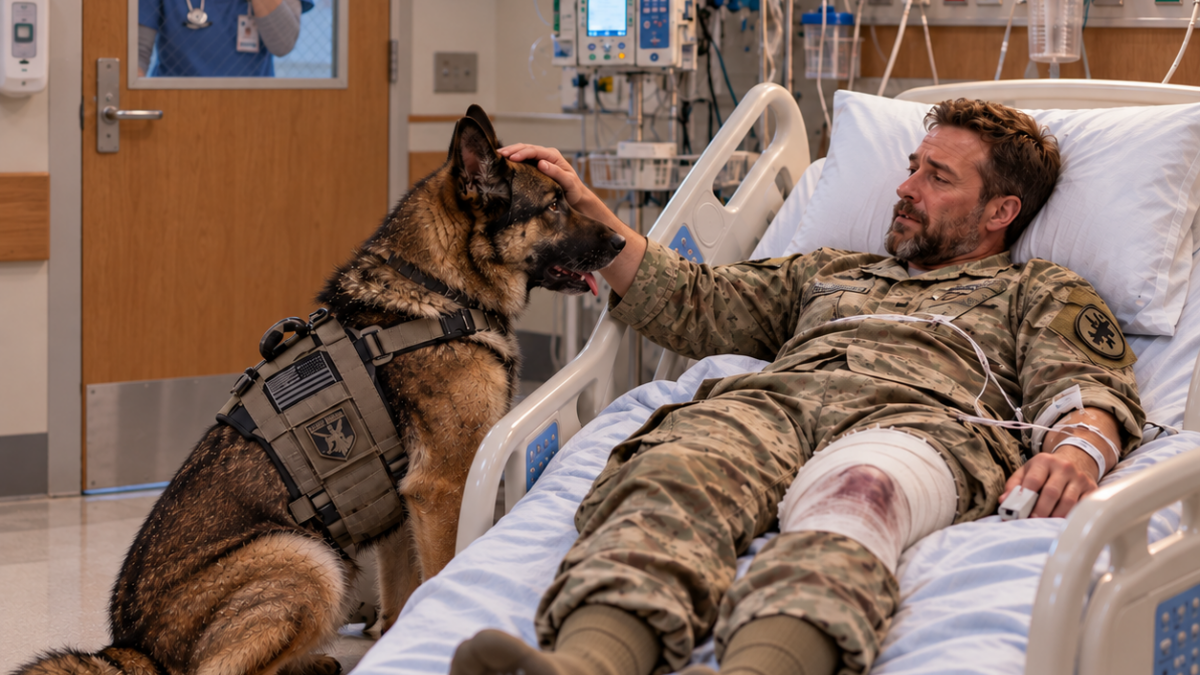
The hospital administration had made a rare exception allowing him to stay with me because of my PTSD and his service status.
The staff received instructions so strict they might as well have been carved into the door.
Do not pet the dog.
Do not feed the dog.
Do not approach the dog from behind.
Do not make sudden movements.
Do not assume the dog is friendly.
Koda was friendly.
To me.
That was enough.
Most nurses avoided room 412 unless they had no choice.
I could not blame them.
The first junior nurse who came in tried to hide how scared she was.
Koda smelled it immediately and gave a growl so low the IV pole trembled.
After that, they sent in Madelyn Hayes.
I had heard her name before I saw her.
Nurses talk outside hospital rooms like patients become deaf once a door closes.
“She’s got 412?” someone whispered.
“Good,” another voice answered. “Maddie can handle anything.”
“What is she, former ER?”
“No idea. She never says.”
“She gives me the creeps sometimes.”
“Why?”
“Too calm.”
That caught my attention.
Too calm.
In my world, too calm usually meant one of two things.
Dead inside.
Or trained.
At 7:00 p.m., the door opened.
Madelyn Hayes stepped into my room wearing pale blue scrubs, rubber-soled shoes, and the kind of plain hospital badge photo nobody likes but everyone accepts because HR does not believe in flattering light.
She was not imposing.
Average height.
Brown hair pulled into a tight bun.
No jewelry except a plain watch.
No perfume.
No bright shoes.
No friendly “How are we feeling tonight?” nurse voice.
She entered like someone trying not to leave a footprint.
Quiet.
Controlled.
Invisible by choice.
But I noticed what most people would not.
She paused half a second inside the doorway.
Not hesitation.
Assessment.
Her eyes moved once across the room.
Window.
Bathroom.
Chair.
Equipment.
My hands.
Koda.
Exit.
Then she came forward.
“Sergeant Carmichael,” she said softly. “I’m Madelyn, your nurse tonight. I’m going to check your vitals and take a look at your surgical site.”
Her voice was calm.
Not sweet.
Not cold.
Just measured.
Koda lifted his head.
At first, I thought he was doing his usual evaluation.
Then his whole body changed.
His ears locked forward.
His shoulders rose.
He came off the bed in one smooth motion, claws clicking against the linoleum.
I grabbed for the leash draped over the rail.
“Koda, heim.”
Home.
Recall.
German command.
He ignored me.
Koda had never ignored me.
Not in training.
Not under fire.
Not in pain.
Not once.
He moved toward Madelyn with slow, deliberate steps.
No growl.
No teeth.
No aggression.
That made it worse.
Aggression I understood.
This was recognition.
Madelyn stopped exactly where she stood.
Koda halted three feet in front of her, sat back on his haunches, lifted his chest, and raised one front paw just slightly off the floor.
My hand tightened around the leash.
I knew that posture.
Not because it was standard.
Because it was not.
That alert was not taught to regular military dogs.
It belonged to a different world.
High-value friendly recognition.
Ranking handler.
Covert operative.
Someone the dog had been trained to identify without barking in a hostile environment.
Koda stared up at Madelyn Hayes.
His tail moved once.
Stiff.
Controlled.
Then he released the faintest whine I had ever heard from him.
Madelyn did not breathe.
For one fraction of a second, the nurse disappeared.
Not physically.
Something behind her eyes dropped its disguise.
And before she could stop herself, her right hand twitched.
Closed fist.
Two fingers down.
A quick, sharp tactical signal.
Stand down.
At ease.
Koda obeyed instantly.
He lowered his paw, relaxed his shoulders, stepped forward, and pressed his nose lightly against the pocket of her scrubs.
Madelyn closed her eyes for less than a second.
But I saw it.
I saw all of it.
“He’s never done that,” I said.
My voice was low.
Dangerous even to my own ears.
Madelyn opened her eyes and placed her polite hospital mask back over her face.
“He’s a beautiful dog,” she said. “I think he smells the beef stew I had in the cafeteria.”
She stepped around Koda like nothing had happened and reached for my IV line.
I caught her wrist.
Not hard enough to hurt.
Hard enough to ask a question she could not ignore.
Her eyes moved to my hand.
Then to my face.
The temperature in the room seemed to drop ten degrees.
“I did not use an English command,” I said. “I spoke to him in German. And you just gave him a release signal I’ve only seen in one classified training environment.”
Her pulse did not jump beneath my fingers.
That bothered me more than if it had.
“Who the hell are you?”
She looked at me with the soft, steady face of a nurse and the eyes of someone who knew exactly how to break my wrist.
“I’m Madelyn Hayes,” she said. “Your registered nurse.”
“Wrong answer.”
“Your blood pressure is elevated, Sergeant Carmichael.”
“No kidding.”
“You recently underwent femoral reconstruction. Stress will increase inflammation and pain response.”
“That dog just identified you like an asset.”
“And you need rest.”
I held her stare.
She did not blink.
Finally, something in her gaze sharpened.
Just enough.
Not a threat.
A warning.
“Let go of my wrist.”
Koda watched us both.
I released her.
Not because I wanted to.
Because every instinct I had told me the woman standing beside my bed was not trapped in that room with me.
I was trapped in it with her.
Madelyn checked my IV drip, scanned the monitor, wrote down my blood pressure, and moved toward the door.
Before she left, she looked once at Koda.
He lowered his head respectfully.
Not submissive.
Respectful.
She turned away too quickly.
The door clicked shut behind her.
I stared at Koda.
“What was that?”
Koda’s ears twitched.
He looked at the door.
Then back at me.
If dogs could say, You know exactly what that was, he did.
By midnight, the hospital had settled into the strange rhythm of the graveyard shift.
Every hospital sounds alive at night, even when the halls look empty.
Elevators ding.
Monitors beep.
Air vents hum.
Rubber soles squeak.
Somewhere, someone coughs.
Somewhere else, someone cries quietly because night makes fear louder.
I did not sleep.
Pain had a hand around my leg, squeezing.
But pain was not why I stayed awake.
Madelyn Hayes passed my room every twenty minutes.
Not always to check on me.
Sometimes she passed with medication.
Sometimes with charts.
Sometimes with nothing visible in her hands at all.
Each time, I watched her through the glass.
Her walk was wrong for a nurse.
Not wrong if you were a civilian.
Wrong if you knew what to look for.
Weight slightly forward.
Dominant hand free.
Corners checked without turning her head.
Reflections used.
Never standing in the center of a hallway.
Never letting anyone come too close behind her.
She moved like a woman who had forgotten how not to survive.
At 1:40 a.m., I pressed the call button.
Madelyn entered three minutes later.
Not rushed.
Not annoyed.
“What do you need?”
“Truth.”
She looked at the IV bag.
“You’re not due for pain medication yet.”
“I’m not talking about oxycodone.”
Her mouth tightened slightly.
Very slightly.
Enough.
I lowered my voice.
“Koda knows you.”
“No. Koda recognizes training patterns.”
“That’s a distinction without comfort.”
She looked at the dog, who was lying beside the bed but watching her with absolute stillness.
“Sergeant Carmichael, I have spent five years as a nurse in this hospital. I work night shifts, take vitals, change dressings, argue with surgeons, and drink coffee that tastes like burnt plastic. Whatever you think you saw—”
“I saw a classified alert posture.”
“—was a dog reacting to stress.”
“You weren’t stressed.”
Her eyes found mine.
There it was again.
A flash of something buried deep.
“I am always stressed,” she said quietly.
That silenced me.
Not because it explained anything.
Because it sounded true.
Before I could push harder, the hospital speakers crackled.
A sharp tone echoed through the floor.
Then came the announcement.
“Code Silver. Security threat on premises. All staff secure in place. Code Silver.”
Madelyn froze.
Not in fear.
In calculation.
Down the hall, someone screamed.
Another voice shouted.
A crash sounded from the direction of the stairwell.
Then the automated lockdown system engaged.
Heavy fire doors slammed shut along the corridor.
A nurse at the station cried out, “Oh my God. He’s coming up the stairs.”
Madelyn moved.
The quiet nurse vanished so completely it felt like a light switching off.
What replaced her was not panic.
It was command.
She stepped into the hallway and pointed at the charge nurse.
“Evelyn, get everyone into the medication room.”
The older nurse stared.
“What?”
“Steel-core door. Key card access. Move now.”
“Madelyn—”
“Now.”
The word cracked across the corridor like a rifle shot.
People obeyed.
Not because they understood.
Because every human being recognizes command when it is real.
Madelyn stripped the wall mount of a fire extinguisher and held it low, not by the handle, but balanced like a tool she had already measured for weight and reach.
I swung my legs over the bed.
Pain exploded through my femur.
I nearly blacked out.
Koda was already on the floor, hackles raised.
“Stay,” I hissed.
He ignored me.
Again.
That was becoming a theme.
I grabbed my crutches and staggered to the doorway.
Madelyn had taken position beside the fire doors leading to the stairwell.
Not hiding.
Waiting.
The angle was perfect.
Anyone forcing that door open would cross blind into her range before seeing her.
My blood ran cold.
She was not defending.
She was hunting.
“That’s a fatal funnel,” I whispered.
Koda looked up at me.
He knew.
The stairwell door rattled.
Once.
Twice.
Someone cursed on the other side.
Then came a loud metallic crack.
The lock failed.
The door flew open.
A man lunged through, wild-eyed, one hand raised with a stolen security weapon.
He never saw Madelyn.
She pivoted with terrifying precision and struck his weapon arm with the fire extinguisher.
Not a wild swing.
Not panic.
A targeted hit.
The weapon clattered across the floor.
Before he could recover, she stepped inside his guard, took his balance, drove him to the linoleum, and pinned him down with controlled force.
The entire takedown took less than three seconds.
No screaming.
No hesitation.
No wasted motion.
She kicked the weapon away, cleared it with practiced speed, and slid it down the hall toward me.
“Carmichael,” she said without looking up.
I caught it.
My hands remembered before my brain did.
She pulled trauma shears from her pocket and held them against the attacker’s neck—not cutting, not stabbing, but placed with enough precision to make the man stop breathing hard.
“Move,” she whispered, “and you bleed.”
The man froze.
Security guards burst in from the opposite end of the corridor, weapons drawn.
Then stopped.
Because the scene made no sense.
A quiet night nurse in pale blue scrubs had a violent armed intruder pinned to the floor like she had been doing it all her life.
Madelyn stood, smoothed the front of her scrub top, and stepped away as if she had just finished changing a dressing.
“Secure him,” she said.
No one argued.
As the guards hauled the man away, Madelyn turned back toward the nurses’ station.
Then she stopped.
Her eyes shifted to the floor near Koda’s paws.
During the struggle, the hidden seam inside her scrub top had torn.
Something had fallen out.
Small.
Black.
Heavy.
A coin.
Koda lowered his head, sniffed it once, then picked it up gently between his teeth.
He walked to Madelyn and sat in front of her, offering it like a retrieved prize.
I stared.
It was not a challenge coin from any unit I knew.
No words.
No motto.
Only a dark engraved insignia I had seen once, years earlier, on a burned document pulled from a compound in Syria.
My mouth went dry.
“Civilian nurses don’t disarm armed suspects like that,” I said.
Madelyn’s fingers closed around the coin.
“And they don’t carry ghost coins.”
The corridor had gone silent around us.
Even the wounded attacker stopped cursing.
Madelyn looked at me, and this time there was no nurse left in her face.
Only the ghost.
“You don’t know anything, Sergeant.”
“I know enough.”
“No,” she said. “You really don’t.”
Then Koda growled.
Low.
Deep.
Not at Madelyn.
At the stairwell door.
I turned.
Embedded in the wood, right where the attacker had entered, was a knife.
Not hospital equipment.
Not something stolen from security.
A black tactical blade sunk deep into the frame.
Pinned beneath it was a scorched strip of fabric.
Madelyn moved before anyone else understood.
She ripped the knife free with a practiced twist and tore the fabric loose.
For the first time all night, her face changed completely.
Not fear.
Recognition.
The fabric was old.
Burned along one edge.
Marked with a faded blood type patch.
Madelyn whispered a name I did not recognize.
Then another.
Then she looked down the hall where the staff had hidden.
“We have about four minutes.”
My grip tightened around the confiscated weapon.
“For what?”
“The real team.”
My brain tried to reject the words.
It failed.
“What team?”
Madelyn looked at me.
The quiet nurse was gone.
The woman standing there was older than her face, colder than her voice, and tired in a way I understood too well.
“The man I stopped wasn’t the attack,” she said. “He was a test.”
“A test for what?”
“For whether I was still me.”
The lights flickered.
Somewhere below, a generator groaned.
Madelyn turned to Evelyn Foster, who had cracked open the medication room door.
“Keep everyone inside. Barricade it. Do not open for anyone unless you hear my voice and Sergeant Carmichael’s together.”
Evelyn stared at her.
“Maddie, what is happening?”
Madelyn’s expression softened for half a second.
“I’m sorry I brought this here.”
“You brought what here?”
“My past.”
The fire doors at the far end of the corridor shook from an impact.
Not a person slamming into them.
An explosive breach being set.
I knew the difference.
So did Koda.
His lips pulled back from his teeth.
Madelyn turned to me.
“You can’t run.”
“No.”
“But you can shoot?”
“Yes.”
“You trust your dog?”
“With my life.”
“Good. Then trust him when he tells you not to trust anyone else.”
She shoved medical supplies into her pockets.
Tourniquets.
Gauze.
Epinephrine.
Flashlight.
Tape.
Useful things.
Not random.
Planned.
“How do you know this hospital’s blind spots?” I asked.
“I know the blind spots of every building I enter.”
That answered more than I wanted it to.
“What are they here for?”
“Me.”
“Why?”
She paused.
The corridor lights flickered again.
“For five years, I have been dead.”
Koda growled harder.
Madelyn looked toward the stairwell.
“Apparently, someone just found my grave empty.”
The breach hit ten seconds later.
The stairwell doors blew inward.
Glass shattered.
Smoke rolled across the hall.
Men in matte-black gear entered in tight formation.
Too fast.
Too coordinated.
Not police.
Not hospital security.
Not ordinary criminals.
Madelyn grabbed my shoulder and dragged me backward into the service corridor with strength she should not have had.
“Koda, move,” I commanded.
He moved.
We slipped through the utility doors as suppressed gunfire punched through the nurses’ station behind us.
Not random.
Not warning shots.
They were clearing the floor.
My stomach turned cold.
Patients.
Nurses.
Civilians.
Madelyn’s face showed nothing.
That was how I knew she cared.
People who feel nothing posture.
People who feel too much go flat.
We reached the freight elevator.
She slammed the basement button.
The doors groaned shut as rounds sparked against the metal seam.
Inside, red emergency light painted her face in blood-colored shadow.
“What the hell are you?” I asked.
She looked at the descending numbers.
“I was useful.”
“That’s not an answer.”
“It’s the only one that doesn’t get you killed.”
“I’m already in an elevator being shot at because my dog recognized a nurse as some kind of covert operative. I think we passed normal answers.”
For one second, her mouth almost curved.
Almost.
Then the elevator lurched.
Stopped.
The lights died.
A heartbeat later, emergency backups kicked on.
Dim red glow.
No movement.
No sound except our breathing and Koda’s low growl.
“They cut main power,” I said.
“Yes.”
“Can they open the shaft?”
“They’re trying.”
Above us came a heavy metallic thud.
Boots landing on the roof of the elevator car.
Koda barked once.
Madelyn raised one finger to her lips.
Then pointed to me.
Back wall.
Stay low.
She did not explain what she was doing next.
Good.
Because some things should not be explained in detail, and some things I would rather not remember clearly.
She moved fast, using what she had on her, turning ordinary medical equipment into enough chaos to force space where there had been none.
There was a sharp blast above us.
Not fire.
Pressure.
Metal screamed.
A man shouted.
The roof hatch slammed open.
Madelyn was through it before the echo finished.
She reached down.
“Give me your arm.”
“I have a shattered femur.”
“And I have no time for your medical history.”
I gave her my arm.
Pain tore through me as she hauled me upward.
Koda scrambled after us with furious athletic grace.
We climbed through the shaft toward the parking garage access.
By the time we reached the level above, sweat had soaked through my hospital gown and pain had turned my vision white at the edges.
Madelyn noticed.
“Stay with me.”
“Trying.”
“Try harder.”
“You always this warm with patients?”
“Only the ones who ask too many questions.”
We pushed through a maintenance hatch into the underground garage.
Cold air hit us.
Rain hammered the metal grates near the exit ramps.
The garage lights flickered, half alive, half dead.
Concrete pillars stretched into darkness.
My leg throbbed so badly I could barely stand.
Madelyn pulled my arm over her shoulder without asking.
Koda moved ahead, belly low, nose working.
“My car is on level three,” she said.
“You have an escape car?”
“I have three.”
“Of course you do.”
“Two now. One was compromised last year.”
I stared at her.
She kept moving.
Then Koda froze.
No bark.
No growl.
He dropped instantly into a combat crouch, eyes locked on a cluster of dark vans near the exit ramp.
“Ambush,” I breathed.
From the shadows, five men emerged.
Black gear.
Night optics.
Compact weapons.
Professional spacing.
At their center stood a man in a tailored charcoal suit, dry despite the rain blowing in from the garage entrance, as if weather itself had signed a nondisclosure agreement with him.
He smiled.
“Hello, Madelyn.”
Madelyn stepped in front of me.
Not dramatically.
Automatically.
“Miles Sterling,” she said.
Her voice changed when she said his name.
Not fear.
Disgust.
“Five years,” Sterling said. “I genuinely believed Caracas had swallowed you.”
“Disappointing night for you, then.”
His smile thinned.
“You always did mistake survival for victory.”
“And you always mistook cruelty for intelligence.”
He looked at me, then at Koda.
“Collateral.”
Koda’s growl deepened.
Sterling returned his attention to Madelyn.
“You stole something that didn’t belong to you.”
“I secured something that was being used to fund illegal operations.”
“You were never authorized to make that decision.”
“No,” Madelyn said. “I was expected to obey men who had forgotten the difference between a mission and a crime.”
Sterling’s eyes hardened.
“Where are the bonds?”
“Gone.”
“You expect me to believe that?”
“No,” she said. “I expect you to keep talking long enough to prove you’re still arrogant.”
That was when I realized she had not stopped in front of us because she was trapped.
She was measuring.
Light.
Distance.
Reflection in the wet concrete.
Position of the transformer box overhead.
Koda’s angle.
My weapon hand.
Sterling’s men raised their rifles.
“Take her alive,” Sterling said. “Kill the ranger and the dog.”
Everything happened at once.
Madelyn’s hand flashed.
The overhead electrical panel erupted in sparks and darkness.
The garage plunged into black.
“Koda, fast!” I shouted.
The Malinois launched forward like a missile.
I heard a man scream.
A weapon hit concrete.
Madelyn moved in the dark like she had been born there.
I fired only when a muzzle flash gave me a target, keeping low, controlled, conserving rounds.
She did not fight like someone trying to win.
She fought like someone refusing to waste motion.
One attacker went down.
Then another.
Koda drove a third into the concrete and held him there with a warning growl that made surrender seem wise.
Sterling fired blindly.
A round snapped past my ear and hit a pillar.
Another grazed Madelyn’s shoulder, tearing through fabric.
She did not flinch.
She crossed the distance to him in three explosive strides, disarmed him, drove him into the pillar, and pinned him there with his own weapon pressed under his chin.
Rain blew through the garage entrance behind her.
Police sirens began to rise in the distance.
Sterling gasped for breath.
“You think this ends it?”
Madelyn leaned close.
“No. This just makes sure you don’t get to write the next part.”
“The Directorate will never stop looking.”
She pulled the black ghost coin from her pocket.
For a moment, she looked at it.
Then she placed it on his chest.
“Tell them Madelyn Hayes died in Caracas.”
His eyes narrowed.
“And who are you now?”
She stepped back.
“Someone worse for people like you.”
The sirens grew louder.
Madelyn turned toward me.
“You need to tell police you were attacked by armed men during a hospital lockdown. Tell them nothing else.”
“You think I’m letting you disappear?”
She glanced toward the ramp.
“I don’t need permission.”
“You saved the floor.”
“I endangered it first.”
“Not by choice.”
She looked at Koda.
He stood beside me now, blood on his muzzle that was not his, eyes still locked on her.
For the first time, Madelyn’s face softened.
“Good dog,” she whispered.
Koda stepped forward and pressed his nose into her hand.
She closed her eyes.
Just for a second.
Maybe remembering another dog.
Another handler.
Another life.
Then she looked at me.
“If he recognized me, others will eventually.”
“Then stop running.”
She almost smiled.
“I did.”
Before I could answer, she turned and ran toward the far exit ramp.
She moved into the freezing Portland rain and vanished between sirens, shadows, and stormwater.
Not stumbling.
Not fleeing.
Choosing.
Koda whined once.
I lowered my hand to his head.
“I know, buddy.”
By the time police reached the garage, Madelyn Hayes was gone.
So were two of the vans.
Sterling was alive.
Furious.
Handcuffed.
Already asking for lawyers under names that probably were not real.
The hospital called it a coordinated criminal attack.
The news called it a failed abduction.
The administration called Madelyn a heroic nurse who had “left employment unexpectedly following a traumatic event.”
Nobody used the right words.
Nobody could.
Evelyn Foster cried through every interview.
“She was quiet,” she kept saying. “She was just so quiet.”
I stayed in Providence General three more weeks.
My leg healed slowly.
My sleep did not.
Koda refused to leave my side unless he was searching the hallway for someone who was not coming back.
Room 412 became famous for about forty-eight hours, which was forty-eight hours too long.
Police asked questions.
Federal people asked better ones.
Men in suits asked questions so carefully worded they sounded like traps.
I answered the same way each time.
A nurse protected us.
Armed men attacked.
I do not know where she went.
That last sentence was true.
Mostly.
Three months later, I received an envelope with no return address.
Inside was a photograph.
Not of Madelyn.
Of Koda.
Taken from a distance, through the glass of the hospital courtyard during my recovery. He was sitting beside my wheelchair, ears up, eyes alert.
On the back, written in clean block letters, were five words:
He always knew first.
No signature.
None needed.
I keep that photo in my desk now.
People ask me sometimes whether Madelyn Hayes was a hero.
I never know how to answer.
Hero is a word civilians like because it makes danger simple.
Madelyn was not simple.
She was a woman who had done things I will never know and carried ghosts I hope never to meet.
She lied to everyone for five years.
She hid weapons in places no nurse should hide anything.
She had escape routes from grocery stores.
She was dangerous in ways most people cannot understand.
But I know this too.
When a hospital floor full of patients was threatened, she did not run.
When she had every reason to save only herself, she saved strangers.
When Koda recognized her, she could have disappeared before the storm reached us.
She stayed too long.
That is usually where courage lives.
Not in clean people making clean choices.
In damaged people standing between danger and someone else anyway.
I saw her once more.
Not in person.
On a grainy security photo passed quietly from one veteran to another through channels that do not officially exist.
A woman with brown hair cut shorter than before, wearing a dark coat, walking through an airport in Lisbon beside a refugee family.
The timestamp was six months after Portland.
The note attached said only:
She got them out.
No one knew from where.
No one knew to where.
I did not ask.
Some ghosts earn the right to remain ghosts.
Koda is older now.
Gray around the muzzle.
Slower to stand.
Still sharper than most men with badges.
Sometimes he wakes from dreams and looks toward the door.
I wonder if he hears her in memory.
I wonder if dogs remember people by scent, by posture, by soul.
Maybe all three.
When hospital staff visit veterans now and someone mentions quiet nurses, I pay attention.
Not because I think every soft-spoken woman in scrubs is a former operative.
Most are exactly what they appear to be.
Tired.
Underpaid.
Overworked.
Holding the line in rooms where life and death argue under fluorescent lights.
But I learned something from Madelyn Hayes.
Everyone carries history inside the way soldiers carry shrapnel.
Some pieces are visible.
Most are not.
The calmest person in the room may not be calm because life has been easy.
Sometimes they are calm because panic was trained out of them in places no one should have to survive.
The quietest person may not be shy.
They may be listening for danger.
The person who never talks about the past may not be boring.
They may be protecting everyone else from it.
For five years, Madelyn Hayes worked as the invisible heartbeat of Providence General Hospital.
She checked pulses.
Changed dressings.
Held pressure on wounds.
Comforted frightened patients at three in the morning.
She let people believe she was ordinary because ordinary was the safest disguise she had left.
Then my dog saw through it.
Not because Koda cared about her name.
Not because he understood classified coins, covert networks, or the lies nations tell in the dark.
He saw what trained soldiers see in each other.
Recognition.
Burden.
Survival.
And respect.
On the last night I was in the hospital, Evelyn Foster came into my room with discharge paperwork.
She looked older than she had three weeks earlier.
“She saved us,” she said.
“Yes.”
“I keep wondering if I should have known.”
“You couldn’t have.”
“She worked beside me for five years.”
“Sometimes that’s how hiding works.”
Evelyn looked toward the empty hallway.
“She used to drink terrible cafeteria coffee with exact change.”
I smiled.
“She scouted exits at grocery stores.”
“What?”
“Nothing.”
Evelyn shook her head.
“I hope she’s safe.”
I looked at Koda.
He was staring toward the door again.
“So do I.”
But safe is a strange word for people like Madelyn.
It does not mean still.
It does not mean untouched.
It does not mean unafraid.
Sometimes safe means the people hunting you are finally more afraid than you are.
Sometimes safe means you stop pretending you can become someone else.
Sometimes safe means walking into the rain under your own name, even if no one else gets to know what that name really is.
Madelyn Hayes vanished from Providence General that night.
But every person on that ward remembered her.
The junior nurse who used to fear room 412 went on to train in emergency medicine.
Evelyn Foster stopped calling calm people “cold.”
The security guard whose life she saved sent flowers to an empty employee locker once a month until HR finally cleared it.
And me?
I learned that not every secret is a lie.
Some are scars wearing silence.
Koda still has the blanket Madelyn used to wrap my leg before dragging me through that service corridor.
He should not care about it.
It is just hospital fabric.
Washed a dozen times.
Folded in the bottom drawer.
But every so often, he pulls it out, rests his head on it, and sighs.
When he does, I sit beside him.
Neither of us says anything.
We do not have to.
We both remember the night the quiet nurse walked into room 412.
We remember the way he recognized her before anyone else could.
We remember the fire doors.
The red elevator light.
The rain in the garage.
The black coin.
The woman who stopped running by disappearing one last time.
And whenever someone tells me dogs do not understand loyalty, I think of Koda sitting three feet from Madelyn Hayes, paw raised, head high, honoring a soldier the world had tried to erase.
He knew.
Before the hospital.
Before the gunfire.
Before the truth.
He knew.
And because he did, a ghost had to become a guardian one more time.








