A Paralyzed Mother Cat Crawled Back to Her 5 Kittens—Then Her Foster Mom Discovered Why She Touched Her Blanket Five Times Every Night
PART3:
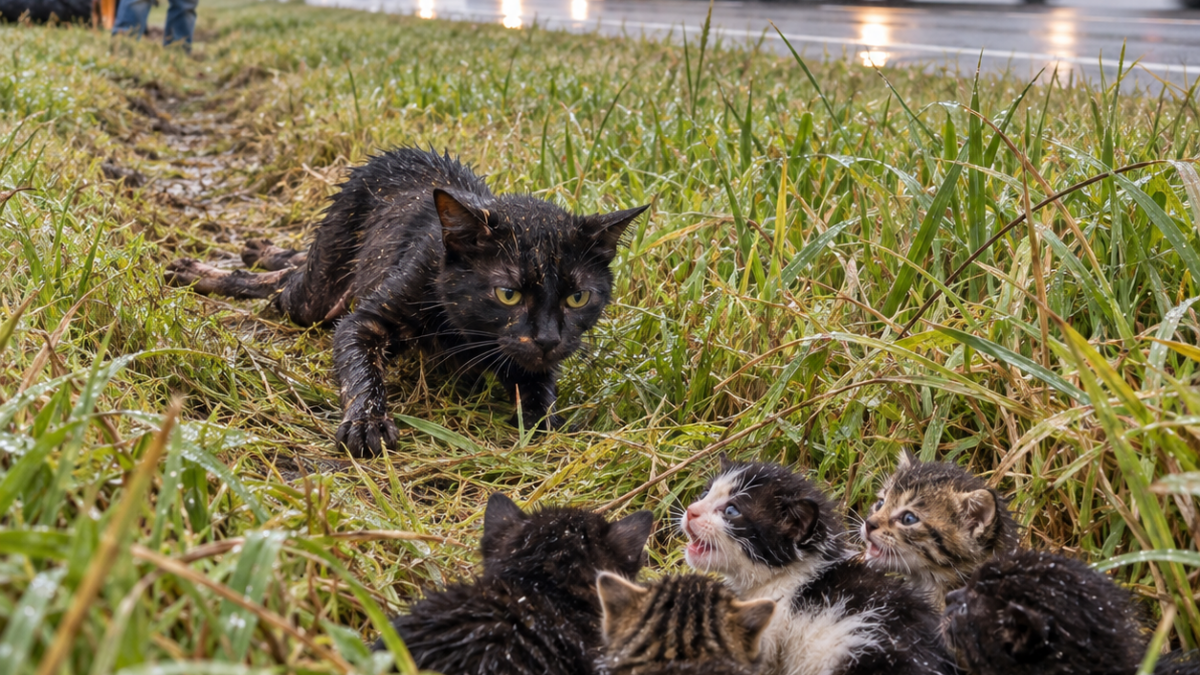
At the end, beneath a clump of tall switchgrass, something squeaked.
Tom stopped.
Then another squeak.
He parted the grass carefully.
Five kittens stared back.
Tiny.
Black.
Gray.
One with a white chest.
Maybe four weeks old.
They were pressed together inside a shallow nest made from dead grass and leaves.
Tom looked from them to the injured mother.
Then back.
“No way.”
One kitten climbed clumsily over another.
Walked toward the adult cat.
The mother heard it.
Her entire upper body changed.
Head lifted.
Front paws dug into the ground.
She pulled.
Tom watched, stunned.
Her back legs did nothing.
They simply dragged behind her.
But the front half of her body worked desperately.
Claw.
Pull.
Rest.
Claw.
Pull.
She moved toward the kitten.
Maybe six inches.
Then another six.
The kitten reached her first.
It pushed beneath her chest.
A second kitten followed.
Then three more.
Within moments, all five were pressed against her belly.
Nursing.
Tom stayed crouched in the grass.
Traffic rushed past.
A semi shook the ground.
The mother cat did not react.
She lowered her head.
Closed her eyes.
And fed them.
Tom looked toward the road.
Then at the flattened strip of grass again.
Suddenly he understood.
She had not been struck where he found her.
The impact happened closer to the highway.
Afterward, unable to use the entire back half of her body, she had dragged herself away from traffic.
Not randomly.
Toward the nest.
Toward them.
Tom called county animal control.
The dispatcher asked the normal questions.
Location.
Animal condition.
Traffic hazards.
Then:
“Can she walk?”
“No.”
“Can she move at all?”
“Front legs.”
“Rear legs?”
“Nothing.”
“Any kittens?”
Tom looked down.
“Five.”
Pause.
“With her?”
“Yeah.”
“Are they alive?”
“They’re nursing right now.”
Longer pause.
“How old?”
“I don’t know. Small.”
The dispatcher said an officer was coming.
Tom stayed.
Twenty minutes.
Then thirty.
He moved his maintenance truck to create some visual protection from traffic without entering the lane.
Found a cardboard box.
Filled a plastic container with water.
The mother would not drink at first.
She would not leave the kittens.
So Tom soaked the corner of a clean shop towel and held it near her mouth.
She licked.
Once.
Then again.
Then drank from the water cap he placed beneath her chin.
Her tongue moved desperately.
Tom whispered:
“How long have you been out here?”
He did not expect an answer.
But later, signs suggested the answer may have been three days.
A highway worker on another shift remembered seeing what he thought was a dead black animal near the median Tuesday morning.
Heavy rain had moved through Tuesday night.
Wednesday temperatures dropped sharply after sunset.
The kittens were still alive Thursday.
Healthy enough to cry.
Healthy enough to nurse.
The mother looked far worse.
Her ribs showed.
Skin pulled tight around her hips.
The wounds on her legs were dirty.
Her gums were pale.
Yet milk still came.
Her body had prioritized five other bodies above itself.
Animal Control Officer Renee Alvarez arrived forty-three minutes after Tom called.
She had worked field response for almost nine years.
Dogs chained behind abandoned houses.
Cats trapped inside walls.
Owls hit by vehicles.
Animals starved, burned, neglected, dumped.
She thought she had learned not to be surprised.
Then she saw the trail.
Renee crouched beside the mother.
Looked at the kittens.
Looked back toward the highway.
“How?”
Tom gave a helpless laugh.
“Exactly.”
Renee examined the cat without trying to move her.
“Hey, Mama.”
The cat opened her eyes.
Exhausted.
Still alert.
Renee moved one hand toward a rear foot.
Touched a toe.
Nothing.
Pressed gently.
Nothing.
She looked at Tom.
“No response.”
“What does that mean?”
“I’m not diagnosing her out here.”
But her face answered anyway.
The kittens continued nursing.
One kneaded the mother’s belly with tiny paws.
Another climbed partly over her front leg.
The mother licked its head.
Slowly.
One stroke.
Then another.
Renee swallowed.
“Okay.”
She stood.
“We’re getting everybody out.”
Normally she would separate neonates temporarily for safer transport.
This time she decided not to.
She prepared a large carrier.
Lined it with towels.
Then lifted the first kitten.
The mother’s head snapped up.
Kitten cried.
Renee placed it inside the carrier.
Second.
Third.
The mother began pulling herself forward.
Tom saw it.
“Wait.”
Renee looked down.
The cat was dragging herself toward the carrier.
Front legs digging into dirt.
Back legs scraping behind.
“She’s trying to follow.”
“I know.”
Renee stopped taking kittens.
Instead she moved the carrier closer.
The mother reached the door.
Tried to climb.
Could not.
Renee slid both hands beneath her chest and pelvis.
The cat cried once.
A sharp sound.
Pain.
“Sorry.”
Renee lifted carefully.
Placed her beside the kittens.
Instantly, the mother rearranged herself.
Front legs curled.
Body curved as much as the injury allowed.
Kittens crowded against her.
Nursing again.
Renee closed the door.
The mother’s eyes never left them.
At the county veterinary clinic, Dr. Hannah Ellis met the carrier at the treatment-room door.
She took one look.
“X-rays.”
But first:
Fluids.
Pain relief.
Temperature.
Wound cleaning.
Bloodwork.
The kittens were weighed individually.
Kitten one.
Healthy.
Kitten two.
Healthy.
Three.
Healthy.
Four.
Healthy.
Five.
Healthy.
That was the first impossible part.
Not merely alive.
Healthy.
Their hydration levels were surprisingly good.
Weights fell within normal range.
No major respiratory signs.
No obvious malnutrition.
Dr. Ellis looked at the mother.
She weighed barely six pounds.
Probably should have been closer to eight.
Dehydrated.
Anemic.
Muscle loss.
Skin wounds along both hind limbs from dragging.
She had given them what she had.
Then kept giving.
The X-rays loaded on the monitor.
Dr. Ellis stared.
Renee stood beside her.
Tom had gone back to work, but not before leaving his number.
Dr. Ellis pointed.
“Three fractures.”
The pelvis was shattered.
One side displaced.
The other fractured near the joint.
A third break closer to the sacrum.
Then came the neurological examination.
Rear paw.
No withdrawal.
Deep pressure.
No response.
Tail.
Minimal movement.
Bladder function compromised.
Dr. Ellis tested again.
Then once more.
Renee asked:
“Could swelling be causing it?”
“Possibly some.”
“But?”
Hannah hated that word.
But.
“But I’m not seeing deep pain response.”
“What does that mean long term?”
“We need time.”
“Hannah.”
She looked at Renee.
“If this remains unchanged, she may never walk again.”
Renee looked through the glass door.
Inside the warmed kennel, five kittens slept against their mother.
One lay across her neck.
“Can she survive?”
“Yes.”
“If?”
“She avoids infection.”
“Her bladder can be managed.”
“The wounds heal.”
“She eats.”
“Pain stays controlled.”
“And somebody is willing to manage a paralyzed cat.”
Renee nodded.
Not impossible.
Hard.
Different thing.
Dr. Ellis continued:
“The biggest immediate issue is whether she can continue nursing safely.”
“She has almost nothing left.”
They supplemented the kittens with formula.
The mother still insisted on nursing.
When staff picked one kitten up, she watched.
When they returned it, she groomed it.
Every time.
A volunteer came in Friday morning.
Five kittens asleep.
Mother awake.
The volunteer placed food near her.
She ignored it.
The smallest kitten squeaked.
Mother immediately repositioned.
The volunteer whispered:
“You have to eat too.”
Eventually they discovered the trick.
Feed her while she fed them.
Wet food placed close enough that she could eat without moving away.
She ate an entire small can.
Then another half.
The clinic posted a rescue request to its network.
Adult female cat.
Probable permanent hind-limb paralysis.
Five nursing kittens.
Needs experienced foster.
Medical management required.
Most people who foster neonatal kittens will tell you the same thing.
Healthy kittens are work.
Sick kittens are more work.
A paralyzed nursing mother with five kittens is not ordinary foster care.
Bladder expression.
Wound checks.
Frequent bedding changes.
Weight monitoring.
Mobility restrictions.
Nutrition.
Five kittens learning to become tiny criminals simultaneously.
The first three rescue groups were full.
The fourth could take kittens but not the mother.
Renee refused to split them yet.
Then Carol Whitman called.
Carol was fifty-eight.
Widowed.
Former elementary-school librarian.
Eleven years fostering cats.
She specialized in what shelters called “complicated placements.”
Which was a polite phrase for:
Animals other people loved but were afraid they could not handle.
Three-legged cats.
Diabetic cats.
Blind kittens.
Cats recovering from burns.
A twenty-two-pound orange cat named Chester who hated everybody except Carol and one particular UPS driver.
Carol arrived Saturday morning.
She brought towels.
Pee pads.
A collapsible pen.
Notebook.
Digital kitchen scale.
And the expression of someone arriving for a job interview she already expected to accept.
Dr. Ellis explained everything.
“Pelvic fracture.”
Carol nodded.
“Permanent paralysis is possible.”
Nod.
“Bladder expression may be required.”
“I’ve done it.”
“Skin protection will be important.”
“I know.”
“She may need a wheelchair later.”
“I figured.”
“Five kittens.”
Carol smiled.
“I can count.”
Hannah hesitated.
“Carol.”
“Yes?”
“You don’t have to take this.”
“I know.”
“This could be months.”
“I know.”
“It could become permanent.”
Carol looked through the kennel door.
The mother cat was lying with kittens stacked around her.
One kitten had somehow crawled onto her head.
Carol smiled.
“Does she have a name?”
“No.”
“She does now.”
Renee leaned against the counter.
“What?”
Carol looked at the cat.
“Median.”
Hannah blinked.
“Median?”
“That’s where she was found.”
Carol’s expression softened.
“In the middle.”
“Between the lanes.”
“Between the place that hurt her and the babies she was trying to reach.”
Renee nodded slowly.
“Median.”
The cat opened her eyes.
Maybe coincidence.
Probably.
Still.
The name stayed.
Carol converted her guest bedroom into a recovery room.
Low pen.
Washable blankets.
Puppy pads beneath fleece.
Heating pad under one section.
Food.
Water.
Scale.
Formula.
Medications organized by time.
Kittens in a shallow nesting bed close enough that Median could reach every one without dragging.
First night:
Carol barely slept.
Not because the kittens cried.
Because Median kept trying to move.
Every time a kitten wandered too far, Median pulled herself after it.
Front legs.
Drag.
Carol would wake to the sound of fabric scraping.
“Hey.”
She would lift the kitten.
Return it.
Then reposition Median.
“You don’t have to chase everybody anymore.”
Median stared at her.
Carol sighed.
“Obviously you disagree.”
She created a larger shallow nest.
Rolled towels around the perimeter.
Kittens could explore without escaping quickly.
That helped.
For about two days.
At four weeks, kittens are beginning to discover that rules are hypothetical.
By five weeks:
Rules no longer exist.
One black-and-white kitten Carol called Rocket learned to climb over the rolled towel.
The gray kitten, Luna, copied him.
Then Comet.
Then Apollo.
The smallest, Nova, screamed until somebody rescued her.
Median watched all of it.
Her back legs remained motionless.
But every kitten sound caused her ears to rotate instantly.
She always knew where they were.
At feeding time, Carol began supplementing aggressively so Median’s body could recover.
At first the mother fought her.
Not physically.
She simply insisted on positioning herself for nursing.
“You have done enough.”
Carol told her.
Median ignored the speech.
“They are getting bottles.”
Median watched.
“They are gaining weight.”
Median watched.
“You’re allowed to keep some calories.”
Median began grooming Nova.
Carol laughed.
“Fine.”
They compromised.
Kittens nursed some.
Bottle-fed some.
Then wet-food slurry.
Median began gaining weight.
Slowly.
Six pounds.
Six-point-three.
Six-point-six.
Her wounds improved.
The road rash across her hind legs closed.
Fur began growing.
But sensation did not return.
One week.
Two.
Dr. Ellis repeated neurological testing.
Nothing meaningful.
Three weeks.
Still nothing.
At the follow-up appointment, Carol sat in the exam room holding Median.
Dr. Ellis finished.
Removed her gloves.
Carol already knew.
“Say it.”
Hannah sat opposite her.
“I think this is permanent.”
Carol looked down.
Median rested against her chest.
“Okay.”
“That’s all?”
“What else?”
“Some people hear permanent paralysis and…”
“Think death.”
“Yes.”
Carol stroked Median’s ear.
“Is she in uncontrolled pain?”
“No.”
“Can we manage her bladder?”
“Yes.”
“Can she eat?”
“Very enthusiastically.”
“Can she interact?”
“Obviously.”
“Can she be happy?”
Dr. Ellis smiled.
“Yes.”
“Then we have a mobility problem.”
Hannah nodded.
“Not a life problem.”
Carol looked down.
“Exactly.”
That sentence became their plan.
Not:
Fix what could not be fixed.
Make the life around it work.
The kittens weaned.
Median’s milk dried gradually.
Her body finally belonged entirely to her again.
Carol expected relief.
Instead, Median became restless.
For almost six weeks, every waking decision had involved kittens.
Where are they?
Are they fed?
Are they close?
Can I reach them?
Now they explored independently.
Climbed cat trees.
Chased toys.
Ran down hallways.
Median watched from the floor.
For the first time, Carol saw frustration.
One afternoon Rocket sprinted past.
Median launched with her front legs.
Dragged.
Stopped.
Watched him disappear.
She made a low cry.
Carol sat on the floor.
“I know.”
Median tried again.
Drag.
Pause.
Carol wiped her eyes.
“No.”
Not:
No, don’t move.
No:
We are changing this.
She called a veterinary rehabilitation center.
The technician measured Median.
Chest circumference.
Body length.
Shoulder height.
Weight.
Two weeks later, a small mobility cart arrived.
Aluminum frame.
Two lightweight wheels.
Soft supportive harness.
Adjustable rear sling.
Carol stared at it on the dining-room table.
“It looks like a moon rover.”
Leo would have liked it.
But this was Median’s story.
Carol fitted the harness.
Median hated it.
Instantly.
She flattened.
Tried backing out.
Rolled sideways.
Bit one strap.
Carol laughed.
“Strong opinion.”
First session lasted forty-five seconds.
Second:
Two minutes.
Third:
Median stood supported by the cart.
Front legs underneath.
Rear body elevated.
She looked confused.
Carol placed a treat three feet away.
Median stared at it.
Then at Carol.
Then at the treat.
One front paw.
Wheel moved.
Median froze.
Another paw.
Wheel moved again.
She looked behind herself.
Saw nothing useful because cats are not designed to understand wheelchairs.
Carol moved the treat.
Five feet.
Median followed.
Slow.
Uneven.
Left wheel caught a rug.
Stop.
Try again.
By the second day, she understood.
By afternoon, she was dangerous.
Carol opened the foster-room gate.
Median shot into the hallway.
One wheel clipped the doorframe.
She corrected.
Continued.
Rocket saw her.
Froze.
Then ran.
Median chased.
Front paws pounding.
Tiny wheels rattling.
Five kittens exploded through the house.
Carol stood in the doorway laughing so hard she had to lean against the wall.
“Okay.”
Median turned sharply.
Nearly flipped.
Recovered.
Continued.
“Maybe slow down.”
Absolutely not.
After six weeks of watching her babies go places she could not follow, Median had mobility.
She intended to use all of it immediately.
Within two days she learned:
Doorways.
Corners.
Kitchen tile.
Hallway rugs.
How to reverse poorly.
How to turn around using a three-point maneuver.
How to trap Carol against cabinets.
How to roll over human feet without remorse.
The kittens stopped seeing the wheels.
Median was simply Mom again.
They chased her.
Attacked the spokes.
Rode briefly on the frame until Carol stopped them.
Slept beneath her.
One night Carol found all five kittens curled around Median’s wheelchair while Median slept still harnessed inside it.
She took a photograph.
It later became her favorite.
Not because of the wheelchair.
Because nobody in the photograph cared about it.
At eight weeks, adoption applications began.
That was always the hardest phase for Carol.
People assumed foster parents kept every animal they loved.
Impossible.
If Carol had kept every cat she loved, she would have owned ninety-three cats and no furniture.
Fostering meant temporary love with permanent consequences.
Rocket went first.
Young couple with another playful cat.
Carol reviewed references.
Home visit.
Adoption.
She placed Rocket inside the carrier.
Median watched.
Rocket cried once.
Median approached in the wheelchair.
Sniffed through the carrier door.
Licked his face.
Carol’s throat tightened.
“Okay.”
She told herself.
“Normal.”
Rocket left.
That night Median searched.
Carol had expected it.
She rolled through the foster room.
Then hallway.
Returned.
Checked the nesting bed.
No Rocket.
Eventually settled.
The following week, Comet and Luna went together to a family with two teenagers.
Apollo went to a retired couple.
Nova was last.
Smallest at rescue.
Most attached to Median.
Nova slept across her mother’s neck even after she no longer needed milk.
Carol almost rejected the perfect application simply because she did not want to separate them.
Then reminded herself:
Foster.
Not fear.
Nova’s adopters were a young veterinarian and her husband.
Indoor home.
Excellent references.
They wanted a confident companion for an older gentle cat.
Perfect.
The morning Nova left, Carol cried before breakfast.
“Very professional.”
She told herself.
Median watched Nova enter the carrier.
Moved closer.
Sniffed.
Nova pressed one paw through the door.
Median touched noses.
Once.
Then Nova left.
The house became silent.
Wrong kind of silent.
No running feet.
No screaming at breakfast.
No kittens climbing curtains despite repeated explanations about civilization.
Just Median.
Carol removed the empty kitten pen.
Folded blankets.
Washed bowls.
Then stopped.
The shallow nesting bed remained in the corner.
Median rolled over.
Got out of her chair with Carol’s help.
Dragged herself into the empty bed.
Curled.
Carol sat beside her.
“I know.”
Median rested her head against Carol’s hand.
People like to believe animals understand departure exactly as humans do.
We do not know that.
Carol did not pretend.
She did not say Median knew her babies had been adopted.
She did not say Median understood loving homes.
She knew only behavior.
Median searched less each day.
Appetite remained good.
She played.
Followed Carol.
Learned routines.
Slept peacefully.
Whatever loss meant to her, life expanded around it.
Then came the conversation everyone had been avoiding.
The rescue coordinator called.
“We should start looking for Median’s adopter.”
Carol said nothing.
“Carol?”
“I heard.”
“We already have interest.”
That surprised her.
“You do?”
“A few.”
“Experienced?”
“One has a paraplegic cat already.”
Another foster had adapted flooring.
One family sent videos of their accessible home.
Good people.
Exactly what Carol always hoped for.
She should have felt relief.
Instead:
“I need a week.”
The rescue coordinator laughed softly.
“You’re keeping her.”
“I didn’t say that.”
“You didn’t need to.”
“I keep almost nobody.”
“You kept Chester.”
“Chester threatened three adopters.”
“Two.”
“He bit the third.”
“Fair.”
Carol looked across the room.
Median was asleep without her wheelchair.
Back legs stretched behind.
Front paws tucked.
Small.
Vulnerable.
Powerful.
“Give me a week.”
“Take two.”
For several days, Carol made lists.
Practicality.
Cost.
Future veterinary care.
Bladder management.
Wheelchair maintenance.
Travel restrictions.
Her own age.
Median might live fifteen years.
Could Carol promise that?
She called her daughter, Rebecca.
Rebecca listened.
Then:
“Mom.”
“What?”
“You already rearranged the downstairs furniture for her.”
“So?”
“You built a ramp to the porch.”
“It was easy.”
“You have backup wheels.”
“They were on sale.”
“You labeled a freezer drawer MEDIAN FOOD.”
“Organization is not adoption.”
Rebecca laughed.
“You’re keeping the cat.”
Carol hung up on her.
Not angrily.
Mostly.
The decision actually came at night.
2:13 a.m.
Carol woke because she heard something soft.
Tap.
Pause.
Tap.
Pause.
She assumed Median needed help.
Walked into the foster room.
Median lay on her blanket.
No distress.
No crying.
Her wheelchair sat beside the wall.
Carol almost left.
Then Median moved her head.
Touched her nose to one fold of the blanket.
Once.
Moved slightly.
Touched again.
Twice.
Again.
Three.
Four.
Five.
Then she circled awkwardly using her front legs.
Settled.
Went to sleep.
Carol stood in the doorway.
“What was that?”
Next night:
Same thing.
Nose.
One.
Two.
Three.
Four.
Five.
Sleep.
Third night:
Again.
Carol filmed quietly.
Not because she knew what it meant.
Because repeated behavior interests foster people.
She showed Dr. Ellis.
Hannah watched.
“Interesting.”
“You think neurological?”
“No.”
“Compulsive?”
“Maybe ritualized behavior.”
“Why five?”
Hannah shrugged.
“No idea.”
Carol did.
Or thought she did.
She went home.
Opened old photos.
First days.
Five kittens around Median.
One.
Two.
Three.
Four.
Five.
Every time a kitten had been removed for weighing, Median watched until it returned.
Every feeding:
Five little heads.
Every bedtime:
Carol remembered something.
During the first weeks, before Median slept, she would move her nose from kitten to kitten.
Sniff.
First.
Second.
Third.
Fourth.
Fifth.
Then relax.
Carol sat at her computer crying.
“No.”
She whispered.
She could not prove Median was counting.
Not mathematically.
Not in the human sense.
Cats can recognize quantity patterns to some extent, but Carol was not interested in turning behavior into a scientific claim she could not support.
Yet she knew the ritual came from somewhere.
Five touches.
Every night.
Never four.
Never six.
Five.
The number her body had organized itself around when survival required checking every kitten.
Carol called the rescue coordinator the next morning.
“I’m adopting her.”
Laughter.
“Finally.”
“I have a reason.”
“I’m sure it’s very rational.”
“She counts to five.”
Silence.
“What?”
Carol explained.
At the end, the coordinator became quiet.
Then:
“Okay.”
Carol wiped her eyes.
“Somebody should be here to see it.”
Median’s adoption paperwork was finalized two weeks later.
Permanent home:
Carol Whitman.
Medical status:
Paraplegic.
Special needs:
Bladder management.
Mobility cart.
Skin monitoring.
Indoor only.
Personality:
Affectionate.
Determined.
Opinionated.
Carrier behavior:
Strongly disapproving.
Carol wrote the last one herself.
Life settled.
Median developed routines.
Morning:
Breakfast.
Bladder care.
Wheelchair.
Patrol kitchen.
Inspect porch.
Attempt to steal Carol’s toast.
Afternoon:
Nap in sun.
Wheelchair off.
Physical therapy.
Play.
Evening:
Follow Carol around like a tiny supervisor.
Night:
Blanket.
One.
Two.
Three.
Four.
Five.
Sleep.
Not every night looked identical.
Sometimes she skipped when exhausted.
Sometimes one touch landed on Carol’s hand instead of the blanket.
But often enough:
Five.
Carol stopped filming.
Some things did not need proof for strangers.
A year after the rescue, Tom Bradley visited.
The highway worker.
He had followed updates online.
Seen the wheelchair photos.
Seen kitten adoption posts.
But never met Median again.
Carol invited him.
Tom arrived carrying a small bag of toys.
“Is this weird?”
“Bringing toys to a cat?”
“No.”
“Coming to visit an animal I found on the highway.”
Carol smiled.
“She owes you.”
“No.”
He shook his head immediately.
“She did the hard part.”
Median rolled into the living room.
Tom froze.
The last time he saw her:
Broken.
Wet grass.
Five kittens nursing.
Now she raced toward him on two wheels.
Stopped.
Sniffed his shoe.
Then rolled directly across his foot.
Tom laughed.
“Still rude.”
“She’s improved.”
He crouched.
Touched her head.
His eyes filled.
“I thought she was going to die.”
“So did a lot of people.”
“Those kittens?”
Carol showed photographs.
Rocket stretched across a couch.
Luna and Comet sleeping together.
Apollo sitting inside a Christmas tree.
Nova watching birds from a window.
“All alive.”
“All loved.”
Tom stared.
“Five.”
“Five.”
Median rolled toward the hallway.
Tom watched.
“Does she know?”
“Know what?”
“That she saved them.”
Carol thought.
“I don’t know.”
Then:
“But I know I do.”
Years passed.
Median became locally famous.
Not celebrity famous.
Rescue-community famous.
Children visited the rehabilitation center and saw video of her learning the wheelchair.
Veterinary students discussed pressure-sore prevention.
Fosters asked Carol about paralysis care.
Median accidentally became an argument against the assumption that mobility disability automatically destroys quality of life.
Carol was careful about that.
She would say:
“Not every injured animal has the same prognosis.”
“Not every family can manage this care.”
“Quality of life has to be judged individually.”
She hated inspirational simplification.
People would comment:
“She never gave up.”
Carol would answer:
“She also had excellent pain medication, veterinary care, food, a wheelchair, and people helping her.”
Courage mattered.
Care mattered too.
Median did not survive solely because she was extraordinary.
She survived because after doing the impossible part alone, somebody finally helped.
Tom stopped the mower.
Renee came.
Hannah treated.
A rescue said yes.
Carol fostered.
Donors paid for the wheelchair.
Adopters gave five kittens homes.
Survival became collective.
That mattered to Carol.
Because people loved the highway part.
The dramatic image.
Paralyzed mother drags herself to babies.
Powerful.
But Carol thought the quieter story mattered more.
The next day.
And next.
Cleaning wounds.
Expressing a bladder.
Changing bedding.
Feeding.
Weighing kittens.
Fitting wheels.
Adoption screenings.
Veterinary appointments.
Showing up after the viral moment disappears.
Rescue is rarely one heroic act.
It is hundreds of boring acts repeated long enough for life to become ordinary again.
Median became very ordinary.
She disliked vacuum cleaners.
Loved chicken.
Hated rain.
Enjoyed sitting near the screen door.
Once cornered Carol’s sister with the wheelchair because she wanted turkey.
Learned how to use momentum to roll over a small threshold.
Developed an unreasonable hatred of a decorative ceramic rabbit in the garden.
Her wheelchair eventually had to be replaced.
The first frame became too worn.
Carol saved it in the garage.
Could not throw it out.
Rebecca noticed.
“Mom.”
“What?”
“You’re hoarding cat medical equipment.”
“It’s her first wheelchair.”
“She is a cat.”
“Exactly.”
Rebecca gave up.
On the second anniversary of the rescue, Carol drove back to the highway.
Median stayed home.
Too dangerous.
Carol parked safely near a maintenance access point and met Tom.
He showed her the approximate place.
Traffic raced past.
The median looked ordinary.
That unsettled Carol.
No marker.
No sign.
No indication that one of the fiercest acts of maternal survival she had ever witnessed happened there.
Grass.
Road.
Noise.
Tom pointed.
“About there.”
Carol looked.
Fifteen feet suddenly seemed very far.
She imagined moving that distance using only arms.
Pelvis broken in three places.
Dragging useless legs across gravel and weeds.
Dehydrated.
Probably in shock.
Somehow orienting toward tiny cries.
Five kittens.
Carol whispered:
“How?”
Tom smiled sadly.
“I asked that too.”
They stood quietly.
Then Tom said:
“You know what I think?”
“What?”
“She didn’t know she couldn’t.”
Carol looked at him.
“She heard them.”
“That was enough.”
Maybe.
No one could know.
But Carol liked it.
The kittens grew.
Their adopters sent updates.
Rocket became thirteen pounds and still behaved like a kitten.
Luna and Comet slept together every night.
Apollo developed a habit of carrying socks into the bathtub.
Nova became gentle and quiet.
Once a year, Carol printed new photos.
Placed them on a shelf near Median’s bed.
The images meant nothing to Median.
Probably.
But they meant everything to Carol.
Five lives.
Branching outward.
Five families.
Children growing beside them.
One kitten later sat beside an elderly adopter during chemotherapy.
Another became inseparable from a teenager struggling through his parents’ divorce.
Nova slept every night against the leg of the veterinarian who adopted her.
Effects continued.
That is the strange thing about rescue.
You rarely know where the life you save will eventually place love.
Median knew none of those stories.
She simply lived.
At age seven, arthritis developed in her front shoulders.
That scared Carol.
For a paraplegic cat, front legs are everything.
They carried her before the wheelchair.
Pulled her across the median.
Powered the cart.
Dr. Ellis adjusted exercise.
More rest.
Weight management.
Joint support.
Wheelchair sessions shortened.
Median complained.
Loudly.
“She believes medical advice is oppression.”
Carol told Hannah.
“Most cats do.”
They modified the chair.
Lighter wheels.
Better support.
Median adapted.
Again.
That was her pattern.
Not invulnerability.
Adaptation.
Something changed.
Then life reorganized.
At age nine, Median could no longer race down the hall like before.
She still rolled.
Slower.
Carol’s hair had become fully gray too.
They aged together.
Every night:
Blanket.
Nose.
One.
Two.
Three.
Four.
Five.
Carol sometimes sat nearby.
Watched.
Never interrupted.
Once Rebecca asked:
“Do you really think she is counting the kittens?”
Carol considered.
“I think humans are too eager to translate animals into ourselves.”
“That sounds like no.”
“It means I don’t know what she thinks.”
“Then why call it counting?”
Carol smiled.
“Because whatever she’s doing, five matters.”
Rebecca watched Median settle.
“And that’s enough?”
“More than enough.”
When Median turned ten, all five kittens were still alive.
No longer kittens.
Adult cats.
Carol received new photos.
She placed them side by side on the dining table.
Median rolled beneath.
Carol counted aloud.
“Rocket.”
“Luna.”
“Comet.”
“Apollo.”
“Nova.”
Five.
“You did good, Mama.”
Median looked up.
Then screamed for chicken.
Carol laughed.
“Yes.”
“Very profound.”
The end, when it eventually came, was not the highway.
That had never been the ending.
Median lived many years after that morning.
Years she was never supposed to have if someone judged her life only by whether her back legs worked.
Eventually kidney disease arrived.
Then age.
Her shoulders weakened.
Wheelchair time became limited.
Carol knew the signs.
She had fostered too many animals not to.
Appetite declining.
Longer sleep.
Less interest in the porch.
Then one morning Median refused chicken.
That frightened Carol more than any laboratory number.
Dr. Ellis was still practicing.
Older.
She came to Carol’s house.
Examined Median on her favorite blanket.
Tests.
Bloodwork.
Options.
Carol asked the question that matters.
“Can we make her comfortable and still give her good days?”
Hannah answered honestly.
“For a while.”
So they did.
Medication.
Fluids.
Favorite foods.
Warm blankets.
No unnecessary appointments.
Median improved briefly.
A good week.
Then two.
Sat by the door.
Rolled through the kitchen.
Bit Carol when medication was late.
Encouraging.
Then decline returned.
One evening, Carol placed Median on the blanket.
The cat lowered her nose.
Touch.
One.
Pause.
Touch.
Two.
Carol watched.
Three.
Four.
Five.
Median rested her head.
Carol’s throat closed.
“You remember.”
She whispered.
Maybe Median did.
Maybe not.
It no longer mattered.
Carol remembered enough for both of them.
The next morning, Median could not comfortably lift herself.
Carol called Hannah.
“I think it’s time.”
No dramatic emergency.
No last-second rescue.
Median had already been rescued.
This decision was part of that rescue too.
Hannah arrived that afternoon.
Rebecca came.
Tom came later after Carol asked if he wanted to.
Renee sent a message.
The rescue coordinator called.
Median lay on the same style of fleece blanket she had used since foster care.
Not the original.
That one had been washed into oblivion years earlier.
But soft.
Blue.
Carol held her.
Hannah gave the sedative.
Median relaxed.
Her front paws, the paws that had dragged her through fifteen feet of highway grass, finally stopped carrying anything.
Carol kissed her head.
“You got all five.”
Her voice broke.
“All five.”
Median breathed slowly.
Carol continued.
“Rocket.”
“Luna.”
“Comet.”
“Apollo.”
“Nova.”
One breath.
Then another.
“You can stop counting.”
Median died against Carol’s chest.
Quiet.
Warm.
Not beside traffic.
Not alone.
Not hungry.
Not trying to crawl toward anyone.
She had already reached them.
Afterward, Carol left Median’s wheelchair beside the wall for three weeks.
Rebecca never asked why.
Eventually Carol cleaned it.
Folded the harness.
Placed it beside the first smaller frame in the garage.
Then she found the old notebook from foster care.
September 16.
Mother: 6.0 lbs.
Kitten weights.
Five entries.
September 17.
Five.
September 18.
Five.
Every page.
Five little numbers.
Carol sat on the floor and cried.
Months later, the rescue asked whether they could create a small memorial post.
Carol agreed under one condition.
“Do not say the wheelchair saved her.”
The coordinator sounded confused.
“What?”
“People will focus on the wheelchair.”
“It gave her mobility.”
“Yes.”
“But she had already saved herself once.”
Carol looked at an old photograph.
Median broken in the grass.
Five kittens around her.
“Say somebody finally helped her finish.”
The rescue used a photograph of Median in her wheelchair.
Beside it:
A photograph of the five kittens as adults.
No dramatic music.
No exaggerated claims.
Just the story.
People shared it.
Some called Median heroic.
Some called it maternal instinct.
Some called it a miracle.
Carol never argued.
She knew the part no photograph could fully show.
The distance.
Fifteen feet.
Try measuring it sometime.
From your couch to another room.
Across a small bedroom.
From one parking space to the next.
Now imagine your pelvis broken in three places.
No movement in either leg.
No deep pain response.
Body dehydrated.
Skin torn.
Cars passing yards away.
And somewhere ahead:
Five newborn voices.
Median crossed it anyway.
Not standing.
Not walking.
Dragging.
Front paw.
Pull.
Rest.
Front paw.
Pull.
Rest.
Until she reached them.
Then she stayed.
Three days.
Sun.
Rain.
Cold.
Traffic.
Pain.
She stayed.
Fed them.
Protected them with a body that could barely protect itself.
And when people finally arrived, the first thing she did as they moved the kittens was try to crawl after them again.
That was Median.
Years after her death, Carol still occasionally caught herself counting.
Five food bowls at foster time.
Five towels.
Five medications.
Then she would laugh.
“One.”
“Two.”
“Three.”
“Four.”
“Five.”
Median had changed the rhythm of the house.
Carol eventually fostered another paralyzed cat.
A young orange male.
Different injury.
Different personality.
Hated wheels.
Loved dragging himself across polished floors.
Someone asked:
“Is he like Median?”
Carol shook her head immediately.
“No.”
“Same disability.”
“Different cat.”
That was another lesson Median left.
Disability is not personality.
Trauma is not identity.
Median was not extraordinary because she could not walk.
She was extraordinary because of what she chose—or instinctively fought—to do with the life still available to her.
Mother.
Survivor.
Wheelchair menace.
Chicken thief.
Blanket toucher.
Loved animal.
All true.
People sometimes asked Carol the same question they had asked from the beginning.
“Why keep a permanently paralyzed cat?”
When Median was alive, Carol had one answer.
“Because she counts to five.”
After Median died, the answer changed slightly.
“Because once, when her body had every reason to stop, five little lives were waiting.”
Then:
“And she went back for them.”
That was the entire story.
Not that love cures paralysis.
It does not.
Not that determination heals shattered bones.
It does not.
Median never walked on four legs again.
The nerves never recovered.
Her pelvis healed imperfectly.
She required care every day of her life.
But the highway did not get the final word.
Neither did the car that struck her.
Neither did paralysis.
Neither did the three days in the median.
Those things became part of her story.
They did not become all of it.
The rest came afterward.
A mower stopping.
A worker walking into grass.
An animal-control officer asking:
“How?”
A veterinarian choosing treatment.
A foster saying yes.
Five kittens growing.
A tiny wheelchair.
A hallway race.
Five adoptions.
Years beside Carol.
One strange nighttime ritual.
Nose against blanket.
Once.
Twice.
Three times.
Four.
Five.
Then sleep.
Five kittens she refused to leave behind.
Five little lives kept alive by a mother whose own body was failing.
Five reasons a six-pound black cat dragged herself away from a highway when every movement should have been impossible.
Median could never tell anyone what she remembered about that day.
She could never explain why she touched that blanket.
Carol never needed her to.
Every night, the answer looked the same.
One.
Two.
Three.
Four.
Five.
And someone was there to see it.








