A Paralyzed K9 Dragged Himself Nearly Six Miles After the Van That Took His Puppies—Then a Deputy Discovered Who the Dying Dog Had Once Been
PART3:
Then she said something that sounded strange even to her.
“He’s trying to get somewhere.”
“Ma’am?”
“He isn’t wandering. He’s going somewhere.”
Deputy Mason Reed heard the call twelve minutes later.
In eleven years with the Bellhaven County Sheriff’s Department, Mason had handled almost every roadside problem rural law enforcement could produce.
Cattle on highways.
Overturned horse trailers.
Drunk drivers asleep behind convenience stores.
Lost children.
Fights at gas stations.
A man once reported a cougar in his chicken coop that turned out to be an especially angry house cat.
Mason expected an injured stray.
Maybe a shepherd mix hit by a car.
Maybe an animal control call that had been passed to him because the county officer was forty minutes away.
Then he pulled behind Heather’s SUV.
She was standing near the front bumper crying.
“He won’t stop,” she said.
Mason stepped out.
“What won’t stop?”
She pointed.
Mason looked toward the median.
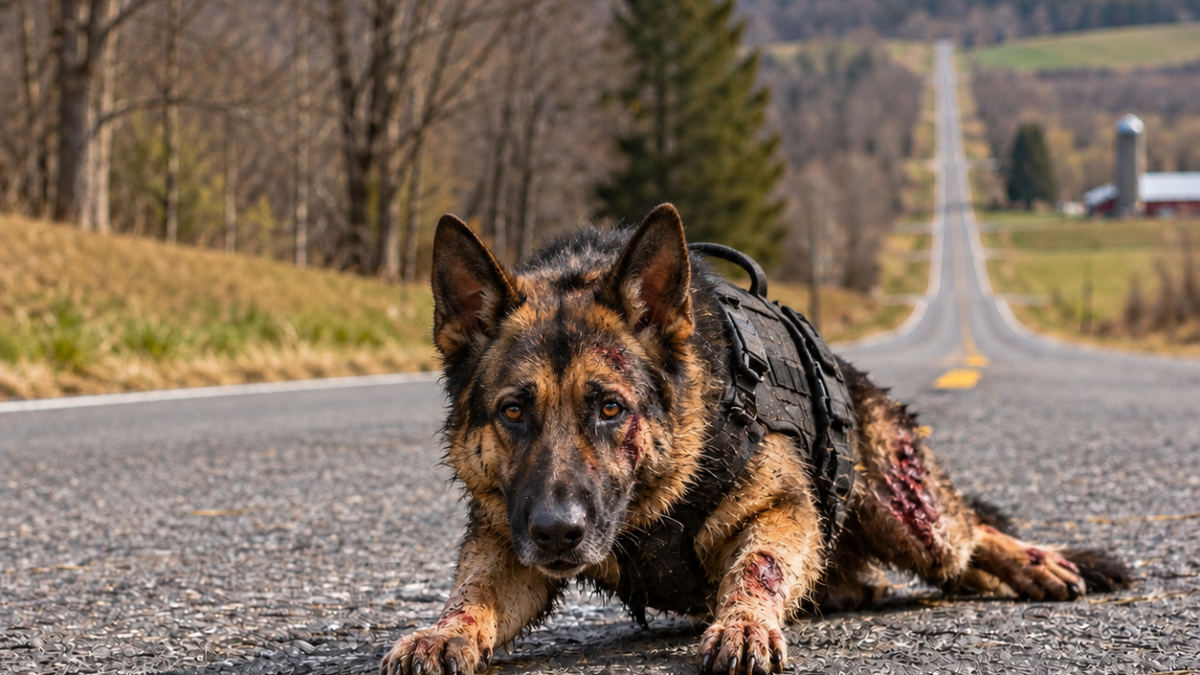
The dog pulled himself forward.
Something inside Mason went still.
He had seen working dogs before.
He had worked beside them.
There was something about the shape of this one, even half-starved and ruined, that caught his attention.
The head.
The shoulders.
The deep chest.
The deliberate focus.
The dog was a large sable German Shepherd, perhaps eighty pounds when healthy, though he looked closer to sixty-five now.
His coat was matted.
His ribs showed.
One ear stood upright while the tip of the other folded slightly forward.
There was no collar.
But there was a faded band around the fur of his neck where one had recently been.
Mason stepped carefully toward traffic and raised a hand until the nearest lane cleared.
He crossed.
The dog heard him.
One ear twitched.
He did not turn.
Mason crouched about ten feet away.
“Hey, partner.”
No response.
“Easy.”
The dog pulled again.
His front legs trembled violently.
The tips of his nails were gone.
Not worn.
Gone.
Mason moved closer.
Then he saw the paws.
The pads were split.
Chunks of black tissue were missing. Gravel had embedded itself in exposed flesh. Several claws had been ground down until the quick bled openly.
The dog’s elbows were raw.
His chest was worse.
A broad strip of skin beneath the breastbone had been scraped hairless and bloody. Every movement reopened the wound.
Small drops marked the road behind him.
Mason stared.
There was one red mark.
Then another.
Another.
Farther back, another.
A trail.
He looked north.
Blood spots faded into the distance.
“Oh, buddy.”
The shepherd took another breath.
Reached.
Dragged.
Mason noticed something else.
The dog was not confused.
Pain had clouded his eyes, but not his purpose.
His gaze kept returning to the road ahead.
South.
Mason touched his radio.
“Dispatch, I need animal control expedited.”
Static answered.
Then the dispatcher said they were still thirty-five minutes out.
Mason looked at traffic.
The dog was less than three feet from the driving lane.
He would not survive another thirty-five minutes.
Mason returned to his cruiser, retrieved heavy gloves and a wool emergency blanket, then crossed again.
Heather stood behind him.
“Please don’t let him die.”
Mason glanced at her.
“I’m going to try not to.”
He approached from the side.
The German Shepherd finally turned his head.
Their eyes met.
Mason stopped.
There was fear there.
And pain.
But beneath both was something familiar.
Assessment.
The dog looked at Mason’s hands.
His stance.
His face.
His uniform.
Then his eyes dropped to Mason’s duty belt.
For a second, the shepherd’s ears shifted forward.
Mason felt something strange in his chest.
“You know this uniform, don’t you?”
The dog tried to move south again.
Mason laid the blanket gently over his shoulders.
The reaction was immediate.
The shepherd twisted his head and snapped once.
Not hard.
Not close.
A warning made by an exhausted animal that had no strength left to enforce it.
“Fair enough,” Mason murmured. “You don’t know me.”
He slid one arm under the dog’s chest and the other beneath his hips.
The shepherd growled.
Then Mason lifted him.
The dog’s hindquarters hung completely limp.
That confirmed what Mason had already suspected.
This was not simple weakness.
Paralysis.
As Mason turned toward the cruiser, the dog suddenly struggled.
His front paws pushed against Mason’s shoulder.
His head twisted south.
“No.”
The shepherd pushed again.
Even with torn paws.
Even bleeding.
He tried to get out of Mason’s arms.
“Easy.”
A sound escaped the dog’s throat.
Not quite a bark.
Not quite a whine.
Something desperate between them.
He looked south.
Then at Mason.
Then south again.
Heather had followed close enough to see.
“What is he doing?”
Mason tightened his grip gently.
“He wants down.”
“Why?”
“I don’t know.”
The dog fought for another two seconds.
Then his strength vanished.
His head dropped against Mason’s arm.
But his eyes remained open.
Watching the highway ahead.
Mason carried him to the cruiser.
Heather touched the edge of the blanket.
“Is he going to live?”
Mason looked down at the body in his arms.
There were old scars beneath the dirt.
One along the muzzle.
Another near the shoulder.
The kind working dogs collected over years.
“I don’t know.”
Heather began crying harder.
Mason opened the rear door of the cruiser and laid the dog across the seat.
The shepherd immediately tried to pull himself toward the opposite window.
South.
Mason stared at him.
“What the hell are you chasing?”
No answer came.
Mason made a decision.
He radioed dispatch.
“I’m transporting the dog myself to Marlowe Veterinary Surgical Center. Advise animal control.”
Then he looked at Heather.
“You can go home.”
She wiped her face.
“No.”
“You’ve done what you needed to.”
“No, I haven’t.”
Mason studied her.
Heather looked through the cruiser window at the shepherd.
“I stopped because I saw him. I want to know stopping mattered.”
Mason understood that.
“Follow me.”
Dr. Karen Ellis had been threatening to retire for six years.
Nobody believed her anymore.
At sixty-two, she still worked more emergency hours than veterinarians half her age, drank coffee black enough to dissolve a spoon, and possessed almost no patience for people who treated animals as disposable objects.
Natalie Brooks was at the front desk when Mason came through the doors carrying the bloody blanket.
Natalie was thirty-four, a veterinary surgical technician with dark hair tied into a loose knot and blue scrubs covered with enough fur to identify half the clinic’s patients.
She saw Mason’s face before she saw the dog.
Then the blanket shifted.
“Room two.”
No questions.
No hesitation.
Dr. Ellis appeared before Mason reached the table.
“What happened?”
“Found him dragging himself down Route 17.”
“Hit?”
“Maybe. Back legs don’t work.”
They opened the blanket.
Natalie inhaled sharply.
The shepherd lifted his head.
Dr. Ellis touched two fingers to his gums.
“Pale. Dehydrated.”
She looked at Natalie.
“IV. Warm fluids. Pain control. Carefully.”
Natalie slid a hand near his shoulder.
“Hey, big guy.”
The shepherd watched her.
His eyes were dark brown.
Clearer than they had any right to be.
Natalie tried to examine one front paw.
The dog growled.
She stopped.
“Okay. You’re allowed.”
Dr. Ellis ran her hands along his spine.
When she reached the lower thoracic area, the shepherd’s muscles tightened.
He did not cry out.
She pinched between the toes of one rear foot.
Nothing.
The other.
Nothing.
She tested tail response.
Almost none.
Her expression changed.
“How long was he on the road?”
“I found him maybe twenty minutes ago.”
“No. I mean how long had he been dragging himself?”
Mason shook his head.
“Unknown.”
Dr. Ellis looked at the chest abrasions.
“These didn’t happen in twenty minutes.”
Heather stood in the doorway.
Her face went pale.
Natalie began trimming dirt-caked fur from around the wounds.
That was when her fingers brushed something beneath the thick coat along the left side of the dog’s neck.
She paused.
“What?”
Dr. Ellis looked over.
Natalie parted the fur.
There was a small tattoo.
Faded.
Numbers and letters.
Mason leaned closer.
“K9 registration?”
“Could be.”
Dr. Ellis looked at Natalie.
“Scanner.”
Natalie brought the microchip reader.
She passed it once over the shoulders.
Nothing.
Again.
A beep sounded.
Everyone froze.
Natalie read the number.
Mason called dispatch.
“Run this chip through county animal records and any law-enforcement K9 registry you can access.”
The dispatcher sounded surprised.
“You think he’s a police dog?”
“I think he was.”
Ten minutes later, while Natalie flushed blood and gravel from the shepherd’s paws, Mason’s radio cracked.
“Reed?”
“Go ahead.”
“We got a return.”
Mason picked up the radio.
Heather looked at him.
Natalie stopped moving.
The dispatcher’s voice changed.
It became slower.
“Dog is registered as Ranger, German Shepherd, male, nine years old. Former K9 with the North Bellhaven Police Department.”
Mason stared at the dog.
The dispatcher continued.
“Handler listed as Sergeant Aaron Hale.”
Mason felt the room tilt slightly.
“Repeat the handler.”
“Aaron Hale.”
Mason knew the name.
Everybody in law enforcement in that part of the state knew the name.
Sergeant Aaron Hale had spent fourteen years with North Bellhaven Police.
Seven of those years had been with Ranger.
Narcotics detection.
Tracking.
Search and rescue.
Felony apprehensions.
Missing persons.
Three county commendations.
One state valor citation.
Two years earlier, Aaron Hale had died after a battle with pancreatic cancer.
Mason remembered the funeral.
There had been a photograph in the newspaper.
Aaron’s flag-draped casket.
Officers lining the church steps.
And an aging German Shepherd sitting beside the family, staring at the doors.
Ranger.
Mason looked down at the ruined dog on Dr. Ellis’s table.
“No.”
Natalie glanced up.
“What?”
Mason stepped closer.
“His handler is dead.”
Dr. Ellis stopped examining the rear limb.
“How long?”
“Two years.”
Natalie’s face changed.
Heather whispered, “Who had the dog after that?”
Mason keyed his radio again.
“Dispatch, who’s listed as current owner?”
A pause.
Then:
“Transfer was filed eighteen months ago. Marcy Whitaker.”
Mason did not recognize the name.
“Address?”
The dispatcher gave one.
South of Bellhaven.
Mason wrote it down.
Dr. Ellis looked at him.
“Before you go anywhere, I need imaging.”
Mason nodded.
His eyes returned to Ranger.
The dog had once worn a working harness.
Once climbed into patrol cars.
Once followed commands through gunfire.
Once trusted human beings enough to run toward danger because one specific man asked him to.
Now his paws had been destroyed trying to crawl down a highway.
The X-rays answered one question and created ten more.
Dr. Ellis stood before the illuminated screen.
“There.”
Mason stared at the image.
Natalie stood beside him.
Dr. Ellis pointed to the lower spine.
“Compression fracture with displacement.”
“From a car?”
“Possibly originally, but not today.”
“How old?”
“Minimum two to three weeks. Probably closer to four.”
Mason looked at her.
“So he was already paralyzed before he got on that highway.”
“Yes.”
Heather sat down.
Natalie folded her arms tightly.
Dr. Ellis continued.
“There’s muscle wasting in both rear limbs. Pressure sores. Urine scalding. This dog has been unable to use his hindquarters for some time.”
Mason thought about the rest area.
“Somebody put a paralyzed retired police dog beside Route 17.”
Dr. Ellis looked at him.
“Somebody also failed to get meaningful treatment when the injury first happened.”
The anger that entered Mason then was not loud.
He did not curse.
Did not hit anything.
It was colder than that.
“What does he need?”
“Tonight? Fluids. Antibiotics. Debridement. Pain management. A catheter. Constant monitoring.”
“And long term?”
Dr. Ellis looked through the glass.
Ranger lay on padded bedding, his front feet wrapped heavily in white bandages.
“A wheelchair if he stabilizes.”
“Will he walk again?”
“I would never say never without advanced imaging, but based on this?”
She looked back at the X-ray.
“No.”
Natalie swallowed.
Mason asked, “Can he live?”
Dr. Ellis took several seconds.
“Yes.”
That single word changed the room.
Then she added, “But surviving and living are not the same thing. He’ll need someone willing to learn the difference.”
Mason left the clinic after dark.
He did not drive to the Whitaker house immediately.
He went back to the highway.
Heather went with him.
They parked where she had first stopped.
Mason carried a flashlight, camera, measuring tape, evidence markers, and the stubborn suspicion that if Ranger had dragged himself any meaningful distance, the road would tell them.
It did.
The first blood marks were obvious.
The farther north they walked, the darker some became.
A smear where Ranger had rested.
Parallel scratches from his claws.
A patch of fur.
A place where the median changed to rough gravel and the drag marks deepened.
Heather stopped speaking after the first mile.
At mile two, she began crying again.
At mile three, neither of them said anything.
The trail continued.
Always southbound.
Fields stretched on both sides.
There were countless places Ranger could have crawled into grass.
He had not.
There were drainage ditches where he could have hidden.
He had not.
There were farm lanes, trees, culverts, soft dirt.
He ignored all of them.
He remained near the highway.
South.
At four and a half miles, Mason found part of a bandage.
White gauze.
Dirty.
Caught on a weed.
He bagged it.
At five miles, they found a broad blood smear where Ranger appeared to have collapsed.
Heather shone her flashlight on the marks.
“He stopped here.”
Mason crouched.
For a moment, he pictured the shepherd lying on cold pavement, front paws destroyed, chest burning, spine broken.
Then he noticed scratch marks ahead.
“He started again.”
Heather turned away.
The trail ended five-point-eight miles north of where Ranger had been found.
At an old highway rest area.
Mason followed the final marks into a strip of grass behind a trash can.
There was an empty water bowl.
A torn sack of cheap dog food.
And an old blue blanket.
Heather stared.
“They left him this.”
Mason photographed everything.
The dog food had been poured perhaps six feet from where the flattened grass suggested Ranger had been placed.
Six feet might as well have been six miles to a paralyzed animal.
Heather folded her arms.
“Who does that?”
Mason looked toward the highway.
“The kind of person who wants to tell himself he didn’t abandon a dog because he left food.”
The rest area had one surveillance camera.
Old.
Grainy.
Poorly positioned.
But functioning.
At 11:17 p.m. two nights earlier, a white cargo van entered the lot.
Mason watched the footage with the state maintenance supervisor.
Passenger door opened.
A woman stepped out.
Rear doors opened.
A man climbed down.
The man carried something large.
Ranger.
Even through poor video, Mason recognized the shepherd.
The man placed him in the grass.
Ranger lifted his head.
The woman set down the bowl and food.
Then something happened that made Mason replay the footage three times.
The man returned to the van.
Opened the sliding side door.
For two seconds, the camera captured four small shapes behind wire.
Puppies.
Ranger’s head rose higher.
Even on silent footage, his entire body changed.
The puppies moved.
Ranger tried to pull himself toward the vehicle.
The man slid the door shut.
The woman turned away.
They got into the van.
Ranger dragged himself several feet across the grass.
The van left.
South.
Ranger reached the edge of the pavement.
Stopped.
Then followed.
Mason sat back.
The supervisor whispered, “Jesus.”
Mason froze one frame.
The rear plate was partially visible.
So was a company logo.
Whitaker Outdoor Construction.
He already had the name.
Now he had the vehicle.
He returned to Marlowe Veterinary Surgical Center after midnight.
Natalie sat beside Ranger.
The clinic was almost dark.
Ranger was awake.
His paws were wrapped.
An IV line ran into his foreleg.
He looked smaller without the dirt.
Older.
There was gray around his muzzle.
Natalie glanced at Mason.
“You found it.”
He knew she could see it on his face.
“Yes.”
“How far?”
“Five-point-eight miles.”
Natalie closed her eyes.
“Nearly six miles.”
“Yeah.”
“Why?”
Mason pulled a chair over.
“There were puppies in the van.”
Ranger’s ear moved.
Natalie stared at Mason.
“What?”
“Four. Maybe eight or ten weeks old. Shepherds.”
Ranger lifted his head.
Mason looked at him.
“You know that word?”
Natalie leaned closer to the dog.
“Puppies?”
Ranger’s breathing changed.
Subtle.
But real.
His nose lifted.
Mason and Natalie exchanged a look.
“The van belonged to the family listed on his chip,” Mason said.
“His owner?”
“Marcy Whitaker.”
Natalie’s jaw tightened.
“Why would a retired K9 have puppies?”
“That’s one of the questions I intend to ask.”
Dr. Ellis appeared in the doorway wearing reading glasses and carrying Ranger’s old registration file that the department had emailed.
“I may have an answer.”
She handed the pages to Mason.
After Sergeant Aaron Hale died, Ranger had briefly stayed with Aaron’s mother.
Her health declined.
Custody transferred to Aaron’s younger sister, Marcy.
The transfer contract contained a clause common in retired working-dog placements.
Ranger was not to be bred commercially.
Natalie read the line twice.
“So if those puppies are his…”
“Somebody saw a retired police dog with an expensive pedigree,” Mason said, “and saw money.”
Ranger lowered his head.
Dr. Ellis looked at him.
“There’s more.”
She held out a photograph.
Aaron Hale crouched in uniform beside a younger Ranger.
The dog wore a black working harness with POLICE across the side.
Aaron had one hand around Ranger’s neck.
Both were looking toward the camera.
Natalie studied the dog in the picture.
Strong.
Alert.
Proud.
Nothing like the bleeding animal she had cleaned hours earlier.
“What did they do together?”
Mason had already pulled the service record.
“Three hundred and twelve deployments. Twenty-one successful suspect tracks. Thirty-eight narcotics finds. Eleven missing-person searches.”
He paused.
“Ranger found a four-year-old boy in woods during a freezing rainstorm in 2020.”
Natalie looked at Ranger.
Mason continued.
“He located the kid under a fallen tree almost two miles from home. Stayed pressed against him until officers arrived.”
Dr. Ellis removed her glasses.
“So this dog spent his life finding people who needed help.”
Nobody spoke.
Then Natalie whispered, “And when he needed help, they left him beside a trash can.”
Ranger’s first three days were ugly.
There was no miracle.
No sudden tail wag.
No sentimental recovery montage.
He developed a fever.
One chest wound became infected.
His damaged paws had to be flushed and debrided repeatedly.
He hated the catheter.
He hated bandage changes.
He hated being lifted.
The first time Natalie tried to clean one elbow, he snapped hard enough to catch the sleeve of her scrubs.
She did not punish him.
She sat beside his kennel afterward.
“You’re allowed to be angry.”
Ranger stared at her.
“You had a job once, didn’t you?”
One ear lifted.
Natalie had asked Mason for information about K9 commands.
She tried one.
“Watch.”
Ranger’s head immediately turned toward the hallway.
Natalie stopped breathing.
She tried another.
“Easy.”
His eyes returned to her.
Not because the word was magical.
Because it was familiar.
Something old was still there.
She placed a treat near him.
He ignored it.
“Okay.”
She placed it closer.
Nothing.
“You’re making me look bad.”
Ranger stared.
Natalie smiled faintly.
“Your file says you once tracked an armed robbery suspect for three miles.”
Nothing.
“You can eat one piece of chicken.”
His nose moved.
She waited.
Eventually, Ranger took the chicken.
Natalie went into the supply room and cried.
Not because eating chicken was heroic.
Because sometimes hope becomes tiny when a body has suffered enough.
Tiny still counts.
Mason visited the Whitaker property the next morning with an animal-control officer and a warrant request underway.
The house sat on six acres.
Behind it were construction trailers, equipment, and a fenced kennel area.
There were no dogs.
Only empty runs.
Marcy Whitaker answered the door.
She was thirty-seven, pale, blonde hair tied back, with the exhausted look of someone who had been afraid for a long time and learned to call it normal.
Her husband Colin came from the garage before Mason had finished introducing himself.
“What’s this about?”
Mason showed them a photograph of Ranger.
Marcy’s face collapsed.
Colin’s did not.
“Where’d you find him?”
Mason watched him.
“On Route 17.”
Colin shrugged.
“Told you he’d move.”
Marcy turned toward him.
“Colin.”
Mason heard the sentence clearly.
“Told you he’d move?”
Colin realized his mistake.
“I mean dogs move. They crawl around.”
“He crawled almost six miles.”
Marcy’s hand went to her mouth.
Colin laughed once.
“That’s ridiculous.”
“We measured it.”
Silence.
Mason took out a still from the rest-area footage.
Colin’s face hardened.
Mason said, “Where are the puppies?”
“What puppies?”
“The four German Shepherd puppies in your van.”
“Sold.”
Marcy closed her eyes.
“To who?”
“Private buyers.”
“Names.”
“I don’t keep track.”
Mason looked toward the empty kennels.
“Where’s the mother?”
Marcy began to cry.
Colin swore under his breath.
Mason turned toward her.
“Mrs. Whitaker?”
“She died.”
“When?”
“Three weeks ago.”
Colin said, “This is none of your business.”
Mason ignored him.
“How did she die?”
Marcy looked at the floor.
“She got sick after the puppies.”
“Vet?”
Nothing.
Mason understood.
“No veterinary care.”
Colin stepped forward.
“You come here over a damn dog and start interrogating my wife?”
Mason kept his voice calm.
“A retired police dog was found paralyzed, dehydrated, infected, and bleeding after being abandoned at a rest area. That makes it my business.”
“He was already useless.”
Marcy flinched.
Mason did not.
He simply looked at Colin.
There are sentences people say when they believe explaining themselves will make them sound better.
Often, those sentences do the opposite.
Colin continued.
“He couldn’t work. Couldn’t walk. Couldn’t even control his bladder. You have any idea what that does to a house?”
Mason said quietly, “How did his spine break?”
Colin’s eyes shifted.
Just once.
But Mason saw it.
“So there is something else.”
Colin folded his arms.
“He got hit.”
“By what?”
“Equipment.”
“What equipment?”
“My side-by-side.”
“Who was driving?”
No answer.
Marcy cried harder.
Mason asked again.
“Who was driving?”
Colin stared at him.
“The dog got in the way.”
“Of what?”
Silence.
Then a small voice came from the hall behind them.
“He was protecting the puppies.”
A girl stood there.
Maybe nine years old.
Thin.
Brown hair.
Bare feet.
Marcy turned sharply.
“Kaylee, upstairs.”
The girl did not move.
Mason lowered his voice.
“Hi, Kaylee.”
“Don’t talk to her,” Colin snapped.
Mason looked at Colin.
Then at the child.
Kaylee whispered, “Dad was loading them.”
“Kaylee!”
The girl flinched so violently Mason’s entire posture changed.
Marcy saw it.
So did animal control.
Mason said, “Nobody yell at her.”
Colin stepped forward.
“This is my house.”
“And I’m telling you not to intimidate a witness while I’m standing in it.”
That stopped him.
Kaylee’s eyes filled.
She looked at Mason.
“Ranger wouldn’t let Dad take the puppies.”
Marcy began shaking her head.
“Sweetheart…”
“He stood in front of the gate.”
Mason waited.
Kaylee swallowed.
“Dad drove the side-by-side at him.”
Colin exploded.
“I did not drive at him!”
Kaylee started crying.
“He wouldn’t move!”
Mason’s jaw tightened.
“What happened?”
“The wheel hit him.”
Colin pointed at the girl.
“You don’t know what you saw.”
Kaylee covered her ears.
Marcy suddenly shouted, “Stop!”
Everyone froze.
It was the first time she had raised her voice.
She was crying openly now.
“He hit Ranger.”
Colin stared at his wife.
Marcy stepped away from him.
“He was angry because Ranger kept standing between him and the kennel. Colin wanted to move the puppies. Ranger kept growling.”
“He attacked me.”
“He never touched you!”
Marcy’s voice broke.
“He was protecting them because Nova was dead!”
Mason felt the pieces lock together.
The puppies’ mother had died.
Ranger had been left with them.
The old K9 had become their only protector.
Marcy wiped her face.
“After Nova died, Ranger slept beside the kennel every night. The puppies climbed all over him. He’d bring food from his bowl and drop it near them. He wouldn’t let strangers close.”
Her husband stared at her as though betrayal only counted when it happened to him.
Marcy continued.
“Colin had buyers. Ranger blocked the gate. Colin drove at him to scare him.”
“I barely touched him!”
“He screamed.”
The room went silent.
Kaylee was sobbing now.
Marcy whispered, “I had never heard Ranger scream.”
Mason thought of the dog on the road.
“He didn’t get a veterinarian?”
“I begged.”
Colin said, “We called someone.”
“No,” Marcy said. “You called your friend who raises hunting dogs.”
“He knew animals.”
“He told you Ranger needed a hospital.”
Colin said nothing.
Marcy looked at Mason.
“For three weeks, Ranger dragged himself around the garage. I cleaned him when Colin was gone. Kaylee brought him water. He still kept crawling to the puppies.”
“Why dump him?”
Marcy’s eyes closed.
“Because the puppies were being delivered.”
Mason understood before she finished.
“Ranger would have followed.”
She nodded.
“Colin said we couldn’t sell expensive dogs with a crippled old K9 growling at customers.”
Mason looked at Colin.
“How much?”
Colin said nothing.
“How much were you selling them for?”
Marcy answered.
“Five thousand each.”
Mason stared.
Twenty thousand dollars.
That was the price attached to the cruelty.
Colin finally said, “They’re pedigreed working dogs.”
Mason’s disgust must have shown.
Colin lifted his chin.
“You people act like I dumped a person.”
“No,” Mason said. “You dumped something that trusted people more than you deserved.”
Mason did not arrest Colin that morning.
Not yet.
Cases built on anger break.
Cases built on evidence hold.
He left with statements, photographs, veterinary contacts, kennel records, and enough probable cause to keep digging.
The Whitakers moved the puppies before a seizure order could be signed.
For eleven days, nobody knew where they were.
Ranger got stronger during those eleven days.
Not much.
But enough.
His fever dropped.
His chest began healing.
He started eating regularly.
Natalie discovered he liked scrambled eggs.
Dr. Ellis discovered he despised bananas.
The receptionist discovered that Ranger still understood the command “speak,” because she accidentally used the word during a phone call and received one enormous bark that scared a delivery driver outside the clinic door.
For half a second after the bark, everyone froze.
Then Natalie laughed.
Ranger looked almost offended.
“There you are,” she said.
Dr. Ellis watched from the doorway.
Natalie stroked the fur beside his ear.
“There you are.”
The paralysis did not improve.
Advanced imaging confirmed permanent spinal cord damage.
Dr. Ellis explained it while Natalie sat beside Ranger.
“He’ll never patrol again.”
Natalie looked at her.
“I don’t think anyone was expecting that.”
“You’d be surprised what people expect when they hear he used to be a K9.”
Ranger rested his head on his paws.
“He doesn’t need to be what he was.”
Dr. Ellis studied Natalie.
“That sentence is going to become important.”
The puppies were found because Colin Whitaker ran a red light.
Officer Luis Romero stopped the white cargo van thirty miles south.
The registration flagged.
So did the plate.
Mason was at home eating reheated chili when dispatch called.
“We have the Whitaker van.”
He stood immediately.
“Puppies?”
“Four shepherd pups in crates.”
“I’m coming.”
When Mason arrived, Colin stood beside the highway arguing with Romero.
Marcy was in the passenger seat.
Kaylee and her older brother Evan sat behind them.
Four puppies occupied two wire crates in the cargo area.
They were smaller than Mason expected.
Dark sable coats.
Oversized ears.
Thin bodies.
Beautiful.
Terrified.
Colin pointed toward them.
“They’re my property.”
Romero said, “Not until animal control clears them.”
“You can’t steal twenty thousand dollars from me.”
Mason walked up.
Colin’s expression changed.
“You again.”
Mason glanced into the van.
The puppies stared back.
One had a small white patch beneath his throat.
Another pressed himself into the corner.
Mason noticed something tied to one crate.
An old black nylon strap.
He reached for it.
POLICE K9.
The letters were faded.
Ranger’s retired harness.
Mason turned.
“Why is this here?”
Marcy looked down.
Colin shrugged.
“Proof of bloodline.”
For the first time in the case, Mason nearly lost his composure.
“You were using his police harness to sell his puppies?”
“People pay for genetics.”
Mason stared at him.
There it was.
Ranger had saved lives.
Found children.
Tracked criminals.
Protected Aaron Hale for seven years.
To Colin, all of that had become advertising.
A sales pitch.
A pedigree.
And when the body that created the profit stopped walking, Colin discarded it beside a highway.
Kaylee began crying.
Mason crouched near the open side door.
“Hey.”
Her father snapped, “Don’t.”
Romero stepped between them.
Mason asked the girl, “Did Ranger see the puppies leave?”
Kaylee nodded.
Her chin trembled.
“Mom said not to look back.”
Marcy covered her face.
Kaylee continued.
“But I did.”
Mason waited.
“He was in the grass.”
“What was he doing?”
The child’s tears fell.
“He was coming after us.”
Nobody spoke.
“He pulled himself out of the grass,” Kaylee whispered. “I saw him in the mirror.”
Marcy sobbed.
“I told Colin.”
Mason looked at her.
“What did he say?”
Marcy tried to answer.
Could not.
Kaylee did it for her.
“He said Ranger would quit.”
The wind moved through the open van.
Mason looked at Colin.
“He didn’t.”
Colin’s face reddened.
“He was a dog.”
“He dragged himself almost six miles.”
“That’s not my fault.”
“You broke his spine.”
“It was an accident.”
“You denied him care.”
“He was old.”
“You bred him against the retirement agreement.”
“That contract doesn’t mean—”
“You dumped him.”
“I left food!”
“He could not reach it.”
Colin stepped closer.
“I’m done listening to this.”
Mason’s voice hardened.
“No. You’re finally going to listen.”
Romero turned slightly, giving Mason space.
Mason pointed toward the crates.
“Those puppies are alive because that dog spent three weeks guarding them after their mother died.”
Colin rolled his eyes.
“He’s an animal.”
“Yes.”
Mason took one step forward.
“And somehow he still understood loyalty better than you.”
The puppies were seized.
So was Ranger’s old harness.
Colin Whitaker left the roadside in handcuffs.
Marcy was not arrested that night.
She gave a complete statement instead.
It did not absolve her.
She had helped abandon Ranger.
She had remained silent.
She had allowed neglect.
But she also became the witness who turned a strong cruelty case into a devastating one.
The puppies arrived at Marlowe Veterinary Surgical Center just before midnight.
Ranger was asleep.
Natalie helped carry the crates inside.
The smallest puppy whimpered.
From down the hallway, Ranger’s head rose.
Natalie stopped.
Again, the puppy cried.
Ranger tried to push himself upright.
His front legs slipped.
“Easy.”
He ignored her.
Another puppy barked.
Ranger made a sound Natalie had never heard from him.
Low.
Almost a whine.
He began pulling toward the kennel door.
Natalie’s eyes filled.
Dr. Ellis put a hand on her shoulder.
“We do this carefully.”
They did not stage a reunion for cameras.
There were no cameras.
No reporters.
No social media live stream.
Just a quiet clinic at midnight.
Dr. Ellis examined all four puppies first.
Dehydrated.
Underweight.
Fleas.
Intestinal parasites.
But stable.
When she was satisfied they were not carrying anything immediately dangerous, they moved Ranger into the rehabilitation room.
He lay on thick blankets.
His paws were still bandaged.
His chest was healing.
The puppies were placed behind a low exercise barrier several feet away.
For a moment, nothing happened.
Then the smallest puppy saw him.
It squealed.
Ranger’s head snapped up.
All four puppies rushed toward the barrier.
The sound that came from Ranger broke Natalie’s heart.
A whine.
High and uneven.
Nothing like the powerful bark he had used during police work.
He pulled forward.
Natalie instinctively reached to help.
Dr. Ellis stopped her.
“Let him.”
Ranger reached.
Dragged.
Reached again.
Not on asphalt now.
On blankets.
Not chasing a disappearing van.
Moving toward four little bodies climbing over one another to reach him.
The puppies shoved their noses through the barrier.
Ranger pressed his face against them.
One licked his muzzle.
Another pawed at his ear.
The white-throated puppy cried until Ranger began licking the top of his head.
Natalie covered her mouth.
Mason stood near the door.
He had seen fatal crashes without crying.
He cried then.
Quietly.
Ranger stayed beside the barrier for almost an hour.
Eventually, exhausted, he lowered his head.
The puppies curled against the opposite side.
All four.
As close to him as the fence allowed.
Natalie sat on the floor.
Dr. Ellis leaned against the wall.
Mason looked at Ranger’s torn, bandaged paws.
Five-point-eight miles.
He finally understood the direction.
Ranger had not been trying to reach the people who abandoned him.
He had not been returning to a home.
He had been following his last assignment.
Protect the helpless.
Somebody had taken them.
So he followed.
The story became public three days later.
Not because the sheriff’s department wanted publicity.
Because video from Colin’s traffic stop appeared online.
Someone had filmed from another car while Colin shouted that the county was “stealing valuable dogs” and that Ranger was “already useless anyway.”
The clip spread.
Then Ranger’s service record emerged.
Local news stations found old footage.
A younger Ranger clearing buildings with Aaron Hale.
Ranger finding a missing child.
Ranger receiving a commendation while Aaron scratched behind his ears because the dog hated ceremonies.
A photograph from Aaron’s funeral appeared.
Ranger beside the casket.
The final image shown during one broadcast was taken after the rescue.
Ranger lying on a veterinary blanket.
Front paws wrapped.
Hind legs motionless.
People became furious.
Dr. Ellis hated almost all of it.
“Outrage is not medicine,” she told Natalie.
Then donations began arriving.
Not money for clicks.
Actual help.
Bandages.
Rehabilitation equipment.
Prescription food.
A canine mobility company offered Ranger a custom wheelchair.
A retired K9 association agreed to cover his long-term medical expenses.
One of Aaron Hale’s former partners came to the clinic.
Lieutenant David Cole stood outside Ranger’s rehabilitation room for nearly five minutes before entering.
Ranger looked at him.
David removed his hat.
“Hey, old man.”
Ranger’s ears lifted.
David knelt.
For several seconds, Ranger stared.
Then David said one word.
“Partner.”
Ranger whined.
David’s face broke.
He dropped to both knees and wrapped his arms gently around Ranger’s shoulders.
“I’m sorry.”
Natalie looked away.
David buried his face against the dog’s neck.
“I’m so damn sorry we didn’t know.”
Ranger rested his chin on David’s shoulder.
No one in the room spoke.
Later, David told Mason something that made the abandonment even harder to understand.
“Aaron used to worry about this.”
“What?”
“What would happen to Ranger after he was gone.”
Mason frowned.
“He knew he was dying?”
“Six months before anybody else knew how bad it was.”
David looked through the glass.
“He made us promise Ranger wouldn’t end up passed around like old equipment.”
Mason felt anger rise again.
“Marcy signed the retirement transfer.”
“I know.”
“Did Aaron trust her?”
David stared at the floor.
“He loved his sister.”
That answered a different question.
Ranger’s first wheelchair fitting happened six weeks after his rescue.
His front paws had healed enough to bear weight.
The pads would always be scarred.
His chest had closed.
He had gained nine pounds.
His coat shone again.
But when Natalie and the rehabilitation technician placed him into the aluminum frame, Ranger froze.
His ears went back.
“Okay,” Natalie said. “I know.”
Ranger looked at her as if she had personally invented humiliation.
“It’s not stylish.”
Dr. Ellis watched from the doorway.
“It cost more than your car.”
“That doesn’t make it stylish.”
Ranger refused to move.
Natalie crouched several feet away.
“Come.”
Nothing.
She tried chicken.
Nothing.
She tried his favorite squeaky ball.
Ranger looked insulted.
Then David Cole, standing near the back wall, quietly said:
“Ranger. Forward.”
The dog’s head lifted.
Old command.
Old voice pattern.
Not Aaron.
But close enough to something he remembered.
Ranger reached with one front paw.
The wheels moved.
He stopped.
Looked behind himself.
Everyone smiled.
He stepped again.
Roll.
Again.
Roll.
Three steps.
Five.
Ten.
Then something changed.
Ranger understood.
The wheels were not restraining him.
They were carrying the part of him that could no longer follow.
He moved across the room.
Slowly at first.
Then faster.
Natalie’s eyes filled.
“Look at you.”
Ranger reached the opposite wall, turned badly, bumped one wheel into a cabinet, barked angrily at the cabinet, corrected himself, and continued.
Dr. Ellis wiped her glasses.
“They always blame the furniture.”
Within two weeks, Ranger could navigate the clinic hall.
Within a month, he could turn around corners.
Within six weeks, he learned that increased speed allowed him to steal sandwiches from low tables.
The receptionist lost half a turkey wrap.
Natalie called it neurological progress.
The receptionist called Ranger a criminal.
Mason said it was ironic considering his résumé.
The puppies recovered too.
DNA testing was eventually performed as part of the breeding investigation.
All four were Ranger’s.
Colin had bred Ranger to a registered shepherd named Nova six months after Aaron died.
There had been an earlier litter too.
Investigators traced three of those dogs.
The money had never been declared.
None of the breeding had been authorized under Ranger’s retirement agreement.
The discovery transformed the case.
Colin had not reluctantly inherited a difficult old dog.
He had monetized him.
Ranger’s police record became part of the sales pitch.
Potential buyers had been shown photographs of Ranger in his K9 vest.
Aaron Hale’s service history had been used to increase the price.
Then Ranger’s body failed.
Not naturally.
Because Colin hit him while trying to remove another litter.
And the animal once worth thousands became an inconvenience overnight.
The trial began seven months after the highway rescue.
Ranger did not attend.
Dr. Ellis refused.
“He’s an animal, not courtroom theater.”
The prosecutor agreed.
Photographs were enough.
The first showed Ranger during service.
Standing beside Aaron.
Muscular.
Alert.
Proud.
The second showed him the day Mason found him.
His paws destroyed.
His chest bloody.
Back legs trailing.
People in the courtroom stopped moving.
Colin’s lawyer argued the collision had been accidental.
The prosecutor did not need to prove otherwise to prove what happened afterward.
Three weeks without appropriate treatment.
Commercial breeding.
Abandonment.
The rest-area footage.
The six-mile blood trail.
The food placed out of reach.
The puppies removed for sale.
Marcy testified against her husband.
Her voice barely rose above a whisper at first.
Then the prosecutor asked why she had put the bowl beside Ranger.
Marcy cried.
“Because I wanted to believe I was leaving him something.”
“Could he reach it?”
“No.”
“Did you know that?”
“Yes.”
“Then why?”
Marcy looked toward the jury.
“Because if I admitted the food didn’t matter, I had to admit what we were doing.”
Nobody spoke.
Heather testified.
She described seeing Ranger on the road.
“He wasn’t looking for help,” she said. “That’s what I remember most.”
The prosecutor asked what she meant.
“He passed places where he could have crawled into grass. He didn’t. He kept going south.”
Her voice shook.
“I’ve never seen anything hurt that badly keep trying that hard.”
Mason testified next.
He described the blood trail.
The rest area.
The surveillance footage.
The puppies.
Then Colin’s attorney asked whether public emotion had influenced the investigation because Ranger had once been a police dog.
Mason answered calmly.
“No.”
“Would this case have received the same effort if he had been an ordinary dog?”
Mason paused.
The courtroom became quiet.
“I hope so.”
The attorney smiled as if he had scored something.
Mason continued.
“But I’ll tell you what knowing his history changed.”
The judge allowed him to continue.
“It made the betrayal easier to understand.”
The attorney frowned.
Mason looked toward the jury.
“That dog had been trained to enter danger because humans asked him to. He tracked armed suspects. He searched buildings before officers went inside. He found missing people. He spent years trusting handlers completely.”
Mason glanced at Colin.
“And when he became helpless, the people responsible for him used that trust against him.”
The defense objected.
The judge sustained it.
But everyone had heard.
Dr. Ellis was clinical.
She described the fracture.
The muscle wasting.
The infected wounds.
The pain.
The untreated paralysis.
The condition of Ranger’s front paws after nearly six miles.
Colin’s lawyer asked whether Ranger’s crawling had worsened his own injuries.
“Yes.”
“So some of the wounds presented at the clinic were caused by Ranger’s decision to move?”
Dr. Ellis looked at him over her glasses.
“Dogs do not understand legal theories of causation.”
A few people almost laughed.
The judge silenced them.
Dr. Ellis continued.
“He moved because he had been abandoned while paralyzed. If you are asking whether an animal should be blamed for injuring himself while attempting to follow the only group he knew, my medical answer is no.”
Natalie testified last.
Colin’s lawyer made the mistake of calling Ranger “damaged.”
Natalie’s expression changed.
“His spinal cord was damaged.”
“That is what I said.”
“No.”
She looked directly at him.
“You called the dog damaged.”
The lawyer hesitated.
Natalie continued before he could recover.
“There is a difference.”
The judge warned her.
Natalie apologized.
Then answered every remaining question precisely.
Colin Whitaker was convicted on felony aggravated animal cruelty, abandonment, and unlawful commercial violations connected to Ranger’s protected retirement status.
He received fourteen months in county custody followed by probation.
He was ordered to pay restitution.
His breeding operation was permanently shut down.
He was prohibited from owning, breeding, selling, or residing with animals for fifteen years.
Marcy accepted a plea agreement.
Probation.
Community service.
Mandatory counseling.
A ten-year ownership prohibition.
Her cooperation reduced the sentence but did not erase responsibility.
She accepted that.
The day after sentencing, Natalie sat beside Ranger near the clinic window.
He was out of his wheelchair, resting on a thick orthopedic bed.
“You won.”
Ranger opened one eye.
She smiled.
“No, you don’t care.”
His eye closed.
“You want chicken.”
His tail could no longer wag normally, but one front paw shifted toward her shoe.
Natalie laughed.
“Justice means nothing without snacks. Understood.”
The puppies went to foster homes.
The smallest, Scout, eventually went to Heather.
The white-throated male, Hale, was adopted by David Cole after he retired from active patrol work.
Another, Piper, became a search-and-rescue dog with a volunteer handler.
The fourth, Ember, went to a family with two teenagers and a fenced farm where she spent most afternoons carrying tennis balls around as if performing classified operations.
None became police dogs.
Nobody wanted their value measured by what job they could perform.
They were allowed to become themselves.
Ranger saw them several times while they were young.
Dr. Ellis allowed short, controlled visits.
The last occurred when the puppies were almost six months old.
They were too large to climb all over him anymore.
That did not stop Scout from trying.
Ranger lay on a blanket while four nearly grown shepherds crowded around him.
Scout licked his face.
Hale stole his toy.
Piper fell asleep with her head across one of his front legs.
Ember sat behind him, ears high, watching the door.
Natalie noticed.
“She does that like him.”
David smiled.
“Guarding.”
Ranger lifted his head.
For several minutes, he watched the four dogs.
Then he relaxed.
Natalie never knew what he understood.
Maybe scent.
Maybe familiarity.
Maybe nothing close to the human story people wanted to build around him.
But when the puppies left that afternoon, Ranger did not attempt to follow the door.
He lowered his head.
Closed his eyes.
Slept.
Natalie decided that was enough.
She adopted him two weeks later.
Dr. Ellis pretended to be shocked.
“You?”
Natalie signed the last page.
“Apparently.”
“You’ve only rearranged your entire house, purchased washable flooring, built two ramps, researched canine wheelchairs at three in the morning, and threatened a delivery driver because he left Ranger’s prescription food in the rain.”
“It could happen to anyone.”
Mason leaned against the reception desk.
“Completely accidental adoption.”
“Exactly.”
Ranger rolled out of the therapy room in his wheelchair.
He saw Natalie.
Changed direction.
Came straight toward her.
His front paws stopped on top of her shoes.
Mason looked down.
“I think he just signed.”
Ranger went home on a Friday.
Natalie had prepared everything.
Ramps.
Low water bowls.
Washable bedding.
Harness stations.
Medication.
Catheter supplies.
Protective booties.
A large bed near the living-room window.
Ranger ignored the expensive bed.
He parked himself beneath Natalie’s kitchen table.
“Of course.”
That first night, he startled awake whenever a vehicle passed.
At 1:40 a.m., headlights moved across the bedroom wall.
Ranger lifted his head.
His body became rigid.
Natalie got out of bed.
“You’re okay.”
Ranger looked toward the front door.
“You don’t have to follow anything.”
His ears shifted.
“You’re home.”
Natalie had not planned to say that word.
Home.
It frightened her more than she expected.
She had been divorced for two years.
Her ex-husband used to accuse her of bringing too much suffering home from work.
“You need broken things,” he once told her. “Makes you feel useful.”
For a while, Natalie wondered if he was right.
Then their elderly Labrador developed kidney disease.
One evening, Natalie came home and heard her husband screaming because the dog had urinated near the back door.
Not hitting him.
Not physically abusing him.
Just standing over an old, frightened animal and raging about the carpet.
Something in Natalie became clear.
Cruelty did not always arrive looking monstrous.
Sometimes it looked like irritation at the helpless.
Sometimes contempt.
Sometimes inconvenience.
Sometimes someone saying, “What do you expect me to do?”
She left six weeks later.
Their Labrador died the following winter.
The house had remained quiet since.
Until Ranger.
At 3:17 that first morning, Natalie woke to soft movement.
Tap.
Roll.
Tap.
Roll.
Ranger came down the hallway.
Stopped in her bedroom doorway.
Natalie sat up.
“You okay?”
He stared.
“You need water?”
Nothing.
“Bathroom?”
Nothing.
Ranger rolled farther into the room.
Stopped beside the bed.
He looked up.
“Oh.”
Natalie unclipped him from the wheelchair and lifted his hindquarters carefully.
He weighed much more now.
Stronger.
Healthy.
Still paralyzed.
She placed him on the bed.
Ranger circled awkwardly with his front legs, then settled near her feet.
Natalie lay back down.
For the first time in years, the house did not feel empty.
Ordinary life became the real miracle.
Ranger learned where sunlight reached the floor at different times of day.
He hated the vacuum cleaner.
He tolerated baths only if Natalie bribed him shamelessly.
He learned to reverse his wheelchair.
He learned to move frighteningly fast across hardwood.
He stole an entire chicken breast from Mason.
He barked every time the mail carrier touched the porch.
He loved children but distrusted men wearing baseball caps until properly introduced.
He slept beside the bathroom door whenever Natalie showered, as if she might be attacked by plumbing.
His shoulders became powerful from pulling the wheelchair.
His front paws healed into thick, dark pads.
The nails grew back unevenly.
The scar across his chest never disappeared.
Neither did the narrow bald strip along his belly.
Natalie could run her fingers across it and feel the rough difference in the tissue.
“The road,” Mason said once.
Natalie looked at him.
“What?”
“He carries some of it.”
She knew what he meant.
Not metaphorically.
Literally.
The asphalt had changed Ranger’s body.
It would remain there until he died.
Mason visited often.
At first, he claimed he was checking on the case.
Then the case ended.
He continued visiting.
Sometimes with takeout.
Sometimes with coffee.
Sometimes with no excuse.
Ranger approved of Mason because Mason understood the sacred rule that a piece of whatever he was eating should eventually reach the dog.
Natalie suspected that was the entire foundation of their friendship.
Two years after the rescue, the county created an emergency veterinary fund for animals seized in cruelty cases.
Dr. Ellis suggested Ranger’s name.
Natalie objected.
“He doesn’t know what a fund is.”
“That is generally true of animals.”
“He’d hate being turned into a mascot.”
Dr. Ellis looked at Ranger asleep under her desk.
“He spent seven years as a government employee. He’s used to his name being attached to things he doesn’t understand.”
The Ranger Fund began quietly.
It paid emergency treatment costs while courts determined ownership.
A puppy with chemical burns.
A neglected horse.
A pit bull with a broken jaw.
Three cats removed from a hoarding case.
An elderly beagle found chained behind an abandoned house.
Not every animal survived.
That mattered too.
The fund was not built on the promise of miracles.
It was built on the promise that suffering would at least be seen.
At the first fundraiser, Ranger sat beside Natalie in his wheelchair.
His old K9 harness hung in a glass case nearby.
Not Colin’s sales prop anymore.
Returned to what it had been.
Evidence of service.
David Cole brought Ranger’s original badge-shaped K9 identification tag.
Mason brought the first rescue report.
Heather came with Scout, now a broad-chested young shepherd who immediately tried to climb into Ranger’s wheelchair.
Then Natalie saw a teenage girl standing at the edge of the crowd.
Kaylee Whitaker.
She was taller.
Her hair shorter.
She stood beside an aunt.
Mason noticed her too.
Kaylee stared at Ranger.
Natalie approached.
“Hi.”
Kaylee swallowed.
“Hi.”
“You’re Kaylee.”
She nodded.
Ranger looked toward them.
Kaylee began crying.
“I’m sorry.”
Natalie felt the words hit somewhere deep.
“You were a child.”
“I saw him.”
“I know.”
“I saw him coming after us.”
Natalie waited.
Kaylee wiped her face.
“I should’ve made Dad stop.”
“You were nine.”
“I could have screamed.”
“You were afraid.”
Kaylee looked at Ranger.
“Does he hate me?”
Natalie did not answer for him.
She crouched and unclipped the leash from Ranger’s harness.
“Come closer slowly.”
Kaylee did.
Ranger watched.
She knelt.
Her hand shook as she held it low.
Ranger rolled forward.
One pull.
Then another.
He smelled her fingers.
Kaylee closed her eyes.
Ranger pressed his nose against her hand.
Then, apparently finished, turned toward Heather because Heather was holding a paper plate containing grilled chicken.
Kaylee laughed through tears.
Natalie smiled.
“He has priorities.”
The girl wiped her face.
“Deputy Reed told me he lived.”
“He did more than live.”
Kaylee watched Ranger reach Heather.
“I want to work with animals someday.”
Natalie looked at her.
“Then learn something important.”
Kaylee waited.
“Caring about them when it feels easy is not enough. You have to care when it costs you something.”
Kaylee nodded.
Years later, she would remember that.
Ranger grew old.
Not all at once.
First came more gray around the muzzle.
Then longer naps.
Then arthritis in his shoulders from years of carrying most of his body weight.
The wheelchair sessions became shorter.
Natalie adjusted everything.
She always adjusted.
More padding.
Warm compresses.
A lighter cart.
Pain medication.
Shorter porch trips.
She moved his bed whenever the sunlight moved.
Mason eventually became part of the house in the quiet way some people enter a life without announcing it.
A jacket over a chair.
Coffee mug in the cabinet.
Spare key.
Ranger stopped barking when he arrived.
That was apparently the official approval.
One rainy evening, Mason sat on the floor beside Ranger.
Natalie was reading veterinary notes on the couch.
Mason ran one hand gently over the old scar on Ranger’s chest.
“Do you ever think about that day?”
Natalie looked up.
“What part?”
“If Heather hadn’t stopped.”
She was silent.
Rain moved against the windows.
“Somebody else might have.”
“Maybe.”
“Or maybe not.”
Mason nodded.
Ranger slept between them.
Natalie closed the folder.
“That scares me more now than it did then.”
“What does?”
“How much sometimes depends on one person deciding something matters enough to stop.”
Mason looked at Ranger.
“He stopped for people his whole life.”
Natalie smiled sadly.
“And eventually somebody stopped for him.”
Ranger opened one eye.
Mason scratched behind his ear.
“You know we’re talking about you?”
Ranger sighed.
Natalie laughed.
“That means no.”
When Ranger reached thirteen, the good days started becoming smaller.
Dr. Ellis noticed before Natalie admitted it.
His shoulders hurt.
Kidney values changed.
Appetite faded.
His breathing became heavier.
Some mornings, he looked toward the wheelchair and did not want it.
Natalie never forced him.
The dog who had spent his whole life obeying human commands had earned the right to say no.
One cold January morning, Ranger refused breakfast.
Then dinner.
The next day, he ate chicken from Natalie’s hand.
The day after that, he would not.
Dr. Ellis came to the house.
Mason was already there.
David arrived quietly.
Heather brought Scout but left him outside at first.
Ranger lay on a thick blanket in a rectangle of winter sunlight.
No wheelchair.
No harness.
No K9 vest.
Just Ranger.
Natalie lay beside him.
She pressed her forehead to his.
“You did enough.”
His breathing was slow.
Her tears fell into his fur.
“You hear me?”
One ear moved.
“You did enough.”
Mason turned away.
David covered his mouth.
Dr. Ellis sat on the floor.
Natalie’s voice broke.
“You don’t have to find anybody.”
Ranger breathed.
“You don’t have to protect anybody.”
Another breath.
“You don’t have to follow.”
His eyes remained on her.
“You can stop.”
Dr. Ellis placed the catheter.
Natalie held Ranger’s face between her hands.
“I’ve got you.”
For a moment, she thought about a younger dog standing beside Aaron Hale.
Strong legs.
Black harness.
Ready eyes.
Then she thought of the rest-area footage.
A paralyzed animal watching a van disappear.
Pulling himself into the road.
Not knowing the distance.
Only the direction.
South.
Five-point-eight miles.
One reach at a time.
Dr. Ellis administered the medication.
Ranger’s body softened.
Natalie whispered into his ear.
“You followed far enough.”
His final breath was quiet.
There was no asphalt beneath him.
No traffic.
No blood trail.
No disappearing van.
No command waiting to be completed.
Only sunlight.
A warm blanket.
And hands that did not let go.
Afterward, Natalie pressed her face into Ranger’s neck and cried with the helpless, ugly grief of someone who had known the ending for years and still found herself unprepared.
Mason sat beside her.
Dr. Ellis wiped her own eyes.
David placed Ranger’s old K9 identification tag near the blanket.
Heather eventually brought Scout inside.
The younger shepherd approached slowly.
He smelled Ranger’s face.
His ears lowered.
Then he lay down beside him.
Nobody moved him.
The house became unbearably quiet after Ranger was gone.
For weeks, Natalie still heard the phantom rhythm.
Tap.
Roll.
Tap.
Roll.
She would look toward the hallway.
Nothing.
Sometimes grief is not hearing a sound.
It is continuing to hear it after the thing that made it has disappeared.
Ranger’s wheelchair was cleaned.
Natalie could not keep it in the house.
She also could not throw it away.
Dr. Ellis placed it in the clinic lobby beside his old K9 harness.
Above it hung two photographs.
In the first, Ranger stood beside Sergeant Aaron Hale in full working gear.
Strong.
Young.
Ready.
In the second, years later, Ranger sat in his wheelchair beside Natalie.
Gray muzzle.
Scarred paws.
Same eyes.
Between the photographs was a small plaque.
It read:
He spent his life answering when humans called.
When humans failed him, he kept moving anyway.
The Ranger Fund continued.
Mason kept a copy of the original highway report in his desk until retirement.
Heather never drove past mile marker 68 without slowing down.
David kept Ranger’s first police collar in a drawer beside Aaron Hale’s photograph.
Scout lived with Heather for thirteen years.
Hale slept beside David’s bedroom door every night.
Piper participated in dozens of wilderness searches.
Ember never held an official job and appeared perfectly satisfied with that arrangement.
Kaylee Whitaker grew up.
At nineteen, she began volunteering at an animal shelter.
At twenty-three, she became a veterinary technician.
Years after Ranger died, Natalie received a letter.
She recognized Kaylee’s name immediately.
I used to think courage meant fighting someone stronger than you.
Ranger taught me something different.
Sometimes courage is telling the truth while you are still afraid.
Sometimes it is stopping the car.
Sometimes it is refusing to look away.
And sometimes it is moving one inch when you have no strength for the whole road.
Natalie folded the letter.
She kept it with Ranger’s adoption papers.
By then, Route 17 had been resurfaced.
The blood was long gone.
The old rest-area camera had been replaced.
The trash can had been moved.
The grass where Ranger had been abandoned looked exactly like every other patch of grass beside every other lonely American highway.
Drivers passed it without knowing.
That seemed appropriate somehow.
Cruelty rarely marks the ground forever.
Neither does courage.
People have to remember.
For years, strangers asked why Ranger followed the van.
Natalie never pretended to know exactly what existed inside a dog’s mind.
Maybe he followed the puppies’ cries.
Maybe their scent.
Maybe the sound of the engine.
Maybe his years of K9 training had taught him to stay with a moving target once he locked onto it.
Maybe he remembered the four small bodies he had slept beside after their mother died.
Maybe all of those things were true.
But the facts remained.
Ranger had softer ground on both sides.
He had shade.
Grass.
Ditches.
Places where a wounded animal could hide.
He did not choose them.
He chose the road.
His back legs did not work.
He chose the road.
His paws split open.
He chose the road.
His chest bled.
He chose the road.
Nearly six miles ahead of him, four frightened puppies were being carried away.
So Ranger went south.
Not because he knew there would be cameras.
Not because he understood courts.
Not because he knew strangers would eventually say his name.
He had no idea a deputy would find him.
No idea a veterinary technician would love him.
No idea his wheelchair would someday sit beneath two photographs in a clinic lobby.
No idea a fund bearing his name would save animals he would never meet.
Ranger only knew that something he had protected was disappearing ahead of him.
And somewhere inside the ruined body of an old police dog, the command remained.
Do not abandon them.
So he reached forward.
Pulled.
Breathed.
Reached again.
A dog who had once run toward danger for people who needed him spent his darkest night crawling toward lives that needed him still.
And perhaps that was why nobody who knew the full story could ever call Ranger broken.
His spine was broken.
His body was damaged.
His trust was betrayed.
But the part of him that had made him a K9 long before anyone put a harness on his back survived every mile.
The loyalty.
The courage.
The refusal to leave the helpless behind.
In the end, Ranger did not become unforgettable because he once wore a badge.
He became unforgettable because when the badge was gone, when his handler was gone, when his legs were gone, when the people responsible for him decided he no longer had value, he remained exactly what he had always been.
Faithful.
Watchful.
Moving toward someone who needed him.
One painful inch at a time.








