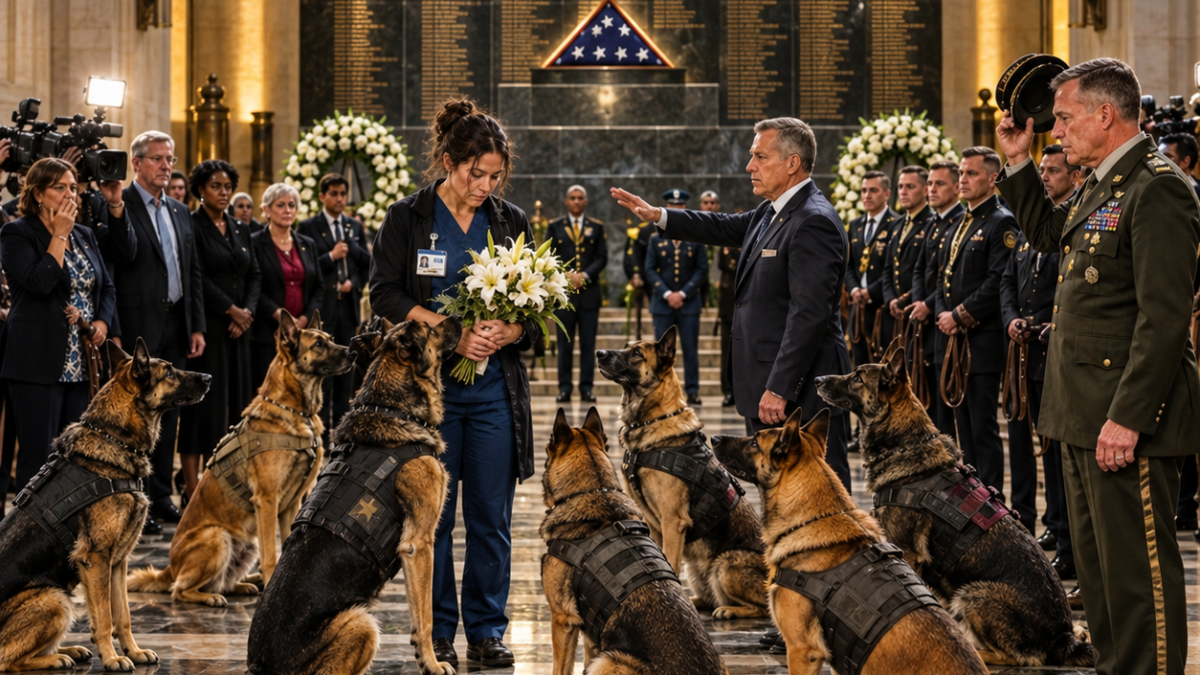
A Nurse Was Asked to Leave a Military Memorial—Then 7 K9s Broke Formation, Surrounded Her, and Revealed the Secret Behind the Seven White Lilies She Carried
PART3:
Representatives from every military branch attended.
Federal law-enforcement agencies sent delegations.
Veterans organizations filled the outer rows.
Television crews lined one side of the courtyard.
Honor guards stood near the granite wall.
A senator was scheduled to speak.
Two Gold Star organizations had reserved seating.
And beside the central walkway stood seven working dogs with their handlers.
They were impossible not to notice.
Valor, an Army German Shepherd with dark sable markings and a scar beneath his right foreleg.
Rogue, a Navy Belgian Malinois whose sharp amber eyes missed nothing.
Echo, an Air Force German Shepherd with a silvering muzzle.
Harbor, a Coast Guard Labrador who looked almost too gentle to have spent years working around maritime interdiction units.
Onyx, a federal Dutch Shepherd.
Cypher, a Marine Corps Belgian Malinois.
And Summit, a large German Shepherd who had served with a joint special operations unit.
Every dog stood still.
Every handler held a short leash.
The seven animals had never trained as a group.
They came from different organizations.
Different careers.
Different assignments.
Different parts of the country.
The audience saw discipline.
Nobody noticed the deeper connection.
Eight years earlier, each of those dogs had passed through Liberty Harbor’s military veterinary rehabilitation program.
Some with fractures.
Some with blast trauma.
Burns.
Deep lacerations.
Neurological injuries.
One with severe shutdown after losing a handler.
One who refused food.
One who panicked at metallic sounds.
Most eventually returned to some form of service.
Some retired.
But for weeks or months, each dog had occupied a kennel or recovery room in the rehabilitation wing connected to Liberty Harbor.
And most had spent nights there without their original handlers.
Deployments did not stop because a working dog was injured.
Transfers happened.
Medical evacuations separated teams.
Handlers waited overseas for updates from people they had never met.
Veterinary staff did the medical work.
But there were nights when medicine was not the problem.
Fear was.
And on those nights, someone else often appeared.
A civilian nurse finishing a twelve-hour shift.
Corrine.
She had first wandered into the veterinary rehabilitation wing eight years earlier because she could not sleep.
That was the explanation she gave.
It was not the whole truth.
The first dog she met was Valor.
He had been younger then.
Four years old.
A blast injury had damaged his shoulder and fractured his foreleg.
The surgeons repaired what they could.
But after the operation, Valor refused to stand.
He growled at staff.
Ignored food.
Snapped once at a therapist.
Not because he was aggressive.
Because everything hurt.
Corrine had been leaving the hospital shortly after midnight when she heard the barking.
She followed it.
A veterinary technician named Luis found her standing outside the kennel.
“You lost?”
“No.”
“This isn’t your wing.”
“I noticed.”
Valor growled from the corner.
Corrine crouched outside the gate.
“What happened?”
Luis explained.
Then added:
“He won’t let anybody near him unless he’s sedated.”
Corrine sat on the floor.
Luis stared.
“What are you doing?”
“Nothing.”
“You work tomorrow?”
“Yes.”
“Then go home.”
Corrine pulled a paperback from her bag.
“Eventually.”
She began reading.
Not to Valor.
Just aloud.
The dog stopped growling after ten minutes.
Twenty minutes later, his head lowered.
An hour later, he fell asleep.
Corrine left before dawn.
She returned the next night.
And the next.
By the fourth night, Valor took food from her hand.
By the sixth, he allowed her to touch his shoulder.
By the ninth, he stood long enough for therapy.
His handler, Colonel Adrian Holt, was still overseas.
Corrine wrote him an update.
Not because anyone asked.
Because she had watched military families live inside uncertainty for years, and uncertainty could become its own kind of injury.
She signed the note:
Night Shift
That became a habit.
Then a promise.
When Rogue arrived months later, Corrine did the same.
Echo.
Harbor.
Onyx.
Cypher.
Summit.
Seven dogs over eight years.
Seven different recoveries.
Seven handlers receiving letters they assumed came from a rehabilitation office.
Corrine never signed her name.
Not to be mysterious.
She simply did not think her name mattered.
What mattered was:
Valor walked twenty-three steps today.
Rogue tolerated the new brace.
Echo finally slept through the night.
Harbor ate without being hand-fed.
Onyx allowed someone to touch his paws.
Cypher responded to his handler’s recorded voice.
Summit stopped pacing after midnight.
Corrine never imagined any of those dogs would see her again.
She certainly never imagined all seven would stand together at a memorial.
That morning, she walked across the courtyard carrying the lilies.
White paper around the stems.
Her coat open enough to reveal navy hospital scrubs.
Her identification badge still clipped to the pocket.
She had worked until 5:40 a.m.
Slept two hours.
Returned for the ceremony.
Nobody important noticed her arrive.
Corrine preferred it that way.
The opening music began.
She waited.
Then moved toward the memorial wall.
An event coordinator stepped into her path.
The woman was maybe forty-five.
Professional.
Polite.
A headset rested over one ear.
“Excuse me, ma’am.”
Corrine stopped.
“Yes?”
“This section is reserved.”
“I know.”
Corrine lifted the flowers slightly.
“I only need a minute.”
The coordinator looked toward the lilies.
“Are you registered with one of the family groups?”
“No.”
“Military branch?”
Corrine shook her head.
“I’m hospital staff.”
The coordinator softened slightly.
“The public remembrance area is on the east side.”
“I understand.”
Corrine looked toward the wall.
“I’ve placed these here every year.”
The coordinator glanced at the crowd.
Television cameras.
Scheduled speakers.
Rows of families.
Protocols.
“I’m sorry.”
Corrine smiled.
“It’s okay.”
“I just need to keep this section clear for immediate military families.”
The sentence entered Corrine more deeply than the coordinator could have known.
Immediate military families.
Corrine looked at Elias’s name.
Then back.
“I understand.”
A second protocol officer approached.
“Everything all right?”
“Yes.”
The coordinator explained:
“She wants to place flowers at the family table, but she isn’t on the registered list.”
The officer looked at Corrine’s scrubs.
Then at her identification badge.
“Ma’am, we’ll need you to return to public seating.”
Several nearby conversations slowed.
Corrine felt eyes.
A sharply dressed guest whispered:
“She’s hospital staff.”
Someone else said:
“Rules are rules.”
Corrine’s face warmed.
Not from shame.
From disappointment.
She could have explained.
She could have pointed toward Elias.
Said:
That is my brother.
I held our mother when the notification officers came.
I helped choose the suit he was buried in because his uniform had not arrived yet.
I still have the last voicemail he left me.
I come every year because I promised him.
She said none of it.
Grief had never made Corrine believe she deserved priority over anyone else’s grief.
She lowered her eyes.
“I’m sorry.”
She turned.
Seven lilies still in her hands.
Twenty yards away, Valor lifted his head.
Colonel Adrian Holt noticed immediately.
Valor had been looking straight ahead.
Now his ears rotated toward Corrine.
Holt glanced in the same direction.
Before he could understand why, Rogue moved.
His handler tightened the leash.
“Stay.”
Rogue ignored him.
Echo turned.
Harbor stood.
Onyx’s entire posture changed.
Cypher stepped forward.
Summit began moving.
Seven handlers reacted almost together.
“Stay.”
“Heel.”
“Hold.”
“Valor.”
“Rogue.”
“Echo.”
None of the dogs barked.
None lunged.
None showed aggression.
They simply began walking.
Calm.
Focused.
Toward Corrine.
The courtyard gasped.
Camera operators swung around.
Corrine heard movement behind her.
She turned.
Valor reached her first.
He stopped.
Looked up.
Then sat directly in front of her.
Corrine froze.
“Valor?”
Holt stopped walking.
He had not heard that name from her before.
Rogue moved to Corrine’s left.
Echo behind her.
Harbor pressed gently against her right leg.
Onyx sat.
Cypher lay down.
Summit settled near the lilies.
Within seconds, the seven dogs had created a loose circle.
Around Corrine.
No training command.
No coordination.
No rehearsal.
Seven different animals making the same choice.
The memorial became completely silent.
Corrine stared at them.
Her eyes filled.
“No.”
She whispered it almost as if embarrassed.
“Guys…”
Valor leaned into her.
Corrine lowered one hand.
His head touched her palm.
And eight years disappeared.
She remembered him under fluorescent lights.
Pain medication.
Refusing food.
Growling because standing hurt.
She remembered reading The Old Man and the Sea because it was the only book in her bag.
She remembered saying:
“You don’t have to be brave tonight.”
Valor licked her wrist.
Colonel Holt reached them.
He stared at Corrine.
Really stared.
Then something in his expression changed.
“I know you.”
Corrine looked up.
Holt removed his cap.
The microphone near the podium picked up his voice.
Everyone heard him.
“I know her.”
The coordinator looked confused.
Holt stepped closer.
“Eight years ago, Valor nearly lost his front leg after an explosion.”
The audience turned.
Holt looked down at the German Shepherd.
“Surgeons saved the leg.”
He looked at Corrine.
“But surgery didn’t bring him back.”
Corrine shook her head immediately.
“Colonel—”
“You did.”
The coordinator’s face changed.
Holt continued.
“I was overseas.”
“My dog was here.”
“I got letters every week.”
He looked toward other handlers.
“Signed Night Shift.”
Rogue’s handler went still.
“What?”
Holt looked at him.
“You got them too?”
The Navy handler stared at Corrine.
“You wrote those?”
Corrine’s face turned red.
“I sent updates.”
“Updates?”
The man laughed in disbelief.
“You wrote me for three months.”
Another handler spoke.
“Echo too.”
Then another.
“Cypher.”
A Coast Guard handler stepped closer.
“Harbor wouldn’t eat.”
Corrine looked down.
“He was stressed.”
“You sat with him.”
“He needed company.”
“You hand-fed him.”
“Only for a while.”
The handler shook his head.
“You sent me photographs.”
Corrine looked uncomfortable.
“I thought you’d want to see progress.”
The man’s eyes filled.
“I was on a cutter in the Pacific.”
“I thought those messages came from some official rehabilitation office.”
Corrine gave a small helpless shrug.
“There wasn’t really an office for that.”
Holt smiled.
“So you became one.”
People began whispering.
Corrine shook her head.
“No.”
“I just…”
She looked at the dogs.
“I was already here at night.”
Another handler said:
“You read to Rogue.”
Corrine smiled despite herself.
“He liked westerns.”
The man laughed through tears.
“He still does.”
The coordinator stood several feet away.
Devastated.
“I had no idea.”
Corrine immediately turned toward her.
“There was no reason you should.”
The woman looked at the lilies.
“Were you trying to place those for one of the dogs?”
Corrine’s expression changed.
“No.”
She looked toward the wall.
“For my brother.”
Silence again.
Corrine held the bouquet tighter.
“I didn’t come for recognition.”
She stepped between the dogs.
Nobody stopped her now.
Holt walked beside her.
The other handlers followed.
Corrine reached the granite memorial.
She found the name without searching.
She always could.
Her fingers touched the engraving.
SERGEANT ELIAS ASHFORD
The coordinator whispered:
“He was your brother?”
Corrine nodded.
“My younger brother.”
“What happened?”
Corrine did not answer immediately.
Her eyes stayed on the letters.
“He was a combat medic.”
She knelt.
Seven dogs settled behind her.
“He died during an evacuation overseas.”
One lily.
Corrine placed it beneath Elias’s name.
“He was helping civilians.”
Second lily.
“He used to say medics don’t get to choose who deserves help.”
Third.
“He believed you went where the pain was.”
Fourth.
Corrine’s voice trembled.
“He loved dogs.”
Fifth.
“He loved people more than he admitted.”
Sixth.
“And before his last deployment…”
She held the seventh lily.
“…he helped stabilize seven injured working dogs waiting for evacuation flights.”
Holt stared at her.
“Seven?”
Corrine nodded.
“Seven.”
Her hand shook.
“He joked that dogs were easier than Marines because dogs didn’t care about rank.”
A few people laughed softly.
Corrine placed the final lily.
“After he died, I started volunteering in the veterinary wing.”
She looked toward Valor.
“I thought if I helped seven more…”
Her voice broke.
She stopped.
No one hurried her.
Finally:
“…then maybe some part of what he believed could keep moving.”
That was the secret of the lilies.
Not seven dogs currently standing behind her.
Seven dogs Elias once helped before she ever met Valor.
Seven lives carried forward.
Seven promises.
Holt lowered his head.
Nobody returned to the scheduled speeches.
Nobody seemed interested in them anymore.
Within an hour, Liberty Harbor administrators began opening archived files from the veterinary rehabilitation program.
Boxes appeared.
Old correspondence.
Veterinary logs.
Handler updates.
Hundreds of envelopes.
Every one signed:
Night Shift
Handlers gathered around a conference-room table.
Corrine sat in the corner wishing the floor would open.
Holt unfolded one letter.
He read silently first.
Then aloud.
“Valor walked twenty-three steps today without assistance.”
His voice shook.
“He growled at physical therapy this morning but accepted treats afterward.”
A few people laughed.
Holt continued.
“He misses your voice, but he’s healing beautifully.”
Then the last lines.
“Stay focused on your mission.”
“We’ve got him here.”
Holt stopped.
He stared at Corrine.
“You wrote that.”
“Yes.”
“Do you understand what that did for me?”
Corrine said nothing.
“I was seven thousand miles away.”
His voice roughened.
“I thought I had abandoned him.”
“You hadn’t.”
“I know that now.”
He held up the paper.
“You told me that before I could believe it.”
Another handler opened a letter.
“Cypher slept through the night.”
He swallowed.
“Don’t carry guilt for being away.”
“He is exactly where he needs to be.”
The man lowered the page.
“I carried this in my vest for six months.”
Corrine looked shocked.
“You kept it?”
“Every letter.”
Harbor’s handler smiled.
“I kept mine too.”
Rogue’s handler nodded.
One after another.
They had saved them.
Folded.
Worn.
Some stained.
Some laminated.
Some tucked into deployment journals.
Corrine looked around the room.
“I didn’t think anybody would remember.”
Holt laughed softly.
“We remembered every word.”
He looked toward Valor.
“We just never knew who gave them to us.”
That afternoon, twelve-year-old Nolan Pierce stood near the memorial wall with his father.
Nolan’s mother had been an Army flight nurse.
She had survived deployments.
Years later, cancer took her.
Nolan had spent most of the ceremony watching Corrine and the dogs.
Finally he asked:
“Dad?”
“Yes?”
“Why didn’t anybody thank her before today?”
Several nearby adults heard.
Nolan’s father looked toward Corrine.
Then toward the decorated officers.
The cameras.
The official programs.
The reserved chairs.
“I don’t know.”
The memorial coordinator heard too.
Her name was Valerie Sutton.
She had worked six months planning the ceremony.
She had memorized names.
Ranks.
Seating charts.
Protocols.
She had wanted everything perfect.
Now she stood beside the woman she had politely removed and cried.
“I saw your scrubs.”
Corrine looked at her.
Valerie wiped her eyes.
“I saw hospital staff.”
“I didn’t ask who you were.”
Holt stepped closer.
“That’s not the lesson.”
Valerie looked at him.
He spoke gently.
“You shouldn’t have needed her to be extraordinary before treating her like she belonged.”
Valerie closed her eyes.
The words hurt because they were true.
Corrine immediately said:
“She was doing her job.”
Holt nodded.
“I know.”
He looked toward the crowd.
“But respect should not depend on discovering someone’s hidden heroics.”
Nolan walked toward Corrine.
In his hand was a small American flag from the children’s remembrance table.
He stopped.
Corrine crouched.
“What’s your name?”
“Nolan.”
“Hi, Nolan.”
He held out the flag.
“My mom was a nurse too.”
Corrine accepted it carefully.
“What kind?”
“Flight nurse.”
“That’s a hard job.”
“She died.”
Corrine’s face softened.
“I’m sorry.”
Nolan looked toward the dogs.
Then back.
“I think she would’ve liked you.”
Corrine’s eyes filled.
“I think I would’ve liked her too.”
Months later, the memorial committee met.
Valerie sat near the end of the table.
Holt attended.
So did hospital leadership.
The chairman opened the meeting.
“We honor sacrifice very well.”
Nobody responded.
He continued.
“We honor uniforms.”
“Medals.”
“Rank.”
“Loss.”
He looked around.
“But perhaps we have overlooked service that happens without any of those things.”
Valerie nodded.
The committee voted unanimously.
Beginning the next year, the memorial would open with recognition for caregivers whose names rarely appeared in official histories.
Combat medics.
Rehabilitation nurses.
Veterinary teams.
Physical therapists.
Behavioral-health specialists.
Civilian hospital staff.
Volunteers.
Family caregivers.
The recognition received a simple name.
The Silent Hands Honor.
Corrine was asked to become its first representative.
She declined immediately.
“No.”
The chairman smiled.
“We expected that.”
“There are thousands of people more deserving.”
“Exactly.”
Corrine frowned.
“We’re not asking you because you’re the only one.”
He leaned forward.
“We’re asking because you understand that.”
She remained silent.
Holt added:
“You won’t be standing there for yourself.”
Corrine looked at him.
“You’ll be standing there for every person who stayed after everyone else went home.”
That persuaded her.
Barely.
The evening before the next memorial, Corrine visited Elias’s name alone.
She thought she was alone.
She was wrong.
Seven handlers arrived quietly.
Seven retired K9s with them.
No cameras.
No officials.
No audience.
Valor lay beside the wall.
Rogue beside him.
Then Echo.
Harbor.
Onyx.
Cypher.
Summit.
Corrine placed seven lilies.
One at a time.
Holt asked:
“Do you ever stop missing him?”
Corrine looked at Elias’s name.
“No.”
“Does it get easier?”
“No.”
Holt smiled faintly.
“You are not very encouraging for a nurse.”
Corrine laughed.
“It changes.”
“How?”
She considered.
“At first grief fills the whole room.”
She looked toward the dogs.
“Later, the room gets bigger.”
Holt nodded.
They stood there until sunset.
The following morning, the memorial began differently.
No politician spoke first.
No television introduction.
The courtyard doors opened.
Seven retired working dogs entered wearing simple white remembrance ribbons.
Behind them walked Corrine.
No special uniform.
No medal.
Navy hospital scrubs beneath a dark coat.
Beside her walked Nolan Pierce carrying the seventh lily.
Children lined the path.
Each held handwritten cards for caregivers.
The dogs stopped near the memorial wall.
Nolan stepped forward.
His voice shook at first.
Then steadied.
“Some heroes carry rifles.”
The courtyard became silent.
“Some carry stretchers.”
He looked toward Corrine.
“Some carry hope.”
Then:
“Today we remember all of them.”
Seven children placed seven lilies beneath Elias Ashford’s name.
The seven K9s settled around Corrine again.
This time nobody gasped.
Nobody tried to call them back.
Colonel Holt removed his cap.
Every K9 handler followed.
Then veterans.
Then active-duty service members.
Then civilians.
Corrine stood in the center.
Uncomfortable.
Emotional.
Still wishing attention could be redirected somewhere else.
Valor pressed against her leg.
She looked down.
“Still causing trouble.”
His tail moved once.
Years passed.
The Silent Hands Honor grew.
Not into something flashy.
Corrine fought hard against that.
There were no trophies.
No giant banners.
Instead, each memorial opened with one story.
A nurse.
A medic.
A therapist.
A spouse.
A veterinary technician.
A volunteer.
Someone whose work had happened quietly.
One year it was a janitor who had spent his breaks sitting with an elderly veteran whose family lived across the country.
Another year it was a physical therapist who had helped thirteen amputees return to independent living.
Another year it was a veterinary surgeon who had slept on the clinic floor beside a working dog after emergency surgery.
Corrine remained at Liberty Harbor.
She still worked nights.
Still avoided awards.
Still told young nurses:
“You’re not here to be remembered.”
One asked:
“Then why are we here?”
Corrine smiled.
“So somebody else can keep going.”
Valor eventually retired fully.
Holt brought him to Liberty Harbor one winter afternoon.
The old German Shepherd moved slowly now.
Gray around the muzzle.
Arthritis in the shoulder that had nearly been lost years earlier.
Corrine sat on the floor beside him.
Valor rested his head in her lap.
Holt leaned against the wall.
“You know he never does that with anyone else anymore.”
Corrine scratched behind the dog’s ear.
“He’s tired.”
“So are you.”
“I’m younger.”
“Not emotionally.”
Corrine looked at him.
“That was rude.”
Holt smiled.
Valor closed his eyes.
Corrine looked toward the scar beneath his fur.
“I thought you were going to die the first week.”
Holt’s smile faded.
“So did I.”
“He was mean.”
“He still is.”
Valor opened one eye.
Corrine laughed.
“You were terrified.”
Holt looked at the dog.
“Who?”
“Him.”
Holt nodded.
“I know.”
Corrine’s fingers moved slowly through Valor’s fur.
“That’s the thing people forget.”
“What?”
“Working dogs are brave because they keep going while afraid.”
Holt looked at her.
“Sounds familiar.”
Corrine ignored him.
Valor lived another three years.
When he died, Holt called Corrine first.
She drove to his house.
No uniform.
No flowers.
Just herself.
Holt sat on the porch holding Valor’s collar.
“I thought I was ready.”
Corrine sat beside him.
“No.”
“No?”
“You’re never ready.”
They watched sunset.
Eventually Holt handed her the collar.
“I want you to have this.”
Corrine shook her head.
“No.”
“He chose you too.”
“He chose both of us.”
Holt nodded.
“That’s why.”
Corrine accepted it.
The following May, she brought eight white lilies.
Valerie noticed immediately.
“You always bring seven.”
Corrine looked toward Elias’s name.
“Seven for him.”
Then toward the place Valor had once stood.
“One for a friend.”
The next year, Rogue was gone.
Then Harbor.
Time moved.
Handlers aged.
Dogs retired.
Some passed.
Yet photographs of the seven remained inside Liberty Harbor’s rehabilitation wing.
Not posed photographs.
Recovery photographs.
Valor taking his first unsupported steps.
Rogue asleep with his head on Corrine’s shoe.
Harbor eating from her hand.
Cypher beside a paperback book.
Summit standing during therapy.
Beneath the photographs hung a plaque.
Not about Corrine.
She had refused that.
It read:
THEY REMEMBER WHO SHOWED UP.
Nolan Pierce grew older.
At eighteen, he returned to Liberty Harbor wearing a college sweatshirt.
Corrine barely recognized him.
“You got tall.”
“So I’ve been told.”
“What are you studying?”
“Nursing.”
Corrine stared.
“You sure?”
He laughed.
“My mom was a nurse.”
“I know.”
“And…”
He hesitated.
“You.”
Corrine shook her head immediately.
“No.”
“What?”
“Do not blame me.”
Nolan smiled.
“I volunteered here because of you.”
“That is worse.”
He laughed.
Then became serious.
“I remember what you told me.”
“When?”
“At the memorial.”
“I said lots of things.”
“You said people don’t need to be famous to matter.”
Corrine frowned.
“That sounds too inspirational to be me.”
Nolan reached into his backpack.
Pulled out the small American flag he had given her years earlier.
She stared.
“You kept that?”
“You gave it back later.”
“I did?”
“You said it belonged with my mom’s things.”
Corrine remembered.
Nolan handed it to her again.
“I want you to keep it this time.”
“Why?”
“Because I start clinical rotations here next month.”
Corrine looked at him.
“Intensive care?”
“Eventually.”
She smiled.
“Come find me when you survive your first night shift.”
He grinned.
“Deal.”
Years after that first memorial, Corrine stood again in the courtyard.
Older now.
Silver beginning in her hair.
The original seven dogs were gone.
Their handlers still attended when they could.
Holt used a cane.
Valerie had become director of memorial programming.
Nolan stood among the hospital staff wearing navy scrubs.
The Silent Hands Honor was now part of the ceremony.
Not the main event.
Corrine had insisted.
The fallen came first.
Always.
But caregivers were no longer invisible.
That mattered.
After the ceremony, Corrine walked alone toward Elias’s name.
She carried seven lilies.
She placed them one by one.
Behind her, footsteps approached.
Holt.
Nolan.
Valerie.
Several handlers.
Nobody spoke.
Corrine finished.
She touched Elias’s engraving.
“You caused a lot of trouble.”
Holt raised an eyebrow.
“Talking to your brother?”
“Yes.”
“What would he say?”
Corrine smiled.
“He’d take credit for everything.”
“That sounds like a Marine.”
Nolan laughed.
Corrine turned.
For a moment she looked at all of them.
People who had entered her life because seven dogs refused to obey one command.
She thought of the morning she had been asked to step away.
The embarrassment.
The lilies in her hands.
Valor walking toward her.
She had never blamed Valerie.
That was important.
Rules mattered.
Protocols mattered.
But people mattered before anyone knew their stories.
That had become the real lesson.
Not that Corrine had secretly been extraordinary.
She did not believe she was.
The lesson was that she should not have needed to be extraordinary.
Neither should anyone.
Respect was not a reward people earned by revealing hidden sacrifice.
Dignity should have been the starting point.
Corrine looked toward the rehabilitation building.
The lights were on.
Somewhere inside, another nurse was finishing a shift.
Another veteran was waking from a nightmare.
Another family was sitting beside a bed.
Another working dog was learning to trust again.
Most of them would never appear at a podium.
That was fine.
History loved medals.
Rank.
Famous battles.
Names carved into stone.
But loyalty remembered differently.
A hand resting beside a kennel at 2:00 a.m.
A letter mailed to someone overseas.
A nurse reading aloud because an injured dog could not sleep.
A person sitting beside another person when there was nothing useful left to say.
Those things rarely became history.
They became something more private.
They became the reason someone survived the night.
Corrine turned toward the exit.
Nolan called:
“You leaving before the speeches again?”
She looked back.
“Tradition.”
Holt laughed.
Valerie shook her head.
“Some things never change.”
Corrine started walking.
Then stopped.
A young rehabilitation nurse stood near the public seating section.
Maybe twenty-four.
She held a small bouquet.
She looked uncertain.
An usher was trying to help her find the correct place.
Corrine watched.
The nurse looked embarrassed.
Corrine walked over.
“Who are the flowers for?”
The young woman looked at her.
“My patient.”
Corrine nodded.
“Family?”
“No.”
“He died last month.”
Her voice trembled.
“I just wanted to leave these somewhere.”
Corrine looked toward the memorial wall.
Then toward the remembrance table.
She took one step aside.
“Come with me.”
The nurse hesitated.
“I don’t think I’m supposed to—”
Corrine smiled.
“I know somebody.”
Holt groaned behind her.
“Here we go.”
Corrine led the nurse toward the wall.
No cameras followed.
No dogs broke formation.
No crowd gasped.
Nothing dramatic happened at all.
And that, Corrine thought, was progress.
Because years earlier, seven remarkable dogs had needed to cross a courtyard before anyone understood why an ordinary nurse carrying flowers deserved to be treated with dignity.
Now no miracle was required.
A door simply opened.
A person made room.
And seven white lilies remained beneath the name of Sergeant Elias Ashford, quietly proving what he had once told his sister:
Dogs never care about rank.
They only remember who showed up.
So do people.








