A Navy SEAL Brought Home an Abandoned Husky—Then One Midnight, His Dying German Shepherd Dragged an Old Collar From Beneath the Desk and Placed It at the Puppy’s Feet.
PART3:
“Old search-and-rescue program. Shut down years ago. They used to train dogs out near the county line before everything moved closer to town.”
“Could he be connected to it?”
“Maybe.”
Tom scanned the puppy for a microchip.
Nothing.
No collar.
No tag.
No vehicle nearby.
No tracks that gave us an answer.
The missing family was still out there, and Tom could not spare someone to sit with a puppy until morning. The nearest shelter was full. The county’s temporary facility could not take him until the next day.
The puppy pressed his small body against the side of my boot.
“I’ll take him to Clare,” I said. “After that, I can keep him overnight.”
Tom looked at me.
“Overnight?”
“Until we find out where he belongs.”
“Sure.”
“Don’t start.”
“I didn’t say anything.”
“You said it with your face.”
He handed me the badge.
I wrapped the puppy in the blue blanket and carried him back to the rescue vehicle. He remained quiet the whole way to Aspen Hollow, sleeping in short, tense stretches, waking whenever the truck slowed, then lowering his head again like he was afraid to expect too much.
Clare Morgan met us at the clinic entrance.
Clare was in her early forties, dark hair tied loosely behind her neck, calm hands, calm voice, and a way of making frightened animals settle before she touched them. She had been treating Ranger for years and had known me long enough to skip unnecessary questions until I was ready to answer.
She examined the puppy gently.
Cleaned the scrape.
Checked his breathing.
Gave him water in a shallow bowl.
“He’s exhausted and underfed,” she said. “But he should recover. Warmth, regular meals, somewhere quiet. More than anything, he needs to feel safe.”
The puppy drank carefully, as if even water had rules he did not understand yet.
“Do you think someone will come looking for him?” I asked.
“I don’t know,” Clare said. “But the note suggests whoever left him wanted him found, even if they didn’t know how to care for him anymore.”
I looked at the scratched badge on the counter.
“Pine Ridge K9 Program. Does that mean anything to you?”
Clare studied it.
“My father volunteered there before it shut down. They trained wilderness search dogs, disaster-response dogs, and emotional support dogs. Some of the older working lines were placed with military families when the program closed.”
Before I could ask more, my phone vibrated.
Marcus Reed.
Former teammate.
Friend, though neither of us used that word often enough.
I stepped into the hallway and answered.
“You make it home?” Marcus asked.
“Not yet. I’m at Clare’s clinic.”
“Everything okay?”
I looked through the doorway at the husky puppy curled inside the blue blanket.
“I found a dog during the search.”
Marcus gave a tired breath that almost became a laugh.
“You always did collect impossible problems.”
The joke sounded weak.
The silence after it went too long.
I could hear a television playing somewhere in the background, though Marcus did not seem to be watching it.
“How’s your leg?” I asked.
“It works.”
“That wasn’t my question.”
He exhaled.
“I’m managing.”
I knew that answer.
It was the same one I had used on doctors, friends, and family whenever I wanted them to stop asking.
Marcus had lost part of his leg the year before. Not overseas, though that would have fit the story better. A highway accident. Bad weather. A truck that crossed the line. One moment he was a man who moved like he owned every room he entered. The next, he was learning balance, pain management, prosthetics, and the humiliation of needing help with things he used to do without thought.
“Come by Aspen Hollow tomorrow,” I said.
“I’m not looking for company.”
“You don’t have to look for it. Just come.”
He did not answer immediately.
Then he said, “Maybe.”
He always said maybe when he meant no.
When I returned to the examination room, the puppy was awake and watching me.
Clare placed a temporary leash beside the blanket.
“The shelter can take him in the morning,” she said. “Or you can foster him tonight.”
Outside, the last sunlight rested on the rooftops of Aspen Hollow, turning them gold. Somewhere beyond town, my house stood at the edge of the pine forest, where Ranger was waiting beside the fireplace.
Ranger.
My old German Shepherd.
My partner.
My shadow.
The dog who had stayed beside me through the years after active duty, through the nights when the house became too quiet, through the mornings when the world felt less like a place to live than a mission to endure.
I had planned to go home alone.
A quiet evening.
A simple meal.
Same routine.
Same chair.
Same dog sleeping beside the fire.
Instead, I lifted the puppy into my arms.
He rested his chin against my chest and closed his eyes.
“Temporary foster,” I said.
Clare smiled just enough to make it clear she did not believe me.
I carried the puppy outside, placed him gently in the passenger seat, and started the drive home as the lights of Redstone Canyon faded behind us.
By the time we reached Aspen Hollow, the last light had vanished behind the pine-covered hills. The town was quiet, its narrow streets lined with small wooden houses and warm windows.
The puppy slept beneath the blue blanket.
I glanced at him several times during the drive, still unsure how a creature so small had managed to change the shape of my entire evening.
My house stood at the end of a gravel road, set behind a low wooden fence and surrounded by tall pines. Beyond the back porch was a wide yard that sloped gently toward the forest. It was not large, but it had strong walls, wide windows, and a deep porch where Ranger and I had spent more quiet mornings than I could count.
When I turned off the engine, the porch light flickered on automatically.
For a few seconds, I sat in the driver’s seat with both hands on the wheel.
I could hear the puppy breathing beside me.
Inside, Ranger was waiting.
I carried the puppy to the front door and pushed it open with my shoulder.
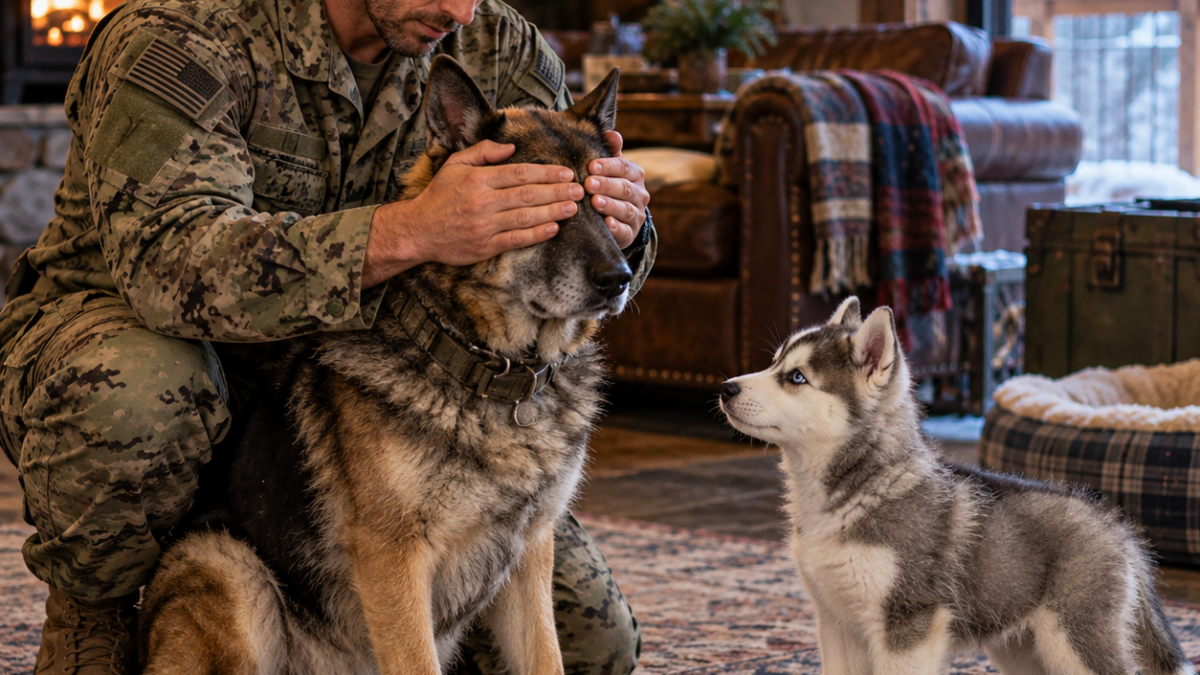
A large German Shepherd lifted his head from the brown rug near the hallway.
Ranger had once been a powerful working dog with a dark saddle, steady amber eyes, and the kind of posture that made strangers step aside without knowing why. Now silver covered most of his muzzle. One ear bent slightly at the tip. His movements had become careful and measured.
Age had taken away his speed.
Not his dignity.
Even from the floor, he watched the room as if every sound still belonged to him.
“Hey, partner,” I said quietly.
Ranger’s eyes moved from my face to the bundle in my arms.
The puppy stirred beneath the blanket, then raised his small head. One blue eye appeared first, then the other.
Ranger did not growl.
He simply studied him with an expression I could not read.
I stepped inside and placed the puppy’s bed near the fireplace, several feet away from Ranger’s rug.
“This is Kota,” I said, feeling slightly foolish as I introduced them. “He’s staying for a little while.”
Ranger pushed himself up.
The effort was visible. Front legs first. A pause. Hind legs slower.
I moved instinctively to help.
Ranger’s eyes warned me not to interfere.
So I stopped.
The old dog stood alone, balanced himself, and walked toward Kota.
The puppy remained still.
Ranger lowered his head and took in the unfamiliar scent.
Dust.
Road.
Clinic soap.
Blue blanket.
Abandoned station.
Kota’s tail moved once.
Ranger looked back at me.
Then he turned away.
He crossed the room, dragged his rug several inches farther from the fireplace, and lowered himself onto it with his back angled toward the puppy.
I watched him in silence.
“No one is replacing you,” I said.
Ranger did not look at me.
Kota seemed to sense the tension. When I placed him on the new bed, he remained curled against the blanket. His ears lowered.
I filled two bowls and set them apart in the kitchen.
Ranger approached his own bowl, sniffed it, and walked away without eating.
Kota watched him.
Then he refused to touch his food too.
“You don’t have to copy him,” I murmured.
Kota blinked up at me.
After a moment, he lowered his nose and took one cautious bite.
Ranger remained near the fireplace, facing the room but refusing to meet the puppy’s eyes.
That night, I tried to make the house feel normal.
I made a simple meal.
Answered messages from the search team.
Placed Kota’s paperwork on the kitchen counter.
Every few minutes, I looked toward Ranger.
For years, he had followed me from room to room. Never crowding. Never begging. Always close enough to respond if needed.
That night, he stayed near the fireplace while Kota remained on the opposite side of the room.
The distance between them seemed far greater than it was.
The next morning, Clare arrived with a medical bag and two paper cups of coffee.
She stepped inside without knocking because she had known me long enough to ignore formalities.
Kota approached first, sniffed her shoes, then retreated under the kitchen table.
Ranger stayed on his rug, watching her calmly.
Clare examined Kota’s paw, checked his eyes, and listened to his breathing.
Then she moved toward Ranger.
The old dog allowed her to place a hand against his chest, though he looked toward me as if asking why the examination was necessary.
Clare listened longer than usual.
Then she checked his gums.
His weight.
His breathing.
“How often has he been skipping meals?” she asked.
“He skipped breakfast.”
“Only today?”
I hesitated.
“A few times recently.”
Clare did not respond immediately.
She wrote something in her notebook and watched Ranger walk back toward the fireplace.
His breathing sounded heavier than it had in the past.
“He’s twelve,” I said. “He has good days and bad days.”
“Then keep track of both,” Clare replied. “Appetite. Breathing. How long it takes him to stand. Whether he seems uncomfortable. Don’t rely on memory.”
I nodded.
I disliked the seriousness in her voice.
Clare did not mention a diagnosis.
I did not ask for one.
Instead, she placed a small container of supplements beside Ranger’s bowl and gave instructions for Kota’s meals.
Before leaving, she looked at both dogs.
Kota had fallen asleep beneath the table.
Ranger’s eyes remained open, fixed on him.
“Give them separate spaces,” Clare said. “Let Ranger choose when he wants to come closer. He has lived here a long time.”
“I know.”
“Knowing and remembering are different things.”
After she left, I stood at the kitchen window and watched the road.
A few minutes later, Marcus’s truck appeared near the fence.
He stepped out slowly, one hand braced against the side of the vehicle. His prosthetic leg made a faint mechanical sound against the gravel, and he paused before climbing the porch steps.
I opened the door before he could knock.
“You made it.”
“I said maybe.”
“You usually say maybe when you mean no.”
“I’m working on being unpredictable.”
Marcus entered and looked around.
His eyes found Ranger first.
Then Kota, who had woken beneath the table.
“At the rescue?” he asked.
“His name is Kota.”
Kota crawled out cautiously, carrying a red rubber ball in his mouth. I had found it beneath an old chair and placed it near his bed, hoping it might make him feel at home.
Kota walked toward Ranger and stopped a few feet away.
He lowered the ball to the floor.
Waited.
Ranger opened one eye, saw the toy, and turned his head toward the window.
Kota picked up the ball and moved a few steps closer.
“Easy,” I said.
The puppy stopped at once.
He looked disappointed, but did not whine.
Marcus crouched beside him.
“He knows how to take a hint.”
Kota glanced at Ranger once more, then carried the ball toward Marcus and placed it carefully against his boot.
Marcus stared down at it.
“What am I supposed to do with this?”
I shrugged.
“Maybe he thinks you need a mission.”
Marcus gave me a tired look.
Kota pushed the ball forward again.
For the first time in months, Marcus laughed.
It was quiet.
Surprised.
Like it had escaped before he could stop it.
He rolled the ball gently across the floor. Kota chased it, slipped slightly on the wooden boards, and returned with his tail moving faster than before.
Ranger watched from the rug.
He did not join them.
But his ears shifted toward the sound.
Marcus rolled the ball again, slower this time. Kota brought it back and rested his chin on Marcus’s knee.
Marcus looked at me.
“He doesn’t know I’m broken.”
“Maybe he doesn’t care.”
The words settled between us.
Marcus lowered his hand and touched the puppy’s head.
Ranger looked away.
But he did not leave the room.
That evening, Marcus stayed for dinner. He spoke little about his injury, and I did not force him. We talked instead about the search team, small-town dogs, and the fact that Kota had already decided the kitchen rug belonged to him.
When Marcus finally left, he paused on the porch and looked back through the warm window.
“I’ll come by tomorrow,” he said.
I nodded.
Inside, Kota had fallen asleep beside the fireplace, though not on Ranger’s rug.
Ranger remained several feet away, head on his paws.
After a long silence, the old dog stood and moved his rug farther from the puppy.
He did not growl.
Did not show anger.
He simply created more distance, as if trying to protect the last familiar piece of his life.
I turned off the kitchen light and stood in the hallway, listening to the quiet breathing of the two dogs.
Kota had entered the house believing he might be left behind again.
Ranger had watched him arrive believing he might soon be forgotten.
I did not understand either fear completely.
But I knew both were real.
I left my bedroom door open, as I had done for Ranger every night for years.
In the darkness, the house held two rhythms of breathing.
One young and uncertain.
One slow and watchful.
Nothing had been solved.
But for the first time, no one was entirely alone.
Three days after Kota arrived, the house had developed a new rhythm.
I was not yet sure whether it was peaceful or simply more careful.
Mornings began with the scrape of Ranger’s claws against the wooden floor, followed by the soft movement of Kota getting out of his bed. The puppy had already learned that the brown rug near the fireplace belonged to Ranger and that the hallway was not a place for sudden games.
He followed me from room to room but stopped whenever Ranger lifted his head, as if the old dog’s silence were a language he was slowly learning.
That morning, sunlight entered through the kitchen windows in thin golden lines.
I filled Ranger’s bowl with the food Clare recommended, placed it beside the wall, and stepped back.
Ranger walked toward it with his usual quiet dignity.
He lowered his head.
Smelled the food.
Then remained still.
I waited.
The old dog took one small bite, lifted his head, and turned away.
“Come on, partner,” I said. “Just a little more.”
Ranger glanced at me, but did not return to the bowl.
He walked slowly toward the fireplace and lowered himself onto the rug.
It took longer than it should have.
Front legs first.
Then his back legs, after a hesitation I tried not to notice.
Kota sat beside his own bowl, watching.
His food had been softened with warm water, and the scent filled the kitchen. Usually, he would have eaten immediately.
He did not move.
His eyes stayed fixed on Ranger.
“You can eat,” I told him.
Kota did not.
I crossed the room and placed one hand against Ranger’s shoulder.
His fur was warm.
His breathing felt heavier beneath it.
For months, I had explained away every change.
He was older.
He had worked hard.
He needed more rest.
Those explanations had once sounded reasonable.
Now they sounded like words I had repeated so often they no longer protected me from the truth.
I called Clare.
She arrived before noon with her medical bag and a folder of notes from the previous visit.
Ranger did not object when she examined him, though he watched me through the whole process.
Clare listened to his heart.
Checked his breathing.
Asked about appetite, sleep, and how he stood after lying down.
This time, I answered honestly.
Ranger had been eating less.
He tired quickly.
Sometimes he coughed at night.
Sometimes he stood in the middle of the room as if he had forgotten why he had walked there.
Clare stayed quiet for a long moment after placing the stethoscope against his chest.
Then she looked at me.
“His heart disease has progressed,” she said gently. “I’m afraid it’s moving faster than we hoped.”
I stared at the worn leather strap of Ranger’s collar.
“How much time?”
Clare did not pretend to know.
“With medication and careful management, we may have months. It could be longer. It could change suddenly. I can’t give you an exact number.”
Months.
The word settled over the room with a weight I did not expect.
I had spent years learning how to respond to immediate danger. I knew how to assess a route, protect a team, and make decisions when every second mattered.
There was no strategy for watching a friend grow weaker.
No piece of equipment to repair.
No enemy to confront.
No mission that could be completed before the clock ran out.
Ranger rested his head on the rug, calm and dignified, as if the conversation did not concern him.
I remembered him young.
Crossing open ground with powerful strides.
Stopping the instant I called his name.
Lying outside the door of temporary barracks, alert through the night.
Finding lost hikers.
Guiding frightened children toward rescuers.
Standing beside me whenever the world became too loud.
Ranger had always known what to do when someone was lost.
Now I wondered whether I was the one who had lost his way.
Clare placed medication bottles on the counter and wrote down a schedule.
“Keep his days familiar,” she said. “Short walks if he wants them. Let him rest, but don’t make the house feel like a hospital. He still needs to feel included.”
I nodded, absorbing each instruction even while my mind resisted the future they implied.
Kota approached the fireplace and stopped several feet away.
He looked at Ranger.
Then toward the bowl in the kitchen.
Ranger opened one eye.
Kota lowered himself onto the floor without making a sound.
Clare watched the exchange.
“He’s learning,” she said. “He knows Ranger needs space.”
I looked at the puppy.
Kota had arrived frightened and uncertain.
Yet he had already begun adjusting himself around an older dog who had never asked for his help.
When Ranger finally lifted his head and took another small bite from the bowl, Kota stood and hurried to his own food.
He ate only after Ranger had begun.
I watched the two dogs beneath the quiet afternoon light and felt something shift inside me.
Kota was not trying to take Ranger’s place.
He was learning how to stay near someone whose strength was fading.
While I tried to adjust to the news, Pine Ridge Animal Haven was facing a crisis of its own.
The rescue center stood at the edge of town on a narrow piece of land surrounded by old fencing, cottonwood trees, and a row of small kennels. Helen Harper had run it for nearly two decades through donations, volunteer work, and a stubborn refusal to give up.
Her sixteen-year-old niece, Lily, helped after school and knew every animal by name.
A notice from the county had been posted on the office door.
The land had been purchased by a development company planning to build a private mountain resort.
Pine Ridge had six months to relocate.
Helen kept the notice folded inside a drawer.
Lily had already made copies and started asking for help.
She created an online page, contacted local businesses, and placed hand-painted signs around Aspen Hollow. Most people wished her luck. Few believed a modest shelter could stand against a company with lawyers, investors, and approved plans.
Marcus came to Pine Ridge intending to stay for one afternoon.
Lily handed him a hammer before he could finish saying hello.
“The west fence is leaning,” she said.
“I’m not a construction worker.”
“You’re taller than me.”
“That is not a qualification.”
“It is the only one I have today.”
Marcus looked at the fence.
Then at Lily.
Eventually, he took the hammer.
The work was slow at first. His prosthetic leg made the uneven ground difficult, and he had to stop several times to regain his balance.
He expected people to notice.
So he kept his eyes on the boards.
Lily did not stare or offer unnecessary encouragement. She simply held the next piece of wood in place and waited.
By late afternoon, one section of fence stood straighter than before.
Not perfect.
But it held.
Marcus stepped back and studied it.
“You’ll have to paint it,” he said.
Lily smiled.
“That means you’re coming back.”
Marcus did not answer.
But the next morning, he returned with a box of screws and a thermos of coffee.
I began helping too.
I repaired a gate, replaced a broken latch, and helped Helen move bags of feed into storage.
The more time I spent at Pine Ridge, the less time I spent thinking about the quiet house and the orange medication bottles on my kitchen counter.
Clare noticed.
She found me beside the shelter’s back fence one afternoon, tightening a bolt that did not need tightening.
“You’ve been here every day,” she said.
“There’s work to do.”
“There will always be work.”
I kept my eyes on the gate.
Clare leaned against the fence.
“You can help Pine Ridge and still go home when Ranger needs you.”
My hand stopped.
“I am going home.”
“You’re arriving at the house. That isn’t always the same thing.”
I looked at her then.
Clare’s voice remained gentle, but she did not let me hide behind it.
“You can rescue other people, Evan. You can repair fences, carry supplies, and give everyone something to depend on. But this time, you have to learn how to stay beside someone you cannot save from time.”
I said nothing.
Beyond us, Lily was explaining to Marcus how to organize a community meeting, and the dogs in the nearest kennel barked at a delivery truck.
The world kept moving.
Asking for repairs.
Decisions.
Plans.
I looked toward the road leading home.
At the house, Ranger would be near the fireplace.
Kota would probably be a few feet away, watching him.
I set down the wrench and removed my gloves.
“I’ll finish tomorrow.”
Clare nodded.
That evening, I returned home before dark.
Ranger was awake on his rug.
Kota sat beside his untouched bowl.
I warmed Ranger’s food, placed it nearby, and sat on the floor without urging him.
After several minutes, Ranger reached forward and ate a few slow bites.
Only then did Kota lower his head to his own bowl.
I rested my back against the wall and watched them in silence.
I still had no answer for the months ahead.
But for the first time, I understood that being present was not the same as giving up.
Sometimes it was the most important mission left.
The days after Clare’s warning passed quietly, but the quiet inside my house no longer felt simple.
I began measuring Ranger’s meals.
Writing down rest times.
Opening the back door early so he never had to hurry.
Placing towels over slippery sections of floor.
Keeping the medication bottles in plain sight instead of hiding them in a drawer.
I still spent afternoons at Pine Ridge with Marcus and Lily, repairing gates and sorting donated supplies, but I always returned home before sunset.
Ranger noticed when I was away too long.
He would remain near the fireplace, awake but still, and lift his head the moment I opened the front door.
Kota grew more confident.
He learned where his food was kept, which blanket belonged to him, and which parts of the house were still forbidden. He discovered that the red rubber ball could be pushed beneath furniture and recovered with great ceremony.
Then came the accident.
One clear afternoon, I stood at the kitchen counter measuring Ranger’s medication into a piece of soft food when the ball rolled from beneath the sofa.
Kota froze.
Then pounced on it with the excitement of a puppy discovering treasure.
He rushed across the living room, paws sliding slightly over the wood floor, the ball bouncing between his teeth.
He tried to stop near the fireplace but turned too sharply.
His shoulder struck a light wooden chair.
The chair tipped over with a sudden crack.
Ranger startled.
He raised his head quickly and tried to stand, but his back legs did not gather beneath him.
His breathing changed.
Fast.
Strained.
I dropped the medication packet and crossed the room.
“Ranger, easy,” I said, kneeling beside him. “You’re all right. Stay still.”
Kota stopped near the fallen chair.
The ball slipped from his mouth and rolled beneath the table.
He looked from me to Ranger, ears lowered, his whole body suddenly small and uncertain.
I placed one hand beneath Ranger’s neck and the other against his side, waiting until his breathing settled.
It took several long minutes.
No one spoke.
The chair remained on its side.
Afternoon light continued to fall across the floor as if nothing had happened.
When Ranger finally rested his head on the rug, I turned toward Kota.
The puppy had not moved.
He stared at Ranger with frightened eyes.
I knew the accident had not been his fault.
But fear reached me before reason could.
“You can’t do that again,” I said, sharper than I intended.
Kota flinched.
I closed my eyes.
The apology stayed trapped behind my teeth.
I carried the chair back to the kitchen, placed the ball on the counter, and returned to Ranger.
Kota remained near the doorway, unwilling to come closer.
That evening, the house felt divided into territories.
Ranger rested beside the fireplace.
Kota stayed on his bed.
I moved between them with the exhaustion of a man trying to prevent two different kinds of pain from touching.
After dinner, I opened the temporary foster papers from Pine Ridge.
The words were plain.
Responsible party.
Temporary placement.
Veterinary care.
Transfer if necessary.
Final adoption.
I stared at that line until the letters blurred.
Ranger had very little time left.
Kota was still young enough to begin again somewhere else.
I told myself finding him another home would be kindness.
I told myself Ranger deserved calm final days without puppy noise.
I told myself a good family might understand Kota better than a man already struggling to care for an aging dog.
But beneath every explanation was fear.
I was afraid Kota would make Ranger’s final days harder.
More afraid I would never forgive myself if that happened.
The next morning, I called Helen.
“I need to ask about placement,” I said.
She listened without interrupting as I explained.
“Is Ranger stable?” she asked.
“He’s resting.”
“And Kota?”
I looked across the room.
The puppy sat near the back door watching Ranger sleep.
“He’s fine.”
Helen was quiet.
“That wasn’t really my question.”
I rubbed my forehead.
“He frightened Ranger yesterday. It was an accident, but Ranger had a difficult episode.”
“Does Ranger want him gone?”
I looked at the old dog.
Ranger’s eyes were open, but his face revealed nothing.
“I don’t know.”
“Then perhaps you should find out what Ranger is asking for before deciding for him.”
“I’m trying to protect him.”
“I know,” Helen said. “But protection can become another name for fear if you’re not careful.”
She promised to ask about possible foster homes and said she would call back once she knew more.
After we hung up, I stood in the kitchen with the phone still in my hand.
Kota slowly approached and placed one paw against my boot.
I looked down at him.
The gesture was so trusting I almost changed my mind.
Instead, I opened the closet and began gathering his belongings.
The small blue bowl went into a canvas bag.
Then the washed blanket from the station.
The soft leash.
The puppy food.
Finally, the red ball from the kitchen counter.
Kota followed me from room to room.
He did not understand paperwork.
But he understood that the things connected to him were being moved.
When I picked up the blue blanket, Kota reached for one corner with his teeth.
“Not now, buddy,” I whispered.
He released it and lowered his head.
Across the room, Ranger watched everything.
He did not bark.
Did not rise.
He simply remained unnaturally still.
That afternoon, Marcus and Lily were at Pine Ridge going through old program records. Tom had sent a photograph of the metal badge we found near Kota’s blanket, and Lily managed to clean up the name stamped on it.
Eleanor Hayes.
Pine Ridge K9 Program.
Helen remembered the name immediately.
“She trained some of the earliest dogs here,” she told them. “Wilderness searches, disaster response, support work. She had a way of seeing potential in animals other people overlooked.”
Marcus found an old record in a box of retired training files.
German Shepherd.
Name: Ranger.
Training number.
Date.
Eleanor’s handwritten initials.
Not much else.
But enough.
Lily took a picture of the record and posted a short story online about Kota, the abandoned puppy connected to Pine Ridge, and Ranger, the retired rescue dog who had once belonged to the same program.
She did not exaggerate.
She did not ask for pity.
She simply wrote that two dogs from different stages of life had found themselves in the same home while Pine Ridge Animal Haven needed help to stay alive.
By evening, messages began arriving from people across Colorado.
Someone offered food.
Someone promised blankets.
A local hardware store offered fence materials.
Small donations appeared one after another, each modest but meaningful.
Marcus read messages aloud while Lily updated a list on the office wall.
For the first time since the development notice arrived, Helen allowed herself to speak about Pine Ridge as if it might have a future.
I knew none of this.
I was home, sitting in the darkened living room while Ranger rested near the fireplace and Kota slept in his bed.
The canvas bag stood beside the kitchen table.
Near midnight, I heard a faint scraping sound from the hallway.
At first, I thought Kota had moved.
Then the sound came again.
Slow.
Uneven.
Followed by a pause.
I rose and walked into the small office.
Ranger stood beside the old desk, head lowered toward the narrow space beneath it.
He was breathing heavily, but his eyes remained focused.
I switched on the lamp.
A worn black collar lay under the desk.
Ranger had found it himself.
“Leave it,” I whispered.
Ranger looked at me.
Then carefully gripped the collar and pulled.
The leather slid across the floor.
Ranger paused.
Gathered himself.
Then began walking toward the living room.
I followed without interfering.
The old dog crossed the hallway one slow step at a time and stopped in front of Kota.
The puppy woke and lifted his head.
Ranger dropped the collar between them.
For a moment, neither dog moved.
Then Ranger touched the leather with his nose and pushed it gently toward Kota.
Kota lowered his head.
Smelled the collar.
Moved closer.
He did not grab it.
Did not play with it.
He simply lay down beside Ranger and placed one paw near the worn leather.
I stood behind them, unable to speak.
I had believed Ranger wanted Kota removed because I had mistaken distance for rejection.
Perhaps the old dog had not been defending his place at all.
Perhaps he had only been waiting to know whether I still saw him.
I lowered myself to the floor and rested one hand on Ranger’s shoulder and the other on Kota’s back.
“I’m sorry,” I whispered.
Ranger did not look at me.
He only allowed Kota to remain close.
The packed canvas bag waited near the kitchen.
I no longer saw it as a solution.
I saw it as proof that fear had almost made a decision for me.
Near dawn, Kota fell asleep with one paw touching the old collar.
Ranger stayed beside him, awake and calm.
I remained on the floor between them, listening to their breathing.
Somewhere across town, strangers continued sending help to a rescue center that had once seemed destined to disappear.
No one in the house said the words aloud.
But the decision had already been made.
Kota would not be leaving.
The next morning, the house felt different without becoming easier.
Kota no longer chased the red ball across the living room. He no longer rushed toward every sound outside. He moved slowly through the rooms, pausing whenever Ranger shifted on the rug, and spent most of his time lying a few feet away from the old dog.
Ranger noticed.
He still kept some distance.
But he no longer left the room when Kota came near.
I took it as a fragile form of peace.
Before leaving for Pine Ridge, I prepared Ranger’s medication, placed fresh water beside the fireplace, and checked the latch on the back door.
Ranger watched me from the rug, breathing steady enough to ease my concern.
Kota sat beside him, alert and quiet.
“We won’t be gone long,” I said. “Stay with him.”
Kota lifted his head as if he understood.
Marcus was waiting near the truck when I stepped outside.
The work at Pine Ridge had grown because of Lily’s post. Donations had arrived from neighboring towns. The shelter now had enough money to replace the damaged medical cabinet, buy supplies, and begin repairs on the oldest section of fencing.
Not enough to solve everything.
Enough to give them time.
“For the first time in weeks, Helen can talk about the future without lowering her voice,” Marcus said.
I glanced back toward the house.
“I’ll be back before lunch.”
“You’ve said that every day this week.”
“Today, I mean it.”
Marcus looked at me but did not argue.
At Pine Ridge, the morning passed in practical tasks.
Marcus measured posts while Lily sorted donated blankets and labeled boxes. Helen answered calls inside the office. A retired teacher offered to organize weekend volunteers. A local hardware store delivered discounted materials.
The shelter was still surrounded by uncertainty, but there was movement everywhere.
People carried boards.
Folded blankets.
Cleaned kennels.
Made lists.
Marcus worked slowly, but he no longer looked at every task as a test of what he had lost. He was beginning to see the work itself as something worth doing.
“You’re good with the dogs,” Lily told him while handing over a box of supplies.
“I’m good with fences.”
“The dogs seem to disagree.”
One older rescue dog had been following Marcus along the edge of the yard, resting its chin against his knee whenever he stopped.
Marcus glanced down at it.
“It has poor judgment.”
Lily smiled and walked away before he could object.
Near the end of the morning, I checked my phone.
No messages from home.
I told myself that was good.
If something were wrong, someone would call.
I returned to work, tightening a bolt on the new gate while Marcus held the frame steady.
Back at the house, Ranger woke from a shallow sleep.
The room was quiet except for the ticking clock above the fireplace. Kota lay near the edge of the rug, head resting between his front paws.
Ranger tried to stand.
His front legs straightened.
His hind legs did not respond.
He paused and tried again.
This time, his paws slipped slightly on the rug, and he lowered himself back down.
Kota rose at once and touched his nose to Ranger’s shoulder.
Ranger did not answer.
Kota looked toward the kitchen.
Then toward the hallway.
I was not there.
The puppy moved to the back door and pushed his nose against the narrow gap beneath it.
The door opened enough for him to squeeze through.
Outside, the yard was bright and dry with the sharp smell of grass, pine needles, and warm soil.
Kota ran.
Across the yard.
Past the workshop.
Down the path I had taken many times before.
He stumbled once on the uneven stones, regained his balance, and continued toward Pine Ridge, where the sound of tools carried through the open air.
I was leaning over the gate when I heard the bark.
Not playful.
Not the sound Kota made when he wanted the ball.
Short.
Urgent.
Repeated.
Marcus looked up first.
“Is that your dog?”
I straightened.
Another bark came from the road.
Kota appeared at the entrance to the work area, white and gray fur marked with dust, chest rising fast from the run.
He looked directly at me, turned toward the house, and barked again.
I took one step forward.
“What is it?”
Kota ran several feet back, then stopped and looked over his shoulder.
For a second, I thought he might be frightened by something outside.
Then he returned, pressed his nose against my hand, and when I did not move fast enough, caught the loose edge of my work pants between his teeth and pulled gently toward the road.
Not aggressive.
Desperate in its simplicity.
Marcus was already reaching for the truck keys.
“Go.”
I did not ask questions.
Kota ran ahead, stopping every few seconds to make sure we followed.
When I entered the house, I found Ranger lying beside the fireplace, awake but unable to rise.
His breathing was shallow and uneven.
His eyes turned toward the sound of my footsteps.
I dropped to my knees.
“I’m here, partner.”
Kota pressed close to Ranger’s face and whined.
I remembered Clare’s instructions, reached for the emergency medication packet, and called her while Marcus prepared the truck.
My hands stayed steady because Ranger needed them steady.
“We’re bringing him in,” I said. “He’s having a serious episode.”
Clare’s voice remained calm.
“Keep him comfortable. Don’t make him walk. I’ll be ready when you arrive.”
Marcus opened the back door of the truck and placed Ranger’s old blanket across the seat.
Together, we lifted the old dog carefully and carried him outside.
Kota followed so closely I nearly stepped on him.
The puppy climbed into the truck and settled against Ranger’s chest.
I reached for him.
Marcus touched my arm.
“Leave him there,” he said. “He knows where he needs to be.”
The drive to Clare’s clinic was quiet except for my voice.
I kept repeating the same words without thinking.
“Stay with me. We’re almost there. You’re not alone.”
Kota remained pressed against Ranger, his head tucked beneath the old dog’s jaw. He did not bark. He did not move away. Even when the truck turned through Aspen Hollow, he held his position.
At the clinic, Clare and an assistant opened the side door before I had fully stopped.
“Bring him inside.”
I lifted Ranger while Marcus carried the medical bag.
Kota tried to follow us through the entrance, but Clare asked Marcus to hold him back. The puppy resisted for one second, then went still, eyes fixed on Ranger as the treatment room door closed.
I stood in the hallway with empty arms.
Silence felt heavier than the noise of the truck.
Marcus placed Kota on my jacket, but the puppy would not sit comfortably. He kept turning toward the treatment room.
“He found you,” Marcus said quietly.
I looked down at Kota.
“He didn’t know what was happening.”
“He knew something was wrong.”
I lowered myself beside the puppy.
“I should have stayed home.”
Marcus shook his head.
“You came back when he called. That’s what matters.”
For a while, neither of us spoke.
Then Marcus looked toward the treatment room.
“After my injury, I thought I had nothing left to offer,” he said. “I couldn’t do the work I used to do. I couldn’t protect anyone the way I thought I was supposed to. I figured that meant I was finished.”
I kept one hand on Kota’s back.
“You helped me get Ranger here.”
“That’s not much.”
“It is to me.”
Marcus looked down at the puppy.
“Maybe saving someone doesn’t always look like the things we were trained to do.”
I remembered Kota running across the yard, turning back again and again until he was certain we followed.
“Sometimes,” I said, “it just means noticing that someone needs help and refusing to walk away.”
Marcus nodded.
A few minutes later, Helen called.
Lily had told her what happened, and she wanted me to know that donations had reached the amount needed to purchase the medical supplies Pine Ridge had been missing. The county had also agreed to review the shelter’s relocation request instead of forcing it to close immediately.
“Ranger may not know it,” Helen said, “but his story helped keep this place alive.”
I looked at the closed treatment room door.
“He’s been helping people for a long time.”
“Then perhaps this is another one of his missions.”
After the call ended, Kota lowered his head onto my knee, but kept watching the door.
Somewhere inside the clinic, Clare and her staff were caring for Ranger.
Outside, Pine Ridge had received another chance.
Marcus sat beside me and, for once, did not try to fill the silence with a joke.
I rested my hand on Kota’s back and listened to the faint sounds beyond the hallway.
I had spent years believing protection meant standing between danger and the people I loved.
Now, sitting on a clinic floor with a frightened puppy beside me, I understood it could also mean staying present when there was no promise of an easy outcome.
Ranger came home two days after the emergency.
But the house recognized he was no longer the same.
He could still stand for short periods, yet every movement required patience. His head remained proud and his eyes clear, but his body worked harder beneath the familiar coat.
Clare carried the medication bag to the kitchen and placed the schedule beside my coffee tin.
“He can be comfortable here,” she said. “Familiar rooms. Familiar voices. Familiar routines. Don’t push him to do more than he wants.”
I looked at Ranger resting in the backseat of the truck.
“What about another treatment?”
Clare’s expression softened.
“There may be things we can try. But I don’t want his remaining days to become a series of procedures and recovery. He needs peace now, Evan. He needs to know he is home.”
For the first time, I did not ask whether there was another option hidden somewhere. Another medication. Another specialist. Another mission that could keep Ranger beside me indefinitely.
I simply opened the truck door and helped him down.
Kota waited near the porch, wearing Ranger’s worn collar on a soft blue strap.
The puppy did not jump or bark.
He stood quietly until Ranger reached the first step, then followed several feet behind.
Inside the house, I made small changes.
Water bowl closer to the rug.
Towels where the floor was slippery.
Bed shifted so Ranger could still see the front door.
Medication bottles in plain sight instead of hidden away.
Every morning, I checked the schedule, prepared food, opened the curtains before sunlight became too strong, and waited for Ranger to tell me what kind of day it would be.
Nothing about the work was dramatic.
Each task carried the weight of a promise.
I no longer told myself he was simply tired.
I no longer said he would be fine while refusing to admit how uncertain the future had become.
I learned the difference between rest and discomfort.
Between a quiet breath and a strained one.
Between the moments when Ranger wanted help and the moments when he wanted to remain independent.
Kota adjusted with him.
The puppy followed Ranger at a careful distance and stopped whenever the old dog stopped. If Ranger drank, Kota waited. If Ranger turned toward the porch, Kota stood beside the doorway until I opened it.
At night, Kota slept close to the old collar, as if the familiar scent carried instructions he did not yet understand.
Some mornings, I carried a chair onto the porch and sat beside Ranger while the town slowly woke beyond the trees. I talked about the years we had shared, not because I believed he understood every word, but because silence had never been the only language between us.
I told him about our first training day, when he had ignored every command for nearly an hour.
I told him about the first lost hiker he found in a stretch of forest where even the search team had started doubting itself.
I told him about the nights he had rested outside my door after difficult missions, never asking questions and never leaving before I slept.
Ranger listened with his eyes half closed, occasionally moving one ear when a familiar name appeared.
I did not know whether he remembered each event.
I knew the memories were still alive in me.
Marcus visited almost every afternoon.
Sometimes he brought supplies from Pine Ridge.
Sometimes he brought nothing.
He would sit on the porch steps while Kota rested near Ranger, and the two of us watched sunlight move across the yard.
Marcus no longer hid the discomfort in his leg or apologized when he needed to pause. He had begun training volunteers at Pine Ridge and helping Helen plan a safer entrance for older dogs.
Lily sent updates about donations and new families offering to foster.
Life continued around us.
But inside my house, time narrowed to meals, medicine, breathing, and the steady presence of a dog who had once seemed unstoppable.
Ranger’s good hours became shorter.
Some mornings, he managed to walk to the end of the porch.
Other days, he stayed on his rug and watched the yard through the open door.
Kota never complained.
He lay nearby with his muzzle on his paws, the blue strap across his chest, Ranger’s collar hanging quietly against it.
Sometimes I caught Ranger looking at the collar.
The old dog never tried to take it back.
He only watched Kota wear it, as if studying whether the young dog had learned how to carry something precious.
One morning, I woke before sunrise because the house was too quiet.
For years, there had always been some small sound outside my bedroom.
Ranger shifting his weight.
A metal tag touching the floor.
A slow breath from the hallway.
Now there was nothing.
Kota appeared in the doorway almost immediately.
He did not enter.
He simply stood with his head lowered and looked toward the living room.
I understood before I moved.
Ranger lay beside the fireplace with his eyes open.
His head rested near the edge of the rug.
His breathing was calm but weak.
I knelt beside him and placed a hand beneath his neck.
“Hey, partner.”
Ranger looked at me.
When I tried to help him stand, his legs did not gather beneath him.
There was no panic in his eyes.
Only deep tiredness that seemed to reach beyond the morning.
I called Clare.
She answered on the second ring and listened as I described his condition.
“Keep him comfortable,” she said quietly. “You don’t have to take him anywhere unless you want to. If he is peaceful, let him stay where he knows he belongs.”
I looked around the room.
The fireplace.
The brown rug.
The old collar hanging against Kota’s chest.
The wooden floor carrying the marks of twelve years together.
“He stays home,” I said.
“Of course,” Clare replied. “I’ll come if you need me.”
I brought Ranger’s old blanket from the back of the sofa. It was faded and soft, with one corner worn from years of use.
I wrapped it around him and lifted him carefully.
He felt lighter than I remembered.
Yet the weight against my chest carried every year we had shared.
Kota followed us to the porch, close enough that I could hear the soft click of the collar with every step.
I laid Ranger on the blanket facing the yard.
The air was mild.
The trees stood still beneath pale morning light.
Kota settled beside him, leaving enough space for Ranger to breathe but close enough for their shoulders to touch.
I sat on the other side and rested one hand against Ranger’s neck.
For a long time, I said nothing.
Then I began telling stories.
The first apartment after active duty.
The winter the heater stopped working.
The night Ranger stayed awake beside me until the nightmares passed.
The missions that ended well.
The ones that left silence behind.
I did not make the memories grander than they were.
I simply gave them back to Ranger one by one, as carefully as returning something borrowed.
Clare arrived near the bottom of the porch steps and stopped there.
Marcus came a few minutes later carrying a small wooden board he had made at Pine Ridge.
Lily followed with wildflowers gathered from the edge of the property.
No one spoke loudly.
They understood the porch belonged to Ranger and me.
Clare placed a folded clinic towel beside the flowers, the same towel Ranger had rested on during his first examination years earlier.
Marcus lowered the wooden board near the steps, but did not show it to me.
Kota shifted closer to Ranger.
The worn collar clicked softly against the blanket.
Ranger opened his eyes and turned his head toward the sound.
With visible effort, he lifted his muzzle and touched the collar resting against Kota’s chest.
He held it there for one quiet breath.
Then he looked at me.
I leaned forward until my forehead rested against his.
“You did enough, old man,” I whispered. “You stayed when I needed you. You found people when they were lost. You brought me home more times than I can count.”
My voice broke.
“I’ve got Kota now. And he’s got me. We won’t forget you.”
Ranger’s eyes stayed fixed on mine.
There was no fear in them.
Only the calm of a watchman who had checked every door and found everything in order.
His breathing became softer.
His body relaxed beneath my hand.
Kota remained pressed against his side.
The trees moved gently beyond the yard.
Somewhere far away, a vehicle passed along the road.
Ranger released one final quiet breath.
And he was gone.
I stayed beside him, holding the old dog long after the morning changed.
Clare lowered her head.
Lily wiped her eyes with the back of one hand.
Marcus stood silently near the steps, giving me space to say goodbye without words.
Later, when the sun had moved higher, Marcus placed the wooden board beside the porch.
It carried one sentence.
He never stopped watching over us.
I read it twice.
“I thought losing him would leave nothing but an empty place,” I said.
Marcus looked toward Kota, who was still lying beside Ranger’s blanket.
“Maybe it leaves a direction instead.”
I followed his gaze.
Ranger was no longer there.
But the collar rested against Kota’s chest, and the young dog remained where the old one had taught him to stay.
For the first time, I understood that a life could end without its meaning ending with it.
Ranger had completed his last watch.
He had not left me without a path.
Several weeks after Ranger’s passing, the house in Aspen Hollow was quieter, but it no longer felt empty.
I kept the old brown rug beside the fireplace, the faded blanket on the porch, and the small wooden board Marcus had made.
Kota grew taller and stronger, yet he moved through the rooms with the same patient care he had learned from Ranger. He no longer startled whenever a door closed or a vehicle stopped outside.
When I picked up the worn collar, Kota lowered his head without being asked, as if he understood the object carried a memory too important to treat like an ordinary toy.
One clear morning, I placed the collar around Kota’s neck and drove to Pine Ridge.
The rescue center looked different.
The old fence had been repaired.
The kennels had fresh roofs.
Volunteers moved between buildings carrying food, blankets, and medical supplies.
The county had delayed the development project after receiving hundreds of letters from local residents, and Helen had been given time to create a long-term plan for the shelter.
It was not secure yet.
But it had a future.
Marcus worked near the new training yard while Lily painted a sign for the entrance. Clare arranged medical supplies in the small clinic room.
Kota walked beside me, calm and attentive, occasionally looking toward the empty space where Ranger would have stood.
“He remembers,” Lily said softly.
“I think we all do,” I replied.
Helen waited in the office with an envelope in her hands.
Her expression was caught between excitement and hesitation.
“This arrived yesterday,” she said. “I wanted you here before I opened it.”
The envelope was thick, cream-colored, and addressed in careful handwriting.
In the corner was the name Eleanor Hayes.
I recognized it from the metal badge found near Kota’s blanket.
Helen opened the letter and began to read, but after the first few lines, she handed it to me.
The writer introduced herself as an elderly woman living at a care center outside Denver. She explained that Lily’s post about Kota and Ranger had reached someone who knew her former work at Pine Ridge.
For years, Eleanor had trained dogs for wilderness searches, disaster response, and emotional support.
Ranger had been one of the first young dogs she worked with after the program opened.
She remembered him as serious, observant, and unwilling to obey anyone who had not earned his trust.
He was never the easiest dog, she wrote. But he was one of the most faithful.
I lowered my eyes to the page.
The letter continued with a story none of us knew.
Kota had come from the final litter descended from the same rescue line as Ranger. Eleanor had taken him in after his previous arrangement fell through. She intended to raise him for a gentle support program, but her health declined faster than expected, and she was moved to the care center before she could find him a permanent home.
She tried arranging safe placement.
The process became complicated.
She feared Kota would be passed from one temporary home to another.
So she brought him to the old observation station near Redstone Canyon, a place still known to rescue teams in the area. She left the blue blanket, food, and the note because she believed someone from Pine Ridge would eventually find him.
I did not leave him because I stopped loving him, Eleanor wrote. I left him because I loved him enough to admit that I could no longer give him the life he deserved. I hoped the right person would hear his silence.
The final lines were addressed directly to me.
Ranger spent his life finding people who were lost. Perhaps his last mission was to lead Kota to you. Please do not think of the puppy as something that replaced him. Think of him as the part of Ranger that was still searching for a home.
I read the letter twice.
The office became very quiet.
Clare placed one hand on my shoulder.
Marcus looked toward Kota, who sat near the doorway with Ranger’s collar resting against his chest.
I had believed our meeting at Redstone Canyon was an accident born from an ordinary rescue call.
Now I understood the blue blanket, the old badge, the note, and the puppy’s connection to Ranger had formed a chain none of us could see at the time.
Ranger had not simply accepted Kota.
He had recognized something in him.
Maybe that was why he had brought out the old collar.
Maybe he had known the young dog would carry forward what he could no longer carry himself.
Helen asked whether I wanted to speak with Eleanor.
I hesitated.
Then agreed.
The call was arranged that afternoon.
Eleanor appeared on screen from a quiet room with sunlight behind her. She looked fragile but alert, with silver hair and a warm expression that softened when Kota came closer to the camera.
“Is that him?” she asked.
“That’s him.”
Kota tilted his head at the sound of her voice.
Eleanor smiled.
“He still listens before he trusts.”
Then she saw the collar.
Her eyes filled.
“Ranger taught him well.”
I told her about Ranger’s final morning, the collar, and the way Kota stayed beside him.
Eleanor closed her eyes for a moment.
“Then Ranger finished what he started,” she said. “He gave that boy a home, and he gave you a reason to keep opening the door.”
I thanked her, but the words felt too small.
Eleanor shook her head.
“I should be thanking you. You did not rescue Kota because he was useful. You rescued him because he needed someone.”
That sentence stayed with me long after the call ended.
It became the foundation of what came next.
With the donations raised after Lily’s post, Helen and I created a new program at Pine Ridge.
We named it Ranger’s Watch Rescue.
The center would continue helping abandoned animals, but it would also offer calm companionship for veterans and families recovering from loss.
Marcus became responsible for training volunteers and helping older dogs adjust to new homes. Lily managed records, adoption updates, and community events. Clare organized the medical program and taught volunteers how to recognize when an animal needed rest, patience, or professional care.
I handled the practical work and spoke with veterans who were not ready to describe what they had been through.
Kota became part of the program slowly.
We never forced him to perform.
Never forced him to approach anyone.
He was taught to remain nearby, to wait without crowding, and to respond to people who needed quiet company.
His greatest gift was not a command.
Not a trick.
It was his ability to stay.
One afternoon, a young boy named Noah arrived at Pine Ridge with his grandmother. He had recently lost his old dog and had not spoken much since. He sat near the fence with his hands folded tightly in his lap, refusing the toys Lily offered and turning away whenever anyone asked a question.
I did not send Kota to him.
Instead, Kota walked freely in the training yard.
After a while, he noticed the boy and moved toward him.
He stopped several feet away.
Lowered himself to the ground.
Then faced the opposite direction, giving Noah space.
Minutes passed.
The boy watched silently.
Kota did not hurry.
Did not demand attention.
Simply remained there.
Eventually, Noah reached out and touched the soft fur along Kota’s shoulder.
Kota turned his head.
But he did not move away.
The boy’s grandmother covered her mouth.
Lily looked toward me with tears in her eyes.
I placed one hand on the old collar around Kota’s neck.
The metal tag made a soft, familiar sound.
I remembered Ranger beside the fireplace.
Ranger standing at the edge of the yard.
Ranger touching his nose to the collar before his final breath.
And I understood then that the old dog was no longer guarding one house.
His watch had become larger.
It lived in Kota’s patience.
In Marcus’s quiet service.
In Lily’s determination.
In Clare’s careful hands.
In every frightened animal that found a safe place at Pine Ridge.
Beneath the framed photograph of Ranger, I placed a small wooden plaque with one sentence:
No one should have to wait alone.
From that day forward, every dog that entered the center was given time, space, and the chance to be understood.
Kota continued to grow.
I continued to heal.
The loss of Ranger never disappeared.
It became gentler.
Like a familiar voice carried from another room.
Whenever Kota settled beside someone who was afraid, I could almost imagine Ranger standing nearby, calm and watchful, certain that the next part of the mission was already underway.
Sometimes the greatest lessons arrive quietly.
Not as orders.
Not as miracles.
Not as loud rescue stories with perfect endings.
Sometimes they arrive as a silent puppy in a blue blanket.
An old dog moving his rug farther from the fire.
A worn collar dragged from beneath a desk.
A final breath on a porch.
A new program in a shelter that almost closed.
I thought Ranger’s last gift would be one more memory.
One more morning.
One more chance to say goodbye.
But it was more than that.
His last gift was Kota.
And the lesson that love is not replaced when another wounded thing enters the house.
It grows a new place to stand.
So every April, when the snow melts along the foothills and the grass turns green around Pine Ridge, I take Kota to the old lookout station at Redstone Canyon.
I bring the blue blanket.
I bring Ranger’s collar.
I stand inside that broken building where I first found a puppy who had waited too long, and I remember the old dog who somehow knew exactly what I needed before I did.
Then Kota leans against my leg.
Quiet.
Patient.
Watchful.
And I hear Ranger’s tag move softly against the collar he left behind.
Not gone.
Not really.
Just farther down the trail.
Still watching.
Still guiding.
Still bringing the lost ones home.








