A Navy Admiral’s K9 Stared at the Same Wall for Four Days and Refused to Eat—Then a Nurse Realized Who He Was Still Waiting For.
PART2:
That answer worried her more than almost anything else.
A commanding officer who said I don’t know was not being vague.
He was admitting that the categories he trusted had failed him.
“What is he doing?” she asked.
“He isn’t doing anything.”
Rebecca frowned and clicked her pen.
“Can you explain?”
“He stopped eating.”
“Since when?”
“Almost four days.”
Her pen paused.
“Four days?”
“Yes.”
“Drinking?”
“Barely.”
“Any vomiting?”
“No.”
“Diarrhea?”
“No.”
“Limping?”
“No.”
“Has he been injured?”
“Not that I know of.”
She wrote quickly.
“Is he barking?”
“No.”
“Responding to commands?”
“No.”
“Playing?”
“No.”
“What does he do?”
PART3:
Grant’s answer came almost immediately.
“He stands against the wall.”
Rebecca leaned back.
“What do you mean?”
“He presses his side against it and just stays there.”
“How long?”
“Sometimes twenty minutes. Sometimes an hour.”
“Does he move if you call him?”
“No.”
“If you offer food?”
“No.”
“If you touch him?”
“Only when I physically guide him away.”
“Has he shown aggression?”
“No.”
“Fear?”
The admiral hesitated.
Rebecca noticed the hesitation.
“What do you mean?”
“I’ve had him for six years,” Grant said.
She waited.
“I know what he looks like when he’s tired. I know what he looks like when he’s sick. I know what he looks like when he’s alert, angry, bored, hungry, restless.”
His voice dropped.
“But this…”
He stopped.
Rebecca heard something in that silence she had heard from hundreds of families, handlers, caregivers, spouses, and veterans over the years.
Fear disguised as information.
“I’ve never seen this before,” he said.
Rebecca closed her notebook.
“What’s his name?”
“Diesel.”
“Age?”
“Eight.”
“Breed?”
“German Shepherd.”
“Military history?”
“Former military working dog. Explosives detection. Patrol support. Three overseas deployments. Retired eighteen months ago.”
Rebecca nodded to herself.
“Any recent medication changes?”
“No.”
“Any new food?”
“No.”
“Any major change in the house?”
The pause returned.
“Admiral?”
“Not exactly.”
That was not an answer.
But it was enough to tell her something was there.
“Do not try to force him to eat,” Rebecca said.
Grant was silent.
“And don’t drag him away from the wall unless there is an immediate safety concern.”
Another pause.
“Can you come?”
Rebecca looked at the dark window beside her desk.
She had worked with service animals before during rehabilitation cases. Dogs recovering from trauma. Dogs retiring from duty. Dogs struggling when their handlers returned from deployment changed in ways nobody wanted to name. But this sounded different.
A dog refusing food for four days required medical evaluation.
A dog refusing the world required something more.
“Yes,” she said. “I’ll be there within the hour.”
She hung up and stood in the kitchen for a moment, one hand still resting on the phone.
Outside, rain streaked the black glass.
She thought of the admiral’s words.
He stands against the wall.
Not hides.
Not paces.
Not howls.
Stands.
Presses his side against it.
Contact.
Pressure.
A solid surface.
A dog trained to move toward sound, command, scent, threat, target, and handler had chosen stillness.
Not just stillness.
A wall.
Rebecca went to her bedroom and changed quickly.
Navy sweater.
Dark pants.
Waterproof boots.
Hair tied back.
She packed her field bag out of habit: stethoscope, small flashlight, gloves, notepad, treats she might not use, a soft slip lead, antiseptic wipes, a pulse oximeter that had no business being useful in half the situations she carried it into, and a folded fleece blanket she kept for animals, children, and the occasional exhausted adult who pretended not to need one.
Before leaving, she looked at the framed photograph on the shelf near her door.
Her brother Daniel.
Army medic.
Smiling in dusty fatigues beside a tan military dog with one ear flopped in a way that made the animal look younger than it was.
Rebecca touched the frame lightly.
Then she left.
Rear Admiral Grant Holloway’s home sat inside a secure naval residential district where every lawn appeared disciplined and every curb looked as if it had been inspected by someone with a clipboard.
The property itself was not grand in the way people might imagine.
Clean white exterior.
Dark shutters.
Low stone walkway.
Simple landscaping.
No flag display beyond the standard pole near the porch.
No dramatic gates.
No public performance of rank.
The rain had eased into mist by the time Rebecca pulled into the drive. A security officer at the entrance had already cleared her name. She stepped from her car with her field bag over one shoulder and looked toward the front door.
It opened before she knocked.
Grant Holloway stood there in a dark navy sweater, gray slacks, and the expression of a man who had not slept more than a few minutes at a time.
He was in his early sixties, tall, straight-backed, clean-shaven, with silver hair and eyes that had probably made junior officers stand taller for decades. But that morning, the authority around him looked almost irrelevant. Rank could arrange fleets. Rank could open doors. Rank could make calls at 5:26 in the morning and have people answer.
Rank could not make a grieving dog eat.
“Ms. Sloan?”
“Rebecca is fine.”
“Thank you for coming.”
“Show me.”
He stepped aside.
The house was unusually quiet.
No television.
No music.
No movement from household staff.
No ordinary domestic noise.
The kind of silence people create when they are trying not to disturb pain and accidentally make the pain louder.
They walked through a foyer lined with framed naval photographs, commendations, and older pictures Rebecca took in with a clinician’s habit of noticing but not staring. Ships. Crews. Formal ceremonies. Younger Grant with dark hair. Grant in uniform beside another officer. Grant kneeling beside a German Shepherd with a broader face than most working dogs. Another German Shepherd beside him, darker around the muzzle.
Two dogs.
Rebecca followed him into the living room.
Then stopped.
Diesel was there.
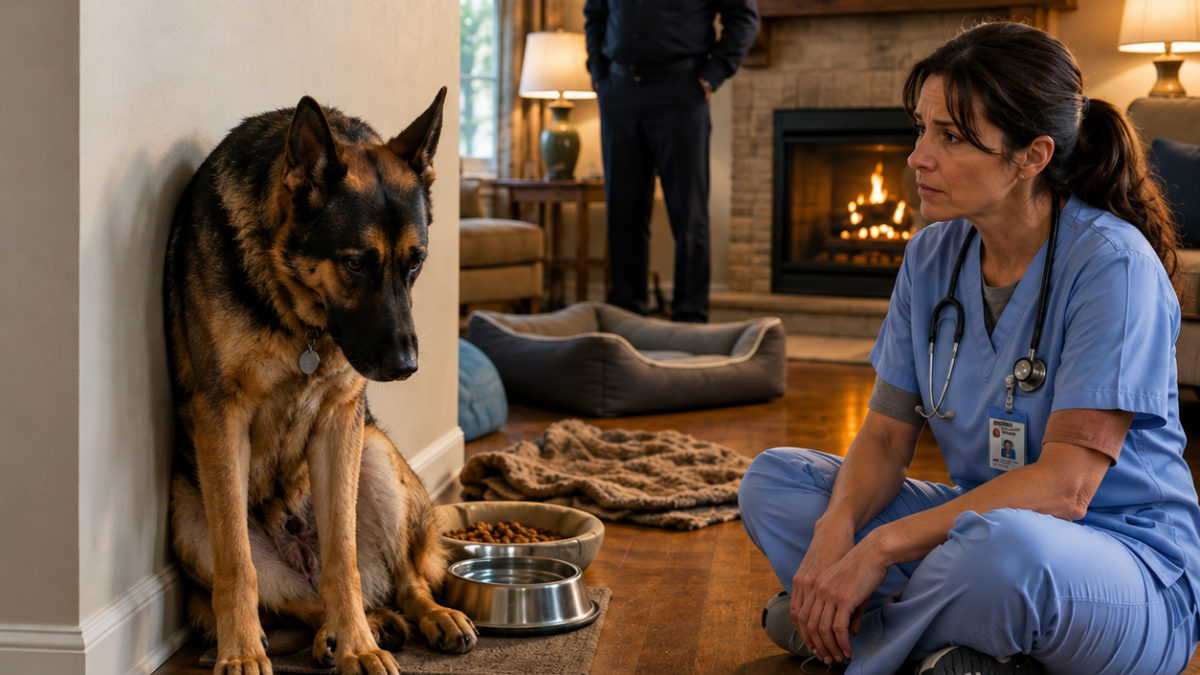
The German Shepherd stood near the far wall beside the fireplace. His right side was pressed firmly against the plaster. His body was parallel to the wall, head lowered, eyes open but distant. His ears did not rise when they entered. He did not bark. He did not turn. He did not even shift his weight.
He looked less like an animal guarding a space than one trying to keep himself from falling out of the world.
Rebecca did not approach.
Not yet.
She watched.
His coat was sable and black, thick along the shoulders, lighter at the chest. His body was fit but not young. The slight stiffness through his back legs suggested years of hard work, military surfaces, hard landings, quick turns, disciplined movement. His paws were large and steady. His breathing was slow. No visible tremor. No panting. No obvious acute pain.
But there was absence in him.
That was the word her mind offered.
Absence.
Not sleepiness.
Not defiance.
Not aggression.
Something withdrawn behind open eyes.
“How long has he been in this position?” Rebecca asked.
Grant checked his watch automatically.
“About forty minutes.”
“Has he moved at all since you called me?”
“He went to the kitchen once. Sniffed his bowl. Came back here.”
“Did he drink?”
“A little.”
“Urinate this morning?”
“Yes. I guided him outside.”
“Defecation?”
“Last night. Normal.”
Rebecca nodded.
She took one step forward.
Diesel did not react.
That concerned her.
Not because he looked dangerous.
Because he looked too far away to care.
She crouched slightly, not lowering herself all the way, not offering a hand.
“Hi, Diesel.”
The dog’s left ear moved a fraction.
Then went still.
Grant whispered, “This isn’t him.”
Rebecca looked at him.
“What happened four days ago?”
“Nothing.”
She stayed quiet.
That was one of the first things she had learned in nursing.
Silence was not empty.
Silence made people place truth where excuses had been.
Grant frowned, looking toward the dog.
“I don’t know. Routine was normal. Morning walk. Breakfast. I had two briefings from home. He slept in the living room. I went out for a meeting in the afternoon.”
“Who was here while you were gone?”
“No one.”
“When did the behavior start?”
“That evening.”
Rebecca looked around the living room.
“Anything moved? Visitors? Maintenance? Loud noises? A storm? Fireworks?”
“No.”
“Think carefully.”
Grant’s eyes shifted toward the fireplace.
“The only major change was…”
He stopped.
Rebecca waited.
“My old canine partner died.”
She turned slowly.
“Four days ago?”
“Yes.”
“Was the dog here?”
Grant nodded once.
“His name was Bruno.”
“What happened?”
“He was retired. Sixteen years old. Declining for months. Arthritis. Kidney disease. We knew it was coming.”
His voice flattened.
“He passed away at the veterinary hospital.”
Rebecca glanced toward Diesel.
“Did Diesel know him?”
Grant’s expression changed, not because the answer was difficult, but because the question seemed to strike something he had been avoiding.
“They were together for years.”
“How close?”
“They slept in the same kennel when deployed. Trained together. Retired to this house together.”
“Were they kenneled separately here?”
“No. They had separate beds, but they slept together half the time anyway. Bruno was older. Diesel followed him around like Bruno outranked everyone in the house.”
“Did he?”
For the first time, a faint ghost of a smile touched Grant’s face.
“Yes.”
Rebecca slowly stood.
“So Diesel lost his companion four days ago.”
Grant looked at the dog.
“Yes.”
“But I thought dogs don’t…”
He did not finish.
Rebecca understood.
“Don’t what?”
“Grieve like this.”
Rebecca looked back at Diesel.
“They notice changes. Especially dogs with strong social bonds. Working dogs even more so sometimes. Their routines, their people, their partners, their scent world. All of it matters.”
Grant stared at Diesel.
“I thought he was sick.”
“He might still be. We need to rule out medical causes. Four days with minimal food and water is serious.”
She pointed gently toward the dog.
“But the timing matters.”
Grant rubbed a hand across his jaw.
“I should have thought of that.”
“You are thinking of it now.”
That was all she gave him.
Not reassurance.
Not blame.
A step.
Rebecca asked Grant to bring Diesel’s veterinary records.
While he searched for them, she did not approach the dog.
She watched.
Diesel’s nose moved occasionally. His breathing remained slow. His body was not trembling. He was not repeatedly looking for an escape route. Not guarding. Not freezing from fear in the usual sense. He simply remained with his body pressed to the wall.
Rebecca shifted her attention to the room.
Then something caught her eye.
Near the fireplace sat a large dog bed.
No.
Two beds.
One in the expected place, angled near the hearth.
The other pushed awkwardly against the wall, partly folded, as if someone had moved it quickly and then could not bear to decide what to do with it. Nearby were two bowls, two blankets, two sets of toys.
One set had been used recently.
The other had the stillness of objects left behind after a hospital room is cleared.
Rebecca walked closer to the bedding, stopping well outside Diesel’s space.
“Where did Bruno sleep?”
Grant returned with a folder in his hand and stopped.
“Usually there.” He pointed near the fireplace. “The larger bed.”
“Where was Diesel’s bed?”
“Beside it.”
“Where is Bruno’s bed now?”
Grant looked at the one against the wall.
“I moved it.”
“When?”
“The day after he died.”
“Why?”
Grant’s jaw tightened.
“I couldn’t look at it.”
Rebecca nodded.
That answer held no fault.
Only grief.
She looked again at Diesel.
The dog had positioned himself with his side pressed against the wall exactly where the outer edge of Bruno’s old bed would have been before Grant moved it.
She looked toward the blanket.
A faint indentation remained in it, barely visible but present.
She did not touch it.
“Have you washed this?” she asked.
“No.”
“Why?”
Grant looked almost embarrassed.
“I couldn’t.”
Rebecca understood.
The blanket still smelled like Bruno.
The house did not.
Not the way it had before.
Human beings live in images and objects. Dogs live in scent, pattern, pressure, location, breath, body heat, and the map of what belongs where.
Bruno had disappeared.
Then Bruno’s place had moved.
Then the house had become quieter.
Then Grant had become anxious, watching Diesel with the command tension of a man who needed response.
Rebecca looked at the admiral.
“I don’t think he wants the wall.”
Grant frowned.
“What?”
“You said he just wants the wall. I don’t think that’s exactly right.”
“What is he doing?”
“I think he is staying as close to Bruno’s old place as he can.”
Grant looked at Diesel.
The dog’s body remained pressed against the plaster.
His head remained low.
Something shifted in Grant’s face.
“He hasn’t eaten.”
“I know.”
“He won’t move.”
“Then we don’t make him move just because we’re uncomfortable watching it.”
Grant stared at her.
“What should we do?”
“First, we get Dr. Feldman here. He needs a physical exam and bloodwork. Medical first.”
“And then?”
Rebecca lowered herself to the floor several feet away from Diesel.
She sat cross-legged on the rug.
Grant looked at her as if she had begun performing a ritual he did not recognize.
“What are you doing?”
“Sitting.”
“Why?”
“Because right now, I don’t think he needs another person asking him to respond.”
She looked toward Diesel.
“He needs someone willing to stay nearby without demanding anything.”
Diesel’s ears moved.
Grant saw it too.
The admiral stood behind her, uncertain what to do with his hands.
Rebecca did not call the dog.
Did not reach.
Did not offer food.
Did not click, coax, command, praise, or plead.
She simply sat.
For several minutes, nothing happened.
Then Diesel slowly turned his head.
For the first time since Rebecca entered the house, he looked directly at her.
Not at Grant.
At her.
Rebecca did not move.
Diesel kept staring.
Then, very slowly, he lifted one paw away from the wall.
Grant held his breath.
The dog did not walk.
He simply stood there, looking at Rebecca.
But his body was no longer sealed completely against the plaster.
And Rebecca realized the wall was not the whole story.
Diesel was not refusing the world.
He might still be looking for a reason to trust it again.
Dr. Aaron Feldman arrived forty minutes later.
He was a veterinarian in his fifties with careful hands and the kind of face animals trusted before people did. He had treated Diesel for years, and the dog’s ears shifted when the veterinarian entered, though he still did not step away from the wall.
“Hey, old soldier,” Dr. Feldman said softly.
Diesel blinked.
Grant stood too rigidly beside the sofa.
Rebecca saw Dr. Feldman glance at him before approaching the dog.
The examination was slow.
Respectful.
Diesel allowed it, though he remained withdrawn.
Heart rate normal.
Temperature normal.
No obvious orthopedic pain.
No abdominal sensitivity.
No fever.
No signs of acute injury.
Mild dehydration.
Some weight loss.
Bloodwork was drawn and rushed through the clinic’s portable processor.
While they waited, Rebecca returned to the floor.
Diesel remained close to the wall, but now he occasionally looked at her.
That mattered.
Dr. Feldman noticed too.
“You’ve been here an hour?” he asked quietly.
“About that.”
“And he’s looking at you.”
“I haven’t done much.”
“That may be why it’s working.”
Grant looked between them.
“What does that mean?”
Dr. Feldman answered first.
“Dogs in distress are often surrounded by people trying to fix something.”
Rebecca nodded.
“Especially working dogs. They are used to expectations. Commands. Tasks. Response. Sometimes when they cannot respond the way people expect, pressure makes them retreat further.”
“I wasn’t pressuring him,” Grant said.
Then he stopped.
Rebecca did not correct him.
She did not need to.
The bloodwork came back within normal limits. Mild dehydration, but nothing that explained the dramatic behavioral change.
Dr. Feldman looked relieved.
Grant did not.
“Then what is wrong with him?”
Rebecca looked toward the moved bed.
“Grief may be part of it.”
“Part?”
“Yes. There’s another possibility.”
“What?”
“When did you move Bruno’s bed?”
Grant looked at her.
“The day after he died.”
“And Diesel’s routine?”
“I tried to keep it normal.”
“How?”
“Same walks. Same feeding times. Same commands. Same house.”
Rebecca nodded.
“But the house was not the same to him.”
Grant frowned.
“Because Bruno was gone.”
“And because Bruno’s strongest scent changed location. His bed moved. The room changed. The routine changed emotionally even if the clock stayed the same. You were watching Diesel constantly. The house became quieter. You were trying to preserve normal, but he woke up inside a different version of the same home.”
Grant slowly sat down.
“So he lost Bruno. Then he lost Bruno’s place.”
Rebecca let the sentence stay between them.
Diesel looked toward the old bed.
Grant saw it.
For the first time, he did not look like an admiral receiving a report.
He looked like a man who had unknowingly removed the last landmark from a map his dog was desperately trying to read.
“What do I do?”
Rebecca’s voice softened.
“Put Bruno’s bed back.”
Grant looked at her sharply.
“You’re sure?”
“Not forever. Just for tonight.”
“I don’t know if I can.”
“You don’t have to do it because you’re ready,” Rebecca said. “You can do it because Diesel isn’t.”
That reached him.
Grant stood after a long pause.
He walked to the wall.
Diesel watched.
Grant lifted Bruno’s old bed with both hands. His face tightened as if the fabric weighed more than a dog bed should. He carried it back toward the fireplace and placed it where Rebecca indicated.
Then he laid Bruno’s old blanket beside it.
Diesel lifted his head immediately.
Grant froze.
The dog stood slowly.
One paw.
Then another.
He moved away from the wall for the first time since Rebecca had arrived.
He walked toward the bed, nose working, ears forward.
He sniffed the blanket.
Again.
Longer.
Then he stood beside it.
Grant’s eyes filled.
“He hasn’t gone there since the funeral.”
Rebecca stayed quiet.
Diesel lowered his head and sniffed the blanket again.
Then he looked toward Grant.
It was the first time he had voluntarily acknowledged his handler all morning.
Grant crouched.
“Hey, buddy.”
Diesel walked over.
Not quickly.
Not with full energy.
But he walked.
He pressed his head against Grant’s shoulder.
Grant closed his eyes.
Rebecca looked away.
Some moments did not need commentary.
That evening, Diesel drank water.
Then he ate a few bites of food.
Not much.
But something.
Grant stared at the bowl as if it were a miracle.
“He ate.”
Rebecca smiled.
“Yes.”
“That’s it?”
“That’s it for tonight.”
Grant looked almost frustrated.
“I want him back.”
Rebecca nodded.
“I know.”
“I mean it. He was… he was solid. Focused. Alive. He was Diesel.”
“He is Diesel.”
Grant looked at her.
“Don’t use that word,” she said gently.
“Which one?”
“Back.”
He frowned.
She gestured toward the dog.
“He is responding to a major loss. He does not have to become the exact dog he was before Bruno died. He has to become comfortable being the dog he is now.”
Grant was silent.
Commanders understand battlefields.
They do not always understand surrender.
The next morning, Rebecca returned.
Diesel was not against the wall.
He was lying beside Bruno’s old bed.
His head rested on his paws. His eyes were open, watchful, but not empty.
Grant met Rebecca in the hallway.
“He moved overnight.”
“I can see that.”
“He slept there for almost five hours.”
“Good.”
“He ate half a bowl this morning.”
“Excellent.”
Grant looked toward Diesel.
“He still hasn’t responded to commands.”
“That may not be the first goal.”
“Then what is?”
Rebecca entered the living room and sat on the floor again, several feet away.
Diesel lifted his head.
Then, after nearly a minute, he stood.
He walked toward her.
Stopped.
Sat.
Grant watched like the air had gone out of the room.
“What do you want me to do?” he whispered.
“Nothing.”
Diesel looked at Rebecca.
She extended one hand slowly, palm relaxed.
He sniffed it.
Then he lowered his head beneath her palm.
Rebecca gently touched the fur around his neck.
He did not pull away.
Grant’s expression softened.
“He hasn’t let anyone touch him there since Bruno died.”
“Then that’s significant.”
Over the next several days, the routine changed gradually.
Not dramatically.
Not with urgency.
Rebecca was careful about that.
Bruno’s bed remained near the fireplace for a while. Diesel’s feeding schedule became consistent. Walks were shorter. Visitors were limited. The house stopped rearranging itself around absence.
Grant stopped calling Diesel repeatedly whenever the dog withdrew.
Instead, he sat nearby.
Waited.
Allowed Diesel to choose.
And something unexpected happened.
The dog started choosing.
He began sleeping away from the wall for part of the night.
He followed Grant into the kitchen.
He brought his blue training toy once, carrying it not with enthusiasm exactly, but with a question in his mouth.
Grant stared.
Rebecca smiled.
“Don’t make a ceremony of it.”
“I wasn’t.”
“You were about to.”
“I outrank you.”
“Not in this living room.”
Grant looked at her.
Then laughed.
It startled both of them.
Diesel’s ears rose.
Grant immediately stopped laughing as if afraid the sound would ruin the moment.
Rebecca shook her head.
“Laughing is allowed.”
Grant looked at Diesel.
“He hasn’t heard much of it lately.”
“No,” Rebecca said. “I imagine he hasn’t.”
That was the other part.
The part Grant had not wanted to name.
Bruno had not belonged only to Diesel.
He had belonged to Grant too.
For years, Grant Holloway had come home to two dogs waiting at the door. Diesel direct, disciplined, intense. Bruno slower, older, dignified, with a graying muzzle and a habit of leaning against Grant’s leg as if reminding him that rank ended at the threshold.
Bruno had retired first.
Diesel followed later.
Together they had filled the house with routine.
Two bowls sliding across tile.
Two sets of nails clicking through the hallway.
Two heavy bodies settling near the fireplace.
Two different snores at night.
Two leashes hanging by the door.
When Bruno’s health declined, Grant had done what officers do.
He monitored.
Scheduled.
Administered medication.
Logged symptoms.
Adjusted food.
Met with veterinarians.
Measured water intake.
Made decisions.
He called it care because it was.
But after Bruno died, Grant had continued managing.
He managed the bed.
Managed the bowls.
Managed the silence.
Managed Diesel’s food.
Managed his own face.
Managed grief like grief was an operation that could be contained if everyone followed procedure.
Diesel had not followed procedure.
Diesel had gone to the wall.
Every evening, even after he began eating again, Diesel returned there.
Not for an hour anymore.
Not all night.
Only a few minutes.
He would walk to the wall, press his shoulder against it, close his eyes, then leave.
Grant asked Rebecca about it on the fifth day.
“Should I stop him?”
“No.”
“Why not?”
“Because maybe he doesn’t need us to take that memory away.”
Diesel stood at the wall, breathing steadily.
Rebecca watched him.
“Maybe he needs to know he can visit it and still leave.”
Grant looked at the dog.
That idea seemed to change the way he saw the wall.
It was not the enemy.
It was not a symptom to erase.
It was part of the dog’s mourning.
And mourning did not always need correction.
Sometimes it needed a safe place.
One evening, as Rebecca prepared to leave, Diesel stood near the doorway.
He looked at her.
Then at the empty hallway.
Then back at her.
Rebecca paused.
“What?”
Grant laughed softly.
“He doesn’t want you to go.”
“You think?”
“He’s never done that with visitors.”
Diesel took one step toward her.
Then stopped.
Rebecca crouched.
“Good night, Diesel.”
The dog touched his nose to her hand.
Then returned to Grant.
Before leaving, Rebecca looked at the admiral.
“Tomorrow, move the bed.”
He frowned.
“Where?”
“Toward the center of the room.”
“Not away from the wall?”
“Not exactly. Toward choice.”
Grant looked confused.
Rebecca smiled.
“Right now, the room has two places: Bruno’s place and the wall. Let’s create a third.”
The next morning, when Rebecca arrived, Grant had already done it.
Bruno’s old bed sat a little farther from the wall, still near the fireplace, still holding the old blanket, but no longer pressed into the corner. Diesel lay beside his own bed, head up, eyes open, watching.
Grant stood near the kitchen doorway.
“He walked around last night.”
“Did he eat?”
“Almost the entire bowl.”
“Good.”
“He brought me his training toy again.”
“That’s excellent.”
Grant looked toward Diesel.
“I thought I had lost him.”
Rebecca shook her head.
“You were watching him like something was wrong with him.”
“There was.”
“No,” she said gently. “Something was wrong around him.”
Grant became quiet.
That distinction mattered.
Rebecca sat on the floor.
Diesel lifted his head, then stood. He walked toward her—not quickly, not cautiously, just normally. He stopped beside her. Rebecca offered her hand. He sniffed it, then lowered his head beneath her palm.
Grant smiled.
“I’ve never seen him do that.”
“He’s learning that the world is still predictable.”
“What changed?”
Rebecca looked at him.
“We did.”
For days, Grant had been searching for a solution.
A specialist.
A medication.
A treatment plan.
More exercise.
Less exercise.
Different food.
Different commands.
A way to restore Diesel to what he had been before.
Rebecca had done something different.
She had observed.
She had asked one question:
What changed?
The answer had not been complicated.
Diesel had lost his closest companion.
Then his home changed.
His routine changed.
His scent environment changed.
His person became anxious.
Everyone around him wanted him to return to normal.
So Diesel had retreated to the one place that remained predictable.
The wall.
It was not a strange obsession.
It was the only constant he could find.
Grant moved Bruno’s old bed again that afternoon.
Slowly.
Half a meter.
Then another.
Diesel watched.
Rebecca watched too.
The bed came to rest near the center of the living room.
Not far from the fireplace.
Not against the wall.
Open space on all sides.
Diesel stood.
He walked around it.
Sniffed the blanket.
Looked at the wall.
Then looked toward Grant.
Grant stopped moving.
“What now?”
Rebecca smiled.
“Let him decide.”
Diesel stood there for several seconds.
Then he walked toward the middle of the room.
He turned once.
Looked around.
And lay down.
Not against the wall.
Not beside Bruno’s old corner.
In the center.
Grant stared.
Rebecca smiled.
“He chose.”
Grant swallowed.
“That’s the first time he’s done that.”
“Exactly.”
For two weeks, the changes continued.
Diesel began eating normally.
He greeted Grant at the door again, though not with the same explosive enthusiasm as before. He responded to familiar commands, then chose sometimes to ignore unnecessary ones in a way Grant admitted Bruno would have approved of. He accepted short walks. He carried the blue training toy outside once and dropped it in the grass.
Then, one cold afternoon, something happened that Grant had not seen since Bruno died.
Diesel ran.
Not far.
Just across the yard.
Twenty yards of sudden motion, head low, tail lifted, paws striking damp grass.
But he ran.
Grant laughed.
“That’s him.”
Rebecca watched from the porch.
“That’s part of him.”
Grant turned.
“What do you mean?”
“He isn’t going back,” she said. “He’s going forward.”
Grant smiled faintly.
“That sounds like something you’ve said before.”
“Because you keep trying to get him back.”
He looked at Diesel.
The dog stood by the fence, sniffing the air.
Grant’s smile faded into something softer.
“I miss Bruno too.”
“I know.”
“Maybe I’ve been making it harder for him.”
“Possibly.”
Grant sighed.
“I thought if I kept everything normal, he wouldn’t notice Bruno was gone.”
Rebecca looked at him.
“Dogs notice.”
Grant gave a short, sad laugh.
“Apparently.”
“And people do too.”
He nodded.
The conversation became quiet because Rebecca was not only talking about Diesel.
Grant had lost Bruno too.
He had been grieving while trying to remain the officer in charge of everything.
Rebecca saw it.
Diesel probably had too.
One evening, Grant sat on the floor beside Diesel’s bed holding an old photograph.
Bruno.
Younger.
Strong.
Standing between Grant and Diesel in front of a transport aircraft.
Diesel walked over.
He sniffed the photograph.
Then sat beside Grant.
Grant ran one hand over Diesel’s shoulder.
“You miss him too.”
Diesel rested his head against Grant’s arm.
Rebecca watched from across the room.
Neither of them needed to say anything.
For the first time, Grant allowed himself to grieve without treating grief as a problem that needed solving.
Diesel did not need Grant to hide the loss.
He needed Grant to acknowledge it.
A few weeks later, the admiral called Rebecca again.
“How’s he doing?” she asked.
“Good,” Grant said.
Then, after a small pause, “Actually good.”
Rebecca smiled.
“He sleeps in the middle of the room now.”
“Good.”
“He still visits the wall.”
“How long?”
“A few minutes. Then he walks away.”
“That sounds healthy.”
Grant was quiet.
“You know what I realized?”
“What?”
“I don’t need him to stop remembering Bruno.”
“No.”
“I just need him to know he’s safe enough to keep living.”
Rebecca nodded though he could not see it.
“That’s the whole thing.”
Months passed.
Diesel returned to routine.
Not the exact routine he had before.
A new one.
He became more social with familiar visitors. He slept in different rooms. He followed Grant around the house. He played more often. He brought the blue training toy and dropped it at Grant’s feet with a look that clearly said humans were slow but trainable.
But once every few days, Diesel would still walk toward the wall.
Stand there.
Press his side against it.
Close his eyes.
Then leave.
Grant never stopped him.
Rebecca never asked him to.
The wall had become a memory.
Not a prison.
One afternoon, Rebecca visited while Grant was at a naval appointment. A family assistant let her in. Diesel came down the hall when he heard her voice.
He walked toward her.
Stopped.
Looked at her.
Then walked to the wall.
He pressed his side against it for several seconds.
Rebecca did not interrupt.
After a while, he moved away, walked back, and lay down beside her.
She smiled.
“I know.”
Diesel’s tail moved once.
“You miss him.”
The dog closed his eyes.
She sat beside him.
“No one is asking you to forget.”
Diesel leaned closer.
Rebecca gently stroked his fur.
For a few minutes, the house was completely quiet.
When Grant returned, he found them sitting together.
He stopped in the doorway.
“You two have your own arrangement now.”
Rebecca laughed.
“Apparently.”
Grant came into the room and sat with them.
Diesel was relaxed, completely different from the animal who had once stood like a statue against the wall.
For a moment, the three of them simply stayed there.
Then Grant said, “I want to thank you.”
Rebecca looked over.
“For what?”
“You didn’t fix him.”
“No.”
“You taught me how to stop trying to.”
That mattered more.
Grant looked at Diesel.
“He saved me too.”
“What do you mean?”
“He made me understand I wasn’t the only one grieving.”
Rebecca smiled.
“Sometimes dogs make us admit things we wouldn’t say ourselves.”
Grant laughed softly.
“That is exactly what happened.”
Before Rebecca left, Grant walked her to the door.
“One more thing.”
She turned.
“What’s that?”
“I used to think being a good handler meant knowing how to control a dog.”
Rebecca smiled.
“And now?”
He looked back toward the living room.
Diesel was lying in the middle of the room, not against the wall, not hiding.
Just resting.
“Knowing when not to.”
Rebecca nodded.
“That’s a good lesson.”
Months later, Diesel would still occasionally visit the wall, and nobody worried because they understood now.
Recovery did not mean erasing Bruno.
It did not mean pretending the loss had not happened.
It meant Diesel could remember him and still eat.
Remember him and still play.
Remember him and still sleep.
Remember him and still choose the center of the room.
That was the real change.
Rebecca had not made the military K9 normal again.
She had helped the admiral understand what the dog was saying.
And Grant had learned to listen.
Sometimes a dog does not need another command.
Sometimes he does not need another treatment.
Sometimes he needs someone to notice what changed around him.
To stop asking, “How do I make him go back to normal?”
And start asking, “What does he need to feel safe again?”
Diesel had been standing against that wall because it held the last familiar piece of a life that had disappeared.
Now he could leave it.
Not because he had forgotten Bruno.
Because he finally believed there was still something worth moving toward.
And every evening when Grant came home, Diesel would meet him at the door.
The admiral would kneel.
The dog would lean against him.
And for a few seconds, neither would move.
Because sometimes healing does not look like a dramatic transformation.
Sometimes healing looks like a dog who once spent an hour facing a wall finally turning around.
And choosing to come home.








