A Mute 6-Year-Old Grabbed a Biker in Walmart and Kept Signing the Same Word—Then a Pharmacy Worker Whispered, “Don’t Let That Man Take Her.”
The machine told me to place the item in the bagging area.
I told the machine something impolite.
A woman two registers over looked at me.
I apologized.
That was when Nora came around the corner.
At first I heard feet.
Fast.
Little bare sneakers slapping polished concrete.
Then pink.
Pink Bluey shirt.
Denim shorts.
Blond hair half pulled out of two braids.
She came around the endcap at a dead sprint.
Straight toward me.
I had enough time to think:
Kid’s gonna hit me.
Then she did.
Both arms wrapped around my waist.
Hard.
Not child-hug hard.
Desperate hard.
Her forehead hit my belt buckle.
The water bottle dropped.
Rolled under the self-checkout.
I looked down.
“What the—”
She lifted her face.
That was when I understood something was wrong.
Her mouth was open.
Her face was crimson.
Tears everywhere.
But no scream.
Nothing.
Only breath.
Fast.
Wet.
Ragged.
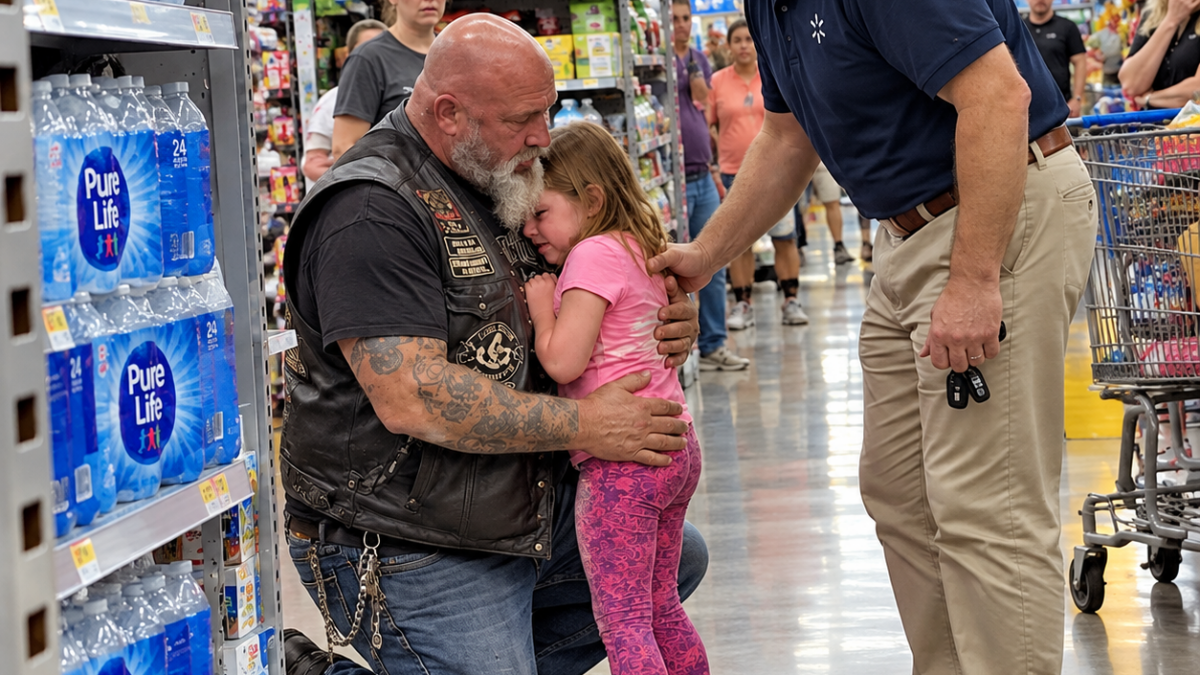
She grabbed both sides of my vest.
Fingers locked around leather.
Then let go with one hand.
Made a sign.
Both hands involved.
Quick motion.
Again.
Again.
Again.
Same sign.
Her eyes stayed on mine.
I knew nothing.
Not one sign.
I had seen interpreters on television.
That was the full extent of my education.
I crouched.
“Slow down.”
Stupid thing to say.
She made it faster.
Again.
Again.
Again.
Then pointed over her shoulder.
Back toward grocery.
Signed.
Pointed.
Signed.
Her face begged me to understand something I did not have the language to understand.
People gathered.
Nobody came close.
That is another thing crowds do.
They become circles.
Enough distance to be safe.
Close enough to watch.
Maybe thirty people.
A woman holding cereal.
Two teenagers.
Older couple.
Employee in yellow vest.
Two phones already up.
Of course.
I looked around.
“Anybody know sign language?”
Nobody answered.
One kid lowered his phone.
The other kept filming.
I said:
“Anybody?”
Nothing.
The girl yanked my vest.
Hard.
I looked back down.
“Okay.”
I dropped onto one knee.
My bad knee protested.
“Okay, sweetheart.”
She signed again.
“I don’t understand.”
I pointed toward myself.
“Ray.”
Then:
“You?”
She hit her chest.
I could not tell whether that meant name or urgency.
She signed.
Again.
Again.
I held both palms out.
“Show me.”
That was when the man appeared.
Khaki pants.
Brown loafers.
Blue polo shirt.
Late thirties maybe.
Dark hair.
Car keys in his right hand.
He approached from the grocery aisle.
Not running.
Walking.
That mattered to me at the time.
He smiled.
Normal smile.
A little embarrassed.
“Sorry.”
He exhaled.
“She does this.”
I looked at the girl.
She had gone absolutely rigid.
He pointed toward her.
“She’s autistic.”
His voice carried the tired patience of a parent explaining something for the thousandth time.
“I’ve got her.”
He reached down.
Nora’s reaction was instant.
She turned into me.
Both fists in my vest again.
Face against my chest.
Then she spun partly around and signed at him.
Same sign.
Harder.
Again.
Again.
Her hands smacked so sharply I could hear skin.
He said:
“Nora.”
She signed.
“Nora, stop.”
Signed.
“Come on.”
He grabbed for her wrist.
I moved her behind my arm.
Did not think about it.
Just happened.
“Give me a second, chief.”
His smile disappeared.
“Excuse me?”
“She’s trying to tell somebody something.”
“She’s having a meltdown.”
He reached again.
I shifted.
Not aggressive.
Yet.
His eyes moved over me.
Leather.
Size.
Beard.
He recalculated.
“I appreciate you helping.”
His voice changed slightly.
“But she’s my daughter.”
“That’s fine.”
“Then let her go.”
“Give me ten seconds.”
I looked toward the crowd again.
“Does anybody know what she’s saying?”
A voice came from behind me.
“I do.”
Young woman.
Pharmacy smock.
Maybe twenty.
Brown hair tied up.
Name tag:
MADDIE.
She had left the pharmacy counter and was walking quickly toward us.
The man said:
“We’re fine.”
Maddie ignored him.
She got beside me.
Watched Nora’s hands.
Her face changed.
“Sir.”
She whispered.
“What?”
“Don’t let go.”
I felt every muscle in my back tighten.
“What is she saying?”
Maddie looked toward the man.
Then Nora.
Then back to me.
“That’s not help.”
My stomach dropped.
“What?”
“She’s signing sick.”
“Sick?”
I looked at Nora.
“She’s sick?”
“No.”
Maddie shook her head.
“She’s saying it to him.”
Nora pointed at the man.
Signed.
Sick.
Pointed.
Signed.
Sick.
Maddie whispered:
“She keeps telling him he’s sick.”
The man laughed.
Too quickly.
“I’m fine.”
That was the moment I actually looked at him.
Not polo shirt.
Not keys.
Not respectable haircut.
Him.
Gray.
Not pale.
Gray.
Sweat poured from his hairline.
His shirt collar was dark.
Walmart was cold enough that I had goosebumps on my forearms.
His left hand was balled around his keys so hard the metal cut into his palm.
His right hand drifted toward the center of his chest.
Stopped.
Dropped.
Then did it again.
Subtle.
Like he did not want anyone noticing.
I stood.
“You all right, man?”
“I said I’m fine.”
“Didn’t ask what you said.”
His jaw tightened.
“Heartburn.”
“Bad burrito.”
“Need to get her to the car.”
Nora slapped her chest.
Twice.
Then pointed at him.
Even without sign language, I understood.
You.
You.
Maddie said:
“She’s saying you.”
He looked at Nora.
Something like anger flashed.
Or fear disguised as anger.
“Nora.”
He signed something one-handed.
Maddie watched.
“What’d he say?”
“Fine.”
Maddie answered.
“He told her fine.”
Nora shook her head violently.
Sick.
The man turned toward the doors.
“Nora.”
He made it two steps.
Three.
His keys fell.
He stopped.
I saw his left shoulder rise.
Right hand hit his chest.
He looked surprised.
That expression haunts me.
Not pain.
Surprise.
Like his body had betrayed an agreement.
Then his knees folded.
He went face-first into a pallet of charcoal briquettes.
The crowd screamed.
Phones jerked.
Nora did not scream.
She could not.
She simply came apart against me.
Mouth open.
No sound.
Whole body convulsing.
Hands searching.
I lifted her away from falling boxes.
Then put her down.
Every part of me wanted to hold her.
But you cannot do CPR while holding a six-year-old.
And I knew what came next.
Twenty-two years as a volunteer firefighter in a town of fourteen hundred people.
Car wrecks.
Farm accidents.
House fires.
Heart attacks.
A tractor rollover I still dream about.
People think volunteer means amateur.
Not where I came from.
When the ambulance is seventeen minutes away, the volunteer with the radio is sometimes the entire emergency department.
I rolled the man onto his back.
“Sir?”
No response.
I tapped hard.
“Can you hear me?”
Nothing.
His eyes were partly open.
No focus.
I put fingers on carotid.
Waited.
One second.
Two.
Nothing.
I leaned over his mouth.
No breath.
My stomach turned cold.
“He’s not breathing.”
Maddie froze.
“Maddie.”
She looked at me.
“That your name?”
“Yes.”
“Call 911.”
She pulled out store phone.
“Get the AED.”
“What?”
“Yellow box on pharmacy wall.”
She nodded.
Ran.
I pointed at a man in a Tyson Foods shirt.
“You.”
He looked behind himself.
“Me?”
“Yeah.”
“Get down here.”
He dropped to knees.
“What do I do?”
“Watch me.”
I placed heel of hand center chest.
Other hand.
Locked elbows.
Started compressions.
One.
Two.
Three.
CPR is violence with permission.
Nobody says that.
Training mannequins do not sound like people.
Bodies do.
Around compression seven or eight, something shifted.
A crack.
Rib.
Someone in crowd gasped.
I did not stop.
“That’s supposed to happen sometimes.”
I said it for them.
For me.
I counted.
Twenty-eight.
Twenty-nine.
Thirty.
Reposition.
Again.
The man’s face looked wrong.
Too still.
His name was Brandon.
I did not know that yet.
At that moment, he was just somebody’s father whose daughter knew he was dying before any adult in the building did.
And I had done this before.
Three years earlier.
Sturgis.
Behind a beer tent.
A brother we called Pogo.
Real name Mark Ellis.
Rode with me since 1987.
Pogo dropped mid-sentence.
I gave CPR for fourteen minutes.
Dust beneath knees.
Music still playing fifty yards away.
People watching.
Paramedics came.
Shocked him.
Worked.
Nothing.
Pogo died before sunset.
I had felt his ribs break too.
For months afterward, every time I closed my hands together, I felt them.
Now I felt Brandon’s.
Pogo’s face tried to replace his.
I shoved memory down.
One.
Two.
Three.
Nora crawled toward us.
Someone tried stopping her.
She yanked away.
She got to her father’s head.
Kneeled.
Put both small hands on his cheeks.
Turned his face toward her.
Then signed.
Sick.
Sick.
Sick.
Fast.
Angry now.
Like:
I told you.
I told you.
I told you.
My vision blurred.
Keep counting.
She stopped signing.
Lowered her forehead onto his.
Stayed there.
Maddie came running.
Yellow AED case.
Phone against shoulder.
“They’re coming.”
“How long?”
“Six minutes.”
Too long.
Not impossible.
“Open it.”
She fumbled latch.
I said:
“Breathe.”
Immediately hated the irony.
She got box open.
AED voice began.
Apply pads to patient’s bare chest.
“Tear his shirt.”
Maddie hesitated.
“Rip it.”
She did.
Buttons flew.
I kept compressing.
AED pads.
One high right chest.
One lower left.
Maddie’s first one crooked.
Her hands trembled.
“Again.”
She peeled.
Reapplied.
The Tyson man asked:
“Can I help?”
“Yes.”
I looked at him.
“When I say switch, you take my place.”
“Hands same spot.”
“Hard.”
“Fast.”
“Don’t stop because it feels ugly.”
His face went pale.
“I got you.”
Maddie looked at Nora.
She said:
“Should I tell her he’ll be okay?”
I almost said yes.
Automatically.
Tell child comforting lie.
Then Maddie shook her head.
“No.”
She looked at me.
“I’m not lying to her.”
I stopped counting for half a second internally, not physically.
Twenty-year-old kid.
Better judgment than most adults.
She kneeled near Nora.
Tapped shoulder.
Nora lifted her face.
Maddie signed slowly.
Spoke aloud for me.
“Daddy.”
Sign.
“Sick.”
“Big man.”
She pointed to me.
“Helping.”
Then:
“Wait.”
Nora looked at my hands.
Up.
Down.
Up.
Down.
She reached.
Placed one palm over the back of my top hand.
Tiny.
Warm.
I could not stop.
“Not yet, baby.”
I said.
“Not yet.”
Her hand rode every compression.
Analyzing heart rhythm.
“Hands off!”
I lifted.
Tyson man moved back.
Maddie pulled Nora against her.
AED:
Shock advised.
Charging.
Somebody in crowd said:
“Oh God.”
I had not prayed in Walmart before.
I prayed then.
Nothing elaborate.
Please.
That was it.
“Clear!”
I checked visually.
Hit button.
Brandon’s entire body jumped.
Nora flinched.
No scream.
Only air.
“Switch.”
Tyson man moved in.
Hands.
Good position.
“Go.”
He compressed.
Hard.
I counted.
One.
Two.
Three.
Brandon did nothing.
Ten.
Eleven.
Twelve.
Nothing.
Twenty.
Then throat moved.
I thought imagination.
Twenty-one.
Gasp.
Wet.
Violent.
Like someone breaking surface after drowning.
“Stop.”
Tyson man froze.
Another breath.
Brandon’s arm lifted.
Grabbed air.
“Roll him.”
We turned him onto side.
He vomited across my boots.
I swear to you:
best thing anybody has ever done to my shoes.
Nora broke from Maddie.
Crawled to him.
Face inches away.
Brandon’s eyes opened.
Barely.
Found her.
He could not speak.
One hand trembled upward.
Made a sign.
Clumsy.
Slow.
Nora stopped.
Her face crumpled.
I did not know the sign.
Maddie did.
Later she told me.
Sorry.
Sirens.
Doors.
Paramedics.
Cops.
Chaos returned.
The first officer came fast.
Young man.
Saw:
Large biker.
Man on floor.
Crying child.
Crowd.
Phones.
He put hand near weapon.
“Sir.”
I backed away already.
“Step away.”
“I performed CPR.”
“Step away.”
I raised hands.
Forty years riding teaches lessons.
One:
when officer’s hand moves to hip, do not win argument.
Especially if you are right.
Maddie jumped between us.
All five foot two of her.
“Are you kidding?”
The officer said:
“Ma’am.”
“That man was dead.”
She pointed at Brandon.
“Dead.”
“He brought him back.”
“We received two calls.”
“One reported biker grabbing a child.”
Maddie looked around at crowd.
“Then one person here is an idiot.”
A few phones lowered.
Older female officer arrived.
Sergeant.
She read scene quickly.
Paramedics working.
AED open.
Tyson worker explaining.
Maddie furious.
Nora trying to reach stretcher.
She looked at me.
“You Ray?”
I nodded.
“How’d you know?”
“Volunteer fire twenty-two years.”
She wrote.
“Any contact with child before father collapsed?”
“She grabbed me.”
“Why?”
“I didn’t know.”
Maddie said:
“She was asking for help.”
Sergeant looked at Nora.
“Can she tell me her name?”
Maddie signed something.
Nora signed back.
“Nora.”
Sergeant softened.
Paramedics loaded Brandon.
Oxygen.
Monitor.
He was conscious enough to answer.
“Name?”
“Brandon.”
“Last name?”
“Bennett.”
“Age?”
“Thirty-eight.”
“Chest pain how long?”
He hesitated.
Paramedic repeated:
“How long?”
“Two days.”
Even I wanted to punch him.
Nora stared.
Apparently she had already tried.
Sergeant asked:
“Mother?”
Brandon pulled oxygen mask.
“Jess.”
“My wife.”
“Works Baptist.”
“Cardiac nurse.”
The paramedic actually stopped.
“Your wife is cardiac nurse?”
Brandon closed eyes.
“Yes.”
“You’ve had chest pain two days?”
“Yes.”
The paramedic muttered something professional-looking that probably meant idiot.
Nora fought sergeant’s grip to reach stretcher.
Not violent.
Pulling.
Brandon reached hand.
They touched fingers.
Then stretcher rolled.
Nora stood.
Looked at me.
I expected nothing.
She walked straight over.
Took my right hand.
Hooked two fingers of one hand around two fingers of the other.
Links.
Then pointed at herself.
Pointed at me.
I looked toward Maddie.
Maddie’s mouth trembled.
“Friend.”
“What?”
“She signed friend.”
Nora did it again.
Two little links.
Friend.
Something inside my chest hurt worse than CPR.
Paramedics left.
Sergeant transported Nora in cruiser because there was no other guardian immediately available and hospital social services were waiting.
Maddie ran to toy aisle.
Returned with stuffed dog.
Tags still attached.
Handed it to Nora.
Nora held dog.
Then touched my vest before leaving.
I stood in automatic doors holding water bottle I had never paid for.
A Walmart manager eventually did it for me.
“Take it.”
He said.
I looked at him.
“What?”
“Water.”
“Take it.”
So I did.
I rode to hospital.
Nobody asked me.
I told myself I only wanted to know whether Brandon survived.
That was partly true.
Hospital waiting rooms and bikers have a long history.
Usually bad.
I knew what I looked like.
Blood on knuckles.
Vomit on boots.
Leather vest.
So I stayed outside.
Road King beneath lamp.
Smoked cigarette.
I had quit two years earlier after Carol died.
Then another.
Then third.
Carol would have slapped them out of my mouth.
Carol Dawson.
My wife.
Thirty-five years.
We tried to have children for eleven.
Doctors.
Tests.
Shots.
Two miscarriages.
Then stopped.
Not because we stopped wanting.
Because wanting had begun killing us.
Carol taught second grade.
Had hundreds of kids pass through her classroom.
At home:
just us.
We built good life.
Motorcycles.
Garden.
Church sometimes.
Friends.
Nieces.
Dogs.
She died four years before Walmart.
Ovarian cancer.
Eleven months from diagnosis to funeral.
After she was gone, house became so quiet I sometimes left garage radio on all night.
I had never been chosen by a child.
Not like that.
Nora had grabbed me.
Then signed friend.
I did not know what to do with that.
At ten, hospital doors opened.
Woman in blue scrubs.
Dark ponytail.
Hospital badge still clipped.
She walked directly toward me.
“You’re Ray.”
“Yes, ma’am.”
“I’m Jess Bennett.”
Brandon’s wife.
I stood.
She stopped four feet away.
Hands over mouth.
Tried to speak.
Could not.
Finally:
“He’s alive.”
My knees nearly went.
I sat again.
Jess laughed through tears.
“Cath lab.”
“LAD ninety-five percent blocked.”
I knew enough.
“Widowmaker.”
She nodded.
“They put in a stent.”
“Cardiologist said…”
She stopped.
Started over.
“He said if Brandon had collapsed in parking lot instead…”
“Or if compressions started five minutes later…”
“He wouldn’t have survived.”
I looked away.
Jess continued.
“They told me twice.”
As though repetition could make impossible fact real.
“He’s had chest pain two days.”
Her voice sharpened.
“Two days.”
“I’m a cardiac nurse.”
She laughed once.
Ugly sound.
“My husband has chest pain for two days and tells me it’s heartburn.”
I said:
“He told me burrito.”
Jess closed her eyes.
“Of course.”
Silence.
Then:
“He told you Nora’s autistic?”
“Yes.”
“She isn’t.”
I looked up.
Jess sat beside me.
“She has congenital bilateral vocal fold paralysis.”
The phrase meant nothing.
Jess smiled tiredly.
“Longer than she is.”
“She was born with nerves that don’t properly move her vocal cords.”
“Surgery when she was a baby.”
“Airway’s fine now.”
“But she has never had functional voice.”
“She can make breath sounds.”
“Some clicks.”
“No speech.”
“She signs.”
I thought of Brandon.
“She’s not autistic?”
“No.”
“Why’d he say it?”
“Because people stop asking questions.”
Jess rubbed face.
“If he says ‘rare laryngeal paralysis,’ they stare.”
“Ask if it can be fixed.”
“Ask whether she’s deaf.”
“Ask whether she’ll ever be normal.”
“So sometimes he says autistic because people understand enough to leave us alone.”
I understood.
Not correct.
Human.
“She knew he was sick.”
Jess looked at me.
“Before he did.”
I remembered:
Sick.
Fine.
Sick.
Fine.
Jess said:
“Brandon knows maybe thirty signs.”
“Basic.”
“Hungry.”
“Bathroom.”
“Fine.”
“Love you.”
“Stop.”
“Wait.”
“He kept saying he’d take the full class.”
“Never did.”
Her eyes filled.
“Nora told me what happened.”
“How?”
“She signs faster than I do.”
“What did she say?”
Jess took breath.
“She said Daddy was signing fine.”
“She signed sick.”
“He signed fine.”
“Over and over.”
“For how long?”
“From home.”
“What?”
“He was having chest pressure before they left.”
“Nora saw him grab the counter.”
“She signed sick.”
“He signed fine.”
“In car he rubbed chest.”
“Sick.”
“Fine.”
“In parking lot he went gray.”
“She said his hand shook.”
“She signed sick again.”
“He told her they just needed water and antacid.”
“Then inside store he bent over cart.”
“She got scared.”
Jess looked at me.
“So she ran.”
“Why you?”
That question hit me.
Jess almost smiled.
“She told me.”
I waited.
“She said Daddy is big.”
I laughed softly.
“Okay.”
“And she needed someone bigger.”
I stopped laughing.
Jess pointed toward my shoulders.
“She ran past a lot of people.”
“She saw you.”
“Big.”
“Looking at her.”
“Everyone else?”
“She said faces.”
That was probably her shorthand.
People looking.
Not moving.
“Then her father came.”
“And tried to take her.”
Jess nodded.
“She knew if she went with him…”
Her voice broke.
“No one would help.”
I stared at parking lot.
Cars.
Lights.
“She told me one thing over and over.”
“What?”
Jess signed something slowly.
Then translated.
“Big man didn’t let go.”
I looked down at my hands.
Those hands had done ugly things.
Fistfights when younger.
Broken nose in a bar.
Wrenches thrown.
Pogo’s ribs.
Carol’s coffin.
Today:
Brandon’s chest.
Nora’s fingers.
“I almost did.”
“What?”
“When Brandon walked up.”
I looked at Jess.
“I almost handed her back.”
“You didn’t.”
“I thought he was…”
I stopped.
“What?”
“I don’t know.”
“Bad.”
“Something.”
“He smiled wrong.”
“Reached wrong.”
“I had my weight set.”
“If he pushed…”
I swallowed.
“I might’ve put a dying man through the shelf.”
Jess stared.
“I’ve been judged by people my whole adult life.”
I said.
“And I judged him in two seconds.”
Jess was quiet.
Then:
“Maybe Nora was the only one paying attention to the right thing.”
That stayed.
Nora did not see biker.
Did not see polo shirt.
Did not see threat.
Respectability.
Class.
She saw:
Dad sick.
Big stranger.
Need help.
Cleaner than all of us.
Jess touched my sleeve.
“Come inside.”
I hesitated.
“I’m not family.”
She looked at me.
“My daughter says you are her friend.”
So I went.
Nora was in family waiting area.
Stuffed dog.
Maddie had apparently come too after shift ended.
Nora saw me.
Got up.
Walked over.
No running.
Held hands.
Friend.
I tried to copy.
Wrong.
She frowned.
Corrected me.
I failed again.
First time I made Nora smile.
Barely.
But smile.
She shook head like I was hopeless.
Fair.
Brandon stayed overnight ICU.
Then two nights cardiac unit.
I did not need to remain.
I left after midnight.
Before leaving, Jess hugged me.
Nora touched two fingers to mine.
At home, I took off boots in garage.
Looked at vomit stains.
Sat on floor.
Cried.
For Brandon.
For Nora.
For Pogo.
For Carol.
For the child Carol and I never got.
All mixed.
Grief is not organized.
Next morning, there was video online.
Of course.
“Biker Grabs Mute Child in Walmart Before Man Collapses.”
That was one caption.
Another:
“Scary Biker Saves Dad After Little Girl Begs for Help.”
Same event.
Two stories.
Depending on who wanted clicks.
First clip ended before Brandon collapsed.
It showed Nora holding my vest, Brandon approaching, me moving her away.
Comments:
That man should be arrested.
Why is he touching the kid?
Dad was probably trying to protect her.
Then second video surfaced.
CPR.
AED.
Nora’s hand on mine.
Tone changed.
Hero.
Angel.
Guardian biker.
I hated both versions.
Villain when camera stopped early.
Hero when camera continued.
Same man.
That lesson was embarrassingly obvious.
The store manager called.
Regional office wanted statement.
Police had also documented mistaken initial call claiming “biker had grabbed a child.”
Sergeant Ruiz called me personally.
“Just so you know, no investigation into you.”
“Wasn’t worried.”
I was.
“We reviewed video.”
“Several witnesses confirmed.”
“Good.”
Pause.
Then:
“You did good.”
I thought about Brandon’s ribs cracking.
“Hope so.”
“He’s alive.”
“Yeah.”
“That’s good enough.”
Maddie got attention too.
Someone posted that she knew ASL and recognized Nora’s sign.
Local news interviewed her.
She refused to call herself hero.
“She communicated.”
Maddie said.
“Everybody keeps saying I interpreted.”
“She communicated.”
“We just finally listened.”
Twenty-year-old.
Again smarter than most.
Walmart regional management reviewed emergency response.
The AED was available.
Employees called 911.
No major failure.
But they added basic disability communication training after incident.
Maddie pushed for visual communication cards at customer service.
Good.
Nora did not become mascot.
Jess protected her from media.
So did I.
One television station asked if Nora could “recreate the sign.”
Jess hung up.
Five weeks later:
Saturday morning.
I was in garage adjusting clutch cable on Road King.
Car pulled driveway.
White Honda.
Brandon got out.
He looked twenty pounds lighter.
Which later I learned he was.
Color back.
Still careful getting out.
Jess behind wheel.
Nora in back.
I wiped hands.
Brandon walked toward me.
I expected handshake.
He stopped.
Raised hands.
Signed.
Slow.
Awkward.
But I had been practicing.
Every night.
YouTube.
Community college ASL channel.
I knew enough.
THANK YOU.
My throat closed.
I signed:
WELCOME.
Probably wrong grammar.
Nora got out.
Walked over.
She smacked Brandon lightly on arm.
Then repeated his next sign properly.
Fast.
Brandon laughed.
“She says I’m terrible.”
Nora signed something.
Jess called from car:
“She said very terrible.”
I laughed.
Brandon became serious.
“We’re taking class.”
“Who?”
“All of us.”
“Jess and me.”
“Tuesday nights community college.”
“Nora comes.”
He looked at his daughter.
“She corrects instructor.”
Nora looked proud.
Then Brandon’s face changed.
“I had thirty signs.”
He said.
“For six years.”
“I kept saying work was busy.”
“Classes were inconvenient.”
“I knew enough.”
His jaw tightened.
“I thought enough was enough.”
Nobody spoke.
“She told me I was sick.”
“For two days.”
“I kept signing fine.”
“Nora watched me ignore her because I didn’t know enough words to have a real conversation.”
“Brandon.”
Jess said gently.
He shook head.
“No.”
“I need to say it.”
He looked at me.
“I was dying.”
“My six-year-old daughter knew.”
“She told me.”
“I dismissed her.”
“What if she hadn’t found you?”
There is no useful answer.
So I did not give one.
Brandon said:
“I will never do that again.”
I nodded.
“I know.”
“How?”
“Because you drove here to tell me.”
He looked at Nora.
“I thought providing for her was love.”
“House.”
“Insurance.”
“Therapy.”
“Doctors.”
“All of that.”
“I told myself signing class could wait because she understood me.”
He laughed sadly.
“Turns out I didn’t understand her.”
Nora walked to me.
Held one hand up.
I kneeled.
Same position as Walmart.
She took my fingers.
Hooked them.
Friend.
This time I knew.
I made sign back.
Both hands.
Clumsy.
But correct.
Her face changed.
Big smile.
No sound.
Didn’t need one.
That became our thing.
Friend.
Carol and I never had children.
I had stopped mourning that actively.
Or thought I had.
Nora opened some sealed room.
Not daughter.
I would never pretend that.
She had parents.
Good ones.
Flawed ones.
Parents who loved her.
I became Ray.
At first.
Then “Biker Ray” on her AAC device.
Later just RAY.
Jess and Brandon invited me to dinner.
I resisted.
Then went.
Nora taught me more signs.
Water.
Bike.
Again.
Funny.
Stop.
Please.
Sorry.
Love.
I made some badly enough she laughed silently.
Brandon improved faster.
Guilt is efficient motivation.
Within six months, he could have basic conversations with Nora.
Not fluent.
But real.
Jess improved too.
Family changed.
Not because heart attack was a blessing.
I hate when people say that.
Heart attack nearly killed him.
It terrified Nora.
Broke ribs.
Medical bills.
Fear.
Nothing good about that.
But surviving forced Brandon to confront something he had postponed.
Listening fully to his daughter.
There is difference between gratitude for survival and gratitude for catastrophe.
One afternoon, Brandon admitted why he had ignored chest pain.
Money.
Not masculinity alone.
Insurance deductible.
Missed work.
He managed warehouse.
Promotion review.
He had taken two sick days previous month when Nora had airway scope.
“Heartburn was cheaper.”
He said.
Jess stared.
“You almost died saving four hundred dollars.”
“More like twelve hundred.”
“Not helping.”
That became another family joke with sharp edge.
He did cardiac rehab.
Changed diet.
Medication.
No smoking—he had quit before.
Walking.
Nora went with him.
When he slowed, she signed:
SICK?
He signed:
TIRED.
Then:
FINE.
She glared.
Brandon laughed.
Corrected:
TIRED, OKAY.
She accepted.
Trust repaired one conversation at time.
The viral video faded.
Internet moved.
Thank God.
But one ugly thing lingered.
A man online insisted first clip proved I had tried to abduct Nora before collapse.
His posts spread in a local group.
My club brothers wanted to visit.
I said no.
Police released statement confirming witness accounts and emergency response.
Walmart footage showed Nora approaching me.
That ended most nonsense.
One evening Brandon called.
“I want to say something publicly.”
“You don’t have to.”
“I do.”
He posted:
Ray Dawson did not grab my daughter. My daughter chose him. I tried to take her away because I was sick and confused, and Ray refused to release her until someone understood what she was trying to communicate. Seconds later I suffered cardiac arrest. Ray started CPR and used an AED. He saved my life. More importantly, he listened to my daughter when I did not. Stop using my family to attack the man who kept me alive.
That silenced most.
Not all.
Internet never fully shuts up.
I kept screenshot.
Not because praise.
Because one line:
My daughter chose him.
Months later, our riding group did charity fundraiser for community sign-language classes.
Idea came from Maddie.
We expected maybe twenty people.
Seventy-three showed.
Bikers.
Parents.
Teachers.
Police.
Walmart employees.
Tyson-shirt man—his name was Curtis Hale—came too.
He had taken over compressions.
I had not seen him since.
He walked up.
“Thought you’d be taller.”
I stared.
“I’m six-two.”
“Adrenaline made you eight feet.”
We laughed.
He admitted he had nightmares after.
So did Maddie.
People forget helpers can be traumatized.
We connected them with fire department peer-support counselor.
I went too.
Surprised everybody.
Especially me.
Therapist asked about Pogo.
I realized Walmart had reopened that wound.
For three years, I had carried failed CPR like verdict.
Brandon lived.
That did not mean I had done CPR better.
Pogo’s heart had simply been different.
Therapist said:
“You were assigning yourself control you never had.”
Same human habit:
if bad outcome is my fault, maybe world remains controllable.
Hard truth:
sometimes you do everything right and people die.
Sometimes you stumble into Walmart for water and save someone.
Control is smaller than we like.
Responsibility remains.
Different things.
Nora turned seven.
Birthday party.
Small.
No singing because she disliked people singing at her even though she could not sing back.
Cupcakes.
Bluey decorations.
I brought toy motorcycle.
She ignored it.
Preferred box.
Classic.
Brandon gave her child-sized sign-language dictionary.
She rolled eyes.
Already knew more than book.
At party, someone asked Jess:
“Is she still mute?”
Jess stiffened.
Before she could answer, Nora signed to me.
I laughed.
“What’d she say?”
Visitor asked.
I hesitated.
Jess smiled.
“Tell her.”
“Nora said she wishes people would stop asking questions about her while she’s standing here.”
Visitor went red.
Good lesson.
From then on, I stopped saying “mute” too.
Not because the word is always forbidden.
Because Nora had a name.
And communication.
She could not speak.
That did not mean voiceless.
Important difference.
At eight, she got a tablet-based AAC system in addition to sign.
She preferred sign with family.
Device with people who didn’t sign.
First full sentence she typed to me:
RAY MOTORCYCLE TOO LOUD.
I typed:
RUDE.
She grinned.
At nine:
CAROL?
She had seen photograph at my house.
I told her about my wife.
How Carol taught children.
How she wanted kids.
How she died.
Nora listened.
Then signed:
SAD.
“Yes.”
She signed:
LOVE.
“Yes.”
Then:
GONE.
“Yes.”
She reached hand.
Friend.
That one remained.
At ten, Brandon had another scare.
Not heart attack.
Chest pain.
This time he did not say fine.
He signed to Nora:
CHEST HURT.
MOM CALL DOCTOR.
Nora watched him.
Then:
GOOD.
Jess drove him emergency.
Turned out inflammation, not blockage.
They came home six hours later.
Brandon told me:
“I’ve never been so proud to go to ER for nothing.”
Not nothing.
He listened.
Nora learned she could trust words.
At eleven, Maddie graduated pharmacy school.
Nora attended ceremony.
Maddie found us afterward.
Still remembered every detail.
She hugged me.
Then signed fluently with Nora.
She had continued classes.
Why?
“Because one little girl shouldn’t have to get lucky enough to find the only clerk who knows her word.”
Maddie started advocating for basic sign training in pharmacy settings.
Not full fluency.
Simple emergency vocabulary.
Pain.
Sick.
Help.
Allergy.
Where.
Name.
People sometimes mocked:
How many deaf customers do you really get?
Maddie answered:
“How many does it take before communication matters?”
Good line.
I stole it.
At twelve, Nora had airway surgery attempt to improve vocalization.
Complicated decision.
Not “fix.”
Her doctors were careful.
Goal:
better airflow control.
Possibility of some voiced sound.
No promises.
After surgery, she produced a rough whisper.
Not speech initially.
First time Brandon heard sound from her throat, he cried.
Nora hated everyone staring.
Signed:
STOP.
We stopped.
Months of speech therapy.
She eventually could create a few quiet sounds.
Some words extremely breathy.
She still preferred sign.
People asked:
“Can she talk now?”
Jess answered:
“She communicates.”
Perfect.
At thirteen, Nora surprised me.
We were in garage.
She sat on workbench.
I adjusted chain on smaller bike.
She signed:
WHY PEOPLE SCARED YOU?
I understood after asking her to repeat.
I shrugged.
“Look at me.”
She did.
“Big.”
“Leather.”
“Beard.”
“Motorcycle.”
“People make guesses.”
She considered.
Then signed:
BAD?
“Some think so.”
She pointed at herself.
Signed:
NO.
I smiled.
“You picked me because I was bigger than your dad.”
She smiled too.
Then:
YOU LOOKED.
That stopped me.
“What?”
She repeated.
YOU LOOKED AT ME.
Not size.
Not really.
Attention.
That six-year-old had run past people holding phones.
Past shoppers.
Employees.
She chose the person who bent down.
Maybe that was the real reason.
I had looked.
My pride in being “scary biker who saved child” shrank.
What mattered was much smaller.
Eye contact.
Knee on floor.
Show me.
We underestimate how often rescue begins there.
By fifteen, Nora volunteered with emergency communication nonprofit.
She made videos teaching first responders not to assume a person who cannot speak cannot understand.
One video reenacted Walmart.
Not with us.
Actors.
She signed narration.
Captions.
The central line:
When communication looks unfamiliar, slow yourself down before you slow the person down.
I watched three times.
Brandon cried.
He cries easier now.
Near-death apparently damaged his ability to pretend.
At sixteen, Nora took motorcycle ride with me.
Jess nearly killed me before it happened.
Nora had asked for two years.
We waited.
Safety gear.
Helmet.
Short route.
Brandon came too on separate bike after learning to ride.
That was ironic.
He bought touring bike at forty-three.
Jess said:
“Heart attack wasn’t enough risk?”
He said:
“Controlled hobbies.”
She said:
“Marriage was my mistake.”
Nora sat behind me.
We had communication taps.
One tap stop.
Two okay.
Three slower.
No three faster.
I refused that option.
First ride:
church parking lot.
Then rural road.
Twenty minutes.
When we returned, Nora removed helmet.
Hair everywhere.
She signed:
LOUD GOOD.
We laughed.
At seventeen, she could speak a few whispered words.
Not reliably.
Painful if overused.
She saved voice for rare things.
Mostly sign.
One day she came to my house.
Brandon and Jess behind.
Nora stood in garage.
I kneeled as habit, though by then she was nearly my height.
She rolled eyes.
Signed:
OLD MAN.
I stood.
She smiled.
Then used voice.
Rough.
Breathy.
Barely above air.
“Ray.”
First time I heard my name from her mouth.
I broke.
Completely.
Hands over face.
She looked alarmed.
Then amused.
Signed:
DRAMATIC.
I nodded.
“Yes.”
“Very.”
She did not use voice again that day.
Didn’t need to.
At eighteen, high school graduation.
Interpreter on stage.
Nora delivered speech through AAC and sign.
Her topic:
Listening.
Not Walmart specifically at first.
She spoke about people confusing speech with intelligence.
Sound with urgency.
Calm appearance with safety.
She said:
“When I was six, my father was having a heart attack.”
Crowd quiet.
“I knew he was sick.”
“He knew some sign language.”
“But he had already decided he was fine.”
“So every time I told him sick, he answered fine.”
Brandon lowered head.
Nora continued.
“The first person who truly listened to me that day did not know any sign language.”
Then she looked at me.
I cried before she finished.
“He simply did not pull my hands away.”
After ceremony, Brandon hugged me.
“She destroyed me.”
“Good.”
“I deserved it.”
“No.”
He looked at me.
“Some.”
“Okay.”
We laughed.
Twenty years passed from Walmart eventually.
That sounds impossible.
Time does not ask permission.
Brandon remained alive.
Stent replacement once.
Medication.
Grandchildren later.
Jess retired from nursing.
Maddie became clinical pharmacist.
Nora became speech-language pathology assistant specializing in AAC access while continuing sign advocacy.
Yes.
Girl who could not speak built career helping other people be heard.
That sounds too neat for fiction.
Life occasionally does something obvious.
She married.
A deaf man named Ethan.
He teased that her sign was bossy.
She said his was sloppy.
Perfect.
At wedding, she invited me to sign guest book.
Under relationship to bride:
FRIEND.
I stared.
Same word.
All those years.
Nora saw.
She took my hand.
Hooked fingers.
Exactly like Walmart.
My hands older now.
Arthritis.
Still understood.
Friend.
Brandon came beside us.
He signed fluently.
Thank you.
I answered:
Family.
He shook his head.
Corrected me.
Friend first.
Then family.
I laughed.
That night, sitting beside dance floor, I thought about the first time I saw him.
Khakis.
Polo.
Keys.
Smile.
I had decided who he was.
He had decided he was fine.
Crowd had decided I was dangerous.
Police caller had decided I grabbed a child.
Everybody deciding.
Nora was only person not guessing.
She was reporting.
Sick.
Sick.
Sick.
Reality.
Adults covered reality with stories.
Heartburn.
Autism.
Stranger danger.
Biker.
Meltdown.
Drama.
Fine.
That word nearly killed Brandon.
Fine.
Sometimes the most dangerous word in English.
It can mean:
Don’t ask.
I’m embarrassed.
I’m scared.
I can’t afford this.
I don’t want to know.
Please stop looking.
Brandon signed it while his daughter begged him to hear sick.
He never forgot.
Years later, when people asked him how heart attack changed him, he did not mention diet.
He said:
“I stopped answering before I listened.”
Good answer.
At sixty-one, I thought strength meant being man who could lift engine.
Do compressions.
Stand between child and threat.
Those things mattered.
But Nora taught me another form.
Strength can be kneeling low enough to admit:
I don’t understand.
Show me.
That is harder for men like me.
We are trained to know.
Fix.
Decide.
Act.
Sometimes acting begins with not knowing.
I do not wear hero label.
Never liked it.
A hero would have understood sign.
A hero might have recognized cardiac symptoms immediately.
I was thirsty biker buying water.
Maddie knew one word I didn’t.
Curtis took compressions when my arms tired.
AED did what hands couldn’t.
Nora started whole rescue.
Brandon’s body responded.
Paramedics finished.
Cardiologist opened artery.
Jess helped recovery.
Nobody owns survival.
It is chain.
Nora knew that before us.
Two fingers hooked into two fingers.
Friend.
Link.
Connection.
When I was seventy-eight, riding became harder.
I sold Road King.
Not to stranger.
Ethan bought it.
Nora’s husband.
I charged one dollar.
Jess called me sentimental fool.
Correct.
Before bike left, Nora came.
She ran hand along tank.
Same tank she once pressed against while sitting behind me.
She signed:
FIRST DAY?
I knew what she meant.
“No.”
Different bike.
Walmart day had been Road King too, but she had never seen it until hospital parking lot perhaps.
I told her:
“The first day you knew me, you grabbed my vest.”
She smiled.
Then used that breathy voice she rarely used anymore.
“Big.”
I laughed.
“Yeah.”
Then:
“Bigger.”
“I remember.”
She signed:
LOOKED.
That line again.
I nodded.
“I looked.”
She touched my chest.
Then signed:
STAYED.
I had no answer.
Because that was thing she remembered.
Not CPR.
Not AED.
Not police.
I stayed.
When her father reached.
When she clung.
I did not let go until I understood.
Maybe that is why word was friend.
Not savior.
Friend.
A friend is someone who stays long enough to learn what you are trying to say.
Carol would have loved Nora.
I believe that without evidence.
Maybe because I need to.
I keep photo of them-that-never-was in my mind.
Carol at kitchen table.
Nora teaching her sign.
Carol learning faster than me.
Laughing.
We build imaginary rooms for people grief denied each other.
Harmless, I think.
After I stopped riding, I kept my cut.
Still have it.
Leather cracked.
Patches faded.
One section stretched where Nora’s six-year-old fists once pulled it.
I can see faint creases if light right.
Maybe imagination.
Doesn’t matter.
Inside left pocket is small card.
Not motorcycle papers.
Not emergency cash.
A drawing Nora made years after Walmart.
Two figures.
One enormous.
One tiny.
Hands connected.
On back she wrote:
YOU DIDN’T UNDERSTAND ME.
YOU STAYED ANYWAY.
That is all.
I have been called many things.
Biker.
Firefighter.
Widower.
Brother.
Troublemaker.
Hero.
Old bastard.
Friend is best.
The day Nora grabbed me, thirty people saw a crying little girl attached to a large stranger.
Some raised phones.
Some froze.
A few worried.
One young pharmacy clerk understood her hands.
One father thought he understood his body.
Nobody had full picture.
That included me.
But Nora did.
Her daddy was sick.
She had been telling him.
He kept answering fine.
So she ran until she found somebody who would stop.
She could not shout.
Could not call 911.
Could not explain in spoken words.
She used what she had.
Hands.
Eyes.
Persistence.
She found a stranger almost five times her weight, grabbed his leather vest, and refused to let him misunderstand her long enough for another person to translate.
People sometimes tell story as:
A biker saved a mute little girl’s dad.
That is not how I tell it.
Nora saved Brandon.
Maddie translated.
I happened to know CPR.
That is story.
And if you ask me what moment matters most, it is not shock.
Not pulse.
Not gasp.
Not even vomit on my boots.
It is earlier.
Before collapse.
A little girl signing.
Sick.
A man saying fine.
Me looking at him for first time.
Really looking.
Gray skin.
Sweat.
Chest.
Truth.
Everything changed because somebody finally stopped assuming the child was problem.
That lesson followed me.
When people communicate differently, inconvenience often gets mistaken for disorder.
A person cannot speak, so adults speak around them.
A child behaves urgently, so adults call it meltdown.
Someone points, signs, repeats, resists, and we focus on stopping behavior instead of understanding message.
Nora’s hands were not misbehavior.
They were emergency broadcast.
Clear.
Accurate.
Ignored.
Imagine how often that happens without cardiac arrest forcing everybody to admit it.
That thought still frightens me.
I learned more signs after that.
Not fluent.
Age and memory.
But enough.
Help.
Pain.
Sick.
Stop.
Yes.
No.
Water.
Friend.
I taught some to riding brothers.
They laughed.
Then learned.
At rallies sometimes deaf riders appreciated.
Once man signed thank you after asking directions.
I signed wrong road at first.
Almost sent him forty miles opposite.
Humility remains.
But friend?
I never forget.
Hands know it now.
Muscle memory.
Hook fingers.
Links.
Nora taught me on a Walmart floor while her father lay without pulse beside pallet of charcoal.
She had every word in a whole language.
She chose that one.
Not hero.
Not strong.
Not thank you.
Friend.
Maybe because a hero arrives after danger.
A friend stays during it.
I don’t know.
I never asked.
Some meanings are better left where they began.
Between two linked hands.
If you ever see someone desperately trying to tell you something in a way you don’t immediately understand, remember Nora.
Do not assume silence means there is nothing being said.
Do not assume distress means confusion.
Do not assume calm means safe.
Do not assume respectable clothes mean healthy or leather means dangerous.
And for God’s sake, if someone who loves you tells you that you look sick, don’t keep signing fine because you are too stubborn to listen.
Brandon learned that part.
I learned mine.
Nora?
She already knew what mattered.
She knew her father was in danger.
She knew nobody was listening.
So she found the biggest stranger in the store, grabbed hold, and refused to let go until somebody finally understood her.
And when it was over—when her father had a heartbeat again, when sirens faded, when police stopped looking at me like a suspect—she took two of my old fingers in her tiny hands and linked them to hers.
Friend.
Forty-two years in a leather vest.
Eleven brothers buried.
One wife buried.
Thousands of miles.
More fights than I’m proud of.
More regrets than I can count.
Before that day, these hands had done plenty.
But they had never spoken.
Now they know one word I will carry until they stop moving.
Friend.








