A Mountain Man Rode to a Widowed Rancher’s Door and Said, “Before Next Winter, I Want a Family With You”—But She Was Hiding One Truth That Could Ruin His Dream
PART2:
A body people believed gave them permission to comment because it did not fit quietly into a room.
Women in town had said I was too broad to look pretty in white.
Men had joked that no husband would carry me across a threshold without breaking his back.
Even after Jonah married me, people whispered that he must have been desperate, kind, or both.
I learned to pretend I did not hear.
But I always heard.
Every word found somewhere to live.
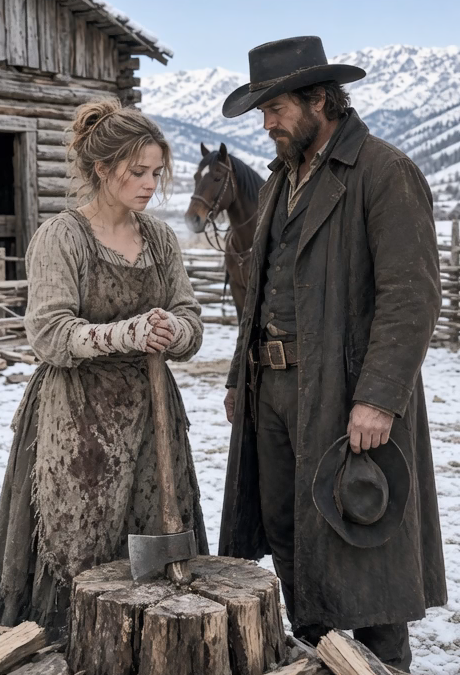
“What do you want, Mr. Stone?”
Gideon turned his hat slowly between his large hands.
That was when I noticed something unexpected.
He was nervous.
“I’ve watched you for some time.”
My eyes hardened.
“That does not improve this conversation.”
“Not in the way you mean.”
He looked down, almost ashamed of the wording.
“I’ve seen you keep this place standing.”
I said nothing.
“Two years alone,” he continued. “You repaired the chicken house after that spring storm. Raised the west fence after the posts rotted through. Saved four calves in February when most men stayed inside. And you still cut your own wood.”
I looked at the ax.
“I don’t have many alternatives.”
“Exactly.”
That answer unsettled me.
He took one step closer, then stopped at a distance that told me he had sense enough not to crowd a woman holding a blade.
“You buried your husband and went on. There are strong men who wouldn’t have managed half as much.”
My throat tightened.
I preferred insults.
I understood what to do with insults.
You built a wall. You sharpened your tongue. You smiled like you had not been hit.
Kindness was more dangerous.
It moved toward locked doors and tried the handles.
“Strength doesn’t fix a leaking roof,” I said. “It doesn’t fill a pantry.”
“No.”
Gideon looked at the house.
The porch boards sagged at one end. One window had a crack stuffed with cloth. The barn needed repairs before heavy snow. The gate latch had been mended twice with wire and hope.
“But without strength,” he said, “nothing else gets built.”
I crossed my arms.
“Did you ride all this way to tell me I work too hard?”
“I came to make you an offer.”
“I already heard one strange enough.”
He inhaled slowly.
“Marriage.”
I laughed.
A dry, hard sound that had nothing to do with humor.
“Mr. Stone, my husband is buried behind the church.”
“I know.”
“Then you should also know I am not shopping for another one.”
“I am not asking you to forget Jonah.”
The laugh left me.
He continued before I could answer.
“And I’m not asking you to pretend you love me.”
“How romantic.”
He accepted that without offense.
“I’d rather be clear.”
“Then be clear.”
He lifted his face.
“I want a family.”
The silence between us changed.
“I have land,” he said. “Cattle. A house too large for one man. I can offer security. You can keep this property if you wish. I’m not trying to buy it.”
“And what do you expect in return?”
“A wife who won’t run at the first winter storm.”
“That is not the same thing as a family.”
“No.”
He held my gaze.
“I want children someday.”
Something closed inside my chest.
He did not notice my reaction at first.
“I don’t want to die and leave behind only stories about the enormous man who lived near the mountain,” he said. “I want more than land and stock records. I want a table with more than one plate on it. I want noise in my house. I want something that stays after I’m gone.”
I looked toward the field beyond him.
“You could choose almost any woman.”
“I don’t want almost any woman.”
A bitter laugh escaped me.
“That is what men say until they look closely.”
His brow tightened.
“I am looking.”
Heat rose in my face, and I hated it.
“In town, they laugh at women like me.”
“In town, people laugh at anything that lets them feel taller.”
“You don’t know what they say.”
“Yes,” he said. “I do.”
My eyes returned to him.
He did not look away.
“They say you’re too big. That no man would choose you if he had choices. That Jonah must have married you because he wanted a worker more than a wife.”
The old humiliation came back so quickly I almost staggered.
“Then why are you here?”
He answered without hesitation.
“Because when I see you splitting wood with your hands opened by cold, I don’t see a woman who is too large.”
I went completely still.
“I see a woman who does not surrender.”
His voice lowered.
“And that is worth more to me than every narrow waist and pretty face in the territory.”
For the first time in years, I did not fold my arms over my stomach.
I did not lower my head.
I did not try to take up less space.
I simply stood there.
Occupying the body that had carried me through loss, labor, hunger, and winter.
Gideon put his hat back on.
“You don’t have to answer today.”
“And if I say no?”
“I’ll leave.”
“Without arguing?”
“Without arguing.”
That surprised me almost as much as the proposal.
He moved toward his horse.
“Think on it.”
“Mr. Stone.”
He turned.
“Why me?”
A faint smile touched his mouth, but it did not reach the place where sorrow lived in his eyes.
“Because surviving winter is not the same as having a life. And I suspect you deserve more than survival.”
Then he mounted and rode away.
I watched him until the horse disappeared beyond the trees.
Only then did I lift my hand to my throat.
Beneath my dress, on a chain where no one saw it, hung Jonah’s wedding ring.
I held it between my fingers.
Gideon believed I had not remarried because I loved my dead husband too deeply.
That was true.
But not the whole truth.
There was another reason.
One I had never told anyone in Raven Pass.
One tied to Jonah, marriage, my body, and the thing Gideon Stone had just said he wanted more than wealth.
A family.
I closed my eyes.
“What do I do, Jonah?”
The wind carried my question over the field.
For the first time since becoming a widow, the coming winter did not feel only like a threat.
It felt like a choice.
I remained beside the chopping block long after Gideon left.
The blood on my palms dried stiff under the bandages. The cold crept through my boots. The hens fussed near the fence, offended that breakfast had been delayed by a marriage proposal, as if they had important appointments elsewhere.
Finally, I carried the ax inside and shut the door.
My house was small enough that a person could stand in the kitchen and see almost every other room. A stove blackened from use. A table Jonah had built during our first year together. Two chairs, though one had not been used regularly in two years. A bed behind a curtain. Shelves with more empty space than food.
I took Jonah’s ring from beneath my dress and laid it on the table.
“I cannot promise him what he wants,” I whispered.
The truth was not that I had stopped loving my husband.
I had loved Jonah Vance with a young, clumsy, grateful love at first, then with the deeper kind built by shared work and ordinary mercy. He was not perfect. He snored. He forgot to mend things until they became disasters. He believed every sick animal could be saved through stubbornness and prayer. He burned bacon and called it crisp.
But he never once made my body feel like an apology.
When he first asked to marry me, I laughed in his face because I thought it was a joke. He looked so wounded that I cried afterward behind the feed store.
“You can’t mean me,” I told him later.
He frowned as if I had said something foolish.
“Who else would I mean?”
“I’m not—”
I could not finish.
Pretty.
Small.
The kind of woman men lifted into wagons and wrote songs about.
Jonah took my hand and said, “Clara, I have no use for a wife who looks like she might blow away in a stiff breeze. I want a woman who feels real beside me.”
I married him three months later.
In a white dress.
People stared.
Let them, Jonah whispered.
So I did.
During our marriage, I became pregnant three times.
The first ended before I had fully believed it was real.
The second lasted long enough for Jonah to carve a cradle rail before I bled through two towels on a spring afternoon while rain hammered the roof.
The third nearly killed me.
I remembered Jonah’s face more than the pain. His hands shaking. His voice breaking. The doctor’s sleeves rolled to the elbow. Blood in the basin. Cold cloth on my forehead. Jonah saying, “Stay, Clara. Don’t you leave me.”
I stayed.
The child did not.
Afterward, Dr. Webb of Raven Pass sat at our table and told us plainly that another pregnancy could be dangerous.
Not difficult.
Not inconvenient.
Dangerous.
Jonah never blamed me.
That almost made it worse.
The town did not know. People simply decided that a woman built like me and unable to fill a cradle must be proof of God’s strange humor. I let them talk because explaining would have meant showing them my softest wound and asking them not to press it.
I knew better.
A year later, Jonah died of fever after helping a neighbor move cattle through wet spring ground.
The fever took him in nine days.
After that, people stopped asking when I would have children.
They started asking how long I expected to keep the ranch alone.
I had no answer except the next day.
Then the next.
Then the next.
Now Gideon Stone wanted a family.
And I had learned too much about hope to let a man build it on my body without knowing the ground might not hold.
The next morning, Gideon returned.
I heard the horse before I saw him.
This time, he rode slower.
He carried a small sack tied to the saddle and stopped several yards from the porch.
“I didn’t come for an answer,” he said before dismounting.
“You’re about to get one.”
His face became careful.
I opened the door wider.
“Come in if you mean to hear it.”
He wiped his boots before entering.
That small thing nearly undid me.
A ridiculous detail. Mud on boots. A man noticing my floor. Yet after years of people assuming a widow’s home was already half-ruined, the courtesy felt enormous.
Gideon placed the sack on the table.
“Clean bandages. Salve. From Mrs. Alder at the mercantile. She says it stings less than turpentine.”
“I know how to tend my hands.”
“I didn’t say otherwise.”
I looked at him.
He looked back.
I gestured to the chair.
He sat.
The chair complained beneath him.
Under different circumstances, I might have smiled.
Instead, I took Jonah’s ring from beneath my collar and set it beside the sack of bandages.
Gideon’s eyes lowered to it.
“I loved my husband,” I said.
“I know.”
“You do not know anything yet.”
He nodded once.
A man used to being corrected rarely reacts so calmly.
So I told him.
All of it.
Not the polite version.
Not the version I might have given a church woman in exchange for a casserole and pity.
I told him about the first pregnancy and the disbelief. The second and the cradle rail. The third and the doctor’s warning. The way Jonah stopped speaking of children because he loved me more than an idea of our future. The way I still saw his face when the wind rattled the shutters at night.
Gideon did not interrupt.
Not once.
When I finished, the kitchen felt too small for both of us and everything I had put into it.
I lifted my chin.
“You want children. I may never be able to give them to you.”
I waited for disappointment.
I knew its shape.
Men rarely hide it well when a woman’s body refuses to be useful in the way they expected.
Gideon lowered his gaze.
“Then yesterday I made a proposal far crueler than I understood.”
My breath caught.
“Cruel?”
“I came here saying I could give you security and you could give me a family.”
“That is what you said.”
“As though one could pay for the other.”
I stayed silent.
“It was not my intention,” he continued. “But intention does not change the words.”
I was used to men explaining why their words should not have hurt.
I was not used to one accepting that they had.
“Do you withdraw the proposal?” I asked.
He considered.
“I withdraw the conditions.”
“I don’t understand.”
“Yesterday I thought I knew what I wanted. Wife. Children. A full table. A house with more noise than walls.”
“That still sounds like what you want.”
“It is.”
I looked away.
“But I arranged it in my head as if I were buying cattle to complete a herd.”
Despite myself, my mouth twitched.
“That has not improved the romance.”
“I’m aware.”
“At least you are honest.”
“Not always soon enough.”
He looked toward my cracked window, the stove, the wood stacked near the door.
“I did not ride here because I looked at your hips and thought of babies.”
My eyebrow lifted.
“You had better not have.”
“I rode here because for nearly a year I watched you do the work of three people and never once heard you ask the town to rescue you.”
“That does not mean I wish to marry.”
“I know.”
He nodded toward my hands.
“May I see them?”
I hesitated.
Then held one out.
He did not grab it.
He waited.
Only when I gave a small nod did he untie the stained bandage.
His hands were enormous, but careful. That seemed unfair somehow. A man that large should have been clumsy. It would have been easier not to trust him.
The cracks in my palm were deep.
“You need to leave the ax alone for several days.”
“I need wood.”
“You have forty cords split.”
“And a whole winter ahead.”
He spread salve over the wounds.
“Then I have another offer.”
I sighed.
“Another marriage proposal before breakfast?”
“No.”
He wrapped fresh cloth around my palm.
“Let me court you.”
I stared at him.
“For what purpose?”
“To find out if we can stand one another when we are not negotiating a life.”
That made me smile.
“And the children?”
His smile disappeared.
“They are not a condition.”
“Easy to say today.”
“Then don’t believe me today.”
He wrapped my other hand.
“Watch me prove it.”
Over the next weeks, Gideon Stone did not mention marriage.
Not once.
He came twice a week.
Always from the front road.
Never through the back gate like a man who believed familiarity excused manners.
He never entered without permission.
Never touched the ax unless I allowed it.
Never moved something in my house without asking where I wanted it.
The first time he noticed the leak in my roof, he said, “I can fix that.”
“I can fix it myself.”
“I did not say you couldn’t.”
The sentence stopped me.
No pity.
No challenge.
Only an offer.
“Then hold the ladder.”
So I climbed, and Gideon held.
When we finished, he did not mention that it would have been faster if he had done the whole job himself.
That mattered.
Reality, however, remained.
Winter was coming.
My pantry was thin.
I had enough wood to survive, but little money for flour, salt, coffee, lamp oil, chicken grain, and nails. Widows learn arithmetic better than most bankers. We count every bean twice because hunger charges interest.
One afternoon, Gideon placed twenty dollars on my kitchen table.
I looked at the coins.
“Take those back.”
“They aren’t a gift.”
“Then what are they?”
“I need someone to review the accounts for my ranch.”
I laughed.
“And this job conveniently pays twenty dollars?”
“For two months.”
“How do you know I can keep books?”
“Jonah told me once.”
The sound of Jonah’s name in his mouth made me stiffen.
Gideon noticed.
“If you don’t want the work, I withdraw the offer.”
I picked up one coin.
“What would you pay a man?”
“The same.”
“Can you prove that?”
A smile touched his mouth.
“I have a ledger full of mistakes. If you understand it, you may charge me more.”
I accepted.
Not for him.
For myself.
The Stone ranch was larger than mine by far.
Too large.
The house had three upstairs rooms that were shut most days. The dining table could seat eight, but only one place was worn from use. In the kitchen, pots hung polished and untouched, as if waiting for hands that never came. The main room had a hearth large enough to warm a gathering, yet the chair beside it had only one indentation.
Gideon had not lied.
His loneliness had walls.
I sat at his table once a week, sorting invoices, shipping receipts, cattle sale records, and feed costs while he worked nearby. He never hovered. He did not pretend to understand figures better than he did. That alone made him wiser than half the men in Raven Pass.
One afternoon, he placed coffee near my elbow.
“Why did you never marry before?” I asked.
He leaned against the doorframe.
“Because every time I thought I was ready, I realized I was only tired of being alone.”
I looked up.
“And with me?”
“It is different.”
“How do you know?”
His answer came slowly.
“Because if you say no, I would rather remain alone than convince you to say yes out of fear of winter.”
I set down the pen.
That sentence followed me all the way home.
Two days later, I went into Raven Pass to sell part of the wood I had cut.
The mercantile was full of women buying flour and ribbon for Christmas sewing. I kept my head down and counted coins while Mrs. Barlow and Ada Finch pretended not to stare.
Mrs. Barlow’s eyes moved over my arms.
“They say The Mountain has been visiting your place often.”
“People say many things.”
“I suppose a man that large needs a sturdy wife.”
Ada laughed.
“Or a desperate one.”
Before, I would have pretended not to hear.
That day, I turned.
“Are you finished?”
Both women stopped smiling.
Mrs. Barlow blinked. “We were only joking.”
“Then find a joke that doesn’t need my body to make it funny.”
Silence fell over the counter.
I paid for the flour, lifted the sack, and walked out.
Gideon stood across the street beside his horse.
He had heard enough.
I waited for him to say something.
He did not.
When I reached him, he asked, “Would you like help with the sack?”
I looked at him.
“Yes.”
He took it.
Nothing more.
That evening, riding home with flour in my wagon and cold air burning my cheeks, I realized something that frightened me more than their laughter.
I was beginning to believe he truly could look at me without trying to turn me into someone else.
And believing that gave him the power to hurt me.
By November, I had earned enough from Gideon’s accounts and wood sales to fill my pantry.
Not richly.
But enough.
Flour.
Salt.
Coffee.
Beans.
Chicken grain.
Lamp oil.
A small sack of sugar I told myself was practical because morale mattered in winter.
I also hid twelve dollars in a tin beneath my bed.
The night I counted that money, relief moved through me so suddenly I had to sit down.
If I refused Gideon, I would not starve.
If I accepted him, it would not be because winter had bent my knees.
The next morning, I rode to the Stone ranch.
Gideon was repairing a corral gate.
“I need to speak with you.”
He set the hammer down immediately.
“That sounds grave.”
“It is.”
I dismounted.
“I can survive the winter alone.”
He watched me, waiting.
“I sold seventeen cords of wood. I received payment for your books. I have food until March if I manage carefully.”
“I’m glad.”
I frowned.
“That is all?”
“What did you expect?”
“I don’t know.”
He thought.
“That I would be upset because you no longer need me?”
I said nothing.
He came closer but stopped with space between us.
“Clara, I have been hoping you would reach this point.”
“Why?”
“Because if you ever say yes to me, I need to know you could have said no.”
The words stole the air from my lungs.
Gideon picked up his hammer.
“Now you can.”
I watched him.
“I’m not finished.”
He put the hammer back down.
“I’m having a terrible morning with this tool.”
I could not help smiling.
Then I became serious.
“If I ever agreed to marry you, there would be conditions.”
He folded his arms.
“Name them.”
“My property remains mine.”
“Yes.”
“Decisions concerning it remain mine.”
“Yes.”
“You will not decide what work I may do simply because I become your wife.”
Gideon opened his mouth.
I lifted one finger.
“You may worry. You may advise. You may argue respectfully. You may not command.”
He closed his mouth.
“Understood.”
“And there will be no promise of children.”
His expression changed.
Not with disappointment.
With attention.
“I do not know if I can bear them. I do not know if it would be safe to try. And I will not spend every month of my marriage watching your face to see if you think I tricked you.”
Gideon remained silent long enough that the wind moved dry leaves along the fence.
“May I speak now?”
“Yes.”
“I want children.”
The old pain opened.
He did not soften the truth.
“I have always wanted them.”
“Then there is the problem.”
“I’m not finished.”
I waited.
“I wanted children before I knew you. I wanted a full house, a wife, noise at the table. It was clear in my mind because none of those people had faces.”
He took one step closer.
“Now you have one.”
My throat tightened.
“That does not erase what you want.”
“No. But it changes what I am willing to lose to get it.”
“What does that mean?”
“It means I will not trade the woman I want for children who do not yet exist.”
I looked away.
“You may regret that.”
“So may you.”
“It isn’t the same.”
“Yes,” he said. “It is. Marriage always means choosing one life and surrendering others.”
That answer was not perfect.
That was why I believed it.
He did not pretend sadness would never visit him.
He did not pretend desire vanished because love arrived.
He said only that he was responsible for what he chose.
“I have not said yes,” I murmured.
“I know.”
“Good.”
He picked up the hammer.
“May I work now?”
“You may.”
Two weeks later, the first great storm came.
Wind tore shingles from my roof before dawn, and when Gideon arrived, he found me on a ladder in freezing rain, trying to tie a canvas over the damaged section.
“You’re going to kill yourself,” he called up.
I looked down.
“That sounds dangerously like an order.”
He closed his eyes briefly.
“Would you like me to hold the ladder?”
“Yes.”
The wind worsened.
We worked nearly an hour. By the time I climbed down, both of us were soaked, stiff, and covered in ice.
Inside, Gideon started the fire while I made coffee.
For a while, the house was silent except for the stove taking flame.
Then I saw him looking at Jonah’s ring on its chain around my neck.
“You may ask,” I said.
Gideon shook his head.
“I don’t need to compete with a dead man.”
I touched the ring.
“I loved him.”
“I know.”
“I still miss him some days.”
“I know that too.”
“Doesn’t it trouble you?”
He considered.
“It would trouble me more if you had to lie to protect my pride.”
My eyes burned.
I turned toward the window.
“Jonah was with me all three times we lost our babies.”
Gideon did not move.
“The last night, he thought I would die too.”
My fingers closed around the ring.
“After that, he stopped speaking of children. He never blamed me.”
That was the part of the secret that hurt most.
“But I blamed myself.”
Gideon stood behind me without touching.
“Every time someone in town mocked my body, I thought the same thing. So large on the outside and still unable to keep a life inside.”
My voice broke for the first time.
“I know that makes no sense.”
“Pain rarely asks permission to make sense.”
I closed my eyes.
Then Gideon did something no man had done when I spoke cruelly about myself.
He did not argue with my body.
He did not rush to call me beautiful.
He did not attempt to erase years of grief with a compliment.
He asked, “Do you still believe you must punish the woman who survived?”
I turned.
And for the first time, I understood that the greatest obstacle between me and a new life was not Gideon.
It was guilt I had mistaken for loyalty.
Three weeks passed before I spoke of marriage again.
I needed time.
Gideon gave it.
No daily visits.
No gifts placed at my door.
No messages through neighbors.
No attempts to make me answer before my own heart had finished arguing with itself.
For seven days, he did not come to my ranch at all.
By the eighth, I was irritated.
By the ninth, I recognized the absurdity of that irritation.
I had asked for space and then expected him to ignore it as proof he cared.
That realization unsettled me.
I had spent so many years expecting men not to respect no that when one did, it felt dangerously close to abandonment.
On the tenth day, I saddled my mare and rode to the Stone ranch.
I found Gideon in the barn fitting a new shoe on the black stallion.
He looked up.
“Mrs. Vance.”
“That’s all?”
He glanced around as if searching for what he had missed.
“Good morning?”
“Gideon.”
He set the tool down.
“You asked for time.”
“I know.”
“I was trying not to do it wrong.”
I crossed my arms.
“It is irritating.”
“Respecting you?”
“Sometimes.”
“I could attempt to become more disagreeable.”
“No need. You started well enough the first day.”
He laughed.
So did I.
Then the silence returned.
I walked to the stallion and touched his neck. The horse huffed warm air against my sleeve.
“I have been thinking about what you said.”
“I’ve said too much.”
“About not wanting me to accept because I need to survive.”
“Yes.”
I breathed in.
“My pantry is full.”
“I know.”
“My roof holds.”
“I checked from the road.”
“I have money put away.”
“I’m glad.”
I turned.
“I can reach spring without you.”
Gideon held my gaze.
“Yes.”
“And I still want to be here.”
For a moment, he stopped breathing.
I felt afraid.
Not the desperate fear I had known when Jonah died.
A different fear.
The fear of holding something I could lose.
“I do not promise you children.”
“I have not asked.”
“I do not promise to stop missing Jonah.”
“I do not want you to.”
“I will not sell my land.”
“That would be foolish.”
My brow rose.
“Careful.”
“I withdraw foolish.”
“Too late.”
He smiled.
I continued.
“And when you have an opinion about my body…”
The smile disappeared.
“I will not use it to measure your worth.”
I studied his face.
“Then I have one question.”
“Ask.”
“Do you still want to marry me?”
He answered without hesitation.
“Yes.”
“Even if our family is only you and me?”
Gideon stepped closer slowly.
“Clara, two people who choose one another are already a family.”
Something inside me, hardened for years, finally gave way.
Not the grief for Jonah.
Not the memory of children I never held long enough.
Those would remain.
What loosened was the belief that loss had made me defective.
Gideon extended his hand.
He did not take mine.
He waited.
I looked at that enormous hand.
Then placed mine in it.
“Then yes.”
His fingers closed carefully.
“Yes what?”
I stared at him.
“Do not ruin the moment.”
“I want to be certain.”
I stepped closer.
“Yes, Gideon Stone. I will marry you.”
He exhaled like a man who had discovered he had been holding his breath for weeks.
But he did not embrace me immediately.
“May I?”
I laughed.
“For once, you may stop asking.”
Gideon wrapped his arms around me.
All my life I had heard that I was too heavy for a man to lift.
Gideon did not try.
He simply held me.
With my feet firm on the ground.
As if I had never needed to be lifted to feel loved.
When we parted, I saw the ax leaning beside the barn door.
The same one Gideon had sharpened weeks earlier after asking permission.
“I have another condition,” I said.
He closed his eyes.
“Of course.”
“Tomorrow, you come help me with the wood.”
“I thought you had enough.”
“Now there are two of us.”
We married in Raven Pass after Christmas.
It was not a large ceremony.
I refused to turn my wedding into entertainment for the same town that had spent years using my body as a joke.
Mae Alder, who sewed my dress, asked, “White?”
I looked at the fabric.
For years, women had implied I should wear dark colors because dark things hid better.
White made no apology.
“White,” I said.
The dress did not try to make me smaller.
It did not crush my waist until breathing became labor.
It did not hide my arms.
When I entered the little church, heads turned.
For the first time in my life, I did not try to imagine what everyone was thinking.
Gideon waited at the front.
The largest man in the territory looked more nervous than I had ever seen him.
When I reached him, I whispered, “You’re shaking.”
“It’s cold.”
“We’re inside a church.”
“Then I’m ill.”
“Coward.”
“Possibly.”
Then we spoke our vows.
There was no promise of children.
No promise that I would abandon the Vance place.
No promise of obedience for Gideon to mistake as ownership.
We promised something harder.
To listen.
To share.
To choose one another freely, and to keep making room for truth even when it hurt.
After the wedding, I did not sell my land.
During the first year, we divided our time between both properties. In spring, we decided to live mostly in Gideon’s larger house because it was better prepared for cattle, workers, and heavy winter. But the Vance place remained mine.
We repaired the barn.
Used the timber carefully.
Leased part of the pasture.
The money went into an account with my name on it.
Gideon never called that land ours unless I did first.
Over time, I did.
Not because the law had changed.
Because my fear had.
The town changed too, though more slowly.
Some people stopped making comments when they discovered I answered.
Others did not.
One afternoon at the mercantile, Mrs. Barlow looked me over while I bought flour and said, “Marriage seems to agree with you.”
I knew exactly what she meant.
That old measuring glance.
My body as public property.
I smiled.
“So does bread.”
She went quiet.
I paid and left.
I did not need to win every battle.
Only stop letting other people’s words become the voice inside my own head.
Gideon did not stop wanting children in a single day.
That would be a lie too pretty to be useful.
Sometimes I saw him watching families in town. A father lifting a little girl onto a wagon. A boy running beside a dog. A mother handing a baby to her husband while adjusting her shawl.
He never lied about not seeing them.
One night, while he repaired a chair by lamplight, I asked, “Do you regret it?”
He set down the tool.
“Marrying you?”
“Choosing a life where you may never be a father.”
He thought before answering.
“Sometimes I miss something I never had.”
The honesty hurt.
But less than a lie.
“What does that mean for us?”
“It means I can feel sadness for one possibility and still be grateful for the life I chose.”
He took my hand.
“Both can live in the same person.”
I understood that.
I still missed Jonah.
I still thought of the babies I lost.
None of those sorrows meant I loved Gideon less.
Years passed.
The child Gideon had imagined when he first rode to my wood shed never came.
Neither did the daughter I sometimes allowed myself to picture when the house was quiet.
There was pain in accepting that.
But there was no blame.
That made all the difference.
The big house was never truly silent.
Ranch hands ate with us during storms.
Neighbors trapped by snow slept in the upstairs rooms Gideon had once imagined as children’s rooms.
At Christmas, our table rarely held only two plates.
A boy from a nearby farm came to help one summer and stayed three years because his father drank and his mother needed him somewhere safe.
A widowed woman and her two daughters spent a winter with us after their roof collapsed.
Gideon taught half the boys in Raven Pass how to calm a frightened horse.
I taught girls how to keep accounts and read contracts before signing anything handed to them by smiling men.
Life filled the house in ways neither of us had planned.
Gideon learned that leaving something behind did not always mean leaving a child with his name.
It could mean land cared for.
Workers paid fairly.
Women treated with dignity.
A house where no one had to shrink to be loved.
Fifteen years after Gideon first rode onto my property, I stood again beside the wood shed.
The original chopping block was long gone.
The shed had been rebuilt, stronger and wider.
My hands were still thick.
Still scarred.
Still mine.
Gideon came up behind me carrying an ax.
“You’re looking too hard at that wood.”
“I’m remembering.”
“The day you met me?”
“The day a giant stranger rode up and announced he intended to marry me before winter.”
He winced.
“I’ve improved.”
“A little.”
He set the ax down.
“Do you regret it?”
I looked at my hands.
Remembered the blood soaking through bandages.
The hunger.
The cold house.
Jonah’s ring against my chest.
The woman I had been, believing survival was the largest thing life would allow her to ask for.
Then I looked at Gideon.
“Yes,” I said.
His face became serious.
“What?”
I picked up the ax.
“That it took me so long to understand I was never too much.”
He went still.
I lifted the ax and split the log in one clean blow.
“I was only surrounded by people too small to see me whole.”
Gideon laughed, deep and bright enough to startle birds from the fence.
I set the ax aside and walked toward the house.
I was no longer the widow waiting only to survive until spring.
I no longer measured my worth by whether my body could bear children, whether a dress made me look smaller, or whether town women approved of how much space I occupied.
I had learned that being chosen could be beautiful.
But choosing myself had changed everything first.
At the door, Gideon stepped ahead and opened it.
I looked at him.
“I don’t need you to open that.”
He began closing it.
I stopped him.
“But I like when you do.”
We went inside together.
No shrinking.
No bargaining.
No woman trying to earn a place by becoming less.
Just a house warm against the wind, a table wide enough for whoever needed it, and a love large enough for both of us to stand inside exactly as we were.








