A Mother Cat Woke Up After Surgery to Find Her Three Kittens Gone—Then Spent Six Hours Searching Every Cage. What She Did With Their Empty Bed Broke Thousands of Hearts.
PART3:
“I mean she’s nursing them.”
“We can see that.”
Raymond nodded.
He signed the form.
Before leaving, he crouched beside the carrier.
One kitten reached a paw through the door.
Raymond touched it with one finger.
He would spend months wishing he had asked one more question.
Instead he stood, told the receptionist, “Take care of them,” and walked into the rain.
By noon, Willow had been entered into the shelter database as:
FEMALE DOMESTIC SHORTHAIR.
APPROX. 2 YEARS.
GRAY/WHITE.
FRIENDLY.
LACTATING.
THREE KITTENS.
The kittens became A18441, A18442, and A18443.
No names.
The shelter took in forty-seven animals that Monday.
Twenty-one dogs.
Seventeen cats.
Four rabbits.
Three guinea pigs.
A cockatiel.
One injured pigeon animal control insisted technically did not belong there but brought anyway.
Hamilton County Animal Center had one hundred and forty-eight permanent animal spaces.
That evening, it housed two hundred and twelve animals.
People who had never worked in a municipal shelter imagined cages.
They did not imagine arithmetic.
How many came in.
How many left.
How many foster homes answered.
How many veterinary procedures could be performed before noon.
How many kennel spaces had to become available by evening.
How many animals could be kept alive when more arrived every day than the building was designed to hold.
Every morning began with numbers.
Intake.
Capacity.
Adoptions.
Transfers.
Medical holds.
Euthanasia risk.
Nobody at Hamilton woke up wanting to be cruel.
That would have made the story easier.
Cruelty with a villain is simple.
Cruelty built into routine is harder.
Because nobody feels responsible.
The protocol regarding nursing mothers had existed for almost nine years.
It had started during a period when kitten intake overwhelmed the shelter every spring.
A consulting veterinarian had written that kittens approximately five weeks old could “begin independent feeding and socialization” and that lactating mothers could be sterilized as soon as medically appropriate.
Over time, begin independent feeding became separate at five weeks.
Then separate at five weeks became adopt kittens immediately if eating independently.
Nobody could identify the exact meeting in which that happened.
There was no dramatic memo.
No person standing in front of a conference table saying, “Let’s take kittens away from anesthetized mothers.”
Policies rarely become harmful that cleanly.
They drift.
A phrase changes.
A staffing shortage arrives.
A shortcut works once.
Nobody reports a problem.
Then the shortcut becomes normal.
By the time Willow arrived, the intake coordinator barely thought about it.
Her name was Carol Hensley.
She had worked at Hamilton for nineteen years.
She knew every intake code.
Every county contract.
Every trick for finding one more kennel when there was no kennel.
At 2:15 that afternoon, Carol stopped outside Willow’s cage.
Three kittens were nursing.
The medical board attached to the door read:
SPAY 7:30 AM.
Carol made a note.
“Kittens eating wet food?”
A kennel technician named Jasmine Reed nodded.
“All three.”
“Good.”
“Still nursing a lot.”
“They’re five weeks.”
“I know.”
“Adoption room’s got three kitten openings tomorrow.”
Jasmine hesitated.
“Can they wait until Mama’s awake?”
Carol looked at her.
“For what?”
“So she can—”
Jasmine searched for the right phrase.
“I don’t know. See them?”
Carol had heard variations of the question before.
“They’re cats, Jasmine.”
Jasmine flushed.
“I know.”
“They don’t understand adoption.”
“I know.”
“If we hold three cages because it feels nicer, three other kittens stay in intake.”
Jasmine looked through the kennel door.
Willow was licking the black kitten’s head.
Carol softened slightly.
“This place works because we move animals.”
“I get it.”
“You will after kitten season.”
Carol walked away.
Jasmine remained.
She crouched.
Willow looked at her.
The smallest gray kitten was asleep with one paw draped across Willow’s white belly.
Jasmine whispered, “You got cute babies, Mama.”
Willow blinked slowly.
At 7:12 the next morning, veterinary technician Luis Mendoza lifted Willow from her cage.
She weighed seven pounds, eleven ounces.
Thin but not dangerously so.
Healthy heart.
Healthy lungs.
No fever.
Still producing milk.
Luis placed her inside a transport carrier.
The kittens immediately began crying.
Willow twisted.
Luis paused.
“Sorry, Mom.”
Jasmine stood nearby.
“Can she nurse one more time?”
Luis looked at the surgery schedule.
Nine cats.
Four dogs.
One cryptorchid male.
Two dental procedures.
He sighed.
“Two minutes.”
Jasmine returned Willow to the cage.
The kittens swarmed her.
Willow lay down immediately.
All three attached themselves.
Jasmine knelt outside.
She would remember this scene later with painful clarity.
The black kitten pushing one sibling away with both hind feet.
Willow licking the top of his head.
The smallest kitten kneading Willow’s belly.
Willow closing her eyes.
Calm.
Safe.
Normal.
At 7:19 Luis said, “We have to go.”
Jasmine nodded.
She lifted one kitten.
Then another.
The third clung to Willow’s fur.
Jasmine gently detached him.
Willow stood.
The carrier door closed.
The kittens cried.
Willow turned circles inside the carrier.
Luis lifted it.
“She’ll be back in a few hours.”
Jasmine watched them disappear through the medical doors.
At 8:03, Willow was anesthetized.
At 8:21, the first incision was made.
At 8:46, the surgery was complete.
At 9:10, she was moved into recovery cage four.
Her basket had been transferred with her.
The same cheap brown plastic basket.
The same white towel.
It smelled strongly of milk.
Of Willow.
Of kittens.
At 9:24, Carol entered the kitten ward.
“Are these Willow’s?”
Jasmine looked up.
“Yes.”
All three kittens were eating softened canned food from a shallow dish.
“Great.”
Carol checked the adoption board.
A family was waiting for a kitten.
Another application had already been approved.
A rescue partner from two counties away had requested one small kitten for a foster-to-adopt family.
Three kittens.
Three placements.
Perfect arithmetic.
Jasmine said, “She’s still out.”
Carol looked toward medical.
“She doesn’t need to be awake.”
Jasmine did not move.
Carol picked up the black kitten.
“Which ID?”
Jasmine read the collar.
“A18443.”
Carol handed him to an adoption counselor.
The smallest gray kitten went next.
Then the larger gray.
Within forty minutes, all three had left the ward.
One went home with a young couple and their eight-year-old daughter.
One went to a retired woman who had recently lost a seventeen-year-old cat.
The third left in a rescue transport van headed ninety miles north.
At 10:37, the kitten ward cage was empty.
Jasmine cleaned it.
She cried while doing it.
She did not tell anyone.
At 11:06, Willow opened her eyes.
The recovery-room camera recorded everything.
At first, almost nothing happened.
She blinked.
Her head lifted and dropped.
Her pupils were enormous.
She tried to stand.
Her hind legs failed.
She lay still.
At 11:31 she stood.
Unsteady.
She turned toward the back of cage four.
The basket.
She stepped inside.
Sniffed.
Stopped.
She sniffed again.
Then she began moving quickly.
Nose against towel.
Around the rim.
Behind the basket.
Back inside.
She pawed the towel.
Pulled it halfway out.
Sniffed underneath.
Nothing.
She vocalized.
The sound was soft.
High.
Repeated.
At noon, Luis checked her incision.
“She’s alert.”
Willow tried to push around his hands toward the open cage door.
He guided her back.
“Easy.”
He closed the door.
Or thought he did.
The latch did not fully catch.
At 12:17, Willow pushed her face against the bars.
The door opened two inches.
She stopped.
Pushed again.
Opened it farther.
Then stepped into the recovery room.
There were twelve cages.
Five occupied.
A sedated terrier.
Two male cats.
An elderly Chihuahua.
A young tabby recovering from neuter surgery.
The camera showed Willow walk directly to cage one.
She stood.
Sniffed.
Then called.
Three quick chirping cries.
Pause.
Again.
Nothing.
She reached one paw through the bars.
No response.
Cage two.
Same thing.
Call.
Listen.
Wait.
Cage three.
Call.
Listen.
Wait.
She reached cage four.
Her own.
Looked inside.
Continued.
Five.
Six.
Seven.
By cage eight, Luis entered.
He froze.
“How did you get out?”
He picked Willow up.
She twisted violently.
Not attacking.
Trying to get down.
He returned her to cage four.
Latched it.
Willow immediately began pushing her face against the bars.
Luis noted:
RESTLESS POST-OP.
At 12:43, Jasmine entered recovery.
Willow saw her.
Called.
Jasmine stopped.
There was something different in the sound.
“Mama?”
Willow called again.
Jasmine looked toward the basket.
Empty.
Her stomach dropped.
She opened the cage.
Willow stepped past her.
Jasmine did not stop her.
Willow went straight to cage one.
Called.
Cage two.
Called.
Cage three.
Jasmine stood in the middle of the room.
“Oh, no.”
Willow continued.
Nine.
Ten.
Eleven.
Twelve.
Then beneath the stainless-steel sink.
Behind the trash can.
Behind the oxygen tank enclosure.
She shoved her head beneath a rolling supply cart.
Called.
Jasmine covered her mouth.
Luis entered.
“What’s happening?”
“She’s looking for them.”
“For who?”
Jasmine stared at him.
“Her kittens.”
Luis’s face changed.
He looked toward Willow.
She was trying to get behind a cabinet.
“Where are they?”
“Adopted.”
“All three?”
“This morning.”
Luis swore softly.
Willow emerged.
Called again.
Luis said, “Should we put her back?”
Jasmine shook her head.
“Give her a minute.”
A minute became twenty.
Willow went around the room again.
Same cages.
Same order.
At each one she called.
Waited.
Listened.
At 1:26, Carol entered.
“What is she doing out?”
Jasmine said, “Looking for the kittens.”
Carol frowned.
“Put her away. She just had surgery.”
“She’s looking for them.”
“I heard you.”
“She’s been doing it for an hour.”
Carol walked toward Willow.
Willow ran—not fast, because of the incision, but fast enough to avoid her.
“Great,” Carol muttered. “Now she’s going to tear her sutures.”
Luis said, “Maybe we can bring one kitten back.”
Carol stared at him.
“They’re adopted.”
“Just temporarily.”
“One is already eighty miles away.”
“What about the other two?”
“Those people signed contracts.”
Jasmine said, “Call them.”
Carol’s expression hardened.
“No.”
“Why?”
“Because we are not calling adopters who just took kittens home and telling them to return the animals because the mother cat is upset.”
“Upset?”
Carol sighed.
“You know what I mean.”
Jasmine’s face flushed.
“No, actually.”
“Jasmine.”
“She’s calling for them.”
“She’ll settle.”
“How do you know?”
“Because animals adjust.”
Luis looked toward Willow.
She had found a bag of clean towels stored on a low shelf.
She hooked one claw into the plastic.
Pulled.
The bag fell.
Towels spilled.
Willow climbed into them.
Sniffed each one.
Burrowed beneath them.
Called.
Nothing answered.
Luis looked back at Carol.
“She doesn’t look like she’s adjusting.”
Carol said, “Put her in the cage.”
Nobody moved.
Carol’s voice sharpened.
“Now.”
Jasmine picked Willow up.
Willow did not struggle this time.
She was breathing hard.
Jasmine placed her in cage four.
Willow entered the basket.
Sniffed.
Stepped out.
Then immediately began calling through the bars.
At 2:11, she forced the latch open again.
The camera caught it clearly.
Paw through gap.
Claw hooking metal.
Push.
Door open.
She resumed searching.
By 3:00, word had spread through the shelter.
People entered recovery quietly.
An adoption counselor watched for five minutes and left crying.
One kennel attendant suggested placing stuffed toys in the basket.
Willow ignored them.
Someone brought a blanket from the kitten ward.
Willow sniffed it intensely.
Then searched harder.
That made things worse.
At 4:18, she crawled beneath the sink cabinet.
Jasmine lay on the floor trying to reach her.
Willow would not come out.
Instead she called into the darkness behind the pipes.
Jasmine began crying.
“I’m sorry.”
Willow called again.
“I’m so sorry, Mama.”
At 5:02, Willow emerged.
She was exhausted.
Her gait had changed.
Slower.
The anesthesia was gone now.
The pain medication was wearing down.
Her fresh incision pulled every time she climbed.
Still she searched.
Cage one.
Call.
Listen.
Cage two.
Call.
Listen.
Cage three.
Call.
Listen.
Same order.
All twelve.
At 5:47, she returned to cage four.
No one put her there.
She climbed into the basket.
Turned twice.
Then lay on her side.
Belly exposed.
Her back legs slightly open.
Front paws curved inward.
The exact posture she had used while nursing.
There was room beside her stomach for three kittens.
She looked toward the cage door.
She called once.
Waited.
Nothing.
Called again.
Waited.
Then stopped.
The camera showed her eyes remain open.
For twenty-six minutes, she did not move except to breathe.
That was when Jasmine took the photograph.
Not because she intended to start anything.
Not because she thought it would become important.
She was a twenty-six-year-old shelter volunteer who had been there fourteen months and was paid exactly nothing.
Her job that evening was laundry.
She had already cried twice.
She stood outside cage four with her phone.
Willow looked small inside the basket.
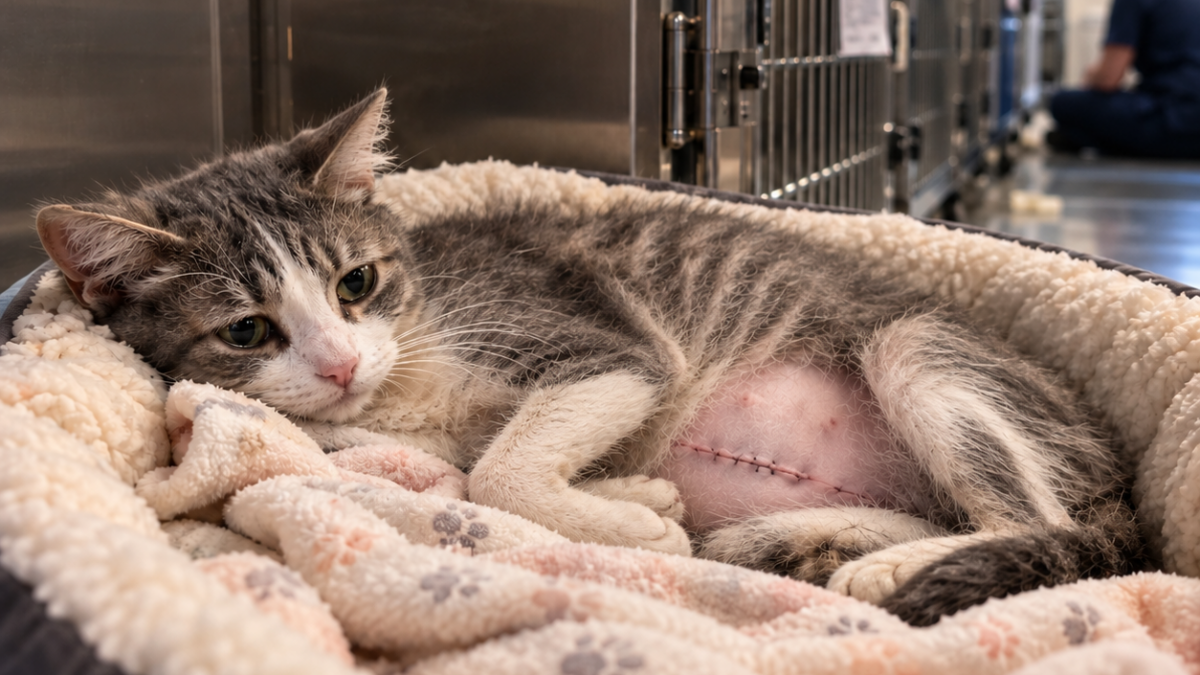
Gray-and-white body curved.
Shaved abdomen.
Fresh surgical incision.
Empty white towel.
Three clear depressions where kittens had slept that morning.
Jasmine took one photograph.
No flash.
Willow did not look at her.
Jasmine went home at 7:30.
At 9:12, she posted the photograph on her private social media page.
She wrote three sentences.
“She was spayed this morning while her three kittens were placed for adoption.
She woke up and searched the recovery room for six hours because they were gone.
She has been lying like this ever since.”
Then she put her phone down.
She expected friends to comment.
Maybe shelter volunteers.
Maybe someone would say poor mama.
By midnight, the post had been shared 1,100 times.
By morning, 18,000.
By noon, 74,000.
By the end of the second day, more than 200,000.
Jasmine woke to hundreds of messages.
Some compassionate.
Some furious.
Some threatening.
“WHAT SHELTER IS THIS?”
“NAME THEM.”
“THIS IS ABUSE.”
“WHO ADOPTS FIVE-WEEK-OLD KITTENS?”
“FIRE EVERYONE.”
“SOMEONE FIND HER BABIES.”
Jasmine panicked.
She deleted the shelter name from an old post.
Too late.
Someone recognized the cage.
Someone else found her volunteer profile.
By 9:00 a.m., Hamilton County Animal Center’s phone lines were unusable.
By 9:30, the county administrator called shelter director Martin Kessler.
Martin had run Hamilton for eleven years.
He was not a cartoon villain.
He loved dogs.
Owned three rescued Labradors.
Had overseen a dramatic reduction in euthanasia rates.
Had secured funding for the medical wing.
He had also become very good at defending systems.
Every organization eventually produces people who confuse criticism of policy with criticism of themselves.
Martin was one of those people.
“What happened?” the county administrator demanded.
“A volunteer posted an emotional photograph without context.”
“Is the context false?”
Martin paused.
“The kittens were legally adoptable.”
“That wasn’t my question.”
“We followed protocol.”
“Did the cat wake from surgery and search for her kittens for six hours?”
Martin looked through his office window.
“Apparently.”
“And the kittens were adopted while she was unconscious?”
“Yes.”
Silence.
“Martin.”
“It is standard shelter management.”
“According to whom?”
“Our medical protocols.”
“I want those protocols on my desk.”
The first mistake Hamilton made was not separating Willow from her kittens.
The first mistake had happened years earlier, when nobody questioned the policy.
The second mistake was separating them while she was unconscious.
The third was refusing to call adopters.
The fourth was what Martin did next.
He wrote a public statement.
“While we understand the emotional response to a recently circulated photograph, the Hamilton County Animal Center follows veterinary-guided, evidence-based protocols designed to maximize lifesaving capacity. The kittens in question were developmentally appropriate for weaning and have been successfully placed into loving homes. Anthropomorphizing animal behavior can unintentionally create misinformation and undermine the difficult work performed daily by shelter professionals.”
Jasmine read it in the laundry room.
Anthropomorphizing.
She stared at the word.
Willow had not eaten in thirty-six hours.
She had drunk almost nothing.
She was still lying in the basket.
When staff tried removing the towel because it was soiled, Willow stood for the first time in hours.
She grabbed it with her teeth.
Dragged it back.
Lay on it again.
Anthropomorphizing.
Jasmine took a screenshot of Martin’s statement.
Then walked into his office.
“You need to change this.”
Martin looked up.
“Excuse me?”
“She’s not eating.”
“We’re monitoring her.”
“She’s producing milk.”
“The vet knows.”
“She’s calling when anybody brings kittens through the hallway.”
“Jasmine.”
“You didn’t watch the camera.”
“Yes, I did.”
“All six hours?”
“I reviewed relevant footage.”
“No. You didn’t.”
Martin closed his laptop.
“You created a serious situation by posting internal shelter material without authorization.”
Jasmine stared.
“Internal shelter material?”
“The recovery area is not for public documentation.”
“She’s an animal, not a document.”
“You signed a volunteer agreement.”
“I took a picture.”
“And accompanied it with incomplete information.”
“What was incomplete?”
“The kittens were old enough to transition.”
“She didn’t know that.”
Martin exhaled sharply.
“We cannot discuss feline cognition as though she understands family separation the way a human mother would.”
Jasmine’s eyes filled.
“You keep saying that because it makes what we did sound less ugly.”
Martin stood.
“What do you want, Jasmine?”
“Call the adopters.”
“No.”
“Bring them back for one day.”
“No.”
“Let her see them.”
“We are not traumatizing three newly placed kittens and destabilizing adoptions because social media is emotional.”
“What about her?”
“She will recover.”
“How do you know?”
“Because cats do.”
“Then why hasn’t she eaten?”
Martin’s jaw tightened.
“You are suspended from volunteer duties until we review the social-media incident.”
Jasmine stared at him.
“What?”
“Hand your badge to reception.”
“You’re punishing me?”
“I’m protecting the shelter.”
“No.”
Her voice shook.
“You’re protecting the policy.”
She removed her badge.
Placed it on his desk.
Then walked out.
Someone in the hallway had heard everything.
By evening, Jasmine’s suspension was online.
That was the fifth mistake.
Public anger doubled.
Veterinary behaviorists began commenting.
Not internet personalities.
Board-certified specialists.
Shelter medicine professors.
Feline behavior researchers.
They explained that queens recognize offspring by scent and vocalization.
That abrupt separation during active nursing can provoke searching, vocalization, stress, appetite suppression, and maternal distress.
That five-week-old kittens, though capable of eating independently, often benefit behaviorally and medically from remaining with their mother longer.
One veterinarian wrote:
“The question is not whether cats experience motherhood exactly as humans do. They obviously do not. The question is whether a lactating animal can experience abrupt separation from dependent offspring as distress. The answer is plainly yes.”
That post was shared nearly a million times.
Hamilton’s defense collapsed.
On day three, Willow still barely ate.
Dr. Nina Patel, the shelter’s consulting veterinarian, requested that she be moved from the recovery room into a quiet medical office.
Martin objected.
“We need the cage.”
Nina stared at him.
“She hasn’t eaten properly in three days.”
“We’re over capacity.”
“She is post-op, lactating, and shutting down.”
“Shutting down is not a medical term.”
“Fine. She is demonstrating severe anorexia and behavioral withdrawal. Better?”
Martin stopped talking.
They moved Willow.
Jasmine was not there.
A kennel technician carried the basket too.
Willow remained inside it during the entire move.
The towel came with her.
At 2:30 that afternoon, Nina sat on the floor beside the basket.
She offered warmed chicken.
Willow smelled it.
Turned away.
Tuna.
No.
High-calorie recovery paste.
Nothing.
Nina touched Willow’s side.
The cat did not react.
“Come on, sweetheart.”
Nothing.
Nina had worked in emergency medicine.
She had seen animals scream.
Bite.
Panic.
Fight.
There was something more unsettling about stillness.
On day four, Willow finally drank.
Then ate three bites of chicken.
The staff celebrated quietly.
Martin did not mention the social-media post again.
The county board scheduled an emergency meeting.
Animal welfare organizations requested copies of Hamilton’s maternal-separation policy.
Then something unexpected happened.
Other shelters began answering.
One in Ohio.
One in Georgia.
One in Arizona.
One in Ontario.
Their employees recognized the protocol.
Some had the same five-week separation threshold.
Some adopted kittens while mothers were in surgery.
Some had done it for years.
Former employees began sharing stories.
A mother cat howling after recovery.
Another tearing open a paper kennel liner.
One refusing food for days.
A dog whose six-week-old puppies were transferred while she was anesthetized.
People had seen pieces of it.
Nobody had connected them.
Willow’s photograph gave the pattern a face.
The story was no longer about Hamilton.
That terrified shelter administrators across the country.
Because the hardest institutional questions are not:
Who broke the rule?
They are:
What if the rule itself was wrong?
The county meeting took place six days after Willow’s surgery.
The room held thirty chairs.
More than a hundred people arrived.
Some stood in the hallway.
Some carried signs.
LET MOTHERS WAKE UP WITH THEIR BABIES.
PROTOCOL IS NOT AN EXCUSE.
COMPASSION IS PART OF MEDICINE.
Martin sat at the front table beside Nina and a county attorney.
Jasmine stood in the back.
She had not planned to speak.
Then Martin gave his presentation.
He showed intake numbers.
Capacity.
Adoption rates.
Kitten mortality.
Foster shortages.
He explained why shelters needed efficient movement.
Most of what he said was true.
That was what made it frustrating.
“We are being portrayed as indifferent,” he said. “That characterization ignores thousands of animals saved annually by staff working under extraordinary constraints.”
People murmured.
Martin continued.
“Could this individual case have been handled differently? Possibly.”
Jasmine closed her eyes.
Possibly.
Then Martin said, “But policy cannot be determined by a viral photograph.”
Jasmine raised her hand.
The board chair recognized her.
She walked toward the microphone.
Her hands shook.
“My name is Jasmine Reed.”
People turned.
“I took the photograph.”
The room erupted.
The chair called for quiet.
Jasmine looked at Martin.
Then at the board.
“I agree with one thing Mr. Kessler said.”
Martin looked surprised.
“A photograph shouldn’t determine policy.”
She swallowed.
“Evidence should.”
She pulled out her phone.
“But the photograph made people look for the evidence.”
Silence.
“I volunteered at Hamilton for fourteen months. I know what overcrowding looks like. I know staff skip lunch. I’ve watched people cry after euthanasias. I’ve taken dogs home because we had no cage.”
Her voice steadied.
“I am not here because I think shelter workers are monsters.”
Martin looked down.
“I’m here because good people can participate in bad systems when everybody keeps saying, ‘That’s the protocol.’”
Nobody moved.
Jasmine continued.
“I watched Willow nurse those kittens twenty minutes before surgery.”
Her voice broke slightly.
“She was unconscious when they left.”
Someone in the audience began crying.
“When she woke up, the basket smelled like them.”
Jasmine looked toward Nina.
“She searched every cage.”
Nina nodded.
“She searched underneath the sink.”
Jasmine inhaled.
“She pulled towels from shelves because she thought they might be underneath.”
The room had become completely silent.
“She called for six hours.”
Jasmine looked at Martin again.
“And while she was doing it, we kept saying she would adjust.”
Martin’s face tightened.
“Maybe she will.”
Jasmine wiped one cheek.
“But ‘eventually adjusts’ cannot be the standard for whether something was humane.”
A woman in the audience whispered, “Exactly.”
Jasmine continued.
“The kittens were five weeks old. They were eating independently. Fine.”
She paused.
“Why did adoption have to happen while their mother was unconscious?”
No one answered.
“That is the question.”
She stepped away from the microphone.
Nina asked to speak.
She had spent the week reading everything she could find.
Shelter-medicine recommendations.
Weaning literature.
Behavioral studies.
She admitted the existing protocol relied on outdated operational guidance and convenience rather than an explicit welfare assessment.
“That is my responsibility,” she said.
Martin turned toward her.
Nina continued.
“I approved medical protocols without questioning the timing of separation.”
“You didn’t write the adoption procedures,” Martin said.
“No.”
She looked at him.
“But I signed them.”
That mattered.
Accountability without performance.
No excuse.
No speech about intentions.
Just:
I signed them.
The board voted that night.
Effective immediately, lactating mothers would not be separated permanently from dependent kittens during anesthesia or initial recovery except for urgent medical necessity.
No kitten under eight weeks would be independently adopted without veterinary review and a documented weaning assessment.
Mothers and litters would remain together whenever medically and behaviorally appropriate.
Any planned separation would require the mother to be fully conscious first.
Postpartum animals would receive behavioral monitoring alongside medical monitoring.
The shelter would form an external welfare-review committee.
Jasmine’s volunteer suspension was revoked.
Martin publicly apologized.
People applauded.
Jasmine did not.
Because Willow still did not have her kittens.
That part did not change.
The black kitten had gone to another county.
The smaller gray kitten now slept on a pink blanket in a little girl’s bedroom.
The larger gray kitten had become the companion of a seventy-four-year-old widow named Susan who sent the shelter a photograph of him curled beneath her chin.
They were safe.
Loved.
Wanted.
Returning them permanently was no longer simple.
Jasmine understood that.
Understanding did not make it hurt less.
On Willow’s eighth day at Hamilton, Jasmine returned.
She was afraid Willow would avoid her.
Instead, Willow walked toward her.
Slowly.
Rubbed once against her shoe.
Jasmine sat on the floor.
“Hi, Mama.”
Willow climbed halfway into her lap.
Jasmine cried.
“I’m sorry.”
Willow purred faintly.
That was when Jasmine made a decision.
She applied to foster her.
Martin personally approved it.
Maybe guilt.
Maybe growth.
Probably both.
When Jasmine carried Willow out of Hamilton, she brought the basket.
The brown plastic one.
The towel had been washed.
Jasmine had wanted to throw it away.
She couldn’t.
The first night at Jasmine’s apartment, Willow hid beneath the bed.
The second day she came out for food.
The third day she climbed onto the couch.
The fourth night Jasmine woke at 2:00 a.m. and found Willow walking through the hallway making the same soft maternal call.
Jasmine lay awake listening.
Three chirps.
Pause.
Three chirps.
Pause.
Then silence.
The behavior faded.
Mostly.
But another remained.
Every evening, Willow walked into Jasmine’s bedroom closet.
There was a low shelf where towels were stored.
Willow pulled one down.
Always the same pale blue hand towel.
She dragged it onto the carpet.
Turned in a circle.
Then lay on her side.
Belly exposed.
Front paws curved.
An empty space beside her.
Twenty minutes.
Sometimes less.
Sometimes more.
Then she stood.
Walked away.
Jasmine never stopped her.
Months passed.
Willow gained weight.
Her shaved fur grew back.
The surgical scar disappeared beneath gray-and-white hair.
She learned to sleep on Jasmine’s pillow.
She discovered how to open the bathroom door by hanging from the handle.
She hated the vacuum.
Loved rotisserie chicken.
Sat inside every cardboard box regardless of size.
She became, in almost every visible way, an ordinary house cat.
But every evening she made the space.
That was what Jasmine called it privately.
Making the space.
The photograph continued spreading.
Shelters contacted Hamilton asking for the updated protocol.
Nina wrote an article for a shelter-medicine newsletter.
She did not call it “Willow’s Rule.”
The internet did.
Willow’s Rule became shorthand for a cluster of recommendations:
Do not permanently separate nursing mothers from dependent offspring while the mother is anesthetized.
Allow conscious transition.
Prioritize full weaning.
Assess behavior, not just minimum nutritional independence.
Treat maternal distress as welfare information, not sentimentality.
Within three months, dozens of shelters formally revised procedures.
Then hundreds.
National organizations circulated guidance.
Veterinary conferences discussed the case.
Training programs added a slide showing Willow in the basket.
Jasmine hated that slide.
Every time she saw it, Willow became an image again.
Not the cat who stole socks.
Not the cat who slept on her neck.
The grieving mother.
She wanted people to learn from the photograph.
She also wanted Willow to be allowed to become more than her worst day.
Six months after the post, a reporter contacted Jasmine.
“We’ve confirmed more than eleven thousand shelters and rescue organizations have accessed or adopted versions of the updated maternal-separation guidance.”
Jasmine stared at the email.
Eleven thousand.
She reread it.
Then looked across the room.
Willow was asleep upside down on the couch.
One paw over her face.
Completely undignified.
“You have no idea,” Jasmine whispered.
Willow opened one eye.
Went back to sleep.
The reporter wanted an interview.
Jasmine agreed under one condition.
“No sad music.”
The producer laughed.
“I’m serious.”
“We don’t control—”
“Then I don’t do it.”
They agreed.
The interview aired on a Sunday.
The reporter asked the question everyone asked.
“Do you think Willow saved a million kittens?”
Jasmine shook her head.
“No.”
The reporter looked surprised.
“Why not?”
“Willow didn’t choose to become a symbol.”
Jasmine folded her hands.
“She was hurt by something people did.”
“So how would you describe her impact?”
Jasmine thought.
“I think people finally paid attention because her grief was visible.”
“Isn’t that saving?”
“The people who changed their policies did the saving.”
She looked into the camera.
“Willow just told us something in the only language she had.”
That clip spread too.
Martin watched it from his office.
Hamilton had changed in the months since the board meeting.
Litters stayed longer.
That created space problems.
The problems were real.
They hired a foster coordinator.
Built partnerships.
Converted an old records room into a kitten nursery.
Expanded volunteer recruitment.
Raised money.
Some days they still ran out of room.
But something important had changed.
When staff said, “There’s no other way,” someone now asked:
“Are we sure?”
Martin had grown to hate that question.
Then, eventually, appreciate it.
Because sometimes there truly was no other way.
But other times “no other way” meant no one had tried yet.
Carol Hensley struggled with the changes.
She had been the intake coordinator who approved the kittens’ immediate placement.
Online strangers discovered her name.
Threatening messages arrived.
Someone posted her home address.
One person sent a photograph of a dead cat.
None of that was justice.
Jasmine said so publicly.
“Do not harass shelter employees,” she wrote. “If you care about animals, threatening human beings helps nothing.”
Carol saw the post.
She did not contact Jasmine.
Not then.
For months she defended herself internally.
Five weeks.
Eating independently.
Three open adoption placements.
Overcapacity.
Protocol.
All true.
Then one afternoon, another mother cat arrived.
Black-and-white.
Four kittens.
Six weeks old.
Surgery scheduled.
Carol stood outside the cage.
The mother groomed one kitten.
That old reflex came back.
Move them.
Create space.
Then she imagined Willow.
Not the photograph.
The camera footage.
Cage one.
Call.
Listen.
Cage two.
Call.
Listen.
Carol changed the surgery schedule herself.
Mother and kittens remained together.
No one congratulated her.
Nobody knew.
That mattered.
Change becomes real when it survives after the cameras leave.
Willow’s kittens grew.
The black one was named Theo.
The small gray kitten became Poppy.
The larger gray became Max.
Jasmine knew because, with permission, the shelter forwarded occasional updates.
She never asked adopters to return them.
People online criticized her for that.
“Why didn’t you reunite them?”
“Why not let Willow see them?”
“Why not bring them together once?”
The answer was complicated.
Time had passed.
Each kitten had bonded to a new environment.
They were approaching adolescence.
Willow’s lactation had ended.
A reunion could satisfy human emotion without meaning what people imagined it meant to the cats.
Jasmine consulted behaviorists.
Most advised leaving them settled.
So she did.
Sometimes love means resisting the reunion you want because it may not belong to you.
Still, Jasmine kept every photograph.
Theo asleep on a keyboard.
Poppy wearing a ridiculous strawberry collar.
Max sitting in Susan’s kitchen sink.
All alive.
All healthy.
That helped.
A little.
Then, nine months after Willow’s surgery, Susan called.
Max’s adopter.
Her voice was shaking.
“I need help.”
Susan had suffered a minor stroke.
She would recover.
But her daughter lived across the country and needed to move Susan closer.
The senior community there allowed one pet.
Susan already had an elderly dog.
She could not take Max.
“I promised I’d keep him forever.”
Jasmine said, “You kept him as long as you could.”
“I failed.”
“No.”
“I did.”
Jasmine looked across her apartment.
Willow was sitting in the window.
“No,” she repeated more firmly. “Sometimes circumstances change.”
The words felt familiar.
Susan cried.
“I don’t want him back in a cage.”
“He won’t be.”
“I mean it.”
“He won’t.”
Jasmine called Hamilton.
Martin answered.
“We can place him in foster.”
“With me.”
Silence.
“With you?”
“Yes.”
“Jasmine.”
“What?”
“You know who Max is.”
“I know.”
“And Willow?”
“I know.”
“This is either the best idea or the worst idea anyone has brought me this year.”
“High standard?”
“You have no idea.”
They consulted Nina.
Then two behaviorists.
No one could predict exactly what would happen.
Max had been separated from Willow at five weeks.
Nine months had passed.
Recognition could be weak.
There could be territorial conflict.
Or nothing.
The recommendation was cautious introduction as unrelated adult cats.
No dramatic reunion.
No cameras.
No expectations.
Jasmine agreed.
Max arrived Tuesday afternoon.
He was enormous compared with the kitten photograph.
Ten months old.
Thick gray fur.
White toes.
Yellow eyes.
He entered the apartment in a carrier.
Willow was closed in the bedroom.
For three days, Jasmine scent-swapped blankets.
Willow sniffed Max’s.
Paused.
Sniffed again.
No obvious reaction.
Max rolled on Willow’s blanket.
Maybe recognition.
Maybe cat behavior.
Day four, they saw each other through a baby gate.
Max froze.
Willow froze.
Jasmine stopped breathing.
Nobody moved.
Then Willow made a sound.
Three quiet chirps.
Pause.
Three chirps.
Jasmine covered her mouth.
Max’s ears turned forward.
Willow chirped again.
Max stepped toward the gate.
Jasmine’s knees weakened.
He pressed his nose against the mesh.
Willow approached.
Nose to nose.
Neither hissed.
Willow sniffed his face.
Then his neck.
Then the top of his head.
Max closed his eyes.
Willow licked him once.
One slow stroke between the ears.
Jasmine sat on the floor.
She did not film.
She did not take a photograph.
Some moments do not belong to the internet.
She simply watched.
Willow groomed him again.
Max pushed against the gate.
The next day, supervised contact.
Max walked into the bedroom.
Willow followed him.
Sniffed.
He explored.
Nothing dramatic.
Then he entered the closet.
Jasmine’s heart stopped.
The pale blue towel lay on the floor.
Willow had pulled it down earlier.
Max sniffed it.
Turned twice.
Lay on it.
Willow stood in the doorway.
For several seconds, she did not move.
Then she walked over.
She lay beside him.
Not in the old nursing position.
He was nearly her size now.
Instead, their backs touched.
Jasmine cried silently from the hallway.
That evening, for the first time in nine months, Willow did not make the empty space.
She still went to the closet.
But Max was already on the towel.
Willow lay beside him.
Twenty minutes.
Then both got up.
Walked out.
Jasmine never told reporters.
Not then.
She feared what would happen.
Headlines.
Cameras.
“Miracle Reunion.”
She wanted Max’s return to belong to Willow.
Not Willow the symbol.
Willow the cat.
For three months, Max stayed.
Susan’s health worsened.
Her move became permanent.
She eventually signed ownership to Jasmine.
Willow and Max were not inseparable.
That surprised people later.
They did not sleep together every night.
They sometimes fought over the sunny chair.
Willow slapped him when he tried stealing her food.
Max ambushed her from behind curtains.
They behaved like cats.
Family is not always constant tenderness.
But every evening around the time Willow used to pull down the towel, Max wandered toward the bedroom.
Not every night.
Most.
Sometimes he lay there first.
Sometimes Willow.
Sometimes neither.
The ritual became less rigid.
The empty shape slowly disappeared.
A year after the original photograph, Hamilton held a training day.
Shelter workers came from six states.
Nina presented data.
Martin discussed operational changes.
Jasmine spoke about public communication.
Carol volunteered to speak last.
Nobody expected it.
She walked to the podium holding a piece of paper.
“My name is Carol Hensley.”
Some people recognized it.
She continued.
“I was the intake coordinator who approved the placement of Willow’s kittens while she was in surgery.”
The room became still.
“For a long time, I believed people wanted me to say I was a bad person.”
She looked down.
“I knew I wasn’t.”
She looked up.
“So I defended what I did.”
Her voice remained controlled.
“I said we were full.”
True.
“I said the kittens could eat.”
True.
“I said we had adopters.”
True.
“I said we followed protocol.”
True.
She paused.
“All of those things were true.”
Nobody moved.
“And we were still wrong.”
Jasmine felt tears rise.
Carol continued.
“That is the hardest lesson I have learned in nineteen years of shelter work.”
She folded the paper.
“You can have a true reason for doing harm.”
Silence.
“You can be exhausted.”
Her voice trembled.
“You can be understaffed.”
She looked at Martin.
“You can be trying to save other animals.”
Back to the audience.
“And you can still cause suffering.”
Carol swallowed.
“The question is not whether you meant to be cruel.”
She looked toward the projected image behind her.
Not Willow’s viral photograph.
A newer one.
Willow asleep in sunlight.
“The question is whether you are willing to change when the suffering becomes visible.”
Nobody applauded immediately.
Not because they disagreed.
Because some statements need a moment before noise.
Then one person stood.
Then another.
Eventually the entire room.
Carol cried.
Jasmine did too.
Martin remained standing longest.
Two years passed.
The number attached to Willow’s influence became impossible to verify precisely.
Ten thousand shelters.
Eleven thousand.
Fourteen thousand.
Policies did not all use the same language.
Some cited Hamilton.
Some cited national guidelines influenced by the Hamilton case.
Some simply updated weaning ages.
Some created maternal-bonding standards.
People loved round numbers.
One million kittens saved.
Nobody could prove that either.
Jasmine disliked the claim.
Then she met a woman at a conference who ran a tiny rescue in rural Kentucky.
The woman said, “We changed because of Willow.”
A shelter veterinarian in Oregon told her the same.
A rescue in New South Wales.
A municipal facility in Ontario.
A foster network in Manchester.
One photograph.
Different places.
The exact number stopped mattering.
The direction mattered.
Fewer mothers waking to emptiness.
That was enough.
Willow turned four.
Then five.
Max became fourteen pounds despite everyone’s best efforts.
Theo lived with his family three states away.
Poppy’s little girl dressed her in doll blankets and sent annual holiday pictures.
Jasmine printed every one.
Willow never saw Theo or Poppy again.
That part remained true.
There was no perfect reunion.
No reversal of the day in April.
Time does not negotiate.
You cannot rewrite an animal’s body so she wakes and finds the morning restored.
Some losses stay losses.
That mattered too.
People wanted the story to become painless because something good came from it.
Jasmine refused.
Good consequences do not erase the original harm.
A changed policy did not return those six hours.
Eleven thousand shelters did not place three kittens back inside that basket.
A million hypothetical animals helped did not mean Willow owed anyone gratitude for what happened.
Suffering does not become justified because people learn from it afterward.
That was perhaps the most important lesson.
Willow did not lose her kittens so others could be saved.
People failed Willow.
Then other people chose not to repeat the failure.
There is a difference.
On the third anniversary, a documentary crew asked Jasmine to recreate the original photograph.
“No.”
“We’d photograph Willow in the same basket.”
“No.”
“It could be powerful.”
“It would be dishonest.”
“The basket still exists?”
“Yes.”
“Could we at least see it?”
Jasmine looked toward the hall closet.
The brown basket was there.
She had kept it.
Not because Willow used it.
Willow had refused to enter it after moving into the apartment.
Jasmine kept it because she had not known what else to do.
“You can photograph the basket,” she said.
“Empty?”
“Yes.”
The producer paused.
“Wouldn’t that be sad?”
Jasmine almost laughed.
“That’s the point.”
The documentary ended with the empty basket.
No Willow.
No reenactment.
Just the basket.
A folded white towel.
Then photographs of shelter nurseries across the country where mothers remained with their kittens.
The narrator said:
“Change does not repair the past. It decides what we do with what the past taught us.”
Jasmine watched the documentary once.
Never again.
She preferred Willow alive beside her.
Years later, the nightly closet ritual nearly disappeared.
Willow occasionally pulled a towel down.
Not often.
Maybe once every few weeks.
She would knead it.
Lie down.
Max sometimes joined her.
Sometimes not.
Jasmine stopped timing it.
Stopped attaching meaning to every movement.
That was another form of respect.
Willow was allowed to be mysterious.
Allowed to have habits that did not need translation.
Allowed to be a cat instead of a metaphor.
Still, some evenings caught Jasmine off guard.
One night in late spring, she found Willow in the closet.
The pale blue towel had become worn at the edges.
Willow lay on her side.
Her front paws curved inward.
The old shape.
Empty beside her.
Jasmine stood in the doorway.
Max was asleep downstairs.
Willow’s eyes were open.
For an instant, the years vanished.
Recovery cage four.
Shaved stomach.
Empty basket.
Jasmine’s chest tightened.
She sat on the floor.
“Do you remember?”
Willow looked at her.
Jasmine immediately felt foolish.
“Of course I don’t know what you remember.”
Willow blinked.
Jasmine leaned against the doorframe.
“Theo’s good.”
Willow’s ear moved.
“Poppy too.”
Nothing.
“Max is downstairs stealing your bed.”
Willow closed her eyes.
Jasmine smiled.
“I thought you’d care.”
She sat there until Willow stood.
The cat stretched.
Walked past her.
Went downstairs.
The towel remained.
An empty shape on the closet floor.
Jasmine folded it.
Put it back.
The next morning an email arrived.
It was from a young veterinarian in Nebraska.
“Ms. Reed,
You don’t know me. During vet school we studied Willow’s case in shelter medicine. Yesterday we had a lactating queen scheduled for emergency surgery. Her four kittens were seven weeks old and technically capable of being separated. Years ago, our shelter would have transferred them while she was anesthetized.
We didn’t.
We kept them in a warming area adjacent to recovery. When she was awake and medically stable, we returned them under supervision.
She called once.
They answered.
She lay down.
They climbed on her.
I just wanted you to know.”
Jasmine read the email twice.
Then a third time.
She went downstairs.
Willow was sitting in a square of sunlight.
Max beside her.
Jasmine crouched.
“You did that.”
Willow scratched behind one ear.
“No.”
Jasmine corrected herself.
“We did that because of you.”
Better.
Willow walked away.
She had never been interested in credit.
Neither had the millions of animals helped by people finally noticing something they should have noticed sooner.
Willow lived to thirteen.
Longer than Jasmine expected.
She developed kidney disease in her final year.
Then arthritis.
She grew thinner.
Max had died two years earlier from lymphoma.
Theo and Poppy both lived into old age too.
By the time Willow’s health declined, the photograph that made her famous had been online for more than a decade.
Some shelter employees entering the field had no idea where the current protocols came from.
That made Jasmine happy.
The best reforms eventually become boring.
Obvious.
“Of course we don’t separate nursing mothers during anesthesia.”
“Of course kittens stay through appropriate weaning.”
“Of course maternal behavior matters.”
Of course.
Words that mean somebody’s old pain became somebody else’s common sense.
Willow’s last morning was quiet.
She could no longer climb onto the bed.
Jasmine made a nest for her on the floor.
Not the brown basket.
Willow still hated that basket.
A soft orthopedic bed.
The pale blue towel lay on top.
Jasmine did not place it there symbolically.
Willow had always liked it.
The veterinarian came to the apartment.
Willow lay against Jasmine’s leg.
The vet explained everything even though Jasmine already knew.
Sedative.
Sleep.
Then the final injection.
Jasmine nodded.
She had helped animals through this hundreds of times as a volunteer.
None of that prepared her.
Before the veterinarian began, Jasmine whispered, “Can I have a minute?”
“Of course.”
The vet stepped away.
Jasmine touched Willow’s head.
“You were never supposed to be famous.”
Willow breathed slowly.
“You were supposed to have your babies.”
Jasmine’s voice cracked.
“I’m sorry you didn’t.”
Tears fell into Willow’s fur.
“I’m sorry we learned because you hurt.”
Willow’s eyes were mostly closed.
Jasmine stroked between her ears.
“But they learned, Mama.”
Her voice broke completely.
“They learned.”
She thought of recovery rooms.
Warm kitten nurseries.
Mothers waking to small bodies.
Shelter workers waiting an extra day.
An extra week.
Finding foster space.
Making room.
Asking one more question.
“They don’t do it the same way anymore.”
Willow exhaled.
Jasmine kissed her head.
“You changed the room.”
That was the phrase that came to her.
Not the world.
The room.
The room where a mother woke.
The room where decisions were made.
The room where people once said, “She’ll adjust.”
The room changed.
Then another.
Then thousands.
Jasmine whispered the names she had once given the kittens in her own head before learning their adopted names.
Little Gray.
Dark One.
Tiny.
Then their real names.
“Theo.”
Willow’s ear moved.
“Poppy.”
Another breath.
“Max.”
Jasmine closed her eyes.
“They were loved.”
That was important.
“They had good lives.”
Willow’s breathing remained slow.
“You did too.”
The veterinarian returned.
Willow died with Jasmine’s hand against her chest.
The pale blue towel beneath her.
Not in a nursing position.
Not waiting.
Just resting.
Jasmine buried Willow’s ashes beneath a young maple tree behind her house.
She did not post the location.
She did not livestream anything.
She shared one photograph.
Not the famous one.
A newer picture.
Willow at twelve years old asleep on her back in a patch of sun.
One hind leg sticking straight into the air.
No dignity whatsoever.
The caption said:
“She died today.
Most of you knew her from one photograph taken during the worst week of her life.
I knew her for eleven years after that.
She loved chicken, hated closed doors, stole warm laundry, bullied Max, slept on my head, and once knocked an entire lasagna onto the floor.
Please remember that too.
She was more than what hurt her.”
Millions of people responded.
Former shelter workers posted photographs of mothers with litters.
Veterinarians posted old protocol pages with Willow’s Rule written in the margins.
A rescue in Canada shared a mother cat waking from surgery with four kittens in a heated pen beside her.
A shelter in Australia posted:
“Ten years. Zero maternal separations during anesthesia.”
A British veterinarian wrote:
“She was part of my shelter-medicine exam.”
A woman in Texas commented:
“I fostered thirty-seven nursing mothers because I saw Willow’s photo.”
Then an elderly woman named Hannah posted a picture of a gray cat.
Poppy.
Fourteen years old.
Alive.
Jasmine stopped breathing.
The caption:
“This was one of Willow’s daughters. She died six months after her mother, at fourteen and a half. She slept beside my daughter every night from age eight until college. She was loved every day.”
Then another comment.
Theo’s family.
A photograph of an elderly black cat sleeping beneath a Christmas tree.
“He made it to fifteen. He was the best boy.”
Jasmine sat at her kitchen table and cried.
All three.
She finally knew.
Max.
Theo.
Poppy.
Long lives.
Warm homes.
Loved.
No one could give Willow that knowledge in a way anyone could prove she understood.
But Jasmine had told her.
At the end.
They were loved.
Years earlier, people had reduced Willow’s story to one sentence:
She lost three kittens and saved a million.
Jasmine never liked it.
It sounded too clean.
Too transactional.
As if pain could be balanced on a scale.
Three lost.
One million saved.
Good trade.
There had been no trade.
Willow never agreed.
She never volunteered her grief for a movement.
She never chose a cause.
She woke up.
Her babies were gone.
She looked for them.
That was the truth.
People watched.
And for once, instead of saying animals do not understand, people asked whether humans had failed to understand enough.
That question changed things.
Not instantly.
Not perfectly.
Some shelters resisted.
Some lacked resources.
Some policies existed only on paper.
But a door opened.
Behavior mattered.
Attachment mattered.
Timing mattered.
The experience of the mother mattered.
And all of it began because Willow refused to behave as though nothing had happened.
She searched.
Cage one.
Call.
Listen.
Cage two.
Call.
Listen.
Cage three.
Call.
Listen.
Twelve cages.
Under the sink.
Behind the cabinet.
Inside towels.
Six hours.
Then the basket.
Then stillness.
Then a volunteer with a phone.
That is how change sometimes begins.
Not with a leader.
Not with a conference.
Not with a perfect research paper.
Sometimes somebody witnesses something that has been normalized for so long that everyone stopped seeing it.
Then they say:
Look.
Really look.
Jasmine did.
Millions did.
Shelters did.
Veterinarians did.
And eventually the system looked at itself.
The brown plastic basket remained in Jasmine’s hall closet after Willow died.
For nearly a year.
Then Jasmine received a request from a university veterinary program.
They were building a small exhibit on the history of shelter medicine.
They wanted the basket.
Jasmine almost refused.
She opened the closet.
Pulled it down.
Sat on the floor.
Same scratches.
Same shallow rim.
Cheap plastic.
Nothing special.
An object that had once held four bodies.
Then three disappeared.
Then one curled around their absence.
Jasmine ran her finger over the edge.
She packed it.
The museum displayed it without dramatic lighting.
Beside it was the photograph.
Beside that, a copy of Hamilton’s old protocol.
Then the revised protocol.
Students stopped.
Read.
Moved on.
Some probably forgot.
Some didn’t.
A small plaque beneath the basket read:
“Willow, female domestic shorthair, approximately two years old at intake.
April 6.
Her observed response to abrupt postpartum separation contributed to broad reconsideration of maternal welfare practices in shelters.
The significance of this case is not that one animal behaved like a human.
It is that humans learned to stop requiring animals to behave like us before taking their distress seriously.”
Jasmine read the plaque the first time and cried.
Then smiled.
That was right.
Willow did not need to be a human mother for what happened to matter.
She did not need human language.
She did not need to understand adoption contracts.
She did not need to know the concept of permanence.
Her body knew three kittens had been there.
Her nose knew their smell.
Her ears knew their voices.
Her milk was still there.
Her basket was still there.
The kittens were not.
So she searched.
And when she could not find them, she held the shape they had occupied.
For days.
Then nights.
Then, in smaller ways, for years.
The people around her finally learned that absence can have a shape.
You can see it in an empty basket.
In a towel curved around nothing.
In a mother lying on her side with space beside her.
In twelve cages opened one after another.
In the pause after a call receives no answer.
Willow’s story did not become important because grief made her special.
It became important because grief made something invisible impossible to ignore.
The shelter had numbers.
Willow had behavior.
The shelter had capacity charts.
Willow had an empty basket.
The shelter had protocol.
Willow kept calling.
The shelter said five weeks was old enough.
Willow searched for six hours anyway.
And in the end, that contradiction forced people to ask whether efficiency had become more important than compassion.
Thousands answered by changing.
Jasmine sometimes visited the veterinary school.
Students occasionally recognized her name.
Most didn’t.
She preferred that.
One afternoon, she stood behind a group of first-year students reading Willow’s exhibit.
A young man pointed at the old protocol.
“I can’t believe they used to do that.”
His friend said, “Different standards then.”
The first student shook his head.
“Still.”
Jasmine smiled.
I can’t believe they used to do that.
Those words are one of the quietest forms of progress.
Something once normal becomes unthinkable.
Not because everyone in the past was evil.
Because someone suffered visibly enough that people changed what they considered acceptable.
The students walked away.
Jasmine approached the basket.
She did not touch the glass.
She simply stood.
For a moment, she remembered Willow at two.
Shaved belly.
Open eyes.
Three missing kittens.
Then Willow at thirteen.
Sunlight.
One paw in the air.
The cat between those two photographs was the life people did not see.
Eleven years.
Warm rooms.
Bad behavior.
Chicken stolen from plates.
Max chasing her through hallways.
Naps.
Illness.
Ordinary days.
That was the part Jasmine treasured most.
Willow had not remained in the basket forever.
She had mourned.
Adjusted.
Lived.
That did not mean the separation had been harmless.
Recovery never proves injury was acceptable.
It proves life can continue after injury.
There is a difference.
Jasmine left the museum.
Outside, students crossed the campus carrying coffee and backpacks.
A cold spring wind moved through the trees.
Somewhere, in some shelter, a mother cat was probably waking from surgery.
Maybe kittens were nearby.
Maybe a technician checked them.
Maybe someone had rearranged the schedule.
Maybe a foster volunteer had taken an extra litter home.
Maybe a worker complained about space and another said:
“We’ll figure it out.”
They would not know Willow.
They might never have seen the photograph.
That was fine.
Change does not need to remember its origin to remain change.
Years later, the photograph still circulated.
Often without context.
Sometimes with exaggerated numbers.
Sometimes with inaccurate details.
The internet does that.
But whenever Jasmine saw it, she still noticed the same thing first.
Not Willow’s eyes.
Not the incision.
Not the empty basket.
The paws.
Curved.
Creating room.
Three spaces.
It was the posture of expectation after expectation no longer made sense.
That was what people had responded to.
A mother’s body still making room for children who were gone.
And perhaps that was why the image traveled farther than anyone predicted.
Because humans knew that shape too.
Parents who had buried children.
People whose partners never came home.
Families separated by borders.
Empty bedrooms.
Empty chairs.
Voicemails saved for years.
Clothes nobody moved from closets.
Beds slept on only one side.
We all understood, in some private way, what it meant to keep the shape of someone after they were gone.
Willow simply did it without words.
One gray-and-white cat.
One basket.
One towel.
Three missing kittens.
Six hours of searching.
Four days of stillness.
Eleven thousand shelters looking at their own policies differently.
Maybe a million animals spared some version of the same abrupt loss.
Maybe more.
Maybe fewer.
The number was never really the point.
The point was that people looked.
And once they truly looked, they could no longer say they had not known.
Willow never got that April morning back.
Theo never returned as a five-week-old kitten.
Neither did Poppy.
Max came back much later, almost grown, carrying a faint memory no human could measure.
There was no way to put the three of them beside Willow’s belly again and undo the empty basket.
Some things cannot be repaired.
They can only be learned from.
That is not justice.
But it is responsibility.
And responsibility was what Willow’s photograph demanded.
Not guilt forever.
Not harassment.
Not punishment for people who inherited bad systems.
Responsibility.
Look at what happened.
Say it plainly.
Change the rule.
Do better next time.
Then keep doing better when nobody is watching.
That is how one photograph mattered.
That is how one shelter mistake became thousands of changed procedures.
That is how a volunteer who thought she was simply documenting a grieving cat ended up forcing an entire industry to have a conversation it had postponed for years.
And that is how Willow’s empty basket became something more than proof of what she had lost.
It became a question left in every recovery room that saw it:
When this mother wakes up, who will she find?
For thousands of cats after Willow, the answer changed.
Her kittens.
Still there.
Warm.
Calling.
Alive.
Waiting for her to open her eyes.
And somewhere in the long chain of people who made that possible was a gray-and-white mother who once woke from anesthesia, found an empty basket, and refused to stop looking until the humans around her finally understood what they had taken.
Willow lost three kittens that morning.
Nothing will ever make that fair.
But because people finally listened to the language of her searching, countless other mothers did not have to wake into the same silence.
The basket stayed empty.
The rule did not.
And that is how one mother’s grief became a promise made to every mother who came after her:
When you wake up, we will try to make sure your babies are still there.








