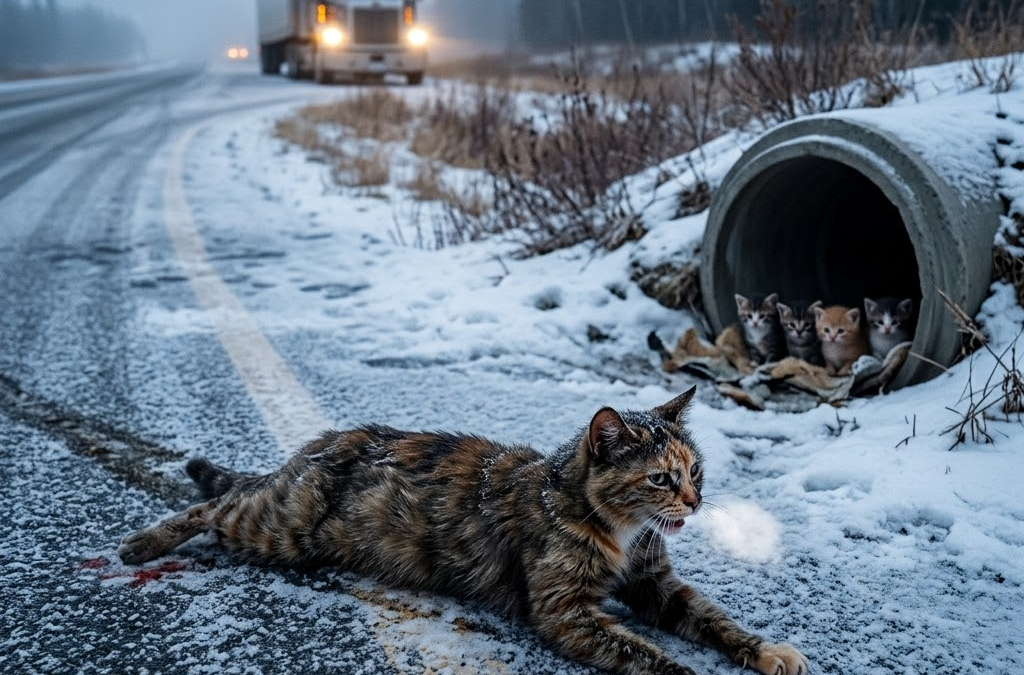
A Mother Cat Was Hit by a Car and Left Paralyzed on a Frozen Highway at −12°C—But She Dragged Herself Nearly 200 Meters With a Broken Spine. When a Trucker Discovered What She Was Desperately Crawling Toward, He Broke Down in Tears… Four Tiny Kittens Were Waiting for Their Mom.
PART3:
A concrete culvert opening beneath the road.
Daniel turned back.
“Hey, sweetheart.”
The cat pulled herself another six inches.
Her right forepaw slipped.
She tried again.
Daniel saw that two claws were missing.
Not broken.
Missing.
Torn away.
Fresh blood darkened the toes.
Her elbows were worse.
The fur had been scraped completely off.
Raw tissue dragged directly against asphalt.
Daniel felt sick.
“Stop.”
The cat did not.
He put one gloved hand in front of her.
She tried to crawl around it.
“I said stop.”
Her eyes remained fixed toward the culvert.
Daniel had never owned a cat.
His family had dogs when he was a boy, but adulthood on the road had made animals impractical.
He knew almost nothing about feline behavior.
He knew pain.
And this animal was in more pain than anything should have been able to move through.
He carefully slid both hands beneath her chest.
The cat twisted immediately.
Not to bite him.
Not to scratch.
To keep moving.
“Whoa.”
She pushed against his forearm with one front paw.
Her head stretched toward the other side of the highway.
Daniel lifted her fully.
She weighed almost nothing.
That shocked him.
Even beneath his gloves, he could feel ribs.
Hip bones.
The rigid uneven line of her lower spine.
Something was terribly wrong there.
The cat made no sound.
She simply strained forward.
Daniel followed her gaze.
The drainage pipe.
A round concrete culvert about eighteen inches wide protruded from the embankment twenty yards beyond the shoulder.
Half blocked by frozen weeds.
He stared.
Then heard it.
A tiny sound.
Almost impossible beneath the idling diesel engine and wind.
A squeak.
Then another.
Higher.
Thin.
Daniel’s arms tightened around the cat.
“No way.”
The cat struggled again.
He carried her across the road.
At the gravel shoulder, he lowered her.
She immediately pulled herself forward.
One arm.
Then the other.
Daniel followed.
The blood trail continued behind her.
He suddenly realized it did not begin near where he had found her.
It extended farther down the highway.
Farther than his headlights revealed.
He turned on the flashlight on his phone.
The red line stretched backward.
Dozens of yards.
Maybe more.
Daniel looked down at the cat.
“How long have you been doing this?”
She reached the culvert.
For the first time, her expression changed.
Her ears lifted slightly.
A sound came from inside.
Then four.
Tiny cries.
The cat pulled herself into the pipe.
Daniel crouched.
Cold wind cut through his jacket.
He held the phone light toward the darkness.
At first he saw mud.
Dead grass.
Then movement.
Four kittens.
Daniel stopped breathing.
They were tiny.
Eyes barely open.
Maybe two or three weeks old.
Huddled together in a shallow depression at the back of the pipe.
A piece of torn insulation had been dragged beneath them like bedding.
The mother reached them.
Every kitten immediately moved toward her.
The cat collapsed on her side.
Four tiny bodies pressed against her belly.
Daniel watched them begin nursing.
He sat back on his heels.
“Oh, hell.”
For several seconds he did nothing.
The wind howled across the road.
His engine idled.
Hazard lights flashed red against the embankment.
Inside the culvert, a dying cat with a broken body began feeding her babies.
Daniel’s throat tightened.
He had expected her to be trying to escape the road.
She had not been escaping.
She had been returning.
He looked back across the highway.
The blood trail.
Now the direction made sense.
She had been somewhere on the opposite side.
Hit.
Then crawled back.
“How far?”
The question came out aloud.
There was no answer.
Daniel stood.
He crossed the highway again.
Followed the blood trail backward.
Thirty yards.
Fifty.
Seventy.
It kept going.
At roughly a hundred yards, he found disturbed snow and a patch of blood near the center line.
Farther still, skid marks.
A broken reflector.
Tufts of tortoiseshell fur frozen into slush.
Daniel stood motionless.
That was where the vehicle had struck her.
The drainage pipe was on the other side.
Almost two football fields away.
He looked toward the tiny dark opening.
“No.”
He paced the distance again with his eyes.
She could not have.
But she had.
With a broken back.
Across traffic lanes.
On ice.
Using only her front legs.
Daniel returned to the culvert faster.
He dropped to his knees.
The mother still lay with the kittens.
One front leg trembled uncontrollably.
Her eyes were closing.
Daniel knew enough to understand that whatever drive had brought her back might be ending.
“Okay.”
He removed his heavy insulated coat.
He placed it beside the culvert.
Then reached inside.
The cat growled.
A weak sound.
“Yeah, I know.”
He slid one hand beneath her chest.
She tried to pull away.
“I’m not taking you from them.”
Her eyes stayed on the kittens.
Daniel lifted her onto the coat.
Then carefully removed each kitten.
One.
Two.
Three.
Four.
He tucked them against their mother.
The cat immediately curved her front half around them.
Her useless rear legs remained stretched behind her.
Daniel stared.
“You’re something else.”
He wrapped all five animals in the coat.
Then carried them to the truck.
Inside the cab, he turned the heater to maximum.
His hands shook.
He found an empty cardboard box beneath the sleeper bunk.
Lined it with towels.
Placed the kittens inside.
Then the mother.
She tried to climb over the edge toward them before he had even finished positioning her.
“Easy.”
Daniel arranged the kittens against her stomach.
She relaxed.
Only slightly.
He grabbed a chemical hand warmer from his emergency kit.
Activated it.
Wrapped it in cloth.
Placed it beneath one side of the box.
Then he pulled out his phone.
No signal.
“Of course.”
The nearest town was about fourteen miles away.
He knew there was a veterinary clinic there because he had once delivered flooring material to the strip mall next door.
Whether anyone would be there before dawn was another question.
Daniel started driving.
The box sat on the passenger seat.
Every few seconds he looked over.
The kittens moved.
The mother barely did.
“Stay awake.”
No response.
“Come on.”
Her eyes opened.
“Good.”
Daniel drove faster.
Not recklessly.
Just faster than the ice deserved.
He kept talking.
He did not know why.
Maybe for her.
Maybe for himself.
“My name’s Daniel.”
The cat’s eyes remained half closed.
“I drive a truck.”
Nothing.
“Pretty obvious.”
One kitten squeaked.
Daniel glanced over.
“You’re all critics.”
The mother lifted her head weakly toward the sound.
“Yeah.”
Daniel swallowed.
“They’re here.”
She lowered her head again.
“You got back.”
That sentence nearly broke him.
He drove another mile before speaking.
“You got back.”
At 5:34 a.m., Daniel pulled into the parking lot of Prairie Ridge Veterinary Center.
Dark.
Locked.
His stomach dropped.
Then he saw a sign beside the door.
AFTER-HOURS EMERGENCY — CALL.
He dialed.
A sleepy male voice answered.
“Prairie Ridge emergency.”
“I’ve got a cat.”
Pause.
“What happened?”
“Hit by a car.”
“Is she breathing?”
“Yes.”
“Bleeding heavily?”
“Yes.”
“Where are you?”
“Outside your door.”
Another pause.
“I’ll be there in eight minutes.”
The veterinarian arrived in six.
Dr. Samuel Pierce was fifty-three and looked as though Daniel had dragged him out of bed—which he had.
He wore jeans, boots, a winter coat over scrubs, and glasses slightly crooked on his face.
Then Daniel opened the box.
Whatever irritation Pierce might have felt disappeared.
“Oh.”
He lifted the mother carefully.
The cat’s body hung strangely from the hips down.
Pierce looked at Daniel.
“Spinal.”
“That’s what I thought.”
“You a vet?”
“No.”
“Good guess.”
They rushed inside.
The kittens were placed beneath warming lamps.
The mother went onto a stainless-steel table.
Pierce’s veterinary technician arrived ten minutes later.
Then another.
Daniel stayed near the doorway.
The examination took time.
Too much time.
Every finding seemed worse.
Body weight: 1.8 kilograms.
Severe dehydration.
Hypothermia.
Body temperature 34.4 Celsius.
Blood loss significant enough that the gums were almost white.
Deep abrasions on both elbows and the underside of the chest.
Two claws ripped completely from the right forepaw.
Another split vertically on the left.
Pelvic bruising.
And the spine.
Pierce took radiographs.
When he returned, his face told Daniel everything.
“How bad?”
“Complete fracture at L4.”
Daniel knew nothing about vertebrae.
“What does that mean?”
“The spinal cord is badly compromised.”
“Surgery?”
Pierce shook his head.
“She will not regain function in her rear legs.”
“Never?”
“No.”
Daniel looked through the glass toward the treatment table.
The cat lay under warm blankets.
“What now?”
“First we see if she survives.”
“And if she does?”
Pierce removed his glasses.
“She’ll be permanently paralyzed from the waist down.”
Daniel looked at the kittens.
“They okay?”
“Cold, but surprisingly good.”
“How?”
Pierce examined one.
“Stomachs aren’t empty.”
Daniel frowned.
“What?”
“She fed them recently.”
Daniel looked at him.
“Before she got hit?”
“Most likely.”
The veterinarian looked toward the mother.
“If your timeline is right.”
Daniel explained the blood trail.
The culvert.
The distance.
Pierce stared.
“How far?”
“About two hundred yards.”
“With this fracture?”
“That’s what she did.”
Pierce shook his head.
“She shouldn’t have been able to.”
Daniel looked at the cat.
“She didn’t seem interested in whether she should.”
They stabilized her throughout the night.
Daniel stayed.
He had freight waiting.
A dispatcher calling.
A delivery schedule now ruined.
He ignored everything for almost an hour before finally answering.
His supervisor, Hank, was furious.
“Where are you?”
“Veterinary clinic.”
Silence.
“What?”
“Long story.”
“Daniel, you’ve got steel due in Lincoln by ten.”
“I’m not making ten.”
“Why?”
Daniel looked through the treatment-room window.
“Cat got hit.”
Another silence.
Then Hank said slowly, “You missed delivery because of a cat?”
“Five cats.”
“What?”
“Four babies.”
“Daniel.”
“I’ll take the write-up.”
“You’re serious.”
“Yes.”
Hank swore.
Then, unexpectedly, sighed.
“My wife volunteers at a shelter.”
Daniel waited.
“I’ll call Lincoln.”
“Thanks.”
“You owe me.”
“I know.”
“Are the cats alive?”
“So far.”
“Then make it worth the headache.”
Daniel hung up.
At 8:12, Pierce sat beside him in the waiting room.
“We have another decision.”
Daniel’s stomach tightened.
“What?”
“Her condition is critical. She’s paralyzed. She’ll require long-term bladder management, skin protection, mobility assistance, possibly a wheelchair.”
Daniel stared.
Pierce continued.
“She may not be able to raise the kittens herself.”
“But she came back for them.”
“I know.”
“What are you saying?”
“I’m saying euthanasia would be medically defensible.”
Daniel looked through the window.
The mother’s eyes were open.
She was watching the box containing the kittens.
One began crying.
Immediately the cat lifted her head.
Tried to move.
Her front paws clawed weakly at the blanket.
Pierce saw it too.
Daniel said, “She’s trying to get to them.”
“Yes.”
“Put them with her.”
“We’re keeping them warm.”
“Put one with her.”
Pierce hesitated.
Then nodded to a technician.
They brought one kitten.
Placed it near the mother’s face.
The change was immediate.
She pulled it beneath her chin.
Licked its head.
The kitten rooted toward her belly.
Pierce watched.
Daniel whispered, “Does that look like an animal who’s done?”
The veterinarian said nothing.
Finally:
“No.”
They did not euthanize her.
For the next twelve hours, the medical team treated shock.
Fluids.
Pain medication.
Antibiotics.
Careful warming.
Wound cleaning.
The abrasions took more than an hour.
Pieces of asphalt had embedded in the raw tissue and frozen there.
Some had to be removed with forceps.
The cat trembled even under sedation.
Daniel sat in the waiting room and listened to muffled sounds through the door.
He hated every one.
At 3:00 p.m., he finally left to complete what remained of his route.
He returned after midnight.
The clinic was dark except for emergency lighting.
Pierce met him at the door.
“She’s alive.”
Daniel exhaled.
“And the babies?”
“Alive.”
“She nursing?”
Pierce smiled faintly.
“You’re going to want to see this.”
Inside the recovery area, the mother lay on thick padding.
Her rear legs remained motionless.
All four kittens were piled against her chest.
One slept beneath her chin.
Another fed.
The mother had rearranged them into a tight cluster.
“How’d they get there?”
“We put them next to her.”
Pierce folded his arms.
“She spent ten minutes dragging herself around until they were positioned exactly like this.”
Daniel smiled.
“Bossy.”
“That’s one word.”
“She got a name?”
The chart on the cage read:
UNKNOWN TORTOISESHELL — HIGHWAY FOUNDLING.
Pierce followed his gaze.
“Staff started calling her Highway.”
Daniel frowned.
“That’s terrible.”
“It stuck.”
The cat looked at him.
“Sorry,” Daniel said. “Apparently your name is Highway.”
She blinked.
“Don’t blame me.”
For eighteen hours after arrival, Pierce assumed Highway’s maternal behavior would diminish.
Pain.
Shock.
Stress.
Physical damage.
All should have interfered.
Instead, she dragged herself to her kittens whenever they cried.
The first time happened at 11:40 the next morning.
A technician had moved the litter a few feet away to bottle-feed one.
Highway woke.
Heard the crying.
Raised her head.
Then pulled herself from the padded bed.
Front paws digging into the tile.
The technician rushed over.
“Stop, stop.”
Highway ignored her.
She dragged both paralyzed legs behind her.
One foot.
Two.
Three.
The kittens cried.
She kept going.
Pierce watched from the doorway.
“Bring them.”
The technician started to pick Highway up.
“No.”
Pierce stopped her.
“Bring the kittens to her.”
They did.
Highway immediately curled around them.
Pierce stared.
He had practiced veterinary medicine for twenty-seven years.
He had seen mothers reject litters after trauma.
Seen injured dogs crawl toward puppies.
Seen queens nurse kittens that were not theirs.
Still, something about Highway unsettled him.
Perhaps because of the damage.
Her body had been catastrophically broken.
Yet behaviorally, she appeared to have made only one calculation.
Kittens cry.
Go to kittens.
Nothing else seemed relevant.
The clinic began supplemental feeding because Highway’s weight dropped.
1.8 kilograms became 1.6.
Then 1.5.
Eventually 1.3.
Pierce became alarmed.
“She cannot keep producing milk at this rate.”
Daniel had started visiting every time his route brought him near town.
“What happens?”
“She dies.”
Daniel stared.
“You’re feeding her.”
“We’re feeding her heavily.”
“Then why is she losing weight?”
“Because healing burns calories. Lactation burns more. She has almost no reserves.”
“So stop the nursing.”
“We’ve tried limiting it.”
Daniel looked toward the recovery pen.
Highway’s ears twitched when a kitten cried from the nursery.
She immediately tried to move.
Pierce sighed.
“She becomes severely distressed.”
“What do we do?”
“Supplement her. Supplement them. Gradually wean.”
“How long?”
“A few weeks.”
Daniel nodded.
“Do it.”
Pierce looked at him.
“You understand there are costs.”
Daniel’s jaw tightened.
“How much?”
The veterinarian gave him an estimate.
Daniel stared at the floor.
He was not poor.
But trucking had not made him rich.
He had a rented house.
Truck payments.
Child support from a marriage that had ended fifteen years earlier.
Little savings.
“I can cover some.”
“You’re not responsible.”
“I found her.”
“That does not make you financially responsible.”
Daniel looked through the glass.
Highway was cleaning one kitten’s face.
“She crossed that road.”
Pierce waited.
Daniel looked at him.
“I can pay something.”
“We have a rescue fund.”
“Use it.”
“Other animals need it.”
“So does she.”
Pierce smiled faintly.
“Fair.”
Word spread.
Not widely.
No viral post.
Not yet.
Just locally.
A truck driver brought in a paralyzed cat with four babies.
One technician told her sister.
Her sister worked at a feed store.
Someone left fifty dollars at the clinic.
Then twenty.
Then a hundred.
A woman mailed a check labeled FOR HIGHWAY AND BABIES.
Daniel did not know until Pierce showed him the ledger.
“Who are these people?”
“People.”
“Why?”
Pierce shrugged.
“They heard.”
By week two, the kittens’ eyes were fully open.
Highway’s wounds had begun closing.
Her elbows formed thick pink scar tissue.
The torn claws remained sensitive.
Her spine would never heal functionally.
Pierce showed Daniel the radiographs again.
“These legs are not coming back.”
Daniel stared at the image.
“What does she know?”
“What do you mean?”
“Does she understand?”
“Animals understand function.”
“She knows she can’t move them?”
“Probably.”
Daniel watched her.
Highway pulled herself toward food using her front legs.
The rear half followed.
She had already adapted.
No hesitation.
No visible confusion.
Just movement.
Daniel whispered, “She doesn’t feel sorry for herself.”
Pierce gave him a look.
“That’s generally a human specialty.”
Daniel laughed.
It was the first time either of them had laughed about anything related to Highway.
The kittens became mobile.
That created a new problem.
They wandered.
Highway hated it.
If one moved more than a few feet away, she called.
Short, insistent chirps.
If the kitten ignored her, Highway dragged herself after it.
The technicians started building barriers.
Low foam walls.
Blankets.
Anything that kept the kittens within her circle without confining Highway.
“She’s controlling,” one technician joked.
Daniel watched her pull a kitten back by the scruff.
“She earned it.”
At five weeks after rescue, the kittens began leaving for foster homes.
Highway did not understand.
The first kitten, a black-and-orange female they called Ember, left with a family from Nebraska.
Highway searched the enclosure afterward.
Daniel sat with her.
“She’s okay.”
Highway crawled to the empty carrier.
Sniffed.
Meowed.
“I know.”
She looked at him.
Daniel felt ridiculous talking to a cat.
He kept doing it.
“They’ve got kids.”
Highway sniffed the door.
“Two girls.”
She meowed.
“They’re going to spoil her.”
Highway crawled back toward the remaining three kittens.
Daniel exhaled.
“I know that doesn’t help.”
The second kitten left.
Then the third.
The last one, a tortoiseshell male with an orange nose, remained until eight weeks.
By then Highway had nursed them for nearly five weeks after the accident.
Long after Pierce thought she would stop.
Long after her own body needed every calorie.
She had to be syringe-fed periodically just to maintain enough weight.
Daniel visited the afternoon the last kitten left.
Highway watched the carrier disappear through the clinic door.
Then she called.
Once.
Twice.
Again.
Daniel sat on the floor.
She crawled around the room.
Checked behind a towel.
Under a chair.
Inside an empty cardboard box.
His throat tightened.
Finally she stopped.
Daniel picked her up.
Her rear legs hung.
She hated being held at first.
Then settled against his chest.
“They’re alive.”
Highway pressed her face against his shirt.
“All four.”
He stroked behind one ear.
“You did that.”
Her purr began.
The sound was soft.
Daniel closed his eyes.
“You did that.”
Once the kittens were gone, the clinic faced another question.
What happened to Highway?
A shelter could take her.
Maybe.
A rescue specializing in disabled animals was possible.
But permanent paralysis made placement difficult.
Highway required bladder expression several times daily.
Special bedding.
Monitoring for pressure sores.
Help grooming areas she could no longer reach comfortably.
Long-term mobility management.
Pierce explained everything to Daniel.
Daniel listened.
Then asked:
“When can she come home?”
Pierce stopped.
“What?”
“With me.”
The veterinarian stared.
“You’ve never owned a cat.”
“Correct.”
“You drive long-haul.”
“Currently.”
“You’re away three, four days at a time.”
“I can change routes.”
“You rent.”
“Landlord allows pets.”
“You know how to express a bladder?”
“No.”
“You know how to manage a paralyzed animal?”
“No.”
“Litter box?”
“No.”
“Cat diet?”
“No.”
Pierce folded his arms.
“Then why?”
Daniel looked through the recovery-room window.
Highway was sleeping on a fleece blanket.
Both front paws extended.
Rear legs useless behind her.
He took his time answering.
“I saw her on that road.”
Pierce waited.
“Less than four pounds.”
Daniel swallowed.
“Back broken.”
He looked at the vet.
“And she was still going.”
Pierce’s expression softened.
Daniel continued.
“I’ve spent twenty-one years driving.”
“Seen wrecks.”
“Seen people do stupid things.”
“Seen people leave other people standing on the shoulder because stopping would make them late.”
His voice became quieter.
“I watched that little animal pull herself across ice because something needed her on the other side.”
Pierce said nothing.
Daniel pointed toward Highway.
“She didn’t know if she’d survive.”
“She didn’t know anybody was coming.”
“She just went.”
His eyes returned to the cat.
“So, no, I don’t know how to care for a paralyzed cat.”
He shrugged.
“I’ll learn.”
Pierce smiled.
“You’re serious.”
“Completely.”
“You understand your life changes.”
Daniel looked at him.
“So did hers.”
Highway went home with Daniel seven weeks after he found her.
Not permanently at first.
A trial foster arrangement.
Pierce insisted.
Daniel’s rented house sat at the edge of a small town.
One bedroom.
One bathroom.
Old carpet.
Secondhand furniture.
A television too large for the room.
Highway hated the carrier.
She hated the house for twenty minutes.
Then discovered Daniel’s bed.
He had placed her on a padded mat on the floor.
Highway dragged herself toward the mattress.
Looked up.
Tried to climb.
Failed.
Tried again.
Daniel watched.
“You can’t.”
Highway pulled.
Her front claws caught the blanket.
She hoisted her chest.
Rear legs dangled.
Then she fell.
Daniel caught her.
“You are unbelievable.”
He placed her on the bed.
Highway circled using only her front legs.
Then curled beside his pillow.
Daniel stared.
“So that’s how this is going to work.”
Highway closed her eyes.
The next morning Daniel woke with her face three inches from his.
“Morning.”
She meowed.
He checked the clock.
4:41.
“No.”
Another meow.
“Absolutely not.”
Highway reached one paw toward him.
“No.”
Claws appeared.
Daniel sat up.
“Fine.”
That was his introduction to cat ownership.
Pierce taught him bladder expression.
The first lesson was humiliating for everyone involved.
“Support her here.”
“I am.”
“Not there.”
“Where?”
“Daniel, she has organs.”
“I’m aware.”
“Doesn’t look like it.”
Highway turned and bit Daniel lightly.
He glared.
“She’s not helping.”
Pierce laughed.
“You two will be great.”
Daniel learned.
Bladder care.
Skin inspection.
Nail trimming.
Nutrition.
Safe lifting.
Bedding.
How to check the paralyzed feet for injuries she could not feel.
How to watch for urinary infections.
How to keep fur clean.
How to prevent pressure sores.
He cut one side of a litter box down to two inches.
Highway stared at it.
Then dragged herself in.
Used it.
Dragged herself out.
Daniel celebrated as if she had graduated college.
“Look at you.”
Highway walked—dragged—away.
“Not impressed?”
She ignored him.
A month later, something arrived at the clinic.
A small rear-support wheelchair.
Two lightweight wheels.
Soft harness.
Adjustable aluminum frame.
Custom-sized for Highway.
Pierce called Daniel.
“Come over.”
“What?”
“Just come.”
At the clinic, Daniel saw the cart.
“Who bought this?”
“No one.”
“What?”
“Company donated it.”
“Why?”
“I posted Highway’s radiographs on a professional mobility forum asking for fitting advice.”
“And?”
“Someone from a small company saw the case.”
Daniel touched one wheel.
“They made that for her?”
“Yes.”
Highway hated it.
The first fitting lasted thirty seconds.
She froze.
Would not move.
Then backed up.
Got angry.
Tried to bite the wheel.
Daniel laughed so hard Pierce told him to leave the room.
Day two, she moved three feet.
Day three, something clicked.
Highway realized her back end followed when she pulled forward.
She moved across the clinic.
Stopped.
Looked behind herself.
Moved again.
Faster.
By afternoon she was racing down the hallway.
A technician shouted:
“She’s coming!”
Highway rolled around the corner like a tiny chariot.
Daniel jumped aside.
She passed him.
“Hey!”
The entire staff laughed.
Pierce folded his arms.
“Three days.”
Daniel grinned.
“Told you.”
“You told me nothing.”
“I was thinking it.”
The wheelchair changed Highway’s world.
At home, Daniel built ramps.
First to the porch.
Then to the bed.
The bed ramp took three attempts.
The first was too steep.
Highway rolled backward.
The second was too narrow.
The third worked.
The first time she climbed it without help, Daniel stood at the bottom.
“Come on.”
Highway pulled.
Wheels turned.
Up.
Up.
Almost.
Then onto the mattress.
She immediately lay on Daniel’s pillow.
He laughed.
“Of course.”
He modified furniture.
Moved rugs.
Added traction mats.
Built a feeding station high enough that her cart could slide beneath.
Changed his work.
That part hurt financially.
Long-haul routes paid more.
He requested regional runs.
His supervisor Hank stared at him.
“You’re serious.”
“Yes.”
“Because of the cat.”
“Yes.”
“You realize how that sounds?”
Daniel shrugged.
“I’ve sounded worse.”
Hank looked toward the dispatch office.
“I can get you Omaha, Lincoln, Kansas City runs.”
“Home every night?”
“Most.”
“Do it.”
“You’ll lose twelve grand a year.”
“I’ll survive.”
Hank shook his head.
“Never thought I’d see it.”
“What?”
“Daniel Mercer reorganizing his career around a cat.”
Daniel smiled.
“Neither did I.”
Highway adapted faster than Daniel did.
Within six months, she had systems.
Morning:
Wake Daniel.
Breakfast.
Bladder care.
Cart.
Patrol kitchen.
Patrol porch.
Judge neighbors.
Nap.
When Daniel returned from a route, Highway recognized the sound of his truck before it turned into the drive.
She would roll toward the door.
Wait.
Daniel opened it.
“There she is.”
Highway meowed.
He crouched.
She pushed her head into his hand.
That became home.
Not the building.
That moment.
The four kittens grew.
Ember’s family sent pictures.
Then the other adopters did too.
Pierce forwarded them.
Daniel printed every one.
Ember sleeping beneath a Christmas tree.
Copper sitting beside a toddler.
Patch stretched across a kitchen counter.
Milo curled beside a Labrador three times his size.
Daniel placed the photos on a shelf.
“Your kids.”
Highway ignored them.
“You want to see?”
No interest.
“Fair.”
He smiled.
“They’re good.”
Highway climbed into her bed.
“All four.”
She began grooming one front paw.
Daniel watched her.
“They’re good because of you.”
Highway never knew that.
At least Daniel assumed she did not.
Animals do not need the story of their own sacrifice.
Humans do.
Perhaps because humans need meaning more desperately.
Daniel remembered the highway constantly.
For the first year, every time he drove past that section, he slowed.
The blood had vanished within days.
Snow.
Traffic.
Road crews.
Nothing remained.
The culvert remained.
Ordinary.
Concrete.
Half hidden by weeds.
Nobody passing at sixty-five miles an hour would imagine four kittens had once waited inside while their mother crawled toward them with a broken spine.
Daniel knew.
That was enough.
One summer morning, he stopped.
Highway was with him.
Not loose.
Never.
She rode in a secured carrier during short trips.
Daniel parked.
Carried her to the shoulder.
The weather was warm.
Green grass had replaced dead winter weeds.
He fitted her cart.
Highway rolled onto the gravel.
Then stopped.
Daniel watched.
“Remember?”
Her ears moved.
Cars passed.
She looked toward the culvert.
Daniel’s chest tightened.
He did not know whether cats remembered places the way humans did.
Maybe the smell meant something.
Maybe nothing.
Highway rolled three feet toward the road.
Daniel immediately grabbed the cart.
“No.”
She looked back at him.
“Absolutely not.”
He turned her away.
“You crossed that road once.”
His voice cracked slightly.
“That’s enough for one lifetime.”
He carried her back to the truck.
Afterward, he never brought her there again.
Some places do not need revisiting.
At Highway’s annual checkup, Pierce inspected the old abrasions.
The elbows had healed into two thick, hairless patches.
Permanent.
Daniel ran one finger near the scar.
“Road did that.”
“Yes.”
“Will the fur ever grow?”
“No.”
“Good.”
Pierce looked at him.
“Good?”
Daniel shrugged.
“She earned the scars.”
Pierce smiled.
“Don’t romanticize scars.”
“I’m not.”
Daniel looked at Highway.
“I just don’t need to pretend they’re ugly.”
That silenced the veterinarian for a moment.
Highway reached 2.7 kilograms.
Her highest recorded weight.
Pierce celebrated.
Daniel brought a can of chicken to mark the occasion.
“You know most people bring cake.”
“She’s a cat.”
“Fair.”
Highway ate.
Years passed.
Daniel’s life became smaller geographically and larger in ways he had not expected.
Regional routes.
Same bed most nights.
Same diner.
Same grocery store.
Highway waiting.
He made friends with neighbors he had barely known because everyone wanted to ask about the little cat on wheels.
Children came to the fence.
“Can we see Highway?”
Daniel would look at her.
“What do you think?”
Highway often rolled directly toward them.
Children crouched.
Touched her gently.
One little boy named Mason had cerebral palsy and used a wheelchair.
The first time he saw Highway’s wheels, his entire face lit up.
“She’s like me!”
Daniel’s throat tightened.
Mason’s mother smiled.
Highway rolled toward the boy.
He put out one hand.
She sniffed it.
Then rubbed her cheek against his fingers.
Mason laughed.
“She likes me.”
Daniel crouched.
“Looks like it.”
“Does she hate her wheelchair?”
“No.”
“Did she used to?”
“For about two days.”
Mason nodded seriously.
“I hated mine for longer.”
Daniel laughed.
“Highway’s impatient.”
Mason looked at the cat.
“Can she run?”
“Want to see?”
Daniel tossed a soft toy across the yard.
Highway launched after it.
Her little wheels bounced across the grass.
Mason screamed with laughter.
His mother covered her mouth.
Daniel pretended not to notice her tears.
After that, Mason visited often.
One afternoon he asked:
“Did Highway get hurt because she was bad?”
Daniel immediately knelt.
“No.”
“My friend at school said sometimes animals get hurt because they go where they shouldn’t.”
Daniel looked at Highway.
Then at Mason.
“No.”
“Then why?”
“Bad things happen.”
Mason frowned.
“That’s not fair.”
“No.”
The boy waited.
Daniel added:
“But what happened after can still be good.”
Mason looked at Highway again.
“She found you.”
“Technically I found her.”
“She found you too.”
Daniel smiled.
“Maybe.”
Highway became five.
Then six.
The veterinarian had originally estimated she was around one or two when found.
Nobody knew exactly.
Her rear legs never regained sensation.
Never twitched.
Never improved.
That surprised people.
They expected the rescue story to end with a miracle.
One day Highway walks again.
It never happened.
Daniel did not need it to.
He hated when strangers said:
“Poor thing.”
Highway did not look poor.
She looked annoyed.
Usually because someone was standing between her and food.
A woman at a gas station once saw the wheelchair.
“Oh, that poor cat.”
Daniel said, “She’s fine.”
“She can’t walk.”
“She can move.”
“But isn’t that cruel?”
Daniel stared at her.
“What?”
“Keeping her alive like that.”
He looked down.
Highway was sniffing a patch of grass.
Her tail lifted.
She rolled toward a dandelion.
Swatted it.
Missed.
Tried again.
Daniel looked back at the woman.
“She eats.”
“Yes.”
“She plays.”
The woman hesitated.
“She sleeps on my pillow.”
No response.
“She chases bugs.”
Daniel pointed.
“She just stole half my turkey sandwich ten minutes ago.”
The woman smiled awkwardly.
Daniel crouched beside Highway.
“She isn’t waiting to become the animal she used to be.”
He scratched behind her ear.
“She’s busy being this one.”
The woman left.
Daniel repeated that sentence later to Pierce.
The vet nodded.
“Good.”
“I was angry.”
“Also good.”
“You’re a strange doctor.”
“So I’ve been told.”
The truth was that Daniel struggled more with Highway’s disability than Highway did.
He mourned for her.
She did not appear to.
He looked at her scarred elbows and imagined pain.
She looked toward dinner.
He saw what had been lost.
She lived with what remained.
That taught him something.
Daniel had spent years doing the opposite.
His marriage had ended because both he and his wife had become people who remembered disappointments better than affection.
His daughter, Kayla, lived in Colorado and called less often than either of them wanted to admit.
Daniel carried guilt from missed birthdays.
Long routes.
Cancelled weekends.
A graduation he had almost missed because a dispatcher promised him extra money to take one more load.
He had always said:
That’s trucking.
As though a profession had made every decision for him.
Highway changed that excuse.
One evening Kayla called.
“You working Christmas?”
Normally Daniel would have said yes.
Holiday loads paid more.
He looked at Highway sleeping beside his boots.
“No.”
Kayla went quiet.
“No?”
“No.”
“You okay?”
“Yes.”
“Dad, you’ve worked Christmas since I was like twelve.”
“I know.”
Another pause.
“Why not this year?”
Daniel looked at Highway.
“I’ve been thinking.”
“That sounds dangerous.”
He laughed.
“Can I come out?”
Kayla was silent.
Then:
“You’re asking?”
“Yeah.”
“For Christmas?”
“Yes.”
She sounded suspicious.
“Who are you?”
“Kayla.”
“I’m serious.”
“So am I.”
Another pause.
Then:
“Yeah.”
Her voice softened.
“Come.”
Daniel drove to Colorado with Highway.
It was the first Christmas he had spent with his daughter in nine years.
Kayla opened the door.
Saw the carrier.
“You brought the famous cat.”
“Course.”
“You’ve sent me more pictures of her in three years than you sent of yourself in twenty.”
“That’s because she photographs better.”
Highway rolled around Kayla’s living room.
Inspected the Christmas tree.
Stole ribbon.
Slept on Kayla’s couch.
On Christmas night, Daniel and his daughter sat at the kitchen table after everyone else went to bed.
Kayla looked toward Highway.
“She really did crawl that far?”
“Yes.”
“With a broken spine.”
“Yes.”
“For the kittens.”
“Yes.”
Kayla stared at her glass.
“You changed routes because of her.”
Daniel nodded.
“Why couldn’t you do that when I was little?”
The question landed exactly where it was intended.
Daniel did not defend himself.
That was new.
“I should have.”
Kayla’s eyes filled.
“You always said you couldn’t.”
“I lied.”
“To me?”
“To myself first.”
She looked at him.
Daniel continued.
“I thought being reliable meant bringing money home.”
“I know.”
“I told myself the miles were for you.”
“They weren’t always.”
“No.”
His voice broke.
“I’m sorry.”
Kayla looked toward the cat.
“What did she do to you?”
Daniel smiled sadly.
“Nothing.”
He shook his head.
“I just watched something with no choices make one.”
His daughter waited.
“She was broken in half.”
Daniel rubbed his hands together.
“And she still moved toward what needed her.”
He looked at Kayla.
“I had working legs.”
Silence.
“I had a phone.”
His eyes burned.
“I had time.”
He swallowed.
“I just kept saying the road made me leave.”
Kayla started crying.
Daniel did too.
Highway slept through the entire reconciliation.
As cats often do.
When Daniel returned home, his life did not become perfect.
He and Kayla still argued.
Some wounds did not disappear because of one Christmas.
But he called more.
Visited twice a year.
Learned his grandson’s baseball schedule.
Sent birthday cards early.
Changed.
Not all at once.
Repeatedly.
That was something Highway had taught him too.
Courage was not one dramatic act.
Most courage looked repetitive.
Pull.
Drag.
Breathe.
Again.
Years after the rescue, Dr. Pierce invited Daniel to speak briefly at a fundraiser for the clinic’s emergency-care fund.
Daniel refused three times.
“I don’t speak.”
“You speak constantly.”
“To you.”
“There’ll be seventy people.”
“No.”
“Highway will be there.”
“No.”
“Mason’s family is coming.”
Daniel stared.
“Low.”
Pierce smiled.
“See you Saturday.”
Daniel stood behind a podium wearing jeans and a button-down shirt.
Highway waited beside him in her wheelchair.
People applauded.
Daniel looked horrified.
“Please don’t.”
They stopped.
“Thank you.”
Laughter.
He looked down at Highway.
“I’m supposed to tell you how I rescued this cat.”
He shook his head.
“That’s not exactly what happened.”
The room grew quiet.
“I was tightening a cargo strap.”
“Almost didn’t see her.”
“Honestly, I noticed the blood before I noticed her.”
He told them.
The frozen highway.
The useless rear legs.
The torn claws.
The blood trail.
How she twisted in his hands toward the culvert.
How he heard the cries.
The four kittens.
He did not embellish.
The facts were enough.
Then he said:
“I’ve driven more than two million miles.”
A few people shifted.
“I’ve seen accidents.”
“Storms.”
“Cars flipped in ditches.”
“People hurt.”
“I used to think courage was mostly something people did when they had training.”
Military.
Firefighters.
Police.
People prepared for danger.
He looked down.
Highway was trying to lick her wheel.
“Then I saw this.”
Laughter.
Daniel smiled.
“She weighed three-point-something pounds.”
“Her spine was broken.”
“She had no idea I was standing fifty yards away.”
“She had no reason to think help existed.”
His voice tightened.
“But something needed her on the other side.”
The room went silent.
“She didn’t negotiate with pain.”
“She didn’t ask whether the odds were good.”
“She pulled.”
“One paw.”
“Then the other.”
Daniel swallowed.
“And I’ve thought about that almost every day since.”
He did not tell them courage meant ignoring fear.
It did not.
He did not claim animals possessed human moral reasoning.
Pierce would have corrected him.
He simply said:
“I don’t know what Highway thought.”
“Maybe nothing the way we think.”
“Maybe it was instinct.”
“Maybe hormones.”
“Maybe she smelled her babies.”
He paused.
“But I know what she did.”
He looked at the audience.
“And sometimes what you do matters more than whatever speech you could make explaining it.”
The fundraiser raised enough money for fourteen emergency cases.
Daniel donated his speaking honorarium.
Pierce told him afterward:
“You’re good at that.”
“Never happening again.”
It happened again.
Not often.
Schools.
Animal rescue groups.
One trucking safety conference that invited him because someone thought the highway angle made sense.
Daniel always brought Highway when appropriate.
Never treated her like a prop.
If she seemed tired, they left.
If she hated the room, speech cancelled.
“She outranks the schedule,” Daniel would say.
At eight, Highway started developing arthritis in her shoulders.
Her front legs had done the work of four for years.
Pierce warned Daniel.
“We knew this could happen.”
“What do we do?”
“Weight control.”
“Medication.”
“Physical therapy.”
“Shorter cart sessions.”
Daniel nodded.
“We do it.”
Hydrotherapy helped.
The first time Highway entered water, she tried to murder everyone.
“This is for your own good,” Daniel said.
Highway yowled.
Pierce laughed from the observation room.
“Sounds convinced.”
Eventually she tolerated it.
Her shoulders strengthened.
Daniel learned massage techniques.
Every evening he sat on the floor.
Highway between his knees.
Gentle pressure.
Slow circles.
She purred.
“These arms did enough.”
He whispered it without thinking.
Then corrected himself.
“Legs.”
Highway opened one eye.
“You know what I mean.”
One winter evening, heavy snow fell.
Daniel sat beside the living-room window.
Highway slept near the heater.
The weather report mentioned black ice.
Road closures.
Visibility.
Daniel’s mind returned to November 2022.
He had done that thousands of times.
But something was different now.
He realized he could no longer picture the road without seeing the entire life that came after it.
The old memory used to stop at blood.
Then at kittens.
Now it continued.
Highway racing Mason across the yard.
Kayla laughing as Highway stole wrapping ribbon.
Pierce fitting the wheelchair.
Four framed photographs of adult cats.
Regional routes.
Christmas in Colorado.
A ramp to Daniel’s bed.
All of it existed because of one sequence of moments.
A driver noticed movement.
A truck stopped.
A cat kept pulling.
Nothing about that morning had looked large while it happened.
Daniel found that frightening.
How many life-changing things had he passed without knowing?
People.
Animals.
Choices.
Phone calls.
He could not go backward and stop for all of them.
But he could stop now.
That became his rule.
If Kayla called, answer.
If a friend sounded wrong, ask twice.
If an animal was on the road, stop safely.
If someone needed five minutes, do not pretend you did not have five.
Highway never knew she had created any rule.
She wanted dinner.
That was enough.
When Highway was about ten, her health declined.
Not suddenly.
Urinary infections became more frequent.
Her shoulders tired faster.
The scar tissue on her elbows cracked occasionally.
One missing claw caused a recurring skin irritation.
Daniel became more vigilant.
Pierce eventually retired.
His younger associate, Dr. Lena Ortiz, took over.
Daniel distrusted her because she looked twelve.
She was thirty-six.
“You’re not Pierce.”
“No.”
“He knows Highway.”
“I’ve read her entire chart.”
“That’s ninety pages.”
“One hundred twelve.”
Daniel blinked.
“Okay.”
Ortiz crouched beside Highway.
“I also watched Dr. Pierce’s old case presentation.”
“What presentation?”
“Your cat is famous in orthopedic circles.”
Daniel glared at Highway.
“You’ve been hiding things.”
Highway yawned.
Ortiz smiled.
“She’s doing well.”
“How well?”
“For her age and condition?”
Daniel frowned.
“Don’t grade her on a curve.”
“I’m not.”
She met his eyes.
“She’s doing well.”
That became enough.
One morning, Daniel found Highway without her cart sitting beside the back door.
Her front paws positioned under her.
Rear body resting on a padded drag bag.
She looked outside.
Snow.
Fresh.
Thin layer.
Daniel opened the door.
“You sure?”
Highway pulled forward.
He carried her onto the covered porch.
Placed her on a blanket.
She watched snow fall.
Daniel sat beside her.
For nearly an hour they did nothing.
Highway’s breath formed tiny clouds.
Daniel remembered another breath in cold air.
Open mouth.
Steam.
Blood.
Her eyes fixed across the road.
He touched her head.
“You don’t have to go anywhere.”
Highway leaned into him.
“You know that, right?”
Purr.
“No babies waiting.”
Purr.
“No road.”
He swallowed.
“Nothing needs you on the other side.”
Highway closed her eyes.
Daniel smiled.
“You can just sit.”
So they did.
Years earlier, he had changed his entire life because he watched a tiny broken animal refuse to stop moving.
Now perhaps the last gift he could give her was the opposite.
Permission to stop.
Not die.
Not yet.
Just stop proving anything.
Stop pulling.
Stop fighting every second.
Rest.
Highway lived another two years.
At twelve, her kidneys began failing.
Daniel knew older cats developed kidney disease.
He still felt betrayed.
“This is separate from the spine?”
Ortiz nodded.
“Age-related.”
“Can we treat it?”
“Manage.”
“For how long?”
“I don’t know.”
Daniel hated those words.
He had heard them before.
He learned subcutaneous fluids.
Highway hated the needle.
She forgave him when chicken appeared.
Her appetite fluctuated.
Weight dropped slightly.
Then stabilized.
Daniel slept more lightly.
He kept a small camera near her bed when he left for regional runs.
Checked too often.
Hank, who was now nearing retirement himself, caught him watching the feed at dispatch.
“Cat okay?”
“Yeah.”
“Then stop spying.”
“She’s old.”
“So are you.”
Daniel looked offended.
“Unnecessary.”
Hank laughed.
One spring afternoon, Ember’s family contacted the clinic.
Ember had died from an aggressive cancer.
Daniel sat in his truck after hearing.
He had not seen her since kittenhood.
Still, he cried.
He went home.
Highway met him.
Older now.
Slower.
He sat on the floor.
“Your girl died.”
Highway rolled toward him.
“Ember.”
He showed her the photograph.
No reaction.
He laughed through tears.
“I know.”
She pressed against his knee.
Daniel stroked her.
“She had ten good years.”
Purr.
“Kids loved her.”
Purr.
“Remember her?”
Probably not.
Maybe some scent in memory.
Maybe nothing.
It did not matter.
Daniel remembered for both of them.
Another kitten died two years later.
The other two remained.
Life moved.
The litter that had once fit inside a drainage pipe became four separate histories.
Highway’s became the longest.
At nearly fourteen, she began refusing the wheelchair.
Daniel tried.
She stiffened.
Would not move.
Ortiz examined her.
“Shoulders hurt.”
“So no cart?”
“Not unless she wants it.”
Daniel looked devastated.
“She loves the cart.”
“Loved.”
The correction hurt.
Ortiz continued gently.
“Needs change.”
He nodded.
At home, Daniel removed some ramps.
Added padded paths.
Carried her more.
Highway accepted being carried now.
That was new.
As a younger cat she always wanted autonomy.
Older Highway liked Daniel’s arms.
Especially his chest.
She would press her head below his chin.
Purr.
The same vibration.
Daniel sometimes thought about the first time.
Wrapped in his winter coat.
Kittens pressed against her.
He had felt that purr through fabric while driving twenty-three kilometers to the clinic.
He had not understood it then.
Maybe Highway was calming the kittens.
Maybe herself.
Maybe purring because the body sometimes does strange things under extreme stress.
Daniel stopped needing an explanation.
It had been there.
That was enough.
The final winter came quietly.
Highway stopped eating breakfast on a Tuesday.
By Thursday she ate chicken only if Daniel held it.
Friday she refused that too.
Ortiz came to the house.
She examined Highway on Daniel’s bed.
The cat barely protested.
That scared him more than any diagnosis.
“Tell me.”
Ortiz sat beside him.
“Kidneys are failing rapidly.”
“Hospital?”
“We can.”
“But?”
“It may buy days.”
Daniel looked at Highway.
“What would you do?”
Veterinarians hated that question.
Ortiz answered anyway.
“I would keep her here.”
His eyes filled.
“Comfort?”
“Yes.”
“How long?”
“Probably very short.”
Daniel nodded.
He knew what came next.
Still, he asked.
“How do I know?”
Ortiz looked at Highway.
“She will tell you.”
Daniel laughed bitterly.
“She’s stubborn.”
“I know.”
“She crossed a highway with a broken spine.”
“I know.”
“What if she refuses to tell me?”
Ortiz touched his arm.
“Then you tell her.”
That night Daniel did not sleep.
Highway lay on his chest.
Exactly where she had once carried kittens against hers.
At 2:13 a.m., she lifted her head.
Looked toward the bedroom door.
Daniel stroked her.
“Nothing there.”
She relaxed.
“You looking for somebody?”
Her breathing was slow.
He thought of the four kittens.
Ember.
Copper.
Patch.
Milo.
Of the culvert.
Of frozen asphalt.
Of the red trail.
Daniel’s throat closed.
“They’re okay.”
Highway’s eyes remained half open.
“All four made it.”
He smiled through tears.
“You hear me?”
Her ear moved.
“You did it.”
He rubbed her forehead.
“They grew up.”
His voice broke.
“They had houses.”
“Beds.”
“People.”
“One stole Christmas ornaments.”
He laughed.
“Of course.”
Highway breathed.
Daniel bent lower.
“You don’t need to go back.”
He had no idea why he said it.
Maybe because part of him imagined she had spent her entire life still crawling toward that culvert.
“You made it.”
A tear fell into her fur.
“You got there.”
Highway began purring.
Weak.
Uneven.
Daniel pressed his face against her head.
“There it is.”
She purred again.
He cried silently.
“You’ve done enough.”
At sunrise, Highway could no longer lift her head.
Daniel called Ortiz.
She arrived with a small black bag.
Highway lay on the fleece blanket Daniel had kept since her first week home.
He had bought it after the old coat finally fell apart.
Daniel sat beside her.
Ortiz explained the process.
He barely heard.
“Will it hurt?”
“No.”
“Will she know I’m here?”
“She’ll smell you.”
Daniel nodded.
He picked Highway up.
Placed her against his chest.
Rear legs limp as always.
Front paws resting near his collar.
He remembered the first morning.
She had fought his hands.
Twisted toward the opposite shoulder.
Nothing could make her stop.
Now she rested.
Daniel whispered:
“No road.”
Highway breathed.
“No kittens waiting.”
Her eyes closed.
“No ice.”
Ortiz administered the sedative.
Highway softened.
Her breathing eased.
Daniel felt the purr fade.
Not stop suddenly.
Just become smaller.
Then silence.
Ortiz waited.
Listened.
Finally she placed one hand on Daniel’s shoulder.
“She’s gone.”
Daniel nodded.
He could not speak.
He held Highway for almost an hour.
Later he buried her ashes beneath the ramp he had built to his bed.
Kayla came from Colorado.
Mason came with his mother.
Pierce, long retired, drove three hours.
Hank stood awkwardly near the fence.
All four kitten families sent photographs.
Daniel had a small stone made.
He did not write:
BRAVE.
HERO.
MIRACLE CAT.
Those words felt too large and too small at once.
The stone read:
HIGHWAY
SHE ALWAYS WENT BACK
Months later, Daniel returned to driving.
Regional.
Never long-haul.
People assumed he would go back now that Highway was gone.
He did not.
A dispatcher asked why.
Daniel shrugged.
“I like coming home.”
The house felt empty.
For weeks he woke at 4:40 expecting a paw on his face.
He left the bedroom ramp in place.
Could not remove it.
The low litter box stayed in the laundry room for three months.
Highway’s little wheelchair sat beside the garage wall.
Eventually Daniel donated it.
Not immediately.
A rescue contacted him about another paralyzed cat.
Young male.
Hit by a car.
Daniel drove the wheelchair to them personally.
The cat was white with black ears.
Terrified.
Daniel watched the foster volunteer fit the frame.
At first the cat froze.
Daniel smiled.
“Give him three days.”
The volunteer looked at him.
“You sure?”
“No.”
He laughed.
“But somebody once told me that.”
The cat moved one paw.
Then another.
One wheel rolled.
Daniel swallowed.
“Yeah.”
He turned away before anyone saw his face.
Years after Highway’s death, he still drove past the culvert.
The road had been widened.
New guardrail.
Drainage improved.
The original concrete pipe remained.
Daniel sometimes wondered whether anyone else knew.
Cars rushed past.
Nobody slowed.
Why would they?
To everyone else, it was roadside infrastructure.
To Daniel, it was the place four lives waited.
The place a fifth refused to die before reaching.
He once pulled over on a warm autumn afternoon.
Walked toward the culvert.
Knelt.
There was nothing inside.
Dry leaves.
Dust.
A spiderweb.
Daniel smiled.
“Good.”
No one waiting.
That was how it should be.
He stood.
Before leaving, he looked across the highway toward the point where he had first seen the blood.
Distance had distorted in memory.
It still looked impossible.
Maybe it always would.
Around one hundred eighty meters.
Two lanes.
Frozen asphalt.
Minus twelve.
Broken L4 vertebra.
Paralyzed rear legs.
Three ripped claws.
Raw elbows.
Severe blood loss.
An animal weighing less than two kilograms.
Every medical fact said stop.
Her body was finished.
Yet there had been four cries on the other side.
So she went.
Daniel spent the rest of his life refusing to turn that into something supernatural.
Highway was not a saint.
She was not an angel sent to teach him a lesson.
She was not proof animals reasoned exactly like humans.
She was a cat.
A mother.
Injured.
Terrified.
Driven by something biology had built into her long before Daniel ever existed.
But biology did not make what happened less astonishing.
If anything, it made it more so.
No promise of reward.
No understanding that someone would praise her.
No concept of courage.
No audience.
No certainty.
Only a need.
And movement toward it.
Daniel eventually spoke about Highway one final time.
A local community college invited him to address a small group of veterinary technician students after Pierce recommended him.
Daniel almost declined.
Then saw the topic.
“Care Beyond Prognosis.”
He went.
At the end, a student asked:
“What did she teach you?”
Daniel looked at the young faces.
He had prepared several answers.
Compassion.
Resilience.
Adaptation.
Responsible animal care.
None felt right.
So he told the truth.
“She taught me that broken doesn’t mean finished.”
The room became still.
Daniel continued.
“But don’t misunderstand.”
He pointed toward an old photograph on the screen.
Highway in her wheelchair.
Scarred elbows.
Bright eyes.
“That doesn’t mean everything can be fixed.”
“She never walked again.”
“Her spine stayed broken until the day she died.”
He paused.
“Some things do not heal.”
His eyes moved over the room.
“But healing and usefulness aren’t the same thing.”
“Wholeness and perfection aren’t the same thing.”
“And needing help does not erase what an animal—or a person—still has left to give.”
He smiled.
“She spent the first part of her story dragging herself toward animals who needed her.”
“The second part was harder for her.”
A student frowned.
“What was harder?”
Daniel looked at Highway’s photograph.
“Learning to let somebody carry her.”
He never forgot the sentence after saying it.
Maybe because it applied to him too.
Highway had spent weeks caring for kittens.
Then a lifetime teaching Daniel that being needed was not the only form of worth.
Sometimes you were allowed to be the one receiving care.
Allowed to need ramps.
Medication.
A wheelchair.
Hands beneath your body.
Someone coming home at night.
Daniel had spent decades believing his value came from doing.
Miles driven.
Loads delivered.
Money earned.
Problems solved.
Highway did not stop mattering after her kittens were gone.
She did not stop mattering when she could no longer walk.
She did not stop mattering when she needed more from Daniel than she could ever return.
Love was not an invoice.
That lesson stayed.
On cold mornings, Daniel still remembered steam rising from a cat’s breath in the headlights.
The bloody asphalt.
The front claws gripping.
One pull.
Then another.
Sometimes memory changed one detail.
In the memory, he reached her sooner.
Before two claws tore out.
Before her elbows became raw.
Before the blood trail stretched so far.
Reality did not allow that mercy.
He had found her when he found her.
Not earlier.
Not later.
And because he did, five lives continued.
Four kittens grew old enough to be adopted.
One broken mother lived more than a decade afterward.
And one truck driver changed the direction of his own life because of what he witnessed on a frozen highway before dawn.
People later told Daniel he saved Highway.
He always corrected them.
“I stopped the truck.”
That was all.
She had done everything before that.
She fed the kittens before crossing the road.
She went hunting because there was nothing else to eat.
She was struck.
She lost her legs in an instant.
Then, somehow, lying on the wrong side of a freezing highway, she oriented herself toward the culvert.
Toward sound.
Toward scent.
Toward four tiny bodies.
Then she pulled.
Once.
Again.
Again.
For nearly two hundred yards.
No one cheering.
No one waiting to rescue her.
Every motion damaging her further.
And when Daniel finally lifted her, she did not surrender into his arms.
She twisted toward the other side.
Because she still had somewhere to go.
That was the image Daniel kept.
Not Highway in the wheelchair.
Not Highway healthy at 2.7 kilograms.
Not Highway sleeping on his pillow.
Not Highway racing children across his yard.
Those memories mattered.
But the one that defined her was the smallest figure he had ever seen doing the largest thing he could imagine.
A cat less than four pounds.
Body broken behind the ribs.
Blood beneath her.
Cold everywhere.
And four babies crying on the other side.
She did not know a trucker would stop.
She did not know a veterinarian would answer an emergency call.
She did not know strangers would donate money.
She did not know someone would build her wheels.
She did not know Daniel would change his routes.
Build ramps.
Learn medications.
Sleep with one hand near her bed whenever she became ill.
She knew only this:
Something needed her.
And somehow, impossibly, she kept going.
Years later, when Daniel was asked why he had changed nearly everything for one injured cat he found before dawn, he never mentioned the money.
Or the inconvenience.
Or the wheelchair.
Or the lost long-haul income.
He thought about frozen asphalt.
He thought about the blood.
He thought about the little concrete pipe.
Then he gave the same answer.
“She weighed less than four pounds.”
“Her back was broken.”
“And she crossed that road in the dark because something needed her on the other side.”
He would pause there.
Usually his voice changed.
“She didn’t know whether she could do it.”
“She didn’t know whether anybody would help her afterward.”
“She just went.”
Then Daniel would smile the tired, quiet smile of a man who had learned something important from an animal incapable of explaining it.
“And I figured if something that small and that broken could do that for the lives depending on her…”
He would glance toward the empty space where Highway’s little wheelchair used to sit.
“…then the least I could do was make sure she never had to cross another road alone.”








