A Mocked Recruit Interrupted a K9 Euthanasia Order and Said, “Give Me the Dog, Sir”
PART2:
The way somebody else was picked first.
He started doing it to himself.
Every morning:
You froze.
Every night:
You froze.
Eventually he stopped correcting anybody, including himself.
That Saturday’s formation had nothing to do with him.
It was supposed to be a retirement ceremony.
Except the retiree was a dog.
They brought Bram out on a short lead.
Dutch shepherd.
Seven years old.
Once powerful.
Still powerful, if you knew what you were looking at.
But thinner now.
Ribs faintly visible.
Coat dull along the shoulders where years of harness work had rubbed fur in familiar bands.
His left ear stood.
The right never moved quite normally.
Head low.
Eyes traveling sideways from face to face.
Counting exits.
Milo noticed because he understood that habit.
Find the exits first.
Then decide if you can stay.
A chief petty officer opened a folder.
His voice carried across the tarmac.
“Military Working Dog Bram, identification—”
The numbers went past Milo.
He did not hear them.
“Operational service: six years.”
“Primary specialization: patrol support, explosives indication, perimeter reconnaissance.”
“Handler: Petty Officer First Class Aaron Halloran, deceased.”
The dog’s head shifted.
Barely.
Milo saw.
The reading continued.
“Subsequent evaluation indicates permanent unilateral auditory deficit.”
“Behavioral instability following handler loss.”
“Unsuitable for reassignment to operational handler.”
Bram looked toward the speaker.
Only with the left side of his head.
That caught Milo.
“Adoption inquiry period: thirty days.”
Milo’s stomach tightened.
“Absent approved placement, veterinary transfer for humane euthanasia is recommended.”
A murmur almost happened.
Then discipline swallowed it.
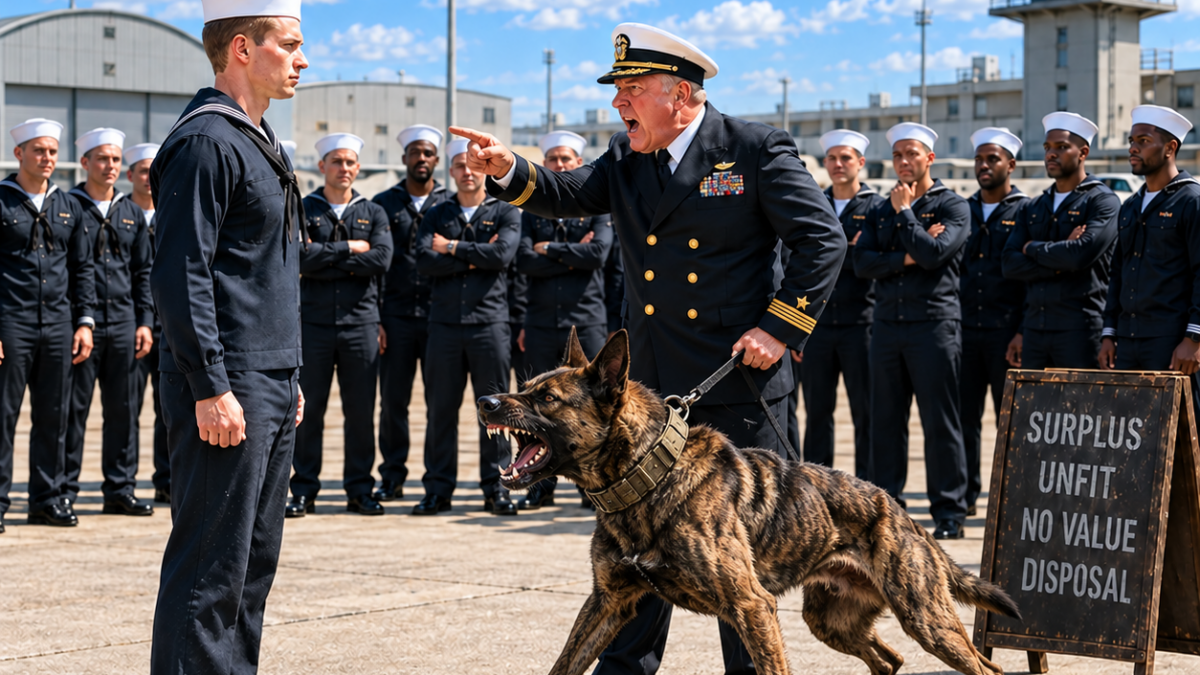
Commander Silas Vance stood behind a small folding table.
Folder open.
Pen uncapped.
He was not cruel-looking.
Milo wished he had been.
Cruel men were easy.
Vance was precise.
Pressed uniform.
Square shoulders.
Gray beginning at temples.
Face that rarely gave away mood.
He was a man who seemed to believe disorder began the moment a procedure was treated as optional.
He looked at Bram.
Then paperwork.
No drama.
No villainous satisfaction.
Just responsibility.
That made Milo move.
He did not decide to.
His left boot came forward.
Then right.
Three strides before his brain caught up.
The sound of his boots carried across the tarmac.
Two hundred heads turned.
Milo stopped six feet from the table.
Vance looked up.
The pen remained suspended.
Milo’s mouth had gone dry.
He had thought nothing through.
No permission.
No plan.
No standing to ask.
He said the only thing that had made it out of him.
“Give me the dog, sir.”
Silence.
Milo heard the flag rope tapping against metal.
Click.
Click.
Click.
Somewhere behind him, somebody inhaled sharply.
Bram lifted his head.
For the first time since the reading began, he stopped watching the crowd.
He looked directly at Milo.
Vance lowered the pen.
Not gently.
It rolled.
Dropped from the table.
Hit concrete.
The sound felt enormous.
“Seaman Recruit Thatcher.”
Milo stood straighter.
“Sir.”
“Return to formation.”
Milo knew the correct answer.
Yes, sir.
Turn.
Walk.
Disappear.
Instead:
“I want to adopt him, sir.”
A slight shift rippled through the ranks.
Milo continued before courage deserted him.
“I’ll assume responsibility for veterinary care and—”
“This is not an adoption fair.”
Vance’s voice did not rise.
“It is an official retirement proceeding.”
“Yes, sir.”
“You interrupted it.”
“Yes, sir.”
“Without request through your chain of command.”
“Yes, sir.”
“Because you saw a dog and had a feeling.”
Milo swallowed.
“No, sir.”
Vance’s eyes sharpened.
“No?”
“I saw the paperwork.”
“You read it from sixty feet away?”
“No, sir.”
That was bad.
Someone behind him shifted.
Milo could feel amusement.
Vance came around the table.
Close now.
He was shorter than Milo expected.
Maybe five-ten.
Still somehow made the space smaller.
“You understand why this animal is here?”
“Yes, sir.”
“Deaf on one side.”
“Yes.”
“No handler.”
“Yes.”
“Behavioral concerns.”
“Yes.”
“Operationally unreliable.”
Milo looked at Bram.
The shepherd’s left ear tracked voices.
The right remained still.
“Yes, sir.”
Vance lowered his voice.
“And you understand why you are standing at the back of formation instead of assigned to the duty track you trained for?”
There it was.
The old wound.
Milo said:
“Yes, sir.”
“Do you?”
“Yes.”
“Because I don’t hand responsibility for a living asset to somebody as a cure for guilt.”
Milo felt the word asset.
Not dog.
Asset.
Still alive.
Still breathing.
Still watching.
Vance continued.
“And I do not reward a sailor whose last field evaluation contains the phrase ‘hesitated under threat conditions’ by handing him an animal whose life depends on consistent judgment.”
Behind Milo:
nothing.
Nobody was smiling now.
He could feel them listening.
“I’m not asking you to forget my record.”
“Then what are you asking?”
Milo looked at Bram.
“A chance to prove the record isn’t all there is.”
Vance’s eyes stayed on him.
Then:
“Petty Officer Okafor.”
A tall man near the front stepped out.
Wesley Okafor.
Long arms.
Close-cropped hair.
Face with a permanent expression of somebody who had seen too much incompetence to be surprised by any new version.
“Sir.”
“Escort Seaman Recruit Thatcher to my office.”
“Yes, sir.”
“Then we’ll discuss proper channels.”
Milo’s stomach dropped.
“And his apparent belief that direct procedures become optional when he feels strongly enough.”
A tiny shift behind Milo.
Not laughter.
Almost worse.
The silence of men trying not to laugh.
Okafor placed one hand on Milo’s shoulder.
“Come on.”
Milo turned.
Walked past formation.
Eyes forward.
At the final row, somebody whispered:
“Supply clerk’s a hero now.”
Short laugh.
Cut off by an NCO clearing his throat.
Milo kept walking.
He did not look at Bram.
If he had, he might have done something even stupider.
Vance’s office smelled like old coffee and printer toner.
A fluorescent tube buzzed.
Milo stood in front of desk.
Okafor by door.
Vance sat.
Opened Milo’s personnel folder.
“Six weeks restricted duty.”
Milo said nothing.
“No kennel access.”
Nothing.
“No contact with base animals pending review.”
Milo’s jaw tightened.
“You report to Petty Officer Reyes in supply.”
“Yes, sir.”
Vance looked up.
“I’m not finished.”
“Sorry, sir.”
Vance studied him.
“There is one part of your previous incident I haven’t spoken to you about directly.”
Milo knew.
“The hesitation.”
“Yes.”
Vance read.
“Live-fire convoy response training.”
“Conflicting radio instruction.”
“Seaman Recruit Thatcher paused prior to movement.”
“Petty Officer Mercer injured.”
Milo stared above Vance’s shoulder.
“There’s another sentence.”
Vance stopped.
Milo regretted speaking.
“What sentence?”
“The order was corrupted.”
Okafor’s eyes shifted.
Vance closed the folder slightly.
“Explain.”
Milo swallowed.
“Initial call said east berm.”
“Range flag said west lane still active.”
“Radio repeated east.”
“I saw Mercer moving left.”
“If I followed the first call—”
Vance interrupted.
“The investigation concluded command confusion contributed.”
“Yes, sir.”
“It also concluded your delay contributed.”
“Yes.”
“So what point are you making?”
Milo’s hands tightened at his sides.
“That I didn’t stop because I was scared.”
Vance’s face remained neutral.
“Why did you stop?”
“Because what I heard didn’t match what I saw.”
“Yet Mercer got hurt.”
“Yes, sir.”
“And that is the burden of judgment.”
Milo said nothing.
Vance leaned back.
“You think I enjoy these decisions?”
“No.”
“I watched men die because somebody trusted instinct over procedure.”
Milo looked at him.
First crack.
Small.
Personal.
Gone immediately.
Vance continued.
“Feelings do not keep people alive.”
His voice hardened again.
“Procedure does.”
Milo said:
“Yes, sir.”
“Dismissed.”
Milo left with six weeks added to the six months he already felt buried beneath.
That night he could not sleep.
He kept seeing Bram.
Not the euthanasia line.
The ear.
The way it did not move.
The way the dog had looked directly at him after:
Give me the dog.
At 1:17 a.m., Milo sat up.
At 1:30, he was outside.
The kennel block stood beyond the motor pool near perimeter floodlights.
He knew the schedule.
Supply paperwork had taught him more about base rhythms than anybody realized.
Rounds at 2200.
Watch change 2300.
Next full kennel inspection 0500.
He told himself he was going to look.
Only look.
He stopped outside chain-link.
Bram paced inside.
Same path.
Six steps.
Turn.
Six.
Turn.
Then lie near door.
Face outward.
Waiting.
Milo remained outside.
Next night:
same.
Third night:
he opened the gate.
Hinge squealed.
Milo froze.
Listened.
Nothing.
He stepped inside.
Bram backed against far wall.
Milo did not approach.
He sat.
Six feet away.
Back against fence.
Hands visible.
No talking.
He had read intake reports.
Enough to know scared dogs did not need strangers filling air with sound.
Minute one.
Bram watched.
Minute five.
Still.
Minute nine.
Milo’s left leg went numb.
Minute twelve:
Bram moved.
One step.
Stop.
Second.
Milo lowered hand.
Palm up.
Not reaching.
Invitation.
Bram’s nose moved.
Another step.
Then another.
He reached Milo.
Pressed muzzle into his palm.
Milo forgot to breathe.
Warm fur.
Dry nose.
Living weight.
He moved thumb once.
Bram stayed.
Up close, Milo saw collar.
Standard identification tag.
Behind it:
second.
Hand-stamped metal.
Worn smooth around edges.
HALLORAN.
Milo’s throat tightened.
He had heard story.
Everyone had.
Aaron Halloran.
Petty Officer First Class.
Killed during live-fire support exercise eight months earlier.
Not this base originally.
Transfer team.
Training event went wrong.
Fragmentation.
Bram survived nearby blast.
Came back physically intact except hearing.
Never fully resumed work.
Milo touched tag.
“Hey, Bram.”
Dog’s good ear moved.
Bad ear did not.
Milo came back the next night.
Then next.
At first he told himself each visit would be last.
Then he stopped lying.
He learned Bram.
Raised voices flattened him.
Fast hands sent him backward.
Boots approaching from right caused immediate reaction.
From left?
Less.
Much less.
A truck backfire outside perimeter one night snapped Bram’s head right.
Instant.
Milo stepped to the dog’s left.
Snapped fingers.
Nothing.
Again.
Nothing.
Walked around right.
Tiny snap.
Bram turned.
Milo stared.
“You’re not deaf.”
Bram looked at him.
“Well.”
Milo smiled faintly.
“Half.”
Not unfit.
Not useless.
Unilateral deafness.
Adaptation possible.
Maybe not original role.
But the file had collapsed several different problems into one conclusion.
Milo started keeping notes.
Small green notebook.
Date.
Time.
Sound source.
Direction.
Distance.
Response.
Right-side auditory acuity strong.
Left-side absent.
Startle reduced with advance visual cue.
Recovery time after loud noise: six minutes first week.
Four minutes second.
Two-note whistle produced orientation response.
Approach tolerance improving.
Food intake increased with human presence.
Bram ate more.
Slept more.
Stopped pacing continuously.
Milo read every canine field manual he could find in supply archives.
Old training guides.
Behavioral conditioning.
Hearing-impaired working dogs.
Retirement placement.
Trauma response.
He was not a handler.
He knew that.
He did not pretend.
But he was careful.
And he watched.
Watching had always been his strength.
Ironically, it was also why people said he froze.
One night Milo brought folded blanket scheduled for disposal.
Bram sniffed.
Circled.
Lay on it.
Milo sat nearby.
“You know what?”
Bram lifted his head.
“They wrote the wrong word on both of us.”
The dog laid his head on Milo’s boot.
Milo looked away quickly.
The gate squealed.
He turned.
Okafor stood there.
Flashlight in hand.
Off.
Milo’s stomach fell.
“You know what restricted duty means?”
Milo stood.
“Petty Officer.”
“Don’t ‘Petty Officer’ me.”
Okafor entered.
Looked at Bram.
Blanket.
Second bowl.
Rope toy.
Milo.
“This isn’t one night.”
“No.”
“How many?”
Milo said nothing.
Okafor sighed.
“How many?”
“Eleven.”
Okafor closed his eyes.
“Eleven.”
“Yes.”
“You violated a direct written restriction eleven times.”
“Yes.”
“Do you enjoy making my job difficult?”
“No.”
“Could’ve fooled me.”
He crouched.
Bram remained beside Milo.
Wary.
Not terrified.
Okafor noticed.
“He used to run to corner when I entered.”
Milo nodded.
“He still may.”
“But not now.”
“No.”
Okafor watched.
“What have you done?”
“Mostly nothing.”
“That doesn’t explain this.”
“Nothing helps sometimes.”
Okafor looked irritated by answer.
Milo picked up notebook.
“He’s not deaf the way report makes it sound.”
“Unilateral.”
“Left.”
“Yes.”
“Right is exceptionally sharp.”
“How sharp?”
“He picked up truck backfire roughly four hundred yards before I registered it.”
“You measured?”
“Estimated.”
Okafor looked at pages.
“You’ve been testing him?”
“Observing.”
“Unauthorized training.”
“Some.”
Okafor handed notebook back.
“You’re supply, Thatcher.”
“I know.”
“Not canine.”
“I know.”
“You have no certification.”
“I know.”
“Then why do you keep acting like you know better than people who do?”
Milo’s face heated.
“I don’t know better.”
“You clearly think you do.”
“I think they stopped looking.”
That silenced him.
Milo continued.
“His handler died.”
“He lost hearing.”
“He got moved.”
“Different people evaluated him.”
“They saw fear and hearing loss and wrote one conclusion.”
“Unfit.”
Okafor’s jaw tightened.
“You think you recognize yourself.”
Milo looked at him.
“That’s what this is?”
“Maybe.”
“Then Vance was right.”
Milo flinched.
“Guilt.”
“No.”
“Projection.”
“No.”
“You want dog because saving him fixes you.”
Milo stared.
“Maybe I wanted that first day.”
Honest.
Okafor waited.
“But he’s not a symbol now.”
Milo pointed.
“He hears on one side.”
“He learns.”
“He recovered.”
“He trusts.”
“Those aren’t my feelings.”
“They’re observable.”
Okafor looked at Bram.
“Show me.”
Milo hesitated.
“You’ll report me.”
“Yes.”
“Either way?”
“Yes.”
Milo exhaled.
“Fine.”
He gave two-note whistle.
Pointed toward rubber marker under tarp.
Bram turned.
Moved.
Sat beside target.
Held.
Okafor’s eyes narrowed.
“That’s retrieve-and-hold orientation.”
“Modified.”
“Where’d you learn it?”
“Manuals.”
“You taught that?”
“He already knew half of it.”
“I changed cue so it’s stronger on his hearing side.”
Okafor was quiet.
Then:
“Damn it.”
Milo thought he meant dog.
He meant situation.
“I have to report you.”
“I know.”
“This can get worse than supply.”
“I know.”
“Captain’s mast.”
“I know.”
“You could lose what’s left of your track.”
Milo looked at Bram.
“Do what you have to.”
Okafor frowned.
“No argument?”
“What would it change?”
“Nothing.”
“Then no.”
Okafor headed toward gate.
Stopped.
“Formal request.”
“I filed one six weeks ago.”
“What?”
“Before ceremony.”
“You said nothing.”
“Nobody answered.”
Okafor stared.
Milo continued:
“Thirty-day adoption window closes before normal chain gets through backlog.”
Okafor looked at dog.
For the first time his certainty looked uncomfortable.
“I still report it.”
“Okay.”
“But…”
He paused.
“I’ll report this too.”
He nodded toward Bram.
Then left.
The next morning Milo was ordered to Vance’s office.
08:00.
Okafor already there.
Formal report on desk.
Vance read each violation.
Eleven unauthorized kennel accesses.
Material removal from supply disposal inventory without final processing.
Unapproved training activity.
Violation of direct written order.
Milo took each.
“Yes, sir.”
Vance finally looked up.
“I have half a mind to refer you.”
Milo stayed silent.
“Do you understand what you did?”
“Yes.”
“Do you?”
“Yes.”
“Because your explanation so far appears to be that you were right.”
Milo’s jaw tightened.
“No, sir.”
“Then explain.”
“I broke order.”
“Yes.”
“I shouldn’t have.”
“Good.”
“But if I hadn’t, nobody would know anything new about Bram.”
Vance leaned back.
“There it is.”
Milo said:
“I’m not saying that makes breaking order okay.”
“Sounds exactly like it.”
“I’m saying both things are true.”
Okafor shifted slightly.
Milo continued.
“I violated your order.”
“And report on Bram is incomplete.”
Vance’s gaze went to Okafor.
“Petty Officer?”
Okafor spoke.
“Sir, I observed animal last night.”
“And?”
“His behavior is materially improved.”
“Under unauthorized interaction.”
“Yes.”
“Hearing?”
“Appears unilateral.”
“That was already known.”
“Severity and compensatory ability were not.”
Vance’s fingers tapped once.
Okafor continued.
“Dog responded to directional cues on good side with accuracy above what file would suggest.”
“You’re endorsing Thatcher now?”
“No, sir.”
Milo glanced over.
Okafor did not.
“I’m reporting what I saw.”
Vance looked between them.
Then opened Bram’s folder.
“The animal transfers off base within week.”
Milo’s stomach dropped.
“Sir—”
“Euthanasia hold effective immediately.”
“He isn’t dangerous.”
“I did not say dangerous.”
“Then why?”
“Because unauthorized intervention complicates disposition assessment.”
Milo stared.
It was his fault.
Again.
He had tried to help.
Made it worse.
Vance stood.
“I need sailors who follow orders.”
Metal crash sounded outside.
A maintenance bay door slamming.
Bram was being brought across yard for scheduled review.
The bang hit.
The dog broke.
Lead snapped tight.
Body rigid.
Then legs collapsed.
Bram dropped flat.
Panting.
Krieger—kennel tech on lead—struggled.
Milo was out door before anybody stopped him.
He ran.
Dropped to knees.
Bram’s eyes wild.
Milo put both palms against ribs.
No commands.
No whistle.
No touch near head.
Weight.
Presence.
“Here.”
Soft.
“I’m here.”
Bram shook.
Milo breathed slowly.
In.
Out.
Again.
Dog’s breaths began matching.
Not perfectly.
Enough.
Vance stood above.
Okafor behind.
Krieger stared.
After several minutes, Bram settled.
Vance spoke quietly.
“I used to watch a man do that.”
Milo looked up.
Something was different in commander’s face.
Memory.
Pain.
Then gone.
“Sir?”
Vance did not answer.
“Get dog back.”
Krieger nodded.
Then Vance looked at Milo.
“All animal contact revoked.”
Milo’s chest tightened.
“No exceptions.”
“Yes, sir.”
“This is final until disposition.”
“Yes.”
Bram looked back while led away.
Milo remained kneeling in gravel.
Okafor picked notebook from ground.
Put it in Milo’s hand.
No words.
Three days passed.
Milo worked supply.
No kennel.
No nights.
He barely slept.
Okafor came by once.
Dropped requisition form.
“He’s eating.”
Milo looked up.
Okafor continued:
“Tech mentioned.”
Then left.
Small mercy.
Fourth morning:
05:30 alarm.
Not drill.
Double pulse.
Perimeter alert.
Northeast fence sensor.
Security sweep.
All available K9 assets.
Regular team thin.
One handler on leave.
Another dog at veterinary evaluation.
Bram listed as fallback.
Milo stared when he heard.
“Bram?”
Seaman at supply window shrugged.
“Short roster.”
“He’s not certified.”
“Apparently breathing counts today.”
Milo watched trucks leave.
He was forbidden within one hundred yards of dog.
Explicit.
He stayed.
Forty minutes.
Then found supply delivery to forward staging point.
Legitimate enough.
He drove.
Stopped three hundred yards from sweep.
Did not approach.
The search moved through scrub pine beside old maintenance road.
Diesel generators from comms unit created constant low roar.
Certified dog cleared first grid.
Team advanced.
Bram walked twenty yards behind, kennel tech holding lead.
Then Bram stopped.
All four feet planted.
Good ear swiveled toward culvert.
Low growl.
Kennel tech pulled.
Bram resisted.
Radio:
“Fallback dog spooked.”
Milo gripped fence.
“No.”
Nobody heard.
Bram leaned toward culvert.
Growl deeper.
The lead team had visually cleared it.
They moved on.
Bram refused.
Milo watched right ear.
Locked.
Not panic.
Alert.
He knew it.
Three weeks.
Hundreds of observations.
The dog was telling them.
Milo’s hands moved to fence.
Vance’s order repeated in head.
No animal contact.
No exceptions.
Career.
Trust.
Procedure.
Then another thought.
What if Bram was right?
Milo climbed.
Hit ground.
Ran.
Someone shouted his name.
He kept going.
Reached Bram.
Dropped beside.
“What is it?”
He positioned near working ear.
“Show me.”
Bram surged toward culvert.
Milo followed lead direction.
Okafor arrived.
Furious.
“Thatcher!”
“Something’s there.”
“Back away.”
“Look at him.”
“Standing order.”
“Look at him!”
Okafor stopped.
Bram not cowering.
Not thrashing.
Target locked.
Milo pointed.
“He’s not afraid of generator.”
“He’s listening through it.”
“To what?”
“I don’t know.”
“That’s point.”
Okafor stared.
Radio crackled.
Team leader:
“Sector visually clear.”
Okafor had two seconds.
Maybe less.
Milo watched calculation.
Then Okafor keyed.
“Hold position.”
“What?”
“Hold.”
“Petty Officer, we’re already—”
“The dog says sector isn’t clear.”
Somebody laughed on radio.
Not malicious.
Disbelief.
Okafor’s face hardened.
“I am not betting somebody’s leg on a visual sweep while a trained animal is flagging a culvert.”
That silenced them.
EOD requested.
A young Seaman near sweep started toward brush anyway.
Curiosity.
Maybe proving.
Generator swallowed warning.
Bram barked.
Lunged.
Lead slipped from tech.
Milo caught it.
Used motion.
He ran across young man’s path.
Shoulder hit chest.
Both crashed into dirt.
“Stay down!”
Seaman cursed.
Then saw Bram.
Standing over them.
Facing culvert.
Growling.
Nobody moved.
EOD arrived nine minutes later.
Twenty more minutes.
Unmarked container.
Wired.
Not maintenance.
Potential explosive device.
Old but live enough.
They rendered safe.
Sector fell silent.
The same silence as ceremony.
But nobody laughed.
Commander Vance arrived in vehicle hard enough that dust followed.
He walked site twice.
Asked questions.
Read radio logs.
Inspected position.
Okafor approached.
“Sir.”
Vance did not look.
“Report.”
“Bram alerted.”
“Certified team?”
“No indication.”
“Milo?”
“Observed Bram from staging fence.”
“In violation.”
“Yes.”
“Crossed perimeter.”
“Yes.”
“Contacted dog.”
“Yes.”
Vance finally turned.
Okafor continued:
“I ordered hold based on their combined assessment.”
“Their?”
“Dog’s alert.”
“Thatcher’s interpretation.”
Vance stared.
“You filed report against him four days ago.”
“Yes, sir.”
“And now you’re defending him.”
“No.”
Okafor’s voice remained flat.
“I’m documenting him.”
“Both reports true.”
That line.
Both things are true.
Vance looked toward Milo.
Torn sleeve.
Scraped elbow.
Bram leaning against him.
Young Seaman alive nearby.
EOD container flagged.
Vance walked over.
Held folders.
Bram’s discharge file.
Milo’s personnel record clipped behind.
He opened.
Read.
“You hesitated once.”
Milo said nothing.
Vance continued.
“Because order didn’t match what you saw.”
“Yes, sir.”
“Today?”
“I saw same thing.”
“Order said stay back.”
“Yes.”
“And?”
“Dog said something was wrong.”
“Dogs don’t speak.”
Milo looked at Bram.
“Not in words.”
Vance stared.
Milo expected reprimand.
Maybe arrest.
Instead Vance looked at culvert.
Then notebook in Milo’s pocket.
“Give me that.”
Milo handed.
Vance read.
Pages.
Dates.
Angles.
Distances.
Recovery times.
Behavioral changes.
Not feelings.
Evidence.
He closed it.
“I told you procedure keeps people alive.”
“Yes, sir.”
“I still believe that.”
“Yes.”
Vance looked at EOD marker.
“But procedure is only as good as information feeding it.”
Milo said nothing.
Vance’s face tightened.
“I treated your judgment as defect.”
Long pause.
“Because I had reason.”
“Yes, sir.”
“But reason isn’t same as certainty.”
Milo looked up.
Vance continued:
“Bram’s file called him unfit.”
“He just found something a certified sweep missed.”
“Yes.”
“Your file called you frozen.”
“You just tackled a sailor away from live device.”
Milo swallowed.
Vance shut both folders.
“I may have written wrong word twice.”
Nobody moved.
Then, louder:
“Seaman Recruit Thatcher’s animal-contact restriction is rescinded effective immediately.”
Milo’s breath caught.
Vance turned toward sweep leader.
“Formal after-action report.”
“Full canine evaluation.”
“Independent.”
“Not whoever wrote first disposition.”
“Yes, sir.”
Then back to Milo.
“And I expect an adoption request on my desk by 0800.”
Milo stared.
“Sir?”
“Do not make me repeat myself.”
“No, sir.”
Vance started away.
Stopped.
“One more thing.”
“Yes?”
“If you ever climb another restricted perimeter fence during an active operation without authorization…”
Milo waited.
“I will personally make your life unbearable.”
“Yes, sir.”
Vance glanced at Bram.
“But today…”
Pause.
“You were right to move.”
Then left.
Milo looked down.
Bram looked up.
Okafor approached.
“You heard commander.”
“Yes.”
“0800.”
“Yes.”
“You filed form wrong last time.”
Milo frowned.
“How do you know?”
“I found it.”
“Where?”
“Wrong routing code.”
Milo closed eyes.
“You’ve got to be kidding.”
Okafor almost smiled.
“Supply clerk.”
“I hate you.”
“Form 5512-B.”
“Attachment veterinary.”
“Three copies.”
Milo laughed.
First real laugh in months.
Adoption ceremony was small.
No formation.
No two hundred people.
Maybe twelve.
Krieger.
Okafor.
Vance.
The young Seaman Milo had tackled.
A few kennel staff.
Morning sun.
Vance signed.
Different document.
Same pen.
This time no euthanasia line.
TRANSFER OF RETIRED MILITARY WORKING DOG.
ADOPTIVE CUSTODIAN: MILO THATCHER.
Milo signed.
His hand shook.
Bram stood beside.
No flinch at crowd.
Vance capped pen.
Okafor cleared throat.
Everyone looked.
“I need to say something.”
He hated public speaking.
Obvious.
“I filed formal report against Thatcher.”
Milo looked over.
“He violated direct order.”
Okafor continued.
“I’d file same report again.”
A few people exchanged looks.
“But…”
Okafor looked at Milo.
“I was also wrong.”
Milo stood still.
“I decided his past mistake explained every choice he made after.”
“And I decided the dog’s file was more trustworthy than the dog standing in front of me.”
He looked toward Vance.
“Both were lazy judgments.”
Vance’s eyebrow moved.
Okafor continued:
“Thatcher broke rules.”
“He also did the work the rest of us had stopped doing.”
“Watching.”
“Recording.”
Testing.”
“Paying attention.”
He faced Milo.
“I was wrong about you.”
Simple.
No speech.
Milo nodded.
“Thank you.”
The young Seaman approached.
The one he tackled.
Name was Eric Barlow.
Nineteen.
Still had scrape on cheek.
He held out hand.
“You hit hard.”
Milo shook it.
“Sorry.”
“No.”
Barlow laughed.
“Don’t be.”
He looked at Bram.
“I was gonna walk right up.”
“Yes.”
“Stupid.”
“Yes.”
Barlow frowned.
“You could soften it.”
“No.”
Fair.
Milo crouched.
Removed standard tag from Bram’s collar.
Left second.
HALLORAN.
He added new one.
BRAM THATCHER.
Under it:
HALLORAN stayed.
Two names.
Not replacement.
Continuation.
Bram leaned into him.
Milo stood.
For first time in months, everyone on that base was looking at him.
It did not feel like judgment.
That took getting used to.
Commander Vance did not restore Milo immediately to convoy track.
This disappointed people who wanted neat endings.
Real commands do not work that way.
Milo’s record still existed.
Policy still existed.
He underwent retraining.
Reevaluation.
Psychological review.
Field recertification.
Bram underwent independent veterinary and behavioral assessment.
The hearing loss was confirmed complete on left.
Right ear excellent.
PTSD-like startle behaviors associated with blast trauma and handler loss.
Not suitable for active patrol deployment.
But appropriate for retirement and specialized scent enrichment.
No euthanasia recommendation.
Vance assigned Milo temporary duty with working-dog support staff three mornings per week while retaining supply responsibilities.
“Earn it.”
He said.
Milo did.
Krieger taught handling properly.
“Everything you did wrong at night?”
“Yeah?”
“Most of it.”
Milo stared.
“But dog improved.”
“Despite you.”
“Comforting.”
“You want praise or competence?”
“Competence.”
“Good.”
Krieger became brutal teacher.
Lead pressure.
Body language.
Reward timing.
Stress thresholds.
Odor imprinting theory.
Milo learned how much he did not know.
That humbled him.
Bram became part of learning.
No operational return.
No fantasy that love cured disability.
He remained deaf on one side.
Still startled by metal impacts.
Still woke some nights pacing.
Milo learned visual cues.
Floor vibration cues.
Position himself on Bram’s hearing side in unfamiliar spaces.
Give warning before loud environments.
Home was small base housing unit initially approved under retired K9 exception.
First night:
Bram did not enter bedroom.
Slept facing front door.
Milo put bed beside.
Dog ignored it.
Three nights later:
one paw.
Next week:
full body.
Month later:
snoring.
Milo laughed first time he heard.
Halloran’s widow contacted him.
That frightened Milo more than commander.
Her name was Rebecca.
She had received notification of Bram’s adoption.
She asked to meet.
Milo wanted to say no.
Not because he didn’t care.
Because he felt like he had taken something.
Okafor said:
“You didn’t take.”
“How do you know?”
“I don’t.”
Helpful.
They met at quiet park.
Rebecca Halloran arrived with thirteen-year-old son Noah.
Bram saw them.
Stopped.
Rebecca covered mouth.
Bram approached slowly.
Then ran.
Not operational sprint.
Old dog joy.
He crashed into Noah.
Boy dropped to knees.
Bram whined.
Rebecca cried.
Milo turned away.
Noah held collar.
Found tag.
HALLORAN.
Still there.
He looked at Milo.
“You kept Dad’s.”
Milo nodded.
“Wasn’t mine to remove.”
Rebecca cried harder.
Later they sat picnic table.
Rebecca said:
“Aaron loved that dog.”
“I know.”
“No.”
She smiled.
“You know reports.”
Then told stories.
Halloran sang to Bram.
Terribly.
Shared scrambled eggs despite rules.
Called him Professor Bram.
Milo smiled.
“He tilts head when confused.”
“Dad taught that accidentally.”
“How?”
“Aaron tilted his own head when confused.”
Noah demonstrated.
Bram did it.
All three laughed.
Rebecca became serious.
“They told us he might be put down.”
Milo looked at hands.
“Yeah.”
“I couldn’t take him.”
“You don’t owe explanation.”
“I feel like I do.”
She breathed.
“When Aaron died, every sound Bram made…”
She swallowed.
“I heard the phone call.”
“The knock.”
“Everything.”
“I have two kids.”
“Job.”
“I couldn’t bring war into living room.”
Milo nodded.
She looked at him.
“Thank you for doing what I couldn’t.”
Milo shook head.
“I did it partly because I was messed up too.”
“Then maybe that’s why it worked.”
No miracle.
Just recognition.
Milo told her about his incident.
For first time without defending.
He hesitated.
Someone hurt.
He was blamed partly.
He blamed himself fully.
Rebecca listened.
Then:
“Aaron used to say confident people scare him more than careful ones.”
Milo looked.
“He said somebody who never hesitates probably isn’t looking hard enough.”
That sentence became important.
Not permission to freeze.
Not excuse.
But balance.
Training after that changed.
Milo stopped trying to become man who never paused.
Instead he practiced making pauses useful.
Assess.
Commit.
Communicate.
One second could hurt.
One second could save.
Difference was skill.
Commander Vance watched.
Months later, final field recertification.
Scenario intentionally chaotic.
Conflicting radio information.
Smoke.
Noise.
Simulated casualty.
Milo received instruction:
advance left.
He looked.
Marker indicated left lane compromised.
Old fear returned.
Everybody watching.
His heart hammered.
This was exactly where he had failed before.
He keyed radio.
“Confirm left lane.”
Response garbled.
Instead of freezing silently, he spoke.
“Hold.”
Then directed team to cover.
Requested second channel confirmation.
Received correction.
Right lane.
Moved.
Fast.
Exercise ended.
Evaluator wrote:
Demonstrated appropriate challenge-and-confirm procedure under conflicting information.
Not froze.
Not hesitated.
Appropriate challenge.
Words matter.
Vance handed report personally.
Milo read twice.
“Thank you, sir.”
“Don’t thank me.”
“Evaluator wrote it.”
“You assigned scenario.”
Vance’s mouth moved.
Almost smile.
“Maybe.”
Milo looked at him.
“Why?”
Vance stared out window.
“The man I mentioned.”
“Bram incident?”
“Yes.”
“Who was he?”
Long silence.
“My younger brother.”
Milo had not expected.
“Army EOD.”
“Afghanistan.”
“Team had suspect device.”
“Procedure said hold position.”
“One man thought he saw secondary trigger.”
“Advanced anyway.”
“Was wrong.”
Vance swallowed.
“Device killed him.”
Milo understood.
Rules.
Procedure.
Order.
Not abstract.
Grief hardened into doctrine.
Vance continued.
“I built career believing deviation killed my brother.”
“Maybe it did.”
He looked at Milo.
“But I forgot opposite can happen too.”
Milo said nothing.
Vance tapped report.
“Your job isn’t obeying less.”
“It is understanding enough to know when information has changed.”
“Yes, sir.”
“That’s harder.”
“Yes.”
“Good.”
Milo returned to operational support.
Not exactly old plan.
Better.
K9 integration training became specialty.
He studied.
Certified eventually.
Bram retired at home but came to low-stress demonstration sessions.
No explosives.
No dangerous work.
He helped teach younger handlers about unilateral hearing, trauma recovery, and retirement transition.
People loved him.
He tolerated people.
Difference.
Okafor became friend slowly.
Neither man acknowledged.
He showed up with dog food.
Milo:
“Why?”
“Bought wrong kind.”
“You don’t own dog.”
“Store refused return.”
“Liar.”
“Take bag.”
Friendship.
Krieger retired two years later.
At ceremony, Milo stood front instead of back.
Krieger said:
“If Thatcher interrupts this one asking to adopt me, shoot him.”
Laughter.
Even Vance.
Milo shouted:
“Medical separation recommended.”
Krieger flipped him off discreetly.
Bram aged.
Gray spread muzzle.
Right ear hearing declined eventually too.
Irony.
Milo adjusted.
Hand signals.
Floor taps.
Touch cues.
Dog already knew visual work from years of operational training.
They became quieter together.
At ten, arthritis.
At eleven, kidney issues.
At twelve, Bram stopped climbing stairs.
Milo moved bed downstairs.
One rainy evening, thunder hit.
Bram did not hear much anymore.
But vibration shook house.
He woke frightened.
Milo sat floor.
Both hands on ribs.
Same as bay door day.
No words needed.
Dog settled.
Milo remembered first nights kennel.
Wrong words on folders.
He thought of how close Bram came to dying because nobody had taken time to distinguish:
unable from different.
damaged from finished.
fearful from dangerous.
hesitant from coward.
Those distinctions became Milo’s leadership philosophy later.
Yes, leadership.
The supply recruit nobody looked at advanced.
Slowly.
Petty Officer.
Then First Class years later.
He supervised younger sailors.
One day, a nineteen-year-old recruit made mistake during drill.
Not catastrophic.
Embarrassing.
Others laughed.
Milo heard old silence.
He called recruit aside.
“Tell me what you saw.”
Kid blinked.
“What?”
“Before mistake.”
Recruit explained.
A bad assumption based on incomplete signal.
Milo corrected.
Retrained.
Documented accurately.
Not erased.
Not branded.
Okafor, now senior chief, heard.
“You’re getting soft.”
Milo replied:
“No.”
“Specific.”
Okafor smiled.
Bram died at thirteen.
Home.
Not euthanasia hold on military form.
His person.
Milo.
Rebecca and Noah came.
Krieger.
Okafor.
Even Commander Vance, retired by then.
They gathered in Milo’s living room.
Vet administered medication.
Bram’s head in Milo’s lap.
Milo held tags.
HALLORAN.
THATCHER.
Two lives.
Dog belonged to both, differently.
Rebecca whispered:
“Tell Aaron he did good.”
Milo’s throat closed.
Noah, grown now, touched Bram’s head.
“Tell Dad I remember.”
Milo could barely breathe.
He looked at dog.
“You don’t have to listen anymore.”
A strange thing to say to dog who spent life losing hearing.
“You can rest.”
Bram’s breathing stopped.
Milo stayed.
Afterward Vance stood near door.
“You okay?”
“No, sir.”
“I’m retired.”
“No.”
Vance nodded.
“Fair.”
Milo laughed through tears.
Bram was cremated.
Ashes divided.
Part to Halloran family.
Part Milo.
Collar tags stayed together.
Nobody argued.
Years later, a plaque appeared near old kennel.
Not heroic statue.
Small.
MILITARY WORKING DOG BRAM
LOYAL IN SERVICE.
FAITHFUL IN RETIREMENT.
HEARD WHAT OTHERS MISSED.
Milo hated last line at first.
Too sentimental.
Then accepted.
Because true beyond hearing.
Bram had heard danger in culvert.
But more importantly, he had recognized Milo before anybody else did.
At ceremony, dog looked up when Milo stepped from formation.
Before Vance.
Before Okafor.
Before unit.
Bram saw him.
Maybe scent.
Movement.
Chance.
Doesn’t matter.
Sometimes being seen once is enough to make person step forward again.
People told story later.
It changed.
Recruit stopped commander.
Dog saved base.
Commander speechless.
That kind of retelling.
Reality quieter.
Vance wasn’t speechless because Milo demanded dog.
He was angry.
He punished him.
Milo broke rules.
Okafor reported him.
Bram was not magically restored.
The device near culvert was old unexploded threat connected to prior range activity, not enemy mastermind.
No movie conspiracy.
No instant promotion.
What changed was harder and more useful.
Evidence challenged labels.
People admitted they had been incomplete.
Institutions corrected themselves.
Milo accepted accountability without accepting false identity.
Vance learned procedure could protect and still require judgment.
Okafor learned two truths can coexist.
A sailor can violate an order and still be right about danger.
A commander can make reasonable decision and still change it.
A traumatized dog can be unsuitable for combat without being unsuitable for life.
A recruit can make one costly hesitation without being coward forever.
That was story.
Years later, Milo spoke to new K9 handlers.
He never opened with Bram.
He asked:
“What is the difference between assessment and label?”
Silence.
Then answers.
Assessment is current.
Label sticks.
Assessment can change with data.
Label resists.
He held up Bram’s old discharge copy.
UNFIT.
Then his own.
HESITATED UNDER THREAT CONDITIONS.
He said:
“Both statements were technically based on something real.”
“Problem was what people did next.”
“They stopped looking.”
That became core.
Don’t stop looking.
At dog.
At sailor.
At patient.
At person.
Files are necessary.
Reports matter.
Rules matter.
But paperwork is memory, not prophecy.
One morning after class, young sailor waited.
“Petty Officer?”
“Yes?”
“I screwed up last month.”
Milo looked.
“Bad.”
“How bad?”
“Nobody died.”
“Then start there.”
Kid explained.
Milo listened.
At end:
“Everyone thinks I’m…”
He could not say word.
Milo knew.
“Whatever they wrote?”
Kid nodded.
Milo looked toward old kennel.
Empty.
Sunlight across concrete.
“Then give them new data.”
The sailor frowned.
“What?”
“Do work.”
“Document.”
“Learn.”
“Don’t demand they forget.”
“Make old sentence too small to describe you.”
Milo wished someone told him that at twenty.
Maybe Bram did.
Without words.
When Milo finally retired, he stood on same tarmac.
Smaller formation.
Vance attended in civilian clothes.
Okafor older.
Krieger walking with cane.
Rebecca and Noah there.
On table:
Bram’s collar.
Two tags.
Milo gave speech shorter than expected.
“I once interrupted a ceremony here.”
Laughter.
“Commander told me procedure matters.”
Vance called from audience:
“I was right.”
More laughter.
Milo smiled.
“He was.”
Then:
“I thought at time he was enemy.”
Vance folded arms.
“He wasn’t.”
“He was trying to keep people alive with rules that had kept people alive before.”
“And I was trying to save dog because I thought I knew something everybody else missed.”
Pause.
“Turns out we were both partly right.”
Silence.
“Best people I’ve served with taught me that being corrected does not make you weak.”
“Changing your mind when evidence changes is not surrender.”
“It is discipline.”
He touched collar.
“Dog taught me that too.”
After ceremony, Vance approached.
“You know.”
“What?”
“First day.”
“Give me dog, sir.”
Milo smiled.
“I remember.”
“I was speechless for maybe half second.”
“Felt longer.”
“I was deciding whether to have you removed physically.”
“Good times.”
Vance looked at collar.
“I almost signed.”
Milo knew.
“Yeah.”
“That bothered me for years.”
“You had file.”
“I had incomplete file.”
“You didn’t know.”
“That is not always excuse.”
Milo looked.
Vance continued:
“But it is explanation.”
“Then what do you do?”
Milo asked.
Vance smiled faintly.
“You keep looking.”
They shook hands.
No salute.
No rank anymore.
Just men.
The original folder eventually came to Milo.
Administrative copy released.
Inside:
euthanasia recommendation.
Adoption denial.
Behavioral evaluation.
Hearing assessment.
Then later:
revised medical findings.
EOD incident report.
adoption approval.
Milo’s recertification.
A story told through corrections.
He framed none.
Kept in drawer.
Bram’s tags stayed on desk.
Sometimes visitors asked.
Milo told story.
Not all.
Enough.
The moment he always returned to was not culvert.
Not device.
Not ceremony.
It was minute twelve in kennel.
Cold floor.
One hand open.
Dog crossing six feet.
Pressing muzzle into palm.
Trust offered quietly.
Milo had thought he was saving Bram.
He was not wrong.
But incomplete.
Bram gave him first place in six months where he was not reduced to worst second of his life.
Dog did not know report.
Did not care rank.
Did not care gossip.
He judged what was in front of him.
Stillness.
Patience.
Hand that did not force.
Then responded.
That gave Milo model for how to judge others.
Not ignore history.
Not pretend consequences vanish.
Look at history.
Then look again.
What is person doing now?
What does evidence say now?
What changed?
What didn’t?
Who are they becoming?
Sometimes answer disappoints.
Sometimes it saves a life.
On last page of Milo’s notebook—green one from kennel—there was a sentence he had written after adoption ceremony.
He had forgotten until retirement.
No date.
Just:
Bram wasn’t waiting for someone to believe he was perfect.
He needed somebody to notice he was still worth the work.
Below that, months later:
Same.
Milo stared at those four letters.
Same.
He laughed.
Young version of himself had been dramatic.
Also right.
He closed notebook.
Outside, somewhere down road, a dog barked.
Milo listened.
Both ears working.
No urgency.
Just dog.
He thought of Bram’s one good ear turned toward culvert.
The other silent.
Still enough.
Enough to notice what everyone else missed.
Enough to save somebody.
Maybe that was final lesson too.
Nobody arrives whole.
Not really.
People lose pieces.
Confidence.
Hearing.
Trust.
Partners.
Careers they expected.
Reputations.
Sometimes part never comes back.
The mistake is assuming loss means nothing useful remains.
Bram lost hearing on one side.
He did not lose judgment.
Milo lost people’s trust.
He did not lose ability to earn it again.
Vance lost his brother.
He did not lose capacity to change what that grief had taught him.
Okafor lost faith in exceptions.
He did not lose courage to make one when evidence demanded it.
Halloran lost life.
He did not lose place in Bram’s collar.
Two tags stayed together until end.
HALLORAN.
THATCHER.
Before and after.
Not competition.
Continuity.
The day Milo stepped out of formation, everybody thought he was acting from guilt.
Maybe partly.
Human motives are rarely pure.
But sometimes a guilty man sees another condemned thing and recognizes how quickly a sentence can become identity.
That recognition is not expertise.
It can still be beginning.
Milo broke rules.
Paid consequences.
Learned skills.
Gathered evidence.
Trusted dog.
Earned second chance.
Not because commander suddenly discovered secret hero.
Because reality became larger than old report.
And when Vance finally signed adoption papers, he did not erase Milo’s mistake.
He did something more honest.
He allowed a new line to be written beneath it.
Years later, whenever a young sailor asked Milo what Bram meant to him, he never said:
“He saved me.”
Too simple.
He said:
“He made people look twice.”
That was closer.
At dog.
At recruit.
At commander.
At reports.
At assumptions.
At word unfit.
At word frozen.
Look twice.
Sometimes first impression protects.
Sometimes first report is correct.
Sometimes procedure is exactly thing that keeps everybody alive.
But when evidence changes, courage may be admitting old conclusion no longer fits.
Two hundred sailors had watched Milo break formation and ask:
“Give me the dog, sir.”
Many thought he was making fool of himself.
Commander thought guilt had finally overwhelmed discipline.
Milo himself did not fully understand why he stepped forward.
Bram did something no one else did.
He lifted his head.
Looked at Milo.
Listened with one ear.
And waited.
Weeks later, beside a culvert everyone else had cleared, Milo returned favor.
He listened to the dog.
That was all.
And because he did, a sailor went home instead of stepping into a live device, a condemned K9 lived long enough to grow old in a house where nobody called him useless, and a recruit who had spent six months standing at the back of every formation eventually learned that one bad second can become part of your story without being allowed to become the whole thing.
They had written the wrong word on both their folders.
Fortunately, neither one of them stopped long enough to believe it forever.








