A Military K9 Froze in a Luxury Hotel Lobby and Raised His Paw at a 71-Year-Old Porter—Then the Handler Asked One Question That Made Everyone Look at Him Differently.
PART3:
You can change the decade, the uniform, the equipment, and the words people use, but handlers still move like handlers. One eye on the dog. One eye on the room. Leash hand quiet. Shoulders squared without stiffness. Their bodies held a certain expectation, as if they were always listening for the moment a command would matter.
The dogs were harder to ignore.
Three German Shepherds came through the lobby just after ten o’clock, moving in formation toward the ballroom after an outdoor demonstration on the side lawn.
Big animals.
Clean coats.
Sharp eyes.
Focused energy.
Ordinary guests stepped back instinctively.
I was near the far corner of the lobby, pushing an empty luggage cart toward the service corridor. I had just helped an elderly couple from Phoenix bring down four bags and a garment case. The cart wheels whispered across the polished marble.
Then the first dog stopped.
Not slowed.
Not hesitated.
Stopped.
Every trained muscle in his body locked at once, like something invisible had reached down and caught him by the collar.
His handler, Staff Sergeant Marcus Webb, gave the leash one short correction.
Nothing.
A second.
Nothing.
Then a third, firmer.
The dog did not move an inch.
I turned my head.
So did half the lobby.
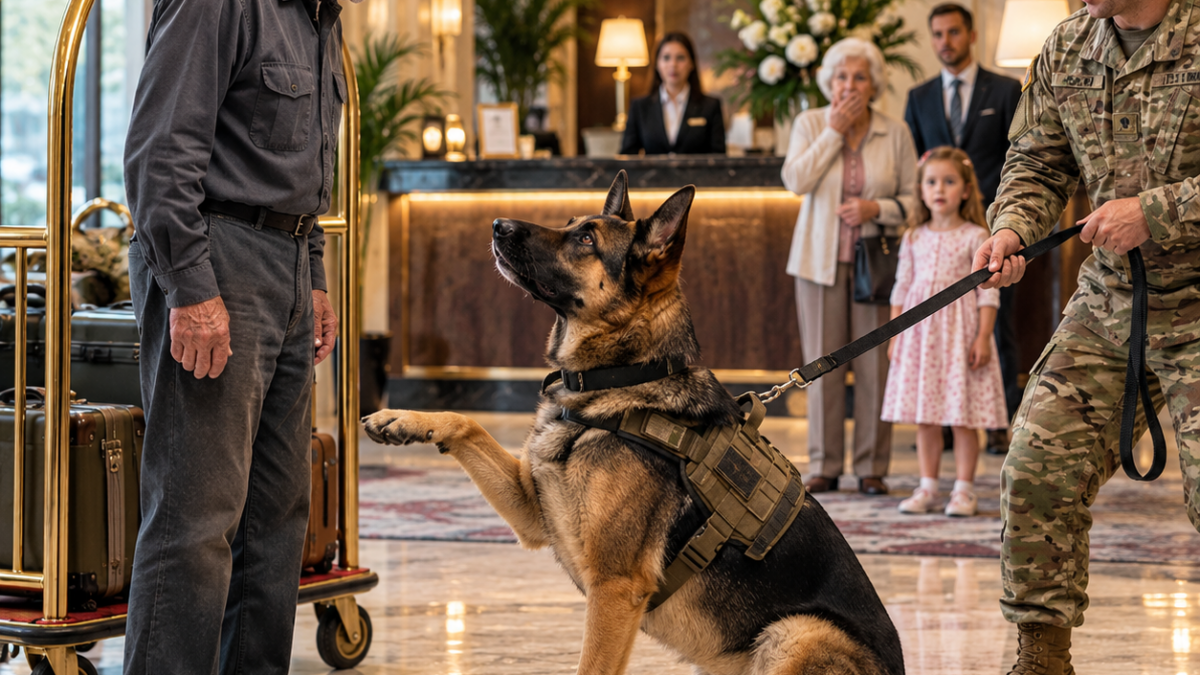
The dog was a German Shepherd, large and dark, with a thick chest, scar along one shoulder, and eyes that held more intelligence than some men I had served under. His handler stood beside him, controlled but confused.
“Zeus,” Webb said, voice tight. “Heel.”
Zeus looked at him.
Then back at me.
The lobby seemed to narrow.
I felt the air leave my lungs before I understood why.
Zeus sat down.
Not the stiff, alert sit of a working dog awaiting orders.
Something slower.
Lower.
His ears dropped.
His head angled down.
His body settled in a posture I had seen only a few times in my life, and every one of those times had been near a flag, a coffin, or a handler who did not come home.
Respect.
That dog was not confused.
He was not distracted.
He was paying respects.
A woman near the front desk pressed her hand to her mouth.
A retired police officer grabbed the arm of the man beside him.
A little girl on a lobby bench tugged on her grandmother’s sleeve and pointed, but no words came out.
Nobody moved.
Nobody spoke.
Across sixty feet of marble, a military dog I had never met stared at me like memory itself had found a body.
Then Zeus lifted his right paw off the ground.
Held it steady.
Aimed it toward me.
I had seen men salute with less precision.
Something old moved inside my chest.
Not pain exactly.
Pain is too clean a word.
This was heavier.
It was the weight of names not spoken in decades, mornings that began with a dog’s breathing beside my bunk, cold fields in Germany, Fort Carson dust, wet leather, diesel exhaust, and a black-and-tan Shepherd named Ranger who had once trusted me more than I trusted myself.
I stopped pushing the cart.
The wheels stilled.
For a moment, I was not in the Harrove Grand lobby anymore.
I was twenty-seven again, standing in a cold training yard before dawn with leash leather cutting into my palm and a dog at my left side waiting for the world to make sense.
Then the present returned.
Crystal overhead.
Red carpet.
Hotel guests.
Derek near the front desk looking irritated and frightened because something unplanned had happened in his lobby.
I straightened.
Not because I meant to.
Because the dog had called me to attention in a language my body still understood.
Spine aligned.
Chin level.
Shoulders squared.
Hands at my sides.
Across the lobby, Zeus’s paw remained raised.
Staff Sergeant Webb crouched beside him.
“Zeus,” he said quietly. “What is it, boy? What do you have?”
Zeus did not look at him.
The other two handlers had stopped as well. Their dogs, one female Shepherd and one younger male, both turned toward me. They had not broken stance the way Zeus had, but they were watching.
Alert.
Reading.
Webb followed Zeus’s line of sight until his eyes found me.
Something clicked in his face.
Not recognition.
Suspicion that recognition was possible.
He stood slowly and loosened the leash.
“Okay,” he murmured.
He did not pull again.
Smart man.
Derek Shields appeared from near the front desk, face tight, hands raised slightly in the way managers do when approaching a problem they hope can be smoothed over before guests notice.
Too late.
Everyone had noticed.
“I’m so sorry about this,” Derek said to Webb. “He’s one of our porters. I can have him removed to the service area if the dog needs more space.”
Removed.
That word slid across the marble between us.
Webb looked at Derek.
“He’s not bothering the dog.”
“Well, no, but the dog seems to be reacting.”
“Yes,” Webb said. “He is.”
Derek blinked, waiting for the sentence to become something he understood.
Webb’s eyes stayed on me.
“Has that man worked here long?”
“Eugene? Nine years, I think. He’s just a porter.”
Just.
That word did not hurt.
Not anymore.
Words only hurt when they are spoken by people whose judgment you respect.
“Last name?” Webb asked.
Derek opened his mouth.
Closed it.
He did not know.
Nine years, and he had to go look up my last name.
I left the luggage cart where it stood and began walking toward them.
Slowly.
Measured.
Hands loose at my sides.
No sudden movements around a working dog. No rushing a moment you do not yet understand. No letting pride enter a space where instinct has already spoken.
I stopped ten feet from Zeus.
The dog made a sound then.
Not a bark.
Not a whine.
Something low and soft from deep in his chest.
Several people later said they felt it more than heard it.
I looked at Zeus for a long moment.
Then I looked at Webb.
“What’s his name?”
Webb’s expression shifted. My voice must have told him something. Quiet, yes. Old, yes. But steady in a way that had nothing to do with calm and everything to do with discipline.
“Zeus.”
I nodded once.
“What’s his line?”
Webb frowned.
“His line?”
“Who trained him? Where does he come from?”
The lobby stayed silent.
This was not the kind of question civilians asked.
It was not even the kind most law enforcement officers asked casually.
But bloodlines matter in military working dogs. Training programs matter. Kennels matter. Handlers matter. Some qualities are taught. Some are inherited. Some are carried forward through dogs long after men are gone.
Webb studied me more carefully.
“His line goes back to Fort Benning,” he said. “Program was restructured about twelve years ago. He comes out of a direct training lineage from a dog named Ranger.”
The name hit me so hard I nearly reached for the cart to steady myself.
Ranger.
For thirty-four years, I had kept that name in a quiet place.
Not forgotten.
Never forgotten.
Just placed somewhere safe enough that I could still go to work, pay bills, answer my daughter’s Sunday calls, and polish my shoes every morning without falling into the past.
I repeated it softly.
“Ranger.”
The dog’s ears moved.
Webb saw my face.
“You know that name?”
I did not answer.
Not right away.
Instead, I lowered myself carefully, one knee at a time, until I was kneeling on the marble floor at eye level with Zeus.
My knees did not appreciate it.
A lot of years had passed through them.
But some gestures matter more than comfort.
Zeus took one step forward.
Then another.
Slow.
Deliberate.
He stopped six inches from my face.
Then he pressed his broad forehead gently against mine.
The lobby disappeared.
Not fully.
I could still hear the chandeliers faintly shifting overhead. Could still smell flowers and floor polish. Could still sense the crowd watching.
But beneath all of that, another memory rose.
Ranger pressing his head against my chest after Graphenver.
Mud on his coat.
Blood on my sleeve.
Snow beginning to fall.
My hands shaking so badly I had to hide them in his fur.
I closed my eyes.
Zeus held the contact.
Not pulling.
Not pushing.
Just there.
Like a message delivered through generations.
When I opened my eyes, they were wet.
I did not care.
Derek returned with my employment file held awkwardly at arm’s length, as if it had become something he was not sure he had the right to touch.
He handed it to Webb without speaking.
Webb opened it.
I knew what little the file said.
Emergency contact: daughter in Portland.
Prior employment: United States Army, 1973 to 1994.
Twenty-one years reduced to one line.
Webb looked up.
Then down again.
“Twenty-one years,” he said aloud.
One of the other handlers, a woman named Carla Diaz, stepped forward.
“Ask him his MOS,” she said quietly.
Webb turned back to me.
“Sir, can I ask what your military occupational specialty was?”
Sir.
That was the first time anyone from the hotel had called me that.
I leaned back slightly from Zeus.
“Eleven Kilo. First eight years.”
Infantry.
Webb nodded.
“Then?”
“I retrained.”
“To what?”
The corner of my mouth moved.
Not quite a smile.
“Thirty-One Kilo.”
The handlers understood immediately.
Military working dog handler.
Carla inhaled sharply.
The younger handler looked from her to me and back again.
“For how long?” she asked.
“Thirteen years.”
I stood carefully.
Zeus remained pressed against my thigh, exactly where a trained dog stands with his handler.
Webb’s voice changed.
The professional crispness softened into something quieter.
“Sir, why didn’t you say anything when you saw the dogs this morning? Why didn’t you tell someone who you were?”
I looked at him.
Then at Derek.
Then at the people watching from behind phones, luggage, coffee cups, and stunned silence.
“I’m a porter,” I said. “Nobody was asking.”
The words were simple.
They landed harder than I expected.
Colonel Patricia Halt had been walking from the ballroom toward the front desk when she stopped in the corridor and saw the lobby frozen around us. She was a compact woman in her early sixties with gray hair, sharp eyes, and military bearing that had outlasted the uniform.
She crossed the lobby without hesitation.
“What’s happening?” she asked Webb.
“Our dog identified him,” Webb said. “He’s a retired handler. Army. Thirteen years with MWD units.”
Colonel Halt turned to me.
“What was your last assignment?”
“Fort Carson,” I said. “Before that, two tours in Germany. Before that, a deployment I’m not at liberty to discuss in a hotel lobby.”
A flicker crossed her face.
Respect, perhaps.
Or recognition of an old door that should not be opened casually.
“What was the last dog you handled?” she asked.
Something shifted under my ribs.
“Ranger.”
The name landed in the center of the lobby like a stone dropped into still water.
Webb looked from Colonel Halt to me.
“That’s the dog Zeus descends from.”
“I know.”
“How do you know?”
I reached into the small breast pocket of my gray uniform. Most people use that pocket for pens or folded notes.
I carried something else.
Not every day at first.
But after a few years, yes.
Every day.
I removed a small oval dog tag worn smooth at the edges and placed it in Webb’s open hand.
He turned it over.
MWD RANGER
U.S. ARMY K9 UNIT
FORT CARSON
Below the official markings, four letters had been scratched by hand.
Not regulation.
Personal.
HOME.
Webb closed his hand around the tag.
“Ranger was your dog.”
It was not a question.
“For nine years,” I said. “Before he was retired into the breeding program. Before his line produced the dogs you work with today.”
Carla pressed the back of her hand against her lips.
The younger handler turned away for a moment.
Men do that when emotion arrives in public and they need one second to put it where it belongs.
Colonel Halt studied me.
She was not looking at the porter.
She was looking at the soldier hidden beneath the gray jacket.
I did not know then that my life was about to change.
Not dramatically.
Real change rarely announces itself with trumpets.
It begins with one person deciding to look closer.
Colonel Halt made phone calls that afternoon.
I know because I watched her step into the side corridor with her phone pressed to one ear and the expression of a woman who did not enjoy delays.
By the time the symposium’s afternoon session ended, three things had happened.
An Army Human Resources Command researcher had pulled my full service file.
A Veterans Affairs liaison had been notified.
And a retired brigadier general named Howard Marsh, keynote speaker at the symposium, had been quietly pulled aside in the ballroom and told what had happened in the lobby.
General Marsh.
That name reached back through time.
I had not seen him in more than thirty years.
He walked into the lobby without his speech notes, without his introduction, and without the prepared remarks he had probably spent two weeks writing.
He walked straight toward me.
I was beside the service corridor, pretending to check the wheel lock on a luggage cart that did not need checking.
The hotel had continued moving after the morning’s moment, because hotels always continue moving. Guests checked out. Guests checked in. Phones rang. Elevators opened. Coffee was refreshed. Someone lost a briefcase. Someone complained about the temperature in the ballroom.
I had gone back to work because work was what I knew how to do when memory got too loud.
General Marsh stopped in front of me.
For a moment, neither of us spoke.
There are looks men share when the thing between them does not have civilian words.
“Eugene,” he said.
His voice was rougher than I remembered.
“General.”
He had known me thirty years earlier. Signed off on two commendations. Written a letter in 1991 that I was not sure had ever reached the right person.
“I read the commendations again last year,” he said. “During the program review.”
I waited.
“The work you did with Ranger during the Graphenver deployment,” he said. “The incident in December of 1989.”
The lobby receded around me.
Cold ground.
Gray sky.
Convoy route.
Ranger’s body going rigid beside my leg.
The faint shift in his breathing when he caught the chemical trace.
My hand giving him line.
The lead vehicle rolling too close.
The officer shouting that we were losing time.
My own boots stepping into the road before I had a plan, putting my body between the vehicle and the blast perimeter to give Ranger room to work.
A mark in the soil no larger than a coin.
A device beneath it.
Seventeen soldiers in that convoy.
Seventeen.
Marsh’s voice brought me back.
“That incident was never properly recognized. We failed you on that.”
“I didn’t do it for recognition.”
“I know,” he said. “That is exactly why it should have been recognized.”
I looked past him toward Zeus, who sat beside Webb near the ballroom entrance, eyes still on me.
He had not stopped watching.
“The records show Ranger identified the device before the lead vehicle crossed the mark,” Marsh said quietly. “They show you put yourself between the vehicle and the blast perimeter to give Ranger room to work. They show seventeen soldiers made it home because of that call.”
I said nothing.
Some numbers do not need help standing.
Marsh continued.
“The records show it. But almost nobody outside that program ever saw it.”
The old familiar instinct rose in me.
Minimize.
Deflect.
Make it smaller.
Say it was the dog.
Say anyone would have done it.
Say the day was complicated.
Say nothing.
But Zeus was watching.
Ranger’s tag was in my pocket again.
And for the first time in a long time, I felt tired of making the truth easier for everyone else to ignore.
So I said only, “Ranger knew first.”
Marsh nodded.
“And you listened.”
That evening was not planned.
Nobody sent invitations.
Nobody made announcements across the hotel speaker system.
Colonel Halt simply told the symposium attendees what had been discovered.
She told it plainly, the way military people tell things when they understand ceremony is less important than accuracy.
An Army veteran.
Twenty-one years of service.
Thirteen years as a military working dog handler.
Two deployments in Germany during a critical period of Cold War operations.
A commendation authorized but never properly delivered.
Nine years working quietly as a porter in the same hotel where sixty handlers had walked past him that morning.
Handlers understand things other people need explained.
They understand what it means to trust an animal with your life.
They understand the cost of a dog that does not come home the same.
They understand what it means for a man to carry a name like Ranger in his pocket for thirty-four years.
At 6:15 p.m., I was near the main entrance helping an elderly couple load bags into a town car.
When I turned around, about sixty people stood across the lobby in a loose formation.
Handlers.
Trainers.
Law enforcement officers.
Military personnel.
Veterans.
Hotel staff.
Guests.
Derek stood off to one side, very still, wearing an expression that said he was realizing something about himself he did not particularly like.
General Marsh stepped forward.
In his hands was a small velvet box.
The kind that opens on a hinge.
Someone had driven forty minutes to make sure it arrived before the evening was over.
He opened it.
Inside was a service commendation medal.
My commendation.
Authorized in 1990.
Lost somewhere in the machinery of the military and the movement of years.
“This is overdue,” Marsh said.
The lobby was silent.
“By about thirty-four years.”
My hands did not move.
I looked at the medal and felt something inside me resist it.
Not because I did not want it.
Because wanting it would mean admitting its absence had mattered.
Marsh’s voice softened.
“The Army recognizes your service, your courage, and your sacrifice. Every person in this room is here because we want you to know that your work with Ranger, and with every dog you trained beside, is still out there. It is in the dogs that came from Ranger’s line. It is in handlers who never knew your name but benefited from the work you did. The work did not disappear, Eugene. It never disappeared.”
My jaw tightened.
Released.
I reached out and took the box with both hands.
It was heavier than it looked.
Or perhaps I was holding more than medal and velvet.
Perhaps I was holding a winter road in Germany, seventeen soldiers, one black-and-tan Shepherd, and thirty-four years of never saying the story aloud.
Around me, sixty people raised their hands in salute.
Zeus stood beside Webb at the front.
He did not sit this time.
He lifted his right paw off the ground and held it steady.
The same gesture that had stopped the lobby that morning.
I looked at him.
Then I stood straighter.
Seventy-one years old.
Gray uniform.
Polished shoes.
Name tag centered.
Thirty-four years late.
I raised my right hand and returned the salute.
A woman near the front desk began crying openly.
Her name was Loretta.
I knew because after that day, she told me.
She had worked at the hotel for twelve years. She had spoken to me hundreds of times. She later said she had never once asked a real question about my life, and she was going to think about that for a long time.
I did not blame her.
Most people are not cruel when they fail to see you.
They are busy.
Distracted.
Trained by the world to notice titles before people.
Uniforms before hands.
Medals before habits.
But I will say this.
It changes a room when people finally look.
I did not leave the hotel after that.
Some people expected me to.
They thought recognition would turn honest work into something beneath me.
It did not.
I came in the following Monday at 6:00 in the morning, same as always.
Collar straight.
Shoes polished.
Name tag centered.
But something in the lobby had shifted.
The air in a place can change when a truth enters it.
The check-in staff knew my name now.
Not just the name printed on the tag.
The name.
The younger porters started calling me Sarge.
Not jokingly.
Not to flatter.
Because one of them had read the article that ran in the Columbus Dispatch the weekend after the symposium, and the name felt true to him.
The first time he said it, I nearly corrected him.
Then I saw his face.
Respect, awkward but sincere.
So I nodded and let it stand.
Derek Shields lasted four more months.
He told people he had received a better offer from a hotel across town.
Maybe he had.
Loretta had her own private opinion and kept it to herself.
General Marsh sent a letter.
Long.
Handwritten.
Official stationery.
I read it twice in my apartment, folded it carefully, and kept it in the breast pocket of my uniform for three days before taking it home.
Then, on a Sunday afternoon in October, with long gold light crossing my kitchen table, I called my daughter in Portland.
Normally, our calls lasted thirty minutes.
That day, we talked for an hour and a half.
She asked what had happened.
So I told her.
Not just the hotel.
Everything.
The Army.
The dogs.
Ranger.
Fort Carson.
Germany.
Graphenver.
December 1989.
The road.
The convoy.
The device.
The medal.
The years I had placed between that life and the one she knew.
I had never told her any of it.
Not fully.
There had been pieces, yes. Small ones. Army stories stripped of weight. Funny barracks incidents. Weather complaints. Harmless fragments.
Never the truth.
When I finished, my daughter was quiet.
Then she said, “Dad, why didn’t you ever tell me?”
I looked at the children’s drawings on my refrigerator.
“Nobody asked,” I said.
The answer sounded smaller than the truth, but it was the closest one I had.
She flew out three weeks later and stayed ten days.
She brought the grandchildren.
The second bedroom, empty for six years, filled with suitcases, shoes, toys, and the sweet chaos of young voices.
I made tomato and basil pasta three nights in a row because the youngest requested it each time.
On the last evening before they flew home, my daughter and I sat on the balcony as the sun went down over Columbus.
She held my hand the way she had when she was little.
“I’m proud of you,” she said.
For a moment, I could not answer.
Then I said, “Thank you.”
After another moment, I said, “It’s enough.”
“What is?”
“Having someone know.”
She squeezed my hand.
I looked toward the city lights.
“I spent a long time not needing anyone to know,” I said. “Turns out not needing can cost a man something.”
She did not try to fix that sentence.
My daughter has always been kind that way.
She lets quiet do its work.
After she left, I thought about Ranger more often.
Not with the old sharpness.
With something gentler.
I thought about thirteen years of mornings that began with the sound of his breathing, steady and close.
I thought about how a dog becomes part of a man’s nervous system.
How you learn each other’s weight, pace, fear, anger, trust.
How his leash hand becomes a second language.
How, after he is gone, the silence at your left side can feel like missing ground.
I thought about what it meant for Ranger’s breathing to still be somewhere in the world, passed forward through a lineage of dogs into Zeus, who had walked into a hotel lobby on an ordinary Tuesday morning and refused to keep moving until the truth surfaced.
Some things do not disappear just because the people around them forget.
Some loyalty outlasts forgetting entirely.
Six months later, Colonel Halt and Staff Sergeant Webb brought Zeus back to the Harrove Grand for a brief visit.
They did not announce it publicly.
No program.
No ceremony.
Just a visit.
I was coming out of the service corridor with a cart full of folded linens when Zeus saw me from forty feet away.
His tail began moving before Webb had taken two steps.
I stopped.
Zeus came forward, controlled but eager, body low in that way older working dogs sometimes move when they remember before they think.
I knelt on the marble floor.
Same as before.
Zeus pressed his forehead against mine.
And held it there.
The lobby stopped again.
It always stopped when something true was happening in the middle of it.
Loretta stood behind the front desk with her hand pressed against her heart. A businessman lowering his phone forgot whatever call he was about to make. A little boy near the elevator whispered, “Is that his dog?”
His mother said, “I think maybe it knows him.”
That was close enough.
Zeus stayed there with me for as long as he wanted.
I did not rush him.
I did not look around to see who was watching.
I just stayed.
The loyalty was still there.
It had always been there.
Patient as stone.
Waiting in a line of dogs that carried memory from one set of paws to the next through years, deployments, retirements, hotel shifts, polished shoes, and rooms full of people who did not know what they were passing.
People ask sometimes whether Zeus really saluted me.
I tell them what happened.
He stopped.
He looked.
He sat.
He lifted his right paw.
You may call that whatever you want.
I know what I felt.
I felt Ranger.
I felt a cold road in Germany.
I felt a command obeyed, a life spared, a medal lost and returned.
I felt thirty-four years fold in on themselves until the old handler and the forgotten porter became the same man again.
That was the gift Zeus brought me.
Not attention.
Not applause.
Not a newspaper story.
He brought me back to myself.
These days, I still work the morning shift.
I still polish my shoes.
I still carry bags when the service elevator is full.
I still flag down taxis in January rain.
But now, when I cross the lobby, people say my name.
Not every person.
Not every time.
Enough.
The young porters ask questions sometimes.
Real ones.
What was Ranger like?
How did you train a dog to detect explosives?
Were you scared?
Did he know when you were scared?
I answer what I can.
I tell them Ranger was stubborn.
Brilliant.
Serious.
Too smart for lazy handling.
I tell them courage in dogs is not the absence of fear.
It is trust strong enough to move through fear.
I tell them a handler’s first job is not command.
It is responsibility.
You do not own loyalty.
You earn it.
One morning, Derek’s replacement, a woman named Anita, found me near the entrance watching rain fall against the awning.
“Eugene,” she said, “why do you still do this job?”
I looked at the empty luggage cart beside me.
Then at the lobby waking around us.
Front desk lights.
Coffee service.
Doors opening.
Guests arriving with places to go and burdens they did not want to carry.
“It’s useful,” I said.
She nodded.
Unlike Derek, she understood enough not to laugh.
The work had not changed.
I had.
Or maybe the room had finally changed around me.
I keep Ranger’s tag in my breast pocket, still.
The medal stays at home in the small velvet box beside General Marsh’s letter and a framed photo my daughter made me print from the newspaper.
In the photo, I am kneeling on the marble floor with Zeus’s forehead pressed against mine.
My eyes are closed.
His paw is lifted.
Behind us, the lobby is full of people who finally stopped walking past.
My youngest grandchild asked me why I like that photo.
I told him, “Because that dog remembered something people forgot.”
He thought about that.
Then he asked, “What did he remember?”
I touched the edge of the frame.
“That loyalty has a way home.”
I believe that more now than I did before.
No matter how many years pass.
No matter how ordinary a man’s life becomes.
No matter how quietly he comes home, puts away the uniform, takes another job, raises a daughter, grows tomatoes on a balcony, and tells himself recognition is not necessary.
Some part of the truth remains alive.
In a record.
In a letter.
In a scar.
In a dog tag.
In a lineage of working dogs.
In one German Shepherd stopping in the middle of a hotel lobby because something in his blood knew to honor what everyone else had missed.
That is the thing about loyalty.
It waits.
It carries forward.
And when the time is right, it finds its way home.








