A Marine Tried to Pull His 11-Week-Old Puppy Away From an Aging German Shepherd—Then the Old Dog Walked Toward the Road, Looked Back, and Waited for Them to Follow.
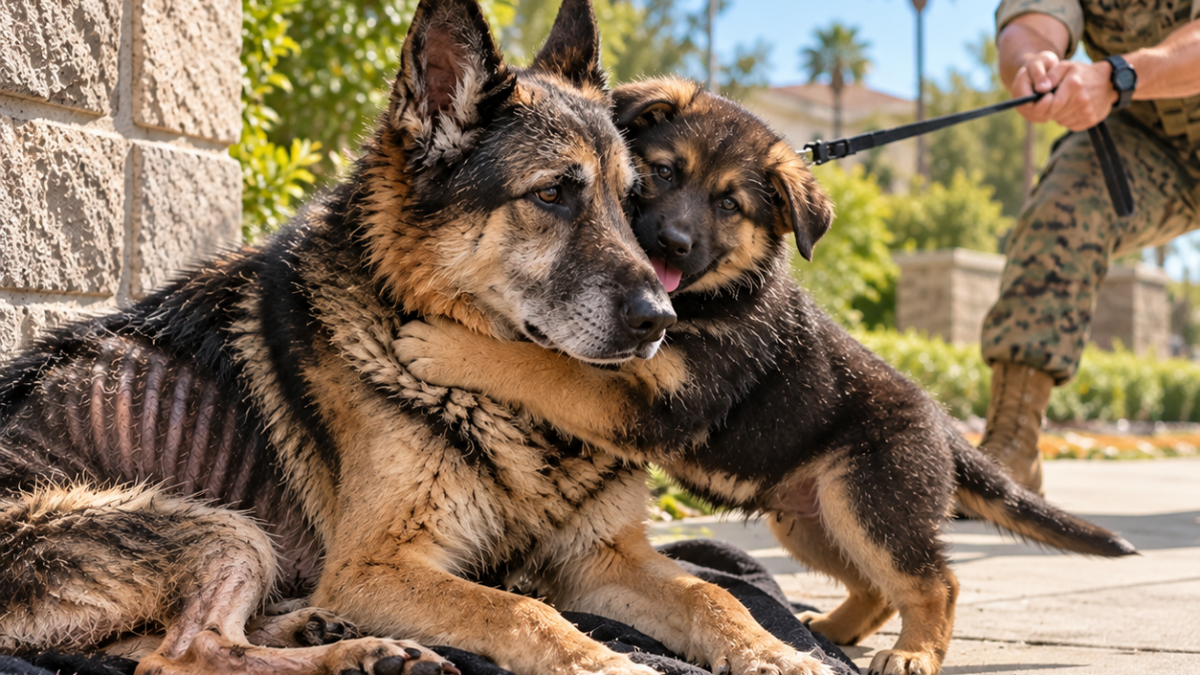
A Marine Tried to Pull His 11-Week-Old Puppy Away From an Aging German Shepherd—Then the Old Dog Walked Toward the Road, Looked Back, and Waited for Them to Follow.
The puppy tore against the leash the moment he saw the old German Shepherd lying beside the stone wall.
I tried to pull him away, thinking he was only excited, but Scout planted all four paws and pressed himself beneath the old dog’s neck like he had finally found the one soul he had been waiting for.
Then the old shepherd stood, looked straight at me, and began leading us toward a place that was supposed to have been empty.
My name is Nolan Pierce.
Staff Sergeant, United States Marine Corps.
For most of my adult life, I believed purpose was something assigned.
A set of orders.
A duty station.
A training schedule.
A convoy route.
A name on a roster.
A time to report and a mission to complete.
I trusted structure because structure had never asked me how I felt.
It simply told me where to be.
That had always been easier.
People who served with me usually described me as dependable before they described me as friendly. I never took offense to that. Friendly was optional. Dependable mattered.
I listened more than I spoke.
I measured situations before stepping into them.
I kept younger Marines out of trouble when I could and pulled them through it when I could not.
I fixed what needed fixing.
I did not spend much time examining what needed fixing in myself.
That was probably why, at thirty-nine years old, I still lived alone in a quiet house near Oceanside, California, close enough to Camp Pendleton to hear helicopters when the wind was right.
My house was clean.
Orderly.
Too quiet, according to my sister.
Perfect, according to me.
Then Scout arrived.
Three days before I followed the old dog, High Coast Animal Rescue called me about an eleven-week-old German Shepherd puppy who needed a short-term foster.
Short-term.
That was the important part.
Temporary.
A few days, maybe a week.
The rescue was overwhelmed after several regional shelters filled beyond capacity. Someone at High Coast knew I had experience with working breeds and asked whether I could keep a puppy stable until paperwork caught up with placement.
I said yes because I had been trained to answer practical requests with practical solutions.
I also said, “I’m not keeping him.”
PART2:
I repeated that sentence three times during the first phone call.
Once when I picked him up.
Once to the volunteer who smiled like she knew better.
Once to Scout himself when he climbed into my passenger seat, put both paws on my gear bag, and looked at me like he had already decided the matter.
“You’re temporary,” I told him.
Scout sneezed on my console.
That was the first negotiation.
He was black and tan, all oversized paws and uncertain ears. His right ear sometimes stood up proudly for several seconds before collapsing again. His left ear leaned sideways as if it had lost interest in military discipline entirely.
He was energetic once he got comfortable, but sudden separation unsettled him.
That was the part I noticed first.
If I left the room, he followed.
If I closed the bathroom door, he sat outside and cried as if abandonment had a very specific smell and I had just recreated it.
At night, he refused the expensive dog bed I had placed near the couch.
Instead, he slept beside the front door.
The first night, I assumed he liked the cool floor.
The second night, I noticed he woke every time headlights passed outside.
The third night, I lay awake and watched him lift his head toward the window again and again.
That was when the thought came to me.
He was waiting.
For what, I did not know.
For whom, I had not asked yet.
That Saturday morning, I drove Scout back to the military family adoption event for a follow-up health check and paperwork review.
Morning sunlight spread across Oceanside, turning the low buildings near the adoption center pale gold. A clean Pacific breeze moved through the palms along the road. Beyond the rooftops, the sky was clear enough to make the distant hills look closer than they were.
I pulled my dark green pickup into the temporary parking area shortly after eight.
Scout sat in the passenger seat like a highly unqualified officer in charge of morale.
“Business first,” I said.
He wagged his tail and stepped on my field notes.
PART3:
I wore rolled-sleeve camouflage utilities, tan boots, and a black field watch I checked more often than necessary.
The watch was habit.
When you spend enough years living by time hacks, your wrist starts feeling responsible for the world.
Scout bounced down from the truck and immediately investigated a line of low shrubs near the parking lot with the urgency of a bomb technician approaching suspicious equipment.
“Scout.”
He ignored me.
“Business first.”
He continued sniffing.
“Fine. Finish your inspection.”
He had known me seventy-two hours and already understood that most of my serious voice contained very little actual threat when used on puppies.
The adoption event had been arranged for military families and veterans. Folding tables stood beneath white canopies across the courtyard. Rescue volunteers moved between shaded areas carrying water bowls. Children knelt near exercise pens. Parents read information sheets. A retired Marine argued with his wife about whether they had room for “just one more” dog while already holding a leash attached to a terrier mix.
For forty minutes, everything was routine.
Scout had his quick health check.
The vet tech confirmed his weight was improving.
The rescue coordinator reviewed his foster notes.
I answered questions.
Yes, he was eating.
Yes, his stools were normal.
Yes, he cried if I left the room.
Yes, he slept by the door.
No, I was not adopting him.
The coordinator wrote something down and did not look at me.
I did not like that.
When we stepped back through the side doors, Scout trotted beside me for exactly three steps.
Then he stopped.
The leash went still in my hand.
Not slack.
Still.
His entire body changed.
His ears lifted.
His head rose.
His weight shifted forward.
Across the courtyard, beside a short stone wall shaded by an ornamental tree, an old German Shepherd lay on a dark blanket.
He was large even in age, maybe eighty pounds, with a broad chest and a heavy black saddle across his back. Gray covered most of his muzzle and had begun spreading above his eyes. His coat was clean enough to suggest someone had cared for him recently, but rough around the shoulders from days outdoors.
One rear leg rested at an awkward angle.
Not injured exactly.
Stiff.
The way age settles into joints that have worked hard for a long time.
His eyes were dark brown and unusually calm.
People passed within a few feet of him, but he did not lift his head.
Scout stared at him.
“Scout,” I said.
Nothing.
Then he moved.
The leash snapped tight so fast I had to shift my footing.
Scout scrambled across the pavement toward the old shepherd, pulling with every bit of strength his small body could produce.
“Easy.”
Scout kept going.
I followed because dragging a panicked puppy backward in the middle of an adoption event was not the kind of scene anyone needed.
The old dog raised his head.
For one second, I expected a warning posture.
A growl.
A stiffening of the neck.
A hard stare.
Something.
None came.
Scout reached him and immediately pressed himself against the old shepherd’s chest.
There was no cautious sniffing.
No slow introduction.
No normal canine conversation.
Scout pushed his head beneath the old dog’s neck, placed both front paws against his shoulder, and leaned into him like he had been trying to reach that exact place for a very long time.
I stopped.
Scout’s body trembled with excitement.
The old shepherd remained still.
Then he lowered his gray muzzle and smelled the puppy carefully.
First Scout’s ears.
Then his neck.
Then along his shoulders.
The movement was deliberate.
Familiar.
That was when something shifted in my attention.
This was not the behavior of two unfamiliar dogs deciding whether they liked each other.
Scout tried to climb farther against him.
I gave the leash a gentle pull.
“Come on.”
Scout planted all four paws.
I pulled slightly again.
The puppy leaned harder into the old dog.
“You’re serious?”
Scout did not look at me.
The old shepherd finally touched his nose to Scout’s forehead.
Then gave one slow lick between his ears.
Scout stopped trembling almost immediately.
“Sir?”
I looked over.
A woman was hurrying across the courtyard toward us.
Megan Brooks.
Thirty-six, warm brown skin, dark curly hair pulled into a loose ponytail beneath a rescue center cap. She wore jeans, running shoes, and a navy polo marked High Coast Animal Rescue.
Megan had worked in animal placement for almost nine years, which meant she had the kind of patience that came from seeing frightened dogs, anxious owners, failed adoptions, surprise miracles, and everything in between.
She rarely rushed an animal.
She almost never assumed calm meant predictable.
She slowed before reaching us.
“That’s the older shepherd we’ve been trying to figure out.”
I glanced down.
Scout still had both paws against him.
“Does he belong to the event?”
“No.”
Megan stayed several feet away.
“We started calling him Major.”
“Major.”
“One of the volunteers said he carried himself like one.”
I looked at the old dog.
The name fit better than it should have.
Megan watched Scout.
“He normally keeps more distance.”
“They know each other.”
She hesitated.
“Maybe.”
I shook my head once.
“That’s not a maybe.”
Scout had lowered himself beside Major now, almost underneath the old dog’s neck.
Megan’s expression grew more serious.
“Major started showing up around here several days ago. Not constantly. Usually mornings. Sometimes near the back entrance, sometimes by this wall. No owner. We’ve asked around.”
“Chip?”
“We scanned once. Nothing showed. One of our veterinary techs thinks he may have an older chip that migrated deeper under the shoulder. We’re planning to scan more carefully if he’ll let us bring him inside long enough.”
“He won’t?”
“He’ll take water. Sometimes food. But whenever anyone tries to lead him somewhere, he walks away.”
I looked at Scout.
Apparently, Major had made one exception.
My phone vibrated in my pocket.
I almost ignored it.
Then I saw the name.
Ben Walsh.
I answered.
“Pierce.”
“Staff Sergeant.”
Corporal Ben Walsh was twenty-five, five-ten, broad through the shoulders, sandy blond hair cut close, and an easy half smile that had once made him one of the most sociable Marines in my section.
Over the previous year, a persistent knee injury had slowly stripped him of the physical routines that had shaped most of his adult life.
Ben joked more whenever he was worried.
I had learned to recognize that habit.
“Good news,” he said.
I heard immediately that it was not good news.
“What happened?”
“Medical separation got approved.”
A pause.
Then a short laugh.
“So I guess Uncle Sam has officially decided I’ve limped around long enough.”
I looked toward the courtyard.
Major had lowered his head beside Scout.
“When?”
“Final processing starts next month.”
“And how are you doing?”
“I’m great.”
“You sound terrible.”
Another silence.
Then Ben’s voice softened.
“I just thought I’d have more time to figure out what comes after.”
I understood that sentence better than I wanted to.
“You don’t need the next thirty years figured out today.”
“Feels like I should.”
“Don’t decide the rest of your life in one day, Ben.”
“Yes, Staff Sergeant.”
“Call me tonight.”
“I will.”
He would not unless I made him.
We both knew that.
I ended the call and stood still for several seconds, phone in hand.
Three days earlier, I had believed my next few years were already organized.
Duty.
Training rotations.
A quiet house.
No complications.
Scout had already interrupted that plan.
Now an aging shepherd had somehow become part of the morning.
I crouched and slid one arm beneath Scout.
The puppy resisted immediately.
“That’s enough.”
Scout stretched both front legs toward Major as I lifted him.
Major rose slowly.
His rear legs stiffened for a moment before supporting him.
I noticed the age in that movement more clearly now.
Major stepped away from the blanket.
Scout twisted in my arms.
“Relax.”
Major crossed the courtyard toward the side road.
Ten yards.
Maybe a little more.
Then he stopped.
I expected him to look back at Scout.
He did not.
He turned his head and looked directly at me.
His posture was quiet.
No barking.
No restless movement.
No obvious distress.
He simply held my gaze.
I had spent enough years reading people in uncertain situations to recognize deliberate attention.
Major waited.
Then he turned and began walking again.
Scout struggled harder in my arms.
The puppy gave a frustrated whine and stretched toward the road.
Major reached the edge of the property.
Stopped once more.
Looked back at me.
Megan came to stand beside me.
“I don’t think he’s wandering.”
I watched the old shepherd.
“No.”
Major turned toward the road, away from the adoption center.
Scout went suddenly still in my arms, staring after him.
I looked from the puppy to Major.
For the first time that morning, I understood what the old shepherd appeared to be asking.
Major wanted us to follow.
He did not hurry.
He moved east along the quieter streets beyond the adoption center with a deliberate pace, stopping whenever the stiffness in his rear legs required it, and continuing only after looking back to confirm that Scout and I were still behind him.
The bright Oceanside morning warmed quickly.
Palm-lined commercial streets gave way to older neighborhoods, wider lots, and dry hills rising beyond the eastern edge of town.
I kept Scout on a short leash.
The puppy wanted to reach Major badly enough to pull almost continuously, but Major seemed less interested in reunion now than destination.
Every few hundred yards, he glanced over his shoulder, found us, and continued.
“You better know where you’re going,” I muttered.
Major did not acknowledge me.
After nearly twenty minutes, I stopped beside my pickup, which Megan had allowed me to retrieve while keeping Major in sight from her rescue vehicle.
Continuing several miles on foot with an eleven-week-old puppy and an aging dog made no sense.
I opened the passenger door, expecting Major to refuse the truck.
Instead, he approached, smelled the step, then looked toward Scout.
Scout scrambled into the cab.
Major followed.
That surprised me more than anything else that morning.
The old shepherd settled behind the passenger seat while Scout immediately pressed himself against him. Major tolerated the contact with the patient resignation of someone who had apparently accepted that personal space no longer existed.
I drove slowly, following Major’s attention whenever we reached an intersection.
Twice, he rose and moved toward one side of the cab before I turned.
Both times, the road he indicated continued east.
“That’s unsettling,” I said.
Scout wagged his tail.
The route eventually left the denser part of Oceanside behind. Low houses became scattered properties separated by chain-link fencing, eucalyptus trees, and dry fields.
I had been around Camp Pendleton long enough to know much of the surrounding region, but the final road was unfamiliar.
Major suddenly stood.
Scout rose with him.
Ahead, a narrow paved lane curved between two low hills.
I turned onto it.
Major relaxed.
A quarter mile later, an old wooden sign appeared beside a locked metal gate.
The paint had faded under years of California sun. Vines climbed across one corner, and several letters had begun peeling away.
But the name could still be read.
SECOND WATCH CANINE PROJECT.
I slowed.
Major moved toward the door before the truck had completely stopped.
The property beyond the gate covered several acres.
A low single-story building stood near the center, surrounded by mature pepper trees and patches of neglected landscaping. Farther back, I could see several covered kennel runs and what looked like a fenced exercise yard.
Weeds grew through cracks in the pavement.
Empty water tubs rested upside down beside one building.
The place had not been abandoned for years.
It had been inactive long enough to feel wrong.
I stepped out.
Scout immediately began pulling toward the gate.
This was different from ordinary puppy curiosity.
He smelled the bottom rail, moved to one post, then the other, circling with such certainty that I stopped trying to guide him.
“You’ve been here.”
Scout pulled again.
Major walked along the outside fence.
I called Megan.
She answered on the second ring.
“Please tell me you didn’t follow him into traffic.”
“We’re fine.”
“That wasn’t the question.”
“He brought us somewhere.”
A pause.
“Where?”
I read the sign.
“Second Watch Canine Project.”
Megan went quiet.
“You know it.”
“No.”
The answer came too quickly to be casual.
I looked through the gate.
“Scout does.”
She told me not to enter until she arrived.
Fifteen minutes later, Megan pulled in behind my truck carrying a tablet and a thick intake folder. Her usually relaxed expression had tightened into professional concentration.
She crouched beside Scout without touching him.
“He really recognizes this place.”
Scout was already trying to push his nose through the gate.
Megan opened the digital intake record.
“We found him eighteen days ago.”
“Where?”
She enlarged a map.
County road northeast of the property.
“How far?”
“Less than two miles.”
Neither of us spoke for a moment.
Scout’s intake report had described him as underweight and nervous, but medically stable. A driver had seen him alone near a drainage shoulder and contacted rescue volunteers.
No collar.
No registration.
No match in the initial database search.
Nothing in the report mentioned Second Watch.
Megan scrolled farther.
“We searched the immediate area. Contacted nearby shelters. Nobody reported him missing.”
I looked toward the property.
“Maybe nobody knew where to report him from.”
Major reached the far corner of the fence.
There, storm runoff had washed soil away beneath the lower rail, leaving a narrow opening.
Before I could reach him, Major lowered himself carefully and slid underneath.
Scout exploded into motion.
The leash tightened.
“No.”
The puppy dug his paws into the dirt.
Major stood inside the property and looked back.
Scout tried again.
I shortened the leash and lifted him before he could wedge himself beneath the fence.
“We’re not breaking into anything because your friend did.”
Megan was already making calls.
Property records listed Second Watch under a private trust associated with its former operator. After several attempts, she reached the legal office managing the site. The person who returned the call was Clare Donovan, an estate administrator with a measured voice and an almost overly careful way of choosing words.
Megan explained the situation.
A rescued puppy.
An older dog already inside.
Possible animals or records overlooked.
Clare requested photographs of the gate, my identification, and Megan’s rescue credentials.
Ten minutes later, written authorization arrived by email, allowing us to inspect the buildings for animal welfare purposes without removing property unrelated to immediate care.
Only then did I open the gate using the temporary access code Clare provided for the electronic lockbox behind the post.
Scout nearly pulled me through.
Major waited twenty yards inside.
As soon as the gate opened, the old shepherd turned and headed toward the main building.
Before we followed, another pickup turned onto the lane.
Ben Walsh stepped out.
Out of uniform, he looked younger than I was used to. His injured knee caused only a slight unevenness in his gait that morning, but I knew how much frustration lay behind it.
“You said you found a damaged fence,” Ben said.
“I said I might need another set of eyes.”
“Same thing.”
He looked toward Major.
“So that’s him.”
Major watched Ben without moving.
Ben did something I noticed immediately.
He did not walk straight toward the dog.
Instead, he lowered himself near the fence, turned slightly sideways, and rested his hands loosely against his knees.
No staring.
No reaching.
No attempt to call Major closer.
After half a minute, Major walked to him.
He smelled Ben’s boot.
Then his hand.
Ben stayed still.
Major moved on.
Megan raised an eyebrow.
“You’ve done that before.”
“My dad kept working dogs around his construction yard when I was growing up. Mostly shepherd mixes. He taught me not to introduce myself like an idiot.”
It was the longest Ben had spoken about anything unrelated to his medical separation since the phone call.
I filed that away.
Ben stood and examined the damaged fence.
“Bottom rail isn’t cut. Ground washed out beneath it. Probably been open a while.”
His father had operated a small residential construction company outside Riverside. Ben had worked summers with him from the time he was fourteen until joining the Marines. He knew framing, fencing, drainage, and the thousand small repairs people rarely noticed until something stopped working.
Together, we entered the main building.
The interior smelled stale, but dry.
A reception desk stood near the door.
Leashes hung from wall hooks.
Several framed photographs remained in place, dust covering the glass.
Scout stopped.
His head lifted.
Then he ran toward a hallway.
I followed.
The corridor opened into an indoor kennel area.
Most of the runs were empty.
Their gates stood open.
Labels remained above several doors.
Some faded.
Some removed completely.
Scout ignored all of them.
He went straight to the far end.
A large kennel stood there with a metal plate fixed above it.
MAJOR K17.
I stopped.
Beside it was a smaller enclosure.
The plate above that one was newer.
SCOUT C31.
Megan slowly lowered the tablet in her hand.
“Well.”
Scout had already pushed his nose through the bars of Major’s kennel.
Major walked inside.
The puppy began whining until I opened the neighboring gate.
Scout did not enter his own enclosure.
He went directly into Major’s.
Inside were two stainless steel bowls.
One large and scratched with age.
One much smaller.
A folded towel lay near the back wall.
Its corners showed the unmistakable wear of puppy teeth.
Scout grabbed one edge.
I stared at him.
“That’s yours, isn’t it?”
Scout dragged the towel six inches, released it, and climbed against Major.
Megan began photographing everything for the rescue record.
Farther down the hall, we found shelves holding harnesses of different sizes, training leads, grooming brushes, and carefully labeled storage bins.
Nothing looked chaotic.
Whatever had caused the facility to stop operating, it had not begun as neglect.
That made the emptiness more confusing.
In the reception area, Ben wiped dust from one framed photograph.
Major was in it.
Younger.
Muzzle darker.
Around him sat four other dogs: a small terrier mix, a Labrador, and two younger shepherds.
Another photograph showed Major lying beneath a tree with a puppy asleep against his side.
A third showed him beside three dogs I did not recognize.
Scout’s presence at the property could now be explained.
Major’s too.
What could not be explained was everyone else’s absence.
“Where are all the dogs?” Ben asked.
Megan looked down the empty hallway.
“And why wasn’t Major with them?”
No one had an answer.
Ben moved toward a small storage room beside the office. One cabinet door had been left partly open. Inside were old event badges, keys, spare tags, and a shallow wooden tray filled with miscellaneous items.
Something metallic caught his attention.
He picked it up.
A Marine Corps challenge coin.
The edges were worn smooth from years of handling.
Ben turned it over.
He read the engraved name once without speaking.
Then he handed the coin to me.
GUNNERY SERGEANT THOMAS AVERY.
I looked from the coin to the photographs of Major on the wall.
Until that moment, Second Watch had been only an abandoned property Scout recognized.
Now it had a name attached to it.
And I had the uneasy feeling that Thomas Avery might explain why two dogs had been separated from a place they both remembered as home.
The challenge coin stayed in my palm long after Ben stepped away from the cabinet.
It was heavier than it looked.
Darkened around the edges.
On one side was the Marine Corps emblem.
On the other, a name that felt less like a clue and more like a person waiting to be found.
Megan moved into the front office with her tablet and authorization email open beside her.
For nearly an hour, she checked cabinets, file drawers, and an old desktop computer that still powered on after Ben found the breaker panel.
Nothing was removed without being documented.
Megan had spent too many years in rescue work to trust a discovery simply because it felt meaningful.
She wanted dates.
Intake numbers.
Transfer records.
Anything that could explain how Scout and Major ended up separated.
“Found something?” she called.
I entered the office.
Ben followed more slowly, one hand briefly touching the door frame as he shifted weight away from his injured knee.
Megan had opened a directory labeled PROGRAM RECORDS.
Inside were hundreds of files organized by year.
Thomas Avery’s name appeared everywhere.
The records described him as a former gunnery sergeant who had served more than twenty years in the Marine Corps before retiring.
A photograph attached to one early document showed him in his late fifties, broad through the chest, close-cropped gray hair, square face, and a steady expression that made me think of senior enlisted Marines who could quiet a room simply by entering it.
Later photographs showed Thomas older.
Hair almost entirely silver.
Deeper lines around the eyes.
But the same posture remained.
His notes were direct.
No sentimental language.
No long explanations.
Only observations.
Megan opened the original Second Watch program description.
I read over her shoulder.
Second Watch had never been a police canine facility.
It did not train military dogs.
It did not prepare dogs for patrol, detection, or protection work.
Instead, Thomas had created the property as a temporary place for dogs that struggled in ordinary shelter environments.
Some were too shy to approach adopters.
Some had been returned after placements failed.
Some became overwhelmed by the constant movement and noise of larger facilities.
Others were being considered for service dog programs but needed time to build confidence before formal evaluation.
Thomas accepted only a few at once.
That was clear from the records.
“He wasn’t trying to save fifty dogs at a time,” Megan said.
I looked at the rows of empty kennels.
“No. He was trying to understand five.”
That distinction mattered.
There were schedules for feeding, exercise, quiet periods, veterinary visits, and gradual socialization.
But the farther we read, the more often one name appeared.
Major.
Not as a trainee.
Not as a client.
As part of the process.
Megan found a video folder.
The earliest clip was nearly seven years old.
Thomas stood in one corner of an exercise yard, older than in his Marine photograph but still solidly built. Beside him stood Major, much younger then, his muzzle completely black and his movements easy.
Across the yard, a small mixed-breed dog remained beneath a bench.
Thomas did not approach.
Neither did Major.
After several minutes, Thomas placed two bowls of food on the ground and moved away.
Major walked to one bowl and began eating.
The smaller dog watched.
At first, nothing happened.
Then the little dog moved one paw out from beneath the bench.
The recording skipped ahead.
Five minutes later, the smaller dog was eating from the second bowl.
Major never went near it.
I watched the clip twice.
Megan opened another.
A nervous shepherd mix stood inside an open kennel doorway. The dog would look outside, take half a step forward, then retreat.
Major lay several feet from the entrance.
He was not facing the kennel.
He was simply there.
Eventually, the frightened dog stepped outside.
Major remained still.
The third clip was recorded at night through a low-light camera.
A young puppy shifted repeatedly behind a divider, unable to settle.
Major lay on the other side.
The puppy moved closer to the barrier.
Major did not respond.
Minutes later, the puppy curled against it and went to sleep.
Ben leaned against the desk.
“Was he trained for this?”
Megan searched the records.
“No certification. No therapy dog file.”
I continued reading.
One of Thomas’s notes provided the answer.
Major is not here to make dogs social. He is here to make the room feel predictable.
A later entry expanded on it.
He knows when not to approach. That matters more than people think.
Thomas used a simple phrase throughout the files.
Anchor dog.
I looked back toward the kennel area.
“That’s what he was.”
Megan nodded.
Not therapy.
Not service work.
Not formal training.
Something quieter.
A stable dog other dogs could read.
Major did not crowd frightened dogs.
He did not respond dramatically to nervous behavior.
He ate calmly.
Rested calmly.
Moved through unfamiliar situations without demanding attention.
Thomas had recognized that other dogs watched him.
Then he built part of Second Watch around that fact.
Ben returned to the kennel hallway.
Major lifted his head when he entered.
Ben sat several feet away, the same way he had outside.
Scout immediately tried to climb across Major to investigate him.
Major gave the puppy a patient look and lowered his head again.
Ben smiled faintly.
“He’s got more patience than half the guys I served with.”
I almost answered, but Megan called from the office again.
This time, her voice had changed.
“Nolan. He returned.”
She had found Scout’s file.
The digital record was short.
SCOUT C31.
Approximately seven weeks at intake.
German Shepherd male.
His background had been documented carefully, but without dramatic detail. Scout had come through a regional rescue transfer after authorities closed an irresponsible breeding property. The dogs had been moved into licensed rescue care and distributed among organizations according to age, health, and available space.
Scout had been physically stable.
Emotionally, he had struggled.
Thomas’s first note read:
Avoided open areas. Would not eat when left alone. Settles only when another dog is visible.
The following morning:
Placed kennel beside Major. Immediate improvement in resting behavior.
I read the next line twice.
Do not separate Scout from Major yet.
Megan scrolled.
Day three: Scout followed Major outside today. First voluntary exit without being carried.
Day five: Ate full meal after Major settled nearby.
Day seven: First full night without crying. Major stayed beside him.
I stopped reading.
The kennel hallway was visible through the office doorway.
Scout had fallen asleep.
Not in the smaller kennel marked with his own identification.
Inside Major’s.
His body curled against the old shepherd’s chest, one paw resting across Major’s front leg.
Major’s eyes were closed.
For me, the morning outside the adoption center changed completely.
Scout had not thrown himself at a strange dog because puppies were unpredictable.
He had not simply found another German Shepherd interesting.
The frantic pulling, the way he had pressed beneath Major’s neck, the way his entire body relaxed after Major touched him — Scout had recognized the animal who made the world feel safe when everything around him was new.
I looked back at the file.
After day seven, the entries became shorter.
Then they stopped.
No final placement note.
No transition plan.
No record explaining when Scout was supposed to leave Major.
The last line was dated several days before the most recent facility activity.
After that, nothing.
Megan frowned.
“That’s unusual for him. Look at the other files. Every completed record has an outcome. Transferred. Adopted. Returned to partner organization. Moved to formal service dog evaluation. Scout’s file just ends.”
I closed the window.
I did not like unfinished records.
In the military, an unfinished record usually meant the explanation existed somewhere else.
We just had not found it yet.
I found Ben behind the main kennel building.
A smaller structure sat partly hidden beneath two pepper trees. Unlike the kennel area, it looked more like a workshop than an animal facility.
Inside were workbenches, hand tools, lumber racks, spare gate hardware, unfinished ramps, and several portable kennel panels.
Ben ran his hand across one workbench.
“Somebody actually used this place.”
Several photographs hung above it.
Groups of men and women working around the property. Some young. Others well into middle age. Several wore Marine Corps shirts or hats, but none were in uniform.
One photograph showed three former Marines rebuilding a kennel gate.
Another showed two people constructing a low wooden ramp.
A third showed Thomas Avery standing beside a group of veterans holding paint rollers and tools.
Ben studied that one for a long time.
A typed page beneath the photographs explained the workshop.
Thomas had invited veterans transitioning out of military service to assist with repairs, maintenance, and basic animal care projects.
No formal therapy language.
No complicated program.
Just work.
Useful work.
The page contained a short statement from Thomas.
Some Marines miss the uniform. Some miss the people. Most miss knowing where they’re supposed to be at 0600. Give them something useful to do while they figure out what comes next.
Ben read it silently.
I said nothing.
The younger Marine moved farther into the workshop and examined a partially built ramp leaning against the wall.
“My dad would have complained about this cut.”
“Of course he would.”
“It’s crooked.”
“It’s been sitting here who knows how long. Still crooked.”
That was the first familiar piece of Ben I had heard all day.
He crouched carefully and examined the frame.
“My dad used to put me on jobs like this when I was fifteen. Said if I could build something an eighty-year-old could walk across without thinking about it, I’d learned enough to start building things people noticed.”
I glanced at him.
“You ever think about going back? Construction, anything?”
Ben did not answer immediately.
Through the workshop window, Scout could be seen following Major slowly across the exercise yard. The puppy stayed close, but no longer pulled ahead. When Major stopped, Scout stopped.
That morning, medical separation had sounded to Ben like a door closing.
Now he was standing in a workshop built by another Marine who had apparently discovered that useful work did not stop when military service did.
Ben looked again at the photograph of Thomas and the veterans.
Then he spoke quietly.
“Maybe leaving the Corps doesn’t have to mean I’m finished.”
I looked at him.
It was the first time since his separation process began that Ben had spoken about the future as if it might contain something instead of merely taking something away.
Outside, Scout lay down beside Major in a patch of afternoon shade.
For now, I understood what the old shepherd had been to Scout.
What I still did not understand was why the work had stopped.
The answer came the following morning.
Megan found it in a folder wedged behind veterinary invoices and emergency contact forms.
I had returned early with Scout.
Ben arrived twenty minutes later carrying a tool bag, two fence posts, and enough hardware to repair the washed-out section along the eastern boundary.
Major had already walked the property once, checking the exercise yard, kennel hall, and front gate before settling beneath the pepper tree where he could see both the driveway and Scout.
By then, I had begun noticing something important.
Major was calm almost everywhere except when a vehicle approached the property.
Each time tires touched the gravel lane, his head lifted immediately.
Megan placed the folder on Thomas Avery’s old desk.
The first page was a hospital notice dated six weeks earlier.
Thomas had suffered a medical emergency at Second Watch.
Later described in the paperwork as a mild stroke.
He had survived.
But he had not returned to the property afterward.
I read the date twice.
It fell only days after the final entry in Scout’s file.
“That’s why the notes stopped,” Megan said.
I nodded.
No planned closing.
No final transfer schedule.
No careful transition.
One day, Thomas had been recording Scout’s progress beside Major.
Then everything stopped.
The records reconstructed the rest in fragments.
A delivery driver arrived at Second Watch late that afternoon and noticed Thomas unwell near the main building. The driver stayed long enough to call emergency services and direct responders to the property.
Thomas lived alone.
No full-time staff on site.
Only volunteers who came according to schedule.
By evening, three rescue organizations had been contacted to move the dogs temporarily while Thomas received treatment.
Megan found the transfer sheet.
Eight dogs assigned to three vehicles.
Names.
Kennel numbers.
Destination organizations.
Departure times.
Hurried handwriting.
Scout appeared on the second page.
SCOUT C31. TRANSFER VEHICLE B.
Below that:
MAJOR K17. TRANSFER VEHICLE C.
But someone had drawn a line beside Major’s name and written one word.
MISSING.
I looked toward the yard.
Major was lying with Scout near the fence Ben was repairing.
The puppy stretched across one of his front legs.
“What does missing mean?”
Megan kept reading.
It meant that when volunteers returned to collect Major, he was no longer in his kennel.
One gate had been left open during the movement of the other dogs.
Someone believed Major had gone with a longtime volunteer.
That volunteer later believed the rescue team had taken him.
Because the property had become a confusion of vehicles, paperwork, emergency calls, and people trying to help quickly, neither assumption was challenged that night.
By the next morning, everyone thought Major was somewhere safe.
He was not.
I leaned back against the desk.
No cruelty had separated Major and Scout.
No one had deliberately abandoned the old shepherd.
The failure was quieter than that.
Everyone had believed someone else had handled it.
Megan closed the transfer sheet.
“I’ve seen versions of this before. Not often, but it happens when something changes too fast. People are trying to solve five problems at once, and the sixth problem disappears between them.”
A dog had fallen into the space between two assumptions.
Ben appeared at the office door, wiping dust from his hands.
“Fence is worse along the bottom than it looked. I can stabilize it today, but we’ll need fresh boards if you want it done properly.”
I held up the paper.
“We figured out when Major disappeared.”
Ben’s expression changed.
He stepped inside and listened while Megan explained.
For once, he did not make a joke.
“Can we see what happened?”
Megan looked toward the old security monitor mounted beside the filing cabinet.
That question led us to another part of the story.
The property’s security system had stored several weeks of footage locally.
Most clips were ordinary.
Volunteers walking dogs.
Deliveries arriving.
Thomas crossing between buildings.
Major resting outside kennels while younger dogs moved nearby.
Megan searched by date until she reached the afternoon of Thomas’s medical emergency.
We did not watch the part involving Thomas.
There was no reason to.
The official records explained enough, and I had no interest in turning a private medical event into evidence for anything else.
Instead, we moved forward to the transfer period.
One camera faced the kennel driveway.
Several rescue vehicles came and went over roughly two hours.
Volunteers carried supplies.
Checked clipboards.
Opened gates.
Returned for forgotten leashes.
Tried to organize animals unfamiliar with them.
Scout appeared briefly in the arms of a volunteer, small enough then that his legs hung awkwardly against her jacket.
He was placed into a secured transport crate inside a white van.
Major stood behind one of the kennel gates.
The footage skipped ahead.
The white van began rolling down the driveway.
Then Major appeared.
Somehow during the final movement between kennel rows, the old shepherd had reached the yard.
He ran toward the departing van.
Not recklessly.
Not frantically.
But with more speed than I had seen from him at any point since finding him.
Major followed the van through the open gate and continued down the lane.
The camera could not follow farther.
Scout disappeared inside the vehicle.
Major disappeared after him.
The next clip showed an empty road.
No one spoke for several seconds.
Ben finally broke the silence.
“He went after Scout.”
I nodded.
The old dog had spent years teaching frightened animals how to stay calm when their world changed.
When Scout’s world changed again, Major followed.
Megan checked regional intake messages from the days after the transfer.
Piece by piece, another pattern emerged.
A German Shepherd matching Major’s description had been reported beside a gas station east of Oceanside.
Two days later, a driver saw an older shepherd near a road frequently used by rescue vans.
A volunteer from the military family adoption program remembered leaving water for a similar dog behind their building.
Eventually, Major began appearing there regularly.
The adoption center I had visited with Scout was one of the places regional rescue vehicles used for handoffs and temporary events.
Major could not have known schedules.
He could not have understood organizations, transport lists, or kennel numbers.
He only needed familiar things.
Vehicle smells.
Dog scents.
Routes he had traveled before.
Places where rescue dogs came and went.
“He was checking the places that made sense to him,” Megan said.
I looked through the office window.
“And eventually Scout came back through one of them.”
That explained the reunion.
It did not explain everything.
Over the next several days, Ben and I continued repairing the eastern fence.
I did not need to ask him to return.
He arrived early each morning anyway.
He measured boards, replaced loose fasteners, corrected drainage near the washed-out section, and started making a list of repairs the workshop would need if anyone ever used it again.
The work gave his days shape.
I noticed the change before Ben did.
He stopped checking his phone every ten minutes.
He stopped making jokes about being almost unemployed.
He ate lunch instead of forgetting it.
By nine each morning, he already knew what he planned to finish before leaving.
One afternoon, I found him sitting beside the exercise yard.
Major was several feet away.
Neither of them was doing anything.
Scout was asleep beneath a bench after exhausting himself with a rope toy.
Ben stared through the fence toward the hills.
“You know what bothers me most?” he asked.
I remained standing.
“The knee?”
Ben shook his head.
“Leaving?”
He took a while to answer.
“I thought that was what I was afraid of. Losing the uniform. Losing the job.”
“What is it?”
Ben rubbed his palms together.
“Waking up and realizing nobody needs me to show up.”
I looked toward Major.
The old shepherd had spent much of his life being useful without making noise about it.
Other dogs ate because he ate.
Rested because he rested.
Walked outside because he walked outside first.
Now Second Watch was empty.
The dogs were gone.
Thomas was gone.
For all Major knew, the work he understood had simply ended one afternoon.
“Being needed isn’t limited to one uniform,” I said.
Ben gave a small nod.
But I was no longer sure I was speaking only to him.
That evening, I took Scout and Major home.
Scout ate dinner, fought unsuccessfully with one of my boots, and eventually fell asleep near the couch.
Major did not settle.
He walked to the front window.
Outside, the last sunlight was fading over the road.
The old shepherd stood there quietly.
I followed his gaze.
The road in front of my house led west, but Major’s attention seemed fixed beyond it, toward the route that eventually connected back to Second Watch.
Scout woke, crossed the room, and leaned against Major.
Major touched his nose to the puppy’s ear.
Then he looked outside again.
I finally understood.
Major had searched for Scout.
He had found him.
But finding Scout had not ended the waiting.
There had been someone else at Second Watch before everything stopped.
Someone Major had watched leave without ever seeing return.
Scout was not the only one Major had been searching for.
The old dog was still waiting for Thomas Avery.
Megan found Thomas three days later.
The lead did not come from the Second Watch files.
It came from a contact listed on an old emergency form, then from a rehabilitation center that had transferred Thomas after his condition stabilized.
By the time Megan reached the final number, Thomas was no longer in a facility.
He was living with his daughter in Temecula, California.
I drove there alone the next afternoon.
Temecula looked different from Oceanside.
Drier.
More open.
Low hills, vineyards, and neighborhoods spread across the warm inland landscape.
The Avery house sat on a quiet residential street shaded by two mature trees. A wheelchair ramp had recently been added beside the front steps, though the railing still looked unfinished.
Sarah Avery opened the door.
Forty-two, tall, slim, straight dark-blonde hair cut just below her shoulders, and the same gray-blue eyes I had seen in photographs of Thomas.
She wore jeans, a cream sweater, and running shoes. There was an alertness in the way she watched me that did not feel suspicious so much as protective.
“Staff Sergeant Pierce?”
“Nolan is fine.”
She gave a small nod and stepped aside.
“My father has asked me six times today if you were still coming.”
The living room had been rearranged to make space for a walker and a wide armchair near the window.
Thomas Avery sat there.
At sixty-eight, he no longer looked exactly like the man in the Second Watch photographs, though the structure remained.
Broad shoulders.
Fully gray hair cut short.
A neatly trimmed silver beard.
One hand rested on the handle of a black walker beside the chair.
His movements were slower than they had once been, but his eyes were sharp.
I expected questions about Second Watch.
About the property.
About the dogs transferred.
About insurance, legal offices, damage, records.
Thomas looked directly at me.
“Did you find Major?”
That was his first question.
Not about the facility.
Not about lost equipment.
Not about the trust or the property.
Major.
“Yes,” I said.
Thomas’s shoulders lowered slightly.
“Is he all right?”
“He’s old.”
Thomas almost smiled.
“He was old before any of this.”
“He’s doing well.”
“And Scout?”
I took out my phone.
“I think you should see this.”
I played the short video Megan had taken outside the adoption center.
Scout pulling against the leash.
Scout pressing his small body against Major’s neck.
Me trying unsuccessfully to encourage him away.
Thomas did not speak.
The clip ended.
I expected him to ask to see it again.
Instead, he kept looking at the dark screen.
“I knew that puppy would remember him.”
His voice was quiet.
I sat across from him.
“You knew Scout was attached to Major.”
Thomas nodded.
He explained that Scout had arrived at Second Watch younger than many dogs Thomas usually accepted. Physically healthy, but unable to settle alone.
If someone left the room, Scout followed.
If a kennel door closed and he could no longer see another dog, he became restless.
Thomas tried routine.
Food at the same time.
Short walks.
Quiet periods.
Nothing worked as quickly as Major.
“I put Scout in the kennel beside him because I thought watching an older dog might help,” Thomas said. “By the second day, Scout was copying him.”
“You wrote not to separate them.”
“I meant not yet.”
Thomas looked toward the window.
“The plan was two more weeks. Maybe less, if Scout kept improving. Then I was going to start introducing him to possible homes.”
“You never got there.”
“No.”
The word carried no self-pity.
Only fact.
Sarah appeared briefly from the kitchen with coffee and water, then left us alone again. I noticed she did that carefully — close enough to help Thomas if needed, far enough to let him speak without feeling supervised.
I asked about Major.
Thomas’s expression changed.
“I didn’t buy him for Second Watch.”
“No?”
“He was mine first.”
Major had come to Thomas years earlier through a local rescue after his previous owner could no longer care for him. Thomas had expected an older shepherd who might enjoy quiet retirement.
Instead, Major became involved in almost everything.
When nervous dogs arrived, Major watched.
When they paced, he stayed still.
When they refused food, he ate nearby.
Thomas had noticed the effect slowly.
“He never pushed them,” Thomas said. “That was the difference. People want to help so badly that sometimes they crowd the animal they’re trying to calm.”
I nodded.
“Major knew when to do nothing.”
Thomas smiled.
“Exactly.”
For the first time, I understood why Major’s absence had worried Thomas more than anything else.
Second Watch could be repaired.
Files could be replaced.
Kennels could be rebuilt.
Major was not part of the facility.
Major had been part of Thomas’s life.
One week later, I brought him.
Sarah chose a quiet park near her house because the flat path would be easier for Thomas than the property around Second Watch.
Ben came too, partly because I needed help managing Scout and partly because Thomas had specifically asked to meet the Marine who found his challenge coin.
The afternoon was warm and clear.
Thomas stood near a shaded picnic area with both hands on his walker.
Sarah remained several steps behind him.
Ben waited beside me.
Scout was already pulling forward.
Major stepped out of the truck.
Then he stopped.
Thomas did not call.
Major did not move.
For several seconds, the old shepherd simply stared.
Thomas’s face changed in a way I had not seen during our first meeting.
The discipline remained.
But something underneath it gave way.
Major took one step.
Then another.
His rear legs moved stiffly.
He did not run.
Thomas did not move toward him.
Major crossed the grass slowly until he reached the walker.
Then the old dog lifted his head and pressed it firmly against Thomas’s chest.
Thomas lowered one hand into the thick fur behind Major’s neck.
The other followed.
He bent as far as his body allowed.
Major leaned into him.
No one said anything.
Scout lasted perhaps ten seconds.
Then the puppy rushed forward and pushed himself between Major, the walker, and Thomas’s legs.
Thomas let out a laugh that broke halfway through.
“Of course.”
Scout put one paw against Thomas’s shoe.
Sarah turned her face away.
Ben stared at the ground.
I gave them silence.
Later, we sat beneath the shade while Major remained beside Thomas.
Scout moved between everyone constantly, unable to understand why a reunion involving him should contain any moment where he was not at the center.
Thomas opened a folder Sarah had brought.
Inside were Major’s ownership records.
He placed them on the table in front of me.
“I want you to take these.”
I looked at him.
“You’re sure?”
Thomas kept one hand on Major’s back.
“No.”
The answer surprised me.
Thomas continued.
“I want him back more than I can explain.”
“Then why?”
“Because wanting isn’t the same as being able.”
He looked down at Major.
Some days Thomas could walk farther than others.
Some mornings were good.
Some were not.
Major was eleven now.
His rear legs were stiff.
He needed regular movement, help getting into vehicles, and someone strong enough to manage him if age made things harder.
Thomas could no longer promise that.
“Missing him doesn’t mean I should ask him to live a smaller life for me.”
I looked at the papers.
I did not sign anything yet.
But I took them.
Before we left, Ben removed the challenge coin from his pocket.
“I think this belongs to you.”
Thomas looked at it.
Then at Ben.
“Where did you find it?”
“Workshop cabinet.”
Thomas turned the coin between his fingers.
“I wondered where that went.”
Ben told him he had seen the photographs of veterans working there.
Thomas studied him for a moment.
“You transitioning out?”
“Medical separation.”
“How are you taking it?”
Ben gave the answer he usually gave.
“Fine.”
Thomas smiled faintly.
“That bad?”
Ben laughed once.
Thomas explained that Second Watch had never been built only for dogs.
The workshop existed because he knew how difficult the first months after military service could be.
Some people missed the mission.
Some missed the structure.
Others simply missed having somewhere they were expected to be.
“Building a ramp doesn’t solve a man’s life,” Thomas said. “But finishing something useful before lunch can remind him he still knows how.”
Ben looked toward Major.
Thomas reached into the side pocket of the folder and removed a small brass key.
“The workshop.”
Ben did not take it immediately.
“You asking me to fix something?”
“I’m asking whether you want to learn.”
“Learn what?”
“Handling canine rehabilitation. Maybe enough to find out whether you hate it.”
Ben looked at me.
Then back at Thomas.
He still did not answer.
But when Thomas held out the key again, Ben took it.
Near sunset, Sarah helped Thomas toward her vehicle.
Major followed beside the walker.
At the passenger door, Thomas rested his hand on the old shepherd’s head one final time.
Then he got inside.
Major stood beside the car as Sarah pulled away.
I watched carefully.
The vehicle rolled toward the exit.
Major took one step after it.
Then a second.
I prepared to reach for the leash.
Major stopped.
The car continued down the road.
Thomas disappeared around the corner.
Major remained still for several seconds.
Scout stood beside me.
The puppy waited.
Then Major turned.
No one called him.
No one pulled him.
The old shepherd walked back across the grass and stopped beside Scout.
Ben closed his fingers around the workshop key.
I looked down at the ownership papers beneath my arm.
For the first time since Major appeared outside the adoption center, the old dog was no longer waiting for Thomas to come back.
He had seen him.
He had found him.
And when the moment ended, Major had chosen to return.
Three months later, Second Watch no longer looked like a place everyone had forgotten.
The wooden sign at the entrance still carried faded marks from years under the California sun, but the letters had been repainted.
The washed-out section beneath the eastern fence was gone.
Four kennel runs had been repaired.
The exercise yard had fresh gates.
The room closest to the office had been converted into a quiet space with thick bedding, low lighting, and enough distance from the main hallway for nervous dogs to settle without constant movement around them.
Ben repaired the workshop roof, replaced two warped doors, and built a wide wooden ramp along the rear entrance.
I resisted every suggestion that we expand too fast.
I understood Second Watch better now.
It had never been designed to hold as many dogs as possible.
It existed to give a small number of them enough time.
Scout’s foster paperwork became permanent six weeks earlier.
The signature took less than thirty seconds.
Accepting what it meant took longer.
The German Shepherd puppy who once slept against my front door was now nearly five months old, taller through the legs, heavier through the chest, and finally in possession of two ears that stayed upright most of the day.
His black-and-tan coat had darkened along the back.
His uncertain puppy expression had begun changing into the alert face of a young shepherd.
He still slept beside Major whenever he had the choice.
The difference was what happened when Major stood and left the room.
Three months earlier, Scout would have followed immediately.
Now he usually lifted his head, watched the old shepherd leave, and went back to sleep.
I noticed that more than Scout did.
Major’s transfer required Thomas Avery’s written authorization, veterinary documentation, and enough rescue paperwork to convince me Megan Brooks secretly enjoyed forms.
When everything was complete, Major legally became my responsibility.
Nothing about Major’s daily routine changed.
He still checked doors.
Still preferred sleeping where he could see most of a room.
Still moved slowly for the first few steps after resting.
But the waiting had changed.
He no longer stood at my window every evening watching the road.
Thomas came to Second Watch once a month with Sarah.
Some visits lasted an hour.
Some lasted three.
Thomas usually sat beneath the pepper tree with Major near his chair while Scout attempted to involve himself in every conversation.
Sarah brought coffee, helped her father move safely around the property, and gradually stopped watching him every second.
Recovery had taught her caution.
Seeing him become part of Second Watch again began teaching her when to let that caution loosen.
Thomas did not run the program anymore.
That mattered.
I was careful about it from the beginning.
Thomas could advise.
He could tell stories.
He could point out where a kennel latch had always stuck or which corner of the yard became muddy after winter rain.
But the daily work belonged to the people who were there now.
Megan managed rescue referrals and placements through High Coast.
She decided which dogs might benefit from Second Watch and, just as importantly, which ones needed a different environment entirely.
Ben became the first official canine care assistant.
His medical separation from the Marine Corps finalized a month earlier.
The first week afterward was harder than he admitted.
He woke before dawn out of habit, reached for a uniform he no longer needed, and discovered how long a morning could feel when nobody had told him where to be.
Then he started arriving at Second Watch at 6:30.
Not because I ordered him to.
Because dogs needed breakfast at seven.
He enrolled in evening courses covering canine behavior, shelter stress, basic handling, and rehabilitation support.
He joked that homework at twenty-five felt like punishment for decisions he made in high school.
But I watched him study at the workshop table long after sunset.
The work had not replaced the Marine Corps.
It gave Ben somewhere to begin after it.
I remained on active duty at Camp Pendleton.
I spent scheduled days off at Second Watch and several evenings there when I could.
I repaired what Ben had not already repaired, reviewed Megan’s placement notes, and slowly learned that helping a frightened dog sometimes involved doing much less than my instincts told me to do.
The first real test of that lesson arrived on a cool February morning.
Megan’s rescue vehicle came through the gate shortly after eight.
A German Shepherd sat secured in the rear compartment.
Her name was Ruby.
She was approximately three years old, medium-sized for the breed, with a sable coat that darkened around her shoulders and back, narrow amber-brown eyes, and a small notch along the edge of her left ear from an old healed injury.
Physically healthy.
But her posture made her look smaller than she was.
She kept her head low around unfamiliar people and preferred corners where walls protected two sides of her body.
Megan gave us the short version.
Ruby had been adopted twice from two different rescue placements and returned both times because she never adjusted to busy homes.
No one described her as aggressive.
She simply withdrew.
Doors opening.
Unfamiliar visitors.
Other dogs moving too quickly.
Too much attention.
All of it sent her looking for the quietest place available.
“She doesn’t need somebody trying harder,” Megan said.
I looked toward the quiet room.
“She needs everybody trying less.”
Megan smiled faintly.
“You’re learning.”
We brought Ruby inside without ceremony.
Ben kept Scout in the yard.
Major remained near the office doorway.
Ruby entered the quiet room, examined it for less than ten seconds, then moved into the far corner beside a low cabinet and sat down.
I placed a bowl of water near the wall.
Then food.
Ruby watched me.
She did not approach.
I moved back several feet.
Nothing.
Ten minutes passed.
Ruby remained in the corner.
Ben entered and sat sideways near the doorway.
He did not look directly at her.
“Morning,” he said quietly, more to the room than to the dog.
Ruby stayed still.
Ben waited five minutes.
Then ten.
No change.
I stood outside the open doorway with Megan.
Months earlier, I might have interpreted the lack of progress as a problem requiring another method.
Now I understood that the absence of movement could itself be part of the process.
Major appeared at the end of the hallway.
He had been asleep in the office.
Scout followed two steps behind him until I caught the puppy gently by the collar.
“Not you.”
Scout looked personally offended.
Major continued alone.
He reached the quiet room.
Ruby’s eyes immediately shifted toward him.
Major stopped.
He did not walk to her.
He did not smell her face.
He did not even look at her for long.
The old shepherd crossed to a spot several yards away from the corner, lowered himself carefully onto the floor, and turned his head toward the hallway.
Then he did nothing.
Ben remained seated.
I remained outside.
Megan checked the time.
Eight minutes passed.
Ruby’s nose lifted.
Major stayed still.
Another four minutes.
Ruby shifted one front paw forward.
Nobody reacted.
I had learned that celebration could be pressure too.
Ruby remained there for almost another minute.
Then the second paw moved.
Her body followed slowly.
She crossed half the distance to the food bowl and stopped.
Major did not turn around.
Ruby looked at him.
Then at the bowl.
Finally, she stepped forward and took one bite.
Ben looked at me.
Neither of us spoke.
Ruby ate again.
Major remained on the floor as if nothing important had happened.
Scout sat outside the room with extraordinary difficulty, held in place mostly by my hand against his chest.
Nearly twenty minutes after Major entered, Ruby stood beside the bowl and ate steadily.
Ben’s expression changed.
He had seen the old videos.
Read Thomas’s notes.
But seeing it happen in front of him was different.
“So that’s it,” he said quietly.
I glanced at Major.
“No.”
Ben looked at me.
“That’s the beginning.”
Three days later, Ruby ate with Major nearby without needing the corner first.
By the end of the week, she rested close enough to the doorway to see movement in the hall without retreating.
No one called it a breakthrough.
Thomas had taught us better than that.
Progress was smaller and quieter.
A photograph was added to the hallway that month.
Sarah had taken it during Thomas’s latest visit.
Thomas sat in a chair beneath the pepper tree.
Major rested at his feet.
Scout stood beside me, no longer small enough to hide beneath Major’s chest.
Ben stood behind us with one hand resting against the repaired fence.
Below the photograph, I installed a simple wooden plaque.
SECOND WATCH
EVERYONE DESERVES ANOTHER PURPOSE
On the wall beside it were two small cards.
MAJOR — HOME
SCOUT — HOME
The cards had been Thomas’s idea.
The notebook had been mine.
I left Thomas’s original records exactly where they were in the office.
I did not try to finish them or rewrite anything that belonged to another period of Second Watch.
Instead, I placed a new notebook beside the old one.
The first page carried one name.
RUBY.
The first entry was simple.
Day one: stayed in the corner.
A few lines below it:
Day three: ate with Major nearby.
That evening, I prepared to leave after everyone else had settled.
Ben was outside turning off the workshop lights.
Megan had already gone home.
Thomas and Sarah had left before sunset.
I walked through the kennel hall.
Scout was asleep against Major.
Ruby lay several feet away on her own bed.
Not touching either dog.
Not hiding either.
The door to the quiet room remained open.
I stopped beside it.
For a moment, my hand rested against the edge.
Once, Second Watch had gone silent because one life changed without warning.
Major had lost Scout.
Major had lost Thomas.
Ben had believed leaving the Marine Corps meant losing the part of himself that mattered.
I had believed Scout would stay only a few days.
None of those things had ended where anyone expected.
Scout found Major again.
Major found Thomas.
Thomas learned that the work he began could continue without requiring him to carry it alone.
Ben discovered that being useful did not depend on a uniform.
And I, who had spent years believing purpose was something defined by orders, schedules, and duty stations, discovered another kind.
Sometimes a living thing does not need you to rescue it.
Sometimes it needs you not to pull it away from the one place where it finally feels safe.
And sometimes, while helping something else find its way home, you discover the road has been leading you somewhere too.
I looked once more into the room.
Major slept.
Scout rested against him.
Ruby’s eyes were closed.
Outside, the workshop light went dark.
I removed my hand from the door.
Then I left it open.
What stays with me most is not only the moment Scout wrapped himself around Major and refused to let that old shepherd disappear again.
It is not the empty kennels, the faded Second Watch sign, or even the challenge coin that led us back to Thomas Avery.
It is the quiet truth Major carried better than any of us.
He had spent years helping frightened dogs without asking for anything in return.
He never forced them forward.
He never crowded them.
He never demanded proof that his patience was working.
He simply stayed close enough for them to believe they were safe.
Scout remembered that.
Thomas remembered it.
And in the end, I did too.
Major had lost the puppy he protected, the Marine he trusted, and the place where his life had meaning.
But he kept searching.
Because I chose to follow instead of pulling Scout away, one unfinished story became several new beginnings.
Scout found home.
Major found Thomas again.
Ben discovered that leaving the Marine Corps did not mean his purpose was over.
Thomas saw Second Watch come back to life.
Ruby took her first quiet steps out of the corner because an old German Shepherd still knew exactly when to do nothing but stay.
Maybe that is what Major had been trying to teach all of us from the beginning.
Sometimes the greatest act of love is not rescuing someone with noise, strength, or perfect answers.
Sometimes it is simply refusing to leave when fear says everyone eventually will.
Major never needed medals for what he did.
His patience was his service.
His loyalty was his language.
His presence was a promise.
And the morning I tried to pull Scout away from him, I thought I was keeping a puppy under control.
I was wrong.
The old dog was not interrupting our day.
He was leading us home.








