A Marine Mocked Me in Front of 20 Soldiers, Showing His Battle Scar and Asking If I’d Ever Seen a Real Wound—Then I Revealed Something About His Injury That Left Him Speechless.
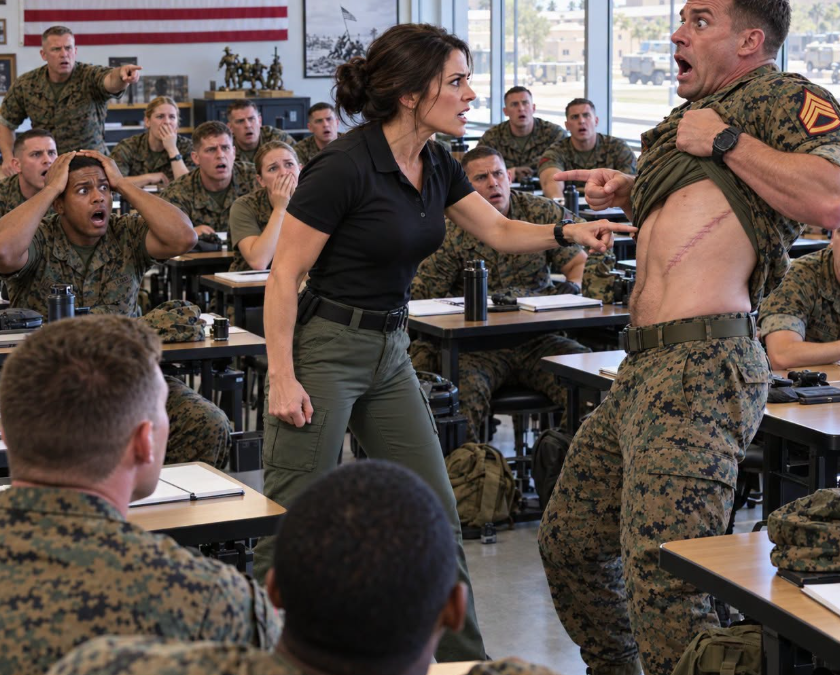
A Marine Mocked Me in Front of 20 Soldiers, Showing His Battle Scar and Asking If I’d Ever Seen a Real Wound—Then I Revealed Something About His Injury That Left Him Speechless.
For nine years, Sergeant Mason Devereaux believed I had looked at his dying best friend, chosen not to help him, and saved Mason instead.
Then, in front of twenty Marines, he lifted his shirt, pointed to the scar beneath his ribs, and asked whether I had ever seen a real wound—so I gave him the date, the time, and one tiny mark beneath his collarbone he had never understood.
Three weeks later, an old medical report arrived in my office with a handwritten note proving that the misunderstanding which poisoned his trust in every corpsman after me had not survived because nobody knew the truth—it survived because people in authority had decided the truth would be inconvenient.
My name is Caroline Lindell.
Most people who know me well call me Cara.
At thirty-three, I had spent fifteen years in the Navy, most of them attached to Marines.
That teaches you certain things.
Marines will continue walking on injuries that should put normal people in ambulances.
They will lie about pain if they think admitting it might remove them from their unit.
They will insist they are fine while blood is running into one boot.
And if you ask a wounded nineteen-year-old whether he can breathe, there is a decent chance he will tell you yes even while one of his lungs is actively becoming a problem.
People lie when they are hurt.
Usually not maliciously.
Fear lies.
Adrenaline lies.
Pride lies.
Loyalty lies.
Memory lies most convincingly of all because memory often believes itself.
That last lesson took me nine years to understand.
At 5:30 on my third Monday with 2nd Battalion, the training lane was still dark enough that I needed a headlamp to unlock the equipment container.
Southern California before sunrise has a coldness visitors don’t expect.
Not winter cold.
Marine-layer cold.
Damp air under eucalyptus trees.
Wet dirt.
Dark sky beginning to turn gray over the hills.
PART2:
I pulled twelve full-body trauma mannequins from the container one at a time.
Each weighed enough to remind my lower back I wasn’t twenty-three anymore.
They could simulate bleeding from multiple wounds.
Chest injuries.
Amputations.
Junctional wounds.
Airway problems.
We could program them through a tablet to punish hesitation with bright artificial blood.
I liked training mannequins.
They didn’t get embarrassed.
They didn’t conceal symptoms.
They didn’t pretend their ankle wasn’t broken because their squad needed one more rifleman.
By six, I had them arranged in two rows.
Then I counted.
Tourniquets.
Gauze.
Chest seals.
Training needles.
Casualty cards.
Gloves.
Twice.
Counting was something I did whenever I arrived somewhere new.
Inventory gives uncertainty edges.
PART3:
Gunnery Sergeant Nolan Mercer arrived carrying two coffees.
He handed one over.
No greeting.
No ceremony.
I liked him immediately.
He was forty-two, gray beginning around the temples, with permanently narrowed eyes suggesting he had spent half his adult life inspecting things other people hoped he would not notice.
He studied my setup.
“Previous corpsman made students drag all this out themselves.”
“Previous corpsman taught a different course.”
Small smile.
Then his expression changed.
“Twenty Marines.”
“Mostly corporals and lance corporals.”
“Couple sergeants with deployments.”
He took a drink.
“One of them will probably test you.”
“Academically?”
“No.”
“Personality.”
I looked at him.
“Serious?”
“Good squad leader.”
“Good Marine.”
“Problem with docs.”
“What kind?”
Mercer shrugged.
“Four corpsmen in three years have complained about him checking everything.”
“Medication labels.”
“Treatment decisions.”
“Triage calls.”
“Everything.”
“Why?”
“He says trust has to be earned.”
“That isn’t completely wrong.”
“No.”
Mercer looked toward the road.
“But sometimes he acts like he’s waiting for a corpsman to prove something.”
At 7:30, the trucks arrived.
Twenty Marines climbed out.
I identified Mason Devereaux before anyone introduced him.
He sat at the highest left corner of the aluminum bleachers.
Lean.
Hard-faced.
Twenty-eight.
Dark hair clipped close.
Arms folded.
No phone.
No jokes.
Just watching me.
There is a particular kind of attention people give when they have already decided you might fail them.
I had seen it in senior enlisted Marines watching brand-new lieutenants.
Patients watching first-year nurses.
Parents watching residents approach sick children.
Mason watched me that way.
The first ninety minutes went well.
Tourniquets first.
I demonstrated.
Then made everybody practice on a partner.
Six were too loose.
I corrected them quietly.
Nobody got humiliated.
Humiliation is a terrible teaching tool if you want someone to remember information when frightened.
If the student’s main memory is everyone laughing at him, that’s what his brain retrieves under stress.
Not where the tourniquet goes.
Not how tight.
Not time applied.
Just shame.
Mason worked fast.
Correctly.
Every time I inspected his work, he looked away.
At nine, we moved into wound packing.
I knelt beside a training mannequin with bright artificial blood pumping from a deep thigh cavity.
“Find the source.”
“Pack directly.”
“Every empty space.”
“Then pressure.”
I pushed gauze deep.
“Three full minutes.”
I looked toward the class.
“At two minutes, your shoulders start hurting.”
“Your hands tell you the bleeding has stopped.”
“Your hands can be wrong.”
That was when Mason spoke.
“Chief.”
I looked up.
“How many of those have you actually done?”
“Mannequins?”
He shook his head.
“Real ones.”
Twenty Marines became quiet.
Not military quiet.
Audience quiet.
The kind that appears when people sense an argument.
I looked at him.
“Enough.”
Then returned to the timer.
He stood.
“That isn’t really an answer.”
“It’s the answer you’re getting during instruction, Sergeant.”
Mason descended the bleachers.
One level at a time.
“With respect, ma’am—”
That word told me everything.
Ma’am.
Not Chief.
He knew what a Navy chief attached to Marines was called.
Ma’am put me somewhere else.
Softer.
Civilian.
Schoolhouse instructor.
A person carrying slides instead of experience.
I let it go.
Timer beeped.
I released pressure.
Simulated bleeding remained controlled.
“Have a seat, Sergeant.”
Instead he grabbed the hem of his T-shirt.
Pulled it to his chest.
A pale scar ran beneath the right ribs toward his back.
Thick at the original injury.
Cleaner along the section surgeons had reopened.
Old staple marks.
Several younger Marines laughed approvingly.
Nothing was funny.
Mason had transformed an argument into performance.
“There.”
He pointed.
“Real wound.”
Then looked directly at me.
“You think you can tell me what made that?”
I looked once at the scar.
Then higher.
And my stomach tightened.
Just beneath his right collarbone was another mark.
Tiny.
Almost invisible.
Faded white.
No wider than a pencil eraser.
Most people would never have noticed.
I did.
I knew where it was.
I knew the angle.
I knew the imperfect crescent along one edge.
Because I had made it.
With a red flashlight clenched between my teeth while somebody screamed another man’s name into Syrian darkness.
I stood.
Slowly.
“June 9, 2017.”
Nobody laughed.
“Approximately 2:40 in the morning.”
Mason stopped moving.
“Rocket landed short of the berm.”
“About fifteen feet to your left.”
His hand dropped from the large scar.
“Fragment entered beneath your right ribs.”
“Damaged your lung.”
The entire lane went silent.
I pointed toward my own collarbone.
“By the time I got to you, pressure was building around that lung.”
“You couldn’t breathe.”
“Somebody put a needle right there.”
I pointed at the tiny scar.
“So you could.”
Mason stared.
“Who told you that?”
“Nobody.”
His face didn’t go pale.
It became young.
That is the only way I can describe it.
For one second, the twenty-eight-year-old sergeant disappeared.
I saw a nineteen-year-old Marine lying on Syrian gravel.
Hands gripping my sleeve.
Blood beneath him.
Begging.
Doc, go to Tommy.
Doc.
Leave me.
Go to Tommy.
Mason lowered his shirt.
Then walked off the training lane.
No words.
No explanation.
I let him.
Chasing him in front of his Marines would have turned memory into spectacle.
Mercer looked at me from beside the litter rack.
I shook my head slightly.
He understood.
Stayed put.
I faced the class.
“Partners.”
“Begin.”
For the next hour, I corrected hand placement.
Reminded eleven Marines that three minutes actually meant three minutes.
Adjusted training bleed rates.
Demonstrated pressure.
Never looked toward the trees.
I could feel Mason standing somewhere out there anyway.
At 10:30, he returned.
Spoke quietly to Mercer.
Climbed into the truck.
Stayed there through lunch.
Nobody asked me anything.
Young Marines are often better at identifying dangerous silence than leaders give them credit for.
Mercer sat beside me on the lowest bleacher with two field meals.
“Want to tell me what that was?”
“Mason asked a question.”
“I answered.”
He chewed.
“Three years I’ve known him.”
“Never seen that Marine walk off training.”
“He had a reason.”
Mercer studied me.
“You were there.”
I kept eating.
“Syria.”
“2017.”
No answer.
Mercer nodded.
“All right.”
He didn’t push.
Another reason I liked him.
After lunch, I went inside the equipment container.
Closed the door.
Plastic torsos.
Medical bags.
Rubber tubing.
Metallic artificial-blood smell.
My hands were steady.
My hands were always steady.
People call that strength.
Sometimes it doesn’t feel like strength.
Sometimes you wish your hands would shake so your body would admit something matters.
I stood alone.
Then said a name I had not said aloud in years.
“Tommy.”
June 9, 2017.
I was twenty-four.
Petty Officer Second Class Caroline Lindell.
Attached to a Marine artillery battery supporting operations in northern Syria.
The position sat on a flat gravel pad behind an earthen berm.
Hot enough during daylight to make metal burn skin.
Cold enough after midnight that people underestimated it.
Enemy rockets landed wide most nights.
Eventually you learned the difference between outgoing artillery and incoming.
People sometimes call familiarity confidence.
It isn’t.
Familiarity means your body moves before thought.
Around 2:40 that morning, I woke to the incoming whistle.
The rocket struck near an ammunition position.
Two Marines had been standing watch there.
I knew because I’d passed them around midnight on my way to the latrine.
Lance Corporal Thomas Reyes asked if I had gum.
I did.
Spearmint.
The other Marine was Mason Devereaux.
I reached them in under a minute.
Dust.
Darkness.
People shouting for corpsman from more than one direction.
Tommy was closer to the impact.
So I checked Tommy first.
Airway.
Breathing.
Carotid pulse.
Nothing.
The injuries to his head and chest were catastrophic.
I checked again.
Because training teaches you never to let panic make an irreversible decision.
No pulse.
I said his name.
Nothing.
Twenty seconds maybe.
Maybe less.
Maybe more.
Then Mason.
Right side.
Conscious.
Gasping.
Trying to crawl toward Tommy despite shrapnel beneath his ribs.
I rolled him.
He caught my sleeve.
Both hands.
“Tommy.”
“Doc, go to Tommy.”
“I already did.”
He didn’t hear me.
Maybe couldn’t.
His breathing deteriorated quickly.
One side of the chest wasn’t moving normally.
Pressure building around the lung.
If I did nothing, the pressure would keep increasing.
Breathing would fail.
He pushed at me.
Tried to twist.
“Go to Tommy.”
“Mason.”
“Leave me.”
“I’m with you.”
“Doc, go!”
“I’m with you.”
I used my knee to control his shoulder.
Located the decompression site beneath the collarbone.
Red flashlight between my teeth.
Performed the procedure.
Air released.
Mason dragged in one full breath.
That look stayed with me.
A body suddenly remembering something basic it was supposed to know.
Two seconds later, he was fighting me again.
The evacuation helicopter took fifty-two minutes.
I know because I timed it.
I maintained pressure.
Reassessed breathing.
Repeated treatment when necessary.
Talked to Mason even after medication, blood loss, and exhaustion pulled him unconscious.
For most of that hour he repeated the same thing.
Tommy.
Go to Tommy.
Leave me.
Tommy.
Then I handed Mason alive to the flight crew.
Tommy Reyes was later placed into a transfer case beneath an American flag.
I helped prepare him to go home.
The next morning, I completed two casualty reports.
Thomas Reyes.
Time of death:
Because the rocket had killed him before I reached him.
Mason Devereaux.
Treatment details.
Evacuation.
Survived.
Then the story started.
Not officially.
Rumors rarely begin officially.
According to that story, the new female corpsman panicked.
She had gone to Mason first.
Chosen the casualty who looked easier.
Ignored Tommy.
Or maybe I checked Tommy too quickly.
Or maybe Tommy had still been breathing.
Or maybe I chose Mason because Mason was conscious and easier to save.
Every retelling became slightly worse.
I had abandoned Tommy Reyes.
Nobody asked me whether that was true.
Rumors in military units don’t arrive as formal accusations.
They live in half-finished sentences.
Jokes that stop when you approach.
Chow-line conversations spoken slightly too loudly.
A sergeant I’d treated for heat exhaustion stopped meeting my eyes.
A lance corporal who borrowed athletic tape from me every other morning started walking to a different aid station.
Eventually Senior Chief Dolores Avery came to my tent.
Sat on the cot opposite mine.
“What happened?”
I gave her the sequence.
No defense.
Reyes first.
No pulse.
Catastrophic injuries.
Then Mason.
Respiratory compromise.
Treatment.
Evacuation.
“You checked Reyes twice?”
“Yes.”
“You’re certain?”
“Yes.”
She nodded.
“Then you made the right call.”
There was a routine medical review.
Battalion surgeon.
Lieutenant Commander Evan Whitaker.
He reviewed the casualty reports.
He wrote that Tommy’s injuries were incompatible with survival.
My triage decision was appropriate.
The interventions performed on Mason materially contributed to his survival.
One paragraph settled the medical question.
But paragraphs in official files don’t speak.
No one gathered the battery.
No one corrected the rumor.
Nobody stood in front of Mason and said:
Tommy was already dead.
Cara didn’t choose you instead of him.
There was no choice.
Two weeks later, I rotated to a hospital assignment.
That move was scheduled.
At least I think it was.
For years, I wondered whether my chain also found it convenient.
A year later I asked about Mason.
Recovered.
Stayed Marine.
Transferred infantry.
I considered writing.
Many times.
Every letter sounded weak compared with what Mason remembered.
He remembered lying on the ground.
Tommy three yards away.
He remembered me kneeling near Tommy only briefly.
He remembered begging me to go back.
Then he woke in Germany.
So I wrote nothing.
I believed the report was enough.
Nine years later, Mason Devereaux walked onto my training lane carrying exactly the story I’d left behind.
By midafternoon, Mercer approached.
“Devereaux wants out.”
“Of the course?”
“Yes.”
“Why?”
“Wants to take it next quarter.”
“With another instructor.”
That hurt more than the confrontation.
Mercer lowered his voice.
“Chief.”
“That Marine has burned through four docs in this company.”
“Questions every medication.”
“Every triage call.”
“Checks labels.”
“Stands behind them during treatment.”
“Two corpsmen asked to transfer platoons.”
I looked at Mason sitting in the truck.
For nine years, I imagined his anger was aimed at me.
It wasn’t.
Not anymore.
I had become a rule.
Every corpsman would eventually choose wrong.
Every medic needed watching.
Every injured Marine could become Tommy Reyes unless Mason was standing nearby to stop it.
That evening, Battalion Sergeant Major Howard Kell called.
Careful voice.
Reasonable.
Almost kind.
Which somehow made it worse.
He said Mason was respected.
Combat wounded.
Promotion candidate.
I was new to the battalion.
Excellent record.
No benefit in turning an old deployment incident into “a thing.”
Simple suggestion.
Let Mason withdraw.
Quietly.
Another instructor certifies him next quarter.
“Nobody needs to reopen 2017.”
I stood beside the equipment container.
Artificial blood darkening dirt.
I’d heard versions of that sentence my whole career.
Let it go.
Don’t make people uncomfortable.
It’s documented.
Don’t revive old pain.
Time will handle it.
Every version sounded mature.
Every version required the person carrying the weight to keep carrying it.
“I want one night.”
Kell agreed.
I sat alone on the bottom bleacher.
Thought about my twenty-four-year-old self writing DECEASED in block letters.
Believing facts would eventually outrun gossip.
Thought about nineteen-year-old Mason awakening in Germany with no one explaining why I had ignored his begging.
Thought about four corpsmen he’d distrusted because I had been too afraid or too disciplined or too tired to finish a conversation.
At 5:17 I texted Mercer.
Tell Sergeant Devereaux I’ll be at battalion aid station at 1800. Door will be open. He doesn’t have to come.
Two minutes.
Copy.
At six, I turned on the treatment-room lights.
Sat on a stool.
6:06.
Mason appeared.
Jeans.
Gray T-shirt.
Hands in pockets.
No squad.
No rank visible.
No audience.
For several seconds we looked at each other.
Then:
“You picked me.”
“You can come inside.”
“Or leave.”
“Your choice.”
He stepped in.
“You picked me.”
“I treated you.”
“Tommy was three yards away.”
“I know.”
“I told you to go to him.”
“I know.”
“You looked at him for maybe two seconds.”
“Then came to me.”
“It wasn’t two seconds.”
His eyes hardened.
“Approximately twenty.”
“You were bleeding.”
“You weren’t breathing correctly.”
“Your sense of time was not reliable.”
Then I gave him the sequence.
Exactly.
Airway.
Breathing.
Pulse.
Wrist.
Neck.
Again.
Tommy’s injuries.
Nothing medicine could reverse.
“Mason.”
“Tommy was already dead when I reached him.”
He shook his head once.
Not disagreement exactly.
Reflex.
“Yes.”
“Nobody told me that.”
His voice broke.
“I know.”
“Nobody told me.”
“That should’ve been handled differently.”
He turned away.
Covered his mouth.
For years, I’d imagined this conversation ending with anger.
Maybe him walking out.
Instead, Sergeant Mason Devereaux folded against the counter and covered his eyes while his shoulders moved.
I stayed seated.
Eventually:
“There was an inquiry?”
“Yes.”
“What did it say?”
“Triage was appropriate.”
“Tommy’s injuries weren’t survivable.”
“My treatment materially contributed to you surviving evacuation.”
“Where was that report?”
“Medical chain.”
“Archived somewhere.”
“And nobody told us.”
“No.”
He laughed.
Nothing humorous.
“Nine years.”
“I know.”
He looked at me.
“Why didn’t you tell me?”
That question hurt more than the accusation.
“Because I was twenty-four.”
“Because people senior to me told me the review settled it.”
“Because I thought you’d trust your own memory more than a report.”
Pause.
“And because letting it go was easier.”
I almost denied that.
Then:
“Yes.”
Fluorescent buzzing.
Nothing else.
“I hated you.”
“I know.”
“Didn’t know your name.”
“Barely remembered your face.”
“I remembered red light.”
“And somebody holding me down while Tommy was over there.”
“I had the flashlight between my teeth.”
He looked at me.
“That explains the red.”
Then sat on the exam table.
Elbows on knees.
“Every doc since.”
“I watch them.”
“They say somebody’s fine, I check.”
“They choose one casualty first, I ask why.”
“I thought if I caught the decision fast enough…”
He stopped.
“You weren’t trying to protect Marines from bad corpsmen.”
He looked up.
“You were trying to stop June 9 from happening again.”
Eyes closed.
There it was.
The wound underneath the wound.
We spoke almost two hours.
He asked whether Tommy said anything after impact.
“No.”
Then I remembered.
“Two hours earlier he asked me for gum.”
Mason looked up.
“Spearmint.”
“Yes.”
That detail broke something open.
Because now Tommy wasn’t a casualty.
He was twenty.
Hated cinnamon gum.
Got homemade food mailed from California that arrived spoiled.
Ate it anyway because his mother had sent it.
Bad student.
Good mechanic.
Annoying laugh.
Mason smiled once.
Then cried again.
At 7:40 he stood.
“Kell called you.”
“Yes.”
“Told you to let me drop.”
“Suggested.”
“Don’t.”
“I wasn’t going to.”
He straightened.
Military posture returning.
“Chief Lindell.”
“Yes?”
“I owe you an apology.”
“For this morning.”
“And probably for things I said about you before I knew your name.”
“Accepted.”
He waited.
“No speech?”
“You have training at seven.”
Almost smile.
“Needle decompression.”
I added.
He touched the tiny scar.
“Might know something about that.”
The next morning I arrived at 5:30.
Six mannequins were already outside.
Mason knelt beside number seven adjusting the bleed control.
“Morning, Chief.”
“Sergeant.”
“Couldn’t sleep.”
We finished setup together.
At seven, twenty Marines sat down.
Mason raised his hand.
“Permission to address the class.”
I knew what it would cost.
“Go ahead.”
He stood.
“Yesterday I asked Chief Lindell if she’d ever seen a real wound.”
The bleachers went still.
“I’m correcting the record.”
He told them.
Syria.
Rocket.
Tommy.
Him.
Nine years believing I chose wrong.
Then he pulled his collar aside.
Pointed to the tiny white scar.
“Chief Lindell put this here in the dark when my lung was failing.”
“She stayed on me for fifty-two minutes while I fought her and told her to leave.”
He looked over his Marines.
“She checked Tommy first.”
“Tommy was already gone.”
“I was wrong about her.”
Pause.
“I’ve also been hard on every corpsman I’ve worked with since.”
“Some of you saw it.”
“That’s on me.”
“Not them.”
Then he turned.
“That’s all, Chief.”
“Thank you.”
“Sit down.”
Class continued.
Something was different.
Mason moved from the top row to the front.
When I demonstrated needle decompression, he watched my hands.
No hostility.
Every Marine passed the practical lane.
Later Mercer handed me a clipboard.
“Devereaux submitted instructor-assistant request for next quarter.”
I looked at Mason loading mannequins.
“He did?”
“Claims relevant experience.”
“That he does.”
Mercer remained beside me.
“My first deployment…”
He stopped.
“We had a corpsman everyone blamed.”
“One casualty died.”
“One lived.”
“I believed the guys.”
“Never asked Doc.”
“Where’s he now?”
“Got out.”
“You know his name?”
Mercer nodded.
“Then ask.”
He looked uncomfortable.
“It’s been eighteen years.”
“It isn’t too late because you’re embarrassed by how late it is.”
A month later, Mercer told me he’d found the former corpsman in Ohio.
Sent a message.
They planned to meet over Christmas.
He told me while pretending to be deeply interested in supply inventory.
That was how Mercer handled emotion.
Mason did something bigger.
He found the battery roster.
Then began calling.
Ten days later, I received a message.
Aaron Bishop.
Former corporal.
Now truck driver in Oklahoma.
I remember standing in chow line and repeating the rumor loud enough for you to hear. I don’t remember exactly what I said. I remember you heard me. We all believed Mason. Nobody checked. I’m sorry.
I replied:
Thank you for writing. Drive safe.
Then another message.
Then four.
Then eight.
Eventually Mason admitted he’d called thirty-one people.
Some apologized.
Some argued.
A few said they’d always suspected the story was incomplete but never challenged it.
Every call forced Mason to repeat the truth.
Tommy couldn’t have survived.
Cara checked him first.
Cara saved me.
It would’ve been easy to treat those calls as vindication.
They weren’t.
The heavier consequence belonged to Mason.
Because each correction required him to confront another person his own story had misled.
His mistake had spread.
So had mine.
I had remained silent because defending myself felt humiliating.
Leaders told me avoiding discomfort was mature.
The result?
Mason carried guilt.
Tommy’s family carried false hope.
Other corpsmen faced distrust.
Dozens of Marines remembered a story that was wrong.
One evening, I called retired Master Chief Dolores Avery.
She answered:
“Lindell, who died?”
“Nobody.”
“Then why are you calling?”
I told her.
Everything.
When I finished, she was quiet.
“I had Whitaker’s report in my hand.”
I sat straighter.
“In Syria?”
“Yes.”
“I considered reading it to the battery.”
“Why didn’t you?”
“I thought it would keep the story alive.”
Silence.
“I thought I was protecting you.”
“I know.”
“No.”
Her voice changed.
“I was protecting the unit from an uncomfortable conversation.”
“Different thing.”
That mattered because Dolores had been one of the people whose judgment I trusted most.
“I was wrong, Cara.”
She had never called me Cara during that deployment.
My eyes closed.
Then she said something I wrote down.
“A correct decision can still leave damage when nobody explains it.”
Three weeks later, an envelope arrived.
Office mail.
Photocopy.
Original 2017 medical review.
Whitaker’s signature.
Appropriate triage.
Reyes injuries incompatible with life.
Devereaux treatment materially contributed to survival.
Underneath:
Handwritten note.
From Evan Whitaker.
Retired now.
North Carolina.
I should have told you this years ago.
Phone number.
I called that evening.
He remembered immediately.
“Reyes and Devereaux.”
“Yes, sir.”
Long breath.
“I’ve followed your career.”
“Saw you make chief.”
“Thank you.”
“I owe you something less pleasant than congratulations.”
After completing the review in 2017, Whitaker had recommended the finding be briefed to the battery.
The rumor was affecting morale.
Trust in medical personnel.
His recommendation was declined.
“By whom?”
“Command.”
“Why?”
“They believed formal correction would reopen Reyes’s death.”
“His family might ask questions.”
“It could look like the unit had a medical problem.”
“So they knew the rumor existed.”
“Yes.”
That changed everything.
For nine years, I had believed silence happened because no one understood.
No.
At least some leaders knew.
Silence was strategy.
Whitaker sounded ashamed.
“I signed the review.”
“Assumed the paragraph would speak.”
“It didn’t.”
“No.”
“Why tell me now?”
“Someone called me.”
“Mason.”
“Yes.”
Of course.
Mason found him during the thirty-one calls.
Whitaker sent archived emails.
No conspiracy.
No villainous plan.
Almost worse.
Everyone believed they were being reasonable.
Don’t amplify gossip.
Don’t reopen grief.
Don’t invite questions.
Move the corpsman as scheduled.
Let time solve it.
Time solved nothing.
I showed the emails to Sergeant Major Kell.
He read silently.
Then leaned back.
“So when I told you not to reopen 2017…”
“You were repeating the 2017 solution.”
He winced.
“Yes.”
I didn’t want investigations against retired people.
The emails showed poor judgment.
Not malicious intent.
Dragging old names through punishment wouldn’t return nine years.
I wanted one change.
“What?”
“How we handle disputed casualty decisions.”
Kell listened.
“If a medic’s decision is formally reviewed because people are questioning it, the findings can’t simply disappear into a file.”
“People affected need an explanation where legally and operationally appropriate.”
“Silence itself has to be treated as a potential risk.”
He nodded.
“Write it.”
So I did.
Battalion surgeon.
Training office.
After-action process.
Nothing dramatic.
No medals.
No ceremony.
A simple requirement.
When serious confusion or rumor follows a casualty event, leaders must determine whether unresolved misinformation could cause additional operational harm.
That was the consequence I never expected when Mason lifted his shirt.
His public challenge exposed a private truth.
His mistrust exposed a structural failure.
My silence showed what that failure cost.
The next quarter, Mason stood beside me as assistant instructor.
He’d been promoted.
Staff Sergeant Devereaux.
First morning, a corporal asked why the mannequins weren’t programmed for maximum bleeding.
Mason answered first.
“Because panic isn’t training.”
Then glanced at me.
“And sometimes your hands tell you something that isn’t true.”
I pretended not to notice.
During the needle station, Mason told a shortened version of his injury.
No heroism.
No performance.
He used himself to explain how trauma affects memory.
“I’m not telling you not to trust your memory.”
He looked across the class.
“I’m telling you not to worship it.”
Better than any slide I had.
That afternoon, my phone rang.
Unknown number.
“Elena Reyes.”
I stopped moving.
Tommy’s mother.
Mason had called her before Whitaker.
For nine years, she had heard the same story.
A medic chose another Marine.
Her son might have survived.
She wanted to meet.
“Yes.”
In May, Mason drove me to Riverside National Cemetery.
Elena wanted to meet before June 9.
A month that didn’t already belong to grief.
Most of the drive was silent.
Outside Temecula, Mason reached into the center console.
Handed me a package.
Spearmint gum.
I put it in my jacket pocket.
Tommy’s headstone sat in a perfect row of white markers.
Green grass.
Elena Reyes was already there.
Folding chair.
Paperback.
Thermos.
Small woman.
Silver threaded through dark hair.
When Mason approached, she stood.
Opened her arms.
Held him a long time.
Then:
“This is Chief Lindell.”
“She was Tommy’s corpsman.”
I had prepared a careful explanation.
Clinical.
Precise.
Elena didn’t let me use it.
She stepped forward.
Took both my hands.
“Mason told me.”
Her fingers tightened.
“For nine years, I thought there was a chance.”
I could have softened.
I didn’t.
“There wasn’t.”
“He was gone before you reached him?”
“Yes.”
“Did he suffer?”
“No.”
She closed her eyes.
The sound that came out was not exactly crying.
More like someone finally releasing breath after holding it nine years.
“Good.”
We sat in the grass.
Elena had two coffee cups.
Mason used the thermos lid.
Complained.
She told him he deserved worse for being twenty minutes late.
Their argument was ordinary.
Affectionate.
I realized Mason had stayed close to Tommy’s family all those years.
Then Elena told stories.
Bad grades.
Old cars.
Lost wallets.
Tamales mailed to Syria despite the obvious problems involved in mailing homemade food halfway around the world.
“They always arrived ruined.”
“He ate them anyway,” I said.
She turned.
I remembered one box.
Five days before the attack.
Everybody complained about the smell.
Tommy sat outside eating them.
Insisting his mother was the greatest cook in California.
Elena laughed.
Then cried while laughing.
Mason put one arm around her.
And Tommy Reyes became a person again.
Not casualty.
Not report.
Not mistake.
Before leaving, I pulled out the gum.
Placed one piece along the top edge of his marker.
Mason added another.
Elena shook her head.
“Marines.”
“She’s Navy,” Mason said.
“Same bad influence.”
She hugged us both.
On the drive back, Mason said he wanted to use Tommy’s story in training.
Only if Elena agreed.
She did.
One condition.
“My son does not become the dead guy in your lesson.”
So we changed how we taught it.
First slide:
Thomas Reyes at seventeen.
Grease on his cheek.
Leaning into the engine bay of a terrible old pickup.
We told them:
Tommy loved cars.
Hated school.
Called his mother Sundays.
Preferred spearmint gum.
Then we told them he died.
It changed the room.
Every time.
Casualties stopped being numbers.
Medical decisions stopped being abstractions.
Mason and I taught together for the next year.
We were not sentimental friends.
He argued when scenarios felt unrealistic.
I told him when his ideas were stupid.
He complained about how many supplies I made him inventory.
I accused him of losing training needles.
He denied everything.
Difference was disagreement no longer meant betrayal.
One evening, my mother called.
I was reviewing course material.
She had spent twenty-six years as a night-shift nurse in Minnesota.
Growing up, she told me almost nothing about the hospital.
I told her about Tommy.
Mason.
Elena.
The cemetery.
The gum.
When I finished, she said:
“You never told me about Syria.”
“You never told me about the hospital.”
She laughed.
Then silence.
Then she told me about 1994.
Sixteen-year-old boy.
Winter crash.
Emergency department.
She stood beside his mother while a physician explained there was nothing more medicine could do.
My mother had carried that night thirty-two years.
Never told anyone.
When she finished:
“There.”
“Now we’re even.”
We weren’t.
But we were closer.
Two years after Mason challenged me, I was still teaching every quarter.
Mason transferred to another battalion.
Whenever schedules allowed, he returned.
During decompression training, he still moved slightly slower than everyone else.
When the simulator released the artificial hiss, he sometimes went quiet for one second.
Students didn’t know why.
They didn’t need to.
Some memories belong to people who were there.
The policy created from Whitaker’s correspondence eventually spread beyond our battalion.
Nothing headline-worthy.
One paragraph in local medical guidance.
Unresolved misinformation after contested casualty decisions could itself become an operational problem.
I liked that.
A paragraph had failed me.
Another paragraph might help someone else.
Mason kept calling people.
Not only about me anymore.
Corpsmen he’d treated badly.
Medics he’d challenged unfairly.
One answered immediately.
One never did.
Another said:
“I appreciate the apology, but I still don’t like you.”
Mason showed me.
“Fair.”
He’d learned something many people never do.
Apologizing does not purchase forgiveness.
You repair what you can because you damaged it.
The other person’s response belongs to them.
I learned something similar about silence.
For years, I thought refusing to defend myself was discipline.
Sometimes it was.
Not every accusation deserves response.
Not every misunderstanding can be corrected.
But silence isn’t automatically dignity.
Sometimes it is fear wearing good manners.
I had been afraid Mason wouldn’t believe me.
Afraid people would think I was making Tommy’s death about myself.
Afraid speaking would reveal how deeply the rumor hurt.
So I told myself the official record was enough.
It wasn’t.
A file cannot walk into a room.
A paragraph cannot sit beneath fluorescent lights and answer the question a man has carried since he was nineteen.
A report cannot call thirty-one people.
People have to do those things.
The next June 9, Mason texted a photograph.
Tommy’s headstone.
Two pieces of spearmint gum.
Message:
Still tastes terrible after sitting in the sun.
I replied:
Don’t eat cemetery gum, Staff Sergeant.
His response:
That’s why you’re the medical professional.
I laughed alone in my kitchen.
For years, June 9 ended the same way in my memory.
Gravel beneath my knees.
Red light between my teeth.
Mason gripping my sleeve.
Go to Tommy.
Now the memory had other endings.
Mason on the exam table touching the tiny scar he had forgotten.
Elena laughing about spoiled tamales.
Mercer admitting he once followed a rumor because everyone else did.
Dolores telling me she should have read the report aloud.
My mother finally speaking about 1994.
None of those things changed Syria.
Tommy remained dead.
I remained the corpsman who had to decide.
Mason remained the nineteen-year-old I chose to treat.
Healing did not rewrite the night.
It changed what the night was allowed to control afterward.
The last time Mason helped teach my course, we had twenty-two students.
At the end of day one, a young corporal stayed behind.
“Chief?”
I turned.
“My dad was a medic in Afghanistan.”
I waited.
“He doesn’t talk about it.”
I nodded.
The corporal stared at the empty lane.
“Should I ask?”
There was a time when I would have said:
Let him decide.
Instead:
“Ask once.”
“Don’t demand an answer.”
“Just make sure he knows the door is open.”
The corporal nodded.
Ran to his truck.
Mason had heard from beside the equipment container.
“Look at you.”
“What?”
“Giving life advice.”
“Load the mannequins.”
“Yes, Chief.”
We carried the final trainer inside.
Before closing the container, I counted.
Tourniquets.
Gauze.
Chest seals.
Training needles.
Everything there.
Then again.
Mason waited outside.
“You still count twice?”
“Always.”
“I already counted.”
“I don’t trust you.”
He grinned.
“That hurts.”
I locked the case.
Then looked at him.
“Real wound?”
He froze.
For half a second, neither of us moved.
Then Mason laughed so loudly Gunnery Sergeant Mercer turned around fifty feet away to see what had happened.
I locked the equipment container.
Sun was dropping behind eucalyptus.
Long shadows crossed the same dirt where Mason once lifted his shirt and demanded to know whether I had ever seen a real wound.
For years, I believed the large scar beneath his ribs was the important one.
It wasn’t.
The important scar was tiny.
Almost invisible.
Just beneath his collarbone.
The mark left by a decision he had never understood.
Proof that while he was begging me to leave him, somebody had chosen to stay.
I think most people carry something like that.
Not always a scar.
Maybe a sentence.
A phone call.
A door somebody left open.
An explanation we misunderstood because we were too hurt to hear it correctly the first time.
We spend years staring at the large wound because it’s easier to see.
Then sometimes, if we are lucky, someone points to the smaller mark and tells us what actually happened.
Maybe we discover we were wrong.
Maybe someone else was.
Maybe no one was cruel at all.
Maybe frightened people made reasonable decisions that created consequences no one intended.
Whatever the truth is, it rarely repairs itself inside a cabinet.
Someone has to carry it into the room.
Someone has to speak first.
And sometimes someone has to remain there long enough for the person who walked away to come back.
For Mason and me, that took nine years.
It still counted.








