A Man Drove Two Hours to Save a Stray Cat With Both Back Legs Broken—Then Paid $1,800 for Surgery and Waited Three Hours Without Leaving Her Side. When the Vet Asked Why He’d Spend So Much on a Cat He’d Known for Just 90 Minutes, His Answer Brought Her to Tears.
PART3:
Walked to the window.
Sat.
Stood.
Then remembered the flannel shirt was still in Rachel’s hands.
He looked at his undershirt.
Blood had soaked through where the cat’s body had rested against him.
A receptionist named Marisol offered him a towel.
He shook his head.
“You want water?”
“No.”
“Coffee?”
“No.”
“Anything?”
He looked toward the treatment-room doors.
“Just tell me if she’s dying.”
Marisol paused.
Then nodded.
“We will.”
His name was Thomas Walker.
He was forty-eight years old.
He owned a small welding and equipment-repair business outside Briar Glen, almost two hours east of the clinic.
He had two dogs.
A twenty-acre property.
A detached workshop.
An old house with a porch that needed repainting.
A refrigerator containing more condiments than actual food.
And absolutely no intention of acquiring a cat.
Until 12:19 that afternoon.
Thomas had been driving home after inspecting a broken hay baler for a customer.
He remembered the weather.
Bright.
Dry.
Blue sky.
He remembered the song playing on the radio.
He remembered reaching for the air-conditioning knob.
Then he saw something near the center line.
At first he thought it was a plastic bag.
Gray.
Moving strangely.
He passed it at fifty-two miles per hour.
His brain understood what his eyes had seen several seconds too late.
Animal.
Thomas looked in the mirror.
A cat was dragging herself toward the shoulder.
Front legs pulling.
Rear half trailing.
Cars behind him.
One pickup moved around her.
Did not stop.
Thomas hit the brakes.
There was nowhere safe to turn immediately.
He drove almost a quarter mile before finding a farm entrance wide enough to reverse.
The vehicle behind him blew its horn.
Thomas ignored it.
He turned around.
By the time he returned, the cat had made it into the narrow strip of grass beside the asphalt.
Two vehicles passed.
Neither slowed.
Thomas pulled onto the shoulder.
Hazards on.
He got out.
The cat saw him.
Tried to crawl farther.
Failed.
“Hey.”
She hissed.
Weakly.
“All right.”
Thomas stopped several feet away.
Blood darkened the fur around both back legs.
He knew enough about injured animals to understand fear.
His dogs had taught him that pain could turn gentleness into teeth.
He crouched.
“I’m not grabbing you yet.”
The cat stared.
Thomas removed his red flannel shirt.
The afternoon was warm, but he wore it while working because welding sparks did not care about weather.
He approached slowly.
The cat tried to pull away again.
One hind leg twisted.
She screamed.
Thomas froze.
The sound hit him somewhere old.
Somewhere he had spent years trying not to visit.
“Okay.”
His voice changed.
“That’s enough.”
He lowered the shirt over her head first.
Darkness calmed her slightly.
Then he wrapped the fabric around her body without straightening the legs.
She bit him once.
Right thumb.
Deep enough to bleed.
Thomas barely noticed.
He lifted her.
The cat went rigid.
Then collapsed into the shirt.
Thomas carried her to the truck.
He put her on the passenger seat.
Started the engine.
Then realized he had no idea where the nearest veterinarian was.
His phone showed one clinic twenty-nine miles north.
Closed Tuesdays.
Another forty-three miles west.
Closed for staff training.
The nearest emergency facility was almost ninety miles away.
Thomas called.
“Can you take a cat with two broken legs?”
The receptionist asked if he was sure they were broken.
Thomas looked over.
The cat’s back limbs were visibly wrong.
“Yeah.”
“Is she conscious?”
“Yes.”
“Breathing normally?”
“No idea what’s normal.”
“Bring her in.”
“How long can she wait?”
“She shouldn’t.”
Thomas hung up.
He drove.
The cat cried whenever the road was rough.
Thomas slowed for every pothole.
At one point a truck behind him rode his bumper.
Thomas pulled off and let it pass.
He spoke to the cat almost continuously.
He did not know why.
“You picked a bad piece of road.”
Silence.
“You could’ve chosen somewhere with a decent veterinarian nearby.”
The cat blinked beneath the edge of the shirt.
“This is on you.”
She made a small sound.
“Yeah, I know.”
At a red light, Thomas touched the shirt.
“Don’t die.”
That was the first honest thing he said to her.
The cat’s breathing remained fast.
Thomas drove.
At 1:03, he called the clinic again.
“Still coming.”
The receptionist told him they were ready.
At 1:27, the cat began shivering.
Thomas turned the air conditioner down.
“You cold?”
He put one hand over the shirt.
Her body felt too warm and too cold at once.
He did not understand shock.
He understood machines.
Metal.
Engines.
Hydraulics.
A bearing could tell you what was wrong if you knew how to listen.
Animals were different.
They could not tell you anything in words.
That helplessness angered him.
At 1:44, Thomas nearly ran a yellow light.
Stopped himself.
Getting both of them hit would help nobody.
At 2:07, he reached Rachel Bennett’s clinic.
Twenty-three minutes later, Rachel emerged.
Thomas stood instantly.
“How bad?”
“She has two fractures.”
His face tightened.
“Both rear legs?”
“Yes.”
“One is a tibial fracture. The other is femoral, displaced.”
Thomas understood very little of that.
“Can you fix them?”
“Yes.”
The answer came quickly.
Thomas exhaled.
Rachel continued.
“She also has road rash along the right hip, bruising, dehydration, and mild shock. I don’t see evidence of chest or abdominal trauma on initial imaging, which is very good.”
“She’ll walk?”
“With surgery, I expect a good outcome.”
Thomas nodded.
“Do it.”
Rachel did not move.
“We need to discuss cost.”
“Okay.”
“She’s not microchipped. No collar. No identifying marks beyond coat pattern. We checked lost-pet reports while imaging her. Nothing so far.”
Thomas waited.
Rachel had given this conversation hundreds of times.
Money was uncomfortable in medicine.
Human or veterinary.
People heard dollar amounts as moral judgments.
Love versus affordability.
Compassion versus reality.
Rachel hated that.
She kept her voice neutral.
“Repairing both legs, anesthesia, medications, hospitalization—you’re looking at approximately eighteen hundred to two thousand dollars if there are no complications.”
Thomas said, “Okay.”
Rachel blinked.
“There may be additional follow-up costs.”
“Fine.”
“I’m not sure you understood.”
“I did.”
“You said she isn’t yours.”
“Correct.”
“So before we proceed, you have options.”
Thomas’s shoulders stiffened slightly.
“What options?”
“We can contact local rescues. We work with two organizations that may be able to assume custody and fund treatment, depending on capacity.”
“You’d still fix her?”
“If they accept her.”
“If.”
“Yes.”
“And if they don’t?”
Rachel did not answer immediately.
Thomas understood anyway.
He looked through the small treatment-room window.
The cat lay beneath a blanket with an IV catheter taped to one front leg.
“No.”
Rachel said, “No?”
“I’m paying.”
“Mr. Walker—”
“Thomas.”
“Thomas, I don’t want you making a decision because you feel pressured.”
“I’m not.”
“This is a significant amount of money for an animal you just found.”
“I know what eighteen hundred dollars is.”
Rachel almost smiled.
“That isn’t what I meant.”
“I know.”
“Do you want time?”
“No.”
He pulled out his wallet.
“Run the card.”
Rachel studied him.
People sometimes made promises during emergencies then changed their minds.
Thomas looked almost irritated that she was still discussing it.
“Are you sure?”
“Yes.”
“Why?”
The question left her mouth before she considered whether it was appropriate.
Thomas looked at the cat.
“Because I saw her.”
Rachel waited.
Thomas shrugged once, as though the explanation were obvious.
“I was the one who saw her.”
He looked back at Rachel.
“So she’s mine.”
Rachel did not understand.
“What does that mean?”
“It means I saw her.”
“I heard that.”
“Then you heard the answer.”
He pulled the card out.
“That’s how it works.”
Rachel would later write the sentence on a yellow sticky note and place it beside her computer.
I SAW HER, SO SHE’S MINE.
THAT’S HOW IT WORKS.
At the time, she simply nodded.
“All right.”
Thomas paid $1,800 before surgery.
The charge processed.
He signed the estimate.
Rachel said, “It’ll be several hours.”
“Okay.”
“You don’t need to stay.”
“I’ll stay.”
“We have your number.”
“I know.”
“We’ll call you the second she’s out.”
Thomas walked toward the waiting room.
Rachel watched him.
“You live two hours away.”
“Correct.”
“You’re going to sit here?”
“Yes.”
“Why?”
He looked back.
“What if something happens?”
“We’ll call you.”
“And then I’ll be two hours away.”
Rachel had no answer to that.
Thomas sat.
The red flannel shirt had been returned to him after the cat was stabilized.
It was stained with blood.
He folded it carefully across his knees.
Three hours.
He did not read.
Did not watch videos.
Did not sleep.
He barely used his phone.
Marisol noticed because most people waiting during surgery did one of two things: distract themselves compulsively or pace.
Thomas did neither.
He sat.
Hands on the flannel.
Eyes mostly on the treatment-room doors.
At 3:06, Jenna came out.
“She’s under anesthesia.”
Thomas stood.
“Good or bad?”
“Normal.”
“She hurting?”
“No. She’s fully anesthetized, and we’ve given pain medication.”
He nodded.
“That’s all I needed.”
“Want coffee?”
“No.”
Jenna almost walked away.
Thomas asked, “She scared?”
Jenna looked at him.
“Not right now.”
“Before?”
“She was.”
Thomas looked down.
“Okay.”
He sat again.
Jenna returned to surgery.
Rachel was placing the first orthopedic pin.
“Your guy asked if she was scared.”
Rachel glanced up.
“His cat?”
“The cat that’s been his for two hours.”
Rachel returned to the leg.
“He’s still out there?”
“Hasn’t moved.”
The first repair took seventy minutes.
The second nearly ninety.
The femur was more difficult.
Rachel had been a veterinarian for fourteen years.
She liked surgery because surgery offered structure.
Problem.
Plan.
Action.
Result.
Not always a good result.
But clarity.
Broken bones could be aligned.
Fixed.
Given time.
Humans were harder.
At 5:17, Rachel closed the final incision.
The cat’s vitals remained stable.
They transferred her to recovery.
Jenna went for the flannel.
Rachel stopped her.
“Why?”
“She settles when we put it near her.”
Rachel watched as Jenna folded the stained shirt around the cat’s body without covering the incisions.
The cat’s breathing slowed.
Interesting.
Smell, probably.
The man who had carried her.
Something familiar after hours of fear.
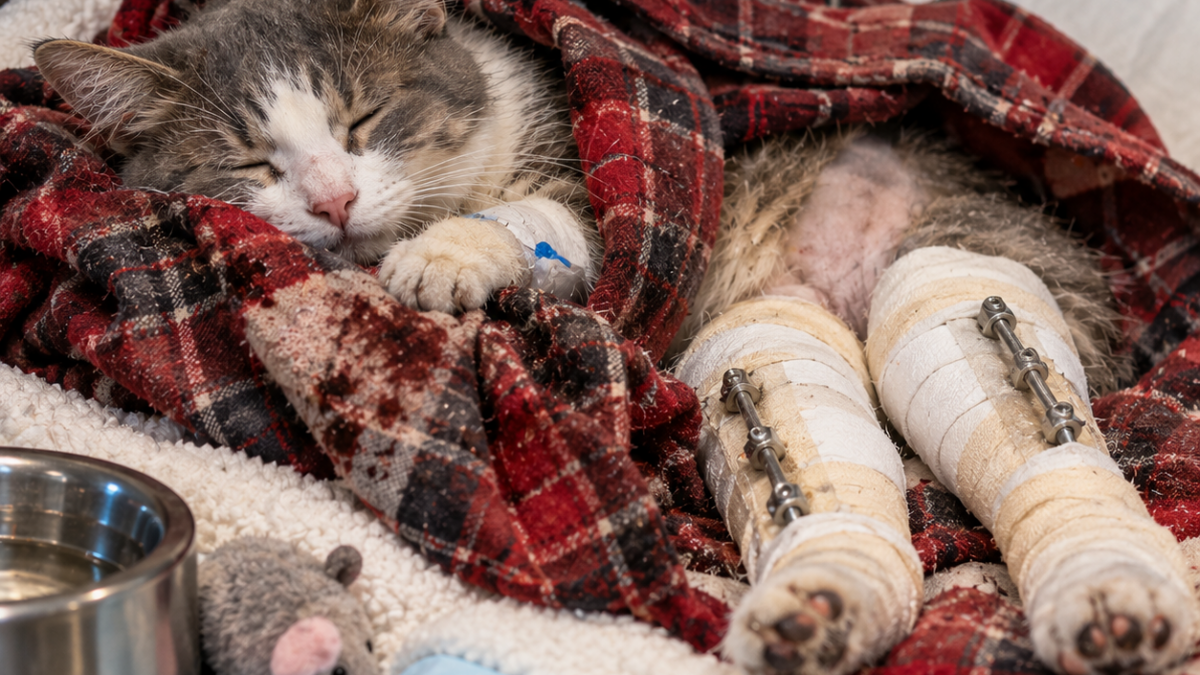
Rachel took a photograph.
Not for social media.
Not yet.
For the medical record.
Gray-and-white cat.
Eyes closed.
Red flannel surrounding her like a nest.
Blood on the collar.
Pins holding both broken legs.
Alive.
At 5:36, Rachel entered the waiting room.
Thomas stood.
“She’s okay.”
His shoulders fell.
Not dramatically.
But Rachel saw the weight leave him.
“Both repairs went well.”
“She’ll walk?”
“Yes.”
“Normal?”
“If healing progresses the way I expect, yes.”
“Good.”
That was all.
Good.
Rachel almost laughed.
She had spent three hours repairing two severely fractured limbs for a stranger’s stray cat, and his entire celebration was one syllable.
“She’ll need six to eight weeks of strict activity restriction.”
Thomas nodded.
“Medication twice daily.”
Nod.
“Follow-up radiographs.”
Nod.
“Possibly rehab.”
“Fine.”
Rachel looked at him carefully.
“So what would you like us to do next?”
Thomas frowned.
“What do you mean?”
“About placement.”
“She’s coming with me.”
Rachel waited.
“You’re adopting her.”
“I guess.”
“You told me you’ve never had a cat.”
“I haven’t.”
“You have dogs.”
“Two.”
“Do they tolerate cats?”
“No idea.”
“You understand she’ll need cage rest?”
“Yes.”
“Litter box management?”
“I’ll learn.”
“Medication?”
“You’ll show me.”
“Indoor confinement?”
“Yes.”
Rachel crossed her arms.
“Thomas.”
“What?”
“Are you sure?”
He looked through the door toward recovery.
“She got anybody else?”
“We don’t know.”
“Then yes.”
“What if an owner appears?”
“I’ll give her back if they’re decent.”
Rachel smiled despite herself.
“And if they’re not?”
“They’re not getting her.”
“That’s not legally how it works.”
“We’ll argue later.”
She laughed.
That surprised both of them.
Thomas relaxed slightly.
Rachel said, “You need a carrier.”
“I don’t own one.”
“We’ll give you one.”
“I’ll pay.”
“You’ve paid enough today.”
“I can pay for a box.”
“Carrier.”
“Whatever.”
They sent him home at 7:10.
The cat was still groggy.
Rachel demonstrated medication.
Thomas watched with the concentration of a man learning to disarm explosives.
“Twice daily.”
“Seven and seven.”
“Approximately.”
“Seven and seven.”
“Don’t force the pills dry. Use food or this pill pocket.”
“Okay.”
“No jumping.”
“She can’t walk.”
“She’ll try sooner than you think.”
“Why?”
“Cats.”
Thomas frowned at the carrier.
“Seems inefficient.”
Rachel laughed again.
“What are you naming her?”
Thomas stopped.
“Name?”
“Yes.”
“I haven’t thought about it.”
“You’ve had several hours.”
“I was waiting.”
“Right.”
He looked into the carrier.
The cat’s eyes were half open.
She had a gray mask across the top of her face and white around the muzzle.
Her front paws were white.
Her back half was wrapped and bandaged.
Thomas said, “Roadie.”
Rachel grimaced.
“No.”
“What?”
“Terrible name.”
“She’s my cat.”
“You’ve been a cat owner for four hours and already you’re defensive.”
He looked again.
“June.”
“Why June?”
“No reason.”
Rachel smiled.
“That one’s better.”
Thomas nodded.
“June.”
The cat closed her eyes.
Thomas drove home slowly.
Much more slowly than he had driven in.
The two dogs met him at the kitchen door.
Duke was a seven-year-old black Lab mix.
Molly was a twelve-year-old shepherd cross with one cloudy eye and arthritis.
They smelled the carrier.
Thomas blocked them.
“No.”
Duke whined.
“Back.”
He put June in the spare bedroom.
The room contained a bed nobody used, a dresser, an old treadmill, and three cardboard boxes Thomas had not opened since moving into the house eleven years earlier.
He set up the crate the clinic had lent him.
Food.
Water.
Low-sided litter box.
Blankets.
June remained drugged.
Thomas sat on the floor.
He watched her breathe.
At 10:32, he called the clinic.
Rachel had already left.
The overnight technician answered.
“Bennett Animal Hospital.”
“My cat’s breathing weird.”
“Mr. Walker?”
Thomas paused.
“How’d you know?”
“You’re the only new client who drove two hours today with a double-leg fracture.”
“Oh.”
The technician talked him through respiratory rate.
Normal.
Post-anesthesia sleep.
Nothing concerning.
Thomas hung up.
At 11:15, he checked again.
At midnight.
At 1:40.
At 3:10.
June slept.
Thomas did not.
At 5:20, Molly found him sitting on the floor outside the crate.
The old dog lowered herself beside him.
Thomas scratched her ear.
“You don’t like cats.”
Molly sighed.
“You don’t know that yet.”
Molly slept.
Thomas stayed awake.
There was another reason he had not left the clinic.
Rachel did not know it.
Nobody there did.
Thomas had not told anyone the full reason he stopped on Route 18 either.
He had told the truth.
He saw June.
So he stopped.
But the truth had roots.
Twenty-two years earlier, Thomas had been twenty-six and stupid in the particular way young men sometimes confuse emotional avoidance with toughness.
His younger brother, Caleb, had been twenty-three.
They worked construction together.
Fought constantly.
Loved each other without ever saying it.
Caleb drank too much.
Thomas knew.
Everybody knew.
One February night, Caleb called him.
1:13 a.m.
Thomas was asleep.
His girlfriend at the time had work early.
The phone rang.
Thomas saw the name.
Ignored it.
Caleb called again.
Thomas answered angrily.
“What?”
Caleb sounded drunk.
“Can you come get me?”
“Where?”
“Sam’s.”
Sam’s Bar was forty minutes away.
Thomas sat up.
“You drove there?”
“Yeah.”
“You idiot.”
“I know.”
“Call a cab.”
“I don’t got cash.”
“Then sleep in your truck.”
“It’s freezing.”
Thomas rubbed his face.
“Caleb, I have to be on site at six.”
Silence.
“Okay.”
“You’re twenty-three years old.”
“I said okay.”
“Figure it out.”
Caleb hung up.
Thomas went back to sleep.
At 2:08 a.m., Caleb drove himself.
At 2:21, his pickup crossed the center line on County Road 6.
He hit a tree.
No seat belt.
Dead at the scene.
Thomas spent years telling himself Caleb made the choice.
That was true.
Caleb drove drunk.
That was true.
Thomas was not responsible for every adult decision his brother made.
Also true.
But underneath all the truth lived another truth Thomas could never remove.
Caleb called him.
And Thomas chose not to go.
That did not make Thomas guilty of the crash.
But guilt did not care about legal categories.
For years, whenever somebody needed help at an inconvenient time, Thomas heard that phone call.
Usually he went.
Neighbor’s tractor stuck.
He went.
Employee with a flat tire.
He went.
Dog loose on highway.
He stopped.
Old woman carrying groceries in rain.
He stopped.
Friends teased him.
“You trying to save the whole county?”
Thomas never explained.
No.
He was trying to answer one phone call twenty-two years late.
June did not know that.
She only knew the large man who smelled of metal and dogs had lifted her from asphalt.
The first week was ugly.
June hated medication.
Thomas hid pills in food.
She ate around them.
He crushed one medication before Rachel told him not to.
Rachel called.
“You cannot crush that.”
“How was I supposed to know?”
“The label.”
“I read instructions, not fine print.”
“The label is the instructions.”
“That’s bad design.”
“You repair farm equipment.”
“Machines are logical.”
“Cats are not.”
June refused the litter box for two days.
Thomas panicked.
Rachel explained the pain medication and immobility could affect behavior.
He bought three types of litter.
June chose the cheapest.
Thomas bought expensive recovery food.
June preferred canned grocery-store chicken pâté.
He purchased a specialized orthopedic cat bed.
June slept on the folded red flannel.
The shirt became hers.
Thomas washed it carefully after Rachel told him blood residue could become unhygienic.
The first time he took it away, June cried.
Not loudly.
Just enough.
Thomas sat in the laundry room waiting for the dryer.
At midnight.
Holding a towel like a temporary replacement.
“You’re unreasonable.”
June stared from the crate.
“The shirt was mine.”
She blinked.
“Fine.”
The flannel returned warm.
June put her face against it.
Thomas smiled.
Molly accepted the cat first.
The old shepherd lay outside June’s crate.
Hours.
Quiet.
June stopped hissing at her by day four.
Duke remained convinced the cat existed specifically to provide entertainment.
He play-bowed.
Whined.
Brought a tennis ball.
June hissed.
Duke seemed heartbroken.
Thomas told him, “You’ve known rejection before.”
Duke looked insulted.
By week three, June could stand briefly with support.
Thomas sent Rachel a video.
June lifted her rear end.
Took one unstable step.
Sat.
Thomas’s voice behind the camera said, “That’s enough.”
Rachel replied:
That is PERFECT. Do not let her do more yet.
Thomas called.
“She wants to walk.”
“She isn’t allowed.”
“Explain that to her.”
“You’re the owner.”
“Veterinary medicine seems mostly like telling animals things they ignore.”
Rachel laughed.
“Now you understand.”
The clinic photograph remained on Rachel’s phone.
She thought about posting it.
She never posted work.
Fourteen years of practice had taught her that public stories could become monsters.
Facts got simplified.
Owners got judged.
People turned medical cases into arguments.
She avoided it.
But this one stayed with her.
Not the surgery.
She had performed harder surgeries.
Not even the money.
People spent more.
It was Thomas in the waiting room.
Three hours.
Bloodstained shirt.
One question.
Is she hurting?
Then the sentence.
I saw her, so she’s mine.
Rachel wrote a post.
Deleted it.
Wrote another.
Deleted that too.
Finally, with Thomas’s permission and no identifying details beyond what he agreed to, she posted the photograph.
She wrote:
I’m a veterinarian. Yesterday a man drove nearly two hours with a stray cat wrapped in his flannel because she’d been hit by a car. Both hind legs were broken. He paid $1,800 for surgery even though he had known her less than ninety minutes. When I asked why, he said, “Because I saw her. So she’s mine.”
Rachel expected a few hundred reactions.
By morning there were thirty thousand.
By afternoon, one hundred thousand.
News pages copied it.
Animal-rescue accounts reposted it.
People argued over whether Thomas was foolish, heroic, privileged, compassionate, irresponsible, saintly, or financially reckless.
Thomas saw none of this for almost two days.
He did not use social media much.
His employee Ray showed him.
“You’re famous.”
Thomas looked at the phone.
“No.”
“That’s your shirt.”
Thomas read the post.
Then comments.
A woman wrote:
We need more men like this.
Thomas frowned.
Another:
Who spends $1,800 on a random animal?
Thomas shrugged.
Another:
This is what being human means.
Thomas locked the phone.
“People need hobbies.”
Ray stared.
“You paid eighteen hundred?”
“Yes.”
“For a cat?”
“Yes.”
“You hate cats.”
“I don’t hate cats.”
“You said cats are freeloading raccoons.”
“That was before.”
Ray laughed for thirty seconds.
Thomas walked away.
The attention created something useful.
Donations poured into the clinic.
Rachel refused money for June.
Thomas had paid.
Instead she created an emergency fund for injured strays.
People contributed twelve thousand dollars in the first week.
Thirty-eight thousand by the end of the month.
Rachel called Thomas.
“This is your fault.”
“What?”
“We have enough money to treat animals people otherwise couldn’t afford to save.”
“Good.”
“That’s all?”
“What do you want me to say?”
“I don’t know. Something emotional.”
“Wrong number.”
Rachel smiled.
Then a complication arrived.
June had an owner.
Or at least somebody claiming to be one.
Four weeks after surgery, a woman named Ashley Monroe called the clinic.
She had seen the viral post.
The cat looked like hers.
Gray and white.
Two years old.
Missing for six months.
Her cat’s name was Misty.
Rachel asked for photographs.
Ashley sent twelve.
The markings matched.
A gray patch shaped like a comma near the nose.
White front socks.
One gray toe on the left front foot.
The same cat.
Rachel’s stomach tightened.
No microchip.
No collar.
But visual identification was strong.
She called Thomas.
“I need you to sit down.”
“Why?”
“June may have an owner.”
Silence.
“How?”
“Woman contacted us. Photos match.”
“How long missing?”
“Six months.”
“How?”
“She says the cat escaped during a move.”
Thomas looked toward the spare room.
June was lying outside the crate now, supervised.
Molly beside her.
Six months.
Thomas asked, “She want her back?”
“Yes.”
That answer hurt more than it should have.
Legally, ethically, emotionally—it was complicated.
Rachel explained.
“If ownership is legitimate, she’s still technically their animal.”
“I paid.”
“I know.”
“I don’t care about the money.”
“I know.”
Thomas’s voice hardened.
“What if they let her outside?”
“We don’t know that.”
“Road didn’t come inside the house.”
“Thomas.”
“She got hit on a highway ninety miles from where this woman lives?”
Rachel had noticed that too.
Ashley lived about sixty miles from the accident site.
Not impossible over six months.
Cats traveled.
Could be transported accidentally.
Could be fed by people.
Could move gradually.
“We need to verify.”
Thomas said nothing.
Rachel heard him breathing.
Finally:
“When?”
“Ashley wants to meet tomorrow.”
Thomas looked at June.
The cat noticed him and began walking awkwardly in his direction.
One careful step.
Then another.
Thomas sat on the floor.
June reached him.
Put her head against his knee.
He closed his eyes.
“Fine.”
Ashley arrived at the clinic with her twelve-year-old daughter, Lily.
The girl was already crying.
Thomas brought June in the carrier.
When Ashley entered, June reacted.
Immediately.
She stood too quickly.
Rachel tried to stop her.
“Misty.”
June stared.
Lily dropped to her knees.
“Misty!”
The cat cried.
A different sound than Thomas had heard.
Recognition.
She moved toward the carrier door.
Thomas felt something break quietly inside him.
Ashley cried too.
“Oh my God.”
Thomas opened the carrier.
June stepped out.
Still stiff.
Still recovering.
She walked toward Lily.
The girl reached.
June rubbed against her hands.
There was no question.
Thomas looked away.
Rachel watched him.
“Thomas.”
“Don’t.”
Ashley held June.
“She remembers us.”
“Yeah.”
Thomas stood.
“How’d she get out?”
Ashley wiped her face.
“We moved in April. She pushed through a loose screen.”
“You looked?”
“Every day.”
“For how long?”
“Months.”
“Posters?”
“Yes.”
“Microchip?”
Ashley looked ashamed.
“No.”
“Collar?”
“She hated them.”
Thomas’s anger searched for somewhere to land.
Ashley was not giving him a good target.
She loved the cat.
That was obvious.
Lily was burying her face in June’s fur.
Thomas asked, “You keep her indoors?”
“We did.”
“Will you now?”
“Yes.”
“Chip her?”
“Today.”
Ashley looked at him.
Rachel had told her what he had done.
“I don’t know how to thank you.”
Thomas nodded.
“You don’t.”
“I want to repay the surgery.”
“No.”
“We can make payments.”
“No.”
“That’s eighteen hundred dollars.”
“I know.”
“You saved her.”
Thomas looked at June.
“No.”
Ashley waited.
“I picked her up.”
Thomas’s voice tightened.
“Rachel saved her.”
Rachel started to object.
Thomas continued.
“And she did the hard part.”
He pointed at June.
The cat looked at him.
That nearly undid him.
Thomas crouched.
June moved toward him.
Lily loosened her grip.
The cat pressed her forehead into Thomas’s hand.
He stroked her head.
“Your people finally showed up.”
Rachel turned away.
Thomas stood.
“Take care of her.”
Ashley nodded through tears.
“We will.”
He walked out before anyone could stop him.
In the parking lot, he sat inside the pickup.
Did not start it.
For fifteen minutes.
Then thirty.
Rachel came outside.
She knocked on the window.
Thomas lowered it.
“You okay?”
“Yes.”
“Liar.”
“She’s theirs.”
“Yes.”
“That was always possible.”
“Yes.”
“I knew it.”
“Yes.”
“Stop agreeing.”
Rachel leaned against the truck.
Thomas stared forward.
“I didn’t think it’d bother me.”
“Why wouldn’t it?”
“Known her a month.”
“That’s long enough.”
“I’ve had tools longer.”
Rachel smiled.
“You don’t sleep beside your welder.”
Thomas looked at her.
“You don’t know my life.”
She laughed.
He did not.
Then he did.
A little.
Rachel said, “Ashley wants to repay you.”
“No.”
“I told her you’d say that.”
“Good.”
“She also said you can visit.”
Thomas shook his head.
“Not doing shared custody of a cat.”
Rachel nodded.
Thomas looked toward the clinic door.
“She’s okay?”
“Yes.”
“She walked to them.”
“She did.”
“Then that’s that.”
Rachel studied him.
“Do you regret paying?”
He almost looked offended.
“No.”
“Why?”
He stared at her.
“You know why.”
“I want to hear you say it.”
Thomas sighed.
“Because she was in the road.”
“No.”
“Rachel.”
“You said something different.”
Thomas looked down at his hands.
“I saw her.”
Rachel nodded.
“Exactly.”
Thomas started the truck.
He drove home alone.
For the first time in a month, no medication schedule waited.
No low litter box.
No crate.
No cat food.
The spare room looked wrong.
The red flannel was gone too.
Ashley had taken it because June had refused to settle without it.
Thomas had told her to keep it.
Now he regretted that slightly.
He sat on the spare-room floor.
Molly came in.
The old dog sniffed the empty space.
Duke searched behind the bed.
Thomas watched.
“She went home.”
Molly looked at him.
“Don’t start.”
Molly lay down beside him.
Thomas put his hand on her back.
“She went home.”
He said it again because he needed the sentence to become true inside him.
The next morning, Ashley sent a photograph.
June—Misty, technically—was sleeping in Lily’s bed.
Red flannel beneath her.
Thomas looked at it for a long time.
He replied with one word.
Good.
Two weeks passed.
Then Rachel called.
“You busy?”
“Yes.”
“You have room for another cat?”
Thomas nearly hung up.
“No.”
“Excellent.”
“I said no.”
“I heard you.”
“Rachel.”
She changed tone.
“There’s a kitten.”
“No.”
“Hit by farm equipment.”
“No.”
“Front leg may need amputation.”
“No.”
“Owner surrendered.”
Thomas closed his eyes.
“What color?”
Rachel smiled.
“Orange.”
“That matters?”
“I don’t know. You asked.”
Thomas rubbed his face.
“I have dogs.”
“You also now own a cat carrier.”
“I gave it back.”
“We have more.”
“I’m not paying another two thousand dollars.”
“You don’t have to.”
“Why?”
“The Thomas Walker Stray Emergency Fund.”
Silence.
“The what?”
Rachel laughed.
“You should’ve read the paperwork.”
“You named it after me?”
“Donors did.”
“Change it.”
“No.”
“Rachel.”
“Forty-three thousand dollars.”
Thomas stopped.
“What?”
“People donated.”
“For what?”
“For animals like June.”
He sat down.
Rachel continued.
“This kitten needs a foster after surgery.”
“No.”
“Three weeks.”
“No.”
“Maybe four.”
“No.”
She waited.
Thomas knew what she was doing.
“Send a picture.”
The orange kitten arrived two days later.
His name became Bolt because Thomas refused to let anyone name him Pumpkin.
Bolt lost one front leg.
He adapted immediately.
Thomas did not.
He followed the kitten everywhere for the first week, convinced three-legged cats were constantly one bad turn from disaster.
Bolt climbed curtains.
Jumped onto countertops.
Attacked Duke.
Thomas called Rachel.
“He’s defective.”
“In what way?”
“He has three legs and somehow moves faster than the four-legged dogs.”
“Normal.”
“He fell off the couch.”
“Cats do that.”
“I thought they were supposed to be agile.”
“Thomas, he had surgery eleven days ago.”
“Seems poorly engineered.”
Rachel laughed.
Four weeks became six.
The rescue called.
“We have an adopter.”
Thomas said, “No.”
The coordinator paused.
“No?”
“He’s staying.”
That was how Thomas got his first cat.
Technically.
June had been borrowed from fate.
Bolt stayed.
The emergency fund changed the clinic.
A terrier with a shattered pelvis.
A tabby with an infected bite wound.
A senior beagle abandoned behind a grocery store.
A hawk struck by a car that was transferred to wildlife rehabilitation.
A barn cat with a severe eye infection.
The fund paid where owners did not exist or could not be located.
Rachel sent Thomas updates.
He pretended not to care.
Then asked too many questions.
“How’s the beagle?”
“Adopted.”
“Terrier?”
“Walking.”
“The ugly tabby?”
“His name is Simon.”
“Ugly Simon?”
“Healthy.”
Thomas nodded.
“Good.”
His line became a joke at the clinic.
Who saw this one?
Sometimes Rachel would text:
We saw him.
Then treatment happened.
The story online evolved.
People stopped focusing only on the first cat.
News outlets returned when the emergency fund passed $100,000.
Thomas refused interviews.
Finally a reporter came to his workshop.
Thomas was welding a trailer gate.
The reporter waited outside until he finished.
“Mr. Walker?”
Thomas removed his helmet.
“No.”
The reporter laughed.
“I haven’t asked anything.”
“Still no.”
“I’d like to talk about the cat.”
“Which one?”
That answer became the interview.
The reporter looked at Bolt, who was sitting on a toolbox despite missing a leg.
“You have a cat now.”
“Unfortunately.”
Bolt jumped onto Thomas’s workbench.
Thomas immediately moved a sharp object away from him.
The reporter smiled.
“You don’t look unfortunate.”
Thomas frowned.
“What do you want?”
“People call what you did heroic.”
“It wasn’t.”
“You drove ninety miles.”
“So?”
“You paid for surgery.”
“So?”
“You waited the whole time.”
“What else was I doing?”
“You adopted her.”
“Temporarily, apparently.”
“Why?”
Thomas knew the question.
Everyone loved the sentence.
Because I saw her.
But he was tired of how polished it sounded.
Real life had not felt polished.
It felt like blood on his shirt and a cat screaming on asphalt.
He leaned against the bench.
“Because if you see something, then you know it’s there.”
The reporter waited.
Thomas continued.
“Before I saw her, I didn’t know.”
He gestured vaguely toward the highway beyond the shop.
“After I saw her, I couldn’t say I didn’t know.”
“That made you responsible?”
Thomas thought.
“No.”
The reporter looked surprised.
“No?”
“Responsible is the wrong word.”
“What word would you use?”
Thomas looked at Bolt.
“Available.”
“Available?”
“I was there.”
He shrugged.
“She needed somebody, and I was the somebody standing there.”
The reporter wrote that down.
Thomas frowned.
“Don’t make it sound smart.”
“It is smart.”
“No, it isn’t.”
The reporter asked, “Do you think everyone should spend $1,800 on every animal they find?”
Thomas laughed.
“No.”
“Then what’s the lesson?”
“I don’t know.”
“You must have one.”
“No.”
He thought about Caleb.
Twenty-two years.
One phone call.
He had never told the reporter.
He was not going to.
Then he said something closer to the truth.
“Do what you can when you’re there.”
The article ran Sunday.
The headline:
“HE WAS THE SOMEBODY STANDING THERE.”
Thomas hated it.
Rachel framed it in the clinic.
Thomas threatened to remove it.
She put it higher.
Months passed.
June’s family sent updates.
Her name became Misty again.
Thomas disliked that.
June suited her better.
He never said so.
Six months after the accident, Ashley invited him to Lily’s birthday.
Thomas declined.
Then Rachel called.
“You’re going.”
“No.”
“The girl wants you there.”
“I don’t do children’s birthdays.”
“You survived orthopedic recovery with a cat. Cake is easier.”
“No.”
Rachel hung up.
Thomas went.
He stood awkwardly near the kitchen holding a gift card because he had no idea what twelve-year-old girls wanted.
Lily opened the door.
“You came!”
Misty appeared behind her.
The cat froze.
Thomas froze.
For half a second he worried she would not remember.
Then Misty ran.
Not perfectly.
One hind leg remained slightly stiff.
But she ran.
Across the hallway.
Directly toward him.
Thomas crouched.
Misty climbed against his chest.
He caught her.
The room went quiet.
Ashley started crying.
Thomas said, “Don’t.”
She laughed through tears.
“I didn’t do anything.”
“You’re doing it now.”
Misty pushed her face beneath Thomas’s chin.
He closed his eyes.
“Hey, June.”
Lily smiled.
“We still call her June sometimes.”
Thomas opened his eyes.
“You do?”
“When she gets in trouble.”
“Good.”
Misty purred.
That sound followed Thomas home.
By the first anniversary of the accident, she walked normally.
Rachel examined the radiographs.
The bones had healed beautifully.
Ashley brought Lily.
Thomas drove two hours for the appointment even though nobody had asked him.
Rachel came out holding the new films.
“Good.”
Thomas smiled.
Rachel pointed.
“You stole my word.”
“She okay?”
“She is.”
Misty jumped onto the exam-room bench.
Rachel touched both rear legs.
No pain.
Good muscle mass.
Mild stiffness in the left hip after prolonged exercise, maybe permanent.
Nothing severe.
“She has a normal life expectancy.”
Thomas nodded.
Lily asked, “Can she remember getting hit?”
Rachel looked at the girl.
“We don’t know.”
“Will she be scared of cars?”
“She should be an indoor cat.”
“She is.”
“Then she doesn’t need to think about them.”
Thomas liked that answer.
Some things did not need to be conquered.
They could simply be left behind.
The anniversary created another burst of online attention.
Rachel wrote an update.
The cat who arrived with both rear legs broken is walking normally now.
The man who brought her still visits.
The emergency fund created after her story has treated 63 animals.
Thomas texted immediately.
You said you wouldn’t post about me.
Rachel replied:
I said nothing embarrassing.
He answered:
63?
Yes.
Thomas sat in his truck.
Sixty-three.
That number felt impossible.
He remembered one body in the grass.
One animal.
One decision.
People liked to talk about ripple effects.
Thomas generally considered the phrase sentimental nonsense.
But sixty-three was not sentimental.
It was a number.
A dog named Freddie.
A kitten named Almond.
An injured barn cat.
A rabbit somebody found in a parking lot.
Actual lives.
One cat had become sixty-three because strangers had seen a photograph and decided to help animals they would never meet.
Thomas finally understood something Caleb’s death had taught him incorrectly.
For years, guilt had told him that one failure defined every future responsibility.
He had to stop.
Had to answer.
Had to go.
Had to rescue.
Because once he had not.
Therapy, which Thomas attended only after Rachel annoyed him for six months, gave him another framework.
His therapist was a man named Dr. Alan Pierce.
Thomas disliked him immediately.
Alan considered that encouraging.
“You’re trying to repay a debt.”
Thomas crossed his arms.
“No.”
“You described your brother for forty minutes.”
“You asked.”
“And then described twenty years of helping anyone who calls.”
“So?”
“You think if you answer enough future calls, it’ll change the one you missed.”
Thomas stared.
“You charging by the insult?”
Alan smiled.
“Usually by the hour.”
Thomas nearly did not return.
He returned.
Months later, Alan said, “Stopping for June was kind.”
Thomas looked at him.
“It wasn’t penance.”
Thomas said nothing.
“You’re allowed to let it be kindness.”
That sentence was harder than any accusation.
Thomas had built an identity around owing.
If he did good because he owed something, then guilt remained useful.
If he accepted that Caleb’s death could not be repaid, then he had to face the fact that his brother was simply gone.
No amount of helping erased it.
Thomas hated that.
Alan said, “Your brother asked for help. You failed him that night.”
Thomas flinched.
The therapist did not soften it.
“You did.”
Thomas’s eyes filled.
“And Caleb still chose to drive drunk.”
Silence.
“Both are true.”
Thomas looked down.
“You don’t need to pretend you did nothing wrong.”
Alan continued.
“You also don’t need to turn the rest of your life into punishment.”
Thomas cried in a therapist’s office for the first time at forty-nine.
He despised every second.
Then returned the next week.
Bolt became his constant shadow.
The three-legged cat slept on his workbench.
Rode inside the cab of his pickup on short trips.
Followed Molly.
Tormented Duke.
Thomas bought cat furniture.
Expensive cat furniture.
Ray from the shop walked in one morning, saw a six-foot climbing tower beside Thomas’s office, and laughed so hard he had to leave.
Thomas told him to shut up.
“You built him a staircase to the window.”
“He has three legs.”
“He jumped on top of the refrigerator yesterday.”
“That isn’t the point.”
“What is the point?”
Thomas did not know.
Cats, he had discovered, changed the architecture of a man’s dignity.
Molly died that winter.
Cancer.
Fast.
Thomas had owned her eleven years.
This time he knew the signs.
He stayed on the floor beside her through the final appointment.
Bolt sat in the carrier nearby.
Afterward, Thomas drove home with Molly’s collar on the passenger seat.
He thought about the strange geometry of care.
Stopping did not guarantee a happy ending.
Paying could not buy permanence.
Love was not an insurance policy against death.
It merely made the living part different.
Duke grieved.
Bolt slept beside him.
Thomas watched the three-legged cat curl against the seventy-pound dog.
He sent Rachel a photograph.
Her reply:
Looks like Bolt saw him.
Thomas stared at that.
Then smiled.
Years passed.
The emergency fund crossed half a million dollars.
Not because Thomas became famous.
His story faded.
Most stories did.
But the clinic kept the fund.
Donors contributed monthly.
People put money into it when their own pets died.
Children ran lemonade stands.
One elderly woman left five thousand dollars in her will.
A trucking company donated after one of its drivers brought in an injured owl.
The fund was renamed officially.
Thomas insisted.
Not the Thomas Walker Fund.
The Somebody Stopped Fund.
Rachel hated the grammar.
Thomas said that was her problem.
A brass plaque appeared near reception:
THE SOMEBODY STOPPED FUND
FOR ANIMALS WHO HAVE NO ONE UNTIL SOMEONE DECIDES THEY DO.
Thomas pretended the plaque was too sentimental.
He read it every visit.
June—Misty—grew older.
Lily went to high school.
Then college.
Ashley sent fewer updates, but enough.
Misty on a Christmas tree skirt.
Misty sitting on Lily’s suitcase.
Misty asleep in sunlight.
Misty wearing a ridiculous birthday hat.
Thomas saved every photo.
He never admitted it.
Rachel knew.
When Misty turned ten, Ashley called Thomas directly.
“She isn’t eating.”
Thomas stood inside his workshop.
Everything inside him tightened.
“Vet?”
“We went.”
“What’d they say?”
“Kidneys.”
He closed his eyes.
“How bad?”
“Early.”
Thomas exhaled.
Manageable.
Not good.
Not terrible.
He drove to see her.
No one asked.
Misty was thinner.
Still beautiful.
She walked toward him slowly.
Thomas sat on the floor.
She climbed into his lap.
Ashley watched.
“I think she remembers the shirt.”
Thomas stroked her head.
“Shirt’s gone.”
“We still have it.”
Thomas looked up.
“What?”
“Lily packed it away.”
Ashley brought a plastic storage container.
Inside was the red flannel.
Faded.
Clean.
One small tear near the sleeve.
Thomas picked it up.
He had forgotten how thick the fabric felt.
Misty sniffed it.
Then stepped onto it.
Turned twice.
Lay down.
The room became very quiet.
Ashley said, “You want it back?”
Thomas shook his head.
“It belongs to her.”
A year later, Misty’s kidneys worsened.
Then stabilized.
Then worsened again.
Lily came home from college often.
Thomas visited twice.
On the final day, Ashley called at 6:20 in the morning.
“I think it’s time.”
Thomas was already putting on boots before she finished.
Two hours later, he arrived.
Misty lay on the red flannel.
She had lived eleven years after the highway.
Eleven years after two broken legs.
Eleven years of beds.
Windows.
Christmas trees.
School mornings.
Lily growing from twelve to twenty-three.
A whole life beyond asphalt.
Thomas sat beside her.
“Hey, June.”
Her eyes opened.
Lily laughed softly through tears.
“She knows.”
Thomas put his hand under the cat’s chin.
“Yeah.”
They took her to the same clinic.
Rachel was still practicing.
Older.
More gray in her hair.
She examined Misty.
Then looked at everyone.
No one needed the speech.
Kidney failure.
Weight loss.
Weakness.
More bad days than good.
Rachel asked, “Are we ready?”
Ashley nodded.
Lily cried.
Thomas did not.
Not yet.
Misty lay on the flannel between them.
Rachel gave the first injection.
Sedation.
Misty relaxed.
Thomas remembered another room.
Another day.
Broken legs.
Blood.
Fear.
A waiting room chair.
He had known her less than ninety minutes then.
Now he had known her eleven years.
Not owned.
Known.
That mattered more.
Thomas whispered, “You were a lot of trouble.”
Misty’s ear moved.
Lily smiled.
“You drove two hours.”
“Exactly.”
“You spent eighteen hundred dollars.”
“Bad investment.”
Ashley laughed through tears.
Misty breathed slowly.
Thomas’s hand rested on the flannel.
Rachel gave the final medication.
Misty died peacefully.
No highway.
No broken bones.
No fear.
Three people touching her.
One veterinarian who had repaired her body eleven years earlier.
Thomas remained after Ashley and Lily left.
Rachel sat opposite him.
Neither spoke for several minutes.
Finally Thomas said, “Eleven years.”
“Yes.”
“She got eleven.”
“Yes.”
He looked at the empty flannel.
“Worth eighteen hundred.”
Rachel smiled.
“I would hope so.”
Thomas laughed once.
Then cried.
Not the controlled tears of therapy.
Not the silent tears after Molly.
He put both hands over his face.
Rachel waited.
When he recovered, he looked embarrassed.
“Don’t.”
“I didn’t say anything.”
“You were going to.”
“No.”
“You veterinarians have faces.”
“So do welders.”
He looked at her.
“Thank you.”
Rachel nodded.
“You’re welcome.”
Misty’s ashes went to Lily.
The flannel went to Thomas.
This time he took it.
He folded it.
Placed it in a drawer beside Caleb’s old pocketknife.
That surprised him.
For years, the two memories had lived separately.
Caleb was the person he did not go get.
Misty was the animal he stopped for.
One failure.
One act of kindness.
Thomas had spent years treating them like opposite sides of an equation.
Eventually he understood they did not cancel each other.
Life was not arithmetic.
Good did not erase bad.
Bad did not erase good.
The only thing a person controlled was the next moment they were present for.
At fifty-nine, Thomas still worked.
Less.
His knees hurt.
Bolt was eleven.
Still three-legged.
Still arrogant.
Duke was gone.
A younger dog named Rosie had joined the house.
Thomas’s workshop employed six people now.
Above the office door hung a framed copy of the first veterinary photograph.
June wrapped in red flannel after surgery.
Thomas had resisted hanging it for years.
Then one day he did.
Underneath was Rachel’s old yellow sticky note, laminated:
I SAW HER, SO SHE’S MINE.
THAT’S HOW IT WORKS.
Ray pointed at it once.
“You know technically she wasn’t yours.”
Thomas looked at him.
“Don’t ruin a good line.”
The Somebody Stopped Fund paid for its thousandth case three years later.
Rachel called Thomas.
“One thousand.”
He stopped speaking.
“You there?”
“Yes.”
“One thousand animals.”
Thomas sat down.
“What kind?”
“What?”
“Number one thousand.”
Rachel checked.
“Brown dog. Hit by a car.”
Thomas closed his eyes.
Of course.
“Owner?”
“None found.”
“Survive?”
“Yes.”
“Good.”
Rachel waited.
“You coming to the clinic?”
“Why?”
“We’re marking it.”
“No.”
“There will be cake.”
“No.”
“Reporters.”
“Absolutely no.”
“Children.”
“Worse.”
Rachel smiled.
“Come through the back door.”
Thomas did.
The thousandth animal was a brown mixed-breed dog with a white chest and a splinted front leg.
Thomas stood beside the kennel.
The dog wagged.
“Don’t.”
The tail wagged harder.
“I’m not taking you home.”
The dog licked his hand through the bars.
Rachel stood behind him.
“You said that about Bolt.”
“I mean it.”
“The rescue already has a foster.”
“Good.”
Thomas looked at the dog.
“Somebody saw you?”
Rachel nodded.
“Teenage girl.”
“Stopped her mom’s car.”
Thomas smiled.
“Good kid.”
“She said she knew about the fund.”
That stopped him.
“What?”
“She recognized the clinic from the story her teacher showed in class.”
Thomas looked at Rachel.
“What story?”
“Yours.”
“I told you people need hobbies.”
Rachel laughed.
The teenage girl arrived later.
Her name was Maya.
Sixteen.
Small.
Nervous.
She wanted to meet the dog.
Thomas happened to be there.
Rachel introduced them.
“This is Thomas.”
Maya’s eyes widened.
“The man with the cat?”
Thomas groaned.
Rachel smiled.
“Yes.”
Maya said, “My teacher told us about you.”
“I’m sorry.”
She laughed.
“I saw the dog and made my mom stop.”
Thomas’s expression changed.
“Why?”
Maya looked at him like the answer was obvious.
“Because I saw him.”
Thomas felt the world become very quiet.
Rachel looked away so he would not see her smile.
Maya continued.
“And I thought if I didn’t stop, I’d keep wondering.”
Thomas swallowed.
“So you stopped.”
“Yeah.”
The brown dog wagged from inside the kennel.
Thomas nodded.
“Good.”
Maya asked, “Is that really how it works?”
Thomas looked at her.
“What?”
“If you see them, they’re yours?”
He thought about that sentence.
At forty-eight, it had sounded simple.
Possessive.
Almost funny.
He had learned better.
Seeing something did not mean ownership.
It meant awareness.
The moment you noticed pain, you gained a choice.
Help.
Call.
Stop.
Move on.
Sometimes moving on was necessary.
Nobody could rescue everything.
Thomas knew that now too.
He looked at Maya.
“No.”
She seemed surprised.
“No?”
“They’re not yours.”
He pointed toward the dog.
“You don’t have to take him home.”
Relief crossed her mother’s face.
Thomas smiled.
“It just means you know he’s there.”
Maya listened.
“And once you know, you decide what kind of person you’re going to be for the next five minutes.”
Rachel would remember that line too.
Thomas did not.
He had stopped collecting his own words.
That evening he drove home.
Sunset spread orange across farmland.
Bolt waited in the front window.
Rosie barked when the truck entered the driveway.
Thomas parked.
For a moment he remained behind the wheel.
Years earlier, Route 18 had looked much like this.
Dry shoulder.
Tall grass.
Fast traffic.
One gray-and-white shape dragging herself away from the road.
He had no idea how many people passed before him.
Five.
Ten.
Twenty.
Maybe nobody had understood what they saw.
Maybe somebody thought she was already dead.
Maybe they had children in the car.
Maybe they were late for work.
Maybe they were scared of injured animals.
Thomas had once been angry at all of them.
He wasn’t anymore.
He knew too much about the complicated reasons people failed to stop.
Sometimes cruelty was intentional.
Sometimes indifference.
Sometimes fear.
Sometimes distraction.
Sometimes one missed phone call at 1:13 in the morning.
What mattered was not pretending he had always been better.
He hadn’t.
He had been the person who failed someone too.
Maybe that was why the highway mattered.
He had been given another moment.
Not the same moment.
Nothing brought Caleb back.
Nothing repaired that night.
But life kept offering choices that were new, not replacements.
And one Tuesday afternoon, something small and gray had appeared in the road.
Thomas saw her.
He stopped.
That was all.
And somehow it was not all.
It became two repaired legs.
A little girl’s missing cat coming home.
Eleven additional years of life.
One three-legged orange menace.
A clinic fund.
A thousand animals.
A sixteen-year-old girl telling her mother to pull over.
Compassion moved strangely.
Not like debt.
Not like repayment.
More like light passed from one window to another.
Nobody owned it.
Nobody used it up.
Rachel retired after twenty-nine years in veterinary medicine.
At her retirement dinner, the clinic staff surprised her.
On the wall was a collage.
Hundreds of animals.
Dogs.
Cats.
Birds.
Rabbits.
A goat.
Two turtles.
A raccoon.
Animals treated through the Somebody Stopped Fund.
At the center was the first photograph.
June sleeping inside red flannel.
Thomas stood in the back.
He had almost skipped the event.
Rachel found him.
“You came.”
“Temporary lapse in judgment.”
She hugged him.
Thomas tolerated it.
Rachel pointed at the collage.
“You realize this is your fault.”
“No.”
“Yes.”
“I found one cat.”
“Exactly.”
Thomas shook his head.
“You fixed one cat.”
“We all did something.”
He looked at the photographs.
“That’s the point.”
Rachel smiled.
During her speech, she did not talk about difficult surgeries.
Awards.
Degrees.
Or career accomplishments.
She talked about the waiting room.
“A veterinarian spends years learning how to diagnose disease,” she said.
“How to repair fractures.”
“How to read bloodwork.”
“How to manage anesthesia.”
“But nobody teaches you what to do when a stranger walks through the door holding an animal that technically belongs to no one.”
People listened.
“We use words like stray.”
“Unowned.”
“Unclaimed.”
“Wild.”
“Abandoned.”
“Found.”
“Those words are useful administratively.”
She paused.
“But for fourteen years before that afternoon, I had never heard anyone solve the question of belonging as simply as Thomas did.”
Thomas looked down.
Rachel smiled.
“He said, ‘I saw her, so she’s mine.’”
People turned toward him.
He hated that.
Rachel continued.
“I don’t believe he meant ownership.”
Thomas looked up.
“I think he meant responsibility in the smallest possible unit.”
“One person.”
“One moment.”
“One creature.”
“One choice.”
She glanced around the room.
“The fund that grew from that day has now treated more than fourteen hundred animals.”
Applause began.
Rachel raised her hand.
“Thomas will hate this part.”
People laughed.
“He hates almost every part.”
More laughter.
Thomas muttered something.
Rachel’s voice softened.
“I’ve thought about his words for years.”
“And I don’t think any of us can be responsible for everything we see.”
“That would crush us.”
“But we can allow ourselves to be interrupted.”
The room became quiet.
“Sometimes compassion is not a personality.”
“It’s an interruption.”
“You were driving somewhere.”
“You had plans.”
“You were tired.”
“You were busy.”
“You were afraid.”
“Then something living needed help.”
“And for a few minutes, your schedule stopped being the most important thing in the world.”
Rachel looked at Thomas.
“That afternoon, he allowed a cat to interrupt his life.”
Thomas blinked rapidly.
Rachel finished.
“She stayed in it much longer than either of us expected.”
Afterward, Thomas handed Rachel a small box.
“What is this?”
“Open it later.”
She opened it immediately.
Inside was a piece of red flannel.
Not the whole shirt.
A square cut from the sleeve.
Framed behind glass.
A small brass plate beneath it read:
SHE WAS SEEN.
Rachel covered her mouth.
Thomas looked uncomfortable.
“Too much?”
“No.”
“You’re crying.”
“I know.”
“That’s awkward.”
“Go away.”
He did.
Years later, when people asked Rachel for the best story from nearly three decades as a veterinarian, they expected something dramatic.
Rare disease.
Impossible surgery.
An animal waking after everyone thought it would die.
Rachel had stories like that.
But she usually told them about Thomas and June.
Not because June’s surgery was remarkable.
It wasn’t.
Orthopedic medicine did what orthopedic medicine often could.
Metal pins.
Rest.
Healing.
The remarkable part happened before the clinic.
On a highway.
In the gap between seeing and deciding.
A gray-and-white cat lay injured beside the road.
Cars passed.
Then one vehicle didn’t.
That was the entire hinge.
One brake pedal.
One U-turn.
One man stepping out.
The difference between “someone should help” and “I will.”
Thomas never considered himself kind.
Rachel believed truly kind people often did not.
They simply accumulated small habits of refusing to look away.
At sixty-two, Thomas still had Bolt.
Barely.
The cat was old now.
Kidney disease.
Arthritis in the remaining front leg.
White hair around the muzzle.
Thomas carried him more often.
One spring night, Bolt sat beside him on the porch.
Thomas had the old red flannel across his lap.
The cat kneaded it.
Thomas smiled.
“You don’t even know her.”
Bolt purred.
Somewhere in the drawer inside the house remained Caleb’s pocketknife.
Thomas no longer avoided it.
He could say his brother’s name now without immediately entering the courtroom of his own memory.
He had forgiven Caleb for driving.
More difficult, he had begun forgiving himself for not going.
Not absolving.
Forgiving.
There was a difference.
He scratched Bolt’s head.
A truck passed on the county road.
Headlights moved through trees.
Thomas thought of Misty.
Two broken legs.
A little girl calling her name.
A red flannel nest.
Eleven years.
He thought about Maya stopping her mother’s car.
The thousandth animal.
The fourteen hundredth.
He thought about the fact that no one person had done all of it.
Rachel had operated.
Jenna had monitored anesthesia.
Ashley and Lily had given Misty a home.
Donors funded animals.
Teenagers stopped cars.
Veterinary technicians stayed late.
Rescues answered phones.
People fostered.
Drivers pulled over.
Compassion was less like heroism than a relay race.
You carried something as far as you could.
Then somebody else took it.
Thomas looked down at Bolt.
“That’s how it works.”
The cat looked up.
Thomas smiled.
“You don’t know what I’m talking about.”
Bolt put his head back down.
That was fine.
Some lessons did not require an audience.
Several months later, Thomas was driving Route 18 again.
Same road.
He had avoided that particular stretch for years without consciously admitting it.
Now work brought him there.
The highway had changed.
New pavement.
Different guardrail.
A convenience store where an empty field used to be.
Thomas slowed near the approximate place.
He could not identify the exact patch of grass.
Time had erased it.
That felt right.
He pulled into a wide gravel turnout anyway.
Stopped.
Got out.
Wind moved through weeds.
Cars passed.
Thomas stood with his hands in his pockets.
He tried to picture June lying there.
Could not.
Instead he pictured Misty at eleven.
Older.
Safe.
Sleeping in flannel.
That was better.
A vehicle passed.
Then another.
Thomas thought about the phrase people still occasionally repeated to him.
I saw her, so she’s mine.
For years, strangers had treated those words like a declaration of ownership.
Thomas knew now they meant the opposite.
June had never belonged to him.
Not really.
He had belonged to the moment.
For ninety minutes, her survival belonged partly to what he chose to do.
Then she belonged to Rachel’s hands.
Then to the recovery room.
Then to his spare bedroom.
Then back to Lily.
Nobody possessed the whole story.
They simply held pieces.
That was what care was.
Temporary custody of someone else’s vulnerability.
Thomas stood there several minutes.
Then returned to the truck.
He started the engine.
Before pulling onto the highway, he checked both directions.
A habit.
Then checked the shoulder.
Another habit.
Nothing there.
Good.
He drove home.
The road disappeared behind him.
And somewhere in a veterinary clinic two hours away, beside a wall covered with photographs of animals who had once belonged to nobody, there remained a yellow note in a frame.
The ink had faded slightly.
The grammar was imperfect.
The meaning had only grown clearer.
I saw her.
So she’s mine.
That’s how it works.
Not forever.
Not ownership.
Not heroism.
Just long enough to stop the truck.
Long enough to pick her up.
Long enough to wrap her in your shirt.
Long enough to drive.
Long enough to wait.
Long enough to say yes when helping would be expensive, inconvenient, frightening, or difficult.
Long enough for someone else to take the next part.
Because maybe the world does not change when everybody notices everything.
Nobody can.
Maybe it changes when one person notices one thing—
and refuses to keep driving.








