A Lonely Navy SEAL Was Paddling Alone When a German Shepherd Puppy in a Bright Yellow Life Jacket Suddenly Jumped Onto His Kayak—Making Him Laugh for the First Time in 3 Years. But He Had No Idea This Tiny Puppy Would Reunite Him With the Brother He Thought He’d Lost Forever… and Change His Life in Ways He Never Imagined.
PART2:
People could say one thing while feeling another.
People could tell you an accident was not entirely your fault and still limp for the rest of their lives.
So Owen repaired boats.
And lived alone.
His cabin sat twenty minutes from the shop among lodgepole pines.
Two bedrooms.
Wood stove.
Kitchen table with two chairs.
Only one ever used.
An old photograph remained inside the bottom drawer of his desk.
Owen had not thrown it away.
He also had not looked at it in almost two years.
Two young Navy SEALs stood in the photograph.
Owen.
Mason Reed.
Both twenty-five.
Wet hair.
Sunburned.
Arms thrown over each other’s shoulders after completing a brutal training cycle.
They looked exhausted.
Invincible.
Stupidly happy.
PART3:
Three months after that photograph, Mason’s military career effectively ended.
And Owen had spent every day since believing he had helped end it.
The accident happened during a maritime training exercise off the California coast.
Not combat.
That somehow made the guilt worse.
Nobody shooting.
No enemy.
No chaos Owen could blame.
Training.
Controlled environment.
Experienced men.
A piece of retrieval equipment had behaved inconsistently during the first phase.
Mason had mentioned something did not feel right.
Owen had checked what he could from his position.
The weather was changing.
Schedule tight.
They were already behind.
Owen made the decision.
Continue.
Finish the evolution.
Reassess afterward.
Minutes later, a mechanical failure combined with shifting water conditions and bad positioning.
Mason went down hard.
His leg twisted beneath equipment.
Fractures.
Ligament damage.
Nerve involvement.
Months of surgeries.
Rehabilitation.
Medical review.
The Navy investigation found multiple contributing factors.
Equipment failure.
Environmental conditions.
Procedural judgment.
Communication failures.
No single person carried legal responsibility.
Owen did not care.
He remembered one thing.
Mason had said something felt wrong.
Owen had said continue.
That became the entire story inside his head.
Mason’s leg never returned to operational standards.
His SEAL career ended.
Owen stayed only long enough to finish the investigation and administrative process.
Then he resigned from active service.
Stopped returning calls.
Stopped answering messages.
Left California.
Eventually arrived in Idaho because a former instructor once said Sandpoint was the kind of place a man could disappear without technically becoming missing.
Owen discovered that was true.
He opened the repair shop.
Bought the cabin.
Paddled.
Worked.
Slept.
Repeated.
For three years.
Nobody had ordered him into exile.
That part was important.
He chose it.
Because guilt, when left alone long enough, can start disguising itself as morality.
Owen told himself staying away from Mason was respectful.
Mason should not have to see him.
Old teammates should not have to decide whether to forgive him.
People were better without the reminder.
So Owen turned loneliness into punishment and called it accountability.
He became extremely disciplined about being miserable.
That September morning began like hundreds before it.
Owen arrived at a small public dock shortly after seven.
He had repaired a hairline fracture along the hull of a customer’s touring kayak and wanted to test it under load before returning it.
He carried the boat down alone.
Checked the repaired section.
Checked deck lines.
Life jacket.
Paddle.
Weather.
Wind negligible.
Water calm.
He slid onto Lake Pend Oreille.
For nearly twenty minutes, nothing disturbed him.
Paddle enters water.
Pull.
Lift.
Switch.
Breathing matching rhythm.
The shoreline drifted by in greens and early autumn gold.
This was the closest Owen came to peace.
Out here, nobody asked questions.
Then a bark cut across the water.
High.
Sharp.
Young.
Owen stopped paddling.
Another bark.
A woman shouted from the dock behind him:
“Finn!”
Owen turned.
Near shore, a wide floating training platform had been attached to the dock.
Standing on it was a German Shepherd puppy.
Maybe five months.
Black-and-tan coat.
Oversized paws.
Tail moving like a windshield wiper.
One ear upright.
The other collapsed halfway sideways.
Around the puppy’s body was a bright yellow canine life jacket with a black handle across the back.
The woman on shore held a leash.
Or what remained of control over one.
“Finn, stay!”
Finn looked at her.
Then at Owen.
Then at the kayak.
Owen had been around working dogs during service.
Disciplined dogs.
Military dogs.
Animals capable of moving through gunfire, taking commands at distance, staying focused around explosions.
This puppy was not one of those.
Finn lowered his front paws.
Rear end up.
Play bow.
Owen knew that posture.
“No.”
Finn’s tail accelerated.
Owen pointed at him.
“Don’t.”
Finn crouched lower.
Owen whispered:
“Absolutely not.”
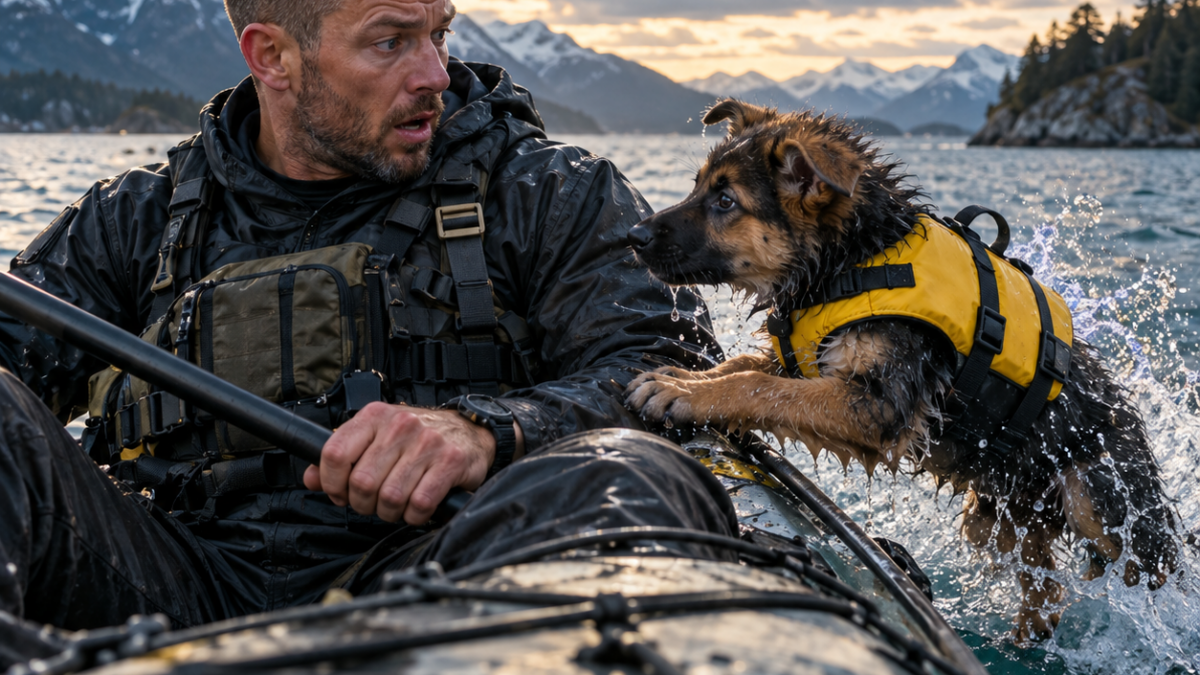
Finn jumped.
Four black paws left the training board.
Yellow life jacket flashed.
The puppy landed on the bow of Owen’s kayak.
The narrow craft lurched violently.
Owen reacted automatically.
Paddle braced.
Hips counterbalanced.
One hand grabbed the handle on Finn’s life jacket before the dog slid sideways.
Water slapped against the hull.
“Jesus—”
Finn found his footing.
Owen stared.
Finn stared back.
For perhaps two seconds, they remained motionless.
Then Finn wagged.
The entire kayak moved.
Owen said:
“You had a perfectly acceptable platform.”
Finn stepped closer.
“You abandoned it.”
Another step.
“That does not make this my problem.”
Finn placed both front paws against Owen’s chest.
Wet.
Dirty.
Owen looked down.
“Seriously?”
Finn licked his chin.
Owen froze.
The puppy did it again.
Something escaped Owen’s throat.
Not a word.
A sound.
Then another.
His mouth opened.
And Owen Carter laughed.
Actually laughed.
Not the small polite noise he made when customers joked.
Not the controlled exhale he used to end conversations.
Laughter.
Real.
Unplanned.
Finn immediately decided this meant victory.
Tail whipping.
Paws sliding.
Tongue out.
Owen tried pushing him back gently.
“Stop.”
Finn licked his cheek.
“Stop.”
Another lick.
“Buddy—”
Owen was laughing harder now.
His eyes watered.
He could not remember the last time that had happened because something was funny.
Probably before Mason.
That thought should have killed the moment.
It didn’t.
Finn sat directly on Owen’s feet.
Yellow life jacket bright against the blue water.
Owen shook his head.
“You’re an idiot.”
Finn barked.
“Yes.”
“Definitely.”
The woman on the dock looked relieved and embarrassed when Owen paddled back.
“I am so sorry.”
Owen steadied the kayak against the platform.
She took Finn’s leash.
“Apparently he slipped the clip when I wasn’t looking.”
Owen looked at the puppy.
Finn attempted to chew the loose end of his own life jacket.
“I’m skeptical about the phrase ‘wasn’t looking.’”
The woman laughed.
She was around Owen’s age.
Twenty-seven, maybe.
Shoulder-length chestnut hair pulled loosely back.
Green eyes.
Fleece jacket over jeans.
No makeup beyond whatever cold air put naturally into her cheeks.
“I promise he usually has slightly better judgment.”
Finn nearly stepped off the dock while staring at a floating leaf.
Owen raised an eyebrow.
She sighed.
“Okay.”
“Not significantly better.”
Owen climbed from the kayak.
Finn immediately pushed his nose against Owen’s hand.
The gesture was so certain.
As though they had an appointment.
Owen scratched behind the crooked ear before catching himself.
The woman noticed.
Did not comment.
“I’m Lily Hart.”
“Owen.”
“I know.”
His hand stopped.
Lily saw the reaction.
“Your shop.”
She pointed toward town.
“Carter Marine Repair?”
Owen relaxed slightly.
“Right.”
“I’ve heard of you.”
“That sounds ominous.”
“Good things.”
“Worse.”
She smiled.
“I volunteer with an organization starting a program here.”
Owen began lifting his kayak.
Lily continued.
“Open Water, Open Hearts.”
He paused.
“Water activities for injured veterans and young people recovering from mobility injuries.”
There.
Veterans.
One word.
Three years disappeared.
Cold medical hallway.
Mason’s brace.
Surgeon explaining nerve damage.
Owen standing six feet away unable to look at his best friend.
Lily saw Owen’s face close.
She stopped speaking.
Owen lifted the kayak.
“You probably have the wrong person.”
“I only wanted to ask about some donated kayaks.”
“I’m not available.”
“No problem.”
That surprised him.
No persuasion.
No:
It’s for a good cause.
No:
Surely you can spare time.
Lily reached into her jacket.
Business card.
“If you change your mind.”
He took it because refusing felt needlessly rude.
Finn leaned against his shin.
Owen looked down.
“Try not to jump onto strangers’ boats.”
Finn wagged.
“That was not approval.”
Another wag.
Owen left.
The lake had returned to silence.
But it did not feel the same.
At the workshop, Owen inspected the kayak again.
Everything passed.
He wrote the customer’s invoice.
Rehung tools.
Swept fiberglass dust.
Then looked down.
Two muddy puppy paw prints were dried on the front of his old green shirt.
He should have been annoyed.
Instead he touched one with his thumb.
That evening at the cabin, Owen reached into his jacket pocket.
One work glove.
Left.
He checked again.
Right glove missing.
“Perfect.”
He searched the truck.
Equipment bag.
Workshop.
Nothing.
At 7:18 his phone vibrated.
Unknown number.
Text.
Hi—Lily from the dock. I got your number from the shop listing. I think we found your glove.
Attached image.
Finn asleep on a fleece blanket.
Owen’s missing glove beneath his chin.
Yellow life jacket hanging behind him.
One crooked ear folded against the leather.
Text below:
He appears emotionally attached. I’ll attempt negotiations tomorrow.
Owen stared.
A smile started before he could stop it.
He enlarged the picture.
Looked again.
Saved it.
Then realized what he had done.
He had hundreds of images on his phone.
Invoices.
Damage photos.
Serial numbers.
Weather screenshots.
Almost nothing personal.
He opened the saved image again.
Finn sleeping on his glove.
Owen sat alone at his two-chair kitchen table and laughed quietly.
Four days later, Lily arrived at the workshop.
Pickup loaded with three old kayaks.
Finn in the passenger seat.
And a fifteen-year-old boy standing beside the truck.
Owen heard the puppy before seeing him.
Bark.
Door opens.
Leash tightens.
Finn spotted Owen.
Entire body reacted.
Owen tried not to.
Failed slightly.
“You again.”
Finn strained forward.
Lily said:
“Wait.”
The puppy sat.
Poorly.
His rear end touched gravel for perhaps half a second.
Owen almost smiled.
Lily handed over a paper bag.
“Your hostage.”
Inside:
Glove.
Owen examined it.
Teeth marks along one edge.
“This has been compromised.”
“He disagrees.”
Owen looked at Finn.
“Of course he does.”
Lily introduced the teenager.
“Ben Miller.”
Ben nodded.
Light brown hair.
Thin frame.
Quiet eyes.
One leg noticeably stiff.
He tried concealing the limp.
That made Owen notice it more.
“Hey.”
Ben said.
“Hey.”
Lily pointed toward the kayaks.
“I’m not asking you to join anything.”
Owen’s expression told her she had chosen the correct opening.
“Just inspect them.”
“Tell us whether repair makes sense.”
“Materials paid.”
“Your normal rate if necessary.”
Owen folded his arms.
“There are other shops.”
“I know.”
“Then why mine?”
Before Lily answered, Ben crouched beside a damaged hull on Owen’s rack.
He did not touch.
Just looked.
“The crack goes deeper.”
Owen glanced.
“What makes you think that?”
Ben froze.
“I—”
“You said it.”
“Why?”
Ben stepped closer.
“The edge.”
Owen waited.
“It’s raised.”
“And?”
“Maybe water got underneath.”
Owen put down the tool in his hand.
“Maybe.”
He pointed.
“What happens if someone sands only the visible crack?”
Ben thought.
“Looks fixed.”
“Isn’t.”
“Correct.”
Lily watched.
Ten minutes passed.
Owen explained delamination.
Stress points.
Weight distribution.
Water intrusion.
Ben asked questions.
Good ones.
Owen answered like a teacher without realizing he had become one.
Finally Lily cleared her throat.
Owen looked at her.
Then at the three donated kayaks.
He sighed.
“I’ll inspect them.”
Lily smiled.
“Thank you.”
“Do not make this bigger.”
“Wouldn’t dream of it.”
“No press.”
“Agreed.”
“No veteran event.”
“Agreed.”
“No speeches.”
“Definitely agreed.”
“Materials at cost.”
“Fine.”
“Reduced labor.”
Lily frowned.
“I didn’t ask for that.”
“I know.”
Finn found an orange shop rag.
Grabbed it.
Ran.
Owen stared.
“That includes you.”
Finn trotted away.
Lily took out a rubber toy.
“Trade.”
Finn immediately dropped the rag.
Owen watched.
“That easy?”
“Give him something better.”
Owen looked toward her.
“People work that way too?”
“Sometimes.”
He did not know why the sentence stayed with him.
Ben returned after school the next afternoon.
Then again.
Owen gave him small tasks.
Inventory fittings.
Measure handle positions.
Record dimensions.
Clean tools.
Nothing pity-based.
Ben appreciated that immediately.
Adults had been helping him too much for a year.
His cycling accident had mangled his leg badly enough to require surgery.
Before the injury, he raced mountain bikes.
Movement had been identity.
Speed.
Balance.
Control.
Afterward:
Physical therapy.
Pain.
People holding doors before he reached them.
Teachers carrying books he had not asked them to carry.
Friends saying:
At least you’re walking.
He hated that sentence.
At least.
Like grief was ungrateful if survival existed.
Owen never said it.
He asked:
“Measurement?”
“Fourteen and three-eighths.”
“Check again.”
Ben checked.
“Fourteen and five-sixteenths.”
“Good.”
“I was wrong.”
“That’s why we measure twice.”
No consolation.
No inspirational speech.
Just work.
Ben trusted that.
Finn became part of the shop almost immediately.
Lily fostered him through a local rescue and brought him whenever conditions were safe.
She established a mat away from tools.
Finn stayed on it.
Approximately sixty percent of the time.
He loved stealing:
Rags.
Gloves.
Pencils.
One measuring tape.
Frank’s hat later.
Mason’s hat even later.
But mostly he loved Owen.
Whenever work stopped, Finn appeared.
Head on Owen’s boot.
Paw across the other.
If Owen shifted:
Finn shifted.
Ben eventually said:
“You know you can move him.”
Owen tightened a screw.
“I know.”
“So why don’t you?”
“No reason.”
Ben grinned.
Owen ignored him.
Within a week Owen kept water near Finn’s mat.
Then a second blanket because mornings were cold.
Then treats in one drawer.
Lily noticed.
Said nothing.
That restraint was part of why Owen began liking her.
She did not narrate every good thing he did.
Did not look at him like a wounded veteran needing rehabilitation.
Did not ask him to tell his story.
She simply worked.
One afternoon, Owen found himself explaining a repair to Finn.
“That’s what happens when someone fixes the visible damage without figuring out why it failed.”
Finn tilted his head.
Owen paused.
“You have no qualifications.”
Finn sneezed.
“Exactly.”
Lily laughed quietly from the doorway.
Owen turned.
“How long have you been standing there?”
“Long enough.”
“Forget it.”
“Already forgotten.”
She had not.
Friday evening, Lily called Finn to leave.
Finn opened one eye.
Did not move.
“Finn.”
Nothing.
Owen crouched.
“Come on.”
Finn stretched a paw toward his knee.
“You’re going home.”
Finn remained.
“There’s work tomorrow.”
One ear lifted.
“You can come back.”
Finn stood.
Followed Lily.
At the door, he turned.
Looked at Owen.
Owen raised one hand.
After they drove away, the workshop became quiet.
Tools organized.
No barking.
No teenager asking questions.
No Lily sorting paperwork.
Owen looked at Finn’s empty mat.
For three years, quiet had been safety.
Now it felt like absence.
That frightened him.
The following Saturday, a dark blue pickup pulled beside Lily’s truck.
Owen looked up from Ben’s modified handle design.
A man stepped out.
Tall.
Strong upper body.
Short dark-blond hair.
Rescue lines over one shoulder.
Folder under his arm.
Slight stiffness in the left leg.
Owen stopped breathing.
There are people your body recognizes before your mind permits recognition.
Mason Reed.
Three years.
Different haircut.
Older face.
More lines around the eyes.
Same way of scanning a doorway.
Same shoulder roll before carrying gear.
Same half-second pause before stepping over uneven ground with the damaged leg.
Owen’s screwdriver stopped halfway through a turn.
Mason saw him.
Stopped too.
Lily came from the storage area.
“Owen, this is Mason Reed. He’s helping with—”
She saw both faces.
Stopped.
Mason said:
“Hello, Carter.”
Owen swallowed.
“Mason.”
Lily’s gaze moved between them.
“You know each other.”
Mason answered.
“We served together.”
Owen looked at Lily.
“You knew?”
“No.”
Truth.
Immediate.
He believed her.
Then looked at Mason.
“There are other repair shops.”
“I’m sure.”
“You should use one.”
Ben stopped drawing.
Finn stood.
Mason remained calm.
“I’m here for the safety review.”
“Then review somewhere else.”
“Owen.”
Mason’s voice never rose.
“I did not come to fight.”
That almost made it worse.
Owen had imagined anger for three years.
Accusation.
Maybe a punch.
He had prepared responses to hatred.
He had no defense against courtesy.
Mason put the folder down.
“Participants need equipment we can trust.”
“That’s all.”
Finn walked over.
Sniffed Mason’s boot.
Mason crouched carefully.
“Hey, buddy.”
Finn discovered the wool cap protruding from Mason’s jacket pocket.
Stole it.
Mason stared.
Finn ran directly to Owen.
Dropped the cap at Owen’s feet.
The room went silent.
Then Mason laughed.
“Well.”
Owen looked at Finn.
“We don’t steal from visitors.”
Finn sat.
Proud.
Mason folded his arms.
“I remember a time you could manage more complicated situations.”
Owen almost answered automatically.
Old rhythm.
Old friendship.
He caught himself.
Finn barked.
Mason smiled.
“Looks like he found the right guy.”
The corner of Owen’s mouth moved.
Barely.
But Mason saw it.
So did Lily.
Work resumed.
Painfully normal.
Mason checked fittings.
Asked questions.
Reviewed safety documentation.
Ben asked about adaptive balance because he noticed Mason’s leg.
Owen braced for discomfort.
Mason simply answered.
“Sometimes my left side reacts slower.”
“How do you paddle?”
“Adjust.”
“Does that bother you?”
“Sometimes.”
Ben looked surprised by the honesty.
Mason continued.
“Good equipment works with the body you have.”
“Not the body somebody thinks you should have.”
Ben looked at his own leg.
Owen heard.
Said nothing.
Later Ben asked:
“Does recovery ever stop being frustrating?”
Mason considered.
“Yes and no.”
“Helpful.”
Mason smiled.
“Some things got easier.”
“Some stayed hard.”
“The biggest change was realizing recovery wasn’t about becoming exactly who I used to be.”
Ben frowned.
“What was it about?”
“Becoming somebody I could live with now.”
Owen tightened a bolt too hard.
Mason continued.
“I thought needing help meant I had failed.”
“Turned out refusing it just made me miserable.”
Ben looked toward the practice kayak.
For the first time, maybe, he imagined water again.
Owen did too.
Another memory.
Mason in rehabilitation.
Parallel bars.
Owen standing at the doorway.
Then leaving before Mason saw him.
Or so Owen thought.
That evening, Owen unfolded the dock plans Lily had left behind.
Old supports.
Access issues.
Floating sections requiring reinforcement.
He marked problems.
Calculated materials.
Told himself he was only looking.
Then his eyes landed on Mason’s safety folder.
A question entered his mind.
One he had avoided three years.
What if Mason did not hate him?
He rejected it immediately.
Then it came back.
Over the next two weeks Mason returned.
Professional.
Measured.
Sometimes familiar.
He knew where Owen kept a wrench without asking.
Once opened the wrong drawer and said:
“You still organize things like a psychopath.”
Owen almost laughed.
Another afternoon Mason handed him coffee.
Black.
No sugar.
Correct.
Neither commented that he remembered.
Those small acts hurt more than anger.
Eventually Ben tested his modified kayak handle while the boat rested on padded supports.
No water.
Safe.
Predictable.
He lowered himself into the seat.
The kayak shifted slightly.
Ben froze.
Hands clenched.
Breathing changed.
“I want out.”
Lily moved immediately.
“Okay.”
No challenge.
No:
You can do it.
They helped him out.
Ben stood beside the bench furious.
“I thought I was over this.”
Mason leaned against the table.
“You don’t get over fear on command.”
“I can’t even sit in a boat that isn’t moving.”
“You sat in it.”
“For ten seconds.”
“And stopped when you needed.”
“That’s failure.”
“No.”
Mason’s voice remained steady.
“That’s information.”
Ben looked away.
Owen watched.
Three years of self-punishment sat inside that conversation.
Owen had believed stopping meant weakness.
Needing help meant failure.
A mistake meant disqualification.
Mason seemed to have learned something else.
After Ben calmed, Owen brought the design notebook.
“Forget what the kayak should do.”
Ben looked confused.
“What did you need to feel?”
“Stable.”
“How?”
Ben described it.
Handle position.
Weight transfer.
Predictability.
Owen listened.
Did not correct immediately.
They redesigned.
By the time Ben left, frustration had become engineering.
Lily watched Owen.
She was beginning to understand the shape of him.
He cared quietly.
Which made it easy to miss.
That same afternoon, Lily mentioned Finn had an adoption inquiry.
Owen’s hand stopped against the dog’s neck.
“From where?”
“Another town.”
“Family?”
“Yes.”
“Kids?”
“One older child.”
“Yard?”
“Owen.”
“What?”
Lily smiled.
“You suddenly have many questions.”
“He’s a German Shepherd.”
“He needs structure.”
“I know.”
“Exercise.”
“I know.”
“People underestimate puppies.”
“I know.”
Finn rolled onto his side.
Pressed one paw against Owen’s boot.
Owen looked down.
“Just saying.”
The thought of someone else taking Finn home followed Owen all evening.
That night, searching a drawer for paperwork, he found the old SEAL photograph.
Him.
Mason.
Shoulders touching.
Two men who had not yet learned how fragile a future could be.
Owen sat.
The workshop door opened.
Mason stepped inside.
“Forgot my tool bag.”
Owen moved the photograph.
Too late.
Mason saw.
He pulled out a chair.
Sat.
Neither spoke.
Finally Mason said:
“Are you planning to avoid me until one of us dies?”
Owen stared at the table.
“I don’t know what you want.”
“Something true.”
Owen laughed without humor.
“Fine.”
He looked up.
“I made the wrong call.”
Mason waited.
“You told me the gear felt wrong.”
“I said continue.”
“We continued.”
“You got hurt.”
“You lost the Teams.”
“I left.”
Mason remained silent.
Owen’s voice roughened.
“I ruined your career.”
Still nothing.
“I don’t know what you want me to say after that.”
Mason leaned back.
“I want you to stop editing the story.”
Owen stared.
“What?”
“You keep one sentence.”
“I said something felt wrong and you continued.”
“That happened.”
“Yes.”
Mason nodded.
“But I saw the irregularity first.”
“You mentioned it.”
“I minimized it.”
“You told me.”
“I told you after I had already decided it was probably nothing.”
Owen shook his head.
“I was lead.”
“Yes.”
“You were responsible.”
“Yes.”
Mason’s tone sharpened slightly.
“And I was responsible for reporting clearly.”
“For insisting.”
“For my own decisions.”
Owen looked away.
“That doesn’t excuse me.”
“I did not say excuse.”
Mason leaned forward.
“I said truth.”
Owen’s hands closed.
Mason continued.
“I was angry.”
“Good.”
“I hated what happened.”
“You should.”
“I hated the Navy telling me I was done.”
Owen’s eyes lowered.
“I hated physical therapy.”
“I hated the cane.”
“I hated strangers opening doors.”
“I hated my leg.”
Then Mason’s voice softened.
“But do you know what I did not hate?”
Owen looked up.
“You.”
Silence.
Owen shook his head.
“Mason—”
“I called.”
“I know.”
“No.”
Mason’s voice cracked for the first time.
“You don’t know.”
“I called you after surgery.”
“You didn’t answer.”
“I texted.”
“You stopped reading.”
“I wrote a letter.”
“You sent it back unopened.”
Owen froze.
“I thought—”
“You thought.”
Mason’s eyes burned.
“That is the problem.”
“You decided what I needed.”
“You decided I would be better without you.”
“You decided guilt gave you the right to disappear from my life.”
Owen could barely breathe.
“I was trying to protect you.”
“From what?”
Mason asked.
“My best friend?”
The sentence landed harder than any accusation Owen had imagined.
“I didn’t need you to fix my leg.”
“I needed you to sit in the damn room.”
Owen looked down.
Mason continued.
“You think the accident was the betrayal?”
“No.”
His voice lowered.
“The silence was.”
Owen’s eyes filled.
For three years he had imagined Mason saying:
You destroyed my life.
Instead:
You left me alone.
“I’m sorry.”
Barely audible.
Mason waited.
Owen tried again.
“I’m sorry.”
“I don’t know how to fix three years.”
“You probably can’t.”
Owen closed his eyes.
Mason added:
“But we already lost them.”
Pause.
“We don’t have to donate the rest.”
The workshop door opened softly.
Lily stepped in to retrieve a forgotten bag.
Finn wandered from behind her.
No idea he was entering one of the most important conversations of Owen’s life.
He walked toward Owen.
Put his head on Owen’s knee.
Owen lowered one hand into black-and-tan fur.
Mason reached across.
Placed a hand on Owen’s shoulder.
Old gesture.
Teammate gesture.
Brother gesture.
Owen did not move away.
Mason took another copy of the old photograph from his bag.
Placed it on the table.
Owen stared.
“You kept one?”
“Of course.”
“Why?”
Mason looked almost offended.
“Because good memories did not become lies just because something bad happened later.”
Then Mason left.
Owen stayed sitting.
Finn against his leg.
Photograph on the table.
Lily had quietly gone outside.
For the first time in three years, Owen allowed a new thought.
Maybe guilt had not made him loyal.
Maybe it had made him absent.
Monday morning, Owen entered the Open Water, Open Hearts planning meeting.
Lily looked up.
Ben stopped writing.
Mason lowered his coffee.
Owen placed marked dock drawings on the table.
“Some of these supports need redesign.”
Lily blinked.
“You’re joining?”
“Apparently.”
Ben smiled.
Mason moved one chair closer.
Owen continued.
“I can handle repairs.”
“But access and safety need input.”
He looked around.
“I can’t do it alone.”
Mason leaned back.
“That sentence physically hurt you.”
“Do not make this worse.”
People laughed.
Owen remained.
That was the beginning.
Not healing.
Healing is a word people use when they want transformation to sound clean.
This was messier.
Owen became irritated during meetings.
Interrupted Frank Dalton, the retired boat builder.
Had to apologize.
Argued with Nora Ellis from the lakeside board about railing dimensions.
Then discovered she was correct.
Hated that.
Listened to Grace Bennett, the rehabilitation specialist, explain that technically functional equipment could still make participants feel unstable.
He learned to ask:
“Walk me through it.”
Instead of immediately saying:
“That won’t work.”
Ben redesigned his adaptive handle three times.
Each version better.
Finn destroyed one paper mock-up by sleeping on it.
Ben wrote:
APPROVED BY FINN
across the torn drawing.
Owen hung it in the shop.
The workshop transformed.
Volunteers.
Tools.
Coffee cups.
Laughter.
Mason appearing without warning.
Lily walking Finn.
Ben arriving after school.
Owen’s solitude began disappearing.
He noticed he did not miss it every day.
The project ran into funding problems.
Dock improvements cost more than expected.
Lily considered delaying.
Owen proposed a community repair fundraiser.
He surprised himself.
Local boat owners came.
Hardware store donated materials.
People paid Owen for maintenance inspections.
Some paid more than asked.
The backlog helped his own struggling business.
The leaking workshop roof finally got repaired.
Nobody called it charity.
That mattered to him.
One evening Lily stayed after volunteers left.
Finn slept on his mat.
Owen put away tools.
Lily asked:
“Was this always your plan?”
“What?”
“Boats.”
“No.”
“What was?”
“Navy.”
“Forever?”
“I thought so.”
He wiped his hands.
“Once I had an idea about teaching water safety.”
“To who?”
“Kids.”
“Why didn’t you?”
“Life.”
Lily nodded.
“My original life changed too.”
She told him about leaving a city career when her father became ill.
Moving back.
Resenting it initially.
Then animal rescue.
Community programs.
Different future.
“Sometimes the life you planned disappears.”
She said.
Owen looked toward her.
“It doesn’t mean the next one is fake.”
They walked along the lake afterward.
Finn between them.
Owen spoke about his mother in Oregon.
How rarely he called.
How he had turned shame into distance from everyone.
Lily did not say:
Call her.
She only listened.
The next day, Owen called.
His mother answered on the second ring.
“Owen?”
Her voice changed instantly.
“Yeah.”
“Are you okay?”
He closed his eyes.
“I think I’m trying to be.”
Silence.
Then his mother cried.
So did Owen.
He hated that Finn watched.
“Don’t judge me.”
Finn tilted his head.
A week later came the final rehearsal.
Clear sky.
Golden trees.
Cold bright water.
Safety teams in place.
New supports.
Adaptive access.
Finn in the yellow life jacket.
Ben preparing to enter the training kayak.
Owen watched.
Ben checked the handle.
Lowered himself.
Breathed.
Everything went well.
Then a sightseeing boat passed beyond the training boundary.
Wake rolled in.
An older connector beneath one dock section failed.
Platform shifted.
Small movement.
Controlled.
But Ben’s kayak turned unexpectedly.
His face changed.
Breathing shallow.
Hands locked.
Grace called:
“Stop exercise.”
Mason began recovery coordination.
Owen’s body reacted before thought.
Move.
Take over.
Fix it.
The lake became California for half a second.
Different equipment.
Mason injured.
Owen’s mistake.
He stepped forward.
Stopped.
Mason already had it.
Grace was with Ben.
Lily moved Finn away.
Rescue personnel positioned.
Everybody doing their job.
Old Owen would have entered.
Taken command.
Confused roles.
Maybe made things worse.
Owen stayed at his assigned station.
He confirmed by radio.
Waited.
Ben shouted:
“I can’t do this.”
Grace spoke calmly.
Owen waited until she signaled.
“Ben.”
The boy barely responded.
“You don’t have to prove anything.”
“I want out!”
“You’re getting out.”
“Look toward shore.”
Ben could not.
His eyes kept returning to the moving water.
Finn barked.
Short.
High.
Owen looked.
Yellow life jacket.
Crooked ear.
Ridiculous little dog.
“Ben.”
“Find Finn.”
The boy turned slightly.
“What?”
“Yellow jacket.”
“Find the troublemaker.”
Ben’s eyes searched.
Found him.
Finn stood beside Lily.
Left ear up.
Right ear sideways.
Head tilted so dramatically he looked confused by gravity itself.
Ben stared.
Then laughed once.
Tiny.
Enough.
His breathing changed.
Grace continued.
Mason coordinated.
Ben loosened his hands.
Minutes later he was back on stable dock.
Safe.
No injury.
Just shaking.
Owen approached only when Grace permitted it.
Crouched.
“How are you?”
“Terrified.”
“Yeah.”
Ben looked embarrassed.
“I panicked.”
“Yeah.”
“Everything we did…”
“Still happened.”
“What if I’m not ready?”
Owen thought.
Then answered:
“Today something unexpected happened.”
“You got scared.”
“You told us.”
“You accepted help.”
Ben looked at him.
“I thought brave meant not panicking.”
Owen glanced at Mason.
“So did I.”
Pause.
“I was wrong.”
The incident triggered a complete review.
Nora identified the failed attachment.
Owen had previously inspected that section.
He could have defended himself.
Could have said age caused failure.
Could have blamed previous maintenance.
Instead:
“I reviewed it.”
He said.
“I should have recommended full replacement of the older connectors.”
Everyone waited.
Old reflex expected punishment.
Instead Frank said:
“We replace all of them.”
Mason:
“Update inspection checklist.”
Grace:
“Add unexpected-movement protocol.”
Nora:
“Document it.”
Nobody asked who was the bad person.
They asked what failed.
Owen sat quietly.
This was the conversation he had denied himself for three years.
Responsibility without annihilation.
A mistake could matter.
Could require correction.
Could remain serious.
And still not become the entire definition of the person who made it.
Two weeks later, the dock reopened.
Approved.
Limited initial program.
Regular inspections required.
Nobody complained.
Opening morning drew families.
Veterans.
Teenagers recovering from injuries.
Parents.
Volunteers.
Finn in yellow.
Tail everywhere.
Ben’s illustrated instructions stood beside the access point.
Mason approached Owen with two paddles.
“Got a surprise.”
“I dislike surprises.”
“I know.”
Mason nodded toward an adapted kayak.
Owen stared.
“No.”
“Yes.”
“You’re paddling?”
“Cleared.”
“With supervision.”
“Grace signed off.”
“You didn’t tell me.”
Mason smiled.
“You would have interfered.”
“Correct.”
A few minutes later, two former Navy SEALs pushed into Lake Pend Oreille.
Separate kayaks.
Side by side.
Not fast.
Not tactical.
No mission.
No stopwatch.
Just water.
At the turning marker, Mason rested his paddle.
“You know.”
“What?”
“I thought we’d never do this again.”
Owen looked across.
“So did I.”
“You disappearing another three years?”
“Depends.”
“On?”
“Whether the jokes improve.”
“They won’t.”
“Then I’ll complain tomorrow.”
Mason smiled.
Tomorrow.
That word mattered.
Not apology.
Not forgiveness.
Tomorrow.
Back at shore, Ben entered his kayak.
This time the movement beneath him brought fear.
Owen saw.
Ben paused.
Breathed.
Continued.
Short route.
Supervised.
When he returned, he grinned so hard his mother cried.
Ben looked for Owen.
Owen gave a thumbs-up.
No speech.
Ben did not need one.
Later Nora asked Owen to remain as long-term technical advisor.
Equipment workshops.
Youth mentoring.
Safety design.
Owen answered:
“Yes.”
Quickly enough to surprise himself.
Several days after opening, Lily came to the workshop carrying a folder.
Finn entered first.
Ran to Owen.
Settled against his boots.
Lily said:
“We need to talk.”
Owen looked at the folder.
“That sounds bad.”
“Finn.”
Owen immediately frowned.
“The adoption family?”
“Didn’t proceed.”
He tried not to look relieved.
Failed.
Lily continued.
“The rescue completed another review.”
“Of what?”
“You.”
Owen stared.
“For?”
“Permanent adoption.”
Silence.
Finn snored lightly.
Lily sat.
“He’s young.”
“High-energy.”
“Needs training.”
“Exercise.”
“Veterinary care.”
“Structure.”
“For years.”
Owen looked at the puppy.
Three years of silent dinners flashed through his mind.
Cabin.
One chair used.
Paddling alone to avoid people.
Then:
Yellow life jacket.
Wet paws.
First laugh.
Workshop mat.
Stolen glove.
Finn lying between him and Mason.
Finn barking Ben back toward shore.
Owen knelt.
Put one hand around Finn’s neck.
“Buddy.”
Finn opened his eyes.
“You already decided, didn’t you?”
Finn licked his nose.
Lily laughed.
Owen wiped his face.
“That is disgusting.”
Finn wagged.
Owen looked up.
“If the rescue approves…”
Lily raised an eyebrow.
“They’re asking you.”
“Then yes.”
Finn went home with him four days later.
Dog bed beside couch.
Bowls in kitchen.
Yellow life jacket beside the door.
Chew toys everywhere despite Owen’s attempt at organization.
First night:
Finn ignored the dog bed.
Slept beside Owen’s bedroom door.
Second night:
Inside bedroom.
Third:
Half under Owen’s bed.
By week two:
Entirely on Owen’s bed.
Owen surrendered gradually.
Lily visited.
Then stayed for dinner.
Then again.
Mason came by.
Ben volunteered.
Owen’s mother visited from Oregon and cried when she saw him laughing with Finn.
Owen told her:
“Please don’t.”
She said:
“I lost three years too.”
He nodded.
“I know.”
No defense.
Just truth.
He started calling weekly after that.
Winter came.
Snow around the cabin.
Finn grew.
Ears eventually both stood.
Almost.
Right one still leaned when he was tired.
Mason joined the community program formally.
Ben developed more equipment designs.
Lily and Owen became something neither rushed to name.
Spring arrived.
Then another summer.
Owen’s life became full of ordinary problems.
Finn chewed one boot.
Workshop compressor failed.
Ben broke a prototype.
Mason forgot a meeting.
Lily got angry because Owen tried fixing her truck without asking.
He apologized poorly.
Then better.
These were beautiful problems.
Because none required disappearance.
One evening, Owen and Mason sat outside the workshop.
Finn slept between them.
Mason’s injured leg stretched forward.
Owen looked at it.
Mason noticed.
“You can ask.”
“Does it hurt?”
“Sometimes.”
“Today?”
“Little.”
Owen nodded.
“Still wish it never happened?”
Mason stared toward the lake.
“Of course.”
Owen swallowed.
Mason continued.
“But wishing it didn’t happen isn’t the same as wishing my life now didn’t exist.”
Owen looked over.
Mason gestured toward the workshop.
Ben inside.
Lily arranging supplies.
Finn dreaming.
“Wouldn’t have met half these people otherwise.”
Owen said:
“That’s a dangerous way to justify bad things.”
“I’m not justifying it.”
Mason replied.
“I’m refusing to let it own everything after.”
Owen sat with that.
Years later, it would remain one of the most important sentences anyone ever gave him.
Refusing to let it own everything after.
Owen eventually stopped wearing the old camouflage shirt every day.
Not consciously.
One morning he put on a gray work shirt instead.
Lily noticed.
Said nothing.
That was why he loved her.
Eventually he told her.
Not dramatically.
They were cleaning after a program event.
Finn had stolen a sponge.
Owen said:
“I love you.”
Lily kept wiping the table.
“I know.”
“That’s annoying.”
“I learned from Finn.”
He laughed.
Then kissed her.
Mason pretended not to see from across the room.
Ben absolutely saw.
Told everyone.
Years passed.
Finn became a large German Shepherd.
Nearly ninety pounds.
Still believed he belonged on kayaks.
Still wore yellow.
Owen replaced the original life jacket twice as Finn grew.
He kept the puppy-sized one hanging in the workshop.
Ben once asked why.
Owen said:
“Evidence.”
“Of?”
“Bad decisions.”
Ben laughed.
Everyone knew the real answer.
The little jacket represented the exact moment Owen’s carefully controlled loneliness developed a crack.
Finn had not healed him.
Owen became irritated when people told the story that way.
Dogs are not magic.
Forgiveness is not magic.
Community is not magic.
Mason had done work.
Owen had done work.
Ben had done work.
Lily too.
Finn simply did what dogs sometimes do extraordinarily well.
He entered a space humans had made too complicated.
Then stayed.
At thirty-three, Owen expanded Carter Marine Repair.
Added adaptive equipment fabrication.
Ben, now twenty, came home during engineering school summers to work there.
His leg never became what it was before the cycling crash.
He competed recreationally again.
Not racing.
Different relationship with movement.
He designed transfer handles and stability supports based partly on his own experience.
One prototype received a patent years later.
Owen framed the first terrible sketch.
Ben protested.
“It’s embarrassing.”
“Correct.”
“Take it down.”
“No.”
Mason became one of the program’s lead safety coordinators.
His military career had ended.
His usefulness had not.
That distinction mattered.
He taught veterans returning to water after injury.
Never overpromised.
Never said:
If I can do it, you can.
He hated that phrase.
Different bodies.
Different injuries.
Different futures.
Instead:
“We’ll find out what works for you.”
Owen liked that.
Lily eventually became director of the rescue organization.
She and Owen married beside the lake.
Finn attended wearing a yellow bow tie.
Not the life jacket.
Mason served as best man.
During the ceremony, Finn attempted to sit on Owen’s foot.
Some things deserved continuity.
At the reception, Mason gave a speech.
Owen warned him:
“No accident story.”
Mason said:
“Fine.”
Then told the kayak story instead.
“Our friend Owen believed for years that nobody could reach him.”
Mason raised a glass.
“Turns out we just needed a reckless German Shepherd with no respect for maritime boundaries.”
Everyone laughed.
Owen looked at Finn.
The dog looked back.
Same confidence.
Different size.
Owen’s eyes burned.
Lily squeezed his hand.
“Don’t.”
He whispered.
“You’ll make it worse.”
“Okay.”
She squeezed anyway.
When Finn reached ten, his muzzle grayed.
That happened too fast.
Owen noticed the first white hairs before Lily did.
Pretended not to.
At eleven, Finn slowed.
At twelve, arthritis.
Owen built a ramp.
Of course.
Ben designed it.
Of course.
Mason criticized the angle.
Of course.
Finn ignored it for two weeks.
Then used it only when nobody looked.
At thirteen, Owen took him paddling less.
Never without safety.
Calm water.
Short shoreline routes.
Yellow senior life jacket.
Finn sat in front.
Older.
Heavier.
Head held into the wind.
One autumn morning they paddled nearly the same stretch where they had met.
Lake flat.
Mountains reflected.
Owen rested his paddle.
Finn leaned back against his knees.
Owen scratched the gray fur around his ears.
“You know you ruined my life.”
Finn looked up.
Owen smiled.
“Completely.”
He looked toward shore.
Lily waving.
Mason sitting on the dock.
Ben helping a nervous teenager adjust equipment.
Open Water, Open Hearts running its fifteenth season.
Owen’s mother visiting with coffee.
Children laughing.
Workshop alive.
“Absolute disaster.”
Finn licked his hand.
Owen laughed.
When Finn died at fourteen, it happened at home.
Old age.
Heart failure.
No emergency.
No frightening end.
Owen lay on the floor beside him.
Lily on the other side.
Finn’s head against Owen’s forearm.
The yellow puppy life jacket hung on a hook near the door.
Owen cried harder than he had at any time since leaving the Navy.
This time he did not disappear.
That mattered.
Mason came that night.
Ben came.
His mother called.
People brought food.
Owen let them.
That may have been Finn’s final lesson.
Grief did not require exile.
Pain did not make you dangerous to everyone who loved you.
You could hurt and remain.
Months afterward, Owen returned to the lake alone.
Almost.
He carried the old puppy life jacket.
Bright yellow faded by time.
He sat on the dock where Finn had first jumped.
Mason walked over.
Lowered himself beside him.
Neither spoke for a while.
Finally Mason said:
“You thinking about throwing it in?”
“No.”
“Good.”
“Pollution.”
Mason smiled.
“You’re sentimental.”
“Never.”
Owen held the jacket.
“You know what bothers me?”
“What?”
“If he hadn’t jumped…”
Mason looked at him.
Owen continued.
“I probably would’ve paddled away.”
“From Lily?”
“Program.”
“You.”
“All of it.”
Mason nodded.
“Probably.”
Owen frowned.
“You’re supposed to tell me I would have figured it out.”
“I know you.”
“Fair.”
Mason touched the yellow fabric.
“Good dog.”
“Terrible dog.”
“Thief.”
“Boundary violations.”
“Multiple.”
Owen smiled.
Then cried again.
Mason remained.
No fixing.
No leaving.
Exactly what Owen had failed to do for him all those years earlier.
The symmetry was not lost on either man.
Owen eventually hung Finn’s first life jacket inside the workshop.
Below it, Ben made a small metal plaque.
FINN
FIRST TECHNICAL ADVISOR.
LILY HATED IT.
MASON LOVED IT.
Owen pretended to object.
The plaque stayed.
Years later, new volunteers heard the story.
Sometimes they embellished.
Finn rescued a drowning SEAL.
No.
Finn sensed trauma.
Probably not.
Finn was a trained therapy dog.
Absolutely not.
He was a five-month-old German Shepherd puppy who saw a man in a kayak and made a terrible decision.
That terrible decision happened to be one of the best things that ever happened to Owen Carter.
Owen always corrected the mythology.
“Finn didn’t save me.”
People would look disappointed.
“Then what did he do?”
Owen would think.
“He interrupted me.”
That was the truth.
Interrupted the silence.
Interrupted the punishment.
Interrupted a story Owen had repeated so often he mistook it for fact.
You failed Mason.
Therefore you are dangerous.
Therefore leave.
Therefore loneliness is deserved.
Finn had jumped onto the kayak before Owen could finish telling himself that story one more time.
Then Lily appeared.
Ben.
Mason.
Community.
Responsibility.
Love.
Owen learned something difficult.
Forgiveness did not erase responsibility.
Responsibility did not require self-destruction.
He had made the wrong decision during that training exercise.
Mason had been hurt.
That remained true.
Mason had also made choices.
Equipment had failed.
Circumstances mattered.
That also remained true.
Owen leaving afterward had caused pain.
True.
He could apologize.
Change.
Stay.
Also true.
Human beings are often desperate for a single clean verdict.
Guilty.
Innocent.
Broken.
Healed.
Strong.
Weak.
Owen’s life became better when he accepted several truths could occupy the same room.
He could regret.
And live.
He could carry guilt.
And receive love.
He could have failed once.
And be trustworthy again.
Mason could forgive without pretending the injury did not matter.
Ben could panic and still be brave.
Lily could care without rescuing.
And a ridiculous dog could be just a dog while still changing everything.
When Owen was older, Open Water, Open Hearts named the adaptive training dock after Mason.
Mason protested.
Lost.
The equipment workshop was named after Ben after he became one of the region’s leading adaptive recreational designers.
Ben protested.
Also lost.
A small bench near the original dock had one brass plate.
FINN’S LANDING.
Owen approved that one.
Underneath:
NO PERMISSION REQUESTED.
Children loved it.
One little boy once asked Owen:
“Did he really jump onto your kayak?”
Owen nodded.
“From there?”
“About there.”
“Were you scared?”
“No.”
“Mad?”
“For three seconds.”
“What happened?”
Owen looked across the water.
“I laughed.”
“That’s it?”
Owen smiled.
“No.”
“That was just the beginning.”
The boy ran away to rejoin his family.
Owen stayed.
The lake looked almost exactly as it had decades earlier.
Blue.
Quiet.
Mountains.
Autumn gold.
Mason approached with coffee.
Older now.
More gray.
Same slight stiffness.
He sat beside Owen.
“You’re brooding.”
“I’m sitting.”
“You brood while sitting.”
“You limp while complaining.”
“Low blow.”
Owen accepted the coffee.
For a while they watched kayaks cross the sheltered training zone.
A teenager laughed when his paddle splashed him.
Volunteer steadied another participant.
Nobody rushed.
Nobody demanded courage.
The program had learned.
Owen had too.
Mason asked:
“You ever think about California?”
“Yes.”
“Often?”
“Less.”
“Still regret it?”
“Every day.”
Mason nodded.
“So do I.”
Owen looked at him.
Mason continued.
“Not every regret needs to disappear.”
“No.”
“Some just need somewhere to sit.”
Owen smiled.
“That sounds annoyingly wise.”
“I practiced.”
They touched coffee cups.
No grand declaration.
Brothers rarely need one after enough years.
Owen looked toward Finn’s Landing.
Yellow plaque catching sun.
He remembered the puppy suspended briefly in the air.
Four paws.
Crooked ears.
Bright jacket.
No hesitation.
Then impact.
Kayak rocking.
Wet paws on his chest.
Tongue against his chin.
Laughter escaping before guilt could stop it.
People sometimes imagine lives change with dramatic decisions.
Sometimes they do.
Sometimes a person finally chooses forgiveness.
Makes the call.
Walks through a door.
Returns home.
But sometimes the first change is smaller.
Almost ridiculous.
A tiny interruption.
One laugh.
One saved photograph.
One workshop visit.
One conversation not avoided.
One apology spoken.
One hand left resting on a friend’s shoulder.
One frightened teenager deciding to try again.
One lonely man allowing a dog to sleep against his boots.
Owen had spent three years believing his life ended at the exact moment he failed to make the perfect decision.
Finn taught him—without meaning to teach anything—that life could begin again without first rewriting yesterday.
Years afterward, Owen could still picture the first morning clearly.
The puppy on the floating board.
Lily calling.
Yellow life jacket.
Finn crouching.
Owen saying:
“Don’t even think about it.”
The dog thinking about it.
Then doing it anyway.
Owen would laugh every time he told that part.
Because Finn had ignored the command that mattered least and somehow answered the need Owen had never admitted aloud.
Come back.
Not to the Navy.
Not to who you were.
To people.
To friendship.
To responsibility.
To laughter.
To tomorrow.
To home.
And when Owen finally understood that, he realized the strangest thing about the morning a German Shepherd puppy jumped onto his kayak.
He had always believed Finn was the one who leaped.
But in the years that followed, Owen came to understand that the little dog had merely landed first.
Owen was the one who eventually had to make the real jump.
Out of guilt.
Out of isolation.
Back toward the people who had never stopped waiting for him.
And this time, when they reached for him, he finally stayed.








