A Little Girl Visited the Same Dying Biker in Room 412 Every Afternoon—Then She Placed a River Stone on His Tray and Asked, “Do You Remember the Bus Stop?” Văn bản đã dán (1)
PART2:
Sick men do not stop noticing just because they are lying down.
I noticed the way nurses knocked twice before entering my room, when every other patient got one tap and a cheerful “coming in.”
I noticed visitors down the hall crossing to the other side when I walked my required laps with my IV pole rattling beside me.
I noticed the security guard, Ray Toiver, studying me a little too long when he thought I was looking at the floor.
I even noticed Dr. Gregory Vance glance at the vest before he looked at my monitor.
Nobody said anything cruel.
That almost made it worse.
Open hatred gives a man something solid to push against.
Suspicion just fills the air.
The first complaint came before I even knew there had been a complaint.
A woman visiting her father down the hall saw me walking near the pediatric elevator bank and asked the front desk whether patients like that were allowed to roam freely.
Patients like that.
Cardiac patients, Ray told her.
Same as everyone else on the floor.
But I saw his face later.
He did not fully believe it either.
Not yet.
I did not blame them out loud.
I had worn leather since before some of those nurses were born.
I had ridden motorcycles since I was nineteen.
I understood, in the tired and practical way a man understands bad weather, that people build opinions out of whatever is easiest to see.
Still, understanding a thing does not make it easier to swallow.
A man can spend forty years building a life he is proud of and still watch strangers decide in ten seconds that none of it counts.
Then Norah appeared in my doorway.
She showed up on a Tuesday.
Small girl.
Navy cardigan.
Gray pleated skirt.
Long brown hair coming loose from its part.
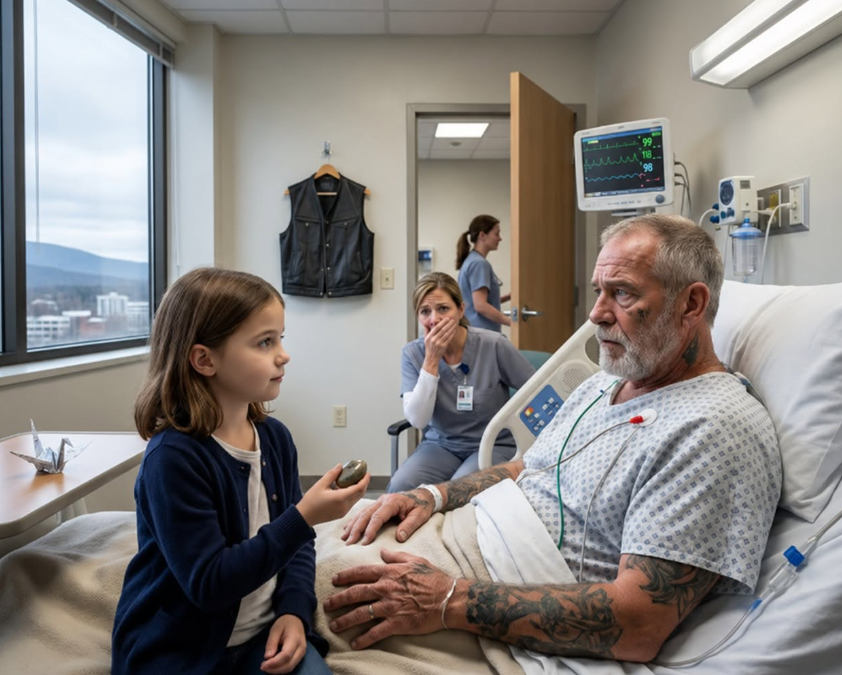
She stood in the doorway holding something cupped in both hands like she was protecting it from wind.
At first, I thought she was lost.
Then I saw where she was looking.
Not at my tattoos.
Not at my IV.
Not at the leather vest on the door.
At my motorcycle boots lined neatly beneath it.
“Those are yours?” she asked.
Her voice was quiet.
But not scared.
“They are.”
“Do you ride a motorcycle?”
“When my heart lets me.”
She considered that with the seriousness children give to facts adults would rather soften.
“My mom works here downstairs in the emergency room,” she said. “I do my homework in the cafeteria until she’s off, and then sometimes I walk around.”
“Does she know you walk around up here?”
The girl shrugged.
It was an honest answer that avoided answering.
I should have told her to go back downstairs.
Any reasonable adult would have.
But after two weeks of being looked at like a hazard, I found myself unwilling to send away the first person on that floor who had looked at me like I was simply a man with boots.
“What’s your name?” I asked.
“Norah.”
“Norah what?”
“Norah Puit.”
I went still.
Only for a second.
Not long enough for her to notice.
But something in that name moved through me like an old road under headlights.
Puit.
I had heard that name once before.
Or maybe I had heard someone screaming it near an ambulance.
Maybe both.
I pushed the thought away because sick men have enough ghosts without inviting more into a hospital room.
“Russell Harrove,” I said.
I tipped my chin toward the vinyl chair against the wall.
“You can sit if you want. I don’t bite. And even if I did, this heart of mine wouldn’t let me chase you.”
That got the smallest smile out of her.
She sat.
Only ten minutes the first day.
She asked careful questions about my vest, my boots, and whether the eagle stitched across the back meant I had been in the military.
“A long time ago,” I told her. “Navy.”
She nodded like that confirmed something rather than taught her anything.
When she left, she did not say she would come back.
She simply did.
The next afternoon.
And the one after that.
Every day between three-thirty and four, Norah appeared with her backpack over one shoulder and that same small object cupped in her hand.
She sat in the same chair and asked about things no one else on the floor seemed curious enough to ask.
What did this tattoo mean?
Did motorcycles get cold in winter?
Why were boots so heavy?
Did Navy people ride on ships every day?
Had I ever seen a whale?
She never asked if I was dying.
I loved her for that, though I never said it.
By the end of the first week, I had learned three things.
Norah liked math but hated showing her work.
She could sit quietly longer than most adults.
And the thing she kept turning over in her palm was a polished river stone, smooth and dark, with one pale line running through it like a tiny road.
She never explained it.
I never asked.
Some people show you what matters before they are ready to tell you why.
The charge nurse noticed the pattern before long.
Pam Ostrander had run the cardiac floor for twenty-two years with the kind of precision that comes from seeing too much and allowing herself to be surprised by almost nothing.
She was not unkind.
That is important to say.
She was cautious.
There is a difference.
Though caution can cut just as deep when it is aimed at the wrong person.
One Monday morning, I watched her at the nurses’ station speaking in that careful hospital language people use when they do not want to say what they are really saying.
Unaccompanied minor.
Unsupervised time.
Non-relative patient.
No documented parental consent.
It did not matter that I had never raised my voice.
It mattered that I looked the way I looked.
Later, Pam went downstairs herself to speak with Norah’s mother.
Diane Puit was thirty-four, an emergency room nurse, and exhausted in the specific way single mothers get when life keeps handing them twelve-hour shifts and bills with teeth.
She went pale when Pam told her where her daughter had been spending her afternoons.
“She told me she did homework in the cafeteria,” Diane said. “She never said anything about the fourth floor. About a patient.”
“I’m not accusing you of anything,” Pam replied. “I just think you should know.”
Diane found Norah that evening exactly where Pam had said she would be.
In the vinyl chair beside my bed.
Laughing at a story I had no business telling about a raccoon that once nested in my motorcycle saddlebag for almost an entire summer.
I saw Diane in the doorway before Norah did.
She stood there very still.
Her eyes moved over me.
Big man.
Tattoos.
IV.
Wires.
Leather vest.
Boots.
Daughter too close.
I knew that look.
Not hatred.
Calculation.
Fear pretending to be judgment.
“Norah, sweetheart,” she said, “it’s time to go.”
Norah went without complaint, but at the door, she turned back.
“Bye, Russell. Same time tomorrow.”
I looked at Diane before answering.
“Only if your mom says it’s all right.”
That was what I said.
Because children should never be put between adults who have not sorted out their own fear.
Diane did not say it was all right.
Not that night.
She took Norah home, and the room felt larger after they left.
Too large.
Machines beeped.
My IV pump clicked.
The star on Mill Mountain came on at dusk.
I watched it and tried not to feel foolish for missing a child I had known less than two weeks.
Word moved through the hospital the way it always does.
Faster than paperwork.
Slower than rumor.
With less mercy than either.
Ray the security guard pulled my file again.
I found out later.
He cross-referenced the Iron Angels against regional databases and found nothing worth finding.
Charity blood drives.
Organ transport escorts.
One noise complaint in 2019 because Dutch Odell’s pipes were too loud and his judgment too poor after midnight.
The absence of evidence did not satisfy Ray.
It rarely satisfies people who want their first impression to be right.
So he watched me.
What he caught was not what he expected.
He saw me teach Norah how to fold a paper crane from a hospital napkin.
Badly.
We both laughed when it collapsed into something that looked more like a wounded chicken.
Ray had trouble filing that away.
So did I.
That Thursday, my oldest friend came to visit.
Marvin Odell, known on the road as Dutch for reasons nobody living could explain, had ridden with me for twenty-six years.
We met at a Veterans of Foreign Wars fundraiser where he was the only man in the room who understood what I meant when I said my ears still rang some nights from a roadside blast I did not care to describe.
Dutch pulled a folding chair beside my bed and dropped a paper bag on the tray table.
“Sunflower seeds,” he said.
“I’m not supposed to have those.”
“Which is why I put them in a bag instead of a written confession.”
He sat down and cracked one between his teeth.
Then he nodded toward the vinyl chair.
“Heard you got yourself a shadow.”
“Kid from downstairs. Mother works ER.”
Dutch chewed slowly.
“Puit, right?”
My chest tightened.
“Norah Puit.”
He saw it.
Dutch saw too much.
Always had.
“You know her?”
“No.”
I answered too fast for a man telling the truth.
He did not push.
That was the gift of old friends.
They know which silences are walls and which are wounds.
But after he left, the name stayed in the room.
Puit.
A year earlier, I had been riding escort with three Iron Angels for an organ transport moving south of the city.
We did that work because years before, one of our members lost a grandson waiting for a donor lung, and I decided if we could not fix waiting, we could at least clear traffic for second chances when they finally arrived.
We were on Route 220 when I saw the little girl go down near a bus stop by the gas station.
Small shape.
School uniform.
Backpack twisted under one arm.
People freeze in moments like that.
They look around as if the right adult will appear from somewhere else and take responsibility.
I stopped.
I had been a Navy hospital corpsman for eleven years.
HM1 by the time I left.
I deployed with a Marine infantry battalion during Operation Iraqi Freedom, and I had learned to work fast in places where chaos wanted to own every second.
The girl’s skin was damp and pale.
Her breathing was wrong.
There was a medical bracelet on her wrist and panic in the eyes of the after-school aide who had been gone just long enough for everything to nearly end.
Blood sugar crash.
Severe.
I carried glucose gel because old habits ride better than good intentions.
I kept her airway clear.
Talked to her.
Kept my voice steady.
Told everyone else to give the paramedics room.
By the time the ambulance arrived, she was still with us.
Barely.
Her mother came running like the world had split open under her feet.
I gave my statement to a responding officer without my name because I had learned long ago that credit pulls focus away from the patient.
Then I got back on my bike and left before anyone thought to thank me.
I never knew if the girl made it.
Not until Dutch said the name Puit.
Not until Norah walked into Room 412 on her own two feet and asked about my boots.
That night, my heart monitor woke the floor at 2:14 a.m.
Ventricular tachycardia.
The kind of rhythm that makes nurses move faster and doctors use fewer comforting words.
It resolved on its own before the code team fully assembled, but the next morning Dr. Vance stood at the foot of my bed with a chart and the expression of a man with bad news trying to decide how much of it to say.
The transplant evaluation committee would meet in two weeks.
Whether I would be listed at all was no longer a certainty.
After he left, I lay awake listening to the air vents and a supply cart somewhere down the hall.
A man can know he is mortal all his life.
It still feels different when the system starts preparing a file for the possibility.
The complaint came on a Wednesday.
A family two doors down had watched Norah visit every afternoon and decided, without speaking to me once, that a man who looked like me should not be alone with a child.
Hospital employee’s daughter or not.
Pam brought the complaint to the nursing director.
The nursing director brought it to administration.
By Friday morning, a new line appeared in my chart.
Visitation by minors restricted unless guardian present at all times.
Pam delivered the news herself, clipboard held against her chest like a shield.
“It isn’t personal,” she said.
I looked at her.
“Everything about a man’s reputation is personal when the reputation isn’t his.”
She had no answer.
But she did notice, before leaving, that my hands were trembling faintly against the blanket.
I tried to hide it.
Did a poor job.
My body had been losing arguments all month.
That afternoon, Norah came anyway.
This time Diane walked half a step behind her, arms crossed, expression unreadable.
I could see the sleeplessness in her face.
She had spent days turning fear over in her hands and finding no shape that comforted her.
She sat in a second chair someone had wheeled in.
She said little.
She watched.
Norah was the one who broke the silence.
She turned the river stone over in her palm, then set it carefully on my tray table beside the water cup.
“Do you remember the bus stop?” she asked.
The room went still.
Diane straightened.
I stopped breathing.
“On the road with the gas station,” Norah said. “Where the ambulance was.”
My eyes moved to the stone.
“I was little,” she continued. “I got really dizzy, and everything went far away. There was a man with tattoos who gave me the juice packet and talked to me until the ambulance people came.”
Diane covered her mouth.
“I found this rock right after in the grass,” Norah said. “I kept it because I didn’t have anything else that was there.”
The machines kept beeping.
The hallway kept moving.
But inside Room 412, time folded in on itself.
Diane’s voice came out very softly.
“That was you?”
I looked at my hands.
The tremor was worse now.
“That was you on 220?”
“I didn’t know it was her,” I said. “Not until Dutch said your name last week.”
Norah looked at me, waiting.
I swallowed.
“I’ve thought about that little girl on the shoulder of that road every day for a year, wondering if she made it. I never once thought I’d find out by her walking into my hospital room on her own two feet.”
I told them the rest in pieces.
Because that was how it had happened.
In pieces.
The organ transport escort.
The gas station.
The aide.
The glucose gel.
The ambulance.
The fact that I left before anyone could turn a child’s worst afternoon into my story.
Diane listened with tears in her eyes and shame rising plainly across her face.
Not shame because she had been cruel.
She had not.
Shame because she had distrusted a man who had once stood steady over her daughter’s nearly lifeless body for no better reason than ink, leather, and other people’s fear.
“I owe you an apology,” she said finally. “I don’t know how to give one big enough.”
“You don’t owe me anything.”
“That’s not true.”
“It is to me.”
I looked at Norah.
“Just let the girl keep coming. That’s payment enough for a man in my position.”
But hospital restrictions do not care about gratitude.
When visiting hours ended, Ray stood outside my door and asked, not unkindly but firmly, for a guardian signature on the approved visitor list.
Diane’s name had not cleared the system yet.
Norah held her mother’s hand and looked back at me through the narrow window.
For the first time in a month, she left without saying she would see me tomorrow.
Diane promised it would only take a few days.
Paperwork.
A formality.
Nothing more.
But Norah’s silence told me the promise had not landed where it was meant to.
The guardian paperwork took four days.
Four days is not long unless you are sick enough to start measuring hope by the hour.
I watched the clock more than the television.
My heart numbers did not improve.
Dr. Vance came twice a day now instead of once.
Word reached me, the way word reaches everyone in hospitals with thin walls, that at least one member of the transplant committee had raised questions about my lifestyle.
My lifestyle.
No one said biker.
No one had to.
They talked about adherence.
Support systems.
Reliability.
Discipline after transplant.
They used clean language because clean language lets prejudice sit at the table without taking off its coat.
My roommate during that stretch was Harold Beckett, a seventy-nine-year-old retired postal worker from Vinton with emphysema and a weak heart of his own.
He kept mostly to himself.
He never asked about my tattoos.
Never mentioned the vest.
Never gave me that careful look other people did.
We shared silence comfortably.
Two old soldiers of different wars.
One day, when Harold’s daughter thought I was asleep, I heard her ask whether he felt safe sharing a room with “a man like that.”
Harold answered without hesitation.
“He helped me find the remote control three times and didn’t ask for a thing in return. That’s more than most people manage.”
I pretended to sleep.
But I remembered.
Thursday, November 7, at 11:52 p.m., Harold’s heart monitor began screaming.
I woke before the night nurse reached the door.
In the three or four seconds it took my own tired heart to catch up with my mind, thirty years of instinct arrived first.
Harold had gone rigid in bed.
Eyes rolled back.
No breath moving his chest.
The young nurse who burst through the curtain was named Kayla.
Second-year.
Good kid.
Smart.
But she had never run a code alone, and for half a second, fear pinned her hands in the air.
“Call it,” I said.
She stared.
“Get the cart. I’ve got compressions started.”
“You can’t—your heart—”
“Cart. Now.”
I was already out of bed.
IV still taped into my arm.
Monitor wires still attached to a heart that had no business carrying another man’s emergency.
But a body remembers what it was trained to do.
I crossed the small room in three steps and placed my hands on Harold’s sternum.
I began compressions.
Hard.
Fast.
Centered.
Counting aloud.
My own monitor started complaining behind me, dragged crooked by the wires.
Kayla ran.
I counted thirty compressions, opened Harold’s airway, gave two rescue breaths, and started again.
My chest burned.
My vision narrowed.
But my voice stayed calm.
“Cart now. Pads ready. Epi when ordered. He’s going into a shockable rhythm.”
Pam arrived forty seconds later with the code team.
She stopped in the doorway for one beat.
I know what she saw.
A dying cardiac patient.
A man she had spent a month quietly suspecting.
Ink.
Leather.
Wires.
Trembling legs.
Performing textbook CPR on his roommate with the precision of a training video.
“Sinus rhythm’s gone,” I said. “V-fib. Get the pads on him.”
I stepped back only when three other hands were ready to take my place.
My legs nearly folded.
Pam guided me into a chair against my protests and wrapped a blood pressure cuff around my arm.
I waved toward Harold’s bed.
“Watch him, not me.”
She watched both.
The team worked Harold for six minutes.
On the second shock, his rhythm caught.
By 12:03 a.m., Harold Beckett was breathing on his own, groggy, alive, staring up at a ceiling he had nearly stopped seeing forever.
Kayla stood against the wall afterward with trembling hands, looking at me differently than she had before.
Later, she wrote in her incident report that my instructions were the clearest she had ever heard during a code.
Calm, she wrote.
Not the calm people had mistaken for menace.
The calm that keeps a man alive until better hands arrive.
It was after one in the morning before the room quieted enough for Pam to speak to me directly.
She pulled a chair beside my bed.
The same chair Norah usually sat in.
For a long moment, she said nothing.
“Where did you learn to do that?” she finally asked.
It was not really a question.
“Eleven years as a Navy corpsman,” I said, still catching my breath. “Fallujah twice. A lot of roads before that.”
Pam looked down at her clipboard.
My color was worse than it had been in weeks.
My hands shook.
My heart, stubborn fool that it was, had just risked itself to keep another man’s beating.
I looked at her and said what I should have said earlier.
“You don’t get to decide what’s inside a man from what you can see standing in a doorway, Nurse Ostrander. You find out from what his hands do when it matters. Everything else is just a story people tell themselves because it’s easier than asking.”
Pam sat with that for a long time.
When she finally stood, she did not apologize.
Not in words.
Not that night.
But the next morning, when the visitor restriction came up for review, Pam was the one who walked it to administration herself and asked why a man who had just saved another patient’s life was still being treated like a liability instead of the asset he had proven himself to be.
The restriction was lifted by noon.
Diane’s guardian signature had already cleared two days earlier, but Pam personally carried the paperwork through every office that needed it, cutting a week of bureaucracy down to an afternoon.
Then she stood at the nurse’s station and told the story of Harold’s code to anyone who would listen.
Not as gossip.
As correction.
There is a difference.
Norah arrived at 3:40 that afternoon.
Backpack over one shoulder.
River stone in hand.
She slowed near the desk, expecting trouble.
Ray held the door open before she could ask.
“Mr. Harrove’s been asking when you’d show up,” he said.
That became our ritual after that.
Norah slowed at the desk.
Ray nodded her through.
Sometimes he gave her a peppermint from his shirt pocket.
No announcement.
No apology.
Just a small candy pressed into her palm like a peace offering from a man learning how to stop performing his assumptions.
Harold moved to a private room down the hall for observation.
Two days later, strong enough to sit up, he wheeled his IV pole into Room 412 himself.
He sat in the second chair across from me without a single word about tattoos, leather, or the fact that I had cracked one of his ribs saving his life.
He only held out his hand.
I took it.
The handshake lasted longer than handshakes usually do.
Some thanks do not need more language than that.
The transplant evaluation committee met the following Tuesday.
This time, Dr. Vance walked in with more than lab numbers and a failing heart on a chart.
He brought a written account of the code, co-signed by Pam Ostrander, documenting what I had done for Harold and the clinical precision with which I had done it.
Evidence, he argued, of exactly the steady discipline and judgment they should want in a transplant candidate.
Not the reputation they had been weighing me against.
The vote passed without further debate.
I was listed as an active candidate, pending continued stabilization.
I did not get a new heart that week.
Or that month.
No one pretended otherwise.
Donor matches take time.
Sometimes more time than a man has.
I understood waiting better than most.
But my name went onto the registry.
My medications were adjusted to hold me steady instead of simply slowing the decline.
For the first time since I had been admitted in early October, Dr. Vance used the word hopeful without sounding like he regretted it.
After that, Diane came by more often.
No longer standing in the doorway with her arms crossed.
She pulled up a chair of her own.
Slowly, over the following weeks, something like friendship grew between the three of us.
Not clean.
Not simple.
Not based only on gratitude.
Those things fade.
This was different.
Diane learned that I had never married.
That if I had ever had a daughter, she might have been close to her age.
That the Iron Angels ran blood drives, toy drives, and organ transport escorts not because we wanted applause, but because some men need a reason to stay useful after the world decides they have become a warning sign.
One evening, while Norah slept curled in the vinyl chair with her homework half-finished in her lap, Diane looked at me.
“You could have told someone,” she said.
“Told someone what?”
“What you did for her that day on Route 220. You could have taken credit. Let people know.”
I looked at Norah.
“Wasn’t about credit.”
Diane waited.
“It was about a kid on the side of a road who needed somebody steady for six minutes. Credit doesn’t fix a blood sugar crash. Steady hands do.”
She did not answer for a while.
I think that was the night she stopped feeling like she owed me and started understanding me.
By the end of November, I was strong enough to be discharged home.
Not cured.
Not fixed.
Just strong enough to wait somewhere that did not smell like antiseptic and cafeteria gravy.
My house was modest, off Melrose Avenue, not far from Diane and Norah’s apartment as it turned out.
A home health nurse would check in three times a week.
I would wear a defibrillator vest until a donor heart became available.
I would take pills on a schedule strict enough to make a Marine blush.
I would eat less salt than any living man should be asked to tolerate.
Dutch and the Iron Angels showed up the morning of discharge with a folding wheelchair ramp they had built themselves for my front steps.
They installed it in under an hour while Norah sat on the porch rail supervising like a foreman with very high standards.
“Too crooked,” she told Dutch.
Dutch looked at the level.
“It is not.”
“It looks crooked.”
“Then your eyes are crooked.”
“Then fix my eyes.”
Diane laughed so hard she had to sit down.
Pam came to the discharge unit off the clock.
She did not make a speech.
Pam was not a speech woman.
She shook my hand and told me to keep my sodium down and my temper up.
Then, in a plain voice, she said, “I spent a month deciding what kind of man you were before I bothered to ask a single real question. I won’t make that mistake again with the next patient who walks in wearing something I don’t understand.”
I looked at her.
Most people never say that part out loud.
“Takes backbone,” I said.
She shook her head.
“Not backbone. Just finally paying attention.”
Dr. Vance signed the discharge papers that afternoon.
In my file, beneath all the standard medical language, he wrote one line in his own handwriting:
Patient has demonstrated exceptional composure under acute stress and a support system uncommon in candidates his age.
He probably meant Dutch.
The club.
Diane.
Pam.
Maybe even Harold.
But I knew the support system also included a little girl with a river stone in her palm, a security guard with peppermints in his pocket, and a hospital floor that had finally learned to see me slower.
Norah walked me out to the parking lot, holding her mother’s hand on one side and two of my fingers on the other because my hand was still too large for hers to properly hold.
At the automatic doors, Ray waited.
As Norah passed, he reached into his shirt pocket and pulled out a single peppermint.
Same kind he had started keeping for her three weeks earlier.
He pressed it into her palm.
No big gesture.
No announcement.
Just a small habit that had become part of the day.
Outside, the air was sharp with approaching winter.
The Iron Angels stood near the curb, leather patched, bikes lined up, looking exactly like the kind of men some people crossed hallways to avoid.
Norah looked up at me.
“Are you scared?”
I considered lying.
Adults lie to children all the time because we mistake comfort for protection.
“Yes,” I said.
She squeezed my fingers.
“Me too sometimes.”
“I know.”
“But you still ride motorcycles.”
“When my heart lets me.”
“And you still helped Harold.”
“When his heart needed me.”
She thought about that.
Then she held up the river stone.
“I kept this because I didn’t know your name,” she said. “But now I do.”
I swallowed.
The whole valley blurred for a second.
“You keep it,” I told her. “A good witness should stay where it’s needed.”
She nodded solemnly, as if I had said something official.
Maybe I had.
I went home that day with a failing heart, a ramp on my porch, a vest under my shirt, pills on the counter, and more people checking in than my pride would have preferred.
Waiting is not easy.
Waiting for a heart is its own kind of war.
There are no explosions.
No front line.
No obvious enemy.
Just time.
Phones.
Appointments.
Good days that trick you.
Bad days that tell the truth too loudly.
But I was not alone in it anymore.
Diane stopped by with soup I was medically allowed to hate.
Norah brought homework and asked whether motorcycles had horns that sounded angrier than cars.
Dutch and the Iron Angels built a schedule without calling it one.
Ray sent peppermints through Norah like coded messages.
Pam called once to ask about my sodium and did not believe a single answer I gave her.
Harold sent a crossword book with one clue circled:
Person who saves.
The answer was hero.
I wrote mechanic in the margin just to annoy him.
The hospital did not change overnight.
Places rarely do.
Some people still saw the vest first.
Some still saw tattoos before hands.
Some still whispered when the Iron Angels parked outside.
But the story of Room 412 moved through Rowan Oak Memorial in a way rumor never had.
Not loud.
Not flashy.
Steady.
A biker saved his roommate.
A child knew him before adults did.
A nurse admitted she had been wrong.
A doctor argued against reputation with evidence.
A security guard started carrying candy.
Those are small things, maybe.
But small things are what most lives are made of.
Months later, on a bright afternoon when the Mill Mountain star was not yet lit, Norah asked me the question I had been avoiding since that first Tuesday.
“Why didn’t you ask who I was sooner?”
We were sitting on my porch.
She was folding a paper crane from one of my old appointment reminders, doing a better job than I ever had.
Diane was inside talking to the home health nurse.
Dutch was in the driveway pretending not to listen while adjusting something on my bike that did not need adjusting.
I looked at Norah.
“I think I was afraid of the answer.”
She frowned.
“Why?”
“Because sometimes people show up carrying a story, and you know if you ask the right question, your own story has to change too.”
She considered that.
Children do not always understand everything adults say.
But sometimes they understand the part adults meant to hide.
“I’m glad I came anyway,” she said.
“So am I.”
She placed the unfinished crane in my palm.
It was wrinkled and uneven.
Perfect.
“Did I help you?” she asked.
I looked down at the paper bird.
Then at the girl who had walked into a room full of machines, rumors, and judgment and seen a man before anyone else bothered to.
“You helped more than you know.”
That was the truth.
Not the tidy kind.
The real one.
Norah did not save my heart.
The doctors were working on that.
The registry was working on that.
Somewhere, someday, another family’s grief might become the reason I got more time, and I carried that truth carefully because a second chance bought with someone else’s loss is not something a decent man takes lightly.
But Norah saved something else.
She saved the part of me that had started believing the whole world would always stop at the doorway and decide.
She reminded me that a person is not only what strangers fear.
Not only what gossip repeats.
Not only what hangs on the back of a hospital door.
A man is what his hands do when it matters.
What his silence protects.
What he carries without turning it into a trophy.
What he still chooses to give when his own heart is failing.
That is what Norah saw.
Not because she was too young to understand danger.
Because children sometimes see past the costumes adults mistake for truth.
Every afternoon in that hospital, she came to Room 412 with her backpack, her stone, and her quiet questions.
Everyone else wondered why.
I finally asked who she was.
And when the answer came, it turned out she was not just a little girl visiting a biker with a dying heart.
She was the child I had once kept alive on the side of a highway.
The proof that a good thing done without applause can still find its way back to you.
The reason a hospital floor learned to look twice.








