A Homeless Veteran Lay Bleeding Outside a Hospital While His K9 Refused to Let Anyone Near Him—Then a Nurse Washed the Dirt From His Arm and Recognized a Tattoo She Had Helped Design 14 Years Earlier
PART3:
How a handler and dog communicate through silence.
How a loyal K9 will protect his person long after everyone else calls the situation impossible.
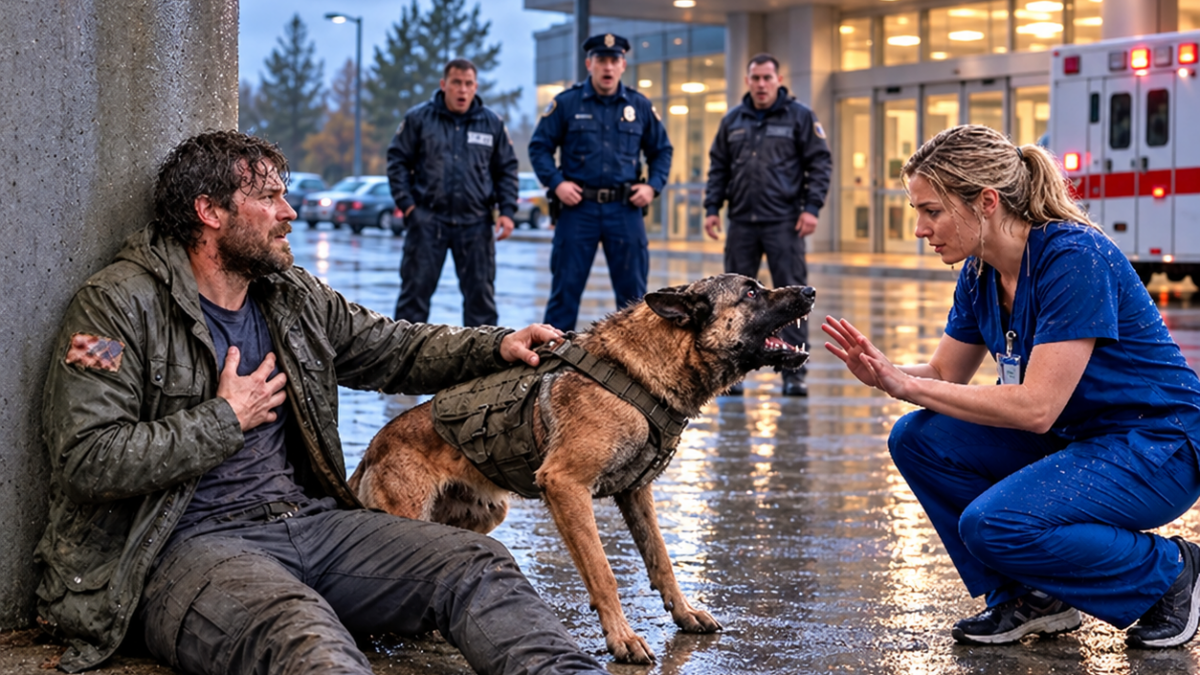
Ranger was not trying to hurt anyone.
He was trying to stop the world from taking the only person he had left.
“Give me two minutes,” I said.
Wilkes stared at me.
“Rachel—”
“Two minutes.”
Then I raised both hands, palms open and empty, and took one slow step forward.
Rain plastered my blonde hair against my face. My soaked scrub top clung to my shoulders. The cold bit through me immediately, but I kept my eyes on Ranger.
Not staring him down.
Not challenging.
Just present.
“Hey, buddy,” I murmured.
His growl deepened.
I lowered my body, crouching slightly so I did not loom over him.
“I see you. You’re doing a good job. You’re keeping him safe. Good boy.”
Ranger’s eyes locked onto mine.
Amber.
Sharp.
Intelligent.
Terrified.
The man on the ground coughed. Red touched his lips.
“Ma’am,” he rasped, “stay back. He was trained to protect. He won’t let you.”
“What’s your name?” I asked, still watching Ranger.
The man blinked hard, fighting to stay conscious.
“Thomas.”
“Last name?”
“Callahan.”
“Okay, Thomas Callahan. Listen to me carefully. I’m a nurse. I can help you, but I need Ranger to know I’m not a threat.”
“He won’t—”
“If you pass out right now, they’ll shoot your dog.”
The words hurt to say.
But pain is sometimes the only language shock can hear.
Thomas stared at me through rain, blood, and fear.
I kept my voice steady.
“You have to tell him I’m a friend. You have to do it now.”
His breathing hitched.
For one second, I thought he was gone.
Then he moved.
With a monumental effort, Thomas lifted his trembling, blood-soaked hand and placed it on the back of Ranger’s neck.
“Ranger,” he croaked.
The dog’s ears twitched.
“At ease.”
The transformation was instant.
Not complete trust.
Not relaxation.
Discipline.
Ranger’s rigid back loosened. The growl died in his throat. He looked down at Thomas and gave a small, worried whine, licking rain and blood from his chin.
Then he took one step back.
Just one.
It was enough.
“Gurney!” I shouted over my shoulder. “Now!”
The EMTs moved.
Wilkes helped lift Thomas. Security backed away from Ranger, which was smart because the dog watched every hand that touched his handler.
As we transferred Thomas onto the gurney, his fingers clawed weakly toward the Malinois.
“Ranger,” he gasped. “Don’t take him.”
“He comes with us,” I said.
Wilkes looked at me.
“Rachel, hospital policy—”
“I don’t care about policy right now.”
“You can’t bring an aggressive dog into the ER.”
“If we separate them, this man’s heart rate will spike, and he’ll bleed faster. The dog stays with him until I say otherwise.”
“Doctor Carter is going to lose his mind.”
“Then he can bill me for it.”
We moved.
The sliding doors opened, and we rushed Thomas inside, leaving a trail of rainwater, mud, and blood across the polished floor.
Ranger trotted beside the gurney, nose brushing Thomas’s dangling hand the entire way.
I did not know it then, but the man I was rushing toward Trauma Bay Three was carrying the answer to the darkest question of my life.
And the dog no one wanted inside the hospital was the only reason that answer had survived long enough to reach me.
Trauma Bay Three was already bright, loud, and waiting.
Dr. Simon Carter stood gloved beside the bed, trauma shears in hand, his face set in the expression doctors wear when they expect chaos but resent being surprised by it.
“What do we have?” he demanded.
Then Ranger stepped into the room.
Dr. Carter froze.
“What the hell is that doing in here?”
“Service animal,” I lied smoothly.
“That is not a service animal.”
“Patient is Thomas Callahan, male, early forties, deep puncture wound to the left lower quadrant, pressure eighty-five over fifty, pulse one-twenty and thready, altered but responsive.”
“Rachel.”
“Possible hypovolemic shock. We need fluids, type and cross, broad-spectrum antibiotics, and a surgical consult.”
“Rachel.”
“What?”
“Get the dog out.”
Thomas gripped the side rail weakly.
“Don’t,” he pleaded. “Don’t take him.”
The monitor screamed as his heart rhythm spiked.
Ranger pressed forward, lips twitching.
Dr. Carter stepped back.
“I am not working on a hemorrhaging patient with an unsterilized, aggressive dog in my trauma bay.”
“He is not aggressive. He is protective.”
“He is a liability.”
“He is the only thing keeping this patient conscious.”
Dr. Carter’s face hardened.
“Observation room. Behind the glass. The patient can see him. That is my final offer before security removes him.”
I looked at Thomas.
His eyes were wild.
“Thomas, look at me.”
He did not.
“Thomas.”
Finally, his gaze found mine.
“I’m going to put Ranger right behind that glass. He will see you the entire time. Nobody is going to hurt him. I swear it.”
“People always say that.”
“I’m not people right now. I’m your nurse.”
Something in his expression shifted.
Maybe he believed me.
Maybe he was too weak to fight.
He gave one tiny nod.
I took Ranger’s leash and led him into the adjoining observation room. He resisted once, not violently, but with the full weight of his body.
I crouched in front of him.
“You can see him from there. Watch him. Guard him from there.”
Ranger stared into my face.
Then, as if he understood more than any animal should, he stepped into the room.
The moment the door closed, he sat beside the glass partition.
His eyes never left Thomas.
Back in the trauma bay, the real work began.
We cut away the soaked jacket.
Then the shirt.
Then the layers beneath.
The smell of rain, dirty cloth, copper blood, sweat, and cheap whiskey filled the room.
But beneath the grime and street-worn clothes was not the body of an ordinary homeless man.
Thomas Callahan’s torso was a map of war.
Old bullet grazes.
Shrapnel scars.
A healed burn across his ribs.
Surgical lines that suggested trauma medicine in bad places under worse conditions.
Dr. Carter noticed too.
His voice lowered.
“Military?”
“Looks like it.”
Thomas groaned as Carter pressed gauze into the wound.
“Deep laceration,” Carter said. “Not a clean puncture. Maybe a knife. Get me irrigation. We need to clean his left side and start a proper line. His veins are collapsed.”
“I’m on it.”
I grabbed warm water, surgical soap, iodine, and a sponge.
Thomas faded in and out as the pain medication finally began to dull the worst of it. His shivering slowed, but his lips remained pale.
I started with his left arm, searching for a viable vein.
The skin was coated in layers of street dirt, dried blood, motor oil, and God knew what else. I washed slowly, carefully, dragging the warm sponge down his bicep and forearm.
The grime began to dissolve.
Pale skin appeared beneath.
Scarred skin.
Then ink.
At first, I thought it was a standard military tattoo.
I had seen hundreds.
Eagles.
Flags.
Unit numbers.
Memorial dates.
Names of fallen brothers.
But as I wiped away the final streak of mud near his inner forearm, the design emerged fully beneath the surgical lights.
My hand stopped.
The sponge slipped from my fingers and hit the floor.
I could not breathe.
It was a fractured trident striking downward through a weeping stone angel.
On either side of the angel were topographical coordinates.
Korengal Valley, Afghanistan.
Around the handle of the trident, etched in jagged black numbers, was a date.
October 14, 2012.
The sound in the trauma bay disappeared.
The heart monitor.
The rain.
Dr. Carter’s instructions.
The wheels of a cart outside the door.
All of it faded into a hollow ringing in my ears.
I knew that tattoo.
I knew every line of it.
Every shadow.
Every number.
Because fourteen years earlier, I had drawn the first version on a diner napkin in Seattle while laughing with my older brother, Staff Sergeant Mitchell Harding, the night before he left for his third deployment.
Mitchell had wanted something for his team.
Something nobody outside them would understand.
“A trident for the strike,” he had said.
I had added the angel.
“For the people who have to cry afterward,” I told him.
He had laughed and flicked a French fry at me.
“Dark, Rach.”
“You asked an ER nurse for tattoo design input. That’s on you.”
He got it inked on his forearm two days later.
A month after that, Mitchell was dead.
Officially, it was a training accident.
A friendly-territory mistake.
A redacted report.
A closed casket.
A folded flag.
A colonel I had never met telling my mother my brother had served with honor while refusing to answer a single real question.
But Mitchell had not been the kind of operator who died in a careless training accident.
I knew that.
My parents knew it.
Everyone who loved him knew it.
For years, I filed requests, wrote letters, contacted old unit friends, and knocked on doors that did not open. Every path ended at the same wall.
Classified.
No records available.
Operational sensitivity.
Matter closed.
Only four men had survived Mitchell’s last mission.
Four ghosts who vanished after his funeral.
Four men carrying the truth.
They called themselves the Weeping Angels.
And every one of them wore that tattoo.
“Rachel?”
Dr. Carter’s voice cut through the silence.
“Nurse Harding.”
I blinked.
He was staring at me.
“What is wrong with you? I need that IV.”
I looked down.
My hands were shaking.
“I’m fine.”
“You are clearly not fine.”
“I’ve got it.”
I grabbed a fresh needle.
As I leaned closer, Thomas’s eyes opened.
The pain medication had dulled his panic, but not his awareness.
His gaze moved from the ceiling to my face, then to the embroidered name on my scrub top.
R. Harding, RN.
His pupils widened.
Slowly, painfully, he reached up with his uninjured hand and grabbed my wrist.
His grip was weak but desperate.
“Harding,” he rasped.
My body went cold.
He stared into my face like he was seeing a ghost.
“You have his eyes.”
Tears burned instantly.
“You knew him,” I whispered. “You knew Mitchell.”
Thomas’s face twisted.
Not confusion.
Grief.
“They didn’t tell you the truth, did they?”
The room tilted.
Dr. Carter frowned.
“Rachel, step back.”
I did not move.
Thomas tightened his grip.
“He didn’t die in an accident,” he whispered. “He died saving me.”
My throat closed.
“Thomas.”
“And now, because I’m here, they’re going to come finish the job.”
Dr. Carter stared at him.
“What are you talking about?”
Thomas looked toward the door as if expecting something terrible to enter at any second.
“It was an execution.”
My heart slammed against my ribs.
“Who?”
He swallowed hard.
“We found something we were never supposed to see. Ghost weapons moving out of Bagram. Our own commanders were selling them to warlords and using the money for off-book operations.”
Dr. Carter’s expression changed.
“Enough. He’s altered.”
“He’s not,” I said.
“Rachel—”
I leaned closer to Thomas.
“Who ordered it?”
Thomas’s eyes found mine.
“Colonel David Erris.”
The name meant nothing to me.
And everything, because Thomas said it like a curse he had been carrying in his mouth for fourteen years.
“He orchestrated the ambush in the Korengal. Wiped out the squad to bury the supply line. Mitchell took two rounds to the chest so I could get down the ravine with proof.”
My tears fell before I could stop them.
Thomas’s voice broke.
“He saved my life, Rachel. I tried to get the truth out. I tried. But they killed the others. One by one. Accidents. Overdoses. Suicides that weren’t suicides. I went off-grid before they could find me.”
“The mugging tonight,” I said slowly. “It wasn’t a mugging.”
Thomas shook his head.
“A hit. Someone recognized me from an old bounty photo circulating in the underground. He cut me, but Ranger stopped him before he finished.”
Behind the glass, Ranger stood suddenly.
His ears went forward.
A low growl vibrated through the observation room.
Dr. Carter looked from Thomas to me.
“This is paranoia. Trauma. Shock. We need psych after surgery.”
“No,” Thomas said. “We need to leave.”
“You’re not going anywhere,” Carter snapped. “You’ll die.”
Thomas grabbed my wrist again.
“When they run my fingerprints through intake, they’ll know I’m here.”
Before I could answer, the trauma bay doors swung open.
Patricia Lewis, the veteran charge nurse on nights, rushed inside.
Patricia did not rush anywhere unless the building was on fire or about to become someone else’s crime scene.
Her face was pale.
“Rachel,” she said. “Simon. Listen to me carefully.”
“What?” Dr. Carter demanded.
“Two men just entered the main lobby. Tactical windbreakers. Badges I don’t recognize. Department of Defense, maybe. They’re demanding immediate release of a John Doe matching this man’s description.”
Thomas closed his eyes.
“And,” Patricia continued, glancing toward Ranger, “they specifically asked for the dog.”
The room went still.
Dr. Carter swallowed.
“Security can handle them.”
Patricia looked at him like he had said something innocent and stupid.
“They are armed, Simon. They bypassed triage and are searching the east wing room by room.”
Ranger’s growl deepened.
“How long?” I asked.
“Three minutes, maybe less.”
Something inside me went quiet.
The fear was still there.
The grief too.
But above both of them rose a different thing.
The same hard, focused clarity I used in trauma codes when panic would only waste time.
I looked at Patricia.
“I need a favor.”
“You always do.”
“A massive one.”
Patricia’s eyes sharpened.
“Say it.”
“Call Greg in security. Tell him to pull the fire alarm in the east wing and lock down the public elevators. Create a bottleneck.”
Dr. Carter stared at me.
“Rachel.”
I ignored him.
“We’re taking Thomas down to B2 through the service corridors. Morgue tunnel to the university garage.”
Patricia did not hesitate.
“I can get you a laundry cart.”
“Good.”
Dr. Carter stepped in front of me.
“You will lose your license.”
“My brother died for this man.”
“That doesn’t make you law enforcement.”
“No,” I said. “It makes me done waiting for people with badges to tell me the truth.”
Patricia disappeared into the hallway.
Thirty seconds later, she returned pushing a deep canvas laundry cart.
“You have two minutes,” she said. “Greg owes me. East alarm is about to go.”
Dr. Carter looked furious.
And terrified.
“This patient is unstable.”
“Then help us stabilize him while he moves.”
For one long second, I thought he would refuse.
Then he cursed under his breath and grabbed a trauma pack.
“If he dies in that cart, I’m blaming you in every deposition.”
“That’s fair.”
Together, Patricia, Carter, and I lifted Thomas from the bed.
He bit back a scream as we lowered him into the cart. I layered blood-stained scrubs and blankets over him, leaving enough room for air and access.
I opened the observation room door.
Ranger shot to Thomas’s side.
“Ranger,” Thomas whispered. “Stealth.”
The dog changed instantly.
No barking.
No growling.
He lowered his body, moved tight beside the cart, and became silent as a shadow.
The fire alarm exploded through the hospital.
Strobe lights flashed.
Doors opened.
Staff shouted.
Patients cried out in confusion.
Somewhere down the hall, people began running.
Patricia pushed first.
I pulled.
Dr. Carter moved beside us, one hand on the trauma pack.
Ranger guarded our rear.
As we reached the freight elevator, I looked through the glass doors toward the waiting area.
I saw them.
Two men moving against the flow of chaos with terrifying precision.
Not police.
Not hospital security.
Predators in government windbreakers.
One turned his head.
His eyes locked on mine.
I slammed the elevator button.
“Come on,” I whispered.
The doors slid open.
We shoved the cart inside.
Ranger bounded in.
I hit B2.
Just before the doors closed, the man broke into a sprint, reaching inside his jacket.
The metal doors sealed shut.
The elevator dropped.
For a moment, nobody spoke.
Only Thomas’s ragged breathing filled the space.
Then Dr. Carter whispered, “What the hell have you dragged me into?”
I looked at Thomas.
“I don’t know yet.”
Thomas closed his eyes.
“Yes, you do.”
The sub-basement was a maze of exposed pipes, damp concrete, old steam lines, and flickering fluorescent lights.
The air smelled of bleach and wet earth.
I pushed the cart hard, wheels rattling against the grooved floor. Patricia had shown me this route years before during a hospital disaster drill. Back then, I had complained it was pointless because nobody would ever need to use the morgue tunnel to escape armed federal operatives.
I owed her an apology.
Ranger moved beside us, checking corners, ears forward.
Thomas coughed under the blankets.
“Rachel.”
“Save your breath.”
“You need to know where it is.”
“Where what is?”
“The ledger.”
I looked down at him.
He pulled the blanket away just enough to speak clearly.
“I didn’t just run. I stole proof. Accounts, dates, transfers, names. Erris’s network. Everything.”
“Where?”
Thomas’s eyes moved to Ranger.
My stomach tightened.
“The harness,” he said. “Micro SD card. Stitched into the heavy nylon behind his neck.”
I looked at Ranger’s frayed tactical harness.
Mud-caked.
Worn.
Ordinary.
A vault.
The dog had not only been protecting Thomas.
He had been carrying the secret that got my brother killed.
We reached the steel door to the campus parking garage.
I shoved the crash bar.
Cold night air slapped my face.
My Subaru sat fifty yards away in the physician overflow lot.
For one second, I thought we had made it.
Then a shadow moved from behind a concrete pillar.
A man stepped into the dim light, suppressed pistol leveled at my chest.
The second operative.
He must have taken the exterior fire escape and cut us off.
“Step away from the cart, Nurse Harding,” he said.
His voice was calm.
Emotionless.
“You’re out of your depth. Walk away, and you get to live.”
I froze with both hands gripping the cart.
The rain had slowed, but water still dripped from the garage ceiling in steady taps.
Tap.
Tap.
Tap.
Behind me, Ranger went perfectly still.
“You killed Mitchell,” I said.
The man’s expression did not change.
“Your brother made a poor career choice.”
Rage flared so hot through my chest that for a moment it burned away the fear.
“He found your secret.”
“He found something above his pay grade.”
“His name was Mitchell Harding.”
The man stepped closer.
“Step away.”
Inside the cart, Thomas let out a sharp whistle.
“Ranger.”
The dog’s body dropped.
The operative’s eyes shifted.
Too late.
“Strike.”
Ranger launched.
He crossed the distance so fast the gunman barely had time to adjust his aim. The pistol fired once into the concrete, sending sparks across the floor.
Then Ranger hit him.
Seventy pounds of trained Belgian Malinois slammed into the man’s chest. He went down hard. Ranger’s jaws clamped around the gun arm with precise apprehension control.
He did not tear.
He held.
Pinned.
Controlled.
The man screamed.
“Go!” Thomas yelled.
I ran.
I shoved the cart toward my Subaru, fumbled the keys, unlocked the doors, and helped Thomas into the passenger seat. Every movement cost him pain. His face had gone gray again.
“Ranger, recall!” Thomas shouted.
The Malinois released instantly, spun, and bounded into the back seat.
I jumped behind the wheel.
The gunman staggered up behind us.
I slammed the car into reverse, clipped a trash bin, then threw it into drive and tore out of the garage.
Rain streaked the windshield.
My hands shook on the wheel.
Thomas pressed one hand over his wound.
Ranger leaned over the console, nose against Thomas’s shoulder.
“Where?” I asked.
Thomas forced his eyes open.
“Not the police.”
“I figured that part out.”
“South. Rural. No cameras. No hospital systems.”
“You’re bleeding again.”
“I know.”
“Thomas—”
“There’s a place,” he said. “Retired Rangers. Men who still remember what oaths mean.”
He gave me directions between shallow breaths.
I drove through the wet Portland night with my dead brother’s ghost in the passenger seat, the truth stitched into a dog’s harness, and the terrifying knowledge that my life had split into before and after.
Three weeks later, sunlight spilled across the porch of my family’s old farmhouse in rural Oregon.
The rain had finally stopped.
For the first time in what felt like years, the air smelled clean.
Pine needles.
Wet earth.
Coffee.
Something almost like peace.
I sat in the rocking chair near the window, holding a mug with both hands while the television played inside the living room.
The headline ran across every channel.
PENTAGON CORRUPTION SCANDAL WIDENS.
COLONEL DAVID ERRIS INDICTED ON TREASON, CONSPIRACY, AND MURDER CHARGES.
The story was everywhere now.
Not all of it.
Never all of it.
But enough.
Thomas’s retired Ranger contacts had gotten us to a safe house. Dr. Carter, furious and terrified, treated Thomas off-grid for the first forty-eight hours with the help of a former field surgeon who asked no questions and carried three weapons.
Patricia and Greg helped bury our tracks at the hospital long enough for the truth to outrun the men chasing it.
We cut the micro SD card from Ranger’s harness.
On it was the ledger Thomas had carried for fourteen years.
Names.
Accounts.
Dates.
Shipments.
Orders.
Proof.
The data went to the Inspector General.
Then to two reporters Mitchell would have liked because they were stubborn, angry, and allergic to intimidation.
After that, the dam broke.
The ghost weapons network collapsed in public view.
Retired officers were summoned.
Active officers were suspended.
Contractors disappeared behind lawyers.
A congressional committee pretended to be shocked.
And the Department of Defense finally issued a public correction regarding Staff Sergeant Mitchell Harding’s death.
He had not died in a training accident.
He had died in combat conditions during an unauthorized operation after exposing criminal conduct by superior officers.
The language was careful.
Sterile.
Government-clean.
But at the center of it was one truth they could no longer bury.
My brother had died a hero.
Not because they finally said so.
Because Thomas had lived long enough to prove it.
The screen door opened behind me.
Thomas stepped onto the porch.
He was clean-shaven now, thinner than he should have been, leaning heavily on a cane. But he was alive.
Ranger followed him, his coat brushed, harness repaired, amber eyes bright.
Thomas stopped beside my chair.
For a moment, we both watched the fields.
Then he reached into his pocket.
“I should have given you these sooner.”
He placed something cold and silver into my palm.
Dog tags.
Mitchell Harding.
My brother’s name pressed into metal.
My fingers closed around them so tightly the edges bit my skin.
Thomas’s voice thickened.
“He gave them to me in the ravine. Told me if I made it out, I should get them to you.”
I could not speak.
Thomas looked down.
“It took me a little while to get home.”
A laugh broke through my tears.
Not because it was funny.
Because the alternative was falling apart.
“Fourteen years is more than a little while.”
“I know.”
I pressed the tags against my chest.
Ranger came to my side and lowered his head under my hand.
I scratched behind his ears.
The dog leaned into me with a contented sigh.
For so long, I thought the truth would feel like victory.
It did not.
Not exactly.
It felt heavier.
It felt like a door opening in a room I had kept locked since my brother’s funeral.
There was relief, yes.
But grief came with it.
Fresh.
Sharp.
No longer softened by uncertainty.
Mitchell had not vanished into a lie anymore.
He stood in my memory with his full name, full courage, and full ending restored.
That mattered.
But it did not give him back.
Thomas seemed to understand.
“He talked about you,” he said quietly.
I looked up.
“What?”
“In the Korengal. Before everything went bad. He talked about his little sister who became a nurse because she said fixing people was better than shooting at them.”
I smiled through tears.
“That sounds like something I’d say.”
“He said you were stubborn.”
“That also sounds accurate.”
“He said if anything ever happened to him, you’d tear the world apart looking for answers.”
My throat tightened.
“He knew me.”
Thomas nodded.
“He was proud of you.”
I closed my eyes.
For fourteen years, I had chased documents, signatures, records, explanations.
But what I had wanted, underneath all of it, was one living person who could tell me my brother had remembered me before he died.
Thomas gave me that.
Not cleanly.
Not easily.
But truly.
The weeks turned into months.
Thomas stayed at the farmhouse while he healed.
At first, he slept on the couch because he refused the guest room.
Then Ranger started sleeping outside the guest room door.
Then Thomas stopped arguing with the dog.
That became a theme.
Ranger usually won.
Thomas did not know how to accept safety.
He flinched when cars slowed near the driveway.
He woke from nightmares with his hand reaching for a weapon he no longer carried.
He ate like someone who expected food to be taken away.
He apologized for towels, coffee, electricity, and breathing too loudly.
One evening, I finally set a plate in front of him and said, “If you apologize for dinner, I’m going to sedate you.”
He looked at me.
Then at the plate.
Then at Ranger.
The dog sneezed.
Thomas said, “Yes, ma’am.”
Progress, I learned, does not always look inspirational.
Sometimes it looks like a haunted man eating mashed potatoes without saying he is sorry for needing them.
Ranger healed too, though no one would have guessed he needed it.
His ribs became less visible.
His coat grew glossy.
He stopped sleeping with one eye open.
Eventually, he started chasing squirrels across the back field like he had never carried classified evidence or pinned an assassin to concrete in his life.
But if Thomas’s breathing changed in the night, Ranger was at his side before I reached the hallway.
Always watching.
Always working.
Always guarding the man who had guarded him from everyone else.
Six months after the indictment, I attended the ceremony correcting Mitchell’s record.
I almost did not go.
Public grief makes me uncomfortable.
Military language makes everything sound braver and cleaner than it felt.
But Thomas insisted.
“He deserves witnesses,” he said.
So we went.
I wore a navy dress my mother had once loved.
Thomas wore a suit that did not fit quite right because his body had changed too much.
Ranger wore a new harness with no hidden compartment.
At the ceremony, an officer I did not know spoke about sacrifice, duty, and truth.
I listened.
I tried not to resent how easily official voices say words they denied families for years.
Then they handed me a medal Mitchell should have received while my parents were still alive to see it.
My hands shook.
Thomas stood beside me, silent.
Ranger pressed against my leg.
Afterward, outside the building, Thomas looked up at the flag moving in the wind.
“I should have come sooner,” he said.
I knew he did not mean the ceremony.
I looked at him.
“You were surviving.”
“That doesn’t feel like enough.”
“It was enough to get the truth here.”
He nodded, but the guilt in his face remained.
Some burdens do not disappear just because history corrects its paperwork.
That night, back at the farmhouse, I placed Mitchell’s dog tags in a small wooden frame beside a photograph of him laughing in uniform.
Not the official portrait.
I hated that one.
Too stiff.
Too polished.
This photo showed him in the backyard years before his final deployment, holding a paper plate in one hand and trying to stop our mother’s terrier from stealing a hot dog.
That was the Mitchell I wanted remembered.
Not a file.
Not a symbol.
My brother.
Thomas stood in the doorway.
“Ranger has something for you,” he said.
I turned.
Ranger trotted forward carrying a small bundle wrapped in faded cloth.
He dropped it gently at my feet.
Inside was a patch.
Old.
Worn.
A black field with the fractured trident and weeping angel stitched in gray.
The Weeping Angels.
Thomas’s voice was quiet.
“Mitchell’s. I kept it after the ravine. Didn’t know why for a long time.”
I picked it up.
The fabric was soft with age.
“He’d want you to have it,” Thomas said.
I held the patch in one hand and the dog tags in the other.
For fourteen years, I had been given a folded flag and silence.
Now I had weight.
Metal.
Cloth.
Memory.
Truth.
I looked at Ranger.
“You carried all this home, didn’t you?”
The Malinois tilted his head.
Thomas smiled faintly.
“He’s dramatic when praised. Be careful.”
I knelt and wrapped my arms around the dog’s neck.
Ranger leaned into me.
For the first time since the hospital, I let myself cry without trying to stop.
Not the sharp tears of shock.
Not the furious tears of betrayal.
The exhausted tears of someone who had been holding a door shut for fourteen years and finally realized no one was trying to force it open anymore.
The storm was over.
Not because every wound healed.
Not because justice was perfect.
Not because the dead returned.
The storm was over because the lie no longer got to speak louder than the truth.
Thomas eventually moved into the small guest cabin near the south pasture.
He said it was temporary.
Then he built shelves.
Then he repaired the porch.
Then he planted tomatoes.
Men like Thomas rarely admit they are staying until their roots have already made the decision for them.
Ranger became the unofficial supervisor of the entire property.
He inspected every delivery.
Approved every visitor.
Rejected one plumber for reasons none of us ever understood but all of us respected.
And every morning, while I drank coffee on the porch, he would sit between Thomas and me like a guardian posted between past and future.
One year after the night at the hospital, I returned to Trauma Bay Three.
Not as the nurse on shift.
As a speaker for a veterans’ emergency care training.
Dr. Carter was there.
So was Patricia.
So was Wilkes, who still looked embarrassed every time Ranger entered a room.
I stood in front of a group of residents, nurses, EMTs, and security staff, and I told them what I had learned.
Not the classified details.
Not the names reporters had not already printed.
The human part.
I told them that a homeless veteran is not a diagnosis.
A dirty jacket is not a history.
A growling dog is not always a threat.
Sometimes it is a partner doing the last job he understands.
Sometimes the person everyone is afraid of is afraid for someone else.
Sometimes the truth you need most is hidden beneath what you assume you already know.
Then I looked at Ranger.
He sat beside Thomas in the front row, calm and proud, wearing his new harness.
“For the record,” I said, “this dog once violated every hospital policy we had.”
A few people laughed.
Dr. Carter muttered, “Several.”
I smiled.
“And if he had not, a man would have died outside our doors, my brother’s story would still be buried, and a criminal network would still be operating behind official silence.”
The room went quiet.
“So yes,” I said, “policy matters. Safety matters. But so does judgment. So does listening. So does remembering that every patient who comes through our doors had a life before we met them.”
Thomas looked down.
Ranger pressed his head against his knee.
I finished with the only lesson that still mattered to me.
“Treat the wound you can see. But never assume it is the only one bleeding.”
Afterward, Wilkes approached Thomas.
He looked uncomfortable.
“I owe you an apology,” he said.
Thomas studied him.
“For what?”
“For almost shooting your dog.”
Ranger looked up at the word dog.
Wilkes swallowed.
Thomas glanced at Ranger.
“Probably best you didn’t.”
Wilkes gave a nervous laugh.
Then he sobered.
“I saw a threat.”
Thomas nodded.
“He was one.”
Wilkes blinked.
Thomas continued.
“He was a threat to anyone trying to take me from him. You weren’t wrong to be careful.”
Wilkes looked surprised.
“But you weren’t seeing all of it,” Thomas added.
“No,” Wilkes said quietly. “I wasn’t.”
Thomas held out his hand.
Wilkes shook it.
Ranger allowed it.
That was as close to forgiveness as anyone needed that day.
That evening, back at the farmhouse, Thomas and I sat on the porch while rain tapped softly on the roof.
Not the violent rain of that hospital night.
This rain was gentle.
Almost kind.
Ranger slept at our feet.
I held Mitchell’s dog tags in one hand, turning them over with my thumb.
Thomas looked toward the dark field.
“Do you ever wish you hadn’t found out?”
I did not answer right away.
The truth had cost me.
It had put me in danger.
It had reopened grief.
It had forced me to see how many people in power had chosen silence because silence protected them.
But it had also given Mitchell back his name.
It had given Thomas back his life.
It had given Ranger a yard to run through without watching every shadow.
“No,” I said finally. “I wish it hadn’t been true. But I don’t wish I hadn’t learned it.”
Thomas nodded.
After a while, he said, “Mitchell used to say you were impossible to lie to.”
I smiled.
“He lied to me all the time when we were kids.”
“About what?”
“Taking my Halloween candy. Breaking my cassette player. Letting my hamster loose.”
Thomas actually laughed.
It was rare enough that Ranger lifted his head.
“What was the hamster’s name?” Thomas asked.
“General Waffles.”
Thomas stared at me.
“I was nine.”
“That doesn’t explain it.”
I laughed too.
The sound startled me.
Not because I had not laughed since Mitchell died.
I had.
But this laugh did not feel borrowed from before.
It belonged to now.
That mattered.
The world did not become simple after that.
No good story should pretend it did.
Some officials escaped consequences they deserved.
Some files stayed sealed.
Some families never got answers.
Thomas still had nightmares.
I still hated sudden knocks at the door.
Ranger still growled at men in tactical windbreakers on television.
But the lie that had shaped fourteen years of my life was broken.
And broken lies, like broken bones, can still ache after they are set right.
At least now they heal in the proper direction.
On the anniversary of Mitchell’s corrected record, Thomas, Ranger, and I drove to the coast.
Mitchell had loved the Oregon coast.
He used to say the ocean was the only thing loud enough to argue with him properly.
We scattered my parents’ old flowers from a cliffside path and stood watching gray waves fold into the rocks below.
I wore Mitchell’s dog tags beneath my jacket.
Thomas wore the Weeping Angels patch pinned inside his coat.
Ranger stood between us, wind whipping through his fur, nose lifted toward the salt air.
Thomas saluted.
I did not.
I just spoke to the wind.
“You were right,” I said.
Thomas looked at me.
“About what?”
I smiled through tears.
“That fixing people is better than shooting at them.”
Thomas looked back at the ocean.
“Mitchell would have laughed at that.”
“I know.”
“He would have been proud of you.”
This time, I believed it without needing proof.
On the drive home, Ranger fell asleep with his head on the center console, one ear touching Thomas’s arm and one paw pressed against my thigh.
That was how he liked us.
Connected.
Accounted for.
Guarded.
I thought back to the first moment I saw him outside the hospital, teeth bared, standing over Thomas in the rain while everyone around him reached for weapons.
Everyone saw danger.
I saw it too.
But beneath the danger was loyalty.
Beneath the mud was training.
Beneath the snarling was fear.
Beneath Thomas Callahan’s ruined jacket was a tattoo my brother had helped design.
And beneath fourteen years of silence was the truth waiting for someone to get close enough to uncover it.
That is what I remember most.
Not the chase.
Not the gun.
Not the headlines.
Not even the indictment.
I remember Ranger standing in the rain, refusing to let anyone touch the man who had protected the last proof of my brother’s courage.
I remember Thomas grabbing my wrist and saying, “You have his eyes.”
I remember realizing that the story I had been told at my brother’s funeral was not an ending.
It was a cover.
And I remember the moment the secret came clean beneath my hands.
Sometimes people come into the ER with wounds we know how to treat.
Knife wounds.
Broken bones.
Shock.
Blood loss.
Those are urgent.
Those are visible.
Those are the ones that make monitors scream and doctors move fast.
But sometimes the deepest wound in the room is a story that was stolen.
A name that was buried.
A hero called an accident.
A veteran called a drifter.
A loyal dog called a threat.
A sister told to stop asking questions.
I did not stop.
Neither did Thomas.
Neither did Ranger.
And because of that, my brother finally came home.
Not the way I wanted.
Not walking through the door with his crooked grin and a joke ready.
But in truth.
In honor.
In the weight of his dog tags against my palm.
In the man he saved.
In the dog who carried the proof.
In the life we built after the lie collapsed.
A homeless veteran protected his K9 from everyone that night because Ranger was all he had left.
But in the end, Ranger was protecting more than Thomas.
He was protecting Mitchell’s last mission.
He was protecting the truth.
And somehow, through blood, rain, fear, and fourteen years of silence, he brought it straight to me.








