A Hiker Found a Starving Mother Cat 9 Miles Deep in the Forest—Then He Saw the 3 Kittens She Had Hidden in a Hole Dug With Her Own Paws
PART3:
And found her sitting beside a fallen tree.
At first, I thought she was old.
That was how thin she looked.
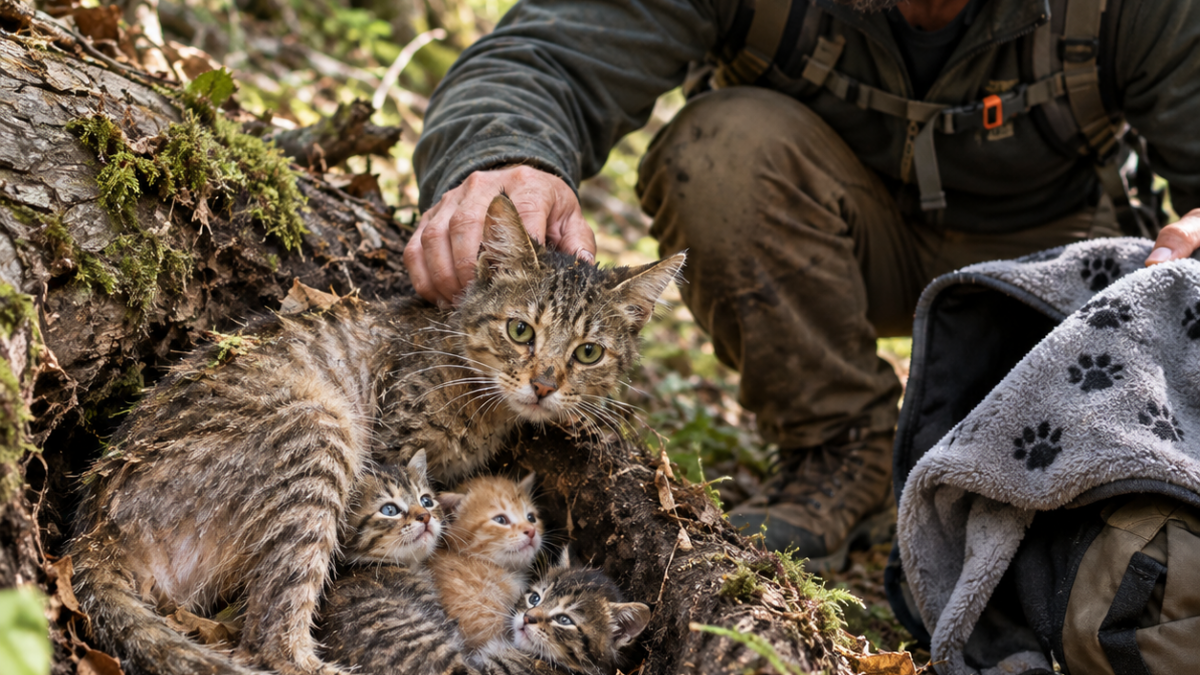
Her brown tabby coat had lost its shine and was full of burrs, leaf fragments, and tiny seeds. Her hips rose sharply beneath her skin. Every vertebra along her back was visible. Her face looked too large for her body because everything behind it had disappeared.
She was small even for a female cat.
She sat perfectly still on the forest floor, staring at me.
That was the first thing that felt wrong.
A stray cat that deep in the woods should have run.
Most domestic cats become nearly impossible to approach after enough time outside. They hide. They bolt. They keep distance because distance keeps them alive.
But this cat did not move.
She watched me.
Her eyes were yellow-green.
Tired.
Alert.
She gave one low warning sound when I stepped closer.
Not quite a growl.
Not quite a hiss.
I stopped immediately.
“All right,” I said. “I see you.”
Her ears flattened slightly.
But still she did not run.
I crouched about six feet away.
That was when I noticed she was not simply sitting.
She was covering something.
Between her front legs, beneath her belly, the ground dipped inward.
A hole.
Maybe eight inches deep, dug into soft earth between two exposed tree roots.
At first, I assumed it belonged to another animal.
Then I saw the edges.
Uneven.
Freshly disturbed.
Scratch marks running through the soil.
Cat-sized claw marks.
I shifted a little to the side.
She moved with me.
Not away.
Across.
Blocking my view.
That was when I understood.
“Oh,” I whispered.
The cat pressed herself lower over the opening.
I could see movement beneath her.
Tiny movement.
I took one careful step closer.
She flattened her ears but held her ground.
“I’m not taking them,” I said.
I have no idea why I said that.
Maybe because the look she gave me felt like a question.
I lowered myself to both knees.
And finally saw inside the hole.
Three kittens.
Packed tightly together on a bed of shredded leaves.
Four weeks old, maybe.
Eyes open.
Tiny ears upright.
One gray tabby.
One brown-and-white.
One almost black except for a white mark beneath the chin.
They were dirty.
Thin.
Alive.
That last word hit me harder than it should have.
Alive.
Nine miles from the nearest road.
No house.
No campground.
No food bowls.
No barn.
No people.
Three kittens curled inside a hole their mother had dug into the forest floor.
The mother stared at me as if waiting to see what kind of animal I was.
I slowly sat back.
“Okay,” I whispered. “Now I understand.”
She still did not relax.
Why would she?
For all she knew, I was simply the next predator.
I took my pack off slowly and pulled out a pouch of tuna I carried for trail lunches.
It was not cat food.
But it smelled strong.
The moment I tore it open, her eyes changed.
Not much.
Just enough.
She smelled it.
Her head moved half an inch.
I placed the tuna on a flat rock about four feet away.
Then backed up.
“Go ahead.”
She looked at the food.
Then at me.
Then down at the hole.
And she stayed exactly where she was.
That was the second thing that broke me.
She was starving.
I could see every bone.
The smell of food was close enough that her nose twitched.
But she would not leave the kittens uncovered while I was there.
I stood.
Backed away farther.
Maybe twenty feet.
Then turned partly sideways and pretended to look at the trees.
After almost a minute, I heard movement.
When I glanced back, she had climbed off the hole.
And I finally saw the rest of her.
She was much thinner than I had realized.
Her belly hung loose from nursing, but her waist had almost disappeared into bone. Her hind legs looked weak. She walked carefully, like every step cost something.
She reached the tuna and ate so fast I became afraid she would choke.
Not chewing.
Swallowing.
Stopping only long enough to look back at the nest every few seconds.
I poured a little water into the lid of my cooking container.
She drank.
Then returned immediately to the hole and lay over it again.
Not beside it.
Over it.
Her body covered the entrance almost perfectly.
The kittens disappeared.
I walked around slowly, studying the shelter.
That was when I began noticing the engineering.
I know that sounds like a ridiculous word to use for a hole dug by a cat.
It wasn’t.
The nest was positioned beneath the overhanging side of a fallen tree, protected from the worst direct rain. It sat between two exposed roots that formed natural walls. The hole was deep enough to lower the kittens below ground level, but not so wide that the mother could not cover most of the opening with her body.
When she stretched over it, there was almost nothing visible underneath her.
Any predator passing nearby would smell an adult cat.
Not three helpless kittens.
She had become the roof.
The camouflage.
The door.
A living lid.
And around the nest, I found small channels scratched into the dirt.
At first, I thought they were animal tracks.
Then I saw where they led.
Downhill.
Drainage.
She had dug shallow trenches to carry rainwater away from the nest.
I stared at them for a long time.
It had rained hard three nights earlier.
Without those little channels, the hole might have flooded.
I moved closer to the fallen tree.
There were scratch marks in the bark.
Not old ones.
The dirt nearby was torn up.
Several feet away, caught on rough bark, was a small tuft of gray fur.
Not hers.
Raccoon, maybe.
Fox.
I could not know.
But something had approached that nest.
And she had fought it.
I looked back at the mother.
She had one dark swelling on her left shoulder that I had not noticed beneath the dirt.
Probably a bite.
Possibly infected.
I stopped seeing a starving stray cat.
I started seeing the previous four weeks.
A pregnant or recently nursing cat somehow abandoned deep in forest country.
Giving birth alone.
Digging because she had nowhere else.
Moving leaves into the hole.
Hunting whatever she could catch.
Returning constantly because kittens that young could not regulate themselves properly.
Lying over them when danger came.
Feeding them from a body that was shrinking every day.
Fighting something larger than herself.
Digging drainage trenches after rain.
And doing all of it without anyone knowing she existed.
I sat down hard on a rock.
“You’ve been busy,” I told her.
She blinked once.
I used the little cell service I had to send a message to another volunteer near the trailhead.
FOUND CAT + 3 KITTENS. VERY BAD CONDITION. NEED VET.
The message took almost two minutes to send.
Then I called the emergency veterinary hospital nearest the trailhead.
Three failed calls.
On the fourth, it connected.
I explained where I was.
The receptionist thought she had heard me wrong.
“You’re how far from your vehicle?”
“Just over nine miles.”
There was a pause.
“And you have four cats?”
“One adult. Three kittens.”
“Can you bring them out?”
I looked at the mother.
At the hole.
At the trail climbing above me.
“I’m going to.”
I should tell you that carrying an adult cat and three kittens nine miles out of rough mountain terrain is a terrible plan.
I had no crate.
No box.
No proper carrier.
Just a fleece jacket inside my pack.
So I improvised.
I took the jacket out and spread it carefully on the ground near the nest.
The mother watched every movement.
I let her smell my hand.
She hissed.
Fair.
I waited.
Then I slid one hand beneath her chest.
For about ten seconds, she fought me.
Not violently.
Desperately.
She twisted, claws catching my sleeve, trying to return to the hole.
“I know,” I said. “I know. I’m not leaving them.”
She did not understand.
So I showed her.
I lifted the first kitten gently.
Her entire body stiffened.
Then I placed the kitten inside the fleece jacket against my stomach.
Second kitten.
Then third.
The mother struggled again.
I lowered her beside them.
The second she felt the kittens, she changed.
Completely.
She curled around all three.
Her front legs enclosed them.
Her body formed a tight crescent.
The kittens immediately began crawling toward her belly.
And before I had even finished closing the jacket around them, I felt vibration against my stomach.
Purring.
I looked down.
She was purring.
Not loudly.
But continuously.
After everything.
After starvation.
After fighting predators.
After weeks of guarding that hole.
The moment all three kittens were against her body, she purred.
I stood there in the middle of the forest with tears suddenly burning my eyes.
“All right,” I said.
My voice sounded rough.
“All right, Mama. We’re going home.”
The first two miles were uphill.
Of course they were.
There are moments in life when the universe could choose to be kind and instead seems to look at you and say, Let’s make sure you mean it.
I held the jacket against my chest with my left arm.
Used my hiking pole in my right.
My tools stayed where I had left them.
I would come back later.
Every few minutes, I stopped and checked inside the jacket.
The kittens were nursing.
The mother watched me.
Sometimes her eyes closed.
Sometimes they opened when I shifted.
But she never tried to escape.
Not once.
She had spent weeks refusing to leave those kittens.
Now that they were against her body, she seemed to make a decision.
Where they went, she went.
The weight should have been manageable.
All four cats together weighed less than some backpack loads I had carried.
But the responsibility changed the weight.
Every rock mattered.
Every slippery root.
Every steep section.
I could not fall.
I could not stumble.
I could not let the jacket open.
For three hours, I walked with my left arm locked across my chest.
By the end, my shoulder burned.
My hand went numb twice.
My shirt was soaked through.
I stopped drinking as much water because every time I reached for the bottle, I had to adjust my hold, and I hated making the mother look up.
The trail descended along a narrow ridge in the final miles, rocky and exposed on one side.
Normally, I loved that section.
That day, I hated every stone.
I took each step slowly.
Plant the pole.
Test the rock.
Move one foot.
Then the other.
The mother cat never moved.
The kittens nursed, slept, shifted, then nursed again.
And through the fleece, against my chest, I kept feeling that purr.
Mile after mile.
That is what I remember most.
Not the pain in my shoulder.
Not the heat.
Not the fear of slipping.
The purring.
I have carried expensive gear.
I have carried emergency supplies.
I once helped carry an injured hiker on a stretcher down three miles of mountain trail.
But nothing I have ever carried felt as important as that fleece jacket.
By the time I reached the trailhead, two volunteers were waiting.
One of them, Marcus, ran toward me.
“You okay?”
“Yes.”
“The cats?”
I opened the jacket slightly.
He stared.
“Oh my God.”
The mother opened one eye.
Marcus immediately stepped back.
“She’s tiny.”
“She wasn’t always.”
That was the first time I said it aloud.
The vet later confirmed it.
Her normal adult weight should have been around eight pounds.
She weighed less than four.
Half her body mass was gone.
We drove straight to the clinic.
I sat in the passenger seat holding the bundle exactly as I had on the trail.
The mother still would not separate from the kittens.
When we entered the veterinary hospital, the staff had already prepared a room.
Dr. Maya Bennett was the veterinarian on duty.
The moment she saw the mother cat, her face became serious.
“Put them here.”
I opened the fleece.
The three kittens squirmed.
The mother tried to curl around them again.
Dr. Bennett touched her gently.
“Oh, sweetheart.”
The examination took more than an hour.
Severe malnutrition.
Dehydration.
Inflamed mammary glands from nursing despite inadequate nutrition.
An abscess in the left shoulder, likely from a bite.
Raw paw pads.
Damaged claws.
Dirt packed so deeply beneath several claws that the staff eventually had to sedate her to clean them properly.
The kittens, somehow, were in much better condition.
Thin, yes.
But active.
Hydrated enough.
Warm.
Responsive.
The gray kitten hissed at everyone.
Dr. Bennett smiled.
“That’s a good sign.”
I stood beside the exam table.
“How are they better than she is?”
The doctor looked at the mother.
“Because she gave them everything.”
She explained it medically.
The mother was producing milk with calories she did not actually have available through food. Her body had started consuming its own reserves.
Fat first.
Then muscle.
Her body was effectively feeding the kittens by dismantling itself.
I stared at the tiny cat.
“She was starving herself to keep nursing?”
“Not consciously the way a person would decide to,” Dr. Bennett said. “But physiologically? Yes. Her body prioritized lactation. She kept producing as long as she could.”
The doctor lifted one paw.
The pads were raw.
“These aren’t walking injuries.”
“What are they?”
“Digging.”
I thought of the nest.
The drainage channels.
The claw marks.
“She dug all that with these?”
Dr. Bennett nodded.
“Repeatedly, from the looks of it.”
I had taken photographs before we left the site so wildlife officers could understand where she had been found. Dr. Bennett studied them.
“She built this?”
“Yes.”
The doctor enlarged one image.
“See the angle here? The entrance is protected by the root system. And these channels?”
“Drainage.”
Dr. Bennett looked at me.
“You found a very smart cat.”
“No,” I said quietly.
“I found a mother.”
The kittens stayed with her.
The clinic staff supplemented them with formula and gradually introduced soft food because the mother needed every calorie they could return to her. They fed her small high-calorie meals frequently so her stomach would not be overwhelmed.
She remained hospitalized for six days.
I visited every day.
I told myself it was because I had found them and wanted to make sure they survived.
By the third day, no one believed me.
Least of all Dr. Bennett.
“You know she watches the door around the time you usually come in,” she said.
“She watches every door.”
“No. She watches that one.”
I looked through the kennel glass.
The mother was lying on a blanket with all three kittens piled against her.
Her eyes were clearer.
Still tired.
But stronger.
When I opened the kennel, she did not retreat.
I sat on the floor.
She stood.
Walked slowly toward me.
And placed one paw on my leg.
That was all.
One paw.
Then she returned to the kittens.
I went out to my truck afterward and sat there for twenty minutes.
I had no explanation for why that affected me so much.
Maybe because trust from an animal like that is not loud.
It does not arrive with speeches.
It arrives one inch at a time.
One paw.
One blink.
One decision not to run.
On the fourth day, Dr. Bennett called me into the examination room.
“We found a microchip.”
I stared at her.
“So she belongs to someone.”
“Belonged, maybe.”
The chip was inactive.
The registration database had no current owner.
The clinic that implanted it had closed years earlier.
There was also evidence of a previous spay surgery—but something had been incomplete or unsuccessful, explaining how she had later become pregnant.
That changed the story in one painful way.
She had not been born wild.
At some point, someone had owned her.
Fed her.
Taken her to a clinic.
Paid for a microchip.
Maybe called her by a name.
Maybe let her sleep on a couch.
Maybe she once knew the sound of a food can opening and the warmth of a bed.
Then somehow she ended up nine miles into one of the deepest forest sections in the region.
How?
We never learned.
Maybe she was abandoned near a logging road and wandered deeper.
Maybe she escaped a campsite.
Maybe someone intentionally drove her somewhere remote.
Maybe her previous owner had died and she passed through several careless hands.
I still do not know.
I only know she had known humans before.
Which made something else harder to understand.
She still trusted me.
The three kittens improved quickly.
Their personalities appeared the second they had enough food to express them.
The gray tabby was fearless and angry at gravity.
The dark kitten wanted to climb everything, especially things too tall for him.
The brown-and-white female slept like she had a full-time job.
By six weeks old, they were eating soft food and running around their foster room.
By seven weeks, all three had approved homes.
I thought saying goodbye would be sad.
It was.
But it was also strange to see them leave one by one in the arms of people who had prepared beds, toys, little bowls, and names.
The gray kitten became Jasper.
The dark one became Bean.
The brown-and-white girl became Maple.
Their mother watched each departure.
I worried she would become distressed.
She sniffed the empty carrier after Maple left.
Then walked to the window.
Sat in the sunlight.
And slept.
Dr. Bennett said the timing was right.
The kittens were independent.
Her job was done.
Except I did not think she knew what came next.
Neither did I.
The clinic called her “Mama Tabby.”
I hated it.
Not because it was wrong.
Because she had earned a name that belonged only to her.
On the sixth day, Dr. Bennett handed me discharge papers.
“She can go to foster.”
“Okay.”
The doctor looked at me.
I looked at her.
Neither spoke.
Finally, she said, “Daniel.”
“What?”
“You carried her nine miles.”
“Almost nine and a half.”
“Exactly. And you have visited every day.”
“I was checking on her.”
“Of course.”
“She needs a quiet place.”
“Yes.”
“I have a quiet place.”
“I know.”
I sighed.
“You planned this conversation.”
“Since day two.”
The cat sat in the carrier between us.
I crouched.
She looked at me through the door.
“You want to come home with me?”
She rubbed one cheek against the plastic.
Dr. Bennett smiled.
“That sounded legally binding.”
So I adopted her.
I named her Nine.
Partly because she had been found roughly nine miles into the forest.
Partly because cats are said to have nine lives.
Mostly because after what she had done, I thought she had probably used several already.
Nine entered my house like someone inspecting a rental property.
She checked every room.
Looked under the couch.
Jumped onto the windowsill.
Inspected the kitchen.
Ignored the expensive cat bed I had bought.
Then slept in the cardboard box it came in.
Of course she did.
For the first week, she woke at every sound.
A branch hitting the roof.
A truck passing.
My refrigerator turning on.
Her ears would snap forward.
Her body would become still.
Listening.
Measuring.
In the forest, every sound had mattered.
Owl.
Fox.
Raccoon.
Storm.
Falling branch.
Something moving through brush.
Safety there depended on noticing first.
It took months before she stopped scanning every room as if something might come through the wall.
Food was different.
The first few weeks, she ate as if every meal might be the last.
I gave her small portions because the vet told me to manage her weight gain carefully.
Nine would finish, lick the bowl, then check the kitchen floor for more.
I started keeping dry food locked in a cabinet after she opened a lower cupboard one night and tore into an entire bag.
The next morning, I found her lying beside it with the expression of someone who had solved capitalism.
“You cannot eat everything at once,” I told her.
She stared.
“You have food tomorrow.”
Stare.
“And the day after.”
She blinked.
I realized then what an absurd promise that was to an animal that had spent weeks never knowing if the next vole would be caught.
So I stopped getting frustrated.
Every meal went down at the same times.
Morning.
Afternoon.
Evening.
Eventually, she learned.
The bowl would fill again.
Safety, I discovered, is not something you explain.
It is something you repeat until the body believes you.
Nine’s paws healed.
The abscess healed.
Her fur became glossy again.
She gained weight slowly until her spine disappeared beneath muscle and healthy tissue.
Her eyes changed too.
Not color.
Expression.
There is a look animals get when they stop expecting the world to attack them every minute.
I cannot describe it better than that.
One evening, about four months after I found her, a thunderstorm came through.
Hard rain.
Wind.
Branches moving.
Nine vanished.
I found her under my bed.
She was curled tightly against the wall.
Not shaking.
But alert.
I lay on the floor several feet away.
“I know,” I said.
The rain hammered the roof.
Nine watched me.
I thought about those drainage channels around the nest.
The raw pads.
Her body stretched over the hole while rain fell on her back.
I stayed there almost an hour.
Finally, she crawled out.
Not completely.
Just far enough to place her head against my hand.
We stayed like that until the storm passed.
People ask me sometimes if Nine understood that I rescued her.
I do not think animals think in those words.
I think she understood something simpler.
I arrived.
The kittens remained safe.
She was carried.
Food appeared.
Pain stopped.
Then I kept coming back.
That was enough.
The story eventually spread through the volunteer trail community.
Someone had seen me carrying the fleece bundle out.
Someone else knew the vet staff.
Within a month, everyone had heard about the “mountain cat.”
People offered to donate money.
The clinic accepted help toward her medical bills.
A woman mailed knitted kitten blankets even though the kittens had already been adopted.
A local outdoor store gave me a new fleece jacket because mine had been permanently claimed by Nine.
I still have the old one.
It hangs by my back door.
There are claw marks near the zipper.
I have never washed them out.
One winter afternoon, my friend Marcus came over and found Nine asleep in my lap.
He had been with the trail crew when I emerged from the forest.
He looked at her healthy body, then laughed.
“That’s the same cat?”
“Apparently.”
“She looked dead.”
“I know.”
Nine opened one eye, offended.
Marcus sat across from me.
“You ever think about what would’ve happened if you didn’t stop?”
I did.
Too often.
But I rarely said it aloud.
“I almost didn’t.”
He nodded.
“You were behind schedule.”
“I was.”
Nine shifted in my lap.
I looked down.
“That’s the part that gets me.”
“What?”
“I almost let a schedule decide whether four animals lived.”
Marcus leaned back.
“You didn’t.”
“No.”
“That matters too.”
I knew he was right.
But I also knew how close life sometimes comes to being missed because we are busy.
Because we are late.
Because someone else will probably handle it.
Because the sound is faint.
Because stopping is inconvenient.
Nine had cried twice.
That was all.
Two weak sounds from ten yards off the trail.
If I had been wearing headphones, I would not have heard them.
If wind had been stronger, I might not have heard them.
If she had been too weak to make the second sound, I might have kept walking.
Sometimes I lie awake thinking about that.
Then Nine jumps onto my bed, steps directly on my ribs because cats believe internal organs are furniture, and settles beside me.
Life rarely lets you remain philosophical for long.
By the next summer, Nine had changed completely.
She had become confident.
Demanding.
Very interested in squirrels.
She slept in sunbeams.
She screamed at closed bathroom doors.
She developed a habit of sitting on my maps whenever I tried to plan trail routes.
The first time I returned to the area where I had found her, I went alone.
I did not take Nine.
I do not know if bringing her back would have mattered to her.
It mattered too much to me.
The nest was still visible.
Barely.
Rain had softened the edges.
Leaves filled part of the hole.
But the exposed roots remained.
So did one faint drainage channel.
I knelt there for a long time.
From that position, I could see exactly what she had seen.
The narrow entrance.
The fallen tree.
The forest beyond.
I placed my palm on the dirt.
Four weeks.
That number stayed with me.
Four weeks of nights.
Four weeks of hunger.
Four weeks of returning to that hole.
I found myself looking at the ground nearby for traces of fur.
Nothing remained.
Nature had already moved on.
That is what forests do.
They do not build monuments.
They grow over everything.
But I remembered.
I walked the surrounding area, trying to understand her hunting range.
The vet had found evidence near the nest when we returned with wildlife staff after the rescue: bits of vole fur, feathers, insect shells.
She had been leaving the kittens only in short intervals.
Catch something.
Eat.
Return.
Again.
Again.
Again.
She could have left.
That is important.
At any point, Nine might have abandoned the litter and traveled toward easier food.
Adult cats can survive where newborn kittens cannot.
She did not.
Instinct, biology, whatever word you prefer—she stayed.
And the cost was written across her body.
She weighed half what she should have.
Her body consumed itself to feed them.
Her paws were damaged from building and repairing the nest.
Her shoulder carried the abscess from whatever animal she fought.
Yet all three kittens lived.
Every one.
That fact still seems impossible to me.
One evening, about a year after the rescue, the families who adopted Jasper, Bean, and Maple agreed to meet.
We held a ridiculous little reunion in my backyard.
Nine sat under a patio chair and looked deeply unimpressed.
Jasper had grown into a huge gray cat with shoulders like a small bulldog.
Bean was long, black, and chaotic.
Maple had remained tiny and sweet until someone attempted to touch her belly, at which point sweetness became theoretical.
Their owners brought photographs.
Jasper asleep beside a toddler.
Bean inside a Christmas tree.
Maple curled on the shoulder of an elderly woman who had lost her husband the year before.
I looked from those pictures to Nine.
Three lives she had built out of almost nothing.
Jasper’s owner crouched beside her.
“So this is their mom.”
Nine sniffed her fingers.
“She saved them,” the woman said.
I shook my head.
“She did more than that.”
I told them about the nest.
The drainage channels.
The raw paws.
The fur caught on the fallen tree.
The way she would not eat while I stood near the kittens.
The way she purred inside my jacket all nine miles out.
By the end, nobody spoke.
Then Maple’s owner said quietly, “She gave them everything.”
Nine chose that moment to steal a piece of chicken from a plate.
I laughed.
“She’s making up for it now.”
That became the rule of her life.
Nine had sacrificed enough.
She never had to sacrifice again.
If she wanted the good blanket, she got the good blanket.
If she wanted the chair, I sat somewhere else.
If she demanded breakfast six minutes early, we negotiated for approximately thirty seconds before she won.
If she wanted my lap while I was working, work became secondary.
Some people would call that spoiling her.
Those people did not meet her in the forest.
Nine grew especially attached to the window beside my desk.
From there, she could see the tree line.
Birds.
Squirrels.
Falling leaves.
Rain.
She watched everything.
But she never tried to escape outside.
Not once.
The door could stand open while I carried groceries, and Nine would stop at the threshold.
She might sniff the air.
She might look toward the trees.
Then she stepped backward.
Home, to her, had a boundary.
And she knew which side she wanted.
Three years after I found her, I suffered a minor heart attack.
Nothing cinematic.
No collapsing dramatically in the yard.
Just pressure in my chest one morning, nausea, sweat, and a stubborn decision to believe I had eaten something bad.
Nine disagreed.
She followed me from room to room, meowing in a way I had never heard before.
When I sat down, she climbed onto my chest and would not settle.
Just paced across me.
Meowed.
Jumped down.
Returned.
Finally, I called Marcus.
He came over, took one look at me, and drove me to the hospital.
Later, he said, “Your cat saved you.”
I told him that was dramatic.
He replied, “You were going to lie down and wait.”
He was right.
When I came home two days later, Nine met me at the door.
She stared for a moment.
Then walked away.
I laughed.
“That’s it?”
She jumped onto the couch.
I sat beside her.
She climbed into my lap.
And purred.
For the first time, I wondered whether the debt had changed direction.
I had carried her once.
Maybe she had been carrying me in smaller ways ever since.
When people hear Nine’s story, they tend to focus on the wilderness.
Nine miles from the trailhead.
Predators.
Hunger.
The hole.
The raw paws.
Those things matter.
But they are not the part I think about most.
I think about how ordinary she became afterward.
And I mean that as the highest compliment.
She became a cat.
Not a victim.
Not a symbol.
Not a miracle people could point at forever.
A cat.
She chased dust.
She hated nail trims.
She slept upside down.
She threw up on a rug I liked.
She once spent forty minutes trying to fit into a shoebox obviously too small for her and then looked personally offended by geometry.
That is what rescue should lead to.
Ordinary life.
The right to be boring.
The right to be difficult.
The right to have preferences unrelated to survival.
Nine had spent weeks being nothing but a mother, hunter, guard, shelter, heater, and food source.
In my house, she got to be selfish.
I was happy to let her.
Years after the rescue, Dr. Bennett still remembered her.
At every annual examination, she would run her hands over Nine’s healthy body and shake her head.
“You know what she weighed when she came in?”
“I remember.”
“Three pounds, fourteen ounces.”
“I remember everything.”
The shoulder scar remained beneath her fur.
Several claws grew a little strangely from the damage.
Otherwise, there was surprisingly little visible evidence of those weeks in the forest.
That seemed unfair somehow.
Not because I wanted scars.
Because I wanted the world to know what she had done.
Then I realized she did not need visible proof.
The proof was Jasper sleeping beside a child.
Bean destroying Christmas decorations.
Maple comforting a widow.
The proof was Nine herself, sprawled across my clean laundry with no concern for the man who had folded it.
One fall afternoon, I gave a talk to a group of new trail volunteers about safety, emergency communication, and wildlife encounters.
I had no intention of mentioning Nine.
Someone else did.
A young volunteer raised his hand.
“Are you the guy who found that cat with the kittens?”
Half the room turned.
I sighed.
“Yes.”
“Is it true you carried them nine miles?”
“Yes.”
“Did you really find them in a hole?”
“Yes.”
“What was she doing out there?”
I paused.
“No one knows.”
Then another person asked, “How did she keep them alive?”
That question had an answer.
So I told them.
I described the nest.
The depth.
The roots.
The drainage.
The hunting remains.
The bite wound.
The raw paws.
The nursing.
The weight loss.
The way she covered the entrance with her own body.
The room became completely silent.
Then one volunteer asked, “Why didn’t she just leave?”
I looked at him.
“Because the kittens were there.”
It was the simplest answer.
And maybe the truest.
After the talk, a woman stayed behind.
She told me she had recently left an abusive marriage with two children.
She did not give details.
She did not need to.
She said, “People keep asking why I waited so long.”
I did not know what to say.
She looked at a photograph of Nine on my phone, healthy and round on my couch.
Then she said, “Sometimes you’re not staying because you don’t want to leave. You’re staying because you’re trying to keep something else alive.”
I have remembered that sentence ever since.
Nine’s story belonged to a cat.
But people carried pieces of themselves into it.
Mothers.
Fathers.
Caregivers.
People who had survived on too little.
People whose bodies had paid the cost for protecting someone else.
People who had kept going long after their reserves should have been empty.
I stopped correcting them.
A story does not always remain where it began.
Nine is older now.
Her face has softened.
Her jumps are more careful.
She sleeps more than she used to.
But every morning, she still comes to the same window.
She sits in the sunlight and looks toward the trees.
I sometimes wonder what she remembers.
Does a certain smell bring back the forest?
Does damp soil mean anything to her?
Does the sound of an owl reach some old hidden part of her body?
I will never know.
What I do know is that she does not sleep with one eye open anymore.
She sleeps deeply.
Fully.
Sometimes on her back.
Feet in the air.
Belly exposed.
An animal cannot offer much more evidence of safety than that.
I still hike.
Not as fast.
Not as far.
I carry a little pouch of cat food now.
People laugh when they see it.
I let them.
I also stop when I hear strange sounds.
Every time.
No matter how late I am.
Because once, on a hot August afternoon, I almost kept walking.
There was work to finish.
Miles ahead.
Daylight fading.
Perfectly reasonable reasons not to stop.
Then a starving cat cried a second time.
And because I turned off the trail, three kittens grew up.
A mother survived.
And my quiet house stopped being empty.
I have walked more than four thousand miles through those mountains.
I have found abandoned camps.
Lost gear.
Broken equipment.
Animal bones.
Storm damage.
Places so beautiful they made me forget my own name for a minute.
But I have never found anything like Nine.
A little tabby almost nine miles into the wilderness.
No reliable food.
No human help.
Three kittens hidden in a hole she dug herself.
She built a shelter.
She dug drainage.
She hunted.
She fought at least one predator.
She nursed three babies until her body began consuming its own muscle.
And when I finally lifted her away from that place, there was so little left of her that I could feel every bone through my jacket.
She had given the kittens nearly everything.
Her calories.
Her strength.
Her paws.
Her sleep.
Her safety.
What remained barely filled the space against my chest.
But she purred.
That is the part I will tell for the rest of my life.
Not because I think the purring meant she was thanking me.
Maybe it did.
Maybe it did not.
Maybe she was calming herself.
Maybe she was calming the kittens.
Maybe she was simply responding to warmth after weeks of cold nights on dirt.
I do not need to know.
For almost nine miles, over rock and roots and steep trail, I carried that mother cat against my chest while her kittens nursed inside my fleece jacket.
My arm went numb.
My legs shook.
The sun dropped lower.
And through all of it, I could feel that small vibration against my ribs.
Mile after mile.
She purred.
She had spent weeks giving every piece of herself to keep three smaller lives breathing.
Then for three hours, someone else carried her.
Maybe that was the first moment she understood she did not have to do everything alone anymore.
And maybe that is why, even now, when Nine climbs into my lap and curls into a warm circle beneath my hand, I think about the hole beneath those roots.
I think about the raw paws that dug it.
The body that covered it.
The kittens hidden underneath.
And the starving little mother who refused to move because leaving would have meant abandoning the only lives that mattered to her.
I almost walked past her.
I will carry that truth with me too.
Not as guilt.
As a reminder.
Sometimes the most important thing you will ever do begins with an inconvenience.
A sound off the trail.
A delay.
Something small asking you to stop when you are certain you do not have time.
I stopped.
Nine had already done everything else.








