A Hiker Found a Starving Mother Cat 9 Miles Deep in the Forest—She Was Too Weak to Move, and He Almost Walked Away. Then He Saw What She Was Sitting On… Three Tiny Kittens Hidden in a Hole She Had Dug With Her Own Bleeding Paws.
PART3
This time there was no question.
A cat.
He looked into the understory.
The sound had come from downslope, maybe thirty feet from the trail.
That made no sense.
He was roughly nine miles from the nearest trailhead by the official map and even farther from the nearest occupied house.
A domestic cat did not simply appear nine miles into that forest.
Maybe someone had brought one camping.
Maybe it was feral.
Maybe he was mishearing some bird call.
Caleb checked his watch again.
Then looked down the trail.
He had work to finish.
He was carrying saws, loppers, a Pulaski axe, water, first-aid gear, and a pack already too heavy.
If it was a feral cat, it would disappear the moment he approached.
If it was injured wildlife, he might make things worse.
He took another step.
Then the sound came again.
This time weaker.
Not calling.
Almost failing.
Caleb set the loppers down.
“Damn it.”
He stepped off the trail.
Briars caught his pants immediately.
He pushed through mountain laurel.
Twigs scraped his forearms.
The forest floor fell steeply toward a dry ravine.
“Hey.”
He felt ridiculous.
“Kitty?”
Nothing.
Caleb moved toward a fallen oak.
Then he saw two eyes watching him from beneath the shadow of the trunk.
Yellow-green.
Motionless.
He stopped.
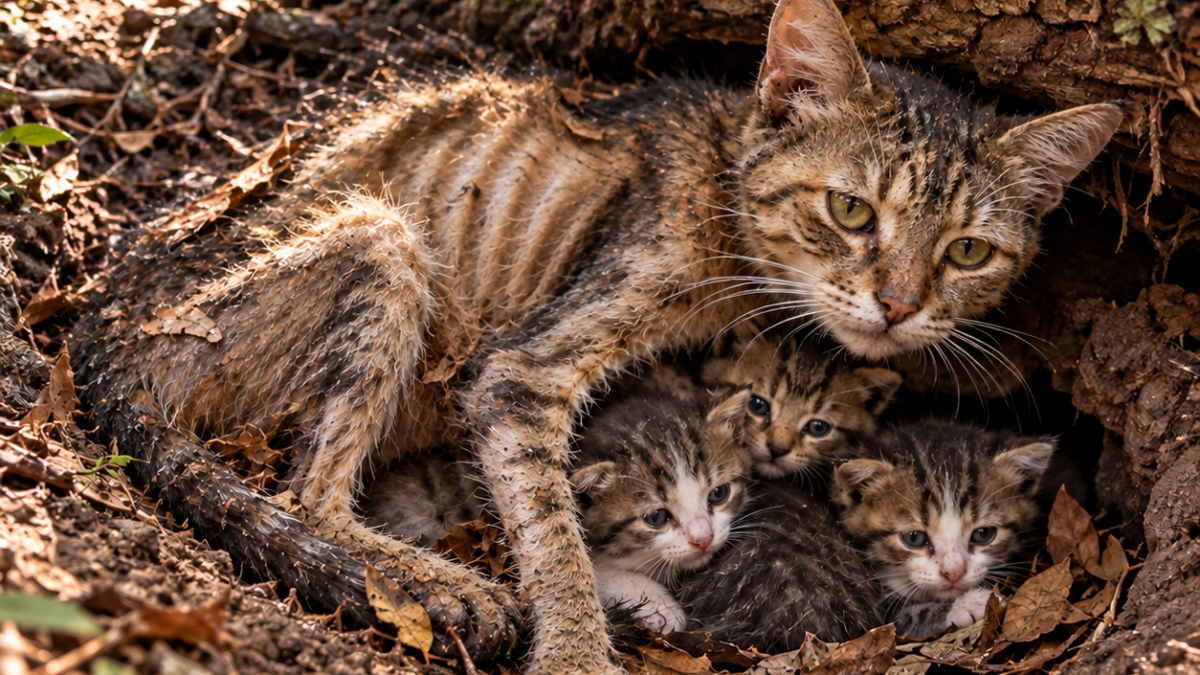
A small brown tabby sat on the forest floor.
At least, he thought she was sitting.
The longer he looked, the stranger the posture seemed.
She was hunched low.
Front legs planted beneath her.
Body curved around something.
Her coat was brown and black with faded striping, but the fur had lost its shine.
Burrs clung to her flank.
Tiny seeds tangled around her belly.
One ear had a shallow tear along the edge.
She did not run.
That worried Caleb immediately.
He had seen feral cats near barns.
They vanished.
Even friendly outdoor cats usually hesitated before letting strangers approach.
This animal simply stared.
“Hey, sweetheart.”
Her ears moved backward.
But her body did not.
Caleb crouched ten feet away.
Now he could see how thin she was.
Her hips projected sharply beneath the skin.
Every vertebra showed.
The line of her spine looked like knuckles beneath fabric.
Her face was narrow.
Her eyes too large for her head.
Caleb had grown up with cats.
His ex-wife had kept two.
He knew what a healthy cat looked like.
This was not one.
“Jesus.”
He slowly removed his pack.
The tabby watched every movement.
He took out a protein bar.
Then remembered it contained chocolate chips.
“Not you.”
He had beef jerky.
Too salty.
Tuna?
No.
He was halfway through checking his food bag when the cat made another rasping meow.
She still had not moved.
Caleb looked more carefully.
“Why aren’t you leaving?”
He shifted one foot closer.
The cat’s ears flattened.
A low growl came from somewhere inside that skeletal body.
But she did not retreat.
Caleb stopped.
“You’re guarding something.”
The moment he said it, he knew.
He lowered himself slowly onto one knee.
From that angle he saw a depression beneath her chest.
Not natural.
A hole.
Her body was positioned directly over it.
Caleb moved slightly left.
The tabby growled again.
“I’m not touching you.”
He leaned.
Something pale moved beneath her.
Tiny.
Caleb’s breath caught.
“No way.”
The mother shifted her front paw.
A kitten’s face appeared.
Then vanished.
Caleb stared.
“Are you kidding me?”
He moved another inch.
The mother exposed just enough of the opening.
There were three kittens.
Pressed together.
Eyes open.
Gray-brown bundles no larger than his hand.
Alive.
Caleb forgot the trail.
Forgot the time.
Forgot every task waiting for him.
He crouched on the forest floor and simply stared.
The hollow was maybe eight inches deep.
Perhaps ten inches across.
Dug between two exposed roots beneath the fallen tree.
Leaves had been pulled inside.
Not simply fallen there.
Pulled.
Torn into smaller pieces.
Arranged.
The sides of the hole were uneven.
Scratched.
Claw marks.
Caleb looked at the mother’s front paws.
Then back at the hole.
“You made this.”
The cat blinked.
Her body covered almost the entire opening.
A fox walking past might never notice three kittens below ground level.
An owl certainly would not see them from above.
To reach them, anything would first have to get past her.
Caleb looked around.
They were surrounded by wilderness.
No tent.
No trash.
No abandoned campsite.
No road.
No structure.
Nothing that explained how a domestic-looking cat had reached this location.
The mother gave another weak warning.
“Okay.”
Caleb sat back.
“Okay. I get it.”
He pulled out his water.
Poured some into the plastic cap of his food container.
Set it six feet away.
The tabby watched.
She did not move.
He backed farther away.
Still nothing.
“You’re not leaving them.”
He opened a package of plain chicken from his lunch.
Placed a small piece beside the water.
Retreated.
The cat’s nose moved.
Her eyes fixed on the food.
Caleb waited.
For almost a minute nothing happened.
Then the mother stood.
Or tried to.
Her hindquarters rose halfway.
Shook.
Dropped.
Caleb’s stomach tightened.
She tried again.
This time she made it.
As her body lifted, the nest became completely visible.
Three kittens.
One tabby.
One mostly gray.
One brown with white paws.
They immediately began crawling toward her.
The mother took two steps.
Her legs trembled.
She reached the chicken.
Swallowed it without chewing.
Then another piece.
Caleb put down more.
She ate.
Fast.
Desperately.
Yet after four bites she turned away from the food.
Returned to the hole.
Lay over the kittens.
Caleb stared.
“You’re kidding.”
He moved the food closer.
She did not go back.
The kittens had begun nursing.
The mother closed her eyes.
Caleb watched her body.
There was almost nothing left of it.
Her sides drew inward with every breath.
Her abdomen looked hollow.
And yet beneath that skin, her body was still producing milk.
Using what?
He thought.
What was left to use?
Her own muscles.
Her own fat.
Herself.
Caleb had carried abandoned dogs out of campsites before.
Once he had helped transport an injured hawk.
This felt different.
There was something deliberate in the little shelter.
Evidence of work.
Weeks of decisions.
He stood.
Walked a circle around the site.
Then he began noticing details.
A few feet downhill, a narrow groove had been scratched through the soil.
Another on the opposite side.
Drainage.
Recent thunderstorms had soaked this mountain.
Yet the nest itself was mostly dry.
Caleb knelt.
The grooves were too small to be natural runoff channels.
He looked again at the mother.
“Did you do that too?”
A few feet beyond the fallen tree, feathers lay among leaves.
Small.
Possibly sparrow.
Farther away, he found the skin and jaw of a field mouse.
Another set of bones near a rock.
The mother had been hunting.
He walked farther.
That was when he found the fur.
Gray.
Caught on rough bark roughly three feet above the ground.
A tuft larger than something naturally shed.
Beneath it the soil had been torn up.
Claw marks.
Leaves scattered.
Something had fought there.
Raccoon, maybe.
Fox.
Caleb looked back at the cat.
Her left shoulder had a swollen patch beneath the fur.
He had not noticed it before.
“You fought something.”
The tabby watched him.
He suddenly understood the full shape of what he was seeing.
She was not simply stranded.
She had built a defensive position.
Dug shelter.
Lined it.
Created drainage.
Hunted.
Returned.
Fed three kittens.
Hidden them with her own body.
Defended the area.
And judging by her condition, she had been doing it until there was almost no animal left.
Caleb checked his phone.
No signal.
Of course.
He was nine miles into the forest.
He could leave.
Hike back.
Call rescue.
Return tomorrow.
The mother might be dead by then.
The kittens might be dead tonight.
Coyotes moved after dark.
Owls too.
Black bears would not hunt kittens intentionally, but a nest meant nothing to them.
The weather forecast called for rain.
Caleb looked at the hole.
Then the mother.
“No.”
He knew exactly what he had to do.
He also knew it would be miserable.
He began unloading his pack.
Trail tools first.
He could cache them beside the marked route and retrieve them later.
He tied the Pulaski and loppers together.
Covered the saw.
Marked coordinates on his offline map.
Then emptied unnecessary weight from his backpack.
The mother watched.
Caleb removed his fleece jacket.
He approached slowly.
“Here’s the problem.”
The cat’s ears flattened.
“I need to get you out.”
Growl.
“You can complain.”
He crouched.
“But you’re not staying here.”
The mother tried to stand.
Could not.
Caleb stopped.
Her eyes remained fixed on him.
He could have simply grabbed her.
She did not have strength to do much.
Something about that felt wrong.
So he sat beside the fallen tree.
Not too close.
He tore another piece of chicken.
Held it out.
Waited.
Five minutes.
Ten.
Eventually the mother stretched her neck.
Took the chicken from his fingers.
Her tongue felt dry.
He gave another.
Then water.
Gradually she let him move closer.
When his fingers first touched the side of her face, she flinched.
But did not bite.
He stroked once.
Her fur felt rough.
“You were somebody’s cat.”
He knew it then.
Not feral.
Too familiar with a human hand.
She leaned into his fingers for half a second.
Then turned toward the kittens.
Caleb’s throat tightened.
“I’m taking them too.”
He laid the fleece jacket on the ground.
One by one, he lifted the kittens.
The mother growled when he touched the first.
By the third, she seemed to understand.
Or perhaps she was simply too tired to fight.
Caleb placed the kittens inside the fleece against his stomach.
They immediately began squeaking.
The mother tried to follow.
Her legs gave out.
Caleb lifted her.
For ten seconds she fought.
Not violently.
Just panic.
Claws against his shirt.
Head twisting toward the nest.
“Easy.”
He lowered her into the jacket.
The moment she felt the kittens beneath her, everything changed.
Her body curled.
Front legs wrapped around them.
She pulled all three close against her belly.
Then she began to purr.
Caleb stopped moving.
The sound came through the fabric.
Weak.
Uneven.
But unmistakable.
He stared down.
“You’re purring?”
The vibration continued.
He swallowed.
“Okay.”
He closed the jacket carefully around all four.
Then began the hike out.
The first two miles were uphill.
That was the section Caleb later remembered least clearly because all his attention went to not falling.
The bundle inside his jacket shifted occasionally.
The kittens nursed.
Their mother remained almost perfectly still.
Caleb held them with his left arm.
Used his trekking pole in his right.
The trail was rocky.
Roots crossed the path.
Sweat soaked his back.
His shoulder began aching after the first mile.
He considered transferring them into his backpack.
Rejected the idea.
He needed to feel them breathing.
At mile two, he stopped.
Opened the jacket.
The mother stared up at him.
“Still alive?”
She blinked.
He offered water from his fingers.
She licked a little.
One kitten crawled higher against her neck.
Caleb smiled.
“You three have no idea.”
He looked at the mother.
“She does.”
The descent began.
Long.
Steep.
Loose rocks underfoot.
No railing.
Nothing between the trail and a fifty-foot drop in several places.
Caleb slowed.
His thighs burned.
The mother’s purring continued.
Not constantly.
But often enough that he felt it against his ribs.
At first he thought vibration from his steps was fooling him.
Then he stopped completely.
The purring continued.
“Why are you still doing that?”
The cat closed her eyes.
Caleb laughed once.
Then unexpectedly cried.
Not much.
Just tears mixing with sweat.
He had no explanation.
He had walked thousands of miles in those mountains.
He had found abandoned camping equipment.
Lost phones.
Wallets.
Broken trekking poles.
A wedding ring once.
He had found a deer skeleton inside an old mining cut.
A bear cub carcass after a late freeze.
He had seen enough of nature not to sentimentalize it.
The wilderness was beautiful.
It was also indifferent.
Things died constantly.
Quietly.
Without meaning.
But this animal—
This small, half-dead cat had spent weeks behaving as though three little lives mattered more than anything else in the forest.
It did something to him.
At mile five, Caleb slipped.
His boot rolled on loose shale.
He slammed one knee down.
His trekking pole flew sideways.
Instinctively both arms closed around his chest.
Around the cats.
Pain shot through his knee.
“Damn!”
He sat.
The jacket moved.
One kitten squeaked.
The mother lifted her head.
“Everybody okay?”
He checked them.
No injury.
His own knee was bleeding through his pants.
He laughed.
“Of course.”
He bandaged himself one-handed.
Kept moving.
By mile seven his shoulders cramped.
The trail leveled.
Sunlight had begun turning golden between the trees.
Caleb could smell evening approaching.
Cooler air.
Damp leaves.
Distant water.
The mother was quieter.
Too quiet.
He checked repeatedly.
Still breathing.
“Don’t you die now.”
The purring restarted.
Caleb shook his head.
“You’re ridiculous.”
At 6:18 p.m., he reached the trailhead.
Nine-point-two miles from the place where he found them.
His truck sat alone in the gravel lot.
Caleb opened the passenger door.
Placed the bundle on the seat.
The mother immediately raised her head.
He had expected her to panic at the vehicle.
Instead she looked around.
Then settled over the kittens.
Domestic.
Definitely.
Someone had transported her in cars before.
Someone had fed her.
Probably loved her.
“How the hell did you get out there?”
No answer.
Caleb drove to Pine Creek Veterinary Hospital.
He called as soon as cell service returned.
“I found a cat.”
The receptionist said, “We close at seven.”
“There are four.”
Pause.
“What?”
“One mother. Three kittens. I’m fifteen minutes away. The mother might be dying.”
“Come.”
Dr. Maya Levin was waiting when he arrived.
Thirty-eight.
Short dark hair.
Calm voice.
The kind of veterinarian who seemed able to think faster the worse things became.
She unwrapped the fleece.
The first thing she said was, “Oh, sweetheart.”
The second was, “How far did you carry her?”
“Nine miles.”
Dr. Levin looked at Caleb.
“You carried four cats nine miles?”
“I didn’t have Uber.”
Under different circumstances she might have laughed.
She did not.
The mother weighed 3.9 pounds.
Less than half the healthy weight Dr. Levin estimated for her frame.
Her body condition score was nearly the lowest possible.
Severe dehydration.
Anemia.
Inflamed mammary glands.
Raw front paw pads.
One claw partly split.
Dirt packed beneath almost every nail.
A deep abscess at the left shoulder.
Several superficial scratches.
No major internal injury.
The kittens were approximately four weeks old.
Underweight.
Mildly dehydrated.
Fleas.
But astonishingly stable.
“All three?” Caleb asked.
Dr. Levin nodded.
“All three.”
“What about her?”
The veterinarian did not answer immediately.
“That depends on tonight.”
Caleb stared at the mother.
“What happened to her feet?”
Dr. Levin examined them.
“This isn’t primarily from walking.”
“What is it?”
“Digging.”
Caleb nodded.
“I thought so.”
“Digging what?”
He showed her photographs.
The nest.
The drainage channels.
The fallen tree.
The feathers.
The gray fur.
Dr. Levin stared at his phone.
“She made this?”
“That’s what it looked like.”
Dr. Levin enlarged the picture.
Then another.
“She excavated below root level.”
“About eight inches.”
“These channels?”
“Rain runoff.”
The vet shook her head slowly.
“I’ve seen feral queens move litters. Hide them in barns. Under porches. Crawl spaces.”
She looked again.
“I’ve never seen anything quite like that.”
Caleb leaned against the wall.
“What do you think she was doing?”
“Exactly what you think.”
Dr. Levin pointed toward the photo.
“The depression puts the kittens below sight line.”
“Right.”
“She can cover most of the opening with her body.”
Caleb nodded.
“Predators would smell her.”
“Yes.”
“Not them.”
“Mostly.”
Dr. Levin studied the mother.
“And an adult cat is a much less attractive target than neonates.”
“You think she knew that?”
The vet smiled faintly.
“I’m careful with words like knew.”
“Instinct?”
“Instinct. Experience. Trial and error. Motherhood.”
She glanced at the raw paws.
“Whatever you call it, she worked.”
They cleaned the mother’s feet under mild sedation.
The dirt was packed so deeply beneath the claws that flushing alone would not remove it.
Dr. Levin found several small infected cracks.
The shoulder abscess was drained.
Antibiotics started.
Fluids.
Calorie-dense food.
Pain control compatible with nursing.
Flea treatment safe for the kittens.
Then the staff placed the family inside a warm kennel.
The mother woke slowly.
First thing she did was count her kittens.
Caleb watched.
She touched each with her nose.
One.
Two.
Three.
Then relaxed.
“You see that?” he whispered.
Dr. Levin smiled.
“Yes.”
Caleb asked, “Can I stay?”
“You already carried them nine miles.”
“Is that a yes?”
“You can sit ten minutes.”
He stayed forty-five.
The next morning Dr. Levin called at 6:12.
Caleb answered before the second ring.
“She’s alive.”
He closed his eyes.
“And the kittens?”
“Loud.”
“Good loud?”
“Obnoxious loud.”
He laughed.
“What about Mom?”
“Eating.”
“How much?”
“Not enough to satisfy me, but enough to annoy the technician who keeps refilling the plate.”
Caleb sat on the edge of his bed.
He had barely slept.
“What happens now?”
“We keep going.”
The veterinary team slowly reconstructed the mother’s ordeal through her body.
Dr. Levin estimated she had probably weighed close to eight pounds before pregnancy.
Now she was under four.
Producing milk alone demanded hundreds of calories.
Hunting small prey might barely sustain an adult cat.
It could not realistically support an adult and three rapidly growing kittens indefinitely.
So the calories came from somewhere else.
Her.
Fat first.
Then muscle.
Her body had begun consuming itself to keep lactation going.
Caleb listened while Dr. Levin explained.
“So she was feeding them with her own body.”
“In the bluntest sense.”
He looked through the glass.
The mother lay on her side.
Three kittens nursing.
“How long could she keep doing that?”
“Not much longer.”
“How much longer?”
Dr. Levin hesitated.
“Days.”
Caleb stared.
“If I kept walking—”
“Don’t.”
“I almost did.”
“But you didn’t.”
“She meowed twice.”
“And you stopped.”
Caleb looked down.
“I was irritated.”
Dr. Levin folded her arms.
“At what?”
“I was behind schedule.”
“That sounds human.”
“I almost left because I wanted to finish cutting brush.”
“But you didn’t.”
He nodded.
The phrase did not absolve him immediately.
Over the next six days, he visited after work.
The mother changed quickly.
Not dramatically at first.
Day one: she ate.
Day two: she lifted her head when Caleb entered.
Day three: she hissed at a veterinary assistant who tried to move a kitten.
Dr. Levin smiled.
“That’s progress.”
“Threatening staff is progress?”
“For her? Absolutely.”
Day four: she walked.
Three-legged-looking at first because one paw was bandaged heavily.
Then all four.
Day five: she climbed into Caleb’s lap.
That surprised everyone.
Especially Caleb.
He sat in the recovery room with one hand resting on the floor.
The mother sniffed him.
Then stepped awkwardly onto his thighs.
Turned twice.
Lay down.
Caleb froze.
Emily, one of the technicians, grinned.
“You can breathe.”
“I’m aware.”
“She likes you.”
“She tolerates me.”
The mother began purring.
Emily raised an eyebrow.
“Very tolerant.”
Caleb scratched gently beneath her chin.
“What’s her name?”
The technician asked.
Caleb looked up.
“She doesn’t have one.”
“Shelter needs something for paperwork.”
He looked at the mother.
Nine miles.
Nine miles carried against his chest.
Nine miles of purring.
“Nine.”
Emily frowned.
“Nine?”
“Her name.”
“Like the number?”
“Yes.”
She smiled.
“I like it.”
Nine.
The kittens were given temporary names by the staff.
Pine.
Fern.
Moss.
Caleb thought they sounded like a candle collection but kept his opinion to himself.
On day six, Nine was discharged to a foster home experienced with nursing mothers.
Caleb offered.
Dr. Levin refused.
“You’re gone ten hours a day.”
“I can work from home.”
“You live alone.”
“That seems discriminatory.”
“You also told me you haven’t owned a cat in twenty years.”
“Twelve.”
“Not helping.”
Caleb sighed.
“Fine.”
But he visited.
By week two, the kittens began eating soft food.
Nine continued nursing anyway.
Dr. Levin had to increase her calories because she kept giving everything to them.
“You don’t have to do this anymore,” Caleb told her during one visit.
Nine ignored him.
Pine attacked her tail stump—there was no stump, just a tail—and fell over.
Caleb laughed.
The mother began grooming him.
Moss climbed onto her head.
Nine endured all of it.
The mystery of her past emerged almost accidentally.
A technician scanned her again.
The first scan had been inconclusive because the microchip had migrated.
This time they found it near her shoulder blade.
A chip.
Old.
Inactive in the current registry.
The clinic that implanted it had closed nearly eight years earlier.
Dr. Levin contacted the manufacturer.
Old serial records confirmed the implant date.
Someone had owned Nine.
Someone had taken her to a veterinarian.
Someone had cared enough to microchip her.
There were other clues.
She used litter immediately.
She understood the sound of a can opening.
She slept on cushions, not under them.
She knew doorknobs meant something happened on the other side.
She tolerated nail handling.
She had once been spayed—or at least someone had attempted the procedure.
Imaging showed residual ovarian tissue.
An incomplete surgery.
Rare, but possible.
Enough functioning tissue had remained for her to become pregnant.
Caleb posted her photo on lost-pet sites.
Nothing.
Local shelters checked old intake records.
Nothing.
Social media posts circulated.
Nothing.
No owner came forward.
After two weeks, one woman contacted the clinic claiming Nine resembled a cat her elderly neighbor had owned years earlier.
No proof.
The neighbor had died.
His relatives said the cat disappeared before the estate was cleared.
Possible.
Not confirmable.
Another man claimed he had seen a similar tabby at a campground forty miles away.
Also impossible to verify.
Caleb became obsessed with the question.
“How does an indoor cat get nine miles into forest?”
Dr. Levin shrugged.
“Walks.”
“That far?”
“Cats can travel astonishing distances.”
“Pregnant?”
“Maybe she wasn’t pregnant when she entered.”
“Someone could’ve dumped her.”
“Yes.”
“You think that happened?”
“I think people dump animals near trails more often than you want to know.”
Caleb stared through the kennel door.
Nine slept with Fern tucked beneath her chin.
“Why?”
“Because wilderness makes irresponsible people feel less guilty.”
He looked at her.
She continued.
“They tell themselves an animal will hunt. Find a farm. Become wild.”
“Instead?”
“Some do survive.”
Her eyes went toward Nine.
“Some pay for survival with everything.”
The kittens were adopted before seven weeks.
That part surprised Caleb too.
He had expected to feel relieved.
Instead, each departure felt like someone dismantling the little family he had carried down the mountain.
Fern went first.
A retired teacher named Linda adopted her.
Nine watched the carrier leave.
Then walked through the foster room calling.
Caleb nearly lost it.
“She thinks we stole her baby.”
The foster volunteer shook her head.
“She’ll adjust.”
Pine left two days later with a young couple.
Moss stayed another three days.
When he finally left, Nine searched behind the couch.
Under blankets.
Inside the carrier.
Then sat by the door.
Caleb sat beside her.
“That’s it.”
Nine looked at him.
“They’re okay.”
She meowed.
“Yeah.”
He stroked her back.
“You did it.”
Nine leaned into his leg.
“You got them here.”
Her purr started.
Caleb closed his eyes.
Three days later he signed the adoption paperwork.
The shelter coordinator smiled.
“Any reason you chose her instead of a kitten?”
Caleb looked offended.
“She chose me.”
Nine went home with him in a blue carrier.
At first, she hated his house.
Not because of the house itself.
Because of closed doors.
Any closed door.
Bathroom.
Bedroom.
Closet.
If Caleb shut one, Nine sat outside and cried.
He assumed separation anxiety.
Dr. Levin had another theory.
“She survived by always knowing where her kittens were.”
Caleb stopped closing interior doors.
Nine slept beside the front door for the first month.
Not on Caleb’s bed.
Not on the couch.
The door.
As if she needed to know nobody could leave without her noticing.
At night, Caleb sometimes woke and found her sitting upright, listening.
A car passing.
Raccoon outside.
Rain on the roof.
She always positioned herself where she could see the hallway.
Guard duty.
Her paws healed.
The shoulder abscess disappeared.
Her weight climbed.
Four pounds.
Five.
Six.
Eventually just over seven.
Her coat became glossy.
The sharp hip bones vanished beneath healthy muscle.
The first time Caleb could pet her without feeling every rib, he cried.
He was sitting on the couch.
Nine asleep on his lap.
His hand moved along her side.
No bones.
Not like before.
Caleb covered his face.
Nine woke.
Stared at him.
“Don’t judge me.”
She licked her paw.
“Fine.”
He laughed.
Then rubbed behind her ear.
“I remember carrying you.”
Nine purred.
“You weighed nothing.”
She stretched.
“I could feel every bone through my jacket.”
Her eyes closed.
“You gave all of it away.”
Over the next year, Caleb returned to Cinder Ridge repeatedly.
The first trip back to the nest was difficult.
Nine did not go.
Caleb went alone.
He found the fallen tree.
The depression still existed, though rain had softened its walls.
Leaves had filled part of it.
The drainage channels were barely visible.
He crouched.
He could still see faint scratch marks under the roots.
Something about the place looked impossibly small.
How had four animals lived there?
He placed his palm inside the hole.
Cool earth.
Quiet forest.
He imagined the kittens sleeping below ground.
Nine covering them.
Rain overhead.
Coyotes calling somewhere in the dark.
Her leaving to hunt with a stomach already empty.
Coming back.
Always coming back.
Caleb found another thing that day.
A few yards from the nest, beneath leaves, lay a faded strip of red nylon.
He picked it up.
Collar?
Possibly.
No buckle.
No tag.
Maybe trash.
He brought it to Dr. Levin anyway.
She examined it.
“Could be.”
“That’s all?”
“Caleb.”
“I know.”
He sat.
“You want the forest to give you an answer.”
“Yes.”
“It may not.”
“Somebody put her there.”
“Maybe.”
“Or lost her.”
“Maybe.”
“Doesn’t that bother you?”
“Of course.”
“Then how do you let it go?”
Dr. Levin smiled sadly.
“Veterinary medicine teaches you to live with unfinished stories.”
Caleb hated that answer.
Mostly because it was true.
He spent months trying to trace the chip.
The defunct clinic’s old veterinarian had retired to Arizona.
Caleb found him.
Dr. Wesley Arnold remembered nothing initially.
Then Caleb emailed a photo.
The vet responded two days later.
I can’t swear to it, but we used that brand of chip mostly between 2012 and 2015.
The surgical scar you described sounds familiar to a batch of low-cost spays we did through a rescue partnership.
Records were destroyed when the practice closed after the flood.
Sorry I can’t help more.
Low-cost rescue.
That opened another possibility.
Nine might have once been a shelter cat.
Adopted.
Rehomed.
Lost again.
Maybe more than once.
Caleb looked at Nine sleeping on the couch.
“How many people did you have before me?”
She opened one eye.
“Were they good?”
No answer.
“Did somebody miss you?”
She yawned.
“I hope somebody did.”
The following spring, Caleb took Nine outside for the first time.
Not loose.
Never again, if he could help it.
Harness.
Long line.
Backyard.
Nine crouched when grass touched her paws.
Her pupils widened.
For several seconds she looked almost terrified.
Caleb immediately moved to take her inside.
Then a bird landed on the fence.
Nine’s entire body changed.
She lowered herself.
Tail twitching.
Predator.
Caleb laughed.
“Oh, there you are.”
She stalked the bird.
The bird flew away.
Nine stared at the empty fence with deep personal offense.
They repeated the backyard trips.
Eventually she loved them.
But if Caleb went inside, even for a moment, Nine ran to the door.
Never stayed alone outside.
Not once.
Two years after the rescue, Caleb met Linda, Fern’s adopter, at a veterinary fundraiser.
“You’re Nine’s person.”
“I prefer roommate.”
Linda laughed.
Then showed him photos.
Fern was enormous.
Healthy.
Spoiled.
Sleeping in laundry baskets.
Caleb stared at the screen.
“That’s Fern?”
“She runs the house.”
“She was the smallest.”
“Not anymore.”
Later he received pictures of Pine.
Then Moss.
All three alive.
Indoor cats.
Loved.
Caleb printed the photos.
Put them in small frames on a shelf.
Nine ignored them.
“Those are your kids.”
She walked past.
“You worked pretty hard on them.”
Nothing.
Caleb smiled.
“Typical.”
Yet sometimes he imagined she recognized their scent when old foster blankets appeared.
He did not know.
He stopped needing to know.
What mattered was that all three lives continued.
Moss developed a habit of sleeping beside his owner’s infant.
Fern learned to open kitchen cabinets.
Pine became obsessed with running water and screamed until faucets were turned on.
Ordinary cat lives.
That was what Nine’s suffering purchased.
Not medals.
Not recognition.
Ordinary mornings.
Food bowls.
Sunbeams.
Vet appointments.
Christmas trees attacked at three in the morning.
Humans complaining about litter tracked across floors.
Life.
Caleb began speaking about Nine occasionally at volunteer orientations.
Not dramatically.
Usually when new hikers complained about carrying emergency equipment.
He would hold up his fleece jacket.
The same one.
Claw marks still visible inside.
“This carried four cats nine miles.”
Someone always laughed.
Then he told the story.
One volunteer asked, “Why didn’t she move the kittens closer to people?”
Caleb said, “Maybe she didn’t know where people were.”
Another asked, “Why didn’t she abandon them and save herself?”
He did not have an answer.
Dr. Levin later gave him one.
“Evolution doesn’t ask mothers to make philosophical decisions.”
He raised an eyebrow.
“She had hormones. Instinct. Attachment.”
“Sounds less romantic.”
“It’s more impressive.”
“How?”
“Because she didn’t need a human idea of sacrifice.”
Dr. Levin stroked Nine’s head during a checkup.
“She simply kept doing what her body and experience told her to do until there was almost nothing left.”
Caleb thought about that.
“She was dying.”
“Yes.”
“And still nursing.”
“Yes.”
“That’s sacrifice.”
Dr. Levin smiled.
“Then call it that.”
Years later, Caleb would still return mentally to the moment he first saw the kittens.
Not because it was beautiful.
It was not.
Nine looked terrible.
The nest smelled of damp earth and decay.
Flies hovered around the shoulder wound.
The kittens were dirty.
The forest was hot.
Nothing resembled a greeting-card miracle.
Survival rarely does.
Real survival is ugly.
It is infection.
Hunger.
Improvisation.
Fear.
Doing the same necessary thing again when there is no guarantee it will matter.
Nine had not built a perfect shelter.
She built one good enough.
She had not found enough food.
She found enough to last one more day.
Then another.
Her drainage channels were crude.
They worked.
Her paws bled.
She kept digging.
Something attacked.
She fought.
Her milk should have dried up.
Her body cannibalized itself to continue.
No one had trained her.
No one was coming.
No one knew she was there.
That was the part Caleb could not stop thinking about.
She had done all of it without an audience.
Humans loved sacrifice when someone witnessed it.
Medals.
Photographs.
Stories.
Thank-yous.
Nine had none.
If Caleb had walked another three steps down the trail, the forest might have swallowed the entire thing.
The kittens could have died that night.
Nine too.
Weeks later another volunteer might have found four sets of tiny bones beneath a fallen tree.
Nobody would have known there had been drainage channels.
Nobody would have known about the gray fur on the bark.
Nobody would have known how long she hunted while starving.
Nobody would have known she covered the hole with her body.
Caleb sometimes wondered whether that made the love less real.
Of course not.
That became one of the largest lessons Nine gave him.
Important things do not become important because somebody sees them.
One rainy evening, almost three years after the rescue, Caleb sat on his porch with Nine.
She had grown older.
Gray had appeared around her muzzle.
The damaged claw never grew quite correctly.
Heavy weather sometimes made her left shoulder stiff.
She sat beside him watching rain gather in the yard.
Water flowed along the edge of the flower bed.
Nine stood.
Walked toward it.
Then began scratching at the mud.
Caleb watched.
She dug a narrow groove.
Nothing dramatic.
Just three or four strokes.
Water changed direction.
Flowed through the groove.
Caleb stopped breathing.
“Nine.”
She looked up.
He stared at the little drainage channel.
Something hit him so hard he had to sit back.
Three years.
Warm house.
Full bowl.
Dry bed.
No kittens.
No wilderness.
And somewhere inside her, that old solution remained.
Water comes.
Dig a path.
He took out his phone.
Almost recorded it.
Then stopped.
Not everything needed to become content.
Some things could simply be witnessed.
Nine walked back onto the porch.
Caleb lifted her.
She settled against his chest.
Much heavier now.
Healthy.
Warm.
He remembered the opposite.
3.9 pounds.
Bones beneath fleece.
Purring for nine miles.
“You know,” he whispered, “I almost kept walking.”
Nine closed her eyes.
“I was late.”
She purred.
“I had four miles of trail left.”
The vibration traveled into his chest.
“I heard you.”
He swallowed.
“Then I almost decided it wasn’t my problem.”
Nine stretched one paw against him.
He smiled.
“Good thing you yelled twice.”
The truth was that she had not yelled.
Barely called.
A broken little sound.
Enough.
That night, Caleb took the old fleece jacket from the closet.
He had never washed away the last small stains inside.
Probably dirt.
Maybe blood.
Maybe nothing.
He folded it carefully.
Nine climbed onto it immediately.
Of course.
“You remember this?”
She kneaded the fabric.
Then lay down.
Caleb sat on the floor beside her.
He thought about the miles again.
Nine against his chest.
Kittens nursing.
One arm around them.
One hand on the trekking pole.
His knee bleeding.
That endless descent.
At the trailhead he had thought he was rescuing four animals.
Years later he understood something else.
Nine had already done almost all the rescuing.
She found the safe place.
She dug the hole.
She lined it.
She fed them.
She guarded them.
She kept water out.
She fought whatever came close.
Caleb had only arrived for the final nine miles.
It mattered.
But it was the easiest part.
When people later praised him, he corrected them.
“She did the hard part.”
One reporter from a local paper once asked him to pose with Nine near the trailhead.
Caleb refused to take her into the forest.
“Why?”
“She earned the right not to go back.”
So they photographed her on his porch.
Nine looked annoyed.
Perfect.
The article called her “Miracle Mom.”
Caleb hated the phrase.
“She wasn’t magic,” he told Dr. Levin.
“No.”
“She was desperate.”
“And competent.”
“And stubborn.”
“Very.”
“And apparently mean to raccoons.”
Dr. Levin laughed.
“Probably.”
Caleb became serious.
“Calling it a miracle makes it sound easy.”
The vet looked at him.
“That bothers you.”
“Yes.”
“Why?”
“Because what she did wasn’t easy.”
He scratched Nine’s neck.
“She paid for every day.”
Dr. Levin nodded.
“Then tell it that way.”
So Caleb did.
Whenever people asked, he did not say Nine was an angel.
He said she was a cat.
A very tired one.
A mother.
A hunter when she had to be.
A digger.
A guard.
An animal with torn pads and an infected shoulder who kept returning to a hole in the ground because three kittens were inside.
That was enough.
More than enough.
On the fifth anniversary of the rescue, Caleb hiked the trail again.
Alone.
He had passed fifty by then.
His knees complained more on descents.
He took longer breaks.
Nine stayed home sleeping on his bed.
The forest had changed.
Storms had brought down new trees.
Young saplings grew where sunlight reached the floor.
The old fallen oak near Nine’s nest had collapsed further.
The hole was almost gone.
Caleb found it because he knew exactly where to look.
He crouched.
There were no claw marks now.
No drainage channels.
Leaves had filled everything.
The forest had reclaimed the evidence.
He sat beside the roots for a long time.
Eventually another hiker passed on the trail above.
The man called down.
“You okay?”
Caleb looked up.
“Yeah.”
“Lose something?”
Caleb smiled.
“No.”
He had already found it years ago.
Back home, Nine met him at the door.
She was slower.
But still loud when dinner was late.
Caleb placed his pack down.
“Guess where I went.”
Nine sniffed his boots.
Forest smell.
Mud.
Leaves.
Something in her posture changed.
Just briefly.
Then she walked away toward the kitchen.
“No nostalgia?”
Meow.
“Food?”
Louder meow.
“Fair enough.”
Caleb opened a can.
Nine ate.
Then followed him to the living room.
He sat.
She climbed onto his chest.
Same position she had taken inside the fleece jacket years earlier.
This time her body had weight.
Warmth.
Strength.
Caleb closed his eyes.
He could hear the purr.
He remembered something Dr. Levin had told him after Nine’s first exam.
“She shouldn’t have had enough calories left to keep producing milk.”
Yet she did.
For a little longer.
Long enough.
That phrase became important to Caleb as he got older.
Long enough.
People often believed survival required certainty.
It did not.
Nine had not needed to survive forever in the forest.
She needed to survive until someone heard her.
The kittens did not need a perfect nest.
They needed one that worked until Caleb arrived.
Caleb did not need to solve Nine’s entire past.
He needed to carry her out.
Nine did not need to know where her babies would eventually live.
She needed to keep them alive long enough to get there.
Long enough.
Sometimes that was all life asked.
When Nine was eleven—or perhaps twelve; nobody ever knew her exact age—she developed kidney disease.
Early.
Manageable.
Caleb changed her food.
Learned to administer fluids.
Nine hated every second.
She still slept beside the door occasionally.
Still scratched small drainage grooves in the garden after heavy rain.
Still purred whenever Caleb wore the old fleece.
The kittens, grown now, remained healthy.
Fern’s owner sent birthday pictures.
Pine became thirteen pounds and was placed on a diet.
Moss moved with his family to Maine.
Caleb kept every photograph.
He sometimes showed Nine.
No recognition he could prove.
That was okay.
She did not need to know what her work had become.
Caleb knew.
Three households contained living animals because of what happened beneath that tree.
Three families loved cats who once fit together inside an eight-inch hole.
Those cats slept in beds.
Knocked over water glasses.
Caught toy mice.
Watched birds through windows.
One comforted a child through a divorce.
One slept beside an elderly woman recovering from chemotherapy.
One became obsessed with a heated blanket.
That was Nine’s legacy.
Not survival in the wilderness.
What came after survival.
One winter night, Caleb sat with Dr. Levin during a routine examination.
Nine had lost a little weight.
Nothing alarming yet.
The vet listened to her heart.
“Still strong.”
Caleb smiled.
“She’s stubborn.”
“We established that years ago.”
He looked at Nine.
“Do you ever think about what would’ve happened?”
“If you hadn’t stopped?”
“Yes.”
Dr. Levin removed the stethoscope.
“Sometimes.”
“I do too much.”
“I know.”
“What if I’d walked on?”
She looked directly at him.
“You didn’t.”
“I know.”
“You keep trying to put yourself on trial for an alternate timeline.”
He laughed.
“That sounds expensive.”
“Veterinary advice is free. Therapy costs extra.”
He stroked Nine’s head.
“I heard one sound.”
“Three, according to your version.”
“Two before I stopped.”
“Still enough.”
Caleb nodded.
Dr. Levin looked at Nine.
“Maybe that’s why the story sticks with people.”
“Because of kittens?”
“No.”
She smiled.
“Because almost everyone has walked past something important once.”
Caleb looked at her.
“And?”
“And people want to believe they might still stop next time.”
He thought about that for days.
Maybe she was right.
Nine’s story was not only about motherhood.
Or survival.
Or cruelty.
Or wilderness.
It was about attention.
A weak sound in the brush.
Easy to miss.
Easy to dismiss.
Easy to classify as someone else’s problem.
Caleb had not been heroic.
He had simply stopped.
Sometimes the distance between tragedy and rescue was that small.
One person stopping.
Looking.
Seeing what was actually there.
Years after he first carried Nine down the mountain, Caleb kept the torn fleece jacket hanging near his hiking gear.
He bought better jackets.
Lighter.
Warmer.
Waterproof.
He never threw that one away.
Inside were three small claw pulls near the zipper.
Nine’s.
He had noticed them after the rescue.
Probably made during those first frantic seconds when he lifted her.
Caleb once considered repairing them.
Could not.
They were evidence.
Not for anyone else.
For him.
On difficult days he touched those little tears and remembered her purring.
Nearly nine miles.
Every mile.
Starving.
Injured.
Separated from the nest she had built.
Yet somehow calm once her babies were against her.
He had asked Dr. Levin why.
The veterinarian said purring could mean many things.
Contentment.
Self-soothing.
Stress regulation.
Pain response.
Communication with kittens.
“Maybe all of it,” she said.
Caleb preferred that answer.
Nine had not necessarily been thanking him.
She might have been comforting herself.
Comforting the kittens.
Managing pain.
Keeping them calm.
The meaning did not have to be romantic to be beautiful.
Whatever the reason, Caleb felt it through his jacket from the first mile to the last.
A small engine of life against his chest.
Proof that something inside her was still going.
Nine never became famous in the way people imagine famous animals do.
No television tour.
No bestselling book.
No brand.
Caleb refused most requests after the local story circulated.
“She’s done enough,” he said.
Instead she lived.
That was the reward.
She slept in sunbeams.
Gained weight.
Lost weight.
Aged.
Learned the sound of Caleb’s truck.
Stole rotisserie chicken.
Hated the vacuum.
Made friends with no dogs whatsoever.
Sat on the porch during rain.
And every so often, when a storm hit especially hard, she inspected the yard afterward.
If water gathered near Caleb’s garden, she scratched.
Small channels.
One after another.
He never stopped watching.
Not because the behavior was miraculous.
Because it reminded him of the animal she had once been when nobody was there to help.
Long before she had a name.
Before Nine.
Before warm blankets.
Before veterinary care.
Before anyone photographed her.
She was simply a starving cat beneath a fallen tree.
Three kittens under her body.
Bleeding paws.
Infected shoulder.
Almost no milk left.
Almost no muscle left.
Almost no time left.
But she kept digging.
Kept hunting.
Kept returning.
Kept covering the hole.
Kept feeding them.
Kept calling.
And finally, one afternoon, the forest gave her one human being close enough to hear.
Caleb had hiked more than four thousand miles in those mountains by then.
He had crossed ridges in snow.
Slept beneath storms.
Found old campsites dating back decades.
Found lost gear.
Found bones.
Found things people had dropped and never returned for.
But nothing he ever found mattered to him like the little brown cat he almost walked past.
Years later, he told a friend the story while Nine slept against his side.
“I could feel every bone through the fleece,” Caleb said.
His friend looked down at the healthy cat.
“Hard to believe now.”
“I know.”
“What was she, four pounds?”
“Just under.”
“And nursing three kittens?”
“Yeah.”
His friend shook his head.
“Crazy.”
Caleb stroked Nine’s head.
“No.”
He thought for a moment.
“Expensive.”
“What?”
“It cost her.”
He looked at his friend.
“That’s the part people miss.”
“Everything she gave them cost her something.”
Food.
Weight.
Muscle.
Skin from her paws.
Blood from the fight.
Sleep.
Safety.
Time.
Eventually almost her life.
His friend looked at Nine.
“Would she have died for them?”
Caleb did not answer immediately.
Then he said, “She almost did.”
Nine opened her eyes.
Caleb smiled.
“But she didn’t.”
He scratched beneath her chin.
“Because she yelled at the right idiot on the right trail.”
Nine began purring.
The same sound.
Older now.
Deeper.
Still there.
Caleb leaned back.
For years people had told him that he rescued Nine.
He never liked that sentence.
It made the story too simple.
The truth was that Nine rescued three kittens long before Caleb arrived.
Caleb carried the family the last nine miles.
That was all.
The most important thing he had ever carried.
But still only the last part.
Everything before that belonged to her.
The hole.
The leaves.
The drainage channels.
The hunting.
The fight.
The nursing.
The waiting.
Her body over the entrance.
Her bones visible beneath her skin.
And that final broken meow from the brush.
A sound weak enough to ignore.
Strong enough not to be.
Sometimes survival is not loud.
Sometimes courage does not look like fighting.
Sometimes it looks like a small mother curling herself over a hole in the ground while rain falls above her.
Sometimes love is not soft.
It is scratched paws.
An empty stomach.
A wound on the shoulder.
A body becoming smaller so three others can become larger.
And sometimes the difference between dying unseen and finally reaching safety is not a miracle.
It is simply someone hearing you once—
then deciding to stop.








