A Hiker Dropped His Phone 140 Feet Down a Mountain Cliff—Two Days Later, Rescuers Found It and Saw One Accidental Photo That Left Them Speechless. A Giant Maine Coon Was Guarding Three Tiny Kittens on a 18-Inch Ledge Above a 300-Foot Drop… And He Refused to Leave Them Behind.
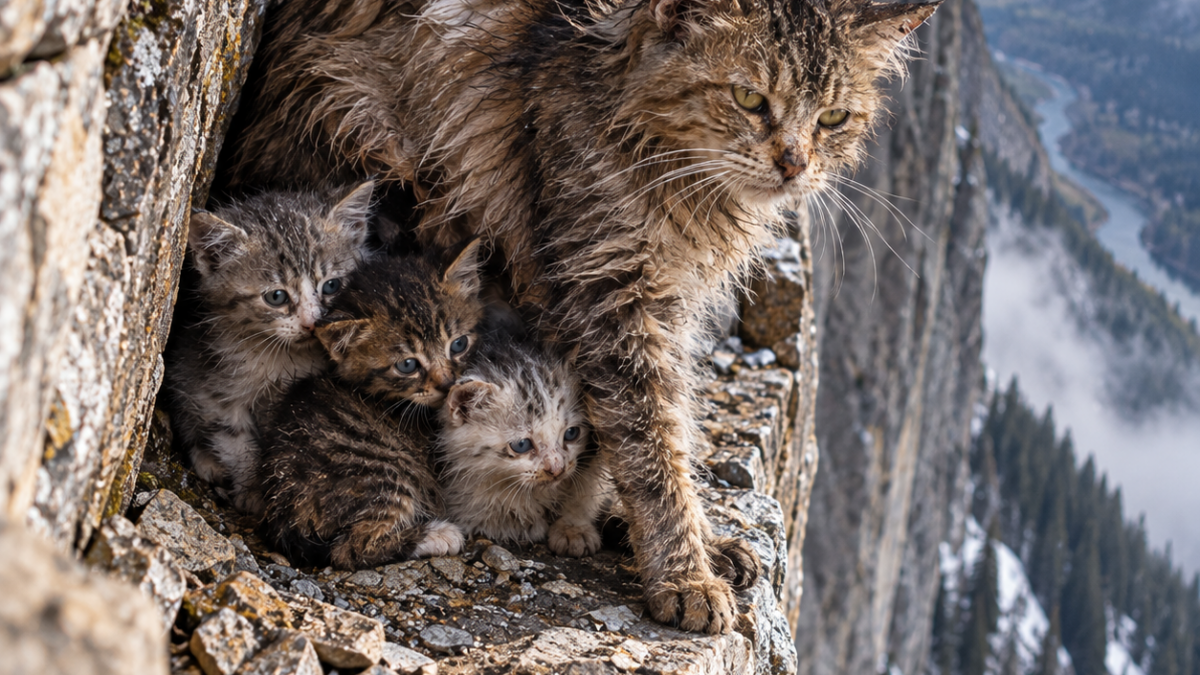
A Hiker Dropped His Phone 140 Feet Down a Mountain Cliff—Two Days Later, Rescuers Found It and Saw One Accidental Photo That Left Them Speechless. A Giant Maine Coon Was Guarding Three Tiny Kittens on a 18-Inch Ledge Above a 300-Foot Drop… And He Refused to Leave Them Behind.
The photograph should never have existed: one accidental frame captured during a 1.3-second fall, showing a massive silver cat balanced on eighteen inches of granite with three kittens hidden behind him and nothing but three hundred feet of empty air at his back.
By the time rescuers reached the ledge four days later, the animal was starving, bleeding from his paws, and so determined to protect the kittens that veteran climbers were afraid to approach him.
But what stunned the rescue team most was not how the cat had survived up there—it was what he had apparently been choosing, every hour for weeks, to sacrifice so the three tiny lives behind him would not fall.
Evan Keller did not know his phone had taken a photograph.
For forty-eight hours, he did not even know the phone still existed.
As far as he was concerned, it had died somewhere beneath Granite Crown Trail at 10:17 on a cold September morning in 2023, after slipping from the pocket of his hiking pants and bouncing down a cliff.
He had watched it disappear.
There had been nothing dramatic about the moment.
No scream.
No heroic attempt to grab it.
One second the phone was there.
The next it was sliding across wet granite.
Evan lunged.
His fingers missed by inches.
The phone struck the rock once.
Spun.
Hit again.
Then vanished over the edge.
“Perfect.”
Evan remained on his knees, one hand still gripping a twisted root.
He had nearly gone with it.
That fact took several seconds to reach him.
Rain from the previous night had left the granite slick. The trail was narrow at that section, crossing an exposed slab at roughly 6,400 feet above sea level.
Below the slab, the mountain dropped away brutally.
Evan had stepped onto the rock.
His right boot slipped.
His body went sideways.
Instinct sent both hands searching.
One caught a root.
The other scraped against stone.
For perhaps two seconds, he had been staring down through empty space.
Then he pulled himself back.
His phone had not been as lucky.
Evan sat on the trail breathing.
PART2:
He was thirty-six years old, reasonably fit, and experienced enough outdoors to understand that the difference between an embarrassing slip and a fatal accident was sometimes less than the width of a hand.
His palm was bleeding.
His left knee hurt.
But nothing seemed broken.
“Idiot.”
He was not sure whether he meant himself or the mountain.
Probably himself.
Evan stood carefully and looked over the edge.
Nothing.
The cliff below was broken by steep slabs, narrow cracks, patches of alpine brush, and dark conifers farther down.
His phone could have landed almost anywhere.
“Enjoy your new home.”
He had paid nearly a thousand dollars for it eleven months earlier.
That irritated him.
Nearly falling to his death irritated him more.
He continued walking.
At the ranger station near the trailhead that afternoon, he reported the lost phone mostly because it contained his driver’s license in the digital wallet and because he was afraid someone might somehow recover it.
The ranger behind the desk asked where he had lost it.
Evan pointed at a trail map.
“Here. Above the north face.”
The ranger looked at the location.
“That’s gone.”
“Yeah.”
“You didn’t try to retrieve it?”
PART3:
Evan laughed.
“No phone is worth that.”
“Good answer.”
Evan filled out a brief lost-property form.
Make.
Model.
Color.
Emergency contact.
Lock screen description.
“My dog,” Evan said.
The ranger glanced up.
“Your lock screen?”
“Black Lab. Red collar.”
“Name?”
“Scout.”
“The dog or the phone?”
Evan smiled.
“The dog.”
The ranger wrote it down.
That should have been the end of it.
Evan drove home.
Bought another phone.
Complained to his sister about the cost.
Went back to work Monday morning.
The mountain moved on without him.
Two days later, a volunteer search-and-rescue team arrived at Granite Crown for a training exercise.
The county team practiced vertical recovery several times each year.
Most rescues were not cinematic.
A broken ankle on a steep trail.
A dehydrated hiker.
A hunter with chest pain.
A climber frozen by fear halfway down a route.
The volunteers trained for the rare moments when none of those situations were simple.
Captain Mark Ellison had been with the unit twenty-one years.
At fifty-four, he had a badly repaired left shoulder, two divorces, one daughter in nursing school, and the permanent habit of noticing terrain differently from normal people.
Where most hikers saw cliffs, Mark saw anchor systems.
Where tourists saw ravines, he saw evacuation routes.
Where photographs showed scenery, his brain calculated risk.
That Saturday, he stood near the top of the north face checking a young volunteer’s harness.
“Again.”
The volunteer sighed.
“Mark—”
“Again.”
“I checked it.”
“You checked it fast.”
“I checked it correctly.”
Mark tugged the buckle.
It moved.
The volunteer’s face changed.
Mark looked at him.
“Again.”
No one argued the second time.
Two climbers descended approximately forty meters to a lower training point.
Another volunteer named Priya Shah moved along the rim looking for a secondary anchor.
She was the one who saw the reflection.
“Mark.”
He did not look up.
“Hang on.”
“Mark.”
Something in her voice changed his attention.
She pointed down.
“There’s something wedged in that crack.”
Mark stepped over.
Sunlight flashed from below.
“Glass?”
“Maybe.”
Priya clipped into a safety line and leaned farther.
“Looks like a phone.”
Mark frowned.
“Who throws a phone off a cliff?”
“Nobody said they threw it.”
They had lost-property information from the ranger station.
The phone matched Evan Keller’s report.
Recovering it was unnecessary.
But the team was already training.
The device was visible.
And the route was accessible with ropes.
“Good exercise,” Priya said.
Mark looked at her.
“You just don’t want to practice another litter haul.”
“I hate litter hauls.”
“That is why we practice.”
“I could recover the phone.”
Mark smiled.
“You could also practice a litter haul.”
Priya groaned.
Twenty minutes later, one of the climbers descended toward the crack.
The phone sat wedged between two pieces of granite approximately 140 feet below the trail.
The screen was shattered.
The metal frame bent.
But when the rescuer picked it up, the device vibrated.
“You’ve got to be kidding.”
He called upward.
“It still works.”
Someone above laughed.
“Good advertisement.”
The phone went into a padded rescue bag.
They finished the exercise.
Later, sitting near the staging area, Mark connected the phone to a portable charger.
The display flickered.
The lock screen appeared.
A black Labrador stared back at him.
Red collar.
“That’s our guy.”
Priya checked the lost-property report.
“Evan Keller.”
Mark was preparing to turn the phone off when he noticed the camera application was open.
There was nothing suspicious about that.
A fall could press buttons.
The screen had several cracks.
Then he saw the thumbnail.
The most recent image was not a normal photograph.
Mostly blur.
Gray.
Green.
Something silver.
Mark nearly deleted it.
Instead he tapped it.
The image filled the screen.
He stared.
Priya was packing carabiners ten feet away.
Mark said nothing.
She looked over.
“You okay?”
No answer.
“Mark?”
He lowered himself onto a rock.
Priya walked toward him.
“What happened?”
Mark held up the phone.
“Look.”
She leaned closer.
At first, she did not understand.
The photograph had been taken at an angle.
The horizon was meaningless.
A vertical wall of granite filled most of the frame.
A dark valley occupied one corner.
A streak of blurred vegetation crossed another.
Then her brain reorganized what she was seeing.
“Oh my God.”
A cat was standing on a ledge.
Not a house cat sitting on a broad shelf.
A huge gray animal with long fur.
Maine Coon, or something close.
Silver coat.
Dark tabby stripes.
Massive paws.
Thick ruff around the neck.
The cat was facing the cliff.
Its back was toward empty air.
One paw gripped the outer rim of the rock.
The other braced against the wall.
And behind the adult cat—
“Are those kittens?”
Mark enlarged the photograph.
Three faces.
Tiny.
Pressed into a crack between the animal’s body and the stone.
Priya whispered, “No way.”
Another team member approached.
“What?”
Mark turned the phone.
The man stopped.
No one spoke for several seconds.
The photograph was strange enough without context.
Then Mark realized something else.
He stood.
“Where did we recover this phone?”
Priya pointed down.
“Crack about forty-three meters below us.”
Mark looked at the image again.
“Photo would’ve been taken during the fall.”
They began reconstructing it.
Evan’s phone metadata recorded the image at 10:17:36 a.m. two days earlier.
The accelerometer logs, damaged but partially readable, showed violent movement around the same time.
The photograph had likely been triggered when the volume button struck the cliff during the first bounce.
Mark estimated the ledge visible in the photograph was about seventy feet beneath the trail.
Twenty-one meters.
Which meant the phone had photographed the animals while still falling.
“Can you see that ledge from here?” Priya asked.
They moved along the rim.
Nothing.
From above, the granite overhung slightly.
The shelf was hidden.
Mark called one of the climbers still below.
“Tom, can you see a ledge around sixty or seventy feet below the rim? North-facing wall.”
Tom scanned.
“Negative.”
“Any cats?”
Long pause.
“Did you just ask me if I see cats?”
Mark looked at Priya.
“Yes.”
“No cats.”
The ledge was invisible from below too.
The geometry concealed it completely.
Mark stared at the accidental photograph.
A phone had been falling at perhaps thirty miles per hour.
The camera had existed in front of that hidden ledge for a fraction of a second.
And in that fraction of a second, the shutter had fired.
One frame.
One impossible line of sight.
Had the phone rotated differently, nothing.
Had the button not been struck, nothing.
Had Evan slipped one second earlier, maybe nothing.
Mark had spent enough years in rescue work to distrust the word miracle.
People used it too easily.
A drunk driver survived a crash—miracle.
A climber ignored warnings and walked away from an avalanche—miracle.
Sometimes what people called miracles were simply probability behaving strangely.
But Mark looked at that photograph and felt something he could not reduce to statistics.
“We need to verify it.”
Priya nodded immediately.
“How?”
“First we call the phone owner.”
Evan answered from his new phone at 3:42 p.m.
“Mr. Keller?”
“Yes?”
“This is Mark Ellison with county search and rescue.”
Evan went silent.
Mark understood why.
Nobody liked unexpected calls from search and rescue.
“You’re not in trouble.”
“Okay.”
“We found your phone.”
Evan laughed once.
“You found what?”
“Your phone.”
“Where?”
“About a hundred and forty feet below Granite Crown Trail.”
“You went after it?”
“We were training in the area.”
“Does it work?”
“Technically.”
“That is ridiculous.”
Mark looked at the image.
“Mr. Keller, your phone took a photograph while it was falling.”
“A photograph?”
“Yes.”
“Of what?”
Mark hesitated.
“I think you should see it.”
He sent the image.
There was silence.
Then Evan said, “What the hell is that?”
“We believe it’s a cat.”
“I can see that.”
“And three kittens.”
Another pause.
“That’s real?”
“We’re trying to confirm it.”
Evan enlarged the image on his replacement phone.
The cat’s eyes were visible.
That detail disturbed him most.
The animal was looking directly toward the falling device.
Not frightened.
Not recoiling.
Simply watching it.
The expression seemed almost severe.
Alert.
Evaluating.
Evan said, “He’s standing on the edge.”
“Yes.”
“He’s going to fall.”
“We don’t know when the image was taken relative to the animals’ current location. They may have moved.”
Evan stared at the photograph.
“Can you get to them?”
“We’re working on that.”
“Do it.”
Mark almost smiled at the change in Evan’s voice.
“We will.”
That evening Evan posted the photograph on a mountaineering forum.
He did not intend for it to spread.
His caption was plain.
My phone fell off a cliff two days ago and apparently took this picture while it was falling. Search and rescue found the phone today. I genuinely don’t know what I’m looking at. Are those kittens?
By midnight, thousands of people had seen it.
By morning, the photograph had spread to hiking groups, animal-rescue pages, climbing forums, and local news accounts.
Everyone had a theory.
Some said it was fake.
Some said the adult cat was a mother.
Others said no female Maine Coon would survive in that environment.
Some insisted the animals must belong to hikers.
One person claimed the adult cat had been digitally inserted.
Another accused Evan of staging the entire thing for attention.
A popular account reposted the image with the caption:
AI-generated animal nonsense is getting out of control.
Evan spent ten minutes arguing in the comments.
Then realized he was arguing with people he would never meet about a photograph his own phone had taken by accident.
He closed the app.
At 8:15 the next morning, Dr. Mara Voss called the rescue unit.
She was a wildlife biologist specializing in human-adapted predators and feral domestic populations in mountain environments.
She had seen the image shared by a colleague.
Her first question was not whether it was real.
“Do you have the original file?”
“Yes.”
“Metadata intact?”
“Mostly.”
“GPS?”
Mark checked.
“Yes.”
“Send me the coordinates.”
“Why?”
“Because if those kittens are as young as they look, we don’t have time to debate Reddit.”
Mara drove three hours to Granite Crown.
She arrived in a dusty Subaru packed with field equipment.
She was forty-three, compact, sharp-featured, and spoke with the impatience of someone who had spent too much of her career explaining obvious things to people in meetings.
Mark liked her immediately.
She studied the original photograph.
“Adult male.”
Mark looked at her.
“You can tell?”
“Head width. Jowls. Body proportions. Not absolute from one image, but I’d put money on male.”
“Would a male stay with kittens?”
“Usually?”
She shook her head.
“No.”
“Could they be his?”
“Genetically? Sure. Behaviorally, male domestic cats generally don’t provide prolonged direct care like this. There are exceptions.”
She enlarged the kittens.
“These are maybe four weeks. Five at most.”
“Could they have climbed onto that ledge?”
Mara laughed.
“No.”
“So they were born there?”
“Most likely.”
Mark looked toward the cliff.
“How long could they survive?”
“Depends on what the adult is doing.”
“The mother?”
“If she’s alive.”
“And if she isn’t?”
Mara studied the adult cat again.
“Then this image gets much stranger.”
Weather prevented a descent that afternoon.
Wind gusts above thirty miles per hour swept across the north face.
Mark refused to put climbers over the edge.
Online, people became furious.
Why hasn’t anyone rescued them?
DO SOMETHING.
They’re going to die!
Evan read the comments.
He called Mark.
“You’re waiting?”
“Yes.”
“They’re still up there.”
“We don’t know that.”
“Then go look.”
“Wind is too high.”
“It’s been three days.”
Mark’s voice remained calm.
“If I put two rescuers on that wall in thirty-mile-per-hour gusts, I might turn four animals into four animals plus two humans needing rescue.”
Evan went silent.
Mark continued.
“We’re going.”
“When?”
“As soon as conditions allow.”
Evan stared at the photograph.
“Okay.”
Then he added quietly, “I’m sorry.”
“I know.”
That night temperatures at elevation dropped below freezing.
Mara barely slept.
She studied topographic maps in her motel room.
The ledge location was terrible.
North-facing.
Minimal direct sun.
Exposed to wind.
Almost no vegetation.
No obvious source of standing water.
She kept returning to the same question.
Food.
If the kittens had been born there, someone had been feeding them.
The mother, presumably.
But where was she in the photograph?
Maybe hunting.
Maybe dead.
Maybe the adult male had simply wandered into frame.
Mara tried to force herself not to invent a story before evidence existed.
Scientists survived by distrusting emotionally satisfying explanations.
Still, she kept staring at the cat’s position.
His body covered the outer edge.
The kittens were behind him.
Protected from wind.
Protected from the drop.
Accident?
Possible.
She slept three hours.
At dawn, the wind dropped.
The rescue began at 7:10 a.m.
Mark led from above.
Priya and Tom descended.
Mara remained at a secondary staging point where she could receive the animals if extraction succeeded.
The team carried ropes, capture blankets, a ventilated carrier, a net, gloves, and sedative equipment approved by the veterinarian advising them.
Nobody knew what condition the cats would be in.
Nobody knew whether they were even alive.
Tom reached the elevation of the suspected ledge first.
He moved laterally across the wall.
“Thirty feet.”
Mark answered over radio.
“Copy.”
“Twenty.”
Priya followed.
“Visibility?”
“Nothing yet.”
Then Tom stopped.
Mark heard his breathing change.
“Tom?”
No answer.
“Tom, status?”
A whisper.
“I see him.”
Everyone at the rim became still.
“Adult cat?”
“Affirmative.”
“Alive?”
“Very.”
A low sound came through the radio.
Not wind.
Mark frowned.
“What is that?”
Tom did not answer immediately.
Then:
“Him.”
The sound continued.
Deep.
Continuous.
Almost mechanical.
Mara stood below listening.
It did not resemble a normal feline hiss.
It came from deeper in the chest.
A warning vibration.
Tom shifted.
The growl intensified.
“I’m not getting closer.”
Mark said, “Kittens?”
“Can’t see them.”
“Do not force approach.”
“Wasn’t planning on it.”
Tom had been involved in technical rescue for two decades.
He had dealt with injured dogs, trapped deer, birds of prey, one furious goat, and terrified humans capable of astonishing violence when panicked.
The cat on the ledge frightened him.
Not because it was charging.
It couldn’t.
There was nowhere to charge.
That was the problem.
The animal had nowhere to retreat.
His entire body filled the usable outer section of the shelf.
Behind him, against the wall, three kittens stared through his fur.
Tom whispered, “I have the kittens.”
“Condition?”
“Eyes open. Moving.”
Mara exhaled.
All three alive.
Tom positioned himself several feet away.
The ledge was narrower than it looked in the photograph.
At the widest point, perhaps eighteen inches.
At the ends, closer to ten.
The adult cat’s hind paws were planted parallel to the edge.
His left front paw rested so near open air that his toes curled over the rim.
His right foreleg braced against the wall.
He did not shift.
Tom understood why.
Any fast movement could knock a kitten.
Or send the adult over.
The cat’s coat blew violently in the wind.
He was magnificent.
And terrible.
Huge head.
Silver fur.
One torn ear.
Eyes bright despite a body that looked too thin beneath the coat.
“Easy,” Tom said.
The growl deepened.
“Fair enough.”
Priya reached a position above and right.
She whispered, “That’s the same cat.”
There was no doubt.
Same torn left ear.
Same markings.
Same heavy ruff.
Same position.
Four days after the photograph, he was still standing between the kittens and the edge.
Mara came over radio.
“Can you see evidence of nesting?”
Tom examined the wall.
“Some debris.”
“What kind?”
“Dry grass. Fur. Feathers.”
“Bones?”
“Yeah.”
“What?”
“Small.”
“Rodent?”
“Probably.”
Mara closed her eyes.
That changed everything.
“Can you see an adult female?”
“No.”
“Any route off the ledge?”
Tom looked toward the left side.
A narrow fracture rose diagonally toward a field of broken rocks.
A highly agile animal might traverse it.
“Possible exit route. Not for kittens.”
“For him?”
“Yes.”
Mara looked at Mark.
“So he can leave.”
Mark understood.
“And comes back.”
“We need evidence.”
Tom spoke.
“There’s more.”
“What?”
“Food remains near the kittens. Fresh feather. Maybe bird.”
Mara said nothing for a moment.
Then, “Do not disturb it.”
The adult cat had access to escape.
He could hunt.
He could leave.
And he had returned.
That did not prove paternity.
It did not prove intention in the human sense.
But it proved behavior.
The animal had been feeding them.
And judging by his body condition, not himself.
The rescue became complicated immediately.
The kittens could not be reached without passing the adult.
The adult would not move.
Tom tried extending a capture blanket.
The cat struck so fast Tom barely saw the paw.
Claws ripped fabric.
Tom jerked backward.
“Okay.”
Priya laughed nervously.
“You good?”
“That cat just made a point.”
Mark asked over radio, “Injury?”
“No.”
Tom looked at the animal.
“He’s got a strong union representative.”
They tried food.
No effect.
They tried backing away.
The cat remained frozen in place.
Twenty minutes.
Thirty.
Forty-five.
Mara watched through binoculars from a distant angle.
Something bothered her.
“He’s not following the food.”
Mark nodded.
“Too stressed?”
“Maybe.”
“Or?”
“Maybe he isn’t hungry enough.”
Mark looked at her.
She gave him a flat expression.
“I’m joking. He’s starving.”
“Then why not take food?”
“Because taking it requires moving.”
That landed heavily.
The adult cat’s job, whatever instinct had made it his job, was positional.
He had constructed his body into a barrier.
To eat, he would have to shift.
To retreat, shift.
To attack fully, shift.
Every movement carried risk to the kittens.
Mara said, “We sedate.”
Tom heard her.
“Thank you.”
The veterinarian had prepared sedative doses based on estimated weight.
The problem was the estimate.
From the photograph, Mara had guessed nineteen to twenty pounds.
Seeing him now, she revised.
“Maybe sixteen actual.”
The long coat concealed severe weight loss.
They adjusted dosage.
Tom used a pole syringe because a dart impact might startle the cat enough to fall.
The first attempt failed.
The cat slapped the pole away.
The second reached his shoulder.
He exploded.
Not outward.
Toward the kittens.
That surprised everyone.
He spun partially, pressing his body harder against the wall.
The deep generator-like sound became a roar.
Tom froze.
“I’ve never heard a cat make that sound.”
Mara whispered, “Neither have I.”
The sedative began working.
Slowly.
The cat’s head lowered.
His legs trembled.
He fought it.
One minute.
Ninety seconds.
He should have been losing coordination.
Instead he remained upright.
Tom said, “He’s resisting.”
“No,” Mara replied. “He’s trying to stay positioned.”
The cat’s rear legs weakened.
His body sagged.
Then he did something none of them expected.
He turned toward the kittens.
Dragged himself the remaining few inches.
And placed one enormous front paw across two of them.
Covered them.
The third pressed beneath his chest.
His head sank.
The last thing he did before losing consciousness was put himself over them.
Priya stopped breathing for a moment.
Tom whispered, “Jesus.”
Mara turned away.
She was a scientist.
She had handled dead animals.
Starved animals.
Burned animals.
Animals caught in wire, traps, vehicles, storms.
She knew how dangerous it was to assign human stories to animal behavior.
But watching the cat collapse over the kittens broke through every layer of professional distance she possessed.
Mark said quietly, “Move.”
The team moved fast.
The adult was secured first.
Then the kittens.
Silver.
Dark tabby.
White and gray.
All three cried when separated from the adult.
The sleeping male’s paw remained curled.
Tom had to lift it away.
The evacuation took almost three hours.
Every animal was placed into an individual secure carrier except during stabilization.
The male was carried separately because of his size and unpredictable behavior as sedation wore off.
When the final rescuer reached safe ground, people who had gathered at a distant observation point began clapping.
Mark hated applause at rescues.
It made dangerous work feel like theater.
But this time he did not stop them.
At the valley veterinary clinic, the examination revealed the cost of the ledge.
The male weighed sixteen pounds.
Seven-point-three kilograms.
Mara had been right.
Based on frame size, muscle structure, and breed characteristics, the veterinarian estimated his healthy weight should have been twenty to twenty-two pounds.
Possibly more.
He had lost roughly one-quarter of his body mass.
His back and hindquarters showed significant muscle wasting.
His paw pads were split and deeply abraded.
Tiny particles of granite were embedded in cracks.
His torn ear was infected.
His coat was matted with sap and alpine vegetation.
There were scratches along his forelimbs consistent with moving through stone and brush.
His stomach was nearly empty.
The veterinarian palpated him.
“Doesn’t make sense.”
Mara looked up.
“What?”
“If he’s been hunting, why is he this thin?”
Mara already knew the answer she feared.
“Check the kittens.”
The kittens were underweight.
But not severely.
Hydration acceptable.
Body condition surprisingly good.
One had a minor respiratory infection.
Otherwise healthy.
The contrast was striking.
Mara stood between examination rooms.
Adult starving.
Kittens relatively nourished.
Food remains on the ledge.
Male capable of leaving.
Male returning.
No female present.
“You think he was giving them the food,” Mark said.
Mara folded her arms.
“I think the available evidence is consistent with that.”
“That is the most scientist answer I’ve ever heard.”
“It is the accurate one.”
“Do you think he was?”
Mara looked through the glass.
The male was waking.
His eyes opened.
Immediately he tried to stand.
The moment he heard the kittens crying in the adjacent room, his entire posture changed.
He pushed against the carrier door.
Mara stared.
“Yes.”
Mark waited.
She exhaled.
“Yes, I do.”
The question of where the mother had gone remained.
They returned to the ledge two days later.
No adult female.
No body.
No collar.
No sign conclusive enough to provide an answer.
A wildlife camera installed near the most likely approach route produced nothing.
Mara listed possibilities.
Predator.
Fall.
Disease.
Human contact.
Territorial conflict.
There was no way to know.
Online, people invented increasingly dramatic versions.
The mother had sacrificed herself.
The male had watched an eagle take her.
The male had fought coyotes.
None of it was supported.
Mara asked the rescue unit to release a correction.
“We don’t know what happened to the mother.”
A reporter asked, “But the male became the father?”
Mara frowned.
“We don’t know if he’s genetically related.”
“Then what should we call him?”
“A feral male cat providing protective and provisioning behavior to three kittens.”
The reporter stared.
Mark laughed from across the room.
“That headline will kill.”
Mara glared.
The article published the next day called him “The Guardian of Granite Crown.”
Mara complained.
Then secretly saved a copy.
The male received a temporary identification number.
GC-4.
Everyone hated it.
Tom began calling him Granite.
Priya called him Captain.
Mark called him Big Guy.
The internet called him Atlas.
That name stuck.
Because he looked as if he had been holding something larger than himself on his back.
Atlas.
The three kittens became Fern, Pebble, and Cloud.
Mara resisted naming them for almost a week.
Then she found herself writing “Fern ate well” instead of “Kitten 1” on a clipboard and surrendered.
Atlas hated captivity.
He did not attack indiscriminately.
That distinction mattered.
When humans gave him space, he remained still.
When anyone approached the kittens, he transformed.
The deep chest sound returned.
Technicians learned to move carefully.
The first night, Atlas refused food.
Second night too.
Mara worried.
“Try feeding him beside the kittens.”
The veterinarian objected.
“He needs low stress.”
“I’m telling you the separation is the stress.”
They moved the kitten enclosure within his sight.
Atlas watched.
Fern cried.
He stood.
Walked to the food.
Ate.
Slowly.
Mara leaned against the wall.
“There you are.”
Over the next several days, another pattern emerged.
Atlas ate only after the kittens had eaten.
The technicians tested it unintentionally.
Morning feeding was delayed for the kittens because of medication.
Atlas’s bowl arrived first.
He ignored it.
The kittens were fed.
He watched.
Then ate.
“Coincidence,” one technician said.
Mara nodded.
“Maybe.”
At dinner it happened again.
Then breakfast.
After several repetitions, nobody called it coincidence.
“He’s waiting,” Priya said.
Mara crossed her arms.
“Appears so.”
“You’re allowed to say something is sweet.”
“I said it appears so.”
“You’re exhausting.”
Atlas was examined for a microchip.
None.
Posters went out.
No owner came forward.
A local woman claimed he belonged to her neighbor.
Wrong markings.
Someone else produced a photograph of a missing Maine Coon from three counties away.
Different animal.
Genetic testing later suggested Atlas was indeed predominantly Maine Coon-type domestic cat, possibly the descendant of abandoned or free-roaming animals in the region.
Not a wild species.
But feral enough that human proximity clearly caused stress.
He had likely survived in the mountain foothills for years.
The torn ear predated the ledge.
Old scars covered his nose.
He knew how to live without people.
That made the sacrifice harder for everyone to ignore.
“He could have left,” Evan said when Mara finally allowed him to visit.
Evan had become unintentionally famous as the owner of the falling phone.
He hated the phrase.
Every interview wanted the same thing.
How does it feel knowing your accident saved those cats?
Evan refused the premise.
“My accident didn’t save them. The rescue team did.”
“But without your phone—”
“Yes, nobody sees them.”
“Does that feel like fate?”
“No.”
“Miracle?”
“I don’t know.”
He disliked pretending to understand chance.
At the rehabilitation center, he stood six feet from Atlas’s enclosure.
The cat watched him.
“You don’t remember me.”
Mara smiled.
“He never met you.”
“He looked straight at my phone.”
“Your phone was falling toward his children.”
“You think they’re his?”
Mara glanced at the kittens.
“Genetic samples are pending.”
“And if they’re not?”
“Behavior doesn’t change.”
Evan nodded.
Atlas’s eyes remained fixed on him.
Evan felt unexpectedly uncomfortable.
“I almost went after the phone.”
Mara turned.
“What?”
“When it fell.”
“You nearly climbed down?”
“For maybe half a second.”
“That would’ve been catastrophically stupid.”
“Thank you.”
“Just being clear.”
Evan smiled.
“I didn’t.”
“Good.”
“I kept thinking afterward that losing it was bad luck.”
Mara leaned against the enclosure railing.
“And now?”
“I don’t think luck is that simple.”
Mara looked at Atlas.
“No.”
The genetic results arrived eleven days later.
Atlas was the probable father of all three kittens.
Mara read the report twice.
Mark was there when she called.
“So?”
She handed him the page.
He read.
Then looked up.
“Dad.”
“Biologically, yes.”
“And behaviorally.”
“Apparently.”
Mark smiled.
“You look happy.”
“I look professionally interested.”
“You look happy.”
“Go away.”
The story spread again.
Not simply a male cat with kittens.
Their father.
A feral male.
A behavior not impossible, but unusual enough to attract scientific interest.
Mara received emails from researchers.
Some warned against overinterpreting.
She agreed.
Others asked for detailed observation records.
She sent them.
A university ethologist requested hair samples and behavioral notes.
The internet cared less about nuance.
Dad Cat Guards Babies on Cliff for Weeks.
Hero Maine Coon Starves to Feed Kittens.
Father Cat Stands Between Family and 300-Foot Drop.
Mara corrected exaggerations where she could.
He had not literally stood without moving for weeks.
Tracks indicated he traveled to hunt.
The ledge was not exactly 300 feet at every point.
No one could prove what he consciously understood about sacrifice.
But the corrections never weakened the actual story.
If anything, truth was more extraordinary.
Atlas had a route to safety.
He used it.
And came back.
Again.
And again.
He brought prey.
Evidence showed it.
He was severely underweight.
The kittens were not.
He positioned himself at the exposed edge.
He defended them from rescuers.
Under sedation, his final conscious movement was toward them.
Nothing needed embellishment.
The three kittens adapted to humans rapidly.
Fern became fearless.
She climbed everything.
Pebble preferred laps.
Cloud slept upside down.
Within six weeks, all three were healthy enough for adoption.
The center received more than twelve thousand applications.
Mara hated that.
“Twelve thousand?”
The coordinator nodded.
“For three kittens.”
“And shelters have thousands of cats nobody applies for.”
“That’s viral stories.”
Mara looked at Fern attacking her shoelace.
“Choose people who want cats, not souvenirs.”
The coordinator did.
No celebrities.
No influencers trying to monetize the story.
No people insisting the kittens must remain together despite lacking resources.
Each adopter underwent screening.
Two kittens eventually went to one family because they were bonded.
The third went to a veterinary technician who had cared for them from the first day.
Atlas watched each removal.
That became the hardest part.
When Fern and Pebble left, Atlas paced.
Not frantic.
Searching.
He called.
A low sound.
Not the warning growl.
Something different.
Mara sat outside his enclosure for forty minutes.
“I know.”
Atlas ignored her.
“You did your job.”
He paced.
“They’re safe.”
He did not know the word.
Of course not.
Mara knew that.
Still she said it again.
“They’re safe.”
Cloud remained another week.
When Cloud left, Atlas stopped eating for a day.
Mara considered whether they had misjudged him.
Maybe releasing him alone was wrong.
Maybe he had become more social through the kittens.
They tested carefully.
He tolerated familiar caretakers.
But he never sought human contact.
He did not purr for them.
Did not approach open hands.
Did not sleep comfortably when people remained nearby.
Outside in a large rehabilitation pen, everything changed.
Atlas climbed.
Patrolled.
Hunted insects.
Tracked birds.
Sat beneath trees for hours.
At night, camera footage showed him moving along the perimeter with astonishing confidence.
“This is where he belongs,” Mara said.
Release planning began.
The location could not be Granite Crown itself.
Too much public attention.
People were already trying to identify the exact ledge.
A group of hikers had attempted to visit despite closures.
Someone left flowers near the trail.
Someone else left cat food.
Mara nearly lost her mind.
“This is how animals get killed by good intentions.”
Mark nodded.
“People love things aggressively.”
“Yes.”
Atlas would be released into suitable foothill habitat connected to the same broader mountain ecosystem but away from heavy trail traffic.
He was neutered.
Vaccinated.
Treated for parasites.
Fitted with a GPS breakaway collar scheduled to detach after several months.
On release morning, frost covered the grass.
Evan came.
Mark.
Priya.
Tom.
Several rehabilitation staff.
Mara had refused media presence.
The carrier sat on the ground facing a tree line.
Atlas was awake.
His silver coat had recovered.
Weight restored to nearly twenty pounds.
Paw pads healed.
Ear infection gone, though the torn shape remained.
He looked larger than he had on the ledge.
Not because he had grown.
Because he was no longer being consumed.
Mara opened the carrier.
Atlas did not move.
Everyone waited.
Thirty seconds.
One minute.
Then his nose appeared.
He smelled the air.
Stepped out.
Paused.
Looked at the humans.
Tom whispered, “That’s the look.”
The same eyes from the photograph.
Evaluating.
Atlas turned toward the woods.
Walked ten feet.
Stopped.
Evan expected him to run.
Instead Atlas looked back once.
Probably checking movement.
Probably checking threat.
Evan knew better than to make it sentimental.
Still, his throat tightened.
Then Atlas disappeared between the trees.
No music.
No cinematic leap.
One moment silver.
Next moment gone.
Mara checked the GPS signal.
“Moving north.”
Mark smiled.
“Of course he is.”
For four months, they watched a dot.
Atlas established a territory covering roughly two square miles.
Five square kilometers.
He moved through rocky draws.
Pine forest.
Open scree.
Creek corridors.
His movements suggested hunting activity.
He remained away from houses.
Avoided roads.
Survived the first major snowfall.
Every few days, Mara checked the collar.
“Still there,” she would say.
Mark began asking unnecessarily.
“Atlas?”
“Fine.”
A week later:
“Atlas?”
“Fine.”
Another:
“Atlas?”
“Still fine.”
In December, the GPS signal remained stationary for six hours.
Mara’s stomach dropped.
Predation.
Injury.
Collar failure.
She drove out with a technician.
They followed the signal to a rocky drainage.
Nothing.
Then something moved fifty yards uphill.
Silver.
Atlas stood on a boulder.
He looked at them.
Mara laughed from pure relief.
“You jerk.”
Atlas vanished.
The collar had simply recorded him sleeping in a sheltered crevice.
In March, the breakaway mechanism activated.
Signal stopped exactly as programmed.
Mara found the collar three days later beneath a pine.
A few silver hairs clung to it.
That was the last confirmed physical trace.
Atlas returned to the mountain.
People asked if she worried.
“Yes.”
“Will you track him again?”
“No.”
“Why not?”
“Because monitoring isn’t the same as protecting forever.”
She would explain that release only meant something if the animal was allowed to resume being wild.
“But what if something happens to him?”
“Something will eventually happen to all of us.”
Reporters rarely liked that answer.
It was true anyway.
Evan framed the photograph.
Not immediately.
For months it lived on his computer.
He could not decide whether displaying it felt exploitative.
The photograph had become famous.
Copies appeared online with quotes Atlas had never said.
Paintings.
T-shirts.
Memes.
One company used the image without permission to sell survival gear.
Evan’s attorney sent them a letter.
He donated most licensing income to the rescue team and rehabilitation center.
Eventually he printed one large copy.
Black frame.
No caption.
It hung in his hallway.
Visitors always stopped.
The composition remained surreal.
Blur from the falling phone at the edges.
Granite.
Empty air.
Atlas.
Three kittens.
The adult cat’s eyes pointing toward the lens.
Sometimes Evan stood in front of it at night.
He thought about 1.3 seconds.
The time between the first impact and the phone becoming trapped lower in the cliff.
One-point-three seconds.
The shutter could have activated at any moment.
Too early—rock.
Too late—blur.
Different rotation—sky.
Different angle—nothing.
Instead, it captured a hidden ledge nobody could see.
The existence of the image disturbed his sense of control.
Evan had always liked explanations.
Cause.
Effect.
Input.
Output.
He was a civil engineer.
His entire profession assumed reality could be measured.
Loads.
Stress.
Failure points.
Margins.
Then his phone fell off a mountain and accidentally photographed a starving father cat guarding three kittens on a ledge invisible to the human eye.
It did not destroy his rationality.
It humbled it.
One journalist asked him what the photograph meant.
Evan initially refused the interview.
Then agreed because the journalist was writing about the rescue volunteers rather than trying to turn him into the hero.
They stood beneath the framed image.
The journalist asked, “What do you see now when you look at it?”
Evan took his time.
“I see something I almost never noticed.”
“What?”
“Staying.”
The journalist waited.
Evan pointed to Atlas.
“Everybody focuses on the drop.”
“Three hundred feet.”
“Right.”
“He’s standing right above it.”
“Yes.”
Evan looked at the photograph.
“But the drop isn’t what matters.”
“What does?”
“The kittens behind him.”
He folded his arms.
“I think most people imagine courage as moving toward something.”
“A rescue?”
“A fight. A dangerous situation. Running into a burning building.”
He looked again.
“But he wasn’t going anywhere.”
The journalist said nothing.
“He stayed.”
Evan’s voice softened.
“That’s what gets me.”
At the rehabilitation center, Mara kept photographs too.
Not the famous one.
Hers showed Atlas asleep after his third week of recovery.
His head rested against the mesh separating him from the kitten enclosure.
Fern slept on the other side.
Their foreheads nearly touched.
That image meant more to Mara because no danger was visible.
No cliff.
No empty air.
No drama.
Only exhaustion.
She thought often about what the public had misunderstood.
People loved heroism when it had a clear visual.
An animal on a cliff.
A firefighter in smoke.
A soldier carrying someone.
A rescuer hanging from a rope.
But most care did not look dramatic.
Care was repetitive.
Unphotographed.
Food carried back.
Position maintained.
Night survived.
Again.
Again.
Again.
Whatever Atlas understood, his behavior had been repetitive.
He had not saved the kittens once.
He had apparently saved them every day.
Hunt.
Return.
Feed.
Guard.
Rest.
Repeat.
Until his body began consuming itself.
Mara had seen similar patterns in mothers across species.
Birds losing weight while feeding nestlings.
Foxes bringing prey to dens.
Female cats nursing themselves thin.
But male domestic cats were less predictable.
Some ignored kittens.
Some attacked unrelated young.
Some tolerated them.
Some, particularly in stable social groups, displayed parental behavior.
Atlas had taken that range and pushed it to an extreme.
“He shouldn’t become evidence for all male cats,” Mara told students during a lecture.
A student raised her hand.
“So what is he evidence for?”
Mara paused.
“Individual variation.”
The class looked disappointed.
She smiled.
“And perhaps for the fact that behavior does not care about our stereotypes.”
They laughed.
Then she displayed the photograph.
The room became silent.
“This is where science gets uncomfortable,” Mara said.
“We can describe what he did. We can measure his weight loss, analyze prey remains, confirm paternity, map his movements, document defensive behavior.”
She pointed at the screen.
“What we cannot do is crawl inside his mind.”
Another student asked, “Do you think he loved them?”
Mara usually hated that question.
That day she did not.
“I think love is a human word.”
The student nodded.
Mara continued.
“But if your definition includes protecting vulnerable young, bringing them food, placing your body between them and danger, returning when you could leave, and losing nearly a quarter of your body weight while they remain comparatively healthy…”
She looked at the screen.
“…then I’m not going to argue very hard with you.”
Years later, Tom still told the story differently.
Not in interviews.
At rescue training.
Whenever young volunteers became overconfident.
He would bring them to a safe practice ledge and say, “You know Atlas?”
Everyone knew Atlas.
Tom would point to a section eighteen inches wide.
“Stand there.”
They would.
“Now imagine three kittens behind your heels.”
Someone would laugh nervously.
“Now imagine ninety meters of air behind you.”
They stopped laughing.
“Imagine wind at thirty miles an hour.”
Tom continued.
“Below freezing at night.”
He would let them stand for a moment.
“Now imagine doing it underfed.”
Then he would say:
“We used ropes.”
Everyone looked at him.
“That cat didn’t.”
It became part of the team’s culture.
Not mythology.
Perspective.
Technical rescuers could become arrogant because equipment made dangerous spaces manageable.
Harnesses.
Anchors.
Ropes.
Helmets.
Training.
Redundancy.
Atlas had possessed none of it.
Only claws.
Balance.
Instinct.
And a reason not to move.
Priya kept the torn capture blanket.
Mark asked why.
She shrugged.
“Reminder.”
“Of what?”
“To respect patients.”
“Animals aren’t patients.”
“He was.”
Tom laughed.
Priya folded the blanket.
Two long claw marks cut through the fabric.
“He told us no.”
Mark said, “And then we ignored him.”
“We were right.”
“Still.”
Priya smiled.
“Still.”
The three kittens grew.
Fern and Pebble stayed together.
Their adoptive family sent yearly updates.
Fern remained fearless.
Pebble became enormous.
Cloud lived with the veterinary technician and developed a habit of sleeping inside laundry baskets.
Genetic testing confirmed all three shared Atlas’s line.
Silver appeared more strongly in their coats as they matured.
Cloud eventually developed the same heavy chest ruff.
People asked if they remembered the ledge.
No one knew.
Probably not in the narrative way humans remember childhood.
But Cloud hated strong wind.
Fern liked sleeping pressed tightly against walls.
Pebble sometimes positioned himself between unfamiliar dogs and Fern.
Their owners noticed.
Mara refused to assign meaning.
Privately, she wondered.
Evan returned to Granite Crown one year after losing the phone.
He almost did not.
The trail made him nervous now.
The exposed granite slab looked less dramatic than memory.
That offended him.
Places where your life almost changes should look different afterward.
They don’t.
The mountain had no idea.
He reached the point where he had slipped.
A small marker now warned hikers about slick rock.
Nothing mentioned Atlas.
That had been deliberate.
Mara fought against turning the site into a tourist destination.
Evan clipped his phone inside a zipped pocket.
He laughed at himself.
Then sat near the trail.
Far below, wind moved through the valley.
He could not see the ledge.
That remained one of the strangest parts.
The place that had become famous was invisible.
From above, nothing.
He knew exactly where it was.
Still nothing.
Evan imagined Atlas below him.
Not as a hero.
Not as an internet symbol.
Just an animal.
Cold.
Hungry.
Maybe frightened.
Maybe not.
Three kittens breathing behind him.
Somewhere in those weeks, Atlas had made thousands of tiny decisions.
Stay.
Leave.
Return.
Eat.
Do not eat.
Move.
Do not move.
No one photographed those.
The famous image captured one instant.
It could not show the nights.
That bothered Evan.
People saw a perfect moment of protection.
They did not see the duration.
And duration was the part that mattered.
Evan remained there until late afternoon.
A hiker approached.
“Beautiful, isn’t it?”
Evan nodded.
The man looked toward the valley.
“You know that cat story happened somewhere around here?”
Evan smiled.
“I’ve heard.”
“Crazy.”
“Yeah.”
“They say he stood on a tiny ledge for weeks.”
“Not continuously.”
The man looked at him.
“What?”
“He left to hunt.”
“Oh.”
“Then came back.”
The hiker considered that.
“Actually makes it better.”
Evan looked down the mountain.
“Yeah.”
“It does.”
The man continued walking.
Evan laughed quietly.
At sunset, he took out his phone.
For a second he considered taking a photograph.
Then put it away.
Some places had already given enough photographs.
The story faded from daily attention.
All viral stories do.
Another animal rescue replaced it.
Then another.
The internet moved on.
People who had once argued passionately about Atlas forgot his name.
Mara preferred that.
Wild animals did not benefit from permanent celebrity.
The rescue team’s donations returned to normal.
The rehabilitation center stopped receiving daily calls.
Granite Crown became a mountain again.
Atlas became a GPS point that ended in spring.
Except for the people directly changed by him.
Mark retired from active rope work two years later.
At his retirement dinner, Priya gave him a framed print.
Not the famous photograph.
A picture from the rescue.
Mark standing at the cliff rim, radio pressed to his mouth.
On the back she had written:
You once told us courage is knowing when not to move.
Mark stared at it.
“I said that?”
“No.”
“Then why’d you write it?”
“You should’ve.”
Everyone laughed.
Mark looked toward Tom.
“Remember that noise?”
Tom nodded.
“Generator cat.”
Mark smiled.
“I’ve heard bears sound less serious.”
Mara raised her glass.
“To patients who object to treatment.”
Priya lifted hers.
“To consent.”
More laughter.
Then Mark became quiet.
“I’ve done a lot of rescues.”
The room settled.
“People ask which one was the hardest.”
He looked around.
“It wasn’t Atlas.”
“Technically, he wasn’t even close.”
Tom nodded.
Mark continued.
“But that one stayed with me.”
He looked at his daughter sitting near the back.
“Because I’ve spent my career thinking rescue means getting somebody out.”
His voice lowered.
“That cat reminded me sometimes protection means staying in.”
Nobody joked after that.
Mara visited the release area occasionally.
Not to find Atlas.
She told herself that.
She checked vegetation.
Camera traps.
Feral population activity.
At least that was the official reason.
One spring morning, nearly two years after release, she found tracks near a muddy creek bank.
Large cat.
Could have been Atlas.
Could have been another feral.
No photograph.
No DNA.
Nothing conclusive.
She crouched.
One track showed a broad pad.
Heavy animal.
Mara smiled.
“You’re allowed to be somebody else.”
She stood and left the track alone.
That afternoon a silver animal appeared briefly on a distant trail camera.
Only the hindquarters.
No face.
The left ear not visible.
Mara watched the three-second clip perhaps thirty times.
She did not publish it.
When Mark asked, she said, “Maybe.”
“Atlas?”
“Maybe.”
“You sound happy.”
“Professionally interested.”
Mark laughed.
Some jokes survive everything.
The original phone eventually went back to Evan.
Bent.
Cracked.
Mostly useless.
He kept it.
Not because it worked.
Because throwing it away felt wrong.
It lived in a desk drawer.
Every so often someone asked why he had not donated it to a museum or auctioned it for charity.
He shrugged.
“It was my phone.”
The accidental photo remained the last clear image the original device ever captured.
One frame.
A technological mistake.
A volume button struck against stone.
An unlocked camera.
A falling rotation.
A precise fraction of a second.
Evan sometimes wondered what would have happened without it.
Probably nothing good.
Atlas might have continued another week.
Maybe longer.
The kittens would grow.
Eventually they would need to leave the ledge.
Could they?
Perhaps.
Maybe Atlas could guide them.
Maybe not.
Autumn storms were approaching.
Snow came early that year.
Their odds narrowed each week.
The photograph had not saved them by itself.
But it had made them visible.
That mattered.
Invisible suffering had always frightened Evan more after Granite Crown.
How much existed just outside the angle anyone happened to see?
People.
Animals.
Families.
Strangers.
One hidden ledge beneath the trail.
He thought about the hikers who had walked above Atlas.
Dozens, probably.
Maybe hundreds.
Boots passing seventy feet overhead.
Talking.
Laughing.
Taking pictures.
Nobody knew four animals were below them.
Not because people were uncaring.
Because they couldn’t see.
That distinction changed Evan.
He became slower to assume absence of evidence meant absence of pain.
When his coworker Daniel started arriving late, Evan’s old instinct would have been annoyance.
Instead he asked if everything was okay.
Daniel’s wife was undergoing chemotherapy.
When his elderly neighbor stopped maintaining her yard, Evan almost complained to the homeowners association.
Then knocked on her door.
She had fallen.
Nothing about those moments was dramatic.
He did not become a saint.
He still lost patience in traffic.
Still ignored phone calls.
Still complained too much about airline seats.
But the hidden ledge lived somewhere in his mind.
You don’t always see what someone is standing between.
That became the phrase he never posted online.
Too sentimental.
Too true.
One evening, several years later, Evan’s niece asked about the framed photograph.
She was eight.
She stood beneath it holding a stuffed rabbit.
“Is that the cat?”
“That’s him.”
“The cliff cat?”
“Yeah.”
“What’s his name?”
“Atlas.”
“Did he name himself?”
Evan laughed.
“No.”
“Then he doesn’t know his name.”
“Probably not.”
She stepped closer.
“Are those his babies?”
“Yes.”
“Why is he standing there?”
Evan looked at the image.
He had answered versions of that question hundreds of times.
Because he’s protecting them.
Because there wasn’t space.
Because they were cold.
Because he was guarding them.
This time he said, “Because that’s where he needed to be.”
His niece nodded as though this explained everything.
“Was he scared?”
Evan considered lying.
Children often preferred brave to mean unafraid.
“I don’t know.”
She looked disappointed.
“Maybe.”
“But he stayed?”
“Yes.”
“Then he’s brave.”
Evan smiled.
“Yeah.”
She pointed at the dark space behind Atlas.
“What’s back there?”
“The kittens.”
“No. Behind him.”
Evan understood.
“The drop.”
“How far?”
“About three hundred feet.”
Her eyes widened.
“That’s huge.”
“It is.”
She studied Atlas’s face.
“Why doesn’t he look?”
“At the drop?”
“Yes.”
Evan had never thought about that.
In the photograph, Atlas was facing the kittens.
His back to the void.
He wasn’t watching what might kill him.
He was watching what he could protect.
Evan felt something move in his chest.
“He had something more important to look at.”
His niece accepted that too.
Children sometimes reached the center of things faster than adults.
The photograph remained on the wall.
Atlas remained somewhere beyond certainty.
Maybe he lived another decade.
Maybe only months.
Mara never pretended to know.
That uncertainty frustrated people.
They wanted an ending.
A cottage.
A warm bed.
Atlas reunited with grown kittens.
A final photograph.
Stories trained people to expect closure.
Wildness rarely provided it.
Mara thought the unknown suited him.
He had entered human awareness accidentally.
A flash of silver during a falling phone’s 1.3-second descent.
He had never asked to be known.
They had taken him from the mountain only long enough to keep him alive.
Then returned him.
The kittens received homes.
Atlas received distance.
Each got what they seemed able to use.
On the fifth anniversary of the photograph, the local newspaper called Evan.
“Would you do a retrospective?”
He almost said no.
Then agreed on one condition.
“Talk to the rescue team more than me.”
The journalist interviewed everyone.
Mark.
Priya.
Tom.
Mara.
The veterinarian.
The kitten adopters.
The piece ran with the original image.
The headline focused on Atlas.
But the final paragraph quoted Mark.
The reporter asked what he remembered most clearly.
Mark could have said the cliff.
The rescue.
The sedation.
He said:
“His paw.”
“What about it?”
“When the drugs started working.”
Mark stared toward the mountains through the interview room window.
“He was losing control of his body.”
The reporter waited.
“He could’ve just collapsed.”
Mark swallowed.
“Instead, he crawled toward the kittens and put his paw over them.”
“Why does that matter to you?”
“Because by then he couldn’t win.”
“What do you mean?”
“He couldn’t stop us.”
Mark looked down.
“He couldn’t understand we were helping.”
“He was scared.”
“Probably.”
“He was sedated.”
“Yes.”
“And the last thing he tried to do was keep covering them.”
Mark’s eyes filled.
“I’ve thought about that for five years.”
The article went viral again.
Not as widely as the first time.
Enough.
New people discovered the photograph.
Old people remembered.
The comments returned.
Some sentimental.
Some skeptical.
Some cruel.
Some beautiful.
Mara read none.
Evan read a few.
Then closed them.
He had learned something else.
A story could be true without winning every argument.
Atlas did not need strangers to agree on what he meant.
He had done what he had done.
That was enough.
The mountain remained.
Granite Crown still froze in winter.
Wind still crossed the exposed ridge.
Hikers still stepped carefully over the slab where Evan had slipped.
Far below, the ledge remained.
Eighteen inches of granite.
Narrower at the ends.
A dark north-facing shelf suspended above the valley.
Eventually weather erased evidence.
Bones scattered.
Fur blew away.
Claw marks softened.
Rain and ice worked into the stone.
No memorial existed there.
No plaque.
Mara insisted on that.
“Leave the mountain alone.”
And they did.
But sometimes people stood at the overlook without knowing exactly where to look.
They imagined it.
The ledge hidden beneath them.
One adult cat.
Three kittens.
Wind.
Stone.
Empty air.
A body becoming a wall.
People liked to say Atlas had defeated the cliff.
He had not.
The cliff never fought him.
Nature was not an antagonist.
It did not care.
The cold did not hate him.
The wind did not resent him.
Gravity did not know his name.
That was what made the story powerful.
There had been no villain Atlas could defeat.
No applause he could earn.
No promise that anyone would ever know what he had done.
He stayed anyway.
There had been no camera watching for weeks.
No audience.
No future fame.
Until one impossible second.
A phone fell through empty air.
Its camera opened.
The shutter fired.
And the world happened to see him.
Not when he was hunting.
Not when he was eating.
Not when he was escaping.
It saw him in the position that had apparently defined those weeks.
On the outside.
The kittens behind him.
The void behind his back.
His paws fixed to stone.
His eyes alert.
His body saying the only thing it knew how to say.
Not them.
If something comes from the wind, it reaches me first.
If something comes from above, it reaches me first.
If one of them slips, my body is here.
If the night becomes too cold, my fur is here.
If food is scarce, they eat first.
If leaving would be easier—
I come back.
No one could prove Atlas thought in those words.
He almost certainly did not.
Animals do not require sentences to make choices.
Bodies can become promises without language.
That was what Evan saw now.
That was what Mara, despite every scientific caution, could not entirely explain away.
That was what Mark remembered whenever he thought about the paw crossing two kittens as sedation pulled Atlas into darkness.
And that was what the photograph became.
Not proof that animals are morally superior to humans.
Not proof that every father sacrifices.
Not proof of destiny, miracles, angels, or cosmic plans.
Something simpler.
Evidence.
Evidence that on one cliff, during one cold stretch of autumn, a large scarred feral cat had choices.
He could leave.
He knew the route.
Tracks proved that.
He did leave.
To hunt.
Then he returned.
He could eat everything he caught.
His body said he did not.
He could occupy the safer inner space.
He took the edge.
He could retreat from the strange humans descending on ropes.
He placed himself in front.
He could use his final conscious movement to escape.
He crawled toward the kittens.
He stayed.
Again and again, whenever the choice existed, he stayed.
Years after the incident, Evan stood beneath the framed photograph with a journalist who asked one final question.
“If you could describe the image in one sentence, what would you say?”
Evan laughed.
“One sentence?”
“One.”
He looked at Atlas.
The photograph was still imperfect.
Slight motion blur.
Strange angle.
Part of the frame obscured.
No photographer would have chosen the composition.
No professional would have accepted the exposure.
Yet no photograph Evan had ever seen felt more precise.
He thought about his phone leaving his pocket.
The drop.
The rescue.
The starving body.
The kittens.
The restored weight.
The release.
The GPS signal vanishing in spring.
Then he said:
“My phone fell off a mountain and accidentally photographed the most important thing I’ve ever seen.”
The journalist waited.
“What was that?”
Evan looked at Atlas’s back.
At the kittens.
At the empty air.
“A living thing choosing where to stand.”
The journalist stopped writing.
Evan continued.
“That’s really it.”
He pointed toward the narrow strip of granite beneath Atlas’s paws.
“Eighteen inches.”
“That’s all he had.”
“Eighteen inches of stone.”
“One side was the wall.”
“One side was the drop.”
“And he could’ve gone somewhere else.”
“But he didn’t.”
Evan’s voice softened.
“He stayed in the only place where his body could be between them and whatever came next.”
That evening, after the journalist left, Evan turned off the hallway lights.
Moonlight caught the glass over the photograph.
Atlas’s silver coat almost disappeared.
The kittens became shadows.
The cliff remained.
Evan stood there a moment longer.
He thought about how photographs freeze motion.
People say they preserve a moment.
But that image had eventually come to mean the opposite to him.
It was not about one moment.
It was about all the moments that happened before and after the shutter.
The unseen nights.
The hunting trips.
The returns.
The cold.
The hunger.
The claws on granite.
The three small bodies asleep against stone.
The adult body outside them.
Again.
Again.
Again.
A photograph could show where Atlas stood.
Only time revealed that he had kept choosing to stand there.
Somewhere, perhaps, a large silver cat still moved through those mountains.
Maybe his torn left ear flicked whenever branches snapped.
Maybe his paws still found impossible purchase on stone.
Maybe when threatened, that strange deep warning still vibrated from his chest like a small generator starting in the dark.
Maybe not.
Wild animals disappear without ceremony.
That is part of being wild.
But Fern lived.
Pebble lived.
Cloud lived.
Three tiny animals who had begun life on a shelf of granite barely wider than a school ruler grew into adult cats in warm homes.
They slept on blankets.
Stole food.
Knocked things from tables.
Sat in windows.
Did ordinary cat things.
The ordinariness mattered.
Because there had been nothing ordinary about the beginning.
Each peaceful afternoon they lived was, in a quiet way, connected to those weeks on the cliff.
To food carried home.
To a large body blocking the wind.
To claws that bled against granite.
To an animal becoming thinner while they became stronger.
Atlas did not live with them afterward.
He did not need to.
He had given them what they needed when they could not survive without him.
Then the world separated them.
That was not failure.
Protection is not possession.
Sometimes its final purpose is to make your presence unnecessary.
Mara understood that best.
When people asked if she wished Atlas had remained at the rehabilitation center, she always answered no.
“He deserved his mountain.”
Even knowing the mountain might eventually kill him?
“Yes.”
Even knowing humans could have kept him safer?
“Yes.”
Because safety was not the only measure of a life.
Atlas had chosen wildness before anyone knew his name.
The humans who rescued him eventually did something difficult.
They stopped rescuing.
They opened a carrier.
They let him go.
And just as the kittens had once survived because Atlas stayed, Atlas was finally allowed to live because the humans understood when not to make him stay.
The road near the release site still winds through foothills.
Snow covers it some winters.
Wildflowers return each spring.
Cars pass without knowing.
Hikers move through the lower trails.
Most never hear the story.
That is probably exactly how Atlas would have wanted it, if wanting could be translated that way.
No crowd.
No camera.
No name.
Just stone beneath his paws.
Wind in his coat.
Space ahead.
Years earlier, on the ledge, he had spent weeks with nowhere safe to step.
Now there was an entire mountain.
And somewhere in a house far away, a broken phone remained in a desk drawer.
Its screen shattered.
Its frame bent.
Its useful life finished.
Yet once, for 1.3 seconds, it had fallen through the exact strip of empty air required to witness something no human standing on the trail could see.
A hidden ledge.
Three kittens.
And one scarred silver cat.
He was not roaring.
Not jumping.
Not fighting.
Not performing anything recognizable as heroism.
He was simply standing there.
Between them and the void.
And when the world finally came looking for him four days later, hungry enough to show bone beneath his fur and weak enough that sedation should have dropped him instantly, he still tried to crawl back over the kittens before consciousness left him.
That was the part Mark never forgot.
The part Mara stopped trying to reduce to statistics.
The part Evan thought about whenever life offered the easier option of walking away.
Atlas had not defeated gravity.
He had not conquered the mountain.
He had not made danger disappear.
He had done something both smaller and greater.
He had decided which side of himself the vulnerable ones would stand on.
Then he stayed there.
On eighteen inches of granite.
With three hundred feet of emptiness behind him.
Until help finally came.








