A Hells Angels Biker Froze When a 6-Year-Old Girl Rose From Her Wheelchair and Took Her First Step—Then He Recognized the Limping Dog She Was Reaching For
PART3:
Diesel by the toolbox.
Long ride?
Diesel stayed with Tank’s sister until he returned, then ignored him dramatically for several minutes before climbing halfway into his lap.
Tank lived alone.
Never married.
No kids.
He had women in his life.
Never permanence.
Diesel was permanent.
Until Tank wasn’t.
Fourteen months before the day in Barstow, Tank went to sleep at fifty-three and did not wake up.
His heart stopped.
That simple.
No motorcycle wreck.
No gunfight.
No grand final act worthy of the stories people expected from men like us.
He brushed his teeth.
Fed his dog.
Went to bed.
Gone by morning.
I found him.
I do not talk about that part much.
Diesel would not leave the bedroom.
Growled at the paramedics.
Not vicious.
Terrified.
He knew Tank was wrong.
He just did not know what death meant.
Neither did I, apparently.
After the funeral came paperwork.
House.
Tools.
Bike.
Storage.
Insurance.
Things people reduce a human life into because the world cannot pause simply because one person does.
Diesel was supposed to come with me temporarily.
I already had the space.
Knew the dog.
Knew his routines.
But three days after the funeral, while Tank’s family was moving boxes from the house, somebody left the back gate open.
Diesel disappeared.
I searched until my boots hurt.
Then rode.
Shelters.
Veterinary clinics.
Rescue pages.
Police departments.
Military dog networks.
Every chapter from Bakersfield to Las Vegas got the photo.
I called ranchers.
Truck stops.
Highway maintenance crews.
Nothing.
Weeks became months.
People stopped asking.
I did not stop looking.
Tank’s dog tags stayed in the inside pocket of my vest.
Every ride.
Every day.
I never decided to carry them forever.
I just never found a day that felt right to remove them.
Fourteen months later, I rode toward Barstow because grief had been particularly loud that morning.
There was no reason.
Tank’s birthday was still weeks away.
Funeral anniversary had passed.
Sometimes your body remembers dates your mind does not.
I just knew I needed road.
The Mojave was brutal that afternoon.
Heat rising off asphalt.
Mountains sitting on the horizon like faded cardboard.
Wind hot enough to feel mechanical.
I pulled into a rundown gas station because the Road King needed fuel and I needed water.
Diner attached to one side.
Sun-faded sign.
Two pumps working.
One questionable.
I parked.
Killed the engine.
That was when a dented sedan pulled in.
Old car.
Back packed almost to the windows.
Blankets.
Bags.
Plastic storage bins.
Cheap cooler.
The kind of car you look at once and know somebody has been living a significant part of life between the seats.
A woman got out.
Early thirties.
Maybe mid.
Hard to tell because exhaustion ages people faster than time.
Brown hair twisted into a messy knot.
T-shirt.
Jeans.
Eyes that kept checking the back seat.
She opened the trunk.
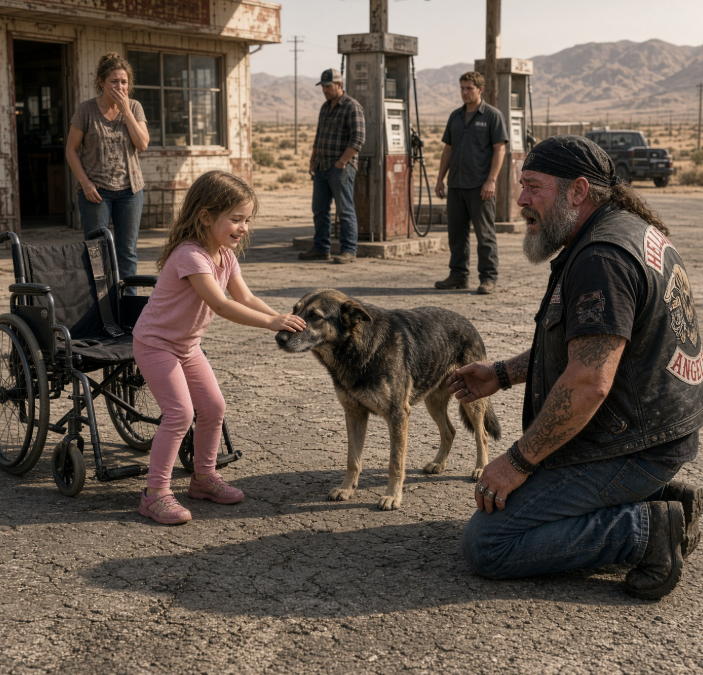
Pulled out a folded wheelchair.
Automatic movements.
Practice.
Snap.
Lock.
Turn.
She opened the rear door.
A little girl waited inside.
Six years old, I learned later.
At the time all I saw were thin legs in pink leggings that did not move when the mother lifted them.
You notice details like that after enough years around wounded soldiers.
How somebody transfers weight.
Which muscles help.
Which do not.
Whether a movement is new or practiced.
The mother settled the girl into the wheelchair.
Adjusted her footrests.
Checked the brake.
Kissed the top of her head.
Pointed toward the diner.
“One minute.”
I could not hear everything.
The girl nodded.
The mother hurried inside.
Maybe restroom.
Maybe change.
Maybe both.
I turned back to the pump.
Then I heard a soft whine.
Not near me.
Around the diner.
I looked.
A German Shepherd emerged from the shadow along the building.
Thin.
Too thin.
Dust gray across his coat.
Rear leg dragging slightly.
Gray muzzle.
One ear torn at the tip.
I stopped breathing.
There are moments when recognition arrives before thought.
Your body knows.
Then your mind tries to catch up.
The dog moved close to the wall instead of crossing open pavement.
Solid cover on one side.
Old habit.
The limp.
Right rear.
Not severe enough to prevent walking.
Enough that every fourth step shortened.
My mouth went dry.
“No.”
The dog stopped.
I stared at the ear.
Notch.
Small triangle gone.
Tank used to joke that it made Diesel look like somebody took a bite out of him.
I had seen that ear ten thousand times.
“Diesel.”
I did not say it loudly.
Barely said it at all.
The dog did not hear.
Or did not react.
Fourteen months.
Hundreds of miles from where he disappeared.
Underweight.
No collar.
No reason whatsoever for him to be standing at the same nowhere gas station where I happened to stop.
I wanted to run to him.
Every part of me did.
I stayed still.
War dogs are not pets in a familiar backyard simply because you love them.
A frightened, hungry retired working dog with months of unknown experiences could bolt.
He could run straight onto the highway.
One chance.
“Easy.”
The little girl saw him.
Her face changed.
Not alarm.
Interest.
She leaned forward.
Made a tiny clicking sound with her tongue.
Diesel’s torn ear rotated toward her.
He stopped.
Looked.
The girl smiled.
“Hi.”
I heard that.
Diesel lifted his head.
Fifteen feet between them.
Maybe less.
The girl held one hand toward him.
He took a step.
Stopped.
Another.
His bad leg dragged.
The child pulled against a strap across her lap.
Could not reach.
She looked down.
Something about her expression changed.
Determination has a recognizable face.
I saw it in recruits.
Soldiers.
Bikers.
Trauma patients trying to walk after being told they might never.
Seeing it on a six-year-old was different.
She unclipped the belt.
Put both hands on the wheelchair armrests.
I started toward her.
“Hey, kid—”
She pushed.
Her arms shook.
Shoulders rose.
Face turned red.
Then her body lifted.
At first I thought she was only repositioning herself.
Then her knees straightened.
Her feet took weight.
Not well.
Not safely.
But weight.
The child stood.
Every instinct in me screamed to reach her before she fell.
I stopped because Diesel was moving.
And because the girl looked like any sudden interference might break whatever fragile connection her body had just found.
Her left leg shook violently.
Right knee nearly buckled.
She held one arm into open air.
Toward Diesel.
“One step.”
She said it to herself.
Maybe to him.
Maybe nobody.
Then one foot moved.
Dragged more than stepped.
But left the pavement.
Came forward.
Landed.
The diner door flew open.
The mother came out.
Her phone dropped.
Cracked against tile behind her.
She froze.
No scream at first.
Just both hands over her mouth.
Then:
“Emma?”
So the girl had a name.
Emma.
She turned slightly.
That nearly dropped her.
Diesel reached her first.
He came close.
Pressed his shoulder beneath the hand she had stretched out.
Emma grabbed fur.
The dog held still.
She laughed.
That sound changed something in the whole parking lot.
Truck driver halfway out of his cab stopped.
Teen at another pump stared.
Cashier appeared behind the window.
The mother sobbed.
I dropped to one knee.
Not because I was trying to be dramatic.
Because my legs suddenly did not trust me.
I opened my hand.
“Diesel.”
Louder.
The dog’s head snapped around.
Everything in him changed.
Ear up.
Eyes fixed.
I knew that face.
Recognition.
He looked at me.
Then Emma.
Back to me.
“Come here, boy.”
My voice broke.
I hated that.
Did not matter.
Diesel limped toward Emma first.
Pressed his head into her hand.
Stayed long enough for her to steady herself.
Then the mother reached them just as Emma’s legs gave way.
She caught her daughter.
All three ended up half on the sidewalk.
Emma laughing.
Mother crying.
Diesel trying to crawl into both of them.
I remained on one knee with Tank’s dog tags suddenly feeling like they weighed twenty pounds inside my vest.
“Diesel.”
He looked at me again.
I approached slowly.
Palm low.
No grabbing.
He sniffed.
Once.
Then shoved his gray head into my chest.
Hard.
I folded over him.
Fourteen months.
I had pictured this moment a hundred ways.
Running across a field.
Shelter kennel.
Phone call.
Never like this.
Never with a child in a wheelchair crying beside us.
“You old bastard.”
Diesel whined.
I buried my face in his neck.
“You’re alive.”
He smelled like dust.
Old fur.
Infection, though I did not recognize that part yet.
And something familiar enough to tear open fourteen months of grief in one breath.
I put a hand inside my vest.
Pulled out Tank’s tags.
Held them near Diesel.
His nose touched metal.
Then his eyes closed.
That nearly finished me.
Sarah—that was the mother’s name—kept saying:
“How?”
Not to me.
To Emma.
“You stood.”
Emma seemed confused by everybody else’s reaction.
“I wanted the dog.”
Sarah laughed through tears.
“You stood.”
“My legs hurt.”
That was when practicality returned.
“Sit her down.”
Sarah looked at me.
“What?”
“She shouldn’t keep weight on them until somebody evaluates what happened.”
I helped return Emma to the chair.
Careful.
No heroics.
Diesel lay at her feet.
Head across her knees.
Sarah stared at me.
“You know him?”
“Yes.”
“Whose dog?”
“My brother’s.”
Not biological brother.
Did not matter.
“He’s been missing.”
“How long?”
“Fourteen months.”
Emma stroked his head.
“I found him.”
I smiled.
“Looks like he found you.”
People brought water.
Diesel drank.
Too fast.
I pulled the bowl after several seconds.
“Slow.”
He glared.
“Still rude. Good.”
Emma giggled.
Sarah sat on the curb.
Hands shaking.
I handed her water.
She looked exhausted enough that the bottle itself seemed heavy.
“What happened to her?”
I asked carefully.
Her face closed.
I immediately regretted how direct it sounded.
“You don’t have to tell me.”
“Car accident.”
A year earlier.
Emma’s father died.
Their vehicle was struck at highway speed.
Emma survived with spinal injuries.
Multiple surgeries.
Months in hospitals.
Different specialists.
Different opinions.
Sarah had heard variations of:
Severe damage.
Poor prognosis.
Do not expect meaningful walking.
Prepare for long-term mobility assistance.
She had spent savings chasing hope across three states.
The car full of belongings suddenly made sense.
They were driving home from another appointment.
This one had brought no miracle.
Sarah had cried in the parking structure where Emma could not see.
Now her daughter had just stood beside a gas pump for a starving dog.
I did not say miracle.
Not because the moment was not extraordinary.
Because bodies are complicated.
A six-year-old standing once was not a diagnosis.
Hope does not need lies added to it.
“She needs a doctor.”
“I know.”
Sarah looked terrified to even say it.
“What if it was just adrenaline?”
“Could be.”
“What if she can do it again?”
“Could be.”
“What if she can’t?”
I looked at Emma.
She was whispering into Diesel’s ear.
“Then she still stood today.”
Sarah started crying again.
That was when the animal control truck arrived.
Tan uniform.
County logo.
Metal capture pole.
I knew the shape.
Diesel did too.
He lifted his head.
Body tightened.
“Easy.”
The officer got out.
“Somebody call about a stray shepherd?”
Half the parking lot suddenly became interested in the ground.
Probably one of them.
Not malicious.
Dog looked bad.
No collar.
Public place.
Reasonable call.
The officer walked closer.
“Need everybody to give me room.”
Diesel growled.
Emma wrapped both arms around his neck.
“No.”
“Sweetheart, step back.”
“He’s mine.”
I stood.
“He’s not a stray.”
Officer looked at me.
“You have proof?”
“I know the dog.”
“That isn’t what I asked.”
Fair.
“He’s a retired working dog.”
“Chip?”
“I don’t know.”
“Tags?”
“Not on him.”
“Ownership papers?”
“Not in my pocket.”
The officer opened his clipboard.
“Bite report matches a shepherd moving through the region.”
My stomach tightened.
“What report?”
“Male German Shepherd. Older. No collar. Bit a man nine days ago.”
“Where?”
He named a town.
Yermo.
I did math.
Something about the timing struck me.
I had called shelters during my search.
Bakersfield intake.
A dog matching Diesel had been reported there around then.
Maybe.
Memory.
I took out my phone.
“Hold on.”
The officer lifted the capture pole.
Diesel growled harder.
“Sir, move.”
“No.”
His eyes narrowed.
I raised both hands.
Not challenging.
“Give me two minutes.”
“This dog has a bite history.”
“This dog has a service number.”
“That does not change—”
“If it’s the same dog.”
He stopped.
“I have photos.”
I found one.
Tank and me younger.
Uniforms.
Dust.
Diesel between us.
Working vest.
Number visible.
Ear notch already there.
I turned the phone.
“Look.”
Officer did.
His expression changed slightly.
“That’s him?”
“Yes.”
“Handler?”
I pointed to Tank.
“Dead.”
“And you?”
“Served with him.”
“Legal owner?”
“I don’t know who paperwork assigned after Tank died.”
Honesty.
Important.
“I’ve been looking for Diesel since he ran after the funeral.”
Officer studied the dog.
Then Emma.
Then me.
“Even if I verify this, I need an ownership process.”
“Fine.”
“I can’t release him because you recognize him.”
“Fine.”
“He still has to be logged.”
“Log him.”
“He may need quarantine if bite report matches.”
“It doesn’t.”
“You don’t know that.”
“I can prove where I think he was.”
“Think?”
“I called Bakersfield.”
He sighed.
“Sir—”
“Call.”
The voice was not threatening.
Command tone sometimes appears after enough years leading groups.
The officer heard it.
So did I.
I softened.
“Please.”
“Call the shelter.”
“I’ll give you the number.”
Emma began crying quietly.
Diesel turned toward her.
Officer looked down.
His stance changed.
Less enforcement.
More human.
“I’m not trying to kill your dog.”
“He’s not my dog yet.”
“Then stop standing like I’m stealing him.”
Fair again.
I breathed.
“Sorry.”
“That bite report carries mandatory hold if confirmed.”
“What happens if it’s not him?”
“Then standard stray intake unless ownership verified.”
“Can I file claim?”
“Maybe.”
“Do that.”
He glanced at my vest.
Then my phone.
“You always this difficult?”
“Yes.”
Sarah made a sound that might have been laughter despite everything.
Then Diesel tried standing.
His rear leg folded.
He yelped.
We all froze.
He went down hard.
That was when I saw the inside of the thigh.
Wound.
Hidden under dirty fur.
Red.
Swollen.
Drainage.
Bad.
Very bad.
I knelt.
“Jesus.”
Officer lowered the pole.
“He needs veterinary care.”
“Now.”
I looked at his gums.
Pale.
Skin tented.
Dehydrated.
“He may be septic.”
The county officer was not a villain.
That needs saying.
Stories like to make the person holding the clipboard cruel because it makes the emotional math easier.
He looked at the wound.
His face changed completely.
“There’s a clinic ten minutes north.”
“Can they handle this?”
“Doc Reyes.”
He already had his radio.
“I’ll call.”
“What about intake?”
“I’ll start verification on the way.”
He pointed at Diesel.
“We move the dog for emergency treatment under county hold.”
Then at me.
“You follow.”
“I’m riding.”
Sarah held up keys.
“He can come with us.”
My motorcycle suddenly looked useless.
The officer considered.
“Better.”
We lifted Diesel.
He weighed maybe sixty pounds.
Should have been closer to ninety.
That scared me more than anything so far.
I got one arm under his chest.
Another beneath hindquarters without pressing the wound.
“Easy.”
Diesel did not fight.
He placed his head on my shoulder.
Right against my vest.
Tank’s tags pressed between us.
I carried him to Sarah’s car.
Emma reached from the chair.
Touched one paw.
“You’re okay.”
She said it with complete confidence.
“We’re coming too.”
Sarah looked at me.
“We are.”
Doc Reyes’s clinic was a low cinderblock building with a hand-painted sign and better medicine inside than appearances suggested.
She met us at the door.
Forties.
Hair in a braid.
No patience for explanations before vitals.
“Table.”
Diesel got fluids.
Bloodwork.
Wound cleaning.
Temperature elevated.
White count ugly.
Deep soft-tissue infection.
No systemic organ failure yet.
Close.
“Another day or two,” Dr. Reyes said, “and this becomes a different conversation.”
I stayed at Diesel’s head.
He watched my face.
Occasionally looked toward the door where Emma waited.
The county officer spent twenty minutes on calls.
Bakersfield shelter.
Registry.
Military working dog records.
Possibly three agencies I did not recognize.
Eventually he came back.
Held out a form.
“Bite report was misidentified.”
I exhaled.
“Shelter log places a dog matching him well outside the location window.”
“And registry?”
He pointed toward Diesel.
“Service number confirmed.”
I closed my eyes.
“Retired military working dog.”
“Yes.”
“Handler listed as Thomas Mercer.”
“Tank.”
“Estate unresolved as to animal ownership after handler death.”
“So?”
“Registry permits a surviving authorized service-connected claimant or family representative to initiate transfer.”
He looked at me.
“You qualify to file.”
My hand shook when I took the pen.
“Does this make him mine?”
“Temporarily recognized claimant pending final transfer.”
Good enough.
The officer folded his clipboard.
“No dangerous-dog hold.”
He looked toward Emma through the window.
Then Diesel.
“Been doing animal control thirty years.”
He shook his head.
“Most stories don’t improve this much in one afternoon.”
I signed.
He reached out.
We shook hands.
“Thank you.”
“Take care of him.”
“I will.”
He paused.
“And get that kid back to a doctor.”
Sarah heard.
“We are.”
Dr. Reyes kept Diesel overnight.
I slept on a folding cot near his kennel.
Sarah and Emma stayed at the motel across the road.
I paid.
Sarah objected.
“I can pay for our own room.”
“I’m sure.”
“Then why—”
“Because tonight you don’t have to.”
Her jaw tightened.
I recognized pride.
I had seen it in veterans.
In bikers.
In myself.
So I changed approach.
“Tank would’ve paid.”
She looked at me.
“Your friend?”
“Yes.”
“Then I’ll argue with him later.”
“Good.”
She accepted.
That night, I sat on the clinic floor with my hand through Diesel’s kennel bars.
He slept.
I did not.
Tank’s tags lay in my palm.
“You see your dog?”
No answer.
“Found him.”
My throat closed.
“Or maybe the kid did.”
Diesel opened one eye.
“You always did make everything difficult.”
Tail thumped once.
I laughed.
At two in the morning, I finally cried.
Quietly.
No audience.
No shame.
The next day, Sarah and Emma returned before breakfast.
Emma asked to see Diesel before she asked for food.
Dr. Reyes allowed it.
Diesel was sedated.
Bandaged.
Still weak.
The moment Emma rolled in, his tail moved.
Once.
Then twice.
Emma smiled like somebody turned on the sun.
I looked at Sarah.
She was crying again.
“This is becoming a habit.”
“Shut up.”
“Fair.”
That afternoon, we talked.
Not about Diesel.
About Emma.
Sarah told me the whole accident.
They had been driving home from Emma’s kindergarten music program.
A pickup crossed the centerline.
Emma’s father, Mark, died at the scene.
Sarah remembered almost nothing after impact until waking in a hospital.
Emma had a spinal cord injury.
Complicated.
Initial swelling.
Surgery.
Months of rehabilitation.
Some physicians believed meaningful voluntary lower-extremity recovery was unlikely.
Others were more cautious.
But after enough disappointment, Sarah heard every cautious statement as another no.
She sold their house.
Moved between family, motels, rehabilitation centers.
Used savings.
Then retirement money.
Then credit.
“Everybody keeps telling me to accept reality.”
“What does that mean to you?”
“That I stop trying.”
“Maybe they mean plan while still hoping.”
She looked at me.
“You sound like a therapist.”
“Insulting.”
She smiled.
Then looked through the clinic window.
“Did you see her?”
“Yes.”
“She stood.”
“Yes.”
“Tell me I didn’t imagine it.”
“You did not imagine it.”
“Does that mean she can walk?”
“I don’t know.”
Sarah’s eyes dropped.
I continued.
“But it means something happened that deserves evaluation.”
There was a veterans rehabilitation center I knew through club fundraising and former service connections.
They had physical medicine specialists experienced with complex neurological injuries.
Not pediatric primarily.
But networks overlap.
I made calls.
One led to another.
By evening, I had a name.
Dr. Meera Shah.
Pediatric rehabilitation specialist in San Bernardino.
A colleague owed a favor.
Sarah stared at the paper.
“We’ve seen specialists.”
“I know.”
“What if she says the same thing?”
“Then you have more information.”
“What if Emma can’t stand again?”
I looked at Diesel.
“Then today still happened.”
That became important over the next several months.
Because Emma did not simply get up and walk.
Real recovery was not cinematic.
The gas-station moment was dramatic because adrenaline, motivation, residual pathways, positioning, and pure stubbornness converged for several seconds.
Dr. Shah spent nearly two hours evaluating Emma.
Reviewed imaging.
Operative records.
Old neurological assessments.
Then ordered new testing.
The conclusion was not:
Miracle.
It was:
Incomplete spinal cord injury.
Very limited but detectable voluntary motor function in muscle groups that previous assessments had classified as functionally absent.
Some nerve pathways had remained.
Weak.
Inconsistent.
Difficult to access.
But present.
Sarah cried when Dr. Shah explained.
“Why didn’t anyone find it?”
“They may not have been detectable then.”
“Or clinically meaningful.”
“Recovery evolves.”
Dr. Shah kept her voice careful.
“This does not guarantee independent walking.”
Sarah nodded.
“But?”
“But your daughter has something to work with.”
That was enough.
More than enough.
Physical therapy began again.
Emma hated it.
That part never makes inspirational videos.
Children do not become brave because adults clap.
Rehabilitation hurts.
It is repetitive.
Slow.
Humiliating.
You fail the same movement fifty times and are expected to try number fifty-one with enthusiasm.
Emma did not.
She cried.
Threw foam blocks.
Once told the therapist:
“I hate your stupid bars.”
The therapist, a former Army rehabilitation specialist named Denise Carter, said:
“Good.”
Emma stared.
“Why good?”
“Means you still have enough energy to insult my equipment.”
I liked Denise immediately.
Diesel became part of the routine after his infection resolved.
He could not enter every therapy space initially.
Paperwork.
Health checks.
Behavior assessment.
Eventually allowed.
He waited at the end of the parallel bars.
No tricks.
No manufactured heroics.
He lay down.
Emma pushed herself upright using braces.
Hands white around metal rails.
One foot.
Shift.
Other.
Knees trembling.
Diesel watched.
“Come on.”
Emma grunted.
“You came to me.”
Another step.
“Now I’m coming to you.”
Sometimes she made three.
Sometimes none.
On bad days, Diesel limped over to her instead.
Denise said:
“Still counts.”
Emma frowned.
“He cheated.”
“Adaptive strategy.”
“What?”
“Cheating with medical vocabulary.”
Emma liked that.
Diesel gained weight.
His infected leg healed.
Old hip damage remained.
Arthritis.
He never returned to the powerful dog in Tank’s photographs.
That was fine.
He did not need to.
Neither did I.
I had planned to leave Barstow the morning Diesel was discharged.
Sarah’s route home went west.
Mine north.
Different lives.
I strapped my bag to the bike.
Diesel stood beside Emma’s wheelchair.
She held his leash.
Sarah looked at me.
“Thank you.”
I hated endings.
“Take care.”
Emma looked up.
“You’re taking Diesel?”
That question stopped me.
Legally, yes.
Emotionally, suddenly complicated.
“He’s coming with me.”
“Where?”
“Home.”
She looked at Diesel.
“Where’s his home?”
I opened my mouth.
Nothing came.
My place?
Clubhouse?
Tank’s old property had sold.
Diesel had never lived with me full-time.
Emma stroked his gray neck.
“He wants to stay with me.”
Kids make statements like they have access to truth adults missed.
Sarah intervened.
“Emma.”
“It’s okay.”
I crouched.
“Diesel was Tank’s dog.”
“Who’s Tank?”
I touched the tags inside my vest.
“My best friend.”
“Did he die?”
“Yes.”
“Did Diesel miss him?”
“Very much.”
Emma looked at the dog.
“I miss my dad.”
There was nowhere to hide after that.
“I know.”
“Maybe Diesel knows that.”
He probably did not understand bereavement conceptually.
But he understood absence.
Routine broken.
Person gone.
Searching.
That was close enough.
I sat on the curb.
“Tell you what.”
Emma waited.
“Diesel needs more recovery.”
“So do I.”
“Yes.”
“I’ll stay nearby until we figure things out.”
Sarah looked at me.
“You don’t have to.”
“I know.”
Those words changed my life.
I rented a cheap place outside town for a month.
Then renewed.
Then stopped pretending it was temporary.
The club thought I had lost my mind.
Rich called.
“You moved to Barstow?”
“For a while.”
“Why?”
“Dog.”
Silence.
“And?”
“Kid.”
Longer silence.
“You getting soft?”
“Say that again when I’m home.”
“Very hard and intimidating. Got it.”
The chapter helped anyway.
Bikers are excellent at pretending support is logistics.
One member found a used wheelchair-accessible van through a cousin.
Another rebuilt the ramp at Sarah’s rental.
Someone else knew a lawyer who helped untangle medical billing.
No ceremonies.
No press.
Just people solving things.
I became the man who showed up.
That was new.
My old skill was arriving.
Showing up repeatedly is different.
Monday therapy.
Thursday neurology.
Friday Diesel’s vet.
School meeting.
Grocery run when Sarah’s car failed.
I taught Emma cards.
She cheated.
Badly.
I taught her to identify motorcycle engines by sound.
Sarah objected.
“Why does a six-year-old need to know that?”
“Life skill.”
“No.”
“Cultural enrichment.”
“Absolutely not.”
Emma learned anyway.
Diesel slept at the foot of her bed.
Not every night initially.
He stayed with me some nights because we needed to be sure attachment was healthy, routines balanced, and Sarah actually wanted a large retired war dog living in her small rental.
She did.
Eventually.
The first night Diesel chose Emma’s room without looking back at me hurt.
I am not proud of that.
I had searched fourteen months.
Carried Tank’s tags.
Found Diesel.
Signed the paperwork.
And part of me wanted the reunion to belong to me.
Then I saw Diesel curl near Emma’s bed.
Saw her asleep with one hand hanging over the mattress toward him.
Understood.
Love is not ownership.
Tank knew that.
I needed time.
Legal transfer was completed.
I became Diesel’s registered owner.
Then established Sarah as co-caretaker.
Years later, paperwork shifted again.
None of it changed what the dog already decided.
He belonged where Emma was.
Rehabilitation progressed.
Slowly.
Month two, Emma could stand thirty seconds with braces and support.
Month four, several steps between bars.
Month six, walker.
Not always.
Wheelchair remained central.
That mattered to Sarah.
At first every wheelchair day felt like failure.
Dr. Shah corrected that.
“Mobility aids are not defeat.”
Sarah nodded.
“Emma’s goal is independence, access, health, and choice.”
Walking was one tool.
Not the measure of her worth.
I needed that lesson too.
Military men understand assistive devices poorly until our own bodies need them.
A cane can feel like surrender until you understand it gives you ground back.
Diesel had a limp.
Emma used braces.
Neither was less complete.
One afternoon Emma fell during therapy.
Hard.
Pads caught most of it.
Still scared her.
She screamed.
“I can’t!”
Denise waited.
Emma hit the mat.
“I hate this!”
“I know.”
“I’m never going to walk normal!”
Silence.
Denise said:
“Maybe not.”
Sarah’s face tightened.
I almost stepped in.
Denise continued.
“You might walk differently.”
“You might use a chair sometimes.”
“A walker sometimes.”
“A brace.”
“Maybe one day mostly your own legs.”
“We don’t know.”
Emma was crying.
“That’s not fair.”
“No.”
“I want my old legs.”
“I know.”
Diesel came over.
Lay beside her.
Emma shoved her face into his neck.
“He has a bad leg.”
“Yes.”
“He still walks.”
“Yes.”
“Slow.”
“Yes.”
Denise crouched.
“Slow still counts.”
That became a phrase.
Slow still counts.
On difficult days, Sarah used it.
I used it.
Emma used it against us when we complained.
Diesel certainly lived it.
A year after the gas station, the clubhouse hosted a small gathering.
Not public.
Tank’s birthday week.
Diesel healthy enough to travel.
Emma stronger.
Sarah came reluctantly because she did not know what to expect from forty motorcycles and twice that many tattoos.
Within twenty minutes she realized half the terrifying men were arguing about potato salad.
Emma loved it.
Somebody—probably Rich—had made Diesel a ridiculous little leather vest.
Patch on back:
EMMA’S DOG
Below it:
Tank’s old service number.
I stared at it.
“Who authorized this?”
Rich shrugged.
“Committee.”
“There is no committee.”
“There is now.”
Emma laughed.
Diesel wore it.
Looked offended.
Then Emma stood at the far end of the clubhouse.
Brace on one leg.
Cane in hand.
Sarah beside her but not touching.
The room quieted.
Not because anyone was told.
Men noticed.
Emma began walking.
Slow.
One step.
Pause.
Another.
Cane.
Brace.
Shift.
Her gait was uneven.
Beautiful.
Not because walking made her more worthy.
Because I knew the hours behind each footfall.
Pain.
Tears.
Boredom.
Falls.
Starting again.
Diesel waited at the front.
I stood near the back.
Halfway, Emma stopped.
Everyone held breath.
She looked at us.
“Stop staring.”
The whole room laughed.
Tension broke.
She continued.
Reached Diesel.
Put both arms around him.
Every man in that room suddenly developed allergies.
I reached inside my vest.
Tank’s tags.
Held them.
“You see this?”
Nobody nearby heard.
“This is your dog.”
My voice cracked.
“He’s got another kid now.”
I looked toward Emma.
“You’d like her.”
That night, I finally removed Tank’s tags from my vest.
Not forever.
I put them in a wooden box at the apartment beside a photograph of Tank and Diesel.
Carrying grief is not the same as honoring it.
Sometimes you can put something down and love it exactly as much.
Sarah noticed.
“You okay?”
“No.”
“Good.”
I looked at her.
She smiled.
“You always say honesty matters.”
“Annoying.”
“You taught me.”
Over time, Sarah became more than Emma’s exhausted mother.
That sentence sounds obvious.
It was not.
Trauma had reduced her entire identity to caregiving.
Appointments.
Insurance.
Medication.
Transfers.
Exercises.
She forgot music she liked.
Food she preferred.
What she wanted.
I started asking.
At first she got angry.
“Where do you want to eat?”
“Emma can only—”
“I asked where you want.”
“I don’t care.”
“Yes, you do.”
Eventually she remembered.
Mexican food.
Old country music.
Sunrise walks.
Photography.
She started taking pictures again using a used camera one of the club wives gave her.
Not charity.
She shot club events in exchange.
Pride preserved.
That became her side income.
Then part-time work.
Then more.
I watched her become visible to herself again.
Whatever existed between Sarah and me developed slowly.
Very slowly.
Neither of us had room for rescue fantasies.
I did not save her.
She did not heal me.
That kind of story sounds romantic and often becomes unhealthy.
We became reliable.
Coffee.
Arguments.
Appointments.
Silence that did not need filling.
She told me when I was overstepping.
Frequently.
I listened more often than I wanted.
Emma called me Cole.
Always.
Never Dad.
Her father was Mark.
We kept photographs.
Talked about him.
I never wanted a dead man erased to create room for me.
Love does not require vacancy.
By the time Emma was nine, she could walk moderate distances with braces and a cane.
Used her wheelchair for long days.
School trips.
Fatigue.
Bad pain days.
She became fierce about correcting people.
One teacher once said:
“You’re doing so well—you hardly need the chair anymore.”
Emma answered:
“I need it because I’m using it.”
I nearly applauded.
Sarah did.
Diesel aged.
Gray spread.
Hip worsened.
We bought ramps.
Orthopedic beds.
Joint medication.
Then one afternoon I caught Emma sitting beside him.
She was rubbing his bad leg.
“Hurts?”
Diesel sighed.
“Mine too.”
She tapped her brace.
“We match.”
He put his head in her lap.
Same as the gas station.
Years disappeared.
I photographed it.
One of the few pictures I ever took well.
That photograph eventually hung beside Tank’s old military picture.
Young Diesel between two soldiers.
Old Diesel beside a girl.
Two lives.
Same dog.
When Diesel was around thirteen, his health declined.
Heart.
Kidneys.
Arthritis.
Nothing dramatic at first.
Shorter walks.
More sleep.
Then one night he could not get comfortable.
Emma was eleven.
Old enough to understand before we said it.
“No.”
Sarah sat beside her.
“Baby—”
“No.”
We took him to Dr. Reyes.
Same clinic.
Different paint on the sign.
She remembered him immediately.
“Old soldier.”
Tests.
Bad news.
We could treat symptoms for a while.
Not cure what age was doing.
Emma demanded every option.
Dr. Reyes explained patiently.
Then asked:
“What does Diesel love?”
Emma wiped tears.
“Me.”
No hesitation.
“Yes.”
“What else?”
“Food.”
I said.
Emma glared.
“Walks.”
“Sun.”
“Sleeping on my feet.”
Dr. Reyes nodded.
“When most of those things become pain instead, we talk again.”
We got four more months.
Good months.
Then mixed.
Then bad.
Emma stopped asking him to follow her upstairs.
We moved everything downstairs.
His bed beside hers.
One January morning, Diesel could not stand.
He tried.
Rear legs failed.
Emma got down on the floor.
“No.”
Diesel licked her hand.
We knew.
Dr. Reyes came to the house.
Diesel lay on a blanket.
Sarah beside Emma.
I sat near his head.
Emma whispered:
“You found me.”
I corrected softly.
“You found him.”
She shook her head.
“No.”
She looked at me.
“He came to me first.”
Fair.
I took Tank’s tags from the box.
Had not carried them daily in years.
Placed them beside Diesel.
He sniffed.
Maybe memory.
Maybe metal smell.
Who knows.
I scratched behind his ear.
“Tank’s waiting, old man.”
My voice broke.
Emma looked at me.
I continued.
“But you don’t have to hurry.”
Diesel’s breathing slowed under sedation.
Emma held him.
He died with his head in her lap.
Exactly where he had placed it the day we found each other.
I had lost Tank once.
Diesel once.
Then Diesel for good.
Grief did not feel the same.
That surprised me.
The first losses had felt like theft.
This one felt like completion.
Painful.
Terrible.
But finished.
Diesel had come home.
Not to one place.
To people.
We buried some of his ashes beside Tank.
The rest Emma kept.
His little vest hung at the clubhouse.
EMMA’S DOG.
Service number underneath.
At Tank’s grave, I placed my hand against the stone.
“Your dog did good.”
Wind moved through dry grass.
“I thought I was supposed to find him for you.”
I laughed.
“Turns out he found somebody else.”
Years passed.
Emma grew.
Her walking remained different.
Some days cane.
Some days braces.
Some days wheelchair.
She stopped measuring success by which one she used.
That may have been the greatest recovery of all.
At sixteen she spoke at a rehabilitation fundraiser.
I sat in back.
Leather vest.
Gray beard nearly white.
Sarah beside me.
Emma stood at the podium using forearm crutches.
She told the gas-station story.
Not the viral version strangers repeated.
Her version.
“I didn’t stand because a dog magically cured me.”
Good.
I smiled.
“I stood because I wanted to reach him.”
The room quieted.
“My spinal injury turned out to be incomplete.”
“Therapy and time helped me learn what my body could still do.”
She paused.
“Diesel didn’t repair my nerves.”
“He gave me a reason to stop believing there was nothing left to try.”
I looked at Sarah.
Tears.
Of course.
Emma continued.
“And I think maybe I did that for him too.”
There it was.
The truth.
Two damaged bodies.
Neither fixing the other.
Both making effort feel worthwhile.
Afterward a reporter asked me:
“Did you save them?”
I almost laughed.
“No.”
“But you found Diesel.”
“I recognized him.”
“You helped Emma get treatment.”
“I made calls.”
“You stayed.”
That word.
Stayed.
Maybe that was my contribution.
I had spent half my life moving.
Tank and I rode because motion felt like freedom.
After his death, I rode because stillness hurt.
Then a gas station in Barstow stopped me.
A wheelchair rolling backward toward the road.
A child.
A dog.
I caught the chair before it reached the drop-off.
That detail became less important than everything afterward, but it happened first.
Sarah had stepped inside.
Emma shifted.
One wheel hit a crack.
Brake had not fully engaged.
The chair began rolling backward.
I saw it.
Ran.
Caught the handles one second before the rear wheels dropped from the curb toward moving traffic.
Emma looked up.
Not afraid of me.
Pointed past my shoulder.
“Dog.”
That was how I turned.
That was how I saw Diesel.
For years, people told the story as though I saved Emma from the road.
Then Diesel inspired Emma to stand.
Then I saved Diesel from animal control.
Nice chain.
Clean.
Wrong.
The truth is messier.
A loose brake put Emma in my line of sight.
Emma showed me where to look.
Diesel gave Emma something immediate enough to reach for that she discovered movement her body had not produced before.
I recognized Diesel’s service history.
Animal control followed procedure but chose discretion and emergency care when facts changed.
Dr. Reyes treated the infection.
Dr. Shah found residual function.
Denise turned function into strength.
Sarah refused to give up without turning hope into denial.
The club helped.
Emma worked.
Diesel waited.
I stayed.
Nobody saved anyone alone.
That is what I eventually understood.
A life changes through chains of people choosing not to walk away.
Sometimes one choice looks dramatic.
A girl standing.
A dog returning.
A biker turning around at the freeway entrance instead of leaving town.
But underneath those moments are hundreds of smaller ones.
One more therapy session.
One more vet appointment.
One more night beside a kennel.
One more phone call.
One more step.
Slow still counts.
Tank used to say something when rides went wrong.
Mechanical trouble.
Weather.
Bad route.
Someone gets lost.
He would shrug and say:
“We’re still moving.”
I hated that phrase when the problem was serious.
After Emma, I understood it differently.
Movement does not always mean speed.
Sometimes movement is a little girl lifting one foot.
Sometimes an old dog dragging a damaged leg toward her.
Sometimes a grieving man unpacking enough of himself to become part of someone else’s tomorrow.
I still ride.
Not as far.
Knees complain.
The chapter has younger men up front more often now.
I am fine with that.
Mostly.
Tank’s tags remain in the wooden box.
Diesel’s photograph beside them.
Emma is grown now.
Sarah and I built a life none of us planned.
I never replaced Mark.
Never replaced Tank.
That was never the job.
The dead do not need replacing.
The living need room.
Sometimes the two can share the same house.
When Emma visits, she still tells the story about the gas station.
Usually she adds embarrassing details.
“Cole cried.”
“I had dust in my eye.”
“In both eyes?”
“Desert.”
“For three hours?”
“Severe weather.”
She laughs.
She keeps a small metal tag on her keychain.
Diesel’s service number.
Not the original.
A replica.
The real one remains with his memorial at the clubhouse.
Once I asked why she carries it.
She said:
“So I remember what happened.”
“What happened?”
She thought.
Then answered:
“I saw something I wanted badly enough to try again.”
That is probably the whole story.
Not miracle.
Not biker.
Not wheelchair.
Not war dog.
Trying again.
Diesel had spent fourteen months surviving after losing Tank.
Emma had spent a year hearing what her body might never do.
Sarah had spent that same year watching hope empty her bank account and still getting her daughter to one more appointment.
I had spent fourteen months pretending movement was the same thing as mourning.
Then all of us met on cracked pavement under a desert sun.
Emma saw Diesel.
Diesel saw Emma.
I saw Tank’s dog.
Sarah saw her daughter stand.
For one minute, every one of us saw something we thought was gone.
Possibility.
That is what stopped me.
That is what kept me.
Sometimes people ask whether I believe everything happens for a reason.
I do not know.
I have seen too much senseless loss to say that easily.
Tank did not need to die so I could meet Sarah.
Emma did not need a spinal injury to become brave.
Diesel did not need to suffer fourteen months in the desert to find purpose.
Pain does not become good simply because something meaningful eventually grows near it.
But I believe this:
When pain happens, what we do next matters.
Who we notice matters.
Who we refuse to abandon matters.
Tank taught me that in uniform.
Diesel taught me again after the war.
Emma taught me on two trembling legs in a gas station parking lot.
The day I saw her stand, I thought I was witnessing a little girl’s future being rewritten.
I was.
I just did not understand mine was being rewritten beside hers.
I came to Barstow trying to be alone.
I left with a starving war dog in emergency care, a frightened mother suddenly carrying hope she was almost afraid to touch, and a six-year-old asking when she could see Diesel again.
I tried riding away days later.
Made it as far as the freeway.
Engine running.
Road open.
Exactly what I thought I wanted.
Then I turned around.
Tank would have laughed.
Probably called me sentimental.
Then asked whether the kid needed anything.
That was who he was.
I sometimes imagine telling him the whole story.
I found Diesel.
He was skinny as hell.
Still stubborn.
Still hated being rushed.
A little girl found him before I could reach him.
She stood up for him.
Literally.
He became hers.
He helped her through years of rehab.
She helped him through the end of his life.
Your dog had two homes, brother.
Maybe three.
You.
Me, for a little while.
Then Emma.
And maybe that was always enough.
The last time I visited Tank’s grave, I stood there longer than usual.
No motorcycle running.
No excuse to leave.
I said:
“I used to think losing something meant it was gone.”
Then I thought about a gray-muzzled shepherd limping around the corner of a gas station.
A little girl rising out of a wheelchair.
A tired mother learning hope could be careful without being dead.
A road captain turning his bike around.
“Turns out sometimes it’s just farther down the road than you expected.”
I touched the stone.
Then walked back to Sarah.
Slowly.
My knees hurt.
She waited.
She always does.
And somewhere in the years between Tank’s death and that moment, without ever noticing exactly when it happened, I stopped being a man who rode because nobody was waiting for him to come back.
I became a man who knew exactly where home was.
Diesel had once spent his life finding hidden danger for soldiers.
In the end, the greatest thing he ever found was not explosives.
It was us.
And the greatest thing Emma ever did was not standing up in that parking lot.
It was giving an old war dog—and a grieving old biker—a reason to believe there might still be something worth walking toward.








