A German Shepherd Was Marked “Too Dangerous” and Scheduled to Die Friday Morning—Then a Navy SEAL Asked to Be Locked Inside Kennel 42 With Him.
PART3″
Then he released immediately and retreated to the back corner.
Six stitches.
No mauling.
No frenzy.
Just neutralization.
That was what made Claire sick.
Because the dog had not acted like an animal losing control.
He had acted like a professional who believed someone had crossed a line.
And in the world of county shelters, that distinction did not matter.
A bite was a bite.
A liability was a liability.
A red tag was a red tag.
EUTHANASIA SCHEDULED: FRIDAY, 8:00 A.M.
Claire stared at the mark on the file.
“I’m sorry, buddy,” she whispered.
Bane paced.
Four steps.
Pivot.
Four steps.
Pivot.
The heavy steel doors at the front of the adoption wing clanged open.
The sound cut through the barking.
Claire looked up.
The man who entered did not look like the usual visitor.
No excited children pulled him toward puppies.
No wife pointed at small dogs.
No elderly couple asked for something “calm and housebroken.”
He came alone.
Tall.
Broad-shouldered.
Faded denim.
Scuffed leather boots.
Plain dark T-shirt under a worn canvas jacket.
His arms were tattooed, but not in the decorative way men collect ink for conversation. His tattoos looked older. Earned. Some faded by sun. Some cut through by scars.
His face was weathered under a short dark beard, and his eyes moved across the shelter not with curiosity, but with a kind of hard, automatic vigilance.
He did not flinch at the noise.
Not once.
Dogs on both sides hurled themselves at the fencing as he walked down the center aisle, but the man moved with the quiet economy of someone who did not waste motion unless motion had purpose.
Claire stepped into his path.
“Can I help you find someone, sir?”
He stopped.
For one uncomfortable second, she felt as if his eyes were reading more than her name tag.
“We have some great labs in the back,” she continued. “And a few younger shepherds, if that’s your breed.”
“I’m not looking for a puppy.”
His voice was low.
Rough.
Not unfriendly.
Just unused.
“I’m looking for the one that’s out of time.”
Claire’s grip tightened around the clipboard.
She had heard versions of that sentence before.
People came in wanting to save the saddest dog. The hardest case. The one with the worst photo online. Sometimes it came from real kindness. Sometimes it came from a savior complex. Sometimes it came from people who wanted a redemption story more than they wanted responsibility.
But this man did not look sentimental.
He looked tired.
And he looked like tired was the safest thing about him.
“Dogs on the urgent list usually have severe behavioral issues,” Claire said carefully. “They require extensive rehabilitation, experienced handlers, and—”
“Show me the worst one you have.”
Claire paused.
“The worst?”
“The one nobody wants to feed.”
Protocol told her to steer him away.
Common sense told her to ask him to leave.
Something about the way he stood there told her neither would work.
Reluctantly, she pointed down the aisle.
“Far wall. Kennel 42. But I’m warning you right now—you cannot touch the cage. He’s aggressive.”
The man did not thank her.
He simply started walking.
Past the yapping terriers.
Past the pit bulls bouncing off the fencing.
Past the shepherd mixes pressing noses to wire.
Past the handwritten cards that said LOVES KIDS, NEEDS YARD, HOUSETRAINED, SHY BUT SWEET.
He stopped in front of kennel 42.
Inside, Bane halted his patrol.
For the first time that afternoon, the pacing stopped.
The shelter seemed to shrink around them.
Bane squared his shoulders and lowered his head slightly. His amber eyes locked onto the stranger on the other side of the chain link.
He did not bark.
He just stared.
The man stared back.
His name was Wyatt Miller.
Claire did not know that yet.
She did not know he had been out of the Navy for eleven months.
She did not know he had spent twelve years in the teams, three deployments in places civilians would never see on maps, and more nights than he could count moving through dark compounds with dogs who heard danger before men felt it.
She did not know his right knee had been rebuilt badly enough that winter made every step feel like grinding glass.
She did not know the government had given him discharge papers, a medical evaluation, and a handshake that did not mention what a man was supposed to do with the silence afterward.
Wyatt stood outside kennel 42 and looked at Bane.
He saw the missing piece of ear.
The scar across the snout.
The raw elbows.
The tension in the hindquarters.
The way the dog protected his center line.
The way he watched hands.
The way he did not waste sound.
Wyatt’s throat tightened.
“You’re a working dog,” he murmured.
Bane let out a low vibrating rumble from deep in his chest.
A warning.
Wyatt did not step back.
He did not lean forward.
He did not put his fingers through the fence like an idiot.
He simply stood there.
He recognized the look in the animal’s eyes.
It was not evil.
It was not madness.
It was not even aggression, not at its root.
It was a soldier left behind enemy lines, surrounded by noise, chaos, strange smells, wrong commands, and people who kept entering his space without understanding the rules of survival.
“He’s not a pet,” Wyatt said softly.
Claire approached behind him, keeping a safe distance.
“No. He isn’t.”
“What do you know about him?”
“Not much. Found near a military reservation. No chip. No tags. Collar had the plates ripped off.”
Wyatt’s jaw tightened.
“Someone erased him.”
Claire looked at the dog.
“Maybe.”
“Not maybe.”
Bane shifted his weight.
Wyatt noticed.
Claire did too, but she did not know what it meant.
Wyatt did.
The dog was loading.
Preparing.
Waiting for one wrong move.
“We named him Bane,” Claire said quietly. “He bit a tech last week. Level four bite on the paperwork. Six stitches.”
“He released?”
Claire blinked.
“What?”
“Did he release after the bite?”
“Yes. Immediately.”
“Then he wasn’t attacking.”
“He put a man in the ER.”
“He stopped a perceived threat.”
Claire’s expression hardened.
“With respect, sir, that distinction doesn’t matter much to the county attorney.”
“It matters to the dog.”
“It doesn’t change the law.”
“When?”
Claire did not pretend not to understand.
“Friday. Eight in the morning.”
Wyatt looked at the red tag.
Something old and cold moved behind his eyes.
“No.”
Claire sighed.
“I’m sorry.”
“No,” Wyatt repeated. “Open it.”
Claire actually laughed once.
Not because it was funny.
Because it was insane.
“Absolutely not.”
“I want to go in.”
“Sir, I don’t know who you are, but I am not opening that kennel. He will tear your arm open.”
Wyatt turned his head.
“He’s trapped in a six-by-eight concrete box with a hundred dogs screaming at him all day. His cortisol is through the roof. He thinks he’s under siege.”
“He is dangerous.”
“So am I.”
Claire did not have an answer for that.
Wyatt reached into his back pocket and pulled out a wallet. He ignored the driver’s license and cash, removing a black metal card and a folded certification paper.
He handed both to her.
Claire looked down.
The black card bore the insignia of Naval Special Warfare.
The paper was an old Department of Defense training credential connected to military working dog handling and rehabilitation.
“My name is Wyatt Miller,” he said quietly. “I ran dogs in Fallujah and Kandahar. I have been bitten by animals that make him look like a golden retriever. Go get your manager. Bring whatever waiver you need me to sign holding the county harmless. Then open the door.”
Ten minutes later, the aisle was cleared.
Dogs still barked, but staff had moved visitors out of the wing. A yellow CAUTION sign had been set near the entrance. Two kennel techs stood near the end of the aisle pretending they were not watching.
Dave Hensley, the shelter director, stood beside Claire clutching a four-page legal waiver.
Wyatt had signed it in jagged black ink.
Dave was sweating.
In his right hand, he held a can of industrial pepper spray.
“I’m telling you, man,” Dave said, “this is completely against protocol. We do not have a bite suit. We do not have a catch pole strong enough if he gets on you. If this goes bad, I’m spraying.”
Wyatt looked at the can.
“Put the spray away.”
“If he attacks—”
“If you spray him, you escalate him. If you escalate him, he fights to the death. Put it away.”
Wyatt did not shout.
He did not need to.
Something in his voice carried command so cleanly that Dave lowered the can before he seemed to realize his hand was moving.
Inside the kennel, Bane tracked every shift outside his cage.
The presence of multiple humans had pushed him higher into defense. He stood center enclosure now, teeth bared, a guttural snarl rolling out of him like an idling chainsaw.
Claire felt the sound in her chest.
Wyatt stood in front of the door.
He did not take a treat.
Did not take a leash.
Did not ask for gloves.
He closed his eyes once.
Four seconds in.
Four seconds out.
Again.
Again.
Animals read more than posture.
They read chemistry.
Fear had a smell.
So did aggression.
So did ego.
Wyatt aimed for none of them.
Zero.
Neutral.
Not prey.
Not threat.
Just present.
“Unlock it.”
Dave reached forward, hand shaking, and popped the carabiner.
The metal clacked loudly.
He slid back the deadbolt and scrambled away.
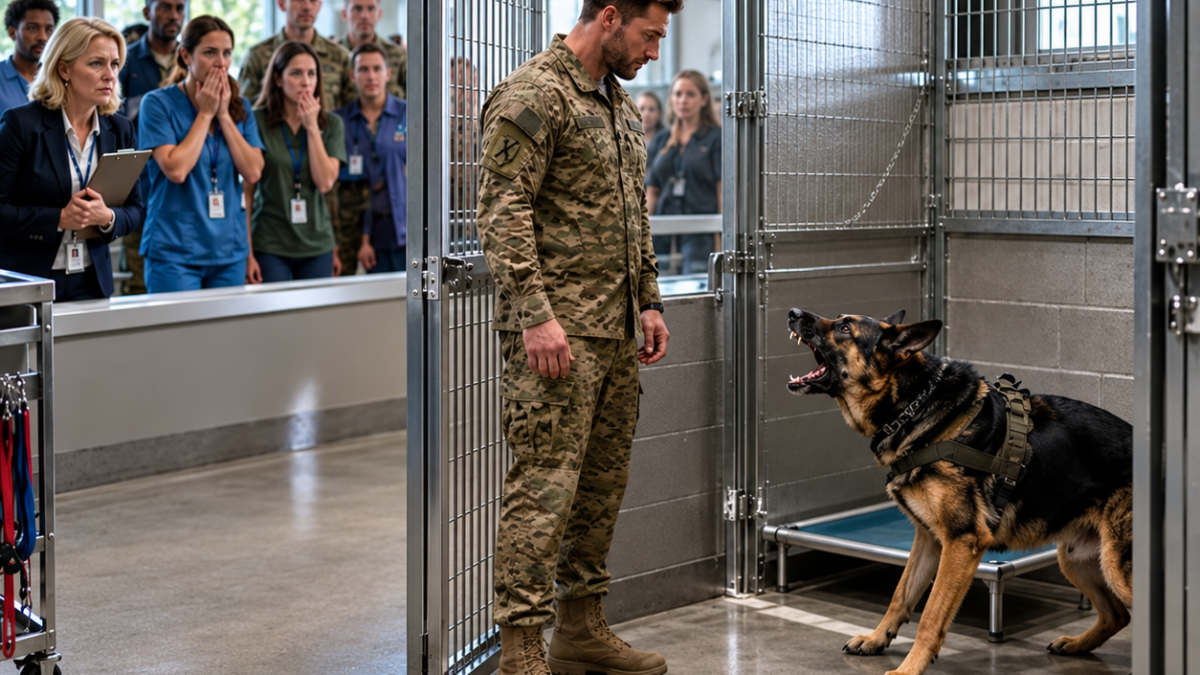
Wyatt pulled the chain-link door open, stepped into the six-by-eight concrete box, and pulled it shut behind him.
The latch clicked.
He was locked in.
Bane exploded.
The shepherd lunged forward with terrifying speed, barking, snapping his jaws inches from Wyatt’s thigh.
A bluff charge.
Designed to force an intruder back.
Most people would have flinched.
Raised hands.
Retreated.
Yelled.
Wyatt did none of those things.
He did not crouch and shove out a hand for the dog to sniff, one of the stupidest things civilians do around frightened dogs with teeth fast enough to punish arrogance.
He did not stare directly into Bane’s eyes.
He did not square his shoulders.
Instead, he turned slightly sideways, narrowing his profile, hands loose at his sides.
He became furniture.
A non-threat.
A void.
Bane backed up.
Confused.
Then lunged again.
This time, he hit Wyatt’s leg with his shoulder hard enough to buckle Wyatt’s bad knee.
Pain flashed white up Wyatt’s thigh.
His jaw tightened.
But he did not move.
No shout.
No correction.
No command.
Outside the kennel, Claire covered her mouth.
Dave whispered, “This is insane.”
Inside, the dynamic began to shift.
Bane paced rapidly in front of Wyatt, barking, spittle flying.
He was trying to force a reaction.
That was what his life had taught him.
Action.
Reaction.
Command.
Execution.
Threat.
Neutralization.
This human did not fit.
He did not retreat.
He did not attack.
He did not challenge.
He did not plead.
Two minutes passed.
The barking began to lose its sharp edge.
Not stop.
Wear down.
High drive burns hot, but it does not burn forever.
Wyatt knew the critical moment when he saw it.
The dog was stuck in a loop.
He needed a circuit breaker.
Slowly, moving with the careful smoothness of a sniper changing position, Wyatt slid down the concrete wall.
He sat on the cold wet floor.
Crossed his legs.
Rested his forearms on his knees.
Then looked at a crack in the opposite cinder-block wall.
He surrendered the high ground.
Completely.
Bane stopped.
The shepherd stood four feet away, chest heaving, ears twitching.
For the first time since Claire had met him, the terrifying guard dog looked lost.
Wyatt did not speak.
He only breathed.
Deep.
Slow.
Rhythmic.
In his mind, he said what he did not yet dare say aloud.
You’re okay, brother.
I know what it feels like when the war ends and nobody tells your brain.
Bane lowered his head.
His nose twitched.
Information.
He was gathering it the only way he trusted.
One step forward.
Pause.
Another.
His nose extended toward Wyatt’s boot.
He smelled leather.
Mud.
Oil from a garage.
Old gun cleaner buried in skin no soap could fully clear.
He smelled scar tissue, salt, metal, something disciplined beneath human fatigue.
And beneath all that, the absence of fear.
Bane moved closer.
Sniffed Wyatt’s knee.
His sleeve.
His elbow.
Wyatt did not move.
He did not try to pet him.
He did not take advantage of the moment.
He let the dog control the interaction.
Outside the kennel, Dave whispered, “He’s going to bite him.”
Claire hissed, “Shut up.”
Bane’s nose touched Wyatt’s elbow.
Still, Wyatt remained still.
The shepherd let out a long, shuddering breath.
The ridge of hair along his back began to settle.
Tension drained slowly from his hindquarters.
Finally, Bane looked at Wyatt’s face.
Wyatt turned his head.
Not fast.
Not direct as a challenge.
Just enough.
Their eyes met.
No demand.
No dominance.
Recognition.
One soldier to another.
Bane took one final step and lowered his heavy head onto Wyatt’s thigh.
Claire started crying before she realized she had made a sound.
Wyatt looked down at the scarred dog resting against him.
For a long second, he did nothing.
Then he lifted one hand and placed it gently behind Bane’s ears.
The dog did not flinch.
He leaned into the pressure with a sound that was half sigh, half broken whimper.
“I got you,” Wyatt said.
His voice cracked on the last word.
He cleared his throat, but it was too late.
The feeling had already escaped.
“I got you, buddy. We’re going home.”
Dave lowered the pepper spray completely.
Claire wiped her cheek with the back of her wrist.
No one said anything.
There was nothing to say.
They had just watched two damaged creatures speak a language most people never bothered to learn.
Wyatt sat on the floor of kennel 42 for a long time with his hand in the dog’s fur.
Around them, the shelter still barked.
Still echoed.
Still smelled like bleach and fear.
But inside that cage, for the first time in three weeks, Bane stopped pacing.
The walk from kennel 42 to the parking lot took twenty minutes.
It should have taken two.
Wyatt did not use the standard shelter leash. He pulled a thick braided tactical slip lead from his back pocket and looped it high behind Bane’s ears, keeping the tension perfectly neutral.
No pulling.
No slack dragging.
Communication, not control.
Bane balked at every doorway.
He braced his paws against the linoleum, dropped his weight, and treated each threshold like a potential ambush.
Wyatt did not yank him forward.
He stopped.
Waited.
Let the dog think.
The moment Bane took one step, Wyatt loosened the lead.
Silent negotiation.
You do not have to like it.
But we are moving forward.
Claire followed at a distance with the signed paperwork clutched against her chest.
Dave stayed near the office door, still sweating.
When they reached the exit, Bane froze again.
The parking lot waited outside.
Open sky.
Cars.
Voices.
Wind.
Unknown.
Wyatt stood beside him.
No pressure.
No baby talk.
No “Come on, boy.”
Just breathing.
Bane’s sides expanded and contracted.
One step.
Then another.
Then he crossed the threshold.
Outside, the afternoon sunlight made him blink hard.
For a second, he looked smaller.
Not less dangerous.
Less armored.
Wyatt’s truck sat at the edge of the lot, a dented matte-black Ford F-150 with worn tires, a cracked dashboard, and a bed full of tools under a weatherproof tarp.
Bane refused to jump into the cab.
He paced the length of the truck.
Sniffed the tires.
Checked the shadows underneath.
Circled.
Backed away.
Wyatt lowered the tailgate and sat on it.
Ten minutes passed.
Claire thought maybe the dog would never get in.
Then, without warning, Bane bolted upward, scrambled across the tailgate, pushed through the open rear door, and pressed himself into the back corner of the passenger side.
Wyatt closed the door slowly.
Claire approached.
“You know this isn’t going to be easy.”
Wyatt looked through the window at the dog.
“No.”
“He may never be normal.”
Wyatt’s mouth twitched.
“Neither will I.”
Claire nodded.
“I need your contact information. Follow-up checks are required.”
“I’ll answer.”
“And if he bites again?”
Wyatt opened the driver’s door.
“Then I failed him.”
Claire did not know what to say to that.
Wyatt climbed into the truck.
Before he closed the door, Claire stepped closer.
“Mr. Miller?”
He looked at her.
“Why him?”
Wyatt glanced at Bane.
The shepherd’s amber eyes were locked on the windshield, scanning the lot like he expected gunfire from the recycling bins.
“Because everyone else looked at him and saw a loaded weapon.”
“And what did you see?”
Wyatt shut the door halfway.
“A weapon is only dangerous when the wrong person is holding it.”
Then he closed the door.
The ride to Wyatt’s rented property on the edge of town was silent.
He did not turn on the radio.
He kept the windows up to muffle traffic.
Every time a semi rattled past, Bane’s head snapped toward the glass. A growl rolled through him, low and automatic.
Wyatt kept one hand resting on the center console.
Not reaching.
Just there.
Every time Bane dropped his guard for even a second, Wyatt’s fingers brushed the coarse fur near his shoulder.
A touch.
An anchor in the moving metal box.
Wyatt’s house looked like a place inhabited by a man who did not plan to stay long.
Single-story cinder-block ranch.
Chain-link fence.
Pine woods behind it.
No flowers.
No porch chairs.
No welcome mat.
Inside, there were no family photos, no soft rugs, no art on the walls. A worn leather sofa faced a muted television. A heavy wooden table held a disassembled carburetor, a coffee mug, and a cleaning mat for firearms. The place smelled like black coffee, dust, machine oil, and Hoppe’s No. 9.
It was not a home.
It was a defensive position with utilities.
Bane stepped through the front door and immediately began clearing rooms.
Not sniffing casually.
Clearing.
Living room corners.
Hallway.
Bathroom.
Bedroom.
Closet.
Kitchen.
Back door.
Front door.
He moved with rigid precision, body low, head level, nose working constantly.
Wyatt watched from the kitchen counter with a glass of tap water.
When Bane finished, he returned to the front door, circled twice, and laid down with his back against the heavy wood frame.
Guarding the single point of entry.
Wyatt leaned against the counter.
“You don’t have to pull security anymore, buddy.”
Bane’s left ear flicked.
But his eyes stayed on the deadbolt.
The first night was brutal.
Wyatt left an orthopedic dog bed in the corner of his bedroom.
Thick.
Supportive.
Expensive.
Bane ignored it.
At 2:00 a.m., Wyatt woke to claws clicking on hardwood.
Fast.
Frantic.
Rhythmic.
He opened his eyes in the dark.
For one second, he was not sure where he was.
That happened sometimes.
The mind, when damaged, returns to older maps.
Then he heard the claws again.
Click-click-click-click.
He swung his legs out of bed, the cold floor biting into his bare feet.
He did not turn on the lights.
Artificial brightness in a panic loop could escalate an animal like Bane, and if Wyatt was honest, sudden light did not help him much either.
He moved through the dark by memory.
Bane was in the kitchen.
Pacing a tight figure eight between the refrigerator and the island.
His tongue hung out.
Spit flew in ropes onto the floor.
His eyes were wide and unblinking in the slice of moonlight from the blinds.
The silence of the house was crushing.
Wyatt understood then.
The shelter had been chaos.
Barking.
Movement.
Constant information.
Bad information, maybe, but information.
Here, the silence was empty.
To a dog conditioned for constant threat detection, empty silence was not peace.
It was the pause before contact.
Wyatt did not grab the collar.
Did not offer food.
Did not command.
He walked to the center of the kitchen and lowered himself flat onto his back on the linoleum.
Pain shot through his knee.
He ignored it.
He laid both arms out at his sides and stared at the ceiling.
Vulnerable.
Bane kept pacing.
Click-click-click-click.
“Here,” Wyatt whispered.
One word.
Firm.
Grounded.
The pacing broke.
Bane stopped near the stove.
He stared at the man on the floor.
A confused whine slipped out of him.
“Right here,” Wyatt said.
He tapped the floor beside his ribs.
Bane hesitated.
Then took one step.
Another.
He sniffed Wyatt’s face.
His hair.
His chest.
His hands.
Then, with a heavy exhausted groan, he collapsed onto the floor and shoved his massive head under Wyatt’s armpit, pinning the man’s arm to his side.
Bane’s heart hammered against Wyatt’s ribs like a jackhammer.
Wyatt wrapped his arm around the dog’s chest.
Breathed slowly.
In.
Out.
In.
Out.
Eventually, the dog’s ragged breathing began to match his.
They stayed on the hard kitchen floor until sunrise.
Two soldiers waiting for an all-clear that was finally starting to sound.
Routine became the armor that held them both together.
Wyatt knew routine.
The military had drilled it into him until time itself became command structure.
Wake.
Eat.
Move.
Work.
Clean.
Sleep.
Repeat.
In the eleven months since his discharge, routine had been the only thing keeping him from dissolving into the ceiling at night.
Now he built one for Bane.
0600: wake up.
0615: food.
0700: run in the pine woods.
Not too far at first.
Not too fast.
Bane was underfed and stressed, and muscle built through panic was not the same as health.
By 0800, they were back home.
Water.
Rest.
Place command on a rubber mat in the garage while Wyatt worked on the 1968 Bronco he had been rebuilding one stubborn bolt at a time.
Bane was not allowed to pace.
Not allowed to break position because a squirrel crossed the driveway.
Not allowed to patrol endlessly.
His job was simple.
Down.
Stay.
Watch me.
Breathe.
At first, he failed constantly.
He would hold position for thirty seconds, then rise, circle, check the door, return, circle again.
Wyatt corrected without anger.
“Place.”
Not loud.
Not pleading.
Command.
The mat became Bane’s new post.
The structure forced his brain to slow.
He did not have to scan for every threat because Wyatt had the perimeter.
He did not have to make every decision.
That was the gift people misunderstood about command when command is used properly.
It can become safety.
A mind in survival mode does not always need freedom first.
Sometimes it needs structure strong enough to rest against.
The first week, Bane never fully slept.
He dozed.
Head up.
Ears alert.
Body ready.
The second week, he slept in twenty-minute stretches.
By the third, he snored once while lying beside the garage workbench, then woke up so surprised by the sound that Wyatt almost laughed.
Almost.
The first time Bane accepted food from Wyatt’s hand, it was not dramatic.
No music swelled.
No sunlight broke through clouds.
Wyatt sat on the back step with a piece of chicken between two fingers and waited sixteen minutes while Bane stared like the chicken might be wired to explode.
Finally, the dog stepped forward, took it gently, and retreated.
Wyatt did not celebrate.
Celebration would have ruined it.
He simply looked out at the pines and said, “Good choice.”
Bane ate the next piece faster.
Trust is not a door opening.
It is a crack in a wall, widened by not forcing your hand through too soon.
The first vet visit nearly failed.
The waiting room was too bright.
Too many animals.
Too many smells.
Too many hands.
Bane locked up at the entrance, body rigid.
The receptionist saw him and froze.
Wyatt looked at her.
“Room. Now.”
She pointed silently to an exam room.
Wyatt led Bane inside, closed the door, and sat on the floor.
Twenty minutes later, Dr. Rosen entered slowly, sideways, eyes soft, hands visible.
Good vet.
She did not coo.
Did not reach.
Did not call him baby.
She spoke to Wyatt first.
“What do you know?”
“Malnourished. Chronic stress. Possible prior tactical training. Bite history. Touch sensitivity around collar line. Start with distance.”
Dr. Rosen nodded like she appreciated not being lied to.
“Sedation?”
“If necessary. But ask him first.”
She looked at Wyatt.
Then at Bane.
Then, to her credit, she did not laugh.
They did the exam in pieces.
Five minutes.
Break.
Another five.
Break.
Weight.
Teeth.
Ears.
Paws.
By the time it was over, Bane had allowed exactly one person besides Wyatt to touch his shoulder with two fingers.
Dr. Rosen wrote in the chart:
Highly reactive but controlled. Handler-aware. Not safe for general adoption. Potentially stable under experienced management.
Wyatt read the note.
It was the first kind thing he had seen written about the dog.
He kept a copy.
By the third month, Bane had changed so much Claire cried when she came for the follow-up visit.
Not because he had become cuddly.
He had not.
He did not greet her with a wagging tail. He did not roll over. He did not bring a toy. He stood beside Wyatt’s left leg and watched her with focused suspicion.
But he did not shake.
Did not pace.
Did not retreat to a corner.
Did not snarl.
His coat had turned rich and dark, black saddle shining under sunlight. The raw patches on his elbows had grown over. He had gained twelve pounds of hard, healthy muscle. His eyes were still sharp, but no longer hollow.
Claire stood in Wyatt’s yard with the clipboard loose at her side.
“He looks…”
“Different,” Wyatt said.
“Better.”
“That too.”
Bane leaned his shoulder into Wyatt’s knee.
Not much.
Enough.
Claire saw it.
“You saved him.”
Wyatt looked down at the dog.
“No.”
Claire frowned.
“You did.”
Wyatt shook his head.
“I gave him orders he could understand. He did the work.”
She looked at the house behind him.
At the fenced yard.
At the garage.
At the pine woods.
At the man and dog standing like two parts of one damaged unit.
“Maybe both of you did.”
Wyatt did not answer.
That night, after Claire left, Wyatt found the old red tag in the folder of adoption papers.
He had kept it without knowing why.
EUTHANASIA SCHEDULED: FRIDAY, 8:00 A.M.
He turned it over in his hand.
Bane watched from his place mat.
“You were supposed to be gone by now,” Wyatt said.
Bane blinked.
Wyatt folded the tag once.
Then again.
Then put it in the wood stove and watched it curl black.
October brought the test neither of them expected.
A late-season storm rolled over the county just before sunset.
The sky turned purple, then black. Wind bent the pines. Rain came hard against the garage roof, rattling metal and running in crooked lines down the windows.
Wyatt was under the Bronco’s hood, fighting a stubborn alternator bolt.
Bane was on his mat by the toolbox.
The first thunderclap hit without warning.
Not a rumble.
A crack.
Explosive.
Close enough to shake dust from the rafters.
Wyatt dropped the wrench.
It hit concrete with a sharp metallic ping.
In less than a second, the garage disappeared.
The smell of oil became burning diesel.
The storm became incoming fire.
The concrete became dirt.
His chest locked.
His vision narrowed.
His hands went numb.
Some part of him knew he was in Ohio.
The rest of him did not care.
Then eighty pounds slammed into his chest.
Wyatt staggered back against the workbench.
Bane had broken place.
The German Shepherd launched up, front paws planted squarely against Wyatt’s jacket.
He was not cowering.
Not hiding.
Not panicking.
He stared directly into Wyatt’s face.
Amber eyes locked onto Wyatt’s blown pupils.
Then he barked.
Sharp.
Demanding.
Wyatt tried to breathe.
Could not.
“Bane,” he gasped, trying weakly to push the dog down.
Bane refused.
He dug his claws into the canvas and leaned harder.
Another roll of thunder shook the garage roof.
Wyatt flinched.
Bane pressed his cold nose against Wyatt’s jaw and released a low steady rumble from deep in his chest.
Not a growl.
A vibration.
An anchor.
I am here.
You are here.
This is now.
Not there.
Here.
The tunnel vision began to break.
The smell of burning diesel faded.
Dog breath replaced smoke.
Damp fur replaced dust.
Wyatt’s breathing hitched.
Then he exhaled.
Long.
Shuddering.
He slid both arms around Bane’s neck and buried his face against the coarse fur behind the scarred ear.
“Good boy,” he rasped.
Bane stayed upright for another full minute.
He did not move until Wyatt’s heart rate slowed.
Only then did the dog drop back to all fours, shake himself once, walk to his rubber mat, and lie down.
He kept his eyes on Wyatt.
Vigilant.
Steady.
Wyatt picked up the wrench with a trembling hand.
Then stopped.
He looked at the dog.
The shelter had marked Bane dangerous.
Liability.
Too broken.
Too much risk.
Unadoptable.
A loaded weapon.
But as thunder rolled again over the garage, and Bane watched him through the storm without moving from his assigned place, Wyatt finally understood something that made his throat tighten.
They had been wrong.
Not about the danger.
Bane was dangerous.
So was Wyatt.
But danger was not the same thing as evil.
A loaded weapon in the wrong hands could destroy a room.
In the right hands, it could hold a line.
Bane had not needed to be unloaded.
He had needed to be trusted with the right mission.
And maybe Wyatt had too.
Winter came early that year.
Snow fell before Thanksgiving, soft at first, then heavy enough to make the pine woods look erased. Wyatt kept the house warm, the routine steady, the perimeter quiet.
Bane hated the first snowfall.
He stalked the yard like the sky had betrayed him.
Then he discovered frozen leaves made excellent crunching sounds and accepted winter with cautious approval.
By December, he slept in the bedroom.
Not on the orthopedic bed.
Naturally not.
He slept across the doorway, body angled so nothing could enter without stepping over him.
Wyatt stopped arguing after night six.
There are victories not worth winning.
On Christmas Eve, Claire came by with a bag of treats and a new collar.
Not tactical.
Not heavy.
Plain dark leather with a small brass plate.
BANE
PROPERTY OF NO ONE
PARTNER OF WYATT MILLER
Wyatt read it twice.
Claire shifted nervously.
“I wasn’t sure if that was too much.”
Wyatt ran his thumb over the engraving.
Bane sniffed the collar, sneezed once, and leaned against Wyatt’s leg.
“No,” Wyatt said quietly. “It’s right.”
Claire looked around the house.
It had changed, though not dramatically.
There was a rug by the sofa now because Bane liked traction when getting up.
A second bowl by the kitchen sink.
A hook near the door for the leash.
A framed copy of Dr. Rosen’s note on the workbench, mostly as a joke Wyatt had not admitted was a joke.
And on the mantel, beside an old folded flag and a photo of men whose names Wyatt rarely said aloud, sat Bane’s burned red tag in a small glass jar.
Claire noticed it.
“You kept it?”
Wyatt followed her gaze.
“Needed to remember what people thought he was.”
“And what do you think he is?”
Bane lowered himself beside Wyatt’s boot with a grunt.
Wyatt looked down.
“My wingman.”
Claire smiled.
Bane sneezed again.
The first time Wyatt took Bane back to the shelter, it was spring.
Not to return him.
Never that.
Claire had called asking if Wyatt would speak to the staff about working dogs, trauma responses, and how not every aggressive behavior meant the same thing.
Wyatt said no twice.
Then said yes because Claire was annoyingly patient and because Bane, for reasons known only to Bane, liked her.
The adoption wing quieted when they entered.
Not completely.
Shelters never go silent.
But people stopped talking.
Bane walked at Wyatt’s left side, calm, controlled, scarred head level. Staff who remembered kennel 42 stared like they were seeing a ghost return with better posture.
Dave came out of the office.
He looked at Bane.
Then at Wyatt.
“I owe you an apology.”
Wyatt shrugged.
“No.”
“Yes,” Dave said. “I looked at him and saw a lawsuit.”
“You were doing your job.”
“I still should have seen more.”
Wyatt looked down at Bane.
“He didn’t make that easy.”
Dave smiled faintly.
“No. He did not.”
During the training, Wyatt did not give a motivational speech.
He hated those.
He stood in front of twelve shelter workers and said, “Do not romanticize dangerous dogs.”
That got their attention.
He continued.
“Some dogs cannot be safely placed. Some dogs are too unstable. Some people want to save things because it makes them feel good, and those people get animals and families hurt.”
Claire blinked.
This was not where she expected him to begin.
Wyatt scratched Bane behind the ear.
“But if you are going to make life-or-death decisions, learn the difference between a dog that wants to hurt and a dog that believes hurt is coming. Learn body language. Learn thresholds. Learn what stress does to the brain. Learn when to back away. Learn when to ask for help.”
He looked at kennel 42.
It was empty now.
Clean.
Waiting.
“And if a dog was built for work, do not expect him to heal by giving him nothing to do.”
A young tech raised his hand.
The one Bane had bitten.
His forearm still carried a pale line.
“What if we’re scared?”
Wyatt looked at him for a long moment.
“Then be honest about it. Fear isn’t the problem. Pretending you’re not afraid is.”
The tech nodded.
Bane watched him.
No growl.
No retreat.
Just watching.
After the session, the young tech approached slowly.
He stopped ten feet away.
“Can I say something?”
Wyatt nodded.
The young man looked at Bane.
“I’m sorry I came in too fast.”
Bane did not care about apologies in the human sense.
But he understood posture.
Soft eyes.
Hands visible.
Distance respected.
He huffed once and looked away.
Wyatt said, “That’s probably as close to forgiveness as you’re getting.”
The kid laughed nervously.
“I’ll take it.”
By summer, Wyatt and Bane were volunteering once a week with a veterans’ rehabilitation program.
Not therapy.
Wyatt refused to call it that at first.
He said therapy sounded like someone with soft shoes asking how your feelings felt about your feelings.
Claire told him he was impossible.
But the program worked.
Not because Wyatt gave speeches about healing.
He did not.
Not because Bane became a cuddly mascot.
He absolutely did not.
It worked because sometimes a veteran who would not talk to another human would sit beside Bane and recognize the posture.
The alertness.
The flinch at sudden noise.
The exhaustion underneath discipline.
Wyatt would say, “He was marked too dangerous.”
The veteran would look at the dog.
Then, often, at the floor.
Wyatt would add, “Turns out he just needed a different mission.”
That sentence did more than any pamphlet.
One Marine named Alvarez sat with Bane for forty minutes without saying a word. At the end, he asked Wyatt, “How long did it take him to sleep through the night?”
“Still working on it.”
Alvarez nodded.
“Yeah. Me too.”
Bane leaned against his knee.
Not much.
Enough.
One evening, after a session, Wyatt sat on the hood of the Bronco outside the program building while Bane lay in the gravel beside him.
The Bronco finally ran now.
Badly, but running.
Claire had come along that day to observe and sat beside him with two gas-station coffees.
“You know what’s funny?” she asked.
“No.”
“I haven’t said it yet.”
“I’m preemptively skeptical.”
She handed him a coffee.
“You came into the shelter asking for the one nobody wanted to feed.”
Wyatt took the cup.
“Yeah.”
“And now half the veterans in the county want to meet him.”
Wyatt looked at Bane.
The dog was asleep, one ear still angled toward them because even rest had terms.
“He earned it.”
“So did you.”
Wyatt did not answer.
Claire did not push.
She had learned.
After a while, she said, “Do you ever think about what would have happened if you hadn’t come in that day?”
Wyatt stared into the trees beyond the parking lot.
“Yes.”
“And?”
“And I try not to stay there long.”
That was the truth.
There were alternate versions of that Friday morning that sometimes came for him at night.
A red tag.
A quiet room.
A dog who never got the chance to stop pacing.
The thought made Wyatt’s hand tighten around the coffee cup until the lid bent.
Bane opened one eye.
Wyatt loosened his grip.
“I’m here,” he said.
Claire looked at him.
For a second, Wyatt realized he had said it to both the dog and himself.
The hardest mission was not saving Bane.
That was what people misunderstood when they heard the story.
They liked the drama of kennel 42.
The dangerous dog.
The Navy SEAL.
The locked cage.
The moment Bane put his head on Wyatt’s thigh.
That was the part people wanted.
The miracle.
The breakthrough.
The cinematic ending.
But the truth was, the kennel was the beginning.
The hard part came after.
Healing is not one emotional moment.
Healing is repetition.
It is choosing patience on the 200th day when the first day’s courage is gone.
It is mopping drool off the kitchen floor at two in the morning without anger.
It is replacing a chewed doorframe.
It is apologizing to a delivery driver because your dog sounded like a demon behind the window.
It is sitting through thunder.
It is learning the difference between setback and failure.
It is understanding that love does not erase instinct.
It gives instinct somewhere safer to land.
Bane never became easy.
Wyatt never wanted easy.
Easy had never saved his life.
Bane became steady.
That mattered more.
One year after the adoption, Claire organized a small ceremony at the shelter.
Wyatt hated the idea immediately.
“No.”
“It’s not for you.”
“No.”
“It’s for the staff.”
“No.”
“And for donors.”
“Absolutely not.”
“And for the dogs still here.”
Wyatt looked at her.
“That’s manipulative.”
“Yes.”
“Effective.”
“I know.”
So he came.
Against his better judgment.
The shelter had repainted the adoption wing. Kennel 42 no longer had a red tag. Instead, a small plaque hung beside it.
IN HONOR OF BANE
REMEMBER THE DIFFERENCE BETWEEN BROKEN AND FINISHED
Wyatt stared at the plaque for a long time.
Bane sniffed it, unimpressed.
Dave gave a short speech. Claire said a few words. Dr. Rosen came. So did Alvarez and several veterans from the program.
Wyatt tried to stand in the back.
Claire dragged him forward with the merciless determination of a woman who had learned he would not argue in public if it meant making a scene.
When it was his turn to speak, Wyatt looked at the small crowd and immediately regretted every decision that had brought him there.
Then Bane leaned against his leg.
Weight.
Pressure.
Anchor.
Wyatt rested one hand on the dog’s neck.
“I don’t have much,” he said.
Everyone quieted.
“This dog was not safe for most homes.”
Claire’s eyebrows lifted.
Wyatt continued.
“That’s true. Pretending otherwise doesn’t help dogs like him. It gets them killed later, after they fail in places they were never built to survive.”
Bane’s ear flicked.
“But he was not hopeless. Those are not the same thing.”
Wyatt looked toward kennel 42.
“He did not need pity. He needed structure. Work. Patience. Boundaries. Someone willing to learn his language instead of punishing him for not understanding ours.”
He paused.
His throat tightened unexpectedly.
“I thought I was adopting a dog that day.”
His hand moved slowly over Bane’s scarred head.
“I was wrong. I was taking home the only living thing I’d met since leaving the Navy that made sense to me.”
The room went still.
Wyatt hated the feeling of so many eyes on him.
But he kept going.
“People talk a lot about coming home. Like it’s a place. Like once your boots hit American soil, the hard part ends.”
He looked at Alvarez.
The Marine nodded faintly.
“Sometimes home is a language you forgot. Sometimes it’s too quiet. Sometimes people mean well and still don’t know what to do with you. Sometimes you need someone beside you who doesn’t ask you to explain why thunder makes your hands shake.”
Bane leaned harder into his leg.
Wyatt looked down and almost smiled.
“This dog was marked too dangerous.”
He looked back at the crowd.
“Maybe he was. But dangerous isn’t the same as done.”
No one clapped right away.
That was good.
Applause would have felt too small.
Then the young kennel tech Bane had bitten started clapping.
Slowly.
Once.
Twice.
Others joined.
Claire cried openly this time and did not bother hiding it.
Wyatt looked down at Bane.
“You happy now?”
Bane yawned.
The second winter was easier.
Not easy.
Easier.
Bane still guarded doors.
Still disliked fireworks.
Still considered the mailman a suspicious federal agent.
Wyatt still woke some nights with his heart pounding.
Still sat with his back to walls.
Still went quiet when helicopters passed low.
But the house no longer felt temporary.
There were rugs now.
Photos.
One of Bane asleep in the garage.
One of the Bronco covered in mud.
One of Wyatt and three veterans from the program standing awkwardly at a charity event, all of them looking like they would rather be changing a tire.
There was a dog bowl by the sink and a second coffee mug in the cabinet for Claire, though neither Wyatt nor Claire commented on when that had become normal.
On the anniversary of the day Bane left the shelter, Wyatt drove him to the pine woods before sunrise.
They walked three miles through cold air and silver fog.
Bane moved ahead on a long line, nose working, tail level.
At the top of a low ridge, Wyatt stopped.
The sun was just beginning to break through the trees.
Bane stood beside him.
For once, neither of them scanned for threat.
They simply looked.
Wyatt took the folded adoption file from inside his jacket.
Not all of it.
Just the first page.
MALE. LARGE. UNKNOWN MIX.
AGGRESSIVE.
UNADOPTABLE.
EUTHANASIA SCHEDULED.
He had already burned the red tag.
But this page had stayed in a drawer.
A reminder.
A warning.
A ghost.
He unfolded it.
Bane sniffed the corner.
“Yeah,” Wyatt said. “They were wrong about you.”
He paused.
“Maybe about me too.”
He tore the page down the center.
Then again.
Then again.
The pieces scattered into his jacket pocket.
He would burn them at home.
He was not a man who littered, even symbolically.
Bane pressed his shoulder against Wyatt’s knee.
Wyatt rested his hand on the scarred head.
The woods were quiet.
Not empty quiet.
Living quiet.
Birds shifting.
Branches creaking.
Bane breathing.
Wyatt breathing.
For the first time in years, silence did not sound like an ambush.
It sounded like morning.
Years later, people at the shelter still told the story of kennel 42.
They told it to new volunteers.
To adopters who thought love alone could fix everything.
To staff who were learning that compassion without skill could become dangerous.
They told it when a hard case came in and everyone needed to slow down before deciding what the animal was.
But Claire always corrected the ending.
“He didn’t save the dog,” she would say.
People always frowned.
“Of course he did.”
“No,” Claire would answer. “He gave the dog a mission. The dog saved him back.”
That was closer to the truth.
The last part of the story happened on an ordinary Thursday.
Not during a storm.
Not inside a shelter.
Not with anyone watching.
Wyatt was in the garage tightening a bolt on the Bronco when a helicopter passed low overhead.
Very low.
The sound slammed through the roof and into his bones.
His hand froze.
His breath stopped.
The old map tried to unfold again.
Desert.
Smoke.
Radio chatter.
Blood.
Before the memory could take him fully, Bane rose from his mat.
Not frantic.
Not alarmed.
He crossed the garage, stepped into Wyatt’s space, and pressed his head firmly against Wyatt’s chest.
No bark this time.
No paws.
No demand.
Just pressure.
Steady.
Certain.
Wyatt lowered one hand to the dog’s neck.
The helicopter faded.
The garage returned.
Oil.
Concrete.
Rain smell.
Bane.
“I’m here,” Wyatt whispered.
Bane huffed once.
Wyatt closed his eyes.
“You too.”
They stood that way until the sky was quiet again.
Then Bane walked back to his mat, circled once, and lay down as if he had simply completed a routine task.
Maybe he had.
Wyatt turned back to the Bronco.
A strange peace settled over the garage.
The shelter had thought Bane was too broken.
Too dangerous.
Too far gone.
Wyatt had thought some of the same things about himself, though he would never have used those words out loud.
But the dog on the mat was not a monster.
The man at the workbench was not a lost cause.
They were both proof of something most people only understand after they have almost given up on themselves.
Healing does not always look gentle.
Sometimes it has scars across its snout.
Sometimes it sleeps against the door.
Sometimes it growls before it trusts.
Sometimes it needs rules, routine, space, work, and a person stubborn enough to sit on a concrete floor and wait.
Bane was not broken.
He had been deployed to the wrong front line.
Wyatt had been too.
Together, they found the right one.
Not a battlefield.
Not a kennel.
Not a place where anyone had to prove they were still useful by surviving pain.
A quiet garage.
A half-rebuilt Bronco.
A house that slowly became a home.
Pine woods behind a chain-link fence.
Thunder outside.
Steady breathing inside.
And two soldiers, no longer waiting for orders, learning the hardest mission of all.
Coming all the way home.








