A German Shepherd Arrived at a Marine’s Montana Cabin Carrying a Puppy—Then He Read Four Characters on Her Tag and Froze Because He Had Seen Them Six Years Earlier.
PART3:
“She wants me to take him.”
“Maybe.”
“Her.”
“We don’t know that.”
“I know.”
Of course she did.
Emma slowly reached into the bag and lifted the puppy against her chest. The little animal pressed its head beneath her chin and stopped screaming.
Only then did something in the adult dog loosen.
I went inside, returned with a stainless-steel bowl, and filled it with water.
The Shepherd drank for maybe four seconds.
Then stopped.
She turned toward the forest.
“Drink,” I said.
She ignored me.
She walked ten yards toward the pines bordering our property.
Stopped.
Looked back.
Walked farther.
Stopped again.
Emma’s voice became quiet.
“She wants us to follow.”
“No.”
The Shepherd disappeared between the trees.
Three seconds later, she returned.
This time, she walked directly to me, nudged my hand, then turned toward the woods.
That was not a request.
That was a command.
I went inside and grabbed a first-aid pouch, water, flashlight, phone, bear spray, and a leash.
Emma still held the puppy.
“You’re staying here,” I said.
“No.”
“Emma.”
“What if there are more?”
I looked at the puppy in her arms.
Then at the Shepherd.
I hated when my daughter asked the exact question already bothering me.
“Beside me the entire time,” I said.
“I promise.”
I clipped the leash onto the Shepherd’s collar.
The dog immediately moved to my left side.
Perfect heel position.
I stopped walking.
So did she.
I looked down at her.
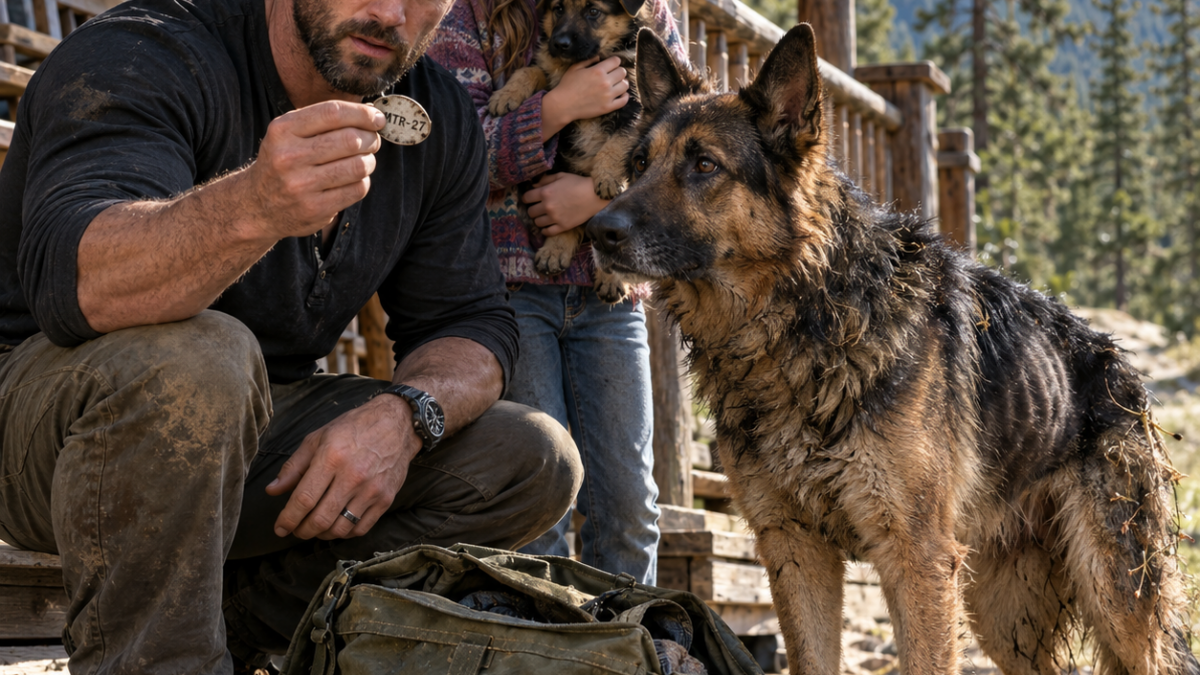
That was when I saw the tag.
A scratched metal plate hung from her collar, almost buried beneath dirt and matted fur.
I rubbed my thumb across it.
Four characters appeared.
MTR-27.
My breath stopped.
Emma bumped into my back.
“Dad?”
I turned the tag toward the sunlight.
MTR-27.
Mountain Task Rescue.
A volunteer search-and-rescue organization that had once operated throughout western Montana. Six years earlier, during the worst wildfire season the Flathead Valley had seen in decades, Mountain Task Rescue helped evacuate hundreds of families when flames jumped roads and cut off entire communities.
Rachel had been one of those families.
So had Emma.
I had been deployed overseas when the fire came through.
Rachel sent me a photograph afterward, the kind of photograph a woman sends her husband when she knows he is losing his mind eight thousand miles away.
In the picture, Rachel knelt in the grass beside a black-and-tan German Shepherd in an orange rescue harness. Three-year-old Emma sat in Rachel’s arms, soot on one cheek, thumb in her mouth, eyes red from smoke and fear.
On the dog’s collar was a tag.
MTR-27.
I pulled out my phone with fingers that did not feel like mine.
The photograph was still stored in a folder I almost never opened.
Rachel smiled from the screen.
Little Emma leaned against her.
And beside them stood a younger, stronger version of the dog standing in front of me now.
Same dark saddle.
Same amber-brown eyes.
Same tiny notch at the top of the right ear.
I looked at the Shepherd.
Emma saw the picture and went still.
“Dad…”
The dog looked toward the forest again.
I swallowed.
“You knew your mom.”
The Shepherd pulled gently at the leash.
There was no time to understand what that meant.
So we followed.
The trail descended through thick lodgepole pine toward a ravine half a mile behind our property. The farther we walked, the slower the Shepherd became. Once, she stumbled, and I reached for her, but she recovered and kept going.
“She’s hurt,” Emma whispered.
“She’s exhausted.”
“Why won’t she stop?”
I already suspected the answer.
Because the mission was not finished.
Twenty minutes later, the Shepherd abruptly left the trail. I followed through brush until I heard a sound beneath fallen branches.
Whimpering.
The Shepherd crawled beneath a broken pine limb.
Two puppies were hidden in a shallow depression.
Emma covered her mouth.
One puppy was dark and restless. The other was smaller, tan-faced, barely lifting its head.
The mother lay beside them.
For the first time since reaching our cabin, she closed her eyes.
I stared at her.
She had carried one puppy nearly half a mile.
Found humans.
Delivered the puppy.
Then gone back for the others.
“She didn’t come to us because she was lost,” I said.
Emma knelt beside me.
“She came because they were.”
I carried the two puppies home.
Emma carried the first.
The Shepherd walked between us.
By sunset, all three puppies were asleep on towels near the fireplace. Emma named them Ranger, Daisy, and Lucky before I could object.
The mother received food, water, medication from my field kit for her damaged paw, and a blanket beside the couch.
Emma sat cross-legged beside her.
“What was her name when Mommy knew her?”
I opened the old photograph again and zoomed in on the orange rescue harness.
One word was embroidered beneath the unit insignia.
SIERRA.
“Sierra,” I said.
The Shepherd’s ears lifted.
Emma’s eyes widened.
“Sierra?”
The dog stood.
Her tail moved once.
Then twice.
The hair rose along my arms.
“She remembers,” Emma whispered.
That night, after Emma went to bed, I found Sierra lying outside her bedroom door.
She was asleep, but her eyes opened instantly when I approached. Her body remained positioned between Emma’s room and the staircase.
Guarding.
Six years earlier, this dog helped bring my wife and daughter out of a wildfire.
Three years earlier, as far as I knew, Mountain Task Rescue had shut down.
And now Sierra had walked out of the Montana wilderness carrying three puppies and wearing the same identification tag.
I crouched beside her and touched the scratched metal plate.
“What happened to you?”
My phone rang downstairs.
Unknown number.
I answered.
For several seconds, no one spoke.
Then an older man’s voice said, “Staff Sergeant Mercer?”
I straightened.
“Who is this?”
“My name is Thomas Reed.”
A pause.
“And if the dog at your cabin is wearing tag MTR-27, don’t let her disappear again.”
I slept less than two hours.
Thomas Reed refused to explain much over the phone. He only asked me to take Sierra to a veterinarian, have her microchip scanned, and call him afterward.
“Why?” I asked.
“Because if the number matches,” he said, “I need to know I’m not losing my mind.”
The following morning, I drove Sierra and the puppies to Flathead Veterinary Center outside Whitefish.
Dr. Lauren Hayes examined Sierra first.
Lauren was forty-two, calm, sharp-eyed, and experienced with working dogs. She noticed what I had noticed.
Sierra entered the exam room and immediately checked the corners.
When Lauren dropped a folded gauze pad behind a cabinet and later let Sierra smell its wrapper, Sierra crossed the room and sat directly beside the cabinet.
Lauren looked at me.
“That dog has scent training.”
“I know.”
“You know her history?”
“I know about six minutes of it.”
Lauren scanned Sierra’s shoulders.
The machine beeped.
A registration appeared.
Name: Sierra.
Organization: Mountain Task Rescue.
Unit: MTR-27.
Handler: Thomas Reed.
Status: Retired — transferred to Blue Creek Working Dog Sanctuary.
I called Thomas immediately.
He answered before the first ring finished.
“It matches,” I said.
Silence.
Then I heard him exhale.
Thomas Reed had been Sierra’s handler for almost six years. Together, they had found lost children, injured hikers, wildfire evacuees, and an elderly hunter who spent two freezing nights in the Bob Marshall Wilderness.
During the wildfire that trapped Rachel and Emma, Sierra located a blocked access road and led rescuers toward several stranded families.
Including mine.
“What happened to her?” I asked.
Thomas went quiet.
“When Mountain Task Rescue dissolved three years ago, I was recovering from shoulder surgery. Sierra was almost eight. They told me she needed retirement.”
“You didn’t keep her?”
“I tried.”
His voice hardened.
“The board said liability rules prevented an active rescue asset from being transferred directly while the organization was dissolving. They promised Blue Creek specialized in retired working dogs.”
“And?”
“I drove there six weeks later.”
I waited.
“They told me Sierra had already been adopted.”
“To who?”
“They refused to tell me.”
Thomas spent months trying to obtain records. Eventually, he received documentation claiming Sierra had gone to a private family. He believed she was safe because he had to believe something.
Then three years passed.
A mutual acquaintance saw my online post asking whether anyone recognized a dog labeled MTR-27.
Thomas called.
By noon, Dr. Hayes had searched every database she could access. Blue Creek Working Dog Sanctuary had closed two years earlier.
Their surviving intake files did not list Sierra.
Not under her name.
Not under MTR-27.
Not under her microchip.
I stared at the computer screen.
“The registry says she went there.”
Lauren nodded.
“The sanctuary says she never arrived.”
Emma sat on the floor with Sierra.
“Then where was she?”
Nobody answered.
By afternoon, Deputy Caleb Foster from the Flathead County Sheriff’s Office sat at my kitchen table. Caleb had served eight years in the Army before becoming a deputy, and I trusted his ability to separate suspicion from evidence.
He listened without interruption.
When I finished, he said, “We have an old dog, incomplete records, a closed nonprofit, and a sanctuary that doesn’t have a matching intake.”
“That’s enough for me.”
“It’s enough to ask questions. Not enough to accuse anyone.”
I nodded.
That distinction mattered.
Over the next four days, Caleb contacted licensing departments, former Blue Creek staff, rescue coordinators, and county shelters.
The problem grew.
Sierra was not the only animal with missing paperwork.
Eleven retired working dogs had records suggesting transfer through Blue Creek during its final year. Some had valid adoption files.
Four did not.
The same transportation company appeared repeatedly.
Northstar Canine Transit.
It had operated vans across Montana, Idaho, and Wyoming.
It had also shut down.
Sierra, meanwhile, behaved as if none of that mattered.
She ate.
She slept.
She protected her puppies.
And every night she lay outside Emma’s bedroom door.
One afternoon, Emma chased a red plastic glider toward the tree line.
Sierra intercepted her.
No growl.
No bark.
She simply planted herself sideways across the trail.
Emma moved left.
Sierra moved left.
Emma moved right.
Sierra blocked her again.
I watched from the porch.
“Emma.”
“I know,” she said, turning back.
Sierra followed her to the house.
Six years earlier, Sierra had brought my family out of danger.
Now she had apparently decided to do it again.
Emma soon began helping at Flathead Haven, a small nonprofit dog rescue run by Melissa Grant. The shelter needed towels, food, leashes, and foster supplies.
Emma stared at Sierra’s old canvas bag and created an idea.
One bag.
One dog.
Each donated canvas bag would contain food, a towel, a bowl, a leash, and enough basic supplies to help one rescue animal transition into a foster home.
She called them Sierra Packs.
Within two weeks, her school collected twenty-three.
I watched my daughter work and wondered how one lost dog had rearranged everyone around her.
Then Caleb called.
“A man named Walter Briggs saw Sierra’s picture.”
I stood.
“Who is he?”
“Former maintenance worker at Blue Creek.”
“And?”
“He kept records.”
“What records?”
“His own.”
Walter had spent months watching animals arrive and leave while the sanctuary collapsed financially. Official paperwork became inconsistent, so Walter started writing license plates, dog names, dates, and destination notes in a black pocket notebook.
Caleb met him first.
Then I did.
Walter opened the notebook.
Halfway down one yellowed page, I saw it.
MTR-27 — SIERRA.
Transferred: Northstar North Property.
My jaw tightened.
Walter tapped another handwritten line.
“I saw her there myself about two months later.”
“You’re sure?”
“I remember that tag.”
“Where?”
He gave us the location.
An abandoned kennel property thirty miles northeast of Kalispell.
For three years, Thomas Reed had wondered where Sierra vanished.
Now we finally had an address.
The Northstar property looked disappointingly ordinary.
I had imagined locked compounds, hidden cages, people destroying records.
Instead, we found sagging fences, empty kennel buildings, weeds growing through gravel, and an office trailer whose windows had clouded over after three Montana winters.
County animal services entered legally with permission from the bankruptcy administrator.
I stayed outside.
Caleb warned me twice.
“You’re here because Sierra is evidence of a broken chain of custody. You are not part of the investigation.”
“Understood.”
“You said that too quickly.”
“I was a Marine.”
“That’s why I said it twice.”
Investigators opened filing cabinets and old cardboard boxes. Several computer drives still worked. Transport manifests emerged.
Some complete.
Others useless.
Blue Creek had been failing. Northstar had taken animals temporarily. Northstar then suffered financial problems of its own. Dogs moved to fosters, private farms, rescue partners, county facilities.
Records did not always move with them.
By midday, investigator Denise Carter carried a photocopied document outside.
MTR-27.
Sierra.
Transferred from Blue Creek inventory to Northstar temporary holding.
Then another line.
Emergency foster placement.
Receiving caregiver: June Keller.
Address partially unreadable.
“No crime?” I asked.
Denise folded her arms.
“I didn’t say that.”
“But?”
“But right now, the evidence looks less like someone deliberately making Sierra disappear and more like organizations collapsing on top of one another.”
Caleb nodded.
“Records stopped following the dogs.”
I hated that answer.
I wanted a villain.
Someone to blame.
Instead, I had negligence, confusion, bad management, closed facilities, and humans assuming someone else had handled the next step.
Sierra had vanished because everyone believed she belonged to someone else.
Denise searched archived property databases.
June Keller had lived alone near Columbia Falls.
She had died eighteen months earlier.
Her niece, Rebecca, eventually answered a county investigator’s call.
“I remember Sierra,” Rebecca said when I spoke to her. “A big Shepherd? Very trained?”
“Yes.”
“My aunt called her Sierra.”
“What happened?”
Rebecca explained that June had volunteered as a temporary foster when Northstar closed. But temporary became permanent because no one ever returned.
June loved Sierra.
For nearly two years, Sierra lived on her rural property.
Then June suffered a severe stroke. During the chaos of ambulances, relatives, and animal transfers, Sierra slipped through a damaged rear gate.
Neighbors searched.
They found nothing.
Rebecca assumed animal control eventually recovered her.
Nobody knew Sierra had been pregnant.
That night, I looked at the three puppies sleeping near my fireplace.
At last, the missing years had shape.
Mountain Task Rescue.
Blue Creek.
Northstar.
June.
Then the forest.
No conspiracy.
Just one loyal dog falling through gaps created by human beings.
And yet, another question remained.
How had Sierra survived long enough to bring her puppies to my cabin?
Walter had one theory.
June’s property was less than ten miles in a straight line from the mountain drainage system behind my land. Sierra might have followed creeks, service roads, wildlife paths, and instinct.
Or maybe something deeper.
I had no scientific proof.
But Sierra had passed other homes.
Other roads.
Other possible places to seek help.
She chose my porch.
Thomas Reed arrived in Montana the next day.
But he refused to meet Sierra.
Not immediately.
“What are you afraid of?” I asked.
Thomas looked away.
“That she won’t remember.”
I understood more than he knew.
After Rachel died, I spent months refusing to open old voice messages.
Memory is safe until reality touches it.
Thomas had preserved Sierra as she existed six years earlier.
Strong.
Fast.
Young.
His partner.
The dog waiting at my cabin was older, scarred, and tired.
Thomas feared the years between them had erased something.
Caleb arranged for him to observe from a distance during the final Northstar inspection.
Nobody expected what happened next.
A county foster dog named Clover escaped from a temporary exercise run.
Clover was fourteen months old, frightened, and unfamiliar with the area. Her tracks disappeared into the woods.
Search volunteers spread out.
I stood with Sierra.
She had already noticed the tension.
Her ears pointed forward.
Denise carried Clover’s blanket.
“No pressure,” she told me. “Sierra is retired.”
I crouched beside Sierra.
“You hear that, old girl?”
Sierra smelled the blanket once.
Twice.
Then her entire posture changed.
The family dog vanished.
MTR-27 appeared.
I looked toward Caleb.
“She wants to work.”
They allowed her one controlled attempt.
Sierra moved slowly along the fence.
Then turned north.
I followed with Caleb.
Two hundred yards away, Thomas stood beside a county vehicle.
The moment Sierra entered the trees, his face broke.
“I know that walk,” he whispered.
Thirty minutes passed.
Then forty.
Sierra stopped often. Checked scent. Reconsidered. Changed direction. Age had slowed her body, but it had not erased her training.
Finally, she led us into an abandoned Forest Service picnic area.
Clover hid beneath a weathered table.
Sierra did not rush.
She lay down.
Waited.
The frightened young dog stared at her.
One minute.
Two.
Then Clover crawled forward.
Sierra remained still.
Eventually, Clover touched noses with her.
Caleb secured the leash.
I knelt beside Sierra.
“That’s enough.”
Sierra breathed hard but looked satisfied.
At the edge of the clearing, Thomas Reed stood frozen.
Tears ran down his face.
Denise quietly asked, “Is she the same?”
Thomas shook his head.
“No.”
I looked at him.
He smiled through the tears.
“She’s older,” he said. “But that’s the same heart.”
Thomas arrived at my cabin at nine the next morning.
Emma had been awake since six.
“Is he taking her?” she asked.
“I don’t know.”
“You’re her family.”
“So is he.”
“That doesn’t make sense.”
“Most families don’t.”
Emma frowned because she knew I was avoiding the real answer.
Thomas’s truck appeared between the pines.
Sierra stood before it entered the driveway.
I noticed.
She had heard hundreds of trucks since arriving at my place.
This one mattered.
Thomas climbed out.
He looked older than the photographs.
Gray hair.
Weathered skin.
Shoulders bent slightly from years outdoors.
He walked halfway across the yard.
Then stopped.
He did not call Sierra’s name.
He lowered himself onto one knee.
Sierra stared.
Thomas’s hands trembled.
Emma grabbed my hand.
The Shepherd took one step.
Stopped.
Her head tilted.
Thomas whispered something I could not hear.
Sierra took another step.
Then another.
Suddenly her ears lifted.
She crossed the yard.
Not running.
Not dramatic.
Certain.
She stopped in front of Thomas.
For one second, nothing happened.
Then Sierra pushed her head into his chest.
Thomas wrapped both arms around her.
His face collapsed.
“I’m sorry,” he whispered. “God, girl, I’m sorry.”
Sierra’s tail struck the grass.
Once.
Again.
Again.
Emma cried silently beside me.
Thomas pressed his forehead against Sierra’s neck.
“I looked for you.”
I turned away.
Some reunions deserve privacy even when there is nowhere private to go.
Later, we sat on the porch while Thomas showed Emma photographs.
Sierra on snow-covered trails.
Sierra riding in rescue vehicles.
Sierra sleeping beside Thomas’s boots.
Sierra wearing an orange Mountain Task Rescue harness.
Then Thomas showed me one I had never seen.
Rachel Mercer stood beside Sierra after the wildfire evacuation.
Three-year-old Emma slept in Rachel’s arms.
Thomas was in the background.
“She wouldn’t leave your wife,” Thomas said.
I looked up.
“What?”
“After we found them, Rachel had trouble breathing from smoke. Sierra stayed beside her until the ambulance came.”
I looked at Sierra.
“Rachel never told me that.”
“She probably had other things on her mind.”
Emma leaned closer.
“So Sierra really saved Mom?”
“She helped us find the road to them,” Thomas said.
Emma wrapped her arms around Sierra.
Then she asked the question all of us had avoided.
“Are you taking her away?”
Thomas stared at the yard.
Ranger and Daisy wrestled beside the porch.
Lucky slept against Sierra’s back leg.
Sierra watched the puppies.
Then looked at Emma.
Then me.
Thomas smiled sadly.
“No.”
Emma blinked.
“But she was yours.”
He shook his head.
“She was my partner.”
“Isn’t that the same?”
“No.”
Thomas rubbed Sierra’s ear.
“A partner gets to choose where she belongs when the work is done.”
Emma looked hopeful.
“She belongs here?”
Thomas studied Sierra.
“I think she made that decision before any of us understood what was happening.”
Sierra stayed with us.
Thomas became part of her life again. He visited every few weeks and eventually volunteered at Flathead Haven, helping retired working dogs adjust to ordinary homes.
For me, Sierra’s story created a different decision.
An envelope had been sitting unopened on my kitchen counter for nearly a week.
Montana Disaster and Emergency Services.
They had offered me a regional emergency-coordination position.
I had delayed answering.
Leaving active-duty Marine life felt like abandoning the identity that had defined me since I was twenty. I had survived deployments, led Marines, lost friends, missed birthdays, missed anniversaries, missed more of Rachel’s life than I liked admitting.
Rachel once told me she understood my service but feared I no longer knew who I was without orders.
After she died, I stayed in uniform partly because the Corps was the one part of my world that still had structure.
Sierra changed the way I saw that.
She had been a search dog.
Then a foster dog.
Then a lost dog.
Then a mother.
Then Emma’s protector.
Different missions.
Same purpose.
One evening, I sat on the porch beside Thomas.
“I’m thinking of taking a state emergency job,” I said.
He nodded.
“You sound disappointed.”
“I don’t know who I am if I’m not a Marine.”
Thomas laughed.
“What?”
“You think Sierra stopped being Sierra when we took off the rescue harness?”
I said nothing.
Thomas pointed toward the yard.
Sierra lay beside Emma while the puppies played.
“The uniform tells people your assignment,” he said. “It doesn’t tell you your value.”
I stared at the mountains.
Rachel would have understood that immediately.
I accepted the position the next morning.
For the first time in years, service would no longer require me to spend months away from my daughter.
Emma hugged me when I told her.
Sierra leaned against my leg.
“Everybody approves?” I asked.
Emma nodded.
“Mom would.”
That was the one sentence I could not answer.
I only looked at Sierra.
Maybe, in some strange way, Rachel had already sent her vote.
By late summer, Sierra no longer looked like the exhausted animal that had emerged from the forest.
Her ribs disappeared beneath healthy weight.
Her coat regained its shine.
The injured paw healed.
Gray remained around her muzzle, and she tired faster than she once had, but she moved with quiet confidence.
The puppies grew quickly.
Ranger became fearless, investigating every open door, toolbox, shoe, and flowerpot. Daisy remained cautious and gentle. Lucky became Emma’s shadow.
Flathead Haven handled their adoptions carefully.
Ranger went to a retired firefighter and his wife near Helena.
Daisy joined a physical therapist whose elderly Shepherd had died the year before.
Lucky stayed with Emma.
Nobody officially voted on that decision.
Emma simply started calling our house “Lucky’s house,” and eventually I accepted that democracy had failed me.
Sierra Packs became much bigger than anyone expected.
Emma’s school collected supplies.
A hardware store donated canvas bags.
A veterinary clinic collected food.
A local outdoor company donated waterproof blankets.
Each bag contained essentials for one rescue animal entering temporary care.
One bag.
One dog.
One easier first night.
Walter Briggs began repairing kennels at Flathead Haven. What started as fixing one broken gate became a part-time maintenance job. For the first time in years, Walter had somewhere people expected him to appear.
Thomas began teaching volunteers how to work with retired service and search dogs.
“Don’t assume they want constant activity,” he told families. “And don’t assume retirement means they’ve forgotten everything.”
Sierra proved the point repeatedly.
Emma once hid my truck keys as a joke.
Sierra found them in less than two minutes.
I made Emma clean the garage for hiding them.
Emma accused Sierra of betrayal.
Sierra appeared unconcerned.
Meanwhile, the county review of Blue Creek and Northstar ended without the dramatic arrests I once imagined.
There had been violations.
Improper transfers.
Missing paperwork.
Failure to maintain required records.
Several former administrators faced fines and restrictions from operating animal facilities again.
But investigators found no organized scheme to harm the dogs.
The truth was more ordinary.
And in some ways, more disturbing.
People had stopped paying attention.
Facilities failed.
Records vanished.
Responsibility became divided among so many hands that no one felt fully responsible anymore.
Sierra survived those failures because individuals occasionally stepped in.
Thomas trained her.
June fostered her.
I opened my door.
Emma refused to look away.
The system failed her.
People saved her.
I remembered that lesson when I started my new emergency-management job.
My first major assignment involved winter shelter planning for rural Montana communities. The old version of me might have focused almost entirely on trucks, fuel, radio systems, staffing, and routes.
Now I asked one additional question.
“Who owns the gap?”
The room went quiet.
“What gap?” someone asked.
“The space between agencies,” I said. “The responsibility everybody assumes someone else has.”
Sierra had taught me to look for that space.
Because sometimes people—or animals—disappear inside it.
At home, life became ordinary.
I cooked badly.
Emma complained dramatically.
Lucky stole socks.
Sierra slept halfway between my bedroom and Emma’s.
Thomas visited.
The seasons changed.
Then, shortly before Christmas, Dr. Hayes called.
“Can you bring Sierra in?”
I heard something careful in her voice.
“What’s wrong?”
“Nothing urgent. I want to discuss her blood work.”
Sierra had early kidney changes.
Not a crisis.
Not yet.
But she was aging.
Emma sat beside me in the exam room while Lauren explained diet, monitoring, medication, and realistic expectations.
Emma stared at Sierra.
“She’s going to die?”
Lauren did not lie.
“One day,” she said. “Not today.”
Emma cried anyway.
That night, she dragged her blanket into the hallway and slept beside Sierra.
At two in the morning, I found them together. Emma’s hand rested across Sierra’s shoulder. Sierra’s head lay beside Lucky’s paws.
I crouched beside them.
I thought of Rachel.
Of deployments.
Of all the time I once believed I could control by planning hard enough.
Sierra opened one eye.
I touched her neck.
“No more missions,” I whispered.
Her tail tapped the floor once.
I smiled.
“Okay. Maybe one.”
The final mission became simple.
Stay.
One year after Sierra arrived, Flathead Haven opened a new wing.
It had six quiet rooms instead of traditional kennel runs.
Heated floors.
Outdoor access.
Low beds.
Sound-dampened walls.
The space was designed for senior dogs and retired working animals that struggled in noisy shelters.
Melissa Grant stood beneath the entrance sign beside Emma.
“What should we call it?” she asked.
Emma answered instantly.
“Sierra House.”
Nobody proposed anything better.
The original canvas bag hung inside the lobby.
Emma refused to replace it.
The canvas remained faded.
One corner was torn.
The leather strap still carried tooth marks.
Beneath it hung a small plaque.
Not explaining Sierra’s entire history.
Just one sentence.
SHE CAME LOOKING FOR HELP FOR SOMEONE ELSE.
Thomas read it for a long time.
“That’s her,” he said.
Guests filled the rescue property during the opening.
Veterans.
Firefighters.
Veterinarians.
Families.
Search-and-rescue volunteers.
People who had followed Emma’s Sierra Pack project.
I wore civilian clothes.
For the first time, that no longer felt strange.
Thomas stood beside me.
“Miss the uniform?”
“Sometimes.”
“Miss the deployments?”
“No.”
He laughed.
Emma ran across the yard with Lucky.
Sierra followed slowly. Her legs were stiffer now. Her muzzle almost completely gray, but her eyes remained bright.
A volunteer accidentally dropped a glove near the parking lot.
Sierra watched it fall.
I saw her notice.
“Don’t,” I said.
Sierra looked at me.
“You are retired.”
She looked toward the glove.
“Sierra.”
Thomas leaned toward me.
“You know she’s going to get it.”
“I know.”
Sierra walked across the grass, collected the glove, and brought it back.
The crowd applauded.
I pointed at Thomas.
“This is your fault.”
He shook his head.
“She was stubborn before I met her.”
Later that afternoon, a woman approached me.
She introduced herself as Rebecca Keller.
June Keller’s niece.
She had driven four hours to attend.
When Sierra saw her, she paused.
Rebecca knelt.
“Sierra?”
The Shepherd approached slowly.
Rebecca began crying before Sierra reached her.
“My aunt loved you.”
Sierra smelled her hand.
Rebecca showed me an old photograph.
June Keller sat on the steps of a farmhouse. Sierra rested beside her.
I had never seen that part of Sierra’s life.
Rebecca looked guilty.
“I’m sorry we lost her.”
I shook my head.
“You didn’t.”
“I should’ve searched longer.”
“You were dealing with your aunt’s stroke.”
“She trusted us.”
I understood that guilt.
I carried different versions of it myself.
Missed phone calls.
Missed holidays.
The night Rachel died while I was stationed in California for training.
“You can love someone and still fail to control what happens to them,” I said.
Rebecca looked at me.
Sierra sat between us.
I scratched her neck.
“The important thing is she was loved there.”
Rebecca hugged Sierra.
For another moment, a broken piece of the dog’s history returned to its proper place.
That evening, after everyone left, Emma sat beneath the Sierra House sign.
“Dad?”
“Yeah?”
“What if she hadn’t found us?”
I looked toward Sierra.
“I don’t know.”
“What if she went to another house?”
“Maybe somebody else would have helped.”
“But she came to ours.”
“Yes.”
Emma thought about that.
“Because she remembered Mom?”
I had asked myself the same question hundreds of times.
There was no way to know.
Maybe Sierra recognized something in the land.
Maybe she remembered Rachel’s scent lingering in old furniture.
Maybe she simply followed the creek and chose the first quiet cabin she found.
Or maybe animals understood certain things humans spent too much time explaining.
“I like to think she remembered something,” I said.
Emma smiled.
“Me too.”
Sierra walked over and lowered herself between us.
Lucky curled beside her.
I watched the sun set behind the mountains.
I had once believed Sierra entered my life because she needed rescue.
I finally understood that was only half true.
She had rescued things too.
Thomas from three years of unanswered grief.
Walter from isolation.
Rebecca from guilt.
Emma from losing one more connection to her mother.
And me from believing that changing direction meant abandoning everything I had been.
Sometimes rescue does not look like pulling someone from a burning building.
Sometimes it looks like showing them where they still belong.
Three years after Sierra walked onto my porch, winter came early to the Flathead Valley.
Snow covered the cabin roof.
Lucky had grown into a strong Shepherd with Sierra’s patient eyes.
Emma was twelve.
I had been promoted to regional emergency-response director.
Thomas visited every Sunday.
Sierra was eleven.
Maybe twelve.
No one knew her exact birthday anymore.
She moved slowly.
Kidney disease had progressed.
Arthritis made stairs difficult.
I built ramps.
Emma placed rugs across slippery floors.
Lucky rarely left Sierra alone.
One December evening, Sierra refused dinner.
I knew.
I called Lauren.
The veterinarian came to the cabin rather than asking us to bring Sierra into the clinic.
Thomas drove through snow to get there.
We gathered in the living room beside the fireplace.
Emma lay on the floor with both arms around Sierra.
“I’m not ready,” she whispered.
I sat beside her.
Neither was I.
Thomas knelt on Sierra’s other side.
The old handler removed something from his coat pocket.
Sierra’s original Mountain Task Rescue harness.
Orange fabric faded almost pink.
MTR-27 still visible.
“I kept it,” Thomas said.
Emma touched the lettering.
“Put it on her.”
I looked at Thomas.
He nodded.
We gently laid the harness across Sierra’s back.
Not tightening the straps.
Just resting it there.
Sierra lifted her head.
Something changed in her expression.
Thomas smiled through tears.
“Yeah, girl.”
Sierra looked toward the front door.
Lucky stood there.
Then he barked.
Once.
I frowned.
Sierra struggled to stand.
“No, sweetheart,” Emma whispered.
But Sierra pushed herself up.
I helped support her.
She walked toward the door.
Thomas stared.
“What is she doing?”
I opened it.
Cold air rushed inside.
Snow fell across the porch.
Sierra stepped outside slowly.
She moved to the railing.
Stopped.
Looked toward the trees.
For several seconds, everyone was silent.
Then I heard it.
A faint whimper beneath the porch.
Lucky ran down the steps.
I followed.
A small dog had crawled beneath the porch for shelter.
A young mixed-breed terrier, trembling from cold, its collar tangled around a broken piece of brush.
I freed it.
Emma wrapped the animal in a blanket.
Thomas stared at Sierra.
Even Lauren laughed softly through tears.
“You have got to be kidding me.”
I carried the little dog inside.
Sierra watched until Emma placed it safely near the fireplace.
Only then did she lie down.
Thomas wiped his face.
“She found one more.”
Her first day at the cabin, Sierra had arrived carrying a puppy.
On what we all knew might be her final night, she refused to rest until one more frightened animal was safe.
MTR-27.
Still working.
Always.
The terrier’s family was located two hours later. A couple living four miles away had been searching through the storm.
When they came to retrieve him, the woman cried with relief.
After they left, Emma returned to Sierra’s side.
Everything felt complete.
There was no dramatic struggle.
No emergency.
Sierra rested with Emma touching her shoulder, Thomas holding her old tag, Lucky lying nose-to-nose beside her, and my hand against her chest.
Lauren made sure she felt no pain.
I leaned close.
“Mission complete.”
Sierra looked at me.
Her eyes shifted toward Emma.
Then Thomas.
Then Lucky.
Her tail moved once.
And Sierra went still.
Emma buried her face against me.
Thomas lowered his head.
Outside, Montana snow covered the tracks Sierra had left on the porch.
We buried her two days later beneath the pine tree overlooking the trail where she first led me toward her puppies.
Thomas placed MTR-27 beneath a small stone.
Emma placed the old canvas bag beside it temporarily.
Then she changed her mind.
“No.”
I looked at her.
“That belongs at Sierra House.”
She carried it back.
I understood.
The tag represented who Sierra had been.
The bag represented what she became.
Months later, the first annual Sierra Search Day raised enough money to provide foster supplies for more than four hundred animals.
Sierra House expanded.
Emma continued Sierra Packs.
Thomas trained new search volunteers.
Walter maintained the shelter grounds.
Rebecca donated annually in June Keller’s memory.
I kept Rachel’s old wildfire photograph on my desk.
Beside it, I placed a second picture.
Emma sitting on the porch.
Lucky beside her.
Sierra between them.
Years later, Emma would describe Sierra differently than everyone expected.
People called her heroic.
A rescue dog.
A survivor.
Emma simply called her proof.
Proof that being lost did not make you useless.
Proof that age did not erase purpose.
Proof that a life could break into several chapters without any one of them making the others meaningless.
And proof that sometimes the one who appears at your door asking for help is also carrying something you did not realize you had lost.
I spent half my life believing duty meant leaving home whenever the world needed me.
Sierra taught me another kind of service.
Sometimes duty meant returning.
Sometimes it meant staying.
Sometimes it meant noticing what everyone else had overlooked.
And sometimes it looked like an exhausted German Shepherd emerging from a Montana forest with a puppy in an old canvas bag, refusing to stop until every life depending on her was safe.
Sierra spent her first career helping strangers find their way home.
In the end, she did the same thing for me.
For Emma.
For Thomas.
And finally, for herself.








