A Foster Mom Begged to Return $247 in Towels So Six Kids Could Have Their First Christmas—Then Her 4-Year-Old Asked One Question That Stopped 40 Bikers Cold.
PART3:
The woman turned, and I got my first real look at her.
Mid-fifties, maybe.
A sweater patched at both elbows.
Hair pulled back in a loose, tired knot.
Eyes so red and raw it looked like she had been crying for days, not minutes.
“I’m sorry,” she said immediately, already retreating. “I didn’t mean to cause a scene. We’ll go.”
“Ma’am, hold on.”
I kept my voice as gentle as I could make it.
“Talk to me. What’s happening here?”
She exhaled like that breath had been sitting in her chest for years.
“I’m their foster mother,” she said. “Six kids right now, all at once. Three of them came to me a month ago from a situation I won’t describe in front of them.”
The oldest girl looked away.
So did one of the boys.
Linda’s voice shook, but she kept going.
“The state stipend covers groceries and not much past that, so I used my own savings on things their rooms actually needed. Sheets. Towels. Basics.”
She looked down at the basket.
“Then I found out none of them—not one—has ever had an actual Christmas morning.”
Her mouth trembled.
“My oldest is fourteen and has never once woken up to a gift under a tree. So I thought, fine, we can live without new towels a little longer. I’ll return these, and I’ll put every dollar toward something that actually matters to them.”
The manager somehow still found room to sigh.
“Policy is policy.”
I turned toward him.
“Remind me what the policy actually is.”
“Thirty-day return window. She’s two days over. Computer won’t process it.”
“Two days,” I repeated. “Two days on towels bought with her own money so six foster kids could have Christmas.”
“Rules don’t bend for circumstances, sir.”
That was when the smallest of the six tugged Mama Linda’s sleeve.
He was maybe four.
Big brown eyes.
Shoes on the wrong feet.
A winter coat too large in the shoulders.
He looked up at her with the kind of question that guts a room.
“Mama?”
Linda crouched immediately.
“Yes, baby?”
“What’s Christmas?”
Nobody in that store moved.
Not the manager.
Not the cashier.
Not the customers who had begun pretending not to listen.
Not one of my brothers.
Linda forced her voice steady.
“It’s a day when people give presents to the people they love, baby. Santa Claus brings toys to good boys and girls.”
The little boy thought about that.
“Am I a good boy?”
Her face broke.
“You’re the best boy there is.”
“Then why doesn’t Santa know my address?”
She did not answer that one.
She just pulled him into her chest so he would not see her face fall apart.
I had heard enough to last me the rest of my life.
I turned to my brothers.
Decades of hard road stood behind me.
Ink.
Gray beards.
Scars.
Divorce papers.
Military funerals.
Lost children.
Bad choices.
Second chances.
More grief stitched into that group than most people carry in ten lifetimes.
Nobody needed instructions.
I turned back to the counter.
“What’s the total on what she’s trying to return?”
The manager checked, visibly irritated.
“Two hundred forty-seven dollars.”
I laid three hundred on the counter.
“She’s keeping every item. We’re covering it.”
His mouth opened.
I looked past him.
“And these six kids are about to have the Christmas of their lives.”
Then I glanced back at the guys.
“We came here looking for kids who needed us. Looks like we just found them.”
What happened in the next hour is something I will never be able to fully explain to anyone who was not standing inside that store.
Forty bikers moved through those aisles with the urgency of men who had just been handed a sacred deadline.
“What’s the fourteen-year-old into?” Tommy called over his shoulder, already moving.
“Art,” Mama Linda said, stunned into motion. “Drawing, mostly. She’s got real talent.”
Tommy disappeared into the art supplies section and did not resurface for twenty minutes.
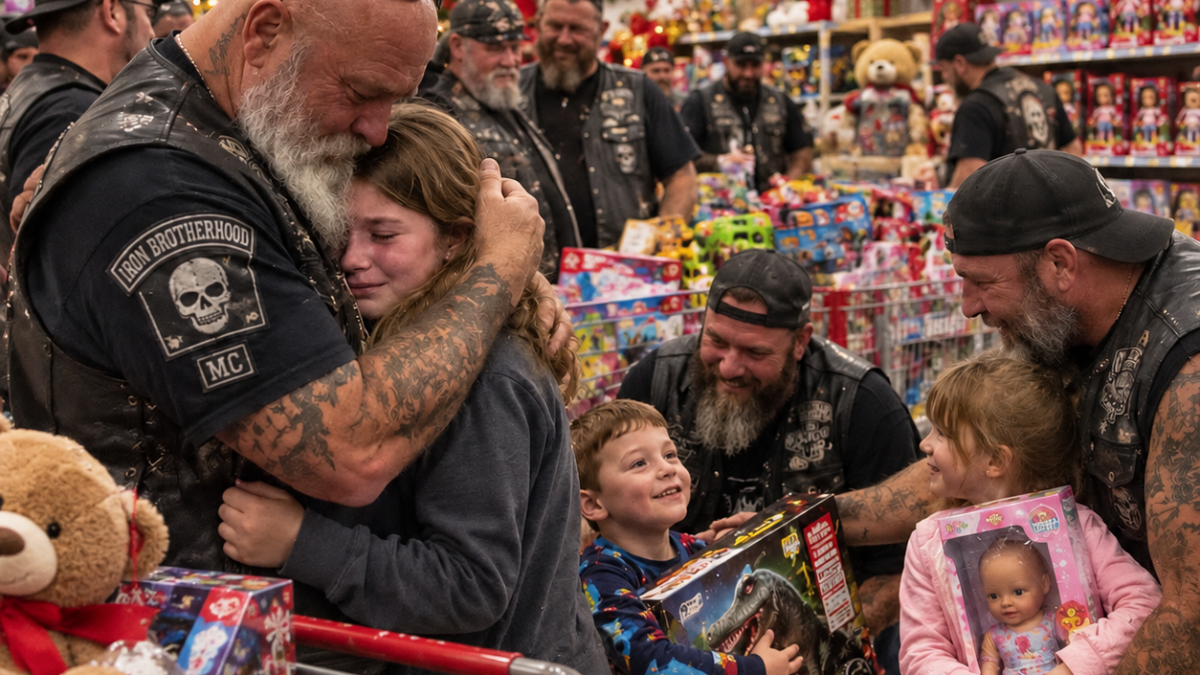
Three of the guys had already claimed the four-year-old, walking him solemnly down the dinosaur aisle and consulting him like a board member on which toy was objectively the coolest.
Six-year-old Keisha picked out her first baby doll while two bikers argued, with total sincerity, over which one had the kindest face.
The eight-year-old twins were escorted through the LEGO section by a brother we called Crusher, who took architectural integrity more seriously than any man should.
And ten-year-old Jerome, who Mama Linda quietly warned me “doesn’t say much, he’s seen things no kid should see,” ended up standing beside a biker named Tiny at the remote-control cars.
Neither of them spoke.
They just stood there.
A huge man in a leather vest.
A small boy with his hands shoved into his sleeves.
After nearly five minutes, Jerome lifted one finger and pointed.
“This one?” Tiny asked.
A nod.
“Good pick, brother. That one’s fast.”
Jerome almost smiled.
Almost.
I stayed near Mama Linda, who had not stopped shaking.
“I can’t let you people do this,” she said. “You don’t even know us.”
“Ma’am, I grew up in foster care myself.”
She looked at me.
I do not talk about that much.
Not because I am ashamed.
Because some things get old and tender at the same time.
“I aged out at eighteen with no family, no savings, and zero Christmas memories worth keeping,” I told her. “If one person had done for me what you’re doing for these six kids, I think my whole life goes differently.”
Her eyes filled again.
“These kids didn’t choose any of this,” I said. “You did. You chose to show up for them. This is the smallest thing we could possibly do back.”
The oldest girl approached me like she was testing whether I would disappear if she got too close.
“What’s your name?” I asked.
“Destiny.”
“That’s a big name.”
She shrugged.
“I didn’t pick it.”
“Fair.”
She looked toward the aisles, where grown men were comparing stuffed bears and arguing over remote-control battery life.
“Why are you doing all this?”
I could have said charity.
I could have said Christmas spirit.
I could have said because we raised the money for kids who needed it, and she and her siblings qualified.
All true.
None enough.
So I told her the truth.
“Somebody should have done it for me thirty years ago,” I said. “And because your Mama Linda is the closest thing to a hero you’ll ever meet in person.”
Her eyes went glassy.
“She’s the first one who didn’t send me back,” she whispered. “Everyone before her said I was too angry. Too much.”
“You’re not too much,” I said. “You’re surviving something most adults couldn’t. There’s a difference.”
Her chin trembled.
She tried to hide it.
Children like Destiny learn early that tears can be used against them.
Then Tommy reappeared.
His cart looked like he had robbed an art school.
Sketchbooks.
Professional paint sets.
Markers.
Colored pencils.
Charcoal.
Canvas packs.
A full easel.
A desk lamp.
A carrying case.
He looked almost embarrassed.
“Wasn’t sure what she’d like,” he admitted. “So I got all of it.”
Destiny stared at the cart.
Then at him.
Then she burst into tears and hugged him.
Tommy was six-foot-something, built like a brick wall, with a beard past his collarbone and hands rough enough to sand wood.
He froze for half a second.
Then wrapped his arms around that sobbing teenage girl like she might break.
His eyes were not dry either.
I turned away because sometimes a man deserves privacy while his heart is being repaired.
By checkout, we had filled twelve carts.
Twelve.
Toys.
Clothes.
Books.
Art supplies.
Bikes.
Dolls.
Science kits.
Stuffed animals.
LEGO sets.
Board games.
Pajamas.
A winter coat for each child because Crusher noticed two sleeves were too short and declared this “logistically unacceptable.”
We spent every cent of the eight thousand dollars.
When that ran out, wallets came out unprompted.
Final total: eleven thousand, eight hundred forty-seven dollars.
Mama Linda could barely speak.
“I don’t know how to ever—”
“One promise,” I said.
She stopped.
“Tell these kids this story when they’re grown. Tell them strangers cared. Tell them they were worth twelve thousand dollars and forty grown men crying in a toy store. And tell them to do the same for somebody else someday.”
My voice got rough.
“That’s the whole trick to fixing this world. One kid at a time.”
A crowd had gathered without my noticing.
A woman offered to help carry bags.
A man pressed a hundred dollars into my palm.
A teenager emptied her wallet—thirty-seven dollars, everything she had.
An elderly couple wrote a check for five hundred.
In twenty minutes, strangers added another two thousand dollars, all of them saying some version of the same thing.
“For the kids.”
The manager stood behind the counter, silent now.
Policy had suddenly become very small.
Mama Linda had driven an old minivan with one sliding door that needed encouragement and a heater that sounded like it was digesting gravel.
There was no chance twelve carts would fit.
So we formed a convoy.
Forty motorcycles.
Three pickup trucks.
One battered minivan.
And six children who kept looking back through the windows like they were afraid everything would disappear if they blinked.
We followed Mama Linda home.
Her house was small.
Clean.
Crowded.
The kind of place where every inch had a purpose because there was no room for anything wasted.
Shoes lined up by the door.
A chore chart on the fridge.
A plastic tree in a box near the hallway, still unopened.
Six stockings folded on the couch with names written in glitter glue.
She looked embarrassed when we stepped inside.
“I didn’t have time to—”
“Ma’am,” I said, “if you apologize one more time, I’m putting you on gift-unwrapping restriction.”
She laughed.
Not much.
But enough.
Then the house transformed.
Someone showed up with a real tree strapped to the back of a pickup.
I still do not know where he got it.
Someone else produced boxes of ornaments from nowhere.
Two brothers assembled bikes in the driveway.
One of the twins ran circles around the living room carrying a LEGO set like sacred scripture.
Keisha sat on the couch holding her baby doll, whispering to it like she had known it forever.
Jerome stood near the wall with the remote-control car box hugged against his chest.
Tiny knelt beside him.
“You want to open it?”
Jerome shook his head.
“Want to keep it safe first?”
A nod.
Tiny nodded back.
“Good plan.”
The little boy, Marcus, walked through the room slowly, touching things.
The tree.
The stockings.
The wrapped boxes.
The lights.
His face was serious in the way very small children get when wonder is too large to process.
Finally, he turned to Mama Linda.
“Mama, is this real?”
She crouched and pulled him close.
“It’s real, baby.”
He looked at me.
“Are you Santa?”
I laughed.
“No, buddy. Just a biker.”
He considered this.
“But the good ones look out for kids who need it.”
“Like a superhero?”
“Something like that.”
He wrapped both arms around my neck without warning.
I held that boy and cried like I had not cried in years.
Before we left, Destiny came up to me holding a folded piece of paper.
“I made this fast,” she said. “It’s not good yet.”
Artists say that even when they hand you something that knocks the air out of your chest.
I unfolded it.
Forty stick figures on motorcycles circled protectively around six smaller children.
In the middle stood a woman with a crooked crown.
Mama Linda.
“My brother asked if you were angels,” Destiny said. “I told him no, just bikers.”
She looked at the drawing.
“Now I think maybe both.”
I had no clever answer for that.
Some moments do not need one.
That drawing is framed on our clubhouse wall today.
Every prospect hears the story before he gets his patch.
Not because we want applause.
Because a man joining a brotherhood should understand what brotherhood is actually for.
It is easy to ride together.
Easy to wear the same colors.
Easy to talk about loyalty when the music is loud and the road is open.
It is harder to stop in the middle of your own plans because a woman you do not know is trying not to cry in front of six children who already know too much about disappointment.
The manager was fired two weeks later.
Turned out he had been quietly denying valid returns for months and pocketing the difference through store credits and false adjustments.
But that is a footnote.
People like him often think they are the story.
They rarely are.
Here is what matters.
Six kids who had never had a Christmas woke up to a tree full of presents.
Mama Linda kept the towels.
The sheets went on beds that no longer felt borrowed.
The dish soap washed plates after pancakes Christmas morning because Crusher and Tiny showed up at 7 a.m. with groceries and absolutely no understanding of portion control.
We still visit every month.
Marcus is six now and has negotiated us down to teaching him to ride at eighteen.
That is the deal.
He brings it up in writing often.
Keisha still has the baby doll.
The twins build LEGO sets with terrifying efficiency.
Jerome talks now.
Not always.
Not to everyone.
But he talks.
Last month he told me he wants to be a foster father one day.
“So I can do what Mama Linda did for me,” he said.
I had to walk outside for a minute after that.
Destiny is sixteen now.
She is in an art program.
Three competitions won.
Still calls me “Mr. Biker Superhero” when she wants to embarrass me in public.
She added color to that first drawing.
Then shadows.
Then details.
Forty motorcycles.
Six children.
One crowned foster mother.
And above them all, in letters that look like light, she wrote:
SANTA KNEW OUR ADDRESS AFTER ALL.
People still ask me what that day taught me.
They expect something dramatic.
Something about the kindness of strangers.
The spirit of Christmas.
The power of community.
Those things are true.
But what I remember most is not the money.
Not the toys.
Not even the manager’s face when forty bikers decided his policy was not the final word.
I remember a basket of towels.
Because those towels were not just towels.
They were proof that Mama Linda had already chosen the children’s needs over her own comfort.
Then she was willing to give them up too, just to buy six kids one good memory.
That is the part people miss.
We did not create the miracle.
She did.
We just helped fund it.
Mama Linda was the one who opened her home.
Mama Linda was the one who stretched grocery money.
Mama Linda was the one who sat up with nightmares.
Who learned court dates.
Who memorized allergies.
Who figured out which child hid food, which child hated closed doors, which child needed a night-light but was too proud to ask.
She was the one standing at that counter trying to trade towels for joy.
All we did was refuse to let her make that trade alone.
Every December now, before our toy run, we stop at the clubhouse wall.
Forty stick figures.
Six smaller ones.
A crowned foster mother.
We stand there for a minute.
No speeches.
No noise.
Just men remembering what the road is supposed to teach you.
That freedom means very little if you only use it for yourself.
Then we ride.
And somewhere, every year, there is another kid who thinks Santa lost their address.
Another foster mother counting dollars in a parking lot.
Another teenager pretending she does not care because caring has disappointed her too many times.
Another manager.
Another policy.
Another moment when somebody has to decide whether to keep walking.
I know what forty bikers learned that Tuesday in December.
We learned that a rule can be followed perfectly and still be wrong.
We learned that children remember who shows up.
We learned that a woman with patched elbows can be braver than a room full of men in leather.
We learned that Christmas is not magic unless somebody makes it so.
And we learned that sometimes the whole world changes right after one small voice asks a question nobody should ever have to ask.
“Then why doesn’t Santa know my address?”
He does now, Marcus.
He does now.








