A Fisherman Lost His Cat When His Boat Sank in 8°C Atlantic Water—Eleven Days Later, a Couple Found Him Three Miles Away With Every Claw Worn Flat.
PART3:
“Cats do not belong on lobster boats.”
He looked at me like I had said something deeply ignorant.
For three weeks, he made my mornings miserable.
Finally, one gray March day, I carried him down to the harbor, convinced that the engine noise, the rolling deck, the gulls, and the smell of bait would send him running back to the house forever.
Instead, Finn stepped onto the Mary Ellen, jumped onto the dashboard inside the wheelhouse, tucked his paws beneath him, and looked through the front glass like he owned the Atlantic.
From that morning on, he came with me.
Every day.
For eight years.
He sat in the wheelhouse when I left the harbor.
He watched the traps come up.
He slept on my lap on the way back when the sea was calm enough for me to sit.
He hated gulls with a religious passion.
He tolerated seals.
He ignored other fishermen unless they had food.
If a storm was coming, Finn always knew first.
Long before the radio turned urgent, before the clouds dropped, before the wind shifted hard enough for a man to notice, Finn would lift his head and stare out the window.
His ears would flatten.
His tail would stop moving.
Sometimes he would climb down from the dashboard and go under the seat.
When Finn went under the seat, I paid attention.
The others started joking that the cat was better than radar.
“Belliveau,” Angus McLeod called one morning from the next slip, “what does the orange captain say about today?”
Finn was sitting on the wheelhouse dash, washing one paw.
“Captain says mind your own traps,” I yelled back.
Angus laughed.
After a while, people stopped seeing Finn as strange.
He became part of the harbor.
Children waved to him.
The woman at the fuel dock kept treats in her pocket.
The Coast Guard boys knew him by name.
Tourists took pictures of him sitting behind the glass like a tiny admiral judging the mainland.
For eight years, every morning began the same way.
Coffee in a steel thermos.
Boots by the door.
Finn yelling before I even touched the keys.
The walk to the truck.
The drive to the harbor.
The smell of salt and diesel.
The gulls.
The ropes.
The Mary Ellen rocking gently in the slip.
Finn jumping aboard ahead of me, always ahead of me, as if I were the assistant and he was the one allowing the trip to proceed.
Then came October 9th.
I have replayed that morning in my head so many times that it no longer feels like memory.
It feels like a room I keep walking into even though I know what is waiting there.
The forecast was bad, but not impossible.
That is what I told myself.
Wind later.
Rain later.
A front coming in faster than expected, but still workable if I moved early and came home before noon.
I had traps to check.
I had been fishing that area for years.
I knew the boat.
I knew the water.
I knew October.
Those are dangerous words.
I knew.
Men die saying them.
Finn did not want to board.
That should have stopped me.
I can hear people saying, “Tom, you could not have known.”
Maybe.
But Finn knew something.
That morning, he sat on the dock beside the gangway and stared at the Mary Ellen.
He did not jump on.
He did not yell at me.
He just sat there.
The sky behind him was a flat, hard gray.
The air felt strange, too warm for October and too still between gusts, like the world was holding its breath.
“Come on, Captain,” I said. “We are late.”
He did not move.
I walked back, picked him up, and expected him to fight me.
He did not.
That is the detail that hurts the most.
Finn hated being carried.
Always had.
But that morning he let me lift him without a sound.
I put him inside the wheelhouse.
He went straight under the seat.
“Getting dramatic in your old age,” I told him.
He was eight.
Not old.
Not young.
Solid.
Strong.
Mine.
We left the harbor at 5:18 a.m.
I remember the exact minute because the clock over the radio glowed green in the wheelhouse, and I thought about how Mary Ellen used to say I was the only man she knew who could be late before sunrise.
The harbor was quiet.
A few lights burned in kitchen windows up the hill.
The lighthouse blinked at the end of the breakwater.
The water inside the harbor lay dark and slick.
Outside, the Atlantic waited.
I reached the traps a little after six.
The sea was already rougher than I liked.
Nothing alarming yet.
Just a restless roll under the hull and wind that kept changing its mind.
I pulled the first line.
Then the second.
Finn remained under the seat.
Once, I glanced back and saw his eyes glowing in the dim cabin light.
He did not blink.
By 7:30, the rain began.
Sideways rain.
Hard rain.
Rain that hit the glass like thrown gravel.
The radio crackled.
A fisherman north of me reported worsening conditions.
Another said he was heading in.
I should have gone with him.
I had four traps left.
Four.
That is how stupidity often looks in real life.
Not like a grand mistake.
Not like arrogance shouted from a cliff.
Just a tired man thinking, Four more, then home.
The wind rose fast.
Too fast.
One moment the boat was working hard but steady.
The next, the sea had sharpened.
Waves began hitting from the side, slamming against the hull with a hollow, violent boom that I felt through my boots.
I secured what I could and turned toward the harbor.
Rain blurred the world.
The shoreline was a dark smear beyond the glass.
The wheel fought in my hands.
The Mary Ellen climbed one wave and dropped hard into the trough behind it.
Finn screamed from under the seat.
Not a normal cat sound.
Not anger.
Not annoyance.
Fear.
I looked back.
“Hold on, Captain.”
The next wave hit.
The deck tilted.
Something loose slammed behind me.
A coil of rope slid across the floor.
I reached for the throttle.
Then I saw the wave.
Even now, I do not know how high it was.
Fishermen exaggerate waves the way old soldiers exaggerate distances, but this one needed no exaggeration.
It rose broad and dark through the rain, its top torn white by wind.
It hit the Mary Ellen on the port side with the force of a moving wall.
The boat rolled.
For half a second, everything hung sideways.
The wheelhouse window filled with water.
Then the world flipped.
There are sounds a man never forgets.
Breaking glass under pressure.
Metal groaning.
The deep, final shudder of a boat giving up.
And somewhere inside all of it, Finn crying once.
Just once.
Then the Atlantic came in.
Cold is too small a word.
The North Atlantic in October does not feel cold.
It feels violent.
It steals air from your lungs.
It punches thought out of your skull.
It makes your hands useless before your mind accepts that you are in danger.
I do not remember escaping clearly.
Memory becomes pieces.
Water.
Dark.
My shoulder striking something.
My hand closing around a strap.
A flash of orange that may have been Finn, may have been rope, may have been my mind trying to invent mercy.
I surfaced choking.
The Mary Ellen was already mostly gone.
I saw part of the stern lift.
Then vanish.
I shouted Finn’s name.
Again.
Again.
The wind ripped the sound away.
I saw nothing.
No cat.
No carrier.
No floating cushion.
Nothing.
Only waves, rain, foam, and the place where my life had just disappeared.
I found a flotation device.
Or it found me.
I do not know.
I got one arm through it.
My boots were heavy.
My coat dragged.
My hands hurt from the cold, then stopped hurting, which was worse.
I kept shouting until my voice broke.
“Finn!”
After a while, I could not shout.
I could barely think the name.
The Coast Guard found me six hours later.
Six hours in the water.
Six hours of rising and falling.
Six hours of trying not to breathe at the wrong time.
Six hours of seeing Mary Ellen’s face in the rain.
Six hours of hearing that single cat cry.
When they hauled me aboard, I remember hands under my arms.
Someone yelling.
A blanket.
A young man’s face close to mine.
“Sir, can you hear me?”
I tried to answer.
What came out was, “My cat.”
He leaned closer.
“What?”
“My cat was on the boat.”
The young man looked at someone behind him.
I saw it in his eyes.
Pity.
Not dismissal.
Pity.
“We’ll look,” he said.
I believed him.
They did look.
As long as they could.
Longer than protocol probably required.
But the storm still owned the water, and the temperature was about eight degrees Celsius.
No one said the obvious in front of me.
No animal could survive that long.
Not in those seas.
Not in October.
Not after the boat went down two miles offshore.
They took me to the hospital.
Hypothermia.
A cracked rib.
Bruises along my shoulder and hip.
Saltwater in my lungs.
I lay under heated blankets while nurses told me I was lucky.
I nodded because that is what people expect from survivors.
But all I could think was that I had dragged Finn onto that boat when he had tried to stay on the dock.
I had carried him into the storm.
The next morning, a Coast Guard officer came to my room.
He held his cap in both hands.
That told me before he spoke.
“We continued searching after first light,” he said gently.
I stared at the wall.
“We found debris from the vessel. No sign of the cat.”
The cat.
Not Finn.
I did not correct him.
He was doing his best with someone else’s grief.
“We are very sorry.”
I thanked him.
I do not know why.
Maybe because he had tried.
Maybe because manners survive even when the heart does not.
When I came home, the house was too quiet again.
Not like after Mary Ellen died.
Different.
Smaller.
Sharper.
Finn’s bowl sat by the back door.
His blanket was still on the chair.
There were orange hairs on my dark sweater where he had slept the week before.
I stood in the kitchen a long time.
Then I bent to pick up the bowl.
I made it halfway to the cupboard.
Then turned back and put it down exactly where it had been.
I could not put him away.
Not yet.
The village was kind.
People brought food.
My sister Claire stayed with me the first night even though I told her not to.
Angus McLeod came by and fixed a loose hinge on my shed that had been loose for six years and did not matter.
The woman from the fuel dock left a small bag of cat treats on my porch, then cried when she realized what she had done.
No one knew what to say.
So most people said very little.
I appreciated that.
The fifth day after the wreck, I went to the harbor.
Not because I had business there.
I had no boat.
I went because staying in the house felt like being buried too early.
The slips rocked in the wind.
Men looked up when I walked down the dock.
Conversation thinned.
Angus handed me coffee without asking.
“He was a tough little thing,” he said.
I looked at the water.
“Not tough enough.”
Angus stood beside me for a while.
Then he said, “You don’t know that.”
I wanted to snap at him.
I wanted to say the sea does not give back what it takes.
But he was old, and he had lost enough to have earned the right to speak gently.
So I said nothing.
On the eleventh morning, the phone rang at 6:43.
I was awake.
I was always awake by then.
Sleep had become a place where the boat sank over and over.
The number was unfamiliar.
I almost let it ring.
Then I answered.
“Thomas Belliveau?”
A woman’s voice.
Breathless.
“Yes.”
“Did you lose an orange tabby cat?”
The house went silent around me.
Not quiet.
Silent.
“What did you say?”
“My husband and I are on the rocks south of Port Greer. We were walking our dog. There is a cat trapped in a crevice. Orange tabby. He has a collar with your number.”
I could not move.
The woman’s voice softened.
“He’s alive.”
I sat down because my legs stopped understanding their work.
“Say that again.”
“He’s alive.”
By the time Claire arrived to drive me, I was standing by the door without a coat, keys in my hand, shaking so hard I could not fit them into the lock.
She asked what happened.
I said, “Finn.”
That was enough.
The beach lay three miles south of the harbor, but the road curved inland before dropping back toward the shore. It felt like crossing a continent.
When we arrived, a couple stood near a field of black rocks, their yellow Labrador sitting beside them as if guarding the place.
The woman lifted one hand and pointed.
“He’s down there.”
The tide was low.
The rocks were wet, dark, and sharp-edged, with ribbons of kelp caught between them.
At first, I saw nothing.
Then I heard it.
A small sound.
Not a proper meow.
A dry, broken rasp.
I dropped to my knees.
Pain from my cracked rib shot through my side, but I barely felt it.
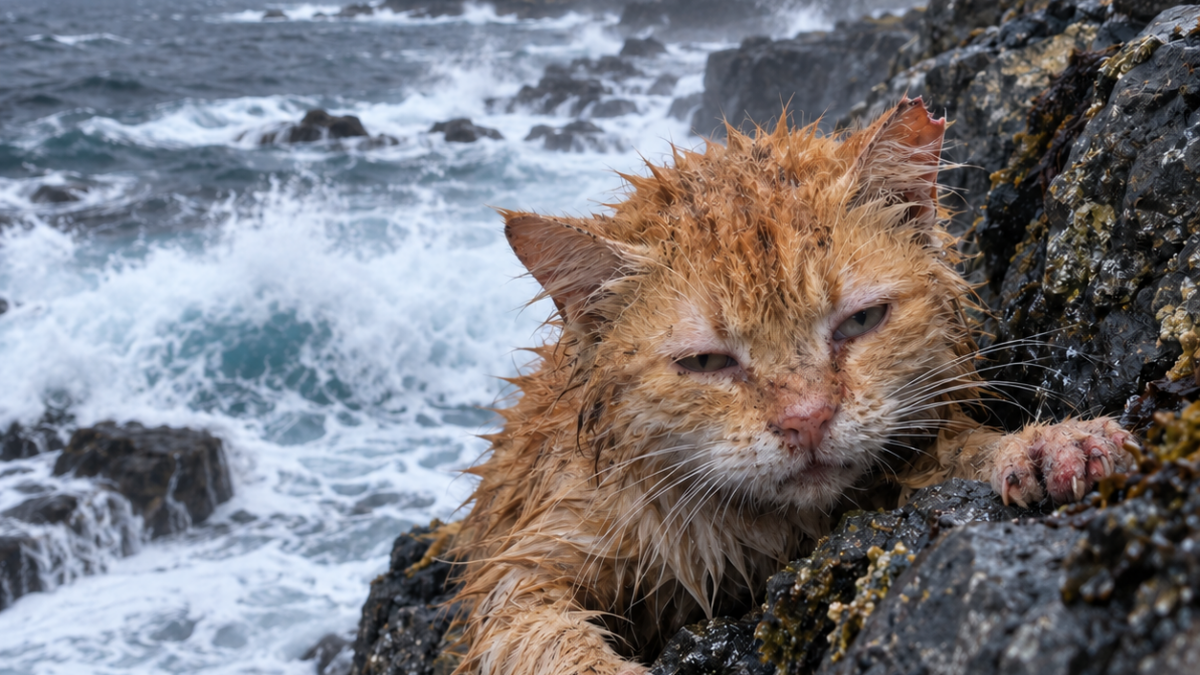
In a narrow crevice just above the high-tide line, something orange and gray lay pressed between two stones.
He did not look like Finn.
That was the terrible truth.
He looked like a piece of wreckage the sea had tried and failed to digest.
His fur was stiff with dried salt.
Hard crusts clung to his sides and back, making him appear larger than he was.
His eyes were almost sealed shut.
His eyelids were red and raw.
His nose was cracked and peeling.
One ear had a fresh tear along the outer edge.
He was thin.
So thin that beneath the salt-stiff fur, his body seemed to have collapsed in on itself.
“Finn,” I whispered.
His damaged ear twitched.
Then he tried to lift his head.
He managed maybe an inch.
That was all.
But he heard me.
He knew me.
I put one hand over my mouth and broke.
I had cried when Mary Ellen died.
I had cried alone after the funeral, sitting on the bathroom floor with my back against the tub because I could not make it to bed.
I had not cried like that since.
On those rocks, in front of strangers, I sobbed like a child.
Claire knelt beside me and held my shoulder.
The couple stepped away without being asked.
Some moments deserve privacy, even under the open sky.
The local veterinarian, Dr. Elaine Porter, arrived twenty minutes later.
She had come straight from home with a medical bag, towels, warming packs, and the kind of calm face people wear when they know panic will not help an animal survive.
When she saw Finn, she stopped.
“Oh, sweetheart,” she whispered.
She worked slowly.
Every movement was careful.
Finn did not fight.
That frightened me almost more than his wounds.
Finn always fought.
He had opinions about being touched, lifted, examined, brushed, moved, inconvenienced, or admired without permission.
But now he let Dr. Porter slide a towel beneath him.
When she lifted him, I saw his paws.
Dr. Porter saw them too.
Her face changed.
His claws were gone.
Not broken.
Gone.
All eighteen claws were flattened, worn down, or torn away.
Some were ground almost to the flesh.
Some had been ripped from the nail beds entirely, leaving dark, crusted wounds behind.
His paw pads were shredded from gripping wet stone.
The truth became clear in that instant.
He had not simply washed ashore and waited.
He had climbed.
He had held on.
For eleven days, through rain, wind, tides, and three more storms, Finn had dug what remained of his claws into those Atlantic rocks and refused to be taken.
Dr. Porter swallowed hard.
“We need to go now.”
At the clinic, they weighed him.
Before the wreck, Finn had weighed a little over five kilograms.
Now he weighed 2.9.
His temperature was 36 degrees Celsius.
Low.
Dangerously low.
He was severely dehydrated.
When Dr. Porter gently pinched the skin between his shoulders, it stayed raised for more than four seconds.
His kidneys were under strain.
His eyes were inflamed from prolonged exposure to saltwater.
His ear needed cleaning.
His nose had cracked from sun and salt.
There were mussel shell fragments between his teeth.
“He ate what washed up,” Dr. Porter said quietly.
I stood beside the exam table, hands useless at my sides.
“How?”
She glanced at him.
“The current likely carried him toward shore within hours of the sinking. Somehow he reached the rocks. He got above the tide line, or close to it. He probably drank rainwater from crevices.”
“There were storms.”
“I know.”
“The tides would have come up.”
“I know.”
Her voice shook on the second one.
She was a veterinarian. She had seen suffering. But even she kept looking at his paws.
“I have never seen anything like this,” she said.
For the first five days, no one knew whether he would keep his sight.
His eyes were swollen almost shut.
The salt had burned the tissue around the lids.
Dr. Porter and her assistant Lila cleaned them several times a day, applied ointment, watched for infection, and spoke to him in soft voices.
He received fluids.
Antibiotics.
Pain medicine.
Warming care.
Tiny amounts of food.
Too much too fast could hurt him.
Everything had to be measured.
Everything slow.
That was hard for me.
I wanted to feed him until the bones disappeared.
I wanted to wrap him in every blanket in the province.
I wanted to undo eleven days of rock and salt with one act of love.
But survival does not work that way.
Healing is not a flood.
It is a drip.
I visited every day.
Forty minutes there.
Forty minutes back.
Sometimes longer if weather was bad.
Claire offered to drive.
I refused most days.
I needed the road.
I needed the ritual.
I needed to arrive.
The staff told me Finn knew the sound of my boots in the hallway.
At first, I thought they were being kind.
Then one afternoon, I paused outside the treatment room before opening the door.
Inside, Finn was silent.
I took one step.
Then another.
Before I touched the handle, I heard it.
A low purr.
Rough.
Weak.
But there.
When I entered, Lila looked up from changing his blanket.
“He started before you opened the door,” she said.
I sat on the floor beside his cage.
That became our way.
There was a chair.
I never used it.
I sat on the floor, reached through the bars, and laid my hand palm up.
Finn would shift slowly, painfully, until he could press the side of his face into my palm.
We stayed that way.
An hour sometimes.
No words.
No movement.
Just contact.
There are kinds of prayer that do not involve speaking.
On the sixth day, Finn opened his right eye fully.
I was there.
Lila was adjusting the IV line.
Dr. Porter had stepped out.
Finn lifted his head, blinking.
The right eyelid trembled.
Then opened.
Not wide.
Not bright.
But open.
One green eye looked around the room.
At the lamp.
At Lila.
At me.
Then he lowered his head again, as if satisfied that the world had remained where he left it.
Lila began crying.
“I’m sorry,” she said, wiping her face with her sleeve.
I shook my head.
“No,” I said. “Don’t be.”
That eye felt like sunrise.
After that, he began returning to himself in small pieces.
He ate a little more.
He growled at a thermometer.
He swatted weakly at Dr. Porter when she examined his paws.
She smiled so broadly I thought she might hug him.
“There you are,” she said.
He tried to stand in the second week.
His legs shook.
His paws hurt.
He took two steps and sat down hard.
I moved toward him, but Dr. Porter stopped me.
“Let him try.”
So I did.
Watching someone you love suffer through recovery is its own kind of discipline.
You want to carry them past the pain.
But sometimes the only way back is through the exact movement that hurts.
Finn tried again the next day.
Three steps.
Then five.
Then across the towel.
His paws would always be sensitive, Dr. Porter explained.
Three nail beds were too damaged for the claws to regrow properly.
Some claws might come back crooked.
Some might never come back.
He would need soft surfaces.
No rough decks for a while.
No jumping from high places.
No cold exposure.
No stress.
She said the last one while looking directly at me.
“No boats,” she added.
I looked at Finn.
He was asleep under a warming lamp, thin as a shadow, one ear torn, face crusted with ointment.
“I don’t know if there will be a boat,” I said.
That was the first time I admitted it out loud.
The Mary Ellen was gone.
The insurance would cover some, not all.
But the bigger question was not money.
It was whether I could return to the water.
A fisherman without a boat becomes a strange creature in a coastal town.
People are kind, but kindness does not give a man an occupation.
The harbor still woke before dawn.
Engines still turned over.
Men still loaded bait, checked lines, cursed weather, and came home smelling of salt and diesel.
I watched from shore for weeks.
I hated the sea.
I missed it.
Both things were true.
The ocean had taken my wife’s namesake.
It had nearly taken me.
It had tried to take Finn.
And still, when the wind came from the east, my body turned toward the harbor before my mind did.
Finn spent twenty-six days in recovery.
When I finally brought him home, Dr. Porter gave me two pages of instructions.
Medication.
Eye ointment.
Soft bedding.
Limited stairs.
Check paws daily.
Watch hydration.
Watch appetite.
Watch behavior.
I read every word twice.
Then I looked at her.
“Thank you.”
She held my gaze.
“I didn’t do what he did.”
“No,” I said. “But you made sure it meant something.”
She looked down.
Veterinarians are not always thanked enough for the lives they return quietly to people.
At home, I set the carrier in the kitchen and opened the door.
Finn did not come out immediately.
For nearly five minutes, he sat inside, looking at the room.
The stove.
The chair.
His bowl.
The back door.
The house that had waited for him.
Then he stepped out.
Carefully.
His paws touched the floor like the floor might betray him.
He crossed the kitchen slowly and climbed, with great effort and no grace, onto Mary Ellen’s old chair.
I moved to help.
He shot me a look.
I stopped.
He made it on his own.
Then he turned in a circle, lowered himself onto the blanket, and closed his eyes.
I sat on the floor beside him.
That first night, I slept in the chair next to him.
Not well.
Not really.
Every time he moved, I woke.
Every time the wind touched the windows, he lifted his head.
When the first storm came after his return, he hid under the table.
I got down on the floor beside him.
My ribs still ached.
My knees protested.
But I lay there with one hand stretched toward him.
“We’re on land,” I told him.
The wind slammed rain against the house.
Finn pressed his cheek into my fingers.
“We’re on land, Captain.”
That winter, we healed badly and honestly.
Finn regained weight slowly.
His fur softened, though one patch on his left shoulder grew back thinner and rougher than the rest.
His right ear healed with a notch in it.
His nose remained slightly scarred.
His paws improved, but he moved carefully on hard floors.
He took stairs one step at a time.
He no longer jumped onto the counter.
That part, at least, I thought was an improvement.
Then I caught him stealing fish from a plate by climbing onto a chair first, and I realized survival had not made him morally better.
The village turned him into a legend.
Children called him “the rock cat.”
The local paper ran a story.
A radio station called.
Someone from Halifax wanted an interview.
I refused most of it.
Not because I was ungrateful.
Because Finn was not a miracle for public consumption.
He was not a symbol to me first.
He was my cat.
The one who woke me too early.
The one who shed on dark sweaters.
The one who had forgiven me for carrying him onto the boat that day, though I had not forgiven myself.
That was the hardest part.
Guilt survives good news.
People think if the lost thing returns, the wound closes.
It does not.
Every time I looked at his paws, I thought: my fault.
Every time he limped on the kitchen floor, I thought: my fault.
Every time rain hit the windows and he flinched, I thought: my fault.
One afternoon in January, Claire found me sitting at the table staring at Finn’s bandaged paw while he slept by the stove.
“You are doing it again,” she said.
“Doing what?”
“Punishing yourself as if it will heal him faster.”
I looked away.
“I put him on that boat.”
“You took him where he wanted to go every day for eight years.”
“He didn’t want to go that morning.”
“No,” she said. “Maybe he didn’t.”
That honesty hurt.
Claire sat across from me.
“You made a mistake, Tom. Maybe. Or maybe you made the same decision you had made a thousand times before, and that morning the sea changed the rules.”
I said nothing.
She reached across the table.
“He came back.”
I looked at Finn.
His body rose and fell under the blanket.
“Yes.”
“Then maybe spend less time apologizing to the past and more time being here for the cat who fought his way back to you.”
That sounded like something Mary Ellen would have said.
Which meant I had to listen.
Spring came slowly.
It always does in Nova Scotia.
Winter does not leave so much as loosen its grip, finger by finger.
The harbor changed first.
More light in the mornings.
Less ice along the edges.
Men working longer outside.
Boats being repaired.
Engines tested.
Ropes replaced.
Every sound called to me.
Every sound frightened me.
Finn started sitting by the back door again.
Not every day at first.
Then more often.
By March, he was there each morning when I came downstairs.
Waiting.
I told myself he wanted sun.
Then I told myself he liked the view.
Then one morning, I picked up my old thermos to clean it, and he stood so fast his paws skidded slightly.
I froze.
He stared at me.
“Absolutely not,” I said.
He blinked.
“No.”
He sat down.
That was worse.
He was patient.
A patient cat is simply a threat stretched over time.
In April, I bought a new boat.
Smaller.
Sturdier than pretty.
More suited to staying closer to shore.
I named her Second Chance.
Angus said the name was sentimental.
I told him at his age he should be careful mocking sentiment, because soon he would be made entirely of it.
He laughed for a full minute.
The first time I took Second Chance out, half the village appeared at the harbor pretending they had reasons to be there.
Angus checked a rope that did not need checking.
Dr. Porter arrived with coffee she did not drink.
Lila came with a camera.
Claire stood with her arms folded, trying not to cry.
Even the Coast Guard officer who had visited my hospital room came down before his shift.
Finn wore a soft harness.
He hated it.
He made that clear to everyone.
I had installed rubber mats along the wheelhouse floor and a padded perch on the dashboard. I had added a small enclosed bed beneath the seat, though we both knew he would use it only if he decided it had been his idea.
A little ramp led from the dock to the deck.
Finn approached it slowly.
The harbor went silent.
He placed one paw on the ramp.
Then another.
His claws, what remained of them, clicked softly against the rubber.
He climbed aboard.
No one cheered.
Not then.
It would have been wrong.
Some victories are too tender for noise.
Finn entered the wheelhouse, sniffed the new dashboard, stepped onto the padded perch, turned in a circle, and sat facing the harbor.
Exactly where he belonged.
Only then did Angus clap once.
Others followed.
Softly.
Finn ignored them all.
I started the engine.
My hands shook.
Not much.
Enough.
Claire saw.
She did not say anything.
The boat moved out of the slip.
The harbor opened before us.
For a moment, as we passed the breakwater, my lungs refused to work properly.
The last time I had crossed that line, I had returned without my boat and without my cat.
Finn stood.
His ears angled forward.
He looked at the water.
Then he looked at me.
One slow blink.
People who do not live with cats may not understand what that meant.
I did.
It meant: Go on, then.
So I did.
We stayed close to shore that morning.
No traps.
No work.
Just a slow run under a pale spring sky.
The sea was calm, almost insultingly beautiful.
Finn sat on the dashboard the whole time.
Not asleep.
Not relaxed exactly.
But present.
So was I.
When we returned, the harbor was still waiting.
This time people did cheer.
Finn tolerated it.
Barely.
Life did not return to what it had been.
That is important.
People like stories where everything broken becomes whole again.
But some things do not become whole.
They become different.
The Mary Ellen was still at the bottom of the Atlantic.
My body still remembered six hours in the water.
Finn’s paws remained sensitive.
His claws never fully returned.
He walked more slowly on hard floors.
He hated storms more openly.
I checked the weather obsessively.
I turned back sooner.
I left traps if the sea began changing.
Younger men joked at first.
Not cruelly.
Just the way fishermen do when fear makes them uncomfortable.
Then one rough morning, Angus turned back after I did.
Then another boat followed.
Eventually no one joked.
A man who survives a mistake has a responsibility to let it teach more than himself.
Finn became older.
All of us do.
But he remained captain.
He rode with me on calm days.
Not every day anymore.
I learned to accept that.
Some mornings, he stayed on Mary Ellen’s old chair and watched me leave alone.
Some mornings, he demanded the boat.
I obeyed when weather allowed.
He still sat on the dashboard.
The new boat was smaller.
The trips shorter.
The coastline closer.
But when the sun came up over the water and turned his orange fur gold, I could almost believe the world had given me something back without asking for payment.
One day in early summer, a little boy at the harbor asked if Finn was the cat who survived on the rocks.
I said yes.
The boy looked at him with awe.
“Was he scared?”
I looked at Finn, who was washing one paw with great dignity despite missing half the claw on it.
“Yes,” I said.
The boy frowned.
“But he was brave.”
“Yes.”
“How can he be both?”
I leaned against the rail.
“That is what brave means.”
The boy thought about that.
Then he nodded as if I had given him something useful.
Maybe I had.
The truth is, I was scared too.
Every time the wind shifted too fast.
Every time dark clouds moved over the water.
Every time the boat rolled harder than expected.
I did not become fearless because I survived.
Finn did not become fearless either.
Survival does not erase fear.
It gives fear a companion.
Memory.
Caution.
Gratitude.
Sometimes wisdom.
On the anniversary of the sinking, I went back to the rocks where Finn had been found.
I did not bring him.
That place belonged to what he had endured, and I saw no reason to make him revisit it.
I went alone.
The tide was low.
The same rocks lay black and wet under the gray sky.
I found the crevice.
Or the one I believed was his.
I stood there a long time.
Three miles south of the harbor.
Two miles from where the boat had gone down.
Eleven days of salt, cold, rain, hunger, and stone.
I crouched and placed my hand on the rock.
It was rough.
Sharp in places.
Wet with spray.
I imagined his paws there.
His body shaking.
His eyes swollen shut.
The tide rising.
The waves reaching.
His claws digging.
Digging.
Digging.
I do not know what keeps a creature alive in a moment like that.
Instinct, perhaps.
Fear.
Stubbornness.
Love.
Maybe he heard my voice in memory.
Maybe that is foolish.
I allow myself foolishness now.
Standing on those rocks, I said, “Thank you.”
To Finn.
To the couple with the dog.
To Dr. Porter.
To the Coast Guard.
To whatever mercy moves unseen through a world that often seems built from accident.
Then I went home.
Finn was waiting in the kitchen, furious that dinner was late.
“Some survivor you are,” I told him. “Five minutes past feeding time and you file a complaint.”
He yelled at me.
I fed him.
Years have passed now.
Not many.
Enough.
Finn is older.
His orange has faded around the muzzle.
He sleeps more.
He still hates gulls, though with less professional commitment than before.
He climbs stairs slowly.
On cold days, his paws bother him.
I keep soft rugs across the kitchen and hallway.
There is one by the door.
One beside the stove.
One leading to the chair that was Mary Ellen’s and is now his by legal right, according to him.
Sometimes visitors ask to see his paws.
I usually say no.
He is not an exhibit.
But sometimes, if the person asks gently and Finn permits it, I show them.
The claws are uneven.
A few never grew back.
The pads are scarred.
The feet of a cat who held onto the world when the world had become nothing but water and stone.
People grow quiet when they see them.
Good.
Quiet is the proper response.
In spring, when the weather is kind, Finn still comes on the boat.
He wears his harness.
He hates it.
He sits on the dashboard of Second Chance as we move along the coast, close enough to shore that I can see the houses, the pines, the church steeple, the rocks where the waves break white.
He no longer sleeps on my lap on the way back.
The ride jostles his paws too much.
Instead, he sits beside me on a padded box, leaning just enough against my thigh that I know he is there.
And I talk to him.
More than I used to.
About weather.
About traps.
About Mary Ellen.
About how foolish we both were and how lucky.
About how the sea is beautiful and cruel and not to be trusted, but still part of us.
People on shore sometimes wave.
Children call his name.
Fishermen lift coffee cups in salute.
The Coast Guard boys still ask how the captain is doing.
I tell them the captain complains about service but remains in command.
Every so often, someone asks whether I regret taking him that morning.
That question has no clean answer.
Yes.
No.
Every day.
Not anymore.
All of those.
I regret ignoring him when he hesitated.
I regret the four traps.
I regret the pride that told me I knew the sea.
But I do not regret eight years of mornings together before that.
I do not regret the dashboard.
The harbor.
The gulls.
The way he made the lonely house breathe again.
Love always carries risk.
Every creature we bring close can be lost.
Every ordinary morning can become the one we replay forever.
If fear of losing Finn had kept me from loving him, I would have been poorer in ways no storm could measure.
So I live with the regret.
And the gratitude.
Both.
That is what surviving often means.
Not choosing one truth.
Carrying two.
The boat went down on October 9th.
I was rescued after six hours.
Finn disappeared into the North Atlantic.
For eleven days, the world believed he was gone.
But three miles south of the harbor, above the high-tide line, a small orange cat with salt-burned eyes and torn paws held onto black rock through storm, hunger, and pain.
He held until strangers found him.
He held until I came.
He held until the life we thought had ended began again, changed but not finished.
These days, when the morning is calm and the sky is clear, I open the back door before dawn.
Finn walks slowly beside my boots.
Not as fast as he used to.
Not as lightly.
But with the same stubborn dignity.
At the harbor, I lift him gently onto the deck because his paws are too sensitive for the jump.
He pretends to hate the help.
I pretend to believe him.
Then he makes his way to the wheelhouse, climbs onto the padded dashboard, and settles facing the sea.
The sun rises.
The engine hums.
The harbor falls behind us.
And the cat who once clung to the rocks of the North Atlantic for eleven days sits exactly where he has always believed he belongs.
In front.
Watching the water.
Still captain.








