A Filthy Dog Waited Outside the ER for Six Days—Then a Vet Scanned His Chip and Realized Who He Was Waiting For
A Filthy Dog Waited Outside the ER for Six Days—Then a Vet Scanned His Chip and Realized Who He Was Waiting For
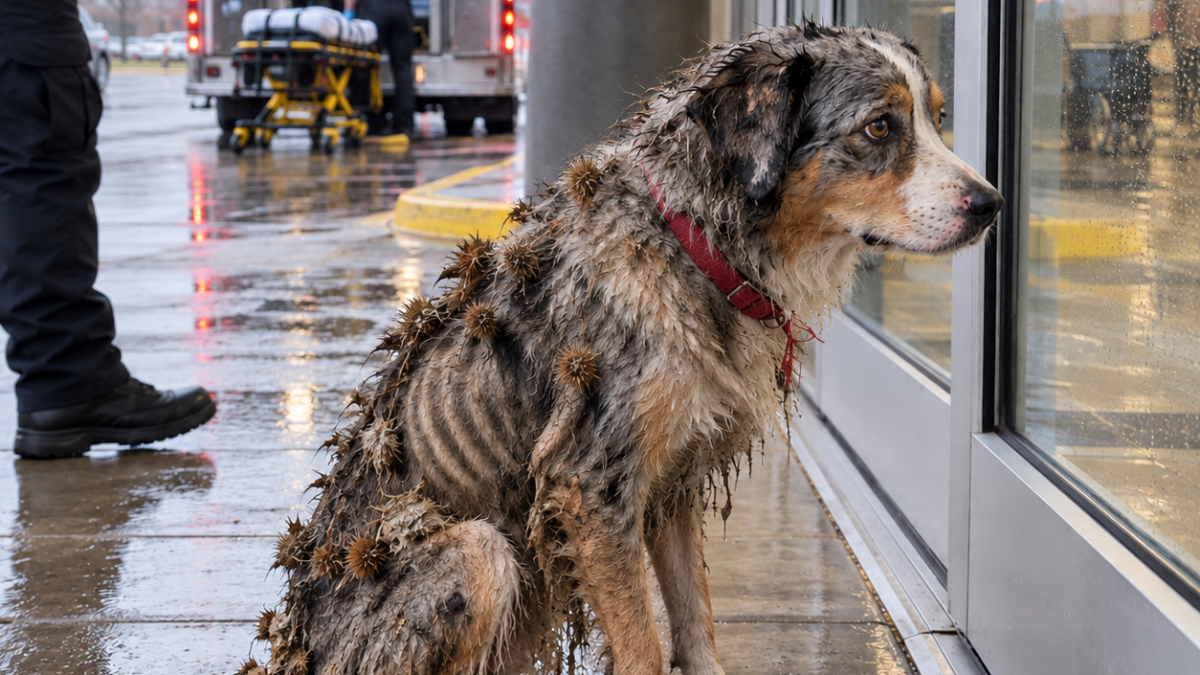
For six straight days, a filthy blue-merle dog sat outside the emergency-room doors in rain and cold, watching every stretcher and refusing to leave until a cafeteria cook finally took him home.
When the family brought the dog to Tulsa’s most respected veterinarian, the scanner beeped, the doctor’s face went white, and one hand signal made the supposedly homeless stray perform a seizure-response routine so precise that everyone in the room stopped breathing.
Then the veterinarian admitted the microchip was registered to him—and the dog had belonged to the son he had thrown out seven years earlier, a young man who was now lying unidentified in the same hospital while his dog waited outside for him to come back.
For six straight days, the dog watched the doors.
He did not beg.
He did not bark.
He did not wander toward the cafeteria dumpster fifty yards away, even when a delivery driver dropped an entire bag of hamburger buns beside it.
He did not follow nurses.
Did not chase squirrels.
Did not approach children.
He simply sat beside the ambulance entrance of St. Mary’s Medical Center in Tulsa and stared at the sliding glass doors as if somebody behind them had made him a promise.
Marisol Reyes noticed him on Monday.
She worked in the hospital cafeteria.
Forty-three years old.
Five-foot-two.
Black hair usually knotted beneath a hairnet by six in the morning.
She had been making eggs, soup, casseroles, grilled cheese, institutional meatloaf, and every possible variation of chicken for nearly eleven years.
At exactly three each afternoon, if the kitchen was not on fire and nobody had called in sick, she took ten minutes outside.
Not because she smoked.
She never had.
She just needed air that did not smell like fryer oil.
That Monday she stepped through the employee door near the ambulance bay, leaned against the brick wall, and saw the dog twenty feet away.
Medium-sized.
Australian shepherd mix, maybe.
Blue-merle coat underneath layers of dirt.
Copper-colored legs.
Pink spot on tip of nose.
His hair was so badly matted that burrs and bits of dead grass hung from his belly like decorations.
One ear had a little notch missing.
His red collar was frayed nearly white at the edges.
No tags.
He was watching the ER doors.
An ambulance backed in.
The dog stood immediately.
Not excited.
Alert.
The rear doors opened.
PART2:
Two paramedics rolled out an elderly woman on a stretcher.
The dog studied the woman’s face.
Then the paramedics.
Then the open ambulance.
When they disappeared inside, his ears lowered.
He sat again.
Marisol watched for another minute.
“Hey.”
The dog glanced toward her.
“Are you lost?”
He looked back at the doors.
Marisol took half a turkey sandwich from the napkin in her pocket.
She always packed a little extra.
Her husband Tony joked she had spent eleven years feeding an entire hospital whether they paid her or not.
She crouched.
“Want some?”
The dog looked at sandwich.
Then at Marisol.
Then back toward the doors.
She tossed a small piece.
PART3:
It landed near his front paws.
He sniffed.
Did not eat.
“That’s turkey.”
Nothing.
“Real turkey too. Not hospital turkey.”
Still nothing.
A security guard came around corner.
Lenny Brooks.
Fifty-seven.
Former Tulsa police officer who had left patrol after a bad shoulder and discovered hospital security involved almost as much paperwork with fewer drunk people trying to bite him.
He waved one hand.
“Go on.”
The dog did not move.
Lenny walked closer.
“Come on, buddy.”
The dog got up.
Moved maybe fifteen feet.
Lenny pointed toward parking lot.
“Keep moving.”
Dog walked another few yards.
Lenny came back.
“Stray?”
Marisol asked.
“Been hanging around.”
“How long?”
“Couple days.”
“Hungry?”
“Probably smelled dumpster.”
Marisol looked at untouched turkey.
“I don’t think so.”
Lenny shrugged.
“He’ll wander off.”
He did not.
Ten minutes after Lenny went inside, the dog returned to the same spot.
By Tuesday, Marisol brought chicken.
He ate that.
But only after watching the doors for another ambulance.
Wednesday, she brought scrambled eggs in a paper bowl.
Thursday, ground beef.
Friday, leftover rice and chicken.
Always same ritual.
Marisol set food down.
Dog sniffed.
Waited.
Eventually hunger won.
But even while eating, he kept his body angled toward the emergency entrance.
Every ambulance made him stop.
Stand.
Watch.
Then sit again.
Lenny stopped chasing him by Friday.
“He just comes back.”
Marisol scratched behind one ear.
The dog flinched at first.
Then allowed it.
“You got somebody in there?”
Lenny laughed.
“What, you think he’s visiting?”
“I’m serious.”
“So am I. Dogs don’t understand hospitals.”
Marisol looked at him.
“You sure?”
Lenny opened mouth.
Closed it.
“No.”
“Then don’t say it like you are.”
Lenny smiled.
“Yes, ma’am.”
Saturday rain started around noon.
Cold drizzle.
January in Tulsa can’t decide whether it wants to be winter or just miserable.
By three, the concrete around ambulance bay shone black.
The dog remained.
Soaked.
Blue-merle fur flattened to his body.
Shivering.
Still watching.
Marisol stood under awning with two slices of roast beef.
He would not come under shelter.
“Come here.”
Nothing.
“Please.”
The dog’s eyes stayed on glass.
“Whoever you’re waiting for isn’t coming through right this minute.”
The dog looked at her.
For one second, Marisol had the ridiculous feeling that he understood every word and disagreed.
She walked into rain.
Crouched beside him.
Up close he smelled awful.
Wet fur.
River mud.
Smoke.
Something sour.
His collar had rubbed skin raw underneath.
She found ribs beneath mats.
Not starving.
Thin.
She held roast beef.
He watched.
Then ate from her hand.
Marisol began crying.
She had no idea why.
Maybe because he was cold.
Maybe because he was waiting.
Maybe because hospitals were full of people waiting for doors to open, and Marisol had seen what waiting did to faces.
She took out phone.
Called Tony.
He answered above noise of generator.
“Reyes Taco Emergency Services.”
“Tony.”
“Uh-oh.”
“We’re getting a dog.”
Silence.
Then:
“Are we?”
“Yes.”
“Is this like when you said we were getting curtains and then I installed six hundred dollars of blinds?”
“No.”
“So actual dog.”
“Yes.”
“Do I get vote?”
“No.”
Another pause.
“Lucy home?”
“Yes.”
“Put her on.”
Marisol could hear their nine-year-old daughter in background before phone moved.
“Mom?”
“Baby, how would you feel about a dog?”
The scream made Marisol hold phone away.
Tony came back.
“That’s your answer.”
Marisol smiled.
“I’ll be home in twenty.”
“Does dog have fleas?”
“Probably.”
“Wonderful.”
“Love you.”
“Love you too. I’m moving taco supplies off floor.”
They called him Muddy.
Lucy chose it.
Tony argued that once they washed him, name would no longer make sense.
Lucy said:
“He’ll always have a muddy soul.”
Nobody knew what that meant.
It sounded poetic enough to win.
First bath took almost an hour.
Second took forty minutes.
They cut out mats carefully.
Some were too tight for scissors, so Monday Marisol planned professional groomer.
Under dirt, his coat was beautiful.
Blue-gray and black marbling.
Copper eyebrows.
White chest.
Pink nose spot looked like thumbprint.
Lucy sat on bathroom floor wrapped in towel.
“He looks like a cloud.”
Tony sniffed.
“He smells like river.”
Muddy shook.
Water covered everybody.
Lucy screamed laughing.
Marisol found herself laughing too.
The dog stood quietly while they dried him.
Then the first strange thing happened.
Tony poured kibble into a bowl.
Muddy approached.
Stopped.
Sat.
He stared at food.
Tony walked away.
The dog did not move.
Lucy crouched.
“Eat.”
Nothing.
“You hungry?”
His body trembled.
Saliva formed at edge of mouth.
Still he waited.
Tony frowned.
“Maybe he doesn’t like it.”
“He ate chicken.”
Marisol knelt.
“Muddy?”
The dog looked at her.
She pushed bowl closer.
“Okay.”
Instantly he lowered head and ate.
Fast.
Hungry enough to gulp.
Tony looked at Marisol.
“You saw that?”
“Yes.”
“Do it tomorrow.”
Next morning, same thing.
Food.
Sit.
Wait.
“Okay.”
Eat.
At doors, same.
Muddy stopped and waited.
Tony opened back door.
Dog remained until Tony walked through first.
On walks, they barely needed leash.
He aligned himself with Tony’s left knee.
Perfect heel.
When Tony stopped, Muddy stopped.
When he turned, dog turned.
No command.
At night, Lucy wanted him in bed.
He refused.
He walked into her room.
Sniffed.
Checked window.
Looked beneath bed.
Then stretched across doorway facing hall.
“You can sleep with me.”
Lucy patted blanket.
Muddy raised head.
Stayed.
At two in morning, Tony got water.
Dog woke before his foot hit hallway.
Watched him.
Relaxed when he recognized him.
The next evening Tony said what they were all thinking.
“Somebody trained this dog.”
Marisol nodded.
“Not sit-and-stay training.”
“No.”
“Serious.”
He scratched Muddy’s chest.
The dog leaned into him.
“He belonged to somebody.”
Lucy’s face changed.
“Are they going to take him?”
Marisol hesitated.
She had made appointment with Brookside Animal Hospital Saturday.
Microchip scan.
Checkup.
Vaccines.
She had not explained what a chip might mean.
“If he has a family looking for him, sweetheart…”
“But he waited at hospital.”
“I know.”
“What if his family left him?”
“We don’t know.”
Lucy’s eyes filled.
Tony sat beside her.
“If he belongs to someone who loves him, imagine how scared they are.”
Lucy hugged Muddy.
Dog rested chin on her shoulder.
“What if nobody loves him?”
Tony looked at Marisol.
Then at dog.
“Well.”
He smiled.
“Then that problem’s solved.”
Thursday night Tony came home later than usual.
His food truck was a converted step van parked most weekdays near an office complex downtown.
Every Thursday after closing, he loaded extra meat, tortillas, beans, rice, bottled water, coffee when weather was cold, and drove beneath the 11th Street bridge near the Arkansas River.
A church bought ingredients.
Tony cooked.
Nobody asked questions.
If you were hungry, you ate.
He had started after his brother died from an overdose twelve years earlier.
By the time family found him, Luis had been living in his car six months.
Tony always said:
“You never know who’s somebody’s brother.”
That Thursday he came through back door at nearly ten.
Muddy stood immediately.
Tony removed jacket.
Marisol saw his face.
“What?”
He shook head.
“Thursday Nate didn’t come.”
“Who?”
“The red-beard kid.”
Marisol opened refrigerator.
“Which red-beard kid?”
“He always comes last.”
Tony washed hands.
“Gray beanie.”
“Scar over eyebrow.”
“Gets two plates.”
Marisol vaguely remembered.
She had driven one of Tony’s bridge regulars to a free clinic last winter after bad seizure.
Young man.
Polite.
Embarrassed.
Red beard.
“I think I know.”
“He missed last week too.”
Tony sat.
“Two years.”
“What?”
“Two years, every Thursday unless weather was impossible.”
“Always exactly last ten minutes.”
“Tonight, nothing.”
Marisol rubbed Muddy’s newly brushed coat.
“Maybe he moved.”
“Maybe.”
Tony did not believe it.
Neither did she.
But thought slid away.
Too many immediate things.
Dog appointment.
Lucy’s spelling test.
Tony’s truck needed alternator.
Marisol’s supervisor changing weekend rotation.
Saturday morning they drove to Brookside Animal Hospital.
Dr. Thomas Keller had a reputation.
Best veterinarian in Tulsa, people said.
Also least likely to make you feel warm while paying him.
He was sixty-two.
Silver hair.
Wire-rim glasses.
Starched blue shirt beneath white coat.
Precise.
Efficient.
Brilliant with animals.
Awkward with humans.
The clinic was clean enough to perform surgery on reception desk.
He entered exam room reading chart.
“New intake?”
“Yes.”
Marisol said.
“Found?”
“Outside St. Mary’s.”
He did not look up.
“How long in your care?”
“About a week.”
“Eating?”
“Yes.”
“Stool?”
“Normal.”
“Vomiting?”
“No.”
“Cough?”
“No.”
He washed hands.
Then finally looked at dog.
Muddy had frozen.
Not scared.
His ears shot forward.
His entire body changed.
Dr. Keller stopped too.
Only for second.
Then professionalism returned.
“Friendly?”
“Very.”
Muddy crossed room.
Sat directly at doctor’s feet.
Raised muzzle.
Pushed pink-spotted nose into Dr. Keller’s open right palm.
The veterinarian’s hand went rigid.
He stared down.
Muddy pushed again.
Dr. Keller withdrew.
“Interesting.”
Tony watched carefully.
“You know him?”
“No.”
Too fast.
Dr. Keller picked up scanner.
“Let’s see if someone’s missing him.”
He passed it over shoulder blades.
Nothing.
Again.
Lower.
Beep.
A number appeared.
Dr. Keller read.
Then read again.
Color left his face.
He lowered onto rolling stool.
Scanner still in hand.
Marisol felt room change.
“Doctor?”
He did not respond.
Muddy remained beside knee.
“Dr. Keller?”
His voice came hoarse.
“Where did you get this dog?”
“Outside St. Mary’s.”
“Exactly where?”
“Emergency-room doors.”
“For how long?”
“He was sitting there six days before I took him.”
Dr. Keller closed eyes.
Lucy pressed into Marisol.
Tony looked between vet and dog.
The doctor stood.
Turned scanner face-down on counter.
“He’s chipped.”
“So he belongs to somebody?”
Lucy asked.
Dr. Keller ignored question.
He stared at dog.
Then raised his right hand.
Palm flat.
Tapped two fingers against his chest.
Muddy stood instantly.
Walked close.
Placed right front paw on Dr. Keller’s knee.
Then pushed his nose into doctor’s hand twice.
Hard.
Dr. Keller made small fist.
Pointed toward door.
Muddy spun.
Ran to exam room door.
Barked three times.
Sharp.
Loud.
Ran back.
Pressed his side firmly against Dr. Keller’s leg.
Feet spread.
Body rigid.
Braced.
The family stared.
Tony whispered:
“What was that?”
Dr. Keller swallowed.
“Alert.”
Pause.
“Get help.”
Pause.
“Brace.”
“What does that mean?”
“That is a seizure-response dog.”
He looked at Muddy.
“A highly trained one.”
“He’s trained to recognize warning signs.”
“Sometimes scent changes.”
“Sometimes movement.”
“Depending dog.”
“He alerts before seizure.”
“Then goes for help.”
“Then braces so handler has something stable when standing afterward.”
Marisol thought about doors.
Food.
Lucy’s room.
Stretcher faces.
“He wasn’t stray.”
She whispered.
Dr. Keller shook head.
“No.”
“He was never a stray.”
Lucy held mother.
“What’s his name?”
Dr. Keller’s jaw moved.
He looked away.
“Registration is old.”
“Contact information needs verification.”
Marisol frowned.
“You read it.”
“I need to make calls.”
“Doctor—”
“Take him home.”
“Feed him.”
“I will call.”
He walked out.
No goodbye.
Closed office door.
Tony stared after.
“What in hell was that?”
Saturday evening, rain returned.
At seven, Lucy opened front door for mail.
Muddy shot between legs.
“Muddy!”
Lucy screamed.
The dog ran.
Marisol grabbed keys.
Tony yelled:
“I’ll come.”
“You stay with Lucy.”
“I’m coming.”
“She can’t—”
“I’m coming too!”
Lucy shouted.
Thirty seconds later all three in car.
Marisol knew destination.
Three miles.
Muddy crossed residential streets.
A driver nearly hit him on Harvard.
Tony cursed.
They reached St. Mary’s.
Dog was already there.
Sitting in exact old spot.
Soaked.
Staring through sliding doors.
Marisol stopped car.
Did not call him.
She walked over.
Sat on wet curb beside him.
Tony and Lucy remained under awning.
Lenny came out with umbrella.
“He came back.”
Marisol nodded.
Lenny stared.
“I need to tell you something.”
She looked up.
He shifted umbrella.
“I wasn’t sure.”
“About?”
“The first day.”
“What first day?”
“Six days before you took him.”
Marisol’s skin prickled.
Lenny continued.
“Ambulance came from river.”
“Young guy.”
“Homeless, I guess.”
“Seizing on stretcher.”
“Bad.”
“Dog was running behind ambulance.”
Marisol stared at him.
“This dog?”
Lenny nodded.
“Right up ramp.”
“Nearly got hit by ambulance turning.”
“When paramedics opened doors, he tried going inside.”
“Couldn’t let animal into ER.”
“We blocked him.”
“Stretcher went through.”
“The doors closed.”
Lenny looked down at Muddy.
“He sat.”
“And he stayed.”
Marisol covered mouth.
Not waiting randomly.
Not confused.
He had watched his person disappear through those doors.
Every stretcher after that was possibility.
Every ambulance.
Every face.
He had been doing exactly what he had been trained to do.
Wait.
Watch.
Protect.
Her phone buzzed.
Unknown number.
“Hello?”
“Mrs. Reyes?”
Dr. Keller.
But voice did not sound cold anymore.
It shook.
“I lied to you.”
Marisol stood.
“What?”
“That microchip.”
Rain hit her hair.
“It isn’t registered to a stranger.”
Pause.
“It’s registered to me.”
At nine that night, Marisol sat in Dr. Keller’s office.
Tony beside her.
Lucy home with neighbor.
The dog lay at Marisol’s feet, wet but calm.
A desk lamp lit room.
Dr. Keller turned computer monitor.
Microchip number.
Registered name:
ATLAS.
Owner:
DR. THOMAS KELLER.
Brookside Animal Hospital.
Tulsa, Oklahoma.
“His name is Atlas.”
The dog’s head lifted.
Tail thumped once.
Marisol felt tears.
“You know him.”
Dr. Keller removed glasses.
“I implanted that chip.”
“When?”
“Eight years ago.”
He rubbed his eyes.
“He was a birthday present.”
“For who?”
“My son.”
Silence.
“Nathan.”
He corrected himself.
“Nate.”
Dr. Keller looked ten years older in dim light.
“He had epilepsy.”
“Since twelve.”
“Bad seizures.”
“He’d drop without warning.”
“Split his eyebrow once on coffee table.”
Marisol’s breath caught.
But she did not interrupt.
“My wife Ellen handled most of it.”
Keller continued.
“She was…”
His voice softened.
“She was better at fear than I was.”
“What does that mean?”
Tony asked.
“She could be scared and still stay in room.”
Dr. Keller looked down.
“I worked.”
“That was my version.”
“Appointments.”
“Surgery.”
“Rounds.”
“If I was at clinic, I could pretend things were manageable.”
“Then Ellen got breast cancer.”
Fast.
Aggressive.
Less than year.
Nate nineteen when she died.
Keller buried himself in work even deeper.
“Sixteen hours a day.”
“Sometimes longer.”
“He was alone in house.”
“With seizures.”
Marisol’s jaw tightened.
Keller noticed.
“You don’t need to say it.”
“I know.”
“I know now.”
For Nate’s nineteenth birthday, Keller bought Australian shepherd puppy from breeder in Claremore.
Companionship.
Nothing more.
“Nate did rest.”
“Read everything.”
“Service-dog training.”
“Scent work.”
“Behavior.”
“He spent hour after hour.”
“Atlas learned to alert before seizures.”
“Fifteen minutes sometimes.”
“Enough to get Nate sitting down.”
“Enough to warn others.”
“He taught him to find help.”
“To brace.”
“To guard door while Nate recovered.”
Keller’s mouth almost smiled.
“Nate was brilliant with dogs.”
“Better than most trainers I’ve hired.”
“Then why didn’t he work here?”
Tony asked.
That question opened wound.
Keller leaned back.
“Because I was a fool.”
No defense.
Nate wanted service-dog training career.
Seizure dogs.
PTSD dogs.
Diabetic alert.
Kids with autism.
Veterans.
Keller wanted veterinary school.
Practice inheritance.
Name on sign.
Father and son.
“I had whole future planned.”
“Did he?”
Marisol asked.
Keller looked.
“No.”
“I never asked.”
He laughed bitterly.
“He told me that.”
“At twenty.”
“He said: ‘You never once asked what I wanted, Dad. You just decided what my life was supposed to look like.’”
“And you?”
“I told him he was wasting himself.”
“That dog training was hobby.”
“That I wasn’t paying for him to play with dogs after cancer drained our savings.”
Keller stared at desk.
“I used his mother’s death as weapon.”
Tony said nothing.
Neither did Marisol.
Some truths should not be softened.
“He packed duffel.”
“Put Atlas in Corolla.”
“Stood in driveway.”
“It was raining.”
Keller’s voice broke.
“He asked me once.”
“Are you really going to let me leave like this?”
Marisol felt chest tighten.
“What did you say?”
Keller closed eyes.
“If you walk out that door, don’t bother coming back.”
Rain tapped window.
Nobody moved.
“That was seven years ago.”
“You never called?”
Marisol asked.
“He changed number.”
“You couldn’t find him?”
“I heard things.”
“Broken Arrow kennel.”
“Then pet store.”
“Lost apartment.”
“Slept in car.”
“I…”
Keller swallowed.
“I told myself he needed to learn.”
Tony’s expression hardened.
“Learn what?”
Keller looked at him.
“That I was right.”
“And were you?”
“No.”
He whispered.
“I learned instead.”
Too late.
Nate disappeared.
Rumors.
Someone said Texas.
Someone said Denver.
No certainty.
Then Atlas appeared outside hospital.
Marisol remembered Tony’s words.
Thursday Nate.
She sat upright.
“Do you have a picture?”
Keller reached wallet.
Worn photograph.
Graduation gown.
Teenage Nate grinning.
His mother beside.
Marisol barely needed it.
“Does he have a scar through left eyebrow?”
Keller went still.
“Yes.”
“From seizure?”
“When fourteen.”
“How do you know?”
Tony was already standing.
His face pale.
“That’s Thursday Nate.”
Keller looked.
“What?”
Tony took photo.
“That’s him.”
“You know my son?”
“For two years.”
The doctor’s face seemed to collapse inward.
Tony sat again.
Every Thursday beneath 11th Street bridge, Nate came at end of food line.
Red beard now.
Gray knit beanie.
Thin.
Polite.
“Could I get second plate, sir?”
Always two.
Tony assumed partner.
Friend.
Girlfriend.
Sick campmate.
It had been Atlas.
Nate left dog guarding tent while he got food.
Marisol remembered seizure.
Last winter.
Nate dropped in food line.
Atlas had not been there that night.
Marisol helped.
Drove him free clinic for medication.
“He told me about you.”
Keller’s eyes widened.
“What?”
“He said his father was veterinarian.”
“Best vet in Tulsa.”
Keller’s mouth opened.
Marisol continued reluctantly.
“Then he said…”
“What?”
“He said you didn’t think much of him.”
Dr. Keller covered face.
Tony added:
“Lucy drew him dog in superhero cape.”
“He carried it.”
“Showed me every week.”
Keller whispered:
“Two years.”
He looked at window.
“He was three miles away.”
Silence.
“I drive over that bridge every morning.”
His voice cracked.
“Every morning.”
Marisol stood.
“St. Mary’s.”
Keller looked.
“If he came in without ID…”
Her mind raced.
“John Doe.”
They drove straight there.
Atlas in rear seat.
Nose pressed glass.
At ICU desk, Marisol found Patrice Coleman.
Night charge nurse.
Friend from years of meal trays and midnight coffee.
Marisol spoke fast.
Dog.
Chip.
Nate.
River camp.
Ambulance.
Scar.
Patrice listened.
Typed.
Stopped.
“We have a John Doe.”
Dr. Keller gripped counter.
“How old?”
“Late twenties estimated.”
“Came eight days ago.”
“From river camp.”
“Status epilepticus.”
“What?”
“Prolonged seizures.”
“Wouldn’t stop.”
“Then aspiration pneumonia.”
“Sepsis.”
“He’s been ventilated.”
Keller’s face drained.
“Scar?”
Patrice hesitated.
“Left eyebrow.”
Dr. Keller could not move.
Patrice walked him.
Marisol stayed back.
Through Room 12 glass, she watched father stop.
Young man in bed looked nothing like graduation picture.
Red beard overgrown.
Face gray.
Breathing tube.
Machines.
Plastic bag belongings on bedside table.
Gray beanie.
And folded crayon drawing.
A dog in superhero cape.
Dr. Keller went to bed.
Touched his son’s forehead.
Scar.
“Nate.”
No movement.
“It’s Dad.”
Ventilator hiss.
“I’m here.”
His shoulders shook.
“I’m sorry.”
Nothing.
“I’m here.”
Outside, three floors below, Atlas was in back seat.
Then came a howl.
Long.
Low.
So mournful Marisol heard faintly through glass.
Dr. Keller did not leave for four days.
He slept in recliner.
Stopped shaving.
Same starched shirt turned wrinkled.
He talked.
At first like doctor.
Facts.
Memories.
Then like father.
“I was wrong.”
Over and over.
“I was wrong.”
“You were right.”
“I never asked what you wanted.”
“I’m asking now.”
“Please wake up and tell me.”
He told Nate things he should have said years ago.
That service dogs mattered.
That his mother had been proud.
That he kept Atlas’s puppy picture in drawer.
That he had driven past 11th Street bridge for years without once looking beneath it.
That he was ashamed.
Sedation stopped.
Seizures controlled.
Infection improved.
Ventilator removed.
But Nate did not wake.
Neurologist Dr. Ana Patel explained brain swelling.
Prolonged seizure.
Hypoxia risk.
Time.
Maybe days.
Maybe longer.
Maybe not.
The Reyes family visited evenings.
Lucy taped drawings to wall.
Atlas with crown.
Atlas driving ambulance.
Atlas wearing doctor coat.
Atlas holding sign:
WAKE UP NATE.
Dr. Keller kept every one.
Atlas stayed at Reyes house.
Without Nate nearby, his behavior changed.
He stopped eating second day.
Even when Marisol said okay.
He lay at front door.
Nose under crack.
Every siren lifted his head.
Every car.
Every footstep.
Lucy sat beside him.
“He knows.”
Marisol stroked smooth coat.
“He knows Nate’s sick.”
Maybe.
Maybe dogs do not understand ICU.
Maybe they understand absence.
Scent.
Routine.
Broken expectation.
Sometimes precision of animal cognition matters less than observable devotion.
Atlas had spent eight years learning Nate’s body.
A seizure before Nate knew.
A collapse.
A recovery.
No wonder separation made him restless.
On fourth day, Dr. Patel asked Dr. Keller into conference room.
“I’m going to speak to you as physician and father.”
That phrase frightened him.
“His reflexes are present.”
“Imaging shows swelling.”
“No purposeful response.”
“Nothing to voice.”
“Nothing meaningful to pain.”
“If we do not see change in forty-eight hours…”
She stopped.
Keller knew rest.
Long-term decisions.
Level of support.
What Nate would want.
He returned to room.
Held son’s hand.
And finally sobbed.
Not elegant tears.
Not restrained grief.
His body folded over bed rail.
He cried for Ellen.
For seven years.
For every Thursday taco.
For every morning over bridge.
For the sentence in driveway.
For arrogance that lasted longer than anger deserved.
Marisol found him hour later.
His eyes swollen.
“I need something.”
“Anything.”
“Atlas.”
Hospital rules.
ICU.
Infection control.
Other patients immunocompromised.
No animal without documentation.
Marisol argued.
“He is patient’s service dog.”
“Where’s paperwork?”
None.
Nate self-trained Atlas.
No official certificate.
No vest.
No active registration beyond microchip.
A dog could perform tasks without paper, but hospital policy required verification.
Nurse manager apologized.
“No.”
Marisol hated word.
Dr. Keller did not argue.
That surprised her.
Old Dr. Keller might have demanded.
Threatened.
Used professional status.
This one sat in hallway.
“Rules.”
He whispered.
“Of course.”
At 2:14 a.m., Room 12 alarms sounded.
Nate’s oxygen dropped.
Heart rate climbed.
Fever.
Respiratory rushed.
Dr. Keller pushed against wall.
Possible reintubation.
At 3:30, Dr. Patel came out.
Stable.
Weaker.
“If there’s anyone who needs to see him…”
She said.
“Call them tonight.”
At 3:45 Dr. Keller called Marisol.
Only one word.
“Please.”
Twenty minutes later Marisol arrived.
Atlas beside.
Lucy’s school had reading program with therapy dogs.
Marisol borrowed blue vest.
Not ideal.
Not official.
Just something to signal purpose.
She went to Patrice.
“I know rules.”
“Please.”
Patrice looked at Atlas.
He sat perfectly still.
Trembling.
Eyes fixed down corridor toward Room 12.
Then looked at Keller.
Gray-faced.
She called attending.
Three minutes.
Quiet discussion.
Hung up.
“Compassionate visit.”
“Fifteen minutes.”
“He needs bath.”
“Twice.”
“Paws clean.”
“Yes.”
“Leash.”
“Yes.”
Patrice opened Room 12.
Atlas did not need direction.
He went straight to bed.
Nails clicking.
Stopped.
Looked at Nate.
For one second dog was completely still.
Then front paws rose to mattress edge.
He licked Nate’s right hand.
Once.
Twice.
Pushed head beneath palm.
Lifted it so Nate’s hand rested over his skull.
One soft bark.
Nudge.
Another bark.
Come back.
A routine practiced thousands of times.
Bathrooms.
Kitchen.
Car.
Sidewalk.
Tent.
Wherever seizures left Nate confused.
Atlas would lick.
Push.
Bark.
Stay.
Again.
He licked fingers.
Pushed head.
Barked louder.
Nate’s fingers moved.
Patrice gasped.
Dr. Keller grabbed bed rail.
The fingers curled.
Slowly.
Into blue-merle fur.
Heart monitor jumped.
Nate’s eyelids fluttered.
Opened barely.
Found dog.
His lips moved.
“Atlas.”
Keller covered mouth.
Nate’s gaze shifted.
Found silver-haired man at foot.
Long look.
Seven years crossing in silence.
“Dad?”
Dr. Keller could not answer.
He came around.
Took Nate’s other hand.
Pressed it to face.
Nodded.
“Yes.”
He finally found voice.
“Yes.”
“I’m here.”
Nate slept again within minutes.
But it was first meaningful response.
Not miracle curing brain.
Not instant recovery.
A response.
Doctors repeated tests.
Nate followed simple command later that morning.
Two fingers.
Open eyes.
Three days until speech became steady.
Recovery began.
When he could talk, he told them what happened night he collapsed.
Two a.m.
Tent beneath bridge.
Seizure warning.
Atlas alerted.
Nate tried medication.
Then seizure hit.
Hard.
Status.
He remembered little.
Paramedic report filled rest.
Atlas ran from camp.
Into 11th Street.
Barked at cars.
A delivery driver stopped.
Dog ran back toward river.
Driver followed.
Found Nate convulsing.
Called 911.
Atlas followed ambulance.
All way hospital.
Lenny confirmed.
Dog at bumper until final turn.
Nate looked at Atlas lying across foot of bed.
“He saved me.”
Keller nodded.
“He did.”
“Then you took him?”
Marisol explained six days.
Waiting.
Rain.
Every ambulance.
Nate cried.
Then said:
“There’s something about chip.”
Dr. Keller looked.
“I could have changed it.”
“What?”
“Registration.”
“Any vet.”
“Any shelter.”
“Five minutes.”
Keller stayed still.
“Why didn’t you?”
Nate looked at dog.
“Because I have seizures.”
Pause.
“Living on street.”
His eyes filled.
“I knew one might be last.”
Keller’s face changed.
“And if something happened…”
Nate swallowed.
“I wanted somebody to scan him.”
“And?”
“I wanted Atlas to go home.”
Keller broke.
“To me?”
Nate nodded.
“You threw me out.”
He said quietly.
“You didn’t throw him out.”
That sentence cut.
“I figured you’d take care of him.”
Keller cried openly.
“I renewed chip.”
Nate stared.
“What?”
“Every January.”
“I kept clinic number.”
“Address.”
“Everything.”
“I told myself it was paperwork.”
He wiped eyes.
“But…”
He looked at son.
“It was the only thread I had.”
Nate squeezed hand.
Marisol stood in corner.
“You both left a door open.”
They looked at her.
“And Atlas walked through it.”
For seven years, father and son had been too proud, too hurt, too ashamed to call.
Nate left microchip registered to father.
Keller kept renewing it.
Neither admitted what that meant.
Atlas carried meaning anyway.
Recovery lasted weeks.
Nate had muscle weakness.
Memory gaps.
Fatigue.
Speech slower when tired.
Physical therapy.
Neurology follow-ups.
Medication adjustments.
Housing problem remained.
You do not wake from ICU and magically regain apartment you never had.
Social worker discussed shelters.
Transitional housing.
Keller said:
“He’s coming home.”
Nate looked at him.
“Dad.”
“If you want.”
That qualification mattered.
Not command.
Not assumption.
“If you want, your room is there.”
Nate stared.
“Same room?”
“Yes.”
“Mom’s piano?”
“Still there.”
Silence.
“You kept it?”
“I couldn’t move it.”
Nate looked away.
“I don’t know if I can live there.”
Keller nodded.
“Okay.”
No argument.
“We’ll find something else.”
That was first sign the relationship might actually have chance.
Not father getting son home.
Father accepting son’s answer.
Nate eventually agreed temporarily.
“While I recover.”
“Fine.”
“Not forever.”
“Fine.”
“You’re going to try to manage everything.”
Keller almost denied.
Then stopped.
“Probably.”
Nate laughed weakly.
“At least you know.”
“We can get therapist.”
Nate blinked.
“You?”
“Yes.”
“My father?”
“Yes.”
“Dr. Thomas Keller, who thinks emotions are poorly documented symptoms?”
Keller smiled for first time.
“Apparently.”
Nate started crying and laughing.
Atlas stood.
Put paw on bed.
Both men reached for him.
Their hands met in fur.
Discharge morning was bright and cold.
April.
Different season than dog’s rain.
Dr. Keller pushed wheelchair himself.
Nate wore gray beanie.
Red beard trimmed.
Atlas walked at left side.
Reyes family waited by ambulance entrance.
Exactly where dog sat.
Tony’s taco truck parked curb.
Breakfast tacos.
Two plates.
“One for you.”
Tony handed Nate first.
“And one for your partner.”
Nate laughed.
Real laugh.
“Still doing doubles?”
“Always.”
Lucy ran forward then stopped.
Looked at Marisol.
Permission.
Nate opened arms.
She hugged carefully.
Then handed drawing.
Blue-merle dog in superhero cape.
Between two people.
Young man with red beard.
Older man silver hair.
Across top:
ATLAS BRINGS PEOPLE HOME.
Dr. Keller read.
Turned away.
Pretended to adjust glasses.
Lenny stood nearby.
“Thought he was dumpster dog.”
Marisol smiled.
“You were wrong.”
“Frequently.”
Sliding doors opened.
For six days, Atlas had watched them.
Waiting for one person.
Now Nate rolled through.
His father behind.
Atlas between.
Dog stopped just outside.
Looked back toward doors.
Nate touched his head.
“Come on.”
Atlas turned.
Walked with them.
Home was not simple.
It should not be.
Seven years does not dissolve because one ICU awakening.
Nate’s room had become museum.
Keller had not touched much.
Old books.
Soccer trophy.
Photos.
A dog leash hanging closet hook from Atlas’s puppyhood.
Nate stood doorway.
“This is creepy.”
Keller flushed.
“I didn’t know what to do.”
“You could’ve used room.”
“I couldn’t.”
Nate sat bed.
Atlas jumped beside.
Keller said automatically:
“No dogs on—”
Stopped.
Nate looked.
Keller laughed.
“Never mind.”
Atlas curled pillow.
Therapy Tuesday afternoons.
First session awful.
Keller spoke like witness.
Dates.
Events.
Facts.
Nate accused him of turning everything into case notes.
Keller accused Nate of disappearing deliberately.
Nate shouted:
“You told me not to come back.”
Keller said:
“You could have called.”
Nate stood.
Atlas stood.
Therapist said:
“Sit.”
Both men looked.
She continued:
“Neither of you gets to make the other responsible for being braver first.”
Silence.
That line became work.
Keller had weaponized authority.
Nate weaponized absence.
Both wounded.
Not equally responsible for original rupture—parent had more power, words mattered more—but years after, repair required both.
Nate admitted pride.
“I knew where clinic was.”
Keller whispered:
“I know.”
“I walked past twice.”
Keller closed eyes.
“Why?”
“To see if sign changed.”
“Didn’t.”
“I know.”
“Why didn’t you come in?”
Nate laughed bitterly.
“You told me not to.”
Seven years later, sentence still alive.
Keller learned words do not expire just because speaker regrets them.
He apologized without expecting forgiveness on timetable.
“I was wrong.”
No “but.”
No “I was grieving too.”
No “you hurt me.”
Those truths could come later.
First:
“I was wrong.”
Nate’s recovery improved.
He started walking farther.
Atlas resumed formal alert behavior as Nate’s seizure pattern returned to baseline.
First time Atlas alerted at Keller’s house, doctor was making coffee.
Dog came.
Two nose bumps to Nate’s thigh.
Paw.
Nate said:
“Dad.”
Keller froze.
“What?”
“Seizure.”
His medical brain activated.
“Sit.”
“I know.”
Nate lowered couch.
Keller hovered.
“Do you want rescue med?”
“Not yet.”
“Timer?”
“Yes.”
“Lights?”
“Dim.”
Atlas pressed alongside.
Keller watched dog work.
Warning before visible signs.
Nate’s focus changed.
Then seizure.
Keller had treated animal emergencies for forty years.
Had seen seizures in dogs, cats.
His own son’s seizures still reduced him to fear.
But Atlas made space structured.
Afterward, dog licked Nate’s hand.
Pushed head.
Barked once.
Nate’s fingers found fur.
Exactly ICU.
Keller watched.
Then understood career Nate had wanted.
Not hobby.
Not playing with dogs.
A trained animal could change a life from uncontrolled risk to supported independence.
A week later Keller cleared storage room at Brookside.
Old cages.
Boxes.
Expired promotional material.
Had carpenter add shelving.
Rubber flooring.
Training space.
He did not tell Nate initially.
When ready, took him back.
Sign on door:
BROOKSIDE SERVICE DOG TRAINING PROGRAM
Director: Nathan Keller
Nate stared.
Then:
“No.”
Keller’s face fell.
“You don’t like?”
“You did it again.”
“What?”
“You decided.”
Keller closed eyes.
Of course.
He had built apology in same shape as old control.
“I’m sorry.”
Nate rubbed forehead.
“I want this.”
Keller looked.
“I do.”
“But ask.”
Keller nodded.
“So…”
He removed sign from hook.
Held it.
“Nathan Keller.”
“Yes?”
“Would you consider starting a service-dog training program here?”
Nate pretended thinking.
“What’s salary?”
Keller laughed.
“Negotiable.”
“Hours?”
“Negotiable.”
“Do I answer to you?”
Keller hesitated.
“Professionally?”
“Yes.”
“Then we need contract.”
Nate smiled.
“Now you’re learning.”
The first dog was a yellow Lab puppy from Claremore.
Shy.
Big paws.
Donated for seven-year-old girl with diabetes.
Nate named her Maple temporarily.
Atlas supervised from bed.
Nate trained scent.
Target behavior.
Alert.
Retrieve.
Go get help.
Keller watched sessions.
Rarely commented unless asked.
That was new discipline for him.
Sometimes hardest way to support child is staying quiet while they do what they know.
Word spread.
A veteran asked about PTSD dog.
Family with autistic teenager.
Woman with epilepsy.
Program grew slowly.
Nate insisted on scholarship component.
“No one should lose independence because they can’t pay twenty thousand dollars.”
Keller nodded.
Clinic funded some.
Church Tony worked with helped others.
Tony catered first fundraiser.
Marisol organized food.
Lucy sold drawings for five dollars.
Atlas became logo accidentally.
Blue-merle silhouette between two open doors.
Underneath:
BRINGING PEOPLE HOME.
Nate hated sentimental marketing.
Lucy loved.
Lucy won.
Atlas’s old red collar was replaced only when fabric became unsafe.
New leather.
Strong.
Tag read:
ATLAS
If found, call Dr. Thomas Keller
Nate insisted wording stay.
Keller touched tag.
“Still me?”
Nate shrugged.
“You answer phone now.”
Small sentence.
Huge.
Marisol kept working St. Mary’s.
She still took break at three.
For months after, she looked toward old spot.
Empty.
At first emptiness felt sad.
Then good.
Some empty places mean somebody went home.
Lenny eventually put a small metal bowl near ambulance door for strays.
Security technically objected.
He was security.
He ignored himself.
One afternoon a nurse asked Marisol:
“How did you know dog wasn’t stray?”
“I didn’t.”
“You took him home anyway.”
“He was cold.”
“That’s it?”
Marisol thought.
“Yes.”
That was all required at beginning.
Not destiny.
Not insight.
Cold dog.
Rain.
Food.
Attention.
Big outcomes begin with small kindness partly because small kindness keeps story moving long enough for truth to emerge.
If Marisol had ignored him, maybe shelter picked him up.
Probably chip scanned eventually.
Maybe Keller called.
Maybe Nate found.
Maybe.
But life does not owe us alternate certainty.
In this version Marisol stopped.
Tony fed.
Lucy loved.
Lenny remembered.
Dr. Keller scanned.
Patrice bent rule compassionately.
Atlas did what he always did.
He worked.
Nate’s life changed too.
Homelessness left scars beyond dirt.
He hoarded food at first.
Tony noticed.
At dinners, Nate wrapped tortillas in napkins and slipped into pocket.
Keller once said:
“You don’t need to.”
Nate’s body stiffened.
Keller immediately corrected.
“Sorry.”
Then:
“There’s always more if you want.”
Nate nodded.
Months before habit faded.
He slept near door.
Atlas across threshold.
Sometimes woke panicked if house too quiet.
Seven years sleeping in cars, shelters, tents trains nervous system differently.
Keller used to turn off hallway lights.
Now left one dim.
No comment.
One night Nate found him asleep kitchen table waiting after seizure.
Nate draped blanket over father.
Morning Keller pretended not know.
They both knew.
Ellen remained between them.
Her absence had helped break family.
Now they spoke.
At therapy Nate said:
“After Mom died, you disappeared before I did.”
Keller did not defend.
“Yes.”
“I was nineteen.”
“I know.”
“You bought me dog instead of sitting with me.”
“Yes.”
“Atlas did job you were supposed to.”
Keller looked at dog on office rug.
“Yes.”
That sentence could have destroyed him.
Instead he accepted.
Then said:
“I can’t take that back.”
“No.”
“But I’d like to do my part now.”
Nate’s eyes filled.
“Okay.”
Healing often looks unimpressive.
One okay.
Then another.
First Christmas together was awkward.
Keller bought too many presents.
Nate accused compensation.
Keller returned half.
Nate bought father cheap coffee mug:
WORLD’S SECOND BEST VET.
“Second?”
Keller asked.
“Atlas.”
“He’s not veterinarian.”
“Semantics.”
They laughed.
Ellen’s piano remained.
Nate eventually opened lid.
Played three notes.
Stopped.
Keller stood hallway.
Did not intrude.
One year anniversary of hospital, they went to 11th Street bridge.
Not ceremony.
Tony invited.
They served tacos.
Nate stood behind truck this time.
Handed plates.
Some people recognized him.
“Thursday Nate.”
One older man hugged.
“You vanished.”
“Hospital.”
“Thought you were dead.”
“Almost.”
Atlas lay under folding table.
People brought him scraps.
Nate enforced:
“Ask first.”
Everyone laughed.
A teenage boy living with mother in car approached.
Saw service-dog program flyer.
“My sister has seizures.”
Nate knelt.
“Tell me about her.”
That was full-circle moment no one photographed.
Good.
Some things survive better without camera.
Dr. Keller came late.
He had surgery.
Parked on street.
For first time in his life, walked beneath bridge rather than over.
He saw tents.
Blankets.
Shopping carts.
People trying to stay warm.
Saw where son slept.
Canvas patch beneath concrete.
A milk crate.
Old burn ring.
Keller stopped.
Nate came beside.
“This was yours?”
“Last six months.”
Keller could not speak.
Nate pointed.
“Atlas slept there.”
A folded area near tent flap.
“He hated rain.”
Keller whispered:
“I drove over you.”
Nate looked upward at highway.
“Every day.”
Keller’s face twisted.
“I’m sorry.”
Nate said:
“You didn’t know.”
“I didn’t look.”
That distinction mattered.
Not knowing can be innocent.
Never looking at possibility can be choice.
But Nate did not punish.
He put hand on father’s shoulder.
“Now you’re here.”
Atlas walked over.
Sat between.
Tony yelled:
“Tacos getting cold!”
They went.
Atlas aged.
Nine.
Ten.
Eleven.
His merle coat silvered.
Hearing softened.
But nose remained.
Seizure alerts reliable.
Eventually arthritis made bracing harder.
Nate trained successor.
A black Lab named Mercy.
First time Mercy alerted correctly, Nate cried.
Atlas watched from bed.
Keller sat floor beside old dog.
“You did good.”
Atlas thumped tail.
When Atlas could no longer work full-time, he retired officially.
Lucy, now teenager, made certificate.
ATLAS KELLER-REYES-HOSPITAL-WAITING-GOOD-BOY
Tony said surname too long.
Lucy said he earned all.
Ceremony in clinic backyard.
No dry eye.
Even Dr. Keller.
Especially him.
Atlas remained family.
At thirteen, kidney values worsened.
At fourteen, mobility declined.
One winter evening, he refused dinner.
Nate knew.
Keller knew before tests.
They brought him to clinic after hours.
Same building where chip had once beeped and changed everything.
Atlas lay on blanket.
Nate sat one side.
Thomas other.
Marisol, Tony, Lucy came.
Lenny came too, claiming security professionals needed closure.
Atlas’s head rested in Nate’s lap.
Dr. Keller could have performed euthanasia.
He could not.
Associate did.
Before sedation, Keller raised right hand.
Tapped two fingers on chest.
Old signal.
Atlas’s ears twitched.
He tried lift.
Nate whispered:
“No.”
“You’re off duty.”
Dog relaxed.
Keller cried.
Nate stroked pink spot on nose.
“You can stop watching doors.”
That broke everybody.
Atlas died surrounded.
Not waiting.
Not alone.
Afterward Nate kept collar.
Microchip still in body.
Registered to father until end.
They cremated him.
A small urn went on shelf at service-dog program.
Not center.
No shrine.
Beside training books.
On plaque:
ATLAS
HE ALWAYS CAME BACK FOR HELP.
Lucy argued wording.
“He also brought people home.”
So second line added:
AND SOMETIMES HE BROUGHT THEM HOME TO EACH OTHER.
Nate said corny.
Kept anyway.
Years after, Brookside Service Dog Training Program expanded into nonprofit wing.
Nate directed.
Thomas still practiced but fewer hours.
He finally learned leaving clinic before dark did not cause world to end.
They hired trainers.
Partnered with shelters when temperament fit.
Worked with veterans, epilepsy patients, diabetic children.
Not every dog succeeded.
Nate was honest.
Service work requires stability, health, specific temperament.
Love alone not enough.
That grounded program.
Marisol served on advisory board despite saying she knew nothing.
Nate told her:
“You know how to notice.”
That was expertise too.
Tony’s food truck catered graduations for dogs.
Every handler received two plates.
“One for you.”
“One for partner.”
Tradition.
Lucy eventually volunteered training.
She wanted veterinary school.
Dr. Keller tried not to look too pleased.
One afternoon she said:
“I might do animal behavior instead.”
Keller smiled.
“Good.”
Nate glanced at him.
No opinion?
Keller said:
“I’m growing.”
They all laughed.
The hospital installed plaque near ambulance bay after Atlas died.
Marisol initially opposed.
“He wasn’t hospital dog.”
Nate agreed.
But Lenny said:
“He waited here six days.”
That spot mattered.
Simple plaque:
ATLAS WAITED HERE.
Please remember that not everyone waiting outside has nowhere to go.
Marisol liked second line.
People left flowers sometimes.
Dog treats.
Once someone left red collar.
Nate removed sentimental offerings monthly and donated usable things to shelter.
He did not want spot becoming grief trap.
Atlas waited to reunite.
Not to make people linger forever.
Dr. Keller occasionally stood by doors.
Never long.
First anniversary, he told Marisol:
“I keep thinking about scan.”
“What?”
“If you had gone different vet.”
“Someone else would call.”
“Maybe.”
“You don’t know.”
“No.”
He smiled.
“You always hate maybes.”
“Doctors too.”
He looked through glass.
“I spent seven years wanting son to come through my door.”
“I never opened it.”
Marisol said:
“You kept chip.”
He nodded.
“Tiny crack.”
“Sometimes enough.”
He looked at her.
“You really just took filthy dog home?”
“Yes.”
“Without asking husband?”
“He married me voluntarily.”
Keller laughed.
Marisol loved hearing that because first time they met he seemed man who had forgotten how.
Nate never became perfectly healthy.
Epilepsy remained.
Medication side effects.
Occasional breakthrough seizures.
Housing stable.
Career meaningful.
But recovery not erase years.
Dental work from neglect.
Chronic shoulder pain from old falls.
Trauma.
Distrust.
Sometimes arguments with father triggered urge to leave.
Once he packed bag after fight about program finances.
Atlas was gone by then.
Mercy sat at doorway.
Nate stared.
Remembered.
Unpacked.
Called therapist.
Repair is choosing not to repeat exit every time pain appears.
Thomas learned too.
When scared, he defaulted control.
Spreadsheet.
Advice.
Orders.
Nate would say:
“Ask.”
Thomas would stop.
“What do you want to do?”
Sometimes those six words saved whole week.
A father who once planned son’s life without asking learned question.
That was Atlas’s final training exercise, Nate joked.
Train the vet.
Hardest animal.
Thomas accepted.
The story sometimes made local news.
“Stray Dog Reunites Vet With Homeless Son.”
Nate hated word stray.
“He had job.”
He would say.
“He had person.”
He hated phrase homeless son too.
“I was Nate.”
Not cautionary tale.
Not father’s tragedy.
When reporters pushed emotional reunion, Nate corrected:
“Atlas didn’t fix us.”
“He found us.”
“We did rest.”
That distinction mattered.
Dogs can open doors.
Humans still have to walk through.
Thomas had to apologize.
Nate had to decide whether relationship worth rebuilding.
Therapy.
Boundaries.
Time.
Atlas could not do those.
But he created chance.
Sometimes chance is miracle enough.
Marisol remembered sixth day most vividly.
Before chip.
Before Nate.
Before service dog.
Rain.
A matted animal refusing shelter because eyes fixed on glass.
She later learned Atlas had run beside ambulance from river.
Hospital staff blocked him for legitimate reasons.
He had no understanding of infection control.
No visitor badge.
No explanation.
He did what trained dog does when separated from handler.
Stay near last known place.
Watch.
Wait.
Six days.
Maybe he wandered for water at night.
Probably.
Maybe found food.
Likely.
No one truly knew every minute.
But every day at three, he was there.
That persistence looked like abandonment to humans.
It was loyalty.
One evening many years later, Marisol sat outside St. Mary’s after shift.
She was nearing retirement.
New security guard.
New nurses.
Lenny gone to Arizona.
Hospital expanded.
Sliding doors newer.
A woman nearby was crying into phone.
Marisol did not listen.
Then a dog approached.
Different dog.
Brown mutt on leash with young man.
Nothing remarkable.
Dog stopped before doors.
Waited for man to go first.
Marisol smiled.
Memory.
She thought about all labels people had used without information.
Stray.
Homeless.
Unidentified.
Difficult.
Stubborn.
Failure.
Dr. Keller’s son.
Patient John Doe.
Labels useful administratively.
Dangerous when mistaken for whole person.
Atlas was filthy.
Still highly trained service dog.
Nate lived under bridge.
Still talented trainer.
Thomas was respected veterinarian.
Still grieving father capable of cruelty.
Marisol was cafeteria cook.
Still person who connected chain because she paid attention.
Tony sold tacos.
Still built community under bridge.
Lucy was child.
Still saw dog as superhero before adults understood why.
People contain more than category.
Dogs too.
At program graduation, Nate often told clients story.
Short version.
“My dog once waited outside hospital six days.”
People smiled.
Then he said:
“He didn’t know if I was alive.”
Silence.
“Service dogs are not equipment.”
“They bond.”
“They work.”
“They make choices within training.”
“They can’t solve everything.”
“But sometimes they keep thread when person can’t.”
He would glance at father.
Thomas sat back row.
Always.
Never front.
Another lesson.
Support without needing center.
Then Nate would introduce graduating teams.
A veteran whose dog woke from nightmares.
A child whose Lab alerted low blood sugar.
A woman whose dog fetched rescue meds.
Each person got own story.
Atlas not template.
Origin.
The microchip scanner remained at Brookside.
Same device eventually replaced technologically, but Thomas kept old one in drawer.
One day Lucy found.
“This the scanner?”
“Yes.”
“The scanner?”
“Yes.”
She held.
“Did it really beep and you almost fainted?”
“I did not faint.”
“Nate says you looked like Victorian widow.”
“Your uncle exaggerates.”
“Nate isn’t my uncle.”
“Practically.”
Family forms strange ways.
Lucy smiled.
Thomas took scanner.
Looked.
A small machine.
One beep.
Seven years collapsed.
He sometimes wondered if forgiveness could be that small.
One beep.
One dog’s name.
No.
Forgiveness took years.
But recognition can happen in second.
Atlas.
His son’s dog.
His own name on chip.
Proof connection had survived despite him.
He said to Lucy:
“Your mother saved us.”
“My mom?”
“Marisol.”
“She’s my mom.”
“Yes.”
“I mean…”
He laughed.
“Sorry.”
Lucy grinned.
“You’re getting old.”
“Apparently.”
He set scanner back.
“Your mother noticed somebody waiting.”
That might be simplest moral.
Notice who waits.
Who stops eating.
Who looks at every stretcher.
Who asks for second taco.
Who says father doesn’t think much of him but still calls him best vet in Tulsa.
Who renews microchip every January while pretending it is paperwork.
Who keeps a door open without admitting it.
Nate and Thomas never got seven years back.
That is important.
Stories sometimes make reconciliation sound refund.
It is not.
Ellen missed years.
Nate suffered.
Thomas carried guilt.
No ending erases cost.
But future remained.
They used it.
That is mercy.
Not restoration of what was lost.
Permission to build with what is left.
Years after Atlas, Thomas developed heart trouble.
Irony not lost on him.
Nate drove appointments.
Thomas complained about being managed.
Nate said:
“Welcome.”
At one visit Thomas had minor procedure.
Nate sat waiting room with Mercy’s successor dog beside.
When sliding doors opened and nurse called, Nate stood.
Thomas looked.
“You waiting?”
“Unfortunately.”
Thomas smiled.
“Good.”
He had learned value.
Later, when Thomas finally retired, clinic sign changed.
BROOKSIDE ANIMAL HOSPITAL
SERVICE DOG TRAINING CENTER
No Keller name.
Thomas had once dreamed surname legacy.
Now did not care.
Nate asked:
“You sure?”
“Yes.”
“Why?”
Thomas looked toward training room.
“Names aren’t legacy.”
Nate waited.
“What you leave working after you’re gone is.”
Nate smiled.
“That’s almost profound.”
“Write it down.”
“No.”
They laughed.
Marisol attended retirement.
Tony brought tacos.
Naturally.
At end Thomas hugged Marisol.
Long.
“I never thanked you correctly.”
“You thanked plenty.”
“No.”
He pulled back.
“You took him home when he looked like nothing.”
Marisol frowned.
“He looked like dog in rain.”
“Exactly.”
She understood.
He had spent life evaluating.
Breed.
Health.
Value.
Prognosis.
Credentials.
Career.
Plans.
Marisol had responded to immediate need.
Cold.
Hungry.
Waiting.
Sometimes compassion works because it acts before judgment finishes.
Thomas said:
“You gave Atlas somewhere safe enough to keep waiting.”
Marisol shook head.
“He gave us somewhere useful to put leftovers.”
Thomas laughed.
She preferred that.
No hero story.
Just people.
At Atlas’s old ER spot, plaque weathered.
One afternoon Nate replaced screws.
A hospital administrator offered new plaque.
“No.”
“Why?”
“It’s fine.”
Letters still readable.
ATLAS WAITED HERE.
Nate ran fingers.
He remembered nothing from eight days in ICU.
No ambulance.
No dog waiting.
No father’s apology during coma.
His memory began around Atlas’s fur and one word.
Dad.
People told him his first spoken name was Atlas.
Then Dad.
In that order.
He joked dog had seniority.
Maybe fitting.
Atlas had stayed when both men left.
Nate sat curb.
Thomas joined.
Older.
Retired.
They watched sliding doors.
“What are you thinking?”
Thomas asked.
Nate looked.
“That I could’ve changed chip.”
“I know.”
“You could’ve stopped renewing.”
“I know.”
“We were both idiots.”
Thomas nodded.
“Apparently genetic.”
Nate laughed.
Then serious.
“You know why I really kept it?”
Thomas waited.
“At first, practical.”
“Then…”
Nate looked at father.
“I wanted one part of my life to still know where home was.”
Thomas’s eyes filled.
Nate continued:
“Even if I didn’t.”
Thomas looked toward parking lot.
“House was never home after you left.”
Nate swallowed.
“I know now.”
They sat.
No dog between them anymore.
No need.
Atlas had done job.
The Reyes family came that evening.
Lucy adult now.
Tony slower.
Marisol retired.
They brought food because of course.
They ate by taco truck near ambulance bay where story began.
Someone asked Lucy about first night dog home.
“He guarded my door.”
“Did that scare you?”
“No.”
“I thought he was magic.”
“Was he?”
She smiled.
“No.”
“Better.”
“He was trained.”
Everybody laughed.
That line captured grounded truth.
Atlas did not possess supernatural knowledge.
He had years of work.
Bond.
Scent discrimination.
Routine.
Problem solving.
Persistence.
Training does not make devotion less beautiful.
It makes it more.
Nate built program around that.
No myths.
No fake claims.
No promising dogs cure disorders.
“Dogs are partners.”
He said.
“Not miracles.”
But sometimes partnership produces outcome that feels miraculous.
A dog runs into traffic for help.
Follows ambulance.
Waits six days.
Gets adopted temporarily by cook.
Scanned by estranged father.
Leads family to unidentified patient.
Reawakens trained response at bedside.
Creates opening.
Not magic.
Sequence of behavior and people willing to respond.
Still extraordinary.
After Tony died years later—quiet heart attack at home—the service-dog program started weekly bridge meal in his honor.
Two plates remained symbol.
One for you.
One for partner.
They served humans and animals.
Marisol attended first Thursday.
Cried entire time.
Nate worked grill.
Terribly.
“He’d fire me.”
He said.
Marisol tasted taco.
“Immediately.”
They laughed.
On wall of truck hung small picture:
ATLAS BRINGS PEOPLE HOME.
Lucy’s childhood drawing.
Colors faded.
Dog cape bright.
Thomas had framed original.
Copy rode truck.
The phrase survived because true in more ways than expected.
Atlas brought Nate back physically.
Brought Thomas back emotionally.
Brought Reyes family into Keller family.
Brought service-dog program into existence.
Brought strangers under bridge into broader circle.
But








