A Fake HOA Cop Pointed a Gun at My Son in My Own Driveway—Then He Learned My Son Commanded an FBI Tactical Team.
PART3:
I had tried very hard not to involve him.
The whole thing had started with seventy-five dollars.
That is how people like Darla operate.
They do not usually begin with guns.
They begin with a fee.
A notice.
A technicality.
Something small enough that paying is easier than fighting.
Then they learn something dangerous.
Most people will tolerate a lot to avoid trouble.
My wife and I had lived in Briar Glen for seventeen years.
When we bought the house, the HOA was exactly what I wanted an HOA to be.
Boring.
It maintained the entrance landscaping.
Paid the pool company.
Managed common-area insurance.
Sent the occasional reminder about garbage cans.
Annual meetings lasted forty minutes.
No one remembered the president’s name unless something broke.
That was success.
Then Darla Finch became treasurer.
At first, everyone liked her.
She was organized.
Energetic.
Always prepared.
She brought spreadsheets.
Compared vendor bids.
Found billing mistakes.
Took over holiday decorating when nobody else wanted to.
People thanked her.
In hindsight, gratitude was the beginning.
Darla discovered that when you do enough work nobody else wants to do, people stop asking how much power you are accumulating along the way.
Treasurer became vice president.
Vice president became president.
She loved telling people she had been “overwhelmingly elected.”
Technically true.
She ran unopposed.
Nobody wanted the job badly enough to compete with her.
Within six months of becoming president, she introduced something called Enhanced Compliance.
The phrase appeared in a newsletter before anyone knew what it meant.
Then came inspection schedules.
Monday: architecture.
Wednesday: parking.
Friday: lawns and exterior standards.
Darla created volunteer patrols.
Then stopped calling them volunteers.
They became Community Compliance Representatives.
A few months later:
Enforcement Personnel.
The language changed before the behavior did.
That mattered.
It gave ordinary people permission to start acting like something more.
My own problem with Darla began with a special assessment.
Three hundred fifty dollars per home.
The letter called it:
EMERGENCY COMMUNITY SECURITY AND INFRASTRUCTURE ASSESSMENT.
Those words bothered me.
Not because $350 would bankrupt us.
It would not.
Because there was no budget.
No bid.
No project list.
No vote attached.
No explanation of what “emergency” meant.
So I emailed Darla.
Could you send the board vote and expense breakdown supporting this assessment?
Twenty minutes later:
The assessment has been properly authorized pursuant to the board’s fiduciary obligations.
That was not an answer.
I asked again.
Please send the relevant bylaw provision and approved budget.
The next morning:
Homeowners are expected to comply with duly authorized assessments rather than obstruct necessary community operations through repetitive document demands.
That was when I pulled out the bylaws.
I am not a lawyer.
I am a retired procurement manager.
Which means I spent thirty-seven years learning that anybody asking you to pay money should be able to show you what the money is for.
The bylaws allowed limited special assessments.
There were procedures.
Notice.
Documentation.
Formal votes.
In certain circumstances, owner approval.
I requested those records.
Darla sent a late fee.
Three hundred fifty became four hundred.
I disputed it in writing.
A week later I received a violation notice.
Mailbox color.
Apparently my dark green mailbox was no longer an approved shade.
It had been dark green for twelve years.
Then came:
Inadequate driveway lighting.
There was no driveway-lighting rule.
Trash bin placement.
I had brought the cans in the same afternoon.
Landscape maintenance.
A shrub supposedly extended four inches too far toward the sidewalk.
By then it was obvious.
This was not compliance.
It was retaliation.
I raised it at a board meeting.
Darla sat behind a folding table with two binders in front of her and the expression of someone who had already decided I was unreasonable.
“Do you believe you should be exempt from community standards?”
“No.”
“Then I’m not sure what we’re debating.”
“The special assessment.”
“That has already been explained.”
“No. It has been asserted.”
Several people looked up.
Her smile tightened.
“You’re splitting hairs.”
“I’m asking for records.”
“You’ve been told the board acted properly.”
“That isn’t a record.”
She leaned forward.
“Some homeowners seem to believe joining an association means they can demand a legal seminar every time they’re asked to contribute.”
“I don’t want a seminar.”
“What do you want?”
“The vote.”
Silence.
“The budget.”
More silence.
“The bylaw provision.”
Someone in the back shifted.
“Anything showing you can charge it.”
Darla’s face changed.
Only slightly.
But enough.
Then she said:
“People who don’t fit in usually don’t stay long.”
The room went quiet.
I remember that sentence more clearly than almost anything else before the shooting.
Not because I felt threatened enough to pack.
Because I finally understood her.
She was not annoyed because I misunderstood.
She was angry because I refused submission.
I looked at the other board members.
Nobody challenged her.
That told me something too.
A week later a package disappeared from my porch.
Delivery photo showed it sitting beside the front door.
When I got home, gone.
Two days later, I found it beside the clubhouse office.
Opened.
Nothing stolen.
I emailed Darla.
She replied:
Items left in violation-visible locations may be temporarily removed during compliance documentation.
Apparently my package had become evidence.
I asked under what authority the HOA was removing private deliveries.
No response.
The following week my wife woke me just after midnight.
“There’s a car outside.”
I looked through the front window.
Black SUV.
Moving slowly.
Lights off for several seconds at a time.
A flashlight beam crossed our yard.
Then our front windows.
I went outside.
The SUV accelerated.
I caught a logo on the door.
HOA SECURITY.
The next morning I called the management company.
They confirmed Briar Glen had contracted supplemental security.
“Which company?”
Pause.
“I don’t have that information.”
“Is the guard licensed?”
“I’d have to check.”
“Armed?”
Another pause.
“I’d have to check.”
That was when I first saw him.
Saturday.
Near the pool.
Same black tactical outfit he would later wear in my driveway.
I watched him stop a sixteen-year-old boy on a bicycle.
“ID.”
The kid looked confused.
“I live here.”
“ID.”
“I’m sixteen.”
“Name?”
The kid gave it.
“Address?”
He gave that too.
The fake officer wrote in a small notebook.
I walked over.
“Why are you asking him for identification?”
He looked at me.
“Security matter.”
“What matter?”
“Who are you?”
“Homeowner.”
“Then keep moving.”
The teenager looked relieved that another adult had stopped.
So I stayed.
“Who employs you?”
“The HOA.”
“Are you law enforcement?”
His jaw tightened.
“I’m enforcement.”
“That was not my question.”
He stepped closer.
“Sir, you’re interfering.”
“With what?”
“Community security operations.”
I looked at the badge.
Then gun.
“What department?”
He smiled.
“You ask too many questions.”
“So does the Constitution.”
He did not like that.
Darla liked it even less.
Monday I received a $100 violation.
INTERFERENCE WITH AUTHORIZED COMMUNITY SECURITY.
I appealed.
Denied.
That evening, I finally called my son.
His name is Michael.
He was forty-two then.
Married.
Two children.
Worked a job he rarely discussed in detail because much of what he did was either sensitive or simply not appropriate dinner-table conversation.
We knew he worked for the FBI.
We knew his career had become increasingly tactical.
We knew he spent years on specialized teams and later moved into command.
We did not ask for stories.
That was intentional.
I had told him we were having “HOA problems.”
That phrase covered everything from shrubbery disputes to organized extortion.
He assumed closer to shrubbery.
“How bad?”
“Annoying.”
“Dad.”
“What?”
“That isn’t an answer.”
“Board overreach.”
“What kind?”
“Fines.”
“Legal?”
“Questionable.”
“Threats?”
“Some.”
His voice changed.
“What kind?”
I told him about Darla saying people who did not fit in did not stay.
The midnight SUV.
The flashlight.
The package.
He went quiet when I mentioned the armed guard.
“Armed?”
“Yes.”
“Uniform?”
“Sort of.”
“What agency?”
“None I can identify.”
“Licensed?”
“Don’t know.”
“Badge?”
“Cheap.”
“What’s the vest say?”
“HOA Enforcement.”
Silence.
Then:
“I’m coming over.”
“You don’t need to.”
“Yes, I do.”
“It’s neighborhood nonsense.”
“Dad.”
The tone was familiar.
He had used it at seventeen when informing me he was going to fix the transmission on a car I had specifically told him not to touch.
“This stopped being neighborhood nonsense when you said gun.”
He came Sunday after lunch.
Jeans.
Dark jacket.
Nothing that said FBI.
That was deliberate.
He told me on the phone:
“I’m coming as your son.”
Not as an agent.
Not to investigate.
Not to intimidate Darla.
Not to turn a private association dispute into a federal issue.
Just to look at what we had.
We sat at the kitchen table.
I spread everything out.
Assessment letter.
Emails.
Violation notices.
Photos.
Video of the SUV.
Package documentation.
Picture of the fake officer.
Michael read without talking.
He got to Darla’s “people who don’t fit in” comment.
Read it again.
Then the picture.
Zoomed in.
“Where did he get that badge?”
“No idea.”
“Gun real?”
“I assume so.”
He enlarged the holster.
“That’s a problem.”
“I know.”
“How often does he patrol?”
“Most afternoons.”
“Ever threaten anyone with the weapon?”
“Not directly that I know.”
Michael leaned back.
“You document every contact.”
“I have.”
“Good.”
“I taught you something after all.”
He smiled.
Then turned serious.
“Listen to me.”
“I’m listening.”
“If he confronts you while armed, you do not challenge him physically.”
“I’m not stupid.”
“I know.”
“Could’ve fooled me from that tone.”
He ignored that.
“You create distance. Call actual police. Do not give him a reason to think this is a contest.”
“You think he’d escalate?”
Michael looked at the photo.
“I think people carrying authority they didn’t earn sometimes overestimate themselves.”
Someone pounded on the front door.
Three heavy hits.
Then three more.
I looked toward entry.
Michael looked too.
Through side glass:
Darla.
And him.
Black vest.
Gun.
Clipboard.
“Perfect timing.”
Michael stood.
“Let me stay inside.”
“Why?”
“I want to hear how they talk to you when they think nobody important is watching.”
I did not like the wording.
“You are important.”
“You know what I mean.”
I opened the door.
Darla smiled.
Professional.
Administrative.
False.
“Good afternoon.”
“Darla.”
“We need to discuss your unresolved compliance balance.”
“I’ve disputed it.”
“You exhausted your internal appeal.”
“I requested documents.”
“The board responded.”
“No.”
She raised a sheet.
“This is your final notice.”
“What happens next?”
“Lien proceedings.”
Michael remained back in hallway.
I said:
“You’re threatening a lien over an assessment you still have not documented.”
Darla sighed.
“You continue using inflammatory terminology.”
“Threatening a lien is literally a threat.”
“It is an enforcement mechanism.”
“Under what authority?”
Her mouth tightened.
Then she noticed Michael.
“Who is that?”
“My son.”
“Does he live here?”
“No.”
“Then he isn’t part of this.”
Michael said:
“I’m fine staying out of it.”
Darla gave him one quick up-and-down look.
“You should.”
The guard smirked.
Darla turned back to me.
“We also need to address your continued interference with security.”
“Because I asked if he was law enforcement?”
“Because you challenged an authorized officer publicly.”
“He’s not an officer.”
The guard stepped closer.
“Careful.”
Michael’s posture changed.
Barely.
Darla said:
“He has full board authority.”
“That does not make him police.”
“You are obsessed with semantics.”
“No. I’m obsessed with reality.”
She held the paper out.
“Pay all outstanding assessments, penalties, and enforcement charges within seventy-two hours.”
“No.”
That surprised her.
“Excuse me?”
“No.”
“Then the association will proceed.”
“Fine.”
“Fine?”
“Put it in writing.”
“I am.”
“Good.”
I pointed toward sidewalk.
“Then leave.”
The fake officer stepped forward.
“We’re not done.”
“You are on private property.”
His hand settled near holster.
Michael stepped into full view.
“Take your hand away from the weapon.”
The fake officer looked at him.
“Who the hell are you?”
“My son.”
“I didn’t ask you.”
Michael’s voice stayed even.
“Take your hand away.”
Darla rolled her eyes.
“Oh, for God’s sake.”
Then she looked at me.
“Your family has the same problem you do.”
“What problem?”
“No respect for authority.”
Michael said:
“He isn’t authority.”
Darla snapped:
“He is HOA enforcement.”
Michael looked directly at the man.
“What law-enforcement agency employs you?”
“I don’t answer to you.”
“Do you hold a sworn commission?”
Nothing.
“State certification?”
Nothing.
“Police authority?”
The fake officer stepped closer.
“Back off.”
Michael did not advance.
He simply did not move.
“You are carrying a firearm while presenting yourself to residents as an officer.”
“I’m security.”
“That isn’t what your vest says.”
Darla cut in.
“This interrogation is over.”
Michael looked at her.
“No one is interrogating you.”
“You need to leave.”
“This is my father’s home.”
“I mean the conversation.”
“That isn’t how conversations work.”
She turned toward her guard.
“Remove him.”
Those two words mattered later.
At the time, they simply made my stomach tighten.
The guard stepped toward Michael.
Michael raised one open hand.
“Don’t touch me.”
“Move.”
“No.”
The man shoved him.
Not hard.
Enough.
Michael stepped back once.
“Do not touch me again.”
Darla said:
“He has authority to remove disruptive individuals.”
Michael looked at her.
“From somebody else’s private property?”
“You’re interfering.”
“No.”
The fake officer shoved him again.
Michael’s hands stayed open.
Visible.
“Last warning. Back up.”
The man became angry.
Not professional.
Personal.
He had gotten used to one thing.
When he stepped toward people, they stepped away.
Michael had not.
“You think you’re tough?”
“No.”
“You think because you know a few legal words you can tell me how to do my job?”
“This isn’t your job.”
The man’s hand dropped.
Fast.
My stomach went cold.
Michael saw it too.
“Don’t.”
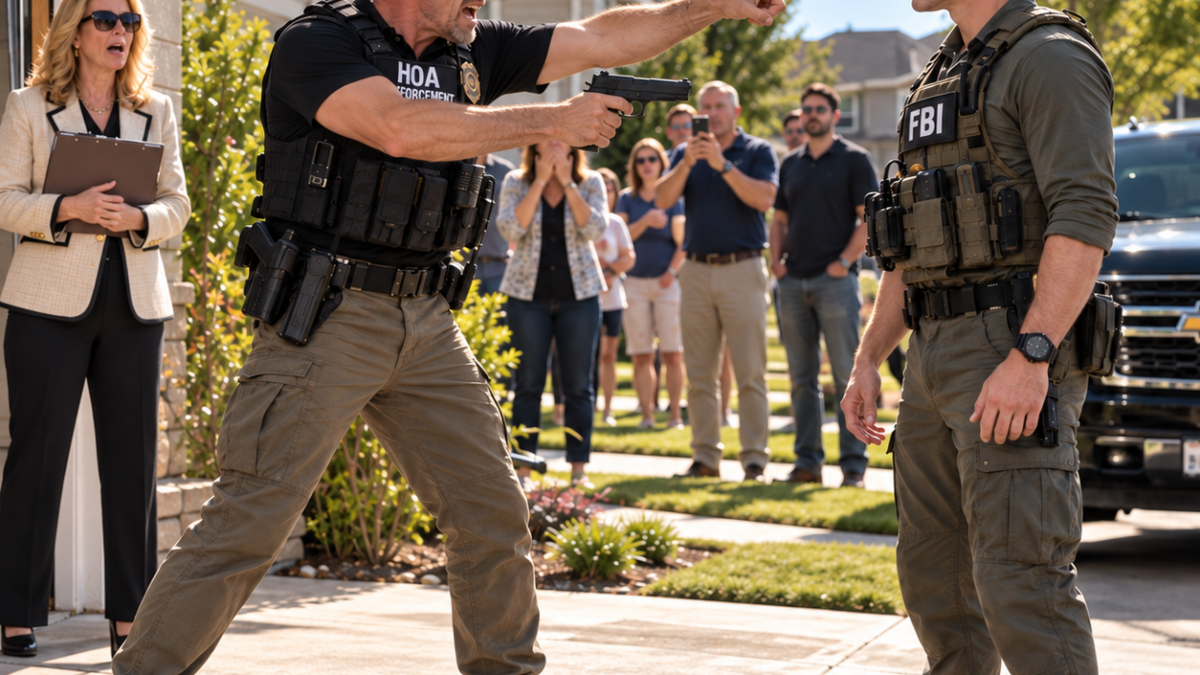
The pistol came out.
By then neighbors had gathered.
Some had been watching from porches.
Others came out because voices were raised.
Now the weapon pointed directly at my son.
Everything stopped.
Even Darla froze.
That is something I remember clearly.
She had created this system.
Encouraged intimidation.
Sent the man to homes.
Called him enforcement.
But even she had not expected a gun to come out in my driveway.
For half a second, she looked horrified.
Then pride returned.
She said:
“See what you caused?”
I stared at her.
“He pulled a gun.”
“He felt threatened.”
“My son is standing there with empty hands.”
What Darla did not know was that Michael was armed too.
Legally.
He had never touched his weapon.
His hands stayed visible.
The fake officer said:
“Get on the ground.”
Michael did not.
“Drop the gun.”
The man laughed.
“You have no authority here.”
Michael answered:
“You have no lawful authority to point that weapon at a homeowner.”
“I said get down.”
“Lower the weapon.”
Darla hissed:
“Do what he says.”
Michael never looked toward her.
Instead:
“Everyone nearby needs to move back.”
The fake officer barked:
“You don’t give orders.”
Michael said:
“I’m trying to keep these people alive.”
Something in his voice changed the street.
People listened.
One father pulled two children behind a vehicle.
A woman backed toward her garage.
Another neighbor lowered his phone enough to move behind a brick mailbox.
For months they had obeyed the fake officer because of costume.
Now they obeyed Michael because there was something unmistakable about genuine control.
One man sounded angry.
The other sounded trained.
The fake officer noticed.
That rattled him.
“Lower it.”
“No.”
“This is your final opportunity.”
“You don’t tell me—”
Michael identified himself.
Not loudly.
“Federal law enforcement.”
The man blinked.
Darla stared.
Michael gave the agency.
The fake officer’s expression changed.
He looked at me.
Then Darla.
Then Michael.
“You’re lying.”
“No.”
Michael’s jacket shifted enough for credentials to be visible.
Darla whispered:
“Oh my God.”
The gun remained up.
The fake officer shouted:
“Don’t reach!”
Michael stopped completely.
“I’m not reaching.”
“You’re trying to draw.”
“No.”
Darla stepped backward.
Then again.
The fake officer seemed to realize what he had created.
He had a loaded firearm pointed at an identified federal agent who had not drawn on him, in front of a street full of witnesses recording from multiple angles.
There were exits.
He could have lowered it.
Stepped back.
Waited for local police.
Said he was confused.
Anything.
Instead he doubled down.
“Get on the ground!”
Michael said:
“You need to lower the gun.”
“You first.”
“I haven’t drawn anything.”
“You’re armed.”
“Yes.”
Several neighbors gasped.
Michael continued:
“But you are the person threatening deadly force.”
The fake officer’s hand began to tremble.
“Lower it.”
“I’m enforcement.”
“No.”
“I have authority.”
“No.”
“You don’t know who you’re dealing with!”
Michael’s expression did not change.
“I know exactly what I’m dealing with.”
Then:
“You are unlawfully threatening an armed federal officer on private property while impersonating law enforcement.”
The man went pale.
Darla said:
“Put it away.”
He ignored her.
She repeated:
“Put the gun away.”
He glanced at her.
The next few seconds exist in my memory as pieces.
A movement.
A command.
The gun shifting.
A crack that seemed too loud for a suburban street.
Concrete kicked near Michael.
People screamed.
Michael moved.
Another shot went high.
The two men collided.
The fake officer lost his primary weapon.
Then reached toward a second weapon concealed at his waistband.
Michael reacted.
One more shot.
Then silence.
The fake officer fell.
Michael backed away enough to create space.
His weapon stayed pointed toward the threat.
“Do not move.”
The man groaned.
Blood spread beneath the edge of his vest.
I ran forward.
“Michael!”
He did not look at me.
“Dad, stay back.”
“Are you hit?”
“No.”
“Are you sure?”
“Yes.”
“Call 911.”
I already had my phone.
“Shots fired. One person down.”
Michael said:
“Tell dispatch armed federal agent on scene. I’ll comply with responding officers.”
My hands shook.
Darla stood near curb.
White.
Folder open on asphalt.
Papers blowing across street.
She stared at the man she had hired.
Then my son.
Then me.
“This wasn’t supposed to happen.”
I looked at her.
“What was supposed to happen?”
She had no answer.
Sirens arrived quickly.
Local police came first.
Then county deputies.
Responding officers moved carefully.
Weapons out.
Michael set his own firearm down before they reached him.
Raised his hands.
Identified himself.
Credentials verified.
Everyone separated.
The fake officer received immediate medical aid.
He survived.
That matters.
I did not want him dead.
Neither did Michael.
Darla tried to walk away.
An officer stopped her.
“I’m HOA president.”
“Stay where you are.”
“I had nothing to do with this.”
That was the wrong thing to say in front of our neighbors.
“You hired him!”
“He works for you!”
“You told him to remove that man!”
Phones were everywhere.
Video from almost every angle.
One camera had captured the shoves.
Another the weapon coming out.
Another the first shot.
One microphone caught Darla saying:
“Remove him.”
Those words followed her for a long time.
Police searched the fake officer’s equipment.
Badge.
Vest.
Radio.
Weapons.
Identification.
No police department.
No sworn status.
No governmental authority.
There were also problems with the firearms themselves and the way he was carrying them.
The illusion collapsed within hours.
He was what I had been saying all along.
A private man playing police.
Except now somebody had been shot because the game had become real.
Michael immediately entered administrative review.
Standard procedure.
His firearm became evidence.
He gave formal statements.
He was not allowed to simply wave credentials and go home.
That mattered to him.
Video established that the other man had drawn first and fired first.
But process was process.
Hours later, after the scene finally cleared, Michael and I sat at my kitchen table.
He looked exhausted.
Not triumphant.
Not heroic.
Just tired.
“You okay?”
“Yes.”
“That isn’t an answer.”
A faint smile.
“Learned that from you?”
“I learned it from you.”
He stared at floor.
Then:
“I thought he was going to shoot you.”
“Me?”
“He kept shifting.”
I had not noticed.
“I thought once he panicked, he might redirect.”
I swallowed.
“You were scared?”
Michael looked up.
“Of course I was scared.”
“You didn’t look scared.”
“That’s the job.”
There it was.
Training did not eliminate fear.
It taught him what to do while afraid.
I reached across table.
“I’m sorry.”
“For what?”
“Calling you.”
He laughed once.
“I’m glad you called.”
“This happened because you came.”
“No.”
His voice hardened.
“This happened because a man pointed a gun.”
I said nothing.
“And because people let him pretend he had authority for too long.”
That sentence became the real beginning of what followed.
That evening, the HOA emailed every homeowner.
The armed individual involved in today’s incident was an independent security contractor who acted outside the scope of his assigned duties.
Independent.
Outside scope.
Not authorized.
Damage control language.
It lasted less than twenty-four hours.
Investigators started collecting records.
Contracts.
Payments.
Emails.
Board minutes.
Security directives.
Resident complaints.
Bank statements.
The man was not independent in any meaningful sense.
HOA money paid him.
Regularly.
Darla had approved several payments personally.
Emails contained patrol schedules.
Names.
Addresses.
Specific residents identified for extra attention.
I was listed as a “priority obstruction case.”
Another email instructed him to:
increase visible presence around the property.
Another:
use all available enforcement methods to compel cooperation.
Darla’s attorney later insisted that did not mean violence.
Maybe not.
But it destroyed the claim that the fake officer had gone rogue without connection to the HOA.
Darla had created the role.
Funded it.
Directed it.
Used it.
And residents began talking.
That was the part she could not survive.
One woman said the guard had followed her teenage daughter home because of an expired parking decal.
An elderly man said he had been threatened with towing while parked on his own driveway.
Another homeowner said the guard rested his hand on the gun during an argument about a yard sign.
A mother said he demanded to inspect her garage.
A man two streets over had video of the SUV circling his home after midnight.
Nobody reported any of it.
Why?
Same answer.
“I didn’t want trouble.”
That phrase haunted me.
Darla had built power on the predictable human desire to avoid inconvenience.
Trouble costs time.
Money.
Energy.
Embarrassment.
So people pay seventy-five dollars.
Then a hundred.
Then four hundred.
They answer questions they do not have to answer.
Let strangers photograph property.
Accept warnings.
Stay quiet.
Each small surrender convinces the person applying pressure that next step is safe too.
Three days after the shooting, Darla Finch was arrested.
I watched on television.
I expected satisfaction.
What I felt was mostly disbelief.
She came out of her house between investigators.
No folder.
No clipboard.
No confident smile.
The exact charges shifted as investigation developed, but they involved the intimidation scheme, financial misconduct, conspiracy-related allegations, and the role the association had played in empowering an armed impersonator.
Then investigators traced the original special assessment.
The one I had questioned.
Part of it had funded “security enhancement.”
Security enhancement was him.
Our neighbors had literally paid into the system used to frighten them.
That discovery broke Briar Glen open.
The emergency HOA meeting was standing room only.
Darla was obviously absent.
Remaining board members sat at the front looking miserable.
A homeowner stood.
“You told us the assessment was infrastructure.”
The acting president said:
“It covered multiple categories.”
“What categories?”
“Security was included.”
“Armed security?”
“We were not aware he would—”
“You approved the payments!”
Another person shouted:
“He threatened my husband last year!”
Someone else:
“He followed my daughter!”
An elderly woman held up a thick envelope.
“You fined me twelve hundred dollars after I complained!”
The board members tried explaining Darla controlled information.
Probably true.
They said they trusted her.
Probably true too.
But sitting on a board means your name goes beside decisions.
Trust does not erase responsibility.
For years, Darla had controlled meetings with procedure.
Three-minute comment rules.
Agenda restrictions.
Motions.
Robert’s Rules.
That night residents were finished being managed.
They demanded records.
Refunds.
Audits.
Resignations.
Outside review.
Eventually court intervention made much of that secondary.
Accounts were frozen.
Operations placed under supervision.
Fines reviewed.
Illegal enforcement practices stopped.
People celebrated.
I did not.
Before Darla, our biggest dispute had been shrubs near pool fence.
Now investigators were subpoenaing bank records.
That is not victory.
That is damage being contained.
Michael’s review resolved sooner.
Videos were unusually clear.
The fake officer drew.
Michael repeatedly told him to lower weapon.
Michael identified himself.
The other man fired.
Multiple witnesses confirmed it.
The shooting was ultimately treated as lawful self-defense.
Michael returned to duty after the required review.
I asked what returning felt like.
“Paperwork.”
“That’s it?”
“And bad coffee.”
“You almost got killed.”
“So did you.”
Then neither of us talked about it for a while.
Families do that.
Discuss weather when real topic is too large.
The trials eventually forced all of it back into the open.
The fake officer survived his injuries and appeared in court months later.
Without tactical vest, he looked ordinary.
That bothered me.
Monsters are easy.
Ordinary people making progressively worse choices are harder.
He had accepted a costume.
Enjoyed the obedience it produced.
Started believing the performance.
People stepped aside.
He gave orders.
Nobody challenged him.
Then someone finally did.
Instead of allowing illusion to collapse, he defended it with a gun.
That was his choice.
Not Darla’s.
Not Michael’s.
His.
The defense emphasized panic.
Confusion.
Perceived threat.
The videos were difficult to argue with.
He created the threat.
Darla’s case was uglier in a quieter way.
Emails.
Payments.
Fines.
Targets.
Directives.
One former board member testified that Darla often said homeowners had “forgotten who runs the community.”
Runs.
Not serves.
That was always her mistake.
She thought office meant ownership.
The criminal cases produced severe consequences.
The armed contractor received a lengthy prison sentence because of the shooting and related weapons offenses.
Darla eventually entered a plea agreement rather than take every issue through trial.
Her sentence was substantial.
Financial penalties and restitution followed.
She was prohibited from holding certain HOA, nonprofit, and fiduciary leadership roles again.
That last part gave me more relief than prison time.
Power had been her drug.
Taking away access to the same mechanism made sense.
The old HOA effectively ceased functioning as it had.
Court supervision dismantled the enforcement structure.
Improper fines were reviewed.
Refunds began.
Eventually a replacement organization was created.
Its job:
Maintain pool.
Pay insurance.
Handle common landscaping.
Manage shared expenses.
Boring things.
Beautifully boring things.
No enforcement unit.
No tactical vests.
No armed patrol.
No midnight flashlight inspections.
No fake badges.
Months after everything, I walked past the old HOA office.
The sign was gone.
A lighter rectangle remained where it had hung.
My neighbor Paul stood nearby.
“Looks better.”
“It looks empty.”
“Exactly.”
Then he grew serious.
“I should’ve said something.”
“About what?”
“The guard.”
I waited.
“He stopped me last year.”
“I heard.”
“I didn’t report it.”
“Why?”
Paul looked embarrassed.
“I figured nobody would believe me.”
“He was HOA security.”
“Exactly.”
“You assumed board would back him.”
“Yes.”
He looked at street.
“I saw him touch that gun more than once.”
That angered me.
Not at Paul.
At what fear had made normal.
“You should’ve called police.”
“I know.”
“Why didn’t you?”
Same answer.
“I didn’t want trouble.”
Paul sighed.
“That’s what all of us say now, isn’t it?”
“Yes.”
People started turning Michael into legend.
I hated that.
He hated it more.
A local headline called him:
FBI COMMANDER WHO BROUGHT DOWN ROGUE HOA POLICE FORCE.
He called me immediately.
“Did you see this garbage?”
“Yes.”
“Police force?”
“One guy.”
“He wasn’t police.”
“Correct.”
“I’m never visiting you again.”
“Your mother will object.”
He laughed.
Then:
“Everything quiet?”
“Yes.”
“No drive-bys?”
“No.”
“Packages?”
“Still on porch.”
“Lock the back door.”
“You’ve been saying that twenty years.”
“Because you still don’t.”
“I live in suburb.”
He paused.
“You lived in a suburb where a fake cop fired at you.”
Fair.
I started locking it.
The neighborhood healed strangely.
At first everyone expected enforcement.
A truck parked overnight and owner waited for notice.
None came.
A family painted front door red.
Nobody died.
A retired teacher put a garden bench near driveway without submitting architectural packet.
Civilization continued.
A teenager parked outside overnight.
Sun still rose.
The neighborhood became less perfect.
And healthier.
Children stayed outside later.
Neighbors talked again.
People compared stories.
That was when we realized nearly everyone had thought their experience with Darla was unique.
That isolation was part of her power.
If each homeowner thinks:
She only hates me.
Then there is no pattern.
Once people talk:
Pattern.
My wife said it one evening on porch.
“Everybody thought they were alone.”
“So did we.”
“That’s how she did it.”
Probably.
Michael came to dinner several months later.
No guns.
No confrontation.
He carried grocery bags.
My wife hugged him too long.
“You’re crushing me.”
“Good.”
He looked at me.
“Help.”
“No.”
“Traitor.”
We grilled steaks.
Talked about grandchildren.
Football.
Roof repairs.
Everything except driveway.
After dinner, he and I sat outside.
Same driveway.
Pavement had been repaired where bullet struck.
Different color remained.
“Do you think about it?”
He knew.
“Sometimes.”
“Every day?”
“No.”
“Good.”
“You?”
“Sometimes.”
He looked toward repaired patch.
“I remember first shot.”
“So do I.”
“I remember he looked surprised.”
“After he fired?”
“Before.”
“About what?”
Michael thought.
“That people weren’t obeying him.”
That was it.
For months, the fake cop confused fear with legitimacy.
Then Michael did not flinch.
The illusion broke.
Unfortunately the man chose violence rather than accept it.
Michael said:
“You know what bothers me most?”
“What?”
“He could have stopped.”
“When?”
“Any time.”
True.
He had exits at every stage.
Do not touch Michael.
Do not draw.
Lower gun.
Wait for police.
Once gun was drawn, still lower it.
After Michael identified himself, still lower it.
He kept choosing the next escalation.
Darla did the same for years.
Every challenge gave her an exit.
Show records.
Correct assessment.
Withdraw retaliatory fine.
Stop patrols.
Dismiss unqualified guard.
Apologize.
Instead, she treated every question as rebellion.
Each escalation made the next one feel necessary.
People asked afterward:
“How does an HOA dispute end with gunfire?”
My answer:
It does not happen in one leap.
It happens one tolerated abuse at a time.
Seventy-five dollars.
A questionable assessment.
A retaliatory fine.
A missing package.
A midnight patrol.
A fake badge.
An ID demand.
A hand resting on a gun.
Each boundary moved a few inches.
By the time the weapon appeared, the people responsible had spent years teaching themselves that normal limits no longer applied.
That was the real danger.
Not HOAs.
Power without challenge.
A year later, the court-appointed administrator held a neighborhood meeting.
No raised board table.
Just folding chairs in a circle.
New governing documents were shorter.
Financial controls.
Independent review.
Clear assessment procedures.
Actual complaint process.
No armed private enforcement.
Someone laughed when that provision was read.
Nobody minded.
Then refunds.
My assessment disappeared.
Late fees disappeared.
Fake violations reversed.
Some homeowners received thousands.
An elderly woman cried after learning almost three thousand dollars in fines would be returned.
She hugged me afterward.
“Your son saved us.”
I shook my head.
“He survived something he never should have had to face.”
“But if that hadn’t happened…”
I knew.
Maybe Darla’s system would have continued another year.
Maybe five.
Maybe someone else would have challenged her.
I hope so.
But bad systems survive precisely because each incident seems too small to become everybody’s problem.
My entire dispute began because I asked for records supporting a charge.
That is almost funny.
If assessment had been legitimate, all Darla had to do was produce documentation.
If not, correct it.
Instead she treated a question as defiance.
That was her weakness.
She could tolerate obedience.
She could not tolerate scrutiny.
Michael once told me:
“Real authority survives questions.”
I think about that often.
A real officer can identify agency.
A real court establishes jurisdiction.
A legitimate fine cites authority.
A legitimate HOA can produce bylaws.
A valid assessment has records.
Real authority leaves paperwork.
Fake authority leaves threats.
Darla had threats.
Her guard had a costume.
Then the actual justice system arrived.
Subpoenas.
Evidence logs.
Search warrants.
Court orders.
Recorded testimony.
Due process.
Paper.
Lots and lots of paper.
Months later, I found one of my old violation notices in a drawer.
INTERFERENCE WITH AUTHORIZED COMMUNITY SECURITY.
$100.
I laughed.
My wife came in.
“What?”
I handed it to her.
She laughed too.
“Frame it.”
“No.”
“Put it beside Michael’s FBI photo.”
“He would kill me.”
“Not if you submit architectural approval.”
I laughed harder than I had in months.
Humor came back.
So did normal life.
Mailbox stayed dark green.
Nobody cared.
Driveway lighting stayed exactly the same.
Nobody cared.
Packages remained on porch.
Nobody removed them.
The first newsletter from replacement association had a line at bottom:
YOUR HOA IS NOT LAW ENFORCEMENT.
I almost framed that.
A new family moved in three houses away.
The father approached while I trimmed bushes.
“Can I ask you something strange?”
“Sure.”
“Someone told me old HOA had its own police.”
I sighed.
“No.”
“So that’s exaggerated?”
“They had a man who wanted residents to think he was police.”
“Oh.”
“He wasn’t.”
The man hesitated.
“And your son…”
“Yes.”
“FBI?”
“Yes.”
“Did he really—”
I interrupted.
“Most versions are more dramatic than reality.”
“There were gunshots?”
“Yes.”
“That seems dramatic.”
“Fair.”
He looked embarrassed.
“Sorry. Nosy.”
“No problem.”
Then:
“Is neighborhood safe?”
I thought about it.
“Yes.”
“Now?”
That word mattered.
“Now.”
We were safer without armed patrol.
That irony would have broken Darla.
She sold fear as safety.
The more power she gained, the less safe we became.
Real safety came from limits.
Transparency.
People knowing they could ask questions without retaliation.
Kids riding bicycles without being stopped for ID.
Packages staying on porches.
Homeowners not watching black SUVs move past windows at midnight.
Boring safety.
Best kind.
I attended Darla’s sentencing.
Not because I wanted to watch her suffer.
I wanted to hear the court describe what happened without HOA language around it.
She looked older.
No sharp blazer.
No binders.
No controlled smile.
When the judge reviewed misconduct, she stared at table.
Financial records.
Retaliation.
Directives.
Improper use of association power.
Relationship with armed contractor.
Her attorney spoke about her cooperation.
Plea.
Acceptance of responsibility.
The court considered all of it.
Then sentence.
I expected victory.
I did not feel it.
Long prison sentences are not fun when you sit close enough to see a human being receive one.
Even when deserved.
Necessary consequences can still be sad.
As deputies prepared to take her away, Darla turned.
Our eyes met.
No anger.
No smugness.
Just exhaustion.
I remembered:
People who don’t fit in usually don’t stay long.
Now she was leaving.
The symmetry gave me no satisfaction.
Reporters waited outside.
One asked:
“Do you feel justice was served?”
“The court made its decision.”
“Do you blame Ms. Finch for the shooting?”
“I blame the person who pulled the trigger for pulling the trigger.”
“But the HOA hired him.”
“The records speak for themselves.”
“Your son nearly died.”
“Yes.”
“Are you angry?”
I thought.
“Less than I was.”
“What do you want people to take from this?”
That answer I had.
“If somebody claims authority, ask where it comes from.”
The reporter waited.
“A badge-shaped object isn’t authority. A vest isn’t authority. A title isn’t authority. An HOA board is not police.”
Then I left.
Michael called after clip aired.
“You sounded dramatic.”
“You’re welcome.”
“For?”
“I made you look restrained.”
He laughed.
Life moved on.
That surprised me.
Terrible days feel permanent while you are inside them.
They are not.
Grass grows.
Paint fades.
Children graduate.
Neighbors move.
Eventually our street stopped being the place where shooting happened.
It became a street.
One summer evening kids played basketball across the repaired section of pavement.
Ball bounced exactly where concrete once shattered.
A twelve-year-old ran after it.
Nobody thought about gunfire.
I did.
For a moment.
Then it passed.
Maybe that is healing.
Not forgetting.
Memory simply stops controlling the present.
Michael came for dinner that night.
We watched kids.
“They’re getting better.”
“At basketball?”
“Yeah.”
“They’re terrible.”
“They’re twelve.”
“Still terrible.”
He laughed.
Ball rolled into driveway.
A boy yelled:
“Sorry, sir!”
I kicked it back.
Badly.
Michael said:
“That was embarrassing.”
“I’m old.”
“You used to blame your knee.”
“Now I blame age.”
We went inside.
Normal.
Beautifully normal.
People sometimes ask if I hate HOAs.
No.
I hate unaccountable power.
Different thing.
Our replacement association works.
Pool is maintained.
Insurance gets paid.
Common property gets repaired.
Financial statements arrive.
If there is a proposed assessment, documentation comes first.
Imagine that.
Questions are allowed.
Nobody treats disagreement as disloyalty.
No “enforcement division.”
Darla’s legacy, ironically, became stronger limits on the office she abused.
That may be the best ending.
Not revenge.
Reform.
I rarely use the fake officer’s name when telling story.
His identity is not useful.
His decisions are.
He wanted authority badly enough to imitate it.
Vest.
Badge.
Gun.
Commands.
People responded to appearance.
For a while, appearance was enough.
Then he met someone who understood difference between image and lawful authority.
Instead of accepting it, he tried to defend illusion with violence.
That is why he went to prison.
He did not lose a gunfight.
He committed an armed attack and survived the consequences.
Michael is particular about that distinction.
So am I.
Because turning violence into entertainment hides the cost.
For weeks afterward, he woke at odd hours.
He did not tell me.
His wife did.
He went through counseling.
Mandatory initially.
Voluntary afterward.
I was glad.
Commanding tactical teams does not make somebody a machine.
One day I apologized again.
Michael stopped me.
“Dad.”
“What?”
“If you apologize one more time, I’m fining you.”
“For what?”
“Emotional noncompliance.”
I laughed.
“How much?”
“Three hundred fifty dollars.”
“Special assessment?”
“Emergency family infrastructure.”
That broke both of us.
We laughed until my wife yelled from kitchen for us to shut up.
Maybe that is how families reclaim bad memories.
Not erase them.
Shrink them enough to carry.
The old HOA file still sits in my cabinet.
Assessment notices.
Violation letters.
Emails.
Police reports.
Court documents.
I should throw it away.
I do not.
Paper tells story better than memory sometimes.
At beginning:
PAY.
COMPLY.
FINAL NOTICE.
AUTHORIZED ENFORCEMENT.
Later:
SUBPOENA.
INDICTMENT.
COURT ORDER.
REFUND.
RESTRUCTURE.
Two completely different kinds of authority.
One demanded belief.
The other proved itself.
That is the lesson I keep.
Fake authority survives on hesitation.
Someone wears shirt.
Uses right words.
Speaks confidently.
Everyone assumes someone else checked credentials.
Somebody else authorized it.
Somebody else knows law.
Darla built an entire system inside that assumption.
Nobody checked.
Until we did.
The first question I ever asked her was simple.
Show me the assessment.
She could not.
Everything after that was an attempt to punish the question.
One question exposed another.
Then another.
A questionable assessment led to retaliatory enforcement.
Enforcement created armed intimidation.
Armed intimidation eventually created confrontation.
Confrontation brought real investigators.
Real investigators found money.
Emails.
Directives.
Patterns.
And when actual accountability entered Briar Glen, the structure Darla had built could not support its own weight.
People still say my son brought down the HOA.
He did not.
Darla did.
She built it on fear.
Michael simply survived the afternoon when fear finally became armed.
Years later, I stood in the driveway one morning holding coffee.
Quiet street.
No patrol.
No black SUV.
A delivery truck stopped.
Driver walked to porch.
Set down package.
Took photo.
Left.
I looked at the box and laughed.
Years earlier Darla’s people had removed one because it was supposedly “visible during compliance review.”
Now this one sat exactly where a package belongs.
My porch.
Untouched.
No notice.
No flashlight.
No tactical vest.
No armed man asking me for identification.
Freedom in its most boring form.
I have learned to appreciate boring.
A few days later Michael called.
“You doing anything Saturday?”
“Depends.”
“On what?”
“Whether you’re bringing trouble.”
He laughed.
“Kids want to visit.”
“Bring them.”
“Any HOA tactical operations scheduled?”
“Pool maintenance.”
“Dangerous.”
“Extremely.”
Then he went quiet.
“Love you, Dad.”
It caught me off guard.
We are not a family that says it every phone call.
“Love you too.”
After we hung up, I stood in kitchen for a while.
That was the thing that mattered.
Not Darla.
Not court.
Not headlines.
Not even the FBI.
My son came to my house one Sunday because I finally admitted I needed help.
He almost died.
He lived.
Everything else came afterward.
The neighborhood survived.
The association changed.
The truth came out.
Darla faced consequences.
The man she empowered faced consequences.
Michael came home to his wife and children.
That was enough.
And whenever I look toward that driveway, I remember what fake authority finally met there.
Not an FBI badge.
Not a tactical commander.
Not a gun.
Accountability.
That was the one thing Darla Finch and her hired enforcer had never learned how to handle.
Once it arrived, everything they had built collapsed under the weight of its own lies.








